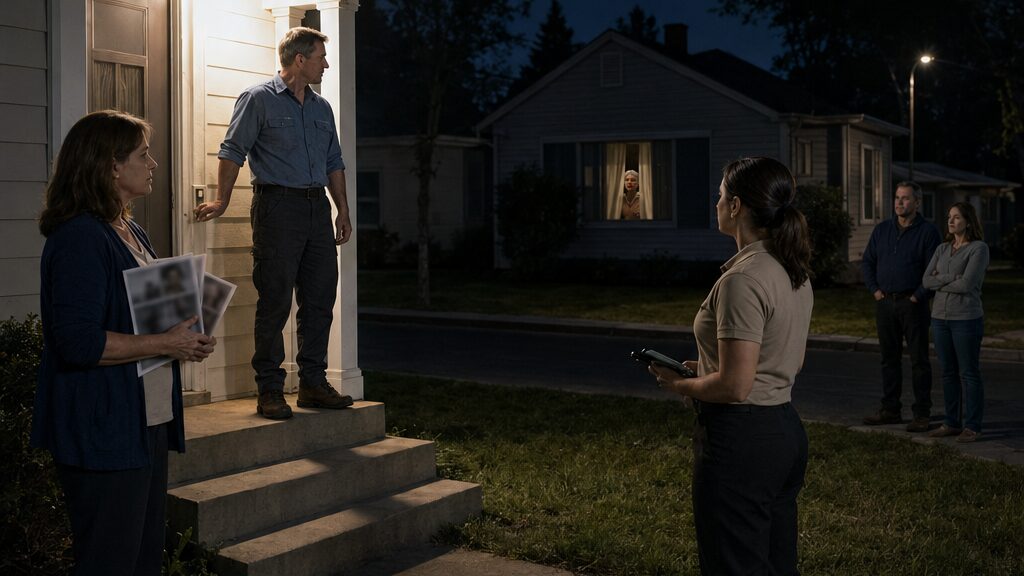
The Porch Light She Tried to Ban Was the Only Signal an Elderly Neighbor Trusted
Chapter 1: The Night the Porch Light Became an Official Violation
The violation notice was already taped beneath Thomas Lewis’s porch light when he came home.
Its white paper fluttered against the brick in the heat rising from the fixture, the red border bright enough to read from the sidewalk. Above it, the bulb burned with its usual hard glow, washing the front steps, the lawn, and half the driveway in pale light.
A woman stood beneath it with a clipboard.
Jennifer Carter was beside her, arms folded tightly across her chest.
Thomas stopped at the end of the walkway, still wearing his municipal work shirt. “You taped something to a live fixture?”
The property manager glanced up. “It’s on the brick.”
“It’s touching the housing.”
She stepped back as if distance settled the point. Two members of the architectural-review committee waited near the curb. Farther down the street, a pair of neighbors had found reasons to linger beside their trash bins.
Jennifer did not look at them. She looked at Thomas.
“We’re documenting the condition at night,” she said. “You ignored the last two notices.”
“They were requests.”
“They were written complaints.”
Thomas set his lunch cooler on the porch step. The light sharpened the hollows beneath Jennifer’s eyes. He had noticed them before, but not this clearly.
The property manager lifted her phone and photographed the fixture. “The governing standard prohibits exterior illumination that creates unreasonable spillover onto an adjacent property.”
Thomas glanced across the street.
Katherine Hall’s house was almost entirely dark. A faint blue light from a television moved behind the front-room curtains, then disappeared.
He looked back at the notice. “What exactly are you asking me to do tonight?”
“Turn it off,” Jennifer said.
The manager’s expression tightened. “Ms. Carter is the complainant. I’m here to observe.”
“You brought a committee.”
“The board requested documentation.”
Jennifer took a folded sheet from her pocket and opened it. Several photographs had been printed across the page—her bedroom wall, her closed blinds, a bright diagonal band cutting through the darkness.
“Those were taken at one fourteen, two thirty-eight, and four eleven in the morning,” she said. “Different nights. Same light.”
Thomas studied the pictures longer than she expected him to.
The brightness was unmistakable. One image showed the edge of a pillow beneath the stripe of light.
“I asked you in person,” Jennifer continued. “I left notes. I suggested a lower bulb. You never answered.”
“I changed the angle.”
“You tilted it down three degrees.”
“Seven.”
One of the committee members exhaled through his nose. Thomas heard the small sound and felt his jaw harden.
Jennifer did too. “This isn’t funny.”
“I didn’t say it was.”
“Then stop treating me like I’m inventing it.”
Thomas looked once more toward Katherine’s curtains. No movement.
He had hoped the notes would stop. Then he had hoped the complaint would remain between two houses. He had told himself that answering would invite questions he had no right to answer. Silence had seemed cleaner.
Now six people stood under the light.
The property manager uncapped a pen. “Mr. Lewis, will you voluntarily switch off the fixture while the board reviews the complaint?”
“No.”
Jennifer stared at him. “Why?”
“It needs to stay on.”
“That is not an explanation.”
“It’s the explanation I can give you.”
Her mouth opened slightly, then closed. “You think saying it like that makes you sound reasonable?”
Thomas climbed one step and reached past the notice. His fingers rested on the switch plate beside the door.
Jennifer’s voice sharpened. “Turn it off so they can see the difference.”
He looked at the committee members. One watched him. The other watched Jennifer. The neighbors near the curb had stopped pretending to move their bins.
“Fine,” Thomas said.
He flipped the switch.
Darkness dropped over the porch so suddenly that the street seemed to widen.
The property manager’s phone screen became the brightest object nearby. Jennifer’s house showed a dim lamp behind drawn blinds. The streetlights stood too far apart, leaving pools of black between driveways.
Across the road, Katherine’s curtain moved.
A silhouette appeared behind it—small, upright, motionless.
Thomas watched the outline of her hand rise to the fabric.
No one spoke.
He turned the porch light back on.
The silhouette remained for one second, then withdrew as the bright square of Thomas’s porch returned to Katherine’s window.
Jennifer followed his gaze. “What was that?”
Thomas removed his hand from the switch. “Katherine asked me not to leave her in darkness again.”
The words changed the air, but not in the way he had intended.
The property manager lowered her phone. One committee member looked across the street with sudden discomfort. The other looked at Thomas as though waiting for the rest.
Jennifer’s face lost some of its anger, but not all of it. “Again?”
“That’s all I’m saying.”
“She asked you to keep a floodlight pointed at my bedroom?”
“It isn’t a floodlight.”
“You know what I mean.”
“No. She asked me to leave a light where she could see it.”
Jennifer looked across the street again. “Why?”
Thomas said nothing.
One of the neighbors near the curb murmured, “She lives alone, doesn’t she?”
Thomas felt the conversation pulling Katherine out of her house piece by piece.
“She told me it helps,” he said. “That should be enough.”
Jennifer turned back. “Enough for whom?”
The question landed harder than her demand had.
She held up the photographs. “I’m not asking her to be afraid. I’m asking to sleep in my own bedroom.”
“I know.”
“No, you don’t. You never came over. You never looked from my window. You decided her need mattered and mine was an inconvenience.”
Thomas felt the answer rise—quick, defensive, absolute. He held it behind his teeth.
The manager slipped the pen into her folder. “This will go to an expedited compliance hearing.”
“When?”
“Monday evening, unless the board determines emergency authority applies sooner.”
Thomas looked at her. “Emergency authority to do what?”
“To require temporary deactivation if the fixture is deemed a continuing nuisance.”
Jennifer’s shoulders shifted. She had wanted the light off. Yet the word deactivation seemed to unsettle her.
The manager pressed the notice flat against the brick. “You’ll receive the hearing packet tomorrow. Continued noncompliance may result in daily fines.”
Thomas pulled the paper free.
The tape left two dull marks beside the glowing fixture.
Across the street, Katherine’s curtains remained closed.
As the group dispersed, Jennifer stayed at the walkway.
“I didn’t know someone depended on it,” she said.
Thomas folded the notice once. “Now you do.”
“That doesn’t make the light stop coming through my blinds.”
He met her eyes.
“No,” he said. “It doesn’t.”
The property manager called Jennifer from the curb. She turned away, then stopped.
“What happened to Katherine?”
Thomas looked toward the dark shape of her house.
“That isn’t my story to tell.”
Jennifer gave a tired, disbelieving shake of her head and walked off.
Thomas stood beneath the light until the street was empty. He could feel its heat against his forehead. In his hand, the notice crackled where he had folded it too sharply.
His phone vibrated.
An email from the HOA filled the screen.
EXPEDITED COMPLIANCE HEARING—MONDAY, 7:00 P.M.
Below the date was a second line.
The board reserved the right to order immediate deactivation before the hearing.
Thomas looked across the street, waiting for Katherine’s curtain to move again.
It did not.
Chapter 2: The Complaint Was Reasonable Until Everyone Chose a Side
Jennifer woke with a bright line across her face and seventeen unread messages on her phone.
For one confused second, she thought morning had come. Then she saw the clock: 4:43 a.m.
Thomas’s porch light cut around the edge of her blackout blind, crossed the wall, and ended on the pillow beside her. The new blinds had cost nearly three hundred dollars. The installer had warned her that no fabric could completely stop light entering at that angle without side channels.
Her phone vibrated again.
The neighborhood discussion thread had found out about the inspection.
One message called the complaint “heartless.” Another asked whether the HOA intended to fine residents for helping elderly neighbors. Someone she had waved to for six years had written, Maybe some people should buy curtains before policing kindness.
Jennifer took a photograph of the bright stripe and attached the timestamp.
She did not post it.
At six thirty, she showered, dressed, and carried coffee into the small room she used as a home office. She worked in payroll administration for a regional delivery company, where mistakes arrived with employee names attached. Twice that week she had entered figures into the wrong columns. The second error had reached her supervisor.
You’ve seemed tired lately, the supervisor had written.
Jennifer opened the HOA packet instead of her work queue.
The complaint form was hers. The language beneath it was not.
Repeated deliberate noncompliance. Refusal to cooperate. Potential selective-enforcement exposure.
At nine, she went to the management office in the clubhouse. The HOA president sat at the end of the conference table, tapping a capped marker against a legal pad. Michelle Green had a calculator, a binder, and the careful expression she wore whenever money or liability entered a conversation.
The property manager closed the door.
“The board appreciates you documenting this,” the president said.
“I documented the light,” Jennifer replied. “Not everything people are saying about Thomas.”
“The distinction may not matter procedurally.”
“It matters to me.”
Michelle slid a copy of the violation history across the table. “He received two courtesy notices and did not respond.”
“He adjusted the fixture.”
“Without approval,” the manager said.
Jennifer pressed two fingers to her temple. “He said an older neighbor asked him to keep it on.”
The president leaned back. “That explanation came after enforcement began.”
“He may have been protecting her privacy.”
“Or he may have discovered a sympathetic justification.”
Jennifer looked at him. “You saw her at the window.”
“I saw movement behind a curtain.”
The marker resumed tapping.
The manager opened a folder. “If we allow an owner to invoke an unnamed third party without documentation, we create an exception we cannot administer.”
“Then ask for documentation.”
“We have.”
“And?”
“He stated that the matter was private.”
The president set down the marker. “You’re the compliance chair, Jennifer. This is your first major case. If you back away because neighbors are criticizing you, every future violation becomes negotiable.”
There it was—not the light, not Katherine, not even the rule. Authority.
Jennifer glanced at Michelle.
The treasurer’s eyes remained on the binder. “Equal enforcement does matter,” she said. “But so does the hardship-review provision.”
The manager turned a page. “He hasn’t requested hardship review.”
“Did we tell him he could?”
“He received the governing documents when he purchased.”
Michelle looked up at that.
The president interrupted. “We are not responsible for teaching every owner how to answer a notice.”
Jennifer thought of the silhouette across the street. Then she thought of the bright stripe on her pillow.
“I’m not withdrawing the complaint,” she said. “But I don’t want language suggesting he invented the woman.”
“We can revise that,” Michelle said.
The president’s expression remained pleasant. “Good. Then we proceed.”
When Jennifer returned home near noon, Thomas was on a ladder beneath the porch eave.
A sheet-metal shield now covered the outer side of the fixture. He held a screwdriver between his teeth and adjusted the bracket with one hand.
She stopped at the edge of his driveway. “Is that approved?”
He removed the screwdriver. “It’s temporary.”
“That wasn’t my question.”
“It directs the spill toward the street.”
“Did you test it from my bedroom?”
His gaze flicked toward her upstairs window. “No.”
“Of course not.”
Thomas climbed down. “I’m trying to fix it.”
“You’re trying to fix it without speaking to anyone.”
He set the ladder against the garage. “I’m speaking to you now.”
“After weeks.”
His face tightened, but his voice stayed level. “Check it tonight.”
Jennifer wanted to say she would. Instead she noticed a shallow burn mark on his work cuff and the fatigue in his own face.
“Why won’t you explain what happened to Katherine?”
“Because she didn’t give me permission.”
“That is the first clear answer you’ve given.”
He looked toward Katherine’s house. “It should have been enough before.”
“No. It should have been the beginning of a conversation.”
For a moment, neither moved.
Then Thomas said, “Check the shield tonight.”
At ten seventeen, Jennifer stood in her bedroom with the lights off.
The center of the wall was darker. The shield had helped.
But a narrow blade of light still slipped past the blind, reflected from the pale siding of the house across from Thomas, and reached the foot of her bed.
She went outside.
Thomas was waiting on his porch.
“Well?” he asked.
“Better.”
His shoulders lowered slightly.
“Not fixed.”
They went upstairs together, stopping at the bedroom doorway as though crossing into private territory required a formal invitation. Jennifer pointed to the wall.
Thomas stared at the reflected band.
He stepped closer to the window, lifted the edge of the blind, and traced the light backward across the street with a technician’s precision.
“I didn’t account for the siding,” he said.
“No.”
He let the blind fall. “I can change the angle again.”
“And if Katherine can’t see it?”
Thomas did not answer.
His phone sounded before Jennifer could continue. A notification appeared on both their screens at nearly the same moment.
The HOA board had amended the violation.
Effective immediately, a daily fine would accrue until verified compliance.
Thomas read the amount twice.
Jennifer stared at the authorization line beneath it.
Her own name appeared beside the title Compliance Chair.
“I didn’t approve daily fines,” she said.
Thomas looked at her, the bright stripe crossing the floor between them.
“But they used your complaint to do it,” he said.
Chapter 3: The Promise Thomas Made Without Asking What It Would Cost
Katherine Hall placed the violation notice in the middle of her kitchen table and asked Thomas who had given him permission to tell her story.
He remained standing by the back door.
The kitchen smelled faintly of coffee and the lemon oil she used on the old maple cabinets. Daylight filled the room, but the curtains facing his house were nearly closed, leaving only a narrow vertical gap.
“I didn’t tell them what happened,” he said.
“You told them I needed your light.”
“They were going to make me turn it off.”
“That is not what I asked.”
Thomas pulled out a chair but did not sit. “What did you want me to say?”
“You might have said there was a private reason and asked me before you said anything more.”
“That’s what I did.”
Katherine tapped the notice with one finger. “Then why did Jennifer come to my door this morning asking whether I felt unsafe?”
He looked down.
“She came here?”
“She did not come inside. She looked embarrassed. I was more embarrassed.”
“I’m sorry.”
Katherine studied him through the lenses of her reading glasses. “You are sorry people found out. That is not the same thing.”
The words stripped away the defense he had carried across the street.
He sat.
On the table beside the notice was a small cordless phone. Thomas recognized it as the one he had bought after the ambulance came. The battery indicator was blinking empty.
“You haven’t charged that.”
“I have another phone.”
“Where?”
“In the living room.”
“Can you reach it from your bedroom?”
Her expression cooled. “We are discussing your light.”
“We’re discussing why it’s on.”
“No. You are discussing why you need it to be on.”
Thomas leaned back.
Through the gap in the curtain, his porch fixture was visible even in daylight—a pale square under the eave.
Eight months earlier, the same view had been black.
He had returned from an emergency callout shortly after midnight and noticed Katherine’s front door open six inches. Her porch was dark. At first he had driven past. Then he had backed up, walked across the road, and heard something fall inside.
Katherine had been on the hallway floor, conscious but unable to stand. Her phone lay on the kitchen counter. She had been there long enough for the hardwood beneath her cheek to feel cold.
Thomas had called the dispatcher, unlocked the door for the paramedics, and sat on the floor beside her until they arrived.
She had gripped his sleeve and said, Do not call James yet.
Even in pain, she had been protecting her independence.
After she returned from the hospital, Thomas replaced the failed bulb above her porch. She began leaving it on. Two weeks later, she asked if he would leave his own light burning too, because she could see it from her chair and from the hallway.
Just for a while, she had said.
The first night, Thomas had checked her window six times.
“You told me the light helped,” he said now.
“It did.”
“Does.”
Katherine removed her glasses. “That is not the whole sentence.”
He waited.
“It helped after the fall. It helped when I woke and could not remember whether I was in the hospital or at home. It helped when every sound in this house seemed larger than it used to.”
Thomas’s hands closed loosely on his knees.
“But it was supposed to be temporary,” she said.
“You never asked me to stop.”
“I did not know I needed to.”
He looked toward the cordless phone again. “You still watch for it.”
“Yes.”
“Then it still matters.”
“So does Jennifer’s bedroom.”
He had no answer ready for that.
Katherine folded the notice along its existing crease. “You made the light into a promise.”
“I told you I wouldn’t leave you in the dark again.”
“You said that after the ambulance.”
“I meant it.”
“I know.” Her voice softened, which made the next words harder. “But you never asked what keeping that promise would cost someone else.”
Thomas looked through the narrow curtain gap. From this chair, his porch light sat exactly in the center of the view.
“I can shield it,” he said. “I already started.”
“Did you ask Jennifer what she could see?”
He shook his head.
“Did you ask me what I could see after you changed it?”
“No.”
Katherine put her glasses back on. “Then you are repairing people as if they are electrical panels.”
He almost smiled, but she did not.
The silence lengthened.
Finally Thomas said, “There’s a hearing Monday. If you explain that you requested the light, they may grant an exception.”
“No.”
“You wouldn’t have to discuss the fall.”
“No.”
“They could disable it before then.”
“Then find another answer.”
He stared at her. “You want me to let them turn it off?”
“I want you to stop using me as the reason you do not have to speak to your neighbor.”
“I was protecting your privacy.”
“You were also protecting yourself.”
His chair scraped the floor as he shifted. “From what?”
“From admitting that you were frightened.”
The kitchen seemed smaller.
Katherine’s gaze stayed on him. “You found me on that floor, and afterward you checked this house every time my curtains moved. The light calmed you too.”
Thomas remembered standing at his own window at two in the morning, waiting for the smallest movement across the street. He remembered telling himself he was being responsible.
“I should have come sooner that night,” he said.
“You came home when you came home.”
“I drove past the door.”
“And then you came back.”
“What if I hadn’t?”
“But you did.”
He looked down at the table. The violation notice sat between them like a bill for something neither had understood they were buying.
Katherine slid it toward him.
“I will not attend the hearing,” she said. “I will not let the board discuss my medical history. And I will not be displayed as proof that you were right.”
Thomas took the paper.
“Are you saying I was wrong?”
“I am saying you were kind. Then you became certain. Those are not the same thing.”
When he returned home, the porch light was still on from the automatic daytime test he had been running. He climbed the ladder, adjusted the shield, climbed down, and crossed the street twice to check the sightline from Katherine’s front window.
He could not enter her house now. She had made that boundary clear.
From the sidewalk, the shield looked correct. From Jennifer’s yard, the reflection off the neighboring siding remained difficult to judge.
Thomas stood beneath the fixture as dusk settled.
For the first time since the complaint began, he switched it off without anyone ordering him to.
Across the street, Katherine’s curtains did not move.
He waited thirty seconds, then turned it on again.
His phone chimed.
The new HOA message contained a formal pre-hearing order. The board cited continuing nuisance authority and scheduled a weekend inspection of any proposed modification.
A final paragraph had been added in bold.
If the fixture failed inspection, the association reserved the right to arrange immediate deactivation at the owner’s expense.
Thomas read it beneath the light he no longer knew how to defend.
Katherine had withdrawn her support for his method. Jennifer had proof of real harm. The board had given him three days.
For eight months, he had believed keeping the light on meant keeping his promise.
Now he had to decide what the promise was worth if the person he made it to no longer wanted him to keep it this way.
Chapter 4: A Safer Answer Failed Because Nobody Asked Katherine First
Thomas tightened the final screw while the property manager’s car turned into the subdivision.
The new shield sat around the porch fixture like a black metal hood, deeper than the temporary piece he had made earlier in the week. He had cut it from a commercial wall-pack guard at the municipal shop, then repainted the edges so no bare metal showed.
From beneath the ladder, it looked clean. Deliberate. Defensible.
His phone showed 6:54 p.m.
The inspection was scheduled for seven.
Jennifer stood at the edge of her driveway with her arms folded, watching him climb down.
“You waited until the last six minutes?”
“I finished it this afternoon.”
“You installed it six minutes before they arrived.”
Thomas moved the ladder against the garage. “I wanted the sun low enough to test it.”
“Did you?”
He looked across the street.
Katherine’s curtains were closed.
“I checked from the sidewalk.”
Jennifer gave him a tired look. “That wasn’t what I asked.”
The property manager parked behind Jennifer’s car. Michelle Green climbed out from the passenger side carrying a binder. The architectural-review volunteer followed in a separate vehicle with a handheld light meter and the solemn expression of someone who had been given a device with numbers on it.
The property manager looked up at the shield. “Is this the proposed modification?”
“Yes.”
“Was a drawing submitted?”
“It’s temporary for inspection.”
“That is not an answer.”
Thomas heard Jennifer exhale.
Michelle opened the binder. “The order allows a field test before formal architectural approval.”
The manager’s mouth tightened, but she nodded.
Thomas switched on the light.
The hood caught most of the upward and sideward spill. The porch remained illuminated, but the hard white glare no longer spread evenly across the lawn. Instead, it fell in a narrower pool over the steps and front walk.
For the first time in months, the fixture looked less like a beacon and more like an ordinary porch light.
The volunteer raised the meter.
“Reading at the property line,” he said.
He walked slowly toward Jennifer’s yard, watching the display. The manager photographed the numbers. Michelle took notes.
Thomas kept his attention on Katherine’s house.
No curtain movement.
Jennifer noticed. “You haven’t spoken to her?”
“She knows there’s an inspection.”
“That wasn’t my question either.”
The volunteer stopped near Jennifer’s side fence. “Direct spill is substantially reduced.”
Thomas allowed himself one breath of relief.
“Come upstairs,” Jennifer said.
The relief vanished.
The manager looked at her. “Inside the residence?”
“That’s where the complaint exists.”
They crossed Jennifer’s lawn together. Thomas hesitated at the front door, remembering the bright line across her bedroom floor. He had entered once as a technician. This time he entered as the cause.
Upstairs, Jennifer had already darkened the room. The blackout blind was drawn tight.
At first, the wall appeared clean.
Then Thomas saw it.
A pale stripe, thinner than before, ran along the baseboard and climbed the corner beside the dresser.
The volunteer checked the meter. “Low reading.”
Jennifer pointed toward the bed. “Low enough to wake someone is still high enough to matter.”
The property manager looked at Thomas. “Can you account for the remaining reflection?”
“The siding two houses over.”
“Can you eliminate it?”
“Possibly with a warmer bulb and a sharper cutoff.”
Jennifer sat on the edge of the bed. Her face looked older in the dimness.
“Possibly,” she repeated.
Thomas crouched beside the window and lifted the blind an inch. From this angle, the shield had changed the fixture’s shape. Instead of a bright square, it appeared as a narrow white slit.
He followed the line across the street to Katherine’s front room.
From Jennifer’s window, Katherine’s curtains looked sealed.
A sound rose from outside.
Three quick knocks.
Then three more.
Thomas released the blind.
“That’s Katherine’s door,” he said.
He was already moving before anyone answered.
He crossed the stairs two at a time, pushed through Jennifer’s front door, and ran across the street. The others followed at a distance.
Katherine’s front door was locked.
“Katherine?”
Something struck the wall inside.
Thomas reached for the spare key beneath the porch rail, then stopped.
She had never formally given him permission to use it except in an emergency.
“Katherine, answer me.”
Her voice came faintly through the door. “I am here.”
He unlocked it.
Katherine stood in the hallway gripping the back of a chair she had dragged from the dining room. Her breathing was quick and shallow. The cordless phone lay on the floor.
Thomas moved toward her.
She lifted one hand. “Do not.”
He stopped.
The front room behind her was darker than usual. From her chair, Thomas’s altered fixture was no longer visible as a broad square. Only a narrow white edge appeared between the curtain and the frame.
“What happened?” Jennifer asked from the doorway.
Katherine looked past Thomas. “The light changed.”
“It’s still on,” he said.
“I know what it is doing.”
Her fingers tightened around the chair.
Thomas glanced at the cordless phone. “Did you fall?”
“No.”
“Chest pain?”
“No.”
“Then sit down.”
“I said I am not hurt.”
The sharpness of her voice steadied the room more than reassurance would have.
Jennifer stepped inside slowly. “Was it the shield?”
Katherine’s eyes moved to her. “I woke from a nap. The room was dark. The light looked wrong.”
Thomas felt the weight of every measurement he had taken from the sidewalk.
“I should have tested it from your chair.”
“Yes.”
The answer came without anger. That made it worse.
The property manager remained outside, speaking quietly to the volunteer. Michelle stood near the threshold, watching Katherine rather than the fixture.
Thomas helped slide the chair closer only after Katherine nodded.
Once seated, she pressed two fingers beneath her collarbone and slowed her breathing.
Jennifer knelt several feet away. “The old light was reaching my bedroom. I asked Thomas to change it.”
“I know.”
“I didn’t know this would happen.”
Katherine looked from Jennifer to Thomas. “Neither of you did.”
Thomas went to the window. From Katherine’s chair, the new shield reduced the porch light to a broken sliver. He had solved the direct spill by destroying the shape she recognized.
A technical fix, correct on paper and wrong in the room that mattered.
“I can remove the shield,” he said.
Jennifer’s face tightened.
Thomas saw it.
He stopped.
Katherine closed her eyes. “No more changes tonight.”
The property manager entered far enough to be heard. “Given the failed test, the existing fixture remains noncompliant.”
Thomas turned on her. “This is not the moment.”
“It is part of the inspection record.”
Michelle shut the binder. “We can suspend the test.”
“The board order requires a determination.”
Katherine opened her eyes. “Then determine that none of you know what you are doing.”
No one answered.
Headlights swept across the front window.
A dark SUV stopped hard at the curb.
A man in a paramedic jacket stepped out before the engine fully died. He crossed the yard with his keys still in one hand.
“Katherine?”
Her face changed—not with relief, but alarm.
“James,” she said. “Who called you?”
“I did,” Thomas answered.
He had sent the message when she failed to answer the door.
James Perez entered, took in the chair in the hallway, the phone on the floor, Thomas beside the window, Jennifer kneeling near the sofa, and three HOA representatives outside.
His expression hardened.
“What happened?”
“No one was injured,” Katherine said.
James crouched in front of her and checked her color, her breathing, her pulse despite her irritation.
Then he stood and faced Thomas.
“You built a safety plan around a porch light?”
Thomas said nothing.
James looked at the narrow white sliver visible through the curtain. “And now an HOA inspection can change the thing she depends on?”
“It was never supposed to be the whole plan.”
“What was the rest of it?”
The question stayed unanswered.
James turned toward Katherine. “You cannot remain alone under an arrangement this fragile.”
Her hand tightened around the chair arm.
Thomas saw the assisted-living argument forming before James spoke another word.
The porch light outside continued to burn behind its new shield, technically improved and suddenly useless to everyone it was meant to help.
Chapter 5: The Family Solution Threatened the Independence Everyone Claimed to Protect
James placed three assisted-living brochures on Katherine’s coffee table before he asked whether she wanted to leave her house.
Their glossy covers showed bright dining rooms, landscaped courtyards, and smiling people who looked as if they had been told exactly where to stand.
Katherine looked at the brochures, then at her nephew.
“No.”
James removed his jacket and draped it over the back of a chair. “You haven’t heard the options.”
“I heard the option before you opened your mouth.”
Thomas stood near the front window. Jennifer occupied the far end of the sofa, hands clasped between her knees. Neither had been invited to stay. Neither had found a clean way to leave.
Outside, the modified porch light cast its narrowed shape across Thomas’s steps.
James sat opposite Katherine. “You had another panic episode tonight.”
“I became disoriented.”
“You dropped your phone.”
“I was holding a chair.”
“That is not better.”
Katherine’s eyes cooled. “You work twelve-hour shifts around emergencies. It has damaged your sense of proportion.”
“It has improved it.”
Thomas watched James push the brochures forward. One had a yellow tab marking a page about emergency call systems.
“We can tour two places this week,” James said. “No commitment.”
“There is already a commitment. Mine. To this house.”
“You live alone.”
“I have lived alone for eleven years.”
“And eight months ago you were on the floor for nearly an hour.”
Jennifer’s head lifted.
Thomas looked at James.
Katherine’s face went still.
James realized what he had said only after the room changed.
Jennifer spoke carefully. “That was what happened?”
Katherine turned toward her. “You were not meant to know.”
“I’m sorry.”
“Everyone is sorry after they have taken what they wanted.”
Thomas moved away from the window. “James didn’t mean—”
Katherine raised her hand.
“Do not explain him to me.”
Thomas stopped.
James leaned forward. “I’m not trying to embarrass you. I’m trying to keep you alive.”
“And Thomas is trying to keep me calm. Jennifer is trying to sleep. The board is trying to protect itself.” Katherine pointed at the brochures. “All of you have arrived with solutions before asking me one useful question.”
James opened his mouth.
“What do I want?” she said. “That is the question.”
The room went quiet.
Katherine stood slowly. Thomas shifted instinctively toward her, and she fixed him with a look until he moved back.
She crossed to the window.
For months, she had kept a narrow gap between the curtains. Even during the day, that opening had aligned with Thomas’s porch.
Now she drew the panels together.
The reflected light disappeared from the glass.
Thomas felt the gesture like a door closing.
“I want to remain here,” Katherine said. “I want a way to call for help that does not depend on whether a neighbor notices my curtains. I want to sleep without wondering whether someone will decide that fear makes me incompetent. And I do not want another person losing sleep so I can pretend a light is a complete safety system.”
Jennifer looked down at her hands.
James picked up one brochure, then put it back without opening it.
Thomas said, “I can install a call button.”
“You could have eight months ago.”
The words struck cleanly.
He had bought the cordless phone. Replaced batteries. Checked locks. Cleared the front steps. Left his light on.
He had done everything that allowed him to remain the person who watched.
“I thought the light was what you wanted,” he said.
“It was what I asked for when I was frightened.”
“You still watched it.”
“Yes.” Katherine turned from the window. “And then I became afraid of losing it. That is not the same as becoming safer.”
James rubbed a hand over his face. “Why didn’t you tell me the anxiety continued?”
“Because every time I describe a bad night, you send me another housing link.”
“That’s not fair.”
“It is accurate.”
He looked toward the brochures.
Jennifer rose from the sofa. “I should go.”
Katherine stopped her. “Not yet.”
Jennifer remained standing.
Katherine studied her. “Did the light truly keep you awake?”
“Yes.”
“How often?”
“Most nights.”
“For how long?”
“About four months.”
Thomas looked at her. “Four?”
Jennifer met his gaze. “I left the first note in March.”
He remembered a folded piece of paper caught beneath the flowerpot. He had thrown it away after reading only the first line.
Your porch light has become a problem.
He had assumed the rest would be a demand.
Katherine saw the recognition in his face. “You ignored her.”
Thomas did not defend himself. “Yes.”
Jennifer’s shoulders lowered a fraction. “I should have come over before filing the formal complaint.”
“You did come over,” Thomas said.
“After I had already decided you were refusing because you could.”
Katherine returned to her chair. “Then perhaps both of you can stop treating certainty as evidence.”
James picked up the brochure with the yellow tab. “A monitored call device can be installed quickly. Fall detection too.”
Katherine looked at him. “Without moving?”
“Yes.”
“And without cameras?”
“Yes.”
“Then say that first next time.”
He nodded.
Thomas looked toward the closed curtains. “What do you want from me?”
Katherine took her time.
“I want a smaller signal I control. Something visible from this room, not a light that floods half the street.”
“I can design one.”
“No. You can propose one.”
The correction was quiet.
“And Jennifer must test it from her house,” Katherine continued. “James will arrange the emergency device. We will make a check-in schedule that does not require anyone staring at my windows.”
Thomas felt the old promise resisting inside him.
It had been simple because it had belonged to him. He kept the light on. He watched the house. He remained ready.
A shared plan meant trusting people who had failed, intruded, ignored, or overreacted—including himself.
Jennifer sat again. “The board may still order the fixture removed before a replacement is approved.”
Katherine looked at her. “Can you stop them?”
“I can ask.”
“That is not what I asked.”
Jennifer inhaled. “I can delay the enforcement recommendation until Monday’s hearing. I cannot guarantee the board will agree.”
“Then do that.”
Jennifer nodded.
James gathered the brochures into one stack but left the emergency-device page on the table.
Thomas said, “The board offered a hardship form.”
Katherine’s expression sharpened. “Using my condition?”
“They may waive the rule.”
“No.”
“It would buy time.”
“It would make me the exception that excuses everything.”
Jennifer looked at her. “The complaint would still exist.”
“Yes.”
Thomas understood before Katherine said the rest.
“I will not support an exemption for the old light,” she said. “If the board removes it, I will accept that until we have something better.”
His chest tightened. “You had a panic episode after one changed evening.”
“And I survived it.”
“That isn’t the standard.”
“It is my life.”
Thomas looked at the closed curtains. He imagined the house dark, the front room empty of the familiar square, Katherine waking alone.
“I promised you—”
“You promised I would not be abandoned.” Katherine’s voice softened. “You did not promise that you would make every decision.”
He could not look at her.
She leaned forward.
“Tomorrow night, bring me a plan I can accept freely. Not one built from your guilt. Not one that wins against Jennifer. Not one that gives the HOA a reason to pity me.”
Thomas raised his eyes.
“And if you cannot,” Katherine said, “I will tell the board to remove the light.”
Chapter 6: At the Hearing Thomas Refused the Exemption He Could Have Won
Thomas began the hearing by placing the disputed bulb on the table and saying Jennifer was right about the glare.
The room had expected a defense.
The HOA president paused with his hand on the agenda. The property manager stopped arranging papers. Michelle Green looked up from the financial report. Jennifer, seated along the side wall, stared at Thomas as though she had misheard him.
The bulb rolled half an inch across the polished table before settling between them.
Thomas remained standing.
“The light entered her bedroom,” he said. “I saw it myself. She notified me before filing the complaint. I ignored her.”
The president leaned toward the microphone. “Mr. Lewis, you understand this hearing concerns whether the violation occurred.”
“Yes.”
“Then you are stipulating that it did?”
“I’m saying the complaint was valid.”
A murmur moved through the small audience behind him.
The president glanced toward the property manager. “That simplifies the first issue.”
“No,” Thomas said. “It complicates the rest.”
He opened a thin folder. Inside were three diagrams: Katherine’s front-room sightline, Jennifer’s bedroom angle, and a proposed low-mounted amber signal with a shielded lens.
He did not distribute them yet.
“The existing fixture became part of an informal safety arrangement after Katherine Hall experienced a medical emergency,” he said. “She has not authorized me to discuss the details. I should have created a better plan months ago. I did not.”
The president folded his hands. “The board has reviewed the circumstances and is prepared to offer a humanitarian exemption.”
Thomas looked at Michelle.
Her expression gave nothing away.
The property manager slid a document toward him. “The fixture may remain operational at its current output for six months, subject to a signed acknowledgment that the exception creates no precedent and that all related information remains confidential.”
Jennifer leaned forward.
The president continued. “In exchange, the board will suspend future fines while an architectural solution is developed.”
Thomas picked up the document.
For three days, he had believed an exemption was what he needed. It would keep the light on. Prevent immediate disruption. Preserve Katherine’s comfort.
It would also preserve Jennifer’s sleepless nights and place Katherine’s private fear inside a confidential file she had never chosen to create.
Thomas set the paper down.
“No.”
The president blinked. “You decline?”
“Yes.”
The property manager’s pen stopped.
Thomas looked toward Jennifer. “An exemption would make her keep paying for my mistake.”
Jennifer’s face changed slightly.
He turned back to the board. “I won’t ask you to declare the old light acceptable. It wasn’t.”
The president’s voice hardened. “Then the violation stands.”
“Yes.”
“And the accumulated fines.”
Thomas glanced at Michelle. “That depends on whether your enforcement followed the governing procedure.”
The property manager straightened. “It did.”
Michelle opened her binder.
Thomas continued before she could speak. “The hardship review was never offered before daily fines began. The inspection order cited emergency authority, but no written emergency finding was issued. Jennifer’s name was attached to an escalation she says she did not authorize.”
The president looked toward Jennifer. “Ms. Carter?”
Jennifer stood.
“My complaint was about the light,” she said. “I supported a hearing. I did not request daily fines before that hearing.”
“You are compliance chair.”
“I am not the board.”
The president’s expression tightened. “You signed the initial complaint.”
“That does not mean I approved every action taken afterward.”
One of the homeowners in the back shifted loudly in his chair.
The president lowered his voice. “This board has an obligation to prevent selective enforcement.”
Jennifer looked at the unlit bulb on the table. “Equal enforcement is not the same as accelerating punishment because a case has become visible.”
The property manager closed one folder and opened another. “The daily fines were authorized under standing policy.”
Michelle spoke for the first time.
“Standing policy still requires the owner to receive notice of the hardship-review process when a claimed medical or safety condition is raised.”
The president turned to her. “He never filed a hardship request.”
“He was never given the form.”
“He had access to the governing documents.”
Michelle’s finger rested on a highlighted paragraph. “That is not what the procedure says.”
Silence settled over the front table.
Thomas watched the balance shift—not toward him, exactly, but away from certainty.
The president addressed Michelle. “Are you alleging procedural invalidity?”
“I am saying the fines should be held pending review.”
The property manager’s jaw tightened. “That exposes the association to inconsistent treatment.”
“So does ignoring our own written process.”
Thomas pushed the exemption document back across the table.
“I’m not asking for special treatment,” he said. “I’m asking you to review a replacement plan Katherine has approved in principle.”
The president looked at the diagrams. “She is not present.”
“She chose not to have her condition discussed publicly.”
“Then how can the board verify her need?”
“You don’t need to verify her fear to evaluate whether the proposed lighting meets the rule.”
The president leaned back. “The exception was designed to protect her.”
Thomas felt the old reflex—to accept protection on Katherine’s behalf, to solve the immediate danger and explain later.
He let it pass.
“She doesn’t want that protection,” he said.
Jennifer looked at him then, not with gratitude but recognition.
Thomas distributed the diagrams.
“The proposed signal is mounted lower, uses a warmer shielded lens, and is visible from one chair in Katherine’s front room. It does not illuminate the street or enter Jennifer’s bedroom. It works alongside a monitored emergency device and scheduled check-ins.”
The architectural-review volunteer examined the specifications. “This would require a variance for placement.”
“A narrow one.”
“And electrical review.”
“I’ll have a licensed contractor perform the installation.”
The president tapped the exemption document. “The board can consider this later. Tonight, the immediate options are acceptance of the temporary exemption or deactivation.”
“Then deactivate the old fixture after the hearing.”
Jennifer’s head turned sharply.
Thomas kept his eyes on the board.
The words cost him more than he expected. For eight months, darkness across the street had felt like failure. Now he was choosing it rather than preserving a promise Katherine no longer accepted.
The president looked almost disappointed that Thomas had removed the leverage.
“Very well,” he said. “If you decline the exemption, the fixture must remain off until a compliant modification is approved.”
The property manager pushed another page toward Thomas.
“This acknowledgment confirms voluntary deactivation and includes a waiver regarding the confidentiality of hardship-related materials.”
Thomas read the paragraph twice.
“What hardship materials?”
The manager’s hand remained flat on the page. “Any information submitted or discussed in connection with this case.”
“I submitted none.”
“The board has received statements.”
“From whom?”
“That information is confidential.”
Jennifer stepped closer to the table. “Are you asking him to waive claims before telling him what records you created?”
The president said, “This is standard language.”
“No,” Michelle replied. “It isn’t.”
She turned several pages in her binder, found a prior form, and placed it beside the new one. The older version contained no waiver.
The president’s face hardened.
Thomas looked from the documents to the manager. “You can keep the fines active unless I sign this?”
“The board may retain them pending final resolution.”
Jennifer faced the president. “That is not what I asked for.”
“This is no longer solely your complaint.”
“It still has my name on it.”
“You wanted enforcement.”
“I wanted the light out of my bedroom. I did not ask you to use Katherine’s situation to expand board authority.”
The room behind them became completely still.
The president lowered the microphone. “Ms. Carter, be careful.”
Jennifer did not sit.
Thomas saw what it cost her to remain standing. Her complaint was still valid. Her anger had not disappeared. Yet she had stopped allowing the board to turn that validity into permission for everything else.
Michelle closed the binder.
“I move that all fines be suspended, that the waiver be withdrawn, and that the replacement proposal receive an expedited technical review.”
The president did not acknowledge the motion.
The clubhouse door opened behind the audience.
Cool night air entered first.
Then Katherine Hall stepped into the room carrying a folded sheet of paper in both hands.
James stood several feet behind her but did not guide her or touch her arm.
Katherine walked to the front table on her own.
“I understand,” she said, “that everyone has prepared another solution for me.”
She placed the paper beside the unlit bulb.
“This time, I brought my conditions.”
Chapter 7: The Light Stayed, but It No Longer Belonged to Thomas Alone
Katherine kept one hand on the paper and looked directly at the board.
“The old light comforted me,” she said. “It should never have become another woman’s punishment.”
No one moved.
The unlit bulb remained between her and Thomas, its clear glass reflecting the fluorescent ceiling panels. Jennifer stood beside the wall, still holding the edge of her chair. James stayed near the door, close enough to help and far enough not to appear ready to.
Katherine unfolded the page.
“My conditions are simple. The existing fixture stays off. Any replacement must be visible from my front-room chair and invisible from Jennifer’s bedroom. It must be controlled from my house. It will not replace a monitored emergency device. And no medical information about me enters association records without my written permission.”
The HOA president adjusted the microphone. “Mrs. Hall, the board appreciates your statement, but some of those conditions concern private arrangements outside our authority.”
“Then exercise less authority.”
A restrained sound moved through the audience and vanished.
Thomas kept his eyes on the diagrams. He had drawn the signal as part of a plan he could manage. Katherine had returned it as a plan she would own.
The president looked toward the property manager. “The association cannot certify emergency equipment.”
“I did not ask it to,” Katherine said. “I asked you to review a light.”
Michelle Green opened her binder again. “The proposed fixture can be considered under the architectural variance process. The emergency device and check-in schedule would remain private.”
The architectural-review volunteer turned one of Thomas’s drawings toward himself. “The lens would need a deeper upper shield.”
“And a side cutoff,” Thomas said. “A lighting contractor can fabricate both.”
Jennifer approached the table. “I want the final test done from my bedroom, not only at the property line.”
Katherine nodded. “And from my chair.”
The president looked between them. “You understand that approval cannot be guaranteed.”
“We understand,” Jennifer said.
Thomas noticed the pronoun.
Michelle placed the older enforcement form beside the new waiver. “Before we discuss the variance, we need to resolve the fines. The required hardship-review notice was not provided, and the escalation was issued before the hearing.”
The property manager said, “The underlying violation was admitted.”
“That supports correction,” Michelle replied. “It does not cure defective procedure.”
The president rubbed his thumb along the microphone stem. “What are you proposing?”
“That all accumulated fines be withdrawn. Thomas covers the replacement fixture and professional installation. The existing light remains off until approval.”
The property manager objected immediately. “That could encourage owners to challenge enforcement on technicalities.”
Michelle met her eyes. “Following our own process is not a technicality.”
Jennifer returned to her chair but did not sit.
“I support the motion,” she said.
The president looked at her. “Despite months of disturbance?”
“Because I wanted the disturbance corrected. I did not want the board to create paperwork around Katherine’s medical history or charge Thomas until he surrendered his right to question it.”
Thomas watched her carefully.
She was not forgiving him. She was refusing to let one valid complaint become permission for unrelated harm.
The president called for a vote.
The motion passed narrowly.
No one applauded.
Michelle wrote the result into the record. The property manager gathered the waiver without looking at Thomas.
The review volunteer tapped the proposed signal. “I can meet the contractor Thursday evening.”
James stepped forward. “The monitored device can be installed Wednesday morning.”
Katherine looked at him. “You arranged that already?”
“I made an appointment. I did not sign anything.”
She considered the distinction, then nodded.
The meeting ended without ceremony. Chairs scraped. Neighbors gathered their coats. The president left through the side door before Thomas could speak to him.
Outside the clubhouse, Katherine stopped beneath the parking-lot lamp.
James reached toward her elbow, then lowered his hand.
“I’ll drive you home,” he said.
“You may.”
Thomas held the diagrams against his chest. “I’ll bring the contractor Thursday.”
Katherine looked at him. “Bring the proposal first.”
“I thought these were the proposal.”
“These are your drawings.”
He understood.
The following evening, Thomas sat at Katherine’s kitchen table with Jennifer on one side and James on the other. The monitored call device rested unopened in its box. A blank weekly check-in sheet lay beside it.
Thomas placed two fixture options on the table.
Katherine rejected the first because its control switch remained at his house.
The second used a small amber lens mounted low beneath his porch rail, with a narrow beam aimed toward her front-room window. A wireless switch would sit on the table beside her chair.
“You turn it on when you want the signal,” Thomas said. “Not automatically. Not from my house.”
Katherine picked up the sample switch.
Jennifer examined the lens specifications. “Can it reflect from the siding?”
“Not at this output, but we test it before approval.”
James pointed to the check-in sheet. “Morning and evening?”
Katherine shook her head. “One evening check-in. If I miss it, call once. Then use the emergency-contact sequence.”
Thomas began to object.
Katherine looked at him.
He closed his mouth.
By Thursday, the lighting contractor had mounted a temporary amber unit beneath the porch rail. After sunset, everyone moved between the three houses.
From Katherine’s chair, the signal appeared as a small warm square framed by the lower edge of her window.
From Jennifer’s bedroom, it was invisible.
She raised and lowered the blind twice, then switched off every lamp in the room.
“Nothing,” she called through the open window.
Thomas stood below with the contractor and felt an old tension loosen.
They returned to Katherine’s house.
She sat in her usual chair with the wireless switch in her hand. The amber square glowed across the street, steady but unobtrusive. It did not illuminate Thomas’s steps. It did not reach the sidewalk. It was not a porch light in the ordinary sense.
James finished activating the emergency device and placed the wearable button beside Katherine.
“You need to wear it,” he said.
“I know.”
“Not leave it on the table.”
“I know.”
He stopped before repeating himself.
Jennifer stood behind Katherine’s chair and studied the sightline. “You can see it clearly?”
“Yes.”
“And if my blinds are open?”
“The signal does not depend on your house.”
Jennifer nodded.
Thomas looked at the old fixture above his door. Its socket remained empty.
For months, he had believed the large white light proved someone was watching.
The small amber signal proved something different: Katherine could ask for reassurance without surrendering control, and Thomas could care without making himself indispensable.
The review volunteer signed the temporary approval sheet. Michelle later confirmed that the fines had been removed from Thomas’s account.
James collected the assisted-living brochures and put them back in his vehicle.
Before leaving, he told Katherine he would visit Sunday afternoon.
“Call first,” she said.
“I will.”
Thomas waited near the front door.
Katherine looked at the switch in her palm.
“Ready?” he asked.
She gave him a look that reminded him the choice was hers.
Then she pressed the button.
Across the street, the amber signal came on.
Chapter 8: Across the Street They Finally Saw More Than Their Own Windows
Katherine’s house was dark at the agreed check-in time.
Thomas stood at his kitchen window with his phone in one hand and the evening checklist open on the screen.
7:30 p.m.
No message.
No amber signal.
The monitored system had not issued an alert, but that did not quiet the old response moving through him. He pictured the hallway floor. The open front door. The cordless phone beyond reach.
At 7:32, he typed Katherine’s number.
He stopped before calling.
Their agreement allowed ten minutes.
Thomas set the phone down, picked it up again, and walked to the front window.
Katherine’s curtains were open. Her chair was empty.
The old porch fixture above Thomas remained dark. Beneath the rail, the amber lens showed no light.
At 7:35, he stepped onto the porch.
Jennifer’s front door opened across the edge of his yard.
Warm light spilled over her steps. Katherine emerged carrying a covered dish while Jennifer held the screen door.
They were laughing about something Thomas could not hear.
He stopped halfway down his walkway.
Jennifer noticed him first. “You look like you were about to call the fire department.”
“I was checking the time.”
Katherine glanced at her watch. “I am five minutes late.”
“Three.”
“That is worse.”
She crossed the street at her own pace. Jennifer walked beside her without taking her arm.
“What were you doing?” Thomas asked.
“Drinking coffee,” Katherine said.
“At night?”
“It was decaffeinated.”
Jennifer lifted a folder. “We were reviewing the hardship-notice proposal.”
Thomas looked at her. “You’re changing the policy?”
“Michelle drafted a requirement that owners receive review options before fines escalate. Katherine found six ways the language still treated people as cases instead of residents.”
“Seven,” Katherine said.
Jennifer smiled. “Seven.”
Thomas looked from one woman to the other.
Their relationship had formed beyond him, outside the triangle of complaint, protection, and defense he had assumed would always connect them.
Katherine reached her porch and turned back.
“You waited before calling.”
“Barely.”
“But you waited.”
He nodded.
She entered her house. A moment later, the lamp beside her chair came on.
Jennifer crossed toward her own driveway.
“The old light really was awful,” Thomas said.
She stopped. “It was.”
“I should have read your first note.”
“Yes.”
He accepted the answer.
Jennifer looked up at the empty socket above his door. “The new signal is better.”
“For everyone.”
“That is usually how good solutions work.”
She went inside.
At 7:41, Katherine’s amber signal appeared beneath Thomas’s porch rail.
A small warm square, visible from one chair across the street.
Thomas checked his phone. Katherine’s message arrived.
Home. Signal on. No emergency.
He typed a reply.
Received.
Then he put the phone away.
Across the street, Katherine settled into her chair without watching for movement at his window. Jennifer entered her bedroom and closed the blinds against the ordinary darkness.
Thomas stood beneath the empty fixture for a moment.
He did not replace the bulb.
He did not turn on another light.
The amber signal remained steady because Katherine had chosen it, and when Thomas went inside, his porch stayed dark.
The story has ended.