The HOA Painted Over His Property Line—Then Its Own Records Exposed Who Controlled the Fourteen Feet
Chapter 1: The Morning They Painted Over the Survey Pin
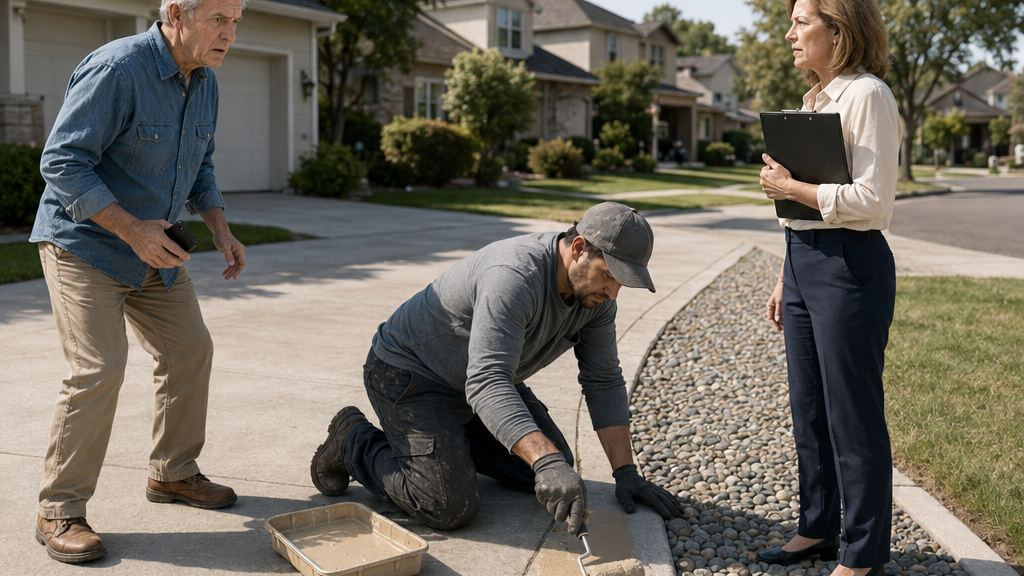
The roller passed over the survey pin before Samuel Hall understood what the man was doing.
One moment the small metal cap was visible between pale gravel and concrete, a dull circle no bigger than a quarter. The next, it disappeared beneath a stripe of wet beige paint.
“Stop.”
The worker froze with the roller halfway through another pass.
Samuel came down his driveway without bothering to close the front door behind him. He had been carrying a mug of coffee when he looked through the kitchen window and saw two men kneeling beside the decorative gravel strip that ran along the corner of his lot.
Now the mug sat somewhere inside, forgotten.
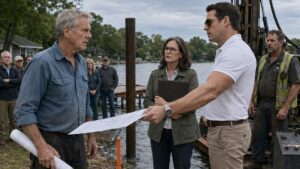
Sharon Nelson stood near the curb with a clipboard tucked against one hip.
“Samuel,” she said. “Good morning.”
“What did he just paint over?”
The worker looked at Sharon.
Samuel pointed to the wet patch. “Right there.”
Sharon glanced down. “They’re correcting the border.”
“That isn’t what I asked.”
He took out his phone and crouched. The beige paint had pooled slightly around the cap, leaving its circular shape barely visible beneath the first coat.
He photographed it.
Then he took another picture with the driveway in frame.
Sharon’s expression tightened.
“We sent you notice,” she said.
“You sent me a landscaping complaint.”
“And you declined the meeting.”
“I sent you the survey.”
“You emailed an attachment.”
“Yes. A survey.”
The second worker had stopped spreading gravel. Both men were watching now, uncertain whether they were supposed to continue.
Samuel stood.
“That metal cap is a survey monument.”
Sharon looked toward it again, but only briefly. “The issue isn’t whether there’s a survey marker.”
“Then why are your contractors painting over it?”
“They’re bringing the visible border into compliance.”
Samuel almost laughed, but there was nothing funny in the way she said it.
The gravel strip had been there for years. River stone, dark gray and tan, running in a narrow curve from the edge of his driveway toward the side yard. Samuel had installed it after buying the corner lot in 2013. The surveyor had shown him exactly where the property line ran, and Samuel had designed the strip to stay comfortably inside it.
Two weeks earlier, Sharon had sent a notice calling the gravel treatment inconsistent with the neighborhood’s updated visual standards.
Samuel had replied with six words and a PDF.
Please review attached recorded property survey.
He had considered that enough.
Sharon clearly had not.
“Who told them where to paint?” Samuel asked.
“I did.”
“Based on what measurement?”
“The association standard.”
“That’s not a measurement.”
“It establishes the visible edge.”
“On my land?”
Sharon shifted the clipboard to her other hand. “Ownership does not automatically settle landscaping control in an HOA.”
That stopped him.
Not because he believed her.
Because she sounded as though she had expected the question.
Samuel looked past her toward the fresh beige line. It ran several feet farther toward his house than the old curb color had. The new stripe did not merely repaint existing concrete. It created a visual boundary.
His boundary, if anyone passing by believed what they saw.
He had spent thirty-two years estimating utility projects. Trenches, service corridors, right-of-way widths, easements, setbacks. Small measurements caused expensive mistakes. An inch on a drawing could become feet on the ground if someone decided a line was approximate.
Lines were never approximate once money was attached to them.
“I do not consent to any more work,” he said.
Sharon’s voice stayed level. “The board has already issued a compliance directive.”
“The board?”
She opened the clipboard and removed two pages.
The first carried the association letterhead. The second appeared to be a contractor work authorization.
Samuel did not take them.
“Does that authorize entry onto privately disputed property?”
“It authorizes correction of a violation.”
“You still haven’t shown me that this strip is yours to correct.”
“The landscaping is visible from the common roadway.”
Samuel looked at her.
“So?”
“Our governing documents allow the association to maintain common visual standards.”
There it was again.
Common visual standards.
Sharon spoke the phrase with the confidence of someone reciting language she had used many times.
Samuel glanced toward the worker with the roller.
“Did she show you a survey?”
The man hesitated. “We were given the line.”
“By whom?”
Sharon answered before he could.
“By me.”
Samuel raised his phone and photographed the entire work area: the roller, the gravel pile, the line, Sharon’s clipboard, the edge of his driveway.
Sharon’s mouth tightened.
“You don’t need to turn this into something larger than it is.”
“You have people standing on my property painting over a recorded marker.”
“We are correcting a landscaping issue.”
“You are changing the visible boundary after I sent you a survey.”
A pickup slowed at the corner.
Samuel recognized the driver but didn’t wave. He could feel eyes on them from two houses away.
That was another thing he disliked about neighborhood disputes. They converted private irritation into public entertainment before either side had established what was true.
Sharon lowered her voice.
“If you had attended the compliance meeting, we could have resolved this properly.”
Samuel felt the accusation land because there was truth in it.
He had deleted the meeting reminder without opening it.
Years ago, before retirement, he had spent months arguing with a contractor over drainage work done from a verbal change order. He had finally paid thousands more than expected because nothing important had been written clearly enough.
After that, he stopped trusting meetings.
Documents first. Conversations later.
“If the meeting mattered,” he said, “the survey still mattered more.”
“That’s your interpretation.”
“No. The coordinates are not an interpretation.”
“The association’s authority is.”
For the first time that morning, Samuel felt something colder than anger.
Sharon was not claiming the marker was wrong.
She was claiming it might not matter.
He stepped aside and called the number printed on the contractor truck.
The worker nearest him frowned. “That’s our office.”
“Good.”
Sharon exhaled. “Samuel.”
“I’m telling your company there’s a property dispute and that I’ve withdrawn permission for further work.”
“You never had to grant permission.”
Samuel looked directly at her.
“That sounds like something we should both be very sure about.”
The workers packed the roller and tools while Samuel was still on the call. The supervisor on the other end sounded unhappy but practical. Once Samuel used the phrases recorded survey and disputed private boundary, the man said the crew would suspend work until the association clarified authorization.
Sharon did not argue with the contractor.
That interested Samuel more than if she had.
She gathered the papers, gave the workers a clipped instruction, and started toward her car.
At the curb she turned.
“The violation hearing will still proceed.”
Samuel looked down at the beige-painted pin.
“Then bring your documents.”
She drove away.
For several minutes he stayed beside the gravel strip.
The paint was already drying.
He crouched and wiped one edge of the metal cap with his thumb. Beige came away on his skin, but the coat underneath remained.
He took one final photograph before touching it again.
Then he went inside.
His home office had become mostly storage after retirement. Old utility maps stood rolled in a corner. Tax folders filled one drawer. At the back of the filing cabinet was the thick closing packet from 2013, still held together by a large black binder clip.
Samuel set it on the desk.
He had not opened it in years.
The first page was ordinary.
The second was not what he was looking for.
He kept going until the survey appeared.
Then, beneath it, he saw a stapled set of older property documents he did not remember reading closely at closing.
Samuel sat down.
Outside his window, a thin beige line cut across fourteen feet of gravel that someone else had decided they controlled.
Chapter 2: Fourteen Feet That Nobody Had Checked
The invoice was still clipped to the survey.
Samuel stared at the amount printed near the bottom.
$800.
He remembered complaining about the price in 2013. The property itself had already drained his savings with closing costs, inspection fees, insurance, and repairs. Eight hundred dollars to have someone confirm lines drawn on a plat had felt excessive.
Now the yellowed invoice looked like the best money he had spent that year.
He unfolded the survey across his desk.
The paper resisted at the creases.
His lot appeared as a clean geometric shape, nothing like the lived-in space outside. No gravel. No shrubs. No mower marks. Just dimensions, bearings, setback lines, and several marked points along the perimeter.
Samuel traced the driveway with his finger.
Then he found the corner.
Fourteen feet.
He checked it twice.
From the edge of the driveway to the line in question, the distance matched what he remembered.
He carried the survey outside along with a tape measure.
The beige stripe was dry now.
Samuel hooked the tape at the driveway edge and walked it toward the gravel.
At fourteen feet, the tape landed almost directly over the painted survey cap.
He photographed that too.
Then he measured the new beige line Sharon’s crew had established.
It sat several feet inside the surveyed boundary.
Samuel exhaled through his nose.
Physical question answered.
At least that one.
“You’re actually measuring it?”
Kevin Moore stood on the sidewalk with a leash wrapped around one hand. His dog had stopped to investigate a mailbox post.
Samuel held up the tape.
“Fourteen feet.”
Kevin glanced at the paint. “I heard there was some disagreement.”
“It stopped being a disagreement when they started moving the line.”
Kevin winced slightly. “They didn’t move the legal line.”
“They painted over the marker and put another visible line inside it.”
“I get that. I’m just saying Sharon’s probably thinking landscaping rules, not property ownership.”
Samuel rolled the tape back into its case.
“That’s what she said.”
Kevin nodded as if that confirmed something. “See?”
Samuel stared at him.
“See what?”
“That maybe you’re both talking about different things.”
The dog pulled toward the grass.
Kevin shortened the leash.
“Look, I’m not defending them coming onto your property without warning. But everybody’s been complaining for a year that the HOA enforces rules differently depending on who lives where.”
“My gravel hasn’t changed in eleven years.”
“I know.”
“Then why is it suddenly a problem?”
Kevin shrugged. “New board. New enforcement.”
“That isn’t an answer.”
“It’s an HOA. Answers tend to arrive as letters.”
Samuel almost smiled despite himself.
Kevin looked at the survey in Samuel’s hand.
“So you definitely own it?”
“Yes.”
“All the way to the pin?”
“Yes.”
Kevin nodded slowly. “Okay. But owning it may not mean they can’t regulate what it looks like.”
That sentence stayed with Samuel after Kevin walked away.
It bothered him because it sounded too much like Sharon’s argument and because Samuel knew enough about property work to understand that Kevin might not be entirely wrong.
Ownership and control were not always identical.
Utility companies could hold easements over private lots. Municipalities could regulate setbacks. Associations could impose recorded covenants.
A line on a survey answered where property ended.
It did not necessarily answer every right attached to that property.
Back inside, Samuel opened the association portal.
He had avoided it for years except when dues were due.
Minutes, budgets, architectural standards, policy updates, committee notices—hundreds of pages accumulated behind bland menu labels.
He found the current CC&Rs.
The PDF was more than sixty pages.
Samuel searched for landscaping.
Twenty-three results.
He searched for visual standards.
Six.
Then common visual standards.
Two.
The wording was broader than he liked. The association retained authority over exterior conditions visible from common areas when those conditions affected neighborhood uniformity or violated adopted standards.
Sharon had not invented the phrase.
That irritated him even more.
He read the section twice.
Nothing in it said the association could physically enter a privately disputed strip and alter it without permission.
But nothing on the page gave him the clean answer he wanted either.
His email chimed.
Subject: FORMAL COMPLIANCE HEARING.
Samuel opened it.
The hearing was scheduled for Thursday evening at the clubhouse.
He read the message once, then again.
The board would review the landscaping violation and determine whether further corrective action or assessment was appropriate.
Samuel leaned back.
So they had painted the line first and scheduled the formal review afterward.
He printed the email.
By late afternoon, the survey, photographs, contractor information, and compliance notice were laid out across his dining table in rows.
It looked like one of his old project reviews.
That was how Samuel preferred problems: flattened into paper, dated, numbered, compared.
People changed their stories.
Measurements usually did not.
He returned to the closing packet.
The deed was near the front. Behind it were the title documents and several attachments.
Samuel had read them at closing in the loose way most buyers read documents after signing their names fifty times. He remembered the title agent pointing out restrictions and utility easements. He remembered asking whether anything unusual affected the corner lot.
Nothing concerning, she had said.
At least, that was how he remembered it.
He began reading from the top.
Utility easement.
Drainage reservation.
Subdivision plat reference.
Then a line halfway down the legal description caught his attention.
Subject to and together with rights established under recorded instrument dated June 18, 1987.
Samuel stopped.
There was a document number.
He did not recognize it.
He pulled the CC&Rs back toward him and searched the number.
One result.
Samuel leaned closer to the screen.
The same recorded instrument appeared in an exhibit listing preexisting property rights incorporated into the subdivision documents.
He looked from the deed to the CC&Rs.
Then back again.
For the first time all day, the fourteen feet did not feel like the biggest question on his desk.
Something had been attached to that strip since 1987.
And apparently the association’s own governing documents knew about it.
Chapter 3: The Easement Hidden Behind an Old Reference Number
The number matched exactly.
Samuel checked every digit before he allowed himself to believe it.
The deed reference.
The CC&R exhibit.
Same instrument.
Same recording date.
June 18, 1987.
At eight-thirty Wednesday morning, he was standing at the county records counter waiting for a clerk to retrieve a scanned copy.
The clerk returned with three printed pages.
“Older subdivision instrument,” she said. “Looks like it was carried forward when the later plat was recorded.”
Samuel took the pages to a table.
The document had been typed long before modern word processors made legal pages clean. Letters sat unevenly. Several stamps overlapped near the bottom.
He read slowly.
The first section described the parcels.
The second established access and drainage obligations.
Then he reached the clause.
Exclusive landscaping and maintenance rights within the designated fourteen-foot perimeter buffer…
Samuel stopped reading.
He read the sentence again.
Then the next.
The rights attached to the owner of the corner parcel and continued with subsequent ownership, subject to specified utility and drainage access.
Samuel felt the satisfaction rise too quickly.
He photographed the pages and called Sharon before leaving the building.
She did not answer.
He left no message.
At home, he spread the 1987 instrument beside his survey.
Fourteen feet.
The same fourteen feet.
He opened the CC&Rs and located the exhibit again.
The association had not merely been unaware of the old rider.
Its own documents referenced it.
Samuel sat back, almost smiling.
For twenty-four hours Sharon had spoken about common visual standards as if those words settled everything.
Now he had a recorded instrument granting exclusive landscaping rights over the exact strip her contractors had altered.
He called a property attorney whose office had handled a boundary issue for a former coworker.
The attorney agreed to see him that afternoon.
Samuel arrived carrying a folder thick enough to suggest he intended to try the case himself.
The attorney noticed.
“You brought the whole neighborhood?”
“Only the part that concerns me.”
That earned the smallest smile.
For forty minutes, Samuel laid out the facts.
Notice.
Survey.
Skipped meeting.
Email response.
Contractors.
Painted pin.
Fourteen feet.
1987 rider.
CC&R reference.
When he finished, the attorney placed both hands on the desk.
“You have a strong problem.”
Samuel frowned. “That doesn’t sound like the same thing as a strong case.”
“It isn’t.”
Samuel pointed to the rider.
“It says exclusive landscaping rights.”
“It does.”
“Over the fourteen-foot buffer.”
“Yes.”
“And their own CC&Rs reference it.”
“Yes.”
“So what exactly is unclear?”
The attorney turned the document toward him.
“This gives you a meaningful property right. It does not automatically erase every covenant that applies to the lot.”
Samuel’s satisfaction thinned.
“They came onto the strip.”
“That matters.”
“They changed it.”
“That matters more.”
“They ignored my survey.”
“Potentially important.”
“So they were wrong.”
“I didn’t say they were right.”
The attorney leaned back.
“What I’m saying is that property disputes rarely become simpler because one document has a good sentence in it.”
Samuel disliked that answer because it sounded like the kind of answer people gave before sending invoices.
The attorney continued.
“The easement rider supports your position that landscaping control belongs to the corner-lot owner. The HOA may still argue that exterior appearance standards apply to whatever you choose to install there.”
“That means they can order changes?”
“Possibly.”
“Then what does exclusive mean?”
“That is exactly the kind of word attorneys get paid to argue about.”
Samuel looked away.
Through the office window, traffic moved along a commercial strip.
For the first time since finding the rider, he felt less certain than before.
The attorney tapped the photograph of the painted pin.
“This may be your cleaner issue.”
“The marker?”
“The conduct.”
Samuel looked back.
“If the association had a legitimate covenant concern, there were procedures available. Notice. Hearing. Legal review. Possibly court enforcement if necessary.”
“They sent contractors first.”
“After you had disputed the boundary?”
“Yes.”
“In writing?”
“I sent the survey.”
The attorney nodded.
“That helps. Especially if they knew the area was disputed before physically altering it.”
Samuel sat quietly.
The attorney studied the documents again.
“Did the board formally authorize the contractor work?”
“They gave me an authorization sheet.”
“That wasn’t my question.”
Samuel thought about Sharon’s wording Tuesday morning.
The board has already issued a compliance directive.
“I don’t know.”
“Find out.”
His phone buzzed before he left the office.
Another HOA email.
Samuel opened it in the parking lot.
The Thursday hearing had been moved to an earlier time and expanded to include review of the disputed landscaping area.
No postponement.
No mention of the easement material he had emailed Sharon less than an hour earlier.
He called her.
This time she answered.
“I assume you saw what I sent.”
“I did.”
“The 1987 rider.”
“Yes.”
“And the CC&R reference.”
“I saw that too.”
Samuel waited.
Sharon said, “We’ll discuss it at the hearing.”
“You were aware of the old instrument?”
“I was aware the governing documents contain historical references.”
“That’s not what I asked.”
“I’m not going to interpret property law over the phone.”
Samuel almost admired the sentence.
It was careful in exactly the way her conduct Tuesday had not been.
“The hearing should be postponed until this is reviewed.”
“The hearing is the review.”
“You already sent a crew onto the property.”
“And the work is currently suspended.”
“Because I stopped it.”
A pause.
Then Sharon said, “Thursday, Samuel.”
The call ended.
That evening he returned to the clubhouse to request recent board minutes.
The office was nearly empty.
Patricia Green sat behind a folding table with a laptop and a stack of invoices. Samuel knew her mostly by sight. She had served as treasurer longer than Sharon had lived in the neighborhood.
When he explained what he wanted, Patricia looked at him for several seconds.
“Which meeting date?”
“The one where they approved the contractor work on my property.”
Patricia’s fingers stopped above the keyboard.
Samuel noticed.
“I don’t know the date,” he said. “That’s what I’m trying to determine.”
Patricia closed the laptop halfway.
“Did Sharon give you a copy of a motion?”
“She gave me a contractor authorization.”
“That’s different.”
Samuel pulled out the page.
Patricia read it without touching it.
Her face changed almost imperceptibly.
“Samuel,” she said quietly, “did Sharon ever show you a board vote authorizing this?”
“No.”
Patricia looked toward the closed door leading to the meeting room.
Then back at him.
“Ask for the motion number tomorrow.”
Samuel folded the authorization and slipped it into his folder.
“What happens if there isn’t one?”
Patricia did not answer immediately.
When she finally spoke, her voice was lower.
“Then the fourteen feet may not be the board’s biggest problem.”
Chapter 4: The Board Vote That Was Never Taken
Samuel put the contractor authorization on the clubhouse table and asked one question.
“What was the motion number?”
Nobody answered.
Sharon Nelson sat at the center of the folding tables arranged in a shallow U. Patricia Green was two seats to her left, laptop open, while two other board members shuffled through printed packets as if the answer might have been stapled between pages.
Samuel waited.
The hearing had been scheduled as a review of his landscaping violation. Sharon had opened with the usual language about exterior standards, uniformity, and the association’s responsibility to maintain neighborhood appearance.
Samuel had let her finish.
Then he had placed the contractor sheet beside the photograph of the beige-painted survey pin.
“What motion authorized physical work on the disputed strip?” he asked again.
Sharon folded her hands.
“The association had already determined the condition was noncompliant.”
“That isn’t a motion number.”
“The president has authority to implement adopted standards.”
“Then show me where that authority includes sending contractors onto an area after the homeowner has disputed the boundary.”
One of the board members looked toward Patricia.
She did not look back.
Sharon said, “You are trying to turn a routine compliance correction into a parliamentary argument.”
Samuel felt the old impulse rise in him—the desire to stop talking, slide the 1987 rider across the table, and let paper embarrass everyone for him.
Instead, he stayed seated.
“My attorney asked whether the board authorized the work. I’m asking the same thing.”
That changed the room.
Not dramatically. Nobody gasped. Nobody sat upright.
But pens stopped moving.
Sharon’s expression hardened.
“You’ve retained counsel?”
“Yes.”
“Then perhaps this conversation should occur through attorneys.”
“This is my violation hearing. You scheduled it.”
Patricia lowered her eyes for a moment.
Samuel noticed.
Sharon reached for the compliance notice.
“The underlying issue remains unresolved. Your property is subject to the declaration, and the declaration gives the association authority over visible exterior conditions.”
Samuel slid the 1987 instrument forward.
“And this grants exclusive landscaping rights over the same fourteen-foot buffer.”
“We’ve seen it.”
“After the work was done.”
“The existence of an easement does not automatically invalidate association standards.”
“My attorney agrees.”
Sharon seemed surprised.
Samuel continued before she could use it.
“He also said that if you believed the covenant allowed enforcement, you had procedures available. Notice. Hearing. Legal review. You chose contractors.”
One of the board members cleared his throat.
“Was there an email vote?”
Patricia finally looked up.
“No.”
Sharon turned toward her. “There was no requirement for an email vote.”
“That’s not what he asked,” Patricia said.
The room went still.
Samuel had known Patricia was uneasy the evening before. He had not expected her to challenge Sharon openly.
Sharon’s voice became careful.
“The board had already adopted the landscaping initiative.”
“The initiative,” Patricia said, “authorized enforcement of the standards. It didn’t authorize entry onto disputed private property.”
Sharon’s jaw shifted.
“We’ve used contractors for corrective work before.”
“On common areas.”
“And on owner lots after notice.”
“After hearings.”
Samuel watched the exchange without interrupting.
For two days, he had been treating Sharon as the entire problem.
Now he saw something larger: a board that had allowed lines of authority to remain vague because vagueness was convenient until someone objected.
Sharon leaned back.
“This property was already in violation. Samuel declined the informal meeting. We had a scheduled cleanup window with the contractor. I exercised enforcement discretion.”
“Emergency enforcement discretion?” Samuel asked.
Sharon looked at him.
“You entered a disputed fourteen-foot strip because repainting gravel edging was an emergency?”
“I did not call it an emergency.”
Samuel opened the association bylaws to a marked page.
“The only section I found allowing unilateral physical action without a vote uses that word.”
One of the board members reached for his copy.
Patricia said nothing.
Sharon’s face flushed, but her voice stayed steady.
“The provision also allows action necessary to protect association interests.”
“From beige gravel?”
“From selective enforcement.”
There was more feeling in that answer than in anything she had said all evening.
Samuel heard it.
So did Patricia.
But Patricia still shook her head.
“I told you to wait.”
Sharon turned sharply.
Samuel did not move.
Patricia closed her laptop.
“Tuesday morning. Before the crew went out. I told you Samuel had submitted a survey and we should postpone physical work until legal review.”
“You said it might be cleaner to wait.”
“I said we should wait.”
“That is not how I remember the conversation.”
“It’s how I wrote it in my notes.”
Patricia opened a folder and removed a single sheet.
Samuel felt his anger rearrange itself.
The fourteen feet still mattered. The easement still mattered. But the sharper issue was sitting in front of him now.
The board had not voted.
The treasurer had raised a warning.
Sharon had proceeded anyway.
Samuel looked at the painted-pin photograph.
Until that moment, he had regarded it as evidence that the HOA crossed his property line.
Now it was evidence of something else too.
They had crossed a procedural line before anyone decided whether they had the authority to cross the physical one.
Sharon collected herself.
“The contractor was already mobilized. We had multiple properties scheduled. Delaying one correction because an owner sent a survey without attending the meeting would have undermined the consistency of the entire effort.”
Samuel stared at her.
“So that’s why you did it?”
“I’m explaining why I made the decision.”
“No. You’re explaining why waiting was inconvenient.”
Her eyes narrowed.
“You also had an opportunity to resolve this before Tuesday.”
The accusation hit where she intended.
Samuel had skipped the meeting.
He had treated a six-word email and an attachment as though communication itself were beneath him.
“I should have attended,” he said.
Sharon blinked.
Samuel continued.
“That was my mistake. It doesn’t authorize yours.”
Nobody spoke for several seconds.
Then the clubhouse door opened.
The landscaping contractor stepped inside.
He had been asked to attend for the second half of the hearing because the board wanted clarification about the work order. He was carrying the same kind of clipboard Samuel had seen Tuesday.
Sharon shifted papers in front of her.
The contractor sat at the end of the table.
Patricia asked the first question.
“Who established the location of the new paint line at the Hall property?”
The contractor glanced at Sharon.
“We were given field instructions.”
“By the board?”
“By the association contact.”
“Who?”
Another pause.
“Ms. Nelson.”
Samuel watched Sharon’s face.
Patricia asked, “Did your crew make an independent property determination?”
“No. We don’t survey.”
“Were you told there was an active boundary dispute?”
The contractor looked uncomfortable.
“Not before arrival.”
Samuel leaned forward.
“When I told your office?”
“We suspended.”
“Immediately?”
“Yes.”
That was true. Samuel nodded once.
Patricia looked at Sharon.
“So the contractor did exactly what we would have expected if they had known beforehand.”
Sharon said nothing.
The contractor checked his notes.
“There’s one more thing. Ms. Nelson walked the location with our supervisor the previous afternoon. She indicated the replacement line personally.”
Samuel felt the last uncertainty disappear from that part of the story.
Sharon had not simply approved a vague work order.
She had chosen the line.
After seeing his survey.
After Patricia told her to wait.
Samuel looked at the photograph again.
He no longer wondered who had told the roller where to go.
The question had changed.
Why had Sharon needed that beige line badly enough to risk everything else?
Chapter 5: Why Sharon Could Not Afford to Back Down
The first surprise in the records room was that Samuel’s property was not supposed to be special.
It was Property 17.
That was how it appeared on the enforcement worksheet Patricia allowed him to review Thursday evening after the hearing recessed without a final ruling.
Seventeen of twenty-four.
Samuel ran his finger down the page.
Faded mailbox posts. Unapproved edging. Stained common-facing fences. Decorative stone outside approved color ranges. Overgrown corner beds.
The list stretched across several streets.
Beside most entries was a date, a notice code, and a contractor status.
His row was the first with a handwritten notation beside it:
PRIVATE BOUNDARY DISPUTE.
Samuel looked at Patricia.
“When was that added?”
“Tuesday afternoon.”
“After the work.”
“Yes.”
He sat back.
The room smelled faintly of paper and old carpet. Metal shelves held years of financial binders, meeting packets, reserve studies, insurance renewals.
Patricia remained standing.
“Sharon didn’t invent the cleanup campaign just to come after you.”
“I didn’t say she did.”
“You’ve been acting like you think she did.”
Samuel looked again at the worksheet.
Maybe he had.
That was the uncomfortable part.
His anger had made the story simple: Sharon saw his gravel, decided she could control it, and pushed until he pushed back harder.
The spreadsheet told a messier story.
“She started this in March?” he asked.
Patricia nodded.
“Complaints had been building before she became president. People said the board ignored some violations and hammered others.”
“Were they right?”
“Sometimes.”
Patricia pulled out another binder.
“There were houses that got three notices for weeds while other properties had obvious violations sitting for years. Some of it was poor recordkeeping. Some of it was board members not wanting fights with neighbors.”
“And Sharon promised to fix that.”
“She promised consistency.”
Samuel looked toward the highlighted entries.
“And people wanted it?”
“A lot of them did.”
The next morning he saw the campaign everywhere.
Once he noticed the beige paint, he could not stop seeing it.
At the entrance island, the curb had been repainted the same muted shade. Around the clubhouse beds, the edging matched. Two common-area tree wells had fresh beige borders.
Uniform.
Clean.
Unremarkable.
Sharon had turned the color into a signal that the board was finally enforcing something evenly.
Samuel disliked admitting that he understood the appeal.
Kevin Moore was dragging his trash bins back from the curb when Samuel stopped.
“You complained about enforcement last year?”
Kevin rested both hands on a bin handle.
“Me and half the street.”
“About what?”
“The house behind us had a fence leaning into the sidewalk for almost a year. Another owner got cited twice for a planter.”
“So you wanted Sharon to tighten enforcement.”
“We wanted the rules to mean the same thing for everybody.”
Samuel nodded.
Kevin watched him.
“That’s not the same as telling her to paint your property line.”
“No.”
“But yeah, people pushed her.”
“How hard?”
Kevin gave him a tired look.
“You’ve never been to one of those meetings.”
Samuel said nothing.
Kevin continued.
“People were angry. Every time someone got a notice, they’d point to somebody else and say, ‘What about them?’ Sharon finally said there would be no more exceptions.”
No more exceptions.
Samuel glanced down the street.
He could imagine the room.
Residents demanding equality.
Board members tired of being accused of favoritism.
Sharon promising a system that would not bend.
Then Samuel Hall skipped his meeting and emailed a survey.
A complication.
An exception.
A test.
None of that excused what she did.
But it explained why backing down had felt dangerous to her.
Kevin studied him.
“You still going after her?”
“I’m trying to figure out what ‘going after her’ means.”
“Well, everybody’s saying you’ve got a lawyer.”
“Everybody usually knows more about my business than I do.”
Kevin smiled briefly.
Then his expression became more serious.
“For what it’s worth, I thought the gravel thing was you being stubborn.”
“It was partly me being stubborn.”
“I didn’t say that.”
“You didn’t have to.”
Kevin looked toward Samuel’s corner lot.
“When I saw the paint over that metal pin, it changed it for me.”
Samuel followed his gaze.
That was the line Kevin understood.
Not easement language.
Not procedural votes.
A piece of metal in the ground that somebody covered because it complicated what they wanted to do.
Friday morning brought a new problem.
The county code-enforcement inspector called Samuel after reviewing the photographs and contractor information submitted by his attorney.
The inspector was careful not to overstate anything.
The property dispute itself, he said, was civil.
The county would not determine HOA authority or interpret Samuel’s easement.
But the contractor’s work raised a separate issue involving the type of exterior modification performed and whether the required local authorization had been obtained.
“Was it?” Samuel asked.
“We don’t show one.”
“What happens now?”
“We contact the contractor and property-management representative. If the work required authorization and they proceeded without it, there may be a correction notice and administrative fine.”
“How much?”
The inspector mentioned an initial amount and possible continuing consequences depending on what remained uncorrected.
Samuel wrote it down.
Two hundred dollars to start.
It was not much compared with legal fees.
But it changed the board’s problem from theoretical to financial.
By noon, Samuel’s attorney had sent a formal cease-and-desist notice regarding additional physical work in the buffer.
At two-thirteen, Patricia called.
“The board wants to resolve this.”
Samuel leaned back in his office chair.
“That sounds promising.”
“There’s an offer coming.”
“From Sharon?”
“From the board.”
The distinction was deliberate.
The email arrived twenty minutes later.
The association would reimburse reasonable restoration expenses for the gravel strip, withdraw the current compliance action concerning the disputed edge, and suspend further work while the parties clarified their respective rights.
Samuel read that section twice.
Then he reached the final page.
Mutual resolution.
No admission of wrongdoing.
Confidential terms.
Withdrawal of pending governance complaints.
Samuel stared at the last phrase.
His attorney called before Samuel could contact him.
“They’re offering you most of what you originally wanted.”
“Most.”
“Your landscaping restored. Costs reimbursed. Enforcement paused.”
“And I drop the complaint about how they authorized it.”
“Yes.”
Samuel walked to the kitchen window.
The beige line remained visible through the glass.
A week earlier, he would have accepted almost immediately.
Pay for the repair.
Stay off his property.
Leave him alone.
That was all he ever wanted from the association.
His attorney said, “This is a practical settlement, Samuel.”
“I know.”
“You don’t have to solve their governance problems.”
“I know that too.”
“Then what’s bothering you?”
Samuel looked at the survey pin, still dulled beneath paint.
The answer was irritatingly clear.
If he accepted, his property would be fixed.
Nothing else would be.
The same board could face the same uncertainty on another lot. The same vague authority could be used again. And Samuel could return to doing what he had done for eleven years—pay dues, skip meetings, complain privately, and assume somebody else would make sure the rules were administered correctly.
The email offered him exactly the kind of victory he had always preferred.
Private.
Documented.
Finished.
Samuel read the confidentiality paragraph one more time.
Then he realized the hardest part of the dispute might not be proving Sharon had crossed a line.
It might be deciding whether getting his fourteen feet back was enough.
Chapter 6: The Invoice Was Easier Than the Choice
The restoration worker found the survey pin with a scraper.
He knelt beside the gravel early Friday afternoon and worked carefully at the hard beige crust until a sliver of metal appeared.
“There it is.”
Samuel crouched beside him.
The worker brushed away another thin curl of latex.
The round cap emerged little by little, scarred but intact.
Samuel had seen the pin hundreds of times without noticing it. Before Tuesday, it had been nothing more than a marker left by someone with surveying equipment.
Now he watched every scrape.
The worker paused.
“You want us to paint around it when we finish the edge?”
“No.”
“Leave it exposed?”
“Yes.”
Samuel took a photograph.
The restored gravel would cost more than he liked, but less than letting the dispute sit half-finished while lawyers exchanged letters. His own crew reset the disturbed stone, cleaned excess paint where possible, and corrected the edging without moving the surveyed boundary.
By late afternoon, the strip looked almost ordinary again.
Almost.
The metal cap remained visible.
Samuel stood over it after the crew left.
His attorney had told him he could accept the board’s reimbursement offer and negotiate out a few of the broader terms.
That would be sensible.
Samuel had always respected sensible.
Yet the confidentiality clause sat unanswered in his inbox.
On Saturday morning he opened the association portal again.
For years, his activity there could have been summarized in three actions: check dues, pay dues, log out.
Now he began reading meeting minutes.
One year.
Two years.
Then four.
The pattern was familiar from workplaces he had known.
Small decisions delegated informally.
Temporary practices that became permanent because nobody objected.
Committees acting beyond their written responsibilities because the board was busy.
Residents appearing only when something affected them personally.
Samuel recognized the last category immediately.
He had been very good at being that resident.
He remembered one meeting notice about architectural procedures that he had thrown into recycling unopened.
Another about contractor standards.
Another about covenant enforcement.
He had told himself the same thing each time.
I take care of my property. This doesn’t concern me.
Now he was spending attorney fees because something he had assumed did not concern him had arrived with two workers and a paint roller.
That did not make Sharon’s decision his fault.
Samuel refused to indulge that false symmetry.
But it did make his own habits part of the story.
Monday morning, he met his attorney.
The settlement offer lay between them.
“You’re going to reject it,” the attorney said.
“Not all of it.”
“That usually means yes.”
Samuel slid forward a revised page.
“I’ll accept reimbursement if the amount is approved in an open board action. I’ll agree not to pursue damages beyond documented restoration and legal expenses associated with stopping the work.”
The attorney read.
“No confidentiality.”
“No.”
“No withdrawal of your procedural complaint.”
“No.”
“And you want a written recognition that the disputed buffer remains under your landscaping control subject to whatever lawful covenants legitimately apply.”
“Yes.”
The attorney looked up.
“They may not agree.”
“I know.”
“You could recover your money now.”
“I know.”
The attorney tapped the paper.
“So why make the harder demand?”
Samuel thought of the restored pin.
“Because if they write me a check quietly, the board can say this was just a misunderstanding with one difficult homeowner.”
“Were you difficult?”
“Yes.”
The attorney smiled.
Samuel did not.
“I skipped the meeting. I sent a six-word email. I assumed attaching a survey was the same thing as participating in a process.”
“That still didn’t authorize entry.”
“No. But I’m done pretending I did everything perfectly just because they did something worse.”
The attorney leaned back.
“That’s a more expensive position.”
“Probably.”
“And slower.”
“Definitely.”
“Just making sure you understand.”
“I do.”
That afternoon Samuel assembled the restoration documentation.
Photographs before the work.
Photographs after.
Contractor receipt.
Materials.
Labor.
Cleanup.
The final amount came to $1,340.
He stared at the number before scanning the invoice.
In the short-form version of the conflict playing around the neighborhood, the invoice would probably become the satisfying part.
HOA damages homeowner’s property. Homeowner sends HOA the bill.
Simple.
Samuel had learned to distrust simple.
He emailed the invoice to the board with a concise cover note.
He requested reimbursement.
He requested a recorded determination regarding the fourteen-foot buffer.
And he requested adoption of a procedure preventing contractors from entering a privately disputed area until ownership, easement, and board authority had been reviewed.
No speeches.
No accusations.
No demand that Sharon resign.
He clicked Send.
Five minutes later, Patricia called.
“I just saw it.”
“Okay.”
“You rejected the settlement.”
“I rejected part of it.”
“The part they cared about.”
“Then maybe that part mattered.”
Patricia sighed.
“You understand the board is worried about creating a rule that makes enforcement impossible every time someone says the word boundary.”
“I’m not asking for that.”
“You’re asking for a pause.”
“If someone produces a credible recorded survey and says the contractor is about to cross it, yes.”
“That could be abused.”
“So could unilateral discretion.”
Patricia was silent.
Samuel softened his voice.
“I’m not asking the board to become powerless.”
“I know.”
“I’m asking it to know where its power comes from before somebody starts painting.”
He heard Patricia move papers.
“Sharon thinks this is aimed at her.”
“It isn’t.”
“She won’t believe that.”
“Then don’t name the policy after her.”
Patricia gave a short, surprised laugh.
It was the first time Samuel had heard her do that.
By early evening, an association email appeared.
SPECIAL OPEN MEETING.
Samuel opened the notice.
The agenda contained four items.
Review of Hall property restoration reimbursement.
Interpretation of recorded buffer rights.
Contractor authorization procedures.
Policy for entry onto disputed owner property.
Samuel sat at his desk and read the list again.
For once, the documents had not ended the conversation.
They had forced one to begin.
He looked through the office window toward the gravel strip.
The metal survey pin caught a small point of late sunlight.
His fourteen feet were visible again.
But the special meeting would decide whether anything beyond those fourteen feet had actually changed.
Chapter 7: The Meeting Where Nobody Got Everything They Wanted
Samuel placed the photograph in the center of the board table.
Nobody could mistake what it showed.
A roller loaded with beige paint. Fresh color spreading across the concrete edge. The small metal survey cap disappearing beneath it.
Beside the photograph, Samuel laid the proposed reimbursement agreement, the 1987 easement rider, and his restored-property invoice.
Then he sat down.
The clubhouse was fuller than at the violation hearing, though not crowded. Kevin Moore had taken a chair near the back. Several residents Samuel recognized only by sight sat along the wall. The landscaping contractor was absent. Samuel’s attorney had advised him that the meeting did not require legal theater and had stayed away unless needed.
Samuel preferred it that way.
This was no longer about frightening the board with counsel.
It was about making the board decide what its own authority meant.
Sharon Nelson called the special meeting to order.
She looked tired.
Not defeated. Not embarrassed enough to perform remorse for the room.
Simply tired.
Patricia Green read the first agenda item.
“Restoration reimbursement for the Hall property.”
One board member moved to approve the $1,340 invoice.
Another seconded.
Sharon looked at Samuel.
“Before we vote, I want it clear that reimbursement is not an admission that the association lacks architectural authority over the property.”
Samuel nodded.
“I’m not asking you to say that.”
A few people shifted in their chairs.
Sharon appeared almost disappointed by the answer.
Samuel continued.
“I’m asking you to recognize that landscaping control in this specific buffer is subject to the 1987 recorded instrument, and that the association should not physically alter a disputed private area before resolving what authority applies.”
“That language,” Sharon said, “could make routine enforcement extremely difficult.”
“Only if routine enforcement requires entering disputed property before review.”
Sharon’s expression tightened.
One board member asked Patricia to summarize the records issue.
Patricia opened a folder.
“The declaration references the 1987 instrument. The instrument grants the corner parcel owner exclusive landscaping and maintenance rights within the fourteen-foot buffer, subject to drainage and utility access.”
“And HOA standards?” the board member asked.
“Still potentially applicable,” Patricia said. “That’s what counsel advised.”
Samuel noticed the word potentially.
A week earlier, he would have jumped on it.
Now he let it remain.
Patricia continued.
“The separate issue is physical corrective work. There is no recorded board motion specifically authorizing entry onto the Hall property.”
Sharon leaned forward.
“The compliance program itself was authorized.”
“Yes,” Patricia said.
“And implementation authority was delegated.”
“For notices and routine correction.”
“This was routine correction.”
Patricia looked at the photograph.
“Once a recorded survey was submitted and the owner disputed the work area, I don’t think it was routine anymore.”
The room became very quiet.
Sharon looked toward Samuel.
“You submitted a survey after declining to attend the informal meeting.”
“Yes.”
“You gave the board no explanation beyond the attachment.”
“Yes.”
“You made no attempt to discuss how the survey interacted with the declaration.”
Samuel could feel Kevin watching from the back.
“I should have come to the meeting,” Samuel said.
Sharon paused.
That admission had unsettled her once before. It did again.
Samuel folded his hands.
“I thought the document should speak for itself. That was arrogant. I should have participated.”
Then he tapped the photograph.
“But my poor communication didn’t give anyone permission to treat the survey as though it didn’t exist.”
Sharon looked down.
Patricia turned a page.
“There’s another point that needs to be on the record.”
Sharon’s head rose.
Patricia’s voice remained calm.
“Before the contractor went to Samuel’s property, I told Sharon that the physical work should wait until the survey issue had been reviewed.”
A murmur moved through the chairs along the wall.
Sharon looked at Patricia, not the residents.
“You said delaying would be preferable.”
“I said we should wait.”
“We were already months behind on the cleanup schedule.”
“That is true.”
“We had residents accusing us of selective enforcement every meeting.”
“That is also true.”
“And Property 17 had become the first case where an owner could simply send an attachment and derail scheduled enforcement.”
Samuel heard something in Sharon’s voice that had not been present during their driveway confrontation.
Not authority.
Fear.
Not fear of Samuel.
Fear of the precedent.
Sharon turned toward the room.
“When I took this position, people wanted one thing from the board: consistency. We had residents cited for minor violations while obvious problems sat untouched because previous boards didn’t want arguments. Every exception became proof that someone else was receiving special treatment.”
Kevin lowered his eyes.
Samuel remembered what he had said beside the trash bins.
People had pushed her.
Sharon continued.
“When Samuel sent the survey, I did review it.”
The sentence landed harder than Samuel expected.
He leaned forward.
“You saw it before the crew went out?”
“Yes.”
There it was.
No document discovered at the last second.
No accidental oversight.
A choice.
Sharon met his eyes.
“I believed the survey established ownership. I did not believe it eliminated the association’s authority over visible landscaping.”
“Then why not wait for the hearing?”
“Because I thought waiting would turn every enforcement action into a negotiation.”
Samuel held her gaze.
“And you decided being consistent mattered more than being certain.”
Sharon did not answer immediately.
Finally she said, “At the time, yes.”
The room remained silent.
Samuel looked at the photograph between them.
That was the answer he had spent a week trying to find.
Sharon had not misunderstood where the pin was.
She had misunderstood what leadership required when certainty ran out.
The reimbursement motion passed.
The board also approved a written recognition that Samuel retained the landscaping and maintenance rights granted by the 1987 instrument, subject to legitimate recorded covenants and utility or drainage rights.
It was not absolute victory.
Samuel had stopped expecting one.
Then Patricia introduced the proposed contractor-entry policy.
The draft required written review before association contractors physically altered any area where an owner had presented credible evidence of a boundary, easement, or ownership dispute.
Sharon objected immediately.
“You’re creating a loophole.”
“A pause,” Samuel said.
“A loophole disguised as a pause.”
One board member suggested narrowing the policy to Samuel’s lot.
Samuel shook his head.
“No.”
Several faces turned toward him.
The board member frowned. “That gives you what you asked for.”
“It gives me an exception.”
“Isn’t that what this dispute is about?”
“No. It’s exactly what started the larger problem.”
Samuel looked around the table.
“If you write a special rule for my fourteen feet, the next homeowner still has to hope the president likes their paperwork better than mine.”
Sharon studied him.
For the first time, her expression held something other than resistance.
Perhaps surprise.
Samuel continued.
“I don’t want the board unable to enforce anything. I want a procedure for the moment when enforcement and private-property evidence collide.”
Patricia nodded slowly.
The wording was revised.
Not to Samuel’s exact version.
Not to Sharon’s.
The final motion required temporary suspension of physical contractor work when credible property documentation created a genuine dispute, followed by board or counsel review before entry.
It also required explicit board authorization for physical corrective work on privately owned areas when owner consent was absent.
The vote passed.
Sharon voted against the first part and for the second.
Samuel noticed that too.
The meeting lasted another forty minutes.
No applause followed.
No one demanded Sharon resign.
A resident complained that the new process might cost legal fees. Another worried owners would abuse it. Kevin said only that a visible survey monument ought to be enough to make anyone stop and check before painting.
When the meeting ended, chairs scraped across the floor.
Samuel gathered his documents.
Sharon was stacking her own papers when he approached.
“I meant what I said,” he told her.
She looked up.
“Which part?”
“I don’t want you powerless.”
A tired half-smile crossed her face.
“That’s generous.”
“It wasn’t meant to be.”
The smile disappeared.
Samuel held her gaze.
“You were wrong to send that crew.”
“I know what the vote says.”
“That isn’t what I said.”
Sharon looked toward the photograph still lying on the table.
Then she said quietly, “I should have waited.”
It was not an apology.
Samuel decided not to force it into one.
He picked up the photograph.
Patricia was closing her laptop nearby.
“We need two homeowners for the temporary policy committee,” she said. “Thirty days. Maybe forty-five.”
Samuel almost answered automatically.
No.
He had spent eleven years avoiding exactly that sort of request.
Committees became meetings. Meetings became arguments. Arguments became people remembering your name when something unpleasant needed doing.
Then he thought of his six-word email.
He thought of the survey folded in a filing cabinet while other people interpreted rules he never bothered to read.
“How often?” he asked.
Patricia blinked. “Once a week, probably.”
Samuel sighed.
Kevin laughed softly from behind him.
Samuel turned.
“Don’t.”
Kevin raised both hands.
Samuel looked back at Patricia.
“All right.”
“You’ll do it?”
“Temporarily.”
Patricia smiled.
Samuel pointed at her.
“Write that down.”
This time even Sharon laughed.
Samuel left the clubhouse carrying the same folder he had brought in.
The survey was still his.
The easement was still complicated.
Sharon was still president.
But for the first time since the roller passed over the pin, Samuel did not feel that protecting a boundary required retreating behind it.
Chapter 8: The Boundary Stayed Visible After the Argument Ended
The maintenance truck stopped before its tires crossed the driveway.
Samuel noticed because he had been walking back from the mailbox when the driver stepped out with a work order in one hand.
The truck was three houses down.
A homeowner stood near a side fence pointing toward a narrow strip of grass where association irrigation piping ran close to the lot line.
The driver looked at the paper.
Then at the ground.
Then he shook his head and made a phone call.
Nobody entered the strip.
Nobody unloaded tools.
Ten minutes later, Patricia arrived with a folder.
Samuel remained at his mailbox longer than necessary.
The new procedure had been adopted less than three weeks earlier.
He had wondered whether it would survive first contact with inconvenience.
Apparently it had.
Kevin came up behind him.
“You planning to supervise every contractor in the neighborhood now?”
Samuel turned.
“I’m getting my mail.”
“You’ve been holding the same envelope for five minutes.”
Samuel looked down.
Electric bill.
“Important correspondence.”
Kevin grinned.
They watched Patricia speak with the homeowner and then walk the edge of the lawn without crossing the disputed area.
Eventually she waved the truck away.
No drama.
No shouting.
Work delayed until the property record could be checked.
Samuel felt an odd satisfaction in how boring it looked.
The temporary committee had spent four meetings making that boring moment possible.
The meetings had been exactly as unpleasant as Samuel expected.
One member thought written review was unnecessary bureaucracy. Another wanted every contractor entry approved by the full board. Sharon argued that a forty-eight-hour preliminary review was more workable than an indefinite stop.
Samuel had surprised himself by agreeing with her.
“You can’t freeze maintenance forever because somebody waves an old map around,” he had said.
Sharon had looked across the table.
“Careful. You’re starting to sound like an HOA president.”
“Take that back.”
Patricia had laughed.
They settled on a process that required credible documentation, written notice of the dispute, and prompt review. Emergency safety work remained exempt under narrower language.
It was not elegant.
It was usable.
That mattered more.
The board also added a contractor checklist requiring confirmation of whether the work area was common property, owner property with consent, or a disputed area needing further authorization.
Samuel had insisted on one line.
Visible survey monuments are not to be covered, removed, disturbed, or treated as landscaping debris.
Nobody objected.
The $1,340 reimbursement check arrived two days later.
The association did not pay every dollar of Samuel’s legal costs. His attorney had warned him not to expect that. Samuel accepted the compromise.
The landscaping violation itself was formally withdrawn as applied to the existing gravel treatment within the buffer, while the board reserved its broader covenant rights.
Again, neither side got language as absolute as it wanted.
Samuel found that increasingly reassuring.
Absolute language was often where trouble started.
Sharon remained president.
That irritated a few residents who had apparently expected Samuel’s dispute to end with her removal.
Samuel had never requested it.
He understood her better now, which was not the same as trusting her completely.
She still liked decisions made quickly.
She still interpreted hesitation as weakness.
But at committee meetings, Samuel saw her ask one question more often than before.
“Do we actually have authority for that?”
He never commented when she did.
One Saturday morning, Samuel was spreading fresh gravel near the driveway when Sharon’s car stopped at the corner.
She got out carrying a folder.
Samuel kept raking.
“You’re not about to cite the color, are you?”
Sharon looked down.
“It’s gray.”
“Mostly.”
“There are tan stones.”
“I can remove them individually.”
“That might be necessary.”
Samuel looked up.
She was almost smiling.
Almost.
Sharon pointed toward the survey pin.
“You left it exposed.”
“Yes.”
“Won’t the mower catch it?”
“Not where it sits.”
She stepped closer but stopped short of the gravel.
That small hesitation did not escape him.
Three weeks earlier, she had stood in almost the same place supervising men who painted over the marker.
Now she waited at the edge.
“I came to drop off the final policy copy,” she said.
“You could have emailed it.”
“You dislike meetings. I assumed you might also dislike attachments.”
Samuel rested both hands on the rake.
“I deserved that.”
“Yes.”
She handed him the folder.
The silence afterward was not comfortable, exactly.
But it was no longer hostile.
Samuel looked toward the street.
“Patricia says the new process already delayed irrigation work.”
“It delayed it four hours.”
“Disaster.”
“The world survived.”
They stood there another moment.
Then Sharon said, “I still think you should have come to that first meeting.”
Samuel looked at her.
“I still think you should have waited.”
“I know.”
That was all.
No apology ceremony.
No handshake.
No sudden friendship.
Sharon returned to her car.
Samuel went back to the gravel.
Later that afternoon, Patricia emailed the committee the finalized procedures. The temporary group could dissolve after one final review session.
Samuel read the message twice.
Months earlier, he would have felt relief.
Instead he found himself checking whether another standing committee needed volunteers.
He closed the browser before making a mistake.
Then opened it again.
Not yet.
Maybe later.
The change did not need to be dramatic to be real.
For eleven years, Samuel had treated the association as something outside his life: an entity that collected dues, mailed notices, and occasionally made foolish decisions.
Now he understood the more uncomfortable truth.
Institutions were mostly people making decisions while other people stayed home.
Sometimes those decisions were careful.
Sometimes they were rushed.
Sometimes one person’s certainty filled a space everyone else had left empty.
Samuel still did not enjoy meetings.
He still preferred written records.
He still believed a measurement should mean something once professionals put it on a recorded survey.
None of that had changed.
What changed was his belief that having evidence relieved him of the need to show up.
Toward evening, he walked the edge of his driveway.
The restored gravel had settled. The beige stripe that once suggested a different boundary was gone except for faint discoloration along one section of concrete.
Samuel could have scrubbed that away.
He had not.
The mark no longer bothered him.
It reminded him that a visible line and a lawful line could be two different things.
At the corner, he stopped beside the survey pin.
The metal cap sat slightly above the surrounding gravel.
When the restoration crew finished, they had asked whether Samuel wanted stone raked over it to make the strip look smoother.
Once, he probably would have said yes.
The pin was not attractive.
It disrupted the clean curve.
It was utilitarian, scarred, and easy to overlook.
Samuel nudged a loose piece of gravel away from its edge with the toe of his shoe.
Across the street, Kevin raised a hand.
Samuel raised his in return.
Farther down, the maintenance truck had come back to the property where work had been delayed that morning. This time the driver carried written clearance.
He crossed the driveway only after the homeowner waved him in.
Samuel watched for a moment, then turned toward his house.
The survey pin remained behind him in plain sight.
No paint covered it.
No gravel hid it.
Nothing announced what it meant.
It did not need to.
The boundary was visible, the process was clearer, and Samuel no longer believed protecting either one required standing alone.
The story has ended.