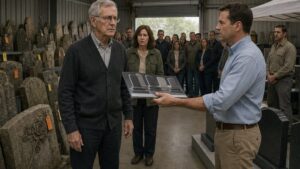
The HOA Leased His Father’s Dock for Fifteen Years—Then the Old Rope Ladder Changed What Everyone Thought They Owned
Chapter 1: The Morning They Drilled Into His Father’s Dock
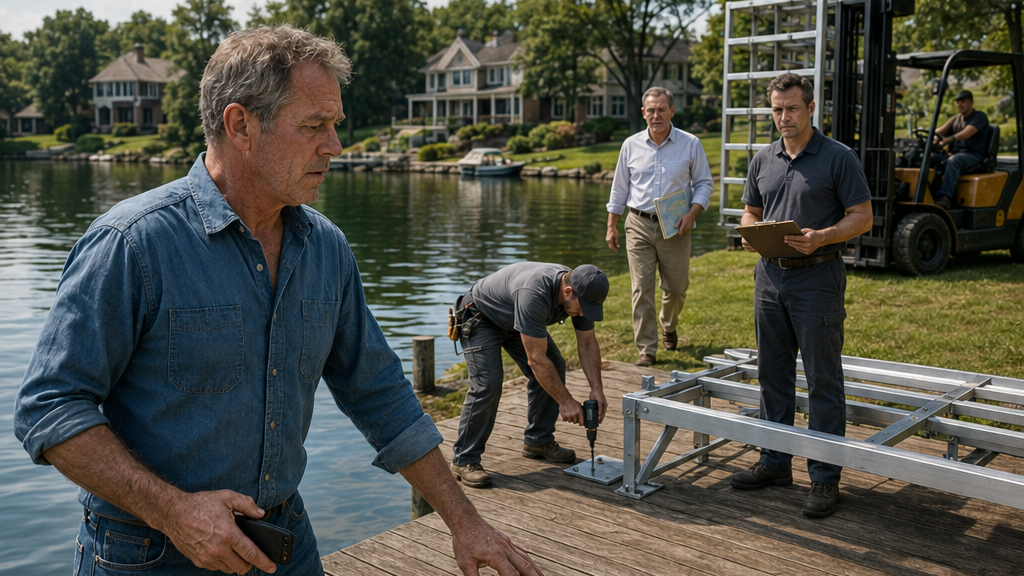
The forklift was already halfway across Joseph Adams’s grass when he stepped out of the kitchen.
It was small enough to fit between the maple trees, but the aluminum rack balanced on its forks stood higher than the cab. Two men in work shirts walked beside it, guiding the operator toward the lake.
Joseph stared for three seconds before he understood where they were going.
Then he ran.
“Stop.”
The operator slowed but did not shut off the engine.
Joseph came down the slope barefoot, coffee still in one hand. His dock extended from the narrow strip of shoreline behind his house, its cedar boards silvered with age. At the far end, sunlight flashed off the aluminum rails of his old fishing boat.
A man Joseph did not recognize stood on the dock holding a clipboard.
“We need you clear of the work area, sir.”
“This is my work area.”
The man looked down at the clipboard. “Joseph Adams?”
“Yes.”
“I’m Justin Taylor. Regional operations.”
“For what?”
Justin pointed toward the aluminum rack.
The answer arrived before he spoke. One worker carried a cordless drill. Another had already set a steel base plate on one of the cedar planks.
Joseph put his coffee down in the grass.
“You’re not drilling that.”
Justin’s expression changed only slightly. “The association approved the installation.”
“The association doesn’t own this dock.”
A second vehicle pulled into the common parking strip behind Joseph’s property. Brian Roberts climbed out.
Joseph had known Brian for nearly twelve years. They had stood beside each other at neighborhood cookouts. Brian had once borrowed Joseph’s post-hole digger and returned it with a new auger bit after breaking the old one.
That familiarity made his arrival worse.
Brian walked down the slope with a folder tucked beneath his arm.
“Joseph.”
“Tell them to stop.”
“They’re authorized.”
“By whom?”
“The board.”
Joseph looked at the drill resting against the cedar.
“My father built this dock.”
Brian’s jaw tightened. “We’ve been over the waterfront issue.”
“No. You sent notices about waterfront access. That isn’t the same thing.”
Justin opened his clipboard folder.
“We have a fifteen-year lease with the association for designated community waterfront locations.”
He offered Joseph a copy.
Joseph did not take it.
He looked instead at the nearest cedar plank.
His father had planed those boards himself in 1961. Joseph had been too young then to remember the construction, but his father had told the story often enough that Joseph could picture it: cedar stacked in the yard, coffee in an enamel mug, the old hand plane pushing pale curls of wood onto the ground.
Later, when Joseph was six or seven, his father had tied a rope ladder beneath the outer edge.
Joseph and the other children used to jump into the lake and climb back up by it until their palms burned.
He had not thought about that ladder in years.
“Move the rack,” Joseph said.
Brian opened his folder.
“This is the community waterfront map.”
The page showed the shoreline in clean colored lines. Joseph’s dock sat inside a shaded band marked as shared waterfront access.
Joseph finally took the paper.
“What recorded instrument gives the association title?”
Brian frowned. “The map is part of the association records.”
“That isn’t what I asked.”
“We have counsel.”
“Then what deed?”
Justin shifted his weight.
Brian pointed at the page. “This area has been treated as common waterfront for decades. People have used these docks. You know that.”
People had used Joseph’s dock.
Neighbors had tied up boats during cookouts. Teenagers had jumped from it. Brian himself had fished there twice with Joseph’s father.
But permission and ownership were not the same thing.
Joseph felt his pulse beating against his throat.
One of the workers lifted the drill.
Joseph stepped toward him.
The worker froze.
For one dangerous second, Joseph imagined taking the drill from his hand and throwing it into the lake.
Then he stopped.
He took out his phone instead.
He photographed the rack.
The base plates.
The cedar.
Justin’s clipboard.
Brian’s map.
Then he moved close enough to photograph the untouched plank where the first holes would go.
“I am telling all of you now,” Joseph said. “I do not consent to this installation.”
Justin glanced at Brian.
Brian said, “Your objection is noted.”
“Then stop.”
“We can’t stop a contracted installation because one homeowner disputes a boundary the association has recognized for years.”
Joseph looked at him.
“One homeowner?”
Brian exhaled. “You know what I mean.”
“No. I want to hear it.”
Brian lowered his voice.
“We signed an agreement. There are deadlines. There are financial obligations. You had notice of the waterfront project.”
“I had notice that you were leasing community property. You never told me you intended to bolt equipment into my dock.”
Brian said nothing.
Joseph turned to Justin.
“On your paperwork, who warrants that the HOA owns this location?”
Justin’s face tightened.
“That’s a legal question.”
“It’s a line in your lease.”
“I’m not discussing contract language with you.”
“Fair enough. But before you drill, you might want to know whether the person who signed that contract can show you a deed.”
Brian stepped forward.
“Joseph, don’t make this bigger than it needs to be.”
That sentence did what the forklift had not.
It made Joseph suddenly calm.
He stepped off the dock.
“Go ahead,” he said.
Justin looked surprised.
Joseph lifted his phone again.
“I’ve told you not to. I’ve documented the condition. I’ve asked for the recorded ownership document. If you proceed, that’s your decision.”
The first drill bit struck cedar.
Joseph flinched despite himself.
The sound was small and ugly.
A spiral of pale wood rose around the bit.
His father’s hand-planed board now had a clean black hole through it.
Brian looked away.
Joseph photographed that too.
By the time he walked back toward the house, four holes had been drilled.
Amy met him at the back door.
“What happened?”
“They have a lease.”
“For our dock?”
“They say it isn’t ours.”
Amy looked past him at the men working below.
“Can they do that?”
Joseph almost answered no.
Instead he said, “I don’t know.”
The admission bothered him more than anything Brian had said.
He went into the small room off the hallway that had once been his father’s study.
The fireproof safe sat beneath a workbench, dusty and gray.
Joseph had carried it into the house after his father died and had not opened it once.
There had always been a reason.
Taxes could wait until Monday.
Old insurance papers were probably useless.
The deeds were surely recorded somewhere else.
And every time he thought of opening it, he remembered the last afternoon his father had sat at that desk, sorting envelopes with hands that shook more than he wanted Joseph to notice.
Joseph opened the top drawer.
Under a bundle of rubber bands and an expired fishing license lay a small brass key.
Outside, the drill started again.
Joseph closed his fingers around the key.
Chapter 2: The Safe Joseph Had Refused to Open
The key resisted on the first turn.
Joseph stopped, wiped his palm against his jeans, and tried again.
The lock gave with a dull metallic click.
Amy stood in the doorway but did not come closer.
Inside the safe were three rows of documents packed into yellowing folders, a small metal cash box, two envelopes of photographs, and a cigar tin that Joseph recognized immediately.
His father had kept spare fishing hooks in it.
Joseph pulled out the first folder.
Property taxes.
The second contained insurance policies.
The third was marked only with the address of the house in his father’s block lettering.
Joseph sat on the floor.
For several minutes he forgot about Brian, the lease, and the drill holes.
He found the original purchase papers, utility easements, receipts for lumber, and a permit from 1961 approving construction of a private residential dock.
Amy crouched beside him.
“Private residential dock.”
“I see it.”
“That helps.”
“Maybe.”
He had learned enough that morning not to confuse a useful piece of paper with an answer.
At the bottom of the folder was a large document folded into quarters.
The paper had gone soft along the creases.
Joseph opened it on the floor.
It was a plat dated 1958.
The lake appeared as a heavy curved boundary along one side of the subdivision, but Joseph’s father’s parcel did something strange.
Its side lines did not stop at the shoreline.
They continued.
Joseph leaned closer.
“Fifty feet.”
Amy pointed. “Into the water?”
“That’s what it looks like.”
The dock sat almost entirely inside those projected lines.
For the first time that day, Joseph felt something close to relief.
He almost laughed.
Instead he took pictures of every corner of the plat and called the county recorder’s office.
By early afternoon he was standing at a public counter beneath fluorescent lights while a clerk examined the filing information.
She entered the reference number into her computer.
“This plat is recorded.”
“So it’s valid?”
She glanced up.
“It’s authentic as a recorded document. I can’t tell you what legal effect it has today.”
Joseph’s relief shortened.
“But the boundary extends past the shoreline.”
“It appears to on this drawing.”
“That means the HOA doesn’t own my dock.”
“I didn’t say that.”
Joseph stared at her.
She softened her tone.
“Mr. Adams, shorelines move. Water levels change. There can be easements, later conveyances, amendments, access rights. You need a title professional or attorney to trace what happened after this plat.”
“But this isn’t just some sketch my father kept.”
“No. It’s recorded.”
That was enough for one afternoon.
Joseph ordered a certified copy.
Before leaving, he stood beside a table and unfolded the copy again.
Brian’s modern HOA map showed one continuous band of shared waterfront.
The 1958 plat showed individual parcel lines reaching into the lake.
Both could not mean what Brian claimed they meant.
But the clerk’s warning stayed with him.
Joseph drove home and spread the old records across the dining table.
A photograph slipped from one of the envelopes.
He picked it up.
His father stood at the end of the dock in swim trunks, younger than Joseph had ever known him. Two boys sat on the edge with their feet in the water.
One was Joseph.
The rope ladder hung beside him.
Thick rope. Wooden steps. A knot around the lower support beam.
Joseph touched the image with his thumb.
He remembered climbing it after long afternoons in the lake, his father standing above him saying, Use your legs, not just your arms.
Amy sat opposite him.
“I haven’t seen that picture in years.”
“Neither have I.”
“You stopped looking at all this.”
Joseph put the photograph down.
“I had other things to do.”
Amy said nothing.
That silence bothered him because it was not disagreement.
It was recognition.
After his father died, Joseph had kept the house maintained. He paid taxes. Replaced shingles. Hired someone to service the septic system.
But the old dock had become something he looked at rather than something he cared for.
When HOA letters came about clarifying waterfront boundaries, he had stacked them with other association notices.
He remembered at least one.
Maybe two.
He went back to the safe.
The letter was wedged inside a folder of association correspondence.
It had been sent first to his father years before, asking lakefront owners to review uncertain boundary and access records.
A later version was addressed to Joseph.
He read the final paragraph twice.
Owners with private documentation were asked to submit copies so the association could update its shoreline records.
Joseph had never responded.
Amy leaned over his shoulder.
“You got this after your dad died.”
“I know.”
“Why didn’t you send them the records?”
“I didn’t know these records were here.”
“You knew the safe was here.”
Joseph looked at her.
She did not accuse him.
That made the truth harder to avoid.
He had known.
He had simply decided that whatever was inside could remain his father’s problem a little longer.
Only his father was gone.
Outside, the aluminum racks stood silver and new against the gray cedar.
Joseph looked from the window to the unanswered letter in his hand.
For the first time, the question was no longer only what the HOA had failed to verify.
It was what Joseph himself had refused to face.
Chapter 3: The Map Everyone Had Treated Like a Deed
Brian placed the two maps side by side on the clubhouse table.
“This one,” he said, tapping the association map, “has been used for more than twenty years.”
Joseph unfolded the certified copy of the 1958 plat beside it.
“And this one has been recorded for more than sixty.”
Around them sat the HOA board, the association’s attorney, Rebecca Wilson, and several lakefront homeowners who had asked to attend.
The difference between the documents was obvious even from across the room.
The association map turned the shoreline into a broad continuous strip.
The old plat cut it into individual extensions.
Brian leaned back.
“Nobody is claiming the old plat is fake.”
“That’s progress.”
“Joseph.”
“What?”
“You came in here last week saying the board leased property it knew belonged to you. That isn’t what happened.”
Joseph felt Amy’s warning from breakfast returning to him.
Don’t make being angry the same thing as being right.
He kept his voice level.
“Then tell me what happened.”
The association attorney answered.
“The modern map reflects historical use patterns. Several shoreline structures have been treated as available to residents for decades.”
“Use isn’t title.”
“Correct.”
Brian looked toward the attorney.
Joseph noticed the irritation.
The distinction mattered.
A neighbor near the end of the table raised a hand.
“When our kids were young, they swam off Joseph’s dock all summer.”
Another said, “We tied boats there during the Fourth of July picnic every year.”
Joseph recognized both memories.
His father had invited people.
That was the part everyone seemed to have forgotten.
“He let you,” Joseph said.
The first neighbor shrugged. “Maybe. I don’t remember asking every time.”
“That doesn’t make it association property.”
“No, but it didn’t look private either.”
The sentence landed harder than Joseph expected.
He pictured his father on the dock, handing children towels, helping neighbors secure boats during storms.
His father had never behaved like a man guarding a boundary.
But generosity did not erase ownership.
Joseph reached into his folder.
“This is the dock permit.”
The attorney examined it.
“Useful.”
“Private residential dock.”
“Yes.”
Brian shook his head. “You keep presenting each piece like it ends the discussion.”
“It should have started the discussion before you signed a fifteen-year lease.”
Silence followed.
Rebecca looked down at her papers.
Brian said, “The board sent requests for shoreline documentation.”
Joseph knew what was coming.
He could have resisted.
He could have said he did not remember.
He could have blamed grief, paperwork, or the fact that his father had never told him what was inside the safe.
Instead he reached into his folder and removed the letter.
“I got one.”
Several heads turned.
Brian stared at him.
Joseph placed it on the table.
“I didn’t answer.”
The admission changed the room.
Not dramatically.
Nobody gasped.
Nobody smiled.
But some of the certainty left the faces that had been waiting for Joseph to prove Brian wrong.
Brian folded his hands.
“So you knew there was a boundary question.”
“I knew the association wanted documents.”
“And you chose not to provide them.”
“Yes.”
“Why?”
Joseph looked at the old plat.
“Because my father had just died. I put his papers in a safe and spent years finding reasons not to open it.”
Brian’s expression shifted.
For a moment he was not the HOA president.
He was simply another man who had known Joseph’s father.
Then the board role returned.
“We can’t administer property based on documents owners refuse to provide.”
“No,” Joseph said. “But you also can’t create ownership because somebody fails to answer a letter.”
The attorney intervened before Brian could reply.
“That is the important distinction.”
She explained that title, easements, historical access, recorded instruments, and physical shoreline changes would have to be examined separately.
The old plat might strongly support Joseph.
The old permit might help.
Longstanding neighborhood use could still raise questions about access.
None of it could responsibly be resolved by comparing two maps at a folding table.
So a surveyor was hired.
Three days later Joseph stood ankle-deep near the shoreline while the surveyor worked between old monuments, modern coordinates, and county records.
Brian watched from the grass.
The aluminum racks remained on the dock, unused now but not removed.
The surveyor eventually drove a temporary stake near the water and looked toward the outer end of the dock.
“Based on the historic line, the projection tracks almost exactly along both sides.”
Joseph felt his shoulders loosen.
“So the dock is inside my parcel.”
“Likely, yes. Title review still needs to confirm later conveyances and easements.”
Brian crossed his arms.
“What about common access?”
“That’s not something I determine.”
Joseph looked at Brian.
“You signed the lease before doing this.”
Brian’s mouth tightened.
“We relied on association records.”
The surveyor glanced toward the clubhouse.
“What title work did you order before leasing the dock locations?”
Brian hesitated.
“Counsel reviewed the agreement.”
“That isn’t what I asked.”
It was almost the same question Joseph had asked on the dock.
This time Brian did not have a colored map to hold up.
Rebecca, who had come down from the clubhouse carrying a folder, stopped several feet behind him.
Joseph saw Brian notice her.
Something passed between them.
Not surprise.
Recognition.
As if this was a question they had already discussed somewhere Joseph had not been.
The surveyor gathered his equipment.
“You’ll want the title chain finished before anybody makes permanent representations.”
Joseph looked at the holes drilled into his father’s cedar boards.
Then at Rebecca’s folder.
Then at Brian.
For the first time since the forklift arrived, Joseph stopped wondering whether Brian had made a mistake.
He began wondering why Brian had been willing to make it.
Chapter 4: The Assessment Brian Was Trying to Avoid
Rebecca Wilson did not begin with the dock.
She began with a number.
“Three hundred and eighty-six thousand dollars.”
The finance meeting had barely started when she turned her laptop toward the board. Joseph sat along the side wall of the clubhouse with Amy beside him, the old plat rolled inside a cardboard tube at his feet.
Brian was at the head of the table.
Nobody spoke.
Rebecca clicked to another page.
“That was the lowest shoreline stabilization estimate we received last fall. The western retaining wall is failing in three sections. Two drainage outlets need replacement. The walkway near the south cove has already been patched twice.”
Joseph looked at Brian.
Brian was staring at the table.
Rebecca continued.
“Our unrestricted reserves at the time were just under one hundred and forty thousand.”
A neighbor near the back shifted in his chair.
“So what does that have to do with the rental lease?”
Rebecca looked at Brian before answering.
“A special assessment was proposed.”
Joseph remembered that letter.
Two thousand four hundred dollars per household, payable in two installments.
He had voted against it.
So had most of the neighborhood.
The room had been loud at that meeting. Retired couples talked about fixed incomes. A young father said his furnace had just failed. Somebody asked why previous boards had not saved enough.
The assessment died by a wide margin.
Rebecca folded her hands.
“The boat-rental proposal came three weeks later.”
Joseph understood before she finished.
Justin’s company would pay the HOA for waterfront access. The lease revenue would fund the repairs.
Brian finally spoke.
“It was a solution.”
Rebecca looked at him.
“It was projected to cover most of the repair obligation over the first several years.”
“Without charging every household twenty-four hundred dollars,” Brian said.
A man behind Joseph muttered, “Which is why we approved the concept.”
Joseph turned.
Several people nodded.
For the first time, he felt the dispute tilt away from the clean shape it had taken in his mind.
Brian had not leased the waterfront because he wanted power over Joseph.
He had been trying to solve a real problem.
Amy leaned toward Joseph.
“That doesn’t make the dock theirs.”
“I know.”
But the knowledge had changed something.
Brian looked directly at Joseph.
“You think I woke up one morning and decided to take your father’s dock?”
“No.”
“You’ve acted like it.”
Joseph let that sit.
Brian pushed his chair back.
“We had crumbling shoreline, no money to fix it, and a neighborhood that had already told us what it thought about an assessment. The rental company offered predictable revenue. We had maps showing common waterfront use. We had decades of practice.”
“And no recorded title.”
Brian’s expression tightened.
“That wasn’t clear at the time.”
Rebecca stopped looking at her laptop.
“Brian.”
The single word changed the room.
Joseph noticed it immediately.
Brian did too.
“What?” he said.
Rebecca opened a paper folder.
“I think we need to be accurate about that.”
She removed an email printout.
Joseph felt Amy straighten beside him.
Rebecca said, “Before the lease was executed, the association’s outside title service sent a preliminary review.”
Brian rubbed a hand over his jaw.
“It was preliminary.”
“What did it say?” Joseph asked.
Rebecca hesitated.
Brian answered first.
“It identified inconsistencies in the shoreline records.”
“Inconsistencies?”
“It did not determine ownership.”
Rebecca slid the paper across the table.
“It recommended parcel-specific title verification before any permanent commercial installation on individually maintained docks.”
Nobody moved.
Joseph looked at Brian.
“When did you get that?”
Brian did not answer immediately.
Rebecca did.
“Eleven days before the lease was signed.”
The room went very still.
Joseph thought about the drill biting into cedar.
Brian looked toward Rebecca.
“We discussed this.”
“Yes.”
“And counsel said the lease could be drafted with representations based on association records.”
Rebecca’s voice stayed even.
“Counsel said the title questions should be resolved.”
Brian looked around the room as though searching for the version of the meeting that existed in his memory.
“We had a deadline.”
Joseph said, “From whom?”
“The company.”
“For what?”
“Seasonal deployment. If we missed the installation window, the first-year payment dropped significantly.”
There it was.
Not theft.
Not corruption.
A deadline.
A budget gap.
A man who had decided an unresolved question was probably harmless because he needed it to be.
Brian turned toward Joseph.
“You didn’t answer the association’s boundary request either.”
Joseph nodded.
“You’re right.”
Brian seemed almost thrown by the admission.
Joseph continued.
“I should have. I should have opened that safe years ago. I didn’t.”
Amy looked at him.
He had never said it so plainly in front of anyone else.
“But you were president,” Joseph said. “You were about to lease property for fifteen years. My failure to answer a letter didn’t turn uncertainty into ownership.”
Brian looked tired now rather than angry.
“You know what happened after the assessment failed? I had people calling my house. Patricia had people stopping her after church asking whether we were going to let the seawall collapse. One couple said they’d have to sell if we pushed another assessment.”
Joseph had no answer to that.
Brian continued.
“The lease looked like a way out.”
“And the warning?”
“I thought the risk was manageable.”
Rebecca closed her eyes briefly.
Joseph heard the words for what they were.
That was the choice.
Not ignorance.
Not confusion.
Brian had seen the gap and stepped over it.
The meeting broke without a vote.
At home that night, Joseph spread the contents of his father’s safe across the kitchen table. The 1958 plat lay beside the HOA repair estimates Rebecca had given him.
Old paper beside new numbers.
Amy poured two glasses of water.
“You feel sorry for him.”
Joseph looked up.
“I understand him.”
“That’s different.”
“He was trying to save people money.”
“He still let them drill into the dock.”
Joseph touched the edge of the old plat.
“I know.”
Amy sat across from him.
“What do you want now?”
A week earlier Joseph would have answered instantly.
Get them off my property.
Now the question had widened.
If the association owed the rental company money, the money would come from somewhere.
Reserves.
Insurance.
Residents.
There was no invisible account labeled Brian’s Mistake.
Joseph’s phone vibrated.
An email had arrived from his attorney.
Attached was a formal notice from Justin Taylor’s company.
Joseph opened it.
The first paragraph stated that all commercial operations at the disputed waterfront locations were suspended immediately.
The second was worse.
The company reserved all contractual and legal claims against the HOA relating to representations of ownership, access authority, equipment installation, lost operating time, and payments already made.
Amy read over his shoulder.
“How much are we talking about?”
Joseph scrolled through the attachment.
The letter did not give a final number.
It did not need to.
The dispute was no longer only between him and Brian.
The company that had arrived with the forklift was stepping away from Joseph’s dock and turning toward the association that had sent it there.
Chapter 5: When the Rental Company Changed Sides
Justin Taylor sat on the opposite side of the conference table and said the sentence Joseph had been waiting a month to hear.
“Mr. Adams told us not to drill.”
Joseph’s attorney stopped taking notes.
Across from them, Justin’s attorney turned one page in a thick binder.
“We do not dispute that.”
Joseph studied Justin.
The man looked different without the clipboard and work crew behind him. Tired, mostly. There were faint creases under his eyes and a legal pad covered with numbers in front of him.
Joseph remembered wanting to throw his drill into the lake.
Now Justin seemed less like an invader than a man who had discovered the contract he trusted might be worth less than the paper holding it together.
Justin said, “You asked me who warranted the site rights. I didn’t answer you.”
“I remember.”
“The association did.”
His attorney tapped the lease.
“The contract represents that the association possesses sufficient rights to grant commercial access to every designated installation location.”
Joseph’s attorney asked, “Including the Adams dock?”
“It is specifically identified on the attached site schedule.”
That detail landed heavily.
The HOA had not merely described a general shoreline.
Someone had listed his dock.
Joseph glanced at the copy.
There it was, reduced to a location code and a diagram.
Justin leaned forward.
“We paid based on that schedule. We fabricated equipment for those sites. We scheduled staff. We turned down other seasonal locations.”
“You also kept drilling after I objected.”
Justin nodded.
“Yes.”
No excuse followed.
Joseph had expected one.
Instead Justin said, “I trusted the lease.”
“And I trusted my father knew what he owned.”
Justin gave a humorless half smile.
“Looks like both of us should have asked more questions.”
The survey and preliminary title review were not yet a final judgment, but they were moving steadily in Joseph’s direction. No later conveyance had been found transferring the dock footprint to the HOA. No recorded document gave the association ownership of the submerged parcel shown on the old plat.
Access remained more complicated.
Ownership did not.
After the meeting, Joseph’s attorney stayed behind.
“There’s something else.”
Joseph waited.
“If the title work finishes the way we expect, you have a credible claim for physical damage, loss of use, possibly enhanced damages depending on what we establish about notice.”
“How much?”
“That depends how hard you want to push.”
Joseph disliked the phrase.
His attorney turned the lease correspondence toward him.
“The rental company is already seeking reimbursement. If its claims survive and yours are added, the association may exceed available reserves.”
“What about insurance?”
“Unknown.”
“And if reserves aren’t enough?”
“You know the answer.”
Special assessment.
Joseph looked through the conference-room window at the parking lot.
A woman was loading groceries into the back of an old sedan. He recognized her from two streets over. Her husband had stood at the assessment meeting and said they could not handle another two thousand dollars.
His attorney said, “Your claim is against the parties responsible. You are not responsible for how the association funds an obligation.”
Legally, maybe.
But Joseph could already see the envelopes arriving at every house.
He drove home by the lake road.
At the dock, he found Justin alone.
The rental racks were still installed, but yellow tags now hung from them indicating they were out of service.
Justin crouched at the outer mounting frame.
“What are you doing?”
“Inventory.”
Joseph stepped onto the dock.
The cedar showed dark circles around the drilled holes. Beneath one rack, a bolt had been driven close to an old repaired seam.
Justin pointed.
“We’ll remove everything if the legal people tell us to.”
Joseph looked over the side.
Something pale moved in the water beneath the rack.
For a second he thought it was a branch.
Then he saw a strip of dark rope.
He crouched.
The hardware blocked most of his view, but a thick line disappeared beneath the crossbeam.
His pulse quickened.
“What is it?” Justin asked.
“Nothing.”
But Joseph knew what he wanted it to be.
The old ladder.
He had assumed it was gone.
Maybe his father had removed it decades ago. Maybe it had rotted away.
Joseph reached down, but the rack frame prevented him from getting his arm through.
He stood.
Justin watched him.
“You really grew up on this thing?”
“Yes.”
“My family had a place on a river when I was a kid. Nothing like this. Mostly plywood and splinters.”
Joseph almost smiled.
Justin looked at the cedar.
“If I’d known there was a real title dispute that morning, I would’ve stopped the crew.”
“You had me standing there telling you.”
“I know.”
Joseph faced him.
Justin did not look away.
“That’s on me,” he said. “I thought you were a homeowner angry about a board decision. We get that. People object after agreements are signed.”
“And you thought the paperwork made me irrelevant.”
“Yes.”
It was the first apology Joseph had received that did not sound like one.
At the next HOA meeting, the tone had changed completely.
Brian spoke less.
Rebecca spoke more.
The board’s attorney described the rental company’s claim without giving a final exposure figure.
Then Joseph’s attorney explained his options.
Several homeowners looked at Joseph rather than the board.
One asked, “Are you suing us now?”
“No.”
“But your attorney sent a claim notice.”
“For the dock and the title issue.”
“What’s the difference if the HOA has to pay it?”
Joseph felt irritation rise.
Then he remembered the unanswered boundary letter.
He remembered voting against the assessment.
“We’re all tangled in this,” he said. “But that doesn’t mean I give up my property because correcting the mistake costs money.”
Nobody answered.
Later, at home, Amy found him reading the damages analysis.
“You could ask for all of it,” she said.
“Yes.”
“Do you want to?”
Joseph looked toward the window.
From the kitchen, the aluminum racks caught the evening light.
For weeks he had imagined them disappearing.
He had also imagined Brian being forced to admit what he had done.
Those thoughts had carried him through meetings, records offices, and attorney calls.
But maximum damages would not restore a single cedar board.
“I want the equipment removed,” Joseph said. “I want the title confirmed. I want the holes repaired as well as they can be.”
“And the rest?”
He folded the damages sheet.
“I’m not going to make every family in this neighborhood pay extra just so I can say I won bigger.”
Amy studied him.
“Are you sure?”
“No.”
That was the first honest answer.
The next morning Joseph called his attorney.
“Limit our demand,” he said. “Title confirmation, removal, repair costs, fees directly tied to clearing this up. We don’t chase every possible damage category.”
His attorney was quiet.
“That reduces leverage.”
“I know.”
“It may also reduce what you recover.”
“I know.”
“Why?”
Joseph looked down at the photograph of his father’s dock lying beside the phone.
“Because I’m trying to get something back, not burn everything around it.”
Chapter 6: The Vote That Could Not Undo the Holes
Rebecca refused to sign the statement before Brian finished reading it aloud.
“No.”
The word was quiet, but it stopped the special meeting cold.
Brian lowered the page.
“What do you mean, no?”
“I mean I’m not putting my name on a statement saying the association owns the Adams dock.”
The clubhouse was packed.
Joseph and Amy stood against the rear wall because every chair had been taken. The modern waterfront map remained on an easel near the board table, but beside it now hung the surveyor’s drawing and the title-review summary.
Three versions of the same shoreline.
Only one had ever been treated as certainty.
Brian looked at Rebecca.
“We discussed presenting the association’s position.”
“That was before the final title report.”
The board attorney shifted in her chair.
Brian noticed.
“So now nobody wants to defend anything?”
Rebecca’s voice stayed level.
“I want to defend the association. That’s why I won’t sign something our own review doesn’t support.”
A murmur moved through the room.
Joseph felt no satisfaction.
That surprised him.
A month earlier he would have imagined this moment as vindication.
Instead he saw Patricia Roberts seated near the aisle, hands clasped tightly in her lap.
Amy had seen her too.
Neither woman waved.
The board attorney stood.
“The title review is substantially complete. No recorded conveyance has been identified transferring ownership of the Adams dock footprint to the association. The historic parcel description and survey support Mr. Adams’s ownership position.”
Someone called from the back, “What about all the years everybody used it?”
“Historical use may inform limited access questions,” the attorney said, “but use by permission or custom does not itself establish association ownership.”
Joseph watched Brian.
He had gone pale.
The attorney continued.
“The recommended resolution is to remove the Adams dock from the commercial lease schedule, negotiate resulting contract claims with the rental company, and adopt a parcel-verification procedure before any future use of individually maintained waterfront structures.”
A neighbor stood.
“So who pays?”
There it was.
The question that had been waiting behind every legal argument.
Rebecca answered.
“Negotiations are ongoing. Insurance has been notified. The board will have to address any uncovered amount.”
“And if that means assessment?”
“We don’t know yet.”
Voices rose.
Joseph heard his own name.
Someone behind him said, “He could have sent the records years ago.”
Another answered, “The board could have checked before signing a fifteen-year contract.”
Both were true enough to hurt.
Brian struck the table once with his palm.
“Enough.”
The room settled.
He looked toward Joseph.
“You want everyone to hear everything? Fine.”
Rebecca said, “Brian—”
“No.”
He stood.
“I received the title warning.”
The words quieted even the people in the hallway.
“I read it. I knew they recommended more verification.”
Joseph held still.
Brian looked not at him but at the homeowners.
“We had thirty-seven days before the rental company reduced the first-year payment. We had a failed assessment. We had emergency shoreline work coming. I believed the association maps and the history of use were enough to proceed while the remaining questions were cleaned up.”
A man near the front said, “You gambled.”
Brian swallowed.
“Yes.”
It was not dramatic.
No shouting.
No excuse.
Just a word.
“Yes.”
Patricia lowered her eyes.
Brian continued.
“I thought the bigger danger was doing nothing. I was wrong.”
Joseph felt something inside him loosen.
Not forgiveness.
Not yet.
But the struggle to make Brian into something simpler than he was suddenly seemed useless.
The vote followed.
Terminate commercial access to Joseph’s dock.
Negotiate amendment of the rental lease.
Authorize removal and repair.
Create mandatory recorded-title verification for future waterfront agreements.
The motions passed.
Rebecca voted yes.
Brian did too.
Afterward he placed a typed resignation on the table.
Nobody applauded.
Joseph was glad.
Outside, several neighbors passed him without speaking.
One older man stopped.
“You know this is going to cost us.”
Joseph nodded.
“I know.”
“You could’ve handled those letters years ago.”
“I know that too.”
The man seemed prepared for an argument and did not know what to do when none came.
He walked away.
Amy joined Joseph near the parking lot.
“Patricia left through the side door.”
Joseph looked back.
Brian’s chair at the head of the board table was empty now.
Beside it, the association map remained propped on the easel, its smooth common-waterfront line suddenly looking less like authority and more like what it had always been.
A drawing somebody had trusted too much.
Removal began four days later.
Justin came with the crew himself.
This time the drill ran backward.
Bolts rose from the cedar one by one.
Joseph stood nearby with a camera, but he no longer photographed every movement.
Justin held up one base plate.
“We can plug the holes, but you’ll always see some of them.”
“I know.”
The first rack came free.
Then the second.
The cedar beneath them was lighter where the metal had blocked sun and rain.
Joseph ran his fingers across the grain.
The damage was visible.
So was the old workmanship.
At the outer section, two workers loosened the final frame.
Justin called, “Lift slow.”
The rack rose several inches.
Something caught beneath it.
One worker stopped.
“There’s a rope wrapped around the support.”
Joseph stepped forward.
The aluminum frame lifted higher.
A length of weather-darkened rope slid across the cedar and dropped against the side of the dock.
Joseph’s breath caught.
He crouched.
The rope was thick, swollen from years of water and age. A wooden rung appeared beneath the surface.
Then another.
Justin looked at him.
“Is that what you were looking at the other day?”
Joseph did not answer.
He reached beneath the frame and closed his hand around the rope.
Near the beam was a knot.
Large.
Uneven.
Familiar.
His father had always tied the same doubled loop because, as he used to tell Joseph, a knot that had held through one good storm deserved another.
Joseph pressed his thumb against it.
The final rack still hung from the lift above him.
The crew waited.
For weeks Joseph had wanted only to see the aluminum gone.
Now, with the last frame suspended and the old rope exposed beneath it, he realized there was something underneath the dispute that no survey had measured.
He looked at the first wooden rung rising from the lake.
The ladder might still be there.
Chapter 7: The Knot His Father Never Untied
Joseph pulled the rope slowly because he was afraid it would come apart in his hands.
The first wooden rung scraped against the dock edge, then the second. Lake water streamed from the old rope in dark lines across the cedar.
Justin motioned for the crew to stop moving the suspended rack.
Nobody spoke.
Joseph reached farther beneath the dock and found another rung.
Then another.
The ladder was still there.
Not intact in the way something stored carefully in a garage might be intact. The wood was dark and softened at the edges. One rung had split almost halfway through. Algae marked the lower rope where it had spent years beneath the water.
But the upper knot was exactly where Joseph remembered it.
His father had tied it around the support beam with an extra loop that always looked unnecessary.
Joseph touched the knot.
For an instant he was eight again, coughing lake water, one knee against a wooden rung while his father stood above him.
Use your legs.
Joseph could almost hear it.
Justin lowered his voice.
“Want us to cut it loose?”
“No.”
Joseph answered too quickly.
Justin nodded.
“We’ll work around it.”
The final aluminum rack came away without touching the rope.
When the forklift carried it up the lawn, the dock looked strangely wide.
The holes remained.
So did rectangular patches of pale cedar where the racks had blocked the sun.
Joseph had spent weeks wanting the metal gone, but its absence did not restore the dock to what it had been.
There was no going backward that cleanly.
He understood that now.
The crew packed their tools. Before leaving, Justin stopped beside Joseph.
“For whatever it’s worth, I’m sorry.”
Joseph looked at the empty mounting holes.
“It’s worth something.”
Justin nodded once and walked away.
Joseph stayed on the dock until Amy came down carrying two towels.
“You found it.”
He held up part of the ladder.
Amy smiled, then covered her mouth.
“I remember that.”
“Everybody remembers it after they see it.”
“No. I remember your father yelling at you because you kept jumping in before he finished tying it.”
Joseph laughed.
The sound surprised him.
“He didn’t yell.”
“He absolutely yelled.”
“He talked loudly.”
Amy sat beside him.
For a while they worked without discussing the board, the lease, attorneys, or money.
Joseph washed mud from the rope with lake water. He replaced the split rung but left the sound ones alone. Where the mounting holes had damaged the cedar, he fitted plugs from matching boards and sanded them flush.
He could still see every repair.
That stopped bothering him.
A week later, the amended lease was signed.
The rental company kept access to the locations the HOA could document as association-controlled. Joseph’s dock disappeared from the schedule entirely.
The financial settlement was less dramatic than neighbors had feared and more painful than they had hoped.
Insurance covered part of the association’s legal expenses but not everything. Reserves absorbed another portion. The board postponed one nonessential landscaping project and approved a smaller assessment for the shoreline work that could no longer be avoided.
There was anger.
Some of it fell on Brian.
Some fell on the board.
Some fell on Joseph.
At the mailbox one afternoon, a neighbor told him, “None of this would have happened if you’d answered those letters.”
Joseph could have listed everything Brian had done after receiving the title warning.
Instead he said, “I should have answered them.”
The neighbor blinked.
Joseph added, “They still shouldn’t have leased the dock.”
Both statements remained true.
That seemed to disappoint people who wanted only one person to blame.
Rebecca became acting board president until the next election. At her first meeting in that role, she introduced a rule requiring recorded-title review before any association contract involved a structure maintained by an individual homeowner.
No colored community map would be treated as ownership proof again.
Joseph attended the meeting but did not speak.
The rule passed.
Afterward Rebecca found him near the door.
“You could’ve pushed harder.”
“For damages?”
“For everything.”
“I know.”
“Why didn’t you?”
Joseph glanced through the clubhouse windows toward the dark line of the lake.
“Because I live here.”
Rebecca seemed to understand.
“So does Brian.”
“I know that too.”
He saw Brian occasionally after that.
At first they avoided each other.
Then one morning their trucks reached the four-way stop at the same time. Brian waved Joseph through.
Joseph lifted two fingers from the steering wheel.
That was all.
It was not reconciliation.
It was enough to acknowledge that neither of them had disappeared.
The harder loss belonged to Amy.
One Sunday afternoon she returned from church earlier than usual and set her handbag on the kitchen counter without removing her coat.
“Patricia wasn’t there.”
Joseph looked up from the cedar strip he was sanding.
“Sick?”
“She hasn’t been there for three weeks.”
Amy folded her arms.
“I called her yesterday.”
Joseph waited.
“She said she thinks it’s better if she joins another Sunday group.”
He set the sandpaper down.
Amy stared toward the back window.
“We taught together for nine years.”
“I’m sorry.”
“She said she doesn’t blame me.”
“But?”
Amy gave him a tired look.
“You know what ‘I don’t blame you’ means when someone says it before leaving.”
Joseph did.
For months he had measured consequences in survey lines, legal fees, drill holes, and board votes.
This one had no figure attached to it.
No policy could repair it.
He walked around the counter and put his hand on Amy’s shoulder.
“I could’ve handled some things earlier.”
“That wouldn’t have changed what Brian did.”
“No.”
“But it might have changed how far it got.”
Joseph nodded.
Amy rested her hand over his.
“That’s probably the part we have to live with.”
By early autumn, the dock was finished.
Joseph replaced two damaged cedar boards and repaired the railing. He sealed the exposed wood but left enough of the old surface untouched that his father’s work still showed through.
The rope ladder took longest.
He replaced only the broken rung.
The old rope was still strong near the top, and he refused to remove the large doubled knot around the beam.
Amy watched him test it.
“You could put that in the house.”
Joseph looked at the ladder.
“Why?”
“Keep it safe.”
He smiled.
His father had never built it to be safe inside a house.
The next morning Joseph drove to the county office carrying a slim folder.
Inside were certified copies of the old plat, the completed survey, the title review, and the updated property documentation.
He filed what needed filing.
He sent copies to the association.
He placed another set in the fireproof safe.
This time, he did not shove the safe back beneath the workbench and forget about it.
He labeled the folder carefully.
Then he went down to the lake.
The restored cedar was warm beneath his hands.
He untied the temporary line holding the ladder on the dock and lowered it over the side.
One rung disappeared.
Then another.
The old knot remained above the water.
Joseph tugged it once.
It held.
He thought about his father, about Brian, about the unanswered letters, and about the weeks he had spent insisting on what belonged to him.
The dock did belong to him.
That was settled now.
But standing there, Joseph understood something the plat had never been able to show.
His father had not left him a boundary to defend.
He had left him something to take care of.
Joseph lowered the final rung into the lake and left the old knot exactly where his father had tied it.
The story has ended.