He Poured a Garage Foundation Across My Property Line, Then Told Me to Sue Him
Chapter 1: The Concrete Crossed the Yellow Stake
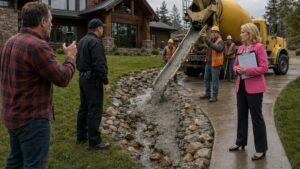
The concrete chute swung over Christopher Hall’s property line before anyone asked his permission.
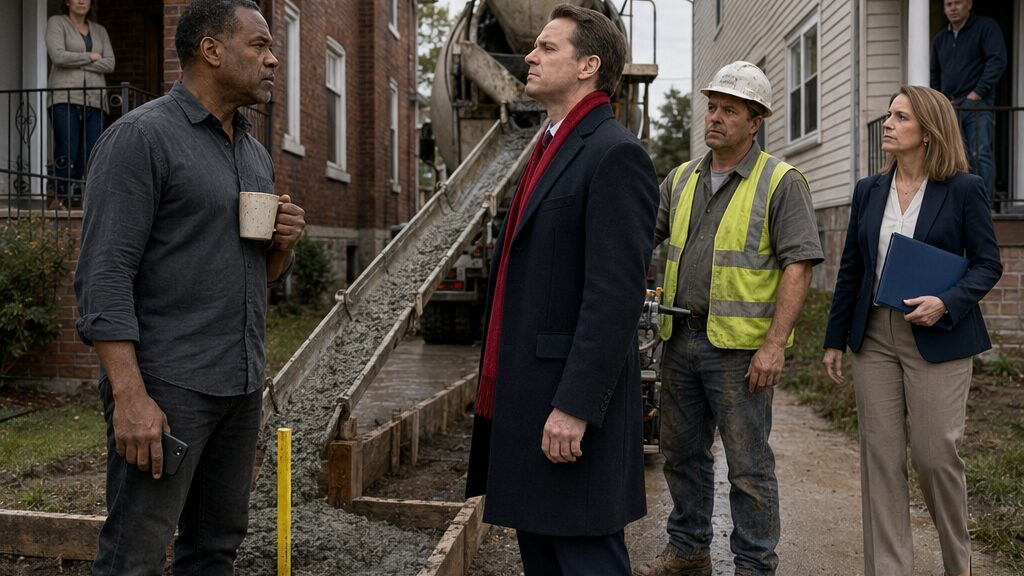
He saw it from the kitchen window: a steel neck extending from the mixer truck, wet gray concrete sliding toward the narrow strip between his brick house and Matthew Baker’s new garage. At the edge of the excavation stood a yellow survey stake Christopher had driven into the soil three days earlier.
The chute was aimed directly at it.
Christopher set his chipped coffee mug on the counter, then picked it up again. The handle had been repaired twice. His late wife used to say he held it whenever he needed to keep both hands from doing something foolish.
Outside, the mixer groaned. Workers guided the flow into wooden forms.
“Stop the pour,” Christopher called.
The concrete foreman looked up. Matthew did not.
Matthew stood beside the forms in a dark coat that belonged at a closing table, not a construction site. He watched the concrete settle as if he were watching money become permanent.
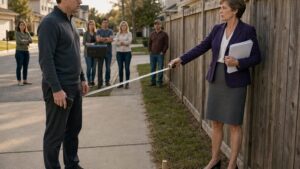
Christopher walked to the yellow stake. The wet edge was already less than two feet away.
“Your foundation crosses my parcel,” he said. “You need to shut this down until the boundary is verified.”
Matthew finally turned. “We verified it.”
“Not with the line on the ground.”
“The HOA approved the plans.”
“The HOA doesn’t establish title.”
One of the workers slowed the chute. The foreman glanced between them.
Matthew’s face tightened. “Chris, we’ve been through this. That old fence isn’t the property line.”
“I’m not talking about the fence.”
Christopher pointed with the mug toward the stake.
“The southeast monument puts the line here. Your outside footing is almost eleven feet over at the rear corner.”
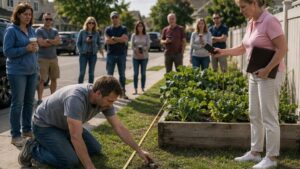
Matthew gave a short laugh. Two neighbors had come out onto their porches, drawn by the truck and raised voices. Christopher felt their attention settle on him.
“Eleven feet,” Matthew repeated. “You measured that yourself?”
Christopher did not answer the question. He had learned long ago that people asked about credentials when they did not like measurements.
“I’m giving you notice,” he said. “The foundation is crossing my property. Stop the pour and call a licensed surveyor.”
Matthew looked at the foreman. “Keep going.”
The chute moved.
Christopher felt the old heat rise under his ribs. He could step into the form. He could grab the lever. He could make the crew choose between pouring concrete and pouring it onto him.
Instead, he took out his phone.
He photographed the stake, the form, the chute, and the wet concrete. Then he switched to video.
“It is Monday, eight forty-two in the morning,” he said. “I am notifying Matthew Baker and the concrete contractor that this foundation extends onto parcel 17-B, my property. The yellow stake marks the surveyed line.”
Matthew stepped closer. “You recording me?”
“I’m recording the notice.”
“You don’t get to stop an approved project because you’re attached to a patch of side yard.”
“It isn’t a patch. It’s titled land.”
Matthew leaned near enough that Christopher could smell mint beneath the concrete dust.
“Then sue me.”
The words were quiet, almost conversational. That made them worse.
Matthew turned to the foreman. “Finish the footing.”
The foreman wiped his palms on his work pants. “Sir, I need both owners clear on this. He’s stated there’s a boundary dispute.”
“He’s not an owner of this project.”
“He’s claiming ownership of the ground.”
Christopher kept the camera steady.
The foreman looked directly into the lens. “For the record, I heard the objection before the pour reached that stake.”
Matthew’s jaw flexed. “And I’m telling you our plans are approved.”
A worker nudged the chute. Concrete spread around the lower half of the yellow stake. It trembled once, then leaned toward Christopher’s yard.
A sharp sound came from the street. A car door closing.
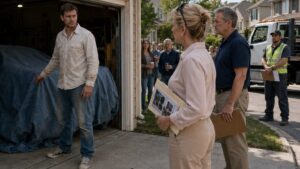
Kimberly Lewis crossed the lawn in low heels, carrying a blue folder against her chest. As HOA president, she had perfected a walk that suggested every sidewalk had been built for meetings she was already late to.
“What is happening?” she asked.
“Christopher is interfering with approved construction,” Matthew said.
“I’m documenting an encroachment.”
Kimberly looked at the concrete, then at the phone in his hand. “Please don’t escalate this.”
“The concrete is escalating it.”
She opened the folder. “The architectural committee reviewed Matthew’s application. The addition complies with the site plan in the association archive.”
“Your archive does not control the deed.”
“It is the plan used for every lot in this section.”
“Then every lot in this section deserves a better plan.”
One of the neighbors looked away to hide a smile. Kimberly noticed.
“Christopher, the board cannot allow individual homeowners to obstruct permitted improvements based on private interpretations.”
“Private interpretations have bearings and distances now?”
Her expression changed slightly. Not enough for anyone else to notice, perhaps, but Christopher saw it. She had expected anger. She had not expected terminology.
Matthew folded his arms. “Show him the plan.”
Kimberly removed a photocopy from the folder and held it out.
The paper was old enough that several lines had faded to gray. Lot 17-B sat beside 17-C, their boundary running straight between the houses. On the page, Matthew’s garage fit inside his lot with room to spare.
Christopher stared at the rear corner. The line passed east of the oak tree, not west.
That was wrong.
But it was wrong in a way he recognized.
“Where did you get this?” he asked.
“The association’s original development file.”
“This isn’t the recorded subdivision plat.”
“It is the plan the board relied on.”
Behind them, the yellow stake disappeared beneath the concrete. Only three inches remained visible, bright against the gray.
Christopher lowered his phone.
Kimberly mistook the movement for surrender. “We can schedule a review, but until then, the approved work proceeds.”
Matthew looked toward the forms with the relief of a man who believed paper had made him safe.
Christopher studied the faded marks in the lower corner of Kimberly’s copy. There was no surveyor’s seal. No recording stamp. Only a handwritten correction beside a field measurement.
A correction he had seen before.
The concrete kept flowing while Kimberly held out the map that placed the entire garage inside Matthew’s property.
Christopher knew one of the documents had to be wrong.
He also knew the handwriting on Kimberly’s page.
Chapter 2: Two Maps Cannot Own One Strip
The same fence corner occupied two different places on Christopher’s kitchen table.
On the licensed survey completed six months earlier, the corner sat eleven feet inside Matthew’s new foundation. On the HOA copy Kimberly had emailed that afternoon, it sat safely beyond the garage wall.
Anna Perez stood over both documents with her suit jacket draped across a chair.
“One of these is not merely inaccurate,” she said. “One of them is unusable.”
Christopher drank from the chipped mug. The coffee had gone cold.
“The county copy?” she asked.
“In the den.”
“Recorded deed?”
“Same drawer.”
“Security footage?”
“Laptop.”
Anna looked at him. “You had all this ready?”
“I keep records.”
“You also let a truck pour concrete across your land while you stood there holding breakfast.”
“I gave notice.”
“You could have called me before it hardened.”
“You were in court.”
“I own a phone.”
Christopher unfolded the recorded subdivision plat and placed it beside the others. Unlike the HOA page, it carried a recording number, surveyor’s certification, and monument references. The boundary followed the licensed survey closely.
Anna traced the lines with one finger.
“So the recorded plat supports you.”
“It supports the monuments. The monuments support the survey.”
“And the HOA approved construction from a photocopy that shifts the line.”
“That appears to be what happened.”
“Appears?”
Christopher moved the mug away from the papers. “Nothing is simple once people start paying lawyers to describe it.”
Anna’s impatience sharpened. “I am a lawyer.”
“You work legal aid.”
“The law changes when my clients have less money?”
“No. The amount of patience expected from them does.”
She stared at him, then opened the laptop.
The side-yard camera showed the morning in a wide, silent frame. Anna advanced the recording until the cement truck entered. Christopher appeared from his back door, mug in hand. The audio came from his phone video, which he had transferred separately.
His warning sounded clearer indoors than it had beside the mixer.
The yellow stake stood bright at the edge of the form. Matthew ordered the work to continue. The foreman acknowledged the objection. Then concrete rose around the stake.
Anna paused the image.
“There,” she said. “Notice before completion. Knowledge of the dispute. Continued construction.”
“Evidence of conduct, not ownership.”
“It matters.”
“It does.”
For the first time since arriving, she looked encouraged.
Then her eyes shifted to Kimberly’s photocopy.
At the bottom of the page, near a faint diagonal note, three initials had been written in blue-black ink.
C.H.
Anna leaned closer.
Christopher reached for the page, but she placed her hand over it.
“You recognized this outside.”
“It looked familiar.”
“It has your initials.”
“Lots of people have those initials.”
“Did lots of people work municipal field crews when this subdivision was built?”
Christopher looked toward the window. Beyond the glass, the upper edge of Matthew’s new foundation was visible between the houses.
The telephone rang before Anna could ask again.
Kimberly’s voice came through the kitchen speaker, precise and formally polite.
“Christopher, the board has received a complaint that you disrupted approved construction and threatened removal of a permitted improvement.”
“I did not threaten anyone.”
“You stated the project was trespassing.”
“That is a description.”
“The board will hold an emergency compliance hearing tomorrow at six-thirty.”
“Against Matthew?”
A pause.
“The notice concerns your interference and the unresolved boundary claim.”
Anna’s eyebrows rose.
Christopher said, “Your approved plan has no survey seal and no recording stamp.”
“It is part of the association’s official archive.”
“That does not make it a legal boundary survey.”
“You may present your evidence tomorrow. Until the county advises otherwise, the board’s approval remains active.”
“Kimberly, if additional work continues after notice—”
“This is exactly the kind of language the board considers escalatory.”
The line went quiet.
Anna closed the laptop with more force than necessary.
“They turned your complaint into a violation hearing.”
“They want control of the forum.”
“Then we take control back. Emergency injunction. County complaint. Formal demand to preserve records.”
“No injunction tonight.”
“Why?”
“Because we don’t know where that copy came from.”
“We know it’s wrong.”
Christopher folded the recorded plat along its original crease.
Anna studied him. “What aren’t you telling me?”
He carried the mug to the sink but did not pour out the coffee. On the shelf above the counter stood a photograph of his wife, smiling beside the oak tree before the fence had been replaced.
Years ago, she had asked him why the county never fixed the boundary file.
He had told her paperwork moved slowly.
That had been true, but not complete.
Anna reopened the HOA plan. “This correction—someone shifted the line west by eleven feet.”
“Approximately.”
“And wrote a field distance beside it.”
“Yes.”
“You didn’t need to study the page to understand it. You knew what it meant the moment Kimberly showed you.”
Christopher said nothing.
Anna’s voice lowered. “Dad.”
His silence, once useful, became a third document on the table—one neither of them could pretend not to see.
She tapped the initials.
“Why does the old correction carry your name?”
Chapter 3: The Hearing Turned the Warning Against Him
Christopher’s complaint appeared as Item Four on the HOA agenda under the words OWNER INTERFERENCE.
He read the line twice before entering the clubhouse.
His mug remained in the truck’s cup holder. He had reached for it when he parked, then stopped. Carrying it into a hearing would make him look too comfortable or too defensive. Without it, his right hand kept closing around nothing.
The meeting room smelled of carpet cleaner and burnt coffee. Kimberly sat at the center table with the HOA treasurer. Matthew occupied the chair nearest the display screen, a leather folder open in front of him.
Anna sat beside Christopher.
“Let me answer procedural questions,” she whispered.
“I can answer for myself.”
“That is not what I said.”
Kimberly called the meeting to order. “This hearing concerns an allegation that Mr. Hall obstructed approved work and made unsupported claims regarding the boundary between Lots 17-B and 17-C.”
“Unsupported?” Anna said.
“You’ll have time.”
Matthew shifted his chair back. He wore no coat tonight. His sleeves were rolled neatly, as if the hearing were another job site he intended to manage.
Kimberly displayed the archived plan. “The architectural committee approved Mr. Baker’s garage based on this document, retained in association records since the development’s initial turnover.”
Christopher watched several homeowners study the screen. The drawing looked official from a distance. Faded paper gained authority when enlarged.
Kimberly continued. “Mr. Hall’s recent objection relies on a private survey that the association has not yet independently reviewed.”
“Licensed survey,” Christopher said.
“Privately commissioned.”
“Those are not opposites.”
The treasurer looked down to hide a reaction.
Matthew stood. “I applied correctly. I paid every fee. I submitted the plan the HOA told me to use. Then, on pour day, Christopher appeared with a stake that had not been visible during our site inspection.”
Anna wrote something on her legal pad.
Christopher said, “The stake was placed three days before the pour.”
Matthew faced him. “According to you.”
Kimberly raised a hand. “We have photographs from the architectural inspection. No yellow stake appears.”
“Because the photograph faces north,” Christopher said. “The stake is behind the form from that angle.”
Matthew’s mouth tightened. “Or it was added later.”
The accusation settled over the room.
Christopher felt the absence of the mug more sharply than he expected. He placed both hands flat on the table.
Anna connected the laptop to the display.
“Then let’s use the camera,” she said.
The side-yard footage filled the wall. The timestamp showed Monday morning. The yellow stake was visible before the truck arrived, upright beside the empty form.
A murmur passed through the room.
Anna advanced the recording. Matthew appeared. The foreman checked the form. Workers positioned the chute. The stake never left the frame.
Matthew leaned toward Kimberly. “That angle could be distorted.”
“The timestamp is continuous,” Anna said.
Kimberly’s expression became careful. “The footage establishes that the marker existed. It does not establish that the marker represents the legal boundary.”
“That is true,” Christopher said.
Anna glanced at him, surprised by the concession.
Christopher stood. “Which is why I told Matthew to stop and obtain an independent survey. I did not ask the crew to accept my marker as law. I gave notice of a credible dispute before the concrete reached it.”
Kimberly turned to the foreman, who had been asked to attend by speakerphone. His voice crackled through the room.
“I heard Mr. Hall say the footing crossed his property. I told Mr. Baker there was a dispute.”
“And did Mr. Hall physically obstruct your crew?” Kimberly asked.
“No.”
“Did he threaten anyone?”
“No.”
“Did he enter the form?”
“No, ma’am. He stood clear.”
Public doubt shifted, small but visible. One neighbor who had avoided Christopher’s eyes now looked directly at him.
The screen froze on the moment concrete covered the yellow stake.
Kimberly cleared her throat. “The board acknowledges that Mr. Hall’s conduct did not constitute physical obstruction.”
It was less than an apology, but more than Christopher had expected.
Then Matthew opened his folder.
“The board should also know that Christopher has a personal connection to the disputed drawing.”
Anna’s pen stopped.
Matthew placed a sharpened copy of the archived plan on the table. The handwritten notation in the corner had been enlarged.
C.H.
Kimberly looked at Christopher. “Are those your initials?”
He could have answered yes and explained the rest. He could have told them about the field crew, the misplaced iron pin, the unofficial correction, and the supervisor who promised to submit an amended sketch.
Instead he said, “Initials do not establish authorship.”
Anna’s face changed.
Matthew sat back. He had been waiting for exactly that answer.
Kimberly’s tone became cooler. “Did you work on this subdivision?”
“I worked for the city when the roads were accepted.”
“That was not my question.”
The room seemed suddenly too warm.
Christopher said, “The document on the screen is not a recorded survey.”
Kimberly looked to the treasurer, then back to him. “Until the county completes its review, the board will not withdraw Matthew’s approval. Limited construction may continue at his risk, provided no vertical framing begins on the disputed side.”
Anna leaned toward Christopher. “At his risk is not the same as permission.”
But Matthew had already heard the part he wanted.
Outside, after the meeting, the clubhouse lights threw long rectangles across the parking lot. Anna walked ahead without speaking.
Christopher reached his truck and saw the mug through the window.
Matthew came up behind him.
“You should have told them,” he said.
Christopher turned.
Matthew no longer looked triumphant. He looked alert, almost wary.
“Told them what?”
“That you drew the correction.”
Christopher’s hand stopped above the door handle.
Matthew lowered his voice. “I know it was you, Chris. I know what happened to the original field notes too.”
Anna had reached her car. She looked back but could not hear them.
Christopher faced Matthew fully.
“How much do you know?”
Matthew glanced toward the clubhouse doors.
“Enough to know you don’t want this dispute examined in public.”
Then he walked away, leaving Christopher beside the truck, his chipped mug visible behind the glass and the old correction no longer buried safely in the past.
Chapter 4: The Offer Hidden Behind the Garage Wall
Matthew was waiting inside the structure he had built partly on Christopher’s land.
At nine Wednesday morning, he stood between unfinished wall frames and gestured through the open doorway as if inviting Christopher into a house he owned without question.
“Come look before you decide what you’re trying to destroy,” Matthew said.
Christopher remained outside the form line. The concrete had cured to a pale, hard gray. Only the top of the yellow survey stake remained visible near one corner, trapped like a warning no one had bothered to remove.
“You asked to talk,” Christopher said.
“Privately.”
“That does not require me to stand inside the disputed area.”
Matthew glanced toward the street. No work crew had arrived. The neighborhood was quiet except for a compressor cycling somewhere behind the house.
“Fine.” He stepped back into the garage and lifted two paper cups from a temporary workbench. “Coffee?”
Christopher looked at the clean white cup. No stains, no chip, no history.
“No.”
Matthew set both cups down.
Without his coat and the hearing-room confidence, he looked younger. Tired, too. A stack of contractor invoices lay beneath a tape measure on the bench.
“You know the archived plan isn’t something I invented,” Matthew said. “The HOA gave it to me before I bought the property.”
“It still isn’t a recorded survey.”
“My lender accepted it. The architect accepted it. The board accepted it.”
“And when the current survey contradicted it?”
Matthew’s eyes shifted to the framed opening where the garage door would go.
“I didn’t have your survey before construction.”
“You had my written notice two weeks before the pour.”
“I had a letter saying you disagreed with the line.”
“It included the surveyor’s contact information.”
Matthew took a breath. “Do you know what happens if I move this structure now?”
Christopher said nothing.
“I lose the framing deposit. I pay redesign fees. The contractor charges a delay penalty. The lender reopens the entire construction package.” Matthew tapped the invoices. “They can suspend the draw. If they do that, I have to carry the project myself.”
“That explains why you wanted the old map to be right.”
“It explains why I relied on the documents everyone else relied on.”
“Until the stake appeared.”
Matthew’s face tightened. “You knew that stake would stop the project.”
“I expected it to stop long enough for someone to verify the line.”
“You expected me to trust a marker you placed yourself.”
“I expected you to recognize risk.”
Matthew moved to the rear wall frame. Beyond it, the disputed strip narrowed toward the oak tree.
“There’s another option,” he said. “We correct the boundary after construction.”
Christopher almost laughed, but Matthew’s expression stopped him.
“You sell me an easement—or a narrow adjustment. Enough to cover the footing. I pay above market value. We record it properly. No lawsuit. No demolition.”
“And until then?”
“We tell the board we resolved it.”
“You mean I tell them the disputed plan is acceptable.”
“I mean we avoid turning a clerical error into a public disaster.”
Christopher studied him. “You knew there was a clerical error.”
Matthew did not answer quickly enough.
“When?” Christopher asked.
“A title reviewer flagged a discrepancy before closing.”
“Before you bought the house?”
“They called it nonmaterial.”
“Eleven feet is material.”
“The old fence matched the HOA plan.”
“The fence was replaced after the original owner stopped maintaining it.”
“I didn’t know that.”
“You knew enough to ask.”
Matthew’s hand flattened on the workbench. “I asked. I was told the county records were inconsistent and the association plan had been used for decades.”
“And you chose the version that preserved your garage.”
“I chose the version that let the project survive.”
The words hung between the open studs.
For the first time, Christopher saw the shape behind Matthew’s arrogance. It was not certainty. It was momentum. Loans, contractors, permits, and reputation had pushed him forward until stopping felt more dangerous than being wrong.
Matthew lowered his voice.
“This is my first project without my father’s company behind me. The lender gave me a deadline because they think I’m overextended. If the title defect stays open, the next draw doesn’t fund.”
“You should have stopped before the pour.”
“I should have done several things differently.”
It was not an apology. It was closer than Christopher expected.
Matthew picked up one of the coffee cups and turned it slowly between his palms.
“You don’t want the old file examined any more than I do.”
Christopher felt his shoulders stiffen.
Matthew continued. “The field correction has your initials. There are notes showing someone identified a misplaced monument but never completed the amendment.”
“Where did you see those notes?”
“In a scanned lender packet. Partial copies.”
“Show me.”
“I don’t have them here.”
“You came to bargain with something you cannot produce?”
“I came to give you a way out.”
“A way out of my own land?”
“A way out of explaining why you knew the county file was wrong for thirty years.”
Christopher looked past him at the new wall frames. The structure was clean, square, and expensive. It had the appearance of something inevitable.
“My wife asked me about that line more than once,” he said.
Matthew waited.
Christopher regretted the sentence as soon as it left him.
“She knew?” Matthew asked.
“She knew records had not been corrected.”
“And you left it that way.”
Christopher turned toward his house.
“Think about the easement,” Matthew called. “You get paid. I absorb the recording costs. Nobody has to lose everything.”
Christopher stopped beside the concrete-covered stake.
“Somebody already decided I could lose eleven feet because staying quiet would be easier.”
He left before Matthew answered.
At the county records office, the clerk brought out three subdivision files and apologized for the delay. Christopher worked through them at a narrow table beneath fluorescent lights.
The recorded plat was where it should be. So were the monument descriptions and road-acceptance records. The supplemental field sketch was missing.
He asked for the municipal crew notes from the year the subdivision was completed.
The clerk checked the index twice. “Those would be in the retired field books, if they were retained.”
Christopher knew one had been retained. He had kept his own duplicate notebook after leaving the city—part habit, part unfinished obligation.
He drove home and went directly to the garage office.
The bottom drawer of the metal cabinet was unlocked. Inside were tax folders, old licenses, and the canvas pouch that had held his notebooks.
The field book was gone.
Christopher searched the desk, the shelves, and the box containing his wife’s estate papers. Nothing.
His phone alerted him to movement captured by the garage camera the previous evening.
He opened the recording.
After the HOA hearing, while Christopher and Anna were still in the clubhouse parking lot, Kimberly crossed his driveway. She tried the side door of the garage office. It opened. She stepped inside and remained there for four minutes.
When she emerged, her blue folder was tucked beneath one arm.
Christopher froze the image as she pulled the door shut.
Chapter 5: The Missing Notebook Was Not Stolen
Anna placed the missing field notebook on Christopher’s kitchen table before he could accuse Kimberly of taking it.
The small book landed beside his chipped mug with a heavy, clothbound thump.
Christopher stared at it.
Anna remained standing. “I took it.”
His hand closed around the mug. “You entered my office without asking.”
“The door was open.”
“That is not permission.”
“No. It isn’t.”
“Kimberly went in after the hearing.”
“I know. I saw the camera clip you sent.”
“You let me believe she took this.”
“For twelve minutes. You let me believe you had told me everything for two days.”
Christopher looked down at the notebook. The dark canvas cover had softened at the corners. A faint line of red soil still marked the lower edge.
“You had no right.”
“I had reason.”
“To steal from me?”
“To stop you from making a decision out of fear.”
“I was not going to destroy it.”
Anna’s expression held.
Christopher set the mug down harder than he intended. Coffee climbed the inner wall and settled again.
“You think I would?”
“I think you spent thirty years not filing what was inside it. I did not know what another bad night might convince you to do.”
The statement hurt because it was not cruel. It was cautious.
Anna sat across from him and opened the notebook near the middle. The pages were filled with distances, bearings, curb elevations, and abbreviated notes written in Christopher’s younger hand.
She turned to a page marked with the subdivision number.
A sketch showed the rear monument beside the oak tree. A heavy arrow pointed toward a second iron pin. Next to it, Christopher had written:
FOUND MONUMENT 11.2′ WEST OF DESIGN POSITION. CHECK ORIGINAL CONTROL. DO NOT USE HOA FIELD COPY FOR LOT STAKING.
The date was twenty-eight years earlier.
Below the warning were his initials.
Christopher remembered the afternoon clearly. The crew supervisor had been angry about delays. Rain was coming. The developer wanted the road acceptance packet closed before the end of the quarter.
Christopher had measured the discrepancy twice and brought it to the supervisor.
The supervisor told him to prepare a correction sheet.
“I did,” Christopher said.
Anna did not soften. “Where is it?”
“I submitted it with the field package.”
“But it was never recorded.”
“No.”
“Did you follow up?”
“Once.”
“And?”
“I was told the county surveyor would reconcile it with the developer.”
Anna looked at the page. “Then you stopped asking.”
“I was a technician. I did not control recording.”
“You controlled whether you kept raising the problem.”
Christopher’s gaze shifted to the photograph above the counter.
His wife had known the shorter version. She knew a boundary discrepancy existed. She did not know that the note in his own hand had warned against the exact document now being used against him.
“I had just been promoted,” he said. “My supervisor told me I was confusing a field irregularity with a legal defect. He said if I kept delaying acceptance, I could explain the cost to the city engineer.”
“So you let him close it.”
“I let myself believe the recorded plat would control if the issue ever mattered.”
Anna closed the notebook halfway. “It matters now.”
“Yes.”
“And Matthew knows enough to make your silence look dishonest.”
“Yes.”
The admission left no place to hide.
Anna turned another page. Stapled inside the back cover was a carbon copy of the correction sheet. It showed the proper monument relationship and carried Christopher’s signature as preparer, but no approval signature above it.
“This helps the boundary case,” she said.
“It also proves I knew the association copy was unreliable.”
“It proves you documented the error.”
“And failed to ensure correction.”
“You were not the recording authority.”
“I lived beside the mistake for twenty-eight years.”
Anna studied him. “Because the fence happened to sit on the right side.”
“And because correcting it would have reopened the whole subdivision file.”
“And because you were embarrassed.”
Christopher looked at her.
“That part matters,” she said. “Not legally. To me.”
He rubbed his thumb along the chip in the mug.
“You thought I did not trust you,” he said.
“I thought you preferred being the only person in the room who knew the truth.”
The sentence was too accurate to reject.
A car door closed outside. Christopher glanced toward the window, expecting Kimberly. It was only a delivery driver moving toward the house across the street.
Anna reopened the notebook.
“There is another problem,” she said. “If we disclose this, Matthew will argue you knew about the defect before he built and failed to provide complete notice.”
“I gave him the licensed survey.”
“But not this history. It could reduce damages. A judge might say you had a duty to clarify sooner.”
“The line will still be the line.”
“Yes. The land claim becomes stronger. The money claim becomes less certain.”
Christopher understood what she was offering him: not reassurance, but a choice with cost attached.
“Could we proceed without the notebook?” he asked.
“We could.”
Anna waited.
He picked up the book. It weighed less than his mug, but his hand felt less steady.
“What would you advise a client?” he asked.
“To disclose it before the other side does.”
“And your father?”
Her face shifted, just enough to show that the two roles had never been separate.
“I would tell him the truth does not become safer because he keeps it in a drawer.”
Christopher opened the cabinet above the refrigerator and took down a clear document sleeve. He slid the notebook inside.
His phone rang.
The display showed Thomas Garcia from the county building department.
Christopher answered.
“I reviewed the plat and the survey you submitted,” Thomas said. His voice carried the measured caution Christopher remembered from city offices. “There are enough inconsistencies to justify an on-site determination.”
“When?”
“Tomorrow. Six-thirty in the morning. I’ll have a survey crew and permit technician with me.”
Christopher looked at Anna.
Thomas continued. “Matthew and the HOA have been notified. No final ruling until we reconcile the physical monuments with the recorded documents.”
“I understand.”
“One more thing, Chris. If you have any historical notes connected to the subdivision, bring them.”
Christopher looked at the notebook sealed inside the sleeve.
Thomas had not asked whether such notes existed. He had asked Christopher to bring them.
“I will,” Christopher said.
After the call ended, Anna pushed the mug toward him. It had left a dark ring beside the notebook.
Christopher wiped the ring away, then placed the field book on top of the county survey where it could not be overlooked.
At dawn, he would have to decide whether to hand it over before anyone asked twice.
Chapter 6: Eleven Feet Became an Official Fact
Thomas Garcia uncovered the yellow stake with a hammer and a narrow masonry chisel.
Each strike broke a thin shell from the hardened footing. Gray fragments scattered across the cold ground until the stake’s bent metal edge appeared beneath the concrete.
The county survey crew watched from behind a tripod. Matthew stood near his driveway with his arms folded. Kimberly held the same blue folder she had carried all week.
Christopher kept the field notebook beneath his arm.
Thomas worked until he could grip the stake with pliers. When it came free, the lower half was coated in concrete and bent toward Christopher’s parcel.
“This was in place before the footing cured?” Thomas asked.
“The camera shows it standing before the truck arrived,” Christopher said.
Matthew answered at the same time. “It was placed by the complainant.”
Thomas looked from one man to the other. “Who placed it is less important than whether it corresponds to the legal boundary.”
The survey crew began from the original subdivision control point near the street. They measured to the rear monument, checked the oak tree reference, and then located an iron pin beneath several inches of soil.
Christopher recognized the rhythm: call a distance, check the prism, record, repeat. Procedure had once comforted him because it removed personality from the result.
Today, every number seemed to lead back to his own silence.
The permit technician compared Matthew’s approved construction plan with the footing. Kimberly spoke quietly about association reliance and architectural consistency. Thomas listened without committing himself.
After forty minutes, the surveyor called him over.
Thomas studied the screen on the data collector. Then he faced the group.
“The recovered monument agrees with the recorded subdivision plat within normal tolerance. The recent private survey also agrees with the monument.”
Matthew’s folded arms loosened.
Thomas continued. “The rear outside corner of the footing crosses Lot 17-B by eleven feet, two inches. The encroachment narrows toward the front.”
Kimberly opened her folder. “Our archived site plan shows a different line.”
“I’ve seen it.”
“The board relied on it in good faith.”
“That may matter to liability. It does not move the monument.”
The statement was quiet, but it changed the space between the houses. Eleven feet was no longer Christopher’s claim. It was an official measurement.
Matthew turned toward him. “You knew this before I bought.”
Christopher felt the notebook against his ribs.
Anna stood near his porch, saying nothing.
He could wait for Thomas to ask. He could let the county issue its finding first, then disclose only what became necessary. The boundary would remain correct either way.
That was how the old error had survived: one necessary step postponed until someone else owned it.
Christopher stepped forward.
“There is a historical field record you need to see.”
He removed the notebook from the sleeve and handed it to Thomas.
Matthew gave a short, humorless laugh. “There it is.”
Thomas opened to the marked page. He read Christopher’s warning, then examined the carbon copy of the unapproved correction sheet.
“You prepared this?” he asked.
“Yes.”
“And the initials on the association copy?”
“Mine, though that copy omits the warning and control references. It appears to have been made from an earlier field sketch.”
“Why was the correction not recorded?”
“My supervisor said it would be reconciled with the developer. I submitted the sheet. I followed up once. Then I let it go.”
Kimberly looked at him as if he had changed shape.
“You knew our plan might be wrong,” she said.
“I knew it was not suitable for boundary staking.”
“You never notified the association.”
“No.”
Matthew stepped closer. “But you waited until after I poured to produce that.”
“I gave you the current licensed survey before you poured.”
“You didn’t give me this.”
“No.”
Thomas closed the notebook.
Christopher expected disapproval. Instead, Thomas asked the survey crew to compare the historical correction against the control data.
The surveyor studied it, entered two figures, and nodded.
“This supports the monument position,” he said. “It explains the source of the discrepancy.”
Matthew looked toward his half-built garage.
Thomas handed the notebook back to Christopher. “Your failure to follow through may become relevant in a civil damages dispute. It does not invalidate the recorded plat or relocate the land.”
The distinction landed with more force than absolution would have. Christopher had not been declared innocent. He had been required to stand in the correct place while admitting how long he had avoided it.
Thomas walked to the permit van and returned with a red notice.
“Because the approved site plan conflicts with the verified boundary, construction is suspended on the garage addition effective immediately.”
He attached the stop-work order to a front wall stud.
Matthew stared at the paper. “The foundation is already complete.”
“The order applies to all further work.”
“What about removal?”
“That requires either an agreement between the owners, an administrative determination where applicable, or a court order. The county is not authorizing private demolition today.”
Kimberly exhaled as if that limitation gave her something to hold.
Thomas continued. “The permit file will remain suspended until the title defect and encroachment are cured.”
Matthew’s phone began ringing.
He looked at the screen and walked toward the street before answering. Christopher heard only fragments.
“Yes, I’m on site.”
“No, the inspection did not clear.”
“Forty-eight hours?”
Matthew stopped walking.
The lender representative’s voice was too faint to understand, but Matthew’s posture carried the message before he ended the call.
He returned slowly.
“They’re suspending the next draw unless I cure the title defect within forty-eight hours.”
No one answered.
The red stop-work notice moved slightly against the bare wood as the morning air passed through the unfinished walls.
Matthew looked at Christopher, no longer with contempt and not yet with surrender.
“What do you want?” he asked.
Christopher glanced at the concrete-coated stake in Thomas’s hand.
For days he had wanted the line acknowledged. Now it was official, and acknowledgment had opened a harder question.
The county could tell them where the property ended.
It could not decide what Christopher should demand from the man who had crossed it.
Chapter 7: The Board Wanted a Quiet Easement
The settlement check covered the disputed strip on the map.
Christopher could still see the boundary line beneath it, a thin black edge emerging from under the paper before disappearing again beneath the lender representative’s signature.
Across the mediation table, Kimberly Lewis folded her hands.
“This is not an admission of fault by the association,” she said. “It is a practical solution.”
Anna sat beside Christopher with the field notebook closed in front of her. Matthew occupied the opposite end of the table. He looked as though he had not slept since the county inspection.
The lender representative pushed the check closer.
“The amount reflects the land value, recording expenses, and a premium for inconvenience. Mr. Hall grants a permanent easement covering the existing footing. The title defect is cured, construction resumes, and everyone avoids litigation.”
Christopher brought his chipped mug to his mouth, then lowered it without drinking.
“How permanent?” he asked.
The representative blinked. “The easement runs with the land.”
“So if I sell my house, the next owner loses the strip too.”
“They purchase subject to the recorded easement.”
“And if Matthew sells?”
“The garage rights transfer with his parcel.”
Christopher looked at Matthew. “The mistake becomes legal because you poured fast enough.”
Matthew leaned forward. “It becomes resolved.”
“No. It becomes inherited.”
Kimberly slid a second document from her folder. “The association will also revise its architectural procedures. Future applications involving side-yard construction will require a current boundary survey.”
“Future applications,” Anna said. “But no correction to the archive?”
Kimberly’s gaze shifted toward the map.
“We can annotate the file.”
“That is not the same as acknowledging it was unreliable,” Anna said.
“The board used the only plan available to us.”
Christopher set the mug down.
The ceramic made a small, hard sound against the table. Everyone looked at it.
“You knew it was unreliable,” he said.
Kimberly’s expression remained controlled. “I knew it differed from the recorded plat.”
“When?”
“Before the emergency hearing.”
Anna opened her legal pad, but Christopher raised one hand.
Kimberly continued. “The architectural committee had already approved the project. Work had begun. If we suspended every approval the moment a homeowner produced a conflicting document, no one could rely on board decisions.”
“So you decided Matthew should rely on yours and I should not rely on mine.”
“I decided the county should resolve the discrepancy.”
“While construction continued.”
“At Matthew’s risk.”
Matthew gave a tired laugh. “Everyone keeps saying that as if the risk belonged only to me.”
The lender representative checked his watch.
Christopher looked again at the check. It was more money than the narrow strip would have brought in an ordinary sale. Enough to replace the roof, repair the porch, and leave something substantial for Anna.
His wife would have understood the temptation. She had spent years turning down the thermostat and postponing repairs while he insisted the house would outlast them both.
Anna did not look at the check. She looked at him.
Matthew said, “Take it, Chris.”
Christopher’s eyes lifted.
“You keep the yard you actually use,” Matthew continued. “I finish the garage. The HOA fixes its process. Nobody spends two years in court.”
“And the official record says the foundation belongs where it is.”
“It says I paid for the right.”
“You paid after taking it.”
Matthew’s jaw tightened. “Do you want a remedy or do you want me punished?”
The question struck closer than Christopher expected.
For days, he had imagined the concrete breaking. He had imagined Matthew standing helpless beside it. Those images had felt like justice when anger was doing the measuring.
Now, with the check on the table, Christopher saw another possibility: he could call revenge principle and no one would correct him.
He turned the mug once by its handle.
“I don’t want the whole foundation removed,” he said.
Matthew stared at him.
Christopher pulled the map from beneath the check and laid it flat.
“The front portion is inside your parcel. The garage can survive if the rear wall is redesigned and the footing is cut back to the certified line.”
The lender representative frowned. “Partial removal still requires engineering review.”
“Yes.”
“It will reduce the usable depth,” Matthew said.
“Yes.”
“The lift bay won’t fit.”
Christopher had seen the plans. The garage was not only for cars. Matthew had designed space for a workshop, storage wall, and lift.
“The house already has a two-car garage,” Christopher said.
“That is not the point.”
“No. The point is that your expansion does not get to occupy my land.”
Kimberly leaned toward him. “A permanent easement is cleaner.”
“For the board.”
“For every party.”
“Not for the next owner of my house.”
Anna slid the check back toward the lender representative.
Matthew stood so suddenly his chair struck the wall.
“You’re choosing demolition over a settlement that makes you whole.”
“I’m choosing removal to the true line.”
“You know what that costs.”
Christopher met his eyes. “You knew enough to stop.”
Matthew looked toward Kimberly, then the lender representative, as if one of them might produce a rule that restored his leverage.
Kimberly said quietly, “Matthew, the association cannot defend the archived plan after the county finding.”
He turned on her. “You defended it three days ago.”
“And that was a mistake.”
It was the first clean admission anyone from the board had made.
Matthew sat again, but the anger remained in his shoulders.
“I continued because every time this came up, Christopher went quiet,” he said. “At the hearing. In the emails. Even when I mentioned the old field notes. He always stopped one sentence short.”
Christopher felt Anna’s attention shift toward him.
Matthew continued. “I thought he would never risk his own name over eleven feet. I thought if the project got far enough, he would take money.”
The room went still.
There it was: not a misunderstanding, not a map, not lender pressure. A calculation about Christopher himself.
His silence had not protected his dignity. It had been priced.
Christopher pushed his chair back and stood.
“At the county hearing,” he said, “I will submit the field notebook, the correction sheet, the recorded plat, and the camera footage. I will testify that I failed to follow through twenty-eight years ago. I will also testify that you received a current survey before the pour and continued anyway.”
Matthew’s face lost color.
“The association record will be corrected publicly,” Christopher said. “Not annotated in a private folder. Corrected.”
The lender representative gathered the check.
“Court action will freeze the construction loan,” he warned.
Matthew did not look at him.
Christopher picked up his mug but did not hide behind it.
“You have until Monday to agree to removal at the certified line,” he said. “After that, I stop negotiating.”
He left the room with Anna beside him.
Behind them, no one spoke until the door had nearly closed.
Then Matthew said, “Wait.”
Chapter 8: The Mug Stayed Still While the Concrete Broke
The demolition saw touched the foundation exactly where the certified line crossed it.
Its blade screamed against the concrete, sending pale dust into the narrow side yard. Two restored yellow stakes stood several feet apart, untouched on Christopher’s side.
His chipped mug remained on the porch rail.
Two weeks had passed since the mediation. Matthew had signed the agreement on the final afternoon, after the lender confirmed that a controlled redesign would preserve the main house loan. The HOA accepted part of the survey and recording costs. Matthew accepted the removal expenses and the loss of his planned workshop depth.
No one called it a victory in the paperwork.
The demolition contractor guided the saw along a bright chalk mark between the stakes. Behind him, a structural engineer watched the cut approach the rear footing.
Christopher stood near the porch steps with Anna.
“You could go inside,” she said.
“So could you.”
“I’m here professionally.”
“You brought donuts.”
“Legal professionals eat.”
The saw stopped. For a moment, the yard was silent except for the ticking metal of the machine.
Matthew came out through the unfinished garage opening. He wore work pants and an old sweatshirt, not the dark coat from pour day. His face tightened when he saw the cut.
“That is deeper than we discussed.”
The contractor removed his hearing protection. “It follows the engineer’s mark.”
Matthew stepped closer. “You’re cutting through the reinforced section.”
“The reinforcement crosses the property line.”
“That section supports the wall.”
“The replacement footing will support the redesigned wall.”
Matthew looked at Christopher.
“They’re destroying my foundation.”
Christopher glanced at the yellow stakes.
“No,” he said. “They’re removing the part that never became yours.”
Matthew’s mouth opened, but Christopher continued before the argument could return to its old shape.
“Ownership begins where consent and law agree. You had neither past that line.”
The contractor replaced his hearing protection. The saw started again.
Concrete dust drifted across the forms. The machine cut slowly, without drama, following the certified boundary inch by inch. There was no crowd. Kimberly had come earlier to confirm the HOA inspection and left before work began. Two neighbors watched from a distance but did not approach.
Christopher was grateful for that.
He had imagined this day too many times with Matthew humiliated at its center. The real thing felt heavier. Every broken section represented money, labor, and a decision that could not be undone.
When the cut was complete, the crew used a compact breaker to separate the encroaching portion. Cracks spread through the gray slab. Pieces were lifted from Christopher’s land and placed into a disposal bin.
The yellow stakes did not move.
Matthew stood inside the reduced footprint, measuring the remaining space with his eyes.
“The lift won’t clear the new wall,” he said.
Christopher knew the statement was not addressed to anyone.
Anna answered anyway. “The revised permit shows standard vehicle depth.”
“I know what it shows.”
The bitterness in his voice remained, but the old contempt had thinned.
During the second hour, the demolition contractor uncovered the bent stake Thomas had removed and saved. He held it out to Christopher.
“Want this?”
Concrete still clung to the lower half.
Christopher took it. The metal was heavier than it looked.
Matthew watched from the garage.
“You’re going to frame it?” he asked.
Christopher examined the bend.
“No.”
He handed it back to the contractor. “Put it with the waste.”
Matthew looked surprised.
“I thought that was your proof.”
“It did its job.”
The contractor tossed the stake into the bin.
By noon, the encroaching concrete was gone. A clean trench marked the place where the new retaining edge and footing would be installed. Christopher’s parcel looked raw, but it was his again.
Matthew approached while Anna reviewed the final measurement with the engineer.
“The lender approved the revised draw,” he said.
Christopher nodded.
“I had to sell the equipment I bought for the lift.”
“I’m sorry you lost money.”
Matthew studied him, searching for mockery.
Christopher gave him none.
“You don’t have to be sorry,” Matthew said.
“I can regret the cost without regretting the boundary.”
Matthew looked toward the porch. “You left the mug over there.”
Christopher followed his gaze.
For years, he had held it through hard conversations as though composure lived in the ceramic. Today it had stayed where he placed it.
“I didn’t need it,” he said.
Matthew gave a slight nod.
It was not reconciliation. It was recognition, and for the moment that was enough.
Later that afternoon, Kimberly returned with the corrected HOA file. The unreliable site plan had been stamped as historical reference only. A new policy required licensed boundary verification for additions within fifteen feet of a lot line.
She handed Christopher a copy.
“The board statement includes our reliance on the wrong document,” she said. “And my decision to allow limited work after the dispute was raised.”
“That will make some meetings uncomfortable.”
“It already has.”
She looked toward Matthew’s shortened garage.
“I thought consistency protected the association.”
“Sometimes it only repeats the first mistake.”
Kimberly accepted the sentence without defending herself.
When everyone had gone, Christopher and Anna sat at the kitchen table. The corrected plat lay between them. His field notebook rested beside it, no longer hidden in a drawer.
At the bottom of the county filing, a blank line waited for his signature acknowledging the historical correction.
Christopher picked up a pen.
“You know,” Anna said, “we can review it again tomorrow.”
“That sounds like something I would say.”
“It is.”
He signed.
The letters of his name looked steadier than he felt.
For twenty-eight years, he had treated the missing correction as another person’s unfinished duty. He had told himself that the monuments remained, that the recorded plat was enough, that no harm had occurred.
Then concrete had crossed the line his silence left vulnerable.
Christopher slid the signed plat toward Anna.
“File it before I can change my mind.”
She placed it inside her case.
Outside the kitchen window, the space between the houses looked wider without the disputed foundation. The new yellow stakes caught the late light along the restored boundary.
Christopher carried his mug to the sink.
The chip was still there. He ran his thumb across it once, then set the mug beside the drying rack instead of holding on.
The story has ended.