The Garden Bed Wasn’t Over the Line, But the Truth Buried Under It Was
Chapter 1: The Pink Polo at the Edge of the Garden
“Your garden bed is on my side,” Nancy Roberts said, pointing at the fresh cedar boards as if they had crawled across the grass overnight. “Move it today.”
Joshua Harris stood with one hand still resting on the handle of his shovel. A line of dark soil marked the edge of the new raised bed, and six tomato seedlings leaned in their paper cups beside his work boots, waiting to be planted. He had spent the whole afternoon leveling the frame, checking the slope, making sure the boards sat square with the fence.
Nancy stood two yards away in a pink polo, white capris, and sunglasses pushed up in her hair. Her lips were tight, her shoulders back. She was not dressed like someone passing through. She was dressed like someone delivering a decision.
Joshua looked from the bed to the narrow strip of grass between their houses. “I’m pretty sure it isn’t.”
“Pretty sure doesn’t matter,” Nancy said. “The HOA map says this strip is mine up to that line.”
She jabbed her finger at nothing visible.
There was no fence between their side yards, only grass, sprinkler heads, and the uneasy openness that came with houses built too close together. Joshua had always hated that strip. Mowing it felt like borrowing air from someone else. For years he had kept everything tucked close to his foundation just to avoid exactly this.
He set the shovel down slowly. “What line?”
Nancy gave him a look that belonged in a meeting, not a yard. “The property line, Joshua.”
“I know what you mean. I’m asking where you think it is.”
“It runs right there.” She pointed again, this time at the outer corner of the raised bed. “You’ve crossed it.”
The cedar boards were clean and pale, new enough that they still smelled sharp in the late afternoon heat. Joshua had built the bed eight feet long, three feet wide, with room for tomatoes, basil, and peppers. His daughter had picked the tomato starts last weekend, holding them up in the garden center like they were something more fragile than plants.
He did not want Nancy’s voice attached to that memory.
“Did you measure it?” he asked.
Nancy blinked once. “Excuse me?”
“The line. Did you measure it?”
“I don’t need to measure what’s already in the HOA packet.” She lifted a folder he had not noticed, tucked under her arm. A small stack of papers showed at the edge. “I’m the compliance chair. I know these lots.”
The front door across the street opened. Joshua saw Linda Moore step onto her porch in a blue zip-up hoodie, phone in one hand, mail in the other. She slowed when she saw Nancy and Joshua facing each other over the bed.
Nancy saw her too. Her voice rose just enough to travel. “We’re trying to handle this before it becomes a formal issue.”
Joshua felt his jaw tighten.
There it was. The invisible audience. The thing Nancy understood better than anybody on the street. A complaint spoken softly was a question. A complaint spoken with a witness became a record.
Linda crossed the street with the kind of careful casualness people used when they wanted to watch but not admit they were watching. “Everything okay?”
Nancy answered before Joshua could. “Joshua installed a garden bed over the side boundary.”
Linda looked at the raised bed, then at Joshua. “Oh.”
It was a small word, but it landed hard. Joshua could hear the rest of it: That explains it. That seems like something a man living alone might not think through. That’s awkward.
“I haven’t seen any measurement,” Joshua said.
Nancy held the folder higher. “You were emailed the community property diagram when you bought the house.”
“I bought this house eleven years ago.”
“Then you’ve had eleven years to understand the line.”
Linda’s eyes slid toward the bed again. She did not look hostile, only interested, and somehow that was worse. The story was taking shape without him. Nancy in the role of order. Joshua in the role of careless neighbor. The garden bed as evidence.
He could feel the old instinct rising in him, the one that had gotten him through the divorce, his father’s illness, the months when the house went quiet except for the refrigerator and the dryer. Say little. Stay calm. Let the other person run out of steam. Do not give anyone more material.
“I’m not moving it today,” he said.
Nancy’s expression sharpened. “That’s not a good idea.”
“I’ll check the line. If I’m wrong, I’ll deal with it.”
“If?” Nancy said.
Joshua bent, picked up one tomato seedling, and set it gently inside the empty bed so the wind would stop worrying its leaves. “If.”
Linda crossed her arms. “I mean, if the HOA has a map…”
Joshua looked at her then. Not angrily. Just long enough that she dropped her gaze to the grass.
Nancy opened her folder. “The map is clear.”
“Then bring it tomorrow,” Joshua said. “I’ll bring a tape measure.”
That gave Nancy pause. For the first time since she had walked into his yard, something uncertain moved behind her face. It was quick, almost nothing, but Joshua saw it. Then she recovered.
“You can measure all you want,” she said. “The violation is the violation.”
“There isn’t a violation until someone proves one.”
Nancy stepped closer to the raised bed, close enough that Joshua had to fight the urge to move between her and the tomato plants. “You know, this is exactly how small things become big things in a neighborhood. One person decides rules are optional, and then everyone else has to live with it.”
“I built a vegetable bed.”
“You built it in the wrong place.”
A delivery truck rolled by at the end of the street. Two houses down, a garage door stopped halfway open. Someone inside had paused it. Joshua saw the dark rectangle and the shape of a person standing just behind it.
His face warmed.
Nancy noticed too. Her shoulders lifted, confidence returning. “I’m trying to give you the chance to fix this quietly.”
Joshua almost laughed, but there was no humor in it. Quietly, with Linda listening and the garage door open and Nancy holding a folder like a warrant.
“I appreciate that,” he said, though he did not. “I’ll measure in the morning.”
Nancy stared at him as if politeness from him was an insult. “The notice will be on your door by morning if that bed is still there.”
“Then I guess we’ll both be up early.”
Linda shifted her weight. “Maybe just move it a foot? Save yourself the headache.”
Joshua looked at the bed. A foot sounded small. A foot was nothing to people watching from porches. But a foot meant admitting Nancy could point at empty grass and make it hers. A foot meant calling his daughter and saying the tomatoes had to wait because he had folded before he knew the truth.
“No,” he said.
Nancy closed the folder with a crisp tap. “All right.”
She turned toward her house, but before stepping back onto her lawn, she looked over her shoulder. “Don’t make this harder than it needs to be, Joshua.”
Linda lingered a moment after Nancy left. “She’s been under pressure lately. The board’s been getting complaints.”
“About my garden?”
“About enforcement. People saying some houses get letters and some don’t.” Linda tucked her mail under her arm. “I’m just saying, she’s not going to let this go.”
Joshua nodded once because he had no safe answer.
Linda went back across the street. The garage door two houses down finally continued its climb. Nancy disappeared behind her gate.
Joshua stood alone beside the raised bed, the shovel cooling in the grass. The tomato seedling inside the frame trembled in the breeze.
He looked at the empty strip between the houses and tried to see the line Nancy saw. There was nothing there. No fence, no stake, no paint, no stone. Only lawn cut to HOA height and the shadow of two roofs meeting in the middle.
Inside his kitchen, his phone buzzed. A text from his daughter lit the screen.
Did you plant them yet?
Joshua stared at the question longer than it required.
Not yet, he typed. Had a small delay.
Before he could put the phone down, a new email arrived from the HOA management portal. Subject line: Pending Compliance Review.
He did not open it. Not yet.
Outside, Nancy’s side gate clicked shut with the clean, final sound of a latch.
Chapter 2: The Tape Measure Everyone Came Outside to Watch
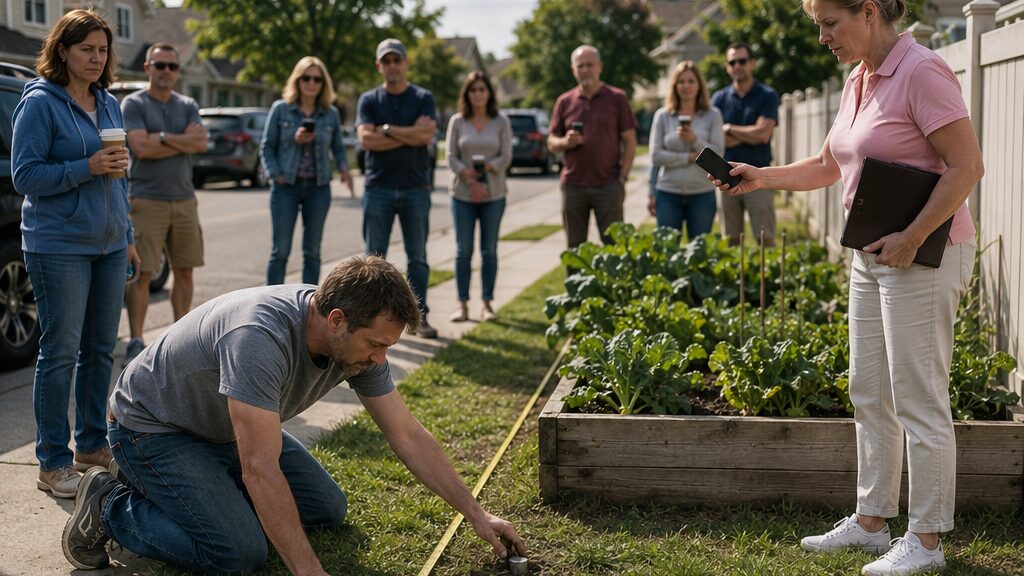
By nine Saturday morning, three neighbors were already pretending not to watch Joshua’s side yard.
He saw them before he opened the garage. Linda Moore stood near her mailbox with a travel mug in both hands. A man from two doors down was trimming one shrub in slow, unnecessary bites. Across the street, someone had raised the blinds just enough to make a narrow bright gap.
Joshua stood inside the garage with a tape measure clipped to his belt, an old flathead screwdriver in his back pocket, and a level he did not need in his hand because holding something made him feel less exposed.
His daughter had not texted back after he told her about the delay. She was coming over that afternoon. He wanted the tomatoes in the ground before then. He wanted the bed to be just a bed.
Nancy’s garage door was already open.
She came out as he crossed the grass, wearing the same pink polo, her sunglasses again perched on her head. Today she had the folder in one hand and a paper cup of coffee in the other.
“Good,” she said. “You decided to check.”
Joshua pulled the tape measure from his belt. “I said I would.”
Linda walked over from her mailbox. “Morning.”
“Morning,” Joshua said.
Linda smiled in a way that was not quite friendly. “I guess we’re settling it.”
Nancy opened the folder and removed a printed diagram. “The community lot guide shows the maintenance strip running here.” She pointed at a thick black line that looked straight and authoritative on paper.
Joshua glanced at it. The houses were rectangles. The yards were pale blocks. The line between his lot and Nancy’s looked like it had been drawn by someone who cared more about neatness than dirt.
“Is that a survey?” he asked.
“It’s the HOA lot guide.”
“That’s not what I asked.”
Nancy’s face tightened. “It’s what residents use for exterior improvements.”
The man trimming the shrub had stopped trimming. Joshua could hear sprinkler water ticking somewhere behind Nancy’s house.
He crouched at the corner of the garden bed and hooked the tape measure against the foundation where he had measured from the day before. He stretched the blade outward, silver and yellow flashing across the grass.
Nancy stood over him. “You’re starting from the wrong point.”
“I’m starting from my wall.”
“The line doesn’t depend on your wall.”
“No. But the setback for the bed does.”
Linda made a small sound, half cough, half laugh. “You might owe her an apology when this is over.”
Joshua kept his eyes on the tape. “Maybe.”
That word quieted her. He had not said it sarcastically. He had meant it. If he was wrong, he would move the bed. He would hate it, but he would do it. What he would not do was move it because Nancy had pointed.
He measured from the foundation to the outer edge of the bed, then from the bed to the faint depression where water sometimes gathered after rain. He had noticed that depression before but never thought about it. Now, crouched low, he saw something else: a small circle in the grass, not metal exactly, just a place where the blades grew thin around a hard spot.
He pressed his thumb against it.
The ground did not give.
Nancy said, “The line is not down there.”
Joshua pulled the screwdriver from his back pocket.
“What are you doing?” she asked.
He scraped gently at the edge of the hard spot. Soil flaked away. Grass roots lifted. A dull metal rim appeared under the dirt, about the size of a quarter but thicker, set flush with the ground.
Linda stepped closer. “What is that?”
Joshua did not answer. He cleared more dirt until the top of it showed: a small round metal cap, weather-darkened, with a cross notch stamped into the center.
The neighbor with the hedge trimmer crossed the street.
Nancy’s voice changed. “That could be anything.”
Joshua brushed the last dirt away with his fingers. The metal was cool beneath the soil. He had seen survey markers before, though not often. His father had pointed one out years ago near the curb, tapping it with the toe of his boot, saying, Don’t ever trust a fence more than a pin.
Joshua had forgotten that until the cap was under his hand.
“It’s a property marker,” he said.
Linda leaned over, her mug tilting. “Is it supposed to be there?”
“Yes,” Joshua said.
Nancy laughed once, too quickly. “You don’t know that.”
Joshua stood, pulled the tape blade across the marker, and extended it toward the raised bed. The blade trembled in the morning air. He read the distance once, then again.
The bed was not touching the line. It was not close enough for an argument. There was space between the marker and the cedar frame, more than he had expected.
He said nothing at first.
That silence did more than any sentence could. Linda looked from the tape to Nancy. The neighbor with the hedge trimmer bent slightly, hands on knees, as if the numbers might rearrange themselves if he stared long enough.
Nancy stepped forward. “Move the tape. You angled it.”
Joshua reset it, slower this time. He hooked the tape at the marker, extended it straight to the bed, and laid the blade flat on the grass.
“Still not close,” the hedge-trimmer neighbor said.
Nancy shot him a look.
Joshua took out his phone and photographed the marker, the tape, the bed, and Nancy’s paper diagram on the grass near his feet. He made sure each image showed enough context to matter.
Linda’s expression had gone uncertain. “Nancy, maybe the map is more general.”
“The map is the map,” Nancy said.
Joshua looked at her. “You told me to move it today.”
“I told you what the HOA records show.”
“You told me it was on your side.”
Nancy’s face colored. “Because according to the documents residents are given, it is.”
The distinction came too late, and everyone standing there heard it.
A white sedan turned onto the street and slowed in front of Joshua’s house. A woman in a navy polo got out carrying a folder and a clipboard. Joshua recognized her from HOA emails and annual meetings: Janet Taylor, the property manager hired by the board to handle compliance letters, dues notices, and the kind of language that made a warning sound less like a threat.
Nancy’s shoulders lowered with visible relief.
Janet walked up the driveway, glanced at the small gathering, then at the garden bed. “Mr. Harris?”
Joshua slipped his phone into his pocket. “Yes.”
“I’m Janet Taylor with Ridgeview Residential Management.” Her tone was professional, careful. “I’m here regarding an exterior improvement complaint.”
Nancy stepped in. “We were just reviewing the line.”
Janet nodded without looking relieved or surprised. She removed a printed notice from her folder. The paper was bright orange at the top.
Joshua looked down at the marker still exposed in the grass. “Good timing,” he said. “We just found the property pin.”
Janet glanced at it, then at her folder. “I understand there may be a disagreement.”
“It’s not a disagreement,” Joshua said, more sharply than he intended. “It’s right there.”
Linda looked at him quickly. Joshua felt the heat of his own voice and forced himself still.
Janet held out the notice. “The association’s file indicates the garden bed is installed within a restricted maintenance strip. You’ll have an opportunity to respond.”
Nancy folded her arms, confidence returning by inches.
Joshua did not take the paper immediately. He looked from the orange notice to the metal marker, from the marker to the raised bed his daughter had wanted planted by lunch.
“What happens if I don’t move it?” he asked.
Janet’s eyes softened, but her voice stayed flat. “The letter explains the timeline. If unresolved, fines may begin after review.”
The hedge-trimmer neighbor backed away first. Linda followed, slowly, no longer smiling. Nancy remained beside Janet as if she had brought in the cavalry.
Joshua finally took the notice.
The orange header read: Required Corrective Action.
Behind it, half hidden in the grass, the small metal marker caught the sun.
Chapter 3: The Notice That Ignored the Ground
The orange notice was taped to Joshua’s front door before noon, even though he had already held it in his hand.
Janet must have done it after leaving the side yard, because when Joshua came back from washing soil off his fingers, the paper was there at eye level, flattened under clear tape, official and ugly against the white paint.
Required Corrective Action.
He stood on the porch and read the first paragraph twice.
Unauthorized raised garden structure installed within association-maintained side setback. Resident must remove or relocate structure within seven days of notice. Failure to comply may result in daily fines, hearing costs, and further enforcement action as permitted under governing documents.
Seven days.
He heard a car door shut across the street and looked over. Linda was talking to another neighbor near the curb. Both women turned their heads away too late.
Joshua peeled the notice from the door carefully so it would not tear. That was his habit: even when angry, avoid damage. Preserve the paper. Preserve the tone. Give no one a reason to say he had made it worse.
Inside, the kitchen smelled faintly of coffee and potting soil. The tomato seedlings sat in a cardboard tray by the sliding door, their leaves bending toward the sun. He set the notice on the table, then opened the HOA email he had ignored the night before.
The attachment was there: Ridgeview Exterior Boundary Reference Packet.
He clicked it.
The first page had the neighborhood logo, a line drawing of identical roofs, and a paragraph about community standards. The second page showed a diagram of lots along his street. Nancy’s lot and his were marked with clean rectangular boundaries. A shaded band ran between the homes, labeled maintenance access.
Joshua zoomed in.
The line did appear to cut close to where his garden sat. On the diagram, the shaded strip widened near the back of his house. But it was not a survey. There were no bearings, no measurements, no county seal. Just a simplified drawing that looked like it had been copied, scanned, and compressed until every uncertainty became a thick black line.
He opened his photos from the morning: the metal marker, the tape measure, the cedar bed, the orange notice in Janet’s hand.
Then he arranged the notice on the table beside his phone and took another picture, making sure the marker photo was visible on the screen next to the violation letter.
The doorbell rang.
His daughter stood on the porch with her backpack over one shoulder and a grocery bag in her hand. “I brought basil,” she said, then noticed his face. “What happened?”
Joshua opened the door wider. “HOA happened.”
She stepped inside, saw the orange notice on the kitchen table, and stopped. “Is that about the garden?”
“Yeah.”
“But you said it was just a delay.”
“It was. Then it became a notice.”
She picked up the paper and read fast, her eyebrows drawing together in a way that reminded him painfully of her mother. “Daily fines?”
“They won’t start right away.”
“That’s not the same as no.”
“No,” he admitted. “It’s not.”
She looked through the sliding door toward the raised bed. “Did you plant anything?”
“Not yet.”
Her disappointment was quiet. That made it worse.
He explained the measurement, the marker, Janet’s visit, the diagram. He kept his voice level. He did not call Nancy names. He did not say he had wanted to throw the notice into her hedge. His daughter listened with the guarded expression teenagers used when deciding whether adults were telling the whole truth or only the version that made them look better.
“So you proved it?” she asked.
“I proved where the marker is.”
“Then why do they still get to fine you?”
“Because their file says something else.”
“That’s stupid.”
“It’s procedure.”
“That’s stupid with a folder.”
He almost smiled.
A motion outside caught her attention. Linda and the other neighbor were still near the curb. Nancy had joined them now, folder tucked under her arm, her pink polo bright even from across the street.
His daughter stepped closer to the glass. “Are they talking about us?”
“Probably.”
“Dad.”
“I know.”
“No, you don’t.” She turned back, cheeks flushed. “You do this thing where you act like if you stay calm enough, people will eventually be fair.”
Joshua looked at her, stung by the accuracy of it.
“I’m handling it,” he said.
“You always say that when you’re not handling it.”
The kitchen went still.
He wanted to tell her she was wrong. He wanted to say restraint was not weakness, that he had learned the hard way what happened when people started shouting in houses, in mediation rooms, in hospital hallways. But she was looking at the orange notice, not at his history.
“I’m going to respond,” he said.
“When?”
He looked at the notice. Seven days. Hearing costs. Further enforcement.
“Today.”
That seemed to satisfy her only a little. She set the grocery bag on the counter and pulled out a small basil plant wrapped in brown paper. “Can we at least keep this alive while everyone argues about invisible lines?”
He took the plant from her. “Yeah. We can do that.”
They set the tomatoes and basil on the back patio where they would get sun but not commit to the bed. It felt ridiculous, arranging plants in temporary exile. His daughter watered them with a measuring cup because the outdoor spigot was near Nancy’s side and neither of them wanted to stand there under the windows.
Later, while she did homework at the kitchen table, Joshua went into the garage to look for the folder where he kept old house documents.
The garage had never recovered from the year everything else came apart. Boxes labeled with his father’s handwriting sat beside plastic bins from the divorce. Tools hung where his father had put them years before, but other things had drifted: paint cans, school projects, tax files, a broken lamp no one wanted enough to fix.
He found the closing documents in a gray file box. Warranty deed. Mortgage papers. Old inspection. HOA bylaws. Nothing about a survey marker.
He was about to close the box when he saw another envelope wedged against the side, yellowed and bent, sealed only by a metal clasp. The handwriting across the front made his chest tighten.
Boundary.
His father had written the word in block letters, pressing hard enough that the ink bled slightly into the paper.
Joshua sat back on his heels.
From the kitchen, his daughter called, “Dad? Did you find something?”
He stared at the envelope, thumb resting on the clasp, and for a moment the orange notice, Nancy’s voice, Janet’s folder, even the garden bed all seemed to pull toward that one word.
“Yes,” he said, though he had not opened it yet. “I think I did.”
Chapter 4: The Envelope His Father Never Got to File
The envelope opened with a dry scrape of metal against paper, and the first thing Joshua saw was his father’s handwriting beside a red circle.
Not a note. Not a reminder. A warning, written in block letters on a faded copy of a survey.
PIN STILL PRESENT. HOA MAP WRONG.
Joshua sat on the garage floor with the envelope across his knees. Dust clung to the tape on the orange notice beside him. Through the open door to the kitchen, he could see his daughter standing still, waiting for him to say whether this was good news or the kind that arrived too late to help.
He pulled out the rest of the papers carefully.
There was a county survey, older than the HOA diagram by at least a decade. There were two photocopied pages from the subdivision plat, dense with measurements, lot numbers, and lines that did not look neat at all. They angled slightly, shifted near drainage easements, and narrowed in places where the HOA packet had smoothed everything into clean rectangles.
His father had circled the marker near the side yard.
Beside it, in blue ink, he had written: Tell Josh not to let them move this.
Joshua swallowed.
His daughter came closer. “Is that Grandpa’s?”
“Yeah.”
“Did he know about the line?”
Joshua did not answer right away. He found a letter draft folded behind the survey, addressed to Ridgeview HOA Board. It had never been mailed. The top corner still held the faint imprint of a paper clip.
To whom it may concern,
The community boundary reference packet distributed to residents of Willow Creek Lane appears to conflict with the county-recorded subdivision survey for Lot 18 and adjoining lots. The discrepancy may affect side-yard maintenance interpretations and resident improvement approvals.
Joshua could hear his father in the sentences: patient, exact, unwilling to sound angry even when he was.
He read on. His father had listed the property pin location, the county recording number, and a request for the HOA to update its internal packet before future disputes arose. The last paragraph was unfinished. The sentence ended halfway through a word.
He must have stopped there. Maybe because he got tired. Maybe because the hospital called. Maybe because Joshua had promised, vaguely, “I’ll look at it later,” and then later became a year, then two, then a sealed envelope in a garage box.
His daughter crouched beside him. “Did you know this was here?”
“No.”
The answer came too fast. Too clean.
She looked at him.
Joshua looked back down at the papers. “I knew he had questions about the side yard. I didn’t know he had all this.”
That was closer to the truth and somehow worse.
After she went back inside, he carried the envelope to his home office and spread the pages across the desk. The room had become a place where he fixed broken routers for clients and ignored anything with emotion attached to it. A second monitor glowed with the HOA portal. The orange notice lay near the keyboard. The marker photo sat open on his phone.
He typed the recording number from his father’s survey into the county records website.
The first search failed.
He typed it again, removing the dash.
A file loaded slowly: Subdivision Plat, Willow Creek Phase Two. The scan was grainy, but the lot numbers matched. Lot 18 was his. Lot 19 was Nancy’s. The line between them did not run as straight as the HOA diagram showed. Near the back half of the house, it shifted away from his garden bed.
Joshua leaned closer.
There it was: an iron pin notation. The same place. The same side yard.
He opened the HOA packet again and placed the windows side by side on the screen. County plat on the left. HOA diagram on the right.
The HOA version had simplified the line until the side-yard strip looked evenly shared and association-controlled. It was not completely fictional. That was what made it dangerous. It looked reasonable until compared to the legal document.
His daughter appeared in the doorway with a glass of water. “So she’s wrong?”
Joshua rubbed his face. “The HOA diagram is wrong.”
“That means she’s wrong.”
“It means she may be relying on the wrong thing.”
“That is a very Dad answer.”
He took the water from her. “I’m trying not to make it personal.”
“She made it personal when she did it in the yard.”
He had no answer for that.
Outside, a car slowed in front of the house. Joshua glanced through the blinds. Nancy’s car rolled past, slower than necessary. She did not look toward the house, but he saw the turn of her head in the driver’s window reflection.
His daughter saw it too. “Are you going to tell them?”
“Yes.”
“When?”
“Tonight, I’ll email Janet with the county record.”
“That’s not telling them. That’s sending a PDF into a machine.”
He looked at her, tired. “It creates a paper trail.”
“Dad.”
“What?”
“You found proof and you still sound like you’re asking permission.”
The words landed harder than Nancy’s accusation had.
Joshua set the glass down. “I’m not asking permission.”
But when he looked at his own hands, he saw he had already stacked the papers into a neat pile, as if preparing them for someone else to approve.
After dinner, his daughter went upstairs, and Joshua stayed at the desk. He drafted an email to Janet Taylor with the county plat attached, the marker photos, and a short explanation. He rewrote the first sentence five times, removing anything that sounded too angry, then anything that sounded too apologetic.
Before sending it, he opened his father’s draft letter again.
At the bottom, below the unfinished paragraph, there was one more note in different ink, shakier than the rest.
Robert Lee saw pin with me. Former board. Ask him if they deny it.
Joshua stared at the name.
Robert Lee lived across the cul-de-sac in the low brick ranch with the flag bracket by the garage and the newspaper that still arrived in plastic sleeves. Joshua had waved to him for years. They had discussed leaf pickup once, and a leaking sprinkler head another time. Nothing more.
Former board.
He searched the remaining pages and found a smaller sheet folded twice. It was not a letter, only a field sketch on graph paper. The side yard, the corner of Joshua’s house, the old drainage dip, the metal pin, and two sets of initials near the bottom.
His father’s initials.
Robert Lee’s.
Joshua sat back.
The house was quiet except for the hum of the computer and the soft knock of the air vent. On the screen, his unsent email waited. On the desk, the orange notice looked less like a threat now and more like a receipt for every time he had postponed discomfort.
He attached the county plat.
Then he attached the marker photos.
Then, after a long moment, he attached his father’s draft letter too.
His cursor hovered over Send.
He did not click it.
Instead, he looked out the office window toward the cul-de-sac, where Robert Lee’s porch light had just come on.
Chapter 5: The Retired Surveyor Across the Cul-de-Sac
Robert Lee saw Joshua coming and hit the garage button before Joshua reached the end of the driveway.
The door began to descend with a low mechanical groan. Behind it, Robert stood beside a workbench, one hand on a cardboard box of sprinkler parts, the other on the wall control. He did not pretend he had not seen him. That almost made it worse.
Joshua stopped at the edge of the driveway with the envelope under his arm. “Mr. Lee?”
The garage door kept coming down.
“Robert,” Joshua called, louder.
The door stopped six inches above the concrete.
For a moment, neither of them moved. Then Robert bent with a stiff grunt and lifted the door manually until there was enough space to see his face. He was in his late sixties, maybe older, with close-cropped gray hair and glasses that hung low on his nose. His expression was not surprised. It was resigned.
“I figured you’d find that envelope eventually,” Robert said.
Joshua’s grip tightened around the papers. “Then you know why I’m here.”
Robert sighed and pressed the button again. This time the door rose.
Inside, the garage was orderly in the way Joshua’s father’s garage had once been orderly. Pegboard tools. Labeled bins. A folding chair near a small fan. On the workbench sat an old field notebook, already open.
Joshua noticed it immediately.
Robert followed his gaze. “I got it out this morning.”
“You knew about the marker.”
“I knew about several markers.”
Joshua stepped inside but stayed near the opening, as if crossing too far would turn this into something he could not back out of. “My father wrote that you saw it with him.”
“I did.”
“And the HOA map is wrong.”
Robert removed his glasses and cleaned them with the hem of his shirt. “The HOA map is simplified.”
“That’s a polite word.”
“It was meant for mowing crews and landscaping approvals, not legal disputes.”
“But now they’re using it for one.”
Robert put his glasses back on. “That’s the problem with simple things. People forget what they were simplified from.”
Joshua almost laughed. “That sounds exactly like something my father would have said.”
Robert’s face changed at the mention of him. Not dramatically. Just a small softening around the eyes.
“He was stubborn,” Robert said.
“He was usually right.”
“Those often travel together.”
Robert opened the field notebook and turned it toward Joshua. The page showed a pencil sketch of Willow Creek Lane, not professional enough for court but precise enough to matter. Lot numbers, curb measurements, drainage notes. In the margin, Robert had written: Harris pin exposed, 2019. HOA packet inconsistent.
Joshua stared at the date. “He was sick then.”
“Yes.”
“He was still out there measuring?”
“He came over with a tape measure and a cane,” Robert said. “Told me if he could still argue with a nurse, he could argue with a bad map.”
Joshua’s throat tightened before he could stop it.
He looked away, toward a shelf of paint cans. “Why didn’t anyone fix it?”
Robert closed the notebook halfway. “Because fixing one line would have raised questions about four lots. Maybe five.”
“So they ignored it.”
“The board discussed reviewing the packet.”
“That’s not the same thing.”
“No,” Robert said. “It isn’t.”
The admission was quiet, but it shifted something in the garage. Joshua had expected denial, or excuses, or the old neighborhood habit of smoothing conflict until nothing had edges. Robert gave him something worse: confirmation without rescue.
“Were you on the board then?” Joshua asked.
“I was stepping down.”
“But you knew.”
Robert’s jaw worked once. “I knew your father was right about the pin. I also knew correcting the packet would start a fight between neighbors who had been mowing wrong strips for fifteen years.”
“So the solution was to wait until someone else got accused?”
Robert looked at him. “No. The solution would have been to do the work. We didn’t.”
Joshua felt heat rise in his chest. “I need you to tell Janet that.”
Robert shook his head.
The answer was so immediate Joshua almost missed it.
“What?”
“I’ll tell the truth if the county record is filed and the board asks me directly. I’m not stepping into a resident complaint based on an old sketch and a memory.”
“You were a witness.”
“I’m not your shortcut.”
Joshua took a step back. “That’s not what I’m asking.”
“It is, a little.” Robert’s voice stayed calm, which made Joshua dislike him for a second. “You want me to walk in and make them listen so you don’t have to be the difficult one.”
Joshua opened his mouth, then closed it.
The old man’s words found the place his daughter had already bruised.
Robert slid the notebook toward him. “Your father tried to file the correction. He got too sick. After he passed, I assumed you would finish it.”
Joshua looked down.
“I didn’t even open the envelope.”
“I know.”
The words were not cruel. That did not make them painless.
Robert leaned against the workbench. “Your father asked me once to remind you. I didn’t. You had enough happening. Divorce, hospital bills, a kid going back and forth between houses. I told myself it was just a line in the grass.”
Joshua looked toward his own house, visible across the cul-de-sac. “Now it’s an orange notice on my door.”
“Yes.”
“And daily fines.”
Robert’s mouth tightened. “Yes.”
Joshua picked up the notebook carefully. “Can I take a picture of this?”
Robert hesitated, then nodded. “A picture, not the notebook.”
Joshua photographed the sketch, the date, the note about the HOA packet. When he finished, Robert closed the notebook and placed one hand over it.
“File with the county,” Robert said. “Get a certified copy. Make the HOA respond to a record, not an argument.”
“They’ll still say their packet controls improvements.”
“Then ask them to show where the governing documents override the recorded plat.”
Joshua looked at him. “You sound like you’ve had that sentence ready for years.”
Robert did not smile. “I have.”
A phone buzzed in Joshua’s pocket. He pulled it out.
Email from Ridgeview HOA Board.
Subject: Emergency Compliance Hearing — Raised Garden Installation.
His stomach dropped.
The message was short. Monday evening. Clubhouse meeting room. Attendance recommended. Fines pending outcome.
Below Janet’s typed notice was a forwarded comment from Nancy Roberts.
Resident has refused voluntary correction despite being informed of association boundary standards. Prompt board review requested to prevent precedent.
Joshua stared at the word precedent.
Robert read his face. “They scheduled it?”
“Monday.”
“That’s fast.”
“Nancy requested it.”
Robert nodded once, as if that explained both too much and not enough. “Then don’t spend Monday begging them to believe your yard. Spend Monday making them explain their map.”
Joshua folded the envelope under his arm. He wanted Robert to come with him. He wanted someone older, calmer, more technical, someone with no orange notice on his own door, to stand up and make the room reasonable.
But Robert had already turned back toward his workbench.
At the driveway, Joshua stopped. “If I file first, and they ask you directly…”
Robert looked at the field notebook under his hand.
“I’ll answer,” he said.
Joshua walked back across the cul-de-sac with the envelope tighter against his ribs than before. Halfway home, he saw Nancy standing at her front window. She stepped back when he noticed.
His phone buzzed again.
A second email arrived from the HOA portal, this one with the hearing agenda attached.
Item 1: Harris Lot 18 Boundary Violation.
Chapter 6: The Map Nancy Needed to Be True
Nancy placed the enlarged HOA map on the clubhouse table before Joshua had even pulled out a chair.
It was mounted on foam board, glossy under the fluorescent lights, with a red circle drawn around the strip between Lot 18 and Lot 19. Joshua’s garden bed had been added in thick black marker, too large and too close to Nancy’s side. The drawing made his yard look like it had reached for hers.
Joshua stood with his folder in one hand.
Nancy looked up. “I thought it would help everyone visualize the issue.”
Of course she did.
The clubhouse meeting room smelled like old coffee and carpet cleaner. A row of folding chairs faced a long table where two HOA board members sat with Janet Taylor between them. Janet had a laptop open and a stack of papers arranged in careful piles. Linda Moore sat in the second row, hands wrapped around her phone, not quite meeting Joshua’s eyes.
His daughter was not there. She had asked to come. He had said no, telling her it would be boring and procedural. The truth was he did not want her watching people discuss him like a problem on an agenda.
Joshua sat down and placed his own folder beside Nancy’s map.
Janet began with the kind of calm that made every word sound pre-approved. “We’re here regarding the raised garden installation at Lot 18 and whether it falls within an association-maintained side setback under current community reference materials.”
“Boundary violation,” Nancy said.
Janet glanced at her. “Alleged boundary violation.”
Nancy pressed her lips together.
That small correction gave Joshua a breath.
One board member asked him to explain. Joshua opened his folder, laid out the photos from Saturday, and placed the image of the metal marker at the top.
“There is a property pin in the ground between the lots,” he said. “I measured from that marker. The bed is not on Nancy’s property.”
Nancy leaned forward. “The issue is not only Nancy’s property. It’s the maintenance strip.”
“Then the strip needs to be defined by something legal.”
“It’s defined in the packet residents are given.”
Joshua slid the county plat copy forward. “This is the recorded subdivision plat.”
Nancy did not look at it. “Most residents don’t read county plats before putting things in common-use areas.”
“It isn’t a common-use area.”
“That is your interpretation.”
Joshua felt his voice wanting to rise. He held it down. “It’s the county’s measurement.”
Janet lifted the county plat and studied it. Her eyes moved from the page to Nancy’s enlarged map. “These do not appear to match exactly.”
“They don’t need to match exactly,” Nancy said. “The HOA diagram governs exterior approvals.”
“Does it?” Joshua asked.
Nancy turned toward him. “You installed without submitting an architectural request.”
“For a movable raised bed under the height limit. The rules say vegetable beds under twelve inches don’t require pre-approval unless they’re in restricted areas.”
“And this is a restricted area.”
“Based on the map that doesn’t match the plat.”
The room went quiet.
One board member shifted in his chair. The other looked at Janet. Janet tapped a few keys on her laptop.
Linda raised her hand halfway, then lowered it.
Nancy saw. “Linda, you were there Saturday. You saw how close it is.”
Linda’s mouth opened. She looked at the foam-board map, then at Joshua’s photo. “I saw the marker.”
Nancy’s eyes sharpened. “You saw him place a tape measure by something in the ground.”
“I saw the marker,” Linda repeated, softer. “I don’t know what it means.”
Joshua looked down at the table. It was not much, but it was not nothing.
Janet spoke before Nancy could answer. “For clarity, the association file is not the same as a county survey. The management company enforces based on the documents provided by the board, but if there’s a conflict with recorded property information, the board may need legal review.”
Nancy’s face changed.
Not anger first. Fear.
It was quick, but Joshua saw it. The same flash he had seen in the yard before she hardened her expression. Her fingers pressed into the edge of the foam board.
“We have spent months trying to restore consistent enforcement,” she said. “Residents complained that violations were being ignored. We cannot have someone challenge every diagram after receiving a notice.”
One board member cleared his throat. “Nancy, no one is saying every diagram—”
“That is exactly what happens,” she said. “One exception becomes a precedent. Then the next person says their shed is different, their trailer is different, their fence is different. The whole point of compliance is that the standards mean something.”
Joshua heard something under her words then. Not just control. Panic at being the person responsible when standards stopped holding. He had not thought about Nancy being under anyone’s pressure. He had only thought about her applying it.
But sympathy did not move the garden bed. It did not erase the notice.
“I’m not asking for an exception,” Joshua said. “I’m asking you to use the correct line.”
Nancy looked at him as if that sentence had betrayed her.
Janet folded her hands. “Mr. Harris, have you filed a formal correction or obtained a certified county copy?”
“I have the recorded plat.”
“Certified?”
“Not yet.”
Nancy exhaled through her nose, almost a laugh.
Janet’s tone remained even. “Then the board has two different materials in front of it: the association reference packet and an uncertified copy of a county document. Given the potential discrepancy, my recommendation is to postpone final enforcement for forty-eight hours.”
“Postpone?” Nancy said.
“Not dismiss,” Janet said. “Postpone.”
Joshua looked at her. “And the fines?”
“Pending,” Janet said. “They would not begin until after review, unless the board decides otherwise.”
“Unless,” Joshua repeated.
The board members conferred quietly. Nancy sat back, arms crossed, but Joshua could see the tension in her jaw. Her map remained in the center of the table, bright and simple and wrong enough to hurt him.
The decision came after less than two minutes. Enforcement would be paused until Wednesday evening. Joshua could submit certified documentation. The board would reconvene if needed.
It was not victory. It was a hallway between two locked doors.
As people gathered papers, Nancy leaned toward him. “You’re making this bigger than a garden.”
Joshua slid his photos back into the folder. “No. I think it was bigger before I built the garden.”
Her eyes flicked toward Janet, then the board members. “You have no idea what happens when rules stop being enforceable.”
“And you have no idea what happens when people enforce the wrong ones.”
For once, Nancy had no immediate answer.
Outside, in the clubhouse parking lot, Linda approached him near his truck. “I’m sorry I said you might owe her an apology.”
Joshua was tired enough that politeness took a second to arrive. “You didn’t know.”
“No,” she said. “But I acted like I did.”
That was more than he expected. He nodded.
When he got home, his daughter was sitting on the porch steps with the basil plant beside her.
“Well?” she asked.
“Paused until Wednesday.”
“That sounds like they found a way not to say you were right.”
He opened the front door but did not go in. Across the street, Nancy’s porch light clicked on.
Joshua looked at the envelope in his hand, then at the side yard where the small metal marker sat exposed in the grass, a dull circle no bigger than a coin.
“I’m going to the county office tomorrow,” he said.
His daughter stood. “In person?”
“In person.”
For the first time all weekend, she smiled like she believed him.
Chapter 7: The Line That Had Been There All Along
“Why was this correction never completed?” the county records clerk asked, sliding the old survey back under the glass partition.
Joshua had expected questions about lot numbers, recording dates, maybe fees. He had not expected the one question that sounded less like paperwork and more like judgment.
He stood at the counter with his father’s envelope open in front of him, the orange notice folded inside his folder, and his phone buzzing twice in his pocket. He did not check it. The clerk had circled Lot 18 on a printed copy of the subdivision plat and placed a yellow sticky note beside the iron pin notation.
“I don’t know,” Joshua said.
The clerk looked over her reading glasses. She had the patient expression of someone who had heard every version of “I don’t know” that a county office could produce.
Joshua looked down at his father’s unfinished letter. The half sentence at the bottom seemed louder in the quiet office than Nancy had been in his yard.
“My father started it,” he said. “He got sick. After he died, I didn’t follow through.”
The clerk’s face softened just slightly. Not pity. Recognition. “That happens.”
It was a kinder sentence than he deserved, and for that reason he had trouble answering.
The records office was on the first floor of a low government building with beige tile, plastic chairs, and a wall clock that seemed to move only when no one watched it. Joshua had taken the morning off work, driven there before the office opened, and still found himself third in line behind a contractor with rolled plans and a woman disputing a deed transfer.
Now the clerk compared the county plat to the HOA diagram Joshua had printed from the portal. Her mouth tightened.
“This,” she said, tapping the HOA page, “is not a recorded survey.”
“I know.”
“It may be useful for their internal purposes, but it doesn’t establish your lot boundary.”
“I need something certified that says that.”
“That we can do.” She marked a form. “Certified copy of the subdivision plat. I can also print the recorded lot description tied to your deed. It will not interpret your HOA rules for you.”
“I’m not asking it to.”
“No,” she said. “You’re asking it to remind them where the dirt is.”
For the first time that morning, Joshua almost smiled.
While she prepared the copies, he finally checked his phone.
Three emails.
One from Janet Taylor: Please submit any certified documentation by 5:00 p.m. today for board review.
One from the HOA portal: Compliance Review Reminder.
One from Nancy Roberts, copied to Janet and the board.
Mr. Harris has continued to dispute association authority despite clear notice. I am concerned this matter is becoming less about a garden bed and more about an attempt to embarrass volunteer leadership.
Joshua read that sentence twice.
Embarrass volunteer leadership.
Not correct a record. Not identify a discrepancy. Embarrass.
He could feel the old pull again: soften the email, sound reasonable, reassure everyone he was not trying to make trouble. He had spent years arranging his words around other people’s comfort. At work. During the divorce. In hospital rooms where his father asked him to bring files from the house and Joshua said, “Later, Dad,” because opening drawers felt like admitting the end was near.
The clerk returned with two stamped documents. Each page bore a raised seal that caught the overhead light.
“Keep these dry,” she said. “And don’t give away your only copy.”
Joshua paid the fee and stepped outside into the noon glare. He sat in his truck with the engine off, the certified survey on the passenger seat, and called his daughter.
She answered on the third ring. “Did they have it?”
“Yes.”
“Certified?”
“Yes.”
“So it’s real real.”
“It’s real real.”
A pause. Then, softer, “Are you okay?”
He looked at the sealed pages. “The clerk asked why it was never finished.”
“What did you say?”
“The truth.”
“That Grandpa got sick?”
“And that I didn’t follow through.”
She was quiet for a moment. “That doesn’t mean the whole thing is your fault.”
“No. But part of it is mine.”
“Dad.”
“I’m not saying that so you’ll make me feel better.” He watched a county employee unlock a side door and wheel a cart of files inside. “I’m saying it because I should have opened the envelope.”
His daughter exhaled into the phone. “Then open everything now.”
He carried that sentence home like another document.
At the house, he did not go inside first. He walked straight to the side yard. The garden bed sat unchanged, empty except for the tomato seedling he had placed there Friday and then moved back out. The metal marker was still exposed in the grass, a small dull circle at the edge of the world Nancy had tried to define.
He knelt beside it and laid the certified survey on a clipboard on the grass. Then he opened the photo on his phone: marker, tape measure, bed.
Marker in the ground. Marker on the survey. Marker in his father’s handwriting.
For once, the pieces did not need him to apologize before they fit.
A door opened next door.
Nancy stepped out, holding her phone. She stopped when she saw him kneeling by the marker with the documents.
“Joshua,” she said.
He stood.
Her face was composed, but her eyes moved quickly to the clipboard. “I hope you understand that continuing to escalate this may not help you.”
“I went to the county office.”
“I assumed you would.”
“They certified the plat.”
Nancy’s mouth tightened. “That doesn’t address the community standards issue.”
“It addresses the line.”
“The board will determine relevance.”
“That’s why I’m bringing it tonight.”
She took a step closer but stayed on her side of the grass, or what she believed was her side. “You’re turning a compliance matter into a public accusation against me.”
Joshua looked at her, really looked. The pink polo was gone; today she wore a white blouse and narrow slacks, dressed for the evening meeting already. She looked tired in a way she had not allowed herself to look in front of the neighbors.
“I didn’t accuse you,” he said. “You accused me.”
“I acted on the map I had.”
“You acted before checking if the map was right.”
Her jaw hardened. “Do you know how many residents complain that nothing is enforced? They send pictures. They threaten to stop paying dues. They say the board plays favorites. Then when we enforce, suddenly everyone has a reason the rule doesn’t apply to them.”
“I’m not everyone.”
“No,” she said. “You’re the one who made everyone watch.”
Joshua almost answered quickly, but the unfairness of it was so sharp he had to let it pass through him first.
“I was in my own yard,” he said.
Nancy looked away.
That was the first time she did not immediately fight back.
At the evening meeting, the clubhouse felt smaller than it had Monday. More chairs were filled now. Word had spread, not officially, but in the way neighborhoods made attendance feel accidental. Linda sat near the aisle. Robert Lee stood at the back with his arms folded, not seated, not announced. When Joshua entered, Robert gave him one small nod.
Janet called the meeting to order. Nancy sat at the side table with her folder closed.
Joshua placed the certified survey beside the enlarged HOA map. The contrast was almost embarrassing: the county seal raised and clean, the HOA line thick and glossy and too simple.
Janet reviewed the documents. One board member asked if the pin shown on the plat corresponded to the one Joshua had photographed.
“Yes,” Joshua said. “I measured it. I photographed it. It is still there.”
Nancy leaned forward. “We still have to consider whether the garden interferes with association maintenance access.”
Janet looked at her laptop. “The maintenance access designation appears to have been drawn from the reference packet, not the recorded plat.”
“So we just ignore our own packet?” Nancy asked.
“No,” Joshua said.
Everyone looked at him.
His heart beat hard, but he kept going. “You correct it.”
Nancy’s face flushed.
Joshua turned to the board, not to her. “I’m not asking you to pretend there wasn’t confusion. I’m asking you to stop enforcing a diagram after you know it’s wrong. I want the violation withdrawn. I want the fines removed before they begin. And I want the record corrected publicly, because the accusation was public.”
The room held still.
A board member glanced toward Robert. “Mr. Lee, you were formerly on the board. Do you have any knowledge of this?”
Robert did not move for a moment. Then he stepped away from the wall.
“I do,” he said.
Nancy closed her eyes briefly.
Robert’s voice was steady. “Joshua’s father brought this discrepancy to my attention several years ago. The county pin was present then. The packet was simplified. The board discussed updating it and did not complete the review.”
“Why not?” Janet asked.
Robert looked at the board table, then at Joshua. “Because it was easier not to.”
No one spoke.
Joshua felt those words settle over the room more heavily than any argument he had made. Easier not to. The motto of every postponed correction. Every sealed envelope. Every false peace.
Nancy gripped her pen. “That does not mean Mr. Harris followed the architectural process.”
“The process relied on the wrong line,” Joshua said. His voice shook once, then steadied. “I should have filed my father’s packet years ago. I didn’t. That’s on me. But I am filing it now, and I am not moving a garden bed that is not over the line just so the old mistake can stay convenient.”
Linda looked down at her hands.
Janet typed something, then turned to the board. “My recommendation is that the violation be suspended immediately pending formal correction of the association reference packet. Based on the certified county record, continued enforcement as a boundary violation is not advisable.”
“Suspended?” Joshua said.
Janet met his eyes. She understood the difference.
“Withdrawn,” she corrected. “With board approval.”
One board member nodded. The other followed.
Nancy sat very still.
Joshua waited for relief, but what came first was exhaustion. The kind that arrived after holding a door shut for years and realizing the room behind it still needed cleaning.
Janet began gathering the papers. “We’ll draft language for the minutes.”
Joshua did not move.
“Please include that the Lot 18 violation was issued based on an incorrect association reference,” he said.
Nancy looked up sharply. “That’s unnecessary.”
“It’s accurate.”
“It singles out this matter.”
“This matter singled me out first.”
The words came out quiet, not cruel, and that made them impossible to dismiss as anger.
Janet paused, then nodded once. “The board can include a correction in the minutes.”
Joshua looked at the certified survey, then at the old HOA map still lying beside it. One was proof. The other had been power because people had treated it like proof.
He slid his father’s unfinished letter across the table.
“And add this to the review file,” he said. “It should have been there a long time ago.”
Chapter 8: Where the Tomatoes Grew After the Apology
“Correction to prior compliance item,” Janet Taylor read, her voice carrying across the clubhouse meeting room. “The board acknowledges that the Lot 18 raised garden notice was issued using an outdated association reference diagram that did not match the recorded county plat. The violation has been withdrawn, no fines will be assessed, and the boundary reference packet will be revised before future enforcement.”
Joshua sat in the third row with his daughter beside him and did not let himself look down.
Two weeks earlier, he would have found a reason not to attend. He would have told himself the email was enough, that minutes were minutes, that being present only made people uncomfortable. But his daughter had asked if he was going, and this time he had understood the real question.
Are you going to stand there while they say it?
So he stood, not literally, but by sitting where everyone could see him.
Nancy sat at the end of the board table, no longer beside the compliance folder. Another board member handled the agenda stack. Her pink polo had not appeared again. Tonight she wore a pale gray sweater, arms folded lightly, expression controlled.
Janet continued. “Until the revised packet is approved, any boundary-related exterior complaints must be reviewed against county-recorded documents before notice is issued.”
A murmur moved through the room. Not applause. Not outrage. Just neighbors recalculating what they had assumed.
Joshua’s daughter nudged his shoe with hers.
He looked at her.
She gave the smallest nod, as if to say, That counts.
After the meeting adjourned, people did not rush him. That almost made it more awkward. A few offered tight smiles. One neighbor asked where he had bought the cedar boards. Another said something about tomatoes needing more sun than people thought. It was the suburban language of apology without risk.
Linda Moore waited near the coffee table until the room thinned. Then she walked over with her hands tucked into the sleeves of her hoodie.
“Joshua,” she said.
His daughter looked from Linda to him, then pretended to study a bulletin board about pool hours.
“Hi, Linda.”
Linda drew in a breath. “I repeated what Nancy said before I knew if it was true.”
Joshua did not help her finish.
She looked toward the board table, where Nancy was placing papers into a tote bag. “I think I liked knowing who was in trouble as long as it wasn’t me.”
That surprised him.
Linda gave a small, embarrassed laugh. “That sounds terrible.”
“It sounds honest.”
“I’m sorry.” She looked at his daughter too. “To both of you.”
His daughter glanced at Joshua before answering. “Thanks.”
Linda nodded, relief and discomfort passing over her face together. “For what it’s worth, the marker was pretty obvious once you cleared it.”
Joshua thought of her standing over him Saturday morning, waiting for his apology. “It had been there the whole time.”
“Yeah,” Linda said. “That’s the part that bothers me.”
When she left, Joshua’s daughter leaned close. “That was almost a real apology.”
“It was close.”
“I’ll take close from a neighbor.”
Across the room, Nancy zipped her tote bag. She spoke to Janet, then to one board member, her posture careful. The board had not removed her from the HOA. No dramatic vote, no public shaming. But the revised process had taken away what mattered: she could no longer turn her certainty into a notice without review.
Joshua started toward the exit.
“Mr. Harris,” Nancy said behind him.
His daughter stiffened.
Joshua turned.
Nancy approached with her tote bag over one shoulder. Up close, she looked older than she had in the yard. Or maybe just less protected by certainty.
“I wanted to say,” she began, then stopped.
Joshua waited.
Nancy glanced at his daughter, then back at him. “The packet was the packet I was given. I didn’t invent it.”
“I know.”
“And I was under significant pressure to address complaints consistently.”
“I know that too.”
Her chin lifted slightly, as if the next words had to climb a hill. “But I should have checked before making it a public issue.”
Joshua heard everything she did not say. I should not have pointed. I should not have made you stand there. I should not have let the neighbors turn your yard into a courtroom.
He also heard what she protected. Her role. Her pride. The part of her that still wanted the first sentence remembered more than the last.
“Thank you for saying that,” he said.
Nancy looked as if she had expected argument and was not sure what to do with the absence of it.
His daughter looked at him sharply, perhaps waiting for him to demand more. For a second, Joshua wanted to. He wanted to lay every embarrassed glance on the table. Every email. Every hour spent proving the ground under his own feet.
But the correction was in the minutes. The violation was withdrawn. The packet would be revised. His daughter had heard him ask for the truth in a room full of people.
He did not need Nancy to become better in one conversation for him to be whole.
“I hope the new process helps,” he said.
Nancy nodded once. “So do I.”
They left the clubhouse together but walked to different cars.
That weekend, Joshua and his daughter planted the tomatoes.
The bed had waited long enough. The seedlings were taller now, a little leggy from their days in temporary pots, but still alive. His daughter loosened the roots carefully while Joshua mixed compost into the soil. The basil went near the corner. Peppers lined the back.
He had placed a small ring of flat stones around the metal marker, not decorative enough to draw attention, not hidden enough to forget. It sat outside the bed, flush with the grass, cleared of dirt but not polished. A plain thing. A true thing.
His daughter noticed him looking at it.
“Are you leaving it like that?” she asked.
“Yes.”
“So Nancy can see it?”
Joshua pressed soil around a tomato stem. “So I can.”
She considered that, then set the next plant into its hole. “Grandpa would’ve liked the stones.”
“He would’ve told me they weren’t level.”
She smiled. “Are they?”
“Not even close.”
For a while they worked without talking. A lawn mower started somewhere down the street. A delivery truck rolled past. Nancy’s side gate opened once, then closed. Joshua did not look up.
When the last tomato was planted, his daughter brought the watering can from the patio. She poured carefully at the base of each stem, avoiding the leaves the way the garden center clerk had taught her. Water darkened the soil and released the clean, mineral smell Joshua had wanted in the first place, before folders and notices and maps.
His daughter handed him the empty can. “You know, you didn’t yell once.”
“I came close.”
“I know.” She wiped her hands on her jeans. “But you didn’t disappear either.”
That was the sentence that stayed.
Later, after she went inside to wash up, Joshua remained beside the bed. The cedar had already lost some of its raw brightness. Soil smudged the corners. The plants leaned but held.
Robert Lee walked by on the sidewalk, slower than usual. He stopped at the driveway and looked toward the side yard.
“Tomatoes in,” Robert said.
“Finally.”
Robert nodded toward the marker. “Good choice.”
“The stones?”
“Leaving it visible.”
Joshua stood, brushing dirt from his palms. “I used to think visible meant asking for trouble.”
Robert looked down the street, where identical mailboxes caught the afternoon sun. “Sometimes it prevents it.”
Joshua thought of his father’s envelope, now filed in a plastic sleeve in the office instead of buried in the garage. He thought of all the years the marker had sat under grass, doing its job without being seen, while people drew lines over it from a distance.
“I should have opened the envelope sooner,” he said.
Robert did not disagree. “Yes.”
The honesty was oddly comforting.
Then Robert added, “But you opened it.”
Joshua looked at him.
“That matters too,” Robert said.
After Robert continued down the sidewalk, Joshua crouched beside the marker one last time. He brushed a stray clump of soil from the stones and pressed one loose edge into place.
Across the yard, the tomato leaves moved in a light wind. They looked fragile. They looked stubborn.
Joshua went inside, leaving the marker uncovered, not as a warning to Nancy or proof for the neighbors, but as a small visible promise to himself: the line had been there all along, and this time he would not let anyone bury it for him.
The story has ended.