The HOA Came With Bolt Cutters To Open The Road He Closed For His Mother’s Safety
Chapter 1: The Bolt Cutters Arrived Before The Notice Did
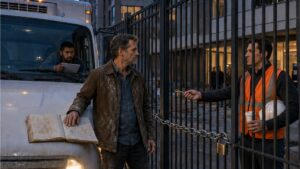
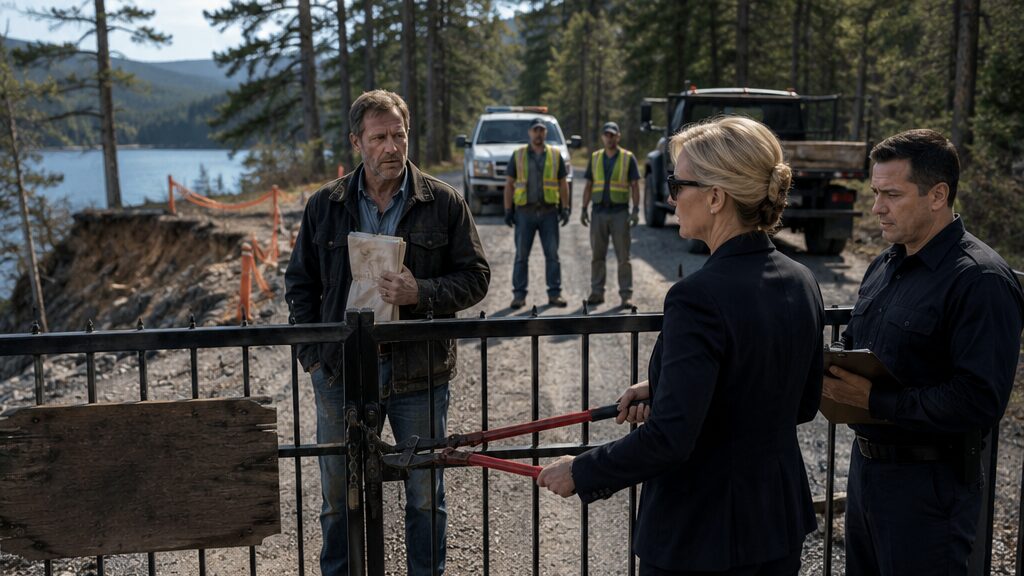
The red jaws of the bolt cutters closed around Brandon Martin’s lock before anyone on the other side of the gate said his name.
He watched from six feet away, one hand around a paper coffee cup gone lukewarm, the other resting against the folded deed packet in his jacket pocket. The black metal gate stood between him and the white HOA patrol vehicle idling on the gravel road, its tires still throwing dust into the cold morning air. Behind it, the lake flashed blue between the pines like nothing ugly had the right to happen there.
“Do not cut that lock,” Brandon said.
The woman holding the bolt cutters paused, but she did not lower them.
Nicole Harris looked exactly as she had at the last three board notices: blonde hair tucked smooth behind one ear, dark blazer zipped against the mountain air, sunglasses hiding whatever expression she had decided to bring that morning. She stood beneath the wooden sign Brandon had screwed to the gate himself.
PRIVATE PROPERTY – NO HOA ACCESS.
Beside her, Joshua Perez, the HOA patrol supervisor, shifted his weight. Two workers in reflective vests waited near a flatbed truck behind the patrol vehicle. One of them had a pry bar. The other kept looking at the washed-out stretch beyond the gate, where orange repair markers leaned along the soft shoulder like warning flags.
Nicole lifted her chin. “Unlock this gate, Mr. Martin.”
“You’re on private road frontage,” Brandon said. “Back the vehicles out.”
“This road has been used by residents for lake access for years.”
“Used is not owned.”
Her mouth tightened. “The association has issued an enforcement order.”
Brandon set the coffee cup on top of the stone gatepost. His hand was steady, though he felt the pressure rising behind his ribs, the old familiar urge to keep his voice flat and let the paper speak. He had learned years ago that anger made people stop reading.
“Do you have a court order?” he asked.
Nicole’s smile was small and practiced. “We have HOA authority to remove unauthorized access restrictions.”
“That is not the same thing.”
Joshua glanced at the bolt cutters, then at Nicole. “Ma’am, maybe we should verify—”
“It’s already been verified.” Nicole’s tone left no room for him. She faced Brandon again. “You were notified that blocking association access is a violation.”
“I was not notified before you arrived with tools.”
“A notice was left at the property.”
“When?”
Nicole looked away for half a second, toward the patrol vehicle. It was the kind of glance most people missed. Brandon did not.
“This morning,” she said.
“This morning while you were already here?”
One of the workers bent to pick up an orange cone from beside the gate.
Brandon’s voice hardened. “Put that down.”
The worker froze. Nicole raised one hand, not to stop him, but to show that she was still in charge. “Those markers are part of the violation. Temporary barriers, signage, gate closure, unapproved roadwork—”
“Road repair.”
“Unapproved roadwork.”
“There’s a washed-out shoulder past that bend.”
“Then you should have waited for approval before creating a closure.”
Brandon reached into his jacket and drew out the folded packet. The paper edges had softened from being opened and closed too many times over the last month. Deed. Survey. County road map. Repair request. Invoice deposit. Photographs.
He unfolded the deed first and held it up through the bars.
“This road from the county turnoff to the lower landing is mine,” he said. “Not the HOA’s. Not the residents’. Mine. The association line stops before this gate.”
Nicole did not take the paper. She looked at it the way people looked at things they had already decided not to see.
“Ownership does not exempt you from community standards.”
“It exempts you from cutting my lock.”
“You bought in adjacent to an association community. You understand shared expectations.”
“I didn’t buy in. My father built the house before your association existed.”
Her sunglasses turned toward the sign.
For one brief second, the scene went still: the red bolt cutters hanging under the words PRIVATE PROPERTY, the patrol vehicle humming behind Nicole, the lake shining beyond them, the workers waiting for permission to make a mistake nobody there would be able to undo cleanly.
Brandon thought of the culvert fifty yards behind him, the way the gravel had sunk after the storm, the right tire track too close to air. He thought of the transport van due next week, the one with the lift that needed more turning room than his pickup. He thought of his mother at the kitchen table, pretending not to count how many appointments he had already rescheduled.
Nicole’s voice cut through it. “Mr. Martin, open the gate.”
“No.”
“Then the association will proceed.”
Brandon pulled out his phone and started recording. “State your name and the authority you’re claiming before you touch the lock.”
Nicole’s face changed, not much, but enough. The smile vanished.
“You’re escalating this unnecessarily.”
“You brought bolt cutters.”
Joshua looked down at his own clipboard, then back to the gate. “Ms. Harris, the work order says removal of obstruction only if owner refuses access.”
Brandon focused on him. “What obstruction?”
Joshua swallowed. “Gate, lock, temporary barriers, cones, signage.”
“The gate has been here sixteen years.”
Nicole snapped, “The lock is new.”
“The lock is new because the road is unsafe.”
“Unsafe because you started unauthorized work.”
“Unsafe because the storm took out the shoulder.”
“Which you did not have permission to repair.”
Brandon stared at her. He could hear the machine logic in every sentence. Permission before safety. Approval before access. Process before the person who had to live behind the broken road.
He slid the repair request from the packet and held it up next to the deed. “I submitted this four weeks ago. Culvert washout. Shoulder repair. Temporary closure. Photos included. Contractor listed. I asked for acknowledgment from the board.”
Nicole’s jaw moved once. “Incomplete applications are not considered submitted.”
“It was complete.”
“It lacked final materials review.”
“For gravel and culvert stone?”
“For exterior alterations visible from common areas.”
He nearly laughed, but the sound would have come out wrong. “It’s a road shoulder.”
“It is visible from association lake access.”
“There is no association lake access through my road.”
“Again,” Nicole said, “that is disputed.”
The second worker had moved closer to the line of orange markers beyond the gate. Brandon saw him through the bars, just at the edge of his vision, his gloved hand closing around the wooden stake nearest the ditch.
Brandon stepped closer to the gate. “Nobody goes past this point.”
Nicole lowered the bolt cutters, but only to her side. “You don’t want this to become expensive.”
“It already is.”
“You’ll be billed for removal and restoration if you continue refusing compliance.”
“Restoration to what?” Brandon asked. “A collapsed shoulder?”
A flicker crossed Joshua’s face. He looked past Brandon then, really looked, down the curve of the road where the gravel narrowed and the orange markers traced the danger line. The closest stake leaned where rain had undercut the edge. Beyond it, the culvert pipe showed dark beneath torn ground.
Nicole saw him looking. “Joshua.”
He straightened.
Brandon folded the deed slowly, buying himself one breath. He had hoped ownership would be enough. He had hoped the sight of a recorded survey and county seal would stop the morning before it turned into a fight. He had promised himself he would not drag his mother’s condition into another room full of people who would turn it into a question, a story, a justification, a rumor.
He had made that mistake before. Silence had seemed kinder.
Nicole pointed past him.
“Remove the orange markers,” she said to the crew. “If he won’t open the gate, document the unauthorized safety barrier first.”
Brandon’s hand tightened around the phone.
The worker reached through the gate, grabbed the nearest repair marker, and pulled it loose from the wet gravel.
Chapter 2: The Road Was Safer Closed Than Open
The crew truck rolled past the cut-lock line before Brandon could get the first repair marker back in the ground.
Nicole had not cut the main chain. Not yet. Joshua had stopped that much after Brandon kept the camera on him and asked him twice to read the work order aloud. But the side access gap near the cedar post, the one Jeffrey Moore used for tools when the gate was locked, had not been chained that morning. One worker slipped through it, opened the small service latch from inside, and waved the flatbed forward as if he had discovered a loophole instead of trespassing.
“Stop the truck,” Brandon said.
Joshua stepped between him and the gate. “They’re only documenting.”
“They are driving toward a failed shoulder.”
The flatbed crept onto the private road, its tires pressing down the damp gravel Brandon had been trying to keep untouched until Jeffrey could finish bracing the culvert. Behind the truck, one of the workers tossed the pulled orange marker into the bed like scrap.
Brandon pushed past Joshua without touching him and walked fast along the road’s edge. “Stay left,” he called. “Do not take that outside line.”
The driver either did not hear him or chose not to. The truck’s right front tire drifted close to the softer edge where the gravel changed color, darker and looser from the water underneath. Brandon saw the ground flex.
“Left!” he shouted.
The driver jerked the wheel. Gravel snapped and slid down into the ditch. Not much. Not enough to collapse. Enough to show what would happen if a heavier vehicle came through blind.
The truck stopped.
For the first time that morning, no one spoke.
The lake wind moved through the pines. Somewhere below the road, water clicked through the exposed culvert pipe, steady and wrong.
Brandon crouched near the edge and filmed the fresh break. The orange marker that should have warned the driver was in the flatbed now, its reflective strip bright against a pile of tools.
Nicole came up behind him. “This is exactly why unauthorized work is a liability.”
He stood. “This is why the road was closed.”
“You can’t create a hazard and then claim the hazard justifies the closure.”
Brandon looked at her then, really looked, trying to find the person behind the blazer and sunglasses and clipped sentences. “The storm created the hazard.”
“You proceeded without approval.”
“I proceeded with a deposit and a contractor because nobody answered.”
“Then your issue is with the process.”
“No,” he said. “My issue is with you standing in front of a failed road calling safety a violation.”
A phone rang in his pocket before she could answer.
He knew the vibration pattern. Jeffrey.
Brandon turned away from Nicole and answered. “Tell me you’re close.”
“I was close,” Jeffrey Moore said. His voice came through rough with road noise. “Then a patrol guy called and said if I set foot on that road today, the HOA will consider me part of an unauthorized alteration.”
Brandon shut his eyes. “They called you?”
“About ten minutes ago. Said the board hasn’t approved the materials.”
“The materials are gravel, pipe sleeve, and treated retaining boards.”
“I know what they are. I sent them the photos. I sent them the slope measurements too.”
Brandon turned slightly. Nicole was watching him.
“When?” Brandon asked.
“Four weeks ago. Same day you signed the deposit. I copied the HOA office. You sent your packet too, right?”
“I did.”
“Well, nobody told me no. Nobody told me anything.” Jeffrey paused. “Brandon, that outside edge is not going to hold another heavy vehicle. If rain comes back before I brace it, keep everybody off it. I mean everybody.”
Brandon looked at the flatbed sitting twenty yards from the bend. “They already drove onto it.”
Jeffrey’s silence was worse than swearing.
“Get pictures,” Jeffrey said. “Every tire mark. Every marker they moved. Don’t argue if you don’t have to. Just get proof.”
Brandon almost laughed at that too. Proof. He had proof layered in folders, emails, survey maps, invoices, and county stamps. Proof had not stopped red bolt cutters from closing around his lock.
“I’ll call you back,” he said.
By the time the HOA vehicles finally backed out, they had taken four repair markers, photographed the gate from six angles, and left a printed notice tucked into the chain.
Nicole did not hand it to him. She folded it once and slid it through the bars, letting it fall at his feet.
“Forty-eight hours,” she said.
Brandon did not bend for it until the patrol vehicle turned around and started back down the road in a cloud of dust.
Only then did he pick it up.
NOTICE OF VIOLATION: UNAPPROVED ACCESS RESTRICTION AND TEMPORARY ROAD ALTERATION.
He read the first line twice, then folded it so hard the paper creased through the text.
At the house, Virginia was sitting at the kitchen table with her pill organizer open in front of her. She had one hand wrapped around a mug of tea and the other resting near the calendar where Brandon had circled her appointment in blue.
“You were gone a while,” she said.
He placed the deed packet on the counter before answering. “HOA came by.”
Her eyes moved to his face. Virginia Martin had lost none of her ability to hear what he did not say. “About the gate?”
“About the road.”
She looked toward the window. From the kitchen, the pines hid the damaged shoulder, but not the sound of trucks when they came too close. “Did they open it?”
“No.”
That was true enough to feel like a lie.
Brandon took out his phone and called the clinic transport number. He kept his back to her while he waited through the recorded menu.
When a dispatcher answered, he lowered his voice. “This is Brandon Martin. I need to reschedule Virginia Martin’s Monday pickup. Road access issue. No, she’s stable. Yes, I understand the next opening may be two weeks.”
Behind him, the chair legs scraped.
“Brandon.”
He closed his eyes.
“No, I’ll call back,” he told the dispatcher, and ended the call.
Virginia had pushed herself halfway up from the chair, one hand on the table. Her face was pale with the effort, but her voice was sharp. “You canceled it?”
“I moved it.”
“You canceled it.”
“The road isn’t safe enough for the van.”
“Because of me.”
“No.”
“Don’t do that.” Her fingers tightened on the table edge. “Don’t stand there with that polite voice and pretend this isn’t because of me.”
He crossed the kitchen, but she raised one hand, stopping him before he could help.
The gesture landed harder than a slap.
“I promised you I’d keep this house workable,” he said.
“You promised too much.”
“I promised enough.”
Virginia looked away first. Outside, the wind pushed a pine branch against the window screen with a soft rasping sound.
Brandon’s phone buzzed on the counter.
For one foolish second, he thought it might be Jeffrey saying he had found a way through this, or Joshua admitting the morning had gone too far.
It was an email from the HOA office.
Subject: FINAL NOTICE – REMOVAL DEADLINE.
Brandon opened it with his thumb.
The message was short. Remove the gate lock, temporary barriers, orange repair markers, and all unapproved road materials within forty-eight hours. Failure to comply would result in association removal at owner expense, with additional daily fines until restoration was complete.
At the bottom, in Nicole Harris’s clean digital signature, one line stood apart.
The Association reserves the right to restore access without further notice.
Brandon looked from the phone to his mother, then toward the window where the private road disappeared into the trees.
He had shown them the deed. They were coming anyway.
Chapter 3: The Approval Request Nobody Wanted To Find
Brandon found his own repair request in a blue folder labeled PENDING AESTHETIC REVIEW, tucked behind a stack of clubhouse landscaping bids.
The label was printed neatly, the kind of neatness that made carelessness look official. He stood in the HOA office records room with the drawer open and the folder in his hand, reading his own name through the plastic tab while the office copier hummed on the other side of the wall.
For a moment he did not move.
The packet was exactly where it should not have been if Nicole’s claim was true. Not incomplete. Not returned. Not denied. Pending.
He opened it on top of the filing cabinet.
His original cover letter was first. Date stamped four weeks earlier. Culvert washout after storm. Temporary safety closure requested. Contractor estimate attached. Photographs attached. Materials list attached. Emergency access maintained for medical and fire response by owner coordination.
Brandon touched the date stamp with his thumb.
He had not imagined sending it. He had not failed to follow the rules. He had not skipped the process because he was stubborn or impatient or too proud to ask.
The process had swallowed the request and then called him the problem.
A voice behind him said, “You’re not supposed to be in that drawer alone.”
Brandon turned.
Pamela Green stood in the doorway holding a ceramic mug and a ring of office keys. She wore a gray cardigan over a blouse and looked less angry than tired, which somehow made Brandon more careful.
“The clerk told me records were open to owners on Fridays,” he said.
“They are. With staff present.”
“She stepped out to take a call.”
Pamela looked at the folder in his hand. Her eyes paused on the label.
“That’s mine,” Brandon said.
“I can see that.”
“It was marked pending.”
Pamela entered the room and set her mug down on a shelf crowded with binders. “Nicole said your application was incomplete.”
“She said a lot of things.”
Pamela did not defend her. That told Brandon more than denial would have.
He turned the packet so she could see the date stamp. “Four weeks ago. Photos. Repair estimate. Materials. Temporary closure notice. I sent the same set by email.”
Pamela read without touching the pages. Her expression changed slowly, not into shock, but into the look of someone adding a number she did not want to add.
“Was this ever placed on the board agenda?” Brandon asked.
Pamela pressed her lips together. “Not that I remember.”
“Did the board vote on it?”
“No.”
“Did anyone ask for missing materials?”
“I didn’t see it.”
“But Nicole did.”
Pamela looked toward the open office door. “I don’t know what Nicole saw.”
Brandon tapped the folder label. “Somebody saw enough to file it.”
Pamela wrapped both hands around her mug though she did not drink. “The board has had a lot in front of it. Lake access has been a standing complaint since spring. People think your gate cut off a route they’ve always used.”
“My gate was there before most of those houses.”
“I’m not arguing that.”
“Then what are you arguing?”
She looked at him directly. “That people are angry, and Nicole is trying to keep them from turning that anger on the board.”
There it was: not cruelty, not exactly. Pressure. Convenience. A room full of residents who wanted a shortcut to the water and a president who had decided the quiet man behind the gate could absorb the blame.
Brandon slid his phone from his pocket and photographed the folder label, then each page.
Pamela’s shoulders stiffened. “Brandon.”
“Public record.”
“That doesn’t mean this won’t get uglier.”
“It got ugly when she brought bolt cutters.”
Pamela lowered her eyes.
He almost said Virginia’s name then. It rose to the back of his throat, full and hot. My mother cannot get safely down that road if they undo this. My mother has been pretending she does not need the transport van because every appointment makes her feel less like herself. My mother built half that garden outside the lake house with her bare hands and now has to ask me whether the road will hold.
Instead he swallowed it.
Privacy was the one thing Virginia had asked to keep.
Pamela watched the words disappear from his face. “Is there something else in that packet?”
“Everything necessary is in that packet.”
“That isn’t what I asked.”
“It’s what I’m answering.”
The clerk returned then, apologizing softly, and the room changed. Pamela stepped back into board-member posture. Brandon closed the folder, took it to the copier, and made copies while the machine light passed over each page like a slow interrogation.
By the time he reached the front office, Nicole Harris was waiting near the door.
No sunglasses indoors. Without them, her face looked younger and more strained. She held her phone in one hand, thumb pressed against the screen.
“I understand you’ve been accessing association files,” she said.
“I found my repair request.”
“Your incomplete request.”
He handed her a copy. “Date stamped. Filed. Pending aesthetic review.”
She did not take it.
“You began work before approval.”
“I began emergency stabilization after four weeks of silence.”
“You installed barriers.”
“I marked a failed shoulder.”
“You locked the gate.”
“I closed a private road before someone drove into a washout.”
Nicole’s voice lowered. “You keep saying private like that ends the conversation.”
“It should have stopped the bolt cutters.”
“The association has an obligation to maintain community access expectations.”
“Expectations are not easements.”
“Legal interpretations vary.”
“County maps don’t.”
That landed. Barely. A small tightening around her eyes.
Brandon saw it and filed it away.
Nicole stepped closer, keeping her voice quiet enough that the clerk would have to pretend not to hear. “You are creating a dispute that will cost everyone money.”
“I’m trying to fix a road.”
“You’re trying to make the board look negligent.”
“I don’t need to make it look like anything.”
Her face flushed. “You started construction without final approval.”
“You ignored the request.”
“I prioritized it according to procedure.”
“You buried it behind landscaping bids.”
For the first time, Nicole’s control slipped. “Because you cannot force an emergency by deciding your project matters more than everyone else’s.”
Brandon stared at her. There was something in that sentence beyond rule language. Fear, maybe. Or resentment. Not of him personally, not at first. Of being cornered. Of being shown that the system she held up as order had become a shield.
He lowered his voice. “You don’t know what it matters to.”
“Then submit complete supporting documentation.”
“I did.”
“Medical, legal, structural, all of it. In proper form.”
His hand tightened around the copies. “You want more paper.”
“I want compliance.”
“No,” Brandon said. “You want me to make this easy for you.”
Nicole’s phone buzzed. She glanced down, read something, then looked back at him with the steadiness of someone choosing a harder line because retreat would be visible.
“The board will hold an emergency hearing Friday evening,” she said. “Until then, any further work is suspended. The hearing will consider removal authorization for the gate and all temporary road alterations.”
The clerk stopped typing.
Pamela, still near the records room door, closed her eyes for half a second.
Brandon held Nicole’s gaze. “You’re escalating after seeing the file.”
“I’m enforcing after seeing that you still don’t understand the rules.”
He placed the copied packet on the counter between them. “And you still don’t understand what that road is holding up.”
Nicole picked up the packet at last, but not to read it. She squared the pages against the counter, turned, and walked back toward the board office.
Brandon’s phone buzzed before he reached the parking lot.
A new HOA notice had arrived.
Emergency Hearing: Authorization For Removal Of Unapproved Gate And Road Barriers.
At the bottom, under Nicole’s signature, was a photograph of his black gate with the private-property sign cropped just high enough th
Chapter 4: The Hearing Turned Safety Into A Violation
Nicole opened the hearing with Brandon’s gate filling the clubhouse wall.
Not the whole gate. Not the road curling behind it toward the washout. Not the orange markers warning where gravel had sunk away from the culvert. Just a cropped photograph of black bars, a new lock, and enough of the wooden sign to show the word PRIVATE while cutting off the line beneath it.
Brandon sat in the second row with his repair packet on his knees and felt the room decide what it was seeing before anyone explained it.
A blocked road.
A selfish owner.
A lake shortcut taken away.
Nicole stood beside the projector screen with a remote in one hand. On the table in front of her lay the red bolt cutters from Monday morning, placed there like evidence. Joshua Perez stood near the back wall, arms folded, patrol cap tucked under one elbow. Pamela Green sat with the other board members, her face turned toward the projected image, not toward Brandon.
“This emergency session concerns unauthorized restriction of association access,” Nicole said, “and unapproved road alterations affecting community use, safety expectations, and potential liability.”
A murmur moved through the room.
Brandon looked at the screen and saw what was missing.
He had photos on his phone of the tire mark near the soft edge. He had the date-stamped request. He had the deed. He had Jeffrey’s estimate and materials list. He had everything but the one thing people would understand immediately, and that one thing was sitting at home trying not to become his argument.
Nicole clicked to the next slide.
A larger image appeared: his orange repair markers lined along the shoulder, taken from an angle that made them look like a barrier across the road instead of a warning beside a failing edge.
“This was installed without final approval,” Nicole said. “The association was not given the opportunity to confirm material compatibility, slope impact, drainage consequences, or access disruption.”
Brandon stood. “I submitted drainage photos four weeks ago.”
Nicole did not look at him. “Mr. Martin will have time to speak.”
“I submitted them before any marker went up.”
“Mr. Martin.”
The gavel tapped once. It was a small sound, but everyone turned toward it. The board member holding it avoided Brandon’s eyes.
He sat back down.
A resident in the front row raised a hand before Nicole finished the next sentence. “My family used that road for years. Nobody said we couldn’t until he locked it.”
“It’s my road,” Brandon said quietly.
The resident turned around. “Then why did nobody care before?”
Because no one drove heavy vehicles down it after storms. Because his father had let neighbors walk through when people still asked. Because generosity, once repeated long enough, was easy for strangers to mistake for permission.
Brandon said none of that.
Nicole clicked again. A photo of the patrol vehicle at his gate appeared. The cropped sign was visible behind her shoulder.
“The board’s concern,” she said, “is not merely access. It is precedent. If one adjacent owner can block a route, install barriers, begin exterior alteration, and then demand retroactive approval by calling it an emergency, the entire community loses process.”
The word process settled over the room like dust.
Brandon opened his folder.
“I have the original request,” he said.
Nicole nodded as if she had expected this. “Which was incomplete.”
“It was stamped pending aesthetic review.”
A small shift went through the table. Pamela’s gaze dropped to the packet in his hands.
Nicole’s voice stayed smooth. “Pending does not mean approved.”
“No,” Brandon said. “But it does mean received.”
He walked to the front only when the board chair gestured that he could. He placed copies on the table: request, photos, contractor estimate, materials list, temporary closure notice, deed excerpt. He did not include the clinic transport schedule. He had printed it, then left it in his truck.
Nicole watched the stack land in front of her.
Brandon faced the room. “The storm undercut the shoulder past the bend. The culvert is exposed. A loaded vehicle taking the outside line could break through. The markers were placed to keep drivers off the weak edge until the repair is finished.”
A man near the back folded his arms. “Then why close the gate? Put up a sign.”
“There was a sign.”
“Not one we could see from the turnoff.”
“Because you shouldn’t be turning onto it.”
The words came out sharper than Brandon intended. The room stiffened against him.
Nicole did not miss it. “This is exactly the issue. Mr. Martin has repeatedly described association residents as trespassers despite long community use.”
“I described my property line.”
“You described families going to the lake as trespassers.”
Brandon closed his hand around the edge of the table. He could feel the conversation moving, not toward truth, but toward the easier story: one angry man and a gate.
A resident stood without waiting to be recognized. “Last month an ambulance had to take the long way around because that gate was locked.”
Brandon turned toward him.
The room went still enough that the projector fan sounded loud.
“That is not true,” Brandon said.
The resident lifted both hands. “I heard it from three people.”
“No ambulance was denied access.”
“How would you know?”
Because emergency transport had his number. Because the old fire key box had been replaced by a code lock two years ago. Because the only medical vehicle delayed last month had been delayed by the county bridge repair, not his road.
Because the patient behind that arrangement was Virginia.
Brandon felt her name rise again. This time it almost got out.
Nicole stepped in before it could. “Emergency access is precisely why private gate restrictions cannot be allowed without review.”
Brandon looked at her. “You know that isn’t what happened.”
“What I know,” she said, “is that the association cannot depend on private discretion for safety access.”
Pamela leaned toward her microphone. “Can we confirm the date of Mr. Martin’s original submission?”
Nicole’s fingers tightened around the remote. “The submission date is not disputed.”
“It matters,” Pamela said.
“It does not change the fact that work began before final approval.”
Pamela looked at Brandon. “Do you have the email receipt?”
He slid a copy across. “And the contractor copy.”
Nicole reached for it first, but Pamela took it.
For a few seconds, the room’s attention shifted away from Brandon and toward the timestamp printed at the top of the page. Four weeks. Three days. Before the gate confrontation. Before the violation. Before Nicole called the closure sudden and unauthorized.
A small payoff, but not a rescue.
Nicole recovered quickly. “Again, submission is not approval. The rules exist so urgent claims can be verified. Otherwise any homeowner could create a hazard, call it safety, and force the board’s hand.”
Brandon wanted to say that he had lived there long before most of them had chosen matching mailbox posts and lake-view dues. He wanted to say his mother had planted the lilacs by the lower turn when the road was still dirt and half the pines were shorter than him. He wanted to say there was a difference between a shortcut and a way home.
Instead he looked at the bolt cutters on the table.
“You brought tools to remove a lock before you verified the road condition,” he said.
Nicole’s face hardened. “We brought tools to restore access.”
“To a road you don’t own.”
“That remains under review.”
Pamela looked up. “Does it?”
Nicole’s head turned slowly.
Pamela did not back away, but her voice stayed careful. “If the association line and easement status are unclear, we should get county confirmation before authorizing removal.”
A few residents groaned.
Nicole faced the board. “And if we allow the closure to stand through another weekend, we signal that any owner can block community use by claiming an emergency. This affects property values, liability, and enforcement consistency.”
There it was again: the fear beneath the procedure. If Brandon’s gate stood, Nicole’s authority shrank.
The board withdrew for twelve minutes.
Brandon waited in the hallway, his packet under one arm. Pamela came out once, saw him, and almost stopped. Nicole called her name from inside before she could speak.
When they returned, the room had grown restless.
The board chair read the decision from a yellow pad. The gate and temporary barriers would remain only until Monday morning at nine. By then, Brandon had to provide county confirmation of ownership boundaries and repair authority. If he failed, the HOA would authorize temporary removal and bill him for costs.
Nicole did not smile.
She did not need to.
Brandon gathered his papers while residents stood around him, talking about access, values, rules, fairness. No one asked what would happen if the road failed before Monday. No one asked why he had closed it in the first place and then stopped when the answer reached his mouth.
Outside, under the clubhouse lights, Pamela approached him with her coat folded over one arm.
“Bring the county map,” she said quietly.
“You think that will be enough?”
She looked toward the meeting room windows, where Nicole’s silhouette moved behind the blinds. “I think you should bring anything she didn’t expect you to find.”
Chapter 5: The Old Road Map Changed The Whole Argument
The county road clerk pulled the old lake-road map from a flat drawer and stopped with one finger resting on a faded boundary line.
“Well,” the clerk said, “that’s not where your association thinks it is.”
Brandon leaned over the counter.
The map was larger than the desk, its paper softened at the folds, the ink browned with age. Pine Ridge Association was marked in a clean block to the east, its internal roads drawn in newer black lines. The private spur to Martin Landing curved away from the county turnoff and ran along the ridge toward the lake house.
The line stopped before Brandon’s gate.
Not near it. Not through it. Before it.
The clerk slid a ruler over the map. “The recorded easement for seasonal foot access expired when the lower dock parcel changed ownership. That was years ago. No vehicular easement shown after that. No association maintenance agreement either.”
Brandon stared at the word expired written in the margin of the copied file.
He had known the road was his. His father had made him read the deed after the first neighbor complained about the gate sixteen years ago. But knowing something in a kitchen and seeing it on county paper under fluorescent light were different things.
“Can I get certified copies?” he asked.
The clerk looked at the stack of papers already in his hand. “For an HOA fight?”
“Something like that.”
“That’ll be three dollars a page.”
He almost smiled. “Cheapest part of the week.”
While the clerk copied the map, Brandon’s phone vibrated.
Jeffrey.
“Tell me you’ve got good news,” Brandon said.
“I’ve got honest news,” Jeffrey replied. “Rain’s coming in Sunday night. Maybe heavy. If that shoulder isn’t braced before then, Monday’s going to be ugly.”
“I’m at county records now.”
“Records won’t hold gravel.”
“I know.”
“I can stage materials by your shed, but if the HOA’s watching me, they’ll say I violated the suspension.”
Brandon looked through the glass partition at the copy machine flashing light over the old map. “Don’t risk your license.”
Jeffrey exhaled. “That road goes, your mother’s not getting down in anything bigger than your truck.”
The words hit harder because Jeffrey did not soften them.
Brandon glanced at the clerk, then turned toward the hallway. “I know.”
“Do you?”
Brandon said nothing.
Jeffrey’s voice lowered. “You keep saying it’s a road issue. It is, but it isn’t. Tell the board why the timing matters.”
“She asked me not to.”
“Your mom?”
“Yes.”
“Then ask her again before the road makes the decision for both of you.”
The line went quiet.
Brandon took the certified copies, paid, and walked out with the old map rolled in a cardboard tube under his arm. The sky had the flat gray color of weather gathering itself. At his truck, he opened Pamela’s email from the night before and reread her last sentence.
Bring anything she didn’t expect you to find.
He wondered what Pamela expected him to find, and what she already knew.
At the lake house, Virginia was in the living room with a basket of folded towels beside her chair and the transport schedule on the table. She had circled the rescheduled appointment in pencil, then erased it hard enough to roughen the paper.
Brandon set the map tube on the dining table.
She looked at it. “County?”
“Yes.”
“And?”
“The HOA access line stops before the gate. The old foot easement expired. No vehicle rights.”
“That should help.”
“It should.”
Virginia knew that tone too. “But it won’t.”
“It may stop the gate removal. It may not get the repair approved fast enough.”
She folded a towel across her lap, smoothing the edges with both hands. “What does fast enough mean?”
He did not answer right away.
The old house creaked around them, boards shifting as the temperature fell. From the living room window, the lake was partly visible between the pines, a hard strip of silver below the ridge. Virginia had fought to stay in that room after the stairs became difficult, after the downstairs den became her bedroom, after Brandon quietly moved his workbench out of the mudroom to make space for a walker she pretended she did not use.
“Monday’s rain could undercut the shoulder more,” he said.
“And my appointment?”
“We’ll see.”
“Don’t say that.”
He sat across from her. “I can explain the medical access issue without details.”
“You mean explain me without me.”
“No.”
“You mean enough to make them feel bad.”
“I mean enough to make them stop.”
Virginia looked at the map tube. “I spent forty years being known in this valley for something other than needing help to get through a door.”
“I know.”
“Do you? Because lately every conversation in this house ends with what I can’t do.”
The words struck clean because there was truth in them.
Brandon looked down at his hands. They were rough from road stakes and old tools, one knuckle split from tightening the gate chain after Nicole left. “I’m trying to keep you here.”
“I’m trying to stay myself while you do it.”
He had no defense for that.
Virginia reached for the folded towel again, then stopped. Her fingers trembled once before settling. “I’m not ashamed of being sick. I’m ashamed of being turned into a reason.”
“You’re not a reason.”
“Then don’t carry me into that room like evidence.”
He looked toward the map tube, the deed packet, the repair photos spread on the table. For weeks he had believed that if he brought enough paper, he could keep Virginia out of it. Paper could be challenged, delayed, refiled, stamped pending. A person could be pitied. Or worse, discussed.
“I won’t use you,” he said.
“But you may have to tell the truth.”
He looked back at her.
Her eyes were tired, but clear. “There’s a difference, Brandon.”
Before he could answer, his phone buzzed again.
Pamela Green.
No subject line. Just a forwarded message.
Brandon opened it.
The original email was from Nicole to a board-only thread, dated two days before the gate confrontation.
County easement status remains uncertain. Do not concede ownership issue in writing. If Martin’s closure stands through the weekend, resident pressure over lake access will become harder to manage before the vote. Proceed with enforcement under unapproved alteration language.
Brandon read it once.
Then again.
Virginia watched his face. “What is it?”
He turned the phone so she could see only the top line, not the whole thread.
Nicole had known.
Not everything. Not Virginia. Not the transport van. But enough. Enough to know the road claim was weak. Enough to know enforcement was easier if she stopped calling it access and started calling it an alteration.
At the bottom of Pamela’s message, beneath the forwarded email, she had typed one sentence.
I will deny sending this if asked, but Monday should not happen this way.
Chapter 6: The Crew Came Back While The Road Was Failing
The machine was already running when Brandon reached the gate.
Rain hit the hood of his truck in hard silver streaks, blurring the black bars, the patrol vehicle, the flatbed, the men in reflective jackets moving through the morning like they had rehearsed not seeing him. A compact loader idled beside the cedar post, its bucket low, engine growling under the sound of water rushing through the ditch.
Two workers were loading Brandon’s repair boards into the truck.
For one second, he did not get out. He sat with both hands on the wheel and watched a man lift the treated lumber Jeffrey had staged by the shed, the boards meant to brace the shoulder before the storm could take more ground.
Then a board slid off the stack and struck the flatbed with a crack that snapped him into motion.
Brandon stepped into the rain without a coat.
“Put those down.”
The nearest worker turned. So did Joshua Perez, standing under the lifted hatch of the HOA patrol vehicle with a clipboard wrapped in a plastic sleeve. Nicole Harris stood beside him in a raincoat, sunglasses gone, hair damp at the temples. She looked less polished in the storm, but no less determined.
“Mr. Martin,” she called. “You were given until nine.”
“It’s eight seventeen.”
“The board authorized preparation for removal.”
“No. The board gave me until nine to produce county confirmation.”
Nicole held out a folded notice, the paper already freckled with rain. “You failed to provide it to the association office before enforcement mobilized.”
“I sent it to the board at seven thirty-two.”
“That was not the agreed process.”
Brandon walked to the flatbed and gripped the end of a board before the worker could slide it farther in. “Those are my materials. They stay here.”
The worker looked past him to Nicole.
Nicole’s voice cut through the rain. “Load them.”
Brandon did not move.
The worker let go first.
Joshua stepped closer. “Mr. Martin, don’t make this physical.”
“I’m not touching him. I’m touching my board.”
“You need to step back.”
“I need you to read your order.”
Joshua looked down. “You have a copy.”
“Read the timestamp.”
Nicole’s head turned. “That isn’t necessary.”
“It is if you expect me to move.”
The loader engine rumbled behind them. Gravel shifted near the road edge with a soft, sick slide. Brandon looked past the gate and saw water cutting a thin brown line through the shoulder where yesterday there had only been damp stone.
“Joshua,” he said, “read it.”
The patrol supervisor’s face had gone tight. Rain dripped from the brim of his cap onto the plastic sleeve. He lifted the clipboard enough to see.
“Work order issued Monday,” he said.
“Time.”
Nicole stepped forward. “The order reflects anticipated enforcement—”
“Time,” Brandon said again.
Joshua swallowed. “Six forty-five a.m.”
Brandon held up his phone, screen bright despite the rain. “The board deadline was nine.”
Joshua did not answer.
“The crew was dispatched before I could fail to comply.”
Nicole’s voice sharpened. “The board made its intent clear. You chose to obstruct.”
“I chose to send certified county records at seven thirty-two. You chose to have a machine at my gate before breakfast.”
The loader bucket lifted slightly.
Brandon turned toward it. “Shut that machine off.”
The operator looked to Nicole.
“Do not shut it off,” Nicole said.
The bucket dipped toward the edge of the service gap where the ground had softened around the cedar post. If it tore that post out, the gate would twist, and the chain line would be useless. Worse, the truck and loader would have room to move deeper toward the washout.
Brandon stepped in front of the bucket.
Joshua cursed under his breath. “Mr. Martin.”
“I said shut it off.”
“You can’t stand there.”
“Then tell him to stop.”
Nicole’s expression flickered—not fear for him, not exactly, but fear of what the scene had become. Machine running. Homeowner standing in rain. Workers holding his boards. Patrol supervisor reading a premature order aloud.
This was no longer a clean enforcement action.
This was a record.
Brandon raised his phone. “State whether you’re proceeding without county confirmation.”
Nicole looked at the phone, then at Joshua. “The association disputes your interpretation.”
“The county map is not an interpretation.”
“It does not address emergency community access.”
“It shows you don’t have the access you’re claiming.”
“It shows one document in a larger history.”
“The expired easement is in the same packet.”
A worker near the flatbed muttered something Brandon could not hear. Another board slid in the rain, knocking against the truck rail.
Then, from behind Brandon’s house, came the slow beep of a vehicle backing down the upper drive.
He turned.
The transport van had arrived.
White, high-roofed, with a side lift and the clinic name on the door, it crept toward the bend and stopped short of the failing shoulder. The driver opened the window and looked from the marked road edge to the gate, then to the loader blocking part of the lane.
Virginia sat visible through the side window, wrapped in her dark coat, one hand resting on the frame beside her.
Brandon felt the world narrow to that square of glass.
She had come out.
He had canceled, rescheduled, argued, carried papers, protected her name, protected her pride, and still the morning had brought her to the edge of the thing he had been trying to keep from swallowing them both.
Nicole followed his gaze.
For the first time, she said nothing.
The van driver stepped out and called through the rain, “I can’t bring the lift over that shoulder. Not with that equipment there.”
Virginia looked at Brandon through the wet glass. She did not wave. She did not plead. She only looked at him and gave the smallest nod.
Not permission to use her.
Permission to tell the truth.
Brandon lowered the board.
He walked back to the gate, phone still recording, rain running down his face and into his collar. He stood where the red bolt cutters had closed around his lock days earlier and faced Nicole, Joshua, the workers, the idling machine, and the van waiting behind the unsafe bend.
“That road closure was for medical transport,” he said. “My mother lives in that house. The repair is to keep that van from putting a wheel through a failed shoulder. You were told there was an emergency access issue in the original packet. You buried it, called the markers a violation, and sent a crew before the deadline.”
Nicole’s face had gone pale under the rain. “You did not provide complete medical documentation.”
“I provided enough to stop a reasonable person from sending a loader.”
Joshua looked toward the van. The operator finally cut the engine.
The sudden quiet was almost violent.
Brandon tapped Pamela’s number.
She answered on the fourth ring, breathless. “Brandon?”
He put her on speaker and held the phone where the rain could not drown him out.
“Pamela,” he said, watching Nicole’s eyes lock onto the phone, “the crew is here before the deadline. Joshua just read the work order timestamp as six forty-five. They’re loading my repair materials. The transport van can’t pass.”
A pause. Then Pamela’s voice, thinner through the speaker: “Is Nicole there?”
“Yes.”
“Is the machine operating?”
“It was.”
Nicole stepped closer. “Pamela, this is not the full context.”
Brandon did not raise his voice. “Either the board stops thi
Chapter 7: The Gate Stayed, But The Rules Changed
Brandon placed the cut chain on the board table before anyone in the clubhouse said good evening.
It landed with a dull metal weight between the certified county map, the original repair request, Jeffrey’s updated estimate, and the printed work order Joshua had read aloud in the rain. The link scarred by Nicole’s bolt cutters faced upward, bright where the metal had been bitten and bent but not fully severed.
The room went quiet around it.
Nicole sat at the far end of the table, not beside the projector this time. Her hair was pulled back, her blazer replaced by a plain dark sweater. She did not look at the chain. She looked at the map.
Pamela Green sat two seats away from her with a folder already open, pages marked by yellow tabs. Joshua stood near the wall again, but without his patrol cap in his hands. He kept his eyes on the floor until Brandon set down the work order.
The board chair cleared his throat. “Mr. Martin, this special session is to review emergency road repair status, access authority, and enforcement procedure.”
Brandon remained standing. “Then I’d like the first item reviewed to be the order that put a machine at my gate before the deadline you gave me.”
Nicole’s mouth tightened, but she did not interrupt.
Pamela leaned toward her microphone. “That is already part of the record.”
The words moved through the room differently than anything Pamela had said before. Not as a question. Not as a careful suggestion. As a line she had decided not to step behind again.
The board chair looked down at his papers. “The timestamp is acknowledged.”
Brandon sat then, slowly. His coat still smelled faintly of rain and wet gravel even after three days. Outside, Jeffrey’s crew had stabilized the worst of the shoulder under a temporary emergency agreement Pamela had pushed through by phone before the transport van left. Virginia had made her appointment two hours late, tired and furious at needing help, but home before dark.
The road had held.
Barely.
Nicole folded her hands. “The association acted under good-faith concern for access and safety.”
Pamela looked at her. “The association acted before the deadline it set.”
Nicole turned. “Mobilization is not removal.”
“The repair boards were being loaded into a truck.”
“They were staged materials connected to an unapproved alteration.”
“They were materials for a road shoulder that county records confirm the association does not own.”
The room stilled again.
Pamela removed a sheet from her folder and slid it toward the board chair. “Certified map. Expired foot easement. No vehicle easement. No maintenance agreement. No recorded association access rights beyond the county turnoff.”
A resident in the back shifted in his seat. “We’ve always used that road.”
Brandon did not turn around.
Pamela did. “Custom does not create the authority to cut a private lock.”
The resident fell silent.
Nicole’s voice was low. “So the board is simply going to abandon access residents have relied on?”
“No,” Pamela said. “The board is going to stop pretending reliance is ownership.”
Brandon looked at her then.
Pamela did not look triumphant. If anything, she looked ashamed that it had taken a machine, a transport van, and a man standing in the rain to make her say aloud what the papers had shown from the start.
The board chair shuffled the documents. “The legal question appears clearer than it was represented at the prior meeting.”
Nicole’s face changed at that, just enough. Not anger first. Fear.
“I represented the issue based on long-standing community use and pending review,” she said.
Brandon picked up the printed email Pamela had forwarded and set it beside the chain. He did not read it aloud. He did not need to. Everyone at the table had a copy now.
County easement status remains uncertain. Do not concede ownership issue in writing.
“You knew it was uncertain before you brought bolt cutters,” he said.
Nicole looked at the paper, then at him. “I knew there were competing interpretations.”
“You didn’t tell the board that when you asked to remove my gate.”
“I told the board there was urgency.”
“There was,” Brandon said. “Just not the one you named.”
For the first time, Nicole met his eyes without procedural language ready in front of her. She looked exhausted. Cornered. Still proud. Still responsible.
“My responsibility is to the association,” she said.
“My responsibility is to the person who has to get home over that road.”
The room held that sentence.
It was not a speech. Brandon had promised Virginia he would not turn her into one. He did not name her diagnosis. He did not describe the appointments, the downstairs bedroom, the erased pencil circles on the transport schedule. He only placed the clinic transport letter on the table, face down except for the header and date.
“Emergency medical access requires a stable road surface and turning clearance,” he said. “That was in my original packet. You did not need private medical details to understand that removing the markers and materials could make the road unsafe.”
Pamela opened another page. “The violation notice against Mr. Martin should be withdrawn. The emergency repair should be approved with conditions limited to actual safety and emergency access. The association should remove all fines and cover the cost of materials moved or damaged during the attempted removal.”
Nicole turned sharply. “Cover costs?”
“The crew acted under an association work order,” Pamela said.
Joshua looked up.
The board chair asked him, “Mr. Perez, did you understand the work order to authorize removal before nine?”
Joshua’s throat moved. “I understood we were to be on-site and ready. Once materials were being loaded, I questioned the timing.”
“Did you advise stopping?”
He glanced at Nicole, then back to the chair. “Not clearly enough.”
That surprised Brandon more than denial would have.
Nicole closed her eyes for a second.
The vote did not come with drama. No one clapped. No one stood. The board chair read each item, and hands rose with the stiff discomfort of people choosing liability management and conscience at the same time.
Violation withdrawn.
Fines removed.
Emergency repair approved.
No association vehicle access through Martin Road except documented emergency response or written owner permission.
A lockbox for emergency responders allowed at the gate.
Revised signage permitted.
Replacement cost for the damaged chain and removed markers reimbursed.
The final item took longer. Nicole’s enforcement authority would be reviewed before any future physical removal order could be issued. She did not object, but her face went flat in a way Brandon understood. Pride had its own injuries.
After the meeting, she approached him while Pamela spoke with the board chair.
“I thought if I let your gate stand,” Nicole said, “I’d lose any chance of keeping order.”
Brandon gathered the chain and papers into his folder. “You mistook order for control.”
She flinched, not much.
He expected a defense. Instead she looked toward the wall where his gate photo had been projected days earlier.
“I should have waited,” she said.
“Yes.”
“I should have read the whole packet.”
“Yes.”
She nodded once, accepting the size of what he would not soften for her. “I’m sorry about your mother.”
He closed the folder. “Be sorry about the order.”
Nicole had no answer to that.
By Thursday, Jeffrey’s crew had the culvert sleeved, the shoulder braced, and fresh gravel packed clean along the curve. The orange markers went back in only until the final inspection, standing straight this time. The old sign stayed, but Brandon added a smaller one below it, plain black letters on white.
EMERGENCY ACCESS LOCKBOX INSTALLED. PRIVATE ROAD. NO THROUGH HOA ACCESS.
The new chain was heavier than the old one. The lock clicked shut with a sound that would once have meant refusal.
Now it sounded like a boundary with room for what mattered.
Virginia’s transport van crossed the repaired bend late that afternoon, slow and careful. Brandon stood near the gate while the driver took the inside line Jeffrey had marked. Virginia sat by the window with her coat buttoned wrong at the top and her chin lifted as if daring the road to make a fuss over her.
When the van passed him, she tapped the glass once.
Not a thank-you. Not forgiveness for every canceled appointment or careful omission.
Just acknowledgment.
Brandon lifted his hand.
After the van turned toward the county road, he closed the gate behind it and locked the chain through the black bars. Then he opened the small emergency box, checked the code card sealed inside for responders, and shut it again.
The lake road was quiet. The repaired shoulder held under the last light. The scarred old chain lay in the bed of his truck, not as proof that he had won, but as a reminder of what silence had nearly cost.
Brandon rested one hand on the gate a moment longer, then walked back toward the house where Virginia had already told him not to hover when she returned.
The gate stayed.
But this time, it was not keeping the world out. It was keeping the road safe enough to let the right help in.
The story has ended.