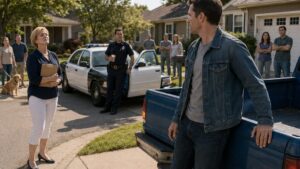
The HOA Sent a Crew to Tear Down the Bridge He Built for Her Safety
Chapter 1: The Crew Was Already Pulling Planks
The saw started before the sun cleared the ridge.
Patrick Hill heard it through the kitchen window, a high, biting whine that did not belong to sheep, wind, or morning work. He had been rinsing a coffee mug at the sink, watching the pond go silver under the first light, when the sound cut across the ranch and made the muscles in his jaw lock.
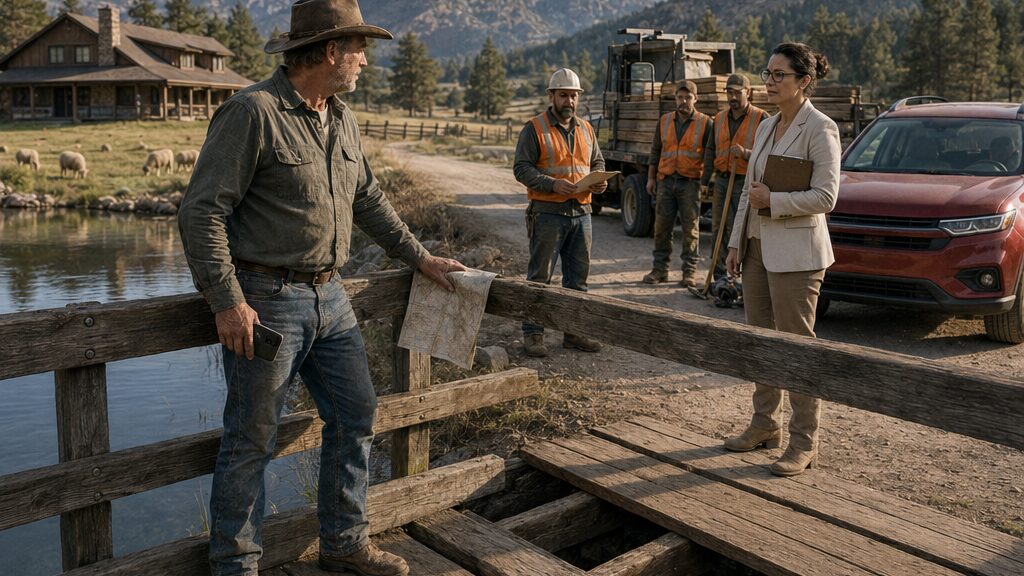
On the far side of the water, two men in orange vests stood on his bridge.
One had a pry bar under the new railing. The other was backing toward a flatbed truck with a plank Patrick had paid for, sanded, sealed, and helped Matthew Lee bolt down three days earlier. A third man crouched near the center span, where the boards crossed the spillway, running the saw between two fresh pieces of lumber.
Patrick set the mug down without drying his hands.
“Patrick?” Barbara called from the bedroom.
He did not answer right away. He watched one of the men lift the plank as if it were scrap. Behind him, near the dirt pullout, a truck idled with its tailgate down. New boards already lay in the bed, stacked like somebody else’s property.
“Patrick?”
He turned from the window. “Stay inside.”
The walker bumped once against the bedroom doorway. “What is it?”
“Just stay inside for a minute.”
He took his hat from the hook, picked up his phone, and went out through the back door.
The air smelled of wet grass and cut lumber. Sheep lifted their heads from the pasture beyond the pond, chewing slowly, as if even they knew something was wrong but not yet worth panic. Patrick crossed the yard with even steps. He did not shout. His boots hit the dirt path, then the first stones near the water. The saw stopped when one of the workers saw him coming.
The man with the pry bar straightened.
“You need to step off that bridge,” Patrick said.
The worker glanced toward the truck. “Sir, we’re under order to remove noncompliant additions.”
“You are standing on my bridge.”
The crouching man stood with the saw hanging at his side. “We were told the owner had notice.”
Patrick held up his phone and started recording. “Then you can tell me who gave it.”
The man with the pry bar looked uncomfortable, but he did not lower the tool. “Supervisor’s on his way back from the truck.”
“No.” Patrick stepped onto the first intact board. “No one touches another plank until I see a written order.”
The worker with the saw shifted his weight. “We don’t want trouble.”
“Then don’t bring a saw onto a man’s property before breakfast and call it paperwork.”
The crew supervisor came around the truck carrying a folded form in one hand and a white hard hat in the other. He was younger than Patrick expected, with a trimmed beard and the tired look of someone already regretting a job.
“Mr. Hill?”
Patrick kept the phone up. “Who sent you?”
“We’re contracted for removal by the High Meadow Homeowners Association.”
Patrick looked at the plank sticking out of the flatbed. “That board is mine.”
“The association authorized removal of an unapproved structure.”
“It was a repair.”
“That’s not what the order says.”
“Then show me the order.”
The supervisor hesitated just long enough for Patrick to see he had not expected the request. He opened the folded form and held it out, but Patrick did not take it. He moved closer and filmed the page.
The words were neat. Too neat. Printed boxes. Parcel number. Exterior alteration. Shoreline structure. Unauthorized railing. Removal approved.
At the bottom, where Patrick expected a county seal or court order, there was only the HOA letterhead and Donna Rivera’s signature.
“That is not a court order,” Patrick said.
“It’s an enforcement authorization.”
“It’s a piece of paper from a board.”
The supervisor lowered his voice. “Sir, I’m just here to do a contracted job.”
“And I’m telling you the job stops.”
A red SUV appeared at the curve of the dirt road, moving too fast for the ranch track. Dust rose behind it in a pale ribbon. Patrick watched it come past the fence, past the lower pasture, past the sign Barbara had painted years ago with the ranch name fading under the sun.
The SUV stopped beside the flatbed.
Donna Rivera stepped out in tan pants, a cream blazer, and clean boots that looked wrong against ranch dirt. She had a clipboard tucked against her side and sunglasses pushed up into her dark hair. Her expression did not change when she saw Patrick recording.
“Mr. Hill,” she said. “You were notified.”
Patrick turned the phone toward her. “I was notified after your crew started tearing apart my bridge.”
“We left notice at the front door.”
“When?”
Donna glanced at her clipboard. “This morning.”
“This morning while your men were already here?”
“The association is proceeding under the emergency exterior enforcement provision.”
Patrick almost laughed, but the sound stayed in his throat. “Emergency?”
“The repair you installed changes the appearance and dimensions of a structure adjacent to shared runoff water. It was denied pending review.”
“It was never denied. Nobody answered.”
“You submitted incomplete materials.”
“I submitted repair receipts, contractor license, photos, and a notice that the old railing had failed.”
“You did not receive approval.”
“Barbara can’t use the gravel route.”
Donna’s pen paused over the clipboard.
Patrick saw the flicker. Not concern exactly. Calculation. The kind of pause people made when a word did not fit into the box they had planned to check.
“My wife,” he said. “She uses a walker. That bridge is the flat route from the house to the drive when the therapy van comes. It is also the safe crossing when the spillway runs high. You are not removing it because the railing is a different color.”
Donna looked toward the bridge. The missing plank left a dark strip over the water. One section of railing leaned loose where the pry bar had bitten under the bolts.
“You should have submitted an accommodation request,” she said.
Patrick held her gaze. “I submitted an emergency repair notice.”
“That is not the same thing.”
“No. One keeps someone safe today. The other keeps you busy for six weeks.”
The crew supervisor looked down at the dirt. One of the workers slowly set the pry bar against the truck.
Donna’s face tightened. “The standards exist for a reason. Unauthorized structures around water create liability. We had an insurance review last month. We cannot allow residents to decide for themselves which rules apply.”
“This ranch was here before your HOA had a mailbox.”
“High Meadow has maintenance review authority for structures affecting shared drainage.”
Patrick stepped to the edge of the bridge. “This crossing does not affect your drainage. It sits inside my parcel.”
“Your opinion is noted.”
“My survey is in the house.”
“Then bring it to the hearing.”
“The hearing?”
Donna pulled a second sheet from her clipboard and held it out. “Emergency board review. Tonight. Seven o’clock. Until then, the crew may pause as a courtesy.”
“A courtesy,” Patrick repeated, looking at the gap where his plank had been.
Donna’s mouth flattened. “Removal resumes tomorrow morning unless the board reverses enforcement.”
Patrick took the paper because leaving it in her hand would have made it look like he was refusing something. He glanced at the date, the time, the bold words near the middle: TEMPORARY REMOVAL AUTHORIZED.
Behind him, from the house, came the faint scrape of Barbara’s walker crossing the bedroom floor.
Patrick turned before he meant to.
Donna followed his eyes toward the window. For the first time, something like discomfort crossed her face. It disappeared quickly.
Patrick lowered his phone. “Your crew takes nothing else today. Not one screw. Not one board.”
Donna closed her clipboard. “Bring your proof to the board tonight, Mr. Hill, because the removal resumes tomorrow.”
Chapter 2: The Map Stopped Only One Machine
Barbara stopped at the kitchen window when she saw the missing rail.
The walker legs clicked once on the tile and then went still. Patrick, coming in with the folded notice in one hand and dust on his boots, watched her fingers tighten around the rubber grips. She had dressed herself, stubbornly, in the blue sweater she wore when she wanted no one to ask how she felt. Her left foot stayed planted. Her right foot shifted back half an inch.
“They took part of it,” she said.
“Only one section.”
“That’s not only.”
Patrick set the notice facedown on the table. “I stopped them.”
Barbara kept looking out. The bridge crossed the pond in a clean brown line except for the raw gap where the new railing had been pulled loose. The missing plank was worse than Patrick had thought from below. From the house it looked like a tooth knocked out of a jaw.
“Can the therapy van come around the long side?” she asked.
“Not if the lower gate’s muddy.”
“It isn’t muddy.”
“It will be if we get the rain they’re calling for.”
She turned, and the effort cost her. He saw it in the way her mouth tightened before she softened it. “Patrick.”
“I know.”
“You don’t have to go to war over every fence post.”
“That bridge is not a fence post.”
“I know that too.”
He wanted to tell her everything at once: the red SUV, the clipboard, the way Donna had said accommodation request as if Barbara were a missing attachment. But Barbara’s face had that pale morning set to it, the one she got when pain medicine had not caught up with movement.
So he said only, “I’m going to get the survey.”
The old map lived in a metal drawer in the mudroom, inside a flat leather case that had belonged to Patrick’s father. He had unfolded it on tailgates, courthouse counters, and once on the hood of a sheriff’s cruiser when a delivery driver tried to cut through the pasture. It had never failed him. Lines were lines. Corners were corners. Land did not move because someone new bought a clipboard.
He spread it on the kitchen table.
Barbara lowered herself into a chair, slower than she wanted him to notice. Patrick placed coffee mugs at the curling corners. The map smelled faintly of dust and old paper. A crease ran diagonally across the pond, exactly where the bridge crossed the narrow spillway.
“There,” he said, tapping the line. “The HOA boundary starts east of the lower road. This bridge is inside the ranch parcel.”
Barbara traced the pond with one finger. “Will that end it?”
“It should.”
She looked at him. “That isn’t what I asked.”
He did not answer.
He collected the repair receipts, Matthew Lee’s estimate, photos of the old cracked railing, and the emergency notice he had emailed four weeks earlier. He printed the email confirmation twice because paper still felt more honest in his hands than a screen. On the table, beside the documents, lay three screws Matthew had removed from the failed railing. The metal was rusted thin near the threads.
Patrick picked one up and rolled it in his palm. “This is what they wanted you leaning against.”
Barbara looked away.
His phone buzzed. Matthew Lee’s name appeared on the screen.
“You see what they did?” Matthew asked as soon as Patrick answered.
“I was standing there.”
“I just got a message from the association office. They said if I continue work without authorization, they’ll file a contractor complaint.”
Patrick looked toward the bridge. One of the workers had left muddy boot prints on the first board. “You did permitted repair work on private property.”
“That’s what I told them. But Patrick, a complaint still sits on my license until it’s cleared. I can’t have that hanging over me. Not with two jobs waiting.”
“I’m not asking you to risk your living.”
A short silence. “You are, though. Not on purpose.”
Patrick closed his eyes.
Matthew’s voice softened. “I’ll help you document what was there. I’ll write that the old rail was unsafe. But I can’t reinstall anything until somebody puts in writing that I’m protected.”
Patrick looked at the rusted screw in his hand. “They’re making the bridge unsafe, then telling us we need permission to make it safe.”
“Yeah,” Matthew said. “That’s about the size of it.”
After the call, Patrick went out to the bridge and photographed every cut, every bolt hole, every board loaded into the truck before it left. He took pictures of the tire tracks beside the pond. He measured the gap with a tape and wrote the numbers on the back of an envelope because anger made him careful.
At noon, an email from Donna arrived.
Subject: Maintenance Review Authority.
Patrick opened it at the kitchen table while Barbara rested in the bedroom. Attached was a scanned page titled SHARED RUNOFF AND WATER ADJACENT STRUCTURES RIDER. It had been added to the HOA documents twelve years after the original ranch parcels were recorded. The language was narrow and thick: any structure adjacent to shared runoff channels, drainage basins, ponds, spillways, or community water features subject to review for safety, appearance, and insurance compliance.
Patrick read it twice.
Then a third time.
The bridge was on his land. The pond was on his land. But the spillway fed a drainage ditch that crossed under the lower HOA road after heavy rain. That was the crack Donna meant to pry open.
He called the county records office. A clerk answered with the tired patience of a person who had been asked all week to settle arguments she had not created.
“I have an old ranch survey,” Patrick said. “I need to confirm whether a later HOA rider can cover a bridge on the original parcel.”
“You’ll need the recorded covenants and any maintenance easements,” the clerk said.
“I have the survey.”
“That’s not the same thing.”
He nearly snapped, then stopped himself. It was the second time that day someone had said those words.
The clerk continued, “The survey shows boundaries. It may not show maintenance obligations added later.”
“Can I get copies?”
“You can request them online, but older parcels may not be fully scanned. If it’s the Hill ranch parcel, some of that is probably in storage.”
Patrick’s grip tightened on the phone. “You know the parcel?”
“We get calls when HOAs and old ranch parcels overlap,” she said. “They are never simple.”
By late afternoon, the kitchen table had become a paper corral. Map, receipts, photographs, printed emails, rusted screws, the HOA rider, the hearing notice. Patrick arranged and rearranged them until the order made sense to him.
Barbara came in quietly.
“You didn’t eat,” she said.
“Wasn’t hungry.”
She glanced at the table. Her eyes rested on the folder he had left closed near the edge. The medical packet from her surgeon sat inside it, along with the physical therapist’s recommendation for flat access and limited uneven-ground walking.
Patrick moved a receipt over it.
Barbara saw.
“I asked you not to use that,” she said.
“And I haven’t.”
She stood very still behind the chair. “I don’t want those people discussing me.”
“They won’t.”
“They will if you hand them that.”
Patrick looked down at the map. “The survey should be enough.”
“Should be.”
He hated the softness in her voice. Not doubt. Worse. Experience.
At six, he packed the documents into a brown folder, leaving the medical packet behind. He took the old survey last, folding it along its familiar creases. When he lifted the folder, the edge of Barbara’s medical letter showed from beneath the receipt he had used to hide it.
A blank space stared up from the appeal checklist Donna had attached.
Medical necessity documentation, if applicable.
Patrick slid the checklist into the folder without filling the gap.
Chapter 3: A Denial Letter With Missing Pages
Patrick walked into the HOA board room and saw his bridge on the wall.
Not the bridge as it had looked three days ago when Matthew Lee tightened the last bolt and Barbara stood at the window pretending she was not crying. Not even the bridge as it had looked that morning, wounded and half-stripped above the pond. This was a blown-up photograph taken from a low angle, the new railing bright against the older boards, red arrows pointing at fresh lumber as if it were contraband.
Across the bottom of the slide were the words UNAUTHORIZED SHORELINE STRUCTURE.
Patrick stopped just inside the doorway.
A few neighbors sat in folding chairs. None of them looked directly at him for long. Donna Rivera stood near the projector screen with her clipboard against her ribs. Nancy Wilson sat at the board table, reading through a packet with a yellow sticky note on almost every page.
Donna glanced up. “Mr. Hill. You’re on time.”
Patrick took the empty chair facing them. “You put my bridge on a screen.”
“It is the subject of the emergency review.”
“It’s a repair.”
“That is what we’re here to determine.”
The board room had carpet that smelled faintly of cleaning solution and old coffee. On one wall hung framed photos of High Meadow’s entrance sign, its clubhouse, its walking trail, all of them polished and green in a way Patrick’s ranch had never been. His land had mud, weather, sheep, loose stones, and fences that leaned slightly because wind had opinions.
Donna began with procedure.
She read section numbers from the rider. She described the bridge as “expanded,” the railing as “visually inconsistent,” and the work as “performed without written approval.” Her voice was calm, almost careful. Patrick understood why people listened to that kind of voice. It made harm sound organized.
When she finished, she nodded to him. “You may respond.”
Patrick stood and opened his folder.
He started with the survey. He unfolded it slowly on the board table because rushing would make him look like the angry man they expected. The paper crackled under the fluorescent lights. Nancy leaned forward. Donna did not.
“This ranch parcel predates High Meadow,” Patrick said. “The pond is inside my property line. The bridge crosses my spillway. The HOA boundary begins east of the lower road.”
Donna lifted a page from her packet. “The association is not disputing historic ownership.”
“You sent men to remove boards from something you don’t own.”
“We are enforcing review authority over water-adjacent structures affecting shared runoff.”
Patrick placed the repair photos beside the map. “This is the old railing. These are the screws that came out of it.” He set the rusted screws in a neat row. One neighbor in the back shifted in his chair. “The railing failed. The boards near the center span had rot. I submitted emergency repair notice four weeks ago.”
Donna’s eyes moved to her packet.
Patrick saw it.
He lifted the printed email confirmation. “Sent on the third. Received by the association office at 8:12 a.m.”
Nancy turned a page quickly. “I don’t see that in our packet.”
Donna said, “The submission was incomplete.”
Patrick looked at Nancy. “But you don’t see it.”
Nancy’s mouth tightened. “No. I see the denial summary, photos, and the enforcement recommendation.”
“The denial summary leaves out the date I notified them.”
Donna’s pen clicked once. “The date does not change the fact that the work required approval.”
“It changes whether I ignored you.”
No one spoke for a moment.
Patrick did not look at the neighbors. He kept his eyes on the board table. If he looked at too many faces, he might think about Barbara sitting at home with the walker close to the chair and the therapy schedule pinned to the refrigerator.
Nancy picked up another page. “Mr. Hill, the packet says no accommodation request was filed.”
Patrick’s hand paused over the receipts.
Donna watched him.
Nancy continued, not unkindly, “You’ve said the bridge has a safety purpose. Is there a medical or accessibility reason the board should consider?”
Patrick felt heat climb his neck.
There it was. Not shouted. Not cruel. Just a reasonable question in a public room, with folding chairs behind him and Donna’s projector making his bridge look guilty on the wall.
He could hear Barbara’s voice from the kitchen: I don’t want those people discussing me.
“The repair was necessary,” he said.
Nancy waited. “For general property access, or for a specific accommodation?”
Patrick looked down at the map. The old crease ran through the pond line like a scar.
“For safe access,” he said.
Donna wrote something on her clipboard.
Nancy’s expression changed slightly. “Mr. Hill, if you’re asking the board to consider a medical necessity exception, we need documentation.”
“I am asking the board to recognize it has no authority to tear apart my bridge.”
“That may be a separate issue.”
“It’s the same bridge.”
“But not the same standard,” Nancy said.
Donna stepped in before Nancy could say more. “The association cannot evaluate personal circumstances that have not been submitted. We have to apply the rules in the record.”
Patrick looked at her. “You came onto my land before the record was complete.”
“We acted on what was submitted.”
“You acted on what you chose to show them.”
Donna’s face hardened. “Be careful, Mr. Hill.”
He almost pushed the folder across the table. The medical letter was not there, but the space where it should have been felt as visible as if he had cut a hole through the paper. He had thought leaving it behind would protect Barbara. Now its absence sat between every word he spoke.
A neighbor in the back raised a hand. Donna acknowledged him.
“If he gets to rebuild with different materials,” the neighbor said, “what stops everybody else from doing the same thing? We all got told no on something.”
Patrick turned halfway. “Did your denied project keep your wife from reaching a therapy van?”
The room went still.
The neighbor looked away.
Donna seized the silence. “This is exactly why proper forms matter. The board cannot operate on emotional claims made after unauthorized construction.”
Patrick folded his hands once, then released them. “Do not call my wife an emotional claim.”
Nancy looked sharply at Donna. Donna’s jaw tightened, but she did not apologize.
The board conferred in low voices. Patrick remained standing. The projected bridge glowed behind them, bright railing, red arrows, ugly label. He imagined Barbara seeing it that way and felt something colder than anger settle in him.
When Nancy finally spoke, her voice was measured. “The board will maintain the temporary enforcement action pending a complete emergency appeal. Removal will remain paused until tomorrow morning.”
Patrick stared at her. “Paused?”
“Until sunrise,” Donna said. “If complete documentation is not filed by midnight, removal resumes.”
Patrick gathered the map slowly. The screws rolled slightly when he lifted the paper; one fell and struck the table with a small, hard sound.
Nancy looked at him as he picked it up. For the first time that evening, she seemed less certain than the packet in front of her.
At the door, Donna handed him another form.
“Midnight,” she said.
Patrick looked at the first line.
Emergency Appeal: Additional Documentation Required.
Below it, in bold, was the missing piece he had refused to bring.
Medical accommodation evidence, if claimed.
Donna lowered her voice so only he could hear. “You can’t ask us to consider what you won’t put in the file.”
Patrick folded the form once, careful not to tear it.
When he stepped outside, the parking lot lights had come on. Beyond them, the road climbed dark toward the ranch, toward the bridge with the missing rail, toward Barbara waiting in a house that now felt farther away than it had that morning.
He sat in his truck and opened the folder again.
The map was there. The receipts were there. The rusted screws were there.
The space where Barbara’s letter bel
Chapter 4: The Meeting Called It a View Problem
Barbara did not make it halfway down the gravel route before her right knee buckled.
Patrick had been walking beside her with one hand hovering near her elbow, not touching because she hated being guided like a gate that might swing wrong. The therapy van was not due until morning, but she had insisted on trying the long way before they decided what to put in the emergency appeal. The moon was still low. The yard light cast a hard white shine over the gravel, making every stone look sharper than it was.
“I’m fine,” Barbara said before he could speak.
Her walker had caught in the loose edge where the gravel sloped toward the lower drive. She had saved herself with both hands locked on the grips, but the movement bent her forward, and Patrick saw the pain break through her face.
He reached for her.
She pulled back. “Don’t.”
“Barbara.”
“Don’t look at me like that.”
He stepped away, but only by inches. “Like what?”
“Like I’m the thing that proves your point.”
The words struck harder than the night air.
From where they stood, the bridge was visible across the pond. The missing rail section made a dark notch in the line of it. The route across it was short, flat, direct. The gravel path curved down toward the gate, around the lower side of the pond, then back toward the drive. Before surgery, Barbara had called it the scenic way. Now it was a field of traps.
Patrick looked at the walker’s front wheels. One had sunk slightly into gravel.
“We’re going back,” he said.
“I can make it.”
“Not tonight.”
“And tomorrow?”
He did not answer.
She laughed once, not with humor. “That’s what I thought.”
He helped her turn because she let him, and that small permission unsettled him more than the near fall. By the time they reached the porch, her breathing had gone shallow. She lowered herself into the kitchen chair and pressed two fingers against the scar hidden under her sweatpants, a gesture she tried to disguise by smoothing the fabric.
Patrick set the emergency appeal form on the table.
The blank line for medical accommodation seemed darker than the rest.
“I’m not attaching the letter,” Barbara said.
“I didn’t ask.”
“You were about to.”
He sat across from her. “The board upheld removal because I didn’t give them enough.”
“They upheld removal because they wanted to.”
“That too.”
“Then why feed them more?”
Patrick looked toward the window. In the glass, the room reflected back at him: the table crowded with papers, Barbara pale and stubborn in the chair, his own shoulders set like he was bracing against weather.
“Because they made the missing letter the excuse.”
Barbara’s mouth tightened. “That letter says more than they need to know.”
“It says you need flat, stable access.”
“It says limited mobility. It says fall risk. It says supervision recommended for uneven ground.” Her voice lowered. “It turns me into a list.”
Patrick did not know what to do with that. He could fight a board, a crew, a fence line, a bad hinge, a cracked post. He could not pry shame out of someone without breaking something else.
“You are not a list,” he said.
“I know that in this room.”
She reached for the folded paper near her elbow. It was the therapy schedule, creased from being handled too often. “Out there, I become the reason neighbors whisper. I become the woman Patrick Hill had to drag before the board because she can’t cross her own ranch.”
“No one is dragging you.”
“But you want to drag the letter.”
He looked down.
That was answer enough.
For a while, only the refrigerator hummed. Then Barbara leaned back and closed her eyes. “After the hospital, I asked you for one thing.”
“I remember.”
“No, you remember the words. I don’t think you remember why.”
Patrick kept still.
She opened her eyes. “I had nurses telling me when to stand, when to sit, when to use the bathroom, when to let someone help me. I had strangers reading numbers off my chart like I wasn’t in the bed. When I came home, I said I did not want this place turned into another file.”
“And I said I wouldn’t.”
“Yes.”
Outside, a sheep bleated once from the dark pasture.
Patrick pushed the appeal form away from him. “Then I’ll file the rest.”
Barbara looked at him carefully. “Without it?”
“With the survey, the receipts, the photos, the contractor statement, and the original notice date.”
“And if they say it’s incomplete again?”
“Then they say it.”
She did not look relieved. That was the part that made him uneasy.
At ten-thirty, the physical therapist called back. Patrick put the phone on speaker because Barbara lifted her chin in that way that meant she would not be discussed from another room.
“I can’t give legal advice,” the therapist said, “but medically, the bridge route matters. Uneven gravel is not a small issue right now. If she falls, you could lose weeks of recovery.”
Barbara stared at the table.
“How many appointments can she miss?” Patrick asked.
“I don’t want her missing any.”
“That isn’t what I asked.”
The therapist sighed. “One, maybe. More than that, we risk stiffness and compensation problems. And if she starts avoiding movement because the route scares her, that becomes its own setback.”
Patrick looked at Barbara. She did not look up.
“Can you put that in a shorter note?” he asked.
“I already did. It’s in the packet from the surgeon.”
Barbara reached over and ended the call.
Patrick did not stop her.
The silence afterward was worse than the call.
“You promised,” she said.
“I’m keeping it.”
“You’re angry about keeping it.”
“I’m angry they made keeping it dangerous.”
Her eyes shone, but she did not cry. Barbara had always treated tears like guests she had no chairs for. “I don’t want them to know the worst day of my life just so I can get across a bridge on land we already own.”
Patrick leaned back, the chair creaking under him. “Then I won’t give them the worst day.”
He filled the emergency appeal before midnight. He attached the survey, the original email, the repair invoice, the photographs of the rotted screws, Matthew’s statement, and a short line that made his hand pause before he wrote it: Bridge repair required for safe household access.
He did not attach the medical letter.
When he clicked submit, a confirmation number appeared. It should have felt like a step forward. Instead, it felt like placing one plank over a hole and pretending the gap was gone.
Near midnight, his phone buzzed with a county weather alert.
Heavy rain expected over the upper ridge. Low crossings and spillways may rise rapidly overnight.
Patrick walked to the window.
The bridge lay black across the pond, one side open where the rail had been stripped away. Beyond it, the gravel route curved into darkness toward the lower gate, where runoff always gathered first.
Behind him, Barbara said quietly, “Patrick?”
He did not turn from the glass.
On the screen in his hand, the warning flashed again, and the line he had not attached to the appeal seemed to grow louder than any siren.
Chapter 5: The Storm Made the Rule Expensive
Patrick woke to sheep crying against water.
Not bleating. Crying. A high, crowded sound carried through the walls before dawn, cutting through the last hard hour of sleep. He was out of bed before he remembered taking off his boots. By the time he reached the back door, rain was slashing sideways across the porch light and the pond had swollen past its clean bank.
The lower pasture was a moving shadow.
He grabbed his coat and stepped outside.
Water rushed through the spillway under the bridge, brown and fast, slapping against the supports. The repaired boards held. The missing rail did not. That open section looked wider in the rain, a black invitation to a wrong step.
Beyond the bridge, near the pasture gate, a cluster of sheep pressed against the fence where runoff had cut across their usual path. The lambs were bunched in the middle, frightened by the water running over the low ground.
Patrick cursed under his breath and started for the bridge.
Then he stopped.
Without the rail, crossing in the dark with rain on the boards would be stupid. Not brave. Not useful. He pictured Barbara’s walker wheels near that same gap and felt anger sharpen into something cold enough to handle.
He took the longer gravel route at a run.
By the time he reached the lower gate, mud had sucked at both boots. The water had not yet risen above the gate hinge, but it was moving hard enough to throw sticks and foam against the fence wire. Patrick opened the side latch and moved along the line, calling low to the sheep. His voice steadied them. It steadied him too.
“Come on. Up. Up now.”
A lamb slipped, scrambled, found its footing. Patrick stepped into the water to push the gate wider. Cold soaked through his jeans instantly. The current hit his shin with more force than he expected.
The flock moved in a rough, panicked ribbon toward higher ground.
One ewe refused, turning back toward the lamb caught near the muddy edge. Patrick went after it, boots sliding, rain running under his collar. He reached the lamb, lifted it awkwardly against his chest, and felt its heart beating fast through wet wool.
When he turned, headlights swept across the pasture.
Matthew Lee’s truck bounced down the ranch road, stopping above the wash. He jumped out in a rain jacket, tool belt half-buckled, face tight with alarm.
“I saw the water from the road,” Matthew shouted. “You all right?”
“Get the upper gate!”
Together they moved the last sheep through. The delivery driver, who had arrived early with feed and found the lower road flooding, helped from the far side without asking questions. By sunrise, the flock was on higher ground, the pond was roaring, and Patrick’s hands were numb.
Matthew stood near the bridge, staring at the missing rail. “If that side was intact, you could’ve moved them straight across.”
“I know.”
“Barbara sees this?”
“Not if I can help it.”
Matthew looked at him. “She already knows more than you think.”
Patrick wiped rain from his face with his sleeve.
They walked onto the bridge together, stopping before the open section. Water thundered beneath them. The boards Matthew had installed were solid underfoot. The gap where the railing had been removed was the danger.
“I can brace it temporarily,” Matthew said. “Not reinstall. Just brace the open edge so nobody steps off.”
“Do it.”
Matthew hesitated.
Patrick turned toward him.
“You heard what I said yesterday,” Matthew said. “If I put materials back, they’ll call it continuing work. A temporary brace might still count.”
“My wife has to cross.”
“And I want her to. But I can’t lose my license, Patrick. I’ve got payroll Friday.”
The words landed between them with the weight of something honest and ugly.
Patrick looked at the open edge. “So what can you do?”
Matthew went to his truck and came back with orange cones, caution tape, and two weighted sawhorses. He set them at the bridge approach and tied a rope line far enough from the gap to force anyone crossing toward the intact side.
“It’s not a repair,” Matthew said. “It’s a warning.”
“That’s what they’ve left us with.”
Matthew lowered his eyes.
Patrick took photos of everything: the water, the missing rail, the cones, the sheep tracks churned into mud, the safe bridge made unsafe by removal. He sent none of them yet. He wanted the evidence clean, ordered, undeniable.
At nine, Donna called.
He let it ring once before answering.
“Mr. Hill,” she said, “we received your appeal. It remains incomplete.”
“The bridge kept livestock from the runoff this morning.”
“The issue is unauthorized work.”
“The issue is you removed a safety rail before a storm.”
“Our crew removed one section under enforcement authority. We paused as a courtesy.”
“Your courtesy nearly cost me animals.”
“Did you continue work after the stop order?”
Patrick looked at the caution tape trembling in the rain. “We marked the hazard you created.”
“That is not what I asked.”
“No. I did not reinstall what your crew took.”
A pause. He could hear papers moving on her end. “We received a report of new materials at the bridge.”
“Orange cones and rope.”
“Mr. Hill, please understand that any continued alteration could affect your appeal.”
Patrick gave a short laugh. He could not stop it this time. “You people have a name for everything except danger.”
Donna’s voice tightened. “The association has to consider liability for all residents, not only one property owner.”
“And my wife?”
“If there is a medical basis, submit it.”
He looked toward the house. Barbara stood in the window, one hand on the walker, watching him through the rain.
Donna continued, softer but no less firm. “I am not trying to make this personal.”
“It became personal when you sent a crew.”
He ended the call before anger made him careless.
By late morning, the rain eased into a gray mist. Patrick walked the muddy edge below the bridge to check the supports. He crouched near the bank where water had pulled soil from around the older posts. Something dark showed beneath the mud, not wood, not stone.
He scraped with his fingers.
A rusted metal plate emerged, bolted into an old concrete footing below the newer boards. He cleared more mud. Another plate sat a few feet away, aligned with the first. They were not part of Matthew’s repair. They were older than the bridge as Patrick knew it, old enough that the bolt heads had almost become part of the concrete.
Matthew crouched beside him. “Those were here before my work.”
Patrick kept scraping. “Before my father rebuilt the top deck, maybe.”
Matthew pointed to a faint line stamped into the metal. “That looks like a county marker.”
Patrick took a close photo.
The shape of the bridge changed in his mind. It was not a new improvement. Not even just an old ranch crossing. It had been anchored, marked, maybe recorded.
He called the county records office with muddy fingers.
The same clerk answered after transferring him twice.
“I found old metal anchor plates at the bridge,” Patrick said. “Stamped with what looks like a county mark. The HOA rider may not be the first recorded document.”
The clerk was quiet long enough for him to hear typing.
“What parcel?” she asked.
He gave it.
More typing.
Then she said, “You may be looking at the wrong map.”
Patrick stood slowly. “What does that mean?”
“The HOA map shows current maintenance overlays. If the bridge is tied to the original ranch access route, there may be an older easement.”
“I have the survey.”
“Not the survey,” she said. “Ask for the original easement, not the HOA map.”
Chapter 6: The Old Easement Nobody Wanted Read
The county clerk brought out the brittle folder with both hands, as if the past might tear if she held it by one corner.
Patrick stood at the counter in wet boots he had tried to wipe clean on the mat and failed. Mud had dried along his cuffs. The clerk pretended not to notice. She set the folder down under a desk lamp and read the label taped across the top.
“Original Hill ranch parcel. Access and water maintenance filings.”
Patrick leaned closer. The parcel number was old enough to look strange, a sequence he had seen only on his father’s tax papers and the yellowed survey map. Someone had written it in black ink that had faded brown at the edges.
The clerk slid on thin cotton gloves. “These haven’t all been scanned. You can photograph for personal records, but official copies take a request.”
“I’ll request them.”
“You may want to see them first.”
She opened the folder.
Inside were pages folded into thirds, a hand-drawn sketch, two stamped filings, and a narrow strip of paper that looked like it had been cut from a larger plan. Patrick recognized the pond before he recognized the words. The shape was rougher, but the spillway line was the same. So was the bridge.
There it was, drawn in black ink across the narrow water channel.
Existing ranch access bridge.
Patrick’s throat tightened.
Not proposed. Not decorative. Existing.
The clerk turned the next page. “Here. Easement language.”
Patrick bent over the counter.
The words took patience. Legal descriptions always seemed written to keep ordinary people from standing up straight. But the meaning came through in pieces: perpetual access, ranch operations, livestock passage, household access, maintenance permitted as necessary for safe use, water runoff channel, county-recognized crossing.
He read the line twice.
Maintenance permitted as necessary for safe use.
The clerk watched him. “That predates the HOA.”
“How far?”
“By decades.”
“And the HOA?”
“They may have later review authority around shared runoff,” she said carefully. “But if this easement is still valid, review authority is not the same as the right to make the crossing unsafe.”
Patrick looked up.
The clerk’s expression remained neutral, but her eyes were not.
“Can you print that?”
“I can print an unofficial copy now.”
“Do it.”
As the printer warmed, the clerk turned another page and frowned slightly. “That’s interesting.”
Patrick stiffened. “What?”
“This file was pulled recently.”
“By who?”
“I can’t give you personal information beyond the request log, but it was requested by an office, not an individual.”
She turned the folder enough for him to see the sign-out sheet.
High Meadow Association Office.
Date: two weeks earlier.
Patrick stared at the line until the words began to blur. Two weeks. Before the crew. Before the hearing. Before Donna told the board the record was incomplete and the bridge was an unauthorized exterior alteration.
The clerk lowered her voice. “It doesn’t prove what they read.”
“No,” Patrick said. “It proves they knew where to look.”
He photographed the sign-out sheet. His hands were steady now in a way they had not been during the storm. Anger had burned hot yesterday. This was different. This was a gate closing behind him.
By the time he reached the ranch, Barbara was at the kitchen table with the therapy schedule in front of her. The walker stood at her side. She looked at the papers in his hand before she looked at his face.
“You found something,” she said.
Patrick laid the unofficial easement copy beside the old survey map. The two documents did not align perfectly at first. He shifted the map, turned the copy slightly, and matched the pond line to the crease that had always run through the paper. The bridge sketch landed exactly where the current bridge stood.
Barbara touched the edge of the old map. “It was always there.”
“Recorded as access. Maintenance permitted for safe use.”
“That should end it.”
Patrick did not answer fast enough.
Her hand stilled.
“What else?” she asked.
“Donna’s office pulled the file two weeks ago.”
Barbara’s face changed slowly. “Before she sent the crew?”
“Yes.”
“Maybe she didn’t read it.”
“Maybe.”
“But you don’t think that.”
“I think she knew enough to slow down and chose not to.”
He called Donna from the porch because he did not trust himself inside, near Barbara, near the letter still folded in the medical packet. The red SUV was not in the yard this time, but he could see it in his mind so clearly that when Donna answered, he looked down the road anyway.
“I have the original easement,” Patrick said.
A faint pause. “You obtained a copy?”
“You already knew it existed.”
“I knew there were older filings. That does not mean they override current review requirements.”
“It says maintenance permitted as necessary for safe use.”
“And we have not received complete documentation establishing special necessity.”
Patrick gripped the porch rail. “The easement establishes access.”
“The medical accommodation establishes urgency. Without it, the board has to treat this as a structural dispute.”
“You pulled the file two weeks ago.”
Donna was quiet.
Patrick let the silence stand.
When she spoke again, her voice had lost some of its polished edge. “Mr. Hill, you need to understand what the association is facing. We had an insurance representative warn us that unreviewed water-adjacent structures could threaten coverage. If one owner modifies a bridge without full approval and someone else claims selective enforcement, that becomes a problem for every resident.”
“So you made it my wife’s problem.”
“I made an enforcement decision based on an incomplete submission.”
“You sent men with saws.”
“I had authority to act.”
“You had doubt.”
Another silence.
This one did not feel empty.
Donna said, “Submit the complete file before the emergency appeal hearing tomorrow.”
“The complete file.”
“Yes.”
“Including Barbara.”
“Including medical necessity, if that is your claim.”
Patrick looked through the window. Barbara had turned the easement copy toward herself and was reading slowly, lips pressed together. The kitchen light caught the silver in her hair. She looked small for one second, then not small at all. Simply tired of being measured by other people’s language.
“I’ll bring the easement,” Patrick said.
“If that is all you bring, the board may still impose a thirty-day review period.”
“She does not have thirty days.”
“Then give us what we need.”
He ended the call.
Inside, Barbara did not ask what Donna had said. She already knew.
Patrick sat across from her. The medical packet lay between them, still closed. For a long time neither of them touched it.
Finally Barbara reached for it.
“Don’t,” Patrick said, too quickly.
She looked at him.
He heard the fear in his own voice and hated it. “I told you I wouldn’t use it.”
“You also told me you’d keep me safe.”
“I’m trying to do both.”
“You can’t,” she said.
The words were not angry. That made them worse.
She opened the packet and removed the letter from the surgeon, the therapist’s note, and the page with restrictions written in neat clinical sentences. She read the top page once, though Patrick knew she had read it before. Then she placed the papers on the kitchen table beside the easement and the old survey map.
“I don’t want them talking about my pain like it belongs to the board,” she said.
“They won’t.”
“They will try.” Her hand stayed on the letter. “So you don’t let them.”
Patrick swallowed.
Barbara slid the letter across the table.
“Use it,” she said, “but don’t let them make me disappear behind it.”
Chapter 7: He Put Barbara Before His Pride
Patrick set the muddy bridge plank across the board table before anyone asked him to sit.
It landed with a dull, wet thud that made the coffee cups tremble. Dirt flaked off one end onto the polished wood. The room went quiet except for the projector fan and the faint scrape of Nancy Wilson’s pen stopping mid-note.
Donna Rivera looked at the plank, then at Patrick. “Mr. Hill, that is not necessary.”
Patrick kept one hand on the board. “It was necessary when your crew took it.”
A photo of his bridge was already projected on the wall again, but this time the image worked against them. The red arrows still pointed at the repaired railing. The label still read unauthorized shoreline structure. But the board on the table smelled of rain and mud and cold water. It had weight. It had splinters. It was harder to make it look like a paperwork problem.
Nancy looked toward Donna. “Was this one removed by the crew?”
Donna adjusted the packet in front of her. “A limited section was removed under temporary enforcement.”
“Before the appeal window expired?”
Donna’s eyes flicked to Patrick. “The initial notice allowed emergency action.”
Nancy did not look down. “That isn’t what I asked.”
The neighbor from the last meeting shifted in the back row. There were more people tonight. Word had spread, as it always did when a private thing was dragged into a room with folding chairs. Patrick recognized some faces from the lower road, some from the feed store, one from the mailboxes. None of them spoke.
Patrick opened his folder.
He did not start with the medical letter.
He started with the old survey map. He spread it carefully beside the plank and weighted the corners with the rusted screws. Then he set the easement copy next to it, aligning the pond line with the crease in the map. The bridge drawing sat where the bridge had always sat.
“This crossing is recorded,” he said. “Original ranch access bridge. Maintenance permitted as necessary for safe use.”
Donna said, “The association does not dispute that an older crossing exists.”
“You disputed my right to repair it.”
“We disputed the unapproved alteration.”
Patrick placed Matthew Lee’s statement on the table. “The boards were rotted. The rail failed. The work matched the existing footprint.”
“The railing material changed.”
“The old material was unsafe.”
Nancy leaned forward. “Mr. Hill, may I see the easement copy?”
Patrick slid it across.
Donna began, “Unofficial copies should be verified before—”
Nancy lifted one hand without looking at her. “I can read an unofficial copy.”
Patrick watched her eyes move over the page. She stopped at the maintenance line, then read it again. Her expression did not soften, exactly. It sharpened.
Donna must have seen it too. “The rider still gives the board review authority over water-adjacent structures.”
“Review authority,” Patrick said. “Not authority to make it unsafe while review is still open.”
Donna’s pen tapped once on her clipboard. “The incomplete accommodation record is the issue. We cannot make special exceptions based on statements.”
Patrick felt Barbara’s letter in the folder before he touched it.
His hand rested there, on the edge of the paper, while the room waited.
He could still hear Barbara in the kitchen: Use it, but don’t let them make me disappear behind it.
He drew the letter out and placed it facedown.
“This is from Barbara’s surgeon and therapist,” he said. “It says she needs flat, stable access and should avoid uneven ground because of fall risk.”
Donna reached for it.
Patrick did not let go.
“She is not a debate topic,” he said.
Donna’s face tightened. “No one is making her one.”
“You called her an emotional claim last night.”
A small movement went through the room. Nancy looked at Donna.
Donna inhaled. “That was not my wording.”
Patrick held her eyes. “It was close enough.”
He turned the letter over and slid it toward Nancy, not Donna. “Read the parts that matter. Not more.”
Nancy accepted the page. She read silently. Her mouth pressed into a thin line.
Patrick looked at the plank under his hand. “I didn’t include that letter before because my wife asked me not to. She spent weeks in rooms where strangers talked about her body like she wasn’t there. I promised I wouldn’t bring that into our home.”
He stopped. The room was still. Even Donna’s pen had gone quiet.
“That promise made sense when the bridge was standing,” he said. “It stopped making sense when your crew took boards off it and called the missing proof my fault.”
Nancy lowered the letter. “Mr. Hill—”
“No,” Patrick said, not loudly. “Let me finish this part.”
Nancy nodded once.
“I thought keeping her private meant keeping her protected. I was wrong. But you were wrong first when you treated an emergency repair like a view problem.”
Donna’s posture stiffened. “The board has obligations beyond one household.”
“So do I.”
The words came out plain, without heat, and somehow that made them land harder.
Patrick placed the storm photos on the table next. Sheep bunched against runoff. Orange cones near the missing rail. The open edge over the swollen spillway. The old anchor plates half-buried in mud.
“This is what your temporary enforcement created before the hearing was complete,” he said. “Not a cleaner shoreline. Not better insurance. A hazard.”
Nancy picked up the photo of the anchor plates. “Where were these?”
“Under the bridge bank. Stamped county marks.”
Donna leaned forward. “They have not been authenticated.”
Patrick pulled out the county clerk’s note. “They’re tied to the same old parcel file your office requested two weeks ago.”
This time Donna did not speak quickly enough.
Nancy turned toward her. “Your office pulled the original easement file?”
Donna’s eyes narrowed slightly, not in anger but in calculation. “I requested background records after the insurance representative raised questions about water-adjacent structures. That is responsible due diligence.”
“And after finding it?”
“I did not have a certified legal opinion.”
“But you knew there was an authority question before sending the crew.”
Donna’s jaw worked once. “I knew there were old documents that required review. I also knew the bridge work had proceeded without formal approval, and residents have been challenging enforcement consistency for months.”
The neighbor in the back looked down.
Nancy said, “So you chose removal.”
“I chose temporary enforcement to preserve the association’s position.”
Patrick looked at the muddy plank. “You preserved your position by removing my wife’s safe route.”
For the first time, Donna looked tired. Not defeated. Not sorry enough. But tired. “If we let every owner decide urgency for themselves, we lose any ability to manage risk.”
Patrick nodded once. “Then manage the risk in front of you.”
The room shifted again.
Nancy set Barbara’s letter beside the easement. “I move that the temporary removal order be suspended immediately pending emergency safety repair approval.”
Donna turned sharply. “Nancy.”
Nancy did not look at her. “And that no further physical enforcement occur while the board verifies the easement.”
Another board member murmured agreement, but Donna raised a hand. “There is still the matter of material compliance. A thirty-day review period would allow us to approve a railing design that satisfies standards.”
Patrick felt the trap settle into place.
A pause that sounded reasonable. A delay that looked neutral. Thirty days for a woman with therapy appointments, for a bridge already opened by saws, for rain that did not wait on design committees.
“No,” he said.
Donna’s eyebrows lifted. “Excuse me?”
“No thirty days.”
“Mr. Hill, refusing compromise may damage your appeal.”
Patrick gathered the easement, Barbara’s letter, and the storm photo into one line on the table. Then he moved the muddy plank so it lay beneath them like a sill.
“This is the compromise,” he said. “Same footprint. Safe railing. Emergency approval. Material adjustment if Matthew can make it without leaving the bridge unusable.”
Donna looked to the board. “That is not how review works.”
Patrick looked at each board member in turn, ending with Nancy. “Then put your votes beside the therapy letter and the easement page. Not beside the word unauthorized. Beside these.”
No one moved for several seconds.
The projector still showed his bridge on the wall, frozen under red arrows. On the table, the real plank sat in mud and silence.
Patrick stepped back from the table.
“Vote where the bridge actually is,” he said.
Chapter 8: The Bridge Returned Without a Crowd
Matthew Lee’s truck came back with the same planks the crew had tried to haul away.
Patrick recognized the long board at the top of the stack by the notch near one end, a small crescent cut Matthew had made to fit around an old post that refused to sit square. Three days earlier, Patrick had watched that plank disappear into the removal flatbed. Now it rode back up the ranch road at sunrise, strapped down behind Matthew’s cab, damp at the edges but still sound.
The bridge stood open and waiting.
Not safe yet. Not whole. But no longer condemned.
Patrick met Matthew near the pond with the approval letter folded in his shirt pocket. It had arrived by email after midnight and in paper form that morning, hand-delivered by a board courier who looked relieved to leave quickly. Emergency safety repair approved. Violation withdrawn pending corrected record. No further physical enforcement authorized. Material color to be adjusted within practical safety limits.
Matthew climbed out and looked toward the bridge. “You sure they won’t change their mind halfway through?”
Patrick handed him the letter.
Matthew read it once, then again, stopping at the line that protected the contractor from enforcement while completing approved emergency work. His shoulders lowered.
“Well,” he said, “that’s the first sensible paragraph I’ve seen all week.”
“It cost enough.”
Matthew looked at him. “How’s Barbara?”
“Waiting.”
“For what?”
Patrick glanced toward the house. “To not be waited on.”
Matthew gave a small smile and went to unload the planks.
They worked without much talk. That suited both of them. The pond had settled after the storm, leaving mud marks along the bank and bits of grass caught in the lower rails. Sheep grazed beyond the pasture fence as if nothing human had nearly turned their crossing into a legal argument. Patrick carried boards, held posts steady, and tightened bolts until his hands remembered a calmer version of the week.
The removed plank went back first.
Matthew set it into place and tapped it down with the heel of his hand. “Same board,” he said.
Patrick ran his fingers over the notch. “Same bridge.”
“Better paperwork.”
Patrick looked at him.
Matthew shrugged. “Not saying that makes it right.”
“No.”
“But it means I can finish.”
By midmorning, the rail stood again. Matthew had adjusted the finish, using a muted stain close enough to the old boards that only someone looking to complain would notice the difference. The structure did not look new anymore. It looked cared for.
Patrick was tightening the last bolt when the red SUV appeared at the bend in the dirt road.
Matthew stopped working.
Patrick straightened slowly.
The SUV rolled to a careful stop beside the pond. This time it did not come in a cloud of dust. Donna Rivera stepped out with a folder instead of a clipboard. She wore boots more suited to dirt than the polished ones from before, though they still looked too clean for the ranch.
Patrick walked down from the bridge but did not meet her halfway.
Donna approached until she stood near the stack of unused scraps. Her eyes moved over the repaired rail, the old anchor plates now cleaned and visible near the bank, and the sheep beyond the fence.
“I’m here to deliver the withdrawn violation in writing,” she said.
Patrick took the folder.
He opened it, read the first page, then the second. Withdrawn. Emergency repair approved. Board review process to be revised for preexisting access structures and urgent accommodation-related repairs.
He closed it. “Nancy wrote this.”
Donna’s expression changed just enough to count as an answer. “The board wrote it.”
“But Nancy made sure it said what it meant.”
Donna looked toward the bridge. “She insisted on several revisions.”
“Good.”
The word was not generous. Patrick knew it. He did not try to soften it.
Donna folded her hands in front of her. For a moment she seemed about to deliver something practiced. Then she looked at the repaired rail and let the practiced thing go.
“The insurance issue is real,” she said.
“I didn’t say it wasn’t.”
“And the board has been under pressure from residents who think every exception is favoritism.”
Patrick looked toward the lower road, where High Meadow began beyond the ranch boundary. “That pressure didn’t put saws on my bridge.”
“No,” Donna said. “I did.”
The admission sat between them, plain and insufficient, but not nothing.
Patrick waited.
Donna looked back at him. “The removal should not have started before the appeal window closed. I should have verified the easement before enforcement. And when you mentioned your wife, I should have paused.”
Patrick thought of the board room, of Barbara’s letter on the table, of the muddy plank under fluorescent lights. “Yes.”
Donna’s eyes lowered briefly. “I am sorry for the harm the process caused.”
He did not tell her it was all right. It was not. He did not tell her Barbara accepted the apology. That was not his to give.
He said, “Fix the process.”
Donna nodded once. “We are.”
Behind him, the kitchen door opened.
Patrick turned.
Barbara stood on the porch with her walker. She had put on the blue sweater again, but this time she had also put on her brown outdoor shoes, the ones with the rubber soles she trusted. Her face was pale with effort and set with decision.
Patrick started toward her.
She lifted one hand. “Don’t.”
He stopped.
Matthew, standing on the bridge with a wrench in his hand, quietly stepped aside.
Barbara came down the porch ramp one measured movement at a time. The walker clicked against the packed dirt. Patrick watched every stone, every small dip, every place her foot might catch, and forced himself not to move unless she asked.
Donna stepped back from the path.
Barbara did not look at her until she reached the bridge approach. Then she paused.
“You’re Donna Rivera,” she said.
“Yes.”
Barbara nodded, as if confirming a delivery. “I’m Barbara Hill.”
Donna’s face tightened. “Mrs. Hill, I—”
“No.” Barbara’s voice was not sharp, but it stopped her. “Not here.”
Donna closed her mouth.
Barbara looked at the bridge. The repaired boards made a steady line across the pond. The railing stood firm on both sides. Morning light touched the water under it, broken by ripples where the runoff still moved toward the lower channel.
Patrick came near but not too near. “You don’t have to cross today.”
Barbara gave him a look that would have made him smile if his chest had not hurt. “I know.”
She set the walker’s front wheels onto the first board.
The sound was small. Rubber against wood. Then the back legs followed. One step. Then another.
Patrick walked beside her, far enough away that the space between them mattered. Matthew watched from the far end with his cap in his hands. Donna stood near the red SUV, holding the folder against her side.
At the place where the rail had been missing, Barbara stopped. She reached out and placed one hand on the new railing. She did not lean hard. She did not need to. Her fingers simply rested there, testing the fact of it.
“This is what they took?” she asked.
Patrick looked at the rail, then at the boards beneath her walker. “Yes.”
Barbara nodded. “Then this is what they gave back.”
“No,” Patrick said quietly. “This is what we kept.”
She turned her head toward him, and for the first time that week, her face softened without hiding pain behind it.
They crossed the rest of the bridge slowly.
On the far side, the sheep had begun moving toward the upper pasture, following the repaired route as if the world had returned to its proper shape. A lamb hesitated near the edge, then stepped onto the boards after its mother.
Donna returned to her SUV without another word. The engine started softly. She turned the vehicle around near the dirt pullout and drove back toward the lower road, red paint shrinking between fence posts and dust.
Patrick did not watch her all the way out.
He stood with Barbara at the far end of the bridge, one hand near hers on the rail, not touching until she shifted her fingers and found him herself.
The pond moved beneath them. The