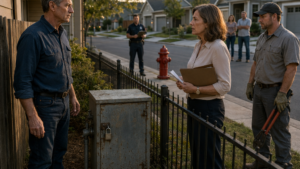
They Said The Will Was Legal Until She Set The Old Letter On The Counter
Chapter 1: The Counter Where Her Name Disappeared
“Mrs. Carter, your name does not appear in the final distribution.”
Andrew Hall said it gently, but the sentence still landed like something dropped on glass.
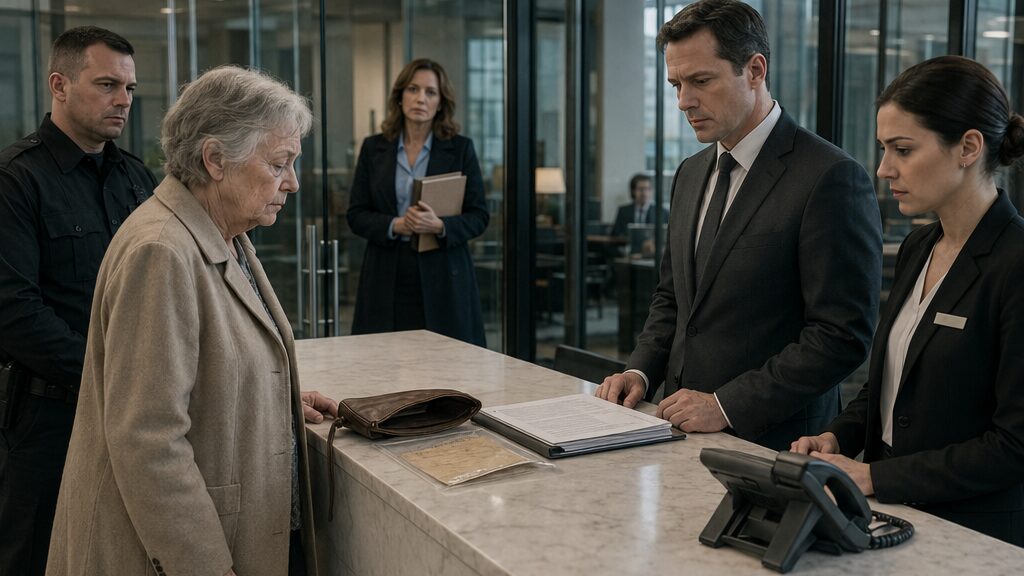
Linda Carter kept both hands on the edge of the polished counter because she did not trust them anywhere else. The counter was cold under her palms, white stone veined with gray, so clean she could see the blur of her beige coat reflected back at her. Behind Andrew, the glass wall of the conference room showed a long table, leather chairs, and Samantha Taylor sitting with a folder in front of her as if she had arrived for a meeting she already understood.
Linda looked at the papers in Andrew’s hand.
“I’m sorry,” she said. “Say that again.”
Amanda Davis, the paralegal standing to Andrew’s right, shifted her weight. She was young enough to still believe a black blazer could make impatience look professional. Her hand rested near the phone on the counter.
Andrew took in a small breath. “Under the revised estate documents, Richard’s residence, primary investment account, and remaining personal property are directed to Samantha Taylor as successor trustee and primary beneficiary.”
Linda heard Richard’s name before she heard the rest. Richard’s residence. Richard’s account. Richard’s property. Not their house. Not the account he had once told her would keep the lights on. Not the workshop where his old radio still sat by the window and his coffee mug had left a ring on the bench.
Samantha looked through the glass without standing. Her hair was neat, her blouse pale blue, her expression arranged into something that might have passed for sorrow if Linda had not known how long Samantha could hold a face.
“What about the workshop account?” Linda asked.
Andrew glanced down. “Included.”
“And the letter box?”
“The personal effects are also included.”
Linda’s fingers closed slightly on the strap of her worn brown pouch. The leather was soft from years of being carried to doctor appointments, pharmacies, grocery stores, and the last three hospital visits Richard had hated. She had brought it today because she had not known what else to do with her hands.
Richard had once teased her about that pouch. You carry half the house in there, Lin.
Now it felt small against her side.
“I don’t understand,” Linda said. “Richard told me—”
“Mrs. Carter,” Amanda interrupted, not loudly, but with a clean edge. “Mr. Hall has reviewed the final signed documents. We understand this is emotional.”
Linda turned her head toward her. “I’m not asking you to understand my emotions. I’m asking what happened to my husband’s will.”
Samantha rose behind the glass.
Andrew’s mouth tightened, not with anger, but with the discomfort of a man who preferred grief to stay seated. “The estate plan was revised before Mr. Carter passed. The documents were properly executed and notarized.”
“When?”
Amanda’s eyes moved toward the reception clerk. “Mrs. Carter, this might be better handled by scheduling a separate consultation.”
“No.” Linda’s voice surprised her. It did not rise. It simply settled. “When did he sign it?”
Samantha opened the conference room door before Andrew answered. “Linda.”
The sound of her name in Samantha’s mouth made every conversation they had avoided stand up between them.
Linda did not turn all the way around. “When?”
Andrew looked from Samantha to Amanda, then down at the packet. “The final trust amendment and will were signed on March fourteenth.”
March fourteenth.
Linda saw Richard in the blue recliner with a blanket over his knees, staring at the kitchen doorway as if it had moved while he slept. She saw him holding a spoon wrong. She heard him call the house by the name of the apartment he had rented forty years earlier. She heard him ask if his mother had gone to church yet, though his mother had been gone since before Linda met him.
She pressed her thumb into the seam of the pouch.
“That was six weeks before he died,” she said.
“Yes,” Andrew said.
“And who brought him here?”
Samantha stepped closer, folder under her arm. “I did. Dad asked me to help him get his papers in order.”
Linda finally looked at her. “He asked you.”
“He was still my father.”
No one at the counter moved for a second. The office sounds carried on without them: a printer warming, a phone vibrating somewhere behind the reception desk, shoes crossing the hallway. Everything ordinary kept going around the place where Linda’s life had been rearranged.
Amanda touched the phone. “Mrs. Carter, we can’t have this discussion in the reception area.”
“I asked a question.”
“And Mr. Hall answered it,” Amanda said. Her eyes flicked toward the hallway, where a uniformed security officer stood beside the frosted glass door. She lifted two fingers, barely a gesture.
The officer began walking over.
Linda felt heat climb from her collar to her face, not the heat of anger, but of being made visible for the wrong reason. The reception clerk stopped typing. A man in a gray suit lowered his voice mid-call. Samantha’s eyes moved, just once, toward the officer, then back to Linda.
That small glance told Linda something.
They had expected this. Not her question maybe, not the exact word when, but this moment. The old woman at the counter. The raised voices they could claim were hers. The security officer close enough to make leaving look voluntary.
“Mrs. Carter,” the officer said, stopping at her left shoulder. “Is there a problem?”
Linda looked down at her own hands. They were thinner than she remembered. A pale line from Richard’s wedding ring still marked her finger though she had moved his ring to a chain after the funeral. She had spent eleven years stepping carefully around Samantha’s grief, never asking for too much space in Richard’s house, never correcting the way Samantha said my father’s kitchen when Linda had cooked in it every day.
Maybe that was why they thought she would step back now.
“No,” Linda said. “There’s a date.”
Samantha gave a tired sigh. “Dad changed his mind. That was his right.”
Linda heard the sentence as everyone else probably did: calm, legal, reasonable. A daughter explaining a father’s choice.
Linda unlatched the pouch.
Amanda stiffened. The officer leaned slightly forward, as if a woman of seventy-two opening a handbag might produce something dangerous. Linda moved slowly enough for everyone to see. A tissue packet. Reading glasses. A folded church program from Richard’s service. A pharmacy receipt. Beneath them, wrapped in a plastic sleeve gone cloudy at the edges, was the yellowed paper she had not planned to use today.
Not yet.
Her hand trembled only once before she steadied it.
She drew the paper out and placed it flat on the counter.
The edges had browned. One fold had nearly split. Richard’s handwriting crossed the page in dark blue ink, the letters slanting forward the way he used to lean into any promise he meant.
Andrew looked at it despite himself.
Amanda’s hand came off the phone.
Samantha’s face changed so quickly Linda might have missed it if she had not been watching for grief and found fear instead.
“This is not a will,” Andrew said carefully.
“I know,” Linda replied.
Samantha recovered first. “Then it doesn’t matter.”
Linda kept her hand on the plastic sleeve. “It matters to me.”
Andrew leaned closer. “May I?”
Linda did not release it right away. The letter was dated nearly two years before Richard’s decline, after his first hospital stay, when he had come home frightened by his own frailty and embarrassed by it. He had sat at the kitchen table with his coffee cooling and written while Linda washed dishes because he said some promises needed ink.
She slid it toward Andrew only far enough for him to read the top.
To my Linda, in case my courage leaves before my memory does.
Andrew’s eyes paused there.
“It says he wanted me protected,” Linda said. “It says the workshop account was for the house bills. It says the letter box was mine. It says he knew there would be arguments.”
Samantha laughed once. It had no humor in it. “A letter written at home is not an estate plan.”
“No,” Linda said. “But it has a date.”
Andrew’s gaze dropped again to the packet in his hand.
Linda heard herself ask the question before fear could shrink it. “What condition was he in on March fourteenth?”
“Linda,” Samantha said sharply.
Linda did not look at her. “Was he alone when he signed?”
Andrew straightened, the first shadow of caution entering his face. “The documents were executed with appropriate formalities.”
“That is not what I asked.”
Amanda’s jaw tightened. “Mrs. Carter, this is becoming inappropriate.”
Linda turned toward her. “A minute ago, you thought I didn’t know what document I was asking about. Now I’m asking about the date on yours.”
The security officer cleared his throat. “Ma’am—”
Linda lifted her eyes to Andrew. “I want a copy of the page with the signatures.”
“You have no current distribution under the revised plan,” Samantha said. “You don’t get to demand—”
“I was his wife.”
“You were his wife,” Samantha said, her voice low and hard enough to cut through the office. “And he still changed it.”
The words emptied the room in Linda’s chest.
Andrew slid one page from the packet, hesitated, then placed it on the counter beside Richard’s old letter. “This is the signature page of the trust amendment. I can provide a formal copy through proper channels.”
Linda looked at the bottom of the page.
Richard Carter.
The signature tried to be his. The R had the right proud spine, but the rest of the name wandered, losing itself between letters. Beside it was the date.
March 14.
The week after he had stared at the living room and asked why the walls were yellow when they had always been blue. The week he had stood in the hallway holding his slippers because he could not find the bedroom. The week he stopped recognizing the house he had built his life around.
Linda drew a slow breath.
Then she bent closer to the paper, not to cry over it, but to remember exactly what she was seeing.
“That was the week,” she whispered, “he stopped recognizing the house.”
Chapter 2: The Pouch She Had Not Opened In Years
The second note fell out of the pouch when Linda shook it over the kitchen table, and for a moment she thought it was only another receipt.
It landed face down beside Richard’s church program and the copy of the signature page Andrew had finally allowed Amanda to make. The kitchen light caught the old tape along its fold. Linda stood there in her beige coat, still buttoned though the house was warm, staring at the small rectangle of paper as if it had knocked.
She should have taken off her coat. She should have made tea. She should have called someone.
Instead, she locked the back door, though no one was outside, and sat.
The brown pouch lay open like an emptied animal. She had carried it for years without thinking about its weight. Now everything inside looked like evidence: a grocery list in Richard’s blocky hand, a hospital parking pass, two mints from the restaurant where he used to order soup even in July, the yellowed letter in its plastic sleeve, and now this folded note she did not remember saving.
Linda turned it over.
Lin—if I forget where I put this, remind me I was trying to be brave.
She pressed the heel of her hand to her mouth.
The note was not dated, but she knew the pen. Richard had used the same blue ballpoint he kept clipped to the calendar by the phone. He had written it during the year he began labeling drawers, not because he was confused yet, he insisted, but because memory had become “a lazy employee.”
Linda unfolded it.
The note inside was shorter than the letter she had shown at the office.
Workshop account stays with Linda for house costs. Letter box goes to Linda. Samantha gets house share from trust, not control over Linda’s roof. Talk to Andrew after holidays. Don’t let the children argue her out of what I promised.
Linda read it once.
Then again.
Then she set it beside the signature page with Richard’s wandering March 14 signature. The two pieces of paper did not belong in the same room. One sounded like her husband. The other looked as if someone had held him still long enough to make his name.
She hated herself for thinking it.
That was the old fear, the one that had kept her quiet when Richard first mentioned “updating things.” Samantha had been in the kitchen that day, tapping something into her phone, saying estate paperwork was too complicated for everyone to keep guessing about. Linda had dried a plate and said nothing because second wives were supposed to be careful with words like inheritance.
She had told herself she was being gracious.
Now it looked like cowardice wearing a clean apron.
Linda took off her coat at last, but left the pouch on the table. She opened the bottom drawer of Richard’s desk in the corner of the dining room. It still smelled faintly of pencil shavings and the peppermint candies he hid from himself. The first folder held appliance warranties. The second held tax papers. The third was labeled HOUSE, though the papers inside had not been sorted since before his final hospital stay.
His calendar lay beneath them.
The wall calendar had been removed after the funeral because Linda could not bear the blue circles around appointments Richard would never keep. Now she spread the pages on the table month by month.
January had ordinary notes. Bank. Pharmacy. Furnace filter. Samantha dinner? written once, with a question mark.
February changed.
Samantha 2 PM.
Samantha 11.
Samantha bringing forms.
Samantha—doctor?
Linda’s finger stopped on that one.
Richard had not told her Samantha was bringing forms. He had told her Samantha was helping find an old insurance policy. Linda remembered because he had been embarrassed that he could not remember the name of the company, and she had kissed the top of his head and said they would find it together after supper.
Together.
The word looked foolish now.
March had fewer entries in Richard’s hand. Samantha’s name appeared more often, but the letters were neater, straighter. Linda leaned closer, frowning.
Not Richard’s writing.
The appointment on March 14 was marked at ten in the morning.
A. Hall—estate update.
Beside it was Samantha’s phone number, written carefully, as if the person who wrote it expected someone else to call if Richard forgot.
Linda sat back.
Outside, a neighbor’s dog barked twice. The refrigerator hummed. The whole house seemed to be pretending it was still a normal afternoon.
She reached for the phone, then stopped before dialing Andrew. What would she say? I found my husband’s calendar and I think the handwriting changed? I have a note that is not a will? My stepdaughter visited more often than she said?
She imagined Amanda’s face at the counter. We understand this is emotional.
That sentence could swallow anything she brought if she carried it badly.
Linda stood and went to the hallway closet. On the top shelf was the small cardboard box from Richard’s last clinic visits: discharge instructions, medication lists, appointment summaries, all the things she had shoved away when the funeral home called to confirm the time. She took it down carefully, though her shoulder protested.
The first packet was from February. The second from early March. Her eyes skipped over words she had once read only for dosage and follow-up instructions.
Confusion reported by spouse.
Patient intermittently disoriented in familiar setting.
Recommend supervision with medication and financial decisions.
Financial decisions.
Linda stared at the phrase until it blurred.
The date was March 11.
Three days before the will signing.
Her first instinct was to cry, but anger got there sooner. Not hot anger. Something colder, more useful.
She placed the clinic packet beside the calendar and the note. The table filled with Richard in fragments: his promise, his confusion, his signature, his daughter’s visits.
No single paper proved enough. Andrew would say that. Samantha would say it louder. The letter was not a will. The note was not formal. The clinic summary was not a legal finding. The calendar might be questioned.
Each piece alone could be dismissed.
Together, they leaned toward one another.
Linda took out a yellow envelope and began writing dates on the outside.
February 6 — Samantha visit.
February 13 — Samantha bringing forms.
March 11 — clinic confusion note.
March 14 — estate signing.
April 28 — Richard died.
Her handwriting looked too small, so she rewrote the dates larger.
The phone rang while she was copying Samantha’s number from the calendar. Linda flinched so hard the pen slipped.
The caller ID showed Samantha Taylor.
Linda let it ring twice.
On the third ring, she answered.
“Yes.”
Samantha did not say hello. “Andrew called me after you left. He said you were upset.”
Linda looked at the table covered in paper. “That isn’t what he said.”
A pause.
Then Samantha sighed, as if Linda had forced her to be patient. “You need to understand something. Dad did not want a fight. He wanted things simple.”
“Then why was I not told he changed everything?”
“You were taking everything personally by then.”
Linda closed her eyes. There it was: the version of her Samantha needed. Emotional. Unsteady. Too involved to be trusted with facts.
“Did you take him to Andrew Hall’s office on March fourteenth?”
“Yes. He asked me to.”
“Was I home?”
“I don’t remember.”
Linda did. She had been at the pharmacy picking up Richard’s new prescription because Samantha had told her she would sit with him for the morning.
The silence stretched.
Samantha’s voice softened, and somehow that was worse. “Linda, don’t make this ugly. Dad knew you would be provided for in other ways.”
“What other ways?”
“You have your Social Security. You have your own savings.”
Linda looked at the note: Don’t let the children argue her out of what I promised.
“I took care of him,” Linda said.
“And I was his daughter,” Samantha replied. “I lost him too.”
Linda almost apologized. The old habit rose fast and familiar: I know, I’m sorry, I’m not trying to take anything from you.
She caught it before it left her mouth.
“I’m going to ask you once,” Linda said. “Did you arrange the appointment with Andrew?”
Samantha’s breath changed.
“That is not your concern anymore.”
The line went dead.
Linda remained with the receiver against her ear long after the click, listening to nothing.
Then she put it down and returned to the calendar. Under March 14, beside Andrew Hall’s name and Samantha’s number, was one more mark she had missed at first. A small check, written in blue ink.
Not Richard’s blue ink.
A neat, sharp check made by someone who liked completed tasks.
Chapter 3: The Six Visits Nobody Explained
Samantha opened the door already holding a copy of the will.
Not a tissue. Not a mug of coffee. Not anything that could pretend this was a family visit. A clipped packet of white paper rested against her chest, one finger tucked between pages, as if Linda had arrived at the part Samantha had prepared.
“You shouldn’t have come here,” Samantha said.
Linda stood on the porch with Richard’s yellowed letter folded inside her coat pocket. She had left the brown pouch in the car because bringing it to Samantha’s door felt like bringing Richard himself into a fight he had spent years avoiding.
“I called first,” Linda said.
“You called to accuse me.”
“I called to ask about March fourteenth.”
Samantha’s house was larger than Linda remembered. Or maybe Linda only noticed now because the porch light was new, the shrubs trimmed square, the welcome mat stiff and unused. Richard had helped Samantha buy the place after her divorce. Linda remembered him coming home with paint on his sleeve and saying she wanted the kitchen yellow like the old house.
Now Samantha stood in that doorway as if Linda were a stranger with a bill.
“I don’t have anything to hide,” Samantha said.
“Then tell me why you took him to sign papers three days after the clinic said he was confused.”
Samantha’s eyes narrowed. “You have no right to his medical records.”
“I was his wife.”
“And I had power of attorney for financial matters.”
Linda felt the porch tilt slightly under her, though nothing moved. “Since when?”
Samantha looked down at the packet. “Dad signed that too.”
“When?”
“Before the final estate update.”
Linda almost asked why Richard had not told her, but the answer sat between them, waiting to be used against her. Because he did not trust you. Because you were too emotional. Because Samantha had been there with forms while Linda had been counting pills and washing sheets and making soup Richard forgot to eat.
“Did he understand what he was signing?”
Samantha stepped outside and pulled the door halfway closed behind her. “You keep asking that like he was gone. He wasn’t gone. He had bad days.”
“March eleventh was a bad day.”
“March fourteenth was not.”
“How do you know?”
“Because I was there.”
The sentence struck cleanly, almost proudly. Linda watched Samantha’s face and saw not only defiance but exhaustion under it. There were faint shadows beneath her eyes. The packet shook slightly in her hand. Not much. Enough.
“Why were you there every week?” Linda asked.
“He was my father.”
“You had not visited every week before.”
Samantha’s mouth tightened. “Maybe I realized I was running out of time.”
Linda looked past her into the front hall. On the wall hung a framed photograph of Richard with Samantha when she was young, both of them standing beside a lake, Richard’s hand on her shoulder. Linda had seen that picture in Richard’s old album. Samantha had taken the original after the funeral without asking.
“I’m not questioning that you loved him,” Linda said.
Samantha let out a short laugh. “That’s generous.”
“I’m questioning why no one told me the paperwork was being changed.”
“Because every conversation with you became about keeping Dad exactly where you wanted him.”
Linda absorbed that, not because it was true, but because some small corner of it had a hook. She had wanted Richard home. He had hated the thought of a care facility. She had argued with doctors, with Samantha, with herself. She had insisted she could manage one more week, then one more.
“I wanted him safe,” Linda said.
“You wanted to be needed.”
The porch seemed to go silent around them.
Samantha looked sorry for half a second, then hardened again. “You think I don’t know what this is? You took care of him and now you think that means the house should be yours.”
“That is not what I said.”
“It’s what everyone says when they don’t want to call it money.”
Linda’s hand went to her coat pocket. She felt the edge of Richard’s letter through the fabric.
Samantha saw the movement. “What is that?”
“Something your father wrote.”
“If it’s the same paper you showed at the office, Andrew already told you it isn’t binding.”
“Andrew also told me the document was signed six weeks before Richard died.”
“Dad changed his mind,” Samantha said. “That was his right.”
Linda had heard the sentence at the office, but on Samantha’s porch it sounded less like law and more like rehearsal.
“Did he say those words to you?”
Samantha did not answer.
“Did he say, ‘I want Linda removed’?”
“He said he wanted things handled by family.”
Linda’s throat tightened. “I was his family.”
Samantha’s face changed again. Not fear this time. Pain, old and sharp.
“You were his wife for eleven years,” she said. “My mother was his wife for thirty-two.”
“I never tried to replace her.”
“No,” Samantha said. “You just lived in her house. Used her dishes. Slept in the room where she died. And then everyone expected me to be grateful because Dad was happy again.”
Linda stared at her.
There it was. Not the full truth, not the legal truth, but something that had been breathing under every polite holiday and short phone call.
“Samantha,” Linda said quietly, “your mother died seven years before I met Richard.”
“That doesn’t mean he stopped belonging to us.”
The words were childish. The grief behind them was not.
For a moment Linda saw Samantha not as the woman with the will in her hand, but as the daughter who had watched her father laugh again and mistaken it for abandonment. It did not excuse anything. It made the harm more complicated, which somehow made it heavier.
Samantha opened the packet and pulled out a smaller envelope. “I was going to mail this.”
Linda looked at it but did not reach.
“It’s from me, not the estate,” Samantha said. “Five thousand dollars. It should help with moving costs or whatever you need until you figure things out.”
The porch air sharpened.
“Moving costs,” Linda repeated.
“You can’t stay in the house indefinitely.”
“I live there.”
“The house is part of the trust.”
“Richard told me I would not be forced out.”
“Richard signed documents giving me authority to handle the property.”
Linda looked at the envelope. White, clean, sealed. A small price for silence. Or maybe, in Samantha’s mind, a mercy.
“When do you expect me to leave?”
Samantha did not blink. “Andrew says there’s a process. I’m not trying to be cruel.”
“But you have a date.”
“I need access to the workshop first. There are accounts tied to estate property, tools, records. We have to inventory everything.”
“The workshop was Richard’s private place.”
“It is estate property now.”
Linda heard the phrase and felt something inside her go still.
Estate property.
Not the room where Richard had taught her to sharpen pruning shears because he said every house needed at least one person who could fix small things. Not the bench where he had left penciled notes to himself. Not the window where he had watched the street when he was too weak to walk to the mailbox.
“When?” Linda asked.
Samantha looked down. “Within ten days.”
“And if I say no?”
“Don’t make me do that.”
“Do what?”
Samantha’s fingers tightened on the packet. “Request formal removal. Have the locks changed. Whatever Andrew says is necessary.”
Linda stepped back once, not from fear but because the porch suddenly felt too small for what Samantha had said.
“You brought a check,” Linda said, “and a threat.”
“I brought a way to keep this from getting worse.”
“For whom?”
Samantha’s face flushed. “For all of us.”
Linda looked at the will packet again. “Did Richard ask you to fix the paperwork because I was too emotional?”
Samantha hesitated.
There it was.
“You told Andrew that,” Linda said.
“He was worried about you.”
“No. You were.”
“He didn’t want you making decisions out of grief.”
“He was still alive.”
Samantha looked away toward the shrubs, toward the neat sidewalk, toward anywhere Linda was not. “He knew you would fall apart when he was gone.”
Linda felt that one enter, because she had fallen apart. Quietly, privately, in the laundry room with Richard’s shirts still warm from the dryer. In the grocery aisle when she reached for his cereal. At the kitchen sink when she washed one mug instead of two.
But falling apart after losing someone was not the same as being unable to know what they had promised.
“I did fall apart,” Linda said. “And then I got up.”
Samantha looked back.
Linda removed the settlement envelope from Samantha’s hand and, for one brief second, Samantha seemed relieved.
Then Linda tore it in half.
Not dramatically. Not with a flourish. She tore it once down the middle, then placed both halves on the porch table beside the potted plant.
Samantha’s mouth opened.
Linda said, “Do not bring me money and call it peace.”
The color left Samantha’s face.
“You are going to regret making me the enemy,” she said.
“I don’t think I made you anything.”
Samantha stepped closer, the will packet pressed to her side. Her voice dropped until it no longer sounded prepared.
“You were his wife for eleven years,” she said. “I was his daughter before you ever knew his name.”
Chapter 4: The Signature Dated After The Bad Day
“You’re not listed as the authorized requester.”
The records clerk did not look unkind. That made it worse. She slid Linda’s clipboard back through the narrow opening in the glass as if returning a grocery coupon that had expired.
Linda stood in the clinic records office with Richard’s death certificate, their marriage certificate, her driver’s license, and a folder thick enough to make her hand ache. Behind the clerk, shelves of files and humming scanners held the private facts of other people’s pain. On the wall, a sign said REQUESTS MAY TAKE 7–10 BUSINESS DAYS.
Linda looked down at the form. “I’m his wife.”
The clerk’s eyes moved to the death certificate. “I understand. But the authorization on file for financial and legal records is Samantha Taylor.”
“These are medical records.”
“They may include records tied to capacity statements, financial decision notes, or third-party communications. I can release limited discharge summaries to a surviving spouse, but not full chart notes without proper authorization or a court order.”
Linda gripped the folder closer to her chest. “I don’t have seven to ten business days.”
The clerk’s voice softened by half an inch. “I can see if there are visit summaries already released to you at the time of care.”
Linda wanted to say that she had been the one sitting beside Richard when he forgot the year, the one reminding him how to swallow the second pill, the one answering the nurse’s questions when he stared at the window. She wanted to ask how a computer could remember Samantha and forget the woman who had buttoned Richard’s shirts when his fingers stopped obeying him.
Instead, she said, “Please.”
The clerk disappeared into the back. Linda remained at the glass, watching her reflection hover over the word RECORDS in white lettering. She looked smaller than she felt. Beige coat. Pouch under her arm. Folder against her chest. A woman who had learned too late that love did not automatically create standing.
Her phone buzzed.
A message from Samantha.
Andrew says you’ve been asking for things you’re not entitled to. Please stop before this becomes expensive for everyone.
Linda stared at the sentence until the clerk returned with three stapled packets.
“These were previously issued after visits,” the clerk said. “I can print copies because you were listed as the receiving caregiver on these specific discharge instructions.”
Receiving caregiver.
Not beneficiary. Not trustee. Not decision-maker.
Caregiver.
Linda took the papers with both hands. “Thank you.”
She did not read them inside. She made it to the car, locked the doors, and spread the packets across the passenger seat. The clinic parking lot was crowded with people carrying their own folders, their own quiet emergencies. Linda lowered the windows only an inch because her breath had fogged the glass.
February 27: medication adjustment.
March 4: follow-up after fall.
March 11: cognitive episode and medication review.
Her finger stopped.
Patient brought in by spouse. Intermittent disorientation reported. Difficulty identifying day and year. Confusion in familiar environment. Recommend supervision with medication, transportation, and financial decisions.
Financial decisions.
The words had looked cold on her kitchen table. Here, in clinic ink, under Richard’s patient number, they seemed to speak louder.
Linda pulled Andrew’s copy of the signature page from her folder.
March 14.
Three days.
She wrote both dates on the back of an envelope in large block letters.
March 11 — confusion / financial decisions.
March 14 — estate signing.
Her hand hovered over the page. Then she added one more line.
Who was in the room?
A car door slammed two spaces away, and Linda flinched. A woman helped an elderly man out of a sedan, one hand under his elbow, the other guiding his cane away from the curb. The man frowned at the pavement as if it had insulted him.
Richard had frowned like that the week before March fourteenth.
Not all day. That was the problem. People who had not lived inside the house could believe he was fine because some hours he was. He could remember a baseball score from 1979 and then ask Linda why the hall mirror had been moved when it had hung in the same place for twenty years. He could recognize Samantha’s voice and still forget where the bathroom was.
On March twelfth, Linda had found him standing in the doorway to the bedroom, holding his slippers.
“What are you looking for?” she had asked.
“The room,” Richard said.
“You’re looking at it.”
He had smiled then, embarrassed and sweet. “Well, that’s inconvenient.”
She had laughed because he needed her to, then gone into the laundry room and pressed both fists against her mouth.
Two days later, Samantha had come “so Linda could run errands.”
The memory entered the car like a draft.
Linda had gone to the pharmacy. Samantha had insisted. “You look exhausted. I’ll sit with Dad. Take your time.” Linda had been grateful. She had bought Richard’s medication, cereal, and the lemon cookies he had suddenly wanted after years of saying lemon desserts tasted like soap.
When she came home, Richard was asleep in his chair. Samantha was at the kitchen counter, placing something into her purse.
“What’s that?” Linda had asked.
“Just insurance forms,” Samantha said.
Linda had not asked again.
Now she opened the March 11 discharge packet and read every line slowly. Under additional notes, someone had typed: Patient advised not to manage complex decisions without supervision. Daughter present for follow-up call request.
Daughter.
Linda’s chest tightened.
She turned the page over, then back, as if more might appear if she looked hard enough. The discharge summary did not say Richard lacked capacity on March fourteenth. It did not say Samantha had done anything wrong. It did not undo the signature.
It only changed the weather around it.
Linda drove to the nursing wing attached to the clinic because Richard had spent two nights there after his fall. The records coordinator there was older, with glasses on a chain and a face that had learned to reveal nothing too soon.
“I’m trying to understand who signed him out for an appointment,” Linda said.
The coordinator asked for dates. Linda gave March fourteenth, then March eleventh. The woman typed, waited, typed again.
“March fourteenth, he was not admitted here.”
“I know. But there was a follow-up transportation note. Maybe from the clinic.”
The coordinator’s lips pressed together. “I can’t release full chart information.”
“I understand.”
“Do you have proof of relationship?”
Linda almost laughed. Instead, she handed over the marriage certificate again.
The coordinator read it, then looked at Linda for the first time as if she were a person rather than a request. “I can confirm limited administrative information that was previously shared with family.”
Linda did not move.
The coordinator printed one page.
“It shows a pickup authorization for a medical-to-legal appointment coordination,” she said. “That’s all I can provide.”
Linda took the page.
On the line marked Responsible party / transportation contact, the name was printed clearly.
Samantha Taylor.
Purpose: legal appointment transportation.
Date: March 14.
Linda sat in the car afterward with the paper in her lap until the engine clicked cold. The clinic record did not prove Richard had been unable to sign. The transportation note did not prove Samantha had coached him. The letter did not prove the will should change.
But now the official timeline had Samantha’s name on the door through which Richard had passed.
Linda placed the new page behind the yellow envelope with the dates. Her hands felt steadier than they had at Andrew’s counter.
She started the car.
Before pulling out, she wrote one more question beneath the others.
Who knew Richard was impaired when he signed?
Chapter 5: The Brother Who Wanted Peace Too Soon
“I was hoping you wouldn’t come here,” William Scott said before Linda reached the top porch step.
He sat in a wicker chair with a blanket over his knees, though the afternoon was warm enough that the neighbor across the street had a sprinkler ticking over the grass. A glass of iced tea sweated on the small table beside him. He had not invited her inside. He had not asked why she came.
That told Linda he already knew.
She stopped with one hand on the porch rail. “Then you know what I’m here to ask.”
William’s face folded around the eyes. He had been Richard’s friend for nearly forty years, his business partner for twelve of them, and the only man Linda had ever seen tell Richard he was being stubborn and survive it. At the funeral, William had held both her hands and said, “He loved you steady, Linda.” Then he had left before Samantha arrived at the reception table.
Now he looked toward the street instead of at her.
“Come sit,” he said.
“I’ll stand.”
“That’s not going to make this easier.”
“I’m not trying to make it easy.”
William nodded once, as if he deserved that. He gestured to the second chair. Linda sat because her knees had begun to ache and she did not want the pain to become part of the conversation.
For a moment, neither of them spoke. The sprinkler ticked. A car passed. Somewhere inside the house, a clock chimed once, though it was not the hour.
Linda opened her folder and removed Richard’s yellowed letter in its plastic sleeve.
William’s eyes went to it before she said a word.
“You’ve seen this,” Linda said.
He looked older suddenly. “I knew he wrote something.”
“That is not what I asked.”
William reached for the iced tea, then seemed to think better of it. His hand fell back to the armrest. “He showed me a draft once. Not that one exactly. Something like it.”
“When?”
“After his first hospital stay. He was scared. Wouldn’t say it that way, but he was.”
Linda placed the letter on the porch table. “He wrote that he wanted me protected no matter what the children argued.”
William closed his eyes.
“Did he say that to you?”
“Yes.”
The answer should have felt like relief. Instead, Linda felt anger move quietly through her. Not at Samantha this time. At the man sitting three feet away who had known Richard’s words and carried them like a stone in his pocket while Linda stood alone at a law office counter.
“Why didn’t you say anything?”
William opened his eyes. “At the funeral?”
“Before the funeral. After. When Samantha started taking him to appointments. When she told everyone he wanted things handled by family.”
“I didn’t know what she was doing.”
“But you knew what he wanted.”
He rubbed his thumb over a dark spot on the wicker armrest. “Richard wanted a lot of things that didn’t all fit together. He wanted you safe. He wanted Samantha to stop feeling pushed out. He wanted no one mad at him after he died, which was a foolish thing to want and exactly like him.”
Linda looked at the letter. Richard’s handwriting seemed to lean toward them, impatient with both.
“He should have fixed it,” she said.
“Yes.”
“So should you.”
William took that without flinching. “Yes.”
The admission disarmed her more than denial would have. She looked away, past the porch steps to the street. For years, she had thought of William as one of Richard’s safe people. A man with grease under his nails, jokes too dry to catch quickly, and an old-fashioned loyalty Linda had trusted because Richard trusted it.
“What did he tell you?” she asked.
William exhaled slowly. “He said the workshop account was for keeping the house running if he went first. Said you knew how to stretch a dollar but shouldn’t have to beg his daughter for roof money. He said the letter box was yours because it had the papers from the first years you two were married. Receipts, old notes, pictures. Things Samantha would call junk.”
Linda swallowed.
“He also said Samantha would fight him,” William added. “Not because she didn’t love him. Because she did, in a way that got mean when she was scared.”
“Scared of what?”
“Being replaced.”
Linda almost said Samantha was grown, that grief did not excuse taking a dying man to sign papers. But William already knew that, and saying it would only spend breath.
“Did Richard tell you he was changing the will?”
“He told me he needed to talk to Andrew after the holidays.” William glanced at the letter. “Then he got worse. I told myself it wasn’t my place.”
“That is a very comfortable sentence.”
“It was,” he said. “For a while.”
Linda’s anger sharpened. “I was his wife, William. I was there when he couldn’t remember where the bedroom was. I was there when he dropped pills because his hands shook. If someone had told me Samantha was arranging legal appointments, I would have gone with him.”
William’s mouth tightened. “And Richard might have hated you for stopping it.”
That struck harder than she expected.
“He was proud,” William said quietly. “You know that. If he had one clear hour and Samantha put papers in front of him saying it would keep the peace, he might have signed just to prove he still could.”
Linda looked down at her hands.
There it was again: the part that made the truth harder. Richard had not been a helpless figure in every moment. He had pride. He had avoidance. He had spent years smoothing conflict instead of facing it. If Samantha had chosen the right hour, the right fear, the right words, she might not have needed to force him. She might only have needed to guide him toward the answer he was too tired to examine.
“Will you put what he told you in writing?” Linda asked.
William’s eyes closed briefly.
“No.”
The word was soft, but it snapped something between them.
Linda stood. “Then why tell me?”
“Because you deserve to know.”
“I deserve more than knowing.”
“I’m not getting dragged into a legal fight between you and Samantha.”
“It was already a fight. You just had the privilege of calling it peace.”
William’s face tightened with shame, but not enough. “I have known that family longer than you have.”
Linda leaned down and picked up the letter. “Samantha said almost the same thing.”
“That isn’t what I meant.”
“I know exactly what you meant.” Linda slid the letter into her folder. “You mean I came later, so the truth costs me less.”
William looked up at her then. “No. I mean I watched Richard lose one wife and nearly lose his daughter after. I watched him climb out of that grief. Then I watched him love you and feel guilty for it. There wasn’t a clean line anywhere.”
Linda stood very still.
Inside the house, the clock ticked through the wall.
William’s voice dropped. “But Linda, he did love you. And he did want you protected.”
“Then say it where it matters.”
He looked at the porch boards.
Linda waited. She hated that she was waiting. Hated that a woman who had changed Richard’s bandages, sorted his pills, and slept beside his fear now stood on a porch needing permission from an old friend to prove she had not imagined being loved.
William did not answer.
She closed the folder.
“I’m sorry I bothered you,” she said.
She was halfway down the steps when he spoke.
“The paralegal.”
Linda turned.
William leaned forward, one hand braced on the chair arm. “Ask Amanda Davis who answered the questions that day.”
Linda stared at him.
“What questions?”
“At the signing.” His voice was low now, urgent and ashamed. “Richard told me later there were questions. Standard ones. Name, date, what the document was for. He laughed about it, but not right. Said Samantha kept helping because he was ‘slow as winter.’ I told myself it was nothing.”
Linda came back up one step. “Did he say Amanda was there?”
“He said the young woman with the black jacket kept looking at Samantha.”
Linda felt the porch tilt under her again, but this time she held the rail.
William looked older than he had when she arrived. “I won’t sign anything today.”
“Today,” Linda repeated.
He looked at the letter in her folder. “Ask Amanda first.”
Linda nodded once. She did not thank him. Not yet.
As she walked to her car, William called after her, the words following her down the path.
“And Linda? If Amanda remembers the blue pen, she remembers more than she told Andrew.”
Chapter 6: The Witness Who Remembered The Blue Pen
“Was my husband alone when he said he understood the document?”
Andrew Hall had barely closed his office door when Linda asked the question.
He stood with one hand still on the knob. Amanda Davis sat at the side of his desk with a legal pad in her lap, her black blazer buttoned, her pen already poised as if this meeting had a harmless agenda. The glass walls of the office made everything visible to the reception area beyond, but not audible. Linda had chosen the chair facing both of them. Her brown pouch rested on her knees.
Andrew returned to his desk slowly. “Mrs. Carter, I thought we were meeting to review your concerns about the timeline.”
“That is my concern.”
Amanda wrote something down without looking up.
Linda unlatched the pouch and removed the yellowed letter, the March 11 discharge summary, the March 14 transportation note, and the copy of Richard’s signature page. She laid them out in a straight line on Andrew’s desk.
Old promise. Medical warning. Samantha’s transportation. Shaking signature.
Amanda’s pen stopped.
Andrew looked at the arrangement with the expression of a man watching a door close behind him.
“These documents don’t establish incapacity,” he said.
“No,” Linda replied. “They establish that there is a question.”
“That is different from a legal conclusion.”
“I know. That’s why I am asking who answered the questions.”
Amanda’s eyes flicked up then. Just once.
Linda turned to her. “You were there.”
Amanda’s lips parted slightly before she recovered. “I assisted with administrative steps for many signings.”
“This one was March fourteenth. Richard Carter. Samantha Taylor brought him. Blue pen.”
The room changed around the last two words.
It was not dramatic. Amanda did not gasp or confess. But her shoulders lost their office shape, and the pen in her hand lowered until its tip touched the legal pad and made a dot of ink.
Andrew noticed.
“Amanda?” he said.
She looked at him. “I’d have to check the file.”
“You remember the pen,” Linda said.
Amanda’s face closed. “We use blue pens for original signatures.”
“This one was placed in his hand.”
Silence.
Andrew leaned back. “Mrs. Carter, who told you that?”
Linda did not answer. She kept her eyes on Amanda. “Did Samantha answer for him?”
Amanda looked toward the glass wall. Beyond it, the reception clerk handed a folder to a man in a gray jacket. Ordinary office life continued at a respectful distance from the question that had entered Andrew Hall’s office and refused to leave.
“I don’t recall the full conversation,” Amanda said.
“That is not no.”
Andrew’s voice sharpened. “Amanda, if you remember something about the execution ceremony, you need to be precise.”
Execution ceremony. Linda hated the phrase. It made Richard’s confusion sound ceremonial too.
Amanda set down the pen. “Mr. Carter was tired.”
Linda’s fingers tightened around the pouch clasp.
Andrew said nothing.
“He understood that he was signing estate papers,” Amanda added quickly. “Mr. Hall, I’m not saying he didn’t.”
“But?” Linda asked.
Amanda looked at her then, and for the first time, there was no polished impatience in her face. Only the exhausted fear of someone whose small choice had grown teeth.
“But Mrs. Taylor did most of the talking.”
Andrew’s jaw moved once. “In what way?”
“She explained why they were there. She had the folder. She kept saying he wanted to simplify things.”
“Did I ask Mr. Carter capacity questions?” Andrew asked.
“Yes.”
“And did he answer?”
Amanda swallowed. “Some.”
Linda heard the word like a dropped key.
Andrew leaned forward. “Some?”
“He answered his name. He knew he was in a law office. He said he was there for papers.” Amanda’s hand moved toward the pen again, then stopped short. “When you asked what the papers did, he looked at Samantha.”
Linda closed her eyes for one breath.
“What did she say?” Andrew asked.
Amanda’s voice thinned. “She said, ‘Dad, remember, this makes me the one who handles everything so Linda doesn’t have to worry.’”
Linda opened her eyes.
Andrew’s face had gone still.
“And then?” Linda asked.
“He said, ‘That’s right. So Linda doesn’t worry.’”
The sentence entered Linda differently than she expected. She had thought the truth would come shaped like malice. Instead, it came wearing Richard’s old tenderness, bent out of shape in someone else’s hand.
So Linda doesn’t worry.
Samantha had found the one argument Richard would sign.
Andrew stood and walked to the window, though the blinds were open and there was nothing outside but the parking lot. “Why was this not noted?”
Amanda’s mouth tightened. “Because he did answer. Because Samantha had the power of attorney. Because the notary was waiting. Because you were running behind.” Her voice began to tremble, and she steadied it with visible effort. “Because I thought it was family mess, not my place.”
Linda felt the echo of William’s porch.
Not my place.
The most dangerous hiding place in the world, apparently.
Andrew turned back. “Did Samantha correct any answer directly?”
Amanda looked at Linda’s row of papers on the desk. “When you asked the date, he said February.”
Linda’s pulse beat once, hard.
Amanda continued, “Samantha laughed. She said, ‘You always do that, Dad. It’s March.’ And then he said March.”
Andrew put one hand on the back of his chair.
Linda’s voice came out almost too quiet. “And the year?”
Amanda did not answer.
Andrew said, “Amanda.”
“He didn’t say it. Samantha said, ‘Twenty twenty-four, Dad.’ And then he repeated it.”
No one moved.
The office seemed suddenly too bright, every clean surface accusing itself.
Andrew sat. “I personally assessed his understanding of the nature of the documents.”
Linda looked at him. “You personally asked prepared questions in a room where his daughter corrected him.”
His face colored slightly. “Mrs. Carter, I understand why that sounds concerning.”
“It is concerning.”
“Yes,” he said after a pause. “It is.”
Amanda looked down at her legal pad.
Linda pushed the yellowed letter slightly closer to Andrew. “This is not a will. I know that. You told me. Samantha told me. Everyone has told me. But it is dated two years before his decline, and it says he was afraid his children would argue me out of what he promised.”
Andrew touched the edge of the plastic sleeve but did not pick it up.
“The clinic summary is three days before your signing,” Linda said. “It says supervision was recommended for financial decisions. The transportation note says Samantha took him to a legal appointment. Amanda remembers Samantha correcting his answers. I am not asking you to perform a miracle. I’m asking you to stop pretending the paper explains itself.”
Andrew’s eyes lifted to hers.
For the first time since Linda had walked into his office days earlier, he looked at her without the soft patience reserved for upset widows.
“I cannot overturn an executed trust amendment,” he said.
“I didn’t ask you to.”
“I also cannot state that Mr. Carter lacked capacity based on what we have here.”
“I know.”
“But,” he said, and Amanda looked up sharply, “I can document concerns about the circumstances of execution. I can recommend independent review. And I can notify Ms. Taylor that distribution of disputed personal property should be paused pending clarification.”
Linda felt the breath she had been holding leave her body slowly.
It was not victory. It was a door unlocked an inch.
Andrew gathered the pages, not to remove them but to align them. “May I copy these?”
Linda looked at Richard’s letter.
“No,” she said first, because the old fear rose fast: papers disappeared, meanings changed, people with offices made copies that turned warm things cold.
Andrew waited.
Linda touched the plastic sleeve. “You may copy it while I watch.”
He nodded. “Of course.”
Amanda stood too quickly. “I’ll make the copies.”
“No,” Andrew said.
Amanda froze.
“I’ll do it,” he said.
The shame that crossed her face was brief, but Linda saw it. Not villain shame. Smaller. The shame of someone who had followed procedure until procedure became a wall someone else got pushed against.
Andrew left the office with the papers, and for a few seconds Linda and Amanda were alone behind the glass.
Amanda looked at the closed door. “I didn’t know he got worse after.”
“He was already worse.”
Amanda flinched.
Linda could have struck harder. She wanted to. Instead, she asked, “Why did you call security on me?”
Amanda’s cheeks reddened. “I thought you were going to cause a scene.”
“I was asking for a date.”
“I know that now.”
“You knew it then.”
Amanda’s eyes filled but did not spill. “I was trying to keep the office calm.”
Linda looked through the glass at the same reception counter where she had stood with everyone watching. “It was never calm for me.”
Andrew returned with copies and placed the originals back in front of Linda one at a time. She counted them silently before sliding the letter into the pouch.
He sat, took out his phone, then paused. “I’m going to ask Ms. Taylor to come in.”
Amanda’s head turned. “Now?”
“Now.”
Linda stood. “I don’t need to be here for that call.”
“I think you do,” Andrew said.
He put the phone on speaker.
Samantha answered on the fourth ring, brisk and guarded. “Andrew?”
“Samantha,” he said, eyes on the aligned copies. “We need to discuss the circumstances of the signing.”
A long silence came through the speaker.
Then Samantha said, “Is Linda there?”
Linda looked at the phone, at Andrew, at Amanda, at the polished desk where Richard’s old promise had finally made the office uncomfortable.
“Yes,” Linda said. “I am.”
Chapter 7: The Letter That Could Not Fix Everything
Samantha slid the settlement envelope across the conference table before Linda had even taken off her coat.
It moved smoothly over the polished wood and stopped beside the empty chair as if it had been waiting for her. No greeting. No apology. No question about whether Linda wanted water. Just a white envelope with her name written on it in Samantha’s neat hand.
Andrew sat at the head of the table with a closed folder in front of him. Amanda was near the wall, not at the table, her legal pad held against her waist. She did not look at Linda first. She looked at the envelope.
Linda remained standing.
“What is that?” she asked.
Samantha folded her hands. “A way to stop this before it hurts everyone more than it already has.”
Linda looked at Andrew.
He did not touch the envelope. “This was brought by Ms. Taylor. I have not advised you to accept it.”
“How much?” Linda asked.
Samantha’s jaw moved. “Enough to help you transition out of the house comfortably.”
Linda sat then, slowly, because standing made it too easy for Samantha to pretend this was emotion instead of a decision.
“Transition,” Linda said.
Samantha’s composure tightened. “You know what I mean.”
“Yes. I do.”
Linda placed her brown pouch on the table. The leather made a soft sound against the wood. Samantha’s eyes went to it, and for a second the room was back at the counter, everyone watching the old pouch as if it might change the law by existing.
Andrew opened his folder. “Before any discussion of settlement, there are concerns that need to be addressed.”
Samantha looked at him. “I thought we addressed them on the phone.”
“We did not.”
“I brought Dad in. He signed. The notary was present. You were present.” Samantha’s voice stayed even, but she had one hand pressed flat against the tabletop. “If you’re now suggesting your own office mishandled something, that is not my fault.”
Andrew accepted the blow without showing much. “I’m saying questions have been raised about the circumstances around Mr. Carter’s capacity and independence on the date of signing.”
Samantha turned to Linda. “You see what you’re doing? You’re turning his last decisions into some courtroom story.”
Linda unlatched the pouch. “No. I’m trying to find out who helped him make them.”
Samantha’s eyes flashed. “He was not helpless.”
“I didn’t say he was.”
“You keep talking about him like he had no mind left.”
Linda removed the yellowed letter, still inside its plastic sleeve, and laid it on the table between them. Then she placed the clinic summary beside it. Then the March fourteenth transportation note. Then Richard’s signature page.
Samantha looked at the line of papers as if Linda had set out pieces of a broken dish.
“I’m not asking what the will says,” Linda said. “I’m asking who helped him say it.”
Amanda’s gaze dropped.
Samantha’s face hardened, but the hardness came late. For one breath Linda saw the fear underneath.
“Dad wanted me to handle things,” Samantha said. “He said you would fall apart. He said you couldn’t deal with accounts and property and repairs and taxes while grieving.”
“He said that?”
Samantha opened her mouth.
Linda waited.
“He worried about you,” Samantha said.
“That is not the same thing.”
“You don’t know what he told me when you weren’t there.”
“And you don’t know what he wrote before he was afraid.”
Samantha pushed the letter back with two fingers. “That letter does not fix anything.”
“No,” Linda said. “It doesn’t.”
The admission seemed to disturb Samantha more than an argument would have.
Linda rested her hands on either side of the pouch. “It doesn’t give me the house. It doesn’t overturn the trust. It doesn’t bring Richard into this room to answer for what he signed. But it tells me he knew exactly what you would argue. And the clinic record tells me what condition he was in three days before you brought him here. And Amanda remembers you correcting his answers.”
Samantha turned sharply toward Amanda.
Amanda’s face went pale.
“You told her that?”
Amanda’s voice was small but steady enough. “I told Mr. Hall what I remembered.”
“You remembered wrong.”
Andrew said, “Samantha.”
“No.” Samantha stood so quickly her chair struck the wall behind her. “No, I sat with him for months while she acted like letting me in the house was a favor. I drove him to appointments. I handled bills she didn’t even know existed. I watched him worry himself sick because he thought Linda would drown in the details.”
Linda’s throat tightened, but she did not interrupt.
Samantha pointed at the signature page. “He signed because he wanted things simple.”
“He signed after you supplied the year,” Linda said.
Samantha’s hand dropped.
The room held the sentence.
Andrew looked from Linda to Amanda, then back to Samantha. “Is that accurate?”
Samantha sat down again, but not fully. She perched on the edge of the chair, as if the room had become unsafe.
“He was tired,” she said.
“That is not an answer,” Andrew replied.
“He was tired. He mixed up dates sometimes. That didn’t mean he didn’t know what mattered.”
Linda looked at her stepdaughter then and saw the shape of it: not a clean theft, not simple greed, not love either. Something tangled and angry. Samantha had taken Richard’s fear of burdening Linda and bent it toward her own old injury until protection became erasure.
“You wanted him to choose you,” Linda said.
Samantha’s eyes filled at once, and she blinked hard against it.
“He was my father,” she said.
“Yes.”
“You got the soft parts of him after my mother died. You got morning coffee and doctor jokes and him fixing shelves for you in a house he bought with her. And then when he started forgetting things, everyone acted like I was supposed to stand back and trust that you knew best.”
“I never asked you to stand back.”
“You never asked me anything.” Samantha’s voice cracked, then repaired itself into anger. “You just became necessary.”
The words hurt because they were not entirely false. Linda had become necessary. She had let necessity become a kind of shield. She had told herself Samantha’s distance was Samantha’s choice and not something she also helped maintain by keeping the house running so completely there was no room left to enter.
But none of that made March fourteenth clean.
“I should have asked more,” Linda said.
Samantha looked startled.
Linda touched the edge of Richard’s letter. “I should have called you more when he got worse. I should have told you about the bad days. But you should not have used one of those days to make me disappear.”
Samantha’s tears did not fall. They sat bright and furious.
“You think this is all money,” Linda said. “It isn’t. Keep the house if that is what the law lets you keep. But do not tell people Richard looked at me clearly, knew what he was taking away, and chose to leave me standing at a counter like a stranger.”
Andrew’s voice entered carefully. “The immediate question is whether disputed personal effects and accounts can be held from distribution while the circumstances are reviewed.”
Samantha wiped under one eye with the side of her finger. “And if I say no?”
“Then Linda may pursue formal review,” Andrew said. “That will be expensive.”
Samantha laughed bitterly. “For everyone. Like I said.”
She looked at Linda. “I can fight this until there’s nothing left worth arguing over. Is that what you want? Fees, delays, filings? You want to spend Richard’s money proving he was confused?”
Linda looked at the envelope.
For one brief, terrible moment, she understood how easy it would be to take it. To end the calls. To avoid the court clerk, the records desk, the porch visits, the humiliation of explaining why love should count when paper did not.
She slid the envelope back to Samantha.
“No.”
Samantha’s face closed.
Linda placed Richard’s letter beside the envelope. Old yellow paper beside clean white hush money.
“I’m not trading this for quiet.”
Before Samantha could answer, there was a knock on the conference room door.
Amanda opened it.
William Scott stood in the hallway, one hand gripping a folded document, his face ashen with the effort of having arrived too late and maybe not too late at all.
“I wrote it down,” he said, looking only at Linda. “What Richard told me. I signed it too.”
Chapter 8: The House Kept One Promise Back
Linda returned to the same counter three weeks later, and the security officer was not there.
The absence felt louder than his presence had. The polished stone still reflected her beige coat. The glass walls still held the office in clean squares of light. Amanda was behind the reception desk, but she stood when Linda entered and did not reach for the phone.
“Mrs. Carter,” Amanda said.
Linda nodded once. “Amanda.”
Her brown pouch rested under her arm. Inside it, Richard’s yellowed letter had been unfolded and refolded so many times that Linda had begun keeping it between two pieces of cardboard. She no longer carried it because she believed it could save her. She carried it because it had survived being dismissed.
Andrew came out of the conference room first.
Samantha followed.
She held a wooden letter box against her body with both hands.
Linda had not seen the box since before Richard died. It was walnut, scratched along one corner, with a brass latch Richard had repaired badly and proudly. For a moment, the office dissolved and she saw it on the high shelf in the workshop, dust on its lid, Richard saying, That one’s yours if I go first, Lin. Don’t let them throw my nonsense away.
Samantha did not look at Linda when she set it on the counter.
The sound was small.
Andrew placed a folder beside it. “The workshop account transfer documents are prepared for review. The funds Richard kept separately for household maintenance will be released to you under a negotiated distribution agreement. Samantha has also agreed that the personal contents of this box belong to you.”
Linda looked at the folder, then at Samantha. “And the review?”
“I have filed a formal memorandum noting concerns regarding the circumstances of the March fourteenth signing,” Andrew said. “It does not overturn the estate plan. It does preserve the issue for independent review if pursued.”
There it was. The real shape of justice. Not clean. Not large enough. A door left open, not a house returned.
Linda put her hand on the letter box.
Samantha’s fingers tightened around nothing, as if they missed its weight.
“I’m not admitting I forced him,” Samantha said.
Linda looked at her.
Samantha’s chin lifted, but the old confidence was gone. “I’m not. He knew he wanted me to handle things.”
“Maybe part of him did,” Linda said.
Samantha flinched.
That was the truth Linda had not wanted three weeks earlier. Richard might have wanted peace badly enough to sign a bad version of it. He might have wanted Samantha soothed and Linda spared and himself finished with questions. He might have been confused, proud, frightened, and loving all at once.
That did not make what Samantha had done harmless.
Linda opened the pouch and removed the yellowed letter one last time. She did not place it on the counter as a weapon now. She laid it gently beside the box.
“He also wanted this honored,” she said.
Samantha looked at the first line. To my Linda, in case my courage leaves before my memory does.
Her eyes moved away.
Andrew slid the folder toward Linda. “You have time to review before signing.”
Linda almost smiled. “Now I do.”
Amanda lowered her eyes.
No one apologized. Not properly. Andrew had already said what he could in careful professional language. Amanda had written a statement about what she remembered, each sentence trimmed by fear and accuracy. William’s signed account sat in Andrew’s file, no longer brave enough to undo everything, but strong enough to make silence impossible.
Samantha touched the top of the box. “He kept things in there I didn’t know about.”
Linda heard the child inside the sentence, still outside a closed door.
“I know,” she said.
Samantha’s mouth tightened. “I looked.”
Linda’s hand stilled on the pouch clasp.
“I didn’t take anything,” Samantha said quickly. “I just looked.”
That admission should have angered Linda. It did, somewhere. But mostly she saw Samantha standing alone in Richard’s workshop, opening the box she had always thought would prove she came first, and finding instead that love had kept records in more than one direction.
“What did you see?” Linda asked.
Samantha shook her head. “You should see it yourself.”
The workshop smelled the same.
Three hours later, Linda stood in the room behind the house with the letter box on Richard’s workbench and the duplicate key in her palm. Dust lined the pegboard where tools had been removed for inventory. The old radio still sat by the window. A coffee ring marked the wood near the vise. Late light came through the dirty glass and cut the room into gold strips.
Samantha had not come inside. She waited in the driveway, arms crossed, looking toward the street.
Linda opened the box.
On top were photographs: Richard younger, Linda laughing with a paintbrush in her hand, the two of them standing in the half-finished kitchen after a pipe burst and ruined the floor. Beneath them were receipts for repairs, notes about furnace filters, a key taped to an index card, and a small envelope labeled in Richard’s hand.
For Lin. Workshop key. She kept the lights on when I couldn’t.
Linda sat on the stool so quickly it creaked.
The note was not dramatic. It did not explain the will. It did not accuse Samantha. It did not restore the house or rewrite the trust or make the last months clean.
It was only Richard, in one of his clear hours, naming what she had done.
She pressed the key into her palm until the teeth left marks.
Outside, a car door opened. Samantha appeared in the workshop doorway but did not enter.
“I didn’t know he wrote that,” she said.
Linda believed her.
For a while, they stayed like that: Linda at the bench, Samantha at the threshold, Richard’s room between them.
“I thought if I handled everything,” Samantha said, “then at least something would still feel like ours.”
Linda looked up. “And did it?”
Samantha’s face folded, not into tears exactly, but into something too tired to defend itself. “No.”
Linda placed Richard’s yellowed letter back into the pouch. Then she put the key and the note inside the letter box and closed the brass latch.
“I’m not going to say it’s all right,” Linda said.
Samantha nodded once.
“And I’m not going to stop telling the truth about March fourteenth.”
Another nod, smaller.
“But I don’t need to take everything from you to prove he loved me.”
Samantha looked toward the workbench, toward the radio, toward the place where Richard had left one promise that had made it through.
“No,” she said. “You don’t.”
At the probate office counter, Linda had signed only after reading every line. At the workshop, she carried the letter box herself. Samantha did not offer to help. Linda was glad. Some things needed to be heavy all the way to the car.
When she reached the driveway, she slid the box onto the passenger seat and tucked the brown pouch beside it, not under the seat, not hidden beneath her coat, but where the afternoon light could touch the worn leather.
Then Linda Carter closed the car door and walked once more to the workshop to turn off the lights herself.
The story has ended.