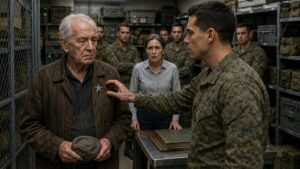
The Officer Pointed His Gun At An Old Veteran Holding Coffee In The Rain
Chapter 1: The Gun Above The Coffee Mug
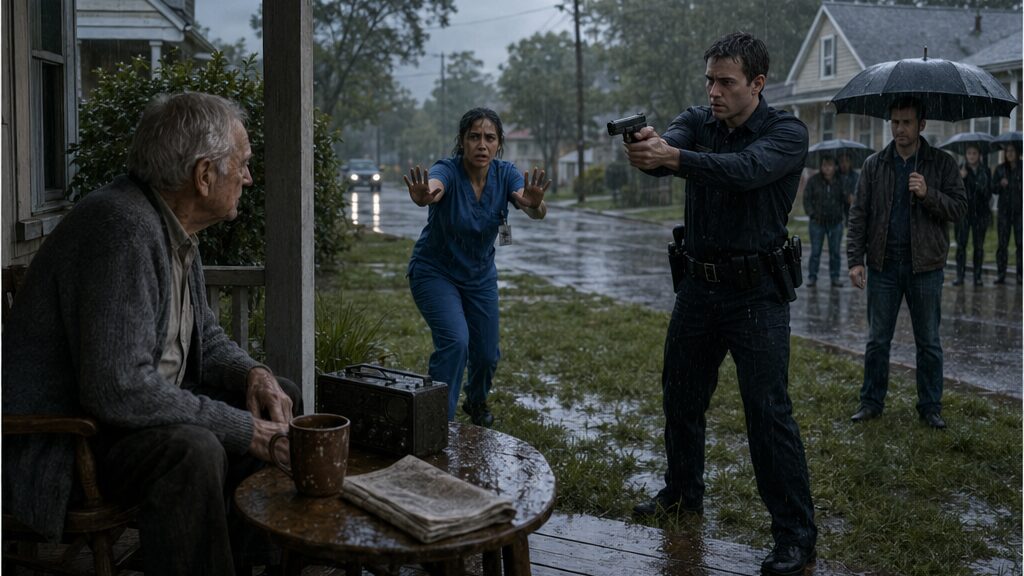
The gun was already pointed at William Allen when his coffee stopped steaming.
Rainwater tapped along the porch roof in quick, nervous bursts, spilling from the gutter in a crooked stream beside the steps. William sat in the same wooden chair he used every morning, his left hand around a chipped brown mug, his right resting on the folded newspaper across his knee. The paper had gone soft at the edges from the damp air. The mug was warm against his fingers, but the man standing in the yard kept both hands locked around a service weapon.
“Sir, keep your hands where I can see them.”
The officer’s voice was young. Too young to hide the strain in it.
William did not move at first. Not because he wanted to test the officer, and not because he had misunderstood. He had heard every word. He had also heard the neighbor’s screen door across the street click shut, the small gasp from someone near the mailbox, the wet hiss of tires slowing at the corner.
He knew how a crowd changed a man’s breathing.
“My hands are here,” William said.
“Do not reach for anything.”
William looked down at his own porch table. The coffee had left a pale ring on the old wood. Beside it lay the newspaper, folded open to the city section, and behind that sat the dark metal field radio with its cracked casing and dead dial. Rain mist had gathered on it. From the yard, in bad light, with fear already in a person’s chest, it could become almost anything.
“Officer,” William said, “that hasn’t worked in years.”
The officer’s jaw tightened. His nameplate read Brown. Ryan Brown. William read it because reading small things steadied him.
“Do not touch it.”
William nodded once.
Across the street, Brandon Miller stood beneath a large black umbrella with one hand on his child’s shoulder. Two other neighbors had come out onto their porches. Someone held up a phone. No one spoke loudly enough for William to catch the words, but he could feel the shape of them. Old man. Device. Police. Something wrong.
His coffee cooled another degree.
Ryan took one careful step closer, shoes darkened by the wet grass. “Sir, I need you to put the mug down and raise both hands.”
William’s hand tightened slightly around the mug, not from defiance but from the old body’s delay between command and movement. His knuckles had not been quick in years. The fingers obeyed, but they obeyed slowly.
“Slowly,” Ryan snapped.
William stopped.
The word cracked across the porch harder than the rain.
He looked at the officer’s face then, really looked. Not cruel. Frightened under the training. The weapon was steady, but the eyes behind it were not. William had seen that before, in places where young men learned how fear could dress itself as command.
“I am going to set the mug down,” William said carefully.
“Don’t narrate. Just do it.”
William lowered the mug an inch.
Ryan’s shoulders lifted.
William froze again.
A woman across the street whispered, “Oh my God.”
The old radio sat between them like a dark accusation. Its antenna had been snapped off decades ago. A strip of faded tape held one corner together. On the front, the worn letters were barely readable. William had cleaned it last night with a dry cloth and set it where he always did when rain came.
He wished, suddenly and sharply, that he had left it in the kitchen.
“Both hands,” Ryan said.
William moved his right hand off the newspaper and raised it, palm out. His left still held the coffee mug because lowering it had made the officer flinch. The pose was awkward, almost foolish. An old man in a gray cardigan, one hand half raised, one hand holding a mug like it was the only ordinary thing left in the world.
“Put it down.”
“I will.”
“Now.”
William’s wrist trembled.
Not much. Enough.
Ryan saw the tremor and misread it. His finger tightened along the frame of the weapon. The muzzle shifted slightly upward, finding William’s chest.
William heard the click of a phone camera.
That sound, small as it was, reached him more deeply than the command. The neighbors would have this now. Not the years he had carried groceries for the woman two houses down when her hip was bad. Not the evenings he had fixed the loose railing on the shared sidewalk without leaving a note. Not the mornings he had waved at Brandon’s child from this same chair and received nothing back.
They would have the old man with the gun pointed at him.
“All right,” William said.
He did not say it to Ryan. He said it to his own hand.
He lowered the mug toward the porch table. The bottom touched wood with a soft ceramic tap.
Ryan jerked forward. “Step away from the object.”
William’s hand stopped beside the radio.
The air broke open with running footsteps.
“Stop! Stop, don’t!”
A woman in blue scrubs came up the sidewalk so fast she nearly slipped on the wet curb. Her hair was pulled back badly, as if she had tied it while driving. One pocket of her scrub top had turned inside out. She lifted both hands, not toward William, but toward Ryan.
“Officer, lower it. Please lower it.”
“Ma’am, stay back.”
“That is not a weapon.”
“Stay back.”
“He’s not—” She caught her breath and looked past the gun, up to the porch. “Mr. Allen?”
William closed his eyes for half a second.
Michelle Torres. VA clinic. Night shifts. Tired smile. The nurse who brought paper cups of water to men who pretended their hands were steady. The one who had once found him sitting in the hallway with a young veteran who could not stop shaking.
Ryan did not lower the gun, but the line of his arms weakened.
Michelle stepped between the sidewalk and the porch, not directly in front of the muzzle, but close enough that everyone saw what she was doing.
“Officer Brown,” she said, reading the nameplate the same way William had, “that’s an old field radio. It’s broken. He brings it out when it rains.”
Ryan’s eyes flicked to the radio and back to William. “You know him?”
“Yes.”
William said quietly, “Michelle, don’t.”
She turned at the sound of his voice, and the anger in her face changed into something worse. Hurt. Recognition. “They called about you?”
William looked across the street.
Brandon’s umbrella shifted.
Ryan saw the look. So did Michelle. So did the neighbors with their phones.
“Sir,” Ryan said, but the word had changed. Less command. More uncertainty. “I still need you to keep your hands visible.”
William lifted both hands then. The coffee mug sat safely on the table. The newspaper sagged across his knee. The old radio gathered rain mist and gave nothing back.
Michelle took one more step. “He is seventy-eight years old.”
Ryan swallowed. “Ma’am, age doesn’t—”
“He helps calm men at the VA who scare trained staff,” she cut in. “He is not confused. He is not threatening you. And that thing on the table is not a gun.”
A neighbor muttered, “Then why does he keep it out there?”
The words came from somewhere behind the hedge, soft enough to pretend they had not been spoken, loud enough to wound.
William lowered his hands slowly. Ryan almost objected, then did not.
For a moment no one moved. The rain filled the silence. It ran down the officer’s sleeves, darkened Michelle’s scrubs, slipped from the porch roof in silver threads. William could feel his heart beating, not fast, just heavily, as if each beat had to climb a hill.
Ryan lowered the weapon until it pointed at the wet grass.
That should have ended it.
It did not.
The neighbors were still watching. The phones were still up. Brandon stood under his umbrella with his mouth set in a line that said he had already chosen his story and would not easily give it back.
William pushed himself from the chair. His knees complained. He did not reach for the table, though he wanted to. He stood without help, shoulders bent but steady, and looked down from the porch at the officer who had come into his yard afraid of him.
“I’m going to pick up my coffee,” William said.
Ryan gave a small nod.
William took the mug. The handle fit the old groove in his fingers. He did not drink. He only held it.
A burst of static came from Ryan’s shoulder radio.
“Brown, confirm complainant location. Caller states visual from residence across the street. Caller reports elderly male with possible weapon or black device, acting not right. Caller remains on scene.”
The words hung in the rain.
Ryan looked across the street.
So did Michelle.
So did William.
Brandon Miller lowered his umbrella just enough for William to see his face.
Chapter 2: Before The Rain Made Him Visible
“Don’t go near that old man’s table,” Brandon Miller said, and the child’s bicycle wobbled to a stop at the edge of William’s driveway.
William heard the warning through the screen door before he saw either of them. He stood in his kitchen with the coffee pot in one hand, watching the first thin rain of the morning bead on the porch rail. The mug waited beside the sink, chipped at the rim, brown as wet bark. The newspaper lay folded under his elbow. On the counter beside it sat the old field radio.
He had not yet carried anything outside.
The child’s small voice came through the screen. “Why?”
“Because I said so.”
“That black thing looks weird.”
William set the coffee pot down without pouring.
He could have opened the door then. Could have stepped out and said, It’s a radio. Could have turned the dead dial and let the child see there was no danger in it, only old metal, old wire, old silence. He could have smiled. Children understood objects better than adults sometimes. Adults saw what fear told them to see.
Instead, William waited until the bicycle wheels clicked away.
Only then did he pour the coffee.
Two days before the officer came, the neighborhood had already begun looking at William as if he were something left too long on a shelf.
It had not always been like that. When William first moved into the small white house on Alder Street, most of the neighbors were older than he was now. They knew the sound of his mower. They borrowed his ladder. They left tomatoes on his porch in August. One by one, they had moved away or died, and younger families bought the houses, painted the doors brighter colors, installed cameras above the garages, and joined group messages with names like Alder Safety and Block Watch.
William was not against safety.
He only distrusted the way some people used the word when they meant control.
He carried the mug to the porch first. Then the newspaper. Last came the field radio, held in both hands though it was not heavy. He placed it on the table with the front facing him, as always. Not toward the street. Never toward the street.
The rain thickened.
William sat.
He opened the newspaper, read three lines about a school board meeting, and did not absorb any of them. Across the street, Brandon stood in his driveway fastening a rain cover over a stroller. He glanced once at William’s porch, then again at the radio. His face had the pinched alertness of a man waiting for proof of something he already believed.
William raised the mug with both hands and drank.
The coffee was too hot. That was useful.
Heat gave the body something simple to obey.
A delivery truck rolled by. The driver lifted a hand. William nodded. A woman walking a small dog crossed to the other side before she reached his house. The dog strained toward the porch, cheerful and foolish, but the woman tugged it away.
William looked at the radio.
The black casing had dulled over the years. There were scratches along one side, a cracked knob, and a strip of army-green tape that no longer stuck well. The antenna stump leaned like a broken finger. It had not transmitted a human voice in half a lifetime.
Still, when rain came, William brought it outside.
Not every rain. Only the ones that began before breakfast and settled over the street with a low gray patience. The kind of rain that erased distance.
A rubber ball rolled into his yard near noon.
The child came after it, bright jacket flashing yellow against the wet grass. William folded the newspaper down and watched the child hesitate near the walkway.
“It’s all right,” William said. “Ball’s yours.”
The child took two steps, eyes fixed not on William but on the table. “Is that a gun?”
William’s fingers tightened around the mug.
“No.”
“What is it?”
The answer sat in his mouth. A radio. A dead one. A promise. A mistake. A voice I still hear when the rain comes down hard enough.
“A radio,” he said.
“Why’s it so big?”
“Old things usually are.”
The child looked as if that answer made sense. Then Brandon’s front door opened.
“Hey,” Brandon called, too sharply. “Come back here.”
The child grabbed the ball and ran.
William lifted his mug again, but the coffee had cooled.
That afternoon, William moved the radio farther back on the table. Then he moved it to the porch floor beside his chair, where no one from the street could mistake its shape. After a minute, he picked it up and put it back on the table facing him.
Hiding it felt like agreeing.
Near dusk, Brandon came over without an umbrella, shoulders hunched against the rain, phone in one hand. He stopped at the bottom of the porch steps rather than coming up.
“Mr. Allen?”
William closed the newspaper. “Yes.”
“I don’t want to make this a thing.”
That was how people announced they had already made a thing.
William waited.
Brandon rubbed water from his forehead. He was a broad-shouldered man in his forties, neatly dressed even in bad weather, with the restless manner of someone who had learned to turn concern into authority. “Some of the parents are uncomfortable with that object you keep out here.”
“It’s a radio.”
“I understand that’s what you’re saying.”
William looked at him.
Brandon shifted. “But from the street, it doesn’t look like a radio. And with everything going on lately—break-ins, people checking doors, strangers cutting through yards—we’re trying to be careful.”
“Careful is good.”
“Right. Exactly.” Brandon seemed relieved, then pressed on too quickly. “So maybe keep it inside. Just so people don’t misunderstand.”
“They can ask.”
“They shouldn’t have to.”
There it was, clean and small.
William set his mug down. “You came to ask.”
Brandon’s mouth tightened. “I’m trying to be respectful.”
“I know.”
The answer did not satisfy him. William saw that. Respectful men wanted gratitude for restraint they had not yet practiced.
“Look,” Brandon said, lowering his voice. “My kid asked if it was a gun.”
“And I said no.”
“That’s not really the point.”
William looked beyond him to the houses with their lit windows, their porch cameras, their trimmed hedges. “What is?”
“The point is people don’t know you.”
William almost smiled, but not kindly enough, so he stopped himself. “I live here.”
“That doesn’t mean people know what’s going on with you.”
The rain tapped the radio casing.
William picked up the newspaper again. “Good night, Mr. Miller.”
Brandon stayed at the steps another second. “You know, silence doesn’t help.”
William did not answer.
That was the mistake. He knew it even then. Silence was good in a storm, good near panic, good when young men with rifles needed someone not to add fear to fear. But silence in a neighborhood thread became whatever other people typed around it.
Brandon walked back across the street.
William remained on the porch until the light faded and the words on the newspaper blurred. Only after dark did he carry the mug inside. He washed it by hand, dried it with a towel, and set it beside the coffee pot for morning.
Across the street, behind a bright kitchen window, Brandon stood with his phone in both hands.
A few minutes later, somewhere William could not see, the Alder Safety thread lit up with a new post.
Does anyone else feel uncomfortable about the old man across from us sitting outside with that black device every time it rains?
Chapter 3: The Report That Changed The Porch
Subject refused commands.
William read the words three times in the police station lobby and felt no anger at first. Only a tired curiosity, as if someone had handed him a photograph of a stranger wearing his face.
The paper trembled slightly in his hand. Not enough for the clerk behind the glass to notice. Enough for William to fold the report and place it on his knee before the tremor could make a public announcement of itself.
Michelle sat beside him in the hard plastic chair, still in her blue scrubs, one foot tapping under the seat. She had driven him because she had insisted, and he had accepted because refusing would have required more energy than he had. Her hair was still damp from the morning rain. Every few seconds she looked at the folded report as if it might crawl away.
“Let me see it again,” she said.
“You’ve seen it.”
“Let me see the part where he says you refused commands.”
William kept his hand on the paper. “It’s his report.”
“It’s wrong.”
“It’s incomplete.”
“That’s a polite word for wrong.”
Across the lobby, Officer Ryan Brown stood near a doorway speaking to a police supervisor. He had changed out of his rain-darkened jacket. Without the weapon in his hands, he looked younger, almost unfinished. He nodded at something the supervisor said, then glanced toward William and quickly looked away.
Michelle saw it. “He knows.”
William looked at the vending machine against the far wall. Someone had taped an Out of Order sign across the coin slot. “Knowing and writing are different.”
“That’s why you file a complaint.”
“No.”
She turned fully toward him. “Mr. Allen.”
He disliked the softness in her voice more than he disliked the report.
“No,” he repeated.
The clerk had given them the preliminary incident summary because Michelle knew which words to use and which counter to stand at. Possible armed subject. Caller reported black device. Subject seated on porch. Subject slow to comply. Scene stabilized when third party identified object as nonweapon. No arrest. No injury.
It should have been good news. No arrest. No injury. The kind of official language that made a person sound lucky to have been frightened in public and sent home.
Michelle lowered her voice. “This can follow you.”
William’s eyes moved to her.
“I’m serious,” she said. “A report like this can trigger a welfare check. Or a safety review if the caller pushes it. If someone says you seemed confused or unstable—”
“I wasn’t confused.”
“I know that.”
He looked down at the folded paper. “Then that’s enough.”
“No, it isn’t.”
The door opened, and Ryan came into the lobby alone. The supervisor did not follow. Ryan held his hat in one hand. His other hand brushed once against his belt, as if checking for equipment that was no longer there.
“Mr. Allen,” he said.
William waited.
Ryan stopped a careful distance away. “I wanted to say I’m glad nobody was hurt.”
Michelle made a sound under her breath.
William looked at Ryan’s face. The young man’s eyes were tired now, the fear drained out and replaced by something less useful. Embarrassment, maybe. Or the beginning of responsibility, which often looked like discomfort before it grew a spine.
“So am I,” William said.
Ryan’s grip tightened on his hat. “The call came in as a possible weapon. The caller said you were sitting with a black device and not responding normally.”
“Not responding to whom?”
Ryan blinked. “Sir?”
“Before you arrived. Who was I not responding to?”
Ryan opened his mouth, then closed it.
Michelle leaned forward. “That’s a good question.”
Ryan looked down at the report in William’s lap. “Dispatch can only go by what the caller says.”
“And you?” Michelle asked.
Ryan’s face flushed. “Ma’am, I arrived on what was described as a potentially armed individual.”
“You arrived at an old man holding coffee.”
Ryan absorbed that. It landed; William saw it. But landing was not the same as changing course.
“I had to secure the scene,” Ryan said, quieter.
William nodded once. “You were afraid.”
Ryan looked up.
Michelle went still.
The words did not accuse him. That made them harder to avoid.
Ryan’s mouth worked slightly before he answered. “I was doing my job.”
“I know.”
“I don’t think you do.”
William let the silence sit between them. It was a silence he had used before, but in the police station lobby it seemed to close around Ryan rather than protect anyone.
Ryan exhaled through his nose. “I’ll review the wording.”
Michelle pounced on it. “Then change it.”
“I said I’ll review it.”
William stood. His knees stiffened, but he made no face. “Thank you, Officer Brown.”
Michelle stared at him. “That’s it?”
“That’s it.”
She followed him out, anger held so tightly in her shoulders that she seemed taller. In the parking lot, the rain had thinned to a mist. William walked slowly to her car, the report folded in his jacket pocket. Each step felt watched, though no neighbors were there.
Michelle unlocked the doors but did not get in. “You’re letting them write you into a story you didn’t choose.”
William opened the passenger door. “People do that every day.”
“That doesn’t make it right.”
“No.”
“Then why won’t you fight it?”
He looked past her, across the rows of wet cars, to where a flag outside the municipal building hung heavy and still. He knew the question she was asking. He also knew the one beneath it. Why won’t you let anyone know what you carried? Why do you keep making yourself smaller until people believe small is all you are?
“My fighting days are over,” he said.
Michelle’s expression changed. “That’s not what this is.”
He got into the car before she could say more.
On the way home, she drove with both hands on the wheel and no radio playing. At a red light, she said, “At the clinic, when that Marine threw the chair last winter, everyone backed away. You didn’t.”
William looked out the window.
“You sat down on the floor,” she continued. “You didn’t touch him. You didn’t order him around. You just told him to breathe when you breathed. He listened to you.”
“He was tired.”
“He was dangerous until you made him feel seen.”
William watched rain collect in the gutter beside the road. “Nobody made me feel anything this morning.”
“That’s not true.”
He did not answer.
When they reached his house, Michelle parked at the curb instead of the driveway. Across the street, Brandon’s curtains moved. The porch looked smaller than it had that morning. The table was empty; Michelle had carried the radio inside after the incident and placed it on William’s kitchen counter without asking.
William stepped onto the porch alone.
The chair was still angled toward the street. The newspaper lay where it had fallen, damp and unreadable. The coffee mug sat on the table with a thin brown line dried inside it.
He picked it up and carried it to the kitchen.
For several minutes, he washed the mug by hand. He used more soap than needed. He rinsed it twice, dried it, then held it under the cabinet light to make sure no stain remained. The chip on the rim caught the light. It had been there so long he no longer remembered when it happened.
The field radio sat on the counter behind him.
He did not look at it.
A knock came at the front door.
Michelle had gone. The knock came again, official and flat.
William opened the door to find a city envelope clipped to the screen by a plastic notice holder. The delivery person was already walking away through the mist.
He removed the envelope and unfolded the letter inside.
NOTICE OF PUBLIC SAFETY AND WELFARE REVIEW
His eyes moved down the page slowly.
Following a reported police response involving a possible weapon, neighborhood safety concerns, and questions regarding resident conduct, the city would review the use of the front property area, visible objects causing public concern, and William Allen’s ability to maintain safe residential conditions.
The date was printed at the bottom.
Three days away.
Across the street, Brandon Miller stood in his front window, phone in hand, watching William read.
Chapter 4: The Nurse Who Knew The Silence
“You let him point that gun at you like you deserved it.”
Michelle said it in the VA clinic hallway with a stack of discharge folders pressed against her chest and anger making her voice too sharp for the quiet wing. A man in a wheelchair looked over from the water fountain. Another veteran near the check-in desk lowered his eyes, pretending not to hear.
William stood beside the vending machine, his folded city notice in his jacket pocket and his coffee mug in one hand.
He had brought the mug without thinking. Only after Michelle stared at it did he realize how strange it looked, carrying a kitchen object into a clinic as if it were a piece of identification.
“I didn’t deserve anything,” he said.
“Then why didn’t you say that?”
A nurse passed them, glanced at Michelle’s face, and kept walking.
William shifted the mug from one hand to the other. The hallway smelled faintly of floor cleaner, wet coats, and burned coffee from the volunteer station. He had come in for a scheduled blood pressure check, but Michelle had found the city notice folded in his coat when he hung it on the chair. She had not asked permission before reading it.
That was new between them.
Before the porch, Michelle had always known where not to step. She brought water. She asked direct questions. She accepted direct refusals. After the porch, she had started looking at him as if he might disappear through a crack in his own silence.
“Michelle,” he said quietly, “you’re working.”
“I’m on break.”
“No, you’re not.”
She looked down at the folders, then back at him. “Don’t do that.”
“Do what?”
“Make me the one out of line so we don’t have to talk about you.”
The words struck cleanly enough that William had no answer ready.
A door down the hall opened, and a veteran in a dark cap came out walking fast, his face pale, breath short. A younger staff member followed at a distance, hands lifted but uncertain. The man in the cap stopped near the exit, trapped between wanting to leave and not knowing where to go.
Michelle’s anger vanished. “Sir? Can you hear me?”
The man’s eyes jumped from face to face. His fingers clawed at the zipper of his jacket.
William set his mug on the vending machine ledge.
He did not hurry. Hurrying made frightened people defend themselves against help. He crossed the hall and lowered himself onto the bench beside the exit, leaving space between them.
“Hard morning,” William said.
The man’s eyes snapped to him.
William looked at the floor, not at the man’s face. “You don’t have to answer.”
The hallway stilled in small increments. Michelle stayed back. The younger staff member stopped moving. The man in the cap kept breathing too fast, but his hands left the zipper.
William put both palms flat on his knees. Inhale. Hold. Exhale. He did it once, then again. The man watched him with suspicion, then irritation, then a reluctant kind of need. On the fourth breath, he matched him.
No one clapped. No one praised him. The clinic returned to motion the way a room does after glass almost breaks but does not.
After a few minutes, the man allowed the staff member to guide him back through the door. Michelle stood where she was, folders still clutched to her chest.
William returned to the vending machine and picked up his mug.
“That,” she said, lower now, “is what I’m talking about.”
He wiped a bead of moisture from the mug’s chipped rim. “He needed quiet.”
“So did you yesterday.”
William started toward the waiting room.
Michelle stepped with him. “The difference is, you gave it to him. You won’t let anybody give it to you.”
He stopped near a framed poster about caregiver support. The word support sat over a photograph of two hands holding each other. He looked away.
“That report says you refused commands,” Michelle said. “That notice says the city is reviewing your conduct. Brandon is telling people he was protecting the block. Officer Brown is probably telling himself he followed procedure. And you’re standing here with a coffee mug acting like none of it can touch you.”
“It touched me.”
“Then act like it.”
A hard answer rose in him. He felt it come up hot and old. You don’t know what acting costs. You don’t know what talking opens. You don’t know what men hear when rain hits metal.
He swallowed it.
Michelle saw that too. Her face changed, anger loosening around worry. “What is the radio?”
William looked down the hall. The man in the dark cap had disappeared behind an exam room door. A cart squeaked somewhere around the corner.
“A radio.”
“You know what I mean.”
He did. That was the trouble.
“It belonged to a man I served with,” William said.
Michelle did not move.
The sentence should have been harmless. A small fact. An old possession. But it made the hallway narrow around him. The smell of floor cleaner thinned. Rain ticked against the clinic windows, soft and patient.
“What was his name?” Michelle asked.
William’s fingers closed around the mug handle until the chip bit lightly into his thumb.
He almost said it.
Jerry Wilson.
He could feel the shape of the name in his mouth. Could hear the voice that belonged to it, quick with jokes when the air was bad, steady on the radio when everyone else shouted. Jerry, who could make static sound like a human thing. Jerry, who had said, If this thing dies, we’re all just guessing.
William set the mug down on a side table before his hand could betray him.
“A long time ago,” he said.
“That isn’t a name.”
“No.”
Michelle’s eyes shone, but she did not reach for him. That, at least, she understood.
“Mr. Allen,” she said, “I can come to the review with you.”
“No.”
“They need to know he was wrong.”
“They need to hear it from me or not at all.”
The words surprised both of them.
For one second, something like relief crossed Michelle’s face. Then she heard the second half.
“Not at all?”
William picked up the mug again. “I haven’t decided.”
“You have three days.”
“I can read a calendar.”
She stepped back as if he had closed a door with more force than intended.
He regretted it immediately. Pride was a poor substitute for privacy, but he had leaned on it so long it felt like bone.
“I’m sorry,” he said.
Michelle looked at the folders in her arms. “I don’t want to take your voice from you.”
“I know.”
“But if you won’t use it, people like Brandon will.”
William had no answer to that.
The automatic doors opened at the far end of the hall, letting in a cool gust of damp air. Michelle’s phone buzzed against the folder stack. She glanced down, frowned, and read with quick, angry eyes.
“What is it?” William asked.
She turned the screen toward him.
A forwarded message from the neighborhood safety thread filled the display.
Residents encouraged to attend public safety review. Pattern of concerning behavior. Visible device. Police incident. Elderly resident may need intervention before someone gets hurt.
At the bottom was Brandon Miller’s name.
Michelle lowered the phone slowly. “He’s organizing them.”
William looked at the message until the words blurred into one another. Then he lifted his coffee mug, though there was nothing in it, and held it with both hands until the trembling stopped.
Chapter 5: The Neighbors Chose A Story
“We all saw enough,” Brandon Miller said before William had even taken his seat.
The community room fell into an embarrassed hush, the kind that pretended to be respect because it did not want to admit it was curiosity. Folding chairs had been arranged in three crooked rows. A long table faced them from the front, where a city hearing clerk sorted papers beside a plastic pitcher of water. Wet umbrellas leaned against the wall. Several neighbors looked away when William entered, then looked back as soon as he passed.
William carried his coffee mug in his right hand.
No coffee. Just the mug.
He had not meant to bring it. He had picked it up from the kitchen counter before leaving, the way another man might pick up his keys. Only when Michelle glanced at it outside the room did he realize she understood and disapproved in the same breath.
Brandon stood near the front, wearing a rain jacket too clean for the weather. His wife sat in the second row with the child beside her. The child looked at William’s hands, then at the mug, then at the floor.
The city hearing clerk tapped the microphone. It squealed once. “This is a preliminary neighborhood safety and welfare review regarding the incident at the Allen residence and related resident concerns. We’ll keep comments brief and civil.”
Brief and civil, William thought, were often the clothes people put on unfairness before taking it into public.
Michelle sat beside him. “You don’t have to let them define the room.”
He looked at the table. “The room came defined.”
Brandon cleared his throat. “I don’t want this to become personal.”
A few neighbors nodded too quickly.
William turned the mug once in his hands.
Brandon continued, “My concern has always been safety. We’ve had break-ins two blocks over. People checking car doors. Packages disappearing. Parents are on edge. Then we have a situation where an elderly resident is sitting outside repeatedly with an object that looks, from a distance, like it could be a firearm or a device. Children have noticed it.”
The word children did its work. Shoulders shifted. A woman in the back whispered to the person beside her.
Michelle leaned toward William. “Say it’s a radio.”
William kept still.
Brandon looked at him, then at the clerk. “I tried to speak to Mr. Allen respectfully. He refused to explain. He dismissed my concerns.”
“I did explain,” William said.
The room turned toward him.
Brandon blinked. “You said it was a radio.”
“That is an explanation.”
“It didn’t address the concern.”
William looked at the child, who was staring at his shoes. “No. It didn’t end it.”
Brandon’s face tightened.
The clerk wrote something down. “Mr. Miller, please continue.”
“There was also the matter of noncompliance when police arrived,” Brandon said.
Michelle’s chair scraped. “That’s not what happened.”
The clerk lifted a hand. “Ma’am, you’ll have a chance.”
William felt Michelle’s anger beside him like heat from a stove.
Brandon inhaled, steadying himself. “I made the call because I believed there was a potential threat. I used the information I had. The officer responded appropriately based on that information.”
At the back of the room, the door opened.
Ryan Brown stepped in without his hat on.
He had not been there when the meeting began. William saw Brandon notice him, and saw something flicker across Brandon’s face—not relief. Calculation, maybe. Or concern that the person he had invoked now stood close enough to contradict him.
Ryan took a place near the wall and did not sit.
The clerk recognized him. “Officer Brown, we may ask for clarification later.”
Ryan nodded.
Brandon continued, but his voice had lost a little weight. “My point is, none of this happens if the object isn’t displayed in a way that creates fear.”
A neighbor raised a hand. The clerk called on her.
“I don’t know Mr. Allen well,” she said, eyes avoiding William. “But my doorbell camera caught part of the incident. It looked frightening. I mean, the officer had his weapon out. There must have been a reason.”
There must have been a reason.
William had heard that sentence in many forms throughout his life. It was a bridge people built so they did not have to stand too close to doubt.
Michelle spoke before the clerk could stop her. “The reason was a bad call.”
Brandon turned. “A concerned call.”
Ryan moved slightly against the back wall.
William saw it. Michelle did too.
The clerk said, “Officer Brown, since your report is included, can you clarify what dispatch relayed?”
Ryan’s eyes went to William first. That was new.
“The call described an elderly male seated on a porch with a possible weapon or black device,” he said. “Caller stated the subject was acting not right and had refused to respond to neighborhood concerns.”
Brandon’s jaw shifted. “That was my understanding at the time.”
Ryan looked at him. “The object was later identified as an old radio.”
“Later,” Brandon said. “After the fact.”
Ryan’s voice stayed level. “It was on the table beside a coffee mug and newspaper.”
The room went quieter than before.
William looked down at the mug. The chip on the rim had darkened where his thumb rested.
Brandon’s wife leaned toward him and whispered something. Brandon shook his head once, a small irritated movement.
Then the child spoke, so softly the clerk almost missed it.
“I asked if it was a gun.”
Every adult turned.
The child’s face reddened. Brandon placed a hand on the child’s shoulder, but the child kept looking at the floor. “Mr. Allen said no.”
Brandon’s hand stiffened.
Michelle closed her eyes briefly.
There was the small payoff William had not expected: a child had heard him. Not enough to save him from the room, but enough to make the room less certain.
The clerk looked at Brandon. “Mr. Miller, did you know that?”
“He said it was a radio,” Brandon answered. “But that doesn’t mean people were comfortable.”
“Comfort,” William said quietly, “is not the same as truth.”
It was the most he had said since entering. It did not sound forceful. It did not need to. It made several people look at him as if they had forgotten he could speak without asking permission.
Brandon flushed. “With respect, Mr. Allen, if you had been more forthcoming, this wouldn’t have escalated.”
Michelle turned on him. “You called police and said he might be armed.”
“I said possible,” Brandon snapped. “There’s a difference.”
“Not when a gun is pointed at him.”
The clerk tapped the microphone again. “Please.”
Brandon took a breath. For the first time, William saw the fear beneath his certainty clearly. It was not only fear of William. It was fear of failing in front of the neighbors who had let him become the man who sent warnings, started threads, spoke to city offices, kept order. If he admitted he had exaggerated, then his authority would look like panic wearing a clean jacket.
The clerk shuffled papers. “Given the concerns raised and pending final review, the city recommends temporary restrictions. Mr. Allen, until the review closes, we ask that any object causing public concern be removed from the visible front porch area. That includes the radio.”
Michelle’s head turned sharply. “You’re ordering him to remove a radio from his own porch?”
“Temporarily,” the clerk said.
William’s hand tightened around the mug.
The room waited for him to object.
He thought of the radio on his kitchen counter. The cracked casing. The dead dial. The way rain gathered on it like memory returning. He thought of Jerry Wilson’s hands, quick over knobs and wires. He thought of Brandon’s child looking ashamed.
Then he thought of Ryan’s gun.
“I understand,” William said.
Michelle stared at him.
Brandon exhaled, almost silently.
The clerk marked the paper. “Final review will be held in two days. Mr. Allen, you may bring any relevant explanation or documentation at that time.”
Documentation. As if the truth of a thing lived only when printed.
William stood. His knees made the movement slow, but nobody mistook it for confusion now. Michelle rose with him, anger bright in her face. Ryan stepped away from the wall as if he might speak, then stopped himself.
As William passed Brandon, the child looked up.
“I’m sorry,” the child whispered.
William paused. “You asked a fair question.”
Brandon’s face hardened at that, though the words had not been meant for him.
Outside, the rain had stopped, but the pavement still shone under the gray sky. Michelle walked with William to her car.
“You can’t keep letting them take pieces of your life because they’re uncomfortable,” she said.
William looked back at the community room windows. Several neighbors were still inside, talking in clusters. Brandon stood at the front with the clerk, pointing at something on the paper.
When William reached home, he did not go inside right away. He stood on the porch and looked at the empty table.
The mug in his hand felt heavier than it should.
By dusk, a printed city notice had been taped to his front door.
TEMPORARY DIRECTIVE: REMOVE VISIBLE DEVICE FROM FRONT PORCH PENDING FINAL REVIEW.
William read it once, then looked through the window at the old field radio sitting on his kitchen counter, waiting for rain.
Chapter 6: What The Radio Never Said
The old radio crackled at 11:17 that night, though it had no batteries and no right to make a sound.
William stood in the kitchen with the directive notice folded beside the sink and the coffee mug waiting empty under the cabinet light. Rain pressed against the windows in long silver lines. The radio sat on the counter where Michelle had left it days before, black casing dull, cracked knob turned toward nothing.
The sound came again.
Not a voice. Not even close. Just a small wet spit of static as moisture found some corroded place inside and reminded the dead machine how to pretend.
William gripped the edge of the counter.
“Don’t start,” he said.
The kitchen gave no answer.
He had not made coffee. It was too late for coffee, and he had already learned that age turned small indulgences into negotiations with sleep. Still, he took the mug from beneath the cabinet and set it beside the radio. Then he filled the kettle, lit the stove, and stood listening to the rain.
The directive notice lay open now.
Remove visible device.
Visible. That was the part that stayed with him. Not dangerous. Not illegal. Visible.
The radio had been harmless until people had to look at it.
When the kettle began to tremble, William turned off the flame before it whistled. He poured hot water over grounds in the old single-cup filter and watched dark coffee gather slowly in the mug. The smell rose, bitter and familiar.
He did not drink.
The radio crackled again.
This time, the kitchen went away.
Rain hit canvas first. Not roof shingles. Canvas. Hard, heavy, full of mud and wind. William was twenty-six again, crouched in a field station that was not much more than a torn shelter and a table nobody trusted. Red clay sucked at boots outside. Voices moved in and out of the dark. Someone shouted for a medic. Someone else cursed at a generator.
Jerry Wilson had been laughing.
That was what people forgot about bad places. Men laughed in them. Not because anything was funny, but because silence let fear hear itself too clearly.
“If this thing dies,” Jerry said, slapping the radio casing with the heel of his hand, “we’re all just guessing.”
“You always say that,” William said.
“Because it keeps being true.”
Jerry had narrow shoulders, quick fingers, and a way of tilting his head when listening through static, as if the radio were a stubborn man he could persuade with manners. He had a wife back home whose letters arrived with pressed flowers inside. He kept them in a plastic sleeve under his shirt.
That night, the rain made every transmission sound drowned.
William had been told to carry a message. Nothing grand. Nothing that would ever belong in a history book. Coordinates corrected. Movement delayed. Hold until confirmation. The kind of message that could save men if carried cleanly and cost them if garbled.
The radio failed halfway through.
Jerry opened the casing with a knife and worked by flashlight, his hands slick with rain. William remembered telling him they had to move. Jerry remembered saying, “Thirty seconds.”
Thirty seconds became a minute.
A minute became shouting.
The last thing William heard through the radio was not a full sentence. Only a broken voice under static and Jerry saying, “I can get it.”
Then the world split into noise.
William came back to the kitchen with both hands braced on the counter and coffee cooling untouched beside him.
He had never told Michelle. Had never told any neighbor. Had told a counselor once, years ago, in sentences so clean they had no blood in them. Equipment failure. Confusion in weather. Casualty. Survivor response.
None of those words said Jerry had looked at him right before leaving cover, grinning like fear could be negotiated with.
None said William had let him go because he wanted the radio alive more than he wanted to admit the message was already lost.
None said he still did not know whether ordering Jerry back would have saved him or only given him a different last second.
Rainwater ran down the window.
William lifted the mug at last. The coffee had cooled enough to drink. He brought it to his lips, then stopped.
For years, coffee in the rain had been discipline. Sit. Remember. Do not look away. Do not sweeten what was bitter. Do not let the morning become ordinary just because you survived to see it.
But tonight the mug looked smaller.
Just ceramic. Chipped. Brown. Made to hold something warm.
He set it down carefully.
“Jerry,” he said.
The name sounded unused, rough at the edges.
He waited, as if the radio might punish him for speaking it in a kitchen instead of a storm.
Nothing happened.
“Jerry Wilson,” he said again.
The second time hurt less and more.
He took the radio in both hands and turned it toward him. On the underside, beneath grime and old tape, were two initials scratched so faintly he had to tilt it under the light to see them.
J.W.
Jerry had done that with the tip of a pocketknife after accusing three different men of borrowing his equipment and returning it “with their bad luck stuck to it.”
William had laughed then. He remembered that, suddenly and with force. He had laughed so hard Jerry threatened to mark his boots too.
The memory loosened something in him.
Not forgiveness. Not yet. But a crack in the punishment.
A knock sounded at the kitchen door.
William startled badly enough to bump the mug. Coffee sloshed over the rim and spread across the counter toward the directive notice.
He grabbed a towel and opened the door halfway.
Ryan Brown stood under the small back awning in a dark jacket, rain shining on his hair. No uniform. No hat. No weapon visible. He held a folder in one hand.
“I’m sorry,” Ryan said at once. “I know it’s late.”
William looked past him into the wet dark. “Is there an emergency?”
“No.” Ryan swallowed. “Not exactly.”
William did not invite him in.
Ryan accepted that. He held up the folder slightly. “I pulled the dispatch notes. Off duty. I shouldn’t have taken copies home, but I wanted to understand what happened before I arrived.”
William’s voice stayed even. “And?”
“The caller used the word possible at first. Possible weapon. Possible mental issue.” Rain dripped from Ryan’s sleeve. “Then dispatch asked if there was immediate danger. The caller said yes.”
William felt the kitchen behind him: radio, mug, spilled coffee, old name awake in the room.
Ryan continued, “He said you were armed.”
The word was not new. It had been in the air since the porch. But hearing Ryan say it without the protection of procedure changed its weight.
“Why are you telling me this?” William asked.
Ryan looked down. “Because my report makes it sound like the scene made the call true.”
William waited.
“And it didn’t,” Ryan said.
It was the first clean thing Ryan had given him.
William opened the door a few inches wider, not enough to welcome him, enough to show he had heard. “Does the report say that?”
Ryan’s face tightened. “Not yet.”
“Then you came to feel better.”
The words landed harder than William intended. Ryan flinched but did not defend himself.
“Maybe,” he said.
That answer did more than an excuse would have.
William looked at the young man, wet and ashamed under the back awning. He saw the porch again, the gun, the neighbors, the sharp command. He also saw fear trying, clumsily, to become responsibility.
“You should go home,” William said.
Ryan nodded, but before he stepped back, his eyes moved past William into the kitchen. He saw the radio on the counter. Saw the coffee spreading into the city notice. Saw William’s towel pressed over the paper too late to keep the ink from bleeding.
“What is it?” Ryan asked softly.
William almost closed the door.
Instead he looked back at the radio. The cracked case gleamed under the cabinet light. The initials were hidden again in shadow.
“A man’s voice,” William said.
Ryan did not understand. That was all right. William had not meant him to.
After Ryan left, William shut the door and stood in the kitchen until the rain softened.
The directive notice was ruined. Black ink feathered across the paper, blurring the words Remove visible device until they looked like something sinking.
William dried the counter, poured the untouched coffee into the sink, and rinsed the mug. Then he sat at the kitchen table with the radio before him.
For the first time in years, he did not bring it to the porch when the rain deepened.
Near midnight, he took out a paper grocery bag and placed the radio inside. Then the mug. Then the folded newspaper from the morning of the incident, still stiff and warped from rain.
He set the bag by the front door.
At the top he placed the ruined directive notice, its ink bled nearly unreadable except for one word that remained clear.
Review.
Chapter 7: The Old Man Finally Corrected Them
William entered the community room carrying the paper grocery bag in both hands, and every conversation stopped before the door closed behind him.
The bag was damp at the bottom from the morning mist. Its top sagged open just enough for the dark edge of the field radio to show. A neighbor in the first row saw it and leaned away as if the object itself had memory enough to harm her. Brandon Miller stood near the front table, already speaking to the city hearing clerk, but his words died when he saw what William had brought.
Michelle stood near the back wall. She did not rush to him. She did not reach for the bag. She only looked at his face, searching for permission to stand close, and when he gave none, she stayed where she was.
Ryan Brown was there too, without his hat, uniform neat but posture changed. He stood beside the wall with his hands folded in front of him, not on his belt.
William walked to the front table slowly. The room watched every step.
The clerk cleared her throat. “Mr. Allen, the temporary directive requested that the device not be displayed on the porch pending review.”
“It isn’t on my porch,” William said.
No one laughed. No one breathed loudly.
He set the bag on the table. First he took out the chipped brown coffee mug and placed it before him. Then the folded newspaper, still warped from rain. Last, he lifted the old field radio with both hands and set it beside the mug.
The radio made a dull sound against the table.
Brandon said, “This is exactly the concern.”
William looked at him.
Brandon’s face tightened, but he kept going. “With respect, bringing that here after being told it worried people doesn’t help your case.”
Michelle shifted near the wall. Ryan lowered his eyes.
The clerk raised a hand. “Mr. Miller, you’ll have an opportunity to speak.”
“He’s making a point,” Brandon said.
William turned the mug so the chipped rim faced him. “Yes.”
The word stopped Brandon.
William remained standing. His knees wanted the chair behind him, but he did not sit. Not yet. He looked at the people in the room one at a time. Some of them had held phones in the rain. Some had watched from behind glass. Some had only read what Brandon wrote and come to feel reasonable.
“I have been asked,” William said, “to explain an object.”
His voice was not loud. The clerk adjusted the microphone toward him, but he gently moved it back.
“I don’t need that.”
The clerk withdrew her hand.
William touched the top of the radio. “This is not a firearm. It is not a bomb. It is not a threat. It is a broken field radio that belonged to a man named Jerry Wilson.”
Ryan’s head lifted.
Brandon folded his arms, but the movement looked less certain than before.
“Jerry served with me,” William said. “He was better with radios than I ever was with people. When the weather got bad, he could hear meaning where the rest of us heard only noise.”
The room was still.
William kept his hand on the casing. He had thought the words would come harder. Instead they came like stones removed from a pocket, one at a time.
“One night, rain made communication almost useless. A message had to get through. The radio failed. Jerry tried to fix it.” He paused. The old instinct rose in him: stop here, keep it clean, give them only facts that could not bleed. “He did not come back.”
Michelle’s face changed, but she did not speak.
William looked down at the mug. “I brought this radio onto my porch when it rained because I believed remembering required discomfort. I thought if I drank coffee in the rain beside it, I was keeping faith with him. Maybe I was. Maybe I was also punishing myself where no one had to know.”
A chair creaked in the second row.
Brandon said, “I’m sorry for your loss, but that doesn’t change that people were scared.”
The words came too quickly. Too defensively. The room felt it.
William looked at him without anger. “No. It doesn’t.”
That answer stole Brandon’s next sentence.
“Fear is real,” William continued. “But fear is not a witness. It can be useful. It can also lie.”
Ryan’s jaw tightened.
William turned toward him. “Officer Brown was told I was armed.”
The room shifted toward Ryan.
Ryan stepped forward from the wall. His voice was steady, but it cost him something. “Yes.”
The clerk looked up sharply. “Officer Brown?”
Ryan did not look at her. He looked at William. “The initial call used the word possible. Possible weapon. Possible issue. When dispatch asked if there was immediate danger, the caller said yes. Later in the call, the word armed was used.”
Brandon’s face went pale in patches. “That’s not fair. I said it looked like it could be—”
Ryan turned to him. “You said he was armed.”
“I was trying to get somebody there before something happened.”
“Something did happen,” Michelle said from the back.
The clerk tapped her pen once on the table. “Let’s proceed carefully.”
William almost sat then. The room had begun moving without him, and some old part of him welcomed it. Let Ryan speak. Let Michelle press. Let Brandon unravel himself. Let the city clerk write the clean version.
He put both hands around the coffee mug instead.
No.
This was his porch. His radio. His silence. His correction.
“Mr. Miller,” William said.
Brandon looked at him warily.
“You came to my steps and asked about the radio.”
“I did.”
“You said people didn’t know me.”
“That was true.”
“It was.” William nodded. “And I let that be the end of it.”
Brandon blinked.
“I could have told you more. I chose not to. Not because you deserved fear. Because I didn’t want your pity. Because I was proud. Because I have spent a long time believing that if I explained pain, I was making an exhibition of it.”
Michelle’s eyes filled, but her mouth stayed closed.
William breathed in slowly. “That was my part.”
Brandon’s shoulders loosened as if relief had offered him a door. “Then you understand why—”
“I’m not finished.”
The room held.
William’s voice remained quiet. “My silence did not put a gun in that officer’s hand. My silence did not choose the word armed. My silence did not make neighbors lift phones instead of asking one question from ten feet away.”
Brandon’s relief vanished.
William saw the shame come into his face, and with it, resistance. Shame almost always looked for a place to become anger.
“You don’t know what it’s like having a kid on this street,” Brandon said. “You sit there every morning watching everybody. You don’t talk. You don’t wave half the time. People hear about break-ins, about older people getting confused, about weapons in houses—”
“My age is not evidence,” William said.
The words were not sharp, but they cut through the room cleanly.
Brandon stopped.
Ryan stepped forward another half pace. “My report also needs correction.”
The clerk looked at him. “In what way?”
“I wrote that Mr. Allen refused commands. That was incomplete. He moved slowly. He verbally indicated what he was doing. I interpreted his movements under stress as noncompliance.”
The words changed the air. Not because they solved anything, but because someone with authority had finally turned the light on himself.
William looked at Ryan, and Ryan did not look away.
“I will amend it,” Ryan said. “And I’ll recommend the incident be reviewed for response and de-escalation training.”
The clerk wrote quickly.
Michelle pressed a hand to her mouth for one second, then lowered it.
Brandon looked around the room as if searching for the version of the story in which he was still only careful. “I didn’t call because I wanted him hurt.”
“I believe you,” William said.
That seemed to trouble Brandon more than accusation would have.
“I wanted someone to come fast,” Brandon said, softer. “My wife was scared. My kid was asking about that thing. People on the thread were saying someone needed to do something. And when dispatch asked if it was immediate, I thought if I said no, they’d take an hour.”
The clerk stopped writing.
Ryan closed his eyes briefly.
Brandon swallowed. “So I said yes.”
William touched the mug’s chipped rim with his thumb. “And when they asked if I was armed?”
Brandon looked at the radio, then at the child seated beside his wife, then finally at William.
“I used the word,” he said. “Because I wanted them to hurry.”
No one spoke.
There was no gasp, no dramatic turning of chairs. Only the ugly little silence that follows a truth too ordinary to dismiss. Brandon had not plotted harm. He had bent fear into certainty and handed it to a young officer with a gun.
William sat down at last.
The clerk’s voice had changed when she spoke. “Given this clarification, the directive regarding the porch object is suspended pending written amendment of the police report and caller record.”
“No,” William said.
The clerk looked confused. “Mr. Allen?”
“I don’t want it suspended.”
Michelle turned toward him.
William looked from the clerk to Ryan to Brandon. “I want it withdrawn. Written. I want the report corrected. Written. I want the caller record corrected. Written. And I want whatever training tells an officer how to slow down when an old man is holding a coffee mug to be more than a conversation after something worse happens.”
Ryan nodded once. “Yes, sir.”
William’s gaze moved to Brandon. “And I want the neighborhood thread corrected by the man who frightened it.”
Brandon’s face flushed. “In front of everyone?”
“You wrote in front of everyone.”
Brandon looked at his wife. She did not rescue him. The child watched him with the unbearable openness of someone still deciding what kind of man he was.
Brandon nodded. Not proudly. Not fully. But enough.
“I’ll correct it,” he said.
William placed the coffee mug back on the table beside the radio. For the first time that morning, he noticed that his hands were shaking. He left them visible.
The clerk gathered the papers. “We’ll issue an updated notice by tomorrow.”
William stood, but before he could lift the radio, Brandon spoke again.
“Mr. Allen.”
William waited.
Brandon’s voice thinned. “I called him armed because I wanted police to hurry.”
It was not new. He had already said it. But this time he said it facing the room, not just William.
“And I knew,” Brandon added, each word slower than the last, “that I did not know it was true.”
Chapter 8: The Porch After The Apology
The porch table had been cleaned, but no one had left flowers.
William stood in the doorway one week later, looking at the bare wood where rain rings, dust, and old coffee stains had been wiped away. The chair had been set square to the street. The newspaper lay folded on the seat in a dry plastic sleeve. Beside it sat the city’s updated letter, clipped under a smooth gray stone so the morning breeze would not take it.
Directive withdrawn.
Report amended.
Caller record corrected.
There was no sign saying sorry. No flag. No ribbon. No neighborly performance waiting to make peace easier for the people who had damaged it. William was grateful for that.
He carried the coffee mug out first.
The rain had stopped before dawn, leaving the street dark and shining. Water clung to the grass. A gutter ticked slowly at the corner of the porch. Across the street, Brandon Miller’s curtains were open, but no one stood in the window.
William set the mug on the table.
Then he went back inside for the radio.
For several minutes he stood in the kitchen with it in his hands. The casing was dry. The initials underneath were still faint, still there. He ran one finger over the cracked knob and waited for the old command to rise: Bring it out. Sit with it. Pay what you owe.
What rose instead was Jerry Wilson’s laugh.
Not the last sound. Not static. Not rain on canvas. A laugh.
William carried the radio to the porch and placed it beside the mug.
He sat.
The chair accepted his weight with a small wooden complaint. He poured coffee from the thermos Michelle had given him years ago after scolding him for drinking clinic coffee. The coffee steamed in the cool air. For a moment, he only watched it.
Then he lifted the mug and drank before opening the newspaper.
It tasted bitter and ordinary.
A patrol car did not stop at his curb. That mattered. A neighbor walking a small dog did not cross the street. That mattered too. She slowed near his walkway, lifted a tentative hand, and kept moving when he nodded back.
Nothing was healed all at once. William did not trust things that claimed to be.
A car door closed down the block.
Ryan Brown came up the sidewalk in plain clothes, a dark jacket zipped to his throat. He stopped at the bottom of the porch steps. No hat. No weapon visible. No command in his posture.
“Mr. Allen.”
William folded the newspaper once. “Officer Brown.”
“Ryan, if that’s all right.”
William considered him. “Not yet.”
Ryan accepted it with a small nod. “Fair.”
He held an envelope in both hands. “The amended report. I know the city mailed a copy, but I wanted to bring this myself. Not for credit. Just so you had it.”
William looked at the envelope but did not reach for it immediately. “Is it different?”
“Yes.”
“How?”
“It says the object was identified as a nonfunctional field radio. It says you verbally communicated your movements. It says my initial description of refusal to comply was inaccurate.”
The porch was quiet except for the gutter’s slow ticking.
“And the training?” William asked.
“My supervisor approved a review session. I asked to be part of it.”
“As punishment?”
Ryan shook his head. “Because if I’m not, I’ll spend the rest of my career pretending that morning was only paperwork.”
William took the envelope then and laid it beside the newspaper.
Ryan glanced at the radio. He did not stare this time. “May I step up?”
The question did not undo the command from before. Nothing did. But it set something beside it.
William nodded toward the other chair.
Ryan climbed the steps carefully, as if entering a place where loud movements had consequences. He sat without leaning back. For a while, neither man spoke.
William drank his coffee.
Ryan looked at his hands. “I’m sorry.”
“I know.”
“I don’t expect that to fix it.”
“It won’t.”
Ryan nodded. The answer hurt him, but he did not ask William to soften it.
Across the street, Brandon’s front door opened. He stepped out with his child beside him. The child carried a small backpack though there was no school that morning. Brandon paused at the edge of his driveway, saw Ryan on the porch, and nearly retreated.
The child did not. The child crossed the street first.
Brandon followed.
Ryan started to stand, but William lifted one hand slightly. Ryan stayed seated.
The child stopped at the bottom step and looked at the table. “Can I ask what it is?”
Brandon closed his eyes briefly, ashamed before the answer even came. “You don’t have to bother Mr. Allen.”
“It’s all right,” William said.
The child looked at him. “Is it really a radio?”
“Yes.”
“Does it work?”
“No.”
“Then why keep it?”
There it was. The question adults had circled with fear, authority, reports, meetings, and shame. A child asked it plainly and left room for the truth to be plain in return.
William set the mug down.
“It belonged to my friend Jerry,” he said. “He used it when we were soldiers. I kept it because I missed him. Then I kept it because I felt guilty. Those are not the same thing, but I mixed them up for a long time.”
The child thought about that with serious eyes. “Was he nice?”
William’s throat tightened. He looked at the radio, then at the wet street beyond it.
“Yes,” he said. “He was funny when things were bad. That’s harder than being funny when things are easy.”
Brandon stood behind the child, hands at his sides. “Mr. Allen,” he said, “I posted the correction. In the thread. I said I exaggerated what I knew.”
William looked at him.
Brandon swallowed. “I also said people should have asked you before they recorded you.”
“People includes you,” William said.
“Yes.” Brandon’s face flushed. “It includes me.”
William let the answer stand. He did not absolve it. He did not punish it.
Michelle arrived a few minutes later, still in scrubs, carrying a paper bag from the bakery near the clinic. She stopped when she saw everyone on and around the porch.
“Well,” she said, “I see nobody needed me to speak for them.”
William looked at her over the rim of his mug. “You’re learning.”
She smiled, but her eyes shone.
Ryan left first, after asking once more if there was anything else William needed from the department. William told him to make the next frightened call slower than the last one. Ryan said he would try. It was not a grand promise, but it was one a man might actually keep.
Brandon took the child home after a quiet goodbye. He did not offer his hand. William was glad. Some gestures needed to wait until they were more than gestures.
Michelle stayed at the bottom of the steps, looking at the radio.
“You told them Jerry’s name,” she said.
William nodded.
“How did that feel?”
He lifted the mug and drank. The coffee had cooled, but not too much. “Late.”
Michelle’s smile faded into understanding.
The sun began to thin the clouds over Alder Street. Water slid from leaves in bright drops. Somewhere down the block, a garage door opened. A dog barked once and stopped.
William unfolded the newspaper.
Beside it, the field radio sat silent in the morning air. It no longer looked like a warning. It looked like an old broken thing that had belonged to someone loved.
The child’s voice called from across the street. “Mr. Allen?”
William looked up.
The child stood in Brandon’s driveway, one hand raised. Not waving for attention. Asking permission.
William raised his mug in answer.
Then, while the street dried slowly around him, he took another drink of coffee before the rain could tell him he had to earn it.