The Suitcase They Put on the Old Veteran’s Back Was the One Promise He Never Broke
Chapter 1: The Brown Suitcase in the Stone Courtyard
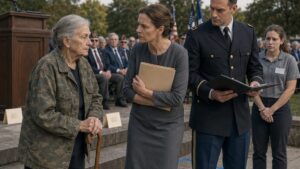
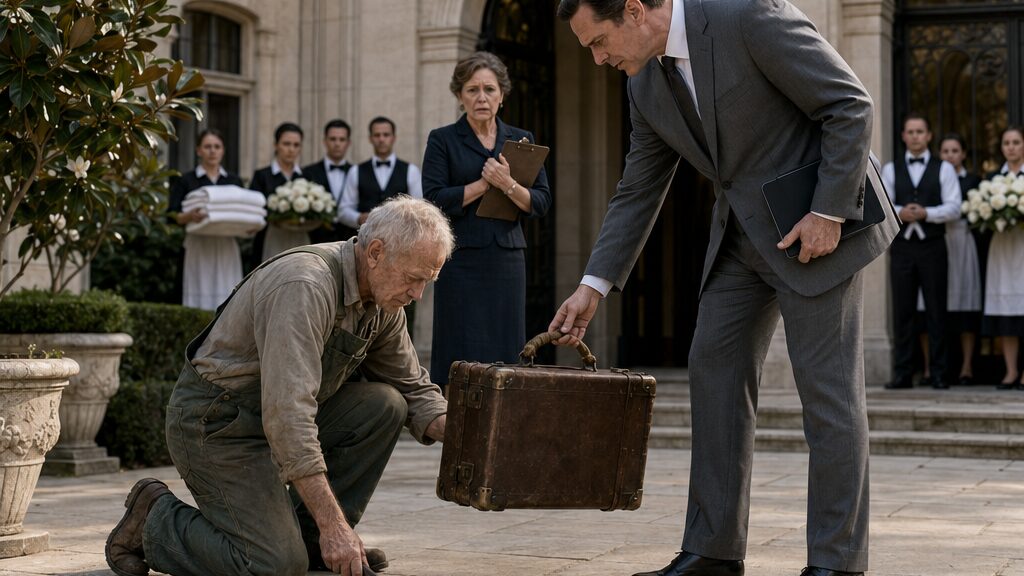
Donald Bennett found the loose stone before the donors did.
It sat just left of the mansion’s front steps, one pale square among hundreds, raised no more than the thickness of a nickel. Most people would not have noticed it. They would have crossed the courtyard with their eyes on the arched doors, the polished brass handles, the tall windows catching morning light. They would have seen the clipped boxwoods and the potted trees placed exactly where the operations manager had ordered them placed. They would have seen the estate the way visitors were meant to see it—old money, clean lines, good intentions in limestone and glass.
Donald saw the stone.
He had seen men trip over less.
He lowered himself slowly, one knee first, then one hand to the cool pavement. His green overalls pulled tight at the shoulders. The fabric was faded nearly gray in places, with darker patches where the knees had been reinforced by his own rough stitching. At seventy-four, he no longer bent easily. Every descent had to be negotiated with the body like a quiet argument.
Beside him sat the brown suitcase.
It was small enough to carry with one hand, old enough that the leather had given up trying to shine. The corners were bruised. The handle had been wrapped twice with dark cord. A brass latch held the front closed, though the metal was clouded from years of weather and touch. Donald had set it near the potted magnolia because he would not leave it in the tool room today. Not with strangers coming through the house. Not with Jonathan Carter ordering people to “streamline” anything that looked outdated.
Donald slid the tip of his flat screwdriver under the raised stone and tested it.
“Mr. Bennett.”
He did not look up at once. He knew the voice already. Clean, clipped, impatient even when it was trying to sound polite.
“Mr. Bennett,” Jonathan Carter repeated. “We discussed this.”
Donald shifted his weight off his bad knee. “Morning to you too.”
Jonathan stood over him in a gray suit that seemed too smooth for the courtyard. His shoes were narrow and dark, polished enough to catch the pale sky. Behind him, two caterers carried folded linens toward the service entrance. A young landscaping temp paused with a tray of white flowers and then wisely kept moving.
“You cannot be in the front arrival path,” Jonathan said.
Donald pressed the stone with his thumb. It rocked. “Somebody catches a heel here, they’ll go down.”
“The guests are not arriving for another hour.”
“Stone doesn’t know that.”
Jonathan exhaled through his nose. He was not a cruel-looking man, Donald thought. That was almost worse. Cruel men came with warning signs. Jonathan came with a tablet, a schedule, and the neat confidence of somebody who had never needed to ask permission to take up space.
Carolyn Reed hurried across the courtyard behind him, headset tucked against one ear, a clipboard hugged to her chest. “Jonathan, the donor packets are missing the garden map inserts.”
“Then remove the garden map entirely,” Jonathan said without turning. “We are not directing donors to a cracked walking path and three benches.”
Donald’s hand stilled on the screwdriver.
Carolyn glanced at him, then away. “I’ll have them reprinted.”
Jonathan’s attention returned to the suitcase. His eyes narrowed as if the old leather had personally offended him.
“And that needs to go.”
Donald’s palm moved to the handle before he meant it to. “It’s not in the way.”
“It is in every photograph of this entrance.”
“It won’t be.”
“Everything old is not automatically meaningful, Mr. Bennett.”
Donald looked up then.
Jonathan was young enough to think that sentence belonged to him. Maybe forty. Maybe a little less. No gray in his hair. No limp in his step. No habit of measuring a room for exits. His suit fit as if it had never been slept in, rained on, or folded under a head on a floor.
Donald’s voice stayed even. “I said I’ll move it.”
“You said that twenty minutes ago.”
“I found the stone twenty minutes ago.”
Jonathan stepped around him and reached for the suitcase.
Donald’s hand closed harder around the handle. “Leave it.”
The courtyard seemed to quiet around that word. Not fully. The fountain still kept its thin silver noise near the side wall. A truck backed somewhere beyond the hedge. But the people close enough to hear found reasons to slow down.
Jonathan smiled, not with amusement but with control. “Mr. Bennett, I am trying to prepare this estate for a board visit that may determine whether this foundation survives another year.”
Donald’s fingers loosened a fraction. “That so?”
“Yes. That is so. Which means I cannot stop every ten minutes to manage sentimental clutter.”
The word hit sharper than Donald expected. Sentimental. Clutter.
He had been called worse by better men and better by worse men. Still, his hand did not move.
Jonathan took the suitcase anyway.
It came up with a small creak of leather. Donald’s shoulder twitched, but he stayed on one knee, the screwdriver still braced under the stone. For one foolish second he thought Jonathan might simply carry it to the side, set it under the shade, prove himself merely hurried and not mean.
Instead Jonathan looked down at Donald’s bent back.
“If you insist on working in the arrival lane,” he said, “you might as well make yourself useful.”
The suitcase came to rest across Donald’s shoulders.
Not heavily. That was part of the insult. It was light enough not to injure, heavy enough to make the meaning clear. The leather pressed across his shoulder blades. The cord-wrapped handle bumped against the back of his neck. Donald’s hand went flat against the stone.
A caterer stopped breathing. The young landscaping temp froze near the urns. Carolyn said, “Jonathan,” but it was too quiet to be an order.
Donald did not move.
For a moment he was not in the courtyard. He was in red mud. He was twenty years old and carrying weight that made no sound because the man it belonged to had stopped speaking. He was counting steps because counting kept panic out. He was promising someone he would bring it home. He was learning that the body could become a bridge if it had to.
Then the morning came back. The fountain. The white flowers. The smell of coffee from the catering carts. The smooth weight of Jonathan’s expectation that Donald would either accept the joke or make a scene.
Donald did neither.
Jonathan patted the suitcase once, as if setting down a paperweight. “There. Stay still and no one trips.”
The words were not loud, but they traveled.
Donald could feel people looking and not looking. The guard near the gate shifted his feet. One of the board members’ assistants, early with a stack of folders, turned her face toward the columns. Jack Miller stood beside the black estate car at the edge of the drive, one hand on the open door, his mouth a hard line.
Jonathan straightened his jacket cuffs and walked toward the arched entrance.
Donald remained on his hands and one knee, the suitcase across his back, until the doors closed behind the gray suit.
Only then did Carolyn move. “Mr. Bennett, I—”
“Don’t,” Donald said.
It was not harsh. That made her stop more quickly.
He breathed once. Twice. The old lesson: do not let the breath run wild. A man could survive many things if he kept command of his breath.
He shifted one shoulder. The suitcase slid, caught against the strap of his overalls, then tipped. He caught it before it struck the stone. His fingers found the wrapped handle with a care that made the watching people look away in shame.
Donald set the suitcase upright.
His knee complained when he rose. He did not hide it, but he did not hurry either. He pressed one palm against his thigh, stood, then brushed dust from the front of his overalls. The screwdriver remained on the ground beside the loose stone. He bent again, not for Jonathan, not for the donors, but because the stone still rocked underfoot.
He fixed it with three precise taps.
When it sat level, he picked up the suitcase and walked to the magnolia pot. Jack had come halfway across the courtyard by then.
“Don,” Jack said under his breath. “Don’t do anything while you’re mad.”
Donald looked at him. “I’m not mad.”
Jack’s face twisted. “That’s what worries me.”
Donald reached into the bib pocket of his overalls and took out his phone. It was old, the screen cracked at one corner, the case rubbed smooth from years in his hand. He scrolled slowly. The name was still there because he had never deleted numbers just because people stopped calling.
Maria Hayes.
He touched the screen and waited.
It rang four times. On the fifth, a woman’s voice answered, careful and busy. “Donald? Is something wrong?”
Donald looked at the suitcase. The brass latch had left a small mark in the dust on his shoulder.
“Maria,” he said. “It’s Donald.”
“I know. I’m in the car. I’m almost there. Is it the board meeting?”
He looked toward the arched doors Jonathan had disappeared through.
“No,” Donald said. “Your father’s suitcase is back in the courtyard.”
The line went quiet.
So quiet Donald could hear the fountain again.
Chapter 2: The Man Everyone Called Maintenance
By ten-thirty, the mansion had swallowed the insult.
That was how places like the Hayes estate survived, Donald thought. They took in a sound, a shame, a raised voice, a broken glass, a name said wrong, and within minutes the walls made everything smooth again. The linens were straightened. The coffee urns polished. The front doors opened and closed on schedule. People who had seen something pretended they had seen a misunderstanding, and people who had not seen it accepted the polished version because it was easier.
Donald carried the suitcase through the service hall with one hand and his toolbox with the other.
The service hall ran behind the grand rooms like a narrow memory the house did not show guests. Its walls were painted a dull cream. Old hooks lined one side. Years ago they had held raincoats, garden hats, folding chairs, crutches, blankets, whatever the recovering men needed when the place was less foundation and more refuge. Now most hooks were empty except for plastic garment bags and spare extension cords.
“Donald.”
Carolyn Reed came quickly from the pantry end, her heels clicking too fast for the hall. She had removed her headset. That meant she wanted this to sound personal.
He stopped beside the door marked Garden Storage.
Her gaze flicked to the suitcase, then to his shoulder, where a pale streak of courtyard dust still crossed the green fabric. “I’m sorry about what happened outside.”
Donald shifted the toolbox against his leg. “Stone’s fixed.”
“That is not what I meant.”
“I know.”
She took a breath, then glanced behind her as if the house might report her for taking too long. “Jonathan is under pressure. The board is nervous. The donor group this afternoon includes people who could cover the winter deficit.”
Donald waited.
Carolyn pressed her clipboard to her chest. “That doesn’t excuse it.”
“No.”
“I’ll speak with him.”
Donald’s mouth moved almost into a smile. “Will you?”
Color rose in her face. Not anger. Recognition. She was not a bad woman, but she had built a life out of keeping rooms ready for people who could write checks. Somewhere along the way, readiness had become obedience.
“I need to ask you something,” she said.
“There it is.”
“Please don’t be visible during the donor tour.”
The words came out small but clear.
Donald looked down the service hall. On the far wall hung a framed photograph from twenty-five years ago: the south garden in spring, three men in wheelchairs under the dogwood trees, an occupational therapist laughing with a coffee cup in hand. Donald was in the background of that photo, younger, darker-haired, kneeling by the same stone border he had repaired twice since.
“Visible,” he repeated.
Carolyn’s fingers tightened on the clipboard. “You know what I mean.”
“I surely do.”
“They want the estate to feel hopeful.”
He looked back at her then. “And I don’t?”
“That is not fair.”
“No,” Donald said. “It isn’t.”
The silence between them filled the narrow hall. From the kitchen came the clatter of serving trays. Somewhere upstairs, a vacuum cleaner started and stopped.
Carolyn lowered her voice. “The foundation may not make it through the year. If today goes badly, none of us may have jobs. The garden program is already suspended. The residential wing is empty. We are trying to keep the doors open.”
Donald could have told her that doors were not the only part of a place worth keeping open. He could have asked when she last sat with a veteran in the garden after a night of bad dreams. He could have told her that hope did not always look clean.
Instead he said, “I’ll be in the tool room.”
Relief moved across her face before she could hide it. That hurt more than her request.
“Thank you,” she said. “Just until the tour ends.”
Donald nodded and opened the storage door.
The tool room smelled of oil, damp soil, and old wood. It had been his kingdom for thirty-two years, though no one would have called it that. Rakes hung by size along the back wall. Hand trowels rested in coffee cans. A workbench ran beneath a small window facing the side garden, its surface scarred by repairs nobody remembered once they were fixed.
He set the brown suitcase beneath the bench.
For a long moment his hand stayed on the handle.
The last time he had seen it in the courtyard before today, Maria had been nine years old, wearing a yellow sweater and asking whether soldiers carried cookies in their luggage. Her father, Charles Hayes, had laughed so hard he had to sit on the fountain edge. Donald had told her no, not usually, but sometimes they carried letters, socks, shaving kits, and pieces of home too small to save them.
Now Maria was a trustee who called before Christmas if she remembered and signed documents Carolyn placed in front of her. That was not a condemnation. People grew away from places that hurt. Donald knew that better than most.
A knock came against the open doorframe.
Jack Miller leaned in, cap in hand. “You all right?”
Donald reached for a rag and wiped dust from a pair of pruning shears. “Everybody keeps asking that.”
“Maybe because we saw a man put a suitcase on your back.”
“Wasn’t a piano.”
Jack stepped inside and shut the door behind him. His driver’s jacket was black and neat, but the cuffs were frayed. He was only six years younger than Donald and looked ten years older when worried.
“You should have let me say something.”
“And have him put you out too?”
“I’m harder to put out.”
“You got a bad hip and a grandbaby you help with rent.”
Jack stared at him. “Don’t turn this around on me.”
Donald set the shears down. “I’m not.”
“You always do. Somebody does you wrong, and somehow you make it about whether they had a hard day.”
“That boy’s not a boy.”
“He acted like one.”
Donald looked toward the suitcase under the bench. “No. He acted like a man in a hurry who thinks hurry makes him important.”
Jack snorted. “That supposed to make me feel better?”
“No.”
Outside the small window, two caterers carried tall arrangements toward the main hall. White flowers again. The foundation had begun using white flowers when the residential wing closed. Someone said they looked peaceful in photographs.
Jack followed Donald’s gaze. “They’re going to sell it, aren’t they?”
Donald did not answer.
“Don.”
“They’re going to try.”
Jack took off his cap and turned it in his hands. “Maybe that’s not the worst thing. Place is half-empty. Roof needs work. Kitchen freezer’s older than both of us put together.”
“The garden isn’t empty.”
“No, because you keep going out there like somebody’s waiting for inspection.”
Donald picked up the screwdriver from his toolbox and set it on the bench, parallel to the edge. “Somebody is always waiting for something.”
Jack softened. “That’s what I mean. You can’t keep carrying it.”
The words found the mark before Jack knew he had thrown them.
Donald crouched with care and pushed the suitcase farther under the bench, away from accidental feet, away from eyes. “I carried worse.”
“Exactly,” Jack said. “You already carried worse.”
For the first time that morning, Donald felt tired enough to sit. He lowered himself onto the stool by the bench. The wood creaked.
Jack watched him, then looked away to give him the kindness of not being seen too closely.
From beyond the door came Jonathan’s voice, distant but sharp. “I want this corridor clear before the guests move through. Anything that looks like maintenance needs to disappear.”
Donald laughed once under his breath.
Jack’s jaw tightened. “Let it go today. Please. Let him trip over his own mouth some other time.”
Donald looked at the toolbox, the window, the suitcase hidden in shadow. He thought of the loose courtyard stone, now level. He thought of Carolyn asking him not to be visible. He thought of Maria’s silence on the phone.
“I’ve been letting things go for a long while,” he said.
“That’s how old men survive.”
Donald stood slowly. His knee clicked. “Maybe.”
He lifted the toolbox again.
Jack frowned. “Where are you going?”
“Side path by the garden gate has a split rail. Donor catches her dress on it, Carolyn’ll blame the weather.”
“Carolyn told you to stay out of sight.”
Donald opened the door. “Then I’ll fix it quietly.”
He left the suitcase under the bench, but halfway down the hall he stopped and looked back.
For the first time in years, he wondered whether hiding it had been protection or surrender.
Chapter 3: A Garden No One Wanted to Explain
The recovery garden began where the mansion stopped pretending.
Out front, everything had been arranged for arrival: bright urns, swept stone, polished doors, the kind of beauty that asked nothing difficult of a visitor. Behind the house, past the service wing and the old brick path, the garden kept its imperfections in plain view.
A bench leaned slightly beneath the dogwood. The therapy rails along the gravel path needed sanding. Moss had grown between the bricks where the sun did not reach. The fountain there had not worked for three years, though rainwater still gathered in its shallow bowl and reflected the sky when the weather was kind.
Donald preferred it to the courtyard.
He set his toolbox beside the split rail and knelt with more care than he had used that morning. Here, no one was watching except a robin in the hedge and the stone angel Maria’s father had once bought from an estate sale because one of the men said the garden needed somebody patient looking over it.
Donald ran his thumb over the cracked wood.
“Still holding,” he murmured.
He had said that to men too. Men with hands that shook so badly they could not button shirts. Men who sat in the garden at three in the morning because sleep had turned against them. Men who walked the brick path in circles until they remembered they were not on patrol. Men who came with wives, mothers, sons, daughters, or nobody at all.
The foundation called the garden an outdoor therapeutic environment now. Before that, Charles Hayes had called it “a place to sit down before the world tells you to get up.”
Donald braced the rail and drove the first screw.
A golf cart hummed somewhere beyond the hedge.
He looked up.
Jonathan Carter appeared on the garden path with Carolyn beside him and two board members behind them. One board member held a paper cup. The other had sunglasses pushed up on her head and the look of someone already deciding whether a place deserved money.
Jonathan stopped when he saw Donald. The disappointment on his face was almost theatrical.
“Mr. Bennett.”
Donald kept one hand on the rail. “This one was split.”
“We agreed you would remain out of donor sightlines.”
“These donors?”
Carolyn gave him a warning look. “This is a preliminary walk-through.”
Jonathan stepped closer, shoes crunching on gravel. “This area was supposed to be closed.”
“It is closed,” Donald said. “That’s why I’m fixing it before you open it by accident.”
One of the board members looked around. “This is the veterans’ garden?”
Carolyn answered quickly. “Historically, yes. It has not been active as a program since the residential wing paused operations.”
“Paused,” Donald said.
Jonathan ignored him. “We are considering several options for the space. Event lawn, donor pavilion, possibly a memorial installation that requires less maintenance.”
Donald felt the screwdriver bite into his palm.
The board member with sunglasses tilted her head. “Less maintenance than a garden?”
“Accessible paths are costly,” Jonathan said. “The benches need replacement. The old therapy structures are not visually aligned with the new proposal.”
Donald stood. Gravel stuck to one knee of his overalls. “Those rails taught men how to trust their legs again.”
Jonathan’s smile tightened. “We appreciate the sentimental history.”
There was that word again.
Donald took one step toward the therapy rails. They were simple wooden supports along the path, worn smooth where palms had gripped them. “This rail here was set low because Daniel—”
He stopped.
The name had come too easily. He did not know if the man was alive. He did not know if his daughter still sent cards. He only knew Daniel had made it six steps farther on a Tuesday in April because the rail was low and the dogwood had been blooming and nobody rushed him.
Jonathan’s eyes flicked to the board members. “Mr. Bennett has been with the property a long time. Naturally he has attachments.”
“Attachments keep things from blowing away,” Donald said.
Carolyn’s face changed at that, just slightly.
Jonathan turned his tablet toward the board members. “The proposed pavilion would create a clean visual axis from the rear terrace to the lawn. It would photograph beautifully.”
“People don’t heal in photographs,” Donald said.
The words came out before he had sanded them down.
Silence settled over the garden.
The robin vanished into the hedge.
Jonathan’s voice lowered. “This is not the time.”
Donald knew that tone. Not anger. Warning.
He looked at the board members. Their expressions were uncomfortable, not hostile. That was the trouble with good people in polished shoes. They rarely knew when discomfort was telling them the truth.
Donald bent to collect his screwdriver.
As he did, the small key slipped from inside his shirt and swung on its chain. It was brass, dulled like the suitcase latch, no bigger than the top of his thumb. He caught it in his fist, but not before Carolyn saw it.
Jonathan saw it too.
“What is that?” he asked.
“A key.”
“To what?”
Donald tucked it back beneath his undershirt. “Something old.”
Jonathan gave a short breath. “Everything here is something old.”
“Not everything kept its promise.”
The board member with the coffee cup looked from Donald to Carolyn. “What promise?”
Donald closed the toolbox.
Jonathan answered before Carolyn could. “This is precisely the problem. The estate has accumulated decades of personal stories and no sustainable operating plan. We honor the mission by keeping the institution alive, not by preserving every bench and anecdote.”
Donald lifted the toolbox. His hand trembled once, and he hated that Jonathan’s eyes went to it.
“Careful,” Jonathan said. “That looks heavy.”
It was not concern. Not after the courtyard.
Donald looked at him for one long second.
Then he set the toolbox down, took out the screwdriver, and placed it in Jonathan’s open tablet hand. Jonathan startled, forced to catch it.
“Then hold that,” Donald said quietly, “while I carry what’s mine.”
He picked up the toolbox again and walked past them toward the service path.
No one stopped him.
At the tool room, the door stood half-open.
Donald knew he had closed it.
He stepped inside.
The brown suitcase was no longer under the bench. It sat on top of it, in a rectangle of window light, as if someone had lifted it there with both hands and then stepped back in recognition.
Maria Hayes stood beside it.
She had removed her sunglasses. Without them, she looked younger and older at once. There were lines at the corners of her eyes that had not been there when Donald last saw her up close, and something in her mouth that belonged to her father when he was trying not to show grief.
“I remembered the handle,” she said.
Donald stayed in the doorway.
Maria touched the cord wrapped around the leather. “I used to think it was ugly.”
“It is.”
She almost smiled, but it failed. “My father said you wrapped it that way.”
Donald set the toolbox down. “Handle split.”
“When?”
“A long time ago.”
Maria looked at the suitcase as though it might answer what he would not. “Donald, why did you say it was back in the courtyard?”
He did not move.
From the garden path outside came distant voices—Jonathan explaining, Carolyn smoothing, the board members murmuring about cost and preservation and donor appeal.
Maria turned toward him fully. “What did my father ask you to keep?”
Donald’s hand moved to the key beneath his shirt, then stopped.
He could still choose silence. He had chosen it for years, and silence had served him well enough. It had kept the suitcase closed. It had kept old pain from becoming an exhibit. It had kept Maria from inheriting one more burden from a father who had already left her too many rooms full of echoes.
But outside, Jonathan was standing in a garden he did not understand, measuring it for removal.
Donald looked at the suitcase in the light.
“Not what,” he said. “Who.”
Chapter 4: Maria Remembers the Wrong Thing
Maria Hayes had spent years teaching herself not to smell the house.
That was the trouble with old places. They kept proof. Lemon oil on the banister. Damp stone near the garden doors. Dust warmed by sunlight in the library. The faint mineral scent of the fountain drifting through open windows. All of it waited for her, patient and accusatory, every time she returned.
She had learned to arrive with a folder in hand and a call scheduled ten minutes after entry. She kept conversations practical. Budget. Roof. Donor commitments. Deferred maintenance. Program suspension. Potential buyers. If she stayed inside those words, she could move through her father’s house without becoming the girl who used to slide down the back staircase in socks.
But the suitcase ruined that.
It sat on Donald Bennett’s workbench like a thing pulled up from under water. Brown leather. Cord-wrapped handle. Brass latch. A small pale scar near one corner where she remembered touching it with a crayon when she was little. She had not thought of that mark in decades.
Donald stood in the doorway and said, “Not what. Who.”
The answer pressed at something she had kept locked as carefully as he had kept the suitcase.
“Who?” she asked.
Donald did not answer quickly. He looked past her to the little window, where late afternoon light lay across the bench. His overalls were still dusty from the courtyard. There was a streak near his shoulder, a flattened place in the fabric she did not want to understand too clearly.
“Your father never told you everything,” he said.
Maria gave a small, tired laugh. “My father made a profession of not telling me everything.”
“He thought he was sparing you.”
“He was good at that too.”
The bitterness surprised her. She had not meant to bring it into the tool room. This was Donald’s place, not hers. She remembered being told as a child not to touch the sharp things, not to run near the shelves, not to bother Mr. Bennett when he was working. She remembered Donald lifting her once so she could see a robin’s nest tucked above the window. His hands had smelled of soil and machine oil.
Now he looked older than she was ready for.
“May I?” she asked, nodding toward the suitcase.
“No.”
It came gently, but it did not bend.
Maria withdrew her hand from the latch. “All right.”
That was Donald. He could refuse without raising his voice and somehow make the refusal feel like a door she had not earned the right to open.
Behind them, footsteps passed in the service hall. Carolyn’s voice floated by, strained but composed, instructing someone to move floral arrangements from the rear terrace. The board walk-through continued. The foundation kept performing life while the thing that had made her father build it sat closed on a workbench.
“What happened in the courtyard?” Maria asked.
Donald’s eyes shifted to hers.
“I heard enough to know something happened,” she said. “Carolyn won’t look me in the face, Jack nearly took the side door off its hinges when I asked where you were, and Jonathan told me you were being disruptive.”
Donald’s mouth tightened at one corner. “That his word?”
“One of them.”
“He put the suitcase on my back while I was fixing a stone.”
Maria stared at him.
The sentence did not arrange itself into sense. She saw the courtyard, Donald kneeling, Jonathan in that gray suit, the suitcase in someone’s hand. Her mind resisted the rest.
“He what?”
Donald’s gaze remained steady, which made it worse.
“He set it there,” Donald said. “Walked off.”
The tool room seemed to shrink around her.
Maria had hired Jonathan after three interviews and two glowing recommendations. He was efficient, precise, confident, sometimes cold in a way she had mistaken for focus. She had told herself the foundation needed someone unsentimental because sentiment had nearly bankrupted them. She had signed his contract in the library under her father’s portrait.
Now she saw Donald on stone.
“I’m sorry,” she said.
He turned slightly away, reaching for a rag that did not need folding. “You didn’t do it.”
“I brought him here.”
“That’s not the same.”
“It feels close.”
Donald said nothing.
Maria looked back at the suitcase. “Why didn’t you tell everyone? Why didn’t you make him answer for it?”
His hands stilled.
After a moment he said, “A man who has to be made sorry in public usually just learns how to hate better.”
“That can’t be the only consequence.”
“No.”
The quiet of that word unsettled her.
She moved closer to the bench, careful not to touch the suitcase. “When I was little, I thought this belonged to you.”
“It did after a fashion.”
“But before?”
Donald glanced toward the closed door. “It belonged to a man your father never forgot.”
Maria closed her eyes briefly. Her father had forgotten bills, birthdays, doctor’s instructions, names at dinner parties. But he had not forgotten men who sat with him in the dark of the garden. He remembered their coffee preferences years after they left. He remembered who could not sit with their back to a door. He remembered who needed the fountain turned off because running water pulled them somewhere else.
“What was his name?” she asked.
Donald’s jaw shifted. “Not today.”
“Donald—”
“Not in this room with people measuring the garden outside.”
The words landed with more weight than anger would have. Maria listened, and for the first time all day she heard the distant murmur beyond the walls not as business but as trespass.
She took a slow breath. “Jonathan says the garden is unsustainable.”
“Jonathan says many things.”
“He says the board needs a clean plan before donors lose confidence.”
Donald reached into the neck of his undershirt and drew out a small brass key on a chain. Maria’s eyes went to it at once. It was the key she had seen flash in the garden.
He held it in his closed fist, not offering it.
“Your father had a clean plan,” he said. “Then he met men who couldn’t be cleaned up for photographs.”
Maria felt the sting of it, though he had not aimed to wound her. “I’m trying to keep the foundation alive.”
“I know.”
“Do you?” She hated the sharpness in her own voice, but it came anyway. “Because everyone here talks to me like I left it to rot. The roof alone could wipe out our reserves. The residential program is closed because we couldn’t staff it. Insurance costs doubled. Donors like the idea of veterans until the price has too many zeros. I am not trying to erase him.”
Donald looked at her with an old sadness. “I didn’t say you were.”
“You didn’t have to.”
He slipped the key back under his shirt. “You remembered the wrong thing, that’s all.”
Maria blinked. “What does that mean?”
“You remembered the house as your father’s burden. It was his promise before it was his burden.”
She looked away first.
Through the little window, the garden lay beyond the hedge, imperfect and green. She remembered being twelve, angry because her father missed a school recital after a man in the residential wing had a bad night. She remembered shouting that strangers got more of him than she did. She remembered her father standing in the library doorway, helpless with love and exhaustion, saying, “Some promises don’t know how to wait, sweetheart.”
She had hated that sentence for years.
A knock struck the doorframe.
Jonathan Carter stood there, tablet under one arm, expression smooth enough to warn her he had already decided what version of the scene they were in.
“Maria,” he said. “There you are. The board is asking whether you want the garden pavilion discussed before or after the financial review.”
Her face cooled by instinct. “After.”
“Good.” His eyes moved to Donald, then to the suitcase. Something calculating passed through them. “I hope Mr. Bennett is not upsetting you with old stories.”
Donald picked up a hand plane from the bench and set it on its proper hook.
Maria saw Jonathan watching him, measuring the trembling fingers, the bowed shoulders, the dusty knees. She saw him see only weakness and inconvenience.
“He told me what happened in the courtyard,” she said.
Jonathan did not flinch. That angered her more than if he had.
“I moved an obstruction,” he said. “Mr. Bennett chose to dramatize it.”
Donald’s hand stopped on the hook.
Maria’s voice dropped. “Did you place that suitcase on his back?”
Jonathan’s mouth tightened. “For a moment. It was ill-advised.”
“Ill-advised?”
“I have already said I will apologize if necessary.”
“If necessary,” Donald said quietly.
Jonathan turned to him. “You are making this much larger than it needs to be.”
Donald nodded once, as if considering that. “I expect I’ve made plenty too small.”
The sentence confused Jonathan. It did not confuse Maria.
Jonathan took a step into the room. “Maria, may I speak plainly?”
“You seem to have started.”
He lowered his voice with professional concern. “This is exactly the kind of emotional entanglement that has kept the foundation from making hard decisions. Mr. Bennett has served here a long time, yes. But he is attached to objects, benches, stories, routines. He is not able to separate personal memory from institutional need.”
Donald looked at the suitcase, not at Jonathan.
“He called you here because he knew the suitcase would affect you,” Jonathan continued. “The timing is not accidental.”
Maria felt the old reflex rise: make the room manageable, keep the meeting on schedule, prevent donors from seeing fracture. Her father had never been good at that. She had become good enough for both of them.
“Donald,” she said carefully, “did you call me because of Jonathan?”
Donald lifted his eyes to her.
“No,” he said. “I called because your father’s suitcase was put somewhere it should never have been.”
Jonathan gave a small, humorless laugh. “There. You hear it? This is symbolism being used as leverage.”
Maria did hear something. Not what Jonathan heard.
She heard the restraint in Donald’s voice. She heard how much he was not saying.
But she also heard the board outside, the money running out, the donor packets already reprinted without the garden map. She heard her father telling her promises did not wait, and she heard herself at twelve years old wishing just one promise would choose her.
“I need the financial review to proceed,” she said.
Donald nodded as if he had expected nothing else.
The acceptance hurt.
Jonathan’s shoulders relaxed. “Thank you.”
Maria looked at him. “That was not agreement with you.”
His relaxation vanished.
She turned back to Donald. “I am not asking you to open it today. But I am asking you not to disappear.”
Donald’s fingers moved to the edge of the suitcase. “I’ve been here.”
“Yes,” she said. “That may be the problem. Some of us stopped seeing you.”
For the first time, something in his face loosened.
Then Jonathan’s phone buzzed. He glanced down, frowned, and looked toward the hall. “The attorney is here early.”
Maria straightened. “For the sale documents?”
“For the contingency review,” he said quickly.
Donald did not miss the change.
Neither did Maria.
Jonathan stepped back into the service hall. “We should go.”
Maria stayed a moment longer.
Donald reached beneath his shirt, took out the brass key, and laid it on the workbench beside the suitcase. He did not open the latch.
Not yet.
“Your father gave me until I couldn’t carry it right anymore,” he said.
Maria looked at the key, then at him.
“And can you?” she asked.
Donald’s gaze went past her, toward the garden.
“That’s what I’m trying to find out.”
Chapter 5: The Offer That Sounded Like an Apology
The next morning, Donald arrived before the sun had cleared the east hedge.
He had not slept much. Sleep came to him in pieces now, and the pieces broke apart easily. A floorboard settling. Rain at the window. The memory of leather pressing across his shoulders in the courtyard. He had lain in his small apartment above the old carriage house and listened to the estate breathe below him: pipes ticking, branches dragging against slate, one distant door that needed planing before winter.
At five-thirty he gave up, dressed in the same green overalls, and carried the suitcase downstairs.
The courtyard was empty when he crossed it. Without people, the place looked gentler. The potted trees stood like sentries relieved of duty. The stone he had fixed lay flat near the front steps. Donald tested it with his boot anyway. It did not move.
He stood there longer than he meant to.
Yesterday, the suitcase had been used to make him small in this exact spot. This morning, he held it by the handle and felt the pull in his shoulder. Its weight had not changed. Only the air around it had.
He took it inside through the side entrance, past the pantry, down the service hall to the tool room. There he set it on the workbench and unlocked the door to the old cabinet beneath the window.
The preservation folder was where he had left it, wrapped in brown paper and tied with string.
He did not open it.
He knew every page. He knew the founder’s signature, the attorney’s seal, the clause that had seemed unnecessary when Charles Hayes drafted it because everyone loved the garden then. He knew the letter Charles had placed on top, addressed to Donald in a hand already made uneven by illness.
Use this only if they forget why the place exists.
For twelve years, Donald had not used it.
He had watched programs shrink, staff leave, donors change, language soften. Recovery became wellness. Residents became clients. The garden became an asset. Every change had come with reasons. Some reasons were even good. A man who had lived through enough knew that harm did not always arrive wearing a sneer. Sometimes it arrived with spreadsheets and regret.
Donald slid the folder into the suitcase beneath the old letters and closed the lid.
The latch clicked softly.
A voice behind him said, “You’re early.”
Jonathan Carter stood in the doorway in shirtsleeves, suit jacket folded over one arm. Without the jacket, he looked less polished. Younger. More tired. There were faint shadows under his eyes.
Donald did not answer.
Jonathan stepped inside but stopped short of the bench. “I was hoping to speak with you before the board convenes.”
“That so?”
“Yes.” Jonathan glanced at the suitcase. “About yesterday.”
Donald waited.
“I should not have placed the suitcase on you.” The words sounded practiced, but not insincere. “It was disrespectful.”
“It was.”
Jonathan’s jaw tightened. He had expected perhaps a softer reply, a way to move quickly through apology and into solution.
“I apologize,” he said.
Donald took a rag from the bench and wiped a smear of oil from his thumb. “All right.”
Jonathan frowned. “All right?”
“I heard you.”
“I’m trying to make this right.”
Donald looked at him then. “Are you?”
The question hung in the tool room.
Jonathan set his jacket on the back of the stool without being invited. “Mr. Bennett, I know you have history here. I understand this place matters to you.”
“No,” Donald said. “You understand it matters. You don’t understand the place.”
“That may be fair.” Jonathan’s voice sharpened, then smoothed again. “But understanding does not pay contractors. It does not reopen residential care. It does not satisfy donors who want accountability.”
Donald closed the cabinet door.
Jonathan drew an envelope from inside his tablet case and placed it on the bench. “I spoke with Carolyn and with Maria. There may be an option that respects your service to the estate.”
Donald looked at the envelope but did not touch it.
“A retirement package,” Jonathan said. “Modest, but meaningful. Six months’ pay. Continued housing through the end of the year. A public thank-you at the Memorial Weekend reception if you want it kept simple.”
Donald’s hand stilled.
If you want it kept simple.
He imagined it: a few polite words in the courtyard, perhaps a framed photograph, people clapping because someone had told them to. Then the garden path cut, the benches hauled away, the suitcase placed in storage or, worse, displayed behind glass with a printed card that got half the story wrong.
“What would I be retiring from?” he asked.
Jonathan blinked. “Your caretaker position.”
Donald nodded toward the window. “And who takes care?”
“We will contract landscaping.”
“That’s not what I asked.”
Jonathan exhaled. “This is a generous offer.”
“It’s an offer.”
“An offer you should consider seriously.”
Donald picked up the envelope, weighed it in his hand, and set it back down. “You think I’m angry because you embarrassed me.”
Jonathan’s face changed. Not much, but enough.
“Aren’t you?”
Donald looked at the suitcase. “I’ve been embarrassed before.”
“That does not excuse—”
“No. It doesn’t.” Donald touched the wrapped handle. “But if it was just my back you put this on, I’d have let you apologize and gone on with my work.”
Jonathan’s gaze moved to the suitcase. “What is in there?”
“Weight.”
“I’m asking plainly.”
“I’m answering plainly.”
Jonathan’s patience thinned. “Maria is under enormous pressure. If you turn this into a symbolic battle in front of the board, you may damage the very institution you claim to care about.”
Donald almost smiled. The boy was good. Not kind, not wise yet, but good at building a cage out of reasonable sentences.
“You ever serve?” Donald asked.
Jonathan looked taken aback. “No.”
“Ever sit with someone while they tried to remember where they were?”
“No.”
“Ever help a man learn which sounds are just doors closing?”
Jonathan looked toward the hall. “My father was a police officer. I know something about public service.”
Donald nodded. “Then maybe you know service can make a house loud even when nobody’s talking.”
For the first time, Jonathan did not answer quickly.
Donald picked up the envelope and held it out.
Jonathan did not take it at once.
“I’m not selling silence,” Donald said.
“It is not silence. It is transition.”
“Call it what lets you sleep.”
Jonathan’s face flushed. “You think I’m the villain here.”
“No.”
That seemed to disarm him more than accusation would have.
Donald placed the envelope against Jonathan’s tablet case. “I think you’re a man trying to save a thing by cutting out its heart because the heart doesn’t photograph clean.”
Jonathan’s mouth opened, then closed.
Footsteps sounded in the hall. Carolyn appeared, saw the two men, and stopped. “The board members are arriving.”
Jonathan did not look away from Donald. “We are not done.”
“No,” Donald said. “We’re not.”
Carolyn’s gaze fell to the envelope, then to the suitcase. She knew enough to say nothing.
Donald lifted the suitcase from the bench.
Carolyn stepped aside. Jonathan did too, after a moment.
The service hall was brighter now, full of morning noise. Caterers rolled carts toward the main rooms. A security guard checked badges near the side door. Somewhere beyond the walls, donors’ cars began arriving on the gravel drive.
Donald walked not to the garden, not to the tool room, not out of sight.
He walked toward the boardroom.
The room had once been the winter parlor. Charles Hayes had kept mismatched chairs there, a piano no one tuned properly, and a shelf of books veterans borrowed and never returned in full. Now a long polished table filled the center. Leather chairs sat evenly spaced. Pitch folders waited at each seat. On the far wall, the founder’s portrait looked past everyone toward the windows.
Donald entered alone.
No one was there yet.
He set the brown suitcase in the middle of the boardroom table.
Its old leather looked wrong against the shine. Too worn. Too plain. Too honest.
He stood with one hand on the handle until the first board member came in and slowed.
Then the second.
Then Maria.
Her eyes went to the suitcase first, then to Donald.
Jonathan appeared behind her, his expression controlled so tightly it had no room left for charm.
“Mr. Bennett,” he said, low enough that only those nearest heard, “this is not appropriate.”
Donald removed his hand from the suitcase.
“No,” he said. “It’s necessary.”
Chapter 6: What the Suitcase Was Really Carrying
No one sat down at first.
The boardroom had been arranged for order, and Donald Bennett had placed disorder in the exact center of it. The brown suitcase sat on the polished table among water glasses, folders, and pens printed with the foundation’s name. Its leather was scuffed. Its corners were tired. The cord around the handle looked like something tied by a man who expected usefulness to matter more than beauty.
Maria remained near the doorway. Carolyn stood behind the chair she normally used for notes. Jonathan Carter kept one hand on the back of another chair, knuckles pale against the leather.
A board member cleared his throat. “Is this part of the presentation?”
Donald looked at Maria.
She did not rescue him. She did not explain for him. She gave him the smallest nod and took a seat.
The others followed slowly.
Donald stood at the end of the table, still in his green overalls, clean shirt beneath them, boots brushed but old. He had considered changing and decided against it. The overalls were what Jonathan had seen. They were what everyone had stopped seeing.
Jonathan remained standing. “Before this begins, I want to note that Mr. Bennett is not on today’s agenda.”
Donald’s eyes went to the founder’s portrait. “I know.”
“Then perhaps—”
“Let him speak,” Maria said.
Jonathan looked at her. Something strained passed between them: warning, frustration, fear of losing control. He sat down.
Donald put the small brass key on the table.
It made almost no sound, but every eye moved to it.
“I don’t like speaking in rooms like this,” Donald said.
His voice was low. The people at the far end leaned in despite themselves.
“Your folders have numbers. I expect they’re true. Roof costs. Staff costs. Insurance. I’m not here to pretend money doesn’t matter. I’ve seen good things fail because nobody counted right.”
Jonathan shifted, perhaps surprised by the concession.
Donald touched the suitcase latch but did not open it yet. “I’m here because yesterday this suitcase was put on my back in the courtyard.”
Carolyn lowered her eyes.
A board member looked sharply at Jonathan. Jonathan’s face had gone flat.
Donald continued before anyone could turn it into a hearing. “That was wrong. But it is not why I brought it here.”
His thumb rested on the brass latch. “This suitcase belonged to Matthew Cooper.”
Maria drew in a quiet breath. The name meant nothing to most in the room. Donald heard what it did to her anyway—the way it brushed against some half-remembered story her father had never finished.
“Matthew was twenty-one when I met him,” Donald said. “Army. Quiet boy. Used to write his mother every Sunday even when there was nothing to say. He carried this suitcase because he said duffel bags made every man look temporary.”
A few people smiled faintly before they realized the story was not going to become charming.
Donald looked down at the leather. “He was wounded before he could come home carrying it himself.”
The room went still.
“I carried it back for him. Not because I was noble. Because I was there, and because a promise made to a scared young man doesn’t stop being a promise when he can’t ask about it anymore.”
He slipped the key into the latch.
The click sounded larger than it should have.
Inside the suitcase lay bundles of letters tied with faded string, a black-and-white photograph, an old handkerchief, and a brown paper folder. There were no medals on top. No folded flag. Nothing arranged to impress. Only paper, handwriting, and the careful order of things kept too long to be casual.
Donald took out the photograph first and placed it on the table.
It showed a younger Donald standing beside Charles Hayes near the unfinished garden. Both men held shovels. Behind them, the first therapy rail leaned unfinished along the path.
“Maria’s father met Matthew’s mother after the funeral,” Donald said. “She gave him permission to use what remained of Matthew’s education fund to start a place where men who came home could learn how to sit still without feeling abandoned. Charles matched it, then added the west wing. Others came after that. Some gave money. Some gave labor. Some gave more than they had.”
He set one bundle of letters beside the photo.
“These are from men who stayed here. Not all of them got better in the way brochures like to describe. Some left angry. Some came back twice. Some wrote one letter and disappeared. But they sat in that garden. They learned the brick path. They knew which bench got morning sun.”
A board member reached toward the letters, then stopped, asking permission without words.
Donald nodded.
The woman untied the string and opened the first page. Her expression changed before she finished the first line.
Jonathan stared at the table. His face was hard to read now.
Donald took out the brown folder last.
“This was written twelve years ago, when Charles was sick.”
Maria pressed her lips together.
“He worried that after he died, the foundation would become something clean enough to forget the men it was built for. He worried about money too. He wasn’t foolish. But he put one condition in writing.”
Donald opened the folder and removed the document. The estate attorney, seated near the side wall, leaned forward sharply.
Donald slid the document toward Maria, not the attorney.
“The garden and the west recovery rooms cannot be sold, demolished, or repurposed without review by the trustee and the preservation holder.”
Maria looked up. “The preservation holder?”
Donald’s hand remained on the folder. “Me.”
Jonathan’s chair made a small sound as he shifted.
Maria read the page. Her face lost color gradually, not from shock alone but from recognition arriving late and whole. “Why didn’t you show me this before?”
Donald looked at the table, at the water glasses, at the people waiting to know whether to be ashamed or defensive.
“Because your father didn’t ask me to trap you,” he said. “He asked me to remind you if reminding became necessary.”
Her eyes filled, but she did not let the tears fall.
Jonathan stood abruptly. “This document needs legal review before anyone draws conclusions.”
The attorney spoke carefully. “It appears to be valid. I will need to examine the full file, but the clause is familiar. I was a junior associate when it was drafted.”
Jonathan turned on him. “And no one thought to mention it?”
The attorney looked uncomfortable. “It was never triggered.”
Donald closed the suitcase halfway, then left it open enough that the letters remained visible.
“I’m triggering it,” he said.
The words were not loud. They did not need to be.
A board member leaned back slowly. Another removed her glasses. Carolyn’s hand covered her mouth for a moment before she lowered it.
Jonathan looked from Donald to Maria. “If the garden cannot be repurposed, the sale proposal collapses. We lose the donor pavilion plan. We lose projected revenue. We may lose the buyer entirely.”
“Maybe,” Donald said.
“That matters.”
“Yes.”
“You think memory pays bills?”
“No.”
“Then what exactly do you want?”
Donald’s gaze rested on him, steady but not cruel. “I want you to stop calling forgetting a plan.”
Jonathan flinched as if the sentence had crossed the table faster than sound.
Maria laid the document down. “We pause the sale vote.”
A board member nodded slowly. “We need a revised model.”
Jonathan pushed his chair back. “You are making an emotional decision.”
Maria’s voice did not rise. “No. I made emotional decisions when I avoided this place because grief was inconvenient. Today I am making a responsible one.”
Donald looked away. That was hers to say, not his to receive.
The board began speaking in low tones: preservation, restricted funds, west wing review, garden rehabilitation grants, veteran partnerships. The room that had been ready to erase a place had become burdened by the obligation to understand it.
Jonathan stood apart from the discussion, his tablet hanging at his side.
Then one of the board members, the woman who had read the first letter, looked at Donald. “Mr. Bennett, why did you refuse to let this be known? People would have treated you differently.”
Donald thought of the suitcase on his back. The stone under his hand. Jonathan walking away. The breath he had commanded not to break.
“I didn’t want different treatment because of what was in a suitcase,” he said. “I wanted people to know better before it had to be opened.”
No one answered.
The sentence was too plain to argue with.
Jonathan’s face had changed. Shame, Donald knew, could make a man dangerous or useful depending on what he did with his hands next. Jonathan’s hands were still empty.
Maria turned to him. “Jonathan, you will step away from the sale presentation until the board decides next steps.”
His jaw tightened. “I understand.”
The board member beside her said, “Given yesterday’s incident, we may need to discuss whether your contract—”
“No,” Donald said.
Every face turned to him.
Jonathan looked up too.
Donald rested one hand on the suitcase lid. “Don’t fire a man while he’s still deciding who he is after being wrong.”
Maria’s eyes searched his. “Donald.”
“He did wrong,” Donald said. “He can answer for it without being made into the whole problem. This house has had more than one person forgetting.”
Jonathan’s throat moved. He seemed about to speak and failed.
The room held him in silence, and this time silence did not belong to Donald alone.
At last Jonathan said, barely above a whisper, “Mr. Bennett.”
Donald waited.
“I was wrong.”
“Yes,” Donald said.
Jonathan looked at the suitcase, then at the overalls, then at Donald’s face as if seeing the labor of years rearrange itself into a man.
“I am sorry.”
Donald did not absolve him. He did not punish him either.
He closed the suitcase gently, leaving the letters and document on the table.
“There’s a split rail by the garden gate,” he said.
Jonathan blinked.
Donald picked up the key. “If you want to start somewhere.”
Chapter 7: The Stone He Fixed Before He Left
One week later, Jonathan Carter was on his knees in the garden.
Donald saw him from the courtyard and stopped beneath the magnolia pot, one hand resting on the handle of an empty wheelbarrow. The morning was cool enough that the stone still held the night air. Dew clung to the edges of the boxwood. Somewhere in the kitchen, a cart rattled over tile, but the house itself felt quieter than it had in months.
Jonathan wore no suit jacket. His sleeves were rolled to the elbows, and a streak of dirt ran across one cuff. He had a screwdriver in one hand and three replacement screws lined carefully beside his knee. The split rail by the garden gate lay braced against a sawhorse. He was doing the work slowly, not because he wanted to be seen doing it, Donald thought, but because he did not know how to do it fast.
That was something.
Jack Miller came up beside Donald with two paper cups of coffee. He handed one over without a word.
Donald took it. “He’s going to strip that screw.”
“He already stripped one.”
“Did you tell him?”
“Thought I’d let him learn from the wood.”
Donald watched Jonathan adjust the driver and try again with less force.
The screw turned cleanly this time.
Jack sipped his coffee. “Board meets again tomorrow.”
“I heard.”
“Carolyn says they’re looking at grants for the west wing.”
“I heard that too.”
“And the garden stays.”
Donald looked toward the path. The old therapy rails had been sanded in two places and marked with blue painter’s tape in six more. The moss between the bricks remained. So did the leaning bench. Nothing looked finished, which comforted him.
“Staying isn’t the same as living,” he said.
“No,” Jack said. “But it beats being paved.”
Donald let that stand.
The week had moved strangely, as if the suitcase had altered the estate’s sense of time. People still hurried, but they hesitated before calling things old. Carolyn had begun asking the grounds crew which repairs mattered before deciding which ones looked urgent. The board members had returned in smaller groups, not for tours but for listening. One had sat on the dogwood bench and read three letters from the suitcase without speaking afterward.
Maria had stayed.
That surprised Donald most. She had taken calls in the library, met with the attorney, walked the west wing with Carolyn, and spent one full afternoon alone in the garden room where the suitcase now rested on a plain wooden table. Not displayed. Not hidden. Present.
Donald had not opened it again.
Maria had not asked him to.
Respect sometimes began there, in not touching what someone had not offered.
A scrape of metal came from the garden gate. Jonathan sat back on his heels, studying the rail as if it might grade him.
Jack leaned toward Donald. “You going to let him suffer?”
“He’s not suffering.”
“He thinks he is.”
Donald took the screwdriver from his own back pocket and walked down the brick path.
Jonathan looked up when Donald’s shadow crossed the rail. For half a second the old reflex returned to his face—the guarded preparation of a man expecting correction to come with humiliation. Then he lowered his eyes.
“I can redo it,” he said.
Donald crouched, slowly, beside the rail. “No need. Screw’s seated.”
Jonathan looked at the wood. “It doesn’t look straight.”
“Wood wasn’t straight to start with.”
“Oh.”
Donald handed him the screwdriver. “Use this on the next one. Handle’s better.”
Jonathan accepted it carefully. Their hands did not touch.
“Thank you,” he said.
Donald rose with a small push against his knee. He could feel Jonathan wanting to say more. The air had been full of that all week: words lining up behind people’s teeth, apologies, explanations, promises, all waiting for the right doorway.
Donald did not provide one.
He walked to the garden room instead.
It had once been a sunroom, then a storage room, then a place no one entered except to stack folded chairs. Maria had ordered the chairs removed. Carolyn had scrubbed the windows herself. Now light fell across the floorboards and onto the brown suitcase, which sat closed on the wooden table under the wall of old photographs.
Not medals. Not flags. Photographs.
Men on benches. Women holding coffee cups. A child asleep against a veteran’s shoulder during a summer picnic. Charles Hayes in shirtsleeves with soil on his knees. Donald younger, standing in the edge of one frame as if already practicing being overlooked.
Maria stood beneath the photographs, reading one of the labels Carolyn had drafted.
“Too polished,” Donald said.
She turned. “Good morning to you too.”
He stepped inside. “Morning.”
Maria looked tired, but not hollow the way she had in the tool room. She wore no blazer today, only a blue sweater and dark pants suitable for walking the grounds. Her father’s house was beginning to look less like a trial she had to attend.
She held out the label. “What would you change?”
Donald read it.
Matthew Cooper’s suitcase, preserved as a symbol of sacrifice, service, and healing.
He made a face.
Maria almost smiled. “That bad?”
“Worse.”
“I was afraid of that.”
“He wasn’t a symbol.”
“No.”
“And it wasn’t healing all the time.”
“No,” she said again, softer.
Donald looked at the suitcase. The cord around the handle had darkened where his hand had carried it. “Just write what it is.”
Maria picked up a pencil.
He thought for a moment. “Suitcase carried home by Donald Bennett for Matthew Cooper. Kept at Hayes House because promises need a place to sit down.”
Maria wrote it slowly. When she finished, she did not look at him at once.
“My father would have liked that,” she said.
“He liked plain talk when he wasn’t avoiding it.”
That brought the smile through.
For a while they stood in the room together, listening to Jonathan’s uncertain work through the open window.
Maria set the pencil down. “Donald, the board wants to create a formal preservation role. Paid. Part-time if you prefer. You would advise on the garden, the west wing, the records. No one expects you to keep hauling stone or repairing rails.”
Donald looked at his hands. They were clean this morning except for dirt settled permanently in the lines. Hands remembered labor even when a job ended.
“And if I say no?”
“Then we still do it. But not as well.”
He appreciated that answer.
“I’m tired,” he said.
“I know.”
“I’m not helpless.”
“I know that too.”
He glanced at her.
Maria held his gaze. “I’m learning the difference.”
Through the window, Jonathan cursed softly at a stubborn screw, caught himself, and said, “Sorry,” though no one had spoken to him.
Donald shook his head once.
Maria followed his gaze. “He asked whether he should resign.”
“What did you say?”
“I told him I would ask you what consequence looked like when it wasn’t revenge.”
“That’s a heavy thing to put on an old groundskeeper.”
“I know.”
He walked to the table and rested his hand on the suitcase. For years, he had thought carrying meant keeping weight from touching anyone else. He had carried Matthew’s suitcase, Charles’s clause, Maria’s inheritance of grief, the garden’s slow decline, even Jonathan’s shame for a few minutes in the boardroom. It had seemed honorable at the time.
Maybe it had been.
Maybe it had also been pride wearing a work shirt.
“Consequence,” Donald said, “looks like repair you don’t get praised for.”
Maria nodded slowly.
“He can start with the rail,” Donald said. “Then the bricks by the fountain. Then learning the names of the people who work here before he tells them what they’re worth.”
“I can make that part of his contract.”
“Don’t make decency a clause. Make the work impossible without it.”
Maria wrote that down too, though he had not meant it as a line for the board.
Donald withdrew his hand from the suitcase. “And no reception speech.”
She looked up. “Donald.”
“No framed thank-you. No surprise ceremony. No standing me in front of people so they can feel better about noticing late.”
Maria’s face softened with embarrassment and affection. “Carolyn already ordered the frame.”
“Carolyn can return it.”
“She won’t like that.”
“She’ll survive.”
Maria laughed quietly. It was the first time he had heard that sound from her without sadness underneath.
Outside, Jack called, “Don! You better come see this before the consultant builds a new gate by accident.”
Jonathan’s voice followed, strained. “I did not build a new gate.”
Donald looked at Maria. “You need me here?”
She looked around the garden room, at the photographs, the suitcase, the label still wet with pencil. “Yes,” she said. “But not every hour.”
That was another good answer.
He left her there and walked back into the garden.
Jonathan stood beside the repaired rail, holding Donald’s screwdriver as if it were borrowed silver. “I think it’s level.”
Donald tested the rail with one hand. It held.
“Good,” he said.
Jonathan let out a breath. “Good.”
Donald started down the path toward the courtyard.
“Mr. Bennett.”
He stopped.
Jonathan walked after him, then halted at a respectful distance. He had learned that much too.
“I owe you more than an apology,” Jonathan said.
Donald waited.
“I thought you were in the way,” Jonathan continued. “Not just yesterday. Since I arrived. I thought every old thing here was something someone had failed to clear out.”
Donald looked at the courtyard beyond the garden arch.
Jonathan’s voice roughened. “I was wrong about you.”
“Yes.”
“And about the place.”
“Yes.”
Jonathan accepted both without flinching. “I don’t know how to fix all of that.”
“No.”
“But I can fix rails.”
Donald glanced back at the repaired gate. “One so far.”
A faint, ashamed smile crossed Jonathan’s face and vanished. “One so far.”
Donald nodded and continued walking.
In the courtyard, the loose stone near the front steps remained level beneath the morning sun. He stopped over it and set the toe of his boot on one edge. Solid.
Good.
He remembered being on his knees there with the suitcase across his back. He remembered the heat behind his eyes, the old red mud under the present stone, the decision not to let Jonathan’s act decide who he became afterward.
Then he saw the young landscaping temp from the week before carrying a tray of white flowers toward the entrance. The young man slowed when he noticed Donald.
“Morning, Mr. Bennett,” he said.
Donald turned.
The young man shifted the tray awkwardly. “Carolyn said these go by the garden room now, not the front doors. She said guests can start where the place started.”
Donald looked at the flowers. White again, but in the morning light they seemed less like decoration and more like something waiting to be planted.
“Need a hand?” Donald asked.
The young man hesitated, then smiled. “Yes, sir. If you don’t mind.”
Donald took one side of the tray. Together they carried it across the courtyard, past the stone he had fixed, through the garden arch, and toward the room where the suitcase rested.
His shoulder ached by the time they reached the door. He did not pretend otherwise. When the young man took the tray fully from him, Donald flexed his hand and let the ache pass without making it into a secret.
Maria came to the doorway. Jack stood behind her with his cap in his hands. Carolyn appeared in the hall, saw the flowers, and said nothing about sightlines. Jonathan remained by the garden rail, screwdriver in hand, waiting for the next task.
No one clapped.
No one saluted.
No one made Donald stand in the center of anything.
The house simply adjusted around the truth it should have known sooner.
Donald stepped back from the garden room and looked once more at the suitcase on the table. For the first time in years, it did not look hidden or carried. It looked placed.
He reached into his pocket and took out the brass key. Maria saw it and grew still.
Donald held it for a moment, feeling its small teeth press into his palm. Then he set it on the table beside the suitcase.
“You keep it here,” he said.
Maria did not touch it right away. “Are you sure?”
“No,” Donald said. “But I’m ready.”
He went outside before she could answer.
At the courtyard, he paused by the repaired stone. A bit of dried mortar had flaked near the seam. He crouched, brushed it away with two fingers, and pressed the edge flat.
Jack watched from the archway. “You retiring from stones too?”
Donald stood with effort. “Not today.”
He looked at the mansion, the garden, the people moving more carefully through both. The place was not saved. Not fully. Maybe no place ever was. But it had remembered enough to begin again.
Donald picked up the empty wheelbarrow and turned it toward the garden path.
Behind him, the stone stayed level.
The story has ended.