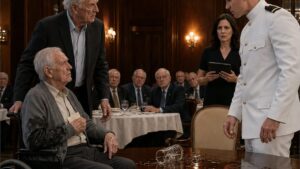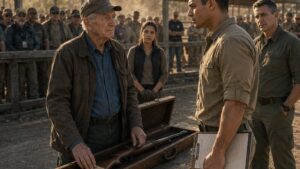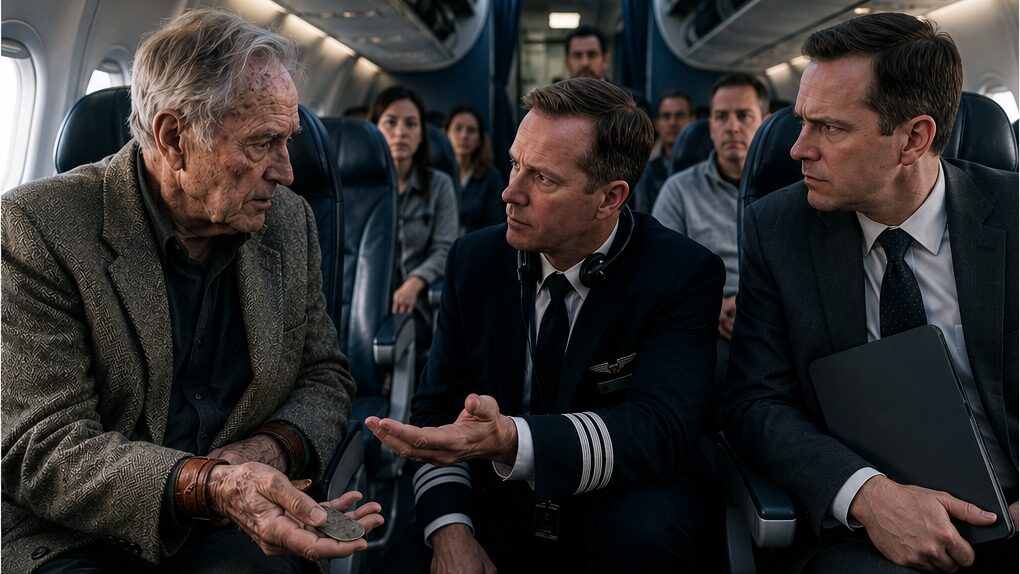
The Pilot Knelt Beside the Old Passenger After Reading the Name on His Worn Flight Tag
Chapter 1: The Old Man Who Would Not Miss His Flight
Joseph Bennett had packed before sunrise, though there was almost nothing to pack.
One white shirt folded twice. One dark tie rolled inside a pair of socks. A small shaving kit he had owned so long the leather had gone soft at the corners. The gray tweed jacket hung over the back of the kitchen chair, brushed the night before and brushed again that morning, though no amount of brushing could hide the age in the elbows.
He stood at the table with both hands resting flat on either side of the open bag, waiting for the tremor in his fingers to settle.
The house was quiet except for the refrigerator’s low hum and the tick of the wall clock. It was too much quiet for a morning with a flight in it. Airports were never quiet. Engines were never quiet. Men in a hurry were never quiet. But his little kitchen, with its single window over the sink and the old coffee cup drying upside down beside it, held him in a silence so complete that he could hear the faint scrape of his thumbnail against the table’s worn varnish.
His daughter came in through the side door without knocking.
“Dad?”
Joseph did not turn right away. He lifted the shaving kit, placed it in the bag, and pressed it down as if it might float away.
“I’m ready,” he said.
Lisa Bennett stood with her car keys in one hand and her phone in the other. Her hair was pulled back, but not neatly. She had dressed fast. That told him she had slept badly. It also told him she had been awake long enough to think of new reasons he should not go.
“You’re pale,” she said.
“I’m always pale before breakfast.”
“You didn’t eat?”
“I had coffee.”
“That’s not eating.”
“It has been close enough most of my life.”
She crossed the kitchen and looked into the bag as though she expected to find proof of some poor decision. Joseph watched her see the shirt, the tie, the shaving kit, the sealed envelope tucked into the side pocket. Her eyes paused there.
“What’s that?”
“Paper.”
“What kind of paper?”
“The folded kind.”
“Dad.”
He closed the bag before she could reach for it. Not sharply. Just enough. Lisa’s hand stopped halfway.
The small hurt that crossed her face made him look away.
She had her mother’s habit of breathing in before saying something she did not want to say. “We can still call them. Whoever’s organizing it will understand.”
“No.”
“You don’t even know how long you’ll have to stand. You don’t know if they’ll have seating. You don’t know if there’ll be someone there to help you from the arrival gate.”
“I know how to sit down when I need to.”
“That is not the point.”
“It seems to be the point every time we talk.”
Lisa put her phone on the table harder than she meant to. The sound cracked through the kitchen. Joseph’s right hand twitched once. She saw it and softened immediately, which was worse.
“I’m sorry,” she said.
He reached for his jacket. “Don’t be sorry for a phone.”
“I’m sorry because I’m scared.”
The sleeve caught on his watch. He worked it loose. There had been a time when he could button a cuff in darkness, repair a fuel line with wind screaming through a torn panel, hold a flashlight between his teeth and make his hands do what they were told. Now a jacket sleeve took patience.
Lisa stepped forward to help.
He did not refuse her. He only paused long enough that she understood she had to ask.
“May I?” she said.
He nodded.
She guided the jacket over his shoulders. Her hands were careful, too careful, and for a moment he was not in his kitchen at all. He was in a fuselage full of heat and oil stink and men trying not to call out for their mothers. Careful hands everywhere. Careful hands doing impossible things too late.
He reached inside the left pocket and touched the flight tag.
It was no bigger than two fingers laid together, darkened with age, its metal edge rubbed smooth. The stamped letters had faded, but he knew them without looking. His name. A unit code. An aircraft designation that had been retired before most of the people at the memorial were born.
Lisa saw the movement.
“You’re taking that?”
Joseph buttoned the jacket. “Yes.”
“You haven’t taken it out in years.”
“I’ve known where it was.”
“That’s not the same.”
He looked at her then. She was fifty-six years old and still, in certain angles, the child who had once stood on his boots to reach the sink. She had spent the last decade learning his pill schedule, his doctor’s names, the safest shoes for him to wear, the chair he preferred at restaurants, the way to speak to clerks who grew impatient when he needed a moment to find his insurance card. She loved him with lists. She loved him by making sure the world touched him less roughly.
But this morning, the thing he needed most was to be allowed to walk into the roughness.
“It’s a memorial,” she said. “Not an inspection.”
His mouth moved before he meant it to. “I said I would come.”
“To whom?”
He took the bag from the chair. It was light, but he felt it in his shoulder.
Lisa waited.
Joseph looked past her, through the kitchen window to the strip of pale morning above the neighbor’s roof. “A long time ago.”
She shut her eyes for a second. When she opened them, she had changed tactics. “Then let me fly with you.”
“No.”
“Dad.”
“You have work.”
“I can take the day.”
“You already took too many days for me this year.”
“That’s not your decision.”
“It is when I’m the reason.”
She pressed her lips together. He could almost hear the answer she swallowed: You are always the reason. Not as accusation. As fear.
“The airline said wheelchair assistance is arranged,” she said. “But you have to use it.”
“I will use it when I need it.”
“No, you have to use it when they offer it. Promise me.”
He picked up the envelope from the bag’s side pocket, checked that it was sealed, then put it back. “I promise I won’t be foolish on purpose.”
“That’s not the same promise.”
“It’s the one I can keep.”
The drive to the airport took forty minutes. Lisa kept both hands on the wheel and her eyes too fixed on traffic. Joseph sat beside her with the bag between his shoes and the gray jacket warm across his chest. He did not turn on the radio. She did not ask.
They passed a school bus, a row of new houses, a gas station where a flag snapped hard in the wind. Joseph watched the flag until it fell behind them. It was not the flag that hurt. It was the habit of looking up when one moved. Looking for weather. Looking for smoke. Looking for the direction of sound.
At the terminal curb, cars slid in and out of the drop-off lane with practiced impatience. Trunks opened. Suitcases rolled. A child cried because one of his shoes had come loose. A man in a suit spoke into earbuds as if the morning itself worked for him.
Lisa parked at the curb and turned toward Joseph.
“I can come inside.”
“You can walk me to the door.”
“I can come to the gate.”
“You cannot without a ticket.”
“I can ask.”
“Lisa.”
She stopped. His name for her, spoken softly, still had the power to do that.
He opened the car door before she could circle around to help. The cold air hit his face. He stood carefully, one hand on the door, one hand on the roof. His knees argued. He ignored them.
Lisa lifted his bag out and set it by his feet. Then she held the handle of the rolling airport wheelchair a skycap had brought over, as if it were a bargain she had negotiated with the world.
The wheelchair assistant waited politely. Joseph saw the young man’s eyes move over him: white hair, jacket, small bag, daughter hovering too close. The category formed quickly. Old passenger. Needs management.
Joseph sat because it was easier than making Lisa plead in public.
At the glass doors, Lisa crouched slightly so her face was level with his. He disliked that more than the chair.
“Call me when you land,” she said.
“Yes.”
“And if anything feels wrong—anything—you tell someone.”
“I will.”
“And if you get too tired, you don’t have to prove anything.”
Joseph looked down at his hands. One of them had slipped inside the jacket, thumb resting against the tag.
“I know,” he said.
But it was not true. He did have to prove something. Not to Lisa, not to the airline, not to the men who might gather in a small room near the destination airport and speak carefully around old grief.
He had to prove that a promise could survive the man who made it.
Lisa kissed his cheek. Her lips were cold.
As the wheelchair assistant pushed him toward the sliding doors, Joseph turned once. His daughter stood at the curb with her arms folded tightly against herself, already looking as if she regretted letting him go.
The doors opened with a soft rush.
Inside, the terminal swallowed him in light, voices, wheels, announcements, and the distant deepening thunder of an aircraft beginning to move.
Joseph pressed the old tag flat inside his jacket.
“I said I would come,” he whispered.
Chapter 2: The Gate Where Everyone Was In A Hurry
The airport did not move like a place. It moved like a machine.
Joseph felt it the moment the wheelchair crossed the polished floor. Wheels clicked over seams. Bags bumped ankles. Voices rose and fell under the ceiling speakers. Every person seemed pulled by an invisible cord toward a gate, a counter, a screen, a line. Nobody looked still enough to be seen clearly.
The wheelchair assistant asked for his ID.
Joseph reached into his jacket, then stopped because his boarding pass was in the bag, not the pocket. He knew that. He had put it there after Lisa printed it twice and circled the gate number. Still, his hand had gone first to the old place, the inside pocket where important things lived.
“Take your time,” the assistant said.
It was kindly meant, but Joseph heard the other meaning tucked inside it. We have already begun waiting for you.
He found the pass and ID. The assistant took them to the check-in counter. Joseph sat facing a row of silver stanchions, watching travelers feed themselves into rope lines. A young mother balanced a baby on one hip while dragging a suitcase with the other hand. A college boy yawned into his hoodie. A man with a leather laptop bag looked at Joseph as if calculating how much delay one old body could create.
Joseph looked away.
At security, a blue-gloved officer asked him to stand if he could. He could, so he did. The wheelchair waited behind him like a witness. He removed his belt slowly, then his shoes. The officer told him he could keep his light jacket on, then another officer said no, jacket off, please.
Joseph obeyed.
The moment the jacket left his shoulders, he felt smaller.
His shirt was clean, but the collar sat loose at his neck. His wrists looked thin below the cuffs. He saw the officer’s eyes drop to the faint yellowing bruise near his forearm where the last blood draw had been difficult.
“Anything in the pockets?” the officer asked.
Joseph reached for the jacket.
“I’ll check, sir.”
The officer’s hands were efficient. Phone? No. Wallet? Yes. Envelope? Leave it. Small metal item? Wait.
The old flight tag slid out and hit the plastic tray with a sound too light for the weight it carried.
The officer picked it up. “What’s this?”
Joseph’s hand moved before he could stop it.
The officer held it back slightly, not unkindly. “Sir?”
“A tag.”
“What kind of tag?”
“Old one.”
The officer turned it under the light. The stamped letters were hard to read unless a person already wanted to read them. “Is this military?”
Joseph’s throat tightened.
“It was aircraft inventory,” he said. “Long time ago.”
The officer looked at the date code, then at Joseph. For one brief second, something like interest crossed his face. Then the line behind them shifted, a bin jammed at the scanner, and the machine swallowed the moment.
“I’ll need to run it separately.”
“It’s not sharp.”
“I understand.”
“It’s not worth anything.”
“I understand.”
Joseph stood in his socks while the tag went into a separate tray. The floor was cold through the thin cotton. His belt lay coiled beside his shoes like something taken from him. The people behind waited in the restless way of people trying to pretend they were not watching.
The assistant brought the wheelchair forward. “You can sit, Mr. Bennett.”
Joseph stayed standing until the tag came back.
The officer placed it in his palm. “You’re good.”
Good. Cleared. Processed.
Joseph curled his fingers around the tag and nodded once.
At the gate, the delay was already blooming. The screen above the desk read BOARDING SOON, but the word “soon” had become meaningless. A gate agent with a neat bun and a blue scarf stood behind the counter answering the same question in different tones.
Her nameplate read Jessica Reed.
“We are waiting on final paperwork,” she told one passenger. “We expect to board shortly.”
“How shortly?” asked a man in a charcoal suit.
“As soon as we receive clearance.”
“That’s not an answer.”
“It is the answer I have.”
Joseph’s wheelchair stopped near the preboarding lane. The assistant leaned close. “You’re all set here. They’ll call passengers needing extra time first.”
“I can walk down when they call.”
The assistant hesitated. “They prefer you stay in the chair.”
“They prefer many things.”
The young man smiled uncertainly and left him with his small bag parked beside the wheel. Joseph watched him disappear into the terminal, already moving faster.
He was alone then, though surrounded by people.
A woman across from him glanced at the wheelchair and then at the empty seat beside her, as if hoping he would not need it. A child stared openly at the wrinkles on Joseph’s hands. Donald Miller, the man in the charcoal suit, paced near the windows and spoke into his phone.
“No, I’m still at the gate. Because apparently final paperwork takes an act of Congress.” He turned, saw Joseph, lowered his voice only slightly. “And they haven’t even started preboarding yet.”
Joseph had learned long ago that a man could survive many things if he did not answer every sound.
Jessica Reed made another announcement. “Ladies and gentlemen, thank you for your patience. We’ll begin boarding Flight 4821 to Raleigh in just a few minutes. At this time, we invite passengers needing extra time or assistance to line up for preboarding.”
Joseph locked the wheelchair brake and stood.
His knees did not approve. He waited until the first sharpness passed, then reached for the handle of his bag.
Jessica looked up. “Sir, you can remain seated. We’ll bring you down.”
“I can walk.”
“We’re trying to keep the jet bridge clear.”
“I understand.”
“We do have a wheelchair transfer process.”
“I don’t need a transfer.”
Her smile stayed professional, but her attention had already split toward the scanner, the waiting line, the phone blinking behind the counter. “Mr. Bennett, correct?”
“Yes.”
“Please wait one moment.”
Donald exhaled loudly behind him.
Joseph heard it. Jessica heard it. Several people heard it and pretended they had not.
Lisa would have stepped in. She would have said he needed just a minute, that he was fine, that people could wait. Joseph almost wished she were there, then was ashamed of the wish.
Jessica scanned his boarding pass. The machine gave a dull warning chirp.
She frowned. “One second.”
The passengers behind him shifted.
Jessica scanned again. Another chirp.
“Is there a problem?” Joseph asked.
“I’m checking.”
Donald said, “Of course.”
Jessica glanced at him, then back at her screen. “Sir, did security inspect a metal item?”
Joseph’s hand went to his jacket.
“It’s a personal item.”
“It may have generated a notation. I just need to verify.”
“It was cleared.”
“I’m sure it was. I need to verify.”
The line behind him felt closer. Someone’s suitcase wheel tapped the back of his shoe. Joseph stepped forward, but the scanner stand blocked him. He could not move through. He could not move back. He was caught in the small public space where people became problems.
Jessica’s voice softened in the way workers softened when they wanted cooperation. “Do you have the item with you?”
Joseph removed the flight tag.
It sat in his palm, old metal against old skin.
Jessica leaned closer. “May I see it?”
For a moment he could not make his fingers open. The boarding lane, the counter, the waiting passengers, the jet bridge beyond the door—all of it thinned into the remembered body of an aircraft bucking in dirty weather, men strapped down and groaning, a young soldier gripping his sleeve with impossible strength.
Sir, if you get home—
“Mr. Bennett?” Jessica said.
Joseph blinked.
The tag slipped.
It struck the edge of the scanner, bounced once, and landed faceup on the carpet between his shoes.
He bent too quickly. Pain flashed up his back. Before he could reach it, Donald Miller stepped forward, not to help, but to keep the line from stalling entirely.
“Maybe someone should just move him along,” Donald said. “Some of us have connections.”
Joseph stayed bent halfway, one hand on the scanner stand, the other hovering uselessly above the floor.
The gate went quiet in pieces.
Jessica came around the counter, picked up the tag, and held it out. “Sir, let me help.”
Joseph took it from her. His hand shook enough that the metal clicked against his wedding ring.
From somewhere beyond the jet bridge door came the low rumble of an aircraft engine turning over.
The sound moved through him before he could brace for it.
He gripped the tag so hard the edge bit into his palm.
Jessica saw his face change. Not enough to understand. Enough to become careful.
“Mr. Bennett,” she said, “would you like to sit for a moment?”
Joseph looked at the open aircraft door down the jet bridge. The flight crew stood inside, readying the cabin. The aisle waited.
“No,” he said. His voice was thin but steady. “I’d like to board.”
Jessica studied him. Then she scanned the pass again, manually cleared the note, and stepped aside.
“Go ahead, sir.”
Donald muttered something under his breath as Joseph moved past. The words did not matter. Their shape did. Old. Slow. In the way.
Joseph walked down the jet bridge one careful step at a time.
At the aircraft door, a flight attendant greeted him with practiced brightness. “Good morning, Mr. Bennett. Welcome aboard.”
The cabin air smelled of coffee, fabric, and fuel. Narrow aisle. Overhead bins. People turning sideways with bags held at chest height. A hundred small impatiences.
His seat was on the left, near the front. Aisle seat.
He lowered himself into it slowly and tucked the bag beneath the seat ahead. His hand went again to the jacket pocket.
The tag was there.
Donald Miller boarded two minutes later, saw Joseph, and gave a small humorless smile as he lifted his bag into the overhead bin with unnecessary force.
Joseph looked down at his hands.
The engines deepened somewhere under the floor.
Chapter 3: When The Pilot Saw The Worn Flight Tag
The delay followed them into the cabin.
It moved down the aisle with the passengers, hid in the tight smiles of the flight attendants, sharpened in the snap of overhead bins. People checked watches and phones. Seat belts clicked. Bags resisted being shoved into spaces too small for them. A child asked whether they were in the sky yet, and his mother said, “Soon,” with the same weary faith as the gate screen.
Joseph sat in 3C with his hands folded over the top of his small bag.
He had chosen the aisle because he did not trust his knees to climb over anyone. Now the aisle made him feel exposed. Every person boarding brushed past close enough to stir the air beside his face. A backpack bumped his shoulder. The owner turned half around.
“Sorry.”
Joseph nodded.
Donald Miller sat across the aisle in 3D. He loosened his tie, opened his laptop, then closed it again when a flight attendant reminded him they were not ready for electronic devices. He looked toward Joseph, then toward the front galley.
The flight attendant who had greeted Joseph came down the aisle carrying a tablet. “Mr. Bennett?”
Joseph looked up.
“There’s still a note attached to your boarding record. Nothing serious. We just need to confirm the item from security is stowed and not loose.”
“It’s in my pocket.”
“May I take a quick look?”
He knew she was only doing her job. He knew the words had no malice in them. Still, he felt the cabin listen.
Donald leaned back slightly, not hiding his interest.
Joseph reached into his jacket. The tag had warmed against him. He brought it out, keeping it flat in his palm so she would not need to take it.
The flight attendant glanced at it. Her expression did not change because the tag meant nothing to her. Old metal. Old letters. Old man.
“Thank you,” she said. “I’ll just let the captain know we cleared it.”
“There’s no need to bother him.”
“It’s part of the process.”
Process. That word again. Soft as cloth, hard as a locked door.
She stepped toward the galley. Joseph began to return the tag to his pocket. His thumb slipped on the worn edge. The tag tilted and slid down the front of his jacket.
He caught it against his lap, but not before it flashed in the aisle light.
Donald laughed once under his breath. “Careful there.”
Joseph did not look at him.
At the front of the cabin, a man in a dark pilot’s uniform emerged from the cockpit. Four sleeve stripes. White shirt. Black tie. Headset resting around his neck. He spoke briefly with the flight attendant, then turned toward row three.
He was younger than Joseph by decades, middle-aged, with a steady face made serious by habit. He walked like someone trained to take up exactly the space needed and no more. His name was stitched on the small black badge above his pocket: Carter.
Captain Samuel Carter stopped beside Joseph’s row.
“Mr. Bennett?”
Joseph held the tag tighter. “Yes.”
“I’m Captain Carter. I’m sorry to trouble you before departure.”
Joseph saw Donald watching. He saw the child across the aisle twist in his seat until his mother gently turned him forward. He saw the flight attendant standing behind the captain with the tablet held to her chest.
“It’s no trouble,” Joseph said, though everyone knew it had become trouble.
Samuel’s eyes moved to the tag. Not quickly. Not the way the security officer had looked, scanning for risk. His gaze paused on the faded stamp, then narrowed with recognition so slight Joseph almost missed it.
“May I?” Samuel asked.
The question landed differently from all the others. Not Can I see it? Not I need to verify. May I?
Joseph opened his fingers.
Samuel did not pluck the tag away. He placed his hand beneath Joseph’s, letting the old metal slide into his palm as if receiving something that might break. He turned it toward the cabin light.
For several seconds, he said nothing.
The plane seemed to hold itself still around them.
Then Samuel lowered his voice. “Where did you get this?”
Joseph’s jaw tightened. “It belonged on a plane before it belonged in my pocket.”
The words came out before he had time to decide whether he would speak them. Once spoken, they sat between them with the weight of something old and not finished.
Samuel looked from the tag to Joseph’s face. His professional expression changed. Not dramatically. There was no gasp, no wide-eyed shock. The change was smaller and more unsettling. His shoulders lowered. His grip on the tag became more careful. When he spoke again, the captain’s voice had left him, and a son’s voice had taken its place.
“Sir,” he said, “is this from a C-141 evacuation flight group?”
Joseph did not answer.
Samuel glanced once toward the flight attendant. “Give us a moment.”
She hesitated. “Captain, boarding is complete. We’re waiting on—”
“A moment,” he said, still quiet.
She stepped back.
Donald shifted across the aisle. “Captain, with respect, some of us have tight connections.”
Samuel looked at him then. Not harshly. Not angrily. Simply enough that Donald stopped.
“I understand,” Samuel said. “And I’ll keep everyone informed.”
Then he turned back to Joseph.
The aisle was too narrow for two kinds of authority. Samuel chose to give his up.
He lowered himself beside Joseph’s seat, one knee close to the carpet, one hand braced lightly on the armrest of the empty row ahead. He was no longer standing over him. The headset cord brushed his shoulder. The four stripes on his sleeve were level with Joseph’s hands.
Behind them, the cabin quieted in a way no announcement could have accomplished.
Samuel held out the tag. “Mr. Bennett, did you serve with the crew attached to this designation?”
Joseph looked at the tag, but he saw instead a different strip of metal, clean then, hanging from a board beside a maintenance hatch. He saw rain moving sideways under floodlights. He saw stretchers. He saw a young man with dirt in his eyebrows asking whether Raleigh had trees.
His fingers closed around the armrest.
“I turned wrenches,” he said.
Samuel waited.
“That’s all.”
“No, sir,” Samuel said softly. “I don’t think that was all.”
Joseph looked at him sharply.
Samuel took the correction without flinching. “My father used to tell a story about an evacuation flight that should not have made it past the first hour. He never knew many names. He knew one.” He looked down at the tag again. “Bennett.”
The name seemed to move through the first rows. Not loudly. People did not repeat it. But heads angled. The flight attendant’s face changed. Donald’s laptop stayed closed.
Joseph’s mouth had gone dry.
“There were many Bennetts,” he said.
“My father said this Bennett had steady hands.”
That phrase struck harder than the engine noise.
Joseph turned toward the window across the aisle though it was too far away to see anything but a slice of gray sky. His right hand had begun to tremble, so he covered it with his left.
Steady hands.
He had hated that phrase for forty years.
People praised the steadiness because they did not know what those hands had failed to hold.
Samuel saw the movement and did not pretend not to. He returned the tag by placing it carefully in Joseph’s open palm.
“I’m sorry,” Samuel said. “I didn’t mean to put you on display.”
Joseph let out one breath that almost became a laugh. “Little late for that.”
A faint flush rose in Samuel’s face. He looked toward the watching cabin, then back at Joseph. “You’re right.”
He stood, but only halfway, bending near enough that Joseph did not have to look up far.
Then Samuel turned to the nearest rows. “Ladies and gentlemen, we’ll be departing shortly. Thank you for giving us a moment of patience.”
It was not an explanation. It was not a tribute. It was a correction.
He faced Joseph again. “Mr. Bennett, would you prefer I continue this conversation after takeoff, or would you rather I leave it alone?”
No one had asked him that all morning.
Not whether he needed help. Not whether he understood procedure. Not whether he could walk, stand, sit, move faster, produce identification, explain the old metal in his pocket.
Would you prefer.
Joseph looked at the tag in his palm. The letters blurred, then steadied.
“After takeoff,” he said.
Samuel nodded once. “Yes, sir.”
The “sir” carried no customer-service shine. It was plain and deliberate.
As Samuel turned toward the cockpit, Donald Miller leaned back in his seat and looked at Joseph as if seeing him had become more complicated than he wanted. The flight attendant moved down the aisle checking belts with a quieter voice than before.
Joseph slipped the tag into his jacket pocket.
His fingers stayed there, pressed over it, while the aircraft door closed.
The engines rose.
The plane began to push back from the gate, slow and heavy, turning toward the runway.
Joseph closed his eyes.
Under the vibration beneath his feet, under the pressurized hush and the murmured instructions from the front, he heard Samuel’s voice again.
My father said this Bennett had steady hands.
Joseph opened his eyes and stared at the seatback in front of him.
He had not come here to be found.
He had come because a dead man’s name had waited long enough.
Chapter 4: The Story Joseph Refused To Tell
The climb pressed Joseph gently into the seat.
He kept his eyes open because closing them made the aircraft too honest. With his eyes open, there were tray tables, safety cards, a blue curtain not quite pulled between the cabin and the galley. There was Donald Miller across the aisle pretending not to look over. There was the child two rows back tapping a plastic dinosaur against the window shade.
With his eyes closed, there was only vibration.
The same old language came up through the floor, through his shoes, through the bones of his legs. Engine. Frame. Air. Strain. He had not forgotten it. The body kept old lessons even when the mind tried to lay them down.
The aircraft leveled enough for the seat belt sign to remain lit but the flight attendants to begin moving. A cart rattled softly somewhere behind him. Joseph took one slow breath and let it out.
A few minutes later, Samuel Carter came out of the cockpit.
He did not come like a man making an announcement. He came quietly, after speaking to the flight attendant near the galley. He removed his cap, tucked it under one arm, and stopped beside Joseph’s row.
“Mr. Bennett,” he said.
Joseph looked up.
Samuel’s face held the same care it had before takeoff, but now there was something harder beneath it: uncertainty. Not about the aircraft. About himself.
“I have a few minutes,” Samuel said. “Only if you still want to talk.”
Joseph glanced at the cockpit door. “Shouldn’t you be flying?”
“My first officer has the aircraft. I won’t stay long.”
“That’s what they all say before staying too long.”
A faint smile touched Samuel’s mouth and vanished. “Fair enough.”
He looked at the empty jump seat near the front, then at the narrow space beside Joseph. He did not kneel this time. Instead, he crouched low enough that Joseph would not have to raise his voice.
Joseph disliked that the gesture moved him.
Samuel kept the tag in view only by looking toward Joseph’s pocket once and then away. He did not ask for it again.
“My father was Larry Carter,” Samuel said. “Staff sergeant. He was twenty-two when he came home with a plate in his leg and a scar down his side. He didn’t talk much about the flight that brought him out. But when he did, he said the aircraft sounded like it was coming apart and there was a mechanic who kept walking the aisle with a wrench in one hand and blood on his sleeve.”
Joseph stared at the seatback ahead of him.
“Your father had a good memory for a wounded man.”
“He remembered hands,” Samuel said. “He said everyone else looked scared except one man whose hands kept moving.”
The cart rattled closer and stopped. The flight attendant saw Samuel, then eased it backward to give them space.
Joseph’s fingers pressed into his knee. “Your father remember what else was on that aircraft?”
Samuel was quiet.
Joseph nodded slightly. “No reason he should. Pain makes a room small.”
“He remembered rain.”
“There was rain.”
“And he remembered someone singing.”
Joseph’s jaw tightened.
Samuel noticed, but did not reach for the silence.
The aircraft dipped gently. A few passengers looked up. Joseph did not. He had learned long ago which movements mattered.
“We were not supposed to take off when we did,” Joseph said.
The words surprised him. Not because they were secret, exactly. There were records somewhere, maybe. Reports, signatures, numbers. But records did not carry heat. Records did not smell like hydraulic fluid and wet canvas.
Samuel waited.
Joseph looked toward the front of the cabin. Past Samuel’s shoulder, Donald Miller sat very still, his laptop still closed on the tray table. Joseph lowered his voice.
“There had been incoming fire closer than command wanted to admit. Too many wounded for the next window. They loaded us heavy. Too heavy, maybe. Nobody said that out loud.”
“You were crew?”
“Maintenance attached to flight operations. I fixed what I could before they lifted. Then something failed after we were up, so I fixed what I could after.”
“What failed?”
Joseph almost smiled. “You want the official list or the true one?”
“The true one.”
“Everything that had been waiting to fail.”
Samuel looked down.
“A pressure line cracked first. Then one panel started shuddering like it wanted to peel. We had stretchers strapped in places stretchers were not meant to be. Men on the floor. Men in web seats. Two nurses who had no room to turn around. Rain coming through seams that shouldn’t have had rain in them.” Joseph’s hand drifted to his sleeve, where there had once been blood that was not his. “Somebody found me a roll of tape that wouldn’t hold. Somebody else gave me a prayer. Neither one was much use.”
Samuel’s mouth moved, but he said nothing.
Joseph heard the child’s dinosaur tap again behind him. Soft. Plastic. Ordinary.
“There was a boy,” Joseph said. “Not really a boy. Old enough to wear boots. Young enough to still be surprised pain could happen to him.”
Samuel’s eyes stayed on him.
“He kept asking about trees.”
“Trees?”
“He was from someplace flat. Said he wanted to know if Raleigh had trees because his mother liked dogwoods. He asked three times. The third time I lied and said he’d see them by supper.”
Joseph’s chest tightened around the next breath. He hated that. He hated being old enough that memory could still ambush him in front of strangers.
Samuel’s voice was barely above the engine noise. “Did he?”
Joseph shook his head once.
The answer seemed to settle between them more heavily than if he had spoken it.
For a while, neither man said anything. The aircraft hummed around them, steady and indifferent. Joseph thought of all the times people had thanked him for his service. At grocery stores. At clinics. Once at a gas station after seeing a faded sticker on his old truck. They meant well. He always nodded. He never knew what part they were thanking. The paperwork? The uniform? The years? The men who came home? The ones who did not?
Samuel said, “My father lived because of that flight.”
“Your father lived because a lot of people did their jobs.”
“And you were one of them.”
“I was one of them.”
Samuel accepted the correction.
Joseph appreciated that more than agreement.
“My father used to say there was a man who kept telling the aircraft to hold together like it could hear him.”
Joseph felt a reluctant warmth rise behind his ribs, painful because it came from the old world.
“I did say that.”
“What did you say?”
Joseph looked at the floor. “Steady now.”
Samuel’s face changed.
“What?”
“That’s what he said you said. ‘Steady now.’ He said he heard it more than the engines.”
Joseph gave a small, dry laugh. “Then the engines must have been worse than I remember.”
Samuel’s smile faded gently. “He never knew what happened to you.”
“Nothing happened to me.”
Samuel did not answer.
Joseph looked at him then, annoyed by the silence.
Samuel’s eyes were not accusing. That made it harder.
“Don’t do that,” Joseph said.
“Do what?”
“Make a shrine out of an old mechanic.”
“I’m not trying to.”
“Yes, you are. Not on purpose. But you are.”
Samuel lowered his gaze. “I’m sorry.”
Joseph shifted in the seat. His hip had begun to ache. “Your father ever talk about the one who didn’t make it?”
Samuel shook his head.
“No,” Joseph said. “Most don’t.”
“What was his name?”
Joseph’s hand closed over the armrest.
The name was there. It was always there. Some memories faded at the edges, but not that. Never that. The name had stayed clean and sharp, untouched by age.
He did not speak it.
Samuel waited long enough to prove he would not force him.
Joseph looked toward the window beyond Donald’s shoulder. Clouds lay in a bright sheet beneath them. Somewhere under that white, the land moved toward Raleigh and its dogwood trees.
“The memorial isn’t for the men who lived,” Joseph said.
Samuel’s face stilled.
Joseph touched the inside of his jacket, feeling the tag through the cloth.
“It’s for the one I still hear.”
Chapter 5: The Passenger Who Finally Lowered His Voice
Samuel returned to the cockpit, but the space he left behind did not close.
Joseph could feel it in the cabin. People had gone back to their books, phones, sleeping masks, crossword puzzles, but not entirely. A slight care had entered the air around row three. The flight attendant paused before reaching across him. The woman with the child whispered instead of scolded. Even the clack of Donald Miller’s laptop keys seemed uncertain when he finally opened it.
Joseph wished everyone would forget.
He also knew they would not.
The flight continued through a smooth stretch of sky, the kind passengers called uneventful because they did not know how many things had to keep agreeing with one another for uneventful to exist. Joseph looked at the closed cockpit door and imagined Samuel behind it, hands on controls that were not really controls in the old sense. Systems now. Screens. Layers of assistance. Still, at the heart of it, a person in a seat listening for what did not sound right.
A flight attendant came by with water.
“Mr. Bennett,” she said, “Captain Carter asked that I make sure you had anything you needed.”
Joseph almost refused automatically. Then he saw her holding the cup with both hands so it would not spill when she passed it over.
“Water’s fine,” he said.
She set it on his tray table. “Please let me know if you want more.”
He nodded.
Across the aisle, Donald let out a sharp sigh. “Could I get coffee when there’s a chance?”
The flight attendant turned. Her smile remained. “Of course, sir. I’ll be right back.”
Donald looked toward the cockpit door. “Assuming we’re not delaying beverage service for another ceremony.”
The words were not loud. That made them worse. They were shaped for the row, not the cabin, wrapped in just enough humor that he could deny the cut if challenged.
Joseph looked down at his cup. The water trembled in tiny rings.
The flight attendant’s smile went still. Before she could answer, Samuel’s voice came over the speaker.
“Ladies and gentlemen, this is Captain Carter. We’re cruising at thirty-two thousand feet and expecting a smooth arrival into Raleigh. I know many of you have connections, and we’re doing everything we can to make up time where safety allows.”
Donald lifted his eyebrows as if vindicated.
Samuel continued. “I also want to thank everyone near the front of the cabin for their patience during boarding. Sometimes a delay is not an inconvenience. Sometimes it is an opportunity to handle someone’s property, history, and name with the care they deserve. We appreciate your understanding.”
No applause followed. No patriotic music. No announcement of Joseph’s service.
Only silence.
Donald’s face colored slowly from the collar up.
Joseph stared at the seatback and felt anger rise, not at Donald but at the announcement itself. Then he listened to what Samuel had actually said. Property. History. Name. Care. No hero. No veteran. No story stolen from him.
The anger loosened.
The flight attendant returned with Donald’s coffee. “Careful, it’s hot.”
Donald accepted it without looking at her.
For several minutes, the cabin carried on with exaggerated normalcy. A child dropped a crayon. Someone unwrapped crackers. A phone chimed before being silenced. Joseph sipped his water and found his throat still tight.
Then Donald closed his laptop.
He sat with both hands resting beside it, looking at neither Joseph nor the screen. At last he turned slightly.
“Mr. Bennett.”
Joseph did not answer right away.
Donald cleared his throat. “I owe you an apology.”
Joseph looked at him.
Donald’s mouth had the rigid set of a man unaccustomed to public repair. “I was rude at the gate. And here.” He glanced toward the front. “I thought you were holding things up.”
“I was.”
“That’s not what I mean.”
Joseph waited.
Donald seemed to search for a better sentence and dislike every option. “I saw an old man in the way,” he said finally. “That was all I let myself see.”
The words were plain enough that Joseph could accept them.
“You had a connection,” Joseph said.
“Yes.”
“Still might miss it.”
“Yes.”
Joseph nodded. “Then you were afraid too.”
Donald blinked.
“People in airports think hurry hides it,” Joseph said. “It doesn’t.”
Donald looked away first.
The flight attendant came back to collect cups. She did not linger, but Joseph noticed her glance at Donald’s closed laptop and then at Joseph’s folded hands.
A few minutes later, the cockpit door opened again. Samuel stepped out briefly, speaking to the flight attendant near the galley. He did not come to Joseph at once. He looked down the aisle, checked the cabin with a pilot’s habitual sweep, then approached only when the attendant moved on.
“Mr. Bennett,” he said, crouching near the row again. “We’ve got about thirty minutes before descent.”
Joseph turned his head. “You keep finding minutes.”
“I’m spending them carefully.”
Joseph almost smiled.
Samuel’s expression held something he had not brought before: a private burden. “I called operations while we were at cruise. Not about you,” he added quickly. “About arrival assistance. There’s a long walk from your gate to ground transport. I wanted to make sure someone was there.”
“I can walk.”
“I know.”
The answer took the argument out of Joseph before it had fully formed.
Samuel continued, “I also checked something with my mother a few minutes ago. She doesn’t always answer unknown numbers, but she answers mine.”
Joseph watched him.
“My father kept a small notebook,” Samuel said. “After he died, she put it with his service papers. I asked if she remembered the name from the evacuation story.”
Joseph’s hand tightened.
“She said he only ever wrote down one full name from that flight.”
“Don’t,” Joseph said.
Samuel stopped immediately.
The force of his own voice embarrassed Joseph. He looked toward the aisle carpet.
Samuel remained still. “I’m sorry.”
Joseph breathed through his nose, once, twice. “You don’t know what name you’re bringing into the air.”
“No, sir. I don’t.”
Donald had turned his face toward the window. It was the first generous thing he had done all morning.
Joseph looked back at Samuel. “Your father lived?”
“Yes.”
“Had children?”
“Three.”
“Grandchildren?”
“Seven.”
Joseph absorbed that. Seven. A whole number of lives branching out from a flight that had smelled of rain and fear.
“He ever walk right?” Joseph asked.
“Not without a limp.”
“But he walked.”
“Yes.”
Joseph nodded. The ache in his chest did not ease, but it shifted. “Then good.”
Samuel’s voice thinned. “He said he lived because somebody refused to accept the sound the aircraft was making.”
“He gave me too much credit.”
“He said you hit the panel with a wrench and told it, ‘Not yet.’”
A laugh broke from Joseph before he could stop it. It was small and rough and startled him. “I did do that.”
Samuel smiled, and for the first time since he had approached Joseph, the smile stayed.
“My father loved that part,” he said.
“Your father was bleeding and drugged.”
“He still loved it.”
Joseph looked down at his right hand. The tremor had quieted for the moment. Not gone. Quieted.
“Steady hands,” Samuel said softly.
Joseph’s smile faded.
Samuel saw it. “I’m sorry.”
“No.” Joseph rubbed his thumb against the side of his finger. “It’s only that people say steady like it means nothing was shaking inside.”
Samuel did not answer quickly. “What should they say?”
Joseph looked toward the front of the plane. “They shouldn’t say anything until they know what the hands were holding.”
Samuel accepted that with a nod.
The seat belt sign chimed on. A few passengers shifted. The flight attendant began moving briskly through the aisle, collecting cups, checking tray tables.
Samuel stood. “We’ll be descending soon.”
Joseph nodded.
Samuel did not leave.
“Mr. Bennett,” he said, more formally now, “when we land, would you allow me to walk with you to the gate area?”
Joseph began to refuse.
Samuel spoke before he could. “Not because you need help.”
Joseph looked up.
Samuel’s eyes were steady. “Because I owe you care.”
Joseph felt the words move through him like a hand placed not on his shoulder but near it, close enough to steady, far enough not to claim.
Across the aisle, Donald lowered his gaze.
The aircraft tipped gently into descent.
Joseph reached inside his jacket and touched the tag. For once, it did not feel like evidence.
It felt like weight shared by one careful inch.
Chapter 6: The Name Joseph Could Barely Say
Raleigh came up through a veil of cloud.
Joseph saw it in fragments from across the aisle: gray runways darkened by earlier rain, service roads shining, a row of trees beyond the airport fence with leaves moving in the wind. Not dogwoods, not from this distance. Just trees. Still, his throat tightened.
The landing was smooth enough that several passengers barely looked up from their phones. Joseph felt every agreement between wheel and runway. Rubber. Weight. Reverse thrust. The body of the aircraft shuddering as it gave itself back to the ground.
When they slowed near the gate, Donald turned to him.
“I hope you make your memorial,” he said.
Joseph studied him for a moment. The man looked smaller without his impatience.
“Hope you make your connection,” Joseph said.
Donald gave a brief nod, accepting both the kindness and the rebuke folded inside it.
The aisle filled too quickly after the sign went off. People stood under the bins, bent awkwardly, waiting to move nowhere. A man farther back tried to pull his suitcase free before there was space for it. The flight attendant asked everyone to remain careful opening bins because items may have shifted.
Joseph stayed seated.
His legs needed a moment. So did the rest of him.
The cockpit door opened after the first rush began. Samuel stepped out without his cap, jacket still buttoned, headset gone. He waited near the front until the aisle thinned, speaking once to the flight attendant and once to a ground worker who appeared at the aircraft door.
Then he came to row three.
“No hurry,” he said.
Joseph glanced toward the open door. “That’s not a phrase airports know.”
“They’re learning today.”
Samuel’s tone was light, but he stood in the aisle in a way that made space around Joseph without announcing he was doing it. Passengers moved past more carefully. Some looked at Joseph, then away. One older woman touched the back of his seat gently as she passed, not quite a gesture, not quite nothing.
Lisa was calling before Joseph had even stood. His phone buzzed in his jacket pocket, against the flight tag.
He took it out and answered.
“I landed,” he said.
“Oh, thank God. Are you all right? Did someone meet you? Are you still on the plane? Why are you breathless?”
“I’m not breathless.”
“You sound breathless.”
“I’m old. Sometimes that’s how talking sounds.”
“Dad.”
He looked up at Samuel, who had turned slightly to give him privacy. “Someone is walking with me.”
“Who?”
“The captain.”
Silence.
Then Lisa said, “The captain?”
“Yes.”
“Why?”
Joseph looked at the open aircraft door, the narrow strip of jet bridge beyond it, the ground worker waiting with a wheelchair just out of sight.
“Because he asked properly,” Joseph said.
Lisa did not understand. He could hear that. But for once she did not fill the gap with more questions.
“Call me after the memorial,” she said.
“If I’m not too tired.”
“Dad.”
“I’ll call.”
He ended the call and placed the phone back in his pocket.
Samuel offered a hand, palm open, not grabbing.
Joseph looked at it. Then he took it.
Standing hurt. There was no dignity in pretending otherwise. His knees stiffened, his hip caught, and for a second his balance shifted backward. Samuel’s hand firmed but did not pull. He let Joseph find his own feet.
“Thank you,” Joseph said.
“Yes, sir.”
The wheelchair waited at the aircraft door. Joseph saw the ground worker’s practiced readiness, the folded footrests, the assumption.
“I’ll walk to the gate seating,” Joseph said.
The ground worker looked to Samuel.
Samuel did not answer for him. “Mr. Bennett says he’ll walk to the gate seating.”
The difference was small. It was everything.
They moved up the jet bridge slowly. Samuel walked on Joseph’s left, half a pace back, not leading unless the walkway angled. The sounds changed as they climbed: aircraft hum behind them, terminal noise ahead, the hollow footfalls of a passage between worlds.
Halfway up, Joseph stopped.
Samuel stopped with him.
“You all right?”
Joseph looked at the ribbed wall of the jet bridge. He had been in dozens of such corridors. They all looked temporary, like places designed for people who belonged somewhere else. This one smelled faintly of rain and rubber.
“I almost turned around this morning,” Joseph said.
Samuel waited.
“At my kitchen table. At security. At the gate. On the plane.” He inhaled slowly. “Right now.”
“Why?”
Joseph touched the tag. “Because dead men don’t ask much until you start answering.”
At the top of the jet bridge, the terminal opened around them. Passengers streamed toward connections and baggage claim. Donald Miller hurried past with his laptop bag over his shoulder, then stopped several yards ahead. He looked back as if he might say something more, decided against it, and lifted one hand in a small farewell.
Joseph returned the gesture.
A row of seats stood beside the windows. Samuel guided the ground worker to park the wheelchair nearby but did not insist Joseph use it. Joseph sat in the nearest chair because choosing to sit was different from being placed.
Samuel remained standing until Joseph looked up and said, “You can sit, Captain.”
Samuel sat.
For a moment they watched the airport move.
Then Samuel said, “The memorial coordinator said the room is on the lower level near ground transport. It starts in forty minutes.”
“You called?”
“I asked the gate agent to call. Then I confirmed.”
Joseph should have been irritated. Instead, he was tired. “You run everyone’s life this way?”
“Only when I’m nervous.”
That earned him a look.
Samuel folded his hands. “My father died six years ago. I thought I knew the story he left us. I thought it was about surviving.” He looked at Joseph. “Now I’m not sure it was.”
Joseph did not answer.
“What was his name?” Samuel asked.
The question was gentle. It still struck bone.
Joseph leaned back. Around them, the terminal blurred. A family arguing softly over a stroller. A cleaning worker pushing a cart. A departure announcement for Chicago. The ordinary world refusing to lower its voice for the dead.
He opened the inside pocket and removed the tag.
His fingers trembled. Samuel saw and did not reach.
Joseph held it for a long moment, then extended it.
Samuel looked at him.
“Hold it,” Joseph said. “Flat.”
Samuel took the tag in both hands.
The old metal lay across his palms. Something passed over his face—not triumph, not awe. Responsibility.
Joseph looked at the tag instead of Samuel when he spoke.
“Jacob Harris,” he said.
The name came out rough.
Samuel bowed his head slightly, as if the name itself had entered the room.
“He was nineteen,” Joseph said. “Said his mother had a dogwood tree by the porch. Said if I ever got to Raleigh, I should tell her he was brave.” His mouth tightened. “But that wasn’t what he asked at the end.”
Samuel’s hands stayed still beneath the tag.
“He asked me to tell her he wasn’t alone.”
Joseph looked toward the windows. Beyond the glass, another aircraft pushed back from a gate, slow and shining under the gray afternoon.
“I never found her,” he said. “By the time I could look, she had moved. Records got thin. People told me I had done enough.” He swallowed. “I started believing them some days. Other days, no.”
“The memorial,” Samuel said.
“His name is being added today. Not because of me. Some historian found records, found family, made calls.” Joseph’s eyes stung, and he was angry at them for it. “They asked if anyone from the flight was still living.”
“And you said yes.”
Joseph’s hands were empty now without the tag. He looked at them, surprised by how strange that felt.
“I said I would come.”
A voice behind them said, “Dad?”
Joseph turned.
Lisa stood near the end of the seating area, breathless, her purse strap twisted in one hand, as if she had run through the terminal and only just remembered she was angry.
For a second, all he saw was the child on his boots at the sink. Then she was his daughter again, scared and furious and trying not to cry.
“What are you doing here?” he asked.
“I got on the next flight after you.” She looked at Samuel, then at the tag in his hands, then back at Joseph. “You said the captain was walking with you.”
“I am,” Samuel said quietly.
Lisa came closer. “Dad, you should have told me.”
Joseph was too tired to pretend not to know what she meant.
“Yes,” he said.
That stopped her.
He looked at Samuel. “May I have it back?”
Samuel rose before returning the tag. He did not pass it casually. He placed it in Joseph’s palm and waited until Joseph’s fingers closed around it.
Lisa watched the exchange. Something in her face changed, not fully, not all at once. She sat beside her father without touching him.
“I thought I was keeping you safe,” she said.
Joseph slipped the tag into his pocket. “You were.”
“But not only.”
“No.”
She wiped under one eye with the heel of her hand, impatient with herself. “What do you need?”
Joseph looked from his daughter to Samuel, then toward the signs for ground transport and the lower level.
There were answers he had given all his life because they were easier. Nothing. I’m fine. Don’t fuss. Let it be.
This time he chose a different one.
“I need to get downstairs,” he said. “And I need both of you to come as listeners.”
Chapter 7: Respect Was What They Did Afterward
The memorial room was not what Joseph had feared.
It was not grand enough to make grief feel staged. It was not crowded enough to turn memory into performance. It was a modest room on the lower level of the airport complex, past ground transport and a glass wall where shuttle buses sighed at the curb. Someone had arranged folding chairs in three careful rows. A small table stood at the front with a framed photograph, a guest book, a vase of white flowers, and a printed program with a name Joseph had not seen outside his own mind in decades.
Jacob Harris.
Nineteen.
The photograph was young enough to hurt.
Joseph stopped at the doorway.
Lisa stopped with him. Samuel, still in uniform, remained half a step behind them both. He had taken off his pilot’s cap before they entered the lower level and had not put it back on. That, too, had been a kind of listening.
Inside the room, a few people spoke quietly. An older woman sat in the front row with both hands around a cane. Beside her was a middle-aged man holding a folder. A memorial coordinator stood near the table, checking a page, her voice low as she spoke to someone Joseph did not know.
No band. No flags arranged for photographs. No cameras waiting for tears.
Just chairs. A name. A photograph.
Joseph’s hand went to his pocket.
Lisa looked at him, but this time she did not ask if he needed to sit. She waited.
He felt the flight tag beneath the cloth. For most of the trip, he had held it like a pass, a burden, a piece of metal proof that he had once belonged to an aircraft and an hour and a promise. Now, with Jacob Harris’s face looking out from the table, the tag felt less like proof than a key to a door he had spent most of his life not opening.
Samuel leaned close enough to be heard only by him. “We can wait here as long as you want.”
Joseph shook his head.
Waiting was how decades had passed.
He entered the room.
The memorial coordinator noticed him first. Her expression changed when she recognized his name, not with surprise exactly, but with the care of someone who had been told to expect something fragile.
“Mr. Bennett?”
“Yes.”
She came forward with both hands free, not reaching for him, only offering her attention. “Thank you for coming.”
Joseph nodded. “This is my daughter, Lisa. Captain Carter.”
The coordinator greeted them quietly. If she wondered why an airline pilot had come, she did not ask.
“The family is grateful you could be here,” she said.
Joseph looked toward the older woman in the front row. Her hair was white and thin, her shoulders narrow beneath a blue cardigan. She was too old to be Jacob’s mother unless time had played tricks beyond even Joseph’s reckoning.
The coordinator saw his glance. “That’s his niece,” she said softly. “Betty. His mother passed many years ago.”
Joseph closed his eyes.
Not long. Just enough for the blow to land.
Of course she had. Mothers did not wait forever because old mechanics were afraid to make phone calls. Porches rotted. Dogwood trees fell. Addresses changed. Regret did not keep anybody alive.
Lisa’s hand moved as if she might touch his sleeve, then stopped before contact. He noticed.
The coordinator said, “Betty grew up hearing only pieces. Her grandmother never received much beyond the official notice. When the records were located, she wanted this small service. She wanted his name spoken with more than dates around it.”
Joseph opened his eyes. “She should have had that sooner.”
The coordinator did not soften the truth for him. “Yes.”
It was the right answer. It hurt, and because it hurt, he trusted it.
They led him to the front row. Betty turned as he approached. Her eyes were pale and sharp in a face deeply folded by age.
“Mr. Bennett?” she asked.
“Yes, ma’am.”
She held out her hand.
He took it carefully. Her grip was stronger than he expected.
“My grandmother kept a place for him on the mantel until the day she died,” Betty said. “Not a picture. There wasn’t one good enough, she said. Just a space.”
Joseph could not answer.
Betty studied him, not accusing, not absolving. “Were you with him?”
Joseph’s throat tightened around the words.
Lisa sat beside him. Samuel remained standing at the end of the row until Joseph looked at him and gave the smallest nod toward the empty chair. Samuel sat.
“Yes,” Joseph said.
Betty’s eyes filled, but no tears fell. “Then I’m glad you came.”
The service began without ceremony. The coordinator spoke about records restored, names corrected, family notified. The middle-aged man read a short military summary in a voice that faltered only once. Joseph listened to numbers: dates, unit, flight designation, destination, age. He had spent years afraid of the facts, only to find they were too small for the truth.
Then the coordinator looked toward him.
“Mr. Bennett, would you like to say anything?”
The room became very still.
Joseph had thought of this moment for weeks and avoided preparing for it. Prepared words would have made an escape route. He could have hidden in proper phrases. Brave young man. Difficult day. Honored to remember.
He stood slowly.
Lisa started to rise, then sat back down. Samuel’s hands moved toward the chair arms, then stopped. Both of them let him stand.
The effort took more from him than he wanted anyone to see. He placed one hand on the back of the chair before him until his balance settled. The room waited. Not with the impatience of the gate. Not with the curiosity of the cabin. This was a different waiting. It made room.
Joseph walked to the small table.
Jacob’s photograph looked impossibly clean. Young face. Dark hair. Uniform pressed for a camera. No rain. No pain. No fear of whether trees waited at the end of a flight.
Joseph removed the flight tag from his pocket.
A faint sound moved through the room, not speech, only breath.
He placed the tag beside the photograph and the guest book. The old metal looked plain under the lights. Smaller than its weight. The stamped letters were almost gone.
“My name is Joseph Bennett,” he said.
His voice scraped at first. He steadied it.
“I was assigned to aircraft maintenance support on the evacuation flight that carried Jacob Harris out.”
Betty bowed her head.
Joseph looked at the tag instead of the room.
“I have told this story badly for a long time,” he said. “Mostly by not telling it.”
No one moved.
“The aircraft had no business being asked to do what it did. But there were men who needed to leave, and weather coming in, and danger behind us. So we loaded too heavy. We lifted anyway. That is not a clean thing to say, but it is the truth.”
He touched the edge of the table. Not the tag. Not yet.
“Jacob was awake more than some. He was hurting. He was scared. He asked about Raleigh. He asked if there were trees. I told him yes. I told him he would see dogwoods by supper.”
His voice broke on the last word. He waited it out. The room waited with him.
“That was a lie,” he said.
Betty covered her mouth.
Joseph looked at her then. “I have been sorry for it most of my life.”
She shook her head, but he lifted one hand—not to stop her kindness, only to finish.
“At the end, he did not ask me to tell anyone he was brave. He did not ask for medals or flags or speeches. He asked me to tell his mother he was not alone.”
The words left him and seemed to stand in the room without him.
“I did not find her,” Joseph said. “I tried late. Too late. I let years make cowards of my hands in ways the war never did.”
Lisa made a small sound behind him.
Joseph kept his eyes on Betty. “So I am telling you. He was not alone. A nurse held his wrist. Another man prayed beside him. I was there. I had one hand on a panel that wanted to come loose and one eye on him when I could spare it. He was not alone.”
Betty’s tears came then, quiet and complete.
Joseph looked down at the tag. “I carried this because it was easier to carry metal than a sentence I had failed to deliver. I don’t know if that makes sense.”
“It does,” Betty whispered.
The room held him upright in its silence.
Joseph placed two fingers on the tag. “This belonged on the aircraft. Then it belonged in my pocket. Today, I think it belongs beside his name for a minute.”
He stepped back from the table.
The coordinator did not rush forward. Nobody clapped. Nobody made the moment smaller by trying to decorate it.
Samuel stood slowly.
Joseph saw him from the corner of his eye and braced himself, though he did not know for what.
The captain came to the table, stopped beside it, and looked at Joseph.
“Permission, sir?” Samuel asked.
Joseph understood only after a second.
A salute would have embarrassed him in the cabin. It would have felt like spectacle at the gate. Here, in this small room, with Jacob’s photograph between them and no one trying to turn grief into a show, it felt like something Samuel was not performing but returning.
Joseph gave one small nod.
Samuel brought his hand up.
The salute was restrained, exact, and brief. Not to the old mechanic alone. Not to the tag. Not even to the photograph. To the space between all three.
Joseph’s eyes burned.
Then Samuel lowered his hand.
Joseph looked at him for a long moment. “Sit down, Captain.”
Samuel blinked.
Joseph’s mouth trembled, almost a smile. “Respect doesn’t have to stand the whole time.”
A soft breath moved through the room. Not laughter exactly. Relief.
Samuel sat.
Lisa stood then, not to help Joseph, but to come beside him. “Dad,” she said quietly.
He looked at her.
“I didn’t know how to ask.”
“I didn’t know how to answer.”
She nodded, crying now without hiding it. “I kept trying to keep you from falling.”
“I know.”
“I forgot to ask where you were still trying to go.”
Joseph took that in. He reached for her hand. His fingers trembled against hers, and this time he let them.
Betty rose with her cane. She came to the table slowly and stood before Joseph. “My grandmother used to say she hoped someone kind was with him.”
Joseph’s breath caught.
“She would have wanted to know your name,” Betty said.
“She should have.”
“Yes,” Betty said. “But I know it now.”
There were no words for what that gave him. Not forgiveness exactly. Not release. Something quieter. A loosening of a strap he had pulled tight every day without noticing.
The coordinator opened the guest book. Betty signed first. Then Lisa. Then Samuel Carter, writing smaller than Joseph expected from a pilot’s hand.
When the book came to Joseph, he stared at the blank line.
His name had been on orders, manifests, medical forms, discharge records, prescriptions, birthday cards from Lisa, junk mail, a boarding pass. But here, next to Jacob Harris’s photograph, it felt different. Less like identification. More like witness.
He wrote slowly.
Joseph Bennett.
His hand shook, but the letters held.
After the short service ended, people came to Betty in twos and threes. No one crowded Joseph. Samuel remained nearby, speaking only when spoken to. Lisa brought Joseph a cup of water and did not tell him to drink it. She simply placed it within reach.
At last, when the room had thinned and the chairs began to look like chairs again instead of witnesses, Joseph returned to the table.
The flight tag still lay beside the photograph.
He stood over it for a long moment.
Samuel came to his side. “Would you like me to leave it?”
Joseph shook his head. “No. Not yet.”
Samuel did not pick it up immediately.
He looked at Joseph. “May I?”
The question touched the whole day: security trays, boarding scanners, hands reaching too fast, people deciding what he needed before he had spoken.
Joseph nodded.
Samuel lifted the tag with both hands and placed it in Joseph’s palm.
The metal was warm from the room.
Joseph closed his fingers around it, then slipped it back into the inside pocket of his gray jacket. It settled against his chest, familiar and changed.
Outside the memorial room, airport noise continued. Wheels over tile. Announcements. Departures. Arrivals. The world still hurried.
Joseph stepped into it more slowly than everyone else.
Lisa walked on one side of him. Samuel on the other, half a pace back.
No one took his arm until he asked.
The story has ended.