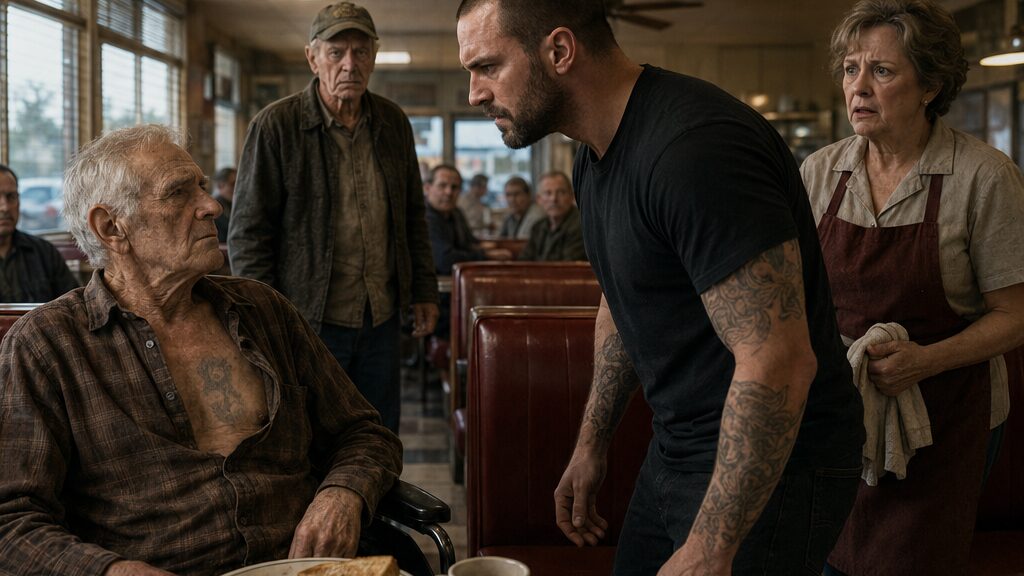
When They Tore Open His Plaid Shirt, The Number 412 Made The Whole Diner Go Silent
Chapter 1: The Booth Beside The Window
Paul Bennett arrived at Catherine Miller’s diner at seven minutes past six, the way he did every morning except Sundays and days when the rain made the ramp too slick.
The nursing home driver lowered the lift with its usual metallic complaint. Paul waited in his wheelchair with both hands resting flat on his knees, looking out at the strip of highway beyond the parking lot. The road was gray in the early light, damp at the edges, with one tractor trailer moving slow past the gas pumps across the way. The driver offered to push him.
“I’ve got it,” Paul said.
The man did not argue. He had learned.
Paul rolled himself across the cracked pavement, right wheel catching once in the shallow seam near the blue-painted curb. He leaned forward, gave the wheel a measured push, and cleared it without looking back. The ramp to the diner was warped where the boards met the concrete. Someone had painted the edge yellow years ago, but the color had worn down to a suggestion. Paul knew where the chair would bump. He knew where the left handrail went cold in winter and sticky in July. He knew where to slow down so the front casters would not twist.
Inside, the bell above the door gave one thin ring.
The diner smelled of coffee, grill onions left from yesterday, bacon grease, and the lemon cleaner Catherine used before opening. Fluorescent lights hummed over the counter. A waitress stood with her back to him, filling napkin dispensers. Two men in leather vests sat in the far booth under the mounted fish, talking low over black coffee. A newspaper customer near the register looked up, then back down.
Catherine glanced from the kitchen pass-through. “Morning, Paul.”
“Morning.”
“Usual?”
“If the hens cooperated.”
“They sent their regards.”
He let the corner of his mouth move, not quite enough for most people to notice. Catherine noticed. She always did.
His booth was the second one from the window. Not the nearest to the door, not the deepest in the room. From there he could see the highway without being in the way of the waitresses. The table had a nick near the metal edge where someone had carved a half moon with a pocketknife. Paul’s chair fit if he angled it once, reversed a little, and brought the left wheel in tight.
The waitress came with coffee before he finished settling. “Careful, it’s hot.”
Paul looked at the cup, then at her hand still hovering near it as if he might forget what heat was.
“I remember hot,” he said.
She flushed. “I didn’t mean—”
“I know.”
That was how most things went now. People spoke to him in warnings. Careful. Slow down. Let me. You sure? They meant kindness most of the time. The trouble was that kindness, repeated often enough, could grow handles. It could grip a man by the shoulders and turn him away from the simplest task.
He opened the paper menu though he had not read it in years. Two eggs over medium, toast, hash browns if Catherine had not made them too oily, coffee black. He liked the small ceremony of being asked. It kept the morning from becoming a delivery.
Outside the window, a pickup turned off the highway too fast, tires snapping gravel. Paul noticed it because his body still noticed such things before his mind had use for them. He watched the truck pass the window and stop near the far edge of the lot. Dark paint. Rust along the wheel well. A decal peeled from the back glass.
The waitress set down silverware wrapped in a paper napkin. Paul placed the fork and knife side by side. He smoothed the napkin once with the flat of his palm.
His shirt cuff had come loose. He looked down and buttoned it with deliberate patience. The shirt was brown plaid, soft from years of washing, thinning at the elbows. Catherine had once offered to take him to the department store and help him choose something newer. He had told her the shirt still had work in it.
The top button was already fastened.
He checked it anyway.
A man at the counter laughed too loudly at something the cook said. The bell over the door rang again, harder this time, not because the door was heavier, but because the person entering did not care how it opened.
Paul did not turn right away.
Boots crossed the floor. Not hurried. Not casual either. A young man’s walk, heavy in the heel, carrying a message for the room before a word was spoken. The conversation in the far booth thinned. The waitress paused beside the coffee station.
Paul picked up his cup.
In the reflection of the window, he saw the man behind him: broad shoulders, shaved head, beard, black T-shirt tight across tattooed arms. Not a boy, though Paul was old enough to think of him as one. Thirties maybe. Anger had aged his mouth.
The man stopped near the register first. Catherine came out of the kitchen wiping her hands.
“Jerry,” she said carefully. “You want coffee?”
The man did not answer her. His eyes were fixed on the reflection in the window. On Paul.
Paul took one swallow of coffee. It was too hot, but he did not show it.
“Paul Bennett,” the man said.
The name traveled across the diner strangely. Not loud, but aimed.
Paul set the cup down on its saucer. He turned the chair a few inches so he could look at him without twisting his neck.
“Yes.”
The man’s jaw moved as if he were chewing something bitter. “You don’t know me.”
“No.”
“You knew my father.”
The two men in the far booth stopped pretending to talk. Catherine’s hands tightened around the towel. The waitress stood by the counter with the coffee pot held in both hands.
Paul looked at the man’s face and searched it the way he had learned not to search faces anymore. There were features that could return after decades: the angle of a brow, the set of the eyes, a stubbornness in the chin. Sometimes the dead had sons and daughters who walked into rooms carrying bone echoes.
“What was his name?” Paul asked.
The man gave a short laugh, not because anything was funny. “You don’t get to ask that like you’re taking attendance.”
Paul’s breakfast came up in the window behind the counter. The cook called, “Order,” then saw the room and went quiet.
Catherine moved a step forward. “Jerry, if this is about—”
“It is not about you, Catherine.”
Paul let his hands rest on the table. The fork gleamed near his right wrist. The knife lay parallel to it, dull-edged, diner-safe.
Jerry came closer. He smelled faintly of motor oil and cold air. There was a mark on the side of his neck, an old burn or scar, half hidden by beard. His eyes went down to Paul’s shirt, to the top button.
“My old man had a picture,” Jerry said. “Four men standing in the mud. One had your face. One had your name on the back.”
Paul did not move.
“Funny thing,” Jerry said. “You look smaller now.”
Catherine said his name again, sharper. “Jerry.”
Paul looked at her briefly. The look was enough. Stay out for now.
The waitress brought the plate because she did not know what else to do. Eggs trembling at the edges. Toast cut corner to corner. Hash browns browned too dark on one side. She set it down carefully, as if a loud plate might break something.
“Thank you,” Paul said.
Jerry stared at the plate. Then at Paul. “That’s it?”
Paul picked up the fork. “You came in while I was having breakfast.”
A flush rose under Jerry’s beard.
“You think you get breakfast?” he said. “You think you get old?”
The words struck the table harder than a fist would have. Paul heard one of the leather-vested men shift in the far booth. He heard the coffee pot touch the burner. He heard, beneath all of it, a rotor that had not existed in this town for fifty years.
He cut into the eggs.
His hand did not shake. That was something. Not pride. Maintenance.
Jerry leaned down until his shadow covered the plate. “Look at me.”
Paul looked.
The young man’s anger was not clean. Clean anger went in one direction. This came apart at the edges. It had sleeplessness in it, and old stories told badly, and a child’s wound grown into a man’s arms.
“You’re the one with the number,” Jerry said.
The fork stopped above the plate.
For the first time that morning, Paul’s face changed. Not much. A tightening near the eyes. A breath held half a second too long.
Jerry saw it. The room saw Jerry see it.
Paul placed the fork down beside the knife.
Outside, a truck passed on the highway and shook the window in its frame.
Jerry stepped closer to the booth, his hands opening and closing at his sides.
“You are,” he said. “You’re the one with the number.”
Chapter 2: The Number Under The Plaid Shirt
The diner did not go silent all at once. It quieted in layers.
First the cook stopped moving pans. Then the waitress set the coffee pot down without sliding it fully back onto the burner. Then the two biker regulars quit murmuring in the far booth. Even the newspaper customer lowered his paper and forgot to pretend he was reading.
Paul remained where he was, angled beside the table, the plate cooling in front of him. The eggs had broken under the edge of his fork, yellow spreading into the hash browns. His coffee steamed beside his right hand. The top button of his shirt sat beneath his throat like a small locked door.
Jerry Carter stood over him breathing through his nose.
“You heard me,” Jerry said.
“I did.”
“Then answer.”
Paul looked at Catherine, not for help, but because he knew she would step forward if he did not tell her not to. He moved one finger against the table. Stay.
Catherine’s face tightened.
Jerry noticed the motion and laughed once. “Still giving orders?”
Paul said nothing.
“That what you did back then?” Jerry asked. “Point your finger and send other men where you wouldn’t go?”
The words seemed to satisfy something in Jerry for half a second. Then they failed him. His jaw clenched again.
Paul folded his hands loosely on the table. The skin across his knuckles was thin and brown-spotted. A scar ran from the base of his thumb to his wrist, pale and crooked. Jerry looked at those hands as if their age offended him.
“You got anything to say about my father?” Jerry asked.
“What was his name?”
Jerry’s face twisted. He put one hand on the table and leaned down. The coffee cup trembled in its saucer.
“You don’t get to do that.”
“I don’t know who you are.”
“You know the number.”
Paul’s eyes lowered for the first time.
That was enough for Jerry. He reached across the narrow space between them and grabbed the front of Paul’s plaid shirt.
Catherine gasped, “Jerry, no.”
The waitress took a step, stopped, looked toward the cook, then toward the two men in leather vests. Nobody moved quickly enough to become first.
Jerry’s fist closed in the fabric at Paul’s chest. Paul’s body shifted forward in the chair, not far, but enough that the wheels clicked against the table leg. His plate scraped. The toast slid into the egg yolk.
Paul lifted his left hand, not to strike, not to pry Jerry’s fingers loose, but to steady himself against the edge of the table.
“Let go,” Catherine said.
Jerry did not.
He pulled.
One button popped loose and tapped against the tabletop. Another held, stretched, then tore free with a dry snap. The old shirt opened crookedly from throat to sternum.
The diner saw what Jerry had been looking for.
On Paul’s chest, where the skin had thinned and folded with age, a faded mark sat above his heart. It was not clean like a tattoo from a shop. Time had blurred it. A narrow black shape, almost like a dagger or a cross depending on the light, ran down toward the numbers beneath it.
The digits were dark enough to survive the years, uneven at the edges, as if put there in a hurry or under conditions that did not care about beauty.
Jerry stared at it.
So did everyone else.
The mark changed the air without explaining itself. It was ugly and ordinary at the same time, a piece of a man’s body that had never been meant for diner light.
Paul did not cover it. He could not, not without fighting Jerry’s grip or making a show of shame. He kept his left hand flat on the table. His right hand rested near the coffee cup. Only the tendons in his neck moved.
“Button it back,” Paul said.
His voice was low. It did not shake. It did not rise.
Jerry blinked, thrown for a moment by the calmness. “What?”
“Button it back.”
A biker in the far booth muttered something under his breath. The newspaper customer stood halfway, then sat again when Catherine looked toward him. The cook came to the pass-through with a spatula still in his hand.
Jerry’s grip tightened. The fabric twisted. “You don’t tell me what to do.”
“No,” Paul said. “I’m telling you what you’ve done.”
That landed harder. Jerry’s eyes flicked to the exposed skin, the torn shirt, the plate, the watchers. For the first time, the scene became visible to him from the outside. An old man in a wheelchair. A torn shirt. Breakfast cooling. A room full of witnesses.
Then grief stepped back into his face and ruined the chance for shame.
“My father had that number in his box,” Jerry said. “He had it on a picture. On a letter. On the back of a map. My mother cried every time she saw it.”
Paul looked up at him.
“What was his name?” he asked again.
Jerry shoved the shirt fabric once before letting it go, not hard enough to tip him, but hard enough to make Catherine move forward.
“Carter,” he said. “Andrew Carter.”
Paul’s right hand slid from the coffee cup to the table’s edge.
There was no loud gasp. No dramatic collapse. His face simply lost something private.
Jerry saw that too.
“You remember now.”
Paul took one breath through his nose. “Yes.”
The word was almost too small for the room.
Jerry leaned down again, but his hand no longer held the shirt. “Then say it.”
Paul said nothing.
“Say what happened to him.”
Paul’s gaze dropped to the plate. The egg yolk had soaked into the toast now. Catherine would insist on replacing it. He knew that. The waitress would apologize though she had done nothing. Everyone in the diner would speak softer to him for a week, which might be worse than the grabbing.
“Not here,” Paul said.
Jerry laughed again, but this time there was no strength in it. “Not here. Not now. Not ever. That’s what men like you always say.”
From the far booth came the scrape of a chair.
Samuel Reed stood slowly.
He was not big. Age had thinned him down, and the blue veins stood out on the backs of his hands. He wore a faded ball cap with no insignia on it, just sun-bleached cloth and a bent brim. He had been sitting with the biker regulars, though he was not one of them. Most mornings he drank coffee, read yesterday’s paper, and left exact change under the cup.
He came no farther than the end of the aisle.
His eyes were on Paul’s chest.
For a second Paul looked at him, and something passed between the two old men. Not friendship. Recognition perhaps. Or warning.
Samuel’s mouth opened, then closed. His face had gone pale beneath its weathered color.
Jerry turned on him. “You got something to say?”
Samuel swallowed. “Carter, let go of him.”
“I already did.”
“Then step back.”
Jerry’s shoulders lifted. “You know what that is?”
Samuel looked once more at the mark. “I know enough to tell you it isn’t what you think.”
The sentence moved through the room like a match struck in the dark.
Jerry pointed at Paul. “He knows what happened to my father.”
Samuel did not deny it.
Catherine stood beside the booth now, one hand on the torn back of the seat. “Jerry, step away from him. Right now.”
Paul touched the edge of his shirt with two fingers. He could have pulled it closed, but the missing buttons made that impossible. He lowered his hand again.
Jerry looked from Samuel to Catherine to the exposed mark. His rage had not gone. It had lost its shape.
Paul said, “Your father was a brave man.”
Jerry’s face hardened instantly. “Don’t you dare make him a sentence.”
Paul closed his mouth.
The waitress began to cry silently near the coffee station. She wiped one cheek with the back of her wrist and looked embarrassed by the evidence of it.
Jerry backed up one step. Then another.
“You had fifty years,” he said. “Fifty years to tell us.”
Paul’s eyes remained on him.
“You don’t get to eat eggs and pretend he never existed.”
Then Jerry turned and walked toward the door. The bell rang violently behind him. Through the window, they watched him cross the lot, yank open the pickup door, and sit behind the wheel without starting the engine.
No one inside the diner spoke.
Paul stared at the place where Jerry had stood. The torn shirt hung open. The mark remained visible, no longer grabbed, no longer hidden, and somehow more exposed because the danger had left.
Catherine reached toward him, then stopped before touching.
“Paul,” she said.
He picked up the loose button from the tabletop. It was small, brown, ordinary. He held it in his palm as if it were something returned from far away.
Samuel’s voice came from the aisle, rough and quiet.
“That number buried better men than you know.”
Paul closed his fingers around the button.
“Don’t,” he said.
The old corpsman lowered his eyes.
Paul looked at the breakfast, the coffee, the torn shirt, the watchers who had seen too much and not enough.
Then he said, to no one in particular, “I’d like to go home.”
Chapter 3: What The Diner Chose Not To Say
Catherine Miller threw away Paul’s breakfast after he left, though there was nothing wrong with the food except what had happened over it.
The eggs had gone flat and dull. The toast was soaked through. Coffee cooled in the cup with a pale ring forming along the inside. One of Paul’s shirt buttons lay on the table until she noticed it was gone and remembered he had closed it in his fist.
The nursing home driver came back for him twenty minutes after Jerry left. Catherine had offered to call the sheriff’s deputy. Paul said no. She offered to call an ambulance. Paul looked at her as if she had misunderstood the injury. She offered to sew the shirt.
At that, he almost smiled.
“Needlework never trusted me,” he said.
He held the torn front together with one hand while the driver pushed him out, though Catherine knew he hated being pushed. That was how she could tell the morning had cost him more than he would spend words on. At the door, the front caster caught on the worn threshold. The driver tilted the chair too sharply. Paul’s shoulders stiffened, but he did not correct him.
The bell rang once as they left.
Afterward, the diner seemed too bright. The red vinyl seats showed their cracks. The chrome napkin dispensers reflected warped faces. A strip of sunlight fell across the booth where Paul had sat, touching the knife, the fork, the untouched corner of toast.
Nobody knew whether to resume eating.
The biker regulars paid first. One of them put a twenty on the counter for six dollars of coffee and did not wait for change. Samuel Reed remained in the far booth with both hands around his cup. The waitress moved from table to table with a damp cloth, wiping surfaces already clean.
Catherine took Paul’s plate herself.
In the kitchen, the cook said, “You want me to call somebody?”
“Should’ve done that while he was here.”
He had no answer.
Catherine scraped the eggs into the trash. The sound made her angry. Not at the eggs. Not even only at Jerry. At the way all of them had stood there measuring when a thing became enough. At the way she had said his name instead of putting herself between Jerry’s hand and Paul’s shirt. At the way the whole diner had waited for permission to do what decency did not need permission for.
She rinsed the plate hard enough that water splashed her apron.
When she came back out, Samuel was standing near the register.
“You know what that mark means,” she said.
He looked toward the door. “Not all of it.”
“Enough.”
Samuel rubbed a thumb along the brim of his cap. “Enough to know it wasn’t put there for decoration.”
“Military?”
His eyes shifted to the kitchen, the waitress, the empty booths. “Some things don’t belong to the room.”
Catherine almost snapped at him. The room had already taken what did not belong to it. Paul’s chest. His fear. His breakfast. His old grief. But Samuel’s face stopped her. There was shame there too, a different shade of it.
“Jerry said Andrew Carter,” she said.
Samuel closed his eyes briefly.
“You knew that name?”
“Not him. Knew of him.” He opened his eyes. “Or thought I did.”
Catherine leaned both hands on the counter. “Paul didn’t want the sheriff.”
“Course he didn’t.”
“Why?”
Samuel gave a tired look. “Because then it becomes statements and charges and some deputy asking him to repeat the part where a young man tore his shirt open. Paul Bennett doesn’t strike me as a man who likes handing strangers his worst five minutes.”
Catherine looked at the booth. “And if Jerry comes back?”
“Then somebody better move faster than we did.”
The words were not accusing. That made them worse.
By nine, the morning crowd had thinned. A mother with a child came in, sensed the mood, and took two muffins to go. The newspaper customer returned his paper to the rack unread. The waitress found the popped button’s thread on the floor and started crying again.
Catherine stepped into the parking lot after the lunch delivery arrived. Jerry’s truck was gone, but the tire marks remained where he had pulled out too sharply, dark crescents in the gravel. Near the ramp, one board had lifted another fraction from its nails. Paul had been managing that hazard for months because she had kept saying she would get someone to fix it when business improved.
Business had improved twice. She had used the money on the freezer, then the roof.
The ramp stayed.
She stood there with her arms folded against the morning chill, looking at the place where Paul’s chair always jolted.
A car turned in from the highway a few minutes later. Not Jerry’s truck. An older sedan, pale blue, one front fender a different color. A woman stepped out wearing jeans, a work jacket, and the expression of someone who had already heard enough bad news before breakfast.
She looked at the diner sign, then at Catherine.
“You Catherine Miller?”
“Yes.”
“I’m Emily Carter.”
Catherine’s stomach tightened.
Emily’s eyes went to the ramp, then the door, then the tire marks. “My brother was here.”
“He was.”
“Did he hurt him?”
The question came out too quickly to be innocent. Catherine heard history in it. Not violence exactly. Fear of escalation. Familiarity with damage.
“He grabbed his shirt,” Catherine said. “Tore it open.”
Emily’s mouth pressed shut. She looked away toward the highway.
Catherine waited.
“My brother gets something in his head,” Emily said. “He thinks if he can make somebody say the right sentence, it’ll fix what came before.”
“He scared an old man in a wheelchair in front of a room full of people.”
“I know.”
“You don’t know. You didn’t see it.”
Emily flinched, but she accepted the blow. “No. I didn’t.”
A truck passed, sending dust across the lot. Emily tucked her hands into her jacket pockets.
“Did Paul say anything about my father?”
Catherine heard the name before Emily spoke it. Andrew Carter sat between them like another person.
“He asked his name,” Catherine said. “Then he said your father was brave.”
Emily looked down. Her eyes shone, but she did not cry. “That sounds like him.”
“Your father?”
“Paul Bennett.” She looked at the diner door. “My mother kept a box. Pictures, letters, half a map. Paul’s name was in it. So was 412. Jerry found it after she got sick. He’s been chewing on it ever since.”
“What does he think Paul did?”
Emily’s answer took too long.
“He thinks Paul came home with the story everyone wanted to hear and left out the part my father died in.”
Catherine folded her arms tighter. “And did he?”
“I don’t know.” Emily’s voice lowered. “That’s the trouble.”
Inside, Samuel watched through the window, his cap in his hands.
Emily noticed him and went still. “Who is that?”
“Samuel Reed. Regular.”
“He was staring at Paul, wasn’t he?”
“He recognized the number.”
Emily’s face changed. Fear, hope, anger—Catherine could not tell which arrived first.
Before either woman could speak, Samuel came out through the diner door. The bell rang behind him and cut off the warm noise from inside.
He stopped on the porch, looking at Emily as if the dead had sent another messenger.
“You’re Andrew Carter’s girl,” he said.
Emily drew herself up. “Yes.”
Samuel nodded once. “Your brother shouldn’t have done what he did.”
“I know that.”
“But if he found Paul Bennett,” Samuel said, “this isn’t over.”
Emily looked from Samuel to Catherine.
“No,” she said. “It isn’t.”
Chapter 4: The Son Who Wanted A Villain
Jerry Carter’s garage smelled like gasoline, old tires, and coffee gone sour in the bottom of a paper cup.
He had left the bay door half open though the morning had turned cold. A strip of daylight lay across the oil-stained floor, stopping at the front wheel of a sedan he had promised to finish two days ago. The hood was up. Tools sat in a neat line along the fender, arranged with the care of a man who could control metal better than memory.
Jerry stood at the workbench with both hands braced on the edge.
The truck engine still ticked outside from the drive back. He had not gone to see his mother. He had not answered Emily’s calls. He had come straight here, to the only room where anger had ever made him useful.
On the bench lay the old metal box.
It had belonged to his mother before the sickness made her forget where she hid things. Army-green once, now scratched to the dull color of a pond in winter. The latch had been stubborn, but Jerry had fixed enough stubborn things. Inside were photographs, folded documents, a map that had split along the creases, and envelopes his mother had tied with butcher’s string.
He had opened that box three weeks ago looking for insurance papers.
Instead he had found his father younger than Jerry had ever been allowed to imagine him.
Andrew Carter stood in one photograph with three other men in mud up to their boots. He wore no clean hero’s posture. His face was thin, tired, and laughing at something beyond the camera. On the back, in his mother’s careful handwriting, were four names.
Andrew. Paul. Samuel. Miller.
Jerry had read them again and again, but one had stayed hot in his mind.
Paul.
Another photograph showed a strip of road swallowed by jungle. Someone had written 412 in pencil near the corner, then circled it so hard the paper tore slightly. There were letters with pieces cut out, dates that made no sense to him, and one envelope addressed to his mother in writing that was not his father’s.
He had not opened that one yet.
He told himself it was because it belonged to her. He knew that was not the whole of it.
He picked up the photograph again. His father’s face had softened at the edges from years in the box. Jerry touched the corner with his thumb, not touching the face.
“You found him,” Emily said behind him.
He closed his eyes once.
She stood in the open bay door, jacket zipped to her chin, hair pulled back carelessly like she had left in a hurry. She looked at the truck, then at the box, then at him. She had always been good at finding the thing he hoped she would miss.
“You went to the diner,” she said.
Jerry set the photograph down. “Catherine call you?”
“No. I went there after you ran from every phone in town.”
“I didn’t run.”
Emily stepped inside. “You tore open an old man’s shirt in front of people.”
His shoulders tightened. “He knew.”
“That doesn’t answer what you did.”
Jerry turned on her. “You didn’t see his face.”
“No. I saw Catherine’s.”
“His face changed when I said Dad’s name.”
“Of course it did.”
“You don’t know that.”
Emily came closer, careful to keep the workbench between them. Not because she feared him exactly. Because anger in the Carter family had always needed furniture around it.
“He’s in a wheelchair, Jerry.”
“That doesn’t make him innocent.”
“It makes what you did ugly.”
The word landed in the garage and stayed there.
Jerry looked away first. Outside, a car passed slow along the street. Somebody’s radio played faintly two houses down, then faded.
“He sat there eating eggs,” Jerry said.
Emily’s expression shifted, anger giving way to something more tired. “People eat breakfast.”
“Not if they know what happened.”
“You don’t know what he knows.”
“He admitted he remembered Dad.”
“That isn’t the same thing.”
Jerry reached into the box and pulled out the folded map. He opened it too roughly. The paper cracked along one crease. Emily flinched.
“Look,” he said.
“I’ve seen it.”
“Then look again.”
He jabbed a finger at the circled number. “Four-one-two. On the map. On the picture. In Mom’s letters. On his chest, Emily. Not on a wall. Not on a file. On him.”
Emily stared at the map. Her face held the same expression she used at their mother’s appointments when doctors spoke in soft voices and avoided clean answers.
“What do you think it means?” she asked.
“I think it means he knows why Dad didn’t come home.”
“He was listed as killed during evacuation.”
“Listed.” Jerry laughed. “That word does a lot of work.”
Their mother had never told the story straight. Some days Andrew Carter had died saving men. Some days he had been left near a road. Some days Paul Bennett had written to her. Some days she swore no letter came. In childhood, Jerry had filled the gaps with monsters because children preferred monsters to blank spaces. Monsters could be hated. Blank spaces only echoed.
Emily touched one of the envelopes in the box. “Mom said Paul came to the house once.”
Jerry looked at her. “When?”
“Before I remember. Maybe before you were born. She said he stood on the porch and couldn’t step inside.”
“She told you that?”
“Once. After too much wine at Thanksgiving. Then she cried and told me to forget it.”
Jerry leaned back against the bench. “You never said.”
“You were nineteen and punching holes in garage drywall because someone mentioned Dad at the VFW picnic. I didn’t think adding Paul Bennett to your head would help.”
His face darkened, but the old shame under it was faster than anger. “That was different.”
“Not as different as you want.”
He turned away from her and picked up a wrench, then set it down because there was nothing to fix with it.
Emily softened her voice. “What did Paul say?”
Jerry saw the old man again: shirt torn open, skin thin over the blackened number, eyes steady in a way that made Jerry want to break something.
“He asked Dad’s name like he didn’t know.”
“Maybe he didn’t.”
“He knew after.”
“And?”
Jerry swallowed. “He said Dad was brave.”
Emily lowered her eyes.
“That all you wanted?” Jerry demanded. “There. Brave. Fine. Put it on a stone and go home.”
She looked up sharply. “Don’t.”
Jerry regretted it, but regret had never stopped him mid-strike. It only waited afterward and made a room smaller.
He reached into the box again, this time for the envelope he had not opened. The paper had yellowed, but the address was still readable. Their mother’s maiden name. An old street. A stamp browned with age. No return address on the front.
Emily saw it and went still. “Where did you find that?”
“Bottom of the box.”
“Did you open it?”
“No.”
“Then don’t.”
“Why?”
“Because it’s Mom’s.”
“Mom doesn’t know what year it is half the time.”
Emily’s face tightened. “That doesn’t make everything hers ours.”
Jerry turned the envelope over. On the back flap, in faded ink, someone had written a single line.
A. Carter — last known words, delivered by P.B.
The garage seemed to drop several degrees.
Emily covered her mouth.
Jerry stared at the initials until they blurred. P.B. Paul Bennett. The man at the diner. The old man with the number under his shirt. The man who had asked his father’s name and then looked as if the floor had opened under them both.
“Jerry,” Emily said quietly.
He slid a finger under the brittle flap.
“Don’t,” she said.
He stopped, breathing hard.
For once, she did not sound angry. She sounded afraid of what a few inches of paper could do.
Jerry laid the envelope on the bench between them. His hand stayed on top of it.
“He had fifty years,” he said.
Emily’s eyes were wet now. “Maybe he spent them trying to survive the same thing you keep using to destroy yourself.”
Jerry looked at the photograph again.
His father smiled from the mud, forever younger than his son.
On the back of the photo, beside the names, his mother had written one more thing Jerry had not noticed the first time. The pencil was faint, almost gone.
Paul carried the road when the road disappeared.
Jerry read it once. Then again.
Outside, the truck engine went quiet at last.
Chapter 5: The Man Who Would Not Defend Himself
Paul slept badly and woke before the room had any light in it.
For a while he lay still, listening to the building. Pipes knocked once in the wall. A door closed somewhere down the hall. A cart squeaked past, pushed by one of the aides beginning rounds. Beyond the thin curtains, the parking lot lamps turned the window glass into a dull gray mirror.
His chest hurt where Jerry’s fist had twisted the shirt.
Not badly. Not enough for a nurse. The skin had reddened in an oval above the heart, one more mark among marks. He touched the place through his undershirt and felt the raised numbers beneath his fingers.
He had not looked at it in a mirror for years. He washed without looking. Buttoned without looking. Let doctors see what they had to see and gave them no stories to carry out of the room.
The shirt lay over the back of a chair. Catherine had sent it back in a paper bag with the nursing home driver after he refused to let her keep it. One button missing. Two torn loose. The fabric around the placket stretched and wrinkled from Jerry’s grip.
Paul had folded it before bed, then unfolded it again. Now it hung like something accused.
He sat up slowly. His left leg gave its familiar useless protest. He transferred to the wheelchair with practiced movements, not graceful but exact. There was a time when standing had been thoughtless. Now every motion required negotiation. He did not resent the chair every day. Some days he even appreciated its honesty. It did not pretend the world was easier than it was.
On the small table by the window sat a metal biscuit tin. Inside were things nobody in the building knew about. Not because they were secret in any useful way. Because people treated old pain like public property once they learned it existed.
Paul opened the tin.
A folded casualty-notification copy lay beneath an old mechanic’s license, two black-and-white photographs, and a strip of map sealed in plastic. The paper had been unfolded and refolded until the creases were soft as cloth. He did not need to read the words. He knew the official lines. Date. Location. Circumstances. Regret to inform.
Beneath it was the envelope.
He had not kept the original. He had delivered that to Andrew Carter’s wife with both hands and no ability to step across her threshold when she asked him in. This was only a copy of what he had written down afterward, because memory was a liar when left alone too long.
Andrew’s words. Not all of them. Paul had never written all of them. Some things had belonged to the dying man and the man who held him, not to paper.
He closed the tin.
The aide knocked, then entered without waiting fully. “Morning, Mr. Bennett. You up already?”
“Looks that way.”
She smiled too brightly. “Breakfast downstairs in twenty. Oatmeal today.”
“I’m going out.”
Her smile faltered. “After yesterday?”
Paul reached for his clean shirt. Not the torn plaid. A blue one Catherine had insisted looked respectable. He paused, then put it back and took the torn plaid from the chair.
The aide noticed. “That one needs mending.”
“Yes.”
“You want me to find you another?”
“No.”
She hovered. “I heard there was an incident.”
Paul threaded one arm into the sleeve. “People hear well.”
“Maybe you should rest.”
“I rested from ten last night to now.”
“You know what I mean.”
He buttoned the shirt with care. Where the missing button left a gap, he pinned the fabric from inside with a small safety pin taken from the tin. It did not hide the damage completely. That was all right. Damage did not embarrass him. Display did.
The aide watched his hands. “Mr. Bennett, if someone hurt you—”
“He hurt himself worse.”
She did not know what to do with that.
The nursing home driver was surprised to see him waiting by the front doors at six. “You sure?”
Paul looked at him.
The driver lifted both hands. “All right. Dumb question.”
The morning outside was clear and colder than the day before. Paul watched the town pass from the van window: closed laundromat, hardware store, a church sign with half its plastic letters tilted, the gas station man hosing down concrete. Ordinary places holding ordinary weather. It had always amazed him how the world continued after things that should have stopped it.
When the diner sign came into view, his hand tightened once on the wheel rim.
Jerry’s truck was not there.
Catherine’s car was. Samuel’s old sedan sat near the side lot. A delivery truck idled by the kitchen door. The ramp waited in its same warped condition, yellow edge worn thin.
The driver came around to lower the lift. “Want me to go in with you?”
“No.”
“You sure?”
Paul almost sighed. “You planning to eat?”
“No.”
“Then no.”
The driver grinned despite himself and stepped back.
Paul rolled toward the ramp. The boards gave their usual hollow knock beneath the chair. Halfway up, the left caster bumped the lifted seam harder than expected. His body pitched forward. He caught the handrail with one hand and the wheel with the other, shoulder flaring with pain.
The driver moved. “I got you.”
“Stay.”
The word came sharper than Paul intended.
The driver froze.
Paul closed his eyes. Not here, he thought. Not like a stubborn fool proving a point to wood.
He adjusted the wheel, reversed an inch, turned, and climbed the seam at a slight angle. The chair cleared it. At the top, he stopped long enough to breathe through the ache in his shoulder.
Inside, conversations dropped lower when the bell rang.
That was worse than staring.
Catherine came out from behind the counter. She looked at the torn shirt, then at his face. “Morning, Paul.”
“Morning.”
“Usual?”
“If the hens weren’t frightened off.”
Her mouth trembled before she found a smile. “They’re tougher than they look.”
Samuel sat in the far booth with coffee untouched in front of him. He did not speak. Paul appreciated that.
The waitress approached with the pot. Her eyes were red. “Coffee?”
“Yes, please.”
She poured with both hands, careful not to spill. “I’m sorry about yesterday.”
Paul looked at the cup. “You didn’t tear my shirt.”
“I didn’t stop him.”
Neither did most people, he could have said. Neither did I, in the way you mean.
Instead he picked up the spoon and set it beside the saucer. “Coffee’s hot?”
She gave a startled laugh, small and wet. “Yes.”
“Then we’ll call that a start.”
She went back to the counter wiping her face with her sleeve.
Catherine brought the plate herself. Eggs, toast, hash browns. Fresh. Too fresh, maybe. She had made the toast golden and buttered edge to edge. Apology could be tasted sometimes.
Paul unfolded the napkin and smoothed it.
His hand stopped.
A number had appeared in his mind so clearly that for a moment he thought someone had written it there. 412. Not the mark on his chest. Not the map. The road. The heat. The noise. Andrew Carter laughing in mud. Andrew Carter bleeding into Paul’s sleeve. Andrew saying, very quietly because his strength had gone elsewhere, Tell them—
Paul folded the napkin again.
He could leave. He had returned. That was enough for pride.
But pride had never been the thing that woke him before dawn.
The bell over the door rang.
Paul did not look up immediately. Catherine did. Samuel did. The waitress gripped the coffee pot.
Jerry Carter stood inside the doorway.
He looked worse than the day before. Not drunk. Not calm. His eyes were sleepless, and his beard had not been trimmed. He held something in one hand. A yellowed envelope.
Nobody moved.
Jerry looked at Paul’s torn shirt, the safety pin, the fresh breakfast. Shame passed over his face and vanished behind need.
Paul placed his napkin beside the plate.
Jerry said, “My mother had this.”
Paul looked at the envelope.
He knew it from across the room.
The diner disappeared at the edges. For a breath, he saw a porch instead. A young widow holding a baby. Himself unable to step inside.
Jerry came no farther than the first booth.
“I didn’t open it,” he said.
Paul’s eyes lifted to his.
That was the first thing Jerry had done right.
The envelope shook once in his hand.
“I need to know why you had his last words,” Jerry said. “And why you left them in a box.”
Paul’s fingers rested beside the fork. He felt the whole room leaning toward him, hungry in a way they did not mean to be.
He turned his chair slightly, facing Jerry fully.
“Not here,” Paul said.
Jerry’s mouth tightened.
Then Paul added, “But not never.”
Chapter 6: The Ramp Nobody Fixed
The next morning, Jerry Carter was already in the parking lot when the nursing home van turned in.
Paul saw him before the driver set the brake. Jerry stood beside the diner ramp in a gray sweatshirt with the sleeves pushed up, hands in his pockets, shoulders hunched against the cold. His truck was parked near the kitchen door. A toolbox sat in the bed.
The driver glanced in the mirror. “That him?”
“Yes.”
“You want me to keep going?”
Paul looked at the diner windows. Catherine was inside, watching from behind the counter. Samuel’s sedan was in the side lot again. The waitress moved past the window and slowed when she saw the van.
“No,” Paul said.
The lift lowered. Morning air slipped under his collar. He had worn the plaid shirt again, mended now only enough to close. Catherine had offered the evening before to sew the buttons properly. He had told her he would do it when his fingers and patience met on the same day.
The safety pin remained beneath the cloth.
Jerry stepped away from the ramp as Paul rolled toward it. He did not come close. He did not speak at first.
The ramp looked worse in daylight now that everyone had been forced to see it. One plank had lifted at the seam. A nail head shone where wood had split around it. The yellow paint along the edge had worn away until it looked like an old bruise.
Paul stopped at the foot of it.
Jerry looked at the board. “That thing’s a lawsuit.”
“It’s a ramp.”
“It’s broken.”
“Many things are.”
Jerry swallowed whatever reply came first.
The driver came around behind the chair. Paul lifted one hand without turning. The driver stopped.
Jerry saw the motion. His face colored slightly.
“You want help?” Jerry asked.
“No.”
Catherine came out onto the diner porch. “Paul, wait. The cook can bring out the portable board from the back.”
Paul looked up the ramp. It was not steep. It was not long. Yesterday, he had cleared it. Today, with everyone watching, the same climb had become something else.
Jerry shifted his weight. “I can push you.”
Paul looked at him.
Jerry’s eyes dropped. “I mean—if you want.”
“I know what you mean.”
The old anger flashed in Jerry’s face, but it did not take hold. He stepped back, palms open, leaving the ramp free.
Paul placed both hands on the rims.
The first push lifted him onto the lower boards. The second carried him toward the seam. He angled the front casters as he had done a hundred times. The left wheel rolled over a warped place, jolting his hip. His shoulder complained from the strain of yesterday. He kept his face still.
Halfway up, the lifted plank caught the small caster hard.
The chair stopped.
Not dramatically. Not dangerously. It simply halted, front wheel wedged against wood too stubborn to yield.
The parking lot went quiet.
Paul reversed an inch. The caster stuck. He tried turning left. The chair twisted, but the wheel held. Pain moved from his shoulder down into his hand.
The nursing home driver stepped forward. Catherine came down one porch step.
Paul said nothing.
Jerry looked at the trapped wheel, then at Paul’s hands. Something changed in his face. Not pity. Pity would have made Paul leave. This was recognition of an object failing a man in public while everyone pretended the man was the problem.
Jerry crouched beside the ramp, careful to stay outside Paul’s reach. “Board’s split underneath.”
“I noticed.”
“Need to lift the caster straight, not forward.”
Paul’s jaw tightened. “I know how wheels work.”
Jerry accepted that. He put one hand on the ramp railing instead of the chair. “Yes, sir.”
The words came out rough, almost accidental.
Paul looked at him.
Jerry did not repeat them.
Catherine hurried into the diner and came back with a flat piece of plywood from the kitchen delivery stack. The cook followed her. Together they slid it over the bad seam. Paul waited until their hands were clear, then pushed again. The chair rolled over the covered place and reached the porch.
No one clapped. No one spoke. That was mercy.
Inside, the diner smelled of bacon and coffee, as if mornings could be rebuilt by repetition. Paul went to his booth. Jerry remained near the door until Catherine looked at him.
“You eating?” she asked.
“I don’t know.”
“That’s not an order.”
Jerry nodded once and sat at the counter, far from Paul.
The waitress poured coffee for Paul first. Then, after a hesitation, poured one for Jerry. He did not touch it.
Paul unfolded his napkin. His hands ached. He hated that they did. He hated that Jerry had seen the board before Catherine did, hated that the young man’s mechanic eyes had understood the ramp’s failure so quickly. He hated most of all that the hatred was unfair.
Catherine set down Paul’s plate.
“Fresh,” she said.
“Yesterday’s was fresh.”
“This one’s less interrupted.”
He looked up at her, and this time his small smile came fully enough for her to see. She blinked and turned away too quickly.
Jerry’s stool scraped. The whole diner stiffened again, but he only reached into the pocket of his sweatshirt and took out a folded photograph. He placed it on the counter, not near Paul, not demanding.
“My mother wrote something on the back,” he said.
Paul did not turn.
Jerry’s voice was lower than it had been in the garage, lower than it had been the day before. “She wrote that you carried the road when the road disappeared.”
Samuel looked up from his coffee.
Paul closed his eyes.
The phrase was not one he had given her. It was Andrew’s joke from before everything burned. Road’s gone, Bennett. Guess you’ll have to carry it.
He opened his eyes again. The toast sat at the edge of the plate, cut corner to corner. Ordinary. Impossible.
Jerry remained standing near the counter. “What does that mean?”
Paul picked up his fork, then set it down.
He turned his chair enough to face Jerry.
“It means your father talked too much when he was scared.”
Jerry’s breath caught, not with anger this time.
“He was scared?” Jerry asked.
“Yes.”
The word seemed to disturb him more than bravery had. A brave father could stay carved in stone. A scared one became alive.
Paul looked toward the window, past Jerry, past the parking lot and the broken ramp, to the highway beyond.
“Scared men can still do brave things,” he said.
Jerry lowered himself back onto the stool. “Did he?”
Paul looked at him for a long time.
“Yes.”
Jerry’s hands closed around the edge of the counter.
The room had become too attentive again. Paul felt it. Samuel felt it. Catherine, to her credit, turned away and began wiping the register though it was clean.
Paul’s chest tightened beneath the plaid.
He had spent fifty years refusing to let strangers feed on Andrew Carter’s last hour. But Jerry was not a stranger, not entirely. He was grief grown into a man. He was a son trying to pry a father out of official language.
Still, there were ways to tell a truth that stole from the dead.
Paul moved his chair back toward the table.
Jerry said, “Please.”
The word was quiet enough that only those already listening heard it.
Paul stared at his plate. Egg yolk, toast, coffee, napkin. Morning assembled again after being broken.
He said, without turning, “Your father did not die asking for revenge.”
Jerry did not move.
“He didn’t die cursing you,” Paul said. “He didn’t die blaming anyone. And he didn’t die alone.”
A sound left Jerry’s throat before he could stop it.
Paul reached for his coffee, but his hand paused before touching the cup.
“That’s all I can give you in a room full of people.”
Jerry looked around then, as if he had forgotten the diner existed. The waitress at the coffee station. Catherine near the register. Samuel in the far booth. The cook visible in the pass-through. All of them trying, too late, to become furniture.
Jerry stood.
For a moment Paul thought he would leave again.
Instead, Jerry walked to the door, stopped beside the ramp visible through the glass, and looked down at the boards.
“I can fix that,” he said.
Catherine glanced up. “The ramp?”
He nodded, still looking outside. “Before somebody gets hurt.”
Paul said, “Somebody already did.”
Jerry turned back.
Paul’s voice was not cruel. That made it harder to hear.
Jerry’s eyes went to the mended plaid shirt. Then to Paul’s face.
“I know,” he said.
Paul watched him, measuring the words, the posture, the hands that had torn and might yet repair.
Jerry touched the folded photograph on the counter but did not pick it up.
“I’ll come back after closing,” he said.
Paul lifted his coffee at last.
“No,” he said.
Jerry stopped.
Paul looked at him over the rim of the cup.
“You’ll come back before opening. If you mean it.”
Chapter 7: What Happened At 412
Catherine closed the diner at two in the afternoon, though the sign said she stayed open until three.
A trucker tapped the door at five past, saw her face through the glass, and left without argument. The waitress wiped down tables that were already clean. The cook turned off the grill and stood in the kitchen doorway with a towel over one shoulder until Catherine looked at him and said, “Go home.” He went, slowly, glancing once toward the back booth.
Samuel stayed.
So did Emily.
Jerry sat at the counter with the yellowed envelope in front of him, untouched since Paul had arrived. His coffee had gone cold. He kept his hands clasped so tightly that the knuckles shone pale. Every few minutes his eyes went to the booth beside the window, where Paul waited with his chair angled toward the room.
Paul had not asked for privacy. He had only asked for no audience hungry for a story.
Catherine understood the difference. She locked the front door, flipped the sign to CLOSED, and pulled the blinds halfway down. Not enough to make the diner secret. Enough to stop passersby from seeing an old man’s face while he opened a door he had kept shut for most of his life.
“Back booth,” Paul said.
Jerry picked up the envelope. Emily followed him. Samuel moved as if to leave.
Paul looked at him. “Stay if you can stay quiet.”
Samuel nodded once and took the end of the booth nearest the aisle. Catherine remained by the counter until Paul turned his eyes toward her.
“You too,” he said.
She came without speaking.
Jerry slid into the booth across from Paul but did not lean forward. That was new. Emily sat beside him, close enough that their shoulders touched. The envelope lay between them on the table like something alive.
Paul looked at it for a long moment.
“I wrote that,” he said.
Jerry’s jaw worked. “The words on the flap?”
“Yes.”
“Why?”
“Because I was afraid I’d forget which ones belonged to him and which ones belonged to me.”
Emily folded her hands in her lap.
Paul rested his right palm on the table. The torn plaid shirt had been mended enough to close, but he had not changed it. The safety pin beneath the cloth pulled the fabric slightly crooked. He could feel the mark under it, not as pain, but as weight.
“Four-one-two wasn’t a unit,” Paul said. “Not officially. It was a route marker on a supply road nobody called a road unless they were being generous. Red mud, broken trees, culverts that washed out if the rain looked at them wrong. We used numbers because names made places sound more permanent than they were.”
Jerry stared at him.
“Your father hated that road,” Paul said. “Said every time we got sent down it, the earth was trying to swallow us and had poor table manners.”
Emily made a soft sound that was almost a laugh. She covered it with one hand.
Paul looked at her. “He liked bad jokes.”
“He did?” she whispered.
“Terrible ones.”
Jerry’s face tightened, but not with anger. With the strain of fitting a living voice into the outline of a man he had known only through silence.
Paul continued. “There were five of us on the last run. Me. Andrew. Samuel wasn’t there. He was at the aid station that day.”
Samuel’s gaze lowered to the tabletop.
“A radio operator. Two boys who had been in-country less than a month. We were supposed to bring back equipment and two wounded men from an outpost that was being cleared. Weather turned. Road went bad. Then the first blast took the lead truck.”
Jerry flinched.
Paul stopped.
Outside, a car passed slowly on the highway. The diner windows held the dim shape of it and let it go.
“I’m not going to give you the sounds,” Paul said.
Jerry looked up.
“I don’t owe the room those sounds. Your father doesn’t either.”
Jerry’s eyes filled, but he nodded.
Paul’s fingers pressed once against the table edge. “After, the road wasn’t a road. It was smoke, water, metal, and men trying to become smaller than fear. Your father moved when nobody could tell where to move. He pulled the radio operator clear. Went back for one of the boys. I told him to wait.”
He paused.
“He did not wait.”
Emily reached for Jerry’s wrist. He did not pull away.
“The second boy was pinned near the culvert. Andrew got him loose. By then we had no working truck and no clean way out. I had one leg full of metal and one arm that didn’t want to answer me. Andrew laughed at me while he tied it off. Said, ‘Bennett, if the road’s gone, I guess you’ll have to carry it.’”
Jerry looked toward the photograph on the counter as if he could see through the wall between rooms.
Paul’s voice thinned but did not break. “Then the firing started again.”
Nobody moved.
“Your father and I stayed with the wounded until the evacuation bird could find a break in the weather. The young ones went first. Andrew made sure of that. He made me promise if only one of us got out clean, it wouldn’t be me because I outranked grief.”
Jerry’s brow furrowed. “What does that mean?”
“It means he knew I would try to stay for the wrong reason.”
“Did you?”
“Yes.”
The word sat naked on the table.
Paul looked directly at Jerry. “I tried to stay. He made that impossible. He pushed me toward the line when I couldn’t stand right, and then he went back for the radio pack because he thought if he could keep talking, the bird would keep coming.”
Emily shut her eyes.
Paul took a slow breath. “He was hit near the marker. Four-one-two. Not in a charge. Not in some clean picture. He was muddy and scared and angry that he’d dropped his cigarettes somewhere. He asked me if the boys got out. I told him yes.”
“Did they?” Jerry asked.
“Yes.”
Jerry’s shoulders sagged.
Paul reached for the envelope, then stopped before touching it. “He asked about your mother. He knew about Emily coming. He didn’t know she was Emily yet.”
Emily’s hand flew to her mouth.
“He said if it was a girl, your mother would name her something soft and then raise her stubborn.”
A tear slid down Emily’s cheek. She did not wipe it.
Jerry stared at the envelope. “And me?”
Paul’s face changed then. It carried an old sorrow with a newer edge.
“He didn’t know about you.”
Jerry absorbed that like a man taking a blow he had asked for.
“You were born after,” Emily said quietly.
“I know,” Jerry said, but his voice had gone hollow.
Paul finally touched the envelope with two fingers and pushed it toward him. “That letter was for your mother. I brought it to the house. She took it. She asked me to come in. I couldn’t.”
“Why?” Emily asked.
“Because she was holding a child who would never know him, and I was standing there with two legs that still moved then, breathing air your father didn’t get.”
Paul looked away from them, toward the blinds. “I thought if I stepped inside, I’d take something from the room that belonged to him.”
Jerry’s eyes were wet now. He did not hide it. “So you left.”
“Yes.”
“My mother waited for more than a letter.”
“I know.”
“You let her.”
“Yes.”
The answer was not defense. It was not apology either. It was a man refusing to step aside from what he had done.
Jerry pressed both palms to his eyes. Emily leaned into him, her own tears falling freely.
Catherine stood near the end of the booth, one hand covering the place at her throat where anger usually gathered. She had expected a cleaner truth, something that would lift Paul up and put Jerry neatly down. This did neither. It left everyone human and damaged and sitting too close to one another.
Samuel spoke for the first time. “The two boys made it?”
Paul nodded. “One became a school principal in Oregon. One wrote me Christmas cards until he died.”
Samuel closed his eyes.
Jerry lowered his hands. “The number on your chest.”
Paul touched the covered place once. “Field hospital. Some of us marked ourselves after. Not for pride. For remembering where to send the dreams when they came.”
“Who put it there?”
“Man with a needle and bad hands.”
Jerry almost laughed and could not.
Paul pushed the envelope closer. “Take it.”
Jerry stared at it. “You read it?”
“I wrote it.”
“No. Since.”
Paul shook his head.
Jerry lifted the envelope carefully, as if age had made it fragile enough to bruise. “Is everything in here?”
Paul did not answer quickly.
Jerry looked up.
“No,” Paul said. “Not everything.”
Emily’s face changed. “What’s missing?”
Paul held her gaze, then Jerry’s. “The part a dying man said that wasn’t meant to fix anyone.”
Jerry’s mouth tightened. The old demand flickered, but weaker now, ashamed of itself.
“I’m his son,” he said.
“Yes.”
“I deserve to know him.”
“Yes.”
“But not all at once.”
Paul’s eyes softened. “Not like this.”
Jerry looked down at the envelope. His thumb brushed the faded line on the flap.
For a long time, nobody spoke.
Then Jerry said, “I’m sorry I tore your shirt.”
Paul watched him.
“I’m sorry I put hands on you.”
Paul nodded once, accepting the words without decorating them.
Jerry swallowed. “I wanted you to be the reason.”
“I was part of the reason,” Paul said. “Just not the villain you needed.”
That hurt Jerry visibly. It also freed him from arguing.
Paul rolled his chair back a few inches from the table. “Read the letter with your sister. Not here. Not in anger.”
Jerry nodded.
Paul turned toward the aisle.
Catherine stepped back to give him room.
At the end of the booth, Jerry spoke again.
“Mr. Bennett.”
Paul stopped.
Jerry held the envelope with both hands. “Will you ever tell me the rest?”
Paul looked at him over his shoulder.
“When you stop needing it to punish somebody,” he said. “Maybe then.”
Chapter 8: A Fresh Plate, Buttoned Shirt
One week later, the ramp did not complain under Paul’s wheels.
That was the first thing he noticed.
The nursing home van had arrived at seven minutes past six, but Paul had seen the repair before the lift finished lowering. New boards ran from the concrete to the porch, clean and sanded, with a fresh yellow strip painted along the edge. The handrail had been tightened. The split plank was gone. Even the rough lip at the threshold had been shaved smooth.
No sign hung from it. No ribbon. No note.
Jerry’s truck was not in the lot.
Paul sat at the bottom of the ramp for a moment while the driver stood behind him pretending not to wait.
“You going up?” the driver asked.
Paul looked at the boards. “Seems built for it.”
He pushed once. The chair rolled forward. No jolt. No catch. No little betrayal of wood pretending to be safe. At the porch, he stopped and put one hand on the rail. The paint smelled faintly new beneath the cold morning air.
Inside, the bell rang softly.
Catherine looked up from the counter. She did not say anything about the ramp. That was how Paul knew she had been warned.
“Morning,” she said.
“Morning.”
“Usual?”
“If they’re not charging extra for smooth entry.”
Her smile came slowly. “Today, the hens are feeling generous.”
Samuel sat in the far booth, cap on the seat beside him. He nodded once. Paul nodded back. The waitress came with coffee and set it down without warning him it was hot. He appreciated that more than she knew.
His booth beside the window was waiting.
Paul angled the chair into place. The table nick, the window, the highway, the metal edge under his fingertips—all of it was the same. Not unchanged. Same. There was a difference.
He wore the brown plaid shirt.
Catherine had sewn the missing buttons back on two nights earlier after he finally let her, sitting at the counter while she worked with a needle from the office drawer. She had not asked to see the mark. She had kept her eyes on the thread. When she handed the shirt back, she said only, “Buttons ought to do their job.” He answered, “Most things ought to.”
Now the shirt was buttoned to the throat by his own hand.
The waitress placed a plate in front of him. Two eggs over medium, toast cut corner to corner, hash browns browned but not burnt. Beside the plate she set a folded napkin and, half hidden beneath the coffee saucer, a small receipt.
Paul pulled it free.
Paid.
No name.
He looked toward Catherine.
She wiped the counter with unnecessary focus.
Paul set the receipt down. “I can buy my breakfast.”
“I know.”
“Didn’t ask if you knew.”
Catherine looked at him then. “He asked if he could. I said once.”
Paul considered objecting. Then he saw, through the window, a shape near the far side of the lot.
Jerry stood by the repaired ramp, not coming in. He wore the same gray sweatshirt, sleeves down this time, hands empty. Emily sat in the pale blue sedan nearby with the engine off. She looked toward the diner but did not wave.
Paul picked up his coffee. Took one sip. Set it down.
“He waiting for permission?” he asked.
Catherine followed his gaze. “Maybe.”
Paul unfolded the napkin and smoothed it once. “He’ll get cold.”
Catherine went to the door, opened it, and stepped outside. Paul watched her speak to Jerry. Jerry shook his head once. Catherine said something shorter. He looked through the window at Paul.
Paul did not beckon. He did not smile. He simply held Jerry’s gaze and looked at the empty stool near the counter.
Jerry came in quietly.
The bell barely sounded.
No one turned to stare. Samuel looked at his coffee. The waitress took an order pad from her apron though no one had asked for anything. Catherine returned behind the counter, leaving the space open.
Jerry stopped beside Paul’s booth, far enough away that there was no shadow over the plate.
“Morning,” he said.
“Morning.”
“I fixed the ramp.”
“I noticed.”
Jerry’s eyes moved to the buttoned shirt, then away. “I should’ve asked Catherine before I bought lumber.”
“You should’ve asked before several things.”
“Yes, sir.”
The words were cleaner this time. Not accidental. Not polished either.
Paul cut into the eggs. Steam rose from the yellow center.
Jerry stood there another moment. “Emily and I read the letter.”
Paul kept his eyes on the plate. “Good.”
“My mother asked us to read it to her too.”
Paul’s fork stopped.
“She remembered some of it,” Jerry said. “Not all. But when Emily said Dad’s bad joke about the road, Mom laughed.”
Paul closed his eyes briefly.
Jerry’s voice roughened. “She hadn’t laughed like that in a while.”
Paul opened his eyes and looked out at the highway.
“I’m glad.”
Jerry nodded. He seemed unsure what to do with his hands, so he put them in his pockets, then took them out again. “I told her what I did here.”
Paul looked at him.
“All of it,” Jerry said. “She said if my father were here, he’d make me fix more than a ramp.”
For a moment the old Andrew Carter stood between them, muddy and scared and laughing at the worst possible time.
“He might,” Paul said.
Jerry’s mouth moved in the beginning of a smile and then failed.
“I don’t expect you to forgive me,” he said.
“That’s useful.”
Jerry took that in, unsure if it was rebuke or mercy.
Paul placed his fork down. “Forgiveness isn’t a receipt. You don’t get to hold it up and prove you paid.”
Jerry looked at the counter, then back. “Then what do I do?”
“Do better when nobody’s watching.”
The answer seemed to settle him more than comfort would have.
From the parking lot, Emily stepped out of the sedan. She did not come in. She leaned against the car and folded her arms, giving the two men the room they had not had before.
Jerry followed Paul’s glance. “She wanted to thank you.”
“She can another day.”
“She thought you might say that.”
Paul lifted his coffee. “Smart woman.”
Jerry breathed once, almost a laugh. Then the question he had been carrying returned to his face. The final piece. The one Paul had kept back.
Paul saw it coming and was tired of hating it.
“Sit down,” he said.
Jerry looked surprised.
“Not there.” Paul nodded toward the stool at the counter. “I’m eating.”
Jerry sat on the stool nearest the booth, turned halfway so he could hear without crowding.
Paul cut a piece of toast, dipped it lightly into the egg, then set it down uneaten. He looked at the window. At the road. At the repaired ramp reflected faintly in the glass.
“He asked me to tell your mother he was sorry about the porch steps,” Paul said.
Jerry frowned. “What?”
“Apparently he promised to fix them before he shipped out.”
Jerry stared.
“That was the first thing. Not grand. Not polished. Porch steps.”
A tear slipped down Jerry’s cheek before his face changed enough to explain it. He wiped it quickly with the heel of his hand.
Paul continued, “He said if the baby was a girl, she’d be stubborn. He was right.”
Jerry gave a broken little laugh.
Paul’s hand moved to the napkin. He did not fold it. He only held the edge.
“And then he said, if there were ever children he didn’t get to meet, they shouldn’t spend their lives afraid of the hole he left.”
Jerry went very still.
Paul turned from the window and looked at him. “He said to let his children live unafraid.”
The diner kept its silence, but this silence had changed. It was no longer the silence of people watching harm. It was the silence of people making room around something fragile.
Jerry bowed his head. His shoulders shook once, then steadied. He did not ask for more.
Paul picked up his fork.
At the counter, Catherine set a fresh mug in front of Jerry without a word. Jerry wrapped both hands around it.
Samuel rose to leave. On his way past Paul’s booth, he paused, touched two fingers to the brim of his cap, and lowered them before the gesture became anything showy. Paul gave the smallest nod.
Breakfast cooled, as breakfast always did when men carried too much into morning. But this time no one had taken it from him.
Paul ate slowly.
Outside, Emily looked at the repaired ramp, then through the window at her brother. She lifted one hand, not quite a wave. Paul saw her in the glass and raised his coffee cup an inch.
The waitress moved quietly between tables. The cook started the grill again. Catherine unlocked the front door and turned the sign around.
OPEN.
A few minutes later, a trucker came in, stamping cold from his boots, and the diner resumed itself around them. Plates, orders, spoons, coffee. Ordinary sounds returning not because nothing had happened, but because something had been allowed to settle where it belonged.
Jerry did not speak again until Paul’s plate was nearly clean.
“I’ll come back tomorrow,” he said. “Ramp might need a second coat.”
Paul wiped his mouth with the napkin. “Paint dries whether you stare at it or not.”
“Yes, sir.”
Jerry stood. At the door, he stopped and turned back. His eyes went once to Paul’s shirt, buttoned and undisturbed.
Then he opened the door carefully enough that the bell gave only one soft ring.
Paul watched him cross the porch, step over the new boards he had laid, and go to Emily. She touched his arm. He did not pull away.
Paul looked down at the receipt beside his saucer. Paid. No name. He folded it once and slid it into his shirt pocket, not over the mark, but near enough.
Catherine came by with the coffee pot.
“Warm-up?”
Paul held out his cup.
She poured without spilling. “You all right?”
He looked at the highway beyond the glass, the booth edge beneath his hand, the plate in front of him, the door that opened and closed without tearing anything from him.
“No,” he said.
Catherine waited.
Paul took a sip of coffee.
“But I’m having breakfast.”
The story has ended.