The Nurse Who Saluted an Elderly Patient and Learned Why Marines Never Forgot His Name
Chapter 1: The Patient Nobody Wanted to Listen To
The discharge papers tore straight down the middle before Jessica Anderson could stop him.
The sound snapped through the rehabilitation ward louder than it should have.
Several patients looked up from televisions and crossword puzzles. A physical therapist froze mid-step. Jessica stared at the two halves of the form in Ronald Miller’s hands.
Ronald didn’t raise his voice. He didn’t curse. He simply placed the torn pages on the tray table beside his bed.
“I’m not signing another one,” he said.
Jessica exhaled slowly.
“Mr. Miller—”
“No.”
His answer came so quickly it felt rehearsed.
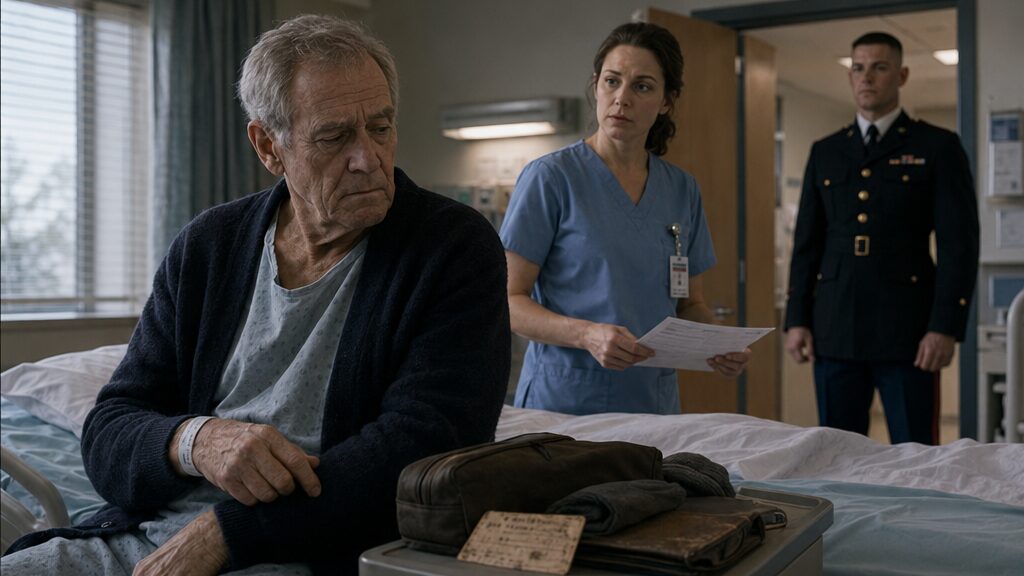
The seventy-four-year-old man settled back against his pillows and folded his arms. The hospital bracelet around his wrist slid down toward his hand. It looked older than most patient bracelets, bent and worn from weeks of use.
Jessica picked up the torn paperwork.
“You know they’ll just print another copy.”
“They can print a hundred.”
His gaze moved toward the hallway.
“I won’t sign those either.”
Three weeks earlier Ronald had arrived after a severe respiratory infection complicated by a fall at home. He had recovered faster than expected. Physically, there was little reason for him to remain in the rehabilitation wing.
Every chart said the same thing.
Ready for transfer.
Ready for discharge planning.
Ready to move.
Yet every discussion ended exactly like this.
Jessica glanced at his chart.
“Can you at least tell me why?”
“No.”
“Mr. Miller—”
“Ronald.”
She stopped.
He rarely corrected people.
“Ronald, then.”
He nodded.
“Why are you refusing?”
For a moment she thought he might answer.
Instead he looked toward the large window overlooking the parking structure.
“You ever notice,” he said quietly, “how everybody asks questions after they’ve already decided the answer?”
Jessica frowned.
“What does that mean?”
“It means nobody here is listening.”
Before she could respond, another nurse called her name from across the ward.
The moment disappeared.
By lunchtime the story had spread through the floor.
Ronald tore up another transfer form.
Jessica heard it twice while passing medications.
Three times while updating records.
Five times during a staff meeting.
The charge nurse shook her head.
“Nice enough man,” she said. “Impossible patient.”
A therapist laughed.
“Every exercise? Perfect. Every medication? On time. Every transfer request? Absolute refusal.”
“He doesn’t even explain himself.”
“Maybe he likes the attention.”
Jessica disliked the comment immediately.
She couldn’t explain why.
Ronald never behaved like someone seeking attention.
He spoke little.
Asked for almost nothing.
Never complained about pain.
Never used the call button unless necessary.
When meals arrived, his tray was already organized before staff returned.
When physical therapy began, he was waiting before anyone asked.
Military neatness.
That was the phrase that came to mind.
Everything had a place.
Everything followed routine.
Even his bedside drawer looked inspected.
Jessica had noticed that during her first week caring for him.
The only thing that seemed out of place was the stubbornness.
Late that afternoon Brandon Perez arrived.
Jessica spotted him before he reached the nurses’ station.
Hospital administrators always seemed to move differently than everyone else.
Faster.
More purposeful.
As if every hallway belonged to a schedule.
“How’s Miller?” Brandon asked.
Jessica already knew where the conversation was heading.
“The same.”
Brandon rubbed his forehead.
“We need that bed.”
“I know.”
“Occupancy is ninety-eight percent.”
He opened a tablet.
“Two admissions are waiting.”
Jessica glanced toward Ronald’s room.
“He says there’s a reason.”
“He says there’s a reason every time.”
Brandon’s voice remained calm.
Not cruel.
Just tired.
“I don’t have the luxury of solving mysteries.”
Jessica folded her arms.
“Maybe it’s not a mystery.”
“Then he should explain it.”
The administrator looked toward the room.
“Patients don’t get to refuse every recommendation indefinitely.”
A few minutes later Brandon stepped inside Ronald’s room.
Jessica followed.
Ronald was sitting upright, reading a newspaper.
The bracelet remained visible against his wrist.
“Mr. Miller,” Brandon began.
Ronald lowered the paper.
“Back again?”
Brandon smiled politely.
“I need to discuss your transfer.”
“No.”
“Please hear me out.”
“I heard you yesterday.”
“And the day before.”
Ronald nodded.
“Then we’re caught up.”
Jessica almost laughed.
Brandon didn’t.
“Mr. Miller, this isn’t personal.”
“Never thought it was.”
“You’ve completed rehabilitation.”
“No.”
The administrator blinked.
“No?”
Ronald folded the newspaper carefully.
“No.”
Something changed in Brandon’s expression.
Patience thinning.
“According to every assessment—”
“Every assessment is wrong.”
Jessica leaned forward slightly.
There it was.
The first new thing Ronald had said in days.
Brandon noticed too.
“Then tell us what’s wrong.”
The room grew quiet.
Jessica waited.
Ronald’s jaw tightened.
His fingers brushed the edge of the bracelet.
Then he looked away.
“No.”
Brandon stared for several seconds.
“Fine.”
He stood.
“You have forty-eight hours.”
Jessica felt the tension instantly.
Ronald did not react.
Brandon continued.
“After that, administration will move forward.”
The door closed behind him.
Silence lingered.
Jessica remained standing beside the bed.
“You should’ve told him something.”
Ronald looked at the torn discharge papers.
“Maybe.”
“Then why didn’t you?”
His expression softened briefly.
Not anger.
Regret.
“Because some things sound foolish until you know the whole story.”
Jessica waited.
Again he said nothing.
When her shift neared its end, she passed Ronald’s room one last time.
The light was dim.
He sat alone, staring toward the hallway.
Not watching television.
Not reading.
Waiting.
For what, she couldn’t tell.
As she reached the nurses’ station, a clerk approached.
“There are visitors asking for someone.”
Jessica glanced up.
“Which patient?”
The clerk checked a note.
“Ronald Miller.”
Jessica looked toward the entrance.
Three men stood there.
All wearing Marine Corps dress uniforms.
And all of them were asking for Ronald by name.
Chapter 2: The Name on the Emergency Contact Card
The Marines refused to explain why they were there.
That became obvious within minutes.
Jessica watched from the nurses’ station as the clerk attempted polite questions.
The oldest Marine smiled.
“We’re just here to see Mr. Miller.”
“Family?”
“No.”
“Friends?”
The Marine’s smile remained.
“We’re here to see Mr. Miller.”
That was all anyone got.
Word spread across the ward almost immediately.
Patients noticed.
Staff noticed.
Even Brandon Perez reappeared from another floor after hearing there were uniformed visitors.
Jessica led them toward Ronald’s room.
The hallway seemed unusually quiet.
The Marines walked with the same measured pace.
No wasted movement.
No unnecessary conversation.
When they reached the door, Ronald looked up from his chair.
For the first time since Jessica had met him, genuine surprise crossed his face.
One Marine stepped forward.
“Evening, sir.”
Sir.
Jessica noticed that immediately.
Ronald looked uncomfortable.
“You boys shouldn’t be here.”
“We heard you were hospitalized.”
“I’m not dead.”
The younger Marines smiled.
The older one nodded.
“We know.”
Ronald sighed heavily.
“Then go home.”
Nobody moved.
Jessica found herself hiding a smile.
The old man who argued with administrators apparently had no more success ordering Marines around.
The conversation remained quiet.
Respectful.
Yet something about it felt different from ordinary visitors.
Not because of uniforms.
Because of the way they listened.
Every word Ronald spoke received their full attention.
No interruptions.
No rushing.
No assumptions.
The exact opposite of every discussion about discharge.
After several minutes Jessica left them alone.
But curiosity followed her through the rest of the shift.
The next morning she returned to Ronald’s room with medication.
The Marines were gone.
Ronald sat by the window.
The bracelet still hung from his wrist.
“Your friends left.”
“They’re not my friends.”
Jessica handed him a cup.
“You seemed happy to see them.”
“I wasn’t.”
She raised an eyebrow.
“You looked surprised.”
“That’s different.”
He swallowed the medication.
Conversation ended.
As usual.
Later that afternoon Jessica began preparing paperwork updates.
One section required verification of emergency contacts.
Ronald’s file contained incomplete information.
She opened the record.
Then frowned.
Something wasn’t matching.
The listed contact information had recently changed.
Not by Ronald.
By someone else.
A note referenced information found among personal belongings after admission.
Curious, Jessica checked the secured patient property inventory.
Most items were ordinary.
Wallet.
Watch.
Reading glasses.
Folded photographs.
Then one entry caught her attention.
Emergency contact card.
No further description.
After obtaining authorization, she retrieved the envelope from storage.
The card was old.
Older than the wallet.
Its edges had softened with age.
On one side was Ronald’s name.
On the other was a Marine Corps emergency contact designation from decades earlier.
Jessica stared.
The paper looked carefully preserved despite years of wear.
A handwritten note appeared beneath the printed information.
If found, notify immediately.
The listed contact name was no longer living.
Jessica recognized that from the chart.
But someone had recently attached another number.
Captain Timothy Campbell.
United States Marine Corps.
Jessica looked back at the card.
Then at Ronald’s record.
The pieces didn’t fit together.
Not yet.
But they connected somehow.
As she returned the envelope, another item slipped partially free.
A photograph.
She paused.
Hospital policy technically allowed her to secure it again without looking.
Instead she glanced down.
A younger Ronald stood among Marines.
No medals displayed.
No dramatic battlefield image.
Just young men smiling at a camera.
One face had been marked with a small pen circle.
Jessica carefully returned everything.
Her pulse felt strangely faster.
That evening she entered Ronald’s room carrying dinner.
He noticed her expression immediately.
“You found something.”
Jessica nearly dropped the tray.
“What?”
“You’ve got the look.”
“What look?”
“The one people get when they think they know more than they did yesterday.”
She set the tray down.
“Maybe I do.”
Ronald sighed.
“There it is.”
“There what is?”
“Curiosity.”
“You don’t like curiosity?”
“I don’t like where it leads.”
Jessica hesitated.
Then decided to ask.
“The Marines.”
“No.”
“Ronald.”
“No.”
“The emergency contact card.”
His eyes lifted.
For the first time she saw genuine alarm.
Small.
Controlled.
But real.
“You went through my belongings?”
“I verified information for your chart.”
He looked away.
The reaction surprised her.
Not anger.
Something closer to sadness.
“They should’ve thrown that card away years ago.”
“Why keep it?”
“No reason.”
She almost laughed.
Both of them knew that wasn’t true.
Jessica stepped closer.
“You were a Marine.”
Silence.
Then a slow nod.
“Long time ago.”
“You never mentioned it.”
“It wasn’t relevant.”
The answer irritated her.
“People are visiting from military bases to check on you.”
“That doesn’t make me special.”
“No.”
She looked at the worn bracelet.
Then at the old man sitting quietly beside the window.
“It doesn’t.”
For several seconds neither spoke.
Then Ronald surprised her.
“Jessica.”
It was the first time he had used her name.
“What?”
“Don’t start treating me differently.”
The request sounded sincere.
Almost worried.
Before she could answer, a knock came from the doorway.
One of the Marines stood there.
Not the older visitor.
A younger officer.
Captain Timothy Campbell.
He stepped inside.
His eyes found Ronald immediately.
Then the old Marine.
Then the bracelet.
“Good evening, sir.”
Ronald grimaced.
“I told you not to call me that.”
Timothy smiled faintly.
“Sorry, sir.”
Jessica watched the exchange.
Something passed between them.
History.
Respect.
Perhaps obligation.
She could not tell.
Timothy handed Ronald a sealed envelope.
“I thought you’d want this.”
Ronald stared at it but didn’t take it.
Not immediately.
Finally he accepted it.
Carefully.
Like something fragile.
Jessica suddenly felt as if she had entered a conversation that began decades before she was born.
Timothy nodded toward her.
“Thank you for taking care of him.”
The words were simple.
Yet they carried unusual weight.
Jessica looked back at Ronald.
Then, almost without planning to, she straightened.
Raised her hand.
And offered a quiet salute.
The room froze.
Timothy’s expression changed.
Ronald’s changed too.
Not pride.
Not satisfaction.
Pain.
Deep and unexpected.
He lowered his eyes.
And Jessica realized the salute had answered one question while creating a much larger one.
Chapter 3: The Salute He Tried to Ignore
Ronald refused to look at Jessica for the rest of the evening.
Not because he was angry.
That would have been easier.
Instead he seemed trapped somewhere far away.
The salute lingered between them like a memory neither of them understood.
When Timothy finally left, Ronald placed the sealed envelope inside his bedside drawer and closed it.
He never opened it.
The next morning Jessica found him already dressed and sitting in a hallway chair outside his room.
The bracelet remained around his wrist.
He stared toward the nurses’ station.
Not at the staff.
Past them.
Avoiding anyone who might mention the previous day.
Jessica approached carefully.
“Good morning.”
He nodded.
“Morning.”
“You didn’t open the envelope.”
His gaze remained forward.
“No.”
“Why not?”
“Because I know what’s inside.”
That answer only created more questions.
Before she could ask another, Ronald pushed himself to his feet.
His movements remained slower than they once had been, but there was still a stubborn strength underneath.
“I’ve got therapy.”
The conversation ended.
Again.
By noon Ronald was irritated with himself.
He knew it.
The salute shouldn’t have bothered him.
The young nurse meant well.
She wasn’t showing off.
She wasn’t performing for anyone.
Yet the gesture had unsettled him all night.
Because salutes reminded him of faces.
Names.
Promises.
Things carried too long.
Things never fully set down.
In the therapy gym, a therapist handed him a resistance band.
“You’re distracted today.”
“I’m old.”
“That’s not what I said.”
Ronald almost smiled.
The therapist continued.
“You have visitors again.”
Of course he did.
The Marines had apparently decided he could not be trusted to recover without supervision.
When therapy ended, Ronald found Timothy waiting near a vending machine.
The captain stood immediately.
Too quickly.
As if caught doing something wrong.
Ronald shook his head.
“At ease.”
Timothy laughed.
“Not how that works.”
“It should.”
They walked slowly toward a quieter hallway.
For several moments neither spoke.
Then Timothy asked the question Ronald had been expecting.
“Have you told anyone?”
“No.”
“Not even the nurse?”
“No.”
Timothy studied him.
“Why?”
Ronald stopped walking.
Because the answer was complicated.
Because explaining would require explaining everything else.
The promise.
The letter.
The reason he remained in this hospital when every sensible person wanted him discharged.
Instead he chose the shorter answer.
“Because it doesn’t matter.”
Timothy looked unconvinced.
“With respect, sir, it matters to some people.”
Ronald stared at him.
“That’s the problem.”
The captain said nothing.
Ronald appreciated that.
Most people filled silence.
Timothy understood it.
Eventually Ronald spoke again.
“People hear Marine and stop listening.”
Timothy frowned.
“What do you mean?”
“They decide who you are.”
His eyes drifted toward the rehabilitation ward.
“They stop seeing the rest.”
For a moment Timothy looked as though he wanted to argue.
Instead he nodded slowly.
A small act of understanding.
The kind Ronald respected.
When they returned to the ward, Jessica watched from the nurses’ station.
The two Marines.
One old.
One young.
Walking side by side.
Not as strangers.
Not exactly as friends.
Something else.
Something built from years Ronald never discussed.
Later that afternoon Jessica found an excuse to update Ronald’s chart.
She noticed several notes added overnight.
Marine visitors verified.
Emergency contact confirmed.
Nothing remarkable.
Except one line.
Patient requested no ceremonial acknowledgment.
Jessica stared at it.
Ceremonial acknowledgment?
What ceremony?
Before she could investigate further, Brandon Perez approached.
He looked exhausted.
“Need a signature.”
Jessica accepted a folder.
Then felt her stomach tighten.
Transfer authorization.
Ronald’s.
Already approved.
“Brandon—”
“I know.”
“He isn’t ready.”
“Clinically, he is.”
“That’s not what I mean.”
Brandon rubbed his eyes.
“Jessica, we’ve discussed this.”
“He keeps saying we’re missing something.”
“And he keeps refusing to explain.”
His voice softened slightly.
“I’m not the villain here.”
She knew he wasn’t.
That was what made it harder.
Beds were needed.
Patients waited.
Rules existed for reasons.
Still, something felt wrong.
Brandon tapped the paperwork.
“Tomorrow morning.”
Jessica looked down.
Official notice.
Final authorization.
Decision made.
When she entered Ronald’s room an hour later, he seemed to recognize the folder immediately.
“You’ve got bad news.”
She sat in the chair beside the bed.
“The transfer was approved.”
Ronald nodded.
No surprise.
No anger.
Just disappointment.
Quiet and familiar.
“They’re moving me.”
“Tomorrow.”
He leaned back.
The bracelet slid against his wrist again.
Jessica hated how small he suddenly looked.
Not weak.
Just tired.
“Ronald.”
He looked up.
“If there’s something we’re missing, tell me.”
For several seconds she thought he might.
His hand moved toward the bedside drawer.
Toward the unopened envelope.
Toward whatever history waited inside.
Instead he withdrew his hand.
“No.”
Jessica closed her eyes briefly.
“Why are you making this so difficult?”
The question escaped before she could stop it.
Regret followed immediately.
Ronald remained silent.
Then, very quietly, he answered.
“I’m trying not to.”
The response hurt more than an argument would have.
Jessica left carrying the transfer notice.
After she disappeared into the hallway, Ronald sat alone.
The room felt smaller than before.
He opened the drawer.
Removed the sealed envelope Timothy had delivered.
Turned it over once.
Twice.
Then set it beside the folded photograph hidden underneath.
The circled face in the picture stared back at him.
A young Marine frozen in time.
A promise frozen with him.
Ronald closed his eyes.
Tomorrow was coming too fast.
A knock sounded at the door.
He expected Jessica.
Or a therapist.
Instead a clerk handed him a document.
“Official copy, Mr. Miller.”
The clerk left.
Ronald unfolded the paper slowly.
Transfer order.
Effective tomorrow morning.
For the first time since arriving at the hospital, he realized he might be running out of time.
Chapter 4: What the Paperwork Never Mentioned
The missing page was not where it should have been.
Jessica discovered that at six-thirty the next morning while reviewing Ronald’s transfer file one final time.
Every patient chart followed the same sequence.
Admission.
Assessment.
Treatment.
Recommendations.
Yet Ronald’s electronic record referenced a document that no longer appeared in the system.
She refreshed the screen twice.
Nothing.
A note remained.
See attached consult report.
The report itself was gone.
Jessica frowned.
Hospital records did not simply disappear.
At least they weren’t supposed to.
She checked again.
Still nothing.
By seven o’clock Ronald’s transfer order was active.
By noon he could be moved.
Yet something about the missing report bothered her enough that she delayed her first break and headed toward medical records.
The records office sat in a quieter section of the hospital where fluorescent lights hummed above rows of filing cabinets and computer terminals.
A clerk helped her access archived documents.
Ten minutes later Jessica found the missing report.
Or rather, part of it.
The document had been uploaded, revised, and partially replaced.
Most of the original text remained.
One section had been removed.
She scanned the remaining pages.
Then stopped.
Patient repeatedly requests information regarding another admitted individual.
Jessica sat straighter.
The sentence continued.
Patient unwilling to discuss reasons for concern.
Requests location updates despite lack of family relationship.
Jessica read it twice.
Another patient.
The first real clue she had seen.
Not a transfer issue.
Not stubbornness.
Not fear of discharge.
Someone else.
The report referenced a consultation performed two weeks earlier.
No names.
Only room numbers.
Jessica copied the information onto a notepad.
When she returned to the ward, Ronald was sitting in his chair beside the window.
The transfer paperwork remained untouched on the tray table.
The folded envelope still rested in the bedside drawer.
The bracelet hung loosely from his wrist.
He looked tired.
More tired than yesterday.
“You look like someone hunting answers,” he said without turning around.
Jessica nearly smiled.
“You make it sound dangerous.”
“It usually is.”
She sat beside the bed.
For several seconds neither spoke.
Then she took a chance.
“There’s another patient.”
The old Marine became very still.
Not dramatic.
Not obvious.
But still.
Jessica had learned to notice small changes.
“You’ve been asking about somebody.”
No answer.
“You never told anyone.”
Still nothing.
“Is that why you’re refusing discharge?”
Ronald stared out the window.
A long silence stretched between them.
Finally he spoke.
“Jessica.”
“Yes?”
“Sometimes helping somebody means keeping your mouth shut.”
The answer frustrated her.
Because it wasn’t really an answer.
But it wasn’t a denial either.
Before she could continue, a familiar voice interrupted.
“Good morning.”
Laura Nelson entered carrying a paper coffee cup and a purse.
Ronald’s daughter.
Jessica had met her twice.
Their conversations never seemed comfortable.
Laura kissed her father’s forehead.
He tolerated it with visible awkwardness.
“You look terrible,” she said.
“So do you.”
Laura laughed despite herself.
Jessica stood.
“I’ll give you both privacy.”
As she left, she heard Laura’s voice lower.
“Dad, please tell me you’re signing the transfer papers today.”
Ronald didn’t answer.
Jessica kept walking.
The silence behind her said enough.
By midday the pressure increased.
Brandon appeared at the nurses’ station carrying a stack of files.
“You look busy.”
Jessica barely glanced up.
“I am.”
“You investigating something?”
The question landed too close.
She looked at him.
“What do you mean?”
Brandon leaned against the counter.
“You’ve spent more time on Ronald Miller than half your assigned patients.”
“He’s my patient.”
“He’s also leaving.”
Jessica hesitated.
Then asked carefully, “Did you remove anything from his file?”
Brandon frowned.
“No.”
“A consult report is incomplete.”
“That sounds like records.”
He looked genuinely confused.
Not hiding anything.
Which somehow made the situation stranger.
Jessica changed subjects.
“What if we’re making a mistake?”
Brandon sighed.
“Jessica.”
“What if there’s a reason?”
“There probably is.”
He rubbed the bridge of his nose.
“Everybody has reasons.”
The answer wasn’t cruel.
It was exhausted.
“I’ve got patients waiting for beds downstairs. Families calling. Staff shortages.”
His gaze softened.
“I don’t dislike the man.”
“Then listen to him.”
“I’ve tried.”
Jessica had no response.
Because that part was true.
Brandon walked away.
The conversation lingered.
Not because he had convinced her.
Because she could see his side too clearly.
Late that afternoon another clue appeared.
Jessica was updating inventory records when she noticed Ronald requesting access to a personal item.
Not the envelope.
Not the photograph.
A folded handwritten letter.
The request had been entered days earlier but never processed.
She located the storage envelope and carefully removed the document.
The paper looked decades old.
Creased and yellowed.
Handled countless times.
A name appeared on the front.
Not Ronald’s.
The handwriting had faded enough that she could barely read it.
Hospital policy should have stopped her there.
Instead she stared at the back.
The letter had been mailed from overseas.
Long ago.
A nurse called her name from down the hallway.
Jessica slipped the letter back into its sleeve.
Then paused.
Something else rested beneath it.
A notation written in pencil.
Same family. Promise remains.
Her pulse quickened.
Same family.
Not friendship.
Not coincidence.
Family.
The missing report.
The unknown patient.
Ronald’s refusal to leave.
The pieces suddenly seemed connected.
Not completely.
But enough.
Jessica carried the letter toward Ronald’s room.
Halfway there she stopped.
The transfer order still stood.
The hospital would move him soon.
Yet she was beginning to suspect nobody actually understood why he stayed.
When she reached the room, Ronald was asleep.
The bracelet remained visible against the blanket.
The letter sat in her hand.
She hesitated.
Then quietly placed it beside the unopened envelope in his drawer.
As she closed the drawer, she noticed something she hadn’t seen before.
A second name written faintly inside the folded letter.
Not Ronald Miller.
Someone else.
Someone whose surname matched a patient currently admitted elsewhere in the hospital.
Jessica stared at the name.
Then at Ronald.
And realized she had just uncovered a clue far larger than any military record.
Chapter 5: The Promise Made Across an Ocean
Ronald unfolded the letter before anyone could stop him.
Jessica had barely entered the room that morning when she saw the yellowed pages spread across his lap.
The transfer order sat untouched beside him.
The envelope from Timothy remained unopened.
Only the old letter mattered.
Ronald stared at the faded handwriting for so long that Jessica wondered whether he was reading it or remembering it.
“You finally opened it,” she said softly.
He nodded.
Not looking up.
“The other one can wait.”
“The envelope?”
“Yes.”
His finger rested against a sentence halfway down the page.
Jessica remained near the doorway.
For once she did not ask questions.
The silence felt earned.
After several minutes Ronald spoke.
Not to her.
To the letter.
As though answering a voice from decades earlier.
“He always hated writing.”
Jessica listened.
Ronald gave a quiet laugh.
“Could fix an engine. Could survive a storm. Couldn’t spell worth a damn.”
The laugh faded.
His eyes remained on the page.
“Who was he?” Jessica asked.
Ronald considered ignoring the question.
She could see the habit.
The reflexive retreat.
The silence that had carried him through half the story.
This time something changed.
Maybe because time was running short.
Maybe because the transfer order waited nearby.
Maybe because he was tired of carrying everything alone.
“A Marine.”
Jessica sat down.
Ronald folded the page carefully.
“His name was Charles.”
The name settled heavily into the room.
Not because of who Charles had been.
Because of what Ronald’s voice sounded like when he said it.
Loss.
Not fresh.
Not healed either.
“We served together.”
Jessica said nothing.
Ronald continued.
“Long time ago.”
His thumb traced one corner of the paper.
“He talked about home constantly.”
A faint smile appeared.
“Wife. Son. Future grandkids he didn’t even have yet.”
Jessica looked at the old letter.
The handwriting suddenly felt less like ink and more like a living connection.
“What happened?”
Ronald stared toward the window.
The answer took time.
“When people ask veterans questions, they usually want stories.”
His eyes returned to hers.
“This isn’t a story.”
She nodded.
Understanding.
Or trying to.
“He didn’t come home?”
“No.”
The room fell quiet.
Ronald lowered his gaze.
“When it happened, I was there.”
Jessica felt her throat tighten.
Not because of drama.
Because of how simply he said it.
No performance.
No details.
Only truth.
A knock interrupted them.
Laura entered.
She stopped immediately.
Her father never discussed military service.
Never.
Yet the letter sat open in his hands.
Jessica stood.
“I can leave.”
“No.”
Ronald surprised both of them.
“Stay.”
Laura sat slowly.
“What is this?”
Ronald looked at the paper.
Then at his daughter.
For a moment Jessica saw hesitation.
Fear even.
Not fear of the past.
Fear of finally sharing it.
“You always thought the Corps took me away from family.”
Laura blinked.
The statement landed harder than an accusation.
“Dad—”
“You did.”
She looked down.
Because it was true.
For years she had quietly believed military service mattered more to him than talking about it.
More than explaining himself.
More than connecting.
Ronald sighed.
“I know.”
Laura folded her hands.
Neither defensive nor apologetic.
Just listening.
The way nobody else had listened before.
Including him.
Especially him.
Ronald lifted the letter.
“This came from Charles.”
His voice roughened.
“After everything happened, I met his wife.”
Jessica noticed his fingers tighten around the paper.
“She gave me this.”
Laura remained silent.
“I promised her something.”
The sentence hung unfinished.
Jessica felt the mystery shifting.
Not solved.
Deepening.
A promise.
Not a transfer dispute.
Not stubbornness.
A promise.
Ronald continued reading portions aloud.
Not every line.
Only fragments.
Enough.
References to family.
To home.
To taking care of one another.
To unfinished obligations.
The words sounded ordinary.
But ordinary promises often lasted longest.
Halfway through, Laura quietly wiped her eyes.
Ronald pretended not to notice.
A kindness Jessica recognized.
The old Marine had spent years avoiding emotional conversations.
Yet now he protected them gently.
Even here.
Even now.
Hours later, after Laura stepped out to take a phone call, Jessica remained.
The room felt different.
Not because everything was understood.
Because something finally was.
Ronald wasn’t staying for himself.
At least not entirely.
The transfer order still sat on the table.
But now she knew there was another reason.
Another person.
Another responsibility.
“What happened to Charles’s family?” Jessica asked.
Ronald looked at the folded letter.
“Life happened.”
The answer sounded simple.
It wasn’t.
He looked tired again.
Years seemed to gather around him.
“I kept track when I could.”
Jessica leaned forward.
“And now?”
Ronald hesitated.
The silence returned.
Not avoidance.
Preparation.
Finally he answered.
“Now somebody needs me.”
The statement carried enough certainty to erase any doubt.
Jessica felt her pulse quicken.
The unknown patient.
The matching surname.
The missing report.
Everything connected.
“Who?”
Ronald closed his eyes briefly.
When he opened them, the decision had been made.
For the first time, he was no longer protecting the secret.
Only revealing it carefully.
“The person I’m here for,” he said quietly, “belongs to Charles’s family.”
Jessica stared.
The room suddenly felt smaller.
Closer.
“Are they in this hospital?”
Ronald nodded.
A single movement.
Nothing dramatic.
Yet it changed everything.
Laura stepped back into the room just as Jessica absorbed the answer.
Neither woman spoke.
Ronald folded the letter one final time.
Placed it beside the unopened envelope.
Then looked toward the hallway.
Toward the rest of the hospital.
Toward someone unseen.
Someone connected to a promise carried across decades.
And for the first time, Jessica knew exactly where to begin looking.
Chapter 6: The Person He Refused to Leave Behind
The surname appeared again before Jessica reached the nurses’ station.
Not in Ronald’s file.
In another patient’s chart.
The moment she saw it, her breath caught.
The same last name she had found on the old letter.
The same name Ronald had protected with silence, transfer refusals, and weeks of frustration.
She checked the room assignment.
Critical care unit.
Three floors above rehabilitation.
Jessica stared at the screen.
The answer had been inside the hospital all along.
By midmorning she secured permission to review the connection through proper channels.
Not because she was chasing gossip.
Because Ronald’s care plan now clearly involved another patient.
A supervisor reluctantly approved limited access.
What Jessica learned changed everything.
The patient was an elderly woman.
A distant relative of Charles.
The last direct family connection Ronald had managed to track over the years.
Recently admitted after a medical emergency.
No nearby support network.
No regular visitors.
Jessica sat back slowly.
Ronald had never been protecting himself.
He had been monitoring her condition.
Checking updates.
Refusing discharge because he feared leaving before knowing she was stable.
A promise carried for decades.
Still active.
Still shaping decisions.
No wonder he refused to explain.
The explanation sounded impossible until all the pieces existed.
Later that afternoon Jessica walked into Brandon Perez’s office carrying both charts.
He immediately noticed her expression.
“That’s never good.”
She closed the door.
“We were wrong.”
Brandon leaned back.
“About what?”
“Ronald.”
The administrator listened while she explained.
Not every detail.
Only enough.
The missing reports.
The family connection.
The relative in critical care.
The promise.
Brandon’s face changed gradually.
Not dramatic guilt.
Something quieter.
Recognition.
The uncomfortable realization that a person’s behavior had made sense all along.
When she finished, he stared at the desk.
For several moments neither spoke.
Then Brandon sighed.
“I asked him three times.”
“I know.”
“He never told me.”
Jessica nodded.
“He barely told me.”
Brandon rubbed his forehead.
The pressure he’d been carrying remained real.
Beds still mattered.
Policies still mattered.
But now another truth sat beside them.
A human one.
Finally he asked, “How long has he carried this?”
“Decades.”
Brandon looked away.
The answer seemed to affect him more than Jessica expected.
Not because Ronald was a veteran.
Because someone had quietly honored a promise for that long.
A promise nobody required.
A promise nobody even knew about.
By evening Brandon accompanied Jessica to Ronald’s room.
The old Marine sat near the window.
The bracelet still hung around his wrist.
The transfer papers remained unsigned.
Ronald looked up when they entered.
His eyes moved from Jessica to Brandon.
He understood immediately.
“Well,” he said softly. “That didn’t take long.”
Brandon sat down.
Not standing over him.
Not holding a clipboard.
Just sitting.
The difference mattered.
“I should’ve listened better.”
Ronald gave a small shrug.
“You had a hospital to run.”
“That’s not an excuse.”
Silence settled briefly.
Then Brandon surprised him.
“How is she?”
Ronald blinked.
The question wasn’t about discharge.
Or paperwork.
Or compliance.
It was about the person upstairs.
For the first time Brandon was asking the question Ronald cared about.
The old Marine looked down.
“I don’t know.”
Jessica felt the weight of those three words.
Because that uncertainty had driven everything.
The transfer refusals.
The arguments.
The silence.
Brandon nodded.
“We can find out.”
A simple statement.
Yet Ronald’s shoulders relaxed slightly.
Not because the problem was solved.
Because somebody had finally joined him in carrying it.
An hour later Jessica escorted Ronald upstairs.
Hospital policy required approval.
Brandon approved it.
The critical care unit was quieter than rehabilitation.
Machines hummed softly.
Lights remained dim.
When they reached the room, Ronald stopped in the doorway.
The woman inside appeared fragile.
Sleeping.
Connected to monitors.
Age had softened the resemblance, but Jessica could see traces of the family connection.
Ronald stood motionless.
Not speaking.
Not moving closer.
Just looking.
Years seemed to gather inside that silence.
Finally he stepped forward.
His bracelet caught the light.
The old identification band he refused to remove.
Jessica suddenly understood why.
The bracelet represented unfinished duty.
A patient waiting.
A promise still active.
Ronald touched the bed rail gently.
“Hello,” he whispered.
Nothing more.
Nothing needed.
After several minutes they left.
No dramatic breakthrough occurred.
No miraculous recovery.
Real life rarely offered such timing.
Yet something important had changed.
The promise no longer belonged to Ronald alone.
Other people understood it now.
As Jessica wheeled him back toward rehabilitation, Ronald spoke unexpectedly.
“Maybe I should’ve told somebody sooner.”
Jessica smiled faintly.
“Maybe.”
He looked down at the bracelet.
“Never been very good at that.”
“No.”
His answering smile appeared briefly.
Then disappeared.
When they returned to the ward, another document waited on Ronald’s bed.
Updated transfer authorization.
Jessica felt frustration immediately.
Then noticed the attached note.
Transfer postponed pending review.
Brandon’s signature sat beneath it.
Ronald read the page once.
Twice.
Then carefully folded it.
Not victory.
Not defeat.
Only time.
A little more time.
Enough to make a choice instead of having one forced on him.
That night Ronald sat beside the window long after visiting hours ended.
The bracelet rested against his wrist.
The letter lay open beside him.
For the first time in weeks, discharge no longer felt like abandonment.
But morning would still require an answer.
Stay.
Or finally let go.
Chapter 7: Respect That Changed More Than a Salute
The discharge packet was waiting on Ronald’s tray table when he woke.
Not a transfer order.
Not another threat wrapped in administrative language.
A discharge packet.
Final.
Real.
The decision had arrived.
For several minutes he simply stared at it.
The hospital bracelet rested against his wrist as it had every day since admission. The plastic edges had become soft from wear. It no longer felt like something attached to him.
It felt like part of him.
A nurse knocked lightly and stepped inside.
“Good morning, Ronald.”
He nodded.
“Morning.”
“You’ll be discharged this afternoon.”
The words landed more gently than he expected.
Not because they surprised him.
Because they no longer felt like abandonment.
After the nurse left, Ronald sat quietly.
The folded letter remained beside him.
The unopened envelope from Timothy remained beneath it.
For the first time, he opened the envelope.
Inside was a single sheet of paper.
Not official military correspondence.
Not a commendation.
Not a certificate.
A handwritten note.
Sir,
You once told me that service means finishing what you started, even when nobody notices.
I thought you should know that people noticed.
Not all of us. Not soon enough.
But we noticed.
Timothy
Ronald read it twice.
Then folded it carefully.
His eyes lingered on the final sentence.
People noticed.
He wasn’t sure what to do with that.
A knock sounded at the door.
Jessica entered carrying a chart.
Then stopped.
“You opened it.”
Ronald nodded.
“Finally.”
She smiled.
Neither mentioned the note.
Some things did not need explaining.
Jessica moved around the room gathering discharge paperwork.
A week earlier the process would have felt mechanical.
Now it felt strangely personal.
Not because Ronald had become famous.
Not because anyone had discovered a heroic secret.
Because they finally understood why he had fought so hard to stay.
The difference mattered.
“You’ll visit before you leave?” Jessica asked.
He knew who she meant.
“Yes.”
“Good.”
A brief silence followed.
Then Jessica surprised him.
“You know, I thought you were the most stubborn patient I’d ever met.”
Ronald laughed softly.
“Only thought?”
She laughed too.
The sound eased something between them.
A relationship built on frustration had slowly become something else.
Understanding.
At midmorning Ronald made one final trip upstairs.
This time nobody needed convincing.
No paperwork.
No arguments.
The critical care staff expected him.
The woman slept when he entered.
The machines sounded steadier than before.
A nurse quietly informed him that her condition had improved overnight.
Not dramatically.
But enough.
Enough to believe she would recover.
Ronald sat beside the bed.
The room remained quiet.
He didn’t speak much.
Never had.
Instead he placed the folded letter on the bedside table.
Not as a burden.
Not as an obligation.
As a bridge.
The promise no longer belonged only to him.
For decades he had carried it alone.
Now other people knew.
Other people could help carry it.
The realization felt unfamiliar.
Almost uncomfortable.
Yet also relieving.
After twenty minutes he stood.
The woman never woke.
That was fine.
The visit had never been about recognition.
Only responsibility.
As he left the room, he paused once.
Then nodded toward the bed.
A farewell.
Or perhaps permission to let go.
By noon several familiar faces had drifted through the rehabilitation ward.
Not for a ceremony.
Not for a farewell gathering.
People simply found reasons to stop by.
A therapist returned a borrowed book.
A nurse wished him luck.
The clerk who had first announced the Marines shook his hand.
Even Brandon Perez appeared.
The administrator stood awkwardly near the doorway.
“I wanted to say goodbye.”
Ronald looked up.
“That’s dangerous.”
Brandon smiled.
“I’ve been told.”
For a moment neither spoke.
Then Brandon stepped closer.
“I owe you an apology.”
Ronald immediately shook his head.
“No.”
“I do.”
“You were doing your job.”
Brandon looked unconvinced.
“Maybe.”
Ronald studied him.
The younger man looked exhausted.
The same pressure remained.
The same responsibility.
Nothing magical had changed.
Yet Brandon had listened when it mattered.
That counted.
“You finally asked the right question.”
Brandon frowned.
“What question?”
“‘How is she?'”
Understanding crossed his face.
Neither man said more.
They didn’t need to.
When Brandon left, he did something small.
He picked up the discharge paperwork from the tray table and handed it directly to Ronald instead of setting it down without looking.
A simple gesture.
Respect expressed through behavior.
Exactly where it belonged.
Later, Laura arrived.
She sat beside her father while staff completed final arrangements.
“You could’ve told me.”
Ronald smiled faintly.
“I know.”
Laura looked down.
“I spent years thinking the wrong thing.”
“So did I.”
Her eyes lifted.
“What does that mean?”
Ronald took a moment before answering.
“It means I spent years assuming silence was easier.”
Laura’s expression softened.
Because that answer included an apology without sounding like one.
For both of them.
The lost years could not be repaired in a single afternoon.
But they could begin somewhere.
They sat together quietly.
No arguments.
No misunderstandings.
Just time.
The thing they had struggled with most.
As discharge approached, Jessica returned one final time.
She carried a small pair of scissors.
Ronald immediately looked at the bracelet.
“Guess that’s it.”
Jessica nodded.
Hospital policy required removal before discharge.
For a moment neither moved.
The bracelet had started as a routine identifier.
Then it became a source of irritation.
Then mystery.
Then a symbol of something unfinished.
Now it represented something else.
Completion.
Jessica carefully cut the band.
The plastic snapped.
A surprisingly small sound.
Ronald rubbed the pale mark left behind.
The bracelet rested in Jessica’s palm.
Finished.
Not discarded.
Finished.
Neither spoke for several seconds.
Then Jessica folded the bracelet and handed it back to him.
Hospital policy probably didn’t require that.
She didn’t care.
Ronald accepted it carefully.
“Thank you.”
The words carried more meaning than either mentioned.
A little later the elevator doors opened on the ground floor.
Laura stood beside him.
A volunteer pushed the wheelchair.
Jessica walked along one side.
Not because procedure demanded it.
Because she wanted to.
Near the exit, Ronald noticed someone standing waiting.
Timothy Campbell.
The Marine captain stood quietly near the doors.
No formation.
No ceremony.
No crowd.
Just one Marine.
Timothy stepped forward.
“Good to see you upright, sir.”
Ronald sighed.
“You still haven’t stopped that.”
“No, sir.”
A smile tugged briefly at Ronald’s mouth.
Timothy looked toward Jessica.
Then back to Ronald.
For a moment nobody moved.
The nurse remembered the first salute.
The one that had caused pain.
The one she hadn’t understood.
Now she understood a little better.
Respect wasn’t about putting someone on a pedestal.
It was about seeing them clearly.
The whole person.
Not just the service.
Not just the age.
Not just the patient.
The person.
Jessica straightened slightly.
Nothing formal.
Nothing dramatic.
A gesture of quiet respect.
Timothy noticed.
This time Ronald did not look away.
He simply nodded.
Accepting it.
Not because he had earned admiration.
Because he finally trusted that they saw more than a Marine.
They saw Ronald.
The hospital doors opened.
Fresh air drifted inside.
Laura touched her father’s shoulder.
“Ready?”
Ronald looked back once.
At the building.
At the people.
At the place where strangers had slowly become listeners.
Then he rose from the wheelchair.
Not because he had to.
Because he could.
“I’m ready.”
Together they walked toward the sunlight.
The story has ended.