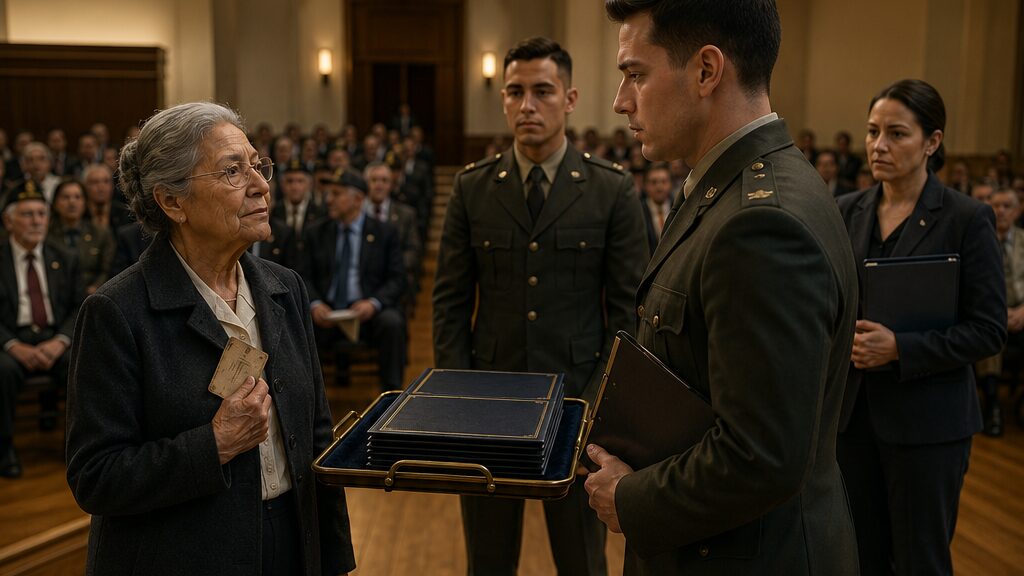
The Officer Lowered His Voice When He Read the Name on Her Old Service Card
Chapter 1: The Woman Who Was Not on the List
Margaret Rivera knew something was wrong the moment she saw the volunteer’s smile fade.
The woman had been cheerful while greeting everyone entering the civic veterans hall. She had handed out printed programs, pointed families toward rows of folding chairs, and welcomed old veterans by name.
Then she looked at Margaret’s card.
Not the old service card in Margaret’s hand.
The registration card.
Her finger stopped halfway down a list.
The smile disappeared.
“I’m sorry,” the volunteer said softly.
The noise of the hall continued around them. Chairs scraped against polished floors. Conversations drifted beneath banners hanging from the ceiling. A veterans’ choir practiced near the stage.
Margaret waited.
The volunteer checked again.
Then a third time.
“I’m not seeing your name.”
Margaret folded her fingers more tightly around the worn card she carried.
“I received a letter.”
“Do you have it with you?”
“No.”
The letter was at home in a drawer beside other papers she rarely touched.
The volunteer looked uncomfortable.
“Maybe the coordinator can help.”
Margaret nodded.
She had spent most of her life watching people become uncomfortable.
The hall smelled faintly of coffee and floor polish.
Near the stage, servicemen in formal uniforms moved between tables. A ceremonial tray rested on a stand beneath a spotlight. Folders were stacked neatly upon it.
Recognition ceremony.
Community veterans appreciation event.
Her daughter had insisted she come.
Susan had driven them across town that morning despite Margaret’s quiet attempts to avoid the trip.
Now Susan was parking the car after helping her through the entrance.
Margaret stood alone.
The volunteer hurried away.
She could have left.
The thought arrived quickly and comfortably.
Leave before anyone noticed.
Leave before explanations became necessary.
Leave before memories followed her into the room.
Instead she remained where she was.
The old service card rested in her palm.
Its edges had softened decades ago.
The photograph showed a much younger woman staring seriously into a camera.
Army Nurse Corps.
The print was faded enough that strangers often squinted before reading it.
Margaret brushed a thumb over the corner.
The card had survived moves, floods, years of neglect, and long periods when she could not bear to look at it.
Yet she had brought it today.
Not because she expected recognition.
Because something about the letter had felt unfinished.
As though a forgotten door had quietly opened.
A woman wearing an event badge approached.
Kimberly Perez.
Coordinator.
Her brisk walk suggested she had spent the morning solving problems.
“Mrs. Rivera?”
Margaret nodded.
Kimberly held a clipboard against her chest.
“There seems to be a discrepancy.”
Margaret almost smiled.
A discrepancy.
A careful word for being absent.
“I received an invitation,” Margaret said.
“I’m sure you did.”
Kimberly scanned papers.
“We have your RSVP.”
“But your name isn’t included in the final presentation roster.”
Margaret listened.
The explanation continued.
Database transfer.
Old records.
Administrative review.
Several phrases passed through the air without meaning much.
In the end the result remained simple.
Her name was missing.
“We can certainly seat you in the audience,” Kimberly said.
Margaret looked toward the rows of chairs.
Veterans sat beside spouses and grandchildren.
Some wore jackets covered with service patches.
Others sat quietly, hands folded.
A few looked as uncertain as she felt.
“That’s fine,” Margaret said.
Relief flickered across Kimberly’s face.
A solved problem.
Almost solved.
The coordinator hesitated.
“Just until we understand what happened.”
Margaret nodded again.
She had learned long ago that people often preferred agreement to truth.
Kimberly hurried away.
The hall continued moving around her.
No one was cruel.
That somehow made it worse.
Cruelty could be answered.
Procedures simply continued.
A familiar voice interrupted her thoughts.
“Mom.”
Susan appeared carrying a purse and a paper cup.
Her forehead tightened immediately.
“What happened?”
Margaret handed her the program.
Susan scanned it.
Then checked again.
The list of honorees stretched across two pages.
Not one mention of Margaret Rivera.
“Oh, no.”
“It’s all right.”
“It isn’t.”
Susan lowered the program.
“You came all this way.”
“I came because you asked me to.”
Susan laughed once.
A frustrated sound.
“You earned being here.”
Margaret looked away.
Earned.
The word always felt heavier than people intended.
“Let’s talk to somebody,” Susan said.
“We already did.”
“And?”
Margaret gestured toward the audience.
Susan’s expression darkened.
Before she could march off toward the staff tables, Margaret touched her arm.
“Don’t.”
“They made a mistake.”
“Yes.”
“So let them fix it.”
“If they can.”
Susan stared at her.
The same stare she had used as a child whenever she suspected her mother was hiding something.
Which happened often.
Margaret had spent years answering questions with partial truths.
Questions about the war.
Questions about old photographs.
Questions about why certain names never appeared in conversations.
The hall lights brightened slightly.
An announcement echoed through speakers.
The ceremony would begin shortly.
People started finding seats.
Near the stage, a young serviceman carefully adjusted the ceremonial tray.
Another officer reviewed papers beside him.
Everything looked organized.
Precise.
Prepared.
Except for one missing name.
Susan squeezed Margaret’s hand.
“I’m sorry.”
Margaret smiled gently.
“For what?”
“For bringing you.”
Margaret considered that.
Then shook her head.
“No.”
Because despite the discomfort, she was glad she had come.
She wasn’t sure why.
Only that leaving now felt wrong.
As though something unfinished still waited inside the hall.
The announcer stepped toward the microphone.
Families settled.
Veterans straightened jackets.
The ceremony began.
Margaret sat quietly near the aisle.
Halfway through the opening remarks, a volunteer approached.
He whispered something to Susan.
Then pointed toward the front.
Someone wanted to speak with Margaret.
Susan frowned.
Margaret stood.
The volunteer led her toward the stage area.
Several staff members waited near the side aisle.
Among them stood a young officer with attentive eyes and a formal posture.
He looked at a clipboard.
Then at her.
Then back at the clipboard.
When he finally spoke, his voice was polite but hurried.
“Ma’am,” he said, “who exactly are you here for today?”
Chapter 2: The Tray Was Meant for Someone Else
Daniel Martinez had been solving problems since six in the morning.
Most were small.
Missing microphones.
Incorrect seating assignments.
A veteran who needed wheelchair access.
A shipment of folders arriving late.
Those were manageable.
Names missing from the recognition roster were not.
Especially fifteen minutes into a ceremony.
He stood beside the stage trying to understand why an elderly woman had been directed toward the honoree area when her name appeared nowhere in the finalized documents.
Kimberly had already warned him.
“Just keep things moving.”
Simple instructions.
The ceremony schedule was packed.
Families had traveled from several counties.
Delays created confusion.
Confusion created complaints.
Daniel preferred avoiding both.
The woman facing him looked calm.
Almost too calm.
Most people in her situation became angry.
Or anxious.
Or eager to explain.
Margaret Rivera simply waited.
“Ma’am,” Daniel repeated, “who are you here for today?”
Her eyes settled on him.
“Myself.”
Not defensive.
Not offended.
Just factual.
Daniel glanced at the clipboard.
Nothing.
“You’re attending as a guest?”
“No.”
The answer made him pause.
Behind him, the ceremony continued.
The announcer introduced another veteran.
Applause rolled through the hall.
Daniel checked the paperwork again.
Still nothing.
“I’m trying to understand where the mistake happened.”
“So am I.”
Her voice remained gentle.
Daniel studied her.
She did not look confused.
That realization arrived unexpectedly.
He had assumed confusion the moment Kimberly mentioned an elderly attendee insisting she belonged on the recognition list.
Now he wasn’t sure.
Confused people usually rushed to explain.
Margaret did not.
She simply stood there holding something in one hand.
An old card.
Worn.
Protected carefully between her fingers.
Daniel noticed it but focused on the immediate problem.
“Do you remember receiving an invitation?”
“Yes.”
“Did it mention a specific recognition?”
“No.”
That complicated things.
Nearby, Larry King adjusted the ceremonial tray.
The tray held corrected commendation folders.
Several names had required spelling fixes earlier that morning.
Daniel had personally approved the revisions.
Everything on that tray belonged to someone.
Everything was accounted for.
Except this woman.
Kimberly appeared beside him.
Her expression said she wanted the situation finished quickly.
“Daniel?”
“I’m handling it.”
“We need to stay on schedule.”
Margaret said nothing.
Daniel felt oddly aware of her silence.
Not passive silence.
Patient silence.
As though she had spent years waiting for people to finish talking.
Kimberly lowered her voice.
“Let’s seat her with the audience and review it afterward.”
The suggestion sounded reasonable.
Daniel almost agreed.
Then he looked at Margaret again.
Something held him there.
Perhaps it was the way she kept one hand resting on the old card.
Perhaps it was the absence of frustration.
Or perhaps it was the uncomfortable feeling that everyone had already decided who she was before asking.
“Mrs. Rivera,” Daniel said carefully, “may I see that card?”
Her gaze moved to the object.
For a moment he thought she might refuse.
Instead she nodded.
The card remained in her hand.
Not offered.
Not yet.
A small gesture.
But deliberate.
Daniel realized she wanted him to ask properly.
An unexpected thought.
He adjusted his tone.
“Would you be willing to show it to me?”
The slightest change appeared in her expression.
Not quite approval.
Not quite relief.
Something softer.
She extended the card.
Daniel accepted it.
The material felt fragile.
Old.
Much older than he expected.
Army Nurse Corps.
The faded photograph caught his attention immediately.
A younger version of the woman standing before him.
Name.
Service information.
Unit designation.
Daniel read it once.
Then again.
Something about the details felt significant.
Not because of rank.
Not because of decorations.
Because the card clearly belonged here.
This was not a guest carrying a relative’s memory.
This was a veteran.
Larry stopped moving.
Daniel noticed it from the corner of his eye.
The younger serviceman stared at the card.
Then at Margaret.
Then back at the card.
The tray remained untouched beside him.
For several seconds nobody spoke.
The ceremony continued beyond the aisle.
Applause drifted through the hall.
Kimberly crossed her arms.
“What is it?”
Daniel didn’t answer immediately.
His attention remained fixed on the faded service information.
Margaret waited.
Patient again.
As though she had seen this moment before.
Not this exact moment.
But the instant when someone finally looked closely enough to realize they had missed something important.
Larry took a small step forward.
His eyes widened.
“Sir.”
Daniel looked up.
Larry rarely interrupted.
“What?”
The younger serviceman pointed quietly toward the card.
Daniel followed the gesture.
And suddenly understood why Larry had stopped moving at all.
Chapter 3: Daniel Read the Card Twice
Daniel read the card a second time because the first reading felt incomplete.
The hall around him blurred into background noise.
Announcements.
Applause.
Movement.
All distant.
The faded print remained clear.
Army Nurse Corps.
Unit designation.
Service period.
A notation he recognized from training records and historical summaries.
Evacuation operations.
Dangerous ones.
The kind discussed briefly in classrooms and forgotten afterward.
Not forgotten by the people who lived through them.
Daniel looked up.
Margaret stood exactly where she had been.
Neither demanding nor apologizing.
Waiting.
The realization unsettled him.
He had approached expecting to guide an elderly attendee away from a misunderstanding.
Instead he was standing in front of someone whose service record deserved examination he had not bothered to give.
Kimberly shifted impatiently.
“Daniel?”
He ignored the prompt.
“Mrs. Rivera.”
Her eyes met his.
“When did you last use this card?”
“A long time ago.”
The answer felt honest and incomplete at once.
Daniel glanced back down.
The photograph showed a young woman with the same steady gaze.
No smile.
No attempt to impress.
Simply present.
“What unit was this evacuation attached to?”
Margaret hesitated.
A brief pause.
Then she answered.
The unit designation matched the notation on the card.
Daniel felt a chill.
Years earlier he had studied an account involving that evacuation.
Not in detail.
Just enough to remember that casualties had been severe.
Medical personnel had remained longer than expected.
Several records were incomplete.
Larry stood quietly beside the ceremonial tray.
Watching.
The tray suddenly seemed symbolic of something Daniel could not yet define.
Recognition prepared for others while one name remained absent.
Kimberly stepped closer.
“We can investigate later.”
“No.”
The word left Daniel before he fully considered it.
Kimberly blinked.
“No?”
He looked at Margaret.
Then at the card.
Then at the printed roster.
Something fundamental felt wrong.
Not merely an administrative mistake.
A failure of attention.
“We investigate now.”
The coordinator’s jaw tightened.
“The program is already running.”
“Then it can pause.”
Her expression suggested disbelief.
The ceremony had taken months to organize.
Schedules mattered.
Timelines mattered.
But standing beside the stage, Daniel found himself wondering why they had organized a recognition event if they were unwilling to recognize someone when evidence sat directly in front of them.
Margaret spoke quietly.
“You don’t need to stop anything.”
The statement surprised him.
Most people would have welcomed intervention.
She sounded almost protective of the ceremony.
Or perhaps protective of the people running it.
Daniel realized she was offering them a way out.
A graceful path back to routine.
For a moment he understood how easily everyone could accept it.
Seat her in the audience.
Continue the program.
Review paperwork later.
Send an apology.
Move on.
The institution would remain comfortable.
The omission would become a note in a file.
And the woman would leave carrying the same card she had brought.
No.
Daniel lowered his gaze briefly.
Then looked back at her.
When he spoke again, his voice had changed.
Quieter.
Careful.
Respectful.
“Mrs. Rivera,” he said, “may I ask another question?”
A flicker crossed Larry’s face.
He had noticed the change.
So had Kimberly.
Margaret nodded.
“Why did you come today?”
The answer took longer.
The hall continued around them.
An announcer read another name.
Audience members applauded.
Somewhere near the back, a child laughed.
Finally Margaret looked toward the stage.
“I wasn’t sure I should.”
Daniel waited.
“My daughter thought I should.”
“And you decided to try.”
“Yes.”
No bitterness.
No accusation.
Just truth.
Daniel felt unexpectedly ashamed.
He had been speaking to her for only minutes.
Already she had shown more patience than the institution showing appreciation for veterans.
He examined the card again.
Then the roster.
Then Kimberly.
“Who handled archival verification?”
“The records office.”
“I want them checked.”
“Now?”
“Now.”
Kimberly exhaled slowly.
“We don’t have time.”
Daniel handed the card back to Margaret.
Not casually.
With both hands.
The gesture surprised even him.
She accepted it.
For the first time, he noticed a hint of emotion in her eyes.
Not triumph.
Not satisfaction.
Something quieter.
Perhaps relief that someone had finally looked.
Larry adjusted his grip on the ceremonial tray.
The folders rattled softly.
Daniel turned toward him.
“Stay here.”
“Yes, sir.”
Then Daniel faced Kimberly again.
The coordinator looked ready to argue.
Instead she studied his expression.
Whatever she saw there changed her mind.
“Fine,” she said.
“I’ll call the archive desk.”
Daniel nodded.
The announcer’s voice echoed across the hall.
Another name.
Another round of applause.
Yet Daniel’s attention remained fixed on the woman standing beside the aisle with an old service card pressed carefully between her hands.
A name had been missed.
Now he needed to understand how.
Daniel looked toward Kimberly.
“Pause the program after this presentation.”
The coordinator stared at him.
Then, reluctantly, she nodded.
And for the first time that morning, the ceremony stopped moving forward.
Chapter 4: The Name Missing From the Program
Susan Williams watched her mother walk into the back office as if she were entering a room where nothing could surprise her anymore.
That frightened Susan more than anger would have.
The office behind the civic hall stage had been turned into a command center. Boxes of programs leaned against one wall. Extension cords ran beneath folding tables. Half-empty coffee cups stood near stacks of folders. A printer hummed as if it had been blamed for too many mistakes already.
Kimberly Perez placed the printed program on the desk between them.
Margaret’s name was not there.
Susan had checked enough times that the page seemed almost hostile now.
Daniel Martinez stood near the door, Margaret’s old service card held carefully in a clear plastic sleeve someone from the office had found. Larry King remained just outside with the ceremonial tray, visible through the half-open door, waiting as though the tray itself had been paused with the ceremony.
Kimberly kept one hand on her phone.
“The archive clerk is searching the old roster,” she said. “But I need everyone to understand something. The public portion is already underway. We cannot simply insert a recognition without verification.”
Susan leaned forward.
“She has a service card.”
“I saw it.”
“You saw her name.”
Kimberly’s mouth tightened.
“That does not explain why she was excluded from the final program.”
Margaret sat in a chair near the corner.
Her coat was folded over her lap.
She did not look wounded.
She looked tired.
“Maybe I was supposed to be excluded,” she said.
Susan turned sharply.
“Mom.”
Margaret looked down at her hands.
“I declined once.”
The office seemed to quiet.
Daniel lifted his eyes from the card.
Kimberly lowered the phone.
Susan stared at her mother.
“What do you mean, you declined?”
Margaret smoothed the edge of her coat.
“Years ago. A veterans’ group asked for a statement. I said no.”
“A statement?”
“And a ceremony.”
Susan waited for more.
Margaret did not offer it.
That was the familiar wall.
All Susan’s life, her mother had kept certain doors closed with gentleness. Never with anger. Never with threats. Just a calm refusal that made pressing harder feel cruel.
But this time Susan could not step back.
“Did you know this might happen?”
“No.”
“But you knew there had been another ceremony?”
Margaret’s face remained composed, but her hand moved once to the service card.
“I knew they had asked.”
Kimberly picked up the program.
“If a prior recognition was declined, it may have affected the database. Some older records mark declined recognitions as closed.”
“Closed?” Susan asked.
The word struck her hard.
Her mother’s life reduced to a closed line.
Daniel moved closer to the desk.
“That would explain an omission, not justify it.”
Kimberly looked at him.
“We are not disagreeing.”
“It sounds like we are.”
A faint color rose in Kimberly’s face, but she did not answer.
The archive clerk’s voice came through the phone speaker.
“I found Rivera, Margaret. Army Nurse Corps. But there are two records attached.”
Kimberly straightened.
“Two?”
“One standard service roster. One evacuation incident file. Older scan. Poor quality.”
Margaret closed her eyes.
Susan saw it.
A tiny movement.
A door inside her mother opening just enough for pain to pass through.
Daniel saw it too.
He did not speak.
Kimberly pressed the phone closer.
“Can you print them?”
“I can send the first. The second may take a few minutes. It was cross-filed under an incident name.”
Margaret stood.
Susan reached toward her, but Margaret shook her head slightly.
Not now.
Not here.
The printer began to stir.
A single page slid out.
Daniel picked it up, read it, and became very still.
Kimberly took it next.
Her expression changed slowly.
Susan could not bear waiting.
“What does it say?”
Daniel handed her the page.
Susan read her mother’s name first.
Then the unit.
Then the brief lines describing medical support during evacuation.
Nothing dramatic.
Nothing like the stories people told in movies.
Just official phrases made colder by restraint.
Remained with wounded personnel.
Assisted transfer under hazardous conditions.
Evacuation incomplete.
Susan looked at her mother.
“Mom.”
Margaret’s gaze stayed on the floor.
The archive clerk’s voice returned through the phone.
“I found the second record.”
Kimberly gripped the desk.
“Send it.”
A pause.
Then the printer started again.
Margaret turned toward the sound as if she recognized it as something much older than paper moving through a machine.
Chapter 5: The Record No One Read Aloud
The second page came out slowly, and Margaret knew before anyone touched it that the past had found its way into the room.
It had always been patient.
It had waited in file cabinets, sealed boxes, family silences, and the stiff corners of an old service card.
Now it lay beneath a printer tray under fluorescent lights.
Daniel reached for it first but stopped.
He looked at her.
A question without words.
Margaret nodded.
He picked up the page.
The paper trembled slightly in his hand.
Not from weakness.
From care.
Margaret appreciated that more than she wanted to.
Kimberly leaned beside him.
Susan stood close enough that Margaret could hear her breathing.
The office door remained partly open. Beyond it, the ceremony had paused into confusion. Low voices drifted from the hall. Chairs creaked. Someone near the stage adjusted a microphone that gave a soft pop.
Margaret stayed seated.
She could stand through pain, ceremony, grief, and waiting.
But reading that page aloud might undo something she had spent years holding together.
Daniel read silently.
His face changed.
Not shock.
Not pity.
Something worse.
Understanding.
Margaret looked away.
On the wall, a framed photograph showed the civic hall on opening day. People smiled beneath a ribbon. The world liked clean beginnings.
The record on the desk was not clean.
“Mrs. Rivera,” Daniel said.
His voice was low again.
She did not answer.
“May I ask what you want done with this?”
Kimberly looked surprised.
Susan looked grateful and afraid.
Margaret looked at the page.
She knew what it said even without reading.
She had signed statements.
Answered questions.
Repeated details until the official version had hardened into something smaller than memory.
A night evacuation.
Wounded men lined on stretchers.
Rain against canvas.
A generator failing.
Orders changing.
A promise made beside a cot to a soldier who believed promises could still matter.
I’ll get you home.
Margaret had not known then how often life would return her to that sentence.
Susan came closer.
“What record is it?”
Margaret heard the child in her daughter’s voice.
Not a child anymore, but still wanting her mother to explain the shape of the dark.
Daniel did not read the page aloud.
For that alone, Margaret could have thanked him.
Instead she said, “It’s about the evacuation.”
Susan waited.
“I was a nurse.”
“I know that.”
“No,” Margaret said softly. “You know the word.”
Susan’s eyes filled, but she did not interrupt.
Margaret folded her hands.
“There were more wounded than we could move. We did what we could. Some made it out.”
A silence.
Then Susan asked, “And some didn’t?”
Margaret looked toward the old service card in its sleeve.
The young woman in the photograph had believed skill and will could carry everyone across a threshold.
“They told me later I saved lives.”
Her voice stayed steady.
“They were right.”
Daniel’s eyes remained on her.
“But that was not all that happened.”
The office seemed too small.
Kimberly lowered herself into a chair, no longer moving like someone managing a schedule.
Margaret could feel the years pressing at her ribs.
She almost stopped.
She had stopped many times before.
At kitchen tables.
In hospital rooms.
Beside school projects when Susan had asked why there were no war stories in their house.
But Daniel had asked what she wanted done.
Not what the ceremony needed.
Not what the record proved.
What she wanted.
That changed the weight of the room.
“There was a soldier,” Margaret said. “I promised him I would bring him home. I believed I could.”
Susan covered her mouth.
Margaret kept her gaze lowered.
“I brought others. Not him.”
No one moved.
The hall noise faded.
The printer clicked once and went silent.
Daniel placed the record flat on the desk, face down.
Margaret noticed the choice.
Not hiding it.
Resting it.
Kimberly spoke carefully.
“Mrs. Rivera, the ceremony can acknowledge your service without reading the incident details.”
Margaret looked at her.
Kimberly’s voice had lost its earlier sharpness.
“We can correct the omission.”
“Can you correct what it leaves out?” Margaret asked.
Kimberly had no answer.
Margaret did not blame her.
No program could carry the full size of a life.
No folder on a tray could hold the names not spoken.
Susan knelt beside her chair.
“I didn’t know.”
“I didn’t want you to.”
“Why?”
Margaret touched her daughter’s cheek lightly.
“Because you were mine. And I wanted you to grow up in rooms where no one was counting who could be carried out.”
Susan closed her eyes.
Margaret withdrew her hand.
Outside the office, a volunteer knocked gently.
Kimberly stood.
“Two minutes.”
The volunteer disappeared.
Daniel remained near the desk.
The old service card lay beside the printed program now.
One proved who she had been.
The other proved how easily a name could vanish.
Daniel looked at Margaret.
“If we resume,” he said, “what should be spoken first?”
Margaret did not understand at once.
He continued.
“Your name is here. Your service is here. But if there is another name that should come before the correction, I need to know.”
The question found the place where the promise had lived all these years.
Margaret looked at the face on the service card.
Then at the turned-over record.
Then toward the hall waiting beyond the door.
For a long moment, she could not speak.
Chapter 6: Before the Hall Stood Still
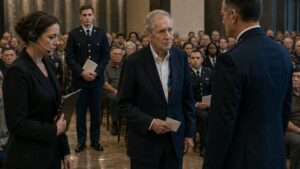
Daniel carried the tray himself when the ceremony resumed.
Larry walked beside him, hands free for the first time all morning, as if he understood that watching could sometimes be service too.
On the tray rested a corrected folder, Margaret Rivera’s old service card in its clear sleeve, and the printed program with her name written carefully in ink beside the roster.
Not elegant.
Not official enough.
But honest.
Daniel had written it himself.
Kimberly had objected only once.
Then she had found a pen.
The hall had quieted into uncertain attention.
People sensed disruption before they understood it. Veterans turned in their chairs. Families leaned toward one another. The announcer stepped back from the microphone with visible relief when Daniel approached.
Margaret stood near the side steps with Susan beside her.
She had agreed to come forward.
She had not agreed to speak.
Daniel held that distinction like an order.
He placed the tray on the stand at center stage.
For the first time all day, it did not feel decorative.
It felt entrusted.
He looked toward Margaret.
She gave a small nod.
Only then did he face the audience.
“There was an omission in today’s program,” Daniel said.
The microphone carried his voice cleanly across the hall.
No dramatic pause.
No performance.
“We are correcting it now.”
A shift moved through the room.
Kimberly stood near the front row, hands clasped.
Larry remained beside the stage, posture straight, eyes fixed on the tray.
Daniel looked down at the card.
He had read the second record only once.
Once was enough.
He had also seen a name there that had stopped him cold.
Not because it was famous.
Because it belonged to his own family history.
His grandfather had carried that evacuation in fragments. A place never fully described. A nurse never named. Men moved through rain. A promise someone kept for as many as she could.
Daniel had grown up with pieces.
He had not known Margaret Rivera was one of them.
He would not make that the center.
Not today.
Not before asking.
Respect was not taking someone’s story and making it useful to yourself.
He lifted the corrected folder.
“Margaret Rivera served with the Army Nurse Corps.”
In the front row, Susan lowered her head.
Margaret remained still.
“Her record confirms service during an evacuation in which medical personnel remained with wounded soldiers under dangerous conditions.”
The hall was utterly quiet now.
Daniel did not read further.
He did not say saved lives.
He did not say what the record implied.
He did not speak the losses aloud for people who had come expecting ceremony.
Instead he turned from the microphone.
He lifted the old service card from the tray with both hands and stepped toward Margaret.
The audience watched.
Daniel stopped before her.
Close enough to return what had always been hers.
“Mrs. Rivera,” he said softly, though the microphone still caught some of it, “we should have looked more carefully.”
Margaret’s eyes held his.
He lowered his head.
Not sharply.
Not theatrically.
A small bow of acknowledgment.
When he raised it again, his authority felt different inside him.
Less like command.
More like attention.
Margaret accepted the card.
Her fingers rested over the faded photograph.
Daniel stepped back.
Then, because she had permitted it, he returned to the microphone.
“Mrs. Rivera asked that one name be spoken before hers.”
A faint movement passed through Margaret’s face.
Daniel read the name from the note she had written in the office with Kimberly’s pen.
Not the full record.
Not the details.
Just the name.
Then he said Margaret’s name.
No applause came at first.
Only silence.
Good, Daniel thought.
Let silence do what noise could not.
Then a few hands began to clap.
Softly.
Without rhythm.
Without demand.
The applause spread, restrained and uneven, like people trying not to intrude.
Margaret stepped forward.
Daniel moved away from the microphone at once.
She stood before it.
Her old service card was in her hand.
The hall waited.
Margaret looked at the audience, then at the tray, then at Daniel.
But she did not take the microphone yet.
Chapter 7: The Quietest Honor in the Room
Margaret did not take the microphone because silence had always told the truth first.
She stood before the hall with her old service card in one hand and the corrected folder resting on the tray beside her. The faces before her were gentle, expectant, uncertain. They wanted to honor her, but they did not know how much room honor required.
For years, Margaret had feared rooms like this.
Not because of attention.
Because attention so often wanted a neat story.
A brave nurse.
A dangerous night.
Lives saved.
Applause.
Then everyone would go home feeling they had understood.
But the truth had never fit neatly inside applause.
She looked toward Susan.
Her daughter stood near the side steps, one hand pressed to her chest. There was sorrow in her face, but not accusation. That helped Margaret breathe.
Daniel waited several feet away, hands folded behind him now, no clipboard, no hurry.
Larry stood near the tray as if guarding something fragile.
Kimberly remained in the front row, the printed program folded in her lap.
Margaret finally leaned toward the microphone.
The hall leaned with her.
“For the ones who are not here,” she said.
That was all.
One sentence.
No explanation followed.
None was needed.
The audience stayed quiet for a moment longer than comfort allowed.
Then the applause returned, still soft, still uneven, but changed. It no longer pushed toward her. It seemed to make space around her.
Margaret stepped back.
Daniel did not rush forward.
He waited until she turned from the microphone of her own accord.
Only then did he lift the corrected folder from the tray and offer it to her.
Inside was not much.
A printed correction.
A copy of the roster.
A note Kimberly had added by hand, promising the public archive and veterans’ group record would be amended before the next ceremony.
Margaret read the promise twice.
Changed behavior.
Not spectacle.
She closed the folder.
“Thank you,” she said.
Daniel shook his head once.
“No, ma’am.”
He did not finish the sentence.
That was wise.
After the ceremony ended, people approached carefully.
Some touched Margaret’s hand.
Some only nodded.
A few veterans’ group members apologized in low voices. Kimberly came last, no clipboard in sight.
“I’ll make sure the record is corrected,” she said.
Margaret studied her face.
“I believe you.”
Kimberly swallowed.
“Thank you.”
Susan helped Margaret toward the side exit after the hall began emptying. The afternoon light waited beyond the doors, pale and clean. Margaret could hear chairs being stacked behind them, the ordinary sounds of a room returning to itself.
Daniel caught up just before they reached the corridor.
He did not block their way.
“Mrs. Rivera.”
Margaret turned.
He held the old service card in its sleeve.
She had not realized she left it on the tray.
For one sharp second, fear passed through her.
Then he placed it in her hands.
Not on top of the folder.
Not carelessly.
Directly into her palms.
“I thought you would want this back before you left.”
Margaret looked at the card.
The young woman in the photograph seemed less distant now.
Not healed.
Not forgiven.
Simply present.
Susan touched Margaret’s elbow.
Daniel hesitated.
“My grandfather was in that evacuation record,” he said quietly. “Not the name you asked me to speak. Another one.”
Margaret lifted her eyes.
“He came home?”
Daniel nodded.
“Yes.”
Margaret absorbed that.
A life carried forward.
A family made possible.
A young officer standing before her because someone had made it through the rain.
She looked down at the card again.
“I am glad,” she said.
Daniel’s eyes lowered.
He did not thank her for saving his grandfather.
He did not turn her into his own story.
He only lowered his head.
This time there was no audience.
No microphone.
No tray beneath a spotlight.
Only a quiet side corridor, a daughter standing close, an old card held carefully, and a young officer who had learned the difference between seeing and looking.
Margaret let the gesture rest between them.
Then she placed the service card inside her coat pocket.
Susan opened the door.
Cool air touched Margaret’s face.
Behind her, the hall lights glowed over the emptied chairs and the tray waiting to be carried away.
Margaret stepped outside without hurrying.
The story has ended.