The Quiet Reason He Returned the Old Wallet With Both Hands
Part I — The Field
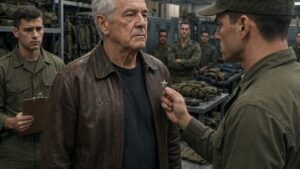
Joseph Harris had taken only six steps onto the training field before a young man in a pressed green uniform put a hand in front of his chest and said, loud enough for forty recruits to hear, “Sir, you are in the wrong place.”
The word sir had no respect in it.
It was a gate with a lock.
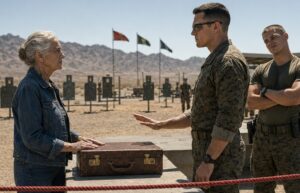
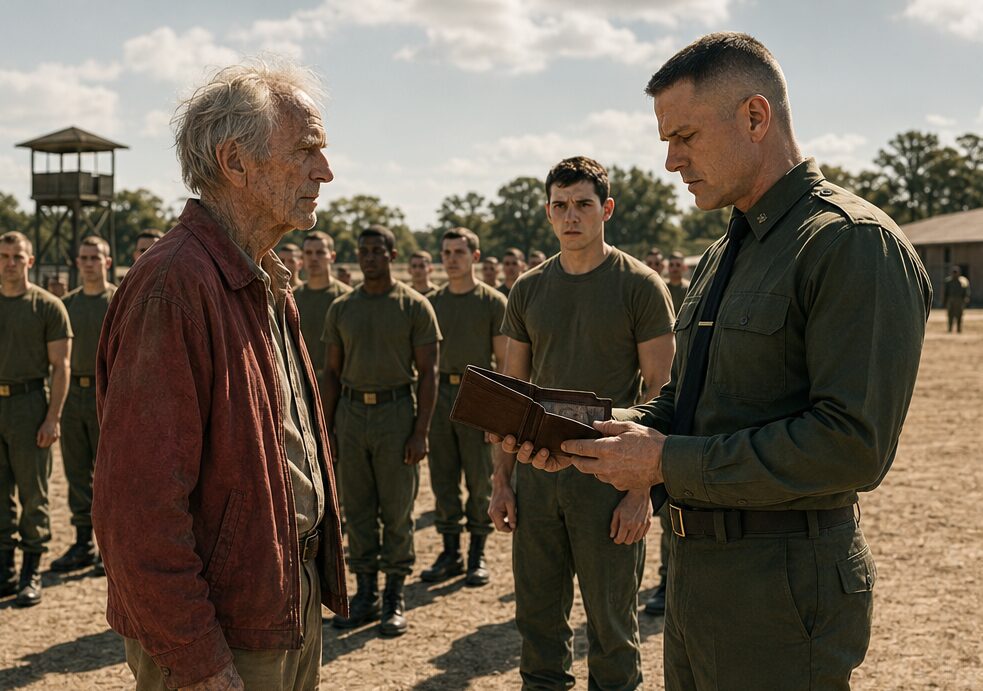
Joseph stopped in the dust. He was seventy-six, narrow through the shoulders, dressed in a faded red jacket that looked too warm for the afternoon and khaki pants that had been ironed with care but not recently. His brown shoes were polished at the toes and cracked at the sides.
Behind the young man, a platoon stood in formation under the white glare of the Georgia sun. Boots aligned. Faces forward. Chins stiff. Every one of them watched without turning their heads.
Joseph knew that trick. A man could watch without moving.
“I’m looking for Private Raymond Reed,” Joseph said.
The young man’s eyes sharpened.
The name hit him before Joseph’s face did.
“You know Private Reed?” he asked.
“I came to speak with him.”
“You don’t speak to anyone on my field without clearance.”
Joseph lifted a folded visitor pass, damp at the crease from his palm. The wind tried to catch it. His fingers trembled once, then steadied.
The young man glanced at it, not long enough to read.
“Visitor processing is behind the main office,” he said. “You walked past two signs and a guard shack.”
“I walked where they told me to walk.”
“No, you walked where you felt like walking.”
The recruits did not move. But the silence changed. It became interested.
Joseph kept his eyes on the young man’s face. The name patch over the man’s pocket read REED.
That explained the jaw. It explained the way he carried anger like a polished tool.
“Then you’re his brother,” Joseph said.
The young man stepped closer. “I am Drill Sergeant Paul Reed. And you are a civilian who wandered onto a restricted training area.”
“I’m not lost.”
“Then you’re trespassing on purpose.”
Joseph reached slowly toward the inside of his jacket.
Paul’s voice cracked across the field.
“Hands where I can see them.”
The old man froze.
Every recruit saw it. The faded jacket. The raised voice. The old hand half-buried near the heart.
Joseph brought his hand out with a worn brown wallet pinched between two fingers.
“I was only getting my identification.”
Paul took the wallet before Joseph could open it.
Not received.
Took.
The difference moved across Joseph’s face so quickly most of the recruits missed it. But Raymond Reed, standing third row back, did not.
Paul opened the wallet with the impatient flick of a man expecting the world to justify his suspicion.
Inside, there was almost nothing.
No stack of bills.
No current military ID.
No impressive credential.
Only an expired VA clinic card, a driver’s license with an old address, the folded visitor pass, a faded photograph tucked behind cloudy plastic, and a single flattened penny pressed so thin it looked like a copper leaf.
A few recruits glanced at one another.
Paul’s mouth moved into the smallest smirk.
“This is what you brought as clearance?”
Joseph looked at the open wallet in Paul’s hands.
“That penny weighs more than it looks.”
Someone in formation breathed through his nose, almost a laugh.
Paul heard it. His face hardened again, but not at the recruit.
At Joseph.
“You think this is funny?”
“No.”
“Then explain why an old man with an expired clinic card and pocket change is standing in front of my unit asking for my brother.”
Joseph’s voice stayed level.
“Because your brother wrote to me.”
Paul’s grip tightened around the wallet.
From the third row, Raymond’s eyes shifted.
Only once.
But Paul saw it.
Part II — The Empty Wallet
Paul turned toward the formation.
“Private Reed.”
Raymond stepped forward, boots striking dust.
“Yes, Drill Sergeant.”
“Do you know this man?”
Raymond looked at Joseph. He was twenty-two and trying not to look like twenty-two. His uniform still held the shape of storage folds. His face was his brother’s face before it had learned how to close.
“I know his name,” Raymond said.
Paul did not like that answer.
“That was not what I asked.”
Raymond swallowed. “No, Drill Sergeant. I’ve never met him.”
Paul turned back to Joseph. “So you came here pretending to know my brother.”
“I said he wrote to me.”
Raymond’s voice came carefully. “I did.”
The field seemed to stop making sound.
Paul’s eyes stayed on Joseph, but the anger in them shifted direction. “You wrote to him?”
“Yes, Drill Sergeant.”
“Why?”
Raymond said nothing.
Paul gave a short laugh with no humor in it. “Private, you are six days from movement orders, and you thought this was a good time to invite some stranger to the training range?”
“He isn’t a stranger.”
Paul held up the wallet. “This is not a man you know. This is a man with an old card, no cash, and a story.”
Joseph’s eyes lifted then.
Not angry.
Worse.
Disappointed.
“Don’t judge a life by what it has left in leather,” he said.
Paul’s face went still. “You don’t get to talk to me about judgment on my field.”
“It isn’t your field.”
The line landed softly.
That was why it cut.
Paul stepped close enough that Joseph could see the pale scar under his chin where a razor had likely caught him years ago.
“You are done here,” Paul said. “I’ll have security escort you out.”
“I’ll leave after I speak to Raymond.”
“You’ll leave when I say.”
Joseph looked past him, toward Raymond. Not pleading. Measuring the distance.
“He needs to know what kind of order a man should refuse.”
The words did something to the formation.
No one moved, but discipline tightened into discomfort.
Paul’s voice dropped. “Say that again.”
Joseph’s hands hung at his sides, empty now. “No.”
Paul stared at him.
For the first time, he looked less certain that he understood the old man in front of him.
A white security truck rolled slowly along the edge of the field, tires crunching gravel. Two guards got out. One of them rested a hand near his radio. The other looked at Joseph, then at Paul, waiting to be told what kind of problem this was.
Paul raised the wallet slightly.
“What’s the penny for?”
Joseph did not answer.
Paul pulled the photograph from behind the plastic.
It was faded almost to brown. Two young men stood beside a transport truck, sleeves rolled, faces thinner than they should have been. One held a metal cup. The other wore a grin that seemed borrowed from a better day.
Paul stared at it.
The air changed before his expression did.
Raymond saw it first.
“Paul?” he said.
Paul did not correct him for using his name.
He looked from the photograph to Joseph’s face.
Then back.
The younger man in the photo had Paul’s jaw.
Raymond’s eyes.
Their father’s mouth.
Paul’s voice came out flat. “Where did you get this?”
Joseph said, “Your father gave it to me.”
Paul slipped the photo back into the wallet as if the paper had burned him.
“My father has been gone eleven years.”
“I know.”
“You don’t know anything about my father.”
Joseph’s fingers curled once. He hid it by resting his hand against his thigh.
“I knew him before either of you did.”
Raymond took half a step out of line.
Paul snapped, “Back in formation.”
Raymond stopped.
But he did not step back.
Part III — The Name in the Photograph
The guards had come close enough to hear.
Paul noticed and turned on them. “Stand by.”
They stopped at once.
Joseph looked toward the guard shack, then the barracks, then the low admin building beyond the field.
“You moved the east gate,” he said.
Paul looked at him.
“Used to be nearer the motor pool,” Joseph continued. “Old route ran behind the mess hall. If a man was late, he cut across this field and hoped nobody with stripes had coffee in him yet.”
A few recruits looked down to hide their reaction.
Paul did not.
“How would you know that?”
Joseph gave the smallest shrug. “A place keeps its bones.”
Paul wanted to dismiss it. Joseph could see that. Men trained to command often disliked facts that arrived from the wrong mouth.
Raymond spoke again, quieter this time.
“Dad had a letter.”
Paul turned. “What?”
“In the cigar box Mom kept in the closet. The one with his patches.” Raymond’s throat moved. “There was a name on the back of an envelope. Joseph Harris.”
Paul’s face lost color slowly.
“You went through Dad’s things?”
“After the orders came.”
“You had no right.”
“I’m his son too.”
That line hit harder than Raymond meant it to. Paul flinched, and Joseph saw the boy inside the drill sergeant for a breath.
Then the field took him back.
Paul faced Joseph. “What did you tell him?”
“Nothing yet.”
“Good. Keep it that way.”
“I made a promise.”
“To who?”
Joseph looked at the photograph in the wallet still trapped in Paul’s hand.
“To Donald Reed.”
Paul’s father’s name, spoken in Joseph’s quiet voice, sounded different than it did in ceremonies, in family stories, in framed commendations.
It sounded like a man. Not a legend.
Paul’s anger came back fast because it had nowhere else to go.
“You do not walk onto my field and use my father’s name to get attention.”
Joseph did not blink. “I walked onto this field because your brother asked me to come.”
“And why would he do that?”
Raymond answered before Joseph could.
“Because Dad wrote that if either of us served, Mr. Harris would know what to tell us.”
Paul turned slowly toward him.
Raymond’s face had gone pale, but he kept speaking.
“There was no message. Just that. A name and one sentence. I tried to find him. The address was old. The VA forwarded a letter.”
Paul looked at Joseph with something close to hatred. Not hatred for the man, maybe. Hatred for the crack opening under his feet.
“What did my father want you to tell him?”
Joseph looked at Raymond.
Then at the recruits.
Then at Paul.
“Not in a hallway,” he said. “Not behind a closed door where it can be made smaller.”
Paul laughed once. “You think you get an audience?”
“No,” Joseph said. “I think the lie already had one.”
That was when Captain Stephanie Grant arrived.
She crossed the field with a folder under one arm and a controlled expression that said she had solved worse situations by refusing to let them become situations.
“Drill Sergeant Reed,” she said, “why is there a civilian on the line?”
Paul did not immediately answer.
Joseph noticed that.
So did Stephanie.
Her gaze dropped to the wallet in Paul’s hand.
“Sir,” she said to Joseph, not warmly, “you’ll need to come with me.”
Joseph held out his hand.
“My wallet first.”
Paul looked down as if surprised he still held it.
For one second, Joseph thought he might return it.
Instead Paul kept it.
“Not until I know what game you’re playing.”
Joseph’s open hand stayed in the air.
Empty.
Then it lowered.
Stephanie’s eyes sharpened at the gesture. “Drill Sergeant.”
Paul’s jaw tightened.
He handed her the wallet.
That hurt more than if he had thrown it.
Joseph did not show it.
Stephanie opened the wallet, checked the visitor pass, the license, the expired VA card. Her professionalism almost hid the pause when she saw the photograph.
Almost.
“You were with Colonel Reed?” she asked.
Paul looked at her. “You knew him?”
“I know the archive,” Stephanie said.
That was not the same answer.
Joseph heard the carefulness in it.
So did Paul.
Part IV — The Line on the Page
Stephanie closed the wallet but did not return it.
“We can discuss this inside,” she said.
“No,” Joseph said.
The captain’s expression did not change. “Mr. Harris, this is not a request.”
“I’ve heard that sentence before.”
Paul stepped in. “You’ll answer the captain.”
Joseph turned to him. “I answered captains before you were born. Some deserved it.”
A low current passed through the unit.
Paul’s face tightened, but Stephanie lifted one hand.
“Drill Sergeant,” she said quietly, “a word.”
They moved three steps away. Not enough.
Joseph had spent too many years around men who thought distance made truth private.
Stephanie lowered her voice. “This name is attached to Silver Gate.”
Paul’s eyes narrowed. “What is that?”
“An evacuation file. Old. Complicated.”
“Why do you know it?”
“Because your father’s name is on it.”
Paul looked toward Joseph.
Joseph stood in the sun, red jacket faded at the shoulders, both hands now clasped in front of him. He looked poor. He looked tired.
He also looked like a man waiting for others to finish pretending.
Stephanie continued, “The official record lists Harris as insubordinate during convoy withdrawal.”
“Then remove him.”
“It also lists six recovered personnel after his unauthorized return.”
Paul’s mouth opened slightly.
Stephanie looked at the formation, then at the guards. “This is exactly the kind of thing that should not happen in front of recruits before deployment.”
Joseph’s voice carried over the gap.
“If truth weakens them, you trained them wrong.”
Stephanie turned back.
Paul did not.
His eyes were still on the wallet.
“Unauthorized return,” he said.
Stephanie’s voice stayed clipped. “The report says command believed the road was no longer viable. A medical team was stranded past the rail bridge. Colonel Reed—then Captain Reed—ordered withdrawal. Harris went back.”
Raymond’s face changed.
“Dad ordered them left?”
Paul snapped, “Private Reed, hold your position.”
Joseph said, “Your father gave a lawful order.”
No one expected him to defend Donald Reed.
That made the sentence heavier.
“He was young,” Joseph continued. “Younger than you are now, Paul. He had command yelling in one ear, smoke over the road, and men waiting for him to be certain. Certainty is expensive when you don’t have any.”
Paul stared at him. “And you disobeyed.”
“I drove back.”
“With permission?”
“No.”
“Then the report was true.”
“The report was clean,” Joseph said. “That isn’t the same thing.”
The recruits were no longer pretending not to listen. They were still in formation, but the field had become something else. A classroom without benches. A room without walls.
Stephanie’s face warned Joseph to stop.
He did not.
“There were six people at the clinic. Two medics. Three locals working under our protection. One translator with half a map in his head and more courage than most officers I knew. The order came down that the road was gone. But I had driven that road twice that morning. It wasn’t gone. It was ugly.”
Paul’s voice was tight. “You’re saying my father left them.”
Joseph looked at him for a long second.
“I’m saying your father believed the men above him.”
“And you didn’t.”
“I believed the road.”
That was the first line Raymond would remember years later.
Not because it was brave.
Because it was simple.
Paul’s anger had changed texture now. Less flame. More fracture.
“If you saved six people,” he said, “why did the report make you the problem?”
Joseph glanced at Stephanie.
The captain looked away first.
Joseph smiled faintly, without pleasure.
“Because somebody had to be.”
Part V — The Penny
Raymond stepped fully out of formation.
This time Paul did not order him back.
“I found another page,” Raymond said.
Paul closed his eyes briefly.
Raymond kept going. “It was in Dad’s handwriting. Just one line. ‘If my boys ever wear the uniform, find Joseph Harris before they learn to love being obeyed.’”
The field went silent in a different way.
Paul turned on his brother. “Why didn’t you show me?”
“Because you would have told me not to look.”
Paul’s face changed as if Raymond had raised a hand to him.
Joseph felt no satisfaction. The truth had teeth on both sides.
Stephanie opened the wallet again. She removed the faded photo and studied it.
In the picture, Joseph had been twenty-nine. Donald Reed stood beside him, grinning like a man who still thought tomorrow would make sense. Joseph remembered the smell of diesel, rain burning off hot metal, Donald’s hand shaking when he passed over the penny.
Not after the rescue.
Before the report.
At a rail station three weeks later, when Donald Reed had found him sitting on a bench with orders in his pocket and disgrace already typed into his file.
Donald had pressed the penny into Joseph’s palm.
“They sell these in a machine by the ticket window,” Donald had said, trying to smile. “My son likes trains. He’s two. Doesn’t know what a coward is yet.”
Joseph had said, “You weren’t a coward.”
Donald’s eyes had filled so fast Joseph looked away.
“I signed it.”
“You had a family.”
“So did you.”
Joseph had not answered.
His wife had already stopped opening letters from him.
Donald had folded Joseph’s fingers around the penny.
“If my boys ever serve, tell them this for me. Don’t let them become the kind of men who need the world to approve of them before they know what’s right.”
Joseph had kept the penny.
Not because Donald was noble.
Because he had been broken enough to tell the truth.
Now Paul stood in the dust, holding the edge of a story he had spent his whole life polishing without knowing where the cracks were.
“My father built his career after that,” Paul said.
“Yes.”
“And you let him.”
“Yes.”
“Why?”
Joseph looked at Raymond first. Then at Paul.
“Because he had a child. Then another. Because he was ashamed. Because I was angry. Because the men above him needed the file closed. Because sometimes a man tells himself silence is mercy when it is only exhaustion wearing better clothes.”
Paul looked down.
For the first time, he seemed younger than his rank.
Stephanie stepped closer to Joseph and held out the wallet.
“Mr. Harris,” she said, softer but still careful, “this needs to be handled properly.”
Joseph did not take it.
“I gave them my name once,” he said. “I won’t give them my memory.”
Stephanie’s hand remained extended.
Paul looked at the wallet in her hand. Then at Joseph’s empty hand. Then at the recruits who had watched him take it.
He understood.
Not everything.
Enough.
“Captain,” Paul said.
Stephanie did not look at him. “Drill Sergeant, do not make this larger.”
“It’s already larger.”
“This unit deploys in six days.”
“Then they should hear it now.”
Stephanie’s mouth tightened. “You are emotionally compromised.”
Paul almost laughed.
Instead he said, “Yes, ma’am.”
Then he reached for the wallet.
Stephanie hesitated.
That hesitation told the whole field where the institution stood.
Paul took the wallet from her, turned, and walked back to Joseph.
But he did not hand it over yet.
He held it at chest height, both palms underneath, as if he had finally noticed it was heavier than leather.
“Tell him,” Paul said.
Joseph looked at Raymond.
Raymond’s eyes had gone wet, but he did not lower them.
“Your father was not a coward,” Joseph said.
Raymond’s breath broke.
“He was afraid,” Joseph continued. “Those are not the same thing.”
Paul’s shoulders shifted as if something had struck him between them.
Joseph turned slightly so the formation could hear without him raising his voice.
“Fear comes for every man. Rank doesn’t stop it. Training doesn’t stop it. A clean record doesn’t stop it. Your father received an order that made sense on paper. On paper, the road was closed. On paper, the clinic was gone. On paper, six people had become acceptable loss.”
He paused.
Dust moved across his shoes.
“But paper was not sitting in that truck.”
No one breathed loudly now.
“I went back because I had seen the road. I came back because men were waiting. Your father signed what he signed because command needed the story neat and because shame can make a man obedient after the danger is over.”
Paul’s eyes closed for a second.
Joseph reached into the wallet and removed the pressed penny.
It looked too small for the moment.
That was why it worked.
He held it out to Raymond.
Raymond stepped forward.
Paul did not stop him.
“Your father gave me this at a train station,” Joseph said. “He told me to find his sons if they ever wore the uniform.”
Raymond opened his palm.
Joseph placed the penny there.
“He said, ‘If my boys ever serve, tell them not to confuse being approved with being honorable.’”
Raymond closed his fingers over it.
Not tightly.
Carefully.
As if the penny might bruise.
Part VI — Both Hands
For a long moment, nobody corrected anyone.
No one told Raymond to return to formation.
No one told Joseph to leave.
No one told the recruits to face front.
Stephanie held her folder against her side and looked out across the field as if the horizon required her attention.
Paul stood before Joseph with the wallet still in his hands.
The old man looked at it.
Paul saw the mistake again: his own fingers taking it, the open wallet held up as proof of nothing, the smirk he had let the recruits see.
It was not just rudeness.
It was repetition.
A file had once reduced Joseph Harris to insubordinate.
Paul had reduced him to trespasser.
Different paper. Same violence.
Paul stepped closer.
This time, he did not thrust the wallet out.
He placed it into Joseph’s hands with both of his own.
“Sergeant Harris,” he said.
The words did not ring.
They settled.
Joseph’s fingers closed around the wallet.
His face did not change much. Men who had spent decades learning not to ask for recognition did not always know what to do when it arrived.
But his thumb moved once over the cracked leather.
That was enough.
Raymond looked at his brother.
Paul did not look back. Not yet.
He kept his eyes on Joseph.
“I was wrong,” Paul said.
Joseph studied him.
“Yes.”
A recruit somewhere in the second row swallowed hard.
Paul almost smiled at the bluntness. Almost.
Joseph put the wallet inside his jacket with the same care he had used before it was taken. The pocket sagged with its small weight.
Stephanie came forward. “Mr. Harris, I can arrange a room if you’d like to make a fuller statement.”
Joseph shook his head. “I didn’t come for a statement.”
“The file can be reviewed.”
“The file can learn to live with itself.”
Stephanie had no answer for that.
Raymond stepped closer, still holding the penny.
“Can I write to you?” he asked.
The question sounded younger than he probably wanted it to.
Joseph looked at him, and something in his face softened enough to hurt.
“If you write,” he said, “write what you mean. Don’t send a man polished words when plain ones cost more.”
Raymond nodded.
Paul cleared his throat. “I can walk you back.”
Joseph looked at the field, then the guard shack, then the long path back under the sun.
“I walked in.”
“I know.”
Joseph looked at Paul’s offered arm.
There was no apology in the gesture, not fully. It was too small for what had been done and too large for Paul to make without effort.
Joseph took it.
The field watched the old man place his hand on the young man’s sleeve.
After three steps, Joseph stopped.
Paul stopped with him.
Joseph’s hand moved from Paul’s arm to his wrist, light but deliberate.
“Don’t lower your voice when the truth needs it,” Joseph said. “Lower it when a man is already ashamed.”
Paul looked down.
“Yes, Sergeant Harris.”
Joseph released him.
They walked the rest of the way in silence.
Behind them, Raymond returned to formation with the penny in his closed hand.
Stephanie stood still for another moment, then gave the smallest nod to Paul.
Not permission.
Acknowledgment.
Paul faced the platoon.
The same recruits who had watched him take the wallet now watched him try to carry what came after.
He inhaled.
“Formation,” he called.
His voice still reached the far edge of the field.
But it no longer struck first.
“Eyes front.”
Boots shifted.
Chins lifted.
Raymond stood among them, not less afraid than before, but differently afraid.
Joseph reached the edge of the field and turned once.
He did not wave.
He did not salute.
He only touched the outside of his jacket where the wallet rested, then continued toward the gate with the slow, steady pace of a man who had not recovered the years, but had recovered the right to name them.