The Coffee He Kept Waiting To Share At Table Twelve
Part I — The Man at the Reserved Table
Joseph had been sitting at Table 12 for forty-three minutes before Brandon decided he looked like a problem.
Not a loud problem.
That might have been easier.
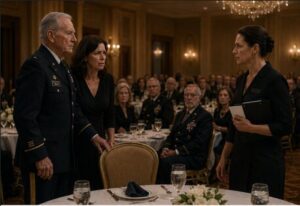
He was the kind that made people lower their voices: an old man in a faded green field jacket, broad in the shoulders but worn thin everywhere else, one hand resting beside a white coffee cup he had not touched. His hair was cut close to his skull. His forearms were marked with tattoos gone soft and blue beneath loose skin. In his left hand, he held a chipped coin that caught the café lights whenever his thumb moved over it.
Rachel stood beside him with the check folder pressed against her black apron.
“Sir,” she said, keeping her voice low, “I’m sorry, but this dining room is reserved in twenty minutes.”
Joseph did not look at the reserved sign.
He looked at the chair across from him.
“I’m waiting on someone.”
Rachel glanced at the empty chair. “Do you know when they’ll arrive?”
His thumb stopped moving over the coin.
“He’s late.”
The answer was so flat that Rachel had no idea whether to apologize or call someone. Around them, the café kept doing what expensive cafés did best. Cups clicked. Chairs whispered over polished floorboards. Men in tailored jackets laughed too softly over lunch menus that cost more than Rachel made in an hour.
Table 12 sat by the front window.
It was also in the middle of the section Brandon needed cleared for the private luncheon.
Rachel looked down at the check folder. One black coffee. Exact change.
And under the saucer, folded once, was an old dollar bill.
The bill looked too deliberate to be forgotten.
Rachel reached for it.
Joseph’s hand moved before she touched the saucer.
Not fast. Not rough.
Just enough.
“Not yet,” he said.
Rachel froze.
Across the dining room, Brandon saw the movement.
He had been standing near the bar with a tablet in one hand and irritation in the other. He wore a dark suit, crisp white shirt, and the kind of watch that made people assume he owned more than he did. His smile was ready for donors. It disappeared as he crossed the room.
“Rachel,” he said, “is there a problem?”
“No,” she said too quickly. “I’m handling it.”
Brandon looked at Joseph the way managers looked at spills.
“Sir, we’re preparing for a private event. I’m going to need this table.”
Joseph kept his eyes on the cup.
“I already paid for it.”
Brandon blinked. “For the coffee, yes. Not for the entire dining room.”
A few customers turned their heads.
Rachel felt heat rise into her face.
Joseph did not.
He sat with the coin in his hand and the untouched cup before him like both things were holding him in place.
Brandon leaned closer. His voice stayed smooth, which somehow made it worse.
“This isn’t a shelter. We have actual guests arriving.”
Rachel’s stomach tightened.
Joseph looked up then.
Not angry.
Not surprised.
Just old in a way that made the insult hang in the air longer than Brandon intended.
“I’ll leave when he gets here,” Joseph said.
Brandon’s jaw tightened. “Who?”
Joseph’s eyes moved back to the empty chair.
“The man who bought the coffee.”
The line made no sense.
That was what made Rachel stay.
Part II — Not Yet
Brandon told Rachel to clear the table.
He did it quietly, but not kindly.
“We don’t have time for this,” he said near the service station, where the sound of steaming milk almost covered him. “Move him to the counter. Box up a pastry if you have to. Do not let this become a scene.”
Rachel looked back at Joseph.
He had turned the cup a fraction, aligning the handle toward the empty chair.
“He doesn’t seem dangerous,” she said.
Brandon gave her a polished, disappointed look. “That is not the standard.”
The private luncheon was for the Henderson Veterans Foundation, a donor-heavy afternoon of speeches, framed photographs, and carefully plated chicken. The café sat three blocks from a military hospital, close enough that men and women with old limps and new dress shoes came in often. Brandon liked the foundation events because they photographed well.
He did not like anything that could not be arranged.
Rachel went back to Table 12.
Joseph did not look at her until she slid into the chair across from him.
That was the first mistake.
She knew it as soon as Brandon’s eyes lifted from across the room.
Still, she sat.
“Who are you waiting for?” she asked.
Joseph studied her face, then her name tag.
Rachel Carter.
His expression shifted so slightly she almost missed it. His thumb pressed the coin until his knuckle whitened.
“You related to Andrew Carter?”
The name hit her under the ribs.
Rachel’s father had been dead since she was three years old. She had grown up with a framed photograph, two folded uniforms in a storage bin, and people who lowered their voices when they said he had been brave.
She had no memory of his voice.
Only other people’s versions of it.
“What did you say?” she asked.
Joseph’s gaze moved away from her.
“Nothing.”
“No, you said his name.”
He closed his hand around the coin. “I shouldn’t have.”
Rachel’s throat tightened. “Did you know him?”
Joseph looked at the cup.
Not her.
The silence was not empty. It was barricaded.
Before she could ask again, Brandon appeared at her shoulder.
“Rachel,” he said sharply, loud enough for three nearby tables to hear, “do not get emotionally recruited by every lonely old man with a story.”
Rachel stood so fast the chair legs scraped.
Joseph heard every word.
He did not defend himself.
That made it worse.
Because if he had snapped back, if he had cursed or made himself impossible, Rachel could have put him in the category Brandon had already chosen for him. Difficult. Confused. Someone else’s job.
But Joseph just sat there.
Like he had been insulted before and had learned not to spend breath proving he was human.
Rachel swallowed. “I’ll get him another coffee.”
“No,” Brandon said.
Joseph finally looked up. “She can decide that.”
Brandon’s expression hardened.
Rachel turned before either man could say more. She walked to the counter, poured a fresh black coffee with hands that were steadier than she felt, and carried it back.
When she placed it before Joseph, he noticed the faint tremor in her fingers.
“You don’t have to apologize for doing something decent,” he said.
It was the first gentle thing he had said.
Rachel almost hated him for it.
Because he still had not told her how he knew her father’s name.
Part III — The Photograph in the Stack
The first donors arrived eleven minutes early.
They came in polished groups: pressed jackets, soft scarves, foundation pins on lapels, solemn smiles prepared before they reached the door. Brandon’s posture changed instantly. His shoulders opened. His voice warmed. He became the kind of man who could say “service” and “gratitude” as if both words belonged to him.
Joseph watched the room fill.
He did not move.
Rachel kept glancing at him while she carried water glasses to the luncheon tables. Each time she passed, something at Table 12 had shifted by a hair. The cup handle. The saucer. The folded bill. The empty chair.
It looked less like waiting now.
It looked like setting a place.
Near the host stand, Timothy, Brandon’s son, balanced a tablet against a stack of framed photographs. He was twenty-four, sleeves rolled to his elbows, nervous in the way young men got when they wanted to be useful but not noticed.
“Dad,” Timothy said.
Brandon did not look up. “Not now.”
“There’s a name on the seating list.”
“Then seat them.”
“No, it’s—” Timothy lowered his voice. “Joseph Miller.”
Brandon’s eyes flicked toward Table 12. “He’s not with the donors.”
“How do you know?”
“Because he came in alone and paid in coins.”
Timothy hesitated. That hesitation was small, but Rachel saw it.
Brandon took the top photograph from the stack, checked the frame, and held it out toward Timothy. “Put these by the projector table. And don’t make me manage you too.”
Timothy looked down at the photo.
Then he stopped.
Rachel had just set down a pitcher when she saw his face change.
“What?” she asked.
Timothy turned the frame toward her.
The photograph was old, sun-faded at the edges. In it, a group of men stood outside a field aid station somewhere dusty and bright. Their clothes were creased, their faces tired, their smiles uneven.
Rachel recognized her father from the photo on her mother’s dresser.
Andrew Carter.
Younger than she ever got to know him. One arm slung around a man with heavy brows and a medic’s bag at his hip.
The older version of that man was sitting twelve feet away from her.
Rachel felt the room narrow.
Joseph saw her holding the frame.
For a moment, he looked ready to stand.
Then he stayed seated.
That hurt more.
Rachel carried the photograph to him.
“Why didn’t you say?” she asked.
Joseph looked at the younger Andrew in the frame. His hand loosened around the coin.
“Because a picture doesn’t tell you what a man cost.”
Rachel flinched. “What is that supposed to mean?”
His eyes lifted to hers.
He looked more tired than stern now.
But he still did not answer.
Behind her, Brandon appeared again, irritation breaking through his donor smile.
“Rachel, this is not the time.”
She did not look away from Joseph. “Did you know my father?”
Joseph’s mouth worked once before sound came out.
“Yes.”
The word was small.
Too small for the space it opened.
Rachel heard her own breathing.
“Was he brave?”
Joseph looked at the empty chair.
Too long.
Far too long.
Then he said, “He was tired.”
Rachel stared at him.
The words struck wrong. They landed in the place where all her clean, polished stories about her father had been kept safe. Brave was allowed. Heroic was allowed. Selfless was allowed.
Tired felt human.
Human felt dangerous.
“That’s what you came here to say?” she whispered. “You show up at my job, say his name, sit there like you own the place, and that’s what you give me?”
Joseph took the blow without moving.
“He was tired,” he said again, quieter. “And he kept going.”
But Rachel had already stepped back.
For the first time, anger steadied her.
“You don’t get to take the only good thing I have and make it smaller.”
Joseph’s face closed.
Brandon seized the silence.
“That’s enough,” he said. “Sir, you’re upsetting my employee. I’m going to ask you one last time to leave before the people who actually support veterans arrive.”
The sentence emptied the room.
Not of sound.
Of excuse.
Timothy looked at his father as if he had finally heard him clearly.
Joseph slowly set the chipped coin on the table.
Then he touched the inside of his jacket, where something flat rested beneath the fabric.
Rachel saw the movement.
So did Timothy.
Brandon saw only an old man refusing to obey.
Part IV — The Page He Carried
Rachel found Joseph near the service station five minutes later.
He had not left Table 12. He had only stood to let Brandon rearrange chairs nearby, then returned to his seat before anyone could claim it. The donors were being guided into the private room now, the sound of their greetings muffled by heavy glass doors.
The café felt divided.
On one side, public gratitude.
On the other, an old man with a cold cup of coffee.
Rachel stopped beside him. “Why did you ask about my father?”
Joseph slid one hand inside his jacket.
Rachel stiffened.
He noticed. His face tightened, but he moved slowly.
What he took out was not a weapon. Not a wallet.
A small field notebook wrapped in a plastic sleeve.
Its corners were softened. Its cover had faded from green to a grayish brown. A black elastic band held it shut.
Joseph placed it on the table but did not push it toward her yet.
“I carried this too long,” he said.
Rachel’s anger faltered. “What is it?”
“His.”
The word changed the air between them.
Rachel did not reach for it.
She wanted to.
She was afraid to.
Joseph opened the notebook with two careful fingers. He turned pages filled with cramped handwriting, numbers, initials, short lines that looked like they had been written in moments stolen from chaos.
Then he stopped.
Near the middle, one page had been folded down.
Rachel leaned closer.
The handwriting was uneven but clear.
One black. One cream. Table by a window when we get home. My treat.
She read it twice.
The first time, it made no sense.
The second time, she looked at the two chairs.
Joseph tapped the page once. “He wrote that after three straight days without a chair.”
Rachel said nothing.
“That was what he wanted. Not a medal. Not a speech. A clean cup. A real table. A window. He said he’d buy.”
Her throat closed.
Joseph’s eyes stayed on the page. “I told him he was cheap if coffee was all I got for dragging him through half a bad week. He said he’d add pie if I stopped complaining.”
A breath that might have been a laugh broke and disappeared.
Rachel touched the plastic sleeve.
“What happened?”
Joseph’s hand closed around the edge of the notebook.
Not to take it back.
To hold himself in place.
“There was an evacuation,” he said. “Too many people. Not enough time. Your father stayed on the radio and kept talking the last vehicles through.”
Rachel knew she should not want details.
She wanted all of them.
“He saved people?”
Joseph nodded once. “Three men who couldn’t walk. Two drivers who didn’t know the road. Me.”
“You?”
His jaw tightened. “I was supposed to go back.”
The café noise felt far away.
“I didn’t.”
Rachel waited for more, but Joseph’s silence returned. Not cold this time. Damaged.
She looked at the page again.
One black. One cream.
Her father’s handwriting. Her father’s joke. Her father as a man who had once wanted a cup of coffee by a window.
Not a framed hero.
A person.
The realization hurt.
Joseph pushed the notebook toward her at last.
“He said, ‘Tell my girl I kept my promise.’”
Rachel’s eyes burned.
“I was three.”
“I know.”
“You waited all this time?”
Joseph did not defend it.
“I told myself you had a life. I told myself your family had enough grief. I told myself silence was kinder.”
“And was it?”
His fingers trembled beside the cup.
“No.”
The answer was immediate.
That made it worse.
The private room doors opened. A ripple of applause drifted out from the luncheon. Someone had begun welcoming guests, thanking them for honoring sacrifice and service.
Rachel looked through the glass.
Brandon stood at the front, smiling.
Joseph did not turn.
He looked at the folded bill beneath the saucer.
“I come every year,” he said.
Rachel stared at him.
“To this café?”
“To wherever I can find a table by a window.” He adjusted the cup handle again, toward the empty chair. “One coffee. One place set. His share under the cup.”
Rachel looked at the bill.
It was not a tip.
It had never been a tip.
“Why this place?” she asked.
Joseph looked at her name tag.
“Because this year, you were here.”
Part V — The Cup No One Could Clear
Brandon came back with his donor smile gone.
He had lasted nine minutes in the private room before his own discomfort dragged him out. Timothy followed a few steps behind, holding the framed photograph like evidence he had not decided how to present.
“Mr. Miller,” Brandon said, and now he used the name because he had learned it mattered to other people, “we can offer you a private space. A meal. No charge. We can even introduce you during the remarks if that would be appropriate.”
Joseph looked up at him.
“I didn’t come to be introduced.”
Brandon’s smile tightened. “I’m trying to make this right.”
“No,” Joseph said. “You’re trying to make it quiet.”
Timothy lowered his eyes.
Rachel stood beside Joseph, the notebook held against her chest.
She wanted him to go into the luncheon room. She wanted every polished guest to see him. She wanted Brandon to stand there and understand exactly who he had tried to remove.
But Joseph’s hand rested near the cup.
Not pleading.
Guarding.
“Maybe they should hear it,” Rachel said softly.
Joseph looked at her, and for the first time there was something like fear in his face.
“Some things aren’t owed to a room because they paid for lunch.”
The sentence stopped her.
Because she had wanted justice.
But she had almost mistaken it for exposure.
Brandon exhaled through his nose, patience thinning. “This table has to be reset.”
“No,” Rachel said.
Brandon turned on her. “Rachel.”
Joseph’s fingers moved toward the folded bill.
Brandon reached for the cup first.
It happened quickly.
His hand closed around the saucer, intending to clear it, smooth it away, make the table useful again.
Joseph caught his wrist.
The dining room went still.
Not violently. Not dramatically. His old hand simply wrapped around Brandon’s wrist with a precision that seemed to come from another life.
Brandon froze.
“Let go,” he said.
Joseph held him for one second longer.
Long enough for every person nearby to see that the old man was not confused.
Long enough for Brandon to understand he had crossed a line he had not known existed.
Then Joseph released him.
He took the folded bill himself.
His fingers shook now.
He lifted the saucer, placed the bill beneath it with care, and set the cup back down.
Then he turned the empty chair slightly toward Rachel.
“Your father bought this coffee.”
Rachel’s breath broke.
Joseph kept his eyes on the cup, as if he could not survive looking at her while he said the rest.
“He told me to tell you he kept his promise. I didn’t. Not when your mother wrote asking for names. Not when the foundation called years later. Not when I found your graduation notice in the paper.”
Rachel gripped the notebook.
“I thought coming home was the thing I had to answer for,” Joseph said. “So I answered by staying away.”
No one moved.
Even Brandon stood silent now, his wrist held close to his side though Joseph had not hurt him.
Joseph looked at Rachel at last.
“I was wrong.”
Two words.
Not enough for thirty years.
Still, they changed the room.
Rachel looked at the empty chair. At the cup handle facing it. At the folded bill hidden beneath the saucer. At the notebook where her father had written something ordinary enough to be holy.
She did not forgive Joseph in that moment.
Forgiveness was too simple a word for what moved through her.
Anger stayed.
Grief stayed.
But something else arrived beside them.
A shape.
A place to put what had never had one.
Rachel pulled out the empty chair and sat.
Joseph closed his eyes.
She moved the cup slowly, turning the handle away from the absence and toward him.
Joseph opened his eyes again.
Rachel slid the notebook closer to herself.
“I don’t know what to do with this,” she said.
Joseph’s voice was rough. “Neither did I.”
That was the first honest answer that did not hurt like a door closing.
Behind them, Timothy quietly took the framed photograph from his father’s hand and placed it on the edge of Table 12.
Not in the private room.
Not beside the projector.
There.
Where it belonged.
Part VI — The Second Cup
The luncheon began without Joseph.
Through the glass doors, a man at a podium spoke about gratitude while forks touched plates and donors nodded with practiced sorrow. Brandon stood near the back of the room, no longer smiling as easily. Twice, he looked toward Table 12.
Each time, he looked away first.
Rachel went behind the counter and poured a second cup of coffee.
This one was not black.
She set a small dish of cream beside it, the way the notebook said.
When she returned, Joseph had put the chipped coin away. His hands were folded in front of him now, empty and exposed.
Rachel placed the second cup across from him.
For a moment, neither of them spoke.
Then she said, “This one’s on my dad.”
Joseph bowed his head.
It was not theatrical. It was not clean. His shoulders tightened once, as if something inside him had tried to break and he had held it together out of habit.
Rachel sat again.
She opened the notebook from the back this time, not the folded page. The inside cover had writing in a different angle, rushed and pressed deep into the paper.
If I don’t get home, find the people who kept their promises.
Rachel read it until the words blurred.
Joseph did not ask to see it.
He already knew.
After a while, he lifted his coffee at last.
The cup shook on the way to his mouth, but he did not spill it.
Rachel watched him drink.
Outside, traffic moved past the window. People hurried by without knowing anything had changed inside the café. Maybe that was how most important things happened. Not loudly. Not with witnesses who understood. Just one table, one cup, one person finally given the missing piece.
Joseph reached into his pocket and took out another folded bill.
Rachel almost stopped him.
But she knew better now.
He placed it beside the first, under the edge of the saucer.
Not a fortune.
Not a grand gesture.
Just enough to say the ritual had changed, but not ended.
Timothy approached quietly.
“Mr. Miller,” he said, then hesitated. “Joseph. Would you like me to bring the photograph back to the event room?”
Joseph looked at Rachel.
Rachel looked at the photograph.
Her father’s young face smiled from a place she could not enter, beside a man she had just begun to understand.
“No,” she said. “Leave it here for now.”
Timothy nodded.
Brandon came out of the private room a few minutes later. He walked to the reserved sign on Table 12 and picked it up.
For a second, Rachel thought he might say something.
An apology. An explanation. A polished sentence meant to repair the shape of himself.
He did not.
He simply carried the sign away.
It was not enough.
But it was not nothing.
Joseph finished half his coffee. The second cup sat across from him, cream untouched, steam thinning into the air.
Rachel closed the notebook and held it against her chest again.
“Will you come back next year?” she asked.
Joseph looked at the cup across from him.
Then at her.
“If I’m asked.”
Rachel thought of all the years he had come without being asked. All the years he had paid for two people and sat with only one grief. All the years he had mistaken absence for respect.
She looked at the empty chair.
Then she looked at him.
“Then come back.”
Joseph’s face did not soften all at once. Men who had carried something that long did not set it down just because someone finally made room.
But his hand moved to the saucer.
Not to protect the bill this time.
Just to touch the edge of the cup, as if confirming it was still there.
Rachel stood when the next table called her name.
The lunch rush had not stopped. The world had not rearranged itself around what had happened. There were orders to enter, water glasses to fill, plates to clear.
But Table 12 stayed untouched.
By the window, Joseph sat with two coffees and the photograph between them, no longer looking like a man waiting for someone late.
He looked like someone who had finally been found.