The Name That Was Missing From The Faded Range Photograph
Part I — The Silver Thing in the Dust
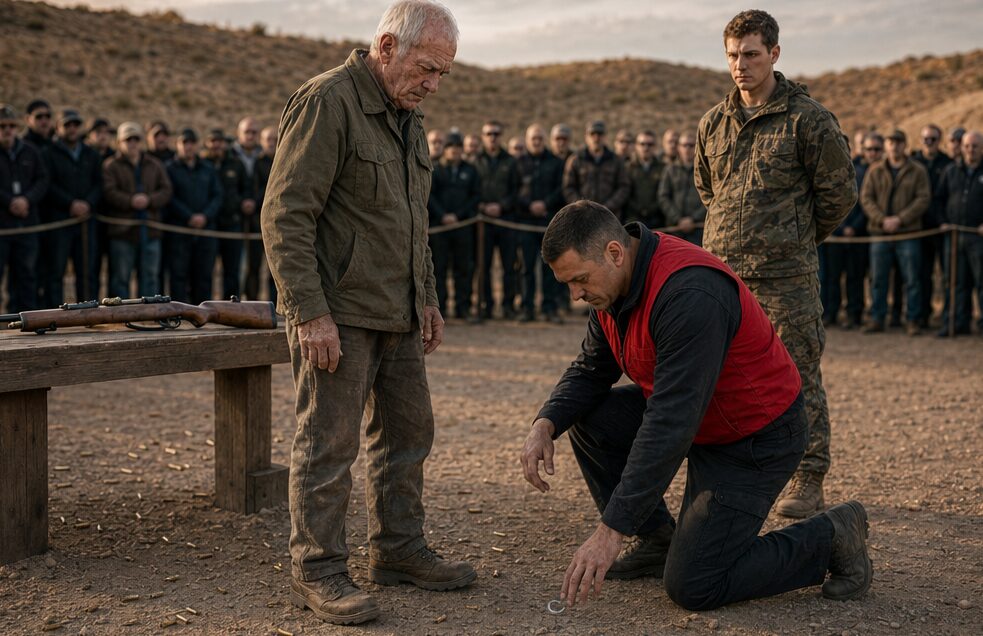
John’s hand was still shaking when the red-vested safety officer dropped to one knee in front of him.
The rifle lay on the wooden bench, cleared and pointed downrange. Brass casings glittered in the gravel around John’s boots. Behind him, a young man in camouflage tried not to smile and failed for half a second.
Then somebody behind the safety rope said, loud enough for everyone to hear, “He’s done. Get him off before he hurts somebody.”
John did not turn.
At seventy-eight, he had learned that some insults were too small to pick up. They stuck to you anyway, but bending for them only made people think they had dropped something valuable.
The man in the red vest reached toward John’s right boot. His name tag read Scott, and he had the square shoulders of someone used to being obeyed.
“Don’t move,” Scott said.
John looked down.
A small silver thing lay half-buried in the dust beside his heel. Not a casing. Not range trash. It had come loose when his rifle jammed and his body had locked itself into old discipline: muzzle forward, finger clear, breathing held, shame nowhere to go.
Scott picked it up between two fingers.
John’s jaw tightened.
“That’s mine,” he said.
His voice was low, but Scott heard it. So did the young man in camouflage standing behind him.
The young man’s name patch read Brian. He had been assigned to event security, though so far the job had mostly involved moving folding chairs and telling older men where the coffee was. He looked from John’s boot to the silver object in Scott’s hand.
“What is it?” Brian asked.
Scott did not answer right away.
He turned the object once. It was a bent metal ring, worn smooth in one place, scratched deep in another. Too old to belong to anything new. Too cared for to be nothing.
John held out his hand.
Scott did not give it back.
A quiet traveled through the people nearest the firing line. Not silence; never silence at a range. The distant cracks continued. The speaker system hummed. Someone’s phone chimed. But the circle around John drew tighter.
“Sir,” Scott said, professional now, “I need you to step away from the line until we inspect the rifle.”
John’s eyes stayed on the silver ring.
“It wasn’t the rifle.”
“We’ll determine that.”
“I already did.”
A man in a polo shirt behind the rope made a sound under his breath. “Sure he did.”
Brian’s smile vanished.
John had come alone. He had signed the waiver with slow fingers. He had paid the entry fee in cash. He had stood in line behind men wearing caps full of pins and jackets full of patches, and no one had looked at him twice.
That was fine. He had not come to be looked at.
He had come to return something.
Scott stood and kept the silver ring in his closed fist.
“Step back from the bench, sir.”
John looked at the rifle. An old bolt-action, clean enough to shame newer ones. Then he looked at Scott.
For a second, Brian thought the old man might refuse.
Instead, John stepped back.
The crowd read obedience as defeat. It often looked the same from a distance.
Scott took the rifle from the bench and cleared it again with practiced hands. The action clicked open. The cartridge came out wrong, bent and ugly. Scott studied it, but his face did not change.
Brian watched John instead.
The old man’s eyes had not followed the rifle.
They had followed Scott’s closed hand.
Part II — A Place Away From the Line
They moved John to a shaded table beside the registration tent, far enough from the firing line that the crowd could pretend it was not watching.
Scott placed the rifle case on another table, out of John’s reach. He set the damaged cartridge beside it. He still had the silver ring.
John sat only after Scott told him to.
That bothered Brian more than he expected.
Old men sat slowly for many reasons. Bad knees. Stiff backs. Pride trying not to show its limp. But John sat like a man choosing not to argue with a world that had already decided the shape of him.
Scott pulled off his gloves.
“Why was this tied to your bootlace?”
John did not answer.
Scott opened his palm. The silver ring sat there, dull in the heat.
“It’s not range equipment,” Scott said. “It came off you during a malfunction. I need to know what I’m handling.”
“You’re handling mine.”
“That’s not an answer.”
“It’s the only one you need.”
Scott’s eyes hardened. “You brought an old rifle, loose personal gear, and a piece of metal tied to your boot onto a live firing line during a charity event. You had a malfunction in front of donors. You understand why this is a problem?”
John looked past him toward the long table where framed photographs stood in rows beneath a banner.
Families had placed flowers there. Small flags. Laminated service records. Names printed in clean black letters.
John had not gone near the table yet.
He had planned to after the memorial volley.
That had been the order he gave himself that morning. Sign in. Wait. Fire once. Return the compass. Leave.
Simple orders were the hardest to obey when memory got involved.
Brian followed John’s gaze.
“You know someone on the board?” he asked.
John’s mouth moved once, almost a word, then stopped.
Scott turned slightly. “Brian, check the display area. See if Amanda needs help keeping people back.”
“Amanda?”
“The event coordinator.”
Brian understood the dismissal. He did not move.
Scott’s expression sharpened. “Corporal.”
That did it. Brian turned toward the display tables.
Behind him, he heard Scott lower his voice.
“Did you come here to make a point?”
John said, “I came here to finish something.”
“With a jammed rifle?”
“With one round.”
The answer hung between them.
Scott looked at the silver ring again, and something in his face changed so quickly most people would have missed it.
John did not.
“You know what that is,” John said.
Scott closed his fist.
“I know what it looks like.”
“No,” John said. “You know what it is.”
Scott leaned closer, close enough that from the firing line it might have looked like intimidation.
“My father served under a man who carried one of these,” he said. “He said that man could find north in a dust storm with one eye shut and half a map.”
John’s face stayed still.
Scott’s voice dropped another notch.
“He also said that man knew how to leave people behind.”
At the display table, Brian stopped walking.
He should not have heard it. He did anyway.
John did not defend himself.
He looked at Scott’s hand and said, “May I have it back?”
Scott laughed once, without humor.
“That’s all?”
“Yes.”
“That’s all you’ve got?”
John’s fingers trembled on the tabletop. He curled them into his palm.
“You asked what I came for.”
“No,” Scott said. “I asked if you came to make a point.”
John finally looked him straight in the eyes.
“I came because I waited too long.”
Part III — The Missing Name
Brian found the photograph by accident.
He had been pretending to check the edges of the display area, but his attention kept sliding back to the shaded table. John sat straight-backed beneath the canopy. Scott stood over him with the posture of a man trying to keep duty from turning personal.
The display board was titled Gray Lantern Memorial Fund.
Brian knew the name. Everyone at the event did. The fund paid for counseling, housing assistance, and scholarships for families connected to a long-ago classified operation that had become public only in fragments. It had the soft language charities used when history was too hard to print.
There were photographs of men in desert fatigues, younger than Brian, grinning beside vehicles and supply crates. Some looked cocky. Some looked tired. One had a cigarette tucked behind his ear. Another held a compass up to the camera as if showing proof that he knew where he was going.
Brian leaned closer.
In one faded photograph, two men stood shoulder to shoulder near a ridge.
One was labeled Jacob.
Founder’s father. Decorated team leader. Remembered for courage during the evacuation.
The second man had been partly cropped out. Only half his face remained, white light cutting across his younger cheek. But Brian knew the eyes.
He looked back at the shaded table.
Then at the photograph.
Then back again.
John was in the picture.
No name beneath him.
Brian felt heat crawl up his neck, and it had nothing to do with the sun.
He went back to Scott, carrying the photo carefully by its frame.
“Why isn’t he named?” Brian asked.
Scott looked at the photograph and said nothing.
John did not look at it.
“Sir,” Brian said, softer now, “is this you?”
John’s eyes moved to the frame.
He took it in for one second. No more.
“That picture was taken before the hill,” he said.
Scott’s mouth tightened.
“Before the hill,” he repeated. “That’s one way to say it.”
Brian looked between them. “What does that mean?”
“It means,” Scott said, “his orders got men out.”
That sounded good until Scott added the rest.
“And one man didn’t.”
John sat very still.
The event coordinator, Amanda, came quickly across the gravel then, her smile already prepared for damage control. She wore a headset and the strained brightness of someone who had donors to soothe.
“Is there a problem here?”
Scott stepped back. “We had a range malfunction. No injury. Rifle is being inspected.”
Amanda looked at John, then at the old rifle, then at the framed photo in Brian’s hands.
Her smile thinned.
“Are you registered as a participant?”
John nodded.
“Were you invited as an honored guest?”
“No.”
The answer landed hard.
Amanda glanced toward the donors under the white tent. Several were watching.
“Sir, with respect, today is not the day for confusion on the firing line.”
John had heard worse. Still, Brian saw the line hit him.
Not because it was cruel.
Because it was neat.
People rarely needed to shout when they had a clipboard.
“I’m not confused,” John said.
Amanda’s eyes flicked to his shaking hand. “Then help me understand why your equipment caused a disruption during a memorial program.”
Scott said, “We haven’t confirmed his equipment caused it.”
Amanda looked surprised.
So did Brian.
John looked at Scott for the first time as if he had heard something unexpected.
Before anyone could speak again, a woman approached from the memorial tent. She moved with quiet authority, silver-streaked hair pulled back, blazer dusted lightly at the cuffs.
The conversations around them lowered without being told.
“Scott,” she said. “What happened?”
Scott straightened.
“Rebecca, we’re handling it.”
The woman’s eyes went from Scott to Brian to the photograph.
Then to John.
Everything in her face closed.
“No,” she said quietly.
John rose from the chair.
For the first time that day, he looked older.
Rebecca’s voice did not rise. It did not need to.
“You picked an interesting place to need sympathy.”
Brian looked down.
Even Scott looked away.
John absorbed the words without flinching, but something behind his eyes lowered itself carefully to the ground.
“I didn’t come for sympathy,” he said.
Rebecca stared at him.
“No,” she said. “Men like you usually come for permission.”
John’s hand twitched toward the green range bag under the table.
Scott noticed.
“What’s in the bag?”
John said, “Something for her.”
Rebecca’s face went pale with anger, not fear.
“I don’t want anything from you.”
John nodded once.
“That’s why I waited.”
Part IV — What the Old Man Knew
The rifle inspection took ten minutes.
It felt longer because no one knew what to do with the old man while they waited.
John sat again. Rebecca stood several feet away, arms folded, refusing the chair Amanda offered. Scott examined the rifle and the damaged cartridge with another range officer near the bench. Brian stayed close to the display board, holding the cropped photograph like it had become evidence.
The firing line continued without them.
That was the worst part.
The world kept moving around John’s humiliation, as if the whole thing were only a scheduling inconvenience.
At last Scott came back with the cartridge in his hand.
His expression had changed.
Amanda saw it first. “Well?”
Scott placed the cartridge on the shaded table.
“Faulty round,” he said.
Rebecca blinked.
Amanda frowned. “Meaning?”
“Meaning the malfunction wasn’t caused by his handling.”
Scott looked at John.
John did not look back.
“The primer and casing are wrong. Donated batch. Should’ve been caught before it reached the line.” Scott swallowed. “He kept the muzzle downrange, cleared his finger, locked the rifle, and held position. If he’d reacted wrong, it could’ve gone bad.”
Nobody spoke.
Brian looked at John’s trembling right hand and understood it differently.
Not fear.
Not confusion.
Control under strain.
The old man had been holding the world still while everyone else judged the shaking.
Amanda’s face flushed. “So there was no violation?”
“There was a malfunction,” Scott said. “He handled it correctly.”
John turned his palm upward on the table.
Scott knew what he wanted.
For a moment, he looked like he might refuse again. Then he placed the silver ring in John’s hand.
The old man closed his fingers around it.
Rebecca watched the gesture.
Her anger did not soften. It sharpened into something more painful.
“So you can still handle a rifle,” she said. “That doesn’t change my father.”
“No,” John said. “It doesn’t.”
Scott’s jaw worked. “My father said you ordered the withdrawal.”
John nodded.
“He said Jacob was still out there.”
“He was.”
Brian felt the air go tight.
Rebecca’s voice became almost too calm.
“And you came here today to stand under his photograph?”
John looked toward the memorial berm beyond the firing line.
“I came to return what I carried.”
Rebecca looked at the green bag.
“No.”
John’s eyes closed once.
Scott said, “Maybe you should leave while this can still be quiet.”
John opened his eyes.
“I have been quiet for thirty-four years.”
No one moved.
The sentence was not loud. It was not dramatic.
That made it worse.
Brian realized he had been waiting for John to defend himself like a man accused.
But John spoke like a man who had already been sentenced and had stopped appealing.
Rebecca shook her head.
“You don’t get to use my father’s memorial to clean your conscience.”
“I know.”
“Then leave.”
John reached down for the green bag.
Scott’s hand moved, but John stopped him with a look.
Not anger. Not threat.
Command.
Scott froze.
John lifted the bag onto the table and unzipped it. From inside, he removed a sealed envelope, a folded page browned at the edges, and an old compass case with one missing ring.
Rebecca saw her name written on the envelope.
Her mouth tightened.
“I said I don’t want it.”
John placed the envelope on the table anyway.
“I’m not asking you to want it.”
Brian stepped closer without meaning to.
The compass body was dented along one side. Its glass was scratched. A strip of old tape held part of the case together. The missing pull ring had left a dark little gap where metal had rubbed metal for years.
John set the silver ring beside it.
His fingers shook too hard to fit it back.
Rebecca noticed.
So did Scott.
John curled his hand away.
“Jacob gave this to me on the ridge,” he said.
Rebecca’s eyes flashed. “Don’t say his name like you earned it.”
John took the blow.
Then he said, “He told me to bring him home if I couldn’t bring him out.”
The firing line cracked in the distance.
One sound.
Then another.
Rebecca’s face changed despite herself.
Scott looked at the folded page.
John touched it with two fingers.
“Map fragment. Field note. The report you saw wasn’t the whole report.”
“My family saw what we were allowed to see,” Rebecca said.
“Yes.”
“And now I’m supposed to believe you were protecting us?”
“No.”
The answer stopped her.
John looked at her then, fully.
“You’re supposed to believe I was following an order I have regretted every morning since.”
No one had a quick response to that.
Quick responses belonged to cleaner stories.
Part V — Permission
The memorial volley was announced over the loudspeaker before Rebecca opened the envelope.
“All participants for the remembrance line, please gather at the east berm.”
Amanda looked panicked. The program was moving. Donors were standing. Families were gathering. The moment that had been planned for months had arrived, and at its center sat an old man no one knew how to remove without making the scene worse.
Rebecca stared at the envelope.
John did not push it toward her.
That mattered.
He waited as if waiting was the last respectful thing he had left to offer.
Finally, Rebecca opened it.
Inside was a letter, short and spare, written in a hand that had taken care with every line.
She read only the first few sentences before her face changed.
Brian did not see the words. He saw her grip tighten on the page.
Scott saw it too.
“What does it say?” he asked.
Rebecca did not answer him.
John spoke instead.
“The route was compromised. The guides would have been named if the full record came out then. Their families were still there. Jacob knew.”
Rebecca looked up.
“My father stayed behind?”
John nodded.
“To draw attention away from the lower path. He made the choice before I was ordered to pull back.”
“You let him.”
“Yes.”
Her eyes filled, but her voice stayed cold. “That’s all you have?”
“No,” John said. “That’s all I can say without making him smaller.”
Rebecca looked as if she might tear the letter in half.
Instead, she folded it once.
Brian saw then that her anger had not disappeared. It had lost its floor.
Scott’s face had gone ashen.
“My father said you never spoke of it.”
“I didn’t.”
“Why?”
John looked at the compass.
“Because every version made somebody pay.”
The loudspeaker called again.
“Final call for the remembrance line.”
John picked up the compass body.
His thumb moved over the empty place where the ring belonged.
“I asked to fire once,” he said. “Not for me.”
Rebecca’s voice shook now. “For him?”
John nodded.
“And then you’ll leave?”
“Yes.”
“Without asking me to forgive you?”
John looked at her almost gently.
“That was never mine to ask for.”
The line broke something in her. Not enough to embrace him. Not enough to absolve him. Just enough that she stopped standing like a locked door.
Scott moved toward the rifle case.
Amanda started to object, then saw Scott’s face and stopped.
Brian carried the rifle case to the firing line.
John walked slowly. The crowd parted with the discomfort of people realizing they had been watching a story without knowing its first page.
Near the berm, John stopped and tried to thread the silver ring back onto the compass.
His fingers would not do it.
He tried once.
Failed.
Tried again.
The ring slipped from his hand and fell into the gravel beside his boot.
For a second, everything became the opening again.
The old man standing.
The silver thing in the dust.
The younger man in the red vest bending toward his feet.
But this time Scott did not grab.
He went down on one knee slowly, where John could see him.
His voice was quiet.
“Permission, Sergeant?”
John looked at him.
The old title moved through the air without ceremony, but it changed the shape of everyone around it.
Scott did not touch the ring.
He waited.
John’s throat shifted.
Then he gave the smallest nod.
Scott picked up the silver ring and threaded it through the compass case with careful hands. No hurry. No performance. He worked like the object deserved patience.
Brian stood behind them, straight now, his earlier smirk long gone.
Rebecca held the field note against her chest.
When Scott finished, he placed the compass in John’s palm, not on the table, not in the dirt, not between them.
In his palm.
John closed his fingers around it.
Then he stepped to the line.
The rifle felt heavier than it had that morning. Or maybe his arms were finally admitting what they had carried.
Scott stood to his right.
Brian stood behind him.
Rebecca stood back by the memorial table, close enough to see.
The names were read.
When Jacob’s name came over the loudspeaker, Rebecca lowered her head.
John raised the rifle.
His hand trembled.
The muzzle did not.
He took one breath.
Then he fired.
The sound rolled against the dry ridge and came back thinner.
John lowered the rifle, opened the action, cleared it, and set it down.
No flourish.
No salute.
No applause.
He walked to the wooden bench and placed the repaired compass in front of Rebecca.
She stared at it for a long time.
Then she touched the silver ring with one finger.
Part VI — The Name Beneath the Picture
Afterward, people tried to speak to John.
They did it awkwardly.
A man in a polo shirt told him, “Good handling out there,” as if compliments could erase timing. Amanda said the charity appreciated his patience, though her eyes kept sliding toward Rebecca for permission. Someone offered water. Someone else offered a chair.
John accepted neither.
Scott returned with a single spent casing in his palm.
“The final round,” he said.
John looked at it.
Scott hesitated, then held it out.
John took it. The brass lay against his palm beside the scratch where the compass ring had marked him after years of being tied to his boot.
Scott said, “I was wrong.”
John closed his fingers around the casing.
“No,” he said. “You were late.”
Scott took that as it was given.
Not cruelty.
Not forgiveness.
A measurement.
Brian approached with the rifle case.
“I can drive you to your car, sir.”
John looked toward the parking lot. It was not far. It looked farther than it had in the morning.
“I can walk.”
Brian nodded, disappointed but trying not to show it.
Then John added, “If you carry the case.”
Brian’s face changed.
“Yes, sir.”
Rebecca stood alone at the memorial table.
The repaired compass rested beside the old photograph. The folded field note lay under her hand. For a while, she did not look at John.
Then she said, “Where was he standing?”
John knew who she meant.
He pointed toward the ridge beyond the east berm. Not dramatically. Not like a man revealing a sacred site. Just accurately.
“Above the wash,” he said. “There was a split rock. He stood left of it so we’d look farther east than we were.”
Rebecca followed his finger.
“What did he say?”
John looked at the ridge.
The whole day seemed to lean toward his answer.
“He said your mother would be angry if he lost the compass.”
Rebecca made a sound that was almost a laugh and not quite enough to become one.
John waited.
“He always lost things,” she said.
“Yes,” John said. “But not people.”
Her eyes filled then.
Not because the line healed anything.
Because it gave her a father who was more than one framed word under a photograph.
She turned away before the tears could become public.
John did not move toward her.
That was his last act of respect.
At the table, Rebecca picked up the faded photograph. The crop had cut John nearly out of it, leaving Jacob centered and smiling into history alone.
Rebecca found a black pen in the registration box.
Her hand hovered beneath the unnamed half-face.
For a moment, John thought she might put the pen down.
Instead, she wrote.
John
The letters were small. Careful. Not decorative. Not announced.
Just there.
Brian saw it.
Scott saw it.
John saw it too.
No one clapped.
The range had gone quieter as afternoon thinned across the gravel. The wind moved dust against his boots, and for the first time all day, John did not look down to check what he had lost.
He gave Rebecca the smallest nod.
She did not return it right away.
Then she did.
John turned toward the parking lot with Brian carrying the case beside him and Scott standing behind them in the red vest, no longer blocking the way.
At the edge of the gravel path, John opened his hand once.
The spent casing rested there.
Warm once.
Empty now.
Still proof that something had happened.
He put it in his pocket and kept walking, head level, while behind him his name remained beneath the faded photograph, finally standing where it had always been.