The Photograph He Refused To See Until Everyone Was Watching
Part I — The Pier Went Quiet
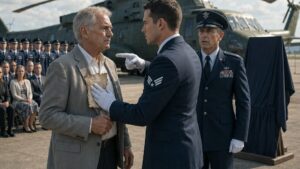
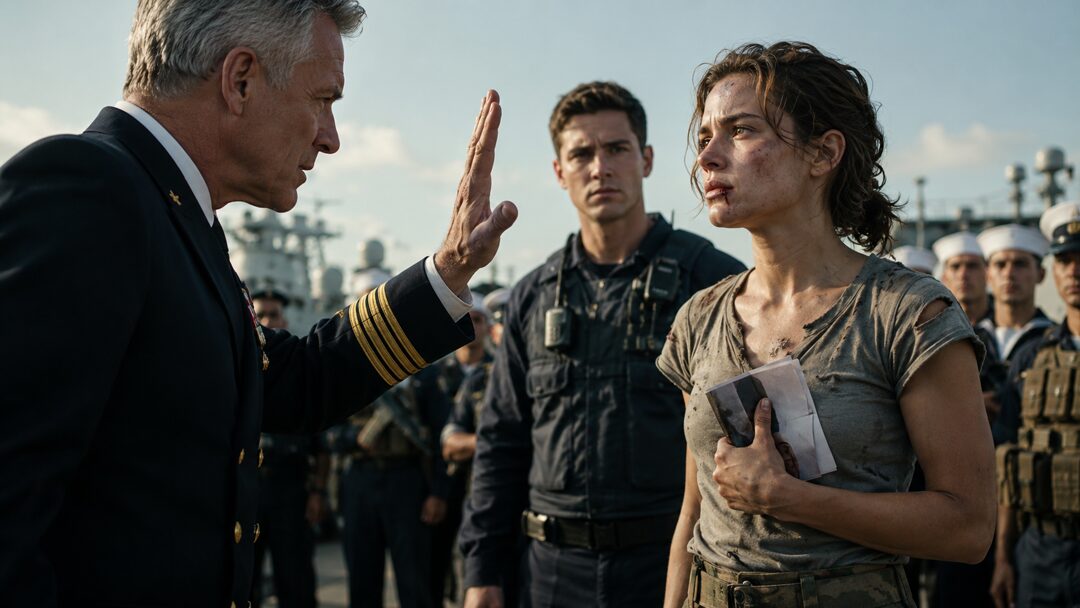
Admiral Richard Hayes raised his hand so close to Emily Carter’s face that every sailor on the pier stopped breathing at the same time.
He did not touch her.
That was almost worse.
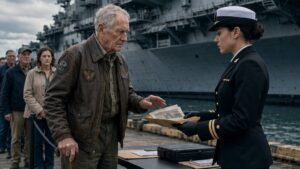
His palm hung there, rigid and open, inches from her bruised jaw, as if he could hold back the entire ruined morning by force. Behind him, a formation of Marines had halted mid-step. Beyond them, the gray hull of a Navy vessel blocked the sunlight from half the pier. Heat shimmered off the concrete. Salt hung in the air.
Emily stood in front of him with blood at the corner of her mouth, one shoulder of her gray training shirt torn loose, camouflage pants stained with dust and black water from a place no one on that pier was supposed to know existed.
Her knees wanted to fold.
She did not let them.
“Lieutenant Carter,” Hayes said, his voice hard enough to cut through engines, gulls, and the low alarm still echoing from the docks. “You will answer me.”
Emily stared past his shoulder.
Not because she was afraid of him.
Because if she looked directly at him too soon, she might give him the photograph before he had a chance to decide who he wanted to be.
The folded square of paper sat inside her right hand, damp from sweat and seawater. She had gripped it so tightly on the ride back that its edges had cut into her palm. It was only a picture. Thin paper. Faded color. A woman’s face.
And still, it weighed more than the sidearm she had surrendered at the gate.
Hayes stepped closer.
“You abandoned an assigned extraction route,” he said. “You ignored a direct recall. You compromised a classified recovery operation. Two operators are in the infirmary because of your decision.”
Emily’s mouth moved, but no sound came.
A sailor near the rail shifted. Someone whispered, then stopped.
Hayes heard it. Everyone did.
That was the problem with rank. It made every private wound public if the person wearing it chose the wrong place to bleed.
“Look at me,” Hayes ordered.
Emily did.
For half a second, she saw the man everyone else saw: silver hair, sharp uniform, immaculate ribbons, posture held like a sealed door. Admiral Richard Hayes, the kind of officer people lowered their voices around even when he was not in the room.
Then she saw the other thing.
The exhaustion under his eyes.
The anger that had arrived too quickly, like it had been waiting for permission.
The way he kept glancing, not at her injuries, but at the hand she would not unclench.
Emily lifted her left hand to her mouth. Her fingers came away red. She looked at them as if the blood belonged to someone else.
Hayes mistook the pause for weakness.
“You will explain yourself before I have you removed from this pier.”
Emily swallowed. The movement hurt.
Then she asked him quietly, “Do you still want me to say it here, sir?”
The question changed the air.
It was not loud. It did not challenge his rank. But it landed in the space between them with enough force that the front line of Marines stiffened.
Hayes’s eyes narrowed.
“What did you say?”
Emily breathed through the pain in her ribs. “I asked if you still want me to say it here.”
Behind Hayes, Lieutenant Michael Grant took one step forward.
“Admiral,” he said carefully, “there’s material from the site you should review before—”
Hayes did not turn.
“Lieutenant Grant, remain where you are.”
Michael stopped.
Emily saw his jaw tighten. His uniform was cleaner than hers, but his face carried the same night. He had been in the operations room when her radio went dark. He had heard her refuse the order. He knew enough to be afraid.
Not enough to understand.
No one did yet.
Hayes lowered his hand at last, but only to point toward the gate.
“You are going to medical,” he said. “Then you are going to debrief. Then, if I find that you acted outside mission parameters for any reason other than immediate survival, you will face every consequence available to this command.”
Emily almost smiled.
It would have been a terrible smile.
“Mission parameters,” she repeated.
The words tasted like salt and copper.
In her head, the pier disappeared.
The heat vanished.
She was back inside the coastal safe house where the walls sweated in the dark and the floor shook from impact somewhere above. Her earpiece crackled. Michael’s voice came through broken and urgent.
Carter, withdraw. Primary recovery failed. Repeat, withdraw.
Then another sound.
Not command.
Not static.
A woman behind a wall, hoarse from too many days without being answered, whispering one word.
Dad.
Emily blinked, and the pier came back.
Hayes was still in front of her. Still furious. Still unaware that the worst thing he could do now was keep demanding the truth in front of witnesses.
“Lieutenant Carter,” he said, “you will not repeat my words back to me as if this is a conversation between equals.”
Emily’s hand tightened around the photograph.
“No, sir,” she said.
“It is not.”
Part II — The Order She Couldn’t Follow
The official briefing had lasted eleven minutes.
Emily remembered that because she had watched the second hand on the wall clock while Commander Hale called the place an abandoned relay station and everyone pretended not to notice the missing pages in the packet.
No civilians expected.
No recoverable personnel.
No live intelligence assets.
Retrieve the drive. Clear the site. Exit through Route Blue.
That had been the mission.
Clean. Narrow. Disposable.
Emily had signed the acknowledgment form because that was what service had taught her to do. Read. Absorb. Obey. Ask questions only if the question improved the mission.
She had once believed obedience was a kind of honor.
That belief had been useful.
It had also made her easy to manage.
The safe house sat low against a stripped stretch of foreign coastline, half-swallowed by reeds and concrete. By the time Emily’s team entered, the building had already been hit. Smoke moved along the ceiling in slow gray sheets. Someone had tried to burn records in a metal trash bin and failed. Paper scraps clung to wet tile.
The drive was exactly where the briefing said it would be.
That was the first thing that bothered her.
Bad places rarely handed you the right object that easily.
One of the operators found it taped beneath a metal desk, sealed in plastic, labeled with a code that matched the packet. Mission complete, according to the room. Mission complete, according to the clock. Mission complete, according to the voice in her ear.
Then Emily saw the interior door.
It was not on the floor plan.
It had been painted the same dull color as the wall, but the paint had cracked around the hinges. There were scratch marks near the bottom. Not old ones. Fresh enough that raw wood showed through.
“Carter,” one of the operators said, “we move in ninety seconds.”
She should have moved.
Instead she crossed the room.
Her gloved hand touched the door. Warm.
From the other side came a small sound.
Not a cry. Not exactly.
A breath shaped like a name.
Emily leaned closer.
“Say again,” she whispered.
The voice behind the wall answered in English.
“Please.”
Her earpiece cracked. “Carter, status.”
Emily looked back at the drive in the operator’s hand. Official truth. Sealed evidence. A successful mission anyone could write up before lunch.
Then she looked at the door the packet had erased.
“There’s someone inside,” she said.
A pause.
Then Michael’s voice from the command channel, lower than before. “Negative. Site has no live personnel.”
“I hear her.”
“Carter, withdraw.”
The operator nearest her shook his head once.
Not cruelly.
That was what stayed with her. He was not cruel. He was scared of the same thing she was: that behind the door was a life large enough to ruin a clean order.
Emily hit the door with her shoulder.
Pain flashed white.
She hit it again.
The third time, the frame cracked.
The operator cursed and helped her.
They got the door open just enough for Emily to slip through sideways.
The room beyond smelled of metal, antiseptic, and old fear.
There were restraints attached to the wall.
A cot.
A plastic water jug.
Names carved into the plaster at shoulder height, some neat, some frantic, some crossed out.
Emily’s light moved across them.
Mara.
Ellen.
S. Hayes.
The beam stopped.
Her breath did too.
She knew that name from an old file she had not been authorized to read twice. A civilian intelligence asset. Missing six years. Declared dead after a transport bombing. Closed with language too smooth to be honest.
Sarah Hayes.
Admiral Hayes’s daughter.
In the corner, a woman lifted her face.
She was older than the file photo. Thinner. Her hair had been cut unevenly, hacked short near one ear. But her eyes were steady in a way that made Emily think of someone who had survived by refusing to waste strength on panic.
“You’re Navy,” the woman said.
Emily crouched.
“Yes.”
The woman tried to laugh. It came out as air. “Is my father alive?”
Emily could not answer quickly enough.
Something hit the building above them. Dust fell in a hard curtain. The operator shouted from the other room. The radio erupted in overlapping voices.
Emily reached for the woman’s arm, but she pulled back.
“No,” the woman said. “Not me. Not yet.”
Emily stared at her.
The woman’s hand shook as she pushed something forward.
A photograph.
Not of the old Sarah in the file.
Of her now.
Alive.
Sitting against the same wall, holding a strip of Navy-blue cloth between both hands. On the cloth, stitched in white thread, was one name.
HAYES.
Behind the photograph, she had written coordinates in a tiny, cramped hand.
“Give him this,” Sarah whispered. “If he stopped looking, make him look again.”
Emily had heard many orders in her life.
That was the only one she knew she could not refuse.
Part III — What the File Said
Back on the pier, Admiral Hayes was still calling it insubordination.
It was easier that way.
A failed officer could be detained. A broken order could be documented. A classified operation could be sealed and moved into a folder with limited access.
A daughter could not.
Not if she was alive.
“Route Blue was clear,” Hayes said. “You had the recovery asset. You had your team. You had your orders.”
Emily’s vision blurred at the edges, but she kept her feet under her.
“Route Blue led away from the holding rooms.”
The words came out before she could decide to stop them.
Michael’s eyes flicked to her.
Hayes went still.
Only for a moment.
“What holding rooms?”
Emily watched his face carefully. “The ones that weren’t on the floor plan.”
A low murmur moved through the sailors at the edge of the dock.
Hayes turned his head slightly. The murmur died.
He looked back at Emily.
“You are injured,” he said. “You are exhausted. You may be confusing structural damage with—”
“With restraints?” Emily asked.
His mouth tightened.
“With names carved into a wall?”
Michael’s radio hissed softly. No one moved to silence it.
Hayes spoke more quietly. That was worse than shouting.
“Choose your next words with discipline.”
Emily thought of the wall.
Not all the names.
Just one.
S. Hayes.
She had not meant to say it in public.
That was the mercy she had tried to offer him.
But Hayes had built the stage himself. He had put her in front of witnesses. He had chosen command theater over caution.
So she said, “Sarah Hayes.”
The name crossed the pier like a signal flare.
A young Marine in the first row blinked. A chief petty officer looked down at the concrete. Michael’s shoulders dropped half an inch, as if he had been waiting for a weight to fall and had still underestimated it.
Hayes did not move.
For three seconds, he became something less than an admiral and more dangerous than a father.
Then the uniform returned.
“That is enough.”
Emily heard the break in it. Tiny. Almost hidden. Not enough for the crowd, maybe. Enough for her.
“The name was carved into the wall,” she said.
“You have no basis for connecting that to—”
“I saw her.”
Hayes stepped forward so fast Michael moved too.
“Admiral,” Michael warned.
Hayes raised one finger without looking at him.
Emily’s chest tightened. She had seen men refuse bad news before. She had seen officers deny casualty reports until the body arrived with a tag. She had watched people protect themselves from truth by attacking the first person foolish enough to carry it.
But she had never seen grief try to stay at attention.
“You saw an injured detainee,” Hayes said. “You saw a hostile site under fire. You saw what panic wanted you to see.”
Emily’s hand burned around the photograph.
“No, sir.”
His eyes sharpened. “No?”
“No, sir. I saw what your file stopped looking for.”
That struck him.
Not visibly enough for anyone else to name. But Emily saw the blood leave his face under the tan.
Michael moved closer, this time not asking permission.
“Admiral,” he said, voice low, “we need to review what she brought back.”
Hayes turned on him.
“You will not assist a compromised officer in building a public narrative out of trauma.”
Michael took the hit. His throat worked once.
Then he said, “With respect, sir, trauma doesn’t write coordinates on the back of a photograph.”
The pier went silent again.
Hayes looked at Emily’s hand.
Now he knew.
Or close enough.
Emily saw it: the terrible beginning of recognition before proof. The mind walking toward a door the body did not want opened.
Hayes had a daughter once. Everyone knew that in fragments, the way people know forbidden stories around powerful men.
Sarah Hayes had been brilliant. Civilian intelligence support. Linguist. Analyst. The kind of person who noticed what other people missed and paid for it. Six years earlier, she had disappeared overseas during a transport movement that became a closed report, then a memorial service, then a subject no one brought up twice.
Michael had told Emily the rest in a hallway two months before, after a drink he did not finish.
“He fought it,” Michael had said. “For a year. Burned favors. Demanded reviews. Then one day he stopped.”
“Why?”
Michael had looked at her then.
“Because they promoted him into the command that had authority over the file.”
At the time, Emily had said nothing.
She knew what silence could buy.
Rank. Survival. Access. The ability to tell yourself you had not surrendered, only waited.
But waiting had a way of becoming a life.
Hayes stared at her hand.
Emily wondered if he was remembering a small girl, or a grown woman, or only a report with black lines where answers should have been.
Then he looked away.
“Lieutenant Carter is to be escorted to medical,” he said.
Michael’s head snapped toward him.
“Sir—”
“Now.”
A Marine stepped forward.
Emily almost laughed again, but her legs chose that moment to fail.
She swayed. The pier tilted. The folded photograph slipped halfway from her fingers.
The Marine reached for her elbow.
The photograph fell.
It landed face-down between Emily and Hayes.
No one picked it up.
No one breathed.
Hayes looked at the small white square on the concrete as if it had spoken his name.
Part IV — The Thing He Would Not Touch
The Marine holding Emily’s arm was young enough to look frightened by her weight.
“I’ve got her,” Michael said, moving in.
Hayes did not answer.
He was staring at the photograph.
Face-down, it looked harmless. A damp piece of paper with one corner bent. It could have been anything: a family snapshot, evidence from the site, a dead woman’s memory, a living woman’s plea.
Emily bent to reach for it and nearly went down.
Michael caught her before her knee struck the pier.
“Easy,” he said.
She hated the gentleness more than the pain.
Hayes’s voice came from above them.
“Do not touch it.”
Michael froze.
Emily looked up.
Hayes had spoken like an admiral again, but his eyes had betrayed him. They had not left the photograph. The command was not about preserving evidence.
It was about delaying the moment when paper became truth.
Emily pulled herself upright against Michael’s grip.
“Sir,” Michael said, “we need to secure it.”
Hayes did not look at him. “I gave an order.”
Emily took one shallow breath.
Another.
The world narrowed to the photograph on the concrete and the man refusing to touch it.
“She asked for you,” Emily said.
Hayes’s face hardened. “Stop.”
“She didn’t know if you were alive.”
“I said stop.”
“She said if you stopped looking—”
Hayes moved.
His hand came up again.
This time no one could pretend it was only anger.
It rose between them not like a threat, but like a man trying to block a door from opening inside his own chest.
Emily stopped speaking.
That was the mercy.
Just that much.
Hayes’s hand trembled once before he clenched it.
“You do not get to use my daughter,” he said, very quietly, “to excuse your failure.”
There it was.
The wound under the rank.
Emily looked at him and, for the first time since stepping onto the pier, felt something other than fury.
Not forgiveness.
Something more difficult.
Pity, maybe. Or recognition.
She had thought Hayes chose cowardice. Maybe part of him had. Maybe part of him had taken the promotion and learned to speak of Sarah in past tense because the living version of grief was too undisciplined to survive command.
But grief did not absolve him.
It only made the damage human.
“I’m not using her,” Emily said. “I’m returning her.”
Hayes flinched.
The line went through him before he could stop it.
Michael crouched slowly and picked up the photograph by the edge. He did not turn it over. He held it out to Emily first, as if the choice still belonged to her.
For a moment, Emily wanted to hide it again.
Not because she doubted the truth.
Because she understood, suddenly and completely, that once Hayes saw the image, his life would divide into before and after. There would be no disciplined version of it. No private processing. No quiet containment. He would know, in front of all of them, that his daughter had lived long enough to wonder if he had abandoned her.
Some truths deserved a closed room.
Some had been buried because men like Hayes kept choosing closed rooms.
Emily took the photograph.
Her fingers left a red smear along the blank back. The coordinates were still there, written small and precise in Sarah’s hand.
Hayes saw them.
His eyes dropped to the numbers.
He knew enough to understand their shape.
Not the place, maybe. Not yet.
But the fact of them.
A destination.
A chance.
Emily held the photograph against her chest for one heartbeat.
Then she extended it toward him.
“Look before you give another order.”
Hayes did not take it.
The Marines watched.
The sailors watched.
Michael watched, no longer careful enough to hide that he was on Emily’s side.
Hayes’s voice came out low.
“If this is not her—”
“It is.”
“If this is some manipulation—”
“It isn’t.”
“If you are wrong—”
Emily’s arm shook, but she kept the photograph raised.
“Then you can punish me after you look.”
The wind moved across the pier. Somewhere behind them, a radio call came in and went unanswered.
Hayes stared at the folded paper.
Emily saw the last fight inside him.
Admiral against father.
Command against memory.
The man who had stopped looking against the girl who might have waited.
Then Richard Hayes reached out.
Part V — The Name on the Cloth
He took the photograph as if it might burn through his glove.
For a second, he only held it.
The paper trembled in his hand. Not much. Enough.
Emily watched his face, because once he turned it over, everyone else would understand something had happened even if they could not see the image.
Hayes unfolded the photograph.
His breathing stopped.
There was Sarah.
Not the smiling file photo from six years ago. Not the polished memorial image in dress whites beside a flag. Not the daughter frozen safely in the past, where grief could be arranged and survived.
This Sarah was alive in the ugliest possible way.
Thin face.
Uneven hair.
Eyes too alert for the body holding them.
One hand gripping a strip of Navy-blue cloth so tightly her knuckles looked pale even in the faded print.
On the cloth, stitched in white, was one name.
HAYES.
Richard’s mouth opened.
No sound came.
The pier had seen him command rooms full of officers. It had seen him receive salutes without blinking, step off aircraft with cameras waiting, speak at memorials without once looking down.
It had never seen him become a father in public.
Emily lowered her arm.
The effort cost her more than she expected. Michael steadied her again, and this time she did not pull away.
Hayes turned the photograph over.
The coordinates waited on the back.
Sarah’s handwriting was cramped but deliberate. Each number pressed hard into the paper, as if she had written against a wall with no table beneath her.
Below the coordinates were four words.
Not dead. Not done.
Hayes closed his eyes.
Only for a second.
When he opened them, something in him had been ruined.
Something else had returned.
“Grant,” he said.
Michael straightened. “Sir.”
Hayes’s voice was not loud, but every person on the pier heard the command forming before he finished it.
“Open an emergency recovery channel. Use my authority. Direct line to Fleet Operations. I want satellite review, drone pass, and a rescue package built around these coordinates.”
Michael was already moving. “Yes, sir.”
Hayes looked at him.
“And Lieutenant?”
Michael stopped.
“If anyone asks who authorized it, you give them my name first.”
Michael held his gaze.
“Yes, Admiral.”
The pier broke into motion.
Radios came alive. Boots struck concrete. The formation dissolved into purpose. Men and women who had been witnesses became participants, running messages, calling vehicles, opening secure lines, making room for a truth too large to stay in one man’s hand.
Emily tried to follow the movement, but her vision dipped again.
A corpsman appeared beside her with a medical kit.
“Ma’am, I need you seated.”
“No.”
“Lieutenant—”
“No,” she said, though her voice barely survived the word. “Not until he says it.”
The corpsman looked confused.
Michael did not.
Hayes heard her.
He stood with the photograph in his hand, the ribbons on his chest bright and useless under the hard sun.
For a moment Emily thought he would refuse. Not because he did not believe her now, but because saying the truth aloud would make him accountable to everyone who had helped bury it.
Then Hayes turned toward the gathered personnel.
“My daughter is alive,” he said.
No one moved.
The words did not sound triumphant.
They sounded like an injury reopening after years of being called healed.
Hayes looked at Emily.
“And Lieutenant Carter brought back the proof.”
Emily’s throat closed.
She had not known she needed that.
Maybe she had.
Maybe everyone who carries truth through fire wants, at the end of it, not applause. Not forgiveness. Just one person in authority brave enough to say: yes, I see what you carried.
Her legs finally gave.
Michael and the corpsman caught her together.
As they lowered her onto the stretcher, Emily looked up at the sky over Norfolk. It was too bright. It made every face around her seem cut from light and shadow.
Hayes stepped closer.
For the first time, he did not tower over her.
He came down to one knee beside the stretcher, still holding the photograph.
“I stopped,” he said.
It was not a full confession.
It was worse.
It was the only one that mattered.
Emily looked at him.
“Then don’t stop now.”
Hayes nodded once.
No promise could undo six years.
But some promises began exactly where undoing failed.
Part VI — Nobody Closes The File
The medical team lifted Emily into the transport, but she kept her head turned toward the pier until the doors nearly blocked her view.
The last thing she saw before they closed was Michael standing beside Hayes, radio pressed to one ear, already speaking in clipped, urgent phrases.
Then Michael lowered the radio for half a second and looked at her.
He saluted.
Not the sharp public kind meant for ceremony.
A quiet one.
A witness recognizing another witness.
Emily did not have the strength to return it properly. She lifted two fingers from the stretcher strap. It was enough.
The doors shut.
Inside the transport, the world became smaller. White ceiling. Metal cabinets. The corpsman’s hands. The tug of gauze at her mouth. A blood pressure cuff tightening around her arm.
“Stay with me, Lieutenant,” the corpsman said.
Emily almost laughed.
She had stayed through worse.
She had stayed through a false floor plan, a locked room, a woman’s voice, a name carved into plaster, and an order that would have been easier to obey than refuse.
Now, for the first time in hours, she let her eyes close.
Not all the way.
Just enough to see Sarah again.
Not as a file.
Not as proof.
As a woman in a ruined room pushing a photograph into Emily’s hand with the last of her strength.
If he stopped looking, make him look again.
Emily had done that.
What came next belonged to more people now.
That was the strange relief of it. The truth was no longer trapped inside her fist. It had crossed the pier. It had entered the radios. It had forced itself into the chain of command and changed the shape of the day.
Outside, engines started.
Farther down the pier, Richard Hayes climbed into the command vehicle with the photograph still open in his hand.
An aide reached toward him with a secure phone.
Hayes took it, then paused.
For years, he had let other men say final. Other men say closed. Other men say no recoverable asset. Other men say accept the finding, Admiral. Other men say grief has to end somewhere.
He looked once more at Sarah’s face.
Older.
Thinner.
Alive.
Then he looked at the coordinates on the back, at the four words pressed into paper by a daughter who had not known whether her father was still listening.
Not dead. Not done.
The aide waited.
Michael stood outside the open door, watching him with the careful stillness of a man deciding what kind of officer he would become.
Hayes lifted the phone.
“This is Admiral Richard Hayes,” he said. “I am reopening file Seven-Eight-One under emergency authority.”
Someone on the other end started speaking.
Hayes cut him off.
“No. Listen carefully.”
He looked through the windshield at the pier where Emily had stood bleeding and silent while everyone waited for her to break.
“This time,” he said, “nobody closes the file.”
The vehicle pulled away.
Behind it, the formation was gone. The perfect lines had scattered into motion, into consequence, into the hard work of answering a truth that had arrived late but alive.
And in the back of the medical transport, Emily Carter finally let go of the photograph-shaped ache in her hand.
Her palm was empty.
For once, that did not feel like loss.