The Map She Would Not Sign Until Every Voice Was Heard
Part I — The Room Went Quiet
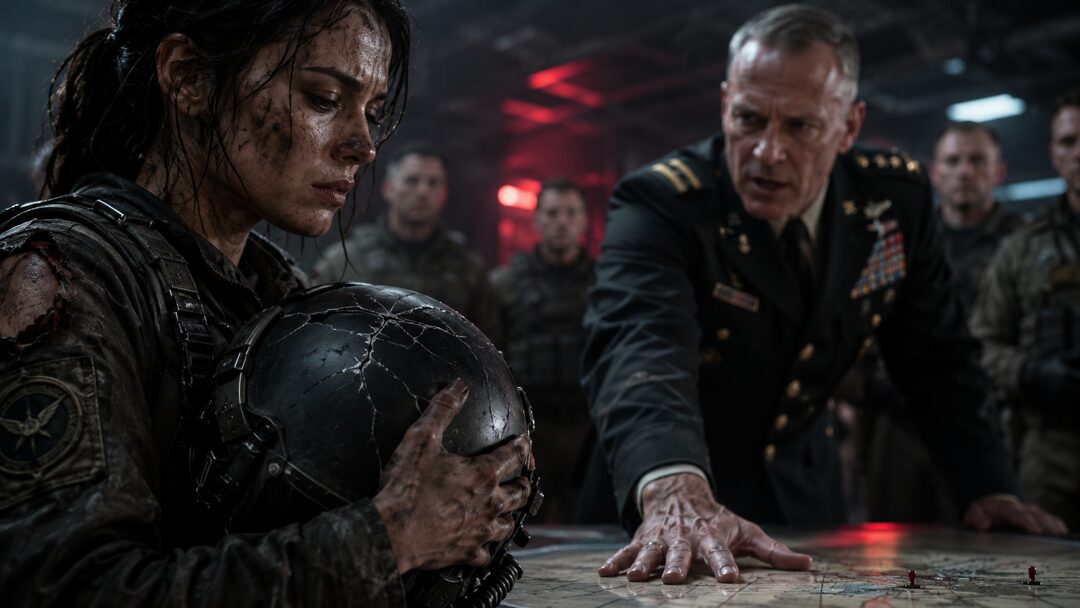
Captain Emily Carter came into the bunker with rain on her shoulders, dust in her hair, and another man’s helmet pressed against her ribs.
No one clapped.
No one ran to her.
Two airmen stepped aside as if she were carrying something unstable. The command room smelled of wet concrete, hot wiring, stale coffee, and the smoke that had been leaking through the ventilation shafts since the storm hit the ridge. Red warning lights pulsed over the walls. Each flash made the tactical map on the center table look alive, then dead, then alive again.
Emily’s flight suit was torn at the sleeve. A strip of gauze at her neck had gone dark. Mud had dried along one cheek, cutting a hard line beneath her eye.
But everyone looked at the helmet.
It was blackened around the rim. The visor was cracked through the middle. Half of the call sign sticker had peeled away, leaving only the last two letters: ER.
Sergeant Michael Miller’s helmet.
Colonel Robert Hale stood at the map table before anyone could decide what to say. His uniform was clean. His jaw was set. His palm came down hard on a marked route drawn in grease pencil.
“Where is Sergeant Miller?”
The room held its breath.
Emily looked at the map, then at Hale, then down at the helmet in her hands.
She did not answer.
Hale’s eyes narrowed. “Captain Carter. I asked you a question.”
Behind him, Major Sarah Bennett stood near the intelligence console, tablet tucked under one arm. Her hair had been pulled back so tightly it made her face look more tired than stern. At the communications station, Sergeant Brian Lewis kept one hand pressed against his headset, though no one was speaking through it.
The forward team was still out there.
That was the fact no one said first.
Eight people pinned somewhere beyond the dry riverbed. One rescue aircraft damaged. One crew chief missing. One pilot returned alone.
And now that pilot stood before them holding the only piece of Michael Miller that had come back.
Hale pointed to the map again. “You were cleared through Corridor Three. You abandoned it here.” His finger stabbed a point along the route. “You cut east, dropped below ridge cover, and went dark for six minutes.”
Emily’s grip tightened around the helmet.
“Six minutes,” Hale repeated. “Enemy communications spiked two minutes after your deviation. Our forward team lost extraction clearance three minutes after that. So I will ask once more. Where is Miller?”
Rainwater dripped from Emily’s sleeve onto the concrete.
“The route was already burned,” she said.
Her voice was quiet enough that half the room leaned in to hear it.
Hale went still.
Then he gave a short, humorless laugh. “That is not an answer.”
“It’s the only one that matters.”
“No,” Hale said. “What matters is whether you knew that before you launched. If you knew, you withheld intelligence. If you discovered it in flight, you disobeyed protocol by continuing. If you guessed, then you gambled with eight lives and lost your crew chief doing it.”
Emily lifted her eyes.
There was no plea in them.
That seemed to anger him more.
“You do not get to stand there like silence is courage,” Hale said. “Not in my command room.”
A few soldiers looked down. One shifted his boots. Another stared fixedly at the wall map, pretending he was not watching a public dismantling.
Emily did not move.
Sarah stepped forward. “Colonel, we need the last nine minutes of radio contact reconstructed before the weather window closes.”
Hale did not look at her. “We need Captain Carter to explain why she ignored orders.”
Sarah’s gaze moved to Emily. “Captain. Last nine minutes.”
For the first time, Emily looked toward the operations screen.
There were time stamps. Call signs. Coordinates. Broken fragments of flight telemetry.
And a gap.
A clean, white absence in the log where something should have been.
Emily saw it.
So did Sarah, because her fingers paused over the tablet.
So did Brian, because he looked away too quickly.
Hale saw Emily notice.
His voice dropped. “You want to blame command for this?”
Emily said nothing.
He leaned across the map. “You lost Miller.”
The name moved through the room like a hand over a flame.
Michael Miller had fixed half the aircraft on base with tape, patience, and insults that somehow made everyone feel better. He had a wife named Laura who sent oatmeal cookies in coffee tins. He had a son who once wore his father’s oversized flight jacket to a family day and refused to take it off.
Emily’s mouth tightened, but she did not speak.
Hale saw the movement and pressed.
“You were unstable after you lost contact. You diverted under personal distress. That is the preliminary finding.”
Sarah looked up sharply.
Emily’s eyes shifted from Hale to the folder lying beside the map.
Hale opened it and slid a paper toward her.
“Sign it.”
The room seemed to get smaller.
Emily looked at the statement. She did not touch the pen.
The words were neat. Clean. Final.
Captain Carter diverted from assigned route following loss of contact with Sergeant Miller. Emotional impairment may have contributed to unauthorized action.
It made the failed mission small enough to file.
It made the map innocent.
It made Michael Miller a weight that had pulled her off course.
Emily read it once.
Then she asked, “Why doesn’t it mention the convoy?”
No one moved.
Outside, thunder rolled across the ridge.
Hale’s expression did not change, but something behind it locked shut.
“There was no convoy in the mission zone.”
Sarah looked down at her tablet.
Brian swallowed.
Emily saw both.
She did not argue. She did not raise her voice. She took one step forward and placed Miller’s helmet on the tactical map, directly over Corridor Three.
The cracked visor covered Hale’s clean line.
“Then your map is missing more than my route,” she said.
Part II — The Missing Minutes
The helmet sat between them like a witness that could not be dismissed.
Hale stared at it.
“Remove that.”
Emily left her hand resting on top of it.
“Captain,” he said, sharper now.
Sarah moved before Hale could escalate. “Colonel, I need to verify the raw feed.”
“You have the command log.”
“The command log has a gap.”
“There was signal disruption.”
Sarah’s face stayed neutral, but Emily saw the change in her eyes. Intelligence officers were trained not to react when they noticed a lie. Sarah was good at it. Too good.
“How long?” Sarah asked.
Hale turned on her. “Major.”
“How long was the disruption?”
Brian’s fingers twitched at the comms board.
Emily saw it. So did Sarah.
“Sergeant Lewis,” Sarah said, still calm. “Pull the local buffer.”
Brian did not move.
Hale’s voice came cold. “That is unnecessary.”
Sarah looked from Hale to Brian. “Pull it.”
Brian’s chair creaked as he stood halfway, then sat again. He was young enough that fear still showed as obedience before it became thought. His headset had left dents in his hair. His eyes flicked toward Emily and bounced away.
“I can check backup storage, ma’am,” he said.
“You will check it now.”
Hale took a step toward Sarah. “Major Bennett, you are not in command here.”
“No, sir,” she said. “I am responsible for the integrity of mission intelligence.”
“And I am telling you the log is sufficient.”
Emily almost laughed then.
Not because anything was funny.
Because Michael would have.
He would have leaned close over the aircraft panel, voice dry in her ear: When someone tells you not to check the thing that can clear them, check it twice.
She could hear him too clearly.
Not as memory exactly.
As pressure.
Hale snapped his fingers toward the side corridor. “Captain Carter. With me.”
Emily picked up the helmet.
Sarah watched her.
For half a second, Emily wanted to hand it over. To put the weight in someone else’s arms. To say, Hold him. I can’t anymore.
Instead, she carried it herself.
The side room had one table, two chairs, and a glass wall looking back into the command center. The red light pulsed through the glass and painted Hale’s face in alternating shades of anger and shadow.
He closed the door.
The noise of the bunker dulled.
For the first time since Emily had returned, Hale lowered his voice.
“You have no idea what you are standing in.”
Emily set the helmet on the table between them.
“I know exactly what I flew over.”
“No,” Hale said. “You saw fragments in bad weather during a collapsing operation. You saw what Miller wanted you to see.”
Emily’s eyes lifted.
There it was.
Not a denial.
A shape around the truth.
Hale leaned forward, both hands on the table. His broad shoulders filled the small room. “Miller transmitted on a restricted channel. That alone puts him in violation. If you start waving around words like convoy and wrong grid, I promise you the story that comes out will not be the one you want.”
Emily’s jaw tightened.
“He had a wife,” Hale said. “A child. A record clean enough to survive becoming a legend. Don’t make him something else.”
Her throat moved.
Hale saw it.
“You think loyalty is telling every ugly piece of a thing?” he asked. “Sometimes loyalty is knowing where the record should stop.”
Emily looked at Miller’s helmet.
The crack in the visor ran from the left temple down across where his mouth would have been.
“Is that what you told yourself?” she asked.
Hale’s face hardened.
In the command room beyond the glass, Sarah had pulled Brian away from the main station. They stood near the backup terminal, half-hidden behind a pillar of equipment. Brian was shaking his head.
Sarah said something.
Brian shook it again.
Then Sarah placed her tablet down, turned the screen toward him, and waited.
Emily could not hear them, but she could read the moment.
Sarah had stopped asking as an officer.
She was asking as a witness.
Brian finally removed a small drive from the inside pocket of his jacket.
Hale noticed Emily looking.
He turned.
For the first time that night, his control cracked.
He opened the door and stepped out.
“Sergeant Lewis.”
Brian flinched.
Sarah closed her hand around the drive.
“Major,” Hale said, “give that to me.”
Sarah did not move.
The bunker alarm chirped twice.
A technician at the far station shouted, “Signal return! Forward team beacon just came up.”
Everyone turned.
On the large screen, a blinking marker appeared near the dry riverbed.
Weak. Intermittent.
Alive.
The room surged around it.
Emily came out of the side room with Miller’s helmet under her arm.
“How many?” Hale demanded.
The technician bent over the screen. “Multiple tags. At least six. Maybe seven. Signal degraded.”
Sarah moved to the map. “Weather window?”
“Fourteen minutes before the ceiling drops below minimum.”
Hale was already pointing. “Launch Rescue Two through Corridor Three. Same approach, higher altitude.”
Emily stepped forward. “No.”
Heads turned.
Hale did not look at her. “You are relieved from operational input.”
“That corridor is still hot.”
“You do not know that.”
Emily placed Miller’s helmet back on the map. This time, she did not place it over the route.
She placed it over the ridge.
“His beacon is there,” she said. “Manual relay. Storm shadow. It cuts below the ridge line and comes out west of the riverbed.”
Hale’s voice was flat. “Unauthorized data.”
“It’s the only clean path.”
“It is unverified.”
“So was your map.”
That landed.
The room felt it.
Hale turned slowly.
Emily was no longer speaking softly.
“You sent us through a map you knew was wrong.”
The bunker froze.
Not because she had shouted.
Because she had not.
She had said it like coordinates.
Precise. Deadly. Too clear to pretend no one heard.
Part III — The Man Who Stayed
Before Operation Night Bell, Michael Miller had taught Emily how to hear fear without obeying it.
A year earlier, during a mountain extraction in whiteout conditions, she had frozen for four seconds.
Only four.
Long enough for warning lights to multiply. Long enough for the injured climber below to vanish behind snow. Long enough for her breathing to become the loudest thing in the cockpit.
Afterward, in the hangar, she had waited for Miller to report her.
He had not.
He had sat on an overturned crate beside the aircraft, drinking burnt coffee from a paper cup, and watched her pretend to inspect a rotor she had already checked twice.
“Four seconds,” she had said finally.
Miller nodded. “Bad four seconds.”
“You should write it up.”
“Probably.”
“You won’t?”
He had looked at her then. Not kindly. Not softly. Just directly.
“Everybody freezes once,” he said. “The trick is not building a home there.”
She had hated him for saying it so plainly.
Then she had survived because of it.
He became the voice in her headset that never wasted words. He told her when the wind lied. He told her when command estimates were optimistic. He told her when a bolt sounded wrong before instruments knew. He knew when she was angry by how quiet she got.
On the night of the extraction, his voice had come through broken and low.
“Carter, listen. Route is bad.”
She had glanced at the storm-lit terrain display. “Say again.”
“Convoy marked friendly. Medical. Wrong grid in the package. Corridor Three runs right over them.”
“Who knows?”
A pause.
Then Miller said, “Hale.”
Emily’s hands had tightened on the controls.
“Did he confirm?”
“He said proceed.”
Below her, the world was black ridges and flashing static.
Behind her, the forward team was waiting for extraction.
Ahead of her, if Miller was right, was a corridor that would pull fire toward people who had never been part of the fight.
“Miller,” she said, “give me the alternate.”
“Negative.”
“Give me the alternate.”
“Carter—”
“Now.”
He had cursed softly, the way he did when a machine was broken but not beyond saving.
Then coordinates came through.
A ridge relay point. Narrow. Ugly. Possible.
She cut east.
The aircraft dropped so hard one of the warning panels screamed. Fire rose from below. Not clean lines. Not the neat digital threats drawn on maps. Real flashes. Real metal. Real consequence.
The convoy appeared for three seconds through a break in rain.
White tarps. Dim markers. A line of vehicles crawling along the wrong side of a dry wash.
Medical.
Friendly.
Alive because Emily had not stayed in the assigned corridor.
Then something slammed into the aircraft.
Miller’s side.
His voice came back ragged.
“Still flying?”
“Barely.”
“Good. I’m setting relay from the ridge.”
“No.”
“Carter.”
“No.”
“Forward team needs a path out. You need to get back and bring another bird.”
“I’m coming around.”
“You are not.”
His breathing changed.
Emily heard it and understood before he said anything else.
“Miller.”
“Don’t build a home here,” he said.
Then, after a burst of static, softer: “Do not come back for me.”
She came back.
That was the part that would not fit inside any clean report.
She came back because he had kept her career alive when she thought it was over. Because he had a son with his eyes. Because a person who saved a convoy and a forward team was not supposed to be left alone on a ridge with a transmitter and a broken voice.
She came back once.
The ridge vanished in rain.
She came back twice.
The aircraft shuddered so violently she tasted blood.
The third time, Miller’s beacon moved.
Not far.
Just enough to guide her away.
Even dying, he had corrected her course.
By the time she landed at base, the aircraft was barely holding together, and Miller’s helmet was on the floor behind her seat, where he had thrown it during the emergency relay transfer.
She did not remember picking it up.
She only remembered standing in the rain, holding it, while someone said, “Where’s Miller?”
Now, in the command bunker, Sarah’s hand closed tighter around the drive Brian had given her.
Hale’s face had gone still in a way that was more dangerous than anger.
“You are making an accusation you cannot carry,” he said to Emily.
Sarah looked at Brian. “Load it.”
Brian’s mouth opened.
Hale said, “Sergeant.”
Brian stopped.
For a second, he was a young man again, too low in rank to take up space, too frightened to understand that silence could become a choice.
Sarah did not rescue him.
She simply held out the drive.
Brian took it.
His hands shook as he inserted it into the console.
“I copied the raw buffer automatically,” he said, barely audible.
Hale’s eyes cut toward him.
Brian swallowed. “Before the log was cleaned.”
No one breathed.
Sarah stepped to the command display.
“Play it,” she said.
Part IV — The Voice in the Static
At first, there was only rain.
Not rain in the room.
Rain carried through a signal, flattened and torn by distance.
Then Miller’s voice came through.
“Night Bell relay to command. Convoy marked friendly. Repeat, friendly convoy on grid seven-two. Package has wrong grid.”
A crackle.
Hale’s voice followed, clipped and controlled.
“Proceed with assigned extraction corridor.”
Miller again. “Sir, Corridor Three crosses their line.”
“Proceed.”
Sarah looked at Hale.
He did not look back.
The recording jumped, damaged by interference.
Miller’s voice returned, lower now. Urgent.
“Do not send Carter through blind. Route is burned. Repeat, route is burned.”
The room changed around Emily.
Not loudly.
No one gasped. No one cursed.
But soldiers shifted their weight. Eyes moved from Hale to the map, from the map to the helmet, from the helmet to Emily.
The world Hale had been holding together with rank and volume began to split.
Then Emily’s own voice came through the speakers.
“Miller, give me the alternate.”
“Negative.”
“Give me the alternate.”
“Carter, there are civilians under that corridor.”
A burst of static.
Then coordinates.
Then impact.
The sound filled the bunker. Metal complaining. Warning tones. Emily breathing through clenched teeth.
Miller’s voice came back.
“Still flying?”
“Barely.”
“Good. I’m setting relay from the ridge.”
“No.”
“Forward team needs a path out. You need to get back and bring another bird.”
“I’m coming around.”
“You are not.”
Static swallowed him for a moment.
Then the line that cut Emily open all over again.
“Do not come back for me.”
Hale reached toward the console. “Stop it.”
Sarah did not.
The recording continued.
Emily’s voice was different now. Not the flat voice from the bunker. Not the controlled officer in front of witnesses. This voice was raw.
“Michael, mark your beacon.”
“Carter.”
“Mark it.”
“Don’t build a home here.”
A long burst of interference.
Then the aircraft screaming as she turned back.
Sarah’s eyes closed for half a second.
Brian looked down.
Hale stood utterly still.
The recording did not absolve Emily.
That was its cruelty.
It showed why she diverted.
It showed Hale knew.
It showed Miller stayed.
And then it showed Emily going back.
Once.
Twice.
Against the order of the man she was trying to save.
Against the need to preserve the aircraft.
Against the cold math that would have made her innocent.
When the recording ended, the silence was worse than the static.
On the big screen, the forward team’s beacon blinked weakly near the riverbed.
Fourteen minutes had become nine.
Sarah turned to Emily, and her voice was careful in a way that hurt.
“If this goes into the rescue command log, it goes in complete.”
Emily knew what she meant.
Not just Hale’s order.
Not just Miller’s warning.
Not just the convoy.
Her return.
Her failure.
The minutes she had spent trying to save one man while the forward team waited under a closing sky.
Hale heard it too. His confidence returned by a fraction, enough to make him cruel again.
“Yes,” he said. “Let’s be complete.”
Emily looked at him.
His eyes said what his mouth did not: You will not survive the whole truth either.
Sarah stepped closer. “Captain. I need your authorization to attach the raw feed to the active rescue file.”
Brian looked at her then, openly.
So did everyone else.
The room had been waiting for Emily to defend herself.
Now it was waiting for her to condemn herself.
Emily looked at Miller’s helmet on the map.
For hours, she had carried it as if holding it tightly enough could keep him from becoming evidence. From becoming a cautionary note. From becoming a mistake in a file.
But Michael Miller had not stayed on that ridge to become a cleaner story.
He had stayed so others could move.
Emily lifted the helmet.
Under it, Hale’s route remained drawn in grease pencil.
Straight.
Confident.
Wrong.
She set the helmet down beside the blinking signal of the forward team.
Then she picked up a marker and drew Miller’s alternate path from the ridge through the storm shadow, west of the dry riverbed.
Her hand did not shake.
“Put all of it in,” she said.
Hale’s face changed.
Not much.
Enough.
Sarah held Emily’s gaze for one second longer than necessary. Then she nodded to Brian.
“Attach the raw feed.”
Brian obeyed.
This time, he did not look at Hale first.
Part V — All of It
The next rescue aircraft lifted under a sky that looked too low to carry anything.
Emily was not allowed to fly it.
Hale made that decision before anyone could remove him from command, and no one argued. Not even Emily. Her aircraft was damaged. Her body was running on shock and coffee fumes. Her judgment was now part of the record.
But the route was hers.
No.
That was not true.
The route was Miller’s.
Emily stood beside Sarah and Brian as Rescue Two followed the line she had drawn across the map. The bunker listened to the flight in fragments.
“Entering storm shadow.”
“Relay acquired.”
“Signal strengthening.”
“Visual on riverbed.”
Emily’s arms hung at her sides now. Without the helmet, her hands looked empty in a way that made her feel exposed.
Hale stood apart near the secure phone.
He had stopped giving orders.
That was how everyone knew.
A general’s voice came through the line once, low and unreadable. Hale answered in clipped phrases. Yes, sir. Understood, sir. Immediately, sir.
Then he took off his headset and placed it on the table.
No one touched him.
No one needed to.
His authority left the room before his body did.
For a moment, Emily thought she would feel satisfaction.
She felt nothing that clean.
Rescue Two called in the first recovery.
Then the second.
Then the third.
A medic’s voice broke once over the channel and recovered fast.
One member of the forward team did not make it to extraction.
The room received that news the way exhausted rooms receive unbearable things: with still faces and eyes that changed.
Emily closed her own eyes.
One more name.
One more family.
One more line no report could soften.
At dawn, a search drone found Michael Miller near the ridge relay point.
He was on his side, half-covered by storm-blown dust, one hand still close to the field transmitter.
Helmetless.
As if some part of him had already come home ahead of the rest.
Sarah found Emily in the hangar after the recovery team returned. The sun had not fully risen. The aircraft sat under maintenance lights, its torn panels open, wires exposed like nerves.
Miller’s helmet rested on a crate beside Emily.
Sarah stopped a few feet away.
“You should get checked.”
“I did.”
“You lied to medical?”
Emily looked at her.
Sarah almost smiled, but it did not survive.
“They’re opening a formal inquiry,” she said.
“I know.”
“The raw feed is attached. Unedited.”
Emily nodded.
Sarah hesitated. “It will not make this simple.”
“It shouldn’t.”
That was the first honest comfort either of them had offered.
Brian appeared at the hangar doors but did not come in. He stood there with his hands folded behind his back, looking younger than ever and older than he had been yesterday.
“I’m sorry, ma’am,” he said.
Emily looked at him for a long moment.
“For copying it?”
His throat moved. “For almost not giving it over.”
Emily picked up Miller’s helmet.
“Almost is a place people live in when they’re scared,” she said. “Don’t unpack.”
Brian nodded once.
It was not forgiveness exactly.
It was a direction.
Later that morning, Emily went to see Laura Miller.
The family housing block was too quiet. The storm had washed the dust off the sidewalks. Someone’s child had left a blue bicycle tipped over in the grass.
Laura opened the door before Emily knocked twice.
She already knew.
Of course she knew.
There was a particular way people stood when the world had reached them before the visitor did. Laura stood that way, one hand on the doorframe, face pale but composed, as if she had used all her shaking before Emily arrived.
Emily held out the helmet with both hands.
Laura looked at it.
For a moment, she did not take it.
Then she did.
The weight changed arms.
Emily had thought she would feel lighter.
She did not.
Laura traced the broken visor with her thumb.
“Did he suffer?”
Emily could have lied.
People lied at doors like this. Not always out of cowardice. Sometimes out of mercy. Sometimes because the truth arrived too large to hand over all at once.
Emily heard Hale’s voice in the bunker.
Sometimes loyalty is knowing where the record should stop.
She looked at Laura and understood, finally, that Michael had deserved better than a polished version of his last minutes.
“He was afraid,” Emily said. “And he stayed anyway.”
Laura’s mouth tightened.
Emily kept going before she could choose silence again.
“He warned us about a convoy. He kept the forward team’s route alive. He told me not to come back for him.”
Laura looked up.
“I tried,” Emily said. “I tried to bring him home. I couldn’t.”
The words did not make Laura break.
They made her breathe.
A small, terrible breath.
Then she looked down at the helmet again and asked, “Did he get them out?”
Emily’s eyes burned.
“Yes,” she said. “He got them out.”
Laura nodded.
Not acceptance.
Not peace.
Just a place to put the next breath.
Behind her, in the hallway, a little boy’s voice called, “Mom?”
Laura closed her eyes.
Emily stepped back.
There was nothing more to offer that would not become noise.
Part VI — What Remained
By the time Emily returned to the hangar, the base had begun pretending to function.
That was what bases did.
Coffee brewed. Engines turned. Reports moved through secure channels. People who had not slept changed shifts with people who would not sleep next. The day did not wait for anyone to be ready.
Miller’s name was already on three documents.
Hale’s was on none of the active channels.
Sarah passed Emily near the maintenance bay and paused only long enough to say, “The inquiry team wants you at thirteen hundred.”
Emily nodded.
“Bring counsel,” Sarah added.
Emily looked at her.
Sarah’s face gave nothing away, but her voice softened by one degree. “Bring counsel anyway.”
Then she walked on.
Brian was back at communications. His posture was straighter. His face still carried fear, but now it had shape. Fear with a task was different from fear with nowhere to go.
Emily entered the small gear room beside the hangar.
Her own helmet sat on the shelf where she had left it before Operation Night Bell. Clean visor. Scuffed sides. Her call sign intact.
For a long time, she only looked at it.
Then she placed her hand on the empty space beside it, where Miller’s helmet had been for the last hour before she took it to Laura.
The shelf looked wrong without it.
So did the world.
The rescue alarm sounded across the hangar.
Not the same tone as the night before.
Not the same mission.
But the body did not know that at first. Emily’s shoulders tightened. Her breath caught. Four seconds opened in front of her like a room she could step into.
Everybody freezes once.
The trick is not building a home there.
She picked up her helmet.
Outside, crews moved fast. Boots on concrete. Voices calling checks. The ordinary urgency of people trying to arrive in time.
Emily stood still for one more breath.
Not healed.
Not forgiven by herself.
Not free of what would come next.
But no longer holding the truth alone.
She tucked her helmet under her arm and walked toward the sound.