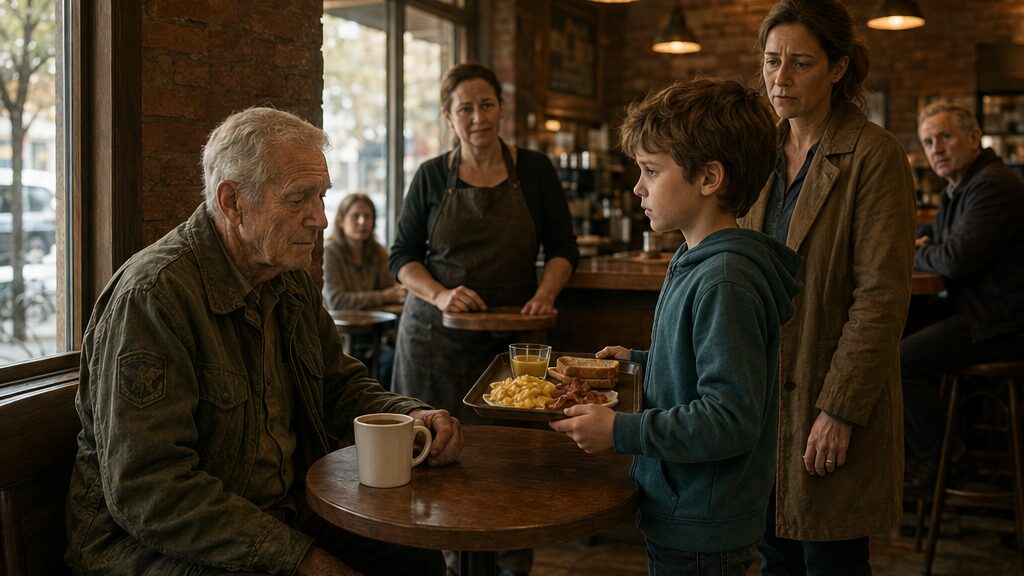
The Boy Brought A Veteran Breakfast, But His Salute Broke A Silence No One Understood
Chapter 1: The White Mug At The Corner Table
The boy was staring at Ronald Taylor’s sleeve.
Ronald saw it before the child’s mother did. He saw it in the window reflection, a small face turned away from the pastry case, eyes fixed not on the muffins or the cinnamon rolls but on the faded patch sewn crookedly above Ronald’s left elbow.
Ronald lowered his hand around the white coffee mug and waited for the boy to look somewhere else.
Most people did.
The café had been open for twenty-six minutes. The morning light came through the front windows in pale strips, catching the dust above the counter and the steam lifting from the espresso machine. Brick walls held the warmth from yesterday. Pendant lights glowed over tables that were still mostly empty except for three regulars, two commuters with phones, and Dennis Clark, who always took the stool closest to the register as if someone had assigned it to him.
Ronald sat where he always sat on Thursdays: the small round table near the right window, close enough to see the street but far enough from the counter that nobody had to talk to him unless they made an effort.
Sandra King had put the mug down without asking.
“Morning, Ronald.”
“Morning.”
That was usually the whole conversation.
Sometimes Sandra asked if he wanted toast. Sometimes oatmeal. Sometimes just “anything else?” in a tone gentle enough to let him refuse without feeling rude.
He always refused.
Coffee only. Black. White mug. Corner table.
Sandra had stopped placing a menu beside him months ago.
Ronald liked that about her. She learned where a man placed his fences and did not lean over them.
He wore the same jacket nearly every Thursday, though it was not part of any uniform anymore. Olive green, softened at the cuffs, button near the pocket replaced with a darker one that did not match. The service patch had lost most of its color. Once, it had been sharp enough for strangers to read from a few feet away. Now it looked like something time had tried to erase but could not quite remove.
That suited him.
The boy kept staring.
He was small enough that his sneakers did not make much sound against the floor. He wore a teal hoodie and stood beside a woman at the counter who was ordering two breakfasts and reminding him not to touch the display glass. His hair stuck up in the back as if he had dressed in a hurry. He held a paper from school folded in one hand.
Ronald turned the mug slightly by its handle.
The boy’s eyes moved from the patch to Ronald’s face.
Ronald looked out the window.
A delivery truck hissed against the curb. A cyclist passed with a red backpack. Across the street, a man in a work vest unlocked the hardware store and shook the door twice though it had already opened.
Ordinary things.
Ronald trusted ordinary things. They did not ask much of him.
Behind the counter, Sandra said, “Two egg plates, one with bacon, one without. Anything to drink?”
“Orange juice for him,” the woman said. “Coffee for me.”
The boy tugged at her sleeve and whispered something.
Ronald did not turn. He had spent years learning not to turn toward every whisper.
The woman answered in a low voice. “Not now, Christopher.”
Christopher.
Ronald placed the name quietly in the part of his mind where he kept details he did not intend to use.
The boy whispered again.
His mother glanced over her shoulder then looked quickly away when her eyes met Ronald’s reflection in the window.
Ronald lifted the mug and took a sip. The coffee was hot enough to make him pause, bitter enough to settle him. He liked that first sip best. It proved the day had begun and asked nothing else.
Sandra slid plates onto the service counter. The breakfast cook called something from the kitchen. Dennis Clark laughed at something on his phone, too loud for the hour. A nearby customer coughed into a napkin.
The boy did not move toward the table, but Ronald could feel his attention like a hand held inches from his sleeve.
He had known attention in many forms. Orders. Inspections. Waiting rooms. The kind faces of strangers who wanted to thank him and then needed him to thank them back for the thanking. The curious look of people trying to decide whether an old man’s silence was pride, sadness, or bad manners.
Child attention was different. Less polished. Less easy to resent.
Still, Ronald kept his eyes on the street.
Sandra came from behind the counter carrying a pot of coffee. She stopped by Dennis first, refilled him, then crossed toward Ronald. “Warm you up?”
Ronald looked into his mug. It was more than half full.
“No, ma’am.”
“You sure?”
“Yes.”
She didn’t move away immediately. Her gaze touched the patch, then the boy at the counter, then Ronald’s face. Sandra noticed too much. She did it kindly, which made it harder.
“You need anything, just wave.”
Ronald nodded.
He would not wave.
The woman at the counter collected a number stand and guided Christopher toward a table near the middle of the room. The boy walked slowly, turning his head once more toward Ronald.
This time Ronald looked back.
Not sharply. Not enough to frighten him. Just enough to say: I know you are looking.
Christopher froze for half a second, then lowered his eyes to the floor.
Ronald regretted it immediately.
The boy slid into his chair. His mother placed the folded school paper beside his napkin. Ronald could see part of a printed flag on it, colored with blue crayon beyond the lines.
A school assignment, then. Veterans, maybe. Service, maybe. One of those weeks when children were taught large words before they knew the cost of them.
Ronald rubbed his thumb over the mug handle.
The café door opened again, letting in a cold slip of air. A bus driver stepped in, ordered coffee to go, and left. Two women took the table under the hanging fern. The morning filled itself in around him, as it always did.
Ronald checked his watch though he did not need to be anywhere.
He had begun coming to Sandra’s café after the grocery store closed its breakfast counter. Before that, he had gone there every Thursday for nine years. Before that, a diner off the interstate. Before that, no routine at all for a while, just mornings that arrived whether he wanted them or not.
Thursday had become the safest day. Not the beginning of the week. Not the end. Not Sunday, with families crowding tables after church. Not Saturday, with children everywhere. Thursday asked less of people.
Coffee only.
Never breakfast.
That rule had started so long ago he sometimes forgot it had been a decision. Then something would bring it back: the smell of toast, the yellow shine of eggs, the scrape of a fork across a plate, and his stomach would close as if a hand had tightened around it.
Christopher’s food arrived.
Ronald heard the server set down plates. He heard the boy thank her softly. A good child, then. Or trying hard to be one. There was a small clatter of silverware, his mother’s quiet instruction, the squeak of the chair as Christopher shifted.
Ronald looked down into his mug.
A tiny crack ran near the rim. Sandra probably had not noticed. Or had noticed and decided Ronald would prefer the same imperfect mug to a newer one.
He respected that.
The boy whispered again.
This time Ronald caught the words.
“Mom, what does that patch mean?”
The café seemed to keep moving, but Ronald’s table became very still.
His thumb stopped on the handle.
Christopher’s mother did not answer right away. Ronald watched her reflection in the window. She looked at him, then at her son, then lowered her voice until the words disappeared under the hiss of the espresso machine.
Christopher listened. His brow pinched, not with fear, but with the effort of carrying something larger than himself.
Ronald turned the mug one more time, placing the crack away from him.
He wanted, suddenly and sharply, to stand. To leave the coffee unfinished. To pass the counter with a nod, step outside, breathe cold air, and let the boy’s question remain behind him with the smell of bacon and bread.
Instead, he stayed seated.
He kept both hands around the white mug.
He looked out the window as if nothing in the room had reached him.
Chapter 2: The Boy Who Came Back With Breakfast
Christopher Moore had only meant to ask one question.
He had not meant to stare. His mother had told him twice that morning not to stare at people, once while brushing his hair down with wet fingers and once in the car when he asked why the man at the bus stop was talking to himself.
But the old man’s patch looked like something from the sheet his teacher had handed out, except older. Realer. The lines were rubbed soft. The thread had gone pale at the edges. Christopher could not read it from the counter, but he knew it meant something because the man sat like his grandfather’s flag stood in the corner at school: quiet, straight, not asking anybody to notice.
“What does that patch mean?” he whispered.
His mother looked uncomfortable, which meant the answer mattered.
“It probably means he served,” Emily said.
“Served who?”
“Our country.”
Christopher looked down at his paper, where he had colored a flag too brightly and written Thank you for keeping people safe in careful pencil. His class had made cards for a veterans’ home, but the school volunteer had said they could make extra if they knew someone who served.
Christopher did not know anyone.
At least, he had thought he didn’t.
“He’s alone,” Christopher said.
Emily followed his gaze. The old man sat at the corner table with only a white mug in front of him. No plate. No newspaper. No phone. He looked like he had built a wall out of not needing anything.
“Some people like to eat alone,” Emily said.
“He’s not eating.”
“Christopher.”
“What?”
“Let him have his morning.”
Christopher lowered his fork. Eggs steamed on his plate. His toast had melted butter all the way to the crust, the way he liked it. He looked at the old man’s table again, then at the empty space beside the mug.
His mother was cutting her breakfast into pieces, though she had not taken a bite. She looked tired. Grown-ups often looked tired in the morning, but today she looked like she wanted to do the right thing and did not know whether the right thing was kindness or leaving someone alone.
“Can I give him my toast?”
“No.”
“Why?”
“Because that might make him feel strange.”
“What if I buy him breakfast?”
Emily almost smiled. “With what money?”
Christopher reached into the pocket of his hoodie and pulled out three folded dollar bills, two quarters, a nickel, and a penny. The coins had lint stuck to them. He placed them beside his plate.
Emily’s face changed.
“Where did you get that?”
“From my jar.”
“That was for your field trip.”
“I know.”
The old man lifted his mug but did not drink right away. Christopher wondered if he knew they were talking about him. He probably did. Old people knew more things than they said.
“Mom,” Christopher said, quieter now, “we made cards for people we don’t even see. He’s right there.”
Emily pressed her napkin to her mouth. For a moment she looked toward the counter as if hoping Sandra King would come over and decide for them.
The café owner was refilling coffee near the register. She glanced their way, then toward the old man, then back again. She had the kind of face that could say no kindly. Christopher prepared himself.
But his mother gathered the money from the table and placed it back in his palm.
“You ask Mrs. King how much a small breakfast costs,” she said. “If she says no, you say okay. If he says no, you say okay. You do not argue. You do not make a scene. Understand?”
Christopher nodded so hard his hair fell into his eyes.
“And Christopher?”
“What?”
“You don’t do this because you feel sorry for him.”
“I don’t.”
“Then why?”
He looked back at the patch.
“Because he kept drinking coffee like nobody saw him.”
Emily sat very still.
Then she said, “Go ahead.”
Christopher climbed down from his chair and carried his money to the counter with both hands. Sandra leaned down to hear him. He spoke softly, but his face burned as if the whole café had gone quiet.
“I want to buy breakfast for the man in the corner.”
Sandra looked at the coins, then at the bills, then at the corner table.
“That’s Mr. Taylor,” she said.
“Can I?”
Sandra wiped her hands on a towel. “He usually only wants coffee.”
“I know.”
“He may say no.”
“My mom said that’s okay.”
Sandra’s mouth softened. “Did she?”
Christopher nodded.
“What would you like to get him?”
Christopher looked at the menu board. There were too many words. He chose what smelled best.
“Eggs and toast. And maybe bacon. Unless he doesn’t like bacon.”
Sandra looked toward Ronald again. “He used to.”
Christopher did not know what to do with “used to,” so he waited.
Sandra tapped the counter once, thinking. Then she pushed the coins gently back toward him and kept only one dollar.
“This covers it.”
Christopher frowned. “That’s not enough.”
“It is today.”
“That’s cheating.”
“It’s a Thursday special.”
“There’s no sign.”
Sandra’s eyes smiled even though her mouth barely moved. “There is if I say there is.”
The breakfast cook rang the little bell sooner than Christopher expected. Sandra placed a plate on a tray with toast cut diagonally, eggs folded soft, two strips of bacon, and a small cup of orange juice. She added a napkin and a fork. Then she paused and set one more thing on the tray: a clean white saucer, though there was no mug on it.
“For balance,” she said.
Christopher took the tray with both hands.
It was heavier than he thought.
The walk from the counter to the corner table felt longer than walking to the principal’s office. His mother watched, one hand near her mouth. Dennis Clark looked up from his phone. A woman near the window stopped stirring her coffee.
Ronald Taylor did not look up until the tray shadow crossed his table.
Christopher stood beside him.
“Sir?”
The old man’s face turned slowly. Up close, he looked even older than Christopher had guessed. Not weak. Just weathered, like the wooden fence behind his grandmother’s house after too many winters.
Ronald looked at the tray.
Then at Christopher.
“I didn’t order that,” he said.
His voice was low, not unkind.
“I know.” Christopher swallowed. “I did.”
Ronald’s hand tightened around the mug. “Son, you take that back to your table.”
“It’s for you.”
“I appreciate it. But no.”
Christopher glanced once at his mother. She gave him a small look that meant remember what I said.
He almost turned back.
Then his eyes landed again on the patch.
“My class made thank-you cards,” he said. “For veterans. But I didn’t know one.”
Ronald did not move.
Christopher’s arms were beginning to tremble from the tray. He carefully lowered it onto the table, beside the white mug.
The fork clicked against the plate.
The sound was small.
Ronald flinched as if it had come from very far away.
Christopher straightened. His heart was beating fast now. He had practiced this only in his head, and in his head he had been braver.
“Thank you,” he said.
Ronald looked down at the eggs, the toast, the bacon, the white saucer, the steam.
Something passed across his face that Christopher did not understand. It was not a smile. It was not anger. It looked like a door opening inside someone who had spent a long time holding it shut.
Christopher raised his right hand to his forehead.
His fingers were not perfectly straight. His elbow was too low. He knew that. But he tried.
For one breath, nobody in the café moved.
Ronald stared at him.
Then, slowly, the old man released the mug.
His hand rose.
The salute he gave back was different from Christopher’s. It was worn smooth by years, exact without being sharp, quiet without being small.
Christopher felt suddenly that he should not speak.
Behind him, a chair scraped. Someone inhaled. Dennis Clark stood halfway up from his stool. Christopher did not turn around.
Ronald lowered his hand first.
His eyes had gone wet, but no tear fell.
“Your mother know you’re doing this?” Ronald asked.
Christopher nodded.
“Good mother.”
“Yes, sir.”
Ronald looked at the tray again. His lips moved once before sound came.
“I promised him breakfast,” he whispered.
Christopher leaned closer. “Sir?”
Ronald’s face closed, not harshly, but like a hand folding over a paper.
“Nothing,” he said. “You better go eat before yours gets cold.”
Christopher wanted to ask who. He wanted to ask why the old man looked at the toast as if it had remembered something for him. But his mother had said not to argue, and something in Ronald’s voice told him questions could be heavier than trays.
So Christopher nodded once, the way he thought respectful people nodded.
Then he stepped back, leaving the breakfast beside the white mug.
Chapter 3: Everyone Saw The Salute, Not The Wound
Sandra King had owned the café long enough to know the difference between a room going quiet and a room pretending not to listen.
This was the second kind.
The espresso machine still hissed. Silverware still touched plates. The breakfast cook still moved pans in the kitchen. But all the small sounds had thinned, as if the café itself was holding its breath around Ronald Taylor’s corner table.
Sandra stood behind the counter with a towel in her hand and watched Ronald look at the breakfast tray.
Not at the boy.
Not at the customers.
At the tray.
That was how she knew something had gone wrong and right at the same time.
Christopher had returned to his mother, but he kept twisting in his chair to look back. Emily put one hand over his, not stopping him exactly, just reminding him that kindness did not give him ownership of the old man’s reaction.
Good, Sandra thought.
The boy had done enough.
Ronald’s hand rested beside the plate. He did not touch the fork. He did not unfold the napkin. The steam from the eggs curled upward and vanished before reaching his face.
Dennis Clark rose fully from his stool.
“Well, I’ll be,” he said, voice carrying too far. “That’s something, isn’t it?”
Sandra’s eyes went to him.
Dennis did not notice. He was looking at Ronald with the bright, eager expression of a man who had discovered late that he was in the presence of a meaningful moment and wanted to join it before it passed.
He raised his hand in a salute.
It was not mocking. Dennis was not a cruel man. He was a loud one. Sometimes the difference mattered less than he thought.
A woman near the fern followed, then the bus driver who had come back in because he had forgotten a receipt. Two hands rose awkwardly. Another customer pressed a palm over his heart instead, unsure what was proper.
Ronald saw them.
Sandra saw him see them.
His shoulders pulled back, but not with pride. With defense.
“Dennis,” Sandra said quietly.
He did not hear.
“Thank you for your service, Mr. Taylor,” Dennis said.
The words were good words. Sandra knew that. But they landed on Ronald in the wrong way, too many eyes attached to them.
Ronald pushed his chair back.
Christopher’s face changed.
“Mom,” he whispered.
Emily put her arm around him.
Sandra stepped out from behind the counter. “Dennis.”
This time, her voice cut through the room.
Dennis turned, hand still half-raised. “What?”
“Let him have his breakfast.”
The sentence sounded ordinary. That was why it worked.
Dennis lowered his hand. The woman near the fern looked down at her coffee. The bus driver folded his receipt and slipped it into his jacket.
Ronald had one hand on the table, the other on the back of the chair. For a moment Sandra thought he might sit again.
Instead, he reached into his jacket pocket.
“Ronald,” she said, softer now.
He placed folded bills beneath the white mug.
“Coffee was fine,” he said.
His voice was steady. Too steady.
“The breakfast is taken care of.”
“I didn’t eat it.”
“It can be wrapped.”
He shook his head once.
Sandra did not argue. She had seen men argue with pride until kindness turned sour in their mouths. She had seen women do it too. She knew when a gift needed room to breathe and when it had pressed too close.
Ronald looked toward Christopher.
The boy sat rigid, frightened that he had done something wrong.
Ronald seemed to understand that faster than any adult in the room.
He gave Christopher a small nod.
Not a smile. Not comfort exactly. But permission.
The boy’s shoulders lowered.
Then Ronald turned and walked toward the door.
Every customer pretended not to watch him leave, which meant every customer watched him leave.
His steps were measured. His jacket hung loose from his frame. The patch on his sleeve passed through a band of window light and, for half a second, became bright enough for Sandra to see the old stitching clearly.
Then the door opened, the bell rang, and Ronald Taylor stepped out into the morning.
The café exhaled.
Dennis rubbed the back of his neck. “I didn’t mean to—”
“I know,” Sandra said.
“I just thought—”
“I know.”
Christopher was staring at the untouched plate.
Emily stood and came toward the counter, leaving her son at the table. Her face carried that careful embarrassment parents wore when a child’s good heart had wandered into adult pain.
“I’m sorry,” she said. “I should have stopped him.”
Sandra looked at Christopher. He was pushing his own toast around without eating. “I don’t think stopping him was the answer.”
“He looked upset.”
“He was.”
Emily winced.
“That doesn’t mean your boy did wrong,” Sandra said.
Emily followed Sandra’s gaze to the corner table. “Then why did he leave?”
Sandra had no simple answer.
Because gratitude could be heavy. Because being seen was not the same as being ready. Because some men survived by arranging their mornings so nothing unexpected touched the old bruises. Because a child had placed eggs and toast beside a white mug and somehow found a locked room.
Instead she said, “Sometimes a good thing still hurts.”
Emily folded her arms across herself. “Christopher won’t understand that.”
“Most grown-ups don’t either.”
The breakfast cook appeared in the kitchen window, silent for once. Sandra lifted the plate from Ronald’s table. The toast had gone soft at one edge. The eggs had cooled. The bacon still smelled warm and smoky.
She carried the tray behind the counter and set it down gently, as if noise might make the morning worse.
Dennis came over with his coffee in hand. He kept his voice lower this time. “Should I apologize next Thursday?”
“If he comes in next Thursday, you should let him order coffee.”
Dennis nodded, chastened. “Right.”
“And don’t tell people about this.”
He glanced toward the nearby customer who had taken out a phone. “Too late for that?”
Sandra turned.
The customer lowered the phone quickly. “I wasn’t recording. I just—”
Sandra held out her hand.
The customer hesitated, then showed the screen. No video. Only a half-open camera app, no image saved.
“Thank you,” Sandra said.
It was not warm.
The phone disappeared into a pocket.
Christopher slipped out of his chair and walked toward the counter. His mother began to call him back, but Sandra lifted two fingers: let him.
The boy stopped beside the tray. “Did I make him sad?”
Sandra crouched enough that they were almost eye level. “You gave him something kind.”
“But did I?”
“Yes.”
“He didn’t eat it.”
“No.”
“Then maybe he didn’t want it.”
Sandra looked at the plate, then at the door Ronald had used. “Maybe he wanted it more than he knew what to do with.”
Christopher thought about that. His eyes shone, but he did not cry.
“He said he promised him breakfast.”
Sandra’s throat tightened.
Emily heard it too. Her face turned toward her son slowly.
Sandra stood. “Did he?”
Christopher nodded.
The café, which had just begun to recover, seemed to go still again.
Sandra looked back at the corner table. The white mug remained where Ronald had left it, turned slightly so the small crack near the rim faced the empty chair. Beneath it was the folded money.
She walked over, lifted the mug, and opened the bills.
Enough for the coffee.
Not the breakfast.
Not one cent more.
Sandra stood there with the money in her hand, the cooling tray behind her, and the old question Ronald had left behind spreading through the room without a sound.
Who was him?
Chapter 4: Margaret Thought Silence Meant Refusal
Margaret Allen found the egg plate in her father’s refrigerator at six-thirty that evening, wrapped in plastic so tightly it looked more like evidence than food.
She had brought soup, because soup was the sort of thing daughters brought when they were trying not to say what they really meant. She had also brought oranges, a loaf of wheat bread, and a small container of chicken salad from the grocery deli. Ronald would tell her it was too much. She would tell him she had been passing by. Neither of them would believe the other.
The refrigerator light buzzed over three bottles of water, half a jar of mustard, a carton of milk one day past its date, and the plate.
Margaret stood with the door open, cold air spilling over her shoes.
“Dad?”
“In here.”
His voice came from the living room, where the evening news played low enough that it was more flicker than sound.
Margaret lifted the plate. Eggs, untouched. Toast folded in a napkin. Bacon wrapped separately in foil. Not from his kitchen. Ronald did not cook bacon anymore; he said the smell stayed too long.
She closed the refrigerator with her hip and carried the plate into the living room.
Ronald sat in his recliner, still wearing the faded green jacket, though the house was warm. His shoes were lined neatly beside the chair, toes pointing toward the hallway. The white socks on his feet made him look older than the jacket did.
“Where did this come from?” Margaret asked.
He looked at the plate in her hands. “Café.”
“You ordered breakfast?”
“No.”
She waited.
He turned his eyes back to the television. “Sandra wrapped it.”
Margaret set the plate on the coffee table. She had learned not to stand over him with questions. It only made him smaller and harder at the same time.
“Why did Sandra wrap you breakfast if you didn’t order it?”
“Long story.”
“You never have long stories.”
“That’s why I don’t tell them.”
The sentence was dry, almost funny. A year ago, Margaret might have laughed. Lately she could not tell when he was joking and when he was putting a chair under the doorknob.
She took off her coat and hung it on the back of the dining chair, though she had told herself she would not stay long. His house smelled faintly of coffee, old wood, and the lavender detergent she had bought him because the unscented one had been out. He had not complained. That was how she knew he hated it.
“I brought soup,” she said.
“I ate.”
She looked at the untouched plate.
He saw her looking and sighed. “I had coffee.”
“That’s not eating.”
“It is after seventy-five.”
“You’re not seventy-five.”
“Close enough.”
Margaret carried the soup to the kitchen without answering. She knew the shape of this conversation. She would press. He would retreat. She would accuse him of not taking care of himself. He would remind her she had a job, a house, her own life. She would say that was not the point. He would say very little after that.
The microwave hummed. She leaned against the counter and looked at the kitchen drawer beside the sink.
It was slightly open.
Ronald never left drawers open. Cabinets, either. His house could be dusty, but never careless. She pushed the drawer with two fingers, and something inside caught against the frame.
Margaret pulled it open farther.
Dish towels. A flashlight. Rubber bands. An old envelope, yellowed at the corners.
And a photograph.
She knew at once she was not supposed to see it.
The photo was tucked beneath a stack of folded napkins, face up enough to show two young men seated on the tailgate of a truck, plates balanced on their knees. One was Ronald, though not the Ronald she had known as a child. This Ronald’s shoulders filled his shirt. His face was lean, sun-browned, almost shy in its youth. The other man was younger, grinning around a piece of toast held between his teeth.
Behind them, the background was too blurred to place. There was dust on their boots. A dented metal mug sat between them.
Margaret heard her father’s chair creak in the living room.
She slid the drawer shut too quickly.
The microwave beeped.
“Need help?” Ronald called.
“No,” she said. “Just hot.”
Her voice sounded guilty to her own ears.
She carried the soup in a bowl with a spoon balanced on the saucer. Ronald looked at her once, and she had the uncomfortable feeling he knew exactly what she had seen. He did not ask.
She placed the bowl on the side table.
“Eat while it’s warm.”
He looked at the soup as if it had made a request.
“Margaret.”
“Please.”
He picked up the spoon.
That small victory should have satisfied her. It didn’t. The wrapped breakfast sat between them, stubborn and silent.
“Did something happen at the café?” she asked.
Ronald took a careful spoonful of soup.
“Dad.”
He swallowed. “A boy bought me breakfast.”
Margaret blinked. Of all the answers she had prepared for, that was not one.
“A boy?”
“Little fella. Christopher.”
“Do you know him?”
“No.”
She sat on the sofa across from him. “Why would a child buy you breakfast?”
Ronald looked at the dark television screen between news segments. His reflection floated there, pale and blurred.
“Saw my patch.”
Margaret’s eyes moved to the sleeve of his jacket. She had seen that patch all her life and stopped seeing it years ago. It was just part of him, like the crease between his brows or the way he folded receipts before throwing them away.
“What did he say?”
“Thank you.”
The room went quiet.
Margaret softened despite herself. “That was sweet.”
Ronald gave no answer.
“And Sandra wrapped the food because you didn’t eat it?”
His spoon paused.
“There were people looking.”
Margaret sat back. Now she could picture it: her father at his corner table, uncomfortable under attention, refusing a kindness because he could not bear the room watching him receive it.
“Dad, people looking at you isn’t always bad.”
He set the spoon down gently. Too gently. “I know the difference.”
She bit back the first thing that rose in her throat.
Do you?
Instead she said, “Maybe they just wanted to show respect.”
“Maybe.”
“You make it hard for people to care about you.”
The words left before she had weighed them.
Ronald’s face did not change, which was worse.
Margaret looked at her hands. “I didn’t mean—”
“Yes, you did.”
She closed her eyes briefly. When she opened them, he was looking at the wrapped breakfast.
“He saluted,” Ronald said.
She looked up.
“The boy?”
Ronald nodded once.
“And you?”
“I returned it.”
Margaret’s chest tightened. She tried to imagine it and could not. Her father, who would not stand for recognition at Memorial Day breakfasts, who stopped attending community events when someone asked him to “say a few words,” had returned a child’s salute in a café.
“That must have meant something to him,” she said.
Ronald looked at her then, and for an instant she saw not refusal but exhaustion.
“It meant something to me.”
The honesty stunned them both.
Margaret waited, afraid to move.
The television light shifted blue across his face. He looked older in that light, but also less defended, as if a door inside him had not closed all the way after the morning.
“He brought eggs,” Ronald said. “Toast. Bacon.”
She said nothing.
“I used to like bacon.”
“I know.”
“No, you don’t.”
The words were not cruel. They were simply true, and because they were true, they hurt more.
Ronald leaned back. His gaze went toward the kitchen, toward the drawer she had opened.
Margaret’s voice dropped. “Who was in the photograph?”
He closed his eyes.
The question sat between them. The soup cooled. The news anchor’s mouth moved soundlessly now; Ronald had muted it without Margaret noticing.
“I shouldn’t have looked,” she said.
“No.”
“I’m sorry.”
He rubbed one hand over his knee. “Young man I knew.”
“From service?”
He nodded.
“What was his name?”
Ronald’s jaw worked once.
“You don’t have to tell me.”
“I know.”
He looked relieved that she had said it, and ashamed of the relief.
Margaret stood and went to the kitchen. She took the wrapped café plate from the coffee table on her way, not asking permission. At the counter, she unwrapped it carefully. The eggs had set firm. The toast was soft, but not ruined. She put everything on a clean plate and warmed it in the microwave for less time than she thought it needed, because Ronald hated food too hot.
When she returned, he watched her as if she were crossing delicate ground.
She set the plate on the side table beside the soup.
“I’m not going to make you talk,” she said.
“That’ll be new.”
She almost smiled. Almost.
“But I am going to ask you to eat something.”
He stared at the plate.
“That boy spent his field trip money or allowance or whatever children carry around now. He wanted you to have breakfast.”
Ronald’s mouth tightened.
“I’m not saying you owe him your past,” she added. “But maybe you can accept the toast.”
For a long moment, he did nothing.
Then Ronald picked up one half of toast.
Margaret looked away so he would not feel watched.
He took one bite.
It was small, and he chewed slowly, as if his body had forgotten what to do with it. But he swallowed.
Margaret sat down again and folded her hands in her lap to keep from reaching for him.
When she looked up, his eyes were wet.
Not crying. Her father did not cry where people could see. But the wetness was there, reflecting the blue television light.
“I promised him breakfast,” Ronald said again, so quietly she might have missed it if the house had not been so still.
This time Margaret did not ask who.
She understood enough to know the question had to wait.
Later, after she washed the soup bowl and wrapped the café plate again, after Ronald said she did not need to fuss and she fussed anyway, after she put on her coat and stood by the front door, her phone buzzed.
A message from Sandra King.
Margaret read it twice.
A little boy left something at the café for your father. I didn’t want to bring it by without asking.
Below the words was a photograph.
A folded piece of construction paper lay beside a clean white mug on Ronald’s corner table. The front was colored with a careful flag and five uneven words.
For the man at the corner table.
Margaret looked down the hallway toward her father’s living room. He had not turned the news sound back on.
She slipped the phone into her pocket without telling him.
Not yet.
Chapter 5: The Note Beside The Empty Chair
Sandra King found the note before sunrise on Saturday, tucked beneath the napkin holder at Ronald Taylor’s table.
The café was still dark except for the light above the register and the blue glow from the kitchen. Outside, the street had not fully woken. A delivery truck idled near the curb, breathing white exhaust into the cold. Inside, the chairs were still turned upside down on some of the tables, and the floor smelled faintly of lemon cleaner.
Sandra had come in early because she could not stop thinking about the plate of food Ronald had not eaten.
She had told herself it was business. Prep the muffins. Check the register tape. Call the repairman about the ice machine. But her feet carried her first to the corner table, the one near the window, where Ronald’s white mug usually sat by seven-fifteen on Thursdays.
The note was folded in half.
Not hidden. Placed.
Christopher had come back Friday afternoon with Emily, cheeks red from cold and embarrassment. Sandra had been wiping the pastry case when he approached the counter with the construction paper clutched in both hands.
“Can you give this to Mr. Taylor?” he asked.
Emily stood behind him, not speaking for him. Sandra respected that.
“I can,” Sandra said. “But he may not answer.”
Christopher nodded as if he had already prepared himself for that.
“And I won’t read it unless he says I can.”
“It’s okay if you read the outside.”
The outside had the flag and the uneven words.
For the man at the corner table.
Sandra had promised to put it where Ronald would see it if he came back.
Now, in the quiet before opening, she set a clean white mug beside the note and stood looking at both.
The chair across from Ronald’s usual seat was pulled out half an inch.
Sandra noticed because she noticed chairs. She knew when someone left in anger, when someone lingered, when teenagers had been trying to look casual, when a widow had sat for an hour and touched the handle of the second mug that was no longer needed.
She nudged the chair back in.
Then she changed her mind and pulled it out again.
Not far. Just enough to make the table look less sealed.
By seven, the kitchen had warmed. By seven-thirty, the first customers came through. Dennis Clark arrived at his usual time but stopped before sitting.
“He coming today?” he asked.
Sandra arranged cups behind the counter. “It’s Saturday.”
“I know.”
“Ronald comes Thursdays.”
“Mostly.”
“Dennis.”
He lifted both palms. “I’m not going to bother him.”
She gave him a look.
“I mean it,” he said. “I thought about what you said.”
“I didn’t say much.”
“You didn’t have to.”
The door opened again, and for half a second they both looked.
Not Ronald.
Sandra spent the morning serving coffee and pretending not to check the corner table. Every time someone moved near it, she felt protective of the note. At ten, she placed a reserved sign there, then removed it immediately because Ronald would hate that. At eleven, she moved the note behind the counter. At noon, she put it back.
By two, she called Margaret Allen.
“I don’t want to overstep,” Sandra said when Margaret answered.
“That means you think you might.”
“I do.”
Margaret gave a tired little laugh. “What is it?”
Sandra looked at the note resting beside the mug. “The boy from Thursday left something for your father.”
Silence.
“He doesn’t know I called you,” Sandra added.
“My father or the boy?”
“Either.”
“What does it say?”
“I didn’t open it.”
Another silence, softer this time.
“Thank you,” Margaret said. “For not opening it.”
“I can hold it until Thursday.”
Margaret breathed out. “He may not come Thursday.”
“I know.”
“But if you bring it to him, he may feel cornered.”
“I know that too.”
There it was, the difficulty of caring for someone who had built a life around not needing rescue. Leave the note, and it might sit untouched. Deliver it, and it might become an intrusion. Throw it away, impossible.
“I could mail it,” Sandra said, though she disliked the idea as soon as she spoke it.
“No. That makes it look official. He hates envelopes.”
Sandra glanced toward the old envelope of café receipts she kept under the register and wondered how many ordinary things people came to hate because of what had once arrived inside them.
Margaret said, “I’ll ask him if he wants to stop by.”
“No pressure.”
“With my father, everything is pressure if it has feeling in it.”
Sandra smiled sadly. “I’ve noticed.”
But Ronald came before Margaret could bring him.
He arrived that afternoon just after the lunch rush, when the café had thinned to two tables and a server rolling silverware in napkins. Sandra looked up from the register and saw him standing inside the door in his green jacket, cap in hand, as if he had entered a room where he was not certain he had been invited.
Not Thursday.
Not morning.
Not his usual time.
That alone told Sandra to be careful.
“Afternoon, Ronald.”
He nodded. “Sandra.”
“Coffee?”
He looked at the corner table. The note lay beside the clean mug. The chair across from it remained slightly out.
His face gave away nothing.
“No,” he said. “Not staying.”
Sandra did not move toward the table. “All right.”
He stood there a moment longer.
Then he walked to the corner.
The café seemed to recede around him. Sandra busied herself wiping the counter, though it was already clean.
Ronald picked up the note but did not open it. His thumb rested on the crayon flag. From where Sandra stood, she saw the paper tremble once.
“Boy left this?” he asked.
“Yes.”
“Christopher.”
“Yes.”
Ronald turned the note over. There was no envelope. No last name written on it. Just the front and the fold.
“Did he ask for anything?”
“No.”
“Want me to write back?”
“No.”
“Then why leave it?”
Sandra considered soft answers and discarded them.
“Because he wanted you to have it.”
Ronald’s mouth moved slightly. Not a smile. Not yet.
He slipped the note into the inside pocket of his jacket. “Thank you.”
He started toward the door.
“Ronald.”
He stopped but did not turn fully.
“I can make coffee to go.”
“No.”
“Or not.”
He looked back then. “You always this pushy with customers?”
“Only the ones who scare off breakfast.”
A little air left him. Almost a laugh, but smaller.
Sandra came around the counter slowly, stopping far enough away that he could still leave.
“He was worried he upset you.”
Ronald looked toward the window.
“He didn’t.”
“You might tell him that someday.”
His hand moved to the pocket where the note rested. “Someday is a wide road.”
“It is.”
He nodded once, as if the matter were settled, and left.
Sandra thought that was the end of it for the day.
But at closing, as she wiped down the tables, her phone rang. Ronald’s name appeared on the screen. He rarely called. When he did, he never wasted words.
“Sandra,” he said.
“Yes?”
“What time does the boy usually come in?”
She sat down in the nearest chair.
“Christopher?”
“Don’t know another boy buying old men breakfast.”
“He and his mother come Thursday mornings before school. Sometimes Friday afternoons.”
There was a rustle on his end, paper maybe.
“Did he write the note himself?”
“I believe so.”
“What did he say to you when he left it?”
Sandra leaned back, looking at the dark window. “He said, ‘If he doesn’t want it, he doesn’t have to keep it.’”
Ronald was quiet for so long she thought the call had dropped.
Then he said, “He spelled soldier wrong.”
Sandra smiled. “He’s young.”
“He wrote, ‘Dear Mr. Taylor, I’m sorry if breakfast made you sad. I just wanted you to know somebody was glad you came home.’”
Sandra closed her eyes.
Ronald’s voice remained steady, but there was effort in the steadiness.
“He wrote that?”
“Yes.”
Another pause.
“I didn’t always come home on time,” Ronald said.
Sandra did not answer. She understood that he was not quite speaking to her.
“There was a young man,” he said. “Used to talk about breakfast like it was a place. Not food. Pancakes, bacon, coffee with too much sugar. He said when we got back, first thing we’d do was sit in a diner and order everything on the menu. I told him I’d buy.”
Sandra held the phone with both hands.
“Did you?” she asked softly.
“No.”
The word was plain. Heavy.
“He didn’t make it back?” she asked.
Ronald breathed once through his nose. “Not to breakfast.”
Sandra looked toward the corner table, now clean and empty except for the salt and pepper shakers.
“I’m sorry.”
“People say that.”
“I know.”
“I’m not saying they shouldn’t.”
“I know that too.”
On Ronald’s end, something tapped lightly. His finger against a table, maybe. Or the folded note.
“I stopped eating breakfast out after that,” he said. “Seemed foolish at first. Then it got to be habit. Then it got to be easier than changing.”
Sandra’s throat tightened, but she kept her voice even. “Christopher couldn’t have known.”
“No.”
“He just saw you.”
“Yes,” Ronald said. “That’s the trouble.”
Sandra let the silence stay.
When Ronald spoke again, his voice had shifted. Not lighter, exactly, but turned toward the living.
“What time Thursday?”
“Seven-thirty, usually.”
“Does he still have school?”
“Yes.”
“I don’t want fuss.”
“I know.”
“No pictures.”
“I’ll make sure.”
“No standing around.”
“I’ll make sure of that too.”
“And Sandra?”
“Yes?”
“If I come, don’t put a sign on the table.”
She looked at the corner chair she had almost marked reserved that morning.
“I won’t.”
“Just two mugs,” he said. “Maybe three.”
Sandra sat very still.
“Three?”
“If his mother sits.”
“I think she would.”
“And breakfast,” Ronald added.
Sandra smiled then, not because it was easy, but because it was not.
“What kind?”
He was quiet long enough for memory to walk through.
“Eggs,” he said. “Toast. Bacon on the side.”
“Orange juice for Christopher?”
“Yes.”
“And for you?”
Ronald gave a small breath.
“Coffee,” he said. “In the white mug, if it’s clean.”
After they hung up, Sandra stayed seated in the dark café. She looked at the empty corner table and imagined the note beside the mug, the chair pulled out not by accident this time, the tray placed down without anyone making it into a show.
For the first time since Thursday morning, she believed the breakfast had not been refused.
It had simply arrived before Ronald knew how to receive it.
Chapter 6: Ronald Chose The Table Before The Story
Ronald arrived before Christopher on Thursday.
That was the first choice.
He could have come late and pretended he had missed the boy by accident. He could have stayed home and let Sandra’s question drift unanswered. He could have folded the note into the kitchen drawer beside the photograph and allowed it to become one more thing he did not touch.
Instead, he stood outside the café at seven-twelve with his green jacket buttoned crookedly and Christopher’s note in his inside pocket.
The windows glowed against the cold morning. Sandra moved behind the counter, setting cups in rows. The corner table was empty. No sign. No flowers. No little flag. Just the table, the window, and the chair across from his seat pulled out barely enough to suggest possibility.
Ronald saw that and almost turned around.
Not because it was wrong.
Because it was right in a way that left him no irritation to hide behind.
He opened the door.
The bell rang.
Sandra looked up and did not smile too broadly. Another kindness.
“Morning, Ronald.”
“Morning.”
“Coffee?”
“Yes.”
She reached for the white mug.
Ronald watched her fill it, watched the steam rise. His hands felt stiff. He had slept little. The note had rested on his kitchen table all night, open beneath the overhead light, five words catching him every time he passed.
Somebody was glad you came home.
People had said versions of that before. Thank you. Welcome home. Glad you made it. Proud of you. Words offered in grocery lines, at the pharmacy, once from a man pumping gas who saw the veteran plate on Ronald’s truck.
He had accepted them politely.
Christopher’s note had not felt polite. It had felt aimed by accident at the exact place Ronald kept covered.
Sandra brought the mug to the table and set it down in the usual spot.
“Food in a bit,” she said.
Ronald looked at her.
“You told me breakfast.”
“I did.”
“You can still change your mind.”
“I know.”
She nodded and left him there.
Ronald sat.
The white mug had the small crack turned toward him today. He touched it once with his thumb. He appreciated that Sandra had not thrown it out. Some things still held coffee even after they cracked.
Dennis Clark came in at seven-twenty and stopped just inside the door when he saw Ronald.
Ronald braced himself.
Dennis removed his cap. “Morning.”
“Morning.”
Nothing else.
Dennis went to the counter, ordered coffee, and took his usual stool. He did not salute. He did not thank him. He did not look back more than twice.
Ronald had not expected to be grateful for restraint, but he was.
The café filled slowly. A commuter. Two women. The bus driver. Ordinary morning sounds gathered: cups, low voices, the scrape of chairs. Ronald breathed through them.
At seven-thirty-four, Christopher entered with Emily.
The boy saw Ronald immediately.
He froze with one hand still on the door.
Emily almost bumped into him. Then she saw Ronald too, and her face went cautious.
Sandra, behind the counter, did not call attention to them. She simply picked up a tray from the kitchen window.
Christopher walked toward the corner table as if crossing thin ice.
He wore the same teal hoodie, though today it was zipped unevenly. His hair had been combed but had rebelled again in the back. In one hand, he held his backpack strap. In the other, he held nothing. No money. No card. No shield.
Ronald stood.
The boy stopped.
“Sir,” Christopher said.
“Mr. Taylor is fine.”
“Mr. Taylor.”
Emily came up behind him. “Good morning.”
“Ma’am.”
Her mouth tightened at the formality, perhaps unsure whether it created distance or respect.
Ronald looked at the chair across from him. Then at the one beside it. He had rehearsed the sentence at home and forgotten it now that they were here.
He tried again.
“If you have time before school,” he said, “you can sit.”
Christopher looked at his mother.
Emily looked at Ronald. “We don’t want to impose.”
“You’re not.”
The words came out rougher than he intended. He adjusted.
“I asked Sandra what time you came.”
Christopher’s eyes widened. “You did?”
“Yes.”
Sandra arrived then with the tray. She placed it carefully at the center of the table: eggs, toast, bacon on a small side plate, a cup of orange juice, and two white mugs. Then, after a half-second, she returned with a third mug for Emily.
No one spoke while she arranged them.
The tray seemed larger than the table.
Ronald sat. Christopher sat across from him. Emily sat beside her son, back straight, hands folded around the mug Sandra had given her.
Ronald looked toward the counter, then at Dennis, then at the nearby tables. A few people noticed. Most quickly looked away. Sandra must have spoken to them with her eyes, because the room held its curiosity gently.
Ronald reached into his jacket and took out Christopher’s note.
The boy’s face turned red.
“You kept it,” Christopher said.
“Yes.”
“I spelled some words wrong.”
“I understood them.”
Christopher looked down at the tray. “I’m sorry I made you sad.”
Ronald placed the note beside the white mug. “You didn’t make me sad.”
“But you left.”
“I left because I didn’t know how to stay.”
Emily’s eyes moved to him then, but she did not interrupt.
Ronald took a breath. He could feel the old instinct rising: close the door, make a joke, say nothing. He put one hand flat on the table until it passed.
“I need to say something before we eat,” he said.
Christopher nodded seriously.
Ronald looked at him, then at Emily. “I’m not good with questions.”
“That’s okay,” Emily said.
“I don’t want anyone recording this.”
“No,” she said at once. “Of course not.”
“I don’t want a speech made of it.”
Christopher frowned. “Like at school?”
“Maybe smaller than that.”
“I won’t.”
Ronald believed him.
“And I’m not going to tell a big story,” Ronald said. “Not today.”
Christopher’s disappointment flickered and disappeared so quickly Ronald almost missed it. The boy was trying to be respectful even with his face.
Ronald softened.
“But I’ll tell you this much. That breakfast you brought me reminded me of somebody.”
“The him?” Christopher asked, then immediately looked worried. “Sorry.”
Ronald looked down at the bacon plate.
“Yes,” he said. “The him.”
The table stayed quiet.
Sandra moved behind the counter. Dennis stared into his coffee as if it required all his attention. The city bus sighed outside and pulled away.
“He was young,” Ronald said. “Younger than I knew how to protect.”
Emily lowered her eyes.
Ronald stopped there. Already the words had brought heat behind his ribs. He did not owe the room more. He did not owe even Christopher more.
The boy seemed to understand. He reached for his orange juice with both hands and took a sip.
Ronald picked up his fork.
The eggs trembled slightly when he cut into them. His hand was not as steady as he wanted. He hoped Christopher did not notice. Of course, Christopher noticed. Children saw everything until adults taught them not to.
But the boy did not comment.
Emily buttered a piece of toast and put it on Christopher’s plate. Then, after a pause, she slid the other half toward Ronald without a word.
Ronald looked at it.
She looked back, uncertain.
He took it.
They ate.
Not much at first. Small bites. Careful movements. The kind of meal that began as a negotiation with grief and slowly remembered it was food.
Christopher finished half his eggs, then looked at the empty chair beside the table.
Ronald noticed.
“What is it?”
The boy hesitated. “Is that chair for someone?”
The question moved through Ronald quietly, more gently than he expected.
He looked at the chair. It had been pulled out just enough. Waiting, but not demanding.
For years, he had kept empty chairs pushed in tight.
“No,” Ronald said first.
Christopher nodded.
Ronald looked at the white mug, the tray, the toast, the folded note.
Then he corrected himself.
“Maybe,” he said.
Chapter 7: The Breakfast He Finally Shared
Ronald did not answer the boy right away.
The empty chair sat at the edge of the table with its front legs caught in a stripe of morning light. It had no coat on the back, no hands resting on it, no coffee cooling in front of it. Still, Christopher watched it as if someone might arrive if everyone waited politely enough.
Maybe.
Ronald had not meant to say even that.
He had meant to say no. He had meant to make the chair ordinary again. A chair was a chair. Wood, screws, old varnish rubbed pale at the corners by years of palms and coats and people shifting their weight. It was not a promise. It was not a grave marker. It was not a place held open for someone who would never walk through Sandra King’s café door.
But the word had already left him, and Christopher had heard it.
Emily heard it too. She placed her mug down softly, careful not to make the table jump.
Ronald looked at his fork. A small piece of egg clung to the tines. He set it beside the plate and folded his hands in his lap.
Around them, the café continued with the discipline of people trying to be kind. Dennis Clark turned a newspaper page without reading it. Sandra wiped the same section of counter twice. The cook rang the service bell once and then seemed to regret how bright it sounded.
Christopher lowered his voice. “Is it for the man you promised?”
Emily touched his shoulder. “Christopher.”
“It’s all right,” Ronald said.
The boy went still.
Ronald looked at the empty chair.
He could stop here. He knew that. He had said enough to satisfy a child’s curiosity and not enough to bleed. He could tell Christopher the man had been a friend, that breakfast had been an old joke, that some promises stayed with you. All true. All useless.
He reached into his jacket and took out the folded note Christopher had written.
The construction paper had softened at the crease from being opened and closed. Ronald placed it beside the white mug, smoothing it with two fingers. The flag on the front leaned to one side. The words were uneven, but they stood.
For the man at the corner table.
“My friend talked about breakfast when things were hard,” Ronald said.
Christopher listened with the seriousness of a child trying to hold a full glass without spilling.
“He didn’t talk about medals. Didn’t talk about being brave. Didn’t talk much about going home, even. He talked about sitting in a place with windows. Ordering too much food. Taking his time.”
Ronald’s eyes moved to the tray.
“Eggs?” Christopher asked.
“Everything,” Ronald said, and a faint, surprised warmth passed through him. “He said he was going to order everything because nobody could tell him not to.”
Christopher almost smiled, then stopped himself.
“He liked bacon?”
“He liked the idea of bacon. Talked more than he ate.”
Emily’s eyes softened.
Ronald picked up the piece of toast Emily had slid toward him earlier. He turned it once between his fingers. Butter shone faintly across the surface.
“I told him I’d buy when we got back,” he said. “First breakfast home. My treat.”
The café seemed to draw nearer around him, though no one moved.
“He didn’t get that breakfast,” Christopher said.
Ronald looked at him.
No adult would have said it so plainly. They would have walked around it, padded it, made the sentence gentler and somehow heavier.
“No,” Ronald said. “He didn’t.”
Christopher looked down at his orange juice.
Ronald waited for the usual thing to happen inside him: the tightening, the shame at having said too much, the old anger at the living for wanting shape put around the dead. It came, but not as strongly. It rose and found the white mug, the tray, the boy’s bent head, Emily’s quiet hand resting near her son’s plate.
It did not disappear.
It made room.
“So you stopped eating breakfast?” Christopher asked.
Ronald let out a breath that might have become a laugh if it had been younger.
“Not all breakfast. Just breakfast out. Shared breakfast. The kind he meant.”
“That’s a long time.”
“Yes.”
“My mom says sometimes people keep rules after they forget why.”
Emily looked startled, then embarrassed. “I say too many things while driving.”
Ronald looked at her. “That one’s not bad.”
A little color rose in her face.
The server passed with a pot of coffee. She did not stop, but Ronald lifted a finger. She came over quickly, perhaps too quickly, relieved to have something useful to do.
“Warm it up, Mr. Taylor?”
He looked at the white mug.
“Yes, please.”
She poured. The coffee rose black and steaming, circling the small crack near the rim but not crossing it.
Ronald watched until she left.
Then he pushed the bacon plate toward Christopher.
“Help me with that.”
Christopher blinked. “Are you sure?”
“I’m too old to fight bacon by myself.”
The boy looked at his mother for permission. Emily nodded.
Christopher took one strip, broke it in half, and placed the smaller piece on Ronald’s plate as if fairness mattered. Ronald accepted the portion without comment.
They ate again.
This time the silence was different. Not empty. Not safe exactly, but shared. Ronald chewed slowly. The toast was warm enough. The eggs were a little softer than he expected. The bacon was crisp at the edge and too salty, which was how it should be.
He had thought the first bite would be the hardest.
It was the second.
The first could be forced through pride. The second required admitting he intended to continue.
Christopher finished his orange juice. A faint mustache of pulp stayed above his lip until Emily wiped it with her napkin. He endured it with a grimace that nearly made Ronald smile.
Sandra came by once, not to ask questions but to set down a small dish of jam.
“Kitchen sent that by mistake,” she said.
Ronald looked at the dish. “Did it?”
“Very careless of us.”
He nodded. “Happens.”
Sandra’s eyes rested on the note beside the mug. Then she left.
Christopher spread jam on his toast with great concentration. Ronald watched his small hand grip the knife too close to the blade.
“Other end,” Ronald said.
Christopher adjusted immediately. “Like this?”
“Better.”
It was such a small correction. So ordinary. It moved through Ronald with an ache sharper than memory.
He looked at the empty chair again.
Maybe.
He had been wrong about the chair. It did not need to be filled to matter. Sometimes a place held open was not a refusal to accept loss. Sometimes it was a way of admitting love had once sat there.
Christopher followed his gaze but did not ask again.
That restraint, from a child, was a gift Ronald had not expected.
He reached into his jacket pocket a second time and took out a smaller folded paper. Not Christopher’s note. His own.
He had written it before dawn, thrown one version away, then another. The final one was short because long words had begun to sound like hiding.
He slid it across the table.
Christopher looked at it but did not touch it.
“For me?”
“Yes.”
“Do I read it now?”
“If you want.”
The boy opened it carefully.
Ronald looked out the window while Christopher read. A bus hissed at the curb. A cyclist passed with a red backpack. The hardware store owner across the street carried a box of lightbulbs to the display window. Thursday continued, stubborn and merciful.
Christopher’s voice was small when he read aloud.
“Dear Christopher. Thank you for breakfast. You reminded me that coming home is not always one day. Sometimes people help you do it a little at a time. If you want to thank someone, notice them while they are still here. That is enough. Mr. Taylor.”
Emily put one hand over her mouth.
Christopher looked up. “I can keep it?”
Ronald nodded.
“I won’t lose it.”
“You might. Boys lose things.”
“I won’t lose this.”
Ronald believed him and did not.
Both were fine.
Emily wiped beneath one eye with her knuckle, then seemed annoyed at herself for doing it. “Thank you,” she said.
Ronald shook his head once. “He started it.”
Christopher folded the note along the same crease Ronald had made. “My teacher said veterans protect people.”
“Sometimes.”
“What else do they do?”
Ronald considered the answer. He could have said serve, sacrifice, endure. Words adults liked because they were polished smooth. He looked at the boy, at the jam on his thumb, at the school backpack slumped against the chair leg.
“They come home and try to be regular people,” Ronald said.
Christopher thought about that. “Are you regular?”
Emily made a soft sound that was almost a warning.
Ronald looked at his cracked mug, his faded patch, the breakfast tray half-empty now between them.
“Working on it,” he said.
Christopher accepted this as a serious answer.
From the counter, Dennis Clark raised his mug slightly, not high enough to call attention. Just enough for Ronald to notice if he happened to look.
Ronald saw.
He gave the smallest nod back.
Dennis returned to his newspaper.
No applause. No speech. No roomful of people standing. Just a man learning, late but not too late, that respect could keep its seat.
The breakfast ended slowly. Emily checked the time and winced.
“School,” she said.
Christopher groaned, then remembered himself. “Sorry.”
Ronald stood when they did. His knees objected, but he ignored them.
Christopher put on his backpack. The straps twisted. Ronald reached out, then stopped, not sure if he had permission. Emily saw and turned her son gently.
“Mr. Taylor’s going to fix your strap.”
Christopher stood still while Ronald straightened it.
The act took three seconds.
It left Ronald unprepared.
“Thank you,” Christopher said.
Ronald tapped the strap once. “There.”
The boy hesitated. Then he raised his hand.
Not as sharply as before. Not for the room. This salute was smaller, almost a question.
Ronald returned it.
Also smaller.
Also enough.
Emily did not hurry the boy through it. Sandra watched from the counter with her hands folded around a towel. Dennis looked down at his paper, giving them the privacy of pretending not to see.
Christopher lowered his hand. “See you next Thursday?”
The question entered Ronald carefully, like someone stepping into a dark room and waiting for permission to turn on a light.
He looked at the table. Two mugs, one with coffee left in it. A third mug cooling near Emily’s place. The tray with toast crumbs. The empty chair pulled out slightly.
He could say maybe again.
Instead he said, “If your mother allows.”
Christopher turned. “Mom?”
Emily looked at Ronald, and something passed between them that did not need explaining. She would not push. He would not vanish without trying.
“We’ll see,” she said.
Christopher accepted this, though reluctantly. He tucked Ronald’s note into the front pocket of his backpack, careful as if it were breakable.
When they left, the bell above the door rang once.
Ronald remained standing until they crossed the window. Christopher turned on the sidewalk and waved. Ronald lifted his hand, not a salute this time, just an old man’s wave.
After they disappeared toward the school, Ronald sat again.
Sandra came over with the coffee pot.
“Warm it up?”
He looked into the mug. There was still enough.
“No, ma’am.”
She started to leave.
“Sandra.”
She turned back.
“Next Thursday,” he said, “don’t pull the chair out too far.”
Her face softened. “No?”
“Just enough.”
She nodded. “Just enough.”
Ronald took Christopher’s first note from the table and folded it along its worn crease. He did not put it back in his jacket. Instead, he set it beside the white mug while he finished his coffee.
The café moved around him.
Cups touched saucers. The kitchen bell rang. Dennis complained quietly about the sports page. Someone laughed near the pastry case. Morning light shifted across the brick wall and found the old patch on Ronald’s sleeve, not making it new, only visible.
The next Thursday, Ronald did not sit alone.
The story has ended.