The Young Trainer Told The Old Veteran To Step Aside Until He Saw What Donald Had Noticed
Chapter 1: The Old Man In The Training Lane
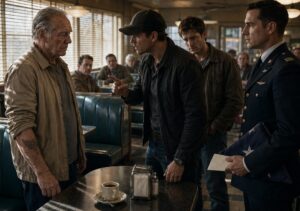
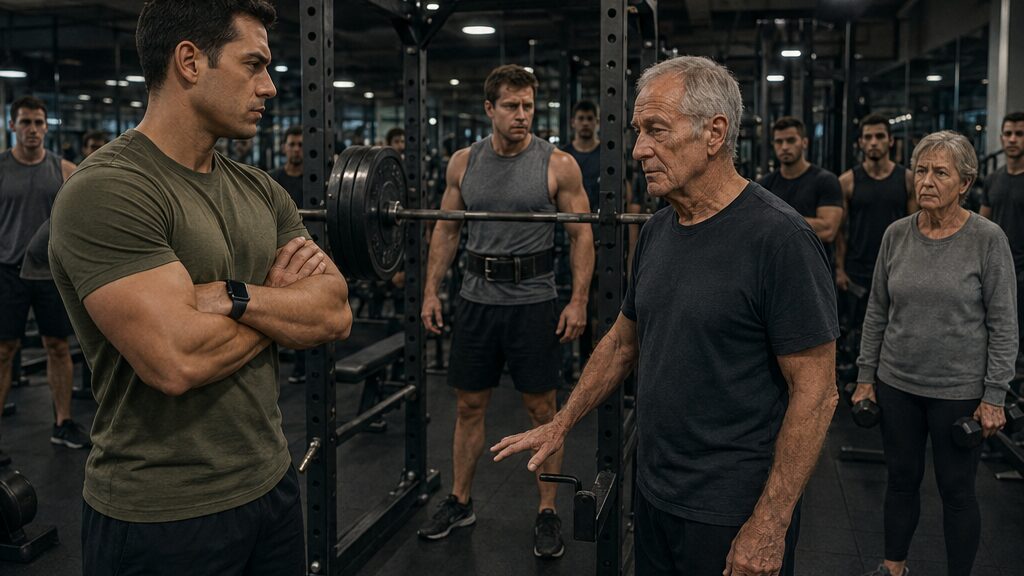
The young trainer stepped in front of Donald Harris with his arms folded hard across his chest, close enough that Donald could smell the mint gum under the iron scent of the weight room.
“You need to move back,” Michael Torres said.
The barbell behind him rested on the squat rack with three plates on each side. A younger man had just walked away from it, laughing with two friends near the mirror. Rubber mats swallowed most footsteps, but not the clink of plates, not the sharp breath of lifters under strain, not the small metallic chatter Donald had heard when the bar was racked too fast.
Donald did not look at Michael first. He looked past his shoulder at the left safety arm. At the pin.
It sat almost right.
Almost was the word that had followed him through too many rooms.
“Sir,” Michael said, louder now, “I’m talking to you.”
Donald brought his eyes back. Michael was broad through the shoulders, young enough to believe a body obeyed if you ordered it sharply enough. Olive athletic shirt, dark watch, clean shoes, jaw tight. The kind of man clients watched because he looked like the result they wanted.
Donald wore a plain dark workout shirt that had faded at the collar. His right knee ached from the cold snap that had come through that morning. His shoulders did not square the way they used to. Even standing still took a small private negotiation with his lower back.
“I heard you,” Donald said.
“Then step out of the lane.”
Donald glanced down. His shoes were not in the lifting lane. He was beside the rack, two feet from the upright, one hand open near the steel peg he had checked before the last set. He had not touched the bar while anyone lifted. He had not spoken except once, quietly, when he saw the pin not fully seated.
A few heads had turned.
That was what Michael wanted him to notice.
The gym was crowded for a Monday evening. Music pulsed from ceiling speakers, all bass and no song. Mirrors multiplied every face into witnesses. A man at the cable station slowed his reps. Two younger gym members near the dumbbell rack stopped pretending not to listen.
Donald felt the old heat rise behind his ears. Not anger, exactly. Anger came fast. This was older. Heavier. The feeling of being reduced before he had even finished a sentence.
“I was only saying the left pin needs to be seated all the way,” Donald said.
Michael’s mouth twitched. “It is seated.”
“No.”
The word came out softer than Donald intended, but it made the space between them tighten.
Michael unfolded one arm just enough to gesture at the rack without looking. “That rack gets used all day. I checked it. My client checked it. You don’t need to hover over people.”
Donald opened his right hand a little, palm down, steadying the air rather than challenging the man. “It shifts when the bar lands hard. The hole’s worn at the edge. You can see the shine where it’s riding.”
Michael finally looked back, quick and irritated, then returned his eyes to Donald. “You’re making people nervous.”
Donald almost smiled at that, but the smile would have looked like contempt, and contempt was a poor tool. “People should be nervous around weight they don’t respect.”
The gym grew quieter in the wrong places.
Michael stepped closer. “This is a training floor. We have rules. You can’t walk around correcting everyone because you used to lift back in the day.”
Back in the day.
Donald let the phrase pass over him. He had learned, long ago, that some words were bait with hooks too small to dignify. He had also learned that silence could be mistaken for surrender.
“I’m not correcting everyone,” he said. “I’m looking at the rack.”
Michael’s arms folded again. Bigger this time. Final. “You’re distracting my clients.”
Behind him, Scott Walker came from the water fountain, towel over his shoulder. Donald knew him only by sight: ambitious, always adding weight before his form caught up, always laughing when his knees shook after a heavy set. Michael had been coaching him for weeks.
Scott looked from Michael to Donald. “Everything good?”
“All good,” Michael said, not turning. “Just clearing the lane.”
Donald saw Scott’s eyes slide over him, not cruelly, not even with much interest. The glance was familiar. It placed Donald in a category before Donald could speak: old man, slow man, man who meant well, man to be managed kindly until kindness became inconvenient.
Donald’s hand lowered to his side.
The pin remained where it was, half a fraction out, its handle angled down instead of flat. Nobody else seemed bothered by it. The bar would probably hold for another set. Probably for ten. Steel tolerated carelessness longer than flesh did.
“Mr. Harris,” Michael said, using Donald’s name as if politeness made the humiliation cleaner, “you’re welcome to use the machines. You’re welcome to stretch. But when we’re training heavy, I need space around my station.”
My station.
Donald looked at the rack again. The upright was scratched where plates had scraped it. Chalk dust clung in the groove near the adjustment hole. A tiny crescent of bright metal showed at the edge of the pin where dark coating should have been. He had noticed it last week. Then again today. He had meant to tell the front desk, but the clerk had been busy with new member forms.
He raised one hand, not pointing now, just showing that he would not argue. “All right.”
Michael watched him a moment longer, as though waiting for resistance. When Donald turned away, the trainer’s shoulders eased.
A dumbbell dropped somewhere. Conversation returned in pieces. The music filled the room again. Donald walked toward the stretching mats, feeling every eye leave him as soon as he became less interesting.
He did not leave the gym.
That was important.
He sat on the edge of a bench near the wall and changed his shoes slowly, though he had already trained. He untied one lace, then tied it again. In the mirror, he could see Michael laughing with Scott, demonstrating hand placement, tapping Scott’s elbows into position. A good trainer in many ways, Donald thought. Attentive to posture. Confident voice. Knew how to make a client believe he could lift more than fear allowed.
Confidence was useful.
It was not the same as judgment.
Barbara Moore passed behind him carrying a pair of five-pound dumbbells. She was near Donald’s age, though she moved with the brisk determination of someone refusing to let the world slow down in public.
“You all right?” she asked under the music.
Donald looked up. “Fine.”
She followed his gaze to the rack. “He shouldn’t talk to you like that.”
“He thinks he’s protecting the room.”
“From you?”
Donald said nothing.
Barbara’s face tightened, but she did not press. She knew the gym’s small humiliations. The younger members who smiled too broadly when offering help. The machines explained slowly, as if age had come for intelligence first. The way people called her “sweetheart” when they wanted her to move.
At the rack, Scott ducked under the bar. Michael stood behind him. The pin held through the unrack. Held through the descent. Held when Scott drove up with a strained sound that brought a grin to his own face.
Donald watched the safety arm tremble when the bar returned.
A small click followed.
Not loud. Not dramatic. No one flinched.
Michael clapped Scott on the shoulder. Scott laughed and stepped away.
Donald rose before he meant to. His knee complained. He paused until the ache passed, then walked toward the water fountain instead of the rack. Halfway there he slowed, pretending to study the class schedule on the wall.
Michael and Scott moved to the dumbbell area, leaving the bar still loaded.
The rack stood empty.
Donald turned his head.
The left safety pin had crept farther out. Not much. Just enough that its handle no longer sat parallel with the frame.
Enough that Donald’s mouth went dry.
Chapter 2: The Rule Nobody Wanted Posted
By Tuesday morning, the gym had printed Donald into a rule.
The paper was taped to the front desk beside a basket of protein bars and a jar of disposable earplugs. It was not large, just one clean white sheet in a plastic sleeve, the letters bold enough for anyone checking in to read.
For everyone’s safety, please do not enter active training areas unless you are lifting, spotting, or working with a trainer.
Donald stood in front of it with his membership card still in his hand.
The front desk clerk smiled as if nothing had changed. “Morning, Mr. Harris.”
“Morning.”
He scanned in. The small machine chirped. Behind the desk, Nicole Martin was visible through the open office door, standing with one hand on her hip and the other holding her phone. She saw Donald, said something quickly into the phone, and ended the call.
“Donald,” she called. “Could I speak with you for a second?”
The office smelled faintly of coffee and printer ink. Framed certificates hung behind Nicole’s desk. A large poster for Saturday’s strength challenge leaned against the wall, not yet mounted. Bold letters promised personal records, prizes, local sponsors, and free trial memberships. In the photograph at the bottom, Michael stood with a barbell across his back, smiling like the gym itself had chosen him as its face.
Nicole closed the door halfway, not fully.
That detail told Donald more than the words she had not yet spoken.
She was younger than him by decades, but not young enough to be careless. She had built the gym from a failing storefront with secondhand machines into a place people talked about in town. Donald respected that. He respected anyone who cleaned bathrooms, balanced books, and still showed up at dawn to unlock the doors.
“Can I sit?” he asked.
Her expression changed at once. “Of course. I’m sorry, yes.”
He sat in the chair across from her desk. It was low and too soft, the kind that made standing up look harder than sitting down. He kept his hands on his knees.
Nicole remained standing. “I wanted to talk before there’s any misunderstanding.”
“There already is.”
She looked pained. “Donald.”
He nodded toward the sign outside. “That wasn’t there yesterday.”
“No, it wasn’t.”
“So it’s not for everyone.”
She took a breath, then lowered herself into her chair. “It is for everyone. But yes, it came up because of yesterday.”
Donald looked at the poster instead of at her. Saturday Strength Showcase. Bring a friend. Test your limits.
“Michael said a couple of members felt watched,” Nicole said. “He said you were stepping close during sets.”
“I was near the rack after the lift.”
“He said you corrected his setup.”
“I warned him about a pin.”
She folded her hands, businesslike. “Donald, I believe you were trying to help.”
He had heard that sentence before, in different offices, from different people. It usually meant the help had been judged more troublesome than the problem.
“The left safety pin on the heavy rack is wearing around the hole,” he said. “It doesn’t seat clean every time.”
Nicole’s eyes moved toward the glass window that looked onto the gym floor. From there, the rack was partly visible between two cable machines. “Has it failed?”
“No.”
“Has anyone been hurt?”
“No.”
She waited, as though those two answers should settle it.
Donald rubbed his thumb against the side seam of his workout pants. The movement was small, hidden by the desk. “That isn’t when you start caring.”
“I do care.” Her voice sharpened, then softened. “I have inspections. Maintenance logs. Trainers checking stations. Insurance requirements. I can’t run this place on every member’s feeling about a piece of equipment.”
“It’s not a feeling.”
“Then write it down for me.”
Donald looked at her.
“I mean it,” Nicole said, reaching for a notepad. “Tell me exactly what you’re seeing. I’ll have maintenance look at it.”
He should have been relieved. Instead, something in his chest tightened. “Maintenance should look before Saturday.”
“They’re coming Friday morning for a few other things.”
“Friday may be late if Michael keeps loading that rack.”
Nicole leaned back. “Michael knows what he’s doing.”
“He knows lifting.”
“Donald.”
“He doesn’t know that pin.”
The room went still.
Outside the office, the gym’s morning crowd moved through machines with the subdued discipline of people exercising before work. A treadmill belt hummed. Someone laughed near the locker hallway. Life continuing, careless and ordinary.
Nicole tapped the pen against the notepad. “I need you to understand my position. Saturday matters. We’ve got local sponsors coming. People signed up. Scott Walker is attempting a big personal record, and Michael has been working with him for weeks. If there’s a real equipment issue, I’ll address it. But I can’t have members confronting trainers on the floor.”
“I didn’t confront him.”
“No,” she said gently. “But it looked like it.”
Donald accepted that because it was true enough to wound.
Looking like something had ruined many things in his life. Looking old. Looking slow. Looking lost when he was only measuring a room. Looking stubborn when he was trying to be careful. Looking like a man who wanted authority back, when all he wanted was for the pin to sit flush.
Nicole slid the notepad toward him. “Write it down. Please.”
He took the pen. His handwriting had grown tighter with age, less patient with curves. He wrote: left rack, safety arm pin, west side, third height from bottom, uneven seating, visible wear on lower edge, shifts after hard rack.
He paused, then added: check under load.
Nicole read it upside down while he wrote. Her face did not dismiss him, but neither did it change enough.
“I’ll put it with the maintenance request,” she said.
Donald set the pen down. “Thank you.”
He stood carefully. Nicole noticed and almost rose to help him, then stopped herself. He appreciated that more than she knew.
At the door, he looked again at the new sign.
“Donald,” Nicole said.
He turned.
“Until Friday, just give Michael room. Let staff handle staff things.”
Staff things.
He nodded once.
The morning passed quietly. Donald used the rowing machine, then stretched his hips near the wall where he could see the heavy rack without seeming to watch it. Michael arrived at ten with Scott Walker beside him, both carrying coffee, both talking about Saturday.
Scott looked energized, nervous under the grin. Michael looked pleased with him.
“We’re not maxing today,” Michael said loudly enough for nearby members to hear. “We’re practicing the path. Saturday you show them what six months of work looks like.”
Scott laughed. “You sure we shouldn’t go heavier?”
“You want the crowd to see it or you want to waste it on a Tuesday?”
They moved to the heavy rack.
Donald lowered his gaze to the mat.
He counted his breath to four. Then again.
A metallic scrape came from across the room. Plates sliding onto sleeves. A collar snapping closed. Michael’s voice, confident and clear.
“Same station Saturday,” Michael told Scott. “Same rack. Same setup. We’ll make it look clean.”
Donald closed his eyes for half a second.
When he opened them, the printed rule by the front desk fluttered under the air vent, and the left pin waited in the rack like a sentence nobody had finished reading.
Chapter 3: The Pin Was Not Sitting Right
On Wednesday evening, the gym was crowded enough that Donald had to turn sideways to pass between the benches.
It was the kind of crowd Nicole liked: loud, energetic, full of people recording sets and checking themselves in the mirrors. The Saturday challenge poster had been mounted near the entrance. Scott Walker’s name was written on a small whiteboard under “Featured Attempts,” and a few younger members had already started treating him like an athlete preparing for a meet instead of a man doing too much too quickly in a neighborhood gym.
Donald kept to the wall for the first twenty minutes.
He warmed his shoulders with a resistance band. He did step-ups on the lowest box, slow and controlled. He wiped down a machine after using it though no one had wiped it before him. He did everything a man could do to remain unobtrusive.
Still, he watched the rack.
Michael was training Scott again. Not heavy at first. Tempo work, pauses, commands. Michael had a good eye for knees drifting inward. He corrected Scott’s stance with two taps of his shoe. He noticed when Scott held his breath too early. Donald gave him credit for that silently.
But when Michael adjusted the left safety arm upward, he pushed the pin in with the heel of his palm and turned away before the handle settled.
Donald’s band went slack in his hands.
The pin had entered the hole, but not straight. The lower edge caught first. The handle angled slightly down, no more than a few degrees, the sort of difference an impatient eye would call nothing.
Donald saw the bright scrape at the rim.
He also saw Scott roll his right shoulder twice while Michael loaded the bar.
Donald set the band on the bench.
Barbara Moore was on the seated row nearby. She saw him move and stopped pulling. He felt her watching, but he did not look back.
He crossed the floor slowly. Not sneaking. Not rushing. A man walking carefully through a room that had already decided his pace meant uncertainty.
Michael looked up before Donald reached the rack. His face closed.
“Mr. Harris,” he said.
Donald stopped outside the lifting lane. “The pin isn’t seated.”
Scott, already under the bar but not yet unracked, turned his head. “What?”
Michael stepped between them.
Not all the way. Just enough.
The gesture made Donald’s hands open at his sides, empty and visible.
“The left safety pin,” Donald said. “It caught low. Pull it and reset it.”
Michael’s arms crossed.
There it was again, the same locked gate of muscle and impatience. In the mirror behind him, the posture doubled, then doubled again, until Donald seemed surrounded by versions of a young man refusing to hear him.
“We checked it,” Michael said.
“No,” Donald said. “You pushed it.”
A few heads turned. Someone lowered a phone. Scott shifted under the bar, uncomfortable now.
Michael’s voice dropped. “We talked about this.”
Donald kept his eyes on the pin. “That doesn’t change the steel.”
“Step away from my client.”
“It’s not flush.”
Michael looked back at the pin, but only for a second. “It’s fine.”
Donald lifted his right hand. With two fingers, he tapped the air toward the handle, careful not to touch the rack. “See the angle? It should sit flat. The wear is on the lower edge, so when weight drops—”
“Enough.”
The word cracked across the space.
Donald stopped.
The gym did too, for one breath.
Michael’s jaw worked. He seemed aware of the people watching, and that awareness hardened him. “You cannot keep interrupting training sessions because something looks wrong to you. This is exactly what we discussed.”
Donald felt the room waiting for him to become what they expected: confused, defensive, angry, embarrassing.
He looked at Scott instead.
“Step out from under the bar while he resets it,” Donald said.
Scott blinked. “Man, I haven’t even lifted yet.”
“That’s why I’m saying it now.”
Someone near the dumbbells muttered something too low to catch. A nervous laugh followed.
Michael turned his body fully toward Donald. He was not touching him. He did not need to. His size, his youth, his staff shirt, the crowd behind him—everything did the touching for him.
“You’re scaring people,” Michael said.
Donald’s fingers curled once, then relaxed. “Good.”
Michael stared.
“Weight should scare people a little,” Donald said. “Not stop them. Just make them check twice.”
For the first time, uncertainty crossed Michael’s face. It did not last. He glanced toward the front desk, where the clerk stood frozen with a stack of towels. Nicole was not visible.
“You need to leave this area,” Michael said.
Donald looked again at the pin.
The wrongness of it seemed brighter now that no one would see it. Not dramatic. Not a snapped cable, not a cracked beam, not something that announced itself as danger. Just a small metal handle declining by a few degrees while a room full of strong people admired their own certainty.
“All right,” Donald said.
He stepped back.
Scott exhaled with a laugh that sounded more relieved than amused. “Guess we’re good?”
“We’re good,” Michael said quickly. “Reset your feet.”
Donald walked toward the far wall.
Each step felt longer than it should have. The old rubber floor gave slightly under his shoes. A barbell clanged behind him as someone else racked too hard. He did not turn. Turning would look like defiance. Not turning felt like cowardice. He chose neither. He walked until he reached the stretching area, then sat on a low bench and looked at his hands.
They were steady.
That almost made it worse.
He had learned to keep his hands steady when men younger than Scott were afraid and pretending not to be. He had learned to see small mistakes before they became names spoken carefully in quiet rooms. He had learned that panic rarely began with noise. It began with someone saying, It’s probably fine.
Scott completed the set.
The pin held.
A few people lost interest. Conversation returned in waves. Michael clapped once and told Scott the depth had been better. Scott grinned, flushed and pleased.
Donald stayed seated.
He should have felt foolish. Part of him did. The old public shame moved through him with practiced steps. Maybe Nicole was right. Maybe the maintenance contractor would come Friday, look at the rack, tighten something, and everyone would forget the old man who made a scene.
But then Scott racked the bar after the next set.
The left safety arm shivered.
A small metallic tick reached Donald through the music.
His eyes lifted before he could stop them.
Barbara Moore stood beside the seated row machine, no longer exercising. She was looking at the rack too.
This time, when the set ended and Michael turned away to adjust the plates, Barbara crossed the floor. She did not approach Michael. She came to Donald.
Her dumbbells were still in her hands, hanging at her sides like she had forgotten them.
She sat beside him slowly.
“That is the third time this week,” she said
Chapter 4: The Man Who Counted Twice
By Thursday afternoon, the heavy rack was empty, and Donald hated that it made him feel relieved.
The gym had a different sound in the slow hours. No crowd pressing against the mirrors, no phones propped against water bottles, no young voices daring one another into heavier sets. Just treadmills humming, plates settling now and then, the soft hiss of the air system above the free weights. The calm should have suited him.
Instead, it gave every small sound room to travel.
Donald stood beside the stretching mats with a resistance band looped under one shoe, drawing it up slowly, letting his shoulder warm through a range it no longer trusted. His eyes kept returning to the heavy rack.
The left safety pin was still there.
It had been pushed flush that morning, or close enough that a glance would pass over it. The handle lay flatter than it had Wednesday night. Someone had touched it. Maybe Michael. Maybe the maintenance contractor had come early. Maybe Nicole had checked it herself after reading Donald’s note.
Donald wanted that to be enough.
He finished the shoulder warmup, sat on the low bench near the wall, and rubbed the tender place above his right knee. A younger member walked past and gave him the careful smile people used when they were trying to be respectful and distant at the same time.
Donald nodded back.
On the far side of the room, Michael adjusted a cable station for a client. He saw Donald and did not look away quickly enough. The moment held, then Michael turned back to the cable stack. His arms were not crossed today. That should have counted for something, but Donald knew avoidance when he saw it.
Barbara Moore came in shortly after two, wearing a gray sweatshirt and carrying a folded towel. She moved past Donald, paused near the rack, then glanced at him. Not dramatically. Just a look. A shared measurement.
He shook his head once.
She kept walking.
After his workout, Donald did what he had told himself he would not do. He went to the rack while nobody was near it. He stood close enough to smell the iron and old chalk. The bar was stripped. The safety arms were set at waist height. The left pin’s handle rested almost flat.
Donald touched nothing at first.
He leaned slightly, narrowing his eyes at the hole where the pin entered the upright. The black coating around the lower edge had been worn to a dull crescent. Not fresh. Not ancient. The kind of wear that came from repeated pressure at a bad angle. He looked across at the right side. That hole was cleaner, its edge evenly marked.
His hand rose before he had decided.
Two fingers.
He tapped the handle lightly.
Once.
Then again.
The pin moved on the second tap. Barely. A short, dry click.
Donald closed his eyes.
He was not in the gym then. Not fully.
He was standing in heat and dust, younger by decades, with a clipboard tucked under his arm and a line of tired men pretending they were not tired. He remembered telling them that speed was not discipline. Discipline was checking the thing no one wanted to check because everyone was ready to move. A strap. A latch. A pin. A knot. A chamber. A buckle. Small things. Small things carried weight.
A young man had laughed once when Donald told him to count twice.
Not mocking. Just young.
“I did, Sergeant.”
“Then do it again.”
The second check had found the loose bracket on the truck rack. That time, they had all gone quiet and done it properly.
Another time, later, someone had not.
Donald opened his eyes.
The gym was still there. The music was low. The pin waited under his fingers. He pulled his hand away as if the steel had burned him.
“Donald?”
Barbara stood a few feet back, towel in hand.
He straightened too quickly and felt his back seize for one sharp second. He covered it by stepping aside.
“You saw that?” he asked.
“I heard it.”
He looked toward the office. Nicole’s door was closed. Michael was no longer on the floor.
Barbara came closer to the rack. “Did you tell her?”
“I wrote it down.”
“That’s not what I asked.”
Donald let out a breath through his nose. It was not quite a laugh. “Yes. I told her.”
“And?”
“Maintenance tomorrow.”
Barbara looked at the rack as if it had personally disappointed her. “Tomorrow is not today.”
Donald liked her for saying it plainly.
He lifted his gym bag from the bench. “Nobody’s lifting heavy on it right now.”
“Scott will.”
“Not today.”
She studied him. “That’s how you’re making peace with it?”
He did not answer.
The question followed him into the parking lot.
Outside, the afternoon sun made the windshields burn white. Donald walked slowly between parked cars, one hand around the strap of his gym bag, the other loose at his side. His truck was near the back, where he could open the door wide without worrying about scraping anyone’s paint.
He set the bag on the passenger seat and stood there with the door open.
Count twice.
The phrase came as clear as if someone had spoken behind him.
He had hated it for years after the accident. Not because it failed, but because it had been right. Because the one time someone had waved off the second check, the world had reminded him that rules were not rituals. They were memory with a job to do.
The trainee’s face came back less often now, but when it did, it came in pieces. A crooked grin. A hand raised from across a yard. A mother at a ceremony Donald could barely remember because he had spent the whole time counting what he should have checked, what he should have repeated, what he should have seen before everyone else accepted the first answer.
He had not been responsible for all of it. Men had told him that. Officers had told him that. Paper had told him that.
Paper did not sit with you at night.
Donald gripped the truck door.
He did not want to be the old man in the gym who turned every small mistake into a memory. He did not want younger men watching him with that polite impatience, as if his caution were a symptom. He did not want to need to be believed.
But he could not make himself stop seeing the pin.
A voice called from behind him.
“Donald.”
Nicole crossed the parking lot with a folder held against her chest. She had followed him out without a jacket, and the wind lifted a strand of hair across her face. She looked tired in a way the office lights had hidden.
“I was hoping to catch you,” she said.
He waited.
She glanced back toward the gym entrance, then lowered her voice. “Maintenance confirmed for tomorrow morning. They’ll inspect the rack before Saturday.”
“Good.”
“I also spoke with Michael.”
Donald looked away.
“He said he’ll keep an eye on it.”
“That won’t fix it.”
“I know.” Nicole shifted the folder from one arm to the other. “I know that. I’m not dismissing what you said.”
He looked at her then, and she seemed to hear the words after she spoke them.
She pressed her lips together. “I’m trying to handle this without making it a bigger issue than it needs to be.”
“It’s already the size it is.”
Nicole’s gaze dropped to the asphalt. A receipt skittered near her shoe and caught under the tire of a parked car.
“There’s something else,” she said. “Saturday will be crowded. We’ll have people watching, filming, walking around. Michael thinks it would be better if you didn’t come during the event.”
Donald’s face did not change.
He had learned long ago that the body could betray a man faster than words.
Nicole rushed on. “Not because you did anything wrong. I’m not banning you. I would never—”
“What are you doing?”
She swallowed. “Asking you to give us one morning. For everyone’s comfort.”
Everyone’s comfort.
The phrase landed more quietly than Michael’s anger and cut deeper because Nicole looked sorry while saying it.
Donald nodded once.
Nicole looked relieved, then ashamed of looking relieved. “Thank you for understanding.”
“I understand,” Donald said.
He put his gym bag in the truck and closed the passenger door.
For a moment, Nicole seemed to want to say more. Instead she held the folder tighter and stepped back.
Donald got into the driver’s seat. He did not start the engine right away. Through the windshield, he could see the gym’s front windows, the poster for Saturday taped inside, the reflection of traffic passing over the words Test Your Limits.
His right hand rested on the ignition.
He saw the pin shift under two fingers.
He heard the click.
He counted once.
Then he counted again.
Chapter 5: The Challenge Needed A Clean Image
Saturday morning belonged to Nicole Martin before the sun cleared the roofline.
She arrived at the gym carrying two boxes of bottled water, a roll of waiver stickers, and the kind of smile she used when worry had to be converted into leadership. The parking lot was already half full. A local supplement shop had set up a folding table near the entrance. The front desk clerk was taping directional arrows to the floor. Someone had brought balloons, though Nicole could not remember approving balloons.
By eight-thirty, the gym looked less like a place where people trained and more like a place where people expected something to happen.
That was the point, she reminded herself.
The Saturday Strength Showcase was supposed to help the gym. New memberships had slowed. Rent had not. Equipment financing did not care whether a business owner slept. A good event could bring in sign-ups, sponsor relationships, and enough local attention to carry them through the summer.
A bad event could do the opposite.
Nicole stood near the heavy rack and watched Michael Torres run the setup.
He moved fast, confident, efficient. He had marked lifting stations with black tape, arranged plates by size, checked collars, and told spectators where not to stand. His olive trainer shirt stretched across his shoulders as he carried two forty-five-pound plates at once, and younger members moved aside for him without being asked.
He looked like control.
Nicole needed control.
“How are we on the rack?” she asked.
Michael slid a plate onto the storage peg. “Good.”
“Maintenance looked at it yesterday?”
“They came.”
“That’s not what I asked.”
He wiped his hands on his shorts and looked at her. “They looked. They tightened the upright bolts, checked the pins, said the rack was usable.”
“Usable.”
“Nicole.”
She heard the irritation under her name. She also heard something else: pressure. Michael had been selling this event for weeks, and Scott Walker’s attempt had become the unofficial centerpiece. The gym’s social media page had already posted his training clips. People had commented. Encouraged. Predicted numbers. It was all harmless until it wasn’t.
“Did they replace anything?” she asked.
“No.”
“Did they mention wear?”
“They said to monitor it.” Michael shrugged. “Every rack in every gym gets wear.”
Nicole looked at the left safety arm. The pin handle lay flat.
Flat enough.
She hated herself for thinking it.
“Where’s Scott?” she asked.
“Warming up in the back.”
“How’s his shoulder?”
Michael’s eyes sharpened. “Fine.”
“You told me he tweaked it last week.”
“He was tight. He’s fine now.”
Before Nicole could respond, a sponsor walked up asking where to place a banner. Then the front desk clerk needed more waiver forms. Then a younger member spilled half a bottle of sports drink near the dumbbell area. The morning broke into pieces, and Nicole chased them all.
The crowd thickened by ten. Phones came out. The gym’s mirrors caught fragments of faces, screens, raised hands, loaded bars. People who normally ignored one another began talking like they belonged to the same team. Nicole felt a brief lift of pride despite everything.
Then she saw Donald Harris through the front window.
He stood outside for several seconds before opening the door.
He wore the same dark workout shirt under an old zip jacket. His gym bag hung from one shoulder. He did not look defiant. That almost made it harder. He looked like a man arriving somewhere he knew he was not wanted but could not stay away from.
The front desk clerk glanced toward Nicole.
Nicole crossed the lobby before Donald reached the scanner.
“Donald,” she said quietly.
He held up his membership card. “Morning.”
“I thought we talked.”
“We did.”
His voice carried no challenge. He scanned in. The machine chirped, cheerful and useless.
Nicole lowered her voice further. “I asked you not to come during the event.”
“You asked.”
A flare of irritation surprised her. “That’s not fair.”
Donald looked past her toward the weight room. “No.”
The single word stopped her.
He did not say she was being unfair. He did not defend himself. He simply refused to polish the moment into something cleaner than it was.
Nicole turned slightly. In the distance, Michael had seen Donald. Even from across the gym, she could read the change in his posture. The arms did not cross yet, but they wanted to.
“Are you here to lift?” Nicole asked.
“No.”
“Then why?”
Donald’s eyes were on the rack. “To make sure I was wrong.”
The answer moved through her before she could decide what to do with it.
Behind them, the front door opened again, and a cluster of spectators came in laughing. Nicole stepped aside to keep the entrance clear. Donald moved with her, not deeper into the gym yet.
“Maintenance said it was usable,” she told him.
He nodded. “Usable is not the same as ready.”
“Donald, I cannot have a scene today.”
“Neither can I.”
She studied his face. It was drawn, the lines around his mouth deeper than she remembered. Not angry. Not eager to be right. That troubled her more.
Before she could answer, Michael approached.
“Seriously?” he said.
Nicole gave him a warning look. “Michael.”
Donald kept his hands at his sides.
Michael stopped a few feet away, close enough for people near the lobby to notice but not close enough to look openly hostile. “Mr. Harris, this is a controlled event. We can’t have members wandering into stations.”
“I won’t wander.”
“You shouldn’t be here.”
Nicole said, “Michael, I’m handling it.”
But the trainer’s attention was fixed on Donald. “You made your point. Maintenance came. The rack is cleared. Today is not about you.”
Something changed in Donald’s eyes then. Not enough for Michael to see, maybe. Nicole saw it because she was close: a small inward closing, as if a door had been eased shut.
“No,” Donald said. “It isn’t.”
Scott Walker emerged from the back hallway, rolling his right shoulder. He was smiling, but his face had the shine of nerves. A few younger members called his name. He raised one hand and laughed.
Donald watched the shoulder roll.
Nicole watched Donald.
Scott came over, energized by the attention. “Morning. Big day.”
Michael turned to him at once, his voice brightening. “Ready?”
“Ready enough.”
Donald’s gaze dropped to Scott’s right hand. He flexed it twice, then pressed his thumb against his palm.
“Any numbness?” Donald asked.
Scott looked at him, surprised. “What?”
Michael stepped in. “He’s fine.”
Donald did not look at Michael. “Your thumb.”
Scott glanced down as if caught doing something private. “Just tight.”
“Grip changes when the shoulder protects itself.”
Michael gave a short laugh with no humor in it. “He doesn’t need a diagnosis.”
Donald nodded once. “No. He needs a check.”
Nicole felt the crowd pressing near them without physically moving. Attention was a current; it traveled fast in a room like this.
“Donald,” she said under her breath.
He heard the warning and accepted it. He stepped back from Scott.
Michael’s arms folded now.
There it was, the same posture from Monday, recreated under brighter lights and more witnesses. Nicole felt a sick recognition. She had thought avoiding conflict would keep the event clean. Instead, the conflict had arrived wearing a member’s old jacket and a trainer’s pride.
Scott tried to laugh it off. “I’m good, really. Just want to get this over with before I think too much.”
“That’s the spirit,” Michael said too quickly. “Warm-up set in five.”
The event began.
Nicole moved through announcements, sponsor thanks, safety reminders. She heard herself telling spectators to stay behind the tape while her eyes kept returning to Donald. He did not approach the rack. He stood near the wall beside Barbara Moore, who had appeared without Nicole noticing. Barbara said something to him. He did not answer. His attention remained on Scott.
Scott’s early warm-ups moved smoothly enough. The crowd clapped after each one. Michael guided him, tightening his belt, adjusting his stance, keeping the energy high.
Donald watched the rack.
Nicole watched Donald watching the rack.
After Scott’s second warm-up, Michael raised the safety arms one notch.
He pulled the right pin, set the arm, pushed the pin through. Then the left. A phone camera blocked Nicole’s view for a second. When the spectator lowered it, Michael had already turned away to call for more weight.
Donald straightened.
It was not dramatic. He did not rush forward or raise his voice. He simply became still in a way that made Nicole’s skin tighten.
Across the floor, the left pin handle sat lower than the right.
Scott chalked his hands. Michael slapped his back lightly and said something that made him smile.
Donald took one step away from the wall.
Barbara touched his sleeve. Not to stop him. To let him know she understood.
Nicole moved too, but she was farther away, boxed in by spectators and equipment. She saw Donald’s hand lift slightly, two fingers ready, as if he could feel the pin without touching it.
Scott ducked under the bar.
The room swelled with phones, breath, expectation.
Donald’s eyes did not leave the left side of the rack.
Chapter 6: The Warning Came Before The Sound
Donald saw the failure before it became sound.
Scott’s right hand set first, a little tighter than the left. The thumb tucked late. His shoulder rolled once under the bar, a small protective motion hidden beneath the noise of the room. Michael stood behind him, close and ready, saying something about breath and drive. The crowd settled into that eager hush people made when they wanted effort without consequence.
The left safety pin sat low in its hole.
Donald had no authority there. Nicole had asked him not to come. Michael had told him to stay away. A line of black tape marked the lifting area, and Donald stood outside it like a man obeying a border that had been drawn for him.
Scott lifted the bar out of the hooks.
The rack shifted.
Not much.
Enough.
Donald stepped forward.
“Stop.”
His voice did not boom. It carried because it had no panic in it.
Michael’s head snapped toward him. “No. Back up.”
Scott held the weight across his shoulders, knees locked, face tightening as the room’s attention fractured. “What’s wrong?”
“Rack it,” Donald said.
Michael’s arm came out, palm open toward Donald. “Do not come in here.”
“Rack it now.”
The crowd murmured. Someone laughed nervously, then stopped. Nicole pushed between two spectators near the side of the rack, her face pale.
Scott looked from Michael to Donald. That half-second of uncertainty cost him. His right shoulder dipped. The bar tilted just enough for the plates to whisper against the sleeve.
Michael refocused. “Scott, eyes forward. You’re fine. One rep.”
Donald saw the breath go wrong.
There was a pattern to fear under load. The chest rose too early. The knees softened before the mind admitted doubt. The hands tightened as if strength could be squeezed out of steel. Donald had seen it in gyms, in training yards, in men carrying more than their bodies had agreed to carry.
“Do not descend,” Donald said.
Michael’s face flushed. “Enough!”
Scott bent his knees.
The room held its breath with him.
On the way down, his right elbow tucked unevenly. His shoulder protected itself. The bar drifted backward a fraction. Michael moved in closer, hands under Scott’s ribs but not touching.
Donald crossed the tape.
Someone said, “Hey.”
He did not look at them.
Scott reached the bottom of the squat. For one suspended instant, everything almost worked. His feet held. His back stayed tight. Michael shouted, “Drive!”
Scott drove.
Halfway up, the bar path shifted backward again. Scott corrected, overcorrected, and stumbled one half-step toward the rack. Michael grabbed for him. The plates rattled. The left end of the bar struck the upright harder than it should have.
The safety arm caught.
The pin clicked.
Donald was already moving.
Not fast like a young man. Not strong like a hero. Fast enough because he had started before the noise. He came in from the left side, one hand to the end of the safety arm, not to hold the weight, not to fight the bar, but to shove the arm inward and upward at the exact point where the half-seated pin began to creep.
“Down!” he ordered.
Scott obeyed the voice before he understood it.
His knees folded. Michael took the bar’s center with both hands, guiding more than lifting. The bar crashed onto the safety arms. The left side dropped a finger’s width before Donald’s palm drove the arm flush against the upright.
The pin slammed into place with a hard metallic crack.
Then the room heard the sound it had been late to fear.
The bar bounced once on the safeties. Plates clanged. A collar slipped against the sleeve. Scott fell backward onto the mat, sitting hard, eyes wide, breath coming in ragged bursts.
Michael kept both hands on the bar long after it had stopped moving.
Nobody clapped.
Nobody spoke.
Donald stood beside the rack with his left hand still braced against the safety arm. Pain ran from his wrist to his shoulder, hot and immediate. He lowered his hand slowly before anyone could see it shake.
Nicole reached Scott first. “Are you hurt?”
Scott shook his head, then nodded, then shook his head again. “I’m okay. I’m okay.”
“Stay seated,” Donald said.
Scott stayed.
Michael looked at Donald as if he had never seen him before. His mouth opened, but nothing came.
Donald pointed with two fingers, not at Michael, not at Scott, but at the left pin. It was fully seated now, handle flat against the frame.
“Pull it,” he said.
Michael did not move.
Donald’s voice stayed low. “Pull it.”
Nicole looked at Michael. “Do it.”
Michael swallowed. He stepped to the side of the rack and wrapped his hand around the pin. At first, it did not move. He tugged harder. The pin came free with a rough scrape, and the safety arm shifted in its bracket.
A murmur passed through the crowd.
Donald gestured to the lower edge of the hole. “There.”
Michael crouched despite himself.
Bright metal showed where black coating had worn away. The hole was no longer perfectly round. The lower lip had been pressed into a slight oval, just enough for a rushed pin to catch low and ride outward when struck.
Michael touched the edge with his thumb.
His face changed.
Not all at once. Pride did not leave a man quickly. It retreated in pieces.
Nicole knelt beside Scott, but her eyes were on the rack. “Maintenance cleared this.”
“Usable,” Donald said.
The word hung there.
Scott looked up at him. His face had gone gray under the flush. “You saw that before?”
Donald glanced at him. “I saw enough.”
“My shoulder—”
“Was changing your bar path.”
Michael stood. “I had him.”
Donald looked at the bar resting on the safeties. Then at Michael’s hands, still chalked, still strong, still late.
“You almost did,” Donald said.
The restraint in it was worse than accusation.
Michael’s jaw tightened, but this time the anger had nowhere clean to go. The crowd had seen the pin. They had heard the crack. They had watched Donald move before the failure announced itself. But Donald did not look at the crowd. That mattered. He did not take the moment and turn it into a weapon.
Nicole stood. “Everyone step back. Give us room.”
The front desk clerk hurried over with a first-aid kit though no one had asked for it. A spectator lowered a phone slowly, as if ashamed to have been recording. Barbara came to the edge of the tape but did not cross it. Her eyes met Donald’s for a moment.
That is the third time this week.
He remembered her saying it. He wished she had been wrong.
Scott flexed his right hand again, staring at his thumb. “I thought it was just tight.”
“It was,” Donald said. “Tight is information.”
Michael looked at him. “How did you know the pin would move?”
Donald’s hand throbbed. He curled it once, hid the wince. “I didn’t know.”
“But you—”
“I knew it could.”
The answer seemed to unsettle Michael more than certainty would have.
Nicole told the clerk to call the maintenance contractor back immediately. Then she faced the spectators. Her voice was steady, but Donald heard the tremor under it. “The event is paused. Please move away from the lifting area.”
People obeyed. Slowly. Reluctantly. Not because they wanted to miss what came next, but because the room had changed. The showcase had become something else. The black tape on the floor no longer looked like event planning. It looked like a boundary that had failed to understand danger.
Michael helped Scott stand, one hand under his arm. Scott accepted the help without joking. His legs trembled.
Donald stepped back from the rack.
The pain in his wrist sharpened when he let his arm hang. He tucked the hand lightly against his side and turned toward the wall.
“Mr. Harris,” Scott said.
Donald stopped.
Scott looked embarrassed now, more than frightened. “Thanks.”
Donald nodded.
Nothing more.
Thank-you was not the point. Gratitude did not undo the part where a warning had to become a near accident before it became worth hearing. Still, he accepted the word because Scott needed to say it.
Michael remained beside the rack.
The trainer’s arms hung loose at his sides. For once, there was no crossed wall between them. He looked down at the pin in his hand, turning it slowly, seeing the scrape marks Donald had seen all week.
Donald watched him for only a second.
Then he walked toward the benches, each step measured, his shoulder burning, his breath controlled. Behind him, the gym stayed quiet in a way no posted rule could have created.
At the rack, Michael lifted the pin toward the light and finally saw what Donald had been trying to show him all along.
Chapter 7: The Apology Donald Did Not Ask For
Nicole put the safety pin on her desk like it was evidence from a trial nobody wanted to hold.
It lay between the coffee mug and the waiver forms, black metal worn bright along one edge, ordinary enough to be mistaken for harmless. Donald sat across from it with his injured hand resting in his lap. He had refused ice twice, then accepted a towel only because Nicole stopped asking and simply placed it beside him.
Through the office window, the gym floor looked wrong.
The crowd had thinned. The sponsor table was half-packed. The heavy rack had been taped off with orange cones around it, the bar stripped and resting empty in the hooks. The room no longer carried the bright noise of challenge. People spoke quietly, looking toward the office and then away.
Donald disliked being watched through glass.
Nicole stood near the door, phone pressed to her ear, giving the maintenance contractor short answers. “No, not next week. Today. If not you, then someone you trust. The rack is out of service until I say otherwise.”
Michael stood by the filing cabinet with his arms folded.
Then he seemed to notice and dropped them.
The movement was small, but Donald saw it. Michael tucked his hands behind his back instead, as if he did not know what to do with them now that they could no longer be a wall.
Scott sat in the chair beside Donald, one shoulder wrapped in a cold pack from the first-aid kit. A paramedic had checked him and found no emergency, only strain, shock, and the pale embarrassment of a man who had nearly turned confidence into injury in front of people holding phones.
“I’m fine,” Scott had said too many times.
No one believed him, but no one argued.
Nicole ended the call and placed the phone facedown. “They’re sending someone in an hour.”
Michael looked at the pin on the desk. “They were here yesterday.”
“I know.”
“They said it was usable.”
Nicole’s face hardened. “And today it wasn’t.”
Michael did not answer.
Donald shifted the towel over his left wrist. The pain had settled into a deep throb. Nothing broken, he thought. Strained. Maybe swollen by morning. He had had worse, though that was not the comfort it used to be. At seventy-four, every injury came with a question: Is this the one that stays?
Nicole turned to him. “Donald, I owe you an apology.”
He looked down at the towel. “You owe the rack a lockout tag.”
“I already put one on it.”
“Then we’re square.”
“No,” she said. “We’re not.”
The room held still around that.
Michael glanced at her, then at Donald. His jaw tightened, but not in anger this time. More like a man bracing for a weight he had loaded himself.
Nicole continued, quieter. “I let the event matter more than your warning. I told myself I was being balanced.”
Donald looked at the pin. “Balance is for after the thing is safe.”
She absorbed that without defending herself. Good, he thought. It was a hard thing, taking a correction without making it about the cost of hearing it.
Scott leaned forward, elbows on his knees. “Mr. Harris, I’m sorry too. I should’ve stepped out when you said.”
“You were under the bar,” Donald said. “That is not the best place to make decisions.”
Scott gave a weak laugh. It ended quickly.
Michael moved then, one step toward the desk. “I need to say something.”
Donald did not look up.
Michael cleared his throat. “Out there. To everyone.”
Nicole frowned. “What do you mean?”
Michael’s voice was tight. “People recorded it. They’re going to talk. I should say I was wrong. Publicly. Before it turns into something else.”
Donald raised his eyes.
There it was. The shape of it. A public apology to repair public embarrassment. A neat reversal for anyone who had watched too much of the wrong part and not enough of the right one.
Michael seemed to mistake Donald’s silence for permission. “I’ll tell them I dismissed you. I’ll tell them you saw the pin. I’ll make sure everyone knows you prevented—”
“No.”
Michael stopped.
Donald set the towel on his knee and sat straighter. “Don’t do that.”
“You deserve credit.”
“I don’t need credit.”
“That’s not—”
“I said no.”
The old command voice surfaced on the last word, not loud, not harsh, but firm enough that Michael shut his mouth.
Donald regretted it almost immediately. Not the refusal. The edge. He was tired, and pain made restraint thinner. He took a breath and softened his hand against the towel.
“If you go out there and make a speech,” Donald said, “you make me the show.”
Nicole looked from him to Michael.
Donald continued, “Then tomorrow somebody posts it with music under it. Old man saves the day. Young trainer humbled. People cheer, argue, forget the rack, and learn nothing.”
Scott’s eyes dropped to the floor.
Michael’s face colored.
Donald was not finished, but he waited until he could speak without cutting. “You want to fix it? Fix what you ignored.”
Michael looked toward the gym floor.
“The rack,” Donald said. “The way you check it. The way you rush when people are watching. The way your client told you his body was giving him information and you called it tight.”
Scott swallowed.
Michael’s hands closed once at his sides. “I thought I had him.”
“I know.”
That answer seemed to strike him harder than accusation.
Donald looked at the young trainer fully. “You are good at many things.”
Michael blinked.
“You see knees. You see depth. You know when a man needs confidence. Those are not small things.” Donald’s gaze moved briefly to the pin. “But confidence can become noise. Today it got loud.”
Michael breathed in through his nose and looked away.
Nicole sat at the edge of her desk, suddenly looking less like the owner of the gym than a woman who had almost watched her business become the place where a preventable accident happened. She picked up the pin, turned it, then set it back down carefully.
“What do you want me to do?” she asked.
Donald almost said, Nothing.
It was the easiest answer. It would let him leave before anyone asked him to become useful in a way that made him feel trapped. It would let him protect the small private life he had built around morning workouts, quiet stretching, and leaving before the evening crowd.
But the pin was on the desk.
Scott’s shoulder was under ice.
Michael’s hands were finally open.
“Start with a real inspection,” Donald said. “Not usable. Safe. Those aren’t the same.”
Nicole nodded.
“Then make every trainer do a second check before heavy lifts. Not a glance. Not a palm slap. Pull, seat, load, confirm. The lifter checks too.”
Michael listened without interrupting.
“And if a member reports equipment, write down what they saw before you decide what they are.”
Nicole closed her eyes briefly.
Donald stood. The chair was low, and the movement cost him more than he wanted it to. Michael shifted forward as if to help, then stopped. Good. Donald appreciated that too.
“I should go,” Donald said.
Scott rose halfway. “Can I—”
“Sit,” Donald said.
Scott sat.
Nicole opened the office door. The gym air rolled in, carrying rubber, chalk, and the subdued murmur of people pretending not to look. Donald stepped through first. He expected the glances, and they came. Some concerned. Some curious. A few embarrassed.
He did not meet them.
Michael followed him out but kept distance until they reached the empty training floor. The heavy rack stood taped off beside them. Without the crowd and the plates, it looked smaller, almost innocent.
“Mr. Harris,” Michael said.
Donald stopped.
The trainer’s voice was lower now. “I was afraid you were making me look like I didn’t know what I was doing.”
Donald looked at him.
Michael gave a short, humorless breath. “Which sounds stupid after today.”
“It sounds human.”
Michael’s face twisted, surprised by the mercy in it. “I didn’t want my clients thinking some old guy could walk in and correct me.”
Donald let the phrase stand there until Michael heard it.
The young man’s eyes dropped. “Sorry.”
Donald looked at the taped-off rack. “Don’t apologize to get comfortable. It wears off.”
Michael nodded slowly.
For the first time all week, he looked as young as he was.
Donald turned to leave.
Behind him, Michael spoke again, so quietly the empty floor almost swallowed it.
“Would you show me what you saw?”
Chapter 8: The Second Check Belonged To Everyone
Donald stayed away from the gym for six days.
He told himself his wrist needed rest, which was true. He told himself Nicole needed time to handle the rack, which was also true. He told himself nobody needed an old man standing around after the danger had passed, and that was the lie he almost believed.
On Friday evening, Nicole called.
He let it ring twice before answering.
“The rack has a new safety arm assembly,” she said without greeting. “Both sides. New pins. The contractor wrote up the wear on the old hole and admitted it should’ve been flagged earlier.”
Donald sat at his kitchen table with his left wrist wrapped and a glass of water untouched beside him. “Good.”
“I also spoke with the insurance representative.”
“That sounds less good.”
A tired laugh came through the phone. “It was necessary. We’re updating inspection procedures.”
“Also good.”
There was a pause.
“Donald,” Nicole said, “I’m not calling to pull you into anything you don’t want. But I’m asking you to come back.”
He looked toward the dark window above the sink. His reflection looked older at night.
“I didn’t leave.”
“I know. But I think we made it feel that way.”
He said nothing.
Nicole let the silence breathe. “Monday morning. Quiet hour. No crowd. No phones. I asked Michael to run staff through the new second-check process before opening fully. I would like you there. Not as a guest speaker. Not as a symbol. Just as Donald.”
Just as Donald.
He held the phone a little tighter.
“I’ll think about it,” he said.
Monday morning came gray and cold. Donald parked near the back as usual. He sat in the truck for a minute after turning off the engine, flexing his wrapped wrist, feeling stiffness answer back. Through the windshield, the gym windows glowed warm against the dull morning.
He did not feel triumphant.
That surprised him, though it should not have. There was no victory in almost being right too late. No pleasure in watching people learn fear from the edge of harm. If anything, he felt the old reluctance that came before entering a room where people had changed how they looked at him.
Respect could be another kind of attention.
He took his gym bag and went in.
The front desk clerk looked up. For one dangerous second, Donald thought she might say something too bright, too large. Instead, she smiled normally.
“Morning, Mr. Harris.”
“Morning.”
The scanner chirped.
The new sign stood on the desk in a clear plastic holder. It was not bold like the old rule. It was simple.
Before heavy lifts: pull, seat, load, confirm. Second check belongs to everyone.
Donald read it twice.
Nicole came from the office, dressed not for an event but for work: gym shoes, dark pants, sweatshirt sleeves pushed up. She looked nervous and did not hide it well.
“I stole your phrase,” she said.
“No,” Donald said. “You used it.”
Her eyes softened.
The main floor was quiet. Only staff and a few early regulars were there. Barbara Moore stood near the stretching mats, pretending to organize resistance bands. When she saw Donald, she raised one hand. He raised his in return.
The heavy rack had changed. Not enough for most people to notice, but Donald noticed. New black safety arms. Clean holes. Fresh pins that sat flat and even, their handles level like a promise properly made. The orange cones were gone. So was the old casualness around it.
Michael stood beside the rack with Scott Walker.
Scott wore no lifting belt. His right shoulder moved carefully, but he smiled when Donald approached.
“Morning,” Scott said.
“Morning.”
Michael turned.
He did not cross his arms.
His hands were open at his sides, palms loose, posture uncertain but not weak. He looked tired, as if the week had taken something from him and left something better in its place.
“Mr. Harris,” he said.
“Donald is fine.”
Michael nodded once. Not too quickly.
Nicole gathered the small staff group around the rack. No announcement. No speech. No sponsor banner. Just a handful of trainers, the front desk clerk, Barbara at the edge because Nicole had invited regular members to observe if they wanted, and Scott standing where he could see but not perform.
Michael picked up one of the new pins.
“We’re changing how we check heavy stations,” he began. His voice was steady, but Donald heard the effort beneath it. “Not because the old way never worked. Because it worked until it didn’t.”
Nobody joked.
Michael slid the pin through the right safety arm and stopped before pushing it fully in. He looked at Donald.
Not for rescue.
For confirmation that he was allowed to continue.
Donald gave nothing but his attention.
Michael pulled the pin back out. “First check. Clear hole. No angle. No obstruction.” He inserted it again slowly, this time watching the line of the handle. “Seat it all the way. Don’t slap it and turn away.”
He pressed the pin until it clicked.
Then he wrapped his fingers around it and pulled lightly. It held.
“Second check,” Michael said. “You confirm after load changes and after hard racks. Trainer and lifter both. If something feels off, you stop. Nobody loses status for stopping.”
Scott looked down at that.
Michael saw him. “Especially if something feels off in your body. Shoulder, grip, breath, whatever. Tightness is information.”
Donald’s eyes moved to Scott.
Scott gave a small, embarrassed nod.
Nicole stood beside the mirror with her arms folded, then seemed to catch herself. Slowly, she let them fall. The motion was so small Donald almost missed it.
Barbara did not.
She glanced at Donald with the faintest smile.
Michael turned toward him. “Did I miss anything?”
The room waited.
Donald could feel the old temptation to disappear. To say no, that’s fine, and step away before he became more central than he wanted. His wrist ached. His knee ached. His pride ached too, though he had less use for that.
He looked at the rack, then at the people around it.
“You missed the pause,” he said.
Michael frowned slightly, attentive.
“After it clicks,” Donald said, “wait half a second. Hands off. Look at it without touching. Sometimes the hand tells you what it wants to feel. The eye checks what’s there.”
Michael absorbed that. Then he repeated the process. Insert. Seat. Pull. Let go. Pause. Look.
This time, the room watched the pin as if it mattered.
Because it did.
Donald stepped back.
Michael noticed. “Do you want to show them?”
“No.”
The answer came easily, without injury.
Michael nodded and did not push.
That was the difference.
The small session continued. Each trainer practiced on both sides. Nicole took notes. The front desk clerk asked whether member-reported equipment issues should go in the daily log or the maintenance file, and Nicole said both. Barbara asked whether regular members could ask for a second check without annoying trainers, and Michael answered before Nicole could.
“Yes,” he said. “Ask.”
Donald looked at him then.
Michael did not look away.
Later, when the group dispersed, Donald went to the stretching area and set down his bag. For the first time in a week, he changed into his gym shoes without feeling watched. Barbara took the mat beside him.
“You came back,” she said.
“I pay dues.”
She smiled. “That’s one reason.”
He pulled the strap tight on his left shoe. His wrist objected. He slowed.
Across the room, Scott approached the rack for light technique work. No crowd. No phone. No performance. Michael stood beside him, not behind him yet, holding the pin in one hand.
“Walk it through,” Michael said.
Scott reached for the safety arm. “Clear hole. No angle. Seat it.”
“Don’t rush.”
Scott pushed the pin through until it clicked. He tugged once, let go, then paused and looked.
Michael opened one hand toward him. “Again on the other side.”
Donald watched from the mat.
There was no applause. No one gathered around him. No one asked what he had done in the Army. No one called him a hero. The gym moved in its ordinary morning rhythm: treadmill belts, low voices, metal placed carefully against metal.
That was enough.
After stretching, Donald walked toward the water fountain. He passed the heavy rack just as Scott finished setting the left safety arm. The pin sat clean and flat.
Donald stopped beside it.
Michael and Scott both went quiet.
Donald lifted two fingers and tapped the handle once.
Then again.
The pin did not move.
He stepped back.
Michael turned to Scott, open hands guiding instead of blocking. “Now you teach me the check.”
Scott looked surprised, then grinned a little. He pulled the pin, cleared the hole, seated it again, and waited half a second before looking.
Donald walked on toward the fountain, leaving them with the rack, the pause, and the second check that belonged to everyone.
The story has ended.