The Quiet Recruit Who Dropped the Barracks Bully and Refused His Brother’s Protection
Chapter 1: The Bag That Landed in the Mud
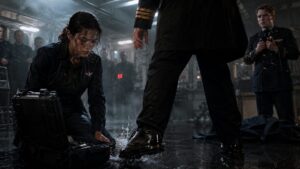
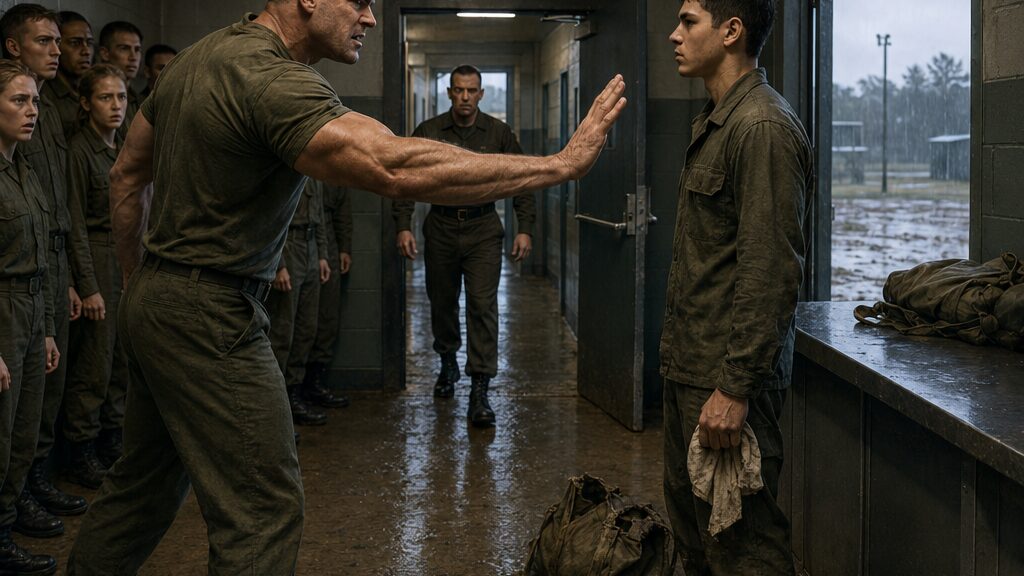
Richard Perez’s gear bag struck the training yard before the armory clerk finished calling his name.
The canvas case hit on one corner, rolled through a shallow rut, and split open in the mud. A folded undershirt slid beneath the rain. A cleaning kit bounced against a stone. The pale cloth Richard had prepared for inspection landed in brown water and disappeared except for one clean edge.
Behind him, someone laughed.
“Perez,” the clerk repeated from inside the restricted doorway. “You coming forward or not?”
Richard looked from the muddy bag to Nicholas Baker.
Nicholas stood beside the inspection counter with one hand still extended from the throw. He was broad enough to narrow the hallway simply by leaning against it. His sleeves were rolled tightly over his arms, though regulations did not require it. The grin on his face was meant for the line of recruits behind Richard.
“Pick it up,” Nicholas said. “Then answer me properly next time.”
No one moved.
Rain rattled against the metal awning outside. Beyond the open security door, water ran down the training field in thin streams. Inside, rifles waited locked behind steel mesh, and the smell of oil and damp uniforms thickened the air.
Richard stepped through the doorway.
He did not hurry.
That seemed to bother Nicholas more than anger would have.
The bag had been packed according to the list taped above Richard’s bunk. Every item folded. Every buckle facing inward. Every inspection tool placed where his hand could find it without searching. Now mud coated the zipper teeth and filled one seam.
Richard crouched and collected the pieces.
A recruit near the door shifted as though she might help. Amy Wilson. Two places behind him in line. Richard saw the movement from the corner of his eye and gave the smallest shake of his head.
She stopped.
Nicholas called from the hallway, “Careful, Perez. Wouldn’t want you to lose something important.”
Richard picked up the cleaning rod, wiped it against his trouser leg, and slid it into the bag. He found the cloth beneath his boot. Mud squeezed between his fingers when he lifted it.
That was the first thing that made his jaw tighten.
Only once. Barely visible.
Nicholas saw it.
“There he is,” he said. “I was wondering if there was anybody in there.”
Richard returned to the hallway carrying the bag by its torn handle.
The recruits made room, not because he asked, but because something in his face discouraged contact. He stopped in front of the inspection counter and placed the bag down carefully.
The clerk glanced at the mud spreading beneath it. “That equipment was supposed to be clean.”
“It was,” Richard said.
Nicholas pushed away from the wall. “That tone again.”
Richard faced him.
Five minutes earlier, Nicholas had asked why a recruit from the newest intake had been allowed near the front of the inspection line. Richard had answered because the clerk had called his number. Nothing more. No apology in the words. No lowered eyes. No nervous smile to soften them.
Nicholas had heard defiance.
“You address a senior soldier with respect,” he said.
Richard’s gaze remained level. “I answered your question.”
A murmur passed through the line and died immediately.
Nicholas smiled, but the expression hardened around his eyes. “You think being quiet makes you tough?”
Richard did not reply.
“Answer.”
“I don’t think about it.”
A few recruits looked down to hide their reactions.
Nicholas turned toward them. “Nobody goes into that armory until Perez learns how this works.”
The clerk frowned. “Baker, I have an inspection schedule.”
“My brother runs this squad.”
“Your brother isn’t the armory clerk.”
Nicholas leaned both hands on the counter. “And when the squad fails inspection, who do you think answers for it?”
The clerk’s mouth closed.
That silence told Richard more than the words had.
Nicholas turned back with his confidence restored. “You heard me. Repeat your answer correctly.”
Richard unzipped the ruined bag.
Mud had reached the inner pocket. He removed the cloth, unfolded it, and examined the damage. The inspection rules required a clean cloth to verify there was no residue on the issued components. This one would leave dirt on anything it touched.
Nicholas had not only embarrassed him. He had created a failure that could be entered into Richard’s first-week record.
“You should ask for another one,” Amy said quietly from the line.
Nicholas looked at her.
She lowered her eyes.
Richard folded the cloth once, then again.
“Perez,” Nicholas said. “We’re waiting.”
Richard slipped the cloth into his palm. “Then wait.”
The hallway became very still.
Nicholas stepped close enough that Richard could smell mint and the bitter trace of coffee on his breath.
“You know who my brother is?”
“Yes.”
“And you think that doesn’t matter?”
Richard glanced at the insignia on Nicholas’s uniform, then at the door behind him. “Not for this inspection.”
The answer landed harder than the bag had.
Nicholas’s face changed. The performance fell away, leaving something younger and meaner beneath it.
All week, Richard had watched other recruits adjust around him. They laughed when Nicholas joked. They moved when he entered. They accepted small orders he had no authority to give. Nicholas borrowed rank through repetition, and no one wanted to be the person who tested whether the loan was real.
Richard understood that kind of power.
It depended on visible surrender.
Nicholas tapped two fingers against Richard’s chest. “Say it again.”
Richard looked down at the fingers.
On the second day of training, Nicholas had knocked Richard’s folded clothes from his bunk and called it an accident. The previous evening, he had taken Richard’s place in the meal line and waited for an objection that never came.
Richard had reported neither incident.
Reports became questions. Questions became explanations. Explanations became rooms where strangers decided whether fear had made you dangerous.
Silence was simpler.
But Nicholas had mistaken silence for permission.
Richard lifted the muddy cloth and set it on the counter.
“I need to complete inspection.”
“You need to learn your place.”
“I know my place.”
Nicholas shifted left, blocking the entrance to the counter.
Richard shifted with him.
Nicholas blocked him again.
One of the recruits breathed out a nervous laugh. Nicholas turned his head toward the sound, and Richard saw the embarrassment strike him. Nicholas no longer had a private argument. He had an audience, and the audience had begun to wonder whether he could finish what he had started.
Richard recognized the moment.
Men like Nicholas became most dangerous when retreat began to look possible.
Nicholas’s hands opened and closed at his sides.
Richard watched them.
Not his face. Not his shoulders. His hands.
The right one bore a faint white scar across the knuckle. The left thumb hooked briefly against the trouser seam before releasing. His weight settled back, then forward. The movement was small, but Richard had learned long ago that violence announced itself in pieces.
Nicholas stepped in.
“You’re going to pick up that bag,” he said, though it was already at Richard’s feet. “You’re going to apologize. Then you’re going to answer me the way a recruit answers someone above him.”
“You are not above me.”
The words were quiet.
They struck Nicholas like a public slap.
His right hand came up.
Amy said, “Baker—”
Nicholas reached toward Richard’s shoulder.
Richard did not move away.
He folded the muddy cloth once more inside his fist and met Nicholas’s eyes.
“Move,” he said.
Chapter 2: Three Seconds Against the Inspection Counter
Nicholas’s fist moved before anyone in the hallway could shout.
Richard’s body answered before he had time to decide whether it should.
The right hand came high and wide, powered by Nicholas’s shoulder and the certainty that no one would meet it. Richard shifted half a step inside the swing. His left hand caught Nicholas at the wrist. His right still held the wet cleaning cloth.
For an instant, Nicholas looked confused.
Then Richard turned.
The wrist rotated. The elbow locked. Nicholas’s larger body followed the pressure because the alternative was a broken joint. Richard stepped past his hip, drew the trapped arm behind him, and drove him forward.
Nicholas’s head struck the steel inspection counter with a flat metallic crack.
The clerk jumped backward.
The line of recruits broke apart.
Richard pressed Nicholas’s wrist high between his shoulder blades and set his forearm across the back of his neck. Nicholas tried to rise, but Richard changed the angle by less than an inch.
His knees folded.
Three seconds had passed.
Maybe less.
The muddy cloth remained clenched in Richard’s right hand, dark water running over his knuckles.
Nicholas grunted against the metal. “Get off me.”
Richard tightened the pin.
Nicholas stopped moving.
The silence that followed was different from the one before the punch. That silence had belonged to Nicholas. This one belonged to everyone who had just watched him lose control of the hallway.
A recruit near the door covered his mouth.
Someone else whispered, “What just happened?”
Amy did not answer. Her eyes stayed fixed on Richard’s feet. They were planted lightly, almost casually, as if he were holding a door rather than a man twice his width.
Nicholas tried to turn his head. “You’re finished.”
Richard said nothing.
“My brother will bury you.”
Richard’s breathing remained even.
That frightened Nicholas more than anger would have. Richard felt it in the sudden tremor that traveled through the trapped arm.
He had felt that tremor before.
Not here. Not in uniform.
In a narrow kitchen with a broken chair against the wall. In a parking lot behind a closed market. In rooms where an apology only convinced the other person there was more to take.
The memory arrived without images, only measurements.
Distance to the wall.
Weight over the front foot.
The point at which resistance ended.
Nicholas’s body had already reached that point.
Richard knew it.
His grip should have loosened.
It did not.
One second stretched between knowledge and release.
In that second, Nicholas was not the protected brother. He was not the soldier who had thrown the bag. He was simply helpless.
And Richard wanted him to understand it.
Boots struck the corridor behind them.
“What is this?”
The voice cut through the hallway.
Drill Sergeant Ronald Mitchell stopped inside the doorway, rain shining on the shoulders of his uniform. His gaze moved from the scattered recruits to the mud on the floor, then to Nicholas folded against the counter.
Finally, he looked at Richard.
Richard released the wrist.
Nicholas slid sideways, caught himself on the counter, and collapsed onto one knee. Blood had appeared at the edge of his eyebrow where it had met the steel.
Ronald pointed. “Perez, wall. Baker, do not stand up.”
“He attacked me,” Nicholas said.
“I did not ask you to speak.”
“My brother—”
“I know exactly who your brother is.”
That ended the sentence.
Richard moved to the wall and stood with his hands visible. The wet cloth clung to his palm. His pulse had not yet quickened, but a dull pressure had begun behind his ribs.
Ronald looked at the clerk. “Weapons secured?”
“Yes, Drill Sergeant.”
“Door locked?”
The clerk hurried to the mesh gate and turned the key.
Ronald addressed the recruits. “Nobody leaves. Nobody discusses this outside this hallway. You will each provide a statement.”
Nicholas pushed himself upright.
Ronald’s gaze snapped toward him. “I told you not to stand.”
“He tried to break my arm.”
“And yet it appears attached.”
Nicholas stared at him.
“Sit down.”
For the first time since Richard had seen him, Nicholas obeyed without making obedience look like a favor.
He lowered himself against the base of the counter, one arm pressed to his chest.
Ronald crossed the hall and stopped in front of Richard. His eyes went to the cloth, then to Richard’s hands.
“You injured?”
“No, Drill Sergeant.”
“Did he strike you?”
“No.”
A murmur moved through the line.
Ronald glanced over his shoulder at Nicholas’s split brow. “Then explain why one soldier is bleeding and the other appears ready for inspection.”
“He swung first,” Amy said.
Ronald turned. “You will speak in your statement.”
Amy swallowed. “Yes, Drill Sergeant.”
Richard felt her attention return to him, searching for something—gratitude, permission, reassurance. He gave none of them.
Ronald pointed at the muddy bag. “Whose?”
“Mine.”
“How did it get outside?”
Richard looked at Nicholas.
Nicholas’s jaw tightened.
“He threw it,” Richard said.
“Why?”
“He wanted a different answer.”
“To what question?”
Richard hesitated.
The hallway seemed to narrow again, though Nicholas remained seated.
Ronald noticed. “That was not a difficult question.”
“He asked why I was near the front of the line.”
“And?”
“I said my number had been called.”
Ronald waited.
“That was all.”
Nicholas laughed once, bitterly. “It wasn’t what he said.”
“No,” Ronald replied. “It appears to have been what you heard.”
Nicholas’s face flushed.
The clerk cleared his throat. “Drill Sergeant, Perez’s cloth is contaminated. He can’t complete inspection.”
Ronald looked at the cloth in Richard’s hand.
“Put it on the counter.”
Richard placed it down.
A brown print remained where his fist had held it.
Ronald studied that print, then the angle at which Nicholas had fallen. “Show me exactly what happened.”
Nicholas began, “I was trying to—”
“Not you.”
Ronald faced Richard. “Slowly.”
Richard stepped away from the wall.
He indicated Nicholas’s position, then his own. “He reached with his right hand.”
“Reached or punched?”
“Punched.”
“You said he did not strike you.”
“He missed.”
A few recruits exchanged glances.
Ronald saw them. “Continue.”
Richard raised his left hand to the height of Nicholas’s wrist. “I caught the arm. Turned the joint. Moved behind his shoulder.”
“Where did you learn that?”
Richard lowered his hand. “It is basic leverage.”
“That was not my question.”
Nicholas gave a harsh laugh from the floor. “See? He planned it. He stood there waiting.”
Richard looked at him.
Nicholas stopped laughing.
Ronald stepped between them. “Perez, eyes front.”
Richard obeyed.
“You had other options,” Ronald said. “You could have stepped back.”
“The armory gate was behind me.”
“You could have blocked.”
“He was larger.”
“You could have taken him to the floor.”
Richard’s gaze moved briefly to the counter.
Ronald followed it.
There it was—the part of the scene no statement could make simple. Richard had not panicked. He had selected a surface, an angle, a stopping point. Every movement had been chosen.
Except perhaps the final second.
Ronald lowered his voice. “How long have you trained?”
Richard did not answer.
“Officially.”
“No official training.”
Ronald’s expression hardened. “You expect me to believe that?”
Richard said nothing.
“Silence is not cooperation, Perez.”
The old instinct tightened around him. Give them nothing they can turn. Nothing they can label. Nothing they can use to decide what you are.
Nicholas pressed a hand to his eyebrow and smiled despite the pain.
He recognized Richard’s refusal as an opening.
“He’s some kind of psycho,” Nicholas said. “Nobody moves like that unless they’ve done it before.”
Ronald did not look at him. “One more word and you will spend the medical examination explaining why you disobeyed a direct order.”
Nicholas shut his mouth.
Ronald returned his attention to Richard. “I am asking once more. Where did a nineteen-year-old recruit learn to control a man that size in three seconds?”
Richard looked at the muddy handprint on the counter.
He had come here believing the uniform could separate his future from everything before it. That belief now seemed as clean and useless as the cloth had been before it landed in the mud.
“Before I came here,” he said.
Chapter 3: The Brother Behind Every Warning
Jason Baker entered the armory office expecting another complaint and found his younger brother wearing a medical collar.
Nicholas sat beside the desk with gauze taped over his eyebrow and his right arm supported in a sling. The sling was precautionary, according to the medic’s note, but Nicholas wore it like evidence of attempted murder.
Jason stopped in the doorway.
For half a second, something unguarded crossed his face.
Fear first.
Then anger.
Then the practiced stillness of a squad leader who understood that other people were watching.
“What happened?”
Nicholas pointed across the room.
Richard sat in a straight-backed chair beneath the duty roster. His wet uniform had begun to dry in dark patches. Mud marked one knee and both cuffs. His gear bag was gone, sealed in a clear evidence sack along with the cleaning cloth.
Ronald stood behind the desk.
“A restricted-area altercation,” he said. “One your brother initiated, according to the preliminary statements.”
Nicholas leaned forward. “He smashed my face into a counter.”
Jason looked at Richard.
Richard met his eyes, then looked away.
That small movement told Jason exactly what Richard expected from him.
Protection. Excuses. Family closing around family.
Jason shut the door.
“Start at the beginning,” he said.
“I already did,” Nicholas replied. “Perez mouthed off. I corrected him. He baited me and attacked.”
Ronald opened a folder. “The clerk states you threw Perez’s bag into the training yard.”
Nicholas’s jaw shifted. “It was a joke.”
“In a restricted armory corridor.”
“No weapons were out.”
“That is not the standard.”
Jason moved to the desk. “Why did you touch his equipment?”
Nicholas looked at him as though the question itself were betrayal. “Because he was disrespecting me.”
“You hold no training authority over him.”
“I’m senior to him.”
“By three weeks.”
Nicholas’s face reddened. “You know how these people get when nobody puts them in line.”
Richard watched Jason’s hands.
One rested flat on the folder. The other curled against his thigh before he forced it open.
Ronald noticed Richard watching.
“Perez,” he said. “Outside. Remain by the marked line.”
Richard rose.
As he passed Nicholas, Nicholas shifted his injured arm away theatrically.
Richard continued without looking at him.
The squad corridor outside was empty except for Amy, who sat on a bench with a blank statement form balanced on her knee. She looked up when Richard emerged.
“Are you all right?” she asked.
“Yes.”
“Baker says you broke his arm.”
“I didn’t.”
“You could have.”
Richard stood on the yellow line painted across the floor.
Amy waited for more.
When none came, she looked back at her form. “You knew he was going to swing.”
Richard did not respond.
“I saw you watching his hand.”
The office door opened.
Ronald pointed at Amy. “Interview room.”
She stood quickly and disappeared down the corridor with him.
Through the closed office door, Nicholas’s voice rose.
“You’re supposed to help me.”
Jason answered too quietly for Richard to hear.
Nicholas spoke louder. “Call home. Tell them what happened before this gets entered.”
The door opened again. Jason stood there alone.
He looked older than he had when he entered.
“Perez.”
Richard followed him into the office.
Nicholas was no longer present. Only the indentation from his chair remained in the thin cushion.
Jason closed the door and stayed beside it.
“Sit.”
Richard sat.
Jason remained standing. “Why didn’t you report the earlier incidents?”
The question landed without warning.
Richard’s face did not change, but Jason saw the delay.
“What earlier incidents?” Richard asked.
Jason gave a humorless breath. “That answer might work better if I hadn’t already spoken to the barracks supervisor.”
Richard said nothing.
“Tuesday, your bunk was emptied onto the floor.”
“It was called an accident.”
“By Nicholas.”
“Yes.”
“Last night, he took your meal position and shoved your tray aside.”
“I ate later.”
Jason moved to the desk. “Those are reportable.”
“They were handled.”
“No. They were absorbed.”
Richard’s eyes narrowed slightly.
Jason looked down at the folder. “That distinction matters today.”
Richard understood then that Jason had known. Maybe not every detail, but enough.
“You knew he did this.”
Jason did not deny it. “I knew he had trouble with boundaries.”
“That is not what you called it when you spoke to him.”
Jason’s head lifted.
Richard had heard them two nights earlier through the thin wall of the squad office. Jason’s voice low and urgent. Nicholas laughing. A warning stripped of consequence before it was even delivered.
Keep it small. Don’t make me write anything. Stay away from the new intake for a few days.
Richard had mistaken the conversation for private discipline.
Now he understood it had been maintenance.
Jason pulled out the second chair and sat opposite him. “My brother has always needed more correction than most.”
“And received less.”
The words were not loud, but Jason flinched.
For a moment, Richard saw the brother beneath the rank. Tired. Defensive. Afraid of a failure that had begun long before the armory.
Then Jason straightened. “You do not know what he has received.”
“I know what he expected.”
“What is that?”
“That you would make today disappear.”
Jason looked toward the door through which Nicholas had been taken.
“He expects many things,” he said.
“Will you?”
The directness seemed to surprise him.
Jason could have ordered Richard silent. Could have reminded him of rank. Instead, he rubbed a hand over his jaw.
“No.”
Richard waited.
Jason opened the incident folder. “I will not alter a statement. I will not call our family. I will not tell the medical staff to soften their report.”
It was more than Richard expected.
It was not enough to create trust.
“Why now?” he asked.
Jason’s eyes lowered to the folder. “Because this time someone hit back.”
Ronald returned before Richard could answer.
Amy entered behind him, still holding her statement. Her fingers had bent one corner of the paper.
Ronald took his place at the desk. “We have a larger issue.”
Jason’s shoulders tensed.
Ronald looked at Richard. “Two earlier incidents. Neither reported. A confrontation today in which you remained in position after Baker threatened you. Then a response executed with more control than most trained recruits possess.”
Nicholas’s accusation had entered the room without Nicholas.
Richard felt it settle around him.
Ronald continued. “Baker claims you baited him.”
“I answered him.”
“You also watched him.”
“Yes.”
“How long?”
Richard looked toward Amy.
She glanced down.
Ronald tapped her statement. “Recruit Wilson says you tracked Baker’s hands before he swung. She also says you warned him.”
Richard said nothing.
“What exactly did you say?”
“Move.”
“Was that a request?”
“No.”
“A threat?”
“No.”
“What was it?”
Richard remembered Nicholas’s weight shifting forward. The thumb leaving the seam. The shoulder turning before the fist rose.
“A last chance.”
Jason stared at him.
Ronald’s expression became unreadable. “A last chance before what?”
“Before he made the decision.”
“Or before you did?”
The question remained between them.
Amy looked at Richard now, no longer as though he were merely the quiet recruit she had tried to help. There was uncertainty in her face. Perhaps fear.
Richard understood it. He had seen that look after the parking lot. After the ambulance arrived. After people learned that a smaller boy could cause greater damage and decided size no longer explained innocence.
Ronald lifted Amy’s statement.
“She confirms Baker threw the bag. She confirms he blocked you. She confirms he swung first.”
Richard’s shoulders loosened by a fraction.
Then Ronald placed the paper flat on the desk.
“She also confirms you were ready long before he struck.”
Richard looked at the sealed bag leaning against the wall. Mud had dried across the clear plastic in branching brown lines.
Jason followed his gaze.
Ronald did not.
His eyes remained on Richard.
“Were you preparing to defend yourself,” he asked, “or waiting for permission to hurt him?”
Chapter 4: What Richard Learned Before Enlistment
Ronald placed a blank incident statement on the table and turned it so the empty lines faced Richard.
“The missing history matters more now than the punch.”
The interview room had no window. A ventilation fan clicked overhead with each rotation, and the fluorescent light flattened everything beneath it—the steel table, two plastic chairs, Richard’s hands resting side by side.
Ronald set the mud-stiffened cleaning cloth beside the form.
Richard looked at it but did not reach for it.
“Your bag remains secured,” Ronald said. “This was personal equipment, not evidence of force. You may have it back.”
Richard took the cloth.
It had dried into a crooked shape. When he tried to unfold it, flakes of dirt fell onto the table. He smoothed one corner, folded it inward, and pressed the crease with his thumbnail.
Ronald watched him.
“Recruit Wilson says you tracked Baker’s hands before he moved.”
“Yes.”
“You described his punch before anyone else could.”
“Yes.”
“You controlled his wrist, elbow, shoulder, balance, and direction in one sequence.”
Richard folded the cloth again.
“Where did you learn it?”
“At home.”
“That is a place. Not an answer.”
Richard kept his eyes on the cloth. “The person who raised me taught me.”
“A parent?”
“No.”
“A licensed instructor?”
“No.”
Ronald sat opposite him. “Why?”
The fan clicked above them.
Richard remembered a kitchen drawer that never closed properly. A chair with one leg repaired using wire. The sharp smell of cleaning solvent used on blood because no one in the house bought antiseptic.
“Because people came through the house,” he said.
“What people?”
“People who were angry.”
“At you?”
“At whoever was there.”
Ronald did not interrupt.
That restraint made the room harder to endure.
Richard turned the folded cloth ninety degrees and began another crease.
“The person who raised me said getting hit was a mistake you only got to make once.”
Ronald’s mouth tightened. “So he trained you.”
“He showed me how to stay standing.”
“With joint locks?”
“With whatever worked.”
“How old were you?”
Richard’s thumb stopped.
“Eleven when it became regular.”
The answer remained in the room without comment. Ronald leaned back, but his expression did not soften. Richard respected him slightly for that.
“What happened when you were eighteen?”
Richard looked up.
Ronald tapped the folder beside him. “Your enlistment screening records a civilian assault inquiry. No conviction. No details attached. That omission may have been legally proper, but it is no longer irrelevant.”
“It was not assault.”
“What was it?”
“A fight.”
“Who started it?”
Richard stared at the blank statement.
“A boy from the neighborhood followed me behind a market. He had two friends. He thought I had spoken to someone he was seeing.”
“Had you?”
“No.”
“Did that matter to him?”
“No.”
The memory came in fragments too quick to avoid: wet asphalt, a loading pallet, three shadows cast by a failing security light. The first boy had grabbed Richard’s collar. Richard had broken the grip. The second had rushed from the side.
After that, there had been no faces. Only angles.
“He had a bottle,” Richard said.
“What did you do?”
“Took him down.”
“And then?”
Richard pressed the cloth flat.
“He got up.”
Ronald waited.
“I made sure he couldn’t again.”
“How?”
Richard did not answer.
“How badly was he injured?”
“Fractured jaw. Broken wrist. Head injury.”
“The report says hospitalization.”
“Yes.”
“Was he still attacking when you delivered the final strike?”
Richard’s jaw tightened.
Ronald leaned forward. “This is the question, Perez. Not whether you know how to fight. Whether you know when the fight is over.”
Richard looked at him.
For years, he had carried the answer in a form that required no words. The ambulance doors closing. A police officer asking whether he felt proud. The guardian who raised him saying he had done exactly what was necessary, then smiling as though injury were proof of education.
Richard had enlisted six months later.
He had believed procedure would make decisions for him. Stand here. Move there. Stop when ordered. Clean each piece. Fold each item. The rules had looked like walls strong enough to hold the past outside.
Then Nicholas threw the bag through an open door.
“I stopped,” Richard said.
Ronald’s gaze remained steady. “Eventually.”
The word struck harder because it was quiet.
Ronald rose. “Come with me.”
They crossed the corridor into the empty combatives gym. Blue mats covered the floor. Padded equipment hung in orderly rows along the wall. No recruits were present.
Ronald stood near the center. “Show me.”
Richard remained at the mat’s edge.
“The counter,” Ronald said. “Slowly. Use me.”
“You could be injured.”
“That concern arrives late.”
Richard stepped onto the mat.
Ronald extended his right arm in a controlled imitation of Nicholas’s punch. Richard caught the wrist without force.
“Continue.”
Richard rotated the hand outward, placed his forearm above the elbow, and stepped behind Ronald’s shoulder.
Ronald’s balance shifted.
Richard stopped.
“What comes next?” Ronald asked.
“Pressure downward.”
“And?”
“He goes to one knee.”
“Safely?”
“If he doesn’t resist.”
“Baker resisted.”
“Yes.”
Ronald straightened. “Show the next option.”
Richard repeated the movement. This time, after turning the wrist and controlling the elbow, he shifted his own hip away and guided Ronald’s arm toward the mat.
Ronald lowered to one knee.
No counter. No impact. No blood.
Ronald looked up at him. “You knew this.”
“Yes.”
“You could have used it in the hallway.”
“The floor was wet.”
“That made the counter safer?”
“No.”
Ronald stood.
The gym felt suddenly too open. Richard saw every exit, every hard edge, every distance between them. He hated that he saw them without trying.
“Why did you choose the counter?” Ronald asked.
“Nicholas was stronger.”
“That explains the lock.”
“He was still moving.”
“That explains the pin.”
“He could have attacked again.”
“That explains not releasing him immediately.”
Ronald stepped closer. “It does not explain why you selected a steel surface when you knew how to take him down without it.”
Richard looked past him at the pads hanging from the wall.
“I made the decision quickly.”
“That is not the same as making it blindly.”
“No.”
“Did you want to hurt him?”
The answer rose and stopped behind Richard’s teeth.
Ronald saw it.
“That pause is why we are here.”
Richard walked to the edge of the mat and picked up the cleaning cloth he had carried in with him. A line of mud had transferred to his palm.
“He threw my bag,” Richard said.
“I know.”
“He knew it would affect inspection.”
“I know.”
“He wanted everyone to watch me pick it up.”
“Yes.”
Richard folded the cloth along its existing crease.
“I did not care about the laughing.”
Ronald said nothing.
“I cared that he believed he could decide what I would do.”
“And the counter changed that?”
“Yes.”
The admission made the room seem colder.
Ronald’s expression shifted—not fear, not quite. Recognition.
“Control learned under threat is still control,” he said. “But it can become another kind of threat if pride decides where it stops.”
Richard’s fingers tightened around the cloth.
“I released him.”
“After he stopped resisting.”
“Yes.”
“How long after?”
Richard saw Nicholas’s cheek against steel. Felt the tremor in his trapped arm. Remembered the single clean second during which nothing in the hallway could touch him.
“I don’t know.”
Ronald did not challenge the lie directly.
He led Richard back to the interview room, where an official notice now rested on top of the blank statement.
Richard read the first line.
Formal conduct review. Zero eight hundred the following morning.
“Command will review the footage, witness accounts, medical findings, and your background,” Ronald said. “You will be asked the same questions.”
Richard set the notice down.
“What happens if I don’t answer?”
“Silence will be recorded as refusal to cooperate.”
Richard looked at the empty lines on the incident form.
Until that moment, silence had always cost less than the truth.
Ronald placed a pen beside his hand.
“Tomorrow,” he said, “you may discover whether that is still true.”
Chapter 5: The Witness Who Almost Stayed Silent
The unfinished statement slid beneath Amy’s barracks door and stopped against her boot.
She stared at it.
The top page was hers. Her handwriting filled most of the lines, compact and careful. The final paragraph ended halfway through a sentence:
Recruit Baker removed Recruit Perez’s gear bag from beside the inspection counter and—
The rest was blank.
Amy opened the door.
The corridor was empty except for the fluorescent lights and the distant sound of boots on the stairwell. No note had been attached. No threat written across the page.
Someone had simply returned the part she had been too afraid to finish.
She carried the statement to the equipment room.
Mud from the morning still marked the threshold where recruits had passed in and out after the armory incident. Amy crouched beside a storage cabinet, searching for the pen she had dropped earlier.
Instead, she found a stiff paper card beneath the lowest shelf.
Richard Perez was printed across the top.
It was the inventory card from his gear bag, smeared brown along one edge. The armory time stamp remained visible. So did a second mark from the security threshold scanner, made when the card had crossed through the open door into the yard.
Amy rubbed the mud gently with her thumb.
The card did not prove why Nicholas had thrown the bag. It did not explain Richard’s frightening speed. But it fixed one event in place, beyond tone or reputation or family.
The bag had gone outside before the fight.
Behind her, the door opened.
Jason entered and stopped when he saw the card.
“You should give that to Drill Sergeant Mitchell.”
Amy rose. “I was going to.”
He looked at the unfinished pages in her other hand. “And those?”
“I don’t know.”
Jason closed the door.
She stiffened.
He noticed and kept his distance. “Nicholas has been telling people Perez came here with illegal combat training.”
“Illegal training isn’t a thing.”
“Contraband instruction. Underground fights. Whatever version makes him sound less responsible.”
“Is any of it true?”
“I don’t know.”
Amy studied Jason’s face. “You knew Nicholas was bothering him.”
His gaze moved to the shelves.
“You knew,” she repeated.
“I knew about the bunk.”
“And the meal line?”
“Afterward.”
“What did you do?”
“I warned him.”
Amy almost laughed, but nothing about his expression invited it. “Did you write it down?”
“No.”
“Did you report it?”
“No.”
“Then you helped him.”
Jason’s jaw tightened.
For a moment, his rank entered the room between them. Amy felt the old instinct to retreat, apologize, make herself smaller.
Jason let out a slow breath.
“Yes,” he said.
The word changed the space more than denial would have.
He leaned against the cabinet. “When Nicholas was seventeen, he was dismissed from a training program. Fighting. Our mother called me every night for a month. She said he needed someone who wouldn’t give up on him.”
“So you made sure consequences gave up instead.”
Jason looked at her sharply.
Amy held his gaze.
“My father left early,” Jason said. “I was the one who got Nicholas through school. The one who pulled him out of trouble. Every time he failed, everyone asked what I had done wrong.”
“That doesn’t make Richard responsible.”
“No.”
“Or the others.”
Jason looked down.
Amy understood there had been others before Richard. Small things. A missing item. A public correction. A shove explained as horseplay. Each incident weak enough to dismiss alone.
Together, they had built Nicholas a uniform no quartermaster had issued.
Jason reached into his folder and withdrew a blank statement form.
“I discouraged a complaint three months ago,” he said. “A recruit said Nicholas had taken his equipment and hidden it before inspection. I told him to resolve it within the squad.”
“What happened?”
“He withdrew it.”
“Because it was resolved?”
Jason did not answer.
Amy set Richard’s inventory card on the workbench. “I thought staying out of it meant I wasn’t choosing.”
“So did I.”
She completed her statement there.
She wrote that Nicholas had mocked Richard’s tone. That he had thrown the bag. That Richard had retrieved it without threatening anyone. That Nicholas blocked him and swung first.
She also wrote that Richard had watched Nicholas’s hands before the attack and appeared prepared.
Jason read nothing over her shoulder.
When she finished, he signed his own statement. His writing took longer. Twice, he stopped with the pen hovering above the paper.
At last, he placed both forms together with the inventory card.
They found Ronald in the squad office.
He accepted Amy’s statement first. Then Jason’s.
His eyes moved across the opening lines.
“You understand what this admission may do to your position?”
Jason stood rigidly. “Yes, Drill Sergeant.”
“And to your brother?”
“Yes.”
Ronald turned to Amy. “You understand Baker may accuse you of coordinating with Perez?”
“Yes.”
“Did you?”
“No.”
Ronald examined the mud-smeared card. “This confirms the bag crossed the restricted threshold before the physical encounter.”
“It doesn’t prove everything,” Amy said.
“No,” Ronald replied. “Useful evidence rarely does.”
Richard appeared at the office door, summoned for evening instructions. His gaze moved from Amy to Jason, then to the documents on Ronald’s desk.
Amy expected relief.
Instead, suspicion tightened his face.
People speaking for him looked too much like people deciding for him.
Ronald saw it. “No one here has determined tomorrow’s outcome.”
Richard’s attention settled on Jason’s signature.
“What did you write?”
“The truth,” Jason said.
Richard’s expression did not soften.
Jason placed his pen beside the statement. “Including the parts that belong to me.”
For the first time, Nicholas’s protection had become evidence against the man who provided it.
Ronald closed the folder over both testimonies.
By morning, the truth would no longer belong to any one of them.
Chapter 6: The Second Richard Would Not Explain
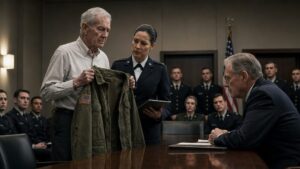
The security footage stopped with Nicholas’s face against the counter and Richard’s hand locked around his wrist.
A timestamp glowed in the lower corner.
The representative assigned to assist Nicholas pointed at the frozen image. “The threat had ended here. Why did Recruit Perez not release him?”
Richard sat across the briefing-room table, hands resting on his knees.
Between him and Nicholas lay the sealed gear bag. Dried mud covered one side beneath the clear evidence plastic. The torn handle bent awkwardly against the zipper.
Nicholas wore no collar now, only a strip of medical tape above his eyebrow. He avoided looking at the bag.
The reviewing officer advanced the footage one frame.
Richard’s arm remained in place.
Another frame.
No movement from Nicholas.
Another.
Richard remembered that second without needing the screen.
Ronald stood against the wall near the door. Jason and Amy waited in chairs behind the main table. Neither had spoken yet.
The representative lowered the remote. “Recruit Perez?”
Richard could say he was assessing the threat.
It would not be entirely false.
He could say the corridor was wet, Nicholas was larger, and release carried risk.
All true.
He could say the passage of time felt different during violence.
Also true.
The reviewing officer glanced at the medical report. “We will return to the final second. First, the initiation.”
Amy was called forward.
She described Nicholas’s demand, the thrown bag, Richard’s return, and the blocked hallway. Her voice shook once, when Nicholas turned toward her, but she continued.
“Did Recruit Perez threaten him?”
“He said, ‘Move.’”
“How did he say it?”
“Calmly.”
“Could that have been a threat?”
Amy looked at Richard. “It could have been a warning.”
“Is there a difference?”
“There was still time for Nicholas to stop.”
Nicholas shifted in his seat.
The armory clerk’s written statement followed. Then the inventory card, its threshold mark establishing that Richard’s property had been thrown outside before the fight.
The reviewing officer studied Nicholas. “Why did you remove another recruit’s equipment from an inspection area?”
“He was undermining order.”
“What authority did you possess to correct him?”
“I’m senior.”
“Not in appointment.”
Nicholas’s mouth tightened. “Everyone knew what he was doing.”
“What was he doing?”
“Making me look weak.”
The room fell silent.
Nicholas seemed to realize what he had admitted. He looked toward Jason.
“Tell them,” he said. “You know how recruits test people. You told me not to let the squad get loose.”
Jason’s face drained.
The reviewing officer turned. “Squad Leader Baker?”
Jason stood.
Richard expected caution. A distinction. Some narrow wording designed to condemn the incident without exposing the pattern.
Jason looked at his brother.
“I told you to maintain standards,” he said. “I did not authorize you to invent authority.”
Nicholas stared at him.
Jason continued, voice rougher now. “I knew about prior incidents. I handled them informally. I believed I could correct him without damaging his career or mine.”
“Jason,” Nicholas said.
“I was wrong.”
The words seemed to strike Nicholas harder than Richard’s counter had.
Jason faced the reviewing officer. “My protection contributed to his belief that consequences would be removed. That failure is mine.”
Nicholas pushed back from the table. “You promised.”
Jason did not look away. “I promised to help you. I confused that with saving you.”
Ronald ordered Nicholas back into his chair.
The reviewing officer reviewed Richard’s background next. The civilian incident. The lack of formal combat certification. Ronald’s demonstration report from the gym.
“You possessed a safer takedown,” the officer said.
“Yes.”
“Why did you not use it?”
“The floor was wet.”
“Sergeant Mitchell indicates the alternative remained viable.”
Richard looked at Ronald.
Ronald’s expression gave him nothing.
“The counter was faster,” Richard said.
“And more damaging.”
“Yes.”
“Did you intend to injure Recruit Baker?”
“No.”
The answer came immediately.
Nicholas laughed under his breath.
The officer replayed the attack at full speed.
Nicholas swung.
Richard moved.
The transformation remained disturbing even to Richard. One moment he stood still with the muddy cloth in his hand. The next, Nicholas was folded against steel.
No hesitation. No wasted movement.
The footage ended on the extra second.
The officer closed the medical file. “The evidence establishes that Recruit Baker initiated unlawful physical contact after repeated provocation and interference with another recruit’s required equipment. Recruit Perez was entitled to defend himself.”
Nicholas began to protest.
Ronald silenced him with a look.
“The initial restraint,” the officer continued, “was proportionate to the size difference and immediate threat. The use of the counter raises concern but does not, by itself, establish retaliatory assault under these conditions.”
Richard felt the room release around him.
Amy lowered her shoulders. Jason closed his eyes briefly.
The officer turned toward Richard. “Your failure to report earlier harassment will be addressed separately. Based on the current evidence, however, removal from training is not warranted.”
It was the outcome Richard had wanted.
The clean outcome.
Nicholas attacked. Richard defended. Witnesses spoke. The institution believed the part that mattered.
The officer began gathering the papers.
Richard looked at the frozen screen.
His own face was visible above Nicholas’s shoulder. Not angry. Not afraid.
Satisfied.
“Sir,” Richard said.
Ronald’s head lifted.
The reviewing officer paused. “What is it?”
Richard’s throat tightened.
He could remain silent and leave the room with the truth shaped into something acceptable. No one could prove what had happened inside that second. No witness could enter it.
He looked at the stained bag.
“I knew he had stopped resisting.”
Nicholas turned toward him.
The officer set the papers down. “At what point?”
“Before I released him.”
“How long before?”
“One second. Maybe less.”
“Why did you maintain the restraint?”
Richard felt every person in the room waiting.
He folded his hands to stop himself from closing them.
“Because I wanted him to feel what he had been making other people feel.”
Nicholas’s face changed.
The anger remained, but something beneath it broke loose—recognition, perhaps, that Richard could have hidden behind the favorable ruling and had chosen not to.
The officer studied him. “You understand that statement may alter the finding?”
“Yes.”
“Then why offer it?”
Richard looked at Ronald.
“Because it happened.”
The reviewing officer spoke quietly with Ronald, then reviewed the footage again. When he finished, he addressed Nicholas first.
“Recruit Baker, your physical aggression, abuse of unofficial status, interference with inspection, and established pattern of intimidation require immediate disciplinary action. You will be removed from informal leadership duties and assigned one month of supervised latrine detail.”
Nicholas’s mouth opened.
“No family intervention. No alternate duty.”
He turned to Jason, but Jason did not move.
The officer then faced Richard.
“Your defensive action remains justified. Your continued restraint after the threat ended does not erase that. It does establish a need for corrective training in proportional force and mandatory reporting.”
Richard waited for the words removal or discharge.
They did not come.
“You will return to the armory counter in two days,” Ronald said from the wall. “There you will complete the inspection that was interrupted.”
Richard looked at him.
“You will also choose what kind of discipline follows you out of that hallway,” Ronald continued. “The kind that hides everything until it explodes, or the kind that speaks before force becomes necessary.”
Nicholas stared down at his hands.
Jason stared at the table.
The stained bag remained sealed between them.
Richard had won the right to stay.
What happened at the counter next would decide whether he had learned how.
Chapter 7: A Month Where Toilets Fight Back
Ronald placed two gear bags on the armory counter and told Richard to choose.
The first was new. Clean canvas, straight seams, unmarked buckles. The second leaned against it like something salvaged after a flood. Mud had dried into the fibers along one side, the handle hung by several frayed threads, and the clear evidence seal had left a pale stripe across the flap.
Richard stood where he had stood before Nicholas swung at him.
The faint mark from Nicholas’s eyebrow had been scrubbed from the steel. A shallow dent remained near the edge of the counter. Richard could not tell whether the dent had been there before.
“The replacement is already issued to you,” Ronald said. “No penalty if you take it.”
Richard touched the new handle.
It felt strong enough to trust without thinking.
“What happens to the old one?”
“Disposed of.”
Richard looked at the stained bag.
Two days earlier, he would have said it did not matter. Equipment was equipment. Damage was weakness made visible. The sensible choice was to replace it and move on.
But the bag contained more than what Nicholas had done.
It held the moment Richard had watched him stop resisting and chosen not to release him. It held Amy’s hesitation, Jason’s confession, and the truth Richard had nearly allowed other people to tell in a cleaner form than it deserved.
“I’ll keep this one,” he said.
Ronald studied him. “Why?”
Richard lifted the torn handle carefully.
“Because replacing it would be easier than remembering it.”
A corner of Ronald’s mouth moved, not quite approval.
“Then repair it.”
The inspection counter had been cleared except for a sewing kit, a basin of warm water, and Richard’s returned equipment. He opened the bag and removed each item.
Mud had hardened inside the pockets. He loosened it with a damp brush and wiped the lining in measured strokes. The water darkened quickly.
Ronald remained nearby with a clipboard.
“This is not punishment,” he said.
“I know.”
“Do you?”
Richard continued brushing.
“You will attend advanced restraint instruction three mornings each week,” Ronald said. “Not because you are incapable of restraint. Because capability without review becomes habit.”
Richard nodded.
“You will also report threats, equipment interference, unauthorized orders, and physical intimidation when they occur.”
Richard’s hand stopped.
Ronald tapped the clipboard. “That requirement appears to trouble you more than the corrective training.”
“Reporting does not always stop anything.”
“No.”
The answer surprised him.
Ronald set the clipboard down. “Sometimes it creates a record. Sometimes it gives someone else a chance to act. Sometimes the person receiving it fails.”
Richard looked at him.
“Speaking is not a guarantee,” Ronald said. “It is still a responsibility.”
Richard returned to the bag.
He threaded a needle through the torn handle and pulled the first stitch tight. His work was not neat. The thread crossed at uneven angles, but the canvas held.
When he finished, Ronald picked up the handle and tested it with one firm pull.
“It will survive,” he said.
Richard poured out the muddy water.
The cleaning cloth lay folded beside the basin. It had been washed twice, but a brown shadow remained near one corner. Richard unfolded it, stretched it across his palm, and approached the inspection station.
The clerk from the morning of the fight waited behind the counter. He looked at Richard, then at the repaired bag.
“Present components.”
Richard laid them out in order.
The clerk examined each one, running a gloved finger along the edges and recesses. At last, he handed Richard the issued part requiring the cloth test.
Richard wiped it slowly.
When he turned the cloth over, no oil appeared. Only the old mud stain remained.
“Clean,” the clerk said.
The word settled differently than Richard expected.
Not erased.
Clean enough to continue.
He repacked every item and closed the zipper. The repaired handle creaked when he lifted the bag, but it held.
Outside, the rain had stopped. Water still gleamed in the ruts of the training field. Amy waited near the building entrance with a formation list in her hand.
“You passed?” she asked.
“Yes.”
Her gaze dropped to the old bag. “They gave you a new one.”
“Yes.”
“But you kept that.”
“Yes.”
Amy seemed ready to ask why, then stopped herself.
Richard noticed.
“You can ask,” he said.
She looked at him sharply.
It was a small thing, but he felt how unnatural the invitation was.
“Why keep it?”
“So I don’t turn what happened into a story where I did everything right.”
Amy nodded once.
“That seems heavy,” she said.
Richard adjusted the handle. “It is.”
From across the yard came the scrape of a metal bucket.
Nicholas stood outside the latrine block in work gloves, holding a long-handled brush. His uniform sleeves were down now. Without the rolled fabric and the crowd around him, he looked less massive.
Jason stood beside him with a duty sheet.
Nicholas pointed toward Richard. “You’re really going to make me do this while he walks around like nothing happened?”
Jason did not turn.
“You were assigned thirty days.”
“I know what I was assigned.”
“Then begin.”
“This is because you chose him.”
Jason looked at his brother. “No. This is because I kept choosing you when I should have chosen the standard.”
Nicholas’s face tightened.
Jason handed him the brush.
For a moment, Nicholas did not take it.
Then he did.
Richard continued toward the training field.
He felt Nicholas watching him. Weeks ago, that attention would have changed his pace. He might have lowered his eyes to deny the challenge or held them too long to prove he did not fear it.
This time, he simply walked.
One week later, the repaired stitching had darkened from use. The stain remained, worked deep into the canvas where no amount of washing could reach it.
Richard passed the latrine block after morning formation.
Nicholas was outside with the same brush and a bucket of gray water. The first sharpness of his humiliation had worn down into something quieter. He looked tired rather than furious.
Their eyes met.
Nicholas waited for a smile, a remark, some final claim of victory.
Richard gave him none.
He did not look away.
He did not look back.
The bag hung from his hand, stained, repaired, and strong enough to carry.
The story has ended.