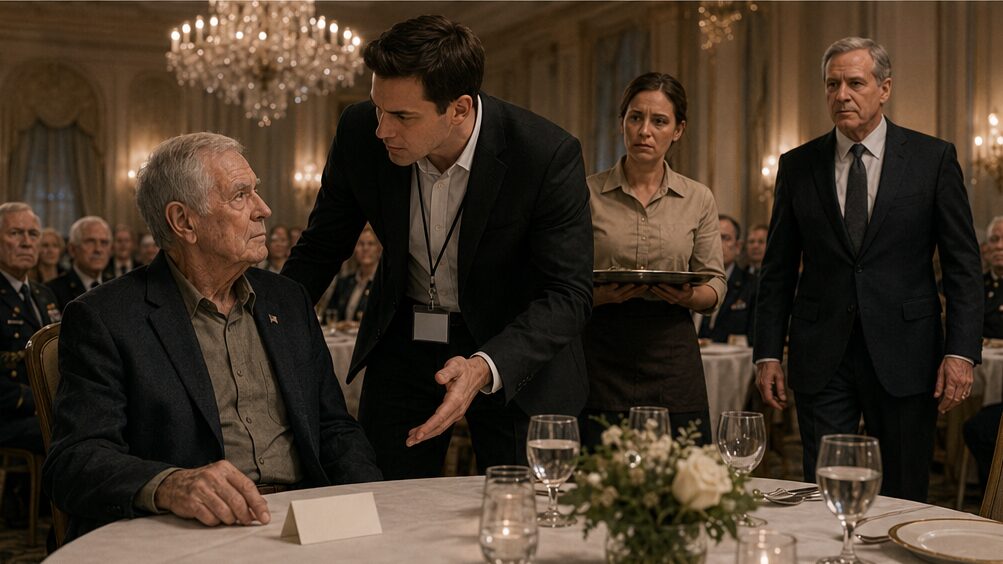
The Old Veteran Stayed Quiet When They Said His Reserved Seat Wasn’t His
Chapter 1: The Card He Would Not Move
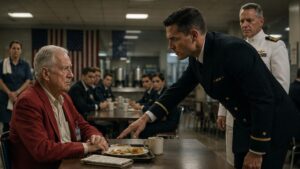
“Sir, that seat is reserved.”
The young man said it softly enough not to sound cruel, but loudly enough for the table beside them to hear.
Samuel Brown had just lowered himself into the chair when the words landed behind his shoulder. He kept one hand on the edge of the round table, steadying the small tremor in his fingers against the linen. The chair was heavier than it looked, carved wood with a cushioned back, the kind a hotel brought out when someone had paid for ceremony.
In front of him sat a folded white card.
Reserved.
The letters were printed in black, centered, clean, and plain. Someone had placed it slightly crooked, turned toward the room instead of the chair. Samuel had corrected that without thinking when he sat down. He had turned it toward himself, as if the word had been waiting for him and no one else.
Now the young man in the dark suit stood beside him with a badge clipped to his lapel. Jeffrey Clark, the badge read. Event Coordinator.
Samuel looked at the badge, then at Jeffrey’s face. Jeffrey was trying to smile. Not a warm smile. A working smile. The kind men used when they wanted a problem to walk away on its own.
“I’m sorry,” Jeffrey said, still leaning slightly over the table. “This table is reserved for honored guests and committee speakers.”
Samuel’s hand stayed near the card.
The banquet hall glowed around them. Chandeliers hung over a room full of round tables, polished glasses, folded napkins, and dark suits. At the far end, a small platform had been arranged with a lectern and a black-draped table holding candles that had not yet been lit. On the wall behind it, a banner read only enough for Samuel to catch the words remembrance dinner before his eyes moved away.
He had almost turned around at the entrance.
He had almost gone back to the parking lot.
But the card was here. The chair was here. And in his coat pocket, folded twice along the same crease, was the invitation he had finally stopped ignoring.
Jeffrey tapped two fingers against the table, not touching Samuel, not touching the card. “We have seating charts up front. I can help you find where you’re supposed to be.”
Where you’re supposed to be.
Samuel heard it without blinking.
A woman in a beige service shirt paused behind Jeffrey with a tray tucked against her hip. She was young enough to be Samuel’s granddaughter, maybe older than she first looked, with tired eyes that knew a room before the room knew itself. She looked from Jeffrey to Samuel, then to the folded card.
Samuel gave her the smallest nod. Not reassurance. Permission not to step into trouble.
“I was told this was my table,” Samuel said.
His voice came out lower than he intended. The room seemed to press around it. Plates clinked. Someone laughed two tables away. A chair scraped. Behind him, guests were still arriving, cheerful and polished, leaning in to read cards, shaking hands as if the whole evening had been built for people who knew exactly where to stand.
Jeffrey’s smile tightened.
“I understand,” he said. “There may have been confusion. But this seat is marked reserved.”
Samuel looked down at the card.
“Yes,” he said.
Jeffrey waited for more. Samuel had none to give him.
The young man shifted his weight. His shoes were bright, recently polished, sharp at the toes. Samuel noticed things like that without meaning to. Shoes, shoulders, hands. He had spent a long life reading what people did before what they said.
A pair of guests at the next table had gone quiet. One of them, a donor-looking man in a silver tie, turned halfway in his chair, his napkin still folded in his lap. A woman beside him pretended to study her program while looking over its top edge.
Jeffrey lowered his voice further. “Sir, I’m trying to avoid embarrassment.”
Samuel almost smiled then. Not because it was funny.
He had walked into rooms carrying men who would never age. He had stood at kitchen doors with folded flags under his arm because a mother could not open the door after seeing the car pull up. He had learned that embarrassment was a small word people used when they had never seen shame with its coat off.
But he did not say that.
He touched the card with one finger and turned it a fraction straighter.
The gesture was small. It made Jeffrey look down.
“Please don’t move the table cards,” Jeffrey said, sharper now.
Several heads turned.
The woman with the tray, Angela Green according to the name stitched on her service badge, drew in a breath. Samuel heard it. Jeffrey did too, because his shoulders stiffened, as if he had stepped farther into the scene than he meant to.
Samuel removed his finger from the card.
“I wasn’t moving it,” he said.
Jeffrey’s face colored slightly. “Sir, I need you to come with me.”
The words were polite. The meaning was not.
Samuel sat very still.
At the far side of the table, seven places had been set. Most were still empty. Each had a card, but only his had no name beneath the word reserved. The other cards bore printed names, titles, affiliations. Samuel did not read them. He did not want to know which person he had apparently interrupted by being alive in the wrong chair.
He could feel the room beginning to decide on him.
Old man. Wrong table. Confused. Maybe stubborn. Maybe didn’t understand.
He knew that kind of decision. It came fast, especially when a body moved slowly.
Jeffrey bent closer. “Sir, we have donors arriving. This table cannot be held up.”
Samuel’s throat tightened, not from anger at first. From memory.
Samantha would have hated this.
No, not hated. Samantha Brown had hated very few things. She would have looked at Jeffrey until he remembered he had a mother. She would have put one gentle hand on Samuel’s sleeve and said, Sam, you were invited. Sit where they asked you to sit.
He had tried to tell her, before she died, that dinners like this were for men who had clean stories. Men who could shake hands and receive thanks without feeling the room behind them fill with names.
She had squeezed his fingers until he stopped talking.
Go once, she had said. Not for them. For the ones you keep carrying.
Jeffrey straightened and looked toward the front of the room. The hotel manager stood near the entrance, checking a clipboard. A committee member waved from near the lectern, impatient, as though seating a room were a battle map and Jeffrey had misplaced a unit.
Samuel noticed the wave. Jeffrey noticed Samuel noticing.
“Let’s make this easy,” Jeffrey said.
Samuel took a slow breath.
Easy would have been staying home. Easy would have been leaving the invitation unopened on the side table by Samantha’s photograph. Easy would have been letting the annual dinner pass again, the way he had let it pass for six years.
He had not come for easy.
Still, he did not rise.
His palm came to rest flat on the linen beside the card. Not over it. Beside it.
“I’ll wait,” Samuel said.
“For what?”
Samuel looked at him then, fully. “For the person who put it there.”
Jeffrey blinked. A muscle moved in his jaw.
“Sir—”
“Jeffrey.”
The name came from the right, firm enough to cut across the table noise without raising itself.
A man in a dark suit moved between two chairs and stopped beside them. He was older than Jeffrey, broad-shouldered, with gray at the temples and the tired directness of someone who had spent the evening solving problems he had not created. Samuel recognized him from the printed letterhead on the invitation before he recognized the face.
Richard Moore.
The veterans’ dinner host looked from Jeffrey to Samuel, then down at the folded card.
His expression changed, but only slightly. Enough for Samuel to see it. Enough for Jeffrey to feel it.
Richard placed one hand on the back of the empty chair beside Samuel.
“Why,” he asked quietly, “is Samuel Brown being moved?”
Chapter 2: The Invitation Folded Inside His Pocket
Samuel stood before anyone could answer.
The movement cost him more than he liked. His left knee complained first, then his lower back, then the old ache beneath his ribs that came whenever weather or memory shifted too quickly. He kept his face even and slipped the folded card between two fingers before Jeffrey could object again.
Richard reached out as if to stop him.
“Samuel, wait.”
“It’s all right,” Samuel said.
It was not all right. The room had already done what rooms do. It had looked. It had measured. It had made a story from a man’s jacket, his slow hands, his quiet voice, and the absence of anything shiny on his chest.
Samuel did not blame the room. He had been part of rooms like this before, on the other side of judgment, back when he still wore a uniform and people assumed authority where they saw pressed fabric.
Now he was an old man in a dark blazer that had hung too long in a closet. His shirt collar sat a little loose at the neck. His shoes were clean but old. Nothing about him announced anything.
That had been his intention.
He moved away from the table before Richard could speak again. Jeffrey stepped back to make space, and the retreat cut more sharply than the confrontation had. Samuel could feel the young man’s relief, quick and guilty, like a door closing softly.
Angela stood near the aisle with her tray held close. Her eyes followed the card in Samuel’s hand.
He did not look at the guests. Not the man in the silver tie, not the woman holding the program, not the two committee members who had paused mid-conversation near the lectern. A room could grow teeth without making a sound.
The hallway outside the banquet room was cooler. Hotel carpet swallowed his steps. Behind him came the wash of voices, silverware, polite laughter trying to restart itself.
Samuel stopped near a side entrance where a tall potted plant leaned toward a brass-framed sign. Beyond the glass doors, the parking lot had gone blue with early evening. A row of cars reflected the banquet lights in their windshields.
He unfolded the card once, then stopped.
Reserved.
That was all it said.
No name. No explanation. No proof.
He almost laughed then, but the sound would not come.
From his inside coat pocket, he took the invitation. The paper had softened along the folds because he had opened and closed it too many times. At home, he had read it at the kitchen table. In the bedroom. Beside Samantha’s old chair. In the garage, where her gardening gloves still lay folded on the shelf because he had never found the right day to move them.
Dear Mr. Samuel Brown,
The local veterans’ remembrance committee would be honored by your presence at this year’s dinner.
He did not need to read further. The rest lived in him now.
Honored by your presence.
He had spent six years declining that sentence.
The first year after Samantha died, Richard Moore had called twice. Samuel had let both calls go to the machine. The second year, a letter came. He had placed it under a stack of mail and found it again in July. The third year, someone from the committee had stopped by and left a program in the mailbox. Samuel had used it to steady a wobbly table leg in the laundry room until guilt made him remove it.
Samantha would have seen all of it.
She saw what he tried to hide before he knew he was hiding it.
“You keep saying no because you don’t want them thanking you,” she had said one winter afternoon, wrapped in the blue blanket she pretended was warm enough. “But that isn’t the whole truth.”
Samuel had been standing at the sink, rinsing a mug that was already clean.
“What’s the whole truth?”
“You don’t want to sit in a room where some seats are empty.”
He had turned off the water.
She had not pushed. Samantha never pushed when she had already reached the place he was protecting.
Now, in the hallway, Samuel pressed the invitation flat against the folded card. The two pieces of paper were different sizes. The invitation was cream-colored, formal, full of words. The card was white, blunt, almost thoughtless.
Both had brought him here.
A door opened at the end of the hall, and kitchen sound spilled out: carts rolling, dishes stacked, someone asking for more coffee cups. Angela came through with an empty tray now, then slowed when she saw him.
“Sir,” she said, careful. “Are you all right?”
Samuel put the invitation away before he answered.
“Yes, ma’am.”
She looked too young to be called ma’am by him and too tired to argue with it.
“I’m sorry about what happened in there,” she said.
“It wasn’t yours to be sorry for.”
“No,” she said, and for a moment he thought she might leave it there. Then her eyes moved toward the banquet room. “But I saw it.”
Samuel folded the reserved card again along its crease. “Seeing things can be a burden.”
Angela’s mouth tightened. Not a smile. Recognition, maybe.
“The host was asking for you,” she said.
“I heard him.”
“He looked worried.”
Samuel nodded once.
Worried was kind of Richard. Late, but kind.
Through the open banquet doors, he could see the check-in table near the entrance. Jeffrey stood behind it now, head bent over a printed seating chart while the hotel manager spoke quickly at his side. The chart was taped to a clipboard and marked with colored lines. Names ran down the page in neat columns.
Samuel should have walked out. The parking lot was close. His truck was not far beyond the second row. He could be home before the candles were lit, before someone at the lectern said words like sacrifice and service into a microphone, words that had become too smooth from being used by people who slept well after saying them.
He touched the invitation through his jacket.
Samantha had made him promise near the end, but not in the dramatic way people imagined promises were made. There had been no thunder, no music, no hand reaching from a white bed. She had been sitting at their kitchen table with a pill bottle beside her and a pencil in her hand, circling the date of the dinner on a calendar for a year she would not see through.
“If they ask again,” she said, “go.”
Samuel had pretended not to understand.
“If who asks?”
She had given him the look that had corrected him for fifty-one years.
“You don’t have to tell stories,” she said. “You don’t have to let them make you into something you are not. Just sit down. Let yourself be counted.”
He had said nothing.
She had circled the date again until the pencil lead darkened the paper.
“Promise me, Sam.”
He had promised because he could deny her very little by then.
Now his hand closed around the card.
Angela was still standing there, waiting as if she understood he had gone somewhere she could not follow.
Samuel turned toward the check-in table. He did not intend to approach it. He only meant to see if Richard was coming, or if Jeffrey had found the mistake, or if the room had decided the matter without him.
But Jeffrey lifted the seating chart just then, angling it under the hallway light.
Samuel saw enough.
Table One.
Reserved. Reserved. Reserved.
Names below several seats. Donor names. Committee names. Richard Moore.
No Samuel Brown.
His name was not on the printed chart at all.
Chapter 3: The Coordinator Needed One Empty Chair
Jeffrey Clark had learned early in the evening that a banquet room could punish a person for one empty chair.
Not loudly. Not all at once. But through glances. Through a hotel manager’s clipped voice. Through a donor guest asking why his wife’s seat was next to a pillar when there were open places near the front. Through the master of ceremonies asking whether the “special guest” had arrived, while not knowing the special guest’s name.
Jeffrey had been handed the seating chart at 4:15 by a committee member who said, “It should all be straightforward,” which meant it would not be.
By 5:10, the florist had delivered centerpieces too tall for guests to see across. By 5:25, the sound system cracked every time someone touched the microphone. By 5:40, two donor guests had switched cards without telling anyone. By 5:50, the hotel manager had informed Jeffrey that the kitchen needed final headcounts immediately or dinner service would fall behind.
And at 5:57, Jeffrey saw an elderly man sitting alone at Table One with his hand near a reserved card that had no name on it.
At first, he had thought it would take thirty seconds.
“Sir, that seat is reserved.”
Polite. Clean. Procedural.
Then the man had looked at him.
Jeffrey had expected confusion, irritation, maybe embarrassment. He had not expected stillness.
The old man’s face was not empty. That was what bothered Jeffrey most as he stood now at the check-in table, staring at the chart as if the correct answer might rise from the page if he kept reading. Samuel Brown had looked at him like a man who understood every word and had chosen not to spend himself on any of them.
Jeffrey hated that he remembered it.
The hotel manager stood at his shoulder. “I need final numbers.”
“You have final numbers.”
“I have three versions of final numbers.”
“The committee gave me this chart.”
“The committee gave you last week’s chart,” the manager said. “Tonight’s changes came in this afternoon.”
Jeffrey shut his eyes briefly. “Where are tonight’s changes?”
“I assumed you had them.”
That was the kind of sentence that moved blame without touching it.
Jeffrey opened his eyes and scanned the chart again. Table One, front center. Richard Moore. Two committee seats. Three donor seats. One reserved seat marked only Reserved. The handwritten note beside it had been smudged when someone spilled coffee on the corner of the paper. All Jeffrey could read was a looped S, maybe part of a B, and the words front table, do not reassign.
That should have been enough.
But not in the moment. Not with the donor guest in the silver tie asking whether his friend from the chamber of commerce had arrived. Not with the committee member waving him over. Not with the kitchen pressing for counts, the manager pressing for timing, and the master of ceremonies pressing for order.
Jeffrey had needed one empty chair to remain empty until he knew who belonged in it.
And then an old man had been sitting there.
Not in uniform. Not wearing a name badge. Not accompanied by Richard Moore or any committee member. Not looking toward the front as if he expected to be welcomed.
Just sitting.
Jeffrey rubbed his thumb over the edge of the chart.
He had not meant to humiliate him.
That thought came too quickly, and because it came too quickly, Jeffrey distrusted it.
A person could do harm without meaning it. He knew that. He had been raised by a father who apologized with repairs, not words. A replaced screen door after shouting. A full tank of gas after silence. Meaning well did not undo what a person made someone else carry.
Still, Jeffrey told himself the situation had been complicated.
He was twenty-eight, the youngest coordinator the committee had hired, and he could feel every older man in the room measuring whether he could handle the evening. He had been corrected twice already for calling the remembrance table a display table. He had been told not to move the candles. He had been told not to change the order of speakers. He had been told that this dinner mattered to people who had earned better than confusion.
So he had tried to prevent confusion.
That was what he kept telling himself.
At the far end of the check-in table, a security volunteer leaned in. “Everything okay?”
“Yes,” Jeffrey said too fast.
The volunteer glanced toward the hallway. “The older gentleman went out that way.”
“I know.”
“You want me to—”
“No.”
The word snapped out. Jeffrey softened it. “No, thank you. I’ve got it.”
He did not have it.
Inside the banquet room, guests were settling. The chandeliers made every glass look expensive. At Table One, the front chair sat empty now, the napkin still folded like a white bird on the plate. Richard Moore stood nearby, speaking with a committee member, but his eyes kept going to the hallway.
Jeffrey could feel the mistake growing shape.
He turned the chart over. Nothing.
He checked the folder beneath it. Printed programs. Meal counts. A list of dietary restrictions. A page of donor acknowledgments. A small stack of blank cards. No updated seating list.
“Jeffrey.”
Angela Green stood on the other side of the check-in table, holding an empty tray against her hip. She should have been near the kitchen doors. Instead she was looking at the chart.
“I need to get back,” Jeffrey said.
“I know.”
Her voice did not accuse him. That made it worse.
She pointed with her chin toward the clipboard. “Can I see the corner?”
“What corner?”
“The one with the coffee stain.”
Jeffrey almost said no. Not because she had no right to see it, but because he had no patience left for another person finding another thing wrong.
Instead he turned the clipboard.
Angela leaned closer. She smelled faintly of coffee and dish soap.
“There,” she said.
“It’s unreadable.”
“Not all of it.”
Jeffrey followed her finger. The stain had blurred the ink, but beneath the brown edge, a few words remained, written in a cramped hand unlike the printed chart.
Hold for S. Brown if he comes.
Jeffrey stared.
Angela did not move her finger.
“If he comes,” she said quietly.
The room noise went on behind them. Laughter, chairs, silverware, a microphone thump from the front.
Jeffrey looked toward the hallway where Samuel Brown had disappeared, then back at the empty front chair he had been protecting from the wrong man.
On the table beside the clipboard lay a stack of blank place cards. One had been folded but not printed.
Angela picked it up, turned it once in her hand, and looked at Jeffrey.
“There’s another note,” she said.
She reached beneath the folder and drew out a smaller slip of paper, half-hidden under the donor acknowledgments. It had been torn from a committee pad, written quickly, and marked with Richard Moore’s initials.
Jeffrey saw the first line before Angela read it aloud.
Samuel Brown may not answer when introduced. Let him decide.
Chapter 4: A Quiet Man Beside The Kitchen Doors
Angela Green had carried plates through enough banquet halls to know when a room was pretending not to stare.
People thought servers did not notice because servers moved at the edges. They noticed everything. They noticed the table where the wife stopped eating after her husband corrected her too sharply. They noticed which guests spoke kindly only when someone important was watching. They noticed when an old man disappeared from a front table and a younger man tried to make the space he left behind look intentional.
Samuel Brown sat now at a small service table near the kitchen doors.
It was not meant for guests. The table held extra water glasses, a folded stack of napkins, and two pitchers covered with white cloth. Someone had dragged a spare chair beside it earlier when the kitchen staff needed a place to sort meal tickets. Samuel had taken that chair as if it had been offered to him.
He had not gone to the parking lot.
Angela saw that first, and it eased something in her chest. Then she saw his hand.
The folded Reserved card rested in his palm.
Not crumpled. Not hidden. Folded along its original crease and held with the same careful pressure someone might use for a photograph.
Angela stood just inside the kitchen doors while servers moved around her with salad plates. The kitchen was bright, hot, and noisy behind her. The banquet room was dimmer, polished, and softer, but the quiet out there had become heavier than the noise.
Jeffrey Clark was at the check-in table with the hotel manager. He held the slip of paper Angela had found, his face pale beneath the chandelier light. He had read it three times and still looked as if he hoped the words might change.
Samuel Brown may not answer when introduced. Let him decide.
Angela had not known what the note meant. She only knew it had been written for a person, not for a seat.
“Angela,” a kitchen worker said behind her, “Table Seven needs coffee.”
“I’ve got it.”
She picked up a pot and crossed the service lane, but instead of turning toward Table Seven, she stopped beside Samuel.
He looked up before she spoke. Not startled. Aware.
“Coffee, sir?”
“No, thank you.”
“Water?”
He glanced at the pitchers on the service table. “I believe I’m near enough.”
It could have been a joke. It nearly was. But his voice had gone inward, and the humor, if there had been any, stayed behind his eyes.
Angela shifted the coffee pot to her other hand. “Mr. Moore is trying to find you.”
“I’m not hard to find.”
“No, sir.”
“He has a room to run.”
“So do I,” Angela said before she could stop herself.
Samuel looked at her, and this time she saw the old soldier in him—not because of posture or strength, but because he heard what was underneath a sentence.
Angela swallowed. “I mean, I saw what happened. I should have said something.”
“You were carrying a tray.”
“That doesn’t make me blind.”
“No,” Samuel said. “But it gives people an excuse not to hear you.”
The words were not bitter. That made them worse.
A server brushed past carrying salads. The smell of dressing and warm rolls followed. At the front of the room, the master of ceremonies tapped the microphone, and feedback scratched across the ceiling. A few guests laughed politely.
Angela looked toward Table One. The empty chair was still there, napkin untouched. Jeffrey had not filled it. Richard Moore stood near the lectern, speaking in a low voice to a committee member whose face kept tightening.
The whole room knew there was a problem now. It simply did not know what kind.
“Why didn’t you tell him?” Angela asked.
Samuel’s thumb moved over the edge of the folded card.
“Tell him what?”
“That it was your seat.”
“I did.”
She remembered his voice: I was told this was my table.
“Yes,” she said softly. “You did.”
He lowered his eyes.
Angela had seen angry guests, drunk guests, lonely guests, guests who snapped their fingers for coffee because being served made them feel large. She had learned which apologies were safe to offer and which made people meaner. But this was different. Samuel’s silence did not ask anyone to feel sorry for him. It asked the room to be better without being told.
That was harder.
She poured coffee at Table Seven and returned through the aisles. Conversations lifted and fell around her.
“Was he lost?”
“Maybe a relative of someone.”
“They should have checked him in.”
“Poor thing.”
Poor thing.
Angela nearly stopped walking.
Samuel was not a poor thing. She did not know what he was yet, but she knew he was not that.
At the check-in table, Jeffrey saw her coming and folded the handwritten note quickly, as if hiding it could take back the reading.
“Did you speak to him?” he asked.
“Yes.”
“And?”
“He’s sitting by the kitchen doors.”
“I know where he is. I mean, did he say anything?”
Angela looked at him. “He said he wasn’t hard to find.”
Jeffrey’s jaw flexed. “This isn’t helpful.”
“No,” Angela said. “It isn’t.”
His eyes flashed, then dimmed. For the first time all evening, he looked younger than his suit.
“I didn’t know,” he said.
Angela kept her voice low. “You didn’t ask like you wanted to know.”
The hotel manager passed behind them with a headset pressed to one ear. Jeffrey waited until she was gone.
“There were donors asking about that seat.”
“There was a man sitting in it.”
“It wasn’t that simple.”
Angela thought of Samuel’s hand beside the card. The way he had turned it without claiming anything aloud. The way he had stood to spare Jeffrey a louder correction.
“No,” she said. “It was simpler than you made it.”
Jeffrey looked toward Samuel, then quickly away.
Angela did not hate him. That surprised her. She had expected anger to make things clear, but Jeffrey was not cruel in the easy way. He was frightened. Frightened of disorder, of being blamed, of older men in committee jackets deciding he was not ready. He had grabbed the smallest-looking problem in the room and tried to move it aside.
The problem had been a person.
The first course went out. Then rolls. Then the hotel lights dimmed a little more, and the candles at the remembrance table were lit one by one. The room settled into ceremony.
Samuel stayed near the kitchen doors.
Angela kept finding reasons to pass him. More water. A tray of butter dishes. A stack of programs someone had dropped near the aisle. Each time, he was still there, the folded card in his palm, his invitation tucked back inside his coat. He watched the room without asking anything from it.
At one point, a security volunteer approached him, spoke briefly, and gestured toward the entrance. Angela felt her body go tight.
Samuel shook his head once.
The volunteer hesitated, then stepped away.
Jeffrey had seen it too. His face changed again, this time with shame sharp enough to make him look almost angry.
Richard Moore moved from the lectern toward the hallway, scanning faces, but a committee member caught his sleeve and pointed toward the microphone. The program was beginning. The room expected order. Order, Angela was learning, could be another word for delay.
The master of ceremonies adjusted his glasses and smiled at the guests.
“Good evening, everyone. Thank you for joining us for this year’s remembrance dinner.”
The room quieted.
Angela stood beside the service doors with an empty tray against her hip. Samuel was only a few feet away, half in shadow, half in chandelier light.
The master of ceremonies continued, “Tonight is especially meaningful because we have the honor of recognizing a veteran who, after many years of declining our invitation, finally agreed to come.”
Angela looked at Samuel.
His fingers closed around the folded Reserved card.
Chapter 5: The Story No One Put On The Program
Richard Moore had spent three months trying not to make the evening about Samuel Brown.
That had been the strange part. Most honorees wanted a paragraph in the program, a photograph on the screen, a moment to stand while people turned their heads. Some pretended otherwise, but they still sent the photograph. They still corrected the spelling of their rank. They still asked whether their family would be seated near the front.
Samuel had asked for none of it.
Samuel had not even said yes himself.
His acceptance had come in a plain envelope with no return address, though Richard knew the handwriting from old condolence cards kept in committee files. The note inside had been short.
I will attend if no one asks me to speak.
S. Brown
Richard had held the card for a long time.
He should have called. He should have driven to Samuel’s house. He should have made certain the front table was handled by someone who understood the difference between a special guest and a ceremonial prop.
Instead, he had written quick instructions on a slip of paper, initialed it, and assumed the machinery of the evening would carry his care where his attention did not.
Now the machinery had swallowed Samuel whole.
Richard stood near the lectern while the master of ceremonies spoke into the microphone, unaware that the sentence he had just read had made the room tilt.
A veteran who, after many years of declining our invitation, finally agreed to come.
Several guests looked toward Table One.
The chair was empty.
Richard felt the absence hit the room before anyone named it. A small confusion moved from face to face. The donor in the silver tie leaned toward his wife. A committee member at the side of the stage stared at the empty place setting as if a guest might materialize if she looked sternly enough.
Richard’s eyes went past them to the kitchen doors.
Samuel was there.
Not hiding. That was the worst of it. Hiding would have been easier to forgive in himself. Samuel sat in the dim edge of the banquet hall with the folded card in his hand, as visible as anyone would let him be.
Richard moved before the master of ceremonies reached the next sentence.
“Hold,” he murmured as he passed.
The master of ceremonies faltered, then filled with something harmless about community support while Richard crossed behind the front table. He kept his pace measured. A room watched panic more closely than it watched error.
Jeffrey Clark stood near the check-in table with his hands at his sides. The young man looked at Richard as he approached, then down. Richard did not stop.
Not yet.
He went straight to Samuel.
“Samuel,” Richard said quietly.
Samuel looked up. The lines around his eyes seemed deeper than when Richard had greeted him by mail in his mind a hundred times and in person not once.
“Richard.”
The use of his name hurt. Not because it was cold. Because it was fair.
“I am sorry,” Richard said.
Samuel glanced toward the front of the room. “You have a program running.”
“That can wait.”
“No,” Samuel said. “That’s the trouble with programs. They don’t wait well.”
Richard pulled out the chair beside him, then thought better of sitting without being invited. He stood with one hand on the chair back.
“I put the note in the file myself. Your seat was not supposed to be touched.”
Samuel’s thumb rubbed once along the folded card. “Notes get lost.”
“People shouldn’t.”
Samuel did not answer.
From the lectern, the master of ceremonies had found his footing again. He spoke about remembrance, gratitude, service, the usual pillars on which evenings like this stood. Richard had written some of those words himself. They sounded thinner now.
“Come back to the table,” Richard said.
Samuel looked at him, not unkindly. “So you can fix it?”
“So I can correct it.”
“There’s a difference?”
Richard opened his mouth, then closed it.
He had commanded rooms, chaired boards, handled donors, comforted widows, and argued with city officials over funding for memorial repairs. He was used to problems becoming smaller when he named them properly.
This one did not shrink.
Because Samuel was right. Richard could return him to the front table. He could whisper to the master of ceremonies. He could have the place card printed, the chair pulled out, the mistake smoothed with professional grief. But Samuel would still have been moved in everyone’s memory. And Jeffrey would become the new object of the room’s appetite, the young man who had disrespected the old veteran. People liked a clean villain almost as much as they liked a clean hero.
Samuel Brown had never given them either.
“I should have met you at the door,” Richard said.
“Yes,” Samuel said.
The answer was quiet. It was not cruel. It did not let him go.
Richard lowered his eyes.
Years earlier, before Richard had taken over the veterans’ committee, Samuel Brown’s name had appeared in a box of files no one had labeled properly. Not for awards. Not for speeches. For letters.
Dozens of them.
To families of men whose names appeared on the county memorial. To widows who had stopped attending ceremonies. To grown children who had asked whether anyone remembered a father they barely knew. Samuel had written them by hand, year after year, not with grand statements but with details: how a man laughed when nervous, how he hummed off-key, how he traded dessert for cigarettes, how he once gave away dry socks and pretended he had an extra pair.
Richard had read three letters before he had to close the file.
No medal told that story. No program paragraph could hold it.
Samuel had spent decades remembering men the public remembered only as engraved names. And when Richard tried to thank him, Samuel had refused every dinner, every certificate, every call.
Until this year.
Until Samantha Brown’s promise, though Richard had only learned that from a neighbor who mentioned her name gently, as if touching a bruise.
At the lectern, the master of ceremonies said, “Some service is visible. Some is carried quietly for years.”
Richard turned sharply. The line was his. He had written it for Samuel. Hearing it while Samuel sat beside the kitchen doors made shame rise hot under his collar.
Angela Green stood a few steps away, still holding her tray. Her face held the same truth Richard was trying not to look away from.
“Samuel,” Richard said, “they need to know you’re here.”
Samuel’s gaze stayed on the front of the room. “Do they?”
“Yes.”
“Why?”
“Because this evening was partly built around you.”
Samuel breathed out slowly. “That’s what I was afraid of.”
The sentence settled between them.
Richard finally understood that the empty chair was not only a mistake. To Samuel, it was a place among names, faces, and absences. It was an invitation to be thanked for surviving, and that was not simple.
“I don’t want to make you stand,” Richard said. “I don’t want to make you speak. I only want your seat to be yours.”
Samuel looked down at the folded card.
“It was mine before anyone knew it,” he said.
Richard nodded. “Yes.”
For a moment, the room seemed to recede. The clink of silverware softened. The lectern voice blurred. Richard saw only the card in Samuel’s hand and the old man’s careful grip, as if the paper might tear if handled with anger.
“Then let me bring you back,” Richard said.
Samuel’s eyes moved to Jeffrey at the check-in table.
The young coordinator stood still, holding the slip Richard had written. His face looked drained of all event polish. The hotel manager spoke near him, but Jeffrey did not seem to hear.
Samuel watched him for a long moment.
Then he said, “Not if it costs someone else his place.”
Chapter 6: He Returned Only To Keep A Promise
Samuel had learned long ago that a man could be right and still do harm with the way he carried his rightness.
That was why he stayed in the chair beside the kitchen doors after Richard asked him to return.
It would have been easy, in one sense. Richard would walk ahead, the room would rearrange itself around authority, the guests would understand just enough to feel ashamed, and Jeffrey Clark would stand there while every face he had tried to manage turned toward him.
Samuel had seen that kind of correction before. It satisfied a room. It did not always repair a person.
He held the folded Reserved card in both hands now. The paper had warmed from his palm. One corner had softened.
At the front, the master of ceremonies paused while a committee member came to the lectern and whispered. Guests shifted, sensing a change in the program. The empty chair at Table One seemed brighter than the others, though nothing about the light had changed.
Richard stood beside Samuel, waiting.
Angela waited too, not close enough to intrude but close enough that Samuel knew she had chosen a side without making a show of it.
Jeffrey stood at the check-in table. His badge had turned crooked on his lapel.
Samuel looked at him and saw not only the young man who had leaned over the table, but the panic beneath the suit. The need to keep order. The fear of being found unready. Those things did not excuse him. Samuel had no use for excuses. But a man could understand a thing without excusing it.
Samantha had taught him that.
Not all at once. Over years. Over burnt toast and hospital bills, over church basements and grocery lines, over the way she would correct him with silence when he hardened too quickly against someone who had disappointed him.
You don’t have to let people hurt you, Sam.
He could hear her voice as clearly as if she sat beside him with her pocketbook in her lap.
But you don’t have to become their hurt either.
Near the end, when the illness had narrowed their house to the kitchen, the bedroom, and the path between, Samantha had circled the dinner date on the calendar. Samuel had tried to ignore it. She had placed the pencil down and looked at him over the rims of her glasses.
“They’re not asking you to be proud,” she had said.
“I know.”
“No, you don’t. You think being thanked means you’re agreeing with what it cost.”
He had stared at the calendar.
She had reached across the table. Her fingers were thin then, colder than they should have been, but her grip remained Samantha’s.
“You can let someone set a place for you,” she said, “without taking the places from the ones who aren’t there.”
He had not answered because he could not.
“Promise me you’ll go if they ask again.”
“Samantha.”
“Promise.”
He had promised.
Then she had added, almost as an afterthought, “And don’t punish some poor person for not knowing your ghosts.”
At the time, he had nearly smiled.
Now the words found him where they had been waiting.
Samuel pushed himself to his feet.
Richard moved to help him, then stopped when Samuel lifted one hand. Not ungrateful. Simply asking to stand by himself.
The room did not fall silent, but it thinned. Conversations weakened. A few heads turned. Then more.
Samuel stood beside the service table with the folded card in his hand. His knee stiffened; he gave it a moment. No hurry. Hurrying had never made pain more dignified.
Angela stepped closer. “Would you like me to walk with you?”
Samuel looked at her. “You already did.”
She pressed her lips together, and her eyes shone once before she turned away to give him the privacy of not being watched too tenderly.
Richard asked, “What do you want me to say?”
Samuel looked toward the front table.
“Nothing yet.”
He started down the side aisle.
The carpet was thick under his shoes. The room’s sound gathered around each step. He did not look at the guests, but he felt their attention shift as he passed. A woman lowered her fork. The donor in the silver tie turned fully in his chair now. The security volunteer near the wall straightened.
Jeffrey saw him coming.
For one brief second, the young man looked as if he might flee. Then he stayed where he was, shoulders squared, face pale.
Samuel stopped beside the check-in table.
The seating chart lay there with its columns and smudges and official lines. Beside it was Richard’s slip of paper.
Samuel Brown may not answer when introduced. Let him decide.
Samuel read it without touching it.
Jeffrey’s voice came out rough. “Mr. Brown—”
Samuel lifted his eyes.
Jeffrey stopped.
There were many things Samuel could have said. He could have asked whether he looked too poor for the front table. He could have asked whether old men had to bring proof of themselves everywhere they went. He could have handed Jeffrey the card and let Richard do the rest.
Instead, he unfolded the Reserved card carefully and set it on the check-in table between them.
“Next time,” Samuel said, “ask before you move someone.”
Jeffrey swallowed. “Yes, sir.”
The words were quiet enough that only the nearest guests heard. That was enough.
Samuel picked the card back up.
Richard had followed several steps behind, holding his own silence like an apology he had not yet earned the right to finish. The master of ceremonies stood frozen at the lectern, one hand on the microphone, looking to Richard for direction.
Samuel did not give him any.
He walked to Table One.
No one clapped. No one stood. The absence of it was almost a mercy.
Angela had moved ahead somehow. The napkin at Samuel’s place had been straightened, but nothing else had been touched. His water glass was filled. The chair had been angled slightly outward, not dramatically, just enough that he would not have to struggle with it.
Samuel looked at the empty plate, the folded napkin, the glasses reflecting chandelier light.
Then he placed the Reserved card back where it had been.
This time, he turned it toward the room.
Not as proof. Not as accusation.
As fact.
Richard came to the lectern. His voice, when he spoke, was lower than before.
“Ladies and gentlemen, thank you for your patience. Tonight’s remembrance moment will continue in a quieter way than printed programs usually allow.”
A ripple moved through the guests, but Richard did not dress it up.
“We are honored that Samuel Brown is with us. He has asked not to speak. We will respect that.”
Samuel lowered himself into the chair. His body welcomed the sitting, but his chest remained tight. At the edge of his vision, Jeffrey stood near the check-in table, motionless.
Richard continued, “Some people serve in ways that never fit neatly on a program. Some remember names after the rest of us have moved on. Tonight, we will let that be enough.”
Samuel looked down at his hands.
They were old hands now. Veins raised, knuckles thick, a tremor in the right when he was tired. Hands that had carried rifles, letters, grocery bags, Samantha’s medicine, casseroles to houses where grief had no appetite. Hands that had written names carefully because spelling mattered when memory was all a family had left.
He saw Samantha across the table as she had been before the sickness took weight from her face: amused, firm, kinder than comfort.
Let yourself be counted.
The remembrance candles were lit one by one. The master of ceremonies read names from the county memorial. Samuel knew many of them before they were spoken. Some he knew by face. Some by letter. Some by the silence that followed them into kitchens and church halls and front porches.
When the last candle caught flame, the room held still.
Samuel did not cry. He had never trusted himself with public tears. But he let his hand rest beside the card, open now, no longer protecting it.
Jeffrey approached after the candle lighting, before dinner resumed. He did not come all the way to the table. He stopped near Richard, said something too low for Samuel to hear, and looked toward the side doors.
The hotel manager stood behind him, lips pressed thin. A security volunteer shifted as if ready to escort someone out, though no one had asked.
Samuel understood the shape of it at once.
Jeffrey had become the mistake the room wanted removed.
Samuel pushed his chair back.
Richard noticed. “Samuel?”
Jeffrey looked up, alarm crossing his face.
Samuel stood slowly, one hand on the table. The room, which had only just begun to breathe again, quieted around him.
He did not raise his voice.
“Don’t remove him,” Samuel said.
Richard turned fully toward him.
Samuel kept his eyes on Jeffrey, not with warmth yet, not with forgiveness fully formed, but with something sturdier than either.
“Let him finish the evening,” Samuel said. “Then let him remember it.”
Chapter 7: The Seat Was Still There At Closing
By the time the last coffee cups were cleared, the banquet hall had lost its shine.
Not all of it. The chandeliers still burned above the round tables, and the silverware still caught the light when servers lifted it into gray tubs. But ceremony had a way of fading once people began reaching for coats. The polished voices lowered. Chairs scraped without apology. Programs were left behind with bent corners and candle wax cooling on the remembrance table.
Samuel Brown stayed seated until the room stopped needing him to prove he had stayed.
That was how it felt to him. Not like being honored. Not like being displayed. Simply like holding a place long enough for the room to understand it had been a place all along.
The Reserved card remained in front of him.
Someone had spilled a drop of water near it during dessert. The edge of the card had curled slightly where moisture touched it, but the word was still clear. Reserved. Samuel had looked at it too many times during the program, not because he needed reassurance anymore, but because the word had changed under the weight of the evening.
At first, it had seemed like a challenge.
Then a shield.
Then a burden.
Now it was only paper.
That should have made it less powerful. Instead, it made Samuel tired in a cleaner way.
Richard Moore had not overdone the correction. Samuel was grateful for that. There had been no grand introduction, no request for him to stand, no sudden demand that the room turn its attention into repayment. Richard had said what needed saying and let the candles carry the rest.
Still, people found ways to approach him.
A committee member stopped by and touched the back of an empty chair as if asking permission to enter the space. “Mr. Brown, we’re very glad you came.”
Samuel had nodded. “Thank you.”
A woman with a program pressed to her chest said her father’s name had been read from the county memorial. Samuel knew the name. He told her only one small thing: that her father had once fixed a broken radio with a butter knife and three inches of wire because everyone else had given up on hearing the game. The woman laughed once, then covered her mouth.
Samuel did not tell more. One detail was often enough to return a man to his family.
The donor in the silver tie came last among the guests, awkward now without the comfort of distance. He stood beside the table, cleared his throat, and said, “I believe I misunderstood the situation earlier.”
Samuel looked at him.
The man waited for Samuel to rescue him from the sentence. Samuel did not.
Finally, the man said, “I’m sorry.”
Samuel accepted that with a nod. Not warm. Not cold. Enough.
Angela Green came by after most guests had gone and began clearing the untouched settings at the front table. When she reached Samuel’s place, she left his water glass where it was.
“You need me to take that?” she asked, looking at the card.
Samuel touched the curled edge. “Not yet.”
“All right.”
She collected plates in practiced silence. Before she left, she set a fresh cup of coffee beside him, though he had not asked for it.
“This one’s not from the service pot,” she said. “Kitchen made a new one.”
Samuel wrapped his hand around the cup. “Thank you.”
Angela hesitated. “I almost didn’t say anything tonight.”
Samuel looked up.
She held the stack of plates against her side. “I see things all the time. I tell myself it’s not my room, not my place, not my business.”
“Sometimes that’s true.”
“Sometimes it’s just easier.”
Samuel nodded once. “Yes.”
She looked relieved that he had not made her better than she was.
“Good night, Mr. Brown.”
“Good night, Angela.”
She left through the kitchen doors, and for a few minutes Samuel sat alone with the sounds of closing: carts rolling, cloths shaken out, a vacuum starting somewhere beyond the far wall and then stopping when someone complained it was too soon.
Jeffrey Clark approached only after the hotel manager had gone.
Samuel saw him coming from the check-in table. The young man had removed his badge and held it in one hand. Without it, he looked less official and more uncertain, which was probably closer to the truth.
He stopped a few feet from Samuel’s chair.
“Mr. Brown.”
Samuel did not tell him to sit. Not yet.
Jeffrey looked at the Reserved card, then at the floor. “I owe you an apology.”
“Yes,” Samuel said.
The answer seemed to steady him more than forgiveness would have.
“I was wrong,” Jeffrey said. “Not just about the chart. About you.”
Samuel let the words stand. Apologies, real ones, needed room to hear themselves.
Jeffrey rubbed the edge of his badge with his thumb. “I thought I was protecting the event. I thought if I kept everything moving, that meant I was respecting what the night was for.” He swallowed. “But I saw you as a problem before I saw you as a person.”
Samuel looked toward the front of the room, where the candles had been extinguished and thin threads of smoke still lifted from their wicks.
“That happens fast,” he said.
“It shouldn’t.”
“No.”
Jeffrey took the correction quietly.
Samuel gestured to the chair beside him.
Jeffrey sat, slowly, as if the chair might not hold him. Up close, Samuel saw the exhaustion in his face. Not enough to excuse anything. Enough to make him human.
“My grandfather served,” Jeffrey said. “He never talked about it. I used to think that meant there wasn’t much to say.”
Samuel sipped the coffee Angela had brought. It was hot and bitter and good.
“Maybe there was too much.”
Jeffrey nodded, eyes lowered. “I think I understand that a little better now.”
“Don’t be too quick with understanding.”
The young man looked up.
Samuel set the cup down. “Understanding takes longer than regret.”
Jeffrey breathed in through his nose, then out. “Then what do I do?”
Samuel glanced at the empty tables, the abandoned programs, the staff folding linens back into bins. The room had become ordinary again. That was when choices mattered most, he thought. Not when everyone was watching. After.
“You work different,” Samuel said.
Jeffrey waited.
“You don’t let a chart tell you more than a face. You don’t move someone because they look easier to move than the mistake behind them. You don’t make older people prove they belong every time they walk slowly into a room.”
Jeffrey’s eyes reddened, but he did not look away.
“And if you don’t know,” Samuel said, “you ask.”
Jeffrey nodded once. Then again, smaller.
“I can do that.”
“You can start.”
The young man looked at the card. “Would you like to take it with you?”
Samuel had expected the question to feel important. It did not. The card had done its work. Taking it home would make it a relic, and he had enough relics. Samantha’s calendar still hung in the kitchen with the circled date. The invitation would go back beside her photograph. That was enough.
“No,” Samuel said. “Leave it.”
“For next year?”
Samuel looked at him, and Jeffrey understood enough to stop.
“Not like that,” Samuel said. “A reserved seat is only respectful if someone is welcomed before they have to defend it.”
Jeffrey looked down at the blank badge in his hand.
After a while, Richard Moore came over with his coat folded across one arm. He did not interrupt. He stood behind the chair beside Samuel until Jeffrey rose.
“Thank you for letting me finish the evening,” Jeffrey said.
Samuel studied him. “Remember why I did.”
“I will.”
Jeffrey walked back to the check-in table. He picked up the seating chart, looked at it for a long moment, then folded it in half instead of placing it back in the folder.
Richard sat where Jeffrey had been.
“I failed you tonight,” he said.
Samuel leaned back in his chair. “You made a mistake.”
“That sounds kinder than I deserve.”
“It isn’t kindness. It’s accuracy.”
Richard let out a tired breath that almost became a laugh.
Samuel looked at the empty table, at the card, at the chair that had waited through the worst of the evening. “Samantha would have said I stayed too long.”
“I’m not sure I believe that.”
“She would have said it after telling me not to leave.”
Richard smiled faintly.
For the first time all night, Samuel smiled too.
He stood with Richard’s help this time, not because he could not stand alone, but because refusing every offered hand could become its own kind of pride. He buttoned his coat, touched the invitation through the inside pocket, and looked once more at the Reserved card.
Then he left it on the table.
A year later, before the first guest arrived, Jeffrey Clark stood at the check-in table with a fresh stack of place cards. The banquet hall looked much the same: chandeliers, round tables, white linen, candles waiting at the front.
But the first card for the front table was blank.
The hotel manager asked whether he wanted it printed.
Jeffrey shook his head.
“Not yet.”
He took the card in his hand and walked toward the entrance to welcome the guest himself.
The story has ended.