The General They Turned Away Because His Jacket Looked Too Poor for the Gala
Chapter 1: The Man in the Faded Jacket at the Gate
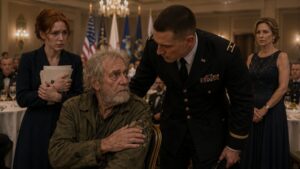
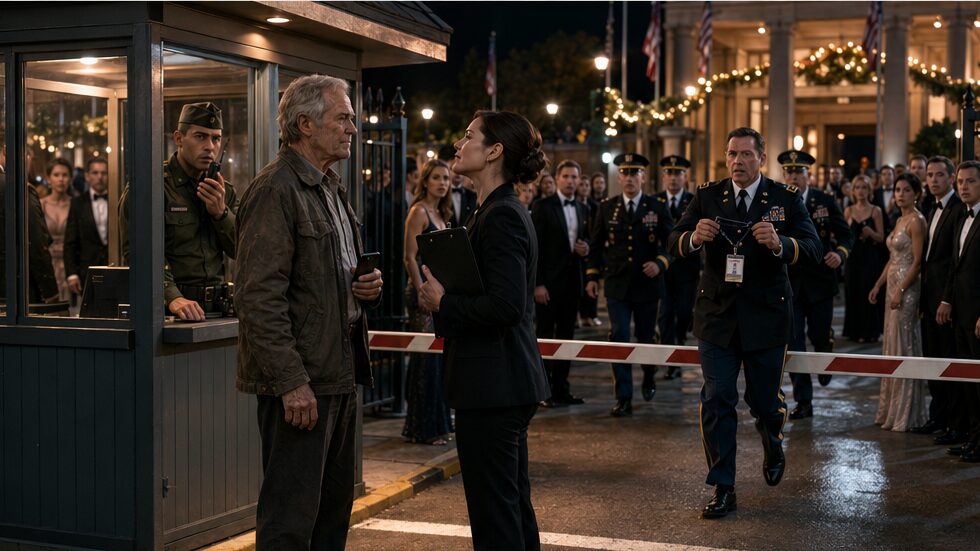
The band was rehearsing the first notes of the evening march when David Campbell reached the checkpoint and the young soldier at the barrier looked down at his jacket before looking at his face.
Behind David, black cars kept arriving in smooth, polished intervals. Doors opened. Tuxedos emerged. Dress uniforms glittered under the checkpoint lights. Women in formal gowns lifted their hems above the curb. Officers with rows of ribbons crossed through the guest lane with the practiced certainty of people who had never wondered whether a gate would open for them.
David stopped at the painted line.
His jacket, faded nearly gray at the seams, hung loose over his shoulders. The cuffs were worn thin. One pocket sagged slightly, as if it had carried the same folded papers for years. Under it he wore a plain shirt, dark trousers, and old shoes with careful polish but no shine left to give.
The soldier at the kiosk straightened. His name tape read Garcia.
“Good evening, sir,” Matthew Garcia said, polite but uncertain. “Invitation or identification?”
David removed a small leather credential case from inside the jacket. He did not hurry. He did not try to step past the line.
Before Matthew could take the case, a woman in a black event blazer crossed from the guest reception table with a clipboard pressed against her chest like a shield.
“Hold there,” she said.
The movement around them tightened. A couple paused near the flower arrangements at the entrance. A colonel’s wife glanced over, then pretended not to.
The woman’s eyes moved from David’s shoes to his jacket, to the plain shirt visible beneath it. She did not look at the credential case.
“This entrance is for gala guests and cleared personnel,” she said.
David held the case out. “That is why I’m here.”
Her smile was small and practiced. “Sir, the veterans’ outreach table is not at this gate. If you were directed here, someone made a mistake.”
Matthew’s hand hovered, waiting to receive the ID.
David said, “I have a meeting before the gala.”
The woman’s expression changed just enough for David to see her decision form. Not curiosity. Not caution. Annoyance.
“A meeting,” she repeated.
“Yes.”
“With whom?”
David glanced beyond the barrier, toward the main hall where lights burned against the evening. “The Secretary’s office is expecting me.”
A laugh rose from someone in the guest line and was quickly swallowed. The band inside struck a wrong note, stopped, then began again.
The woman stepped fully in front of him. Her badge read Kimberly Martin, Event Coordination.
“Sir,” she said, voice louder now, shaped for witnesses, “that cheap suit isn’t getting into this event.”
The music inside cut off as if someone had closed a door on it.
For one second even the engines at the curb seemed quieter.
Matthew’s face tightened. He looked at David’s jacket again, then at Kimberly. “Ma’am, I can run the credential.”
Kimberly did not move. “No need.”
David lowered the case slightly. His eyes stayed on hers, calm and unreadable.
“It would take less than a minute,” Matthew said.
Kimberly’s smile sharpened. “Sergeant Garcia, we are not turning the formal entrance into an open screening line because someone wandered to the wrong barrier.”
“I did not wander,” David said.
“No?” She glanced toward the arriving guests. “Then you chose a strange evening to make a scene.”
David looked past her again, not as if searching for rescue, but as if measuring the distance between where he stood and where he was meant to be.
“I’m not making a scene,” he said.
Kimberly leaned closer. “Then help me prevent one.”
A pair of officers approached the lane, slowed, and passed without intervening. Their eyes slid over David the way people looked at an inconvenience they had not been assigned to handle. One of them gave Kimberly a brief nod, approving or relieved.
That nod changed her posture. She stood taller.
“Sir,” she said, “tonight’s event includes senior leadership, visiting officials, family guests, and restricted personnel. We have strict visual and credential protocols.”
“Credential protocols begin with checking credentials.”
The words were quiet. They carried no anger. That made them land harder.
Kimberly’s fingers tightened on the clipboard.
Matthew shifted his weight. “Ma’am, if his name is on the list—”
“It is not your job to debate event flow with me in front of guests,” Kimberly said.
A flush rose under Matthew’s collar. He closed his mouth.
David saw it. He saw the soldier’s glance toward the brass near the gate, the fear of correcting the wrong person in public. He saw Kimberly’s fear too, hidden beneath the crisp blazer and controlled voice. Fear of disorder. Fear of embarrassment. Fear of being the civilian woman blamed if one person slipped through and someone important asked why.
He could have ended it then.
The name. The rank. One sentence.
Instead he held the credential case at his side and waited.
A limousine rolled past them toward the inner drop-off point. Its windows reflected the checkpoint lights and, for a moment, David’s worn jacket looked even duller beside the black paint and chrome.
Kimberly followed his glance.
“There is a side office for unresolved access issues,” she said. “You can wait there until someone confirms your purpose.”
“My purpose is time-sensitive.”
“So is mine.”
“I was told to arrive at this gate.”
“By whom?”
David did not answer immediately.
Kimberly took the pause as victory. “Exactly.”
Matthew looked at the credential case again. “Sir, may I at least see—”
“No,” Kimberly said, sharper than before.
Several guests had stopped now. Not openly. Not rudely. Just enough to watch without admitting it. A woman with pearl earrings murmured something behind a gloved hand. A young officer looked away when David’s gaze passed over him.
David’s face did not change.
That steadiness irritated Kimberly more than protest would have. She had managed late vendors, misplaced seating cards, officers with impossible demands, and spouses who believed rank transferred through marriage. She knew panic when she saw it. She knew bluffing.
This old man was not bluffing, and she did not understand why.
“Sir,” she said, “I am going to ask you one final time to step out of the checkpoint lane.”
“I’m expected inside.”
“You are delaying cleared guests.”
“No one is delayed. The lane beside me remains open.”
Her cheeks colored.
Matthew glanced toward the kiosk screen, then toward the line of cars. “Ma’am, I can move him to the booth and verify—”
Kimberly turned on him. “Do not reward noncompliance.”
The word hung there.
David looked at her then, fully.
Noncompliance.
It had been a long time since anyone had used that word on him at a gate.
He slid the credential case back into his jacket. The old fabric folded around his hand, soft from years of wear.
Kimberly saw only retreat.
“Thank you,” she said, already turning away.
David did not move.
Her head snapped back.
“Sir.”
“I have not refused an order,” he said. “I have asked for proper verification.”
“And I have determined that your presence at this entrance is inappropriate.”
“Based on what?”
Kimberly’s eyes flicked to the jacket before she could stop herself.
There it was. The whole trial. The whole verdict.
David nodded once, almost to himself.
Inside the gate, the band resumed, softer now, uncertain. Trumpets tested a ceremonial phrase that did not quite gather strength.
Kimberly lifted her hand and pointed toward the outer sidewalk, away from the lights, away from the guest line, away from the installation.
“If you don’t step away from the checkpoint,” she said, “I will call the Sergeant of the Guard.”
Matthew’s jaw moved as if he wanted to speak.
David looked at the young soldier, then back to Kimberly.
For the first time, something in his stillness sharpened.
Chapter 2: A Name Buried Behind Restricted Access
Matthew found the name on the second search, and the color left his face before he understood why.
Campbell, David.
The kiosk screen offered no rank, no billet, no unit, no guest category. Beside the name, in a red-bordered field usually reserved for classified movement notes, one word appeared.
Restricted.
Matthew’s thumb froze above the keyboard.
Kimberly saw the hesitation and stepped closer. “What is it?”
Matthew lowered his voice. “There is an entry.”
“Then read it.”
“I can’t. It’s restricted.”
David stood just outside the booth light, hands relaxed at his sides, jacket collar lifted slightly by the evening breeze. The faded cloth seemed to absorb the checkpoint glare instead of reflecting it. Behind him, guests continued filtering around the scene, but more slowly now. Everyone sensed that the small inconvenience had become something else.
Kimberly angled herself so the watching guests could not see the screen. “Restricted how?”
Matthew swallowed. “Name only. No details available from this terminal.”
“Is he cleared?”
“It doesn’t say.”
“Is he listed as a gala guest?”
“It doesn’t say that either.”
Kimberly turned back to David with visible relief. “Then we have our answer.”
“No,” Matthew said before he could stop himself. “Ma’am, restricted entries usually require confirmation through command security.”
Kimberly’s eyes cut to him.
The radio clipped to Matthew’s shoulder crackled, a burst of static broken by half a syllable and then nothing. He touched it, grateful for something to do.
“Main gate to command security,” he said. “Requesting clarification on restricted visitor entry, surname Campbell, first name David.”
Static answered.
Kimberly folded her arms. “Do not broadcast guest issues on an open channel.”
“It’s the command security channel.”
“It is still not appropriate during the arrival window.”
David said, “Sergeant, there should be a secondary verification line attached to the entry.”
Matthew checked. A small icon blinked near the lower corner of the screen. He clicked it. A prompt opened, then refused access.
“Requires head-of-security authorization,” he said.
Kimberly’s confidence faltered for half a breath.
David watched the screen without leaning in. “Then call the head of security.”
Kimberly laughed once, not because anything was funny, but because the request threatened the balance she had built in front of the crowd. “We are not calling the head of security because a man without proper attire knows a few procedural words.”
“I know more than a few.”
“Apparently not enough to follow them.”
Matthew’s radio crackled again. This time a voice came through, chopped and distant. “—repeat visitor name—”
Matthew lifted it. “Campbell. David Campbell. Restricted entry at main gala checkpoint. Request—”
Kimberly reached out and pressed the transmission down with two fingers. Not violently, but firmly enough to stop him.
“That is enough,” she said.
Matthew stared at her hand.
David’s gaze went there too.
Kimberly removed her fingers as if the radio had burned her. “We have procedures for unknown access.”
“Yes,” David said. “They begin with verification.”
“They also include threat prevention.”
“Do I appear threatening?”
“You appear unverified at a restricted event.”
“That is not the same thing.”
“It is tonight.”
A man in a dinner jacket paused near the rope line. “Is everything all right, Ms. Martin?”
Kimberly’s face changed instantly. Softer. Brighter. Controlled.
“Perfectly, Colonel. Just resolving a gate issue.”
The colonel looked at David, taking in the old jacket, the plain trousers, the credential case no longer visible. His eyes lingered on the worn cuff. “Need assistance?”
“No, sir,” Kimberly said quickly. “We have it under control.”
David almost spoke then. The colonel was close enough. One word could travel. One correction from David could end the performance before Kimberly drove it deeper.
But he heard another gate in his memory. Another evening. A woman’s voice held flat by humiliation. A young guard asking for papers already submitted. A folded flag in a case nobody had recognized until someone important finally arrived.
He let the moment pass.
The colonel nodded to Kimberly and moved on.
She watched him enter, then turned back with renewed force. “You see? This is exactly what I mean. Every minute spent here becomes visible.”
“Then make the proper call,” David said.
“The proper call is to remove an unresolved risk from the formal checkpoint.”
Matthew’s hand hovered near the keyboard. “Ma’am, I don’t think we should classify him as—”
“As what?”
He hesitated.
Kimberly’s voice lowered. “Say it, Sergeant.”
“As a risk. Not yet.”
David looked at Matthew, and for the first time that evening his expression softened.
Kimberly saw the exchange and misread it as alliance against her. Her jaw tightened.
“I understand you want to be generous,” she said to Matthew, carefully enough that the watching guests could hear the lesson but not the threat beneath it. “But generosity is not a security protocol.”
“No, ma’am.”
“We are not here to guess at people’s stories. We are here to protect the installation.”
David said, “An installation that cannot tell the difference between a story and a credential has a problem.”
Kimberly’s head turned slowly. “What did you say?”
“I asked whether this gate now judges clearance by fabric.”
The nearby murmurs stopped.
Matthew closed his eyes for a moment.
Kimberly’s smile disappeared completely.
“Sir, I have treated you with more patience than this situation requires.”
“You have treated my jacket with suspicion and my credentials with disinterest.”
“You were given a lawful instruction to step away.”
“I was given an instruction by an event coordinator who refused to verify my clearance.”
“I coordinate access for this event.”
“You coordinate seating and arrivals. Security verifies clearance.”
The words were not loud. They did not need to be.
Kimberly’s face went pale, then red. Her fear had nowhere to go except forward.
She turned to Matthew. “Open the incident log.”
“Ma’am—”
“Now.”
Matthew opened the form reluctantly. A blank field waited under category.
Kimberly leaned toward the screen. “Unauthorized civilian at gala checkpoint. Refused direction to exit.”
David’s eyes flicked to the screen.
“Civilian?” Matthew said.
“He is dressed as one, he is acting outside the guest flow, and he has no visible clearance.”
“Restricted entry means there is some kind of clearance issue pending.”
“Or a warning.”
Matthew looked at David. There was an apology in his face, but not courage. Not yet.
Kimberly noticed and spoke each word cleanly.
“Log him as a civilian risk at the gala checkpoint.”
The static on Matthew’s radio flared again, louder this time, filling the booth with a harsh, broken hiss.
David looked from the screen to Kimberly.
Something in him seemed to settle—not into anger, but into decision.
Chapter 3: The Widow Who Recognized the Jacket
Janet Adams stopped in the guest line so abruptly that the woman behind her nearly stepped on the back of her shoe.
For several seconds she did not see the lights, the uniformed ushers, or the line of cars moving through the formal lane. She saw only the sleeve of David Campbell’s faded jacket, where the fabric near the cuff had been rubbed smooth by years of use.
Her hand tightened around the small evening bag she carried.
“That jacket,” she whispered.
David heard her before he saw her. His shoulders shifted, barely, as though a familiar weight had been placed across them.
Kimberly, still standing between David and the checkpoint, turned with sharp irritation. “Ma’am, please continue through guest processing. This area is being handled.”
Janet did not move.
She was dressed carefully but not richly, in a dark blue dress and a plain coat. No glittering jewelry, no rank beside her, no officer guiding her forward. Her hair had been pinned back with the care of someone who did not want to ask for help in a public place.
Her eyes stayed on David.
“David?” she said.
A few guests looked between them.
Kimberly’s expression shifted again, quick and assessing. Another complication. Another person outside the polished rhythm of the entrance.
“Are you with him?” she asked.
The question was simple. The tone was not.
Janet looked at Kimberly then, and David saw the old reflex cross her face—the small tightening of someone preparing to prove she had a right to stand where she already stood.
“No,” David said before she could answer. “Mrs. Adams is an invited guest.”
Kimberly glanced at her clipboard. “Name?”
Janet drew herself up. “Janet Adams.”
Kimberly scanned the guest pages. Her finger stopped, then moved again. “Gold family seating. Memorial table.”
The words were correct. The delivery was careless.
Janet’s mouth pressed thin.
David’s hand closed once at his side.
Kimberly looked up. “Your lane is to the left, Mrs. Adams. Staff will direct you.”
Janet still did not move. “Where did you get that jacket?”
The band inside began another rehearsal phrase, low brass this time, warm and distant. David looked down at the cuff as if he had forgotten he was wearing it.
“It was given to me,” he said.
“No.” Janet’s voice trembled, not with doubt, but with recognition. “It was not given. It was left.”
David’s eyes closed briefly.
Kimberly exhaled through her nose. “This is not the time for personal matters.”
Janet turned toward her fully. “You don’t know what time it is.”
The nearby line went still.
Matthew, behind the kiosk glass, looked up from the incident log.
Kimberly’s nostrils flared. “Ma’am, I understand this evening may be emotional for some guests, but we cannot allow—”
“Emotional for some guests,” Janet repeated softly.
David said, “Janet.”
She looked back at him. In that look there were years: hospital corridors, folded uniforms, ceremonies endured, phone calls neither of them had wanted to make. There was also accusation—not loud, not unfair, but alive.
“You kept it,” she said.
“Yes.”
“All this time.”
“Yes.”
Kimberly’s impatience bent toward suspicion. “Sir, if you are attempting to use a memorial guest to support your entry—”
David’s voice cut through hers, still quiet but no longer gentle. “Do not finish that sentence.”
Kimberly stopped.
It was the first time he had sounded like command.
Not rank. Not volume. Command.
Janet heard it too. Her eyes searched his face. “She doesn’t know, does she?”
“No.”
“Why not?”
“Because this is not why you came tonight.”
Janet’s laugh was small and broken. “You think you get to decide that?”
David looked away.
Kimberly seized the pause. “Mrs. Adams, if this man is causing you distress, we can have him escorted away from the guest approach.”
Janet stared at her.
David stepped half a pace forward. Matthew’s hand moved toward the booth door, ready to intervene if the barrier line became an actual breach.
“I am not causing Mrs. Adams distress,” David said.
Janet’s gaze remained on Kimberly. “No. This gate is.”
The words struck David harder than Kimberly seemed to understand.
Kimberly’s face tightened. “This gate is operating under formal event protocols.”
Janet looked at the checkpoint arm, the polished signs, the flags arranged beneath bright lamps. “It was operating under protocols the last time too.”
David turned toward her. “Janet.”
But she had already started, and grief, once forced into words, did not always obey rank.
“I stood here with a folded invitation and a letter from casualty affairs,” she said. “I had my son beside me. He was nineteen. He was trying not to cry because he thought soldiers weren’t supposed to cry in public. They told us our names weren’t visible in the system. They told us to wait outside the barrier until someone could confirm we belonged at his father’s memorial.”
Matthew’s eyes dropped.
Kimberly’s clipboard lowered a fraction.
David did not look at anyone. He looked only at Janet.
“That was years ago,” Kimberly said, but there was less certainty in it now.
Janet nodded. “Yes. Years. Long enough for paint, flowers, and new signs. Not long enough, apparently, for the gate to learn manners.”
A low murmur moved through the small crowd. Not mockery now. Discomfort.
David took another step toward Janet, careful not to cross the checkpoint line. “You should not have had to say that here.”
“No,” she said. “I shouldn’t have had to live it here.”
He accepted the blow because it was true.
His hand touched the jacket pocket. The old fabric wrinkled under his fingers. Inside that pocket, years ago, he had found a note Janet’s husband had never mailed. Nothing grand. A grocery list on the back of a range schedule. A reminder to call home. A life interrupted mid-errand.
David had worn the jacket only three times since receiving it. Once at the burial. Once when Janet’s son left for training. And tonight.
Kimberly watched the exchange, trapped between empathy and the fear of losing control of the entrance. “Mrs. Adams,” she said more softly, “I am sorry for what happened then. But tonight I still have to maintain security.”
Janet looked at David. “Is that what this is? Security?”
David did not answer.
Because the honest answer was worse than silence.
He had wanted to know. He had asked for no visible escort, no announced rank, no ceremonial reception at the outer gate. He had wanted the installation to show him what it saw when rank was hidden and cloth was worn thin. He had told himself it was necessary. Clean. Professional.
Now Janet stood in front of him with old pain in her face, and necessary did not feel clean.
Kimberly straightened, recovering herself. “Mrs. Adams, please proceed to your assigned entrance. Sir, you have already been instructed to step away.”
Janet’s head turned slowly.
David spoke before she could. “Go inside, Janet.”
“Not without knowing why you’re standing here in his jacket.”
“I will explain.”
“When?”
He glanced toward the barrier, the booth, the watching guests, the woman who had mistaken restraint for weakness.
“Soon.”
Janet studied him, and her eyes softened with something more difficult than anger.
“You promised me,” she said. “You said nobody would have to stand at this gate and ask to be seen.”
David’s face changed then—not much, but enough for Matthew to notice.
Kimberly noticed too, though she did not understand it.
The radio at Matthew’s shoulder crackled again. The static filled the space between them like a warning.
Janet stepped closer to David, close enough to touch the worn sleeve but not doing it. Her voice lowered.
“This is the same gate,” she said.
David finally turned from Janet to Kimberly, and the calm in his eyes was no longer patient.
Chapter 4: The Call That Made the Static Stop
Kimberly lifted her radio before David could answer Janet.
“Sergeant Garcia,” she said, without taking her eyes off David, “prepare to have this individual removed from the formal approach before the first toast.”
Matthew’s hand stopped over the incident log. The cursor blinked beside the words civilian risk, waiting for him to press submit.
David saw the hesitation. He also saw Janet standing beside the guest lane with her invitation clutched too tightly, her face composed in the same way a folded flag was composed—neat because grief had been forced into shape.
The band inside the gate stopped again. A single trumpet tried one note, then fell silent.
“Mrs. Adams should be escorted in,” David said.
Kimberly’s mouth tightened. “Mrs. Adams may proceed when she chooses to follow staff direction.”
Janet gave a small, humorless breath. “There it is again.”
Kimberly turned toward her. “Ma’am, I apologized for what happened before. I cannot change the past.”
“No,” Janet said. “But you recognized it quickly enough to repeat it.”
The words drew a quiet reaction from the line. A few guests looked away. One older officer shifted as if to intervene, then decided against it.
Kimberly heard the murmur and stiffened. Every watching face became, to her, another performance review. Another person who might later say she lost control of the entrance. Another senior spouse who might complain that the evening began with disorder.
She pointed past David toward the sidewalk.
“Sir, final instruction. Leave the checkpoint lane.”
David looked at her hand. Then at the barrier arm. Then at Matthew’s unfinished log.
He had built a career on letting facts speak after everyone else had exhausted noise. He had believed, perhaps too stubbornly, that a person who needed his rank displayed before offering fairness had already failed the first test of command.
But Janet had not come to be part of his test.
And Matthew had not been trained for courage by being abandoned inside someone else’s lesson.
David reached inside the faded jacket.
Kimberly stepped back half a pace. “Keep your hands visible.”
David paused. Slowly, with two fingers, he removed his phone.
Matthew’s shoulders dropped in relief and dread at once.
“I’m making a call,” David said.
Kimberly gave a sharp laugh. “To whom? The banquet office?”
David did not answer her. He touched one number on the screen and lifted the phone to his ear.
The small sound of the ring seemed too soft for the checkpoint. It slipped under the idling engines, under the restless shuffling of formal shoes, under the static that still rasped from Matthew’s shoulder radio.
Kimberly folded her arms, but her eyes had narrowed. Something about the way David waited had changed the air.
The call connected.
“Margaret,” David said, “I need the Secretary.”
Kimberly blinked.
Matthew looked up.
David listened for a breath. “No. Not delayed by traffic.”
A voice spoke on the other end, quick and clipped, audible only as a thin thread to those nearest him.
David’s face remained still.
“Yes,” he said. “I’m at the main visitor gate.”
The static on Matthew’s radio crackled and died.
David turned slightly, not away from Kimberly, but toward the barrier, toward the installation beyond it.
“Mr. Secretary,” he said, calm enough that the words cut cleanly through the gathered silence, “I’m trying to get to the meeting, but your security says I’m a civilian risk.”
No one moved.
Kimberly’s lips parted, then closed. Her eyes went first to the phone, then to Matthew’s screen, then to David’s jacket, as if the fabric might rearrange itself into an explanation she could survive.
On the other end of the line, the voice changed.
David listened.
“No,” he said. “No injury. No breach. Just a failure of verification.”
Kimberly’s head snapped up at that.
Matthew whispered, “Oh, no.”
Inside the booth, a second phone began to ring. Not the public line. The red command handset mounted beside the access console.
Matthew stared at it.
“Answer it,” David said.
Matthew grabbed the handset. “Main gate, Sergeant Garcia.”
Whatever came through made him straighten so quickly his chair scraped the wall.
“Yes, sir. Yes, sir, he is here. No, sir, not processed. Yes, sir, Ms. Martin is present.”
Kimberly’s face drained of color.
The radio on her belt chirped. Then another radio nearby. Then the gate speaker clicked, buzzed, and cut out. From the inner road came the sudden slam of a vehicle door.
David still held the phone to his ear.
“Yes,” he said quietly. “That may be necessary now.”
Janet watched him with an expression that had shifted from hurt to recognition, though not relief. There was too much pain between them for relief to arrive quickly.
Kimberly stepped toward Matthew. “Who is that?”
Matthew covered the handset badly. “Command security.”
“I can see that. What are they saying?”
He did not answer.
“Sergeant.”
Matthew looked at David, then back at her. “They said nobody is to move him.”
The words went through the checkpoint like cold water.
Kimberly’s gaze flicked to David. “Sir, if there has been confusion, you could have identified yourself properly.”
David lowered the phone slightly. The call remained connected.
“I presented credentials.”
“You withheld context.”
“I watched you refuse process.”
Her voice lowered, pleading beneath the anger now. “You let this happen.”
David’s eyes moved toward Janet, then Matthew, then the incident log. “Yes,” he said. “I did.”
That answer unsettled Kimberly more than denial would have.
From inside the installation, boots hit pavement at a run.
A line of officers appeared beyond the inner checkpoint, moving fast from the administration road. At their center was a broad-shouldered man in formal uniform with a security badge clipped high and a face already tight with alarm.
Brandon Hall.
Kimberly recognized him and took one involuntary step back.
Matthew remained at attention with the handset pressed to his ear.
David spoke once more into the phone. “I understand. I’ll remain here.”
He ended the call.
For one second, the only sound was the distant crowd inside the gala hall, unaware that its polished entrance had become the evening’s center of gravity.
Then the band erupted.
Not rehearsal. Not a mistaken phrase.
The official march for a Flag Officer rolled out from behind the gate with full brass force, so sudden and powerful that the guests nearest the barrier flinched.
Officers who had been walking began to run.
Kimberly stared at David as the music rose around him, and at last she understood that the old jacket had not hidden a man trying to enter the gala.
It had hidden the man the gala had been waiting for.
Chapter 5: The Badge No One Had Been Allowed to See
The first officer reached the gate at a run and stopped so hard his polished shoes skidded on the pavement.
Behind him, others snapped into place with the trained violence of sudden correction. Hands rose. Chins lifted. The formal guest line, which had moments earlier leaned toward David with curiosity and judgment, folded backward into silence.
Brandon Hall came through last, not because he had moved slowly, but because everyone cleared a path for him.
His face looked carved from panic.
“General Campbell,” he said, and saluted.
The title struck the checkpoint harder than the band.
Matthew’s hand rose automatically. His salute was sharp but pale. Kimberly did not salute. She stood with her clipboard held against her stomach, unable to find the right shape for her body.
David returned the salute.
Not lazily. Not theatrically. Precisely.
Then he lowered his hand and looked at Brandon.
“Colonel Hall.”
Brandon swallowed. “Sir, I was informed there was a delay at the gate.”
“A delay,” David said.
The word was not accusation. It did not need to be.
Brandon’s eyes flicked toward Kimberly, then Matthew, then the kiosk screen. He saw the unfinished log. He saw civilian risk. The muscles in his jaw tightened.
“Sir,” he said, “your access packet was restricted per special movement instructions. The outer gate should have escalated immediately.”
Matthew’s face tightened at outer gate, as if the phrase itself had stepped away from responsibility.
David noticed.
“Should have,” he said.
Brandon turned to one of the officers behind him. “Badge.”
The officer opened a hard black case. Inside, resting on dark foam, lay a high-level security badge with a gold seal, a coded stripe, and David’s name printed in clean block letters. The badge looked too new, too bright, too certain beside the jacket.
Brandon took it with both hands.
For the first time all evening, David seemed almost weary.
Brandon stepped forward, and his fingers trembled as he lifted the lanyard over David’s head. The badge settled against the faded veteran’s jacket, gold seal over worn fabric, official proof over private memory.
The image silenced even the guests who had not understood the title.
Kimberly stared at it as if it had appeared from nowhere.
Brandon stepped back and saluted again. “General, on behalf of installation security, I apologize.”
David returned the salute, then let his hand fall. “Who controlled the access format?”
Brandon did not look away. “I did, sir.”
The answer was too quick to be a lie and too clean to be complete.
Kimberly seized on it like air.
“Colonel Hall,” she said, voice shaking, “with respect, the event staff had no visibility on his identity. The entry showed no rank. No guest category. No escort note. I was operating under the information provided.”
Several people turned toward Brandon.
He looked at Kimberly, and something like anger flashed across his face before discipline buried it. “The instruction for restricted entries is escalation to command security.”
“I attempted to maintain the checkpoint.”
“You overrode the guard.”
Kimberly’s mouth tightened. “Because he could not confirm clearance.”
Matthew looked down.
David turned to him. “Sergeant Garcia.”
Matthew lifted his eyes. “Sir.”
“Did I ask for verification?”
“Yes, sir.”
“Did you attempt it?”
“Yes, sir.”
“Were you stopped?”
The question stood in front of him like a doorway.
Matthew glanced at Kimberly.
Her face changed—fear now, naked and silent. Not the fear of being wrong. The fear of being left alone with the consequences.
Matthew had lived most of his career in the narrow space between seeing something and saying something. He had learned that hesitation could be called respect. He had learned that silence could be called discipline.
David waited.
Matthew swallowed. “Yes, sir. Ms. Martin stopped the radio transmission and directed me not to escalate.”
Kimberly’s breath caught.
“I did not stop—” She halted, because too many people had seen her fingers press the radio.
Brandon turned fully toward her. “You touched a security transmission?”
“I was preventing open-channel confusion during the arrival window.”
“That channel is not under event coordination.”
“I was told to keep the formal entrance clean.”
“By whom?”
She looked at him then, and for the first time David saw not arrogance but a trapped person trying to remember which instruction could save her.
“No one in particular,” she said.
Brandon’s silence made that answer collapse.
Kimberly’s voice dropped. “Everyone. The meetings, the walkthroughs, the seating rehearsals. Every warning was about optics. No crowding at the gate. No visible disputes. No unverified people near the formal lane. No embarrassment in front of senior leadership.” She looked toward David, then away. “He looked—”
She stopped.
David finished for her. “Unimportant.”
No one corrected him.
The band still played, but the march now sounded strange against the stillness at the gate, too grand for the small human failure it had exposed.
Brandon drew himself up. “General, I take responsibility for the restricted formatting. Your arrival should have had a sealed escalation note accessible to the guard commander.”
“To the guard commander,” David said. “Not the sergeant at the booth.”
Brandon hesitated. “Correct, sir.”
“So the first person required to treat an unknown visitor properly was given the least information.”
Brandon’s face tightened. “Yes, sir.”
“And the civilian coordinator was allowed to believe appearance management was a security function.”
Kimberly looked up sharply at that, stung by both blame and the hint of understanding inside it.
Brandon said, “That was not the intent.”
“Intent has had a generous evening,” David said.
The sentence landed without volume. Brandon absorbed it like a reprimand delivered in writing.
A senior officer near the gate stepped forward cautiously. “General, the Secretary’s party is expecting you inside. We can relocate this discussion to the command conference room.”
David looked past him toward the lit hall. Through the open entrance, he could see white tablecloths, flags, polished chairs, waiting speeches, a room built to honor service in front of cameras and chandeliers.
Then he looked at Janet.
She stood beside the guest lane, not inside it, not outside it, caught again at the edge of a military ceremony that had invited her grief but not protected her dignity.
David touched the badge where it lay over the jacket.
“No,” he said.
Brandon went still. “Sir?”
“The meeting will begin here.”
A ripple passed through the officers.
Kimberly’s eyes widened.
David turned to Matthew. “Submit nothing further in that log until I review it.”
“Yes, sir.”
He turned to Brandon. “Bring the incident record, the restricted access instructions, and anyone who gave event staff authority over gate movement.”
Brandon’s face hardened with the knowledge of what that would mean. “Yes, sir.”
David looked finally at Kimberly. There was no triumph in his eyes. That almost made it worse.
“You will attend,” he said.
Her voice came out thin. “General, am I being relieved?”
“Not yet.”
The answer held her in place more effectively than any dismissal.
David looked toward the gate, where the barrier arm still stood lowered in front of him despite the badge, the march, the salutes, and the gathered officers.
“Raise it,” he said.
Matthew moved fast. The arm lifted.
David did not step through.
Instead, he turned back toward the checkpoint booth, the guests, the staff, and the woman who had called him a risk.
“We will meet beside the barrier,” he said, “with everyone who handled this incident present.”
Chapter 6: The Meeting Held Beside the Barrier
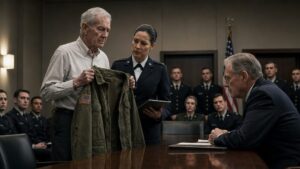
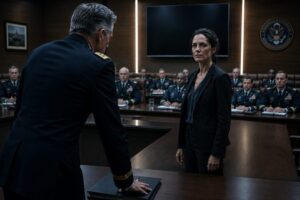
David refused the chair at the head of the command tent and asked for Kimberly’s incident log instead.
That was when the room understood the gala would not absorb the mistake and move on.
The tent had been raised beside the gate for overflow security coordination, not for reckoning. Folding tables held radios, printed arrival schedules, spare badges, bottled water, and a vase of white flowers someone had moved from the reception line in a failed attempt to make the space look less temporary. Outside, the official march had ended, and gala music had resumed at a careful distance, soft enough to pretend nothing serious was happening.
Inside the tent, no one pretended well.
Matthew stood near the entrance with his cap tucked under one arm. Brandon placed a folder on the table in front of David. Kimberly stood on the opposite side, her clipboard gone now, hands clasped so tightly her knuckles had whitened.
Janet had been asked to wait in the guest holding area.
David had refused that too.
“She stays if she chooses,” he said.
Janet chose the chair nearest the tent opening, close enough to leave if the air became unbearable.
David opened the incident log. He read it once. Then again. The badge on his chest caught the tent light. Beneath it, the faded jacket looked even older.
“Unauthorized civilian at gala checkpoint,” he said.
Kimberly swallowed.
“Refused direction to exit.”
No one spoke.
David looked at Matthew. “Was I asked for identification?”
“Yes, sir.”
“Was identification provided?”
“Offered, sir. Not accepted.”
“By whom?”
Matthew’s eyes lowered, then lifted. “Ms. Martin.”
Kimberly said, “I made an event-control decision based on incomplete access data.”
David looked at her. “That is a better sentence than the one in the log. It is still not the truth.”
Her face tightened, but she did not answer.
Brandon opened the folder. “General, the restricted access instruction originated from my office. Your visit was designated low-visibility due to the Secretary’s meeting and the internal review component. Only command security and senior installation leadership had full visibility.”
“Why?”
“To avoid leaks and prevent unnecessary ceremony before your arrival.”
David touched the edge of the folder. “And yet ceremony found me.”
Brandon looked down. “Yes, sir.”
“Who knew gate staff would not see my rank?”
“I did.”
“Who trained event staff on what to do with restricted entries?”
Brandon hesitated.
David waited.
“No one specifically,” Brandon said.
Kimberly’s head rose. It was the first thing that had sounded like possible shelter.
David saw it and did not let her hide inside it.
“Ms. Martin,” he said, “when Sergeant Garcia attempted to escalate, why did you stop him?”
Her mouth opened. Closed.
Outside, a burst of laughter came from the gala hall, bright and wrong.
“I thought he was losing control of the line,” she said.
“Was he?”
“No.”
“Then what did you think you were losing?”
Her eyes flashed. “The entrance.”
“That is not an answer.”
Kimberly looked toward Brandon, then Janet, then the tent wall as if instructions might be printed there.
“I was told this gala mattered,” she said. “I was told there could be no visible confusion. No delays. No people drifting into the formal lane without the right look, the right pass, the right escort. Every walkthrough, someone reminded me that senior leadership would be watching.” Her voice roughened. “When you arrived dressed like that, standing where cameras could see, I thought if I let it become uncertain, I would be blamed for it.”
David listened without softness, but without cruelty.
“So you made me certain,” he said.
Kimberly’s eyes filled, though no tears fell. “Yes.”
Janet shifted in her chair.
David heard the small movement. He looked at her. “Mrs. Adams.”
She stiffened at the formality.
“I am going to ask you something. You do not have to answer.”
She looked at the jacket instead of his face. “You brought me into it when you wore that.”
The words struck him cleanly.
He nodded. “Yes.”
Brandon glanced between them, suddenly aware that the jacket had a history no access packet contained.
David opened the folder further. Beneath the restricted instruction lay a thin appendix of complaint summaries. He removed it and placed it on the table.
“Colonel Hall,” he said, “what is this?”
Brandon’s face changed. “Prior guest access concerns.”
“Read the category headings.”
Brandon did not move.
David’s voice lowered. “Read them.”
Brandon picked up the page. “Veteran guest confusion. Gold family routing issue. Enlisted spouse access delay. Contractor misidentification. Retiree seating credential dispute.”
Kimberly looked at the page as if it had become a mirror.
David turned to Matthew. “Have gate staff discussed these incidents?”
Matthew’s throat worked. “Not as incidents, sir.”
“As what?”
He looked at Brandon, then at Kimberly.
“Presentation issues,” Matthew said.
The tent went very quiet.
David did not look surprised. That made Brandon look worse.
Matthew continued, because stopping would have been harder now. “Before major events, we’re told to keep the approach clean. Watch for anyone out of pattern. People without formal dress, people who seem lost, people who might be at the wrong gate. We’re told to move them aside quickly so the entrance doesn’t clog.”
“Who tells you that?”
“Different briefers, sir. Event staff. Security supervisors. Sometimes both.”
Kimberly whispered, “I didn’t invent it.”
David looked at her. “No. You chose how to use it.”
She flinched.
Janet spoke from the chair. “That is how they said it before.”
Everyone turned.
She kept her hands folded in her lap, but her fingers trembled. “Not those exact words. But close. We were ‘out of pattern.’ My son had borrowed a jacket. It didn’t fit him. I had the wrong envelope because they had mailed three different instructions. The guard looked embarrassed. The woman with the guest list looked irritated. No one was cruel enough to shout. That would almost have been easier.”
David closed his eyes once.
Janet looked at him. “Your friend’s name was on the program inside. His picture was on the table. His boots were on display. But his family stood outside the gate while people checked whether we belonged near his memory.”
Kimberly’s hand went to her mouth, then dropped.
Brandon stared at the complaint summaries. “Mrs. Adams, I was not in this position then, but I—”
“Don’t apologize because he is here,” Janet said, nodding toward David. “That is another kind of performance.”
Brandon stopped.
David let the silence stay. It was the first honest thing the tent had produced.
Then he removed the badge from around his neck.
Every officer in the tent seemed to tense at once.
David placed it on the table, gold seal facing up. Then he slipped out of the faded jacket and laid it carefully over the back of the empty chair beside him.
Without the jacket, he looked smaller for a moment. Older. A man in a plain shirt with a badge on a table and a grief he had allowed back into the room.
“This jacket belonged to Margaret Adams’s husband,” he said.
Janet looked up sharply. “His name was not Margaret.”
The correction came before she could stop it, and the tent froze.
David’s face tightened with pain. “No,” he said. “Forgive me. Your husband.”
Janet’s eyes shone. “Nicholas.”
David bowed his head. “Nicholas.”
Kimberly looked away, ashamed to witness the mistake and more ashamed that she had needed it to understand the depth of the wound.
David touched the jacket’s worn shoulder. “I wore this tonight because I wanted to know what this gate would honor when it could not see rank. I told myself that was leadership.”
Janet’s voice was quiet. “Was it?”
He did not answer quickly.
“No,” he said at last. “Not all of it.”
Outside, a trumpet began a soft ceremonial passage from inside the hall. It sounded distant, polished, untouched by the tent’s air.
David looked at Brandon. “This review is no longer private.”
Brandon’s shoulders sank slightly. “Understood, sir.”
David turned to Kimberly. “You will not be made the sole explanation for a culture you did not create.”
For the first time, Kimberly looked as if she might breathe.
Then he added, “But you will not be spared responsibility for what you chose.”
Her breath stopped again.
David picked up the incident log and tore nothing, crossed out nothing, hid nothing. He placed it beside the complaint summaries.
Janet looked at the jacket on the chair.
“I never wanted a salute,” she said. “I wanted someone to open the gate without making me beg.”
Chapter 7: What Real Command Requires in Public
Margaret Lopez met David at the tent opening with a phone in one hand and a warning already in her eyes.
“General,” she said quietly, “if you address this in the hall, it will become the story of the evening.”
Behind her, the gala entrance glowed with polished brass, white tablecloths, and flags arranged for photographs. Through the open doors came the careful murmur of people pretending not to wait. The band had softened into background music, but every few measures a trumpet line slipped toward the gate, bright and ceremonial, as if the building itself were trying to pull David inside.
David had put the faded jacket back on.
The badge lay against it now, heavy and official. The gold seal covered the worn place near the chest pocket where Nicholas Adams had once kept pens, folded range notes, and a grocery list he had never finished.
Margaret glanced at the badge, then the jacket. “The Secretary is being briefed. He wants the meeting preserved if possible.”
David looked toward the hall. “Preserved from what?”
“From turning into a public correction no one is ready for.”
“No one is ready because no one prepared.”
Her mouth tightened. She was efficient enough not to argue with truth unless it interfered with timing. “Senior leadership believes the matter can be handled through command channels tonight and addressed formally after review.”
Brandon stood a few steps behind David, silent. Kimberly was beside him, pale, eyes fixed on the pavement. Matthew waited near the barrier as if still guarding the line, though the line had stopped being the point.
Janet had not moved from the tent entrance. She watched David with a guarded stillness he recognized and disliked because he had helped create it.
Margaret lowered her voice. “Sir, there are families in that hall, donors, officers from other commands, press-adjacent guests. If this becomes public at the threshold, the focus shifts from the honorees to a gate failure.”
David looked at Janet. “It already shifted for some of them years ago.”
Margaret followed his gaze. Her confidence faltered, but only briefly. “Then let us correct it properly.”
“Properly is often what people call quietly when quietly protects them.”
She absorbed that.
Brandon stepped forward. “General, I can relieve Ms. Martin immediately. I can open an investigation into event access procedures before midnight. I’ll submit myself for review on the restricted-access formatting.”
Kimberly’s eyes closed for half a second.
David turned to Brandon. “You are offering a clean line.”
“Yes, sir.”
“No. You are offering a narrow one.”
Brandon’s jaw worked. “Sir, I am responsible for security. She is responsible for her conduct. Let the chain handle it.”
“The chain handled the complaints by calling them presentation issues.”
Brandon had no answer.
David looked at Kimberly. “Ms. Martin.”
Her head lifted with visible effort. “General.”
“What did you see when I stood at the gate?”
She swallowed. “An unverified man.”
“Before that.”
Her eyes flicked to the jacket. “Someone who did not fit the event.”
“Before that.”
She looked confused, then frightened of the answer. “A problem.”
The word came out small.
David nodded once. “And what did my calmness mean to you?”
Kimberly’s fingers twisted together. For the first time she looked not at Brandon, not at Margaret, but at David directly.
“That you thought the rules did not apply to you,” she said. “Or that you were trying to make me uncomfortable enough to let you through.” Her voice roughened. “I have watched officers smile politely while ignoring me. I have watched spouses talk over me. I have watched people with important names treat every instruction like a suggestion. When someone stands still and makes me feel unreasonable, I assume I’m being handled.”
Matthew’s eyes moved toward her, surprised.
Kimberly drew a breath that shook. “I mistook your calm for another kind of power game. And then I used the only power I had.”
David let the answer remain in the air.
It was not an excuse. It was worse and more useful than an excuse. It was a piece of the machine speaking through the person it had shaped.
Janet stepped closer. “And when I stood here?”
Kimberly turned toward her. Her face crumpled, but she kept herself upright. “I saw another complication.”
Janet looked down.
Kimberly added, barely audible, “I am sorry.”
Janet did not rescue her from the silence.
David touched the badge at his chest. “Colonel Hall, if I let you remove Ms. Martin now, what happens tomorrow?”
Brandon answered carefully. “She is disciplined. Event protocols are reviewed. Security procedures are corrected.”
“And the story becomes that a civilian coordinator embarrassed the installation by blocking a General.”
Brandon said nothing.
“Is that the truth?”
“No, sir.”
David looked toward the hall again. “Then we will not tell it.”
Margaret stepped closer. “General, a public statement can still humiliate her.”
“Yes.”
Kimberly’s face tightened.
David turned back. “And silence can humiliate everyone who has been treated this way without a badge to prove they mattered.”
The sentence moved through them without force, and that made it impossible to avoid.
Janet looked at the jacket. “Nicholas never cared for speeches.”
David’s expression softened. “No. He cared for open doors and hot coffee.”
For the first time that evening, Janet almost smiled. It vanished quickly.
“He told you to watch the gates,” she said.
David’s eyes went down.
Kimberly looked between them.
Janet’s voice was quiet, but every person near the barrier heard it. “After our son was born, Nicholas said bases teach you what they value by how they treat people at gates, clinics, and pay offices. Not ceremonies. Ceremonies are easy.”
David’s hand closed around the edge of the old jacket.
“He said that to me before his last deployment,” Janet continued. “David came to the house afterward. He stood on our porch in that jacket because I had thrown it into a box and told him I could not look at it. He said he would keep it until I wanted it back.” She looked at him now. “Then he promised me he would watch the gates.”
Margaret lowered her phone.
David looked older than he had at the checkpoint. “I thought wearing it tonight would honor that promise.”
“Part of it did,” Janet said. “Part of it used the gate the way the gate used us.”
The words cut cleanly because they were not cruel.
David nodded.
“Yes,” he said.
Kimberly stared at him as if she had expected command to reject any wound it caused.
David turned to her. “Your conduct harmed people tonight. Mine did too.”
“No, General,” Brandon said immediately.
David looked at him, and Brandon stopped.
“I let the test continue after I knew it was becoming public,” David said. “I watched Sergeant Garcia retreat. I watched Mrs. Adams drawn back into a place of injury. I told myself exposure was necessary. Perhaps it was. But leadership does not get to call every consequence useful because it proves a point.”
Matthew stood straighter, as if something had been placed on him that was heavy but not shameful.
Margaret exhaled. “Then what do you intend to do?”
David looked through the open hall doors.
Inside, guests were turning now, aware of movement at the threshold. Officers near the entrance stood uncertainly between the ceremony they had rehearsed and the correction no one had planned.
David lifted the badge from his chest and let it fall back against the jacket.
“I intend to open the gate correctly,” he said.
Brandon moved instinctively. “Sir, the band is mid-set.”
“Ask them to stop.”
Margaret’s eyes narrowed, not resisting now, calculating how to contain the damage while letting the truth breathe. She lifted her phone and sent a message.
Kimberly whispered, “General, what do you want me to do?”
David looked at her for a long moment.
“Stand where you stood,” he said. “But this time, listen.”
Her lips parted, but no sound came.
Janet drew her coat closer around herself. “David.”
He turned.
She looked at the jacket, then at the door. “Do not make Nicholas a symbol bigger than the man.”
David bowed his head slightly. “I won’t.”
The music inside stopped on an unfinished measure.
The silence spread outward from the hall to the gate, from the gate to the tent, from the tent to every person pretending they had not been waiting to learn what kind of command David Campbell would choose.
David stepped to the gala threshold and asked for the doors to remain open.
Chapter 8: The Gate Opens for More Than the General
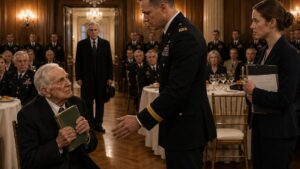
The gala hall fell silent before David said a word.
He stood at the threshold in plain trousers, old shoes, and the faded jacket that still refused to look ceremonial, even with the highest-level badge resting against it. Behind him, Brandon Hall stood at attention. Kimberly Martin stood a step farther back, stripped of clipboard and certainty. Matthew Garcia waited near the open gate, and Janet Adams remained just outside the hall, where the light reached her but did not force her forward.
Every table had turned.
Dress uniforms glittered. Glasses sat untouched. The band held instruments in lowered hands. Flags stood along the wall, perfectly arranged, perfectly still.
David did not step to the podium.
That would have made it a speech.
Instead, he remained at the doorway where the polished hall met the checkpoint road.
“I delayed your evening,” he said.
No microphone carried the words, but the room was quiet enough.
A few officers began to shift, as if preparing to stand.
David lifted one hand slightly, and they stopped.
“This installation did not fail tonight because one person made one rude remark,” he said. “It failed because too many people were taught, directly or indirectly, to treat appearance as order and uncertainty as inconvenience.”
Kimberly looked down.
David did not turn toward her.
“A gate that only recognizes polish will eventually fail to recognize service.”
The sentence settled over the tables with more weight than the anthem had carried earlier. No one clapped. No one dared.
David touched the worn sleeve of the jacket.
“This belonged to a soldier named Nicholas Adams. He was not a symbol. He was a husband, a father, a friend, and a man who believed institutions show their character in ordinary moments. Years ago, his family came to this installation carrying grief and paperwork. They were made to wait at a gate while people decided whether they belonged near his memory.”
A chair scraped softly somewhere in the back.
Janet’s face tightened, but David did not look at her long enough to turn her into the center of the room. He honored her privacy by not asking for her expression.
“That should have ended then,” he said. “It did not.”
Brandon’s jaw tightened. Margaret stood near the side entrance with her phone lowered, eyes moving across the room to see who understood and who only feared the report that would follow.
David continued. “Tonight I came without visible rank because I wanted to know what this gate would do when authority was not dressed for recognition. That decision exposed a problem. It also caused harm. For my part in that, I accept responsibility.”
A ripple moved through the senior officers. They were not used to hearing a General place himself inside a failure before assigning it elsewhere.
David turned slightly, enough to include the checkpoint behind him.
“Effective immediately, restricted visitor entries will include accessible escalation instructions for the guard actually standing the post. Event staff will not override security verification. Gate personnel will be trained to move uncertain cases toward confirmation, not humiliation. Prior access complaints involving families, veterans, retirees, enlisted spouses, contractors, and memorial guests will be reopened. Not summarized. Reopened.”
Brandon gave a single nod. “Yes, sir.”
The words carried.
David looked toward Matthew. “Sergeant Garcia.”
Matthew came to attention. “Sir.”
“You will submit a statement tonight. Include your hesitation.”
Matthew swallowed. “Yes, sir.”
“Hesitation is part of the truth. Hiding it would make it useless.”
Matthew’s eyes changed, not relieved, but steadier.
David turned to Kimberly.
She braced herself.
“Ms. Martin,” he said.
Her voice was barely audible. “General.”
“You will be removed from gala access authority pending review.”
Her face went white.
“You will receive formal discipline for interfering with a security transmission and for logging an offered credential as a civilian risk without verification.”
“Yes, General.”
The words cost her, but she did not argue.
David continued, “If you remain employed on this installation, you will complete remedial work with the family liaison office and gate access training before you hold any event authority again.”
Kimberly looked up. Surprise broke through the dread. She had expected a clean dismissal, a public ending, a story that would follow her and simplify her into the woman who blocked a General.
David gave her no comfort, but he gave her something harder.
A path tied to repair.
“Yes, General,” she said again, and this time her voice held.
Janet watched her without forgiveness and without satisfaction.
That was enough.
David stepped aside from the doorway.
“Mrs. Adams,” he said, not loudly, not ceremonially.
Janet’s eyes moved to his.
He did not salute. He did not announce her. He did not ask the room to stand. He simply turned to Matthew at the gate.
“Open it correctly.”
Matthew moved to the checkpoint as if the entire evening had narrowed to the movement of his hand. He raised the barrier fully, then came around from the booth instead of waving Janet through from behind glass.
He stopped at a respectful distance.
“Good evening, Mrs. Adams,” he said. “Your name is on the guest list. May I escort you to your table, or would you prefer to proceed on your own?”
Janet looked at him for a long moment.
“On my own,” she said.
“Yes, ma’am.”
He stepped aside.
No one touched her elbow. No one announced her grief. No one made her prove it twice.
Janet walked through the gate.
As she passed David, her fingers brushed the sleeve of the faded jacket. Not taking it back. Not yet. Only acknowledging that it had carried what neither of them had known how to put down.
“Nicholas would have liked the coffee line better than the ceremony,” she said softly.
David’s mouth moved almost into a smile. “He would have complained about both.”
She entered the hall without applause.
That restraint saved the moment.
Only after she had reached the memorial table did movement return. Chairs shifted. A few people stood quietly, not as performance, but because they no longer knew how to remain seated. The band director looked toward David for instruction.
David shook his head once.
No march.
No swelling music.
The evening resumed differently, with softer voices and eyes that moved more carefully toward the entrance.
Later, after the official remarks had been shortened and the first course had gone cold at several tables, David returned to the gate.
He did not go alone. Brandon walked with him, carrying the old access packet and the complaint summaries under one arm. Margaret followed at a distance, already drafting the orders that would be signed before midnight. Matthew stood at the booth, rewriting the incident log from the beginning.
Kimberly was there too.
She had asked to remain until relieved properly. Brandon had almost refused, but David allowed it.
Not as punishment.
As memory.
A car pulled up near the outer lane. An older veteran stepped out slowly, wearing a plain brown coat over a shirt that did not quite match the formality of the evening. He held an invitation envelope in one hand and looked toward the lights with the uncertain expression of someone prepared to be redirected.
Kimberly saw him first.
For one instant, old training crossed her face. The scan. The judgment. The fear of disorder.
Then her eyes moved to David’s faded jacket and the badge resting against it.
She stepped forward before Matthew could leave the booth.
“Good evening, sir,” she said, voice careful but clear. “May I help verify where you’re expected?”
The veteran held out the envelope.
Kimberly accepted it with both hands.
She did not look at his coat again until after she had looked at his name.
Matthew watched from the booth. Brandon watched from beside the barrier. Janet, visible through the hall doors near the memorial table, turned her head as if some part of her had heard the gate open from inside.
David stood just beyond the checkpoint light.
The highest-level badge rested against the old jacket, gold over faded cloth, proof over memory, authority over service but not above it.
Kimberly checked the list, found the veteran’s place, and opened the gate without being told.
The story has ended.