The Day Amanda Carried Her Mother’s Tarnished Boots Through the Gate They Tried to Close Forever
Chapter 1: The Gate Closed Before Sunrise
The gate slammed shut with a metallic crack that echoed across the cemetery entrance.
Amanda Baker stopped walking.
For a moment she thought the sound came from somewhere else. Memorial Day crowds were already gathering beyond the fence. Uniforms moved between rows of white headstones. Flags flickered in the early morning light.
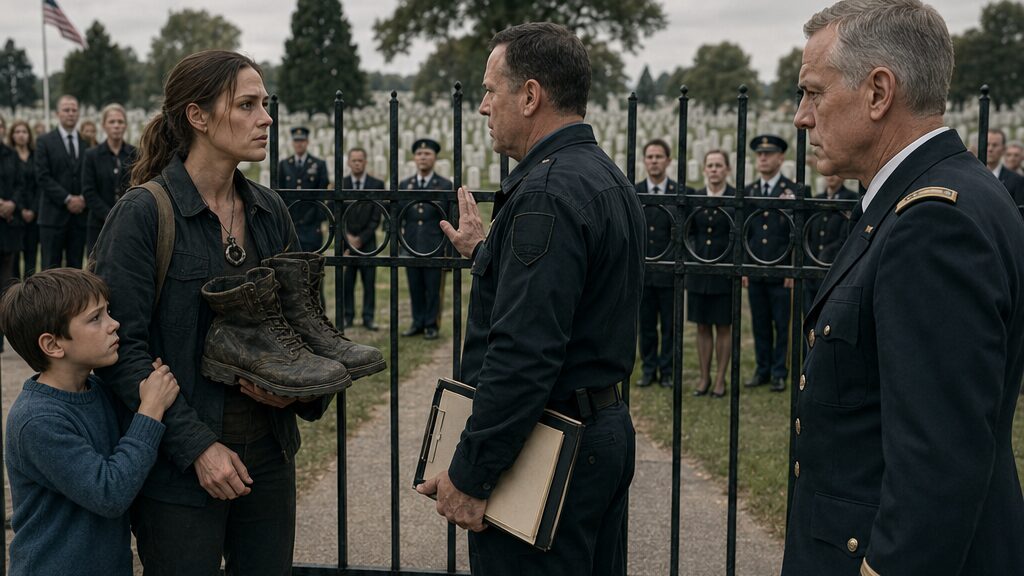
Then she saw the security guard standing directly in front of her.
“Ma’am,” he said. “You can’t enter.”
Samuel tightened his grip on her hand.
Amanda shifted the pair of tarnished combat boots she carried against her chest. The leather was cracked. The soles were worn smooth. She had spent three hours cleaning them the night before and they still looked old.
Because they were old.
They had belonged to her mother.
“I have authorization,” Amanda said quietly.
The guard held out a hand.
She passed him the folder.
He opened it.
Samuel stared up at the tall fence.
“Mom?”
“It’s okay.”
The guard flipped through the papers.
His expression changed.
Not sympathy.
Not concern.
Annoyance.
“You have a problem.”
Amanda felt her stomach tighten.
“What kind of problem?”
“Your paperwork is incomplete.”
The words landed harder than she expected.
“No.”
“I’m afraid so.”
Amanda stepped closer.
“I submitted everything.”
“Not according to this file.”
The guard tapped a page.
“There are unresolved benefit records.”
Amanda stared at the folder.
For years she had received letters.
Requests.
Corrections.
Missing forms.
Updated forms.
Replacement forms.
Every time she thought the issue was settled, another letter arrived.
She had stopped expecting resolution.
But she had not expected this.
Not today.
“This ceremony is for invited families,” the guard said. “You’ll have to come back next month.”
Amanda blinked.
“Next month?”
“That’s what the record says.”
Samuel looked between them.
“We came a long way.”
The guard softened slightly when he looked at the child.
Only slightly.
“I’m sorry.”
Amanda almost argued.
Almost.
Instead she swallowed the words.
The old habit returned.
Stay calm.
Don’t cause trouble.
Don’t make a scene.
Her mother had taught her dignity.
The lesson had become silence.
Behind the gate, more attendees were entering.
Officers.
Veterans.
Families.
Nobody stopped them.
Nobody questioned why they belonged.
Amanda looked down at the boots.
A memory surfaced.
She was eight years old.
Her mother sitting at the kitchen table.
Mud still on these same boots.
Laughing about something Amanda could no longer remember.
The memory hurt because it was incomplete.
Like everything else.
A volunteer approached from inside the gate.
“Problem?”
The guard handed over the folder.
The volunteer skimmed the pages.
Then glanced at Amanda.
“Benefits issue.”
Just like that.
A label.
Not a person.
Amanda felt heat rising into her face.
Several nearby visitors had started watching.
Not openly.
But enough.
The kind of watching people do when they sense embarrassment.
She hated it.
Samuel leaned against her leg.
“Mom?”
She forced a smile.
“It’s okay.”
It wasn’t.
The volunteer pointed toward the boots.
“What’s that?”
“My mother’s combat boots.”
The volunteer nodded politely.
Then lost interest.
As though the answer meant nothing.
The guard returned the folder.
“You’ll need to resolve the file before we can process access.”
Amanda stared at him.
“Do you know who my mother was?”
The question escaped before she could stop it.
The guard hesitated.
“No.”
Amanda immediately regretted asking.
Because she wasn’t trying to prove status.
That wasn’t why she came.
She had spent years avoiding exactly that.
“My mother is buried here,” she said.
The guard looked uncomfortable.
But procedure remained stronger than discomfort.
“I understand.”
No.
He didn’t.
Amanda knew the difference.
A line of veterans passed through another entrance.
One of them glanced at the boots.
His eyes lingered for a second.
Then he kept walking.
Amanda wondered if anyone remembered.
Not her mother specifically.
Just remembered.
The cost.
The sacrifice.
The people behind the names.
A bugle rehearsal sounded faintly from deeper inside the cemetery.
The ceremony would begin soon.
The realization tightened around her chest.
After all these years.
After all the paperwork.
After all the waiting.
She might spend Memorial Day standing outside a fence.
The guard cleared his throat.
“Ma’am, I need you to step aside.”
There it was.
The humiliation she had been trying to avoid.
Public.
Ordinary.
Bureaucratic.
The kind nobody remembered except the person living through it.
Amanda moved aside.
Samuel followed.
They stood near a stone wall just outside the entrance.
For several minutes nobody spoke.
People continued entering.
The event moved forward without them.
Amanda looked at the boots.
The leather creased beneath her fingers.
Her mother had carried wounded soldiers in these boots.
Walked patrols in these boots.
Crossed a battlefield in these boots.
Now they couldn’t even get through a gate.
A shadow fell across them.
The guard again.
Amanda prepared herself for another instruction.
Another refusal.
Instead his attention fixed on something hanging around her neck.
A small ring.
Worn on a chain.
Old.
Rough.
Unpolished.
His eyes narrowed.
“What is that?”
Amanda instinctively touched it.
The ring rested against her palm.
Cold metal.
Familiar weight.
Her mother’s last gift.
The guard studied it for another moment.
Then gave a short dismissive laugh.
“That thing looks like it came out of a scrap pile.”
Amanda’s fingers tightened around the ring.
For the first time that morning, anger stirred beneath her restraint.
Chapter 2: The File Nobody Finished
The file was thicker than Amanda remembered.
That bothered her.
Because she had seen it many times before.
An administrative clerk dropped it onto a desk inside a temporary office near the cemetery entrance.
Dust lifted from the cover.
“Here it is.”
Amanda stared.
The clerk looked apologetic.
“Honestly, I thought this case was already resolved.”
“So did I.”
The clerk sat down.
Samuel occupied himself with a paper cup of water nearby.
The combat boots rested beside Amanda’s chair.
The sight of them against government paperwork felt wrong somehow.
Human sacrifice beside bureaucracy.
Memory beside procedure.
The clerk opened the file.
Page after page.
Forms.
Letters.
Transfer notices.
Requests.
Corrections.
Amanda recognized many of them.
Others she had never seen.
The clerk frowned.
“That’s strange.”
Amanda leaned forward.
“What?”
“This transfer code.”
The clerk flipped backward.
Then forward.
Then backward again.
His confusion deepened.
Amanda felt a flicker of hope.
Confusion was better than dismissal.
At least confusion meant somebody was looking.
“What does it mean?”
The clerk pointed.
“This file was transferred.”
“Transferred where?”
“I don’t know.”
“You don’t know?”
He shook his head.
“There’s no destination listed.”
Amanda stared at him.
“How is that possible?”
The clerk gave a humorless smile.
“You’d be surprised.”
The answer frustrated her more than an excuse would have.
For years she had assumed she was missing something.
That she had failed to submit the right document.
Missed a deadline.
Made a mistake.
Now another possibility emerged.
Maybe the system had failed first.
The clerk continued searching.
Minutes passed.
Outside, distant announcements echoed across the cemetery grounds.
The ceremony schedule had begun.
Amanda checked her watch.
Every passing minute felt heavier.
She wasn’t only losing access.
She was losing time.
The clerk suddenly froze.
“Wait.”
Amanda sat upright.
“What?”
He pulled out an older document.
The paper was yellowed.
Folded at the edges.
Different from the modern forms surrounding it.
“This record shouldn’t be here.”
Amanda looked closer.
A military casualty notification.
Her mother’s name.
The sight of it still hurt.
Years had passed.
The pain remained.
The clerk scanned the page.
Then another.
Then another.
His expression changed.
“What is it?”
“There are two different processing chains.”
Amanda frowned.
“I don’t understand.”
“Neither do I.”
Not the answer she wanted.
But at least it was honest.
The clerk turned the file toward her.
“See these reference numbers?”
Amanda nodded.
“They lead to separate archives.”
“Meaning?”
“Meaning somebody started a second review years ago.”
Amanda stared.
“A review of what?”
The clerk hesitated.
“I can’t tell.”
“Why not?”
“Because the linked report is restricted.”
Amanda blinked.
Restricted.
The word felt absurd.
Her mother’s death had occurred decades ago.
What could still be restricted?
The clerk rubbed his forehead.
“This doesn’t make sense.”
Amanda watched him carefully.
He wasn’t hiding information.
He genuinely seemed puzzled.
For the first time all morning she felt something unfamiliar.
Suspicion.
Not toward a person.
Toward the story she had been told.
Maybe the paperwork wasn’t delayed.
Maybe it was unfinished.
The distinction mattered.
A lot.
A knock sounded at the office door.
A veteran stepped inside.
White hair.
Formal suit.
Rows of ribbons.
He glanced around.
“Is this where families check event credentials?”
“Not right now,” the clerk said.
The veteran nodded.
Then noticed the boots.
His expression changed.
Not recognition.
Respect.
Quiet respect.
“Those belong to someone who served.”
Amanda nodded.
“My mother.”
The veteran studied them for a moment.
Then looked at Amanda.
“Keep carrying them.”
He said it simply.
Like advice.
Like an order.
Like a blessing.
Then he left.
Amanda watched the door close.
The clerk returned to the file.
Several minutes later he found another notation.
His eyebrows rose.
“This review was never completed.”
Amanda felt her pulse quicken.
“What review?”
The clerk pointed.
“That’s the problem.”
He tapped the page.
“The report exists.”
“Where?”
“Archive storage.”
“Can we get it?”
The clerk hesitated.
“Not quickly.”
The ceremony announcements grew louder outside.
Amanda looked toward the window.
Time was slipping away.
Again.
Always.
The clerk closed the file.
“I’m sorry.”
Amanda looked at him.
“For what?”
“For letting this sit for so long.”
The answer surprised her.
Because it sounded genuine.
Not institutional.
Human.
For years she had imagined faceless offices.
Faceless decisions.
Faceless mistakes.
Now she was looking at a man who seemed ashamed of something he hadn’t personally done.
A silence settled between them.
Then the clerk opened the file one last time.
Something caught his eye.
His hand stopped.
Slowly, he slid a single sheet free.
Amanda saw only part of it.
A reference number.
Several red markings.
One line typed near the bottom.
The clerk read it twice.
Then looked up.
“What?”
His voice lowered.
“This restricted report isn’t connected to benefits.”
Amanda stared.
“Then what is it connected to?”
The clerk turned the paper toward her.
Near the bottom sat a single classification note.
Battlefield Action Review.
Amanda felt the room suddenly grow smaller.
Chapter 3: What the Ring Was Made From
Steven Anderson stopped walking.
Across the cemetery entrance, a young woman stood beside a stone wall holding a pair of battered combat boots.
That wasn’t what caught his attention.
It was the ring.
Even from several yards away, something about it felt familiar.
He slowed.
The morning ceremony was minutes from beginning.
Staff members moved around him.
Announcements sounded through hidden speakers.
Yet his eyes remained fixed on the metal hanging from Amanda’s neck.
The security guard stood nearby.
Steven caught the last part of their exchange.
“…looks like it came out of a scrap pile.”
Amanda’s expression hardened.
Not dramatically.
Just enough.
The look of someone who had spent years swallowing insults and was finally running out of room for them.
Steven changed direction and approached.
The guard immediately straightened.
“Sir.”
Steven ignored him.
His attention stayed on the ring.
“May I see it?”
Amanda blinked.
The question seemed to catch her off guard.
She glanced at the guard.
Then back at Steven.
Slowly she lifted the chain from her neck.
The ring settled into her palm.
Steven took it carefully.
The moment the metal touched his fingers, recognition flashed.
Not certainty.
Memory.
Old memory.
A briefing room.
A photograph.
A story told years earlier by a retired officer.
He turned the ring under the light.
Uneven metal.
Dark discoloration.
Hand-forged.
Not jewelry.
Something else.
“Where did you get this?” he asked quietly.
Amanda answered without hesitation.
“It was made from the shrapnel that killed my mother.”
Silence followed.
The guard shifted uncomfortably.
Steven stared at the ring.
His pulse quickened.
“Who made it?”
“A soldier who was with her.”
The answer landed heavily.
Not because of the words.
Because of what they implied.
Steven looked up.
“What was your mother’s name?”
“Amanda Baker.”
“No. Your mother’s.”
Amanda hesitated.
Then answered.
Steven’s face changed.
The name struck somewhere deep in memory.
Not complete memory.
Fragments.
Reports.
Stories.
References buried inside military history.
The guard looked between them.
Confused.
Steven handed the ring back.
“Stay here.”
Amanda frowned.
“Why?”
Instead of answering, Steven looked toward the administrative office.
At that exact moment, the elderly veteran from earlier emerged from the building.
His eyes landed on the ring.
Then widened.
He crossed the distance surprisingly fast.
“Let me see that.”
Amanda held it out.
The veteran examined it.
His expression softened.
“I know this metal.”
Amanda froze.
“What?”
The veteran looked at her.
“I was there.”
The words seemed impossible.
Even Steven looked surprised.
The veteran touched the ring gently.
“This came from the Ridge.”
Amanda stared.
The Ridge.
A name she had heard before.
Never explained.
Always avoided.
Her mother never spoke much about combat.
The people who served with her spoke even less.
“What happened there?” Amanda asked.
The veteran looked away.
For several seconds he didn’t answer.
When he finally spoke, his voice carried old weight.
“Something we’re still talking about.”
Amanda felt a chill.
The ceremony speakers crackled alive.
An announcement echoed across the grounds.
The event was beginning.
But nobody moved.
Not yet.
The veteran looked toward Steven.
“You know what this means.”
Steven nodded slowly.
Maybe.
Not fully.
But enough.
Enough to know the story wasn’t what he thought.
Enough to know Amanda’s paperwork problem was hiding something larger.
Amanda tightened her grip on the boots.
The leather creaked softly.
The same sound seemed to echo from somewhere far away.
A battlefield.
A memory.
A history she had inherited but never fully understood.
Steven looked at her.
“Has anyone ever explained why that ring exists?”
“No.”
“Has anyone shown you the full battlefield report?”
Amanda laughed once.
A short, bitter sound.
“I can’t even get access to my own file.”
Steven absorbed that.
Then looked toward the ceremony grounds.
Rows of officials waited.
Families gathered.
Speeches were scheduled.
Traditions prepared.
And yet something far more important now stood outside the gate.
A daughter carrying questions nobody had answered.
A ring nobody had properly explained.
A story trapped inside records nobody finished.
Steven made a decision.
Not a dramatic one.
A practical one.
Sometimes those mattered more.
He turned toward an aide.
“I need archive access.”
“Sir, the ceremony—”
“Archive access now.”
The aide stared.
Then hurried away.
The veteran smiled faintly.
Amanda noticed.
“What?”
The old man nodded toward Steven.
“He doesn’t ask for archives unless he’s serious.”
For the first time that morning, hope appeared.
Small.
Dangerous.
But real.
Steven looked once more at the ring.
Then toward the distant memorial.
The name from Amanda’s mother’s file continued echoing in his thoughts.
A name connected to a battlefield.
A battlefield connected to a report.
And a report connected to a story someone had never finished writing down.
An aide returned, slightly out of breath.
“Archive authorization approved.”
Steven accepted the access credentials.
Then looked directly at Amanda.
“I’m going to find out what happened.”
Amanda searched his face.
For years she had heard promises.
Most led nowhere.
Yet something about this felt different.
Because he wasn’t promising recognition.
He was looking for truth.
Steven turned and started walking toward the archive building.
Halfway there, he stopped.
Looked back.
And for the first time that morning, he addressed Amanda not as a visitor, not as a claimant, not as a problem.
As someone who belonged.
“Don’t leave.”
Then he disappeared into the archives, carrying a question that had suddenly become impossible to ignore.
Chapter 4: The Name Behind the Memorial
The archive door buzzed open.
Steven stepped inside and immediately regretted how long it had taken him to come here.
Rows of metal shelving stretched across the room. Boxes, binders, and storage containers filled the space. The records of thousands of lives sat quietly behind labels and inventory numbers.
Outside, Memorial Day ceremonies were beginning.
Inside, history waited.
An archivist looked up from a desk.
“I need a battlefield action review.”
The archivist frowned.
“Today?”
“Today.”
Steven handed over the reference number from Amanda’s file.
The archivist entered it into a terminal.
For a moment nothing happened.
Then her expression changed.
“That’s unusual.”
Steven had heard those words several times already that morning.
“What is?”
“The report isn’t stored with casualty records.”
“Where is it?”
She clicked again.
A pause.
Then another.
Finally she stood.
“Follow me.”
They crossed the room.
Past shelves.
Past storage cages.
Past decades of forgotten paperwork.
The archivist unlocked a secured cabinet.
Inside sat a single archive box.
The label carried a battlefield designation.
The Ridge.
Steven felt a familiar pull in his memory.
The name had followed him all morning.
Now it sat directly in front of him.
The archivist placed the box on a table.
Inside were photographs.
Operational reports.
Witness statements.
Medical summaries.
And one thick folder marked:
Battlefield Action Review.
Steven opened it.
The first pages contained standard military language.
Coordinates.
Timelines.
Personnel movements.
Then the story changed.
The deeper he read, the quieter the room seemed to become.
A patrol had entered contested territory.
An ambush followed.
Communication systems failed.
Evacuation routes collapsed.
Casualties mounted.
Steven turned another page.
Then another.
The name appeared.
Amanda’s mother.
Not as a footnote.
Not as a casualty listing.
As the center of the report.
He kept reading.
Minutes passed.
The archivist remained silent.
Finally Steven reached a witness statement.
A surviving soldier described a collapsing position.
Another described incoming fire cutting off retreat.
A third described Amanda’s mother refusing evacuation.
Steven sat back.
The report was no longer describing an isolated act of bravery.
It was describing a decision.
One that changed outcomes.
One that kept people alive.
A folded photograph slipped from between two pages.
Steven picked it up.
The image showed a younger group of soldiers standing beside damaged vehicles.
One face immediately caught his attention.
He knew it.
Not from memory.
From the present.
The photograph trembled slightly in his hand.
One of the surviving soldiers from that operation had later become a senior commander.
A name now known throughout the military.
Steven checked the report.
Then the photograph.
Then the report again.
The connection was undeniable.
Amanda’s mother hadn’t simply served alongside important people.
She had saved them.
The realization settled heavily.
An entire generation of military leadership had inherited lives she helped preserve.
Yet her daughter stood outside a gate.
Waiting.
Explaining herself.
Carrying paperwork.
Steven continued reading.
Near the end of the report, another section appeared.
Administrative Review Delay.
His jaw tightened.
The battlefield review had never been fully processed.
Not because of malice.
Not because of conspiracy.
Because several departments had transferred responsibility during restructuring years earlier.
The review entered the system.
Then stalled.
Not permanently.
Just long enough.
Long enough became years.
Years became decades.
Nobody deliberately buried the truth.
They simply stopped carrying it forward.
Steven thought about Amanda.
He thought about the boots.
He thought about the look on her face when she asked if anyone remembered.
For the first time all morning he understood the real injury.
Not paperwork.
Neglect.
The slow erosion of memory.
A voice interrupted him.
The archivist was looking at another document.
“Sir.”
“What?”
She handed it over.
A handwritten statement.
Unlike the formal reports.
Unlike the witness summaries.
Personal.
Steven read.
The statement came from a survivor of the battle.
Near the bottom was a single passage.
She told us if we got out alive, somebody had to remember the families too.
Steven read the sentence again.
Then again.
The words struck harder than the battlefield details.
Because they sounded human.
Immediate.
Real.
Not history.
A promise.
He looked at the signature.
The name belonged to one of the soldiers Amanda’s mother had helped save.
Steven closed his eyes briefly.
Outside, applause echoed faintly from the ceremony grounds.
The event had already begun.
Meanwhile Amanda waited beyond the gate.
Still believing she needed proof.
Still believing she had to earn entry.
The archivist looked at him.
“Is it important?”
Steven answered without hesitation.
“More important than the ceremony.”
He gathered the documents.
The photograph.
The witness statements.
The battlefield review.
Then he stopped.
Another page remained at the bottom of the file.
A final recommendation.
Never completed.
Steven read it.
His expression hardened.
The recommendation proposed a permanent recognition linked to Amanda’s mother’s actions.
A recognition that had never been formally enacted.
The process had simply ended before completion.
Steven looked toward the exit.
The ceremony wasn’t just incomplete.
It was honoring memory while missing part of its own history.
He picked up the archive box.
Then left.
By the time he reached the cemetery grounds, speeches were already underway.
Rows of attendees faced the memorial stage.
Flags lined the pathways.
Music drifted across the headstones.
Steven moved quickly.
An aide hurried after him.
“Sir?”
“We need to stop the program.”
The aide stared.
“Stop it?”
“Now.”
The aide looked shocked.
“What’s happened?”
Steven held up the file.
“We forgot someone.”
And without waiting for another question, he headed toward the ceremony.
Chapter 5: The Ceremony Stops
The speaker was halfway through a prepared tribute when movement spread through the crowd.
At first only a few people noticed.
Then more.
Heads turned.
Whispers followed.
A senior officer was walking directly toward the stage carrying a thick archive file.
Steven Anderson rarely interrupted public ceremonies.
When he did, people paid attention.
Amanda saw him from beyond the gate.
The moment she spotted the folder under his arm, something changed inside her.
Hope returned.
Dangerous hope.
The kind that hurt if it failed.
The guard noticed him too.
His posture straightened.
The ceremony continued for another minute.
Then Steven climbed the stage steps.
The speaker paused.
Confusion spread.
A microphone crackled.
Several officials exchanged uncertain looks.
Steven spoke quietly to the event coordinator.
The coordinator’s expression shifted from annoyance to concern.
Then disbelief.
Then something close to embarrassment.
The music stopped.
Silence rolled across the cemetery.
Hundreds of people watched.
Amanda stood frozen.
Samuel held her hand.
“Mom?”
She couldn’t answer.
On stage, Steven opened the archive file.
The event coordinator leaned toward a microphone.
“Please remain where you are.”
The unusual request only deepened curiosity.
Steven spoke to several senior leaders seated nearby.
One of them took the report.
Read several pages.
Then looked sharply toward the cemetery entrance.
Toward Amanda.
Another officer followed his gaze.
Then another.
A chain reaction.
People searching for the woman none of them had noticed before.
The same woman who had spent the morning being turned away.
The coordinator approached the microphone again.
His voice sounded different now.
Less practiced.
More uncertain.
“There has been an important discovery regarding today’s ceremony.”
The crowd grew still.
Amanda wished she could disappear.
She hated attention.
Always had.
Her mother had been the same.
Do the work.
Avoid the spotlight.
Move forward.
Yet every eye seemed to be drifting toward her.
The guard shifted beside the gate.
For the first time all day, he looked uncomfortable.
Not defensive.
Not angry.
Uncomfortable.
Steven stepped to the microphone.
The archive file rested in his hand.
“We have learned that a significant battlefield review connected to this cemetery was never completed.”
Silence.
He continued.
“The oversight affected military records, family recognition, and historical documentation.”
Amanda felt her pulse racing.
The words sounded larger than she expected.
Bigger than paperwork.
Bigger than benefits.
Steven looked directly toward her.
The crowd followed his gaze.
Now everyone knew where to look.
Amanda wanted to lower her eyes.
Instead she stood still.
The boots remained in her arms.
Heavy.
Familiar.
Steven’s voice softened.
“The person affected by that oversight is present today.”
The cemetery became so quiet Amanda could hear flags snapping in the distance.
A pathway opened naturally through the crowd.
Nobody instructed people to move.
They simply did.
Steven stepped away from the microphone.
Then pointed toward the gate.
“Open it.”
The guard reacted immediately.
He unlocked the entrance.
The metallic click sounded louder than the earlier slam.
Amanda stared.
For several seconds she didn’t move.
The guard looked at her.
His expression carried something she hadn’t seen before.
Regret.
Not enough to erase what happened.
But real.
“You can go through,” he said quietly.
Amanda swallowed.
Samuel tugged gently on her sleeve.
“Mom?”
She took a step.
Then another.
The crowd watched.
No applause.
No cheering.
Only attention.
The kind that felt heavier.
More honest.
As Amanda entered the cemetery, people moved aside.
Not dramatically.
Respectfully.
She walked slowly.
The boots pressed against her chest.
Each step carried years.
Letters.
Forms.
Waiting.
Silence.
Fear.
All of it.
When she reached the front, Steven met her.
He opened the file.
Then handed her a photograph.
Amanda stared.
A younger version of her mother looked back from the image.
Alive.
Smiling.
Standing beside soldiers she didn’t recognize.
Amanda’s hands trembled.
She had never seen the picture before.
Steven lowered his voice.
“Your mother saved lives that day.”
Amanda looked up.
“I know.”
“No.”
His expression remained steady.
“You know she died.”
Amanda froze.
Steven glanced at the crowd.
Then back at her.
“The full story was never finished.”
Behind them, senior officials were reading the report.
Faces changing.
Realizations spreading.
One after another.
Amanda stared at the photograph.
For years she feared her mother’s sacrifice had disappeared.
Now she faced a different possibility.
Maybe the story had survived.
Maybe it had simply never reached her.
A microphone squealed softly.
The event coordinator returned.
He looked toward Steven.
Then toward Amanda.
Then toward the assembled military leadership.
The decision was no longer his.
It belonged to all of them.
A senior officer stood.
Then another.
Then another.
The crowd sensed something happening.
Something larger than a schedule change.
Larger than a speech.
Amanda tightened her grip on the boots.
The ceremony had stopped.
And every person present was waiting to learn why.
Chapter 6: The Weapon Present
The first rifle moved.
Then another.
Then another.
Amanda stood frozen as an entire honor guard stepped into position across the cemetery pathway.
The ceremony crowd parted completely now.
Silence settled over hundreds of people.
No speeches.
No announcements.
No music.
Only the sound of boots striking earth in perfect rhythm.
Amanda looked toward Steven.
“What is happening?”
He answered softly.
“A correction.”
The word hit harder than she expected.
Not celebration.
Not recognition.
Correction.
As if something bent years ago was finally being straightened.
The soldiers continued moving.
Their formation stretched farther than Amanda could immediately see.
Samuel stared wide-eyed.
“Mom…”
Amanda squeezed his hand.
The combat boots felt heavier than ever.
Not because of their weight.
Because of what everyone now knew about them.
What she now knew.
The boots were no longer simply her mother’s belongings.
They had walked through a moment that altered lives.
A senior officer approached carrying several documents.
He handed them to Steven.
Steven reviewed them quickly.
Then looked at Amanda.
“The review board findings were completed this morning.”
Amanda blinked.
“This morning?”
“The process should have been completed years ago.”
The honesty caught her off guard.
No excuses.
No careful wording.
Just truth.
Nearby, several military leaders stood waiting.
Not impatiently.
Respectfully.
One of them stepped forward.
His hair was gray.
His posture remained rigid despite age.
When he stopped in front of Amanda, he looked directly at the boots.
Then at her.
“I owe my life to your mother.”
Amanda stared.
The words seemed impossible.
The officer continued.
“I never knew your records were incomplete.”
His voice carried regret.
“None of us did.”
Amanda looked away.
For years she had imagined people choosing to forget.
Choosing not to care.
Now she faced something harder.
Maybe forgetting wasn’t always deliberate.
Maybe memory simply faded when nobody carried it.
The officer nodded toward the boots.
“She carried three wounded soldiers out before she was hit.”
Amanda swallowed.
No one had ever told her that.
Not once.
The battlefield report had contained facts.
This sounded different.
Human.
Personal.
The officer glanced toward the formation.
“Two of those soldiers are standing over there.”
Amanda followed his gaze.
Among the crowd stood two elderly veterans.
Both watching quietly.
One lifted a hand in greeting.
Amanda felt something inside her begin to crack.
Not dramatically.
Slowly.
Years of carrying grief alone.
Years of carrying questions alone.
Years of carrying silence.
Steven stepped closer.
“There was something else in the archive.”
Amanda looked at him.
He unfolded a photocopied page.
Handwritten.
Weathered.
The same statement he had found earlier.
He pointed to a paragraph.
Amanda read.
She told us if we got out alive, somebody had to remember the families too.
The words blurred.
She blinked rapidly.
Then read them again.
Her mother’s voice suddenly felt close.
Not because she could hear it.
Because she could recognize it.
The concern for others.
The stubborn sense of responsibility.
The refusal to think only about herself.
Amanda lowered the paper.
“She said that?”
A veteran nearby answered.
“She did.”
Amanda looked toward him.
The elderly man from earlier stepped forward.
“The day before the operation.”
His eyes shone slightly.
“She talked more about families than herself.”
A long silence followed.
Samuel leaned against Amanda’s side.
The little boy looked up.
“Grandma said that?”
Amanda nodded.
Unable to trust her voice.
The veteran smiled.
“Your mother worried about people she hadn’t even met.”
The honor guard commander raised a hand.
The formation snapped straighter.
Every movement precise.
Every motion deliberate.
Steven looked toward Amanda.
“They want you to walk through.”
Amanda hesitated.
Instantly.
The old instinct returned.
Don’t make a scene.
Don’t stand in front.
Don’t draw attention.
The same instinct that had kept her silent for years.
The same instinct that allowed the unfinished file to remain unfinished.
The same instinct that made her accept answers she knew were incomplete.
Steven seemed to recognize the hesitation.
“You don’t have to do this for yourself.”
Amanda looked at him.
Then at Samuel.
Then at the boots.
Finally at the soldiers.
No.
Not for herself.
For her mother.
For the promise buried inside that handwritten note.
Amanda straightened.
Then took the first step.
The honor corridor opened before her.
Rows of soldiers lined both sides.
Rifles held in formal position.
Faces forward.
Unmoving.
The cemetery seemed impossibly quiet.
Amanda walked.
One step.
Then another.
The boots rested against her chest.
She passed veterans.
Families.
Military leaders.
People who had never known her mother.
People who suddenly understood they should have.
Halfway through the corridor, the command rang out.
“Weapon Present!”
The sound echoed across the cemetery.
Every rifle lowered in perfect unison.
Not toward the sky.
Toward her.
Toward the family of the fallen soldier.
The gesture struck with overwhelming force.
Amanda stopped.
Tears blurred her vision.
For a moment she couldn’t continue.
Her knees felt weak.
Her breathing became uneven.
Everything threatened to overwhelm her.
The crowd.
The history.
The years.
The loss.
Steven quietly moved beside her.
Not to guide.
Not to rescue.
Only to stand there.
Amanda closed her eyes briefly.
Then steadied herself.
When she opened them again, she continued walking.
The boots remained secure in her arms.
No longer a burden.
Something else.
A legacy.
At the end of the formation, applause never came.
No one wanted to break the moment.
The silence meant more.
Then a small voice appeared.
“General!”
Heads turned.
Samuel had stepped forward.
Amanda’s heart jumped.
The little boy looked toward one of the senior officers.
Then, with complete seriousness, he raised a crooked salute.
It wasn’t correct.
Not even close.
His elbow was wrong.
His hand tilted awkwardly.
But he held it proudly.
The cemetery froze.
For one heartbeat.
Two.
Then the General returned the salute.
Perfectly.
His eyes filled with tears.
Several veterans looked away.
Others wiped their faces openly.
The honor guard remained motionless.
Samuel grinned.
The simplicity of it broke whatever restraint remained in the crowd.
Not noise.
Not cheering.
Emotion.
Raw and unmistakable.
Amanda looked at her son.
Then at the soldiers.
Then at the boots.
For the first time in years, she no longer felt alone.
Chapter 7: The Family Still Standing
The crowd had finally dispersed when Amanda returned to the memorial.
The silence felt different now.
Not empty.
Peaceful.
Rows of white headstones stretched into the distance.
Flags still fluttered softly.
Samuel wandered nearby, studying names carved into stone.
The boots remained in Amanda’s hands.
One last time.
She approached her mother’s grave.
Then knelt.
Carefully she placed the tarnished combat boots beside the marker.
For years they had lived in a closet.
Protected.
Hidden.
Preserved.
Today they looked as though they finally belonged somewhere.
Amanda rested her hand against the leather.
“You’re remembered,” she whispered.
The words surprised her.
Not because they were untrue.
Because she finally believed them.
Footsteps approached.
Amanda looked up.
Steven stood several yards away.
Not wanting to intrude.
Yet not wanting to leave without speaking.
“You found me.”
A faint smile touched his face.
“It wasn’t difficult.”
Amanda stood.
For a moment neither spoke.
The cemetery carried enough silence already.
Finally Steven extended a folder.
“This belongs to you.”
Amanda accepted it.
Inside were updated records.
Completed reviews.
Official acknowledgments.
The paperwork that had remained unfinished for years.
She flipped through several pages.
Then stopped.
“Benefits restored.”
Steven nodded.
“And the battlefield review has been formally entered into the record.”
Amanda stared at the document.
For so long she had believed this outcome was impossible.
Now it sat in her hands.
Almost ordinary.
Paper.
Ink.
Signatures.
Yet it represented years of waiting.
Years of uncertainty.
Years she could never get back.
Steven seemed to understand.
“We can’t fix the lost time.”
“No.”
“But we can stop losing more.”
Amanda closed the folder.
That answer felt honest.
The kind she trusted.
They stood quietly for a moment.
Then Steven reached into his jacket pocket.
He withdrew the photograph from the archive.
The one showing Amanda’s mother smiling among fellow soldiers.
“I thought you should keep this too.”
Amanda accepted it carefully.
Her fingers traced the image.
The smile.
The posture.
The expression.
For a second she saw herself.
Not physically.
In the way her mother looked toward the people beside her.
Protective.
Present.
Connected.
Amanda laughed softly through lingering tears.
“I’ve spent years carrying things.”
Steven glanced toward the boots.
“I noticed.”
“The boots.”
“The ring.”
“The paperwork.”
Her voice lowered.
“The anger.”
Steven said nothing.
He didn’t need to.
Amanda looked back toward the grave.
For the first time she realized something important.
Remembering wasn’t the same as carrying everything alone.
The difference mattered.
Samuel suddenly ran over.
“Mom!”
He stopped beside them.
“What happens now?”
Amanda smiled.
A simple question.
A difficult answer.
What happened now?
No more waiting for letters.
No more wondering if records existed.
No more fighting to prove her mother mattered.
The future felt strangely open.
Steven looked toward Samuel.
“What do you think happens now?”
Samuel considered the question seriously.
Then pointed toward the headstones.
“We tell people.”
Amanda looked at him.
The answer struck with surprising force.
Because it was exactly right.
Steven smiled.
“So that’s the plan?”
Samuel nodded confidently.
“The stories.”
Amanda laughed.
This time without sadness.
Without bitterness.
Without fear.
Later, as the afternoon faded, visitors continued leaving the cemetery.
Amanda remained.
Not because she needed closure.
Because she wanted one final moment.
She sat beside the grave.
The boots resting nearby.
The photograph in her lap.
Samuel leaning against her shoulder.
The ring hanging from her neck.
None of those objects felt the same anymore.
The boots were no longer evidence.
The ring was no longer a mystery.
The records were no longer missing.
Each carried a story now.
A story connected to people.
To memory.
To responsibility.
Amanda looked across the cemetery.
At the soldiers still standing watch.
At the families moving between headstones.
At the lives connected by sacrifice.
Her mother had once asked survivors to remember the families too.
The promise had nearly disappeared.
Nearly.
But not completely.
Because someone had finally chosen to carry it forward.
Samuel tugged gently on her sleeve.
“Mom?”
“Yeah?”
The little boy looked toward the rows of soldiers in the distance.
Then back at her.
“When I grow up, can I help people too?”
Amanda felt tears threaten again.
Not from grief.
From something warmer.
Something stronger.
She wrapped an arm around him.
“You can.”
Samuel smiled.
Satisfied.
The answer was enough.
Amanda looked once more at the boots beside the grave.
Then at the photograph.
Then at the cemetery beyond.
The story had never been about recognition.
Not really.
It had been about remembering.
And now she knew she wasn’t the only one carrying that responsibility anymore.
The story has ended.