The Veteran They Tried to Remove From the Kill-House Changed the Base Forever Without Saying a Word
Chapter 1: The Man With the Worn Pistol Bag
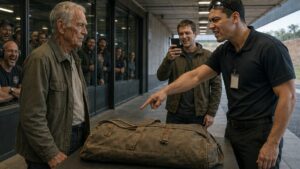
The guard at the base entrance stared at the bag before he looked at the man carrying it.
“Can I help you, sir?”
Gregory Baker stopped walking.
The morning line of vehicles moved behind him. Families, volunteers, sponsors, and active-duty personnel flowed toward the open-base charity event. Most carried branded gear cases and expensive shooting equipment.
Gregory carried a faded canvas pistol bag with worn handles and a dark stain near one corner.
The guard glanced between the bag and Gregory’s face.
“You here with somebody?”
“No.”
“You participating?”
“That’s the plan.”
The guard looked unconvinced.
Gregory understood why.
His shoulders were slightly rounded. His gray hair was thin. The fingers wrapped around the bag trembled faintly.
The guard checked a clipboard.
“Name?”
“Gregory Baker.”
The guard ran a finger down the list.
For a second Gregory wondered if there had been a mistake.
Then the guard nodded.
“You’re registered.”
Another guard stepped over.
“Military background?”
Gregory hesitated.
“Long time ago.”
The younger guard smiled politely.
“Well, enjoy the event.”
Gregory thanked him and continued through the gate.
The moment he crossed onto the base, he heard a whistle blast somewhere in the distance.
The sharp sound cut through him.
Not enough to stop him.
Just enough to remind him.
His grip tightened around the pistol bag.
The event occupied several training areas spread across the installation. Charity booths stood beside military displays. Families walked between demonstrations.
The atmosphere felt relaxed.
Almost festive.
Gregory had nearly turned around three times before arriving.
Not because of the event.
Because of Kimberly.
His phone vibrated.
He already knew who it was.
Kimberly: Dad, please tell me you’re not actually doing this.
He kept walking.
Another message appeared.
Kimberly: You don’t have anything left to prove.
Gregory stared at the screen.
His thumb hovered over the keyboard.
Then he locked the phone and slipped it away.
That answer had become routine.
Silence.
The same silence that frustrated her.
The same silence that had followed them through years of arguments.
The charity registration tent sat near a large training complex.
Several younger participants stood nearby discussing scores, equipment, and rankings.
Gregory heard one of them laugh.
“That pistol costs more than my truck.”
Another responded.
“Still cheaper than losing.”
The group laughed.
Gregory glanced down at his own bag.
Nobody would brag about what was inside.
The canvas was old enough to vote.
He moved toward the registration desk.
A volunteer handed him a packet.
“Welcome, Mr. Baker.”
“Thank you.”
“You’ll be observing most of the morning activities before participant evaluations begin.”
Gregory nodded.
The volunteer looked curious.
“Have you done anything like this recently?”
“A little.”
The answer seemed to satisfy her.
It wasn’t entirely true.
It wasn’t entirely false either.
Another whistle sounded.
Closer this time.
His shoulders tightened automatically.
The sound pulled a memory loose.
Concrete walls.
A shouted command.
The smell of dust.
A young man waiting for instructions.
Gregory blinked.
The memory vanished.
Just as quickly as it had arrived.
He moved away from the registration area and toward the tactical training compound.
The special forces kill-house stood beyond a fenced perimeter.
Gray walls.
Multiple entry points.
Observation towers.
Several active Military Police instructors moved between groups of participants.
Even from a distance Gregory could hear commands being shouted.
His hand trembled again.
More noticeably now.
He tucked it into his jacket pocket.
Nobody seemed to notice.
Until he heard laughter.
Not directed at him.
Not yet.
A group of soldiers stood near the training area.
Young.
Confident.
Competitive.
The sort of men who believed their bodies would always obey them.
Gregory remembered being one of them.
For a moment he almost smiled.
Then he noticed one soldier at the center of the group.
Tall.
Athletic.
Easy grin.
The others paid attention whenever he spoke.
Brandon Thompson.
Gregory didn’t know the name yet.
But he immediately recognized the type.
The natural leader.
The performer.
The one who could turn a crowd in any direction he wanted.
Brandon noticed Gregory.
Only briefly.
Then he returned to entertaining the group.
Gregory continued walking.
He found a quiet bench overlooking part of the course.
The pistol bag rested beside him.
For several minutes he simply watched.
Movement drills.
Target transitions.
Timed exercises.
The fundamentals never changed.
Equipment changed.
Techniques evolved.
Fundamentals remained.
Another message arrived.
Kimberly again.
Dad.
Please.
Just come home.
You’re seventy-six.
Gregory closed his eyes.
Not because of the number.
Because of what sat behind it.
Fear.
Her fear.
The same fear he carried himself.
He typed three words.
I’m doing fine.
Before he could send it, he deleted the message.
The phone returned to his pocket.
Silence again.
A familiar habit.
A flawed one.
A whistle shrieked across the range.
A burst of shouted commands followed.
Gregory looked toward the sound.
Several soldiers jogged between stations.
One stumbled.
The others laughed.
The atmosphere remained light.
Competitive.
Harmless.
For now.
Gregory picked up the worn pistol bag and stood.
As he approached the next training area, conversations began slowing around him.
Eyes followed him.
Some curious.
Some confused.
A few amused.
He ignored them.
He had spent most of his life ignoring things.
The problem was that people often mistook silence for surrender.
He rounded a corner.
The athletic soldier from earlier stood there surrounded by half a dozen others.
Brandon’s gaze landed on Gregory immediately.
Then on the bag.
Then on Gregory’s clothes.
Plain jacket.
Plain boots.
Nothing expensive.
Nothing impressive.
Brandon smiled.
The smile wasn’t friendly.
It wasn’t hostile either.
Not yet.
It was the smile of a man who had just found something interesting.
Something useful.
Something that might make people laugh.
And when the surrounding soldiers looked toward Gregory, waiting for Brandon’s next comment, Gregory suddenly realized he had become the center of attention.
Chapter 2: The Wrong Kind of Guest
“Sir.”
Brandon’s voice carried easily.
The nearby soldiers stopped talking.
Gregory stopped walking.
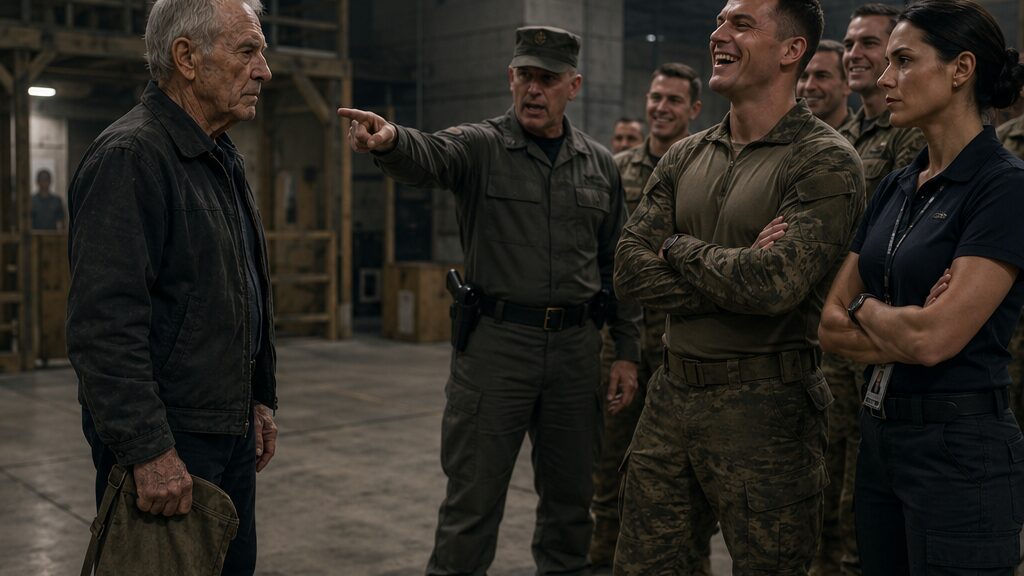
Brandon nodded toward the bag.
“You lost on your way to a fishing tournament?”
Laughter spread through the group.
Not cruel laughter.
Not yet.
The casual kind.
The kind that grew dangerous when nobody challenged it.
Gregory looked at him.
“No.”
“Good.”
Brandon grinned.
“For a second I thought somebody dropped a grandfather into the tactical course.”
More laughter.
A few phones appeared.
Nothing official.
Just soldiers entertaining themselves.
Gregory remained expressionless.
The reaction seemed to disappoint Brandon slightly.
Most people either laughed along or got angry.
Neither happened.
“So you’re competing?”
Gregory nodded.
Brandon glanced around dramatically.
“That’s impressive.”
More chuckles.
One soldier pointed at Gregory’s jacket.
“I think my dad has that exact coat.”
“No,” Brandon said. “His dad has a newer one.”
The crowd laughed again.
Gregory adjusted the strap on the bag.
Nothing else.
No defense.
No argument.
No explanation.
The lack of reaction only encouraged them.
Brandon stepped closer.
“You know this isn’t a museum exhibit, right?”
A few people laughed harder.
Others looked uncomfortable.
Gregory noticed both groups.
The second group interested him more.
People often followed the loudest voice in a crowd.
Not because they agreed.
Because it was easier.
Brandon folded his arms.
“What’d you sign up for?”
“The course.”
“The actual course?”
“That’s usually what the word means.”
A few soldiers exchanged surprised looks.
The answer wasn’t aggressive.
Just dry enough to land.
One of them smiled despite himself.
Brandon’s grin tightened.
For the first time, Gregory saw something behind the confidence.
A need.
A need to stay on top.
A need to keep the crowd with him.
“You shoot much?”
“A little.”
“A little.”
Brandon repeated the words theatrically.
The crowd laughed again.
One soldier raised a phone higher.
Recording now.
Gregory saw it.
Ignored it.
The laughter eventually faded.
People expected more.
Instead Gregory simply walked away.
That should have ended the interaction.
It didn’t.
Because now Brandon had an audience.
And audiences expected performances.
Throughout the next hour, comments followed Gregory wherever he went.
Not openly hostile.
Just persistent.
A joke here.
A remark there.
Questions that weren’t really questions.
Each one earned another round of laughter.
Gregory endured it.
The strange thing was that the mockery bothered him less than the attention.
He had spent years avoiding attention.
Attention invited expectations.
Expectations invited disappointment.
A sharp command echoed across the training area.
The sound hit him unexpectedly.
For a fraction of a second the world shifted.
Concrete walls.
Dust.
Radio chatter.
Someone yelling for movement.
His hand tightened around the pistol bag.
When the memory faded, he realized he had stopped walking.
Several people were staring.
Gregory forced himself forward.
A woman in a staff polo approached him near the event administration area.
Melissa Rivera.
Her smile appeared professional.
Practiced.
Careful.
“Mr. Baker?”
“Yes.”
“I’m Melissa. Event coordinator.”
Gregory nodded.
“I wanted to check in.”
Her eyes briefly dropped toward the pistol bag.
“Everything going okay?”
“So far.”
“Good.”
The answer seemed to complicate whatever she had planned to say.
Melissa lowered her voice.
“I’ll be honest.”
Gregory waited.
“We’ve had some concerns.”
“About what?”
“The atmosphere.”
There it was.
Not safety.
Not rules.
Atmosphere.
She glanced toward several participants.
Some still watching him.
Some laughing.
Some filming.
“We want everyone comfortable.”
Gregory said nothing.
Melissa shifted slightly.
“The event has sponsors.”
“Congratulations.”
She blinked.
The answer wasn’t rude.
Yet somehow it made her uncomfortable.
“I just mean…”
She paused.
“We don’t want disruptions.”
Gregory looked at her calmly.
“I haven’t disrupted anything.”
“No.”
She exhaled.
“No, you haven’t.”
That was the problem.
She couldn’t point to anything he had done.
Only what people assumed about him.
A whistle sounded nearby.
The course briefing would begin soon.
Melissa glanced toward the training facility.
Then back at Gregory.
“Maybe observing would be a better option today.”
Gregory understood.
The suggestion wasn’t a suggestion.
Not really.
He nodded once.
As though considering it.
Melissa looked relieved.
Then Gregory picked up the bag and walked toward the course briefing area.
Her relief disappeared instantly.
Behind him he heard her call his name.
He didn’t stop.
The briefing area filled quickly.
Rows of participants gathered around the instructors.
Gregory stood near the back.
Brandon noticed him immediately.
The grin returned.
A few phones came out again.
The story was becoming entertaining.
The old man still hadn’t left.
One soldier beside Brandon muttered something.
Brandon laughed.
Then pointed openly toward Gregory.
The gesture drew even more attention.
For the first time, Gregory felt genuine irritation.
Not because of Brandon.
Because part of him wondered whether Kimberly would agree with them.
Whether she would see the same thing.
An old man refusing to recognize limits.
The thought lingered longer than Brandon’s insults.
That was what made it dangerous.
Melissa appeared beside one of the instructors.
They spoke quietly.
Both glanced toward Gregory.
The conversation lasted less than a minute.
But Gregory already knew what it meant.
Someone was discussing whether he belonged there at all.
Chapter 3: Echoes Inside the Kill-House
“Move!”
The shouted command cracked through the air.
Gregory froze.
Not visibly.
Not enough for anyone else to notice.
But inside, something locked.
The instructor’s voice bounced off the concrete walls surrounding the training compound.
For a heartbeat, the kill-house no longer looked like a training facility.
It became another place.
Another year.
Another set of walls.
Another day he had spent decades trying not to remember.
His fingers tightened around the pistol bag.
The rough canvas pressed against his palm.
Reality slowly returned.
People moved around him again.
The briefing continued.
No one seemed aware that he had briefly disappeared into memory.
No one except one person.
Scott Harris.
The drill instructor stood several yards away.
Watching.
Not staring.
Observing.
The way experienced instructors observed everything.
Scott’s expression changed slightly.
Not judgment.
Recognition.
Gregory looked away first.
The briefing ended.
Participants dispersed toward various stations.
The kill-house loomed nearby.
Gray walls.
Narrow entrances.
Dark windows.
Gregory felt his stomach tighten.
A whistle shrieked.
Another memory tried to surface.
This time he forced it down immediately.
He turned and walked away from the course.
Not toward the parking lot.
Just away.
A few minutes.
A little distance.
That was all he needed.
The farther training lanes were quieter.
Families watched demonstrations.
Volunteers handed out drinks.
Nobody paid attention to him here.
Gregory sat on a low concrete barrier.
The pistol bag rested beside him.
For several minutes he simply breathed.
Slowly.
Carefully.
His phone buzzed.
Kimberly.
Again.
This time he answered.
“Hello.”
Silence.
Then relief.
“Dad.”
“I’m here.”
“You actually picked up.”
“I know.”
“Are you okay?”
Gregory looked toward the distant kill-house.
“I think so.”
“You think so?”
He smiled faintly.
She sounded exactly like her mother when she was worried.
“Dad, you don’t have to do this.”
The words landed harder than Brandon’s jokes.
Because Kimberly meant them.
“Come home.”
Gregory stared at the bag.
The worn canvas.
The faded stitching.
Years of use.
Years of memories.
“I’m not sure I can.”
A pause.
Then softer:
“Why?”
Gregory opened his mouth.
Nothing came out.
The answer existed.
He simply couldn’t say it.
Not yet.
The silence stretched too long.
Kimberly sighed.
“I knew it.”
“What?”
“You still won’t talk about it.”
“No.”
“That’s the problem.”
She wasn’t angry.
She sounded tired.
More tired than angry.
When the call ended, Gregory sat alone with the phone in his hand.
The familiar guilt settled into place.
His silence protected nothing anymore.
Yet he clung to it anyway.
A shadow fell across him.
Scott Harris stood nearby.
“Mind if I sit?”
Gregory shrugged.
Scott sat beside him.
For a while neither spoke.
The distant sounds of training echoed across the base.
Finally Scott nodded toward the bag.
“Old friend?”
Gregory looked down.
“Something like that.”
Scott studied him.
“You almost left.”
It wasn’t a question.
Gregory didn’t answer.
“You froze during the briefing.”
Still not a question.
Gregory glanced at him.
Scott’s expression remained neutral.
Professional.
Patient.
The expression of someone who had seen things before.
“You know what that place sounds like?” Scott asked quietly.
Gregory said nothing.
“I do.”
The instructor stood.
“Whatever you’re carrying in there…”
He nodded toward Gregory’s chest, not the bag.
“…it isn’t age.”
Then he walked away.
Gregory remained seated.
The words stayed behind.
For the first time all day, someone had seen the truth.
Or part of it.
Not enough to understand.
Enough to notice.
Half an hour later Gregory returned to the training compound.
The atmosphere had changed.
Melissa Rivera waited near the registration area.
The moment she saw him, her expression tightened.
“Mr. Baker.”
Gregory stopped.
“We need to discuss your participation.”
There it was.
Official now.
Around them, people slowed.
Listening.
Watching.
Brandon stood in the distance with several soldiers.
Interested.
Melissa folded her arms.
“There have been concerns.”
“Whose concerns?”
“Multiple concerns.”
Gregory almost smiled.
People always hid behind groups when they wanted authority.
“We have to consider safety.”
The word irritated him.
Safety.
Not dignity.
Not inclusion.
Safety.
As though age itself were dangerous.
Melissa continued.
“The course is demanding.”
“I noticed.”
“Perhaps observing would be better.”
Gregory looked past her.
Toward the kill-house.
Toward the instructors.
Toward the concrete structure that had been haunting him all morning.
Part of him wanted to agree.
Part of him wanted the easy exit.
No embarrassment.
No risk.
No failure.
He could leave.
Drive home.
Tell Kimberly she had been right.
The temptation frightened him.
Because it felt reasonable.
Scott appeared near the course entrance.
Their eyes met briefly.
No encouragement.
No pressure.
Just observation.
The decision belonged to Gregory.
Nobody else.
Melissa waited.
“So?”
Gregory looked down at the pistol bag.
Then back at the course.
Then at Melissa.
“I’d like to participate.”
Her jaw tightened.
“Mr. Baker—”
“I’d like to participate.”
The second statement carried more weight.
Not louder.
Final.
Melissa exhaled sharply.
“Then sign the evaluation waiver.”
She handed him a clipboard.
The paper felt heavier than it should have.
Not because of the form.
Because of what signing meant.
No more hesitation.
No more retreat.
Gregory signed his name.
Across the compound, Brandon’s grin slowly returned.
The old man had volunteered.
The entertainment wasn’t over.
Gregory handed back the clipboard.
Then he picked up the worn pistol bag and walked toward the course registration table.
This time he didn’t stop.
Chapter 4: The Course Nobody Wanted Him On
The registration volunteer looked up as Gregory approached.
“You still want the evaluation slot?”
“Yes.”
The volunteer hesitated only briefly before checking his name.
Around them, word had already spread.
People weren’t gathering because they expected excellence.
They were gathering because they expected failure.
The difference mattered.
Gregory signed another form and accepted a numbered badge.
The volunteer handed it over.
“Lane Four.”
A few nearby participants exchanged amused looks.
One of them whispered, “This is going to be ugly.”
Gregory pretended not to hear.
The pistol bag felt heavier than it had that morning.
Not physically.
Emotionally.
Every step toward the preparation area felt like stepping deeper into something he could still abandon.
Brandon appeared before he reached Lane Four.
Almost as if he had been waiting.
“You’re really doing this.”
Gregory stopped.
Brandon looked genuinely surprised now.
Not mocking.
Surprised.
“I thought you’d leave.”
Gregory adjusted the strap on the bag.
“I considered it.”
The admission caught Brandon off guard.
For a second he had no joke ready.
Then he recovered.
“Probably should’ve.”
Several soldiers nearby laughed.
Brandon pointed toward the kill-house.
“That’s not a charity walk in there.”
“I know.”
“You know?”
Brandon shook his head.
“You don’t.”
The younger man’s confidence wasn’t entirely arrogance.
Gregory could see something else underneath it.
Pride.
The course mattered to him.
His reputation mattered to him.
The crowd mattered to him.
Brandon wasn’t simply trying to be cruel.
He was protecting a version of himself.
Unfortunately, that version required someone beneath him.
Today that someone happened to be Gregory.
“You worried about me?” Gregory asked.
A few nearby soldiers laughed.
Brandon smirked.
“Not even a little.”
“Good.”
Gregory walked past him.
The answer followed him longer than any insult.
The preparation area sat beside the kill-house entrance.
Participants checked equipment, reviewed safety procedures, and listened to final instructions.
Gregory found an empty bench.
The pistol bag rested beside him.
For a moment he simply looked at it.
The canvas had faded unevenly over decades.
One handle had been repaired twice.
A small scratch near the zipper reminded him of another training day years ago.
Another mistake.
Another reason he had almost stopped shooting entirely.
He closed his eyes.
Not now.
The memory retreated.
A shadow crossed the bench.
Scott Harris stood nearby.
“You got Lane Four.”
Gregory nodded.
Scott glanced toward the growing crowd.
“Popular lane today.”
“Seems that way.”
For a moment neither man spoke.
Then Scott lowered his voice.
“You don’t owe anybody a performance.”
Gregory looked at him.
“No?”
“No.”
Scott nodded toward the kill-house.
“You only owe yourself honesty.”
The words lingered after Scott walked away.
Gregory wasn’t sure he liked them.
Honesty was exactly what he had spent years avoiding.
A whistle shrieked.
The next group entered the course.
The sounds echoed from inside.
Commands.
Footsteps.
Target impacts.
The familiar rhythm tightened something deep inside him.
His hand began trembling again.
More noticeably now.
He placed it against the pistol bag.
The rough canvas steadied him.
A few seats away, two younger participants noticed.
One whispered to the other.
They both looked away quickly when Gregory glanced over.
The tremor embarrassed him more than Brandon ever could.
Because it felt true.
Age.
Pain.
Doubt.
Things he couldn’t argue with.
A clipboard appeared in front of him.
Melissa Rivera.
“Final confirmation.”
Gregory looked up.
Her expression remained professional, but something had changed.
Less certainty.
More caution.
“As long as you understand participation is voluntary.”
“I understand.”
“And if you decide not to run the course—”
“I understand.”
Melissa sighed.
For the first time all day, she looked tired.
Not annoyed.
Tired.
“This event becomes my responsibility if somebody gets hurt.”
Gregory studied her.
There it was.
The real pressure.
Sponsors.
Liability.
Public perception.
None of it excused her behavior.
But it explained it.
“I know.”
Melissa nodded.
Then quietly added, “I hope you know what you’re doing.”
It wasn’t an insult.
That surprised him.
Before he could answer, she walked away.
Lane assignments were called.
Participants moved toward staging positions.
The crowd followed.
Phones appeared again.
Gregory saw them everywhere.
A public failure was always entertaining.
Especially one everyone expected.
Lane Four suddenly felt like a small arena.
Brandon stood among the spectators.
Arms crossed.
Confident.
Waiting.
The first participant finished.
The second participant finished.
Applause followed a strong performance.
Murmurs followed a poor one.
Then the coordinator called Gregory’s number.
The crowd immediately grew louder.
Whispers spread.
A few laughs.
Someone muttered, “This should be interesting.”
Gregory rose slowly.
The tremor remained.
Every eye followed him.
For the first time all day, he felt completely alone.
Not isolated.
Alone.
A different thing.
He walked toward the staging table.
The pistol bag hung at his side.
The kill-house entrance waited ahead.
Concrete.
Steel.
Shadows.
Memories.
The closer he got, the stronger the pressure became.
His heartbeat quickened.
The whistle blasts.
The shouted commands.
The smell of oil and dust.
Past and present began brushing against each other.
Dangerously close.
A timer operator gestured toward the start position.
“Whenever you’re ready.”
Gregory nodded.
The crowd fell quiet.
Not respectful.
Curious.
Waiting.
Expecting.
He placed the pistol bag on the table.
The zipper sat directly in front of him.
For several seconds he simply stared at it.
Then he reached forward and slowly pulled it open.
Chapter 5: The Moment the Tremor Disappeared
Nobody laughed.
Not anymore.
The crowd watched in silence as Gregory unzipped the bag.
The worn teeth of the zipper rasped through the stillness.
Inside lay a pistol that looked almost as old as the bag itself.
Clean.
Maintained.
Used.
Not displayed.
Not collected.
Used.
Gregory lifted it carefully.
The tremor in his hand was impossible to miss now.
Someone behind Brandon whispered, “He’s shaking.”
Another voice answered quietly.
“Maybe they should stop this.”
For the first time all day, Brandon didn’t join the comments.
He watched.
Waiting for confirmation.
Waiting for proof that he had been right.
Gregory ignored all of them.
His attention rested entirely on the pistol.
His thumb brushed the frame.
The worn edge near the grip.
The faint marks left by years of training.
The familiar weight.
The familiar balance.
A hundred memories existed inside that metal.
Most of them unpleasant.
Some of them precious.
A whistle sounded somewhere beyond the crowd.
The sharp note struck him like a hammer.
Suddenly he wasn’t standing at the start line anymore.
Dust.
Heat.
Concrete walls.
A younger version of himself moving through another structure.
Someone shouting.
Someone missing a step.
Someone getting hurt.
The memory surged forward.
For a terrifying second he nearly lost the present entirely.
His breathing stopped.
The pistol felt distant.
The crowd vanished.
Then his thumb found the worn edge of the grip again.
The sensation grounded him.
Not because it erased the memory.
Because it reminded him he had survived it.
The flashback loosened its hold.
Reality returned.
When Gregory finally looked up, something had changed.
Not in the crowd.
In him.
The tremor disappeared.
It happened so subtly that most people missed it.
Scott Harris did not.
Neither did Brandon.
The shaking hand became steady.
His shoulders straightened.
The hesitation vanished.
The transformation wasn’t dramatic.
It was worse than dramatic.
It was quiet.
The timer operator blinked.
As though the elderly man standing before him had somehow become somebody else.
“You ready?”
Gregory nodded once.
The timer beeped.
He moved.
The first room swallowed him.
Targets appeared.
His pistol rose.
Two controlled shots.
Transition.
Two more.
Movement.
Another target.
The rhythm looked effortless.
Not fast.
Efficient.
Every unnecessary motion had been removed.
Outside, spectators shifted uneasily.
People expected speed.
Instead they witnessed economy.
Nothing wasted.
Nothing rushed.
Inside the kill-house, Gregory moved through corners and doorways with frightening familiarity.
Years seemed to fall away.
Not physically.
His joints still hurt.
His breathing still carried age.
But his discipline remained untouched.
A difficult target appeared at an awkward angle.
He engaged immediately.
Perfect.
Another.
Perfect.
The radio chatter of course officials changed tone.
The casual amusement disappeared.
Numbers began getting checked twice.
Brandon’s smile faded.
The crowd noticed.
The man they expected to fail had not made a mistake yet.
Gregory cleared another room.
A sudden command echoed from a nearby instructor.
The voice struck him unexpectedly.
Memory exploded again.
Another training day.
Another course.
A younger trainee moving too quickly.
A mistake.
The impact.
The guilt.
Gregory froze for half a heartbeat.
Only half.
But he felt it.
The old wound remained.
The old fear remained.
That was the truth he had hidden from Kimberly.
Not fear of embarrassment.
Fear of repeating failure.
Fear that one day hesitation or age would cost someone something important.
His jaw tightened.
He forced the memory away.
The next doorway waited.
So did the next decision.
Move forward.
Or stop.
Gregory stepped through.
The course became harder.
Longer sight lines.
Smaller targets.
More complicated movement patterns.
The challenge should have exposed weakness.
Instead it exposed experience.
Every difficult section seemed oddly familiar to him.
Not because he had seen this course before.
Because he had spent a lifetime solving similar problems.
Outside, phones lowered.
People stopped recording for entertainment.
Now they recorded because they couldn’t believe what they were seeing.
Scott crossed his arms.
A slow smile touched his face.
Not pride.
Recognition.
The fundamentals.
Still alive.
Still undefeated.
Inside the final room of the sequence, Gregory engaged the last targets.
The pistol settled.
Silence followed.
For one second nobody reacted.
Then officials hurried toward score sheets.
The crowd erupted into confused conversation.
Brandon stared toward the exit.
Waiting.
Needing to see the results.
Gregory emerged from the kill-house.
Breathing hard.
Sweat visible beneath the collar of his jacket.
His age suddenly obvious again.
But the crowd looked at him differently now.
Nobody laughed.
Nobody made jokes.
The silence felt heavier than mockery.
An official checked the scoring tablet.
Then checked it again.
Another official leaned over his shoulder.
A third joined them.
Whispers spread rapidly.
Gregory didn’t ask questions.
He already knew one thing.
He had finished.
That alone mattered.
Then the official looked up.
His expression stunned.
And somewhere in the growing crowd, someone quietly said:
“That’s a perfect sequence.”
Chapter 6: What Discipline Looks Like
The words moved through the crowd faster than any announcement.
Perfect sequence.
Not good.
Not impressive.
Perfect.
People repeated it as though saying it twice might make more sense than saying it once.
Brandon stood motionless.
A few soldiers looked toward him, waiting for a reaction.
He had none.
For the first time all day, the attention wasn’t following him.
It belonged entirely to Gregory.
Officials gathered around the scoring station.
Double-checking.
Verifying.
Searching for mistakes.
Gregory leaned against a barrier and slowly lowered himself onto a bench.
His legs felt heavier than concrete.
The adrenaline that had carried him through the course was fading.
Pain returned.
So did exhaustion.
The pistol rested inside the open bag beside him.
Not a symbol of embarrassment anymore.
Not even a symbol of skill.
At that moment it felt like an old conversation finally resumed after years of silence.
Scott Harris approached carrying a bottle of water.
Gregory accepted it.
“Thanks.”
Scott sat beside him.
For a few seconds both men watched the crowd.
Then Scott spoke quietly.
“You know what they’re doing over there?”
“Checking the score.”
“They’re trying to find a reason it can’t be true.”
Gregory laughed softly.
The sound surprised both of them.
Scott nodded toward the kill-house.
“That wasn’t luck.”
“No.”
“That wasn’t muscle memory either.”
Gregory unscrewed the bottle cap.
“What was it then?”
Scott watched several young soldiers arguing near the scoring station.
“Discipline.”
The answer lingered.
Neither man added to it.
Across the compound, Brandon finally began moving again.
Not toward Gregory.
Toward the scoreboard.
Toward confirmation.
Toward proof.
The need was written across his face.
Gregory understood it.
He remembered being young enough to believe excellence could be measured entirely by performance.
Age taught different lessons.
Sometimes painful ones.
His phone vibrated.
Kimberly.
He stared at the screen.
Then answered.
“Hi.”
Her voice arrived immediately.
“What happened?”
Gregory frowned.
“What do you mean?”
“I’ve gotten three messages.”
“From who?”
“People from the event.”
That surprised him.
Kimberly continued.
“One of them said you’re making a scene.”
Gregory almost smiled.
“A scene?”
“Another said you embarrassed a lot of people.”
The smile vanished.
That description felt closer to the truth.
“What happened?”
For a moment Gregory considered giving his usual answer.
Nothing.
Everything’s fine.
The easy lie.
The familiar silence.
Instead he looked at the pistol bag.
At the course.
At the crowd.
“I stayed.”
A pause.
Then:
“That’s all?”
“No.”
His throat tightened unexpectedly.
“I stayed.”
The words carried more meaning than he intended.
Kimberly understood anyway.
Neither spoke for several seconds.
Then she quietly said, “Okay.”
No argument.
No lecture.
Just okay.
The conversation ended shortly afterward.
Yet something between them felt different.
Not fixed.
Changed.
A sudden burst of noise erupted near the scoring station.
Gregory looked up.
Official results were being posted.
The crowd surged closer.
Scott stood.
“So much for a quiet afternoon.”
Gregory remained seated.
He had no desire to join them.
The numbers didn’t matter anymore.
Not really.
Then a familiar voice cut through the noise.
“Sir.”
Gregory looked up.
Brandon Thompson stood in front of him.
The confidence remained.
But it looked damaged now.
Not destroyed.
Just shaken.
Brandon glanced toward the scoreboard.
Then toward the pistol bag.
Then toward Gregory.
“I checked three times.”
Gregory waited.
“I thought there had to be a mistake.”
The younger man laughed once.
Without humor.
“There wasn’t.”
Neither spoke.
The silence became uncomfortable.
For Brandon especially.
Finally he asked, “How long?”
“How long what?”
“How long did it take to get that good?”
Gregory looked at him carefully.
The question wasn’t sarcastic.
That was new.
“Longer than I expected.”
Brandon nodded slowly.
As if trying to understand something beyond shooting.
Something about time.
About effort.
About assumptions.
An announcement echoed across the loudspeaker.
Official results confirmed.
The crowd reacted immediately.
Some applauded.
Others simply stared.
Gregory didn’t look toward the board.
He didn’t need to.
Brandon did.
The younger soldier turned toward the sound.
Then back toward Gregory.
For the first time all day, he stood at attention without realizing it.
Not formally.
Instinctively.
Respect replacing amusement.
Before either man could speak again, another whistle blast echoed across the compound.
Sharp.
Sudden.
The sound struck Gregory harder than expected.
The world flickered.
Concrete walls.
Dust.
A shout.
A trainee moving too quickly.
A mistake he had never completely forgiven himself for.
His vision blurred.
Just briefly.
But long enough.
Scott saw it immediately.
So did Brandon.
Gregory gripped the edge of the bench.
The memory passed.
The present returned.
Yet the moment left something behind.
A realization.
He hadn’t come here to prove anything to Brandon.
Or Melissa.
Or the crowd.
Or the base.
He had come because part of him still feared that the old mistake defined him.
That the years since then had changed nothing.
That Kimberly’s worry might be true.
The course had answered a different question.
Not whether he was still capable.
Whether fear deserved control.
The scoreboard announcement echoed again.
Official results finalized.
No corrections.
No revisions.
No mistakes.
The crowd’s attention shifted toward the posted rankings.
Gregory looked at the worn pistol bag resting beside him.
Then slowly zipped it closed.
The score no longer mattered.
But what happened next might.
Chapter 7: The Sign at the Gate
“Mr. Baker.”
Gregory looked up from the closed pistol bag.
Melissa Rivera stood beside the bench.
The crowd remained clustered around the scoreboard behind her, but the noise had changed. Earlier it had been amusement. Then disbelief.
Now it sounded like conversation.
Real conversation.
Melissa glanced toward the posted rankings.
“You finished first.”
Gregory shrugged.
The reaction seemed to unsettle her.
Most participants would have celebrated.
Most would have stayed near the crowd.
Most would have wanted everyone to know.
Gregory simply rested one hand on the worn bag.
Melissa looked at it for a moment.
Then she sat on the opposite end of the bench.
“I owe you an apology.”
Gregory remained silent.
The words appeared difficult for her.
“I thought I knew what kind of person belonged here.”
A few seconds passed.
“I was wrong.”
Gregory nodded once.
Not accepting.
Not rejecting.
Simply acknowledging.
Melissa exhaled.
“I spent the entire morning worried about appearances.”
She laughed quietly.
“And somehow the least impressive-looking person at the event ended up teaching everyone the most.”
The statement hung between them.
Gregory looked toward the kill-house.
People were still discussing his run.
He wished they would stop.
The performance already felt distant.
The decision to stay mattered more.
Melissa followed his gaze.
“The base commander wants to review civilian participation policies.”
That got Gregory’s attention.
“Why?”
“Because several instructors filed recommendations.”
Gregory frowned slightly.
“Instructors?”
Melissa nodded.
“Apparently some people think we’ve been filtering out the wrong participants.”
The irony was obvious.
The event had nearly removed him.
Now people were questioning the process itself.
Melissa stood.
“Whatever happens, your run started that conversation.”
Gregory didn’t know how to respond.
Fortunately, he didn’t have to.
A familiar voice called from behind.
“Mr. Baker.”
Scott Harris approached.
Melissa nodded to him and left.
Scott watched her go.
“She’s having a rough day.”
Gregory smiled faintly.
“I noticed.”
Scott sat where Melissa had been.
For a while neither man spoke.
The silence felt comfortable.
Not empty.
Comfortable.
Eventually Scott said, “You know what surprised me?”
Gregory looked at him.
“You almost left.”
The comment landed harder than expected.
Scott wasn’t talking about the course.
He was talking about earlier.
The bench.
The hesitation.
The phone call.
Gregory looked away.
“Yeah.”
Scott folded his arms.
“I’ve trained people for years.”
He nodded toward the kill-house.
“The best ones aren’t the fearless ones.”
Gregory listened.
“They’re the ones who keep moving after fear shows up.”
Another whistle echoed across the training grounds.
This time Gregory barely reacted.
Scott noticed.
A small smile touched his face.
“The fundamentals.”
Gregory nodded.
“The fundamentals.”
Scott stood.
Then hesitated.
“You never answered my question.”
“What question?”
“Why you came.”
Gregory stared at the bag.
For a long moment he considered giving another incomplete answer.
The familiar habit.
The familiar shield.
Instead he surprised himself.
“Years ago, during a training exercise, somebody got hurt.”
Scott waited.
“I was supervising.”
The words came slowly.
“I didn’t make the mistake.”
He tightened his grip on the bag.
“But I never stopped wondering if I should’ve seen it sooner.”
Scott said nothing.
Gregory appreciated that.
“After that, every range sounded different.”
Every whistle.
Every command.
Every training facility.
The memories never fully disappeared.
“I stopped competing.”
He looked toward the kill-house.
“Stopped teaching.”
Scott understood now.
Not all of it.
Enough.
“And today?”
Gregory smiled faintly.
“Today I wanted to find out whether fear was making my decisions.”
Scott nodded once.
The answer seemed sufficient.
Neither man needed more.
A vehicle entered the parking area nearby.
Gregory barely noticed at first.
Then he saw who stepped out.
Kimberly.
She moved quickly through the crowd.
Looking worried.
Looking determined.
Looking exactly like she always did when she believed her father was being stubborn.
Gregory stood.
For a second Kimberly simply stared at him.
Then at the crowd.
Then at the scoreboard.
Then back at him.
“You couldn’t just have a normal afternoon?”
The question carried equal parts relief and frustration.
Gregory laughed.
A real laugh this time.
Kimberly shook her head.
“I leave you alone for one day.”
She stopped beside him.
Her eyes moved toward the pistol bag.
Then toward the kill-house.
Then toward the spectators still discussing his performance.
Finally she looked directly at him.
“You okay?”
The question felt different now.
Not accusatory.
Not protective.
Honest.
Gregory considered lying.
The instinct remained.
Years of silence didn’t disappear in one afternoon.
But something had changed.
“I’m tired.”
Kimberly smiled.
“That I believe.”
He hesitated.
Then continued.
“And I was scared.”
The admission surprised both of them.
Kimberly blinked.
For a moment she looked younger.
Like the little girl who used to sit beside him on the porch asking questions.
“You were?”
Gregory nodded.
“Most of the day.”
She stared at him.
Not because of the fear.
Because he had finally said it aloud.
The silence that had lived between them for years cracked slightly.
Not shattered.
Cracked.
Kimberly sat beside him.
Neither rushed to fill the space.
Eventually she touched the worn pistol bag.
Carefully.
As if seeing it differently for the first time.
“I always hated this thing.”
Gregory smiled.
“I know.”
“It reminded me of everything you wouldn’t talk about.”
The truth hurt because it was accurate.
For years the bag had represented absence.
Distance.
Silence.
Kimberly looked toward the training compound.
Then back at her father.
“I thought coming here meant you were trying to prove something.”
“So did I.”
The answer surprised her.
Gregory looked down at the bag.
The faded canvas.
The repaired handle.
The years.
“I don’t think that’s why I came anymore.”
Kimberly waited.
Gregory searched for the right words.
Eventually he found them.
“I came because I was tired of letting fear make decisions for me.”
The statement settled between them.
Simple.
Honest.
Enough.
The loudspeaker crackled nearby.
An announcement called staff members toward the administration building.
Melissa hurried past with several documents in hand.
Two instructors followed.
Among them was Scott.
The conversation sounded serious.
Official.
Kimberly noticed.
“What’s going on?”
Gregory shrugged.
“No idea.”
Hours earlier he would have cared.
Now he wasn’t sure.
The sun had begun lowering toward the horizon.
Participants gradually packed equipment and headed home.
The excitement of the day slowly dissolved into ordinary movement.
For the first time since arriving, Gregory felt at peace.
Then Brandon Thompson appeared.
The younger soldier stopped a few feet away.
Kimberly immediately recognized him as trouble.
Gregory recognized something else.
Embarrassment.
Brandon shifted awkwardly.
An unfamiliar look on him.
“I wanted to say something.”
Nobody helped him.
He had to do it himself.
Good.
“You don’t owe me anything,” Gregory said.
Brandon nodded.
“I know.”
A pause.
Then:
“I was wrong.”
The words cost him something.
Gregory could see it.
Not humiliation.
Pride.
The kind of pride young men often confuse with strength.
Brandon looked toward the kill-house.
“When I saw you walk in this morning…”
He shook his head.
“I thought I already knew everything important about you.”
Kimberly watched carefully.
Gregory remained silent.
Brandon glanced at the bag.
Then back at Gregory.
“I didn’t.”
Another pause.
Then he offered his hand.
Gregory accepted it.
Nothing dramatic.
No speeches.
No audience.
Just two men standing near a bench.
The handshake lasted only a moment.
It was enough.
When Brandon walked away, Kimberly watched him go.
“That must’ve hurt.”
Gregory smiled.
“For both of us.”
The crowd continued thinning.
Vehicles left.
Equipment disappeared.
The day finally began ending.
As Gregory and Kimberly walked toward the exit gate, they passed the main entrance where everything had started.
The guards remained at their posts.
Families continued leaving the base.
Workers moved signs and barriers.
Then Gregory noticed a maintenance crew installing something new beside the entrance.
A fresh sign.
The old temporary notice had been removed.
One worker stepped aside.
The words became visible.
CIVILIAN VETERAN PARTICIPANTS WELCOME
Kimberly stopped walking.
Gregory did too.
Neither spoke.
Across the entrance road, Scott Harris stood watching the installation.
Their eyes met briefly.
The instructor nodded once.
Not toward the sign.
Toward Gregory.
A gesture of respect.
A gesture of understanding.
Gregory looked at the words one final time.
Then at the worn pistol bag hanging from his shoulder.
That morning it had marked him as someone who didn’t belong.
Now it felt like something else entirely.
Not proof.
Not victory.
Just a reminder.
Fear could stay.
Memories could stay.
Age could stay.
The decision to move forward belonged to him.
Gregory adjusted the strap on the bag.
Then walked through the gate beside his daughter.
He never looked back.
The story has ended.