The Old Marine at Booth Seven Let Them Misjudge His Silence Until the Coffee Went Cold
Chapter 1: The Man Who Would Not Leave Booth Seven
Ronald Bennett came to the diner before the lunch crowd, the same way he had for years, stepping in just after the breakfast men had finished their eggs and before the first office workers started glancing at their watches.
The bell above the door gave its thin metal cry.
No one looked up at first.
That was all right with him.
He stood just inside the entrance and let his eyes adjust to the bright, flat light. The diner had changed its napkin holders again. Chrome this time, with little black advertisements slipped into the sides. The floor had been polished until the old cream tiles shone in spots and dulled in others. The counter stools had new red covers, not quite matching the booths, and a chalkboard near the register announced a lunch special in looping handwriting.
But Booth Seven was still there.
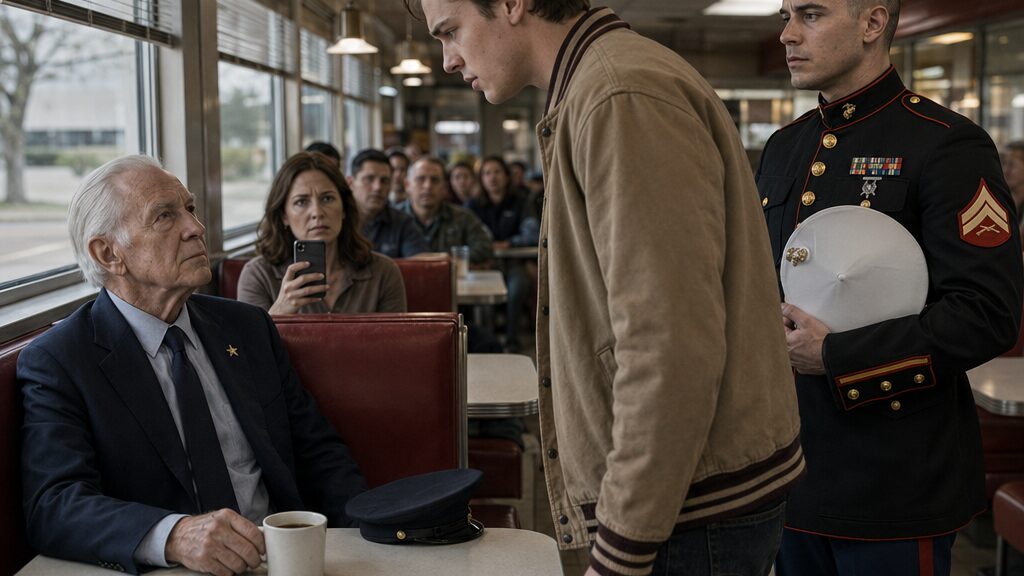
Back left corner. Red vinyl seat with a small repaired seam near the window side. White tabletop with a faint gray ring that had survived every cleaner Brenda Walker ever tried. A narrow view of the parking lot, the street, and the flagpole outside the hardware store across the road.
Ronald touched the small star pin on his navy suit jacket before he crossed the room.
It was not a medal. It was not military issue. It was only a little brass star with the enamel worn thin at the points, the kind of thing a woman might once have kept in a sewing box or pinned to a church bulletin sash. Most people never noticed it. Those who did usually mistook it for decoration.
That suited Ronald.
Emily Carter noticed him when he was halfway to the booth.
Her face softened, then tightened in the way young people’s faces did when they remembered they were supposed to be busy.
“Morning, Mr. Bennett,” she said, wiping her hands on her apron. “Coffee?”
“Yes, ma’am.”
“Same booth?”
“If it isn’t trouble.”
Emily glanced over her shoulder. The diner was still mostly empty, but three tables near the window had reservation slips on them, and two booths were pushed together for a group that had not arrived yet. Her eyes went to Booth Seven and came back to him.
“No trouble,” she said.
Ronald nodded once and continued.
He sat carefully, not because he wanted anyone to see him struggle, but because there were wrong ways to sit down when your knees had begun keeping records of every winter. He took the window side. He always did. He placed his hat beside him, flat on the seat, crown up. Then he rested both hands on the tabletop and waited.
The coffee came in a plain white cup.
Emily set it down gently, as if noise might disturb something.
“Cream?”
“No, thank you.”
“You having anything with it?”
He looked at the cup. Steam moved across the surface and disappeared.
“Not today.”
Emily did not ask why. That was one of the reasons Ronald still liked her. She had questions in her eyes, but she did not turn them into sound.
“I’ll check on you,” she said.
“No hurry.”
She smiled, then went back toward the counter.
Ronald wrapped two fingers around the cup handle but did not lift it. The coffee was too hot. It always started too hot. That was part of it. The waiting. The cooling. The room going through its ordinary movements while the cup changed by degrees.
He watched a delivery driver stack boxes near the kitchen door. Brenda Walker came out from the back with a clipboard in one hand and a phone tucked against her shoulder. She was speaking low and fast, the way people did when they owed money or expected bad news. Her eyes swept across the dining room and passed over Ronald once before returning.
Recognition appeared. Then calculation.
Ronald looked down at his cup.
He did not blame Brenda for calculation. Running a diner was arithmetic with grease burns. She had inherited the place from a man who had inherited it from his sister, and each year the booths looked a little newer while the margins looked a little thinner. Ronald had watched owners age behind that counter. He had watched menus shrink and prices rise and regulars disappear one by one.
Brenda ended her call and approached with the clipboard held against her chest.
“Mr. Bennett,” she said. “Good to see you.”
“Mrs. Walker.”
“You doing all right today?”
“Yes, ma’am.”
She looked at the cup, then the empty table in front of him. “Just coffee?”
“Yes.”
Her smile stayed in place, but her attention moved beyond him to the front windows, where a pickup had just pulled in. “We’re expecting a bigger lunch than usual. Some folks from the dealership, maybe a local reporter if she keeps her word. We’re trying out the new menu boards.”
“I won’t be in the way.”
“Oh, I didn’t mean that.”
Ronald lifted his eyes.
Brenda’s fingers pressed into the clipboard. “You know I didn’t mean that.”
“I do.”
The answer gave her nothing to argue with. She nodded too many times and went back toward the register.
Ronald let the room settle again.
Outside, the sky was high and pale, the kind of May morning that looked gentle from behind glass. A woman in a blue coat hurried past the window with a child’s backpack over one shoulder. A truck reversed badly, corrected, and parked across two faded lines. The flag across the street snapped once, then drooped.
May fourteenth.
He did not say the date to himself. He had not needed to in many years.
The bell over the door rang again and again as the diner filled. Conversation rose in layers. Forks touched plates. A man laughed too loudly near the counter. Someone asked whether they still served meatloaf. Emily moved between tables with coffee in one hand and patience in the other.
Ronald’s cup cooled.
He could tell by the way steam no longer lifted straight up. By the way heat stopped pressing against his knuckles when he held his hand near the rim.
A young man in a tan varsity-style jacket came in from the kitchen carrying a plastic tub of clean silverware. Ronald had seen him once before, maybe twice. He had dark hair combed carefully and the quick, restless stride of someone trying to be noticed by the right people. His name tag read Justin.
Justin set the tub down near the counter and leaned toward Brenda. She spoke to him without looking up from the register. He glanced around the room, then toward Ronald.
Ronald saw the moment he became a problem.
Not a man. Not a customer. A problem.
Justin said something to Brenda. She shook her head. He looked again at Booth Seven, at the one white cup, the empty place settings, the growing lunch line near the door.
Ronald turned the cup a quarter inch clockwise.
He had done that before, years ago, when the cup had been in another man’s hand. A nervous habit, someone had called it. Not Ronald’s habit. Not at first.
Emily came by with the coffee pot.
“Warm it up?”
“No, thank you.”
She hesitated. “It’s getting cold.”
“Yes.”
She seemed about to ask something, but Justin called her name from the counter, sharp enough that two customers looked up.
Emily gave Ronald an apologetic look and left.
He watched her go. He watched Justin point toward the booth, then toward the waiting customers. Emily shook her head once. Justin’s jaw moved. Brenda was now at the front, speaking with a woman holding a small camera bag, her business smile bright and strained.
Ronald looked back to the window.
There were things a man could fight and things a man could only carry. Age made the difference clearer. It also made other people less willing to believe you knew the difference.
A shadow fell across the table.
Justin stood at the open end of the booth, one hand braced on the vinyl seat opposite Ronald. Up close, he was younger than Ronald had first thought. Early twenties, maybe. Old enough to have been told he was an adult, young enough to believe adulthood meant never being uncertain.
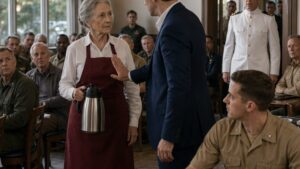
“Sir,” Justin said, not quietly, “we’re going to need this booth.”
Ronald looked up at him.
The noise in the diner seemed to tilt around them.
“I’m waiting,” Ronald said.
“For someone?”
Ronald’s fingers rested near the cup.
“In a manner of speaking.”
Justin looked at the empty seat across from him. Then at the cold coffee. Then at the room full of people.
The young man’s mouth tightened.
Ronald knew that look. It was the look of someone who believed kindness had been offered and refused, and now permission had been granted to stop being kind.
At the counter, Emily froze with two plates in her hands.
Brenda turned from the woman with the camera bag.
Ronald kept his back straight and his hands still.
He had arrived early. He had ordered little. He had taken up a booth during lunch. All of those things were true.
They were not the whole truth.
Justin leaned closer.
“Sir, I’m asking politely,” he said.
Ronald heard the word politely land harder than the rest.
He looked at the cooling cup and thought, not for the first time, how strange it was that some promises became invisible unless you explained them to strangers.
“I understand,” Ronald said.
But he did not move.
Chapter 2: A Cold Cup in Front of Everyone
Justin Miller had been told three times that morning to think like a manager.
The first time, Brenda had said it while handing him the updated lunch schedule, her voice brisk and tired. The second time, she had said it after he let a delivery driver block the back door with crates. The third time, she had said nothing at all. She had only looked at the line forming near the entrance, looked at Booth Seven, and then looked at him.
Justin understood that look better than words.
His mother’s hours had been cut again. His own tuition bill sat unopened on the kitchen table. Brenda had hinted that if the diner’s new lunch push worked, she might make him full assistant manager for the summer. That would mean steady hours. It might mean insurance after the probation period. It might mean not asking his mother whether she had paid the electric bill or just moved it under a stack of mail.
So he thought like a manager.
And what he saw was one old man occupying a four-person booth during the rush, nursing a cup of coffee so cold it had stopped steaming.
Justin kept his voice controlled, but he knew it carried. Voices always carried in the diner. The ceiling was too low, the floor too hard, the booths too close together.
“Sir, we’ve got people waiting.”
Ronald Bennett’s eyes remained on him. Pale, steady, unreadable.
“I see that,” Ronald said.
“Then you understand the situation.”
“I understand there are people waiting.”
Justin exhaled through his nose. “Right. So if you’re finished—”
“I’m not.”
The answer was soft. That made it worse.
At the next table, a man with suspenders stopped cutting his pancakes. A woman near the aisle turned slightly in her chair. Kimberly Hayes, who had come in to meet someone and stayed for the unfolding discomfort, lifted her phone from beside her water glass.
Justin saw the movement and felt heat climb up his neck.
Great. Perfect. Now there was a camera.
He should have stepped back. He knew that later. He knew it even then in some small, buried place. But the diner was full, Brenda was watching, Emily looked like she was about to interfere, and the old man sat there as if the whole room could bend around his cup.
“Sir,” Justin said, “you can’t hold up a table all day over one coffee.”
A few people went still.
Ronald’s expression changed only in the smallest way. His eyelids lowered. Not anger. Not fear. Something more like weariness.
Justin mistook it for defiance.
“Especially if you’re not ordering anything else,” he added.
Emily set the plates down at the wrong table.
“Justin,” she said.
He did not look at her.
Ronald’s right hand moved. For one sharp second Justin thought the old man might point at him, might demand a manager, might play the wounded elder while everyone watched.
Instead Ronald placed two fingers against the side of the coffee cup.
The gesture was so slight that Kimberly’s phone had to tilt down to catch it.
“I’m waiting until it cools,” Ronald said.
Justin gave a short laugh he did not mean to sound cruel. “It is cool.”
“Yes.”
“Then I don’t understand.”
“No,” Ronald said. “You don’t.”
The words were not loud, but they reached farther than Justin’s had.
Justin felt the room shift against him. He leaned one hand on the table, closing the space without quite touching anything.
“Look, I’m not trying to be disrespectful.”
Ronald looked at Justin’s hand on the tabletop.
Justin removed it, then hated himself for removing it.
“Then don’t be,” Ronald said.
The silence that followed was worse than a shout.
Behind Justin, the bell over the door rang.
No one turned at first. The room had tightened around the booth. Kimberly’s phone remained raised. The woman with the camera bag stood beside Brenda near the register, forgotten.
Then a man in a dress uniform stepped into the diner.
He was tall, straight-backed, and young enough that the uniform still seemed to shine around him. A white cap tucked under one arm. Ribbons neat. Shoes polished. His eyes scanned the room quickly, searching for someone rather than a table.
Justin glanced back, annoyed at the interruption, then looked again.
The man’s gaze moved past Brenda, past the waiting customers, past Justin’s tan jacket, and stopped on Ronald Bennett.
Something happened to his face.
Not surprise exactly. Recognition, held in check.
The Marine walked forward.
The diner made space for him without anyone asking. Conversations died. Chairs stopped scraping. Even the kitchen seemed to quiet, though the grill still hissed behind the pass.
Justin straightened.
The Marine stopped beside the booth, not in front of Justin but near enough that Justin had to shift back. He looked at Ronald’s jacket, at the small brass star pin, at the white cup under Ronald’s fingers.
Then he removed his cap.
“Mr. Bennett?” he asked.
Ronald looked up slowly.
The Marine’s voice changed. It lowered.
“Ronald Bennett?”
Ronald studied him for a moment. “Yes.”
“My name is Thomas Reed. Staff Sergeant.” He swallowed once, as if the rest of the sentence had weight. “I was told I might find you here today.”
Ronald’s fingers stayed on the cup.
“Who told you that?”
“A man named Anthony Coleman, sir. He said if I ever had the chance, I should come by this diner on May fourteenth and look for the Marine with the little star.”
The word Marine moved through the diner like a match struck in the dark.
Justin felt it before he understood it. The customers were looking at Ronald differently now. Not completely. Not with full knowledge. But the old man in the booth had changed in their eyes while sitting perfectly still.
Ronald did not smile. “Anthony still talks too much.”
Thomas Reed’s mouth twitched, but his eyes were wet at the edges.
“Yes, sir. He does.”
Justin looked from Thomas to Ronald, then to the coffee cup. His stomach tightened.
Kimberly’s phone was still recording.
Brenda had one hand over her mouth.
Emily stood behind the counter with her eyes fixed on Ronald, as if she had served him for years and only now realized she had never really seen him.
Thomas seemed to notice the pressure in the room then. His gaze moved to Justin, not sharply, but with enough force that Justin’s shoulders lowered without permission.
“Is everything all right here?” Thomas asked.
Ronald answered before Justin could.
“It is.”
Justin turned back toward him. “Sir, I—”
Ronald lifted one hand, not high. Just enough.
Justin stopped.
The old man looked at the cup again. The surface was dark and still.
“I was asked to move,” Ronald said. “That’s all.”
Thomas looked at the crowded diner, the people waiting, the phone, Justin’s face.
“That so?”
Ronald’s voice remained even. “It’s a busy day.”
No accusation. No rescue request. No performance.
That made Justin feel smaller than any public scolding could have.
Brenda came forward at last, her voice careful. “Mr. Bennett, you don’t have to go anywhere.”
Ronald looked at her kindly, which somehow made her flinch.
“I know,” he said.
The words were gentle. They also made clear that knowing had not been the issue.
Thomas stood beside the booth, cap held against his chest. He seemed uncertain whether to say more. Ronald gave him the smallest shake of the head.
Not here.
Justin saw it. So did Emily. Maybe Kimberly did too, because her phone dipped a little.
Ronald reached into his jacket pocket and took out folded bills. He placed more than the coffee cost beside the cup.
Emily stepped forward. “Mr. Bennett, no.”
He rose slowly, using the table for balance. Thomas moved as if to help him, then stopped when Ronald glanced at him. The old man put on his hat. He adjusted his jacket. The small star pin caught the overhead light and flashed once.
Justin stood frozen in the aisle.
Ronald turned to him.
For one panicked second, Justin expected to be condemned in front of everyone. He almost wanted it. A clean punishment would have been easier than the old man’s calm.
But Ronald only said, “Young man.”
Justin’s throat tightened. “Yes, sir?”
Ronald looked at him for a long moment.
“Tables are not the only things people wait for.”
Justin did not know what to do with that.
Ronald walked past him toward the door. Thomas stepped aside and followed at a respectful distance, not like a guard, not like an escort, but like a man who knew he had not been invited any closer.
The bell rang when Ronald left.
The diner remained silent after the door shut.
Then Kimberly’s phone chimed.
Once. Then again. Then again.
She looked down at the screen.
Justin did not need to ask.
The video was already leaving the room.
Chapter 3: The Video Leaves the Diner
Emily found the coffee cup after the rush died.
It sat where Ronald had left it, untouched except for the faint mark of two fingers on the porcelain. The bills lay beside it, folded once. Too much for coffee. Too little for what had happened.
She picked up the money first because Brenda was watching from the register and because work gave hands something to do when the heart did not know where to stand.
Under the cup, a ring of moisture had formed on the white tabletop.
Emily wiped around it but not through it.
That was foolish. She knew it was foolish. The table needed cleaning. A party of three could walk in any second and ask for Booth Seven. Brenda could tell her to reset it. Justin could come out of the back and pretend not to look.
But Emily stood there with the damp cloth in her hand and the cold cup in front of her, and she could still hear Ronald’s voice.
Tables are not the only things people wait for.
She had served him for almost two years. Not every day. Not even every week. But often enough that she knew his order. Coffee, no cream. Sometimes toast. Sometimes soup if the weather was bad. Always polite. Always folded his napkin before leaving. Always more tip than the order warranted.
She had thought of him as kind.
Kind was a small word. It let a person feel decent without having to know more.
Her phone vibrated in her apron pocket.
She ignored it.
It vibrated again.
By the time she reached the service station, the dishwasher had already seen the video. So had the cook. So had the delivery driver, who had apparently received it from a cousin who lived two towns away.
The clip was thirty-one seconds long.
It began with Justin leaning over Booth Seven.
You can’t hold up a table all day over one coffee.
Emily flinched when she heard it. In the room, the words had been uncomfortable. On the phone, stripped of the diner’s heat and noise and pressure, they sounded brutal.
The video caught Ronald’s two fingers touching the cup. It caught his answer.
I’m waiting until it cools.
Then Thomas Reed entered the frame. The comments had already turned him into a symbol before anyone knew his name. Marine walks in. Watch what happens. Rude kid learns lesson. Old veteran disrespected in diner.
Emily tapped the screen off.
Justin was in the storage hallway, sitting on an overturned crate with both hands clasped behind his head. His tan jacket was folded beside him. Without it, he looked younger.
“You saw it?” he asked.
Emily did not answer.
He dropped his hands. “I didn’t know.”
“That he was a veteran?”
Justin looked up sharply. “That it mattered.”
The answer came too fast and too honest.
Emily leaned against the doorframe. “You hear yourself?”
His face reddened. “I mean—no. That’s not what I meant.”
“What did you mean?”
He rubbed both hands over his face. “I meant I didn’t know there was a whole thing. The Marine. The pin. Whatever that was.”
“You didn’t need to know a whole thing.”
Justin stared at the floor.
From the dining room, Brenda’s voice rose and fell with a customer. Too bright. Too controlled. The diner had become busy again, but not in the way Brenda wanted. People came in asking if this was the place. They glanced toward Booth Seven. Some ordered coffee just to sit and watch the corner. One man asked Emily whether the old veteran was coming back, as if Ronald were an exhibit that had stepped out for a break.
Emily hated them a little for it.
She hated herself for not stopping Justin sooner.
Her phone vibrated again.
This time the message was from Kimberly Hayes. Emily knew her only by face and by the way she always ordered unsweetened tea, then added sugar herself.
Did Mr. Bennett see the video? I didn’t expect it to get this big. People are asking who he is.
Emily typed three different answers and deleted all of them.
Brenda appeared at the hallway entrance, pale under her makeup.
“Justin, go home.”
He stood. “Brenda, I can finish the shift.”
“No. You can’t.” She glanced at Emily, then away. “Not today.”
Justin’s jaw tightened. “Are you firing me?”
“I’m telling you to go home before someone comes in here looking for you.”
“That’s not fair.”
Brenda laughed once, not with humor. “Fair left the building when half the county watched you corner an old man in my dining room.”
Justin picked up his jacket, then stopped. “You wanted the table cleared too.”
Brenda went very still.
Emily looked between them.
Justin’s voice dropped. “You looked at me.”
“That is not the same as what you did,” Brenda said.
“No,” he said. “It’s just cleaner.”
For a moment Emily thought Brenda might slap him. Instead the owner stepped aside.
“Go home, Justin.”
He left through the back.
The door shut hard enough to rattle the mop handles.
That evening, Emily closed her section early because too many people kept asking questions. She reset Booth Seven twice and then finally left it empty, though there was no house rule that allowed such a thing. Brenda saw and did not object.
At seven, after the dinner crowd thinned, the diner phone rang.
Brenda answered near the register. “Walker’s Diner.”
Emily was filling salt shakers when Brenda’s posture changed.
“Yes,” Brenda said carefully. “This is she.”
Emily looked up.
Brenda reached for a pen.
“No, he isn’t here now.” A pause. “Yes. He does come in. Not every day.” Another pause, longer this time. “May fourteenth?”
Emily set down the salt shaker.
Brenda’s eyes moved to Booth Seven.
“I’m sorry,” she said into the phone, quieter now. “Who is this?”
The voice on the other end was too low for Emily to hear, but she saw the answer land.
Brenda wrote two words on the back of a receipt.
Thomas Reed.
Then, beneath it, one more line.
Does Ronald Bennett still come there on May 14?
Brenda thanked the caller and hung up slowly.
Neither woman spoke for several seconds.
Outside, the parking lot lights flickered on. The window beside Booth Seven turned dark enough to reflect the empty red vinyl seat, the white tabletop, and the place where the coffee cup had been.
Emily imagined Ronald sitting alone somewhere, not watching the video, not answering strangers, not explaining himself.
She took the cup from the dish rack. Clean now. Ordinary again.
But when she held it, she could still feel how cold it had been.
Chapter 4: The Name Thomas Reed Remembered
Thomas Reed had not meant to walk into the diner like a warning.
He had meant to come early, before the lunch crowd, before anyone could turn a simple errand into a ceremony. He had meant to order coffee, sit near the counter, and ask quietly whether an old Marine named Ronald Bennett still came by on May fourteenth.
Instead, he had arrived to find a young man standing over Ronald’s booth and half the diner holding its breath.
Thomas had seen worse rooms go silent. Barracks before bad news. Hospital halls. A church basement after a folded flag was carried in. Silence had different weights depending on what had made it, and the silence in the diner had been made by shame arriving late.
Now, the next morning, he stood in the parking lot before opening and watched Brenda Walker unlock the front door.
She saw the uniform first. Then his face.
“You’re Staff Sergeant Reed,” she said.
“Thomas is fine, ma’am.”
She gave a tired laugh and held the door open. “Nothing about yesterday feels fine.”
The diner smelled like bleach, old coffee, and griddle heat beginning to wake. Chairs still sat upside down on a few tables. A bus tub rested on the counter. The early light turned the red booths darker than they looked at noon.
Thomas removed his cap as soon as he stepped inside.
Brenda noticed. Her eyes flicked toward Booth Seven.
“He isn’t here,” she said. “I don’t know if he’ll come back.”
Thomas nodded. “I called because I hoped to avoid surprising him.”
“You did that anyway.”
“Yes, ma’am.”
She studied him for a moment. “Do you know him?”
“Not the way you mean.”
Emily Carter came out of the kitchen tying her apron. She stopped when she saw Thomas.
“You’re the Marine from the video,” she said, then looked embarrassed by how small that sounded.
Thomas gave her a nod. “I’m one of them, I suppose.”
“One of who?”
He looked toward Booth Seven. “People who owe a man they’ve never properly met.”
Brenda crossed her arms, not defensive exactly, but bracing. “Everybody online seems to know what happened here. I’m starting to think nobody does.”
“That’s usually how it works.”
Emily walked closer, wiping her hands though they were already clean. “Why May fourteenth?”
Thomas did not answer at once. He moved toward Booth Seven and stood beside it the way he had yesterday, not too close, not sitting down. The tabletop had been scrubbed. The little ring from Ronald’s cup was gone.
“My old gunnery instructor was Anthony Coleman,” Thomas said. “Meanest kind man I ever knew. He had a habit of telling stories when he cleaned his rifle. Same stories every time. Most of them grew longer depending on who was listening.”
Brenda’s mouth tightened. “And Ronald was in one of them?”
“Ronald was the part he didn’t embellish.”
Emily leaned against the counter.
Thomas traced the edge of the booth with his eyes. “Anthony said there was a Marine who carried a little brass star instead of the things men usually carry to prove what they’ve done. Said if we ever saw him, we were to leave him alone unless he wanted otherwise.”
Brenda looked down. “Then yesterday…”
“Yesterday I did not leave him alone.”
No one corrected him.
Thomas reached into his coat pocket and took out a folded slip of paper, worn soft along the creases. He opened it on the table. It was a copied note, the ink faded from being handled too many times.
Emily came close enough to see only a few words.
May 14. Walker’s. Booth by window. Brass star.
“Anthony gave this to me when he retired,” Thomas said. “Told me he kept meaning to come himself. Never did. His knees got bad. Then his lungs. Then pride did the rest.”
Brenda touched the back of a chair. “Why send you?”
“He didn’t send me. He just made sure I knew where to look.” Thomas folded the paper again. “I was passing through for a ceremony at the reserve center. I thought I’d come by. Pay respects if it seemed right.”
“And did it?” Emily asked.
Thomas looked at her.
“No.”
The kitchen fan clicked on. The sound filled the pause with mechanical breath.
Brenda’s phone buzzed on the counter. She glanced at it, silenced it, and turned it face down.
“It’s local news,” she said. “They want to ask about the video.”
Emily’s eyes widened. “Already?”
“They’re calling it a veteran respect story.” Brenda’s voice hardened on the phrase. “They want to film at the booth.”
Thomas looked at Booth Seven again.
“He won’t like that.”
“No,” Emily said quietly. “I don’t think he will.”
A shadow moved across the front window.
All three turned.
Ronald Bennett stood outside the diner, not at the door but beside the window near Booth Seven. He wore the same navy suit, the same hat, the same star pin on his lapel. He had one hand on the sill, not leaning hard, just resting there.
For a moment he seemed less like a customer arriving than a memory deciding whether to enter.
Emily went to unlock the door, then remembered it already was. Ronald opened it himself.
The bell rang.
No one spoke until he had crossed the room. Thomas straightened. Brenda’s arms fell to her sides. Emily stepped back from Booth Seven as though she had been caught touching something that was not hers.
Ronald looked at Thomas first.
“Staff Sergeant.”
“Mr. Bennett.”
“You came back.”
“Yes, sir.”
Ronald’s gaze dropped to the folded paper in Thomas’s hand. “Anthony?”
“Yes, sir.”
“He still alive?”
Thomas hesitated.
Ronald took the answer without needing it spoken.
“He always said he’d outlive anybody who owed him money,” Ronald said.
Thomas gave a small, pained smile. “He nearly did.”
Ronald nodded once and turned to Brenda. “May I sit?”
The question struck her visibly.
“Of course,” she said. “Please.”
Ronald slid into Booth Seven. Emily moved automatically toward the coffee pot, then stopped and looked back for permission she had never asked for before.
Ronald noticed.
“Coffee would be kind.”
Her eyes shone. She nodded and hurried away.
Thomas remained standing.
Ronald looked at him. “You don’t need to stand there like a flagpole.”
Thomas almost smiled. “No, sir.”
“Sit if you’re having coffee. Stand if you’re giving a speech.”
Thomas sat across from him.
Brenda retreated to the counter, but not far. Emily brought two cups, her hands steady only because she made them steady. She set one in front of Ronald and one in front of Thomas.
Ronald looked at the second cup.
Something moved across his face and was gone.
Thomas saw it and understood, too late, that sitting opposite him had not been a small thing.
“I’m sorry,” Thomas said.
“For what?”
“For yesterday. For stepping in.”
Ronald turned his cup by the handle.
“You stepped in because you thought a wrong was happening.”
“It was.”
Ronald looked toward the window. “Maybe.”
Thomas leaned forward slightly. “Sir, he shouldn’t have spoken to you that way.”
“No.”
“Then why protect him?”
Ronald’s eyes returned to him. “Because a man can be wrong without needing a crowd to enjoy it.”
Thomas sat back.
From the counter, Brenda looked away as if the sentence had reached her too.
Emily poured coffee into the second cup, then into Ronald’s. Steam lifted between the men.
Thomas touched the folded note in his pocket. “Anthony said the star belonged to someone else.”
Ronald’s hand covered the pin lightly. “Anthony said a lot.”
“He said you would never tell the story.”
“That sounds like me.”
“May I ask why?”
Ronald looked at the coffee until the surface stilled.
“Because once a story becomes useful, people stop asking whether it is true in the right way.”
Thomas did not understand all of it. He understood enough.
Brenda came closer, unable to hold back. “Mr. Bennett, there are reporters calling. People online want to come here. They want to buy your coffee. Pay for your meals. Some are angry at Justin. Some are angry at me.”
Ronald lifted his cup but did not drink.
“I’m sorry for that.”
“You’re sorry?” Brenda asked.
“It happened in your house.”
That was how he said it. Not business. Not diner. House.
Brenda’s mouth trembled once before she tightened it.
“I should have stopped it,” she said.
Ronald did not absolve her. He did not accuse her either.
He set the cup down.
“Then stop what comes next.”
Outside, a car slowed by the window. The driver stared in as if hoping to glimpse the old man from the video.
Thomas saw Ronald’s shoulders draw in almost imperceptibly.
“Sir,” Thomas said, “if people knew even a little, they might treat this differently.”
Ronald gave him a tired look. “People rarely treat little as little.”
No one spoke.
The coffee cooled.
At last Ronald reached into his inner jacket pocket and took out a small envelope, creased and yellowed at the flap. He laid it on the table but kept one finger on it.
Thomas looked at the envelope, then at him.
Ronald did not open it.
“Tell Anthony, when you see him wherever Marines like him end up, that he still talked too much.”
Thomas swallowed. “Yes, sir.”
Ronald returned the envelope to his pocket.
The glimpse was enough to change the room and not enough to satisfy it.
Emily felt it like a door barely opened.
Brenda felt it like warning.
Thomas felt it like an order.
Ronald lifted the cup again, waited, and finally took one small sip.
Then Brenda’s phone buzzed again against the counter, skittering across the surface like an insect.
She turned it over.
Her face changed.
“The reporter is outside,” she said.
Ronald closed his eyes for one second.
When he opened them, the coffee was still steaming.
Chapter 5: When Respect Becomes Another Performance
By noon, Brenda Walker had learned that attention could crowd a room even when the room was empty.
The reporter had been turned away at the door with a promise of “not today,” which Brenda knew meant nothing once people wanted a story. Two customers had come in and asked for “the veteran booth.” A man from the dealership offered to sponsor free coffee for veterans if she would let him put a sign in the window. Someone online had given the diner a one-star review for disrespecting heroes. Someone else had given it five stars for “standing up for the old Marine,” though Brenda had done no such thing.
The phone would not stop ringing.
By early afternoon, Brenda unplugged it.
The silence afterward was not peaceful. It was accusatory.
She stood in the back storage room with Emily, staring at a stack of paper menus and a box of old saucers the previous owner had refused to throw away. The saucers were chipped, yellowed, mismatched. Brenda had meant to donate them. Now she wondered whether everything old in the diner had been waiting for her to understand it.
“I’m not trying to exploit him,” she said.
Emily did not answer quickly enough.
Brenda turned. “You think I am.”
“I think you’re scared.”
That was worse because it was kinder.
Brenda looked down at the clipboard in her hand. The top page was a list of possible ideas she had written in the nervous hour after Ronald left. Veteran Appreciation Lunch. Booth Seven Coffee Special. Wall of Service. Local Hero Day.
Every line looked worse in the storage room.
“I have payroll Friday,” Brenda said. “The freezer repair is on my credit card. The lunch rollout was supposed to bring people in before summer. Then this happens and suddenly everyone is looking at us. Do you know how many diners would kill for that?”
“Yes.”
“Then I’m supposed to ignore it?”
Emily reached into the box of old saucers and lifted one. It was white with a green stripe and a small chip along the rim. “Maybe not ignore it. Maybe not grab it either.”
Brenda took the saucer from her.
The chip was smooth, worn down by years of washing. On the underside someone had written a faded number in black marker: 7.
Brenda frowned. “Where did this come from?”
“Old stock, I guess.”
“I’ve never seen these used.”
“Maybe before your time.”
Brenda hated that phrase, even when it was true.
The back door opened, and Ronald Bennett stepped into the kitchen hallway as if he had been invited, though no one had heard him knock. He held his hat in one hand.
Emily straightened. “Mr. Bennett.”
Ronald’s gaze went to the saucer in Brenda’s hand.
For the first time since Brenda had known him, his composure failed in a visible way. Only for a breath. His lips parted. His hand tightened around the brim of his hat.
Brenda looked down at the saucer.
“Is this yours?”
“No,” Ronald said.
But his voice had changed.
Emily noticed. “Do you recognize it?”
Ronald came closer. The storage room felt too small for him now, not because he filled it, but because the air around him seemed to require quiet.
He touched the chipped rim with one finger.
“This was what they used before the remodel,” he said. “Long time ago.”
“At Booth Seven?” Brenda asked.
He nodded.
Brenda’s grip loosened. “I didn’t know.”
Ronald gave her a faint look. “Most people don’t know most things.”
The words held no bitterness. That made them harder to bear.
Brenda set the saucer on the shelf between them. “Mr. Bennett, I wanted to talk to you.”
“I suspected.”
She glanced at Emily, then decided there was no clean way to have the conversation. “The video has brought attention. A lot. Some good, some not. People are asking what we’re going to do.”
“What do you want to do?”
Brenda lifted the clipboard, then lowered it. “I thought maybe we could make something respectful. Nothing flashy. A small sign. Maybe a free coffee program. Maybe keep Booth Seven open for veterans on certain days.”
Ronald looked at the list without taking it.
“Why?”
The question stopped her.
“To honor you.”
“No.”
His answer was immediate, but not sharp.
Brenda flushed. “No?”
“You said people are asking what you’re going to do. That is not the same as honoring anyone.”
Emily looked at the floor.
Brenda’s fear turned, briefly, into frustration. “I am trying to fix this.”
Ronald placed his hat on a stack of folded aprons.
“You can’t fix yesterday by selling a better version of it.”
The storage room seemed to shrink further.
“I wasn’t going to sell it,” Brenda said.
He glanced at the clipboard.
She turned it against her chest.
“I have a business to keep alive,” she said quietly. “That may sound ugly, but it’s true.”
“It doesn’t sound ugly.”
“You think I’m wrong.”
“I think you’re tired.”
Brenda had no defense against that. Her throat tightened with sudden, inconvenient anger.
“You come in once a year,” she said. “You sit there with one cup of coffee, and none of us know why. Then something awful happens, and now everyone expects me to understand the sacred meaning of a booth I’ve been trying to keep from tearing at the seams.”
Emily whispered, “Brenda.”
“No,” Brenda said, but softly now. She looked at Ronald. “I’m sorry. I am. But I don’t know what you want from me.”
Ronald picked up the chipped saucer.
He held it carefully, thumb beneath the flaw.
“I want people to stop making a stage out of a table.”
Brenda’s eyes dropped.
From the hallway came a faint sound: the back door opening again.
Justin Miller stood there.
He had no jacket on this time, only a plain gray shirt and jeans. His hair was uncombed. There were dark half-moons under his eyes. He looked at Ronald first, then Brenda, then the saucer in Ronald’s hand.
“I didn’t know you were here,” Justin said.
No one answered.
He stepped in just enough for the door to close behind him. “I came for my last check.”
Brenda sighed. “I told you to wait until Friday.”
“I didn’t want to come when there were people out front.”
His voice was smaller than yesterday’s, but shame had not made him gentle yet. It had made him raw.
Ronald looked at him without expression.
Justin’s eyes flicked to the chipped saucer. “Is that part of it too?”
Emily’s face hardened. “Justin.”
“What? I’m asking.”
“No,” Ronald said. “You’re protecting yourself with the shape of a question.”
Justin stared at him.
The sentence landed cleanly, with no raised voice.
Brenda closed her eyes.
Justin’s jaw worked. “Do you have any idea what people are saying about me?”
Ronald set the saucer down. “Some.”
“They found my school. They found my mother’s page. Somebody left a message saying she raised trash.” His voice cracked at the last word, and he looked furious that it had. “I said something stupid. I didn’t hit you. I didn’t rob you. I didn’t know.”
Ronald’s face did not soften, but his attention sharpened.
“You didn’t know what?”
Justin’s mouth opened. Closed.
“That I should care,” he said at last.
The room went still.
Justin looked away as soon as he said it.
“That came out wrong.”
Ronald waited.
Justin rubbed his palms against his jeans. “No. It didn’t.”
Brenda’s clipboard lowered to her side.
“I was trying to do my job,” Justin said. “And then everyone looked at me like I was supposed to see some invisible sign over your head. Like I should’ve known you mattered more than the next customer.”
Ronald nodded faintly.
Justin’s eyes flashed. “That’s not agreement.”
“No,” Ronald said. “It is recognition.”
Justin swallowed.
Emily shifted closer to the doorway, not interfering, just staying.
Ronald picked up his hat. “A man should not need a sign over his head.”
Justin looked at the floor.
Brenda whispered, “Mr. Bennett—”
Ronald turned to her. “Don’t make the booth a promotion. Don’t make the boy a monster. Don’t make me a lesson people can buy with coffee.”
He looked at each of them in turn.
“Those are not requests I can enforce. They are only what I ask.”
Then he walked toward the back door.
Justin moved aside quickly.
Ronald paused beside him.
“You want your life back,” he said.
Justin’s face tightened.
“Yes.”
“Then start with someone else’s.”
He left.
The back door closed softly.
No one moved for several seconds.
Then Justin looked at Brenda.
“I don’t know what that means,” he said.
Emily picked up the chipped saucer and placed it carefully on the shelf.
“I think,” she said, “he wants you to find out before you apologize where people can see you.”
Chapter 6: The Apology Ronald Would Not Let Become a Show
Justin arrived before closing and waited outside until the last customer left.
Emily saw him through the front window, standing near the edge of the parking lot under the weak yellow light. He did not come in. He did not wave. He stood with his hands in his pockets and his shoulders lifted against the evening chill, looking less like a man demanding his job back than someone waiting to be told whether he was allowed to enter a room he had damaged.
Brenda locked the door after the last customer and turned the sign to CLOSED.
“He’s still out there,” Emily said.
“I know.”
“Are you letting him in?”
Brenda looked toward Booth Seven. “It isn’t my apology.”
Ronald came at eight.
He entered through the front, not the back, though Emily had left the side door unlocked for him. He wore his brown coat this time instead of the navy suit. Without the tie and polished shoes, he looked older, more ordinary, more vulnerable in a way that made Emily uncomfortable with her own noticing.
The star pin remained on his lapel.
He nodded to Brenda, then Emily.
“Is he here?”
Brenda unlocked the door.
Justin stepped in and immediately looked like he regretted it. The diner after closing had none of the noise that had protected him before. No plates, no customers, no line at the door. Every footstep sounded intentional.
Ronald walked to Booth Seven.
He did not ask Justin to follow, but Justin did.
Emily started to retreat to the kitchen. Ronald glanced at her.
“You may stay if you like.”
She stopped.
Brenda stayed near the counter, arms folded loosely, not as owner now but witness.
Ronald slid into the window side of Booth Seven. The same side. Justin stood at the end of the table.
“Sit,” Ronald said.
Justin hesitated. “There?”
Ronald looked at the seat across from him.
Justin sat.
He did it awkwardly, as if the vinyl might accuse him.
Ronald looked toward Emily. “Two coffees, please.”
Emily brought them in white cups on two saucers. She had chosen the chipped saucer with the green stripe for the cup across from Ronald, though she had not asked if she should. When Ronald saw it, he drew a slow breath.
He did not correct her.
She set one cup in front of Ronald and one in front of Justin.
Justin stared at his cup.
“I’m sorry,” he said quickly.
Ronald’s hands remained folded.
Justin looked up. “I am. I shouldn’t have said what I said. I shouldn’t have stood over you. I shouldn’t have put my hand on the table. I shouldn’t have—”
“Slow down.”
Justin stopped.
“Are you apologizing,” Ronald asked, “or listing evidence?”
Justin’s mouth tightened.
“I don’t know.”
“That is the first useful thing you’ve said.”
Brenda looked down to hide something close to a smile. It disappeared quickly.
Justin swallowed. “I don’t know how to do this with you sitting there like that.”
“Like what?”
“Like nothing touches you.”
Ronald’s eyes moved to the window. Outside, the parking lot was empty except for Justin’s car and Brenda’s. The glass reflected the booth back at them: old man, young man, two cups.
“Plenty touches me,” Ronald said.
Justin’s voice dropped. “Then why didn’t you say anything?”
Ronald looked at him again. “Because some rooms are not owed what they ask for.”
Justin absorbed that slowly.
“I thought you were being stubborn.”
“I was.”
The answer startled him.
Ronald touched his cup handle. “Stubbornness is not always wrong.”
“No. I mean…” Justin rubbed his face. “I thought you were making a point.”
“I was not making it for you.”
The coffee steamed between them. Emily leaned against the counter, hardly breathing.
Justin looked at the second cup. “Is this about someone?”
Ronald did not answer.
Justin nodded as if he deserved the silence. “Okay.”
That seemed to matter more than another apology would have.
Ronald reached into his coat and took out the yellowed envelope Thomas had seen. He placed it on the table, not between them exactly, but close enough for Justin to know he was being allowed near something.
“I had a friend,” Ronald said.
The diner held still.
“He was not my closest friend. That matters. People like stories better when everything is clean. Best friend. Last words. Heroic promise. Life is not always that courteous.”
Justin looked at the envelope.
“He was nineteen,” Ronald said. “He hated coffee. Said it tasted like burned dirt and office carpet. But his mother sent him packets because she thought all Marines drank coffee, and he never had the heart to tell her.”
Emily’s eyes lowered.
Ronald’s thumb moved along the edge of the envelope.
“On a bad day, he asked me to write to her if he could not. I did. Later, I met her here. Booth Seven. She had come to collect what little of him the world was willing to give back.”
Justin’s face had gone pale.
Ronald opened the envelope. Inside was a small folded letter and a brass star, dull at the edges. He did not remove the letter. He only let Justin see that it existed.
“She put that star on the table. Said it had been on his bedroom wall when he was a boy. Said he used to tell people he would follow it anywhere.” Ronald touched the pin on his lapel. “She asked me to keep it because she could not bear to. Then she asked me to have coffee with her.”
“But he hated coffee,” Justin said softly.
Ronald looked at him.
Justin flushed, as if ashamed to have spoken.
Ronald nodded. “Yes. He did.”
A faint sound came from Brenda, quickly swallowed.
“She ordered two cups,” Ronald said. “One for her. One for him. She waited until his went cold. Then she left it. She said a mother should not have to drink what her son never got old enough to refuse.”
The words did not sound like a speech. They sounded like stones placed one by one.
Justin’s eyes had reddened.
“Every year?” he asked.
“After she died, yes.”
“May fourteenth.”
Ronald folded the envelope again.
“The day she met me here. Not the day he died. She said the day grief finds a witness is sometimes the day a person begins surviving it.”
The diner was quiet except for the hum of the refrigerator.
Justin looked at his coffee as if it had become too heavy to lift.
“I interrupted that.”
“Yes.”
No softening. No cruelty.
Justin took it.
“I’m sorry,” he said again, but the words were different now. Smaller. Less eager to be accepted.
Ronald leaned back.
“What do you want from your apology?”
Justin’s brow furrowed. “I want you to know I mean it.”
“And after I know?”
“I don’t know.”
“Do you want me to forgive you so the internet stops?”
Justin looked down.
“Yes,” he said.
Brenda shifted.
Justin’s face twisted. “And no. I mean, yes, I want it to stop. My mom didn’t do anything. But that’s not… I don’t want that to be the only reason.”
Ronald watched him for a long moment.
“Good. Then we have a beginning.”
Justin looked up.
Ronald slid the untouched coffee across the table slightly, not all the way.
“You stood over me because you thought being responsible meant making someone smaller.”
Justin’s eyes dropped again.
“Tomorrow morning,” Ronald said, “come before opening.”
Justin blinked. “Here?”
“Yes.”
“What do you want me to do?”
Ronald closed the envelope and placed it back inside his coat.
“Set this booth. Bring two cups. Say nothing unless you are asked.”
Justin waited for more.
There was no more.
“That’s it?”
Ronald’s expression did not change.
“No,” he said. “That is only what it looks like.”
Justin stared at the two cups.
The coffee in front of Ronald had begun to cool. The one across from him still steamed faintly from the chipped saucer.
Justin reached for it, then stopped.
“Should I drink it?”
Ronald looked at the cup. Then at him.
“Not that one.”
Justin pulled his hand back as if from a flame.
Emily turned away quickly, wiping at her cheek with the heel of her hand.
Brenda walked to the front door and checked the lock, though it was already locked.
Ronald sat a while longer. No one rushed him. No one asked what came next.
When he finally stood, Justin rose too, but not quickly. Not to crowd him. Not to prove respect. Just because an older man was leaving the table.
Ronald put on his hat.
At the door, he paused and looked back at Justin.
“If you come tomorrow, come for the right reason.”
Justin’s voice was hoarse. “What’s the right reason?”
Ronald’s hand rested on the door.
“To learn where not to stand.”
Then he stepped into the dark, leaving the second cup untouched behind him.
Chapter 7: The Morning They Left the Booth Empty
Justin arrived before the sun had cleared the hardware store roof.
For a minute he sat in his car with both hands on the steering wheel, watching the diner windows hold the gray morning. No one was inside yet except Brenda, whose shape moved behind the counter as she switched on lights one row at a time. The sign on the door still said CLOSED. The parking lot was damp from overnight rain. A newspaper lay darkened near the curb, its plastic sleeve beaded with water.
He had slept little.
Twice he had picked up his phone and opened the video. Twice he had closed it before the sound began. He did not need to hear himself again. The words had taken up enough space in his head.
You can’t hold up a table all day over one coffee.
He got out of the car.
Brenda unlocked the door before he knocked. She looked him over without softness, but without the edge she had carried the day before.
“You came,” she said.
“Yes.”
“Right reason?”
He looked past her toward Booth Seven. “I’m trying.”
She stepped aside.
Inside, the diner was not yet itself. Chairs still rested upside down on tables. The grill was cold. The coffee makers waited with empty glass pots beneath them. Without customers, the place seemed smaller and older, less like a business than a room that had learned to feed people through habit.
Emily was already there, tying her apron. She nodded to Justin once.
No one gave him instructions.
He went to the dish rack and took down two white cups. Then he stopped, looked at Emily, and said, “The chipped saucer?”
She pulled it from a safe place beneath the counter, wrapped in a clean towel. The green stripe looked pale in the morning light. The chip on the rim was visible only if you knew to look.
Justin took it carefully.
He set Booth Seven with two cups. One on an ordinary saucer. One on the chipped saucer across from Ronald’s usual seat. He placed no menus there. No silverware. No folded napkins standing like little tents. Only the cups.
Then he stood beside the table, not at the end of the booth, not blocking the aisle.
Emily watched from the counter.
“Farther back,” she said quietly.
Justin looked at her.
She did not explain.
He stepped back until he was near the next table. The difference was only a few feet. It felt larger.
Brenda came out of the office holding a piece of paper.
“I wrote something,” she said.
Justin stiffened. “For online?”
“For the door.”
Emily crossed the room and read over her shoulder.
The sign was handwritten, not printed.
Booth Seven is kept open on the morning of May 14. Thank you for understanding.
No mention of Ronald. No mention of Marines. No mention of the video.
Justin looked at it for a long time.
“That’s all?” he asked.
Brenda’s mouth pulled to one side. “I had six longer versions. They all sounded like I was trying to sell decency.”
She taped the sign inside the window, low enough to be read but not large enough to announce itself from the street.
A car pulled into the lot at ten minutes before opening.
Ronald Bennett stepped out slowly, wearing the navy suit again, the hat, the star pin. He paused beside the car after closing the door, looking not at the diner but at the flag across the street. It hung still in the damp morning air.
Justin’s throat tightened.
“He doesn’t need us staring,” Emily said.
Everyone found something else to look at.
The bell rang when Ronald entered.
Brenda stood behind the counter. Emily held the coffee pot. Justin remained near the next table with his hands at his sides.
Ronald took in the room: the sign on the window, the empty booth, the two cups, Justin standing away from the aisle.
His gaze settled on Justin.
“Morning,” Justin said.
Ronald nodded. “Morning.”
No one moved until Ronald did.
He walked to Booth Seven and lowered himself into the window side. He placed his hat beside him, crown up, as he always had. His fingers touched the cup on the ordinary saucer, then hovered over the one on the chipped saucer across from him.
Emily approached with the pot.
“Coffee?” she asked, and her voice stayed steady.
“Yes, ma’am.”
She filled Ronald’s cup first. Then she looked at the second cup.
Ronald gave one small nod.
She filled that one too.
Steam rose from both.
Justin stood still. He had never noticed how much work there was in not filling silence with himself.
Brenda unlocked the front door but did not turn the sign to OPEN yet. Outside, a man approached, read the note in the window, glanced toward Booth Seven, and then stepped back. He did not enter. A woman in a red coat stopped beside him. They spoke quietly and moved on.
Ronald watched the coffee.
The first cup was his. The second belonged to someone who would never sit across from him, someone Justin had never met and had nearly erased without knowing there was anything there to erase.
Kimberly Hayes arrived just after opening.
She came in without her usual quickness, phone held in both hands instead of raised. Brenda met her near the register.
“I changed the caption,” Kimberly said.
Brenda glanced toward Ronald. “To what?”
Kimberly swallowed. “I took out Justin’s name. Yours too. I wrote that I filmed a moment I didn’t fully understand, and that respect means knowing when not to make someone’s pain public.” She looked toward Booth Seven. “I can take it down if he wants.”
Ronald did not turn, but his voice carried.
“Leave it changed.”
Kimberly’s eyes filled quickly. She nodded though he was not looking at her.
Justin stood by the counter, hearing his own breath.
A few regular customers came in after that. They noticed the sign. They noticed Booth Seven. They noticed Justin, too. No one said anything to him. That silence was not forgiveness. It was room. He understood the difference now.
Thomas Reed arrived last, in plain clothes.
He stopped inside the doorway when he saw the booth. His eyes went to the second cup, then to Ronald.
Ronald lifted one hand slightly.
Not an invitation to approach. Not a dismissal.
A recognition.
Thomas nodded and took a seat at the counter.
Emily poured him coffee.
For nearly twenty minutes, the diner worked softly around Booth Seven. Plates moved. Orders were called. The grill began its ordinary hiss. Brenda answered the phone and said, with a calm Justin had not heard from her in days, “No, we’re not doing interviews.”
Ronald waited.
The steam thinned. The surface of the second cup darkened and stilled. Justin watched from a distance, his hands clasped in front of him, not because he wanted to look humble but because he did not trust them to do anything else.
At last Ronald lifted his own cup.
He held it near his mouth, then paused.
Everyone who was watching tried not to be.
Ronald took a sip before the coffee went cold.
It was such a small thing that Justin nearly missed its weight.
Ronald lowered the cup. His eyes stayed on the second one.
The untouched coffee sat on the chipped saucer, cooling in its own time.
Justin stepped forward, then stopped himself. He looked at Ronald, not asking with words.
Ronald glanced at him.
“Refill the counter,” he said.
Justin understood.
Not this cup. Not this booth. Not this moment.
He went to the counter and filled the waiting mugs of two customers who had pretended not to watch the old Marine drink. He warmed Thomas’s coffee without being asked. He brought Emily a clean stack of napkins. He moved through the diner carefully, learning the shape of service without possession.
Near noon, Ronald stood.
Justin did not rush to help him. Thomas did not rise until Ronald had already secured his balance. Brenda stepped out from behind the register but stayed where she was.
Ronald put on his hat.
At the table, the second cup remained full and cold.
He placed money beside his own cup only. Then, after a moment, he added a second folded bill beside the untouched one.
Emily came close, her eyes shining. “Mr. Bennett, you don’t have to pay for that.”
Ronald looked at the second cup.
“I’m not paying for coffee,” he said.
No one asked what he was paying for.
He walked toward the door. Justin stood near the counter, leaving the aisle clear.
Ronald paused beside him.
Justin kept his eyes level, though it took effort.
“Thank you for coming back,” Justin said.
Ronald studied him for a long second.
“Thank me by remembering how far back you stood.”
Justin nodded.
“I will.”
Ronald turned to Brenda. “May fourteenth only.”
Brenda understood at once. No wall of service. No special. No campaign.
“May fourteenth only,” she said.
He looked at Emily. “You chose the right saucer.”
She pressed her lips together and nodded.
At the door, Thomas stood.
Ronald gave him a look that almost became a smile.
“Tell Anthony he still owes me five dollars,” he said.
Thomas’s face softened. “I will, sir.”
The bell rang as Ronald left.
No one clapped.
No one saluted.
No one followed him with a camera.
Through the window, they watched him cross the parking lot at his own pace. The morning had brightened. The flag across the street moved once in a light wind, then settled.
Inside, Booth Seven held two cups: one used, one untouched.
Justin waited until Brenda nodded before he approached the table. He picked up Ronald’s cup first. Then the bills. Then the ordinary saucer.
He did not touch the second cup.
Emily came beside him with a tray.
“Leave it a while,” she said.
Justin stepped back.
Together, they let the coffee go cold.
The story has ended.