Chapter 1: The Old Case On The Desert Range
Introduction
The first thing Mark Taylor noticed was the wind.
Not the voices.
Not the banners stretched across the entrance gate.
Not the volunteers carrying clipboards between folding tables.
The wind.
It moved low across the desert wash beyond the firing lanes, dragging ribbons of dust along the hard ground. A lazy crosswind. Inconsistent. The kind that fooled people who looked only at flags.
Mark stood beside his pickup truck and watched it for a moment before reaching into the bed.
The worn wooden rifle case waited exactly where he had left it.
The brass latch had lost most of its shine years ago. Scratches marked the wood. The handle had been repaired twice.
Someone passing by might have mistaken it for a forgotten relic.
Mark lifted it carefully.
The weight felt familiar.
Comforting.
He closed the truck and started toward the range.
The charity event was already drawing a crowd.
Veterans gathered near tents.
Junior shooters moved between tables carrying hearing protection and ammunition boxes.
Range volunteers directed traffic.
A large banner announced the purpose of the day: a fundraising match supporting families of wounded service members.
Mark approved of that.
It was why he had come.
Not for attention.
Not for competition.
Just to support the event and fulfill a promise that had brought him back to this range after many years away.
The old rifle case swung lightly at his side as he walked.
Several people glanced at it.
A few glanced at him.
Then looked away.
An elderly man carrying equipment older than some of the participants was easy to dismiss.
Mark was used to it.
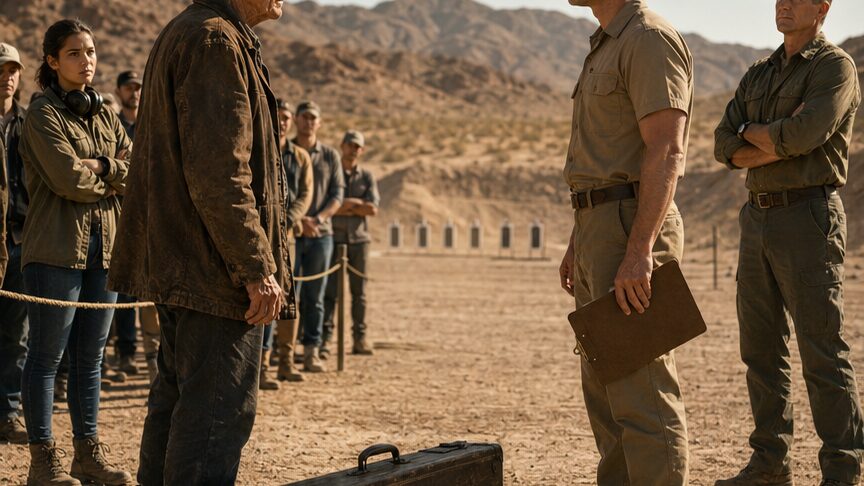
Near the registration tent, Ruth Baker moved between volunteers with the focused energy of someone managing a hundred problems at once.
She noticed him approaching.
“Morning, sir.”
“Morning.”
“Here for the charity match?”
“I am.”
She offered a smile.
“Registration’s right here.”
Mark set the case down beside the table.
The wood looked especially old against the sleek rifle bags and molded polymer cases stacked nearby.
Ruth handed him a form.
“Name?”
“Mark Taylor.”
She wrote it down.
Nothing in her expression changed.
No recognition.
No surprise.
Just another participant.
Mark preferred it that way.
As he completed the paperwork, voices drifted from the firing line.
Instructions.
Commands.
Corrections.
One voice carried farther than the others.
Young.
Confident.
Trying very hard to sound certain.
Mark glanced toward the line.
A tall instructor in a range uniform stood directing shooters.
Benjamin Roberts.
The name appeared on a sign clipped to his shirt.
He moved constantly.
Talking.
Pointing.
Correcting.
Performing authority as much as exercising it.
Mark had known instructors like that.
Sometimes confidence came from knowledge.
Sometimes it came from fear that people might discover how much you still had to learn.
Ruth finished processing the form.
“You’ve shot organized matches before, Mr. Taylor?”
“A few.”
She laughed softly.
“Something tells me that’s an understatement.”
Mark smiled but didn’t answer.
A volunteer handed him a lane assignment.
Lane fourteen.
One of the outer positions.
Far from the center.
Far from the spectators.
Mark nodded.
That suited him perfectly.
He picked up the rifle case and headed toward the firing area.
The desert sun climbed higher.
Heat shimmered above the sand.
The smell of dust and gun oil drifted across the range.
As he approached lane fourteen, he noticed several younger shooters setting up equipment nearby.
Carbon-fiber stocks.
Electronic optics.
Wind meters.
Rangefinding devices.
Thousands of dollars’ worth of gear.
Nobody paid much attention to him.
Until he placed the wooden rifle case on the bench.
One of the junior shooters glanced over.
Then another.
A few smiles appeared.
Not cruel.
Just amused.
The way people smiled when they encountered something they assumed belonged to another era.
Mark ignored them.
He opened a small pouch and removed hearing protection.
Slow.
Methodical.
Unhurried.
A voice suddenly called out behind him.
“Sir.”
Mark turned.
Benjamin Roberts approached.
Clipboard under one arm.
Expression already skeptical.
His eyes dropped immediately to the rifle case.
Then to Mark.
Then back to the case.
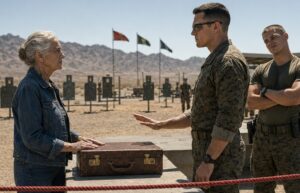
“Can I help you?”
“I’m assigned here.”
Benjamin checked the clipboard.
“You’re shooting today?”
“That’s the plan.”
The instructor studied him a moment longer.
“You sure you’re in the right event?”
A few nearby shooters looked up.
Mark kept his expression neutral.
“I registered.”
“There’s a beginner clinic over near the short-range bays.”
“I’m aware.”
Benjamin shifted his weight.
The smile on his face carried an edge.
“These lanes are for qualification shooting.”
“I know.”
The answer seemed to irritate him.
Mark recognized the reaction.
Some people expected uncertainty from old men.
Confidence disrupted the picture they had already created.
Benjamin looked again at the case.
“What’s in there?”
“A rifle.”
Several shooters chuckled quietly.
Benjamin didn’t.
“Mind opening it?”
“During inspection.”
The response was polite.
Firm.
Not argumentative.
Benjamin’s jaw tightened slightly.
Mark could almost hear the assumptions being assembled.
Old equipment.
Old shooter.
Possible safety problem.
Potential embarrassment.
The instructor glanced toward the line where volunteers were organizing competitors.
Then back to Mark.
“You understand we have strict safety standards.”
“I’m glad to hear it.”
Another answer that somehow made things worse.
Benjamin crossed his arms.
For a moment neither man spoke.
The desert wind moved dust across the firing mats.
Far downrange, target frames stood against the pale earth.
Finally Benjamin said, “We don’t want anyone getting hurt today.”
“Neither do I.”
A few nearby shooters exchanged looks.
Something about the conversation had stopped being amusing.
Mark remained calm.
Benjamin appeared increasingly frustrated.
The instructor seemed unable to find the mistake he expected.
Yet he remained convinced one existed.
Before he could continue, a volunteer called his name from farther down the line.
Benjamin glanced away.
Then back at Mark.
“Stay here.”
“I wasn’t planning to leave.”
Benjamin took two steps away.
Stopped.
Turned around again.
His eyes narrowed.
“Actually, no.”
The words carried across the lane.
Several nearby conversations faded.
Benjamin pointed away from the firing line.
“Step away from the line until I inspect that rifle.”
Silence settled briefly around them.
Mark looked at the young instructor.
At the uncertainty hiding beneath authority.
At the crowd beginning to watch.
Then he lowered his gaze to the old wooden case.
The same case people always noticed before they noticed the man carrying it.
When he looked up again, his voice remained steady.
“Of course.”
He stepped back exactly as instructed.
No argument.
No protest.
No defense.
Only patience.
But as he moved away from the line, more eyes followed him than before.
And for the first time that morning, the crowd began wondering whether they had judged him too quickly.
Chapter 2: The Instructor With The Loudest Voice
Benjamin Roberts hated being uncertain.
That was the truth he never admitted.
Authority depended on certainty.
At least that was what he believed.
So when the old man stepped away from the firing line without arguing, Benjamin felt something unexpected.
Not satisfaction.
Discomfort.
Most people pushed back.
Most people explained themselves.
Most people tried to win.
Mark Taylor had done none of those things.
The old man had simply complied.
As if Benjamin’s order wasn’t worth fighting.
As if the outcome had already been decided somewhere else.
Benjamin shoved the thought aside.
He had work to do.
The charity event was the biggest public range day of the year.
Sponsors were watching.
Club members were watching.
Veterans were watching.
Most importantly, Patrick Davis was watching.
Benjamin glanced toward the administration building.
The senior range officer had not arrived yet, but he would.
And when he did, Benjamin intended to look professional.
Prepared.
Commanding.
The promotion opportunity later in the year depended on it.
He returned to supervising the firing line.
The morning qualification groups rotated through their stations.
Commands echoed across the desert.
Rifles were checked.
Safety procedures reviewed.
Targets posted.
Benjamin moved constantly.
Correcting stances.
Answering questions.
Making sure everyone noticed he was in charge.
Yet his attention kept drifting back toward lane fourteen.
Mark Taylor waited beside the old rifle case.
Patient.
Silent.
Not reading a phone.
Not talking.
Not fidgeting.
Just watching the range.
Benjamin disliked it.
The stillness felt deliberate.
Modern shooters usually filled silence with something.
The old man simply observed.
Eventually Benjamin walked back toward him.
The case remained closed.
“Still waiting?”
Mark looked up.
“You told me to.”
Benjamin felt irritated by the answer despite having no reason to be.
“Right.”
He crouched beside the case.
“Let’s have a look.”
Mark nodded.
No defensiveness.
No hesitation.
The latch clicked open.
The wooden lid lifted.
Benjamin expected rust.
Dust.
Neglect.
Instead he found care.
The rifle inside was old.
Very old.
But spotless.
Metal surfaces showed maintenance.
The wood stock carried years of use without abuse.
Everything sat neatly arranged.
Nothing loose.
Nothing improvised.
Benjamin inspected it.
Checked the action.
Verified the chamber.
Reviewed the safety condition.
Every detail met standards.
Actually, exceeded them.
He closed the action and frowned.
“Where’d you get this?”
“I’ve had it a long time.”
“Still shoots?”
Mark smiled faintly.
“It tries.”
A nearby shooter laughed.
Benjamin didn’t.
He handed the rifle back.
Technically there was no problem.
No reason to deny participation.
Yet something about the old man continued bothering him.
Perhaps because Benjamin couldn’t place him.
Competence usually advertised itself.
Military stickers.
Competition patches.
Branded equipment.
Stories.
Mark displayed none of it.
Only the rifle.
Only the case.
Only quiet confidence.
Benjamin stood.
“Fine. You’re cleared.”
“Thank you.”
Again that calm voice.
Again no effort to prove anything.
Benjamin walked away.
For the next hour the event continued smoothly.
But the image stayed with him.
The old rifle case beside modern equipment.
The old man sitting quietly while younger shooters talked around him.
The absence of self-promotion.
It felt unnatural.
Near midday a vehicle pulled into the range parking area.
Heads turned.
Benjamin looked up.
Patrick Davis had arrived.
The senior range officer stepped from his truck and immediately began surveying the event.
Benjamin straightened instinctively.
Patrick possessed the kind of authority that required no performance.
He rarely raised his voice.
Rarely repeated instructions.
People listened anyway.
Benjamin hurried toward him.
“Sir.”
Patrick nodded.
“Everything running smoothly?”
“Yes, sir.”
They began walking together toward registration.
Benjamin listed procedures.
Participation numbers.
Safety checks.
Logistics.
Patrick listened while scanning the range.
Then they reached the registration table.
Ruth handed over participant records.
Patrick reviewed them casually.
Until he reached one name.
His movement stopped.
The paper remained frozen in his hand.
Benjamin noticed immediately.
“What is it?”
Patrick didn’t answer at first.
His eyes stayed on the form.
Mark Taylor.
Slowly Patrick looked across the firing line.
Searching.
Then finding.
Far down lane fourteen.
An elderly man sitting beside an old wooden rifle case.
Patrick’s expression changed.
Not surprise exactly.
Recognition.
Deep recognition.
The kind that reached backward through years.
Benjamin followed his gaze.
“You know him?”
Patrick remained silent for several seconds.
Then he folded the paper carefully.
“I might.”
The answer only increased Benjamin’s curiosity.
Patrick continued watching Mark.
A thoughtful look settling across his face.
Not admiration.
Not concern.
Something more complicated.
Benjamin suddenly felt a small knot tighten in his stomach.
For the first time all day, he wondered whether Mark Taylor was not who he appeared to be.
And Patrick Davis kept staring at him as though a forgotten chapter of history had just walked back onto the range.
Chapter 3: The First Rule Was Never Speed
By noon the desert heat had settled over the range like a blanket.
Mark sat beneath a shade canopy and watched dust drift across the firing lanes.
The wind had changed twice already.
Most shooters hadn’t noticed.
They relied on devices.
Screens.
Numbers.
Mark trusted observation first.
Technology second.
The old wooden rifle case rested beside him.
Its surface glowed softly in the sunlight.
Every scratch carried a memory.
Every repair had a story.
But today wasn’t about the past.
Today was about patience.
The firing line grew busier as qualification rounds continued.
Commands echoed through loudspeakers.
Targets moved.
Scopes adjusted.
Volunteers hustled between stations.
Mark observed quietly.
Listening.
Watching.
Learning the rhythm of the range.
And slowly he noticed something else.
Benjamin Roberts was rushing.
Not dangerously.
Not intentionally.
But rushing.
The young instructor moved shooters through procedures faster than conditions warranted.
Efficiency mattered.
Safety mattered more.
Mark kept his thoughts to himself.
Until the demonstration.
A group of junior shooters gathered near the central lane.
Amy Garcia stood among them.
Alert.
Attentive.
Eager to learn.
Benjamin stepped forward.
“Watch closely.”
He lifted a training rifle and began demonstrating handling procedures.
The crowd focused on him.
Mark did too.
The sequence started well.
Then Benjamin turned while speaking.
The muzzle swept farther than it should have.
Not toward anyone directly.
But close enough.
A small mistake.
The kind that grew into larger ones when ignored.
Most people missed it.
Mark didn’t.
Neither did Amy.
The young shooter frowned.
Uncertain.
Benjamin continued talking.
Moving quickly.
Trying to maintain momentum.
Trying to impress.
Mark stood.
The old joints protested slightly.
He ignored them.
Then he walked forward.
Not hurried.
Not dramatic.
Just deliberate.
Benjamin noticed him approaching.
His expression hardened immediately.
“What is it now?”
Mark stopped several feet away.
“May I make an observation?”
The question alone irritated Benjamin.
The audience sensed tension.
People turned toward them.
Patrick Davis watched from nearby.
Silent.
Interested.
Benjamin folded his arms.
“Go ahead.”
Mark nodded toward the rifle.
“The first rule was never speed.”
Benjamin frowned.
“What?”
“The first rule.”
Mark’s voice remained calm.
“It was never speed.”
Silence spread.
The younger shooters listened.
Mark continued.
“Slow is smooth. Smooth becomes safe. Safe becomes fast enough.”
Benjamin’s jaw tightened.
“I know safety procedures.”
“I’m sure you do.”
No insult.
No challenge.
Which somehow made the correction harder to dismiss.
Amy glanced between them.
Patrick’s eyes narrowed thoughtfully.
Benjamin looked around.
Aware of the audience.
Aware of attention shifting.
His pride stepped forward before his judgment could stop it.
“If you’ve got something to prove,” he said, “prove it.”
Mark said nothing.
Benjamin pointed toward lane fourteen.
“Everyone’s heard enough advice.”
A few spectators exchanged looks.
The tension became visible.
The challenge had arrived.
Benjamin continued.
“Let’s see whether that old rifle still works.”
The crowd grew quieter.
Mark looked at him for a long moment.
Not angry.
Not offended.
Just thoughtful.
Then he turned toward the wooden rifle case.
The desert wind brushed across the range.
Dust curled through the sunlight.
People followed him.
Amy followed.
Patrick followed.
Even the volunteers slowed to watch.
Mark knelt beside the case.
His hands settled on the worn brass latches.
Steady hands.
Patient hands.
The same hands that had performed this ritual thousands of times.
The lid opened.
Sunlight touched polished wood and steel.
No flourish.
No performance.
Just care.
Mark lifted the rifle.
The movement drew silence from the crowd.
Something had changed.
The amusement from earlier was gone.
The certainty was gone too.
Nobody laughed now.
The old man handled the rifle with effortless familiarity.
Every motion precise.
Every step controlled.
Patrick watched closely.
A faint memory seemed to pass behind his eyes.
Mark checked the chamber.
Verified the action.
Confirmed every detail.
The routine looked smoother than any demonstration Benjamin had given all morning.
People noticed.
Benjamin noticed.
That realization unsettled him more than he expected.
Mark settled beside the firing mat.
The rifle rested gently in position.
He studied the distant targets.
Then the wind.
Then the dust.
Then the target again.
Amy found herself holding her breath.
Finally Mark spoke.
Not loudly.
Yet everyone heard him.
“The target will tell you.”
The words settled across the range.
Simple.
Certain.
Old.
Patrick’s expression changed immediately.
Recognition flashed through his eyes.
Strong enough that Amy noticed.
Strong enough that Benjamin noticed too.
Nobody understood why.
Not yet.
But the atmosphere had shifted.
The challenge no longer felt amusing.
It felt important.
Mark adjusted his position.
The rifle settled naturally against his shoulder.
The distant targets shimmered through heat waves.
Wind crossed the wash beyond the range.
And for the first time that day, every person watching understood the same thing.
Whatever happened next would answer far more than a question about an old rifle.
Benjamin folded his arms.
Trying to appear confident.
Trying to suppress growing uncertainty.
Mark remained motionless.
Studying conditions.
Waiting.
The target hanging far downrange seemed impossibly small.
Yet his attention never wavered.
Then the range fell completely silent.
And Benjamin heard himself say the words that committed everything.
“Go ahead, Mr. Taylor.”
Mark’s eyes never left the target.
The wind shifted again.
He smiled slightly.
And accepted the challenge.
Chapter 4: Wind Across The Empty Wash
Amy Garcia had seen plenty of people act confident with rifles.
Most of them talked too much.
Mark Taylor did not.
That was the first thing she noticed when he settled behind the old rifle. He did not fill the silence with jokes or warnings or reasons. He did not explain how hard the shot would be. He did not look around to see who was watching.
He simply became still.
The firing line seemed to tighten around him.
Amy stood behind the marked spectator rope with the other junior shooters, her hands clasped around the strap of her range bag. She could feel dust sticking to the sweat on her palms. Beside her, a younger shooter whispered something and then stopped when no one answered.
Far downrange, the target was barely more than a pale square trembling in the heat.
A spotting scope stood near Patrick Davis.
The scorekeeper adjusted another scope beside him.
Benjamin Roberts remained near the line with his clipboard tucked against his ribs, his posture stiff enough to look painful.
Mark seemed unaware of all of them.
He lay behind the rifle with the old case open beside the mat. The lid rested on its hinges like a small wooden door into another time. Inside, the lining was faded but clean. Amy could see the empty spaces where tools and cloth had been placed with care.
Nothing about the case looked impressive.
Everything about it looked used.
That unsettled her more than expensive equipment ever had.
Mark lifted his head slightly and looked over the range rather than through the sights. His eyes tracked the flags first, then the dust, then the low brush beyond the target line. He waited.
Benjamin shifted.
“We do have other shooters waiting,” he said.
Patrick glanced at him once.
Benjamin went quiet.
Amy noticed that too.
Mark adjusted his left hand by less than an inch. He touched the stock as though asking it a question. Then he leaned in again.
The wind brushed Amy’s cheek.
She looked toward the range flags.
They barely moved.
Then she saw what Mark had been watching.
A thin line of dust crossed the wash behind the target. It moved at a different angle than the flags near the firing line. The wind near them was not the wind downrange.
Mark waited until the dust thinned.
Then waited longer.
No one spoke.
The old rifle cracked.
Amy flinched despite herself.
The sound moved across the desert and returned faintly from the berm.
Mark did not lift his head.
The scorekeeper bent over the spotting scope.
A long second passed.
Then another.
“Impact,” the scorekeeper said.
His tone was odd.
Not excited.
Not doubtful.
Oddly careful.
Patrick stepped closer to the scope.
“Where?”
The scorekeeper moved aside.
Patrick looked.
Amy watched his face instead of the target. His expression barely changed, but something in his shoulders lowered.
Benjamin leaned toward another scope.
“Let me see.”
No one stopped him.
He looked through it.
For a moment he said nothing.
Then he pulled back.
“That’s one shot.”
Mark remained behind the rifle.
“Yes.”
The answer was quiet.
Benjamin’s mouth tightened.
“Take the next.”
Mark did not obey immediately.
He opened the action, checked, settled again, and returned to the sights only when ready. The pace was almost frustrating. Amy realized she had been trained to expect speed after the first shot. Mark’s slowness made every movement visible.
Nothing wasted.
Nothing rushed.
He watched the dust again.
The wind shifted.
He waited.
A fly circled near the mat and vanished.
Amy heard someone behind her exhale.
The second shot broke.
This time she did not flinch.
She stared at the distant paper as if she could see through the heat.
The scorekeeper looked into the scope.
His hand moved to adjust focus.
He looked again.
Patrick waited.
“Impact,” the scorekeeper said.
“Mark?” Patrick asked.
The scorekeeper swallowed.
“Same mark.”
A murmur moved through the spectators.
Benjamin stepped forward sharply.
“That’s not possible from here.”
No one answered.
Patrick looked through the scope again.
Then he turned toward Mark.
Mark had already opened the action.
He was not smiling.
He was not looking at Benjamin.
He was looking at the wind.
Amy felt something in her chest tighten.
It was not excitement exactly.
It was recognition of a kind of discipline she had wanted without knowing its shape.
Benjamin had told them all morning to trust instruction.
Mark was showing them what instruction looked like when it had settled into bone.
The third shot took the longest.
The sun pressed against the range.
Heat waves trembled above the lane.
The wind wandered, died, then returned from the left.
Mark’s breathing seemed to vanish.
Amy could not tell whether he was waiting for the wind to agree with him or waiting for himself to agree with the shot.
The old rifle cracked again.
The sound was no louder than before.
But the silence after it was different.
The scorekeeper went to the scope.
He stayed there.
Too long.
Benjamin turned on him.
“Well?”
The scorekeeper lifted his face slowly.
“I can’t call it clean from here.”
Benjamin seized on that.
“So he missed.”
“I didn’t say that.”
“Then what are you saying?”
The scorekeeper looked toward Patrick.
“I’m saying we should bring the target back.”
No one moved for a second.
A desert gust rattled the shade canopy.
Mark rose slowly from the mat and opened the rifle. His movements remained exact. He cleared it, checked it, and set it down safely.
Only then did he sit back on his heels.
Amy stared at him.
She wanted him to look triumphant.
He didn’t.
He looked tired.
And calm.
As if the shot had never been about proving he could make it.
As if the answer had belonged to the target all along.
Chapter 5: When The Target Came Back Silent
Patrick Davis knew the sound of a crowd changing its mind.
It did not sound like applause.
It sounded like the absence of easy laughter.
It sounded like people becoming careful with their breathing.
As the target carrier rolled back from the far line, Patrick stood near the return area with his arms folded and his eyes on Mark Taylor.
The old man had not approached the crowd.
He had returned the rifle to the mat, verified it safe, and closed the old wooden case halfway, as if the matter were almost finished but not quite.
Benjamin stood closer to the target path than anyone else.
Too close.
Too eager.
His face held a stubborn expression Patrick recognized from younger instructors who had confused correction with defeat.
Patrick had once worn a version of that face himself.
The target arrived clipped to its frame.
The scorekeeper lifted it down.
Dust streaked the paper.
The center mark was visible even before it came fully into view.
No one spoke.
That was the worst of it for Benjamin.
There was no cheering to hide behind.
No shouted admiration.
Just the plain white target and the small dark wound at its center.
Patrick stepped forward.
The scorekeeper held the paper flat.
Three shots had passed through one ragged hole.
Not perfectly one hole.
Nothing in the real world was perfect.
But close enough that the paper had torn into a single dark clover at the center mark.
Patrick heard Ruth Baker whisper, “Oh my.”
Benjamin stared.
His mouth opened once.
Closed.
Opened again.
“Could be the paper tore on retrieval,” he said.
The words landed badly.
No one corrected him at first.
The silence did it instead.
Patrick looked at the scorekeeper.
“Call it.”
The scorekeeper cleared his throat.
“Three confirmed impacts. Center group.”
Benjamin’s fingers tightened around the clipboard.
“With that rifle?”
Patrick looked toward lane fourteen.
“With that shooter.”
The distinction mattered.
Benjamin heard it.
Mark did too.
The old man finally approached, walking with the same steady pace he had used all morning. He stopped several feet from the target, not crowding the proof, not reaching for it.
His eyes moved over the paper once.
Only once.
Then he nodded.
“Wind held longer than I thought.”
A few people looked at him as though he had just explained a miracle by mentioning the weather.
Patrick almost smiled.
That phrase.
That restraint.
That refusal to make the moment larger than it needed to be.
Memory stirred fully now.
Not Mark’s face as it was, but a younger version in old photographs. A name spoken in range rooms. A standard quoted by instructors who had never met the man behind it.
The target will tell you.
Patrick had heard those words from his own first mentor.
He had heard them after bad shots, lucky shots, rushed shots, and shots ruined by pride.
He had never known where they began.
Until now.
Benjamin turned toward Mark.
“You expect everyone to believe you just walked in here after all these years and did that cold?”
Mark met his eyes.
“No.”
Benjamin blinked.
Mark continued, “I don’t expect anything.”
That answer left Benjamin with nowhere to go.
Patrick stepped in before pride could make the young man worse.
“Mr. Taylor,” he said, “have you been here before?”
Mark’s gaze shifted to him.
For a second, Patrick saw recognition in the old man’s eyes too.
Not immediate.
Careful.
As though Mark were sorting through decades.
“A long time ago.”
“My first instructor trained under a man named Taylor.”
Mark’s expression softened only slightly.
“What was his name?”
Patrick told him.
The effect was small but unmistakable.
Mark looked toward the range office, then back to the desert.
“He was a good student.”
Patrick felt the weight of that sentence.
Was.
Not is.
A small silence followed.
Even Benjamin seemed to sense it did not belong to him.
Ruth approached with a folder pressed against her chest.
Her face was pale with urgency.
“Patrick.”
He turned.
She held out an old laminated card.
“I found this in the archive box. The one we keep for the anniversary display.”
Patrick took it.
The card had yellowed at the edges.
A younger Mark Taylor stared out from a faded photograph.
Beside the image were printed range credentials, instructor authorization, and a handwritten note in blue ink.
Safety standard review committee.
Patrick looked up slowly.
Ruth’s voice dropped.
“His signature is on the original range procedures.”
The paper in Patrick’s hand suddenly felt heavier than the target.
Around them, people leaned closer.
Benjamin looked from the card to Mark.
The color in his face changed.
Mark saw the card and sighed quietly.
Not with pride.
With resignation.
As if the past had stepped into the open before he was ready.
Patrick held the card carefully.
“Mr. Taylor,” he said, “you helped write the rules we still teach.”
Mark’s eyes went to the junior shooters.
Then to Benjamin.
Then to the target.
“No,” he said softly. “We wrote reminders. The rules were already true.”
Benjamin lowered his clipboard.
For the first time all day, he had no answer.
Ruth looked at Mark with new understanding, but Mark did not accept the attention. He reached toward the old card only to turn it face down in Patrick’s hand.
“The event is for the families,” he said. “Not for me.”
Patrick nodded.
But the silence around them had changed again.
It no longer judged.
It listened.
And Benjamin Roberts stood in the middle of it, finally realizing the old man he had mocked had been part of the ground beneath his own authority.
Chapter 6: The Name Behind The Old Rule
Mark wished Ruth had not found the card.
The target was one thing.
A target spoke only about a shot already taken.
The card invited stories.
Stories invited polishing.
Polishing turned men into decorations on walls.
Mark had spent enough of his life watching people mistake symbols for standards.
He followed Patrick and Ruth into the range office because refusing would have created a larger scene. The room smelled of paper, coffee, dust, and old cleaning solvent. A wall near the back held photographs from previous events: charity matches, youth clinics, club anniversaries, safety courses.
In the corner, a display board had been prepared for the day.
Old score sheets.
Founding documents.
A faded photograph of instructors standing beneath this same desert sun many years earlier.
Mark saw himself before anyone pointed him out.
Younger.
Straighter.
Harder around the eyes.
Standing beside men who were gone now.
He looked away first.
Ruth placed the old range card on the desk.
“I’m sorry,” she said. “I didn’t mean to put you on display.”
“You were doing your job.”
“Still.”
Mark glanced toward the window.
Outside, the crowd had not dispersed completely. People pretended not to watch the office.
Benjamin stood near the doorway but did not enter until Patrick nodded him in.
The young instructor looked smaller indoors.
Not weak.
Just stripped of the space where his voice could carry.
He held his clipboard at his side instead of against his chest.
Ruth picked up one of the old procedure sheets.
“Your name is on three revisions.”
Mark said nothing.
Patrick studied the document.
“Muzzle discipline. Cold line verification. Instructor pacing standards.”
He looked up.
“That one sounds familiar today.”
Benjamin flinched almost imperceptibly.
Mark noticed.
So did Patrick.
Ruth read a handwritten margin note.
“‘No student learns safety from a rushed teacher.'”
She looked at Mark.
“Did you write that?”
Mark’s jaw tightened.
“Maybe.”
Patrick smiled faintly.
“That means yes.”
Mark gave him a tired look.
Patrick’s smile faded into respect.
For a moment, the office held only the low hum of an old fan turning overhead.
Then Benjamin spoke.
“I didn’t know who you were.”
Mark turned to him.
“That shouldn’t have mattered.”
The words were not sharp.
That made them land harder.
Benjamin looked down.
“No, sir.”
Mark hated the sir more than the mockery.
Not because respect was wrong.
Because sudden respect was often just embarrassment wearing clean clothes.
He moved toward the wall display and touched the edge of an old photograph.
“People get names wrong,” he said. “They get age wrong. Equipment wrong. Happens every day.”
Benjamin said nothing.
“The line doesn’t care.”
Outside, a rifle case latch clicked somewhere.
Mark heard it and paused.
His own wooden case rested back on the bench, waiting.
He wished he were there instead of here.
Patrick stepped beside him.
“My mentor talked about you,” he said quietly. “Not often. But when he did, everyone listened.”
Mark kept his eyes on the photograph.
“He talked too much.”
Patrick almost laughed, then caught himself.
“He said you taught him the target never lies.”
Mark shook his head.
“No. I taught him people lie to themselves before the target ever gets a chance.”
Benjamin’s face tightened again, but this time he did not defend himself.
Ruth closed the folder.
“What brought you back today?”
Mark did not answer immediately.
Through the window, Amy Garcia stood near the firing line with the other junior shooters. She was watching the empty mat where he had lain behind the rifle.
A careful watcher.
That mattered.
“I made a promise,” Mark said.
No one pressed him.
He appreciated that.
After a while, he added, “To a student.”
Patrick understood first.
His eyes softened.
“The man who trained me.”
Mark nodded once.
“He believed this place could teach more than shooting. Discipline. Patience. Respect for consequence.” He looked at Benjamin. “Not fear. Not ego.”
Benjamin absorbed it without looking away.
Mark continued, “He asked me, years ago, to come back if the range ever became more about performance than standards.”
Ruth lowered her eyes.
Patrick looked toward the firing line.
Benjamin swallowed.
“That’s why you came today?”
“That and the charity.”
The answer was simple because the truth was simple.
Mark had not come to expose anyone.
He had not come to reclaim anything.
He had come because a promise made to a good student did not expire just because the hands that made it had grown old.
A soft knock came at the open door.
Amy stood there, half in sunlight.
She looked uncertain but determined.
“Mr. Taylor?”
Mark turned.
“Yes?”
She glanced at Patrick, then Ruth, then Benjamin.
“I’m sorry to interrupt.”
“You’re not.”
She held her range cap in both hands.
Her voice was quiet enough that everyone leaned slightly to hear.
“Before you leave, would you teach me one thing?”
Benjamin looked at her.
Something crossed his face.
Not jealousy.
Not anger.
Recognition of what real authority attracted when it stopped demanding attention.
Mark looked past Amy to the desert range.
The sun had begun lowering.
The wind was changing again.
He felt the old ache in his knees.
The deeper ache in his memory.
Then he looked back at the young shooter.
“One thing?”
Amy nodded.
“Just one.”
Mark reached for the old range card on the desk and slipped it gently back into the folder, out of sight.
Then he picked up his cap.
“All right,” he said. “But we start with the case.”
Chapter 7: The Shot He Chose Not To Take
The range was quieter at sunset.
Most of the crowd had drifted toward the clubhouse, where Ruth Baker had asked volunteers to help pack away banners and donation boxes. A few veterans remained near the shade tents, speaking in low voices. The junior shooters lingered at the edge of the firing line, unwilling to leave but unsure whether they were allowed to stay.
Mark Taylor carried the wooden rifle case back to lane fourteen.
Amy walked beside him.
She did not talk.
That pleased him.
People who wanted to learn usually began by filling the air with questions. People who were ready to learn often discovered silence first.
Benjamin followed several steps behind them.
Patrick stayed near the range office, giving them distance.
The western sky had turned amber above the desert wash. Long shadows stretched from the target frames. The wind had softened but not vanished. It moved differently now, low and cool across the ground, lifting dust only in brief touches.
Mark placed the case on the bench.
Amy stood with her hands at her sides.
He looked at her.
“What did you see today?”
She glanced toward the distant target area.
“You made three shots through almost the same hole.”
“That’s what the paper showed.”
She frowned slightly, catching the correction.
“You waited for the wind.”
“Some.”
“You didn’t rush.”
“No.”
She looked at the case.
“You checked everything before you touched the line.”
Mark nodded.
“That’s the lesson.”
Amy blinked.
“That’s it?”
“That’s enough for one day.”
Behind them, Benjamin shifted.
Mark heard the movement but did not turn.
Amy studied the old case.
Its brass latch glowed in the last light.
“Why start with the case?” she asked.
Mark rested one hand on the worn wood.
“Because before anyone sees what you can do, they see what you brought. They judge it. Then they judge you.”
Amy lowered her eyes.
“I did.”
“So did most people.”
“I’m sorry.”
Mark shook his head.
“Don’t be sorry. Be better next time.”
She nodded once.
The words settled into her more deeply than praise would have.
Mark opened the case.
Slowly.
Deliberately.
Not for display.
For sequence.
He showed her how every item had its place. Cloth. chamber flag. small tool. log card. rifle.
“Order matters,” he said. “Not because neatness wins matches. Because disorder hides mistakes.”
Amy leaned closer.
He did not let her touch anything yet.
“First question before you handle any firearm?”
“Is it safe?”
“Too broad.”
She thought.
“Is the chamber clear?”
“Closer.”
He looked at her until she understood he would wait as long as needed.
Finally she said, “Have I personally verified the condition?”
Mark nodded.
“Good.”
Benjamin’s voice came from behind them, quieter than it had been all day.
“Mr. Taylor.”
Mark closed the case halfway but did not latch it.
Then he turned.
Benjamin stood with his clipboard held loosely in one hand.
He looked younger now. Not because humiliation had weakened him, but because certainty had left his face and made room for honesty.
“I owe you an apology,” Benjamin said.
The junior shooters went still.
Mark waited.
Benjamin swallowed.
“I judged you by your age and your equipment. I made it public. Then I tried to argue with the truth when it came back on paper.”
He looked toward Amy, then the others.
“That was wrong.”
The words were plain.
No performance.
Mark respected that.
After a moment, he said, “Apology accepted.”
Benjamin nodded, but did not seem relieved.
Good, Mark thought.
Relief came too easily when apology was treated like a receipt.
Benjamin looked at the firing mat.
“I thought authority meant never looking unsure.”
Mark turned back to the case.
“Authority means making sure no one pays for your uncertainty.”
The sentence landed quietly.
Benjamin looked down.
Amy remembered it. Mark could tell by the way her eyes sharpened.
Patrick approached then, carrying the target paper.
He had placed it inside a clear sleeve to keep the torn center from widening.
“Ruth wants to pin this inside the clubhouse,” Patrick said. “With your permission.”
Mark looked at the paper.
The three-shot group sat in the middle like a small dark knot.
All day, people had wanted that paper to mean something.
Proof.
Correction.
Reversal.
Victory.
To Mark, it meant conditions had been read properly and fundamentals had held long enough.
“Pin it without my name,” he said.
Patrick almost protested.
Then stopped.
“What should the label say?”
Mark looked at Amy.
She looked back, startled.
“The target will tell you,” she said softly.
Mark smiled.
“That will do.”
Patrick nodded.
Benjamin looked at the target, then at the old rifle case.
“Would you consider coming back?” he asked.
Mark’s hands paused on the latch.
The question touched something older than the day.
He saw, for a moment, the student who had asked him years ago not to let the range forget what mattered. He saw younger faces on hot mornings, heard corrections carried across dust, remembered men who had believed safety was not a rulebook but a form of respect for everyone standing near you.
He had come to keep a promise.
He had not expected the promise to ask anything more.
“We’ll see,” Mark said.
It was not yes.
It was not no.
Benjamin accepted it like more than he deserved.
The sun lowered until the range lights began to hum faintly above the lanes.
Mark finished showing Amy how to close the case.
Not just shut it.
Close it properly.
Check the rifle. Check the chamber flag. Return each item. Lower the lid. Secure the latches. Lift with care.
“Everything you do before and after the shot matters,” he said. “The shot is only the part people notice.”
Amy placed one hand lightly on the case handle after he gave permission.
“Thank you,” she said.
Mark nodded.
He lifted the case himself.
It felt heavier at the end of the day.
Or perhaps his arm was tired.
Across the range, Ruth pinned the sleeved target to the clubhouse wall. A few volunteers gathered around it. No one clapped. No one needed to.
The paper hung beneath the simple label Patrick had written.
The target will tell you.
Benjamin remained at the firing line, watching Amy explain the case sequence to another junior shooter in a low, careful voice.
Mark saw that and felt something ease.
Not pride.
Not exactly.
Something quieter.
The comfort of knowing a standard had moved from one set of hands to another.
He walked toward his truck as the desert cooled around him.
Dust shifted under his boots.
The old wooden case swung at his side, still scratched, still plain, still carrying more than anyone could see from a distance.
Behind him, the range settled into evening.
Ahead of him, the last sunlight stretched across the parking lot.
Mark did not look back until he reached the truck.
When he did, he saw Amy standing near lane fourteen, showing Benjamin how she had been taught to wait before touching the case.
Benjamin listened.
Really listened.
Mark placed the wooden case gently in the truck bed and rested his hand on it for a moment.
Then he closed the tailgate.
The target stayed pinned to the wall.
The old rule stayed with the range.
And Mark Taylor drove away before anyone could turn him into a story larger than the lesson.
The story has ended.