When They Pulled Open His Shirt, The Number 412 Changed The Room
Chapter 1: The Table Beside The Window Was Already Taken
Joseph Bennett arrived at Miller’s Crossing Diner at eleven minutes past ten, the same as always, though the clock above the pie case had been running six minutes slow since March.
He knew because Ruth Miller had once stood under it with a broom in her hand, squinting up like the clock had personally disappointed her, and said she would ask the owner to fix it before Easter. Easter had come, lilies had browned in church windows, summer had pressed its heat against the glass, and the clock still lied by six minutes.
Joseph did not mind. There were worse things in the world than a clock that kept almost-time.
The bell over the door gave its thin metallic cough when the young cashier pushed it open for him. She held the door with one hip while pretending not to struggle with the weight of it. Joseph guided his chair over the threshold, one hand on the wheel, the other resting over his shirt pocket.
“You’re good, sir,” the cashier said brightly.
Joseph nodded once.
The diner smelled of coffee burned a little too long on the hot plate, bacon grease, lemon cleaner, and the floury warmth of biscuits. It was a small place, narrow in front and wider near the back, with booths along the windows and four square tables in the middle where lunch regulars liked to sit in groups and complain about things they did not truly want changed.
The table beside the far window was empty.
Joseph saw it before he saw anything else.
It sat under the striped shade with a clean paper placemat, two wrapped sets of silverware, and the small glass sugar holder Ruth always filled more than the others because she said people at that table seemed to need sweetness. Outside the window, the parking lot sloped toward the road. A maple tree near the curb had begun losing its leaves early, one yellow leaf stuck wetly to the glass.
Joseph rolled toward the table.
Behind the counter, Ruth looked up from pouring coffee into three mugs at once.
“Morning, Mr. Bennett,” she called.
He lifted two fingers from the wheel.
“Your usual?”
He nodded again.
Ruth did not ask if he wanted the eggs over easy, toast dry, bacon soft, coffee black, or the white mug instead of the brown one. She had asked the first four times, years ago. After that, she remembered. Some people thought remembering was a small kindness. Joseph knew it was not small.
He positioned his chair at the table with the practiced angles of a man who disliked being helped into places. The old wooden chair that usually blocked the space had already been moved aside. Ruth did that before he arrived on the twelfth day of every month. He had never thanked her aloud. She had never forced him to.
He set the brake with his thumb.
On the table sat a white ceramic mug, turned so the handle pointed toward him. He put his hand around it but did not lift it. First he turned it once clockwise, then once back, until the tiny chip near the rim faced the window.
Only then did he take a breath.
Outside, a delivery truck hissed to a stop. Inside, forks touched plates, someone laughed too loudly in the corner booth, and the radio above the kitchen pass-through played an old country song low enough to be mistaken for memory.
Ruth brought the coffee herself.
“Food’ll be right out,” she said, setting the pot back against her apron. “You warm enough here? That vent’s been acting up.”
Joseph looked toward the ceiling vent, then at her.
“I’m fine.”
His voice had not warmed up yet. It came out rough, not unfriendly, but unused.
Ruth smiled as if he had given her a whole paragraph.
“Good.”
She tucked an extra napkin beside the silverware and moved on.
Joseph watched steam rise from the mug. The white surface of the coffee trembled slightly when someone walked heavily behind him. He laid his right hand on the edge of the table until the tremble settled.
The twelfth day.
He did not say the date in his head anymore if he could help it. Numbers had a way of becoming rooms. Say one, and suddenly you were standing inside it.
A group of three men came in wearing work shirts with a plumbing company logo on the back. They looked at Joseph’s table, then at the larger empty table near the kitchen, and one of them said, “Window’s taken.”
The second man lowered his voice badly. “Always is, I guess.”
Joseph heard him. He heard most things people thought were softened by turning slightly away.
Ruth came with his plate. Eggs glossy at the center, toast cut diagonally, bacon pale the way he liked it. She placed the plate in front of him and slid the extra napkin closer, a small square of white on the table.
“You need anything, wave me down.”
Joseph nodded.
He picked up his fork, but before he cut into the eggs, he touched the napkin’s edge. Not folding it. Not yet. Just making sure it was there.
At the counter, the owner’s voice rose from the kitchen pass-through. “Ruth, we’ve got a party of six coming in fifteen. If window table stays locked up for one, we’re losing the rush.”
Ruth glanced toward Joseph, then back toward the kitchen. “There are other tables.”
“Not for six there aren’t.”
Joseph looked down at his plate. The eggs had begun cooling from the edges inward.
A minute later, Matthew Carter came out from the back.
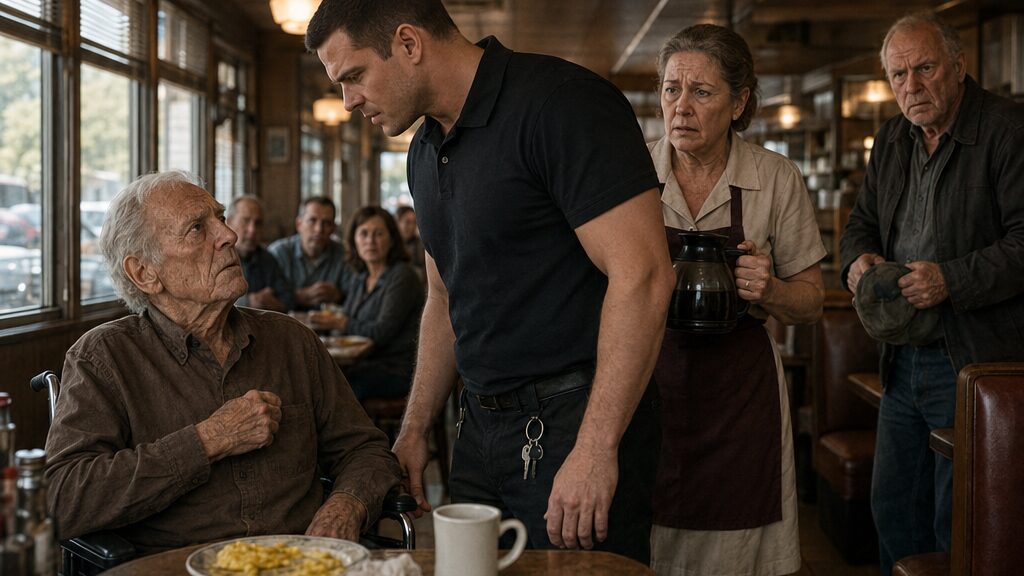
Joseph had seen him before, though not often before noon. Matthew was broad through the shoulders, with close-cut hair and a black polo shirt with the diner’s name stitched over the chest. He carried himself like a man always expecting to be asked to move something heavy or stop something from happening. His keys hung from his belt. His face was young but already set in the habit of impatience.
He stopped near Ruth.
They spoke too low for most of the room to hear.
Joseph heard enough.
“He’s one person.”
“He comes once a month.”
“And sits two hours.”
“He pays.”
“Ruth.”
“No.”
Matthew’s jaw tightened. He looked toward the table beside the window. Their eyes met.
Joseph cut into the eggs. The yolk opened slowly across the plate.
Matthew came over with a practiced service smile that did not reach any part of him that mattered.
“Mr. Bennett?”
Joseph chewed, swallowed, and set the fork down.
“We’re going to need this table for a larger party.”
Joseph looked at the other tables. Two were empty. One had a newspaper spread across it and no customer. The corner booth held a man reading receipts and pretending the coffee cup in front of him justified taking up four seats.
“My table,” Joseph said.
Matthew breathed through his nose. “I understand you like sitting here. But today we need to be flexible.”
Joseph picked up the mug, turned it slightly, and put it back down.
Ruth appeared near Matthew’s shoulder. “I can put the party in the middle if we pull two tables together.”
“The owner already said this one,” Matthew said without looking at her.
Joseph stared out the window. A yellow leaf peeled loose from the glass and dropped from sight.
“Sir,” Matthew said. The word was polite. The tone was not. “I’m asking respectfully.”
Joseph’s left hand moved to his shirt pocket.
It was a small motion, but Matthew saw it. His eyes went there, then back to Joseph’s face.
“You have a problem moving, I’ll help you.”
“No.”
The room had become quieter by a few degrees. Not silent. Diners rarely went silent all at once. They thinned into attention. Forks slowed. A chair stopped scraping halfway through its turn. The man with receipts lowered one page.
Matthew stepped closer.
“This isn’t your personal dining room.”
Joseph looked up at him then. The younger man’s face was clean-shaven, flushed slightly along the cheekbones. He smelled faintly of dish soap and aftershave.
“No,” Joseph said. “It isn’t.”
“Then let’s not make this hard.”
Joseph placed both hands on the wheels of his chair but did not release the brake.
For one brief second Ruth seemed about to step between them. The owner called her name from the back, sharp and irritated. The party of six had arrived at the door, voices bright with hunger and no knowledge of what they had walked into.
Matthew leaned down until his shadow fell across Joseph’s plate.
“I said we need the table.”
Joseph’s fingers tightened once on the wheel rims.
The room waited for him to shout, to explain, to become the kind of old man people knew what to do with.
He only said, “Not today.”
Matthew’s service smile disappeared.
Chapter 2: The Number Under The Worn Brown Shirt
Matthew Carter had been told twice that morning that he needed to take charge of the floor.
The first time came from the owner, who had pointed at the reservation list with a pen and said, “You’re not here to be liked.”
The second came from the cook, who had shoved a tray of biscuits through the pass-through and muttered, “Dining room’s jammed because nobody tells people no.”
Matthew had heard both remarks as instructions.
Now he stood beside the window table with a party of six waiting near the register, Ruth watching him like he was about to step off a curb into traffic, and Joseph Bennett sitting in his wheelchair as if the table had roots grown through the floor.
Matthew felt the eyes before he counted them. The plumbers. The teenagers near the pie case. The old man in the corner with the folded cap. The young cashier holding six menus against her chest.
He told himself the old man was forcing this.
“Mr. Bennett,” he said, keeping his voice low. “I’m going to move you to another table.”
Joseph did not touch his fork.
“No.”
Matthew looked at the plate, at the coffee, at the napkin near Joseph’s hand. “Your food goes with you. Nothing changes.”
Joseph’s eyes lifted slowly.
“Everything changes.”
Something in the answer irritated Matthew more than refusal would have. It sounded like a riddle made at his expense. Like the old man expected him to know things no one had told him.
Ruth said, “Matthew, leave it.”
He did not turn around. “I’ve got it.”
The owner was visible now in the kitchen doorway, wiping his hands on a towel. He did not come out. That was the kind of help Matthew was used to.
Joseph’s right hand rose again toward his shirt pocket, a guarded motion.
“What are you reaching for?” Matthew asked.
Joseph’s hand stopped.
The question landed harder than Matthew intended. He knew it as soon as the cashier’s mouth opened slightly. But his pride was already moving faster than his judgment.
Joseph looked at him with something cold and disappointed.
“My napkin.”
“It’s on the table.”
“My pocket.”
Matthew saw the worn brown shirt, the pocket with its loosened stitching, the way Joseph kept his palm over it like there was money or medicine or something sharp inside.
“You can take it out slowly,” Matthew said.
Ruth made a small sound behind him. “For heaven’s sake.”
Joseph did not move.
The party of six had stopped talking.
Matthew leaned down. “Sir, I’m not playing games.”
Joseph’s voice came lower. “Neither am I.”
Matthew reached for the shirt pocket.
He meant to catch Joseph’s wrist. He meant to stop whatever the old man was hiding before the room could become something he could not manage. That was what he told himself later, and it was almost true. But anger made his hand careless. His fingers caught the front of Joseph’s shirt instead, bunching the thin brown fabric near the buttons.
Joseph’s chair shifted back an inch before the brake held.
The white mug rattled against the table.
“Matthew!” Ruth snapped.
Joseph’s hand closed around Matthew’s wrist.
Not violently. Not weakly either.
Matthew froze.
The old man’s grip was dry, bony, and exact. It did not squeeze for pain. It simply stopped him. Matthew looked down in surprise, and in that half-second his hand pulled harder than he meant to.
One button snapped loose.
The front of Joseph’s shirt opened.
Under the hollow of his collarbone, on skin pale with age and crossed by old scars of no clear shape, was a dark tattoo. The lines had blurred over time but remained unmistakable: a narrow cross, or maybe a blade pointed downward, inked above three numbers.
The room changed.
No one gasped. That would have been easier. Instead there was a thick withdrawal of ordinary sound. The grill hissed from the kitchen. A spoon clicked once in a saucer. The radio went on singing to no one.
Matthew still had a fistful of Joseph’s shirt.
Joseph looked not at the exposed tattoo, not at the broken button, but into Matthew’s face.
“You don’t know,” Joseph said quietly, “what you’re touching.”
The words were not loud. They carried anyway.
Matthew released the fabric as if it had burned him.
Joseph kept hold of his wrist for one second longer, then let go. He pulled the shirt together with stiff fingers. The missing button had fallen somewhere under the table.
Ruth stepped forward, her face pale. “Mr. Bennett, I’m sorry.”
Joseph did not answer her.
The old man in the corner stood.
He was tall, though age had bent one shoulder lower than the other. He wore a plain jacket and held a folded cap in both hands. Until that moment he had been another lunch regular, one of the men who came for soup and coffee and paid in exact change.
Now his eyes were fixed on Joseph’s chest.
“Where did you get that number?” he asked.
Joseph’s fingers stopped on the shirt.
Matthew turned. “Sir, please sit down.”
The old man ignored him.
“Where did you get it?” he asked again, softer this time.
Joseph looked toward him.
For the first time since Matthew had approached the table, uncertainty crossed Joseph’s face. It was brief, like a shade passing over a window.
“Long time ago,” Joseph said.
The old man swallowed. “That number was never decoration.”
One of the plumbers murmured, “What’s that supposed to mean?”
No one answered him.
Matthew felt heat crawl up the back of his neck. He wanted someone to explain the room back into shape. He wanted the owner to step out, Ruth to speak, Joseph to say he had misunderstood, the old man in the corner to sit down and let this become a customer-service problem again.
But Joseph had gone still in a way Matthew did not understand. He sat with his shirt gathered closed in one hand and the other resting near the white mug. His plate was in front of him, eggs broken and cooling. His coffee had splashed into the saucer.
The party of six began whispering among themselves. The cashier lowered the menus.
Ruth bent to pick something up from the floor. When she straightened, she held the broken button in her palm.
“Joseph,” she said.
It was the first time Matthew had ever heard her use his first name.
Joseph looked at the button, then at Ruth’s face. Something about that seemed to decide him.
He took the button from her, placed it beside the crumpled napkin, and pulled his chair brake loose.
“I’ll move,” he said.
“No,” Ruth said at once. “You don’t have to.”
Joseph did not look at Matthew. That was worse than being stared at.
“I said I’ll move.”
Matthew stepped back to clear space.
Joseph turned his chair with slow, controlled pushes. The movement cost him more than Matthew had noticed before. His left arm did most of the work. His right hand returned again and again to hold the shirt closed.
The table beside the window sat suddenly empty except for the plate, the mug, the button, and the napkin.
The old man in the corner, still standing, said, “Bennett.”
Joseph stopped.
Matthew looked between them.
The old man held his cap tighter. “Your name is Bennett?”
Joseph did not answer for a long moment.
Then he said, “Eat your lunch.”
The old man’s mouth tightened, not in offense but in recognition of a door being shut.
Joseph rolled toward the smaller table near the kitchen, where the vent blew cold air down from the ceiling. Ruth moved as if to help him, then stopped when she saw his shoulders.
The owner came out, finally, with a smile too bright for the room.
“All right,” he said to the waiting party. “We can seat you now.”
No one moved.
Matthew looked down at his own hand. He could still feel the thin fabric of Joseph’s shirt bunched in his fingers, and beneath that, for one awful second, the hard beat of the old man’s chest.
The old man in the corner turned to him.
“If that number is real,” he said, “you just put your hands on the wrong memory.”
Chapter 3: Nobody Apologized While The Coffee Went Cold
Joseph left before noon.
He did not finish the eggs. He did not touch the toast again. He drank half the coffee from the white mug after Ruth carried it to the smaller table, but even that seemed more like duty than wanting.
The party of six eventually sat by the window. They ordered meatloaf specials and sweet tea and spoke too carefully for the first ten minutes, as if the table itself might report them.
Matthew stayed near the register with his arms at his sides. He did not know where to put his hands. Every ordinary task suddenly made them visible.
When he reached for a stack of menus, he saw his fingers gripping brown fabric.
When he lifted a coffee pot, he saw the tattoo.
Three numbers, badly inked or simply aged, dark against old skin.
Ruth passed him twice without speaking. That was new. Ruth always had something to say, even if it was only “behind you” or “watch that plate” or “don’t let the front door slam.” Silence from her had edges.
The owner cornered Matthew after the lunch rush thinned.
“Well,” he said, “that got dramatic.”
Matthew stared at him.
The owner threw the towel over one shoulder. “Don’t look at me like that. You handled it a little rough, sure, but he did move.”
“He’s in a wheelchair.”
“And stubborn people come in all kinds of chairs.”
Matthew wanted that to make sense. It would have helped if it did.
Ruth came through the swinging door carrying a bus tub. “Don’t.”
The owner raised both hands. “I’m saying we had a rush.”
“You saw him grab Mr. Bennett’s shirt.”
The owner’s expression tightened. “Keep your voice down.”
“The whole room saw it.”
Matthew looked toward the window table.
The party of six had left. The plates were stacked. A twenty-dollar bill sat under a glass with a wet ring soaking through the corner. The white mug was still there because Ruth had not let anyone bus it.
On the saucer lay the broken button.
Beside it was the napkin Joseph had touched before everything went wrong. Ruth had folded it once without thinking, then unfolded it again like she had disturbed something.
“I’ll apologize when he comes back,” Matthew said.
Ruth looked at him then.
“What?”
“I said I’ll apologize.”
“When he comes back,” she repeated.
“He comes every month, doesn’t he?”
“On the twelfth,” she said. “For six years.”
Matthew shifted. “Then I’ll apologize next month.”
Ruth set the bus tub down harder than necessary. “You pulled open an old man’s shirt in front of a dining room, and your plan is to wait a month because it’s convenient?”
The owner said, “Ruth.”
“No.” She pointed toward the table. “He sits there once a month. Same meal. Same mug. Tips two dollars even when coffee’s bad and the toast is burned. He never complains. He never asks for a discount. He never tells stories. And today he left holding his shirt closed like he’d been robbed.”
Matthew’s face burned.
“He reached for his pocket,” he said, but the words sounded smaller outside his head.
Ruth’s mouth tightened. “So you thought what? That Joseph Bennett was going to start a diner riot with a napkin?”
The cook, listening from the pass-through, lowered his eyes and disappeared.
Matthew looked again at the table. The white mug had gone cold. A skin of coffee clung to the inside rim. The chip faced the window.
“I didn’t mean to pull it open.”
“But you did.”
The owner exhaled. “All right. Enough. We’ll call him.”
“We don’t have his number,” Ruth said.
That surprised Matthew.
“He’s a regular,” he said.
“He pays cash. He doesn’t use rewards cards. He doesn’t write checks. He comes in, eats, leaves.” Ruth picked up the mug and held it like it was heavier than ceramic. “Some people don’t leave handles behind for strangers.”
Matthew had no answer.
After the lunch rush, Ruth cleaned the window table herself.
She wiped around the plate first, though the eggs had dried yellow at the edges. She lifted the broken button and placed it in a small paper condiment cup. She carried the white mug to the counter, washed it by hand, dried it, and put it on the shelf away from the others.
Only when she returned for the napkin did she notice writing.
It was faint, pressed into the paper with a shaking hand, not written in ink but marked by the edge of a thumbnail or maybe the tine of a fork.
Not 412. Just 12.
Ruth stared at it until the number blurred.
Matthew came up beside her. “What is it?”
She folded the napkin carefully. “I don’t know.”
Under the mug’s saucer, where coffee had spread and dried in a pale ring, the young cashier found a small appointment card. She held it out with two fingers, unsure whether it belonged to trash or evidence.
“Ruth?”
The card was bent at one corner. The print was plain, official, and impersonal.
Veterans Affairs Community Transport
Passenger: Joseph Bennett
Pickup: Miller’s Crossing Diner
Date: 12th
Return requested: 12:40 p.m.
No phone number. No address. Just the transport line and a confirmation code.
Ruth read it once, then again.
“He was being picked up here,” she said.
Matthew looked at the door through which Joseph had left. “But he rolled out on his own.”
“He wasn’t supposed to.”
The owner took the card from Ruth, frowned at it, and set it back down quickly, as if official paper carried blame.
“Maybe they got him outside.”
Ruth went to the front window.
The parking lot was almost empty. Heat shimmered above the pavement. Across the road, beyond the maple tree, the sidewalk ran unevenly past the closed hardware store and the bus stop bench with peeling green paint.
No wheelchair. No transport van.
Matthew pushed open the diner door and stepped outside.
The bell coughed behind him.
The air smelled of hot asphalt and fryer grease from the vent. Down the sidewalk, in the distance, he saw an old man in a wheelchair moving slowly past the hardware store, one hand working the wheel, the other holding his shirt together at his chest.
For a moment Matthew could not move.
Joseph looked very small out there.
Not weak. Not harmless. Those were different words. Small in the way a person looked when the world had made too much space around him.
Matthew took one step forward.
“Mr. Bennett!”
Joseph did not turn.
A car passed between them, and when it was gone, the wheelchair had reached the shadow of the bus stop.
Matthew did not call again.
Behind him, Ruth stood in the doorway with the appointment card in one hand and the condiment cup with the broken button in the other.
“What now?” she asked.
Matthew watched Joseph’s bent shoulders disappear behind the bus shelter’s scratched glass.
“I don’t know,” he said.
But he did.
He knew that the coffee had gone cold, the table had been filled, the rush had been handled, and nobody had apologized while it still mattered.
Chapter 4: The Man Who Remembered Only Half The Story
Stephen Reed did not go back to Miller’s Crossing Diner the next morning because he wanted breakfast.
He had oatmeal at home. He had instant coffee that tasted faintly of cardboard and a jar of orange marmalade he had opened three weeks ago and kept meaning to finish. He had no need to sit in a vinyl booth under a slow clock and listen to Ruth Miller scrape plates into a gray tub.
But at nine-thirty he put on his plain jacket, folded his cap under one arm, and drove the five blocks anyway.
The diner was thin with morning light when he arrived. A retired nurse sat near the counter with a paperback open beside her toast. Two teenage customers shared pancakes in the back, their phones faceup on the table. Ruth stood by the register counting change, her hair pinned badly at one side as if she had done it while thinking about something else.
She looked up when Stephen came in.
For a second neither of them spoke.
Then Ruth said, “Coffee?”
Stephen nodded.
“Booth?”
“No.” He looked toward the table beside the window.
It was empty.
The chair had been put back in place, pushed neatly under the table. The sugar holder was full. The blinds were half raised. Everything looked ordinary enough to offend him.
“Counter’s fine,” he said.
Ruth poured his coffee before he sat. She did not ask what he wanted to eat.
“You came back,” she said.
“So did you.”
“That’s work.”
“Not all of it.”
She looked toward the kitchen, then toward the table beside the window. “I didn’t sleep much.”
Stephen wrapped both hands around the mug. It was brown ceramic, thick and chipped, not Joseph Bennett’s white one. “Neither did I.”
Ruth lowered her voice. “You knew something yesterday.”
He watched steam move over the coffee. “Not enough.”
“But something.”
Stephen rubbed his thumb along the mug handle. The skin over his knuckles was spotted and loose now, but he still had the hands of a man who had tightened bolts in the dark and carried hot metal without waiting for gloves. “I knew the number.”
“Four-twelve.”
His jaw moved once. “Don’t say it like a table order.”
Ruth flushed. “I’m sorry.”
He looked at her then, and the sharpness went out of him. “No. I’m the one who came in sour.”
The cook rang the bell at the pass-through though no plate was waiting. Habit, maybe. Or impatience. Ruth ignored it.
“What was it?” she asked.
Stephen looked toward the teenagers, then the nurse, then the empty table by the window. The room felt too clean for the question.
“Not a proper unit,” he said at last. “Not in the way people think. Temporary detail. Evacuation, recovery, transport, depending who needed paperwork to sound tidy.”
Ruth listened without moving.
“Most of us belonged somewhere else before and after. That’s how the Army does things when it doesn’t want a thing remembered too clearly. Pull men from here, men from there. Give the job a number. When it’s over, the number disappears faster than the men do.”
“Were you part of it?”
“No.”
The answer came too quickly. Stephen felt it and took a slow drink of coffee, burning his tongue.
“I crossed paths with men who were,” he said. “That’s all.”
Ruth’s eyes stayed on him.
Stephen gave a dry laugh without humor. “You wait long enough, everybody your age becomes a detective. You hear one old man say he crossed paths, and you know he’s hiding the road.”
“I don’t need all of it,” she said.
“No. You want enough to fix what happened.”
Her hands tightened on the edge of the counter. “Is that wrong?”
“No.”
Stephen set the mug down. Outside, a school bus rolled by with no children visible through the tinted windows.
“I was stateside when I heard about them,” he said. “A hospital transfer point. Men came through with records that didn’t match their bodies. Tags missing. Names smudged. Some could talk, some couldn’t. A few had that number written in grease pencil on their paperwork. Four-one-two. It meant somebody had pulled them from somewhere they weren’t supposed to survive.”
Ruth swallowed.
“Joseph?”
“I don’t know.” Stephen shook his head. “That’s the trouble. I don’t know if he was one who pulled men out, one who got pulled out, or one who watched the wrong man get left behind.”
“He has it tattooed on him.”
“That’s why I couldn’t sleep.”
Ruth reached under the counter and brought out a small paper condiment cup. Inside lay a brown button.
Stephen stared at it.
“He left this,” she said. “Matthew broke it.”
Stephen did not touch the cup. “Where is Matthew?”
“Back office. Supposed to be checking inventory.”
“Is he?”
“No.”
From behind the swinging door came the faint sound of boxes being moved with unnecessary force.
Ruth placed something else on the counter: a napkin, folded inside wax paper to protect it. She opened the wax paper carefully.
Stephen leaned closer.
The napkin was creased and soft from handling. Near the center, pressed into the paper with faint indentations, was the number 12.
“He did this before he left,” Ruth said. “Or maybe while he was sitting there. I don’t know.”
Stephen looked at it longer than he wanted to.
“Twelfth day,” he said.
“That’s when he comes.”
“Every month?”
“For six years.”
Stephen sat back. The diner seemed to move away from him, tables stretching longer than they were.
“What?” Ruth asked.
“Some numbers are dates before they become anything else.”
“You think it’s connected?”
“I think if an old man marks twelve on a napkin after someone opens his shirt and shows four-twelve to a room full of strangers, I wouldn’t call it coincidence.”
Ruth folded the wax paper back over the napkin.
The swinging door opened, and Matthew came out carrying a clipboard he clearly had not read. He stopped when he saw Stephen.
“Morning,” Matthew said.
Stephen nodded once.
Matthew’s eyes went to the condiment cup and then away. “We’re trying to find a way to contact him.”
“VA transport card,” Ruth said. “I called the number. They wouldn’t give me anything. Privacy.”
“Good,” Stephen said.
Matthew looked at him.
Stephen met his eyes. “Good that they wouldn’t hand out an old man’s details to people who already mishandled him once.”
Matthew flinched. Not much, but enough.
Ruth said, “Stephen.”
“No, he should hear it clean.” Stephen turned his mug slowly. “You made him into a problem because that was easier than making room.”
Matthew’s face tightened. “I know what I did.”
“No,” Stephen said. “You know what your hand did. That’s not the same thing.”
The words hung between them.
Matthew set the clipboard on the counter. “Then tell me what the number means.”
Stephen looked back at the empty window table.
“I told Ruth what I know.”
“That’s it?”
“That’s it.”
Matthew’s frustration rose fast. “You said yesterday I put my hands on the wrong memory. That sounded like more than ‘that’s it.’”
Stephen breathed in through his nose. He felt old suddenly, not in the usual way of knees and back and waking at four, but in the way of carrying half-knowledge for too many years until it hardened into something that looked like wisdom from a distance.
“I know enough to be ashamed I didn’t stand up quicker,” he said.
Matthew looked down.
Stephen reached for the wax-wrapped napkin and pulled a clean paper napkin from the dispenser beside him. He took a pen from Ruth’s apron pocket without asking. On the napkin he drew what he remembered seeing under Joseph’s shirt: a narrow vertical mark, crossed near the top, with space below where numbers would sit.
His hand hesitated before the numbers.
He did not write them.
“That mark,” he said, tapping the unfinished sketch, “was on a transport crate in a field hospital once. I saw two men touch it before they let the crate be loaded. Not salute it. Touch it. Like a doorframe before leaving home.”
Ruth’s eyes shone, but she said nothing.
“Who was in the crate?” Matthew asked.
Stephen capped the pen.
“Records said saved,” he said. “But records say lots of things.”
Matthew frowned. “What does that mean?”
Stephen folded the napkin in half, hiding the unfinished mark.
“It means some men connected to that number were listed as saved even when they never came home.”
Chapter 5: Matthew Carter Learns What Control Cannot Repair
Matthew had not meant to tell Emily.
He drove to the VA volunteer office because Ruth would not stop looking at the appointment card as if it were a living thing, and because the transport line had given him nothing but polite refusals, and because Emily knew how to speak to people behind desks who had rules taped inside their skulls.
He planned to say there had been an incident with a regular customer. He planned to say the diner wanted to return a lost item. He planned to leave out the part where his hand had torn open Joseph Bennett’s shirt.
Emily Carter listened for less than a minute before her face changed.
“What did you do?” she asked.
They stood outside the volunteer office in a hallway that smelled of floor wax, old paper, and coffee from a machine that made every cup taste like pennies. On the wall behind Emily were flyers about caregiver support, hearing aid appointments, transportation changes, and a group meeting for men who did not like the word group.
Matthew shifted the appointment card from one hand to the other. “I told you. He refused to move tables.”
“You said there was an incident.”
“There was.”
“What did you do?”
He looked away.
Emily wore a blue volunteer badge clipped to her cardigan. Her hair was pulled back in a low knot, and there were shadows under her eyes that made Matthew remember she had been doing this work after her actual job, three evenings a week, for more than a year.
He had teased her once about spending her free time with cranky old men.
She had told him cranky was often what pain looked like when it did not want pity.
Now he wished he had listened harder.
“I grabbed his shirt,” he said.
Emily did not speak.
“It wasn’t like that.”
“Like what?”
“I thought he was reaching for something.”
“Was he?”
Matthew could still see Joseph’s hand, careful and defensive, moving toward the pocket.
“I don’t know.”
“You don’t know,” Emily repeated.
“He had something in his pocket, maybe. He wouldn’t move. The owner was on me, the floor was backed up, people were watching—”
“So you put your hands on him.”
The hallway felt too bright.
Matthew said, “I didn’t mean to expose him.”
Emily’s face went still. “Expose him?”
He closed his eyes briefly.
“When I grabbed the shirt, a button broke. It opened. He had a tattoo.”
“What tattoo?”
“A mark. A number. Four-twelve.”
The moment he said it, Emily’s eyes sharpened.
Not recognition exactly. Something adjacent to it.
“You know it,” Matthew said.
“No.” She took the appointment card from him. “But I know his name.”
“You do?”
“I’ve seen it.”
“Here?”
She looked down the hall toward the records window, then back at him. “Not his file. Don’t ask me that.”
“I’m asking if you know how to reach him.”
“I can’t give you someone’s information.”
“I’m your brother.”
“That makes it worse, not better.”
A man with a cane moved slowly past them, eyes forward, his jaw clenched with the effort of pretending not to hear. Emily lowered her voice.
“Joseph Bennett has been on volunteer transport lists. He cancels more than he uses. He comes in when he has to. He does not stay for events, does not join groups, does not want recognition.”
“Recognition for what?”
Emily handed the card back. “That is not the first question.”
“What is?”
“Why you decided an old man had to earn ordinary respect by explaining himself.”
Matthew opened his mouth, then shut it.
Emily leaned against the wall beneath a flyer about missed appointments. For a moment she looked less angry than tired.
“You remember when Dad got sick?” she asked.
Matthew looked at the floor.
Their father had not been a veteran. He had been a delivery driver with hands cracked from winter work and a temper that got smaller after the illness took his strength. Matthew remembered lifting him from a recliner while pretending not to notice the wet spot on his sweatpants. He remembered hating the helplessness in the room so much that he mistook it for anger at the man.
“You used to get sharp with him when he moved slow,” Emily said.
“That was different.”
“It always is when you’re the one doing it.”
Matthew felt the words land and stay.
“I was twenty,” he said.
“And now?”
He folded the appointment card until the crease whitened.
Emily took it from him before he could damage it further. “Control feels clean to you. It isn’t. Not when you use it because somebody else’s frailty scares you.”
He wanted to deny it. Instead he saw Joseph’s chair shifting back under the force of his hand. He saw the old man holding his shirt closed on the sidewalk.
“I need to apologize,” he said.
“Yes.”
“Can you help me find him?”
“No.”
“Emily.”
“I can help you do it right. That’s not the same as handing you his address because you feel guilty.”
He looked through the open office door. Inside, an older woman sorted folders at a desk. A muted television played captions no one watched. On a side table sat a row of white mugs, each printed with a different community sponsor logo.
White mugs everywhere, he thought. He was not sure why that made his chest hurt.
“What does right mean?” he asked.
Emily took a breath. “First, you call the transport line and leave a message that his lost property is at the diner. You don’t ask for his address. You ask them to tell him. Second, you stop trying to make the apology fast enough to relieve you. Third, you ask yourself what you’re going to change if he never lets you say it.”
Matthew looked at her.
“If he never lets me?”
“He doesn’t owe you a scene where you feel forgiven.”
The office phone rang. Emily glanced back but did not move.
“There’s more,” Matthew said.
Her expression told him she knew.
He told her about Stephen Reed. About the partial recognition. About the old evacuation detail. About men listed as saved who never came home. He told it badly, stopping twice when his own voice began to sound too much like an excuse.
Emily listened with her arms folded.
When he finished, she said, “Do not turn him into a mystery you’re entitled to solve.”
“I’m not.”
“You are. I can see it.”
“I just want to understand what I did.”
“You know what you did.”
Matthew stared at the appointment card in her hand. “I put my hands on him.”
“Yes.”
“And I made the room think he was something less than he was.”
Emily’s face softened by one degree. “That’s closer.”
She went into the office and spoke quietly to the woman at the desk. Matthew waited in the hall, reading the same flyer three times without absorbing it. When Emily returned, she had written a phone number on a sticky note.
“This is the general message line for community transport. You can say the diner has his button and appointment card. You can say Ruth Miller would like to return them. You do not say tattoo. You do not say four-twelve. You do not say you need closure.”
Matthew took the note.
“Thank you.”
She held it a second longer before letting go. “There’s something else.”
“What?”
“He cancelled.”
Matthew went cold. “Cancelled what?”
“His next ride.”
“How do you know?”
“I can see schedule changes. Not addresses. Not files. Schedule changes.”
“When?”
“This morning.”
The hallway seemed suddenly farther from the diner than five blocks and a few turns. “Because of me?”
Emily did not answer.
She did not have to.
That evening, after the diner closed, Matthew stayed behind with the lights half off.
He wiped the window table three times. He moved the wooden chair out, then back, then out again, leaving space where Joseph’s wheelchair had fit. He set the white mug at the place nearest the window and turned it until the chipped rim faced the glass.
Ruth watched from the counter.
“You’ll wear a hole in that table,” she said.
“I called the line.”
“And?”
“Left a message.”
“What did you say?”
“That we had his button and his card. That we were sorry.”
Ruth waited.
Matthew looked at the mug. “That I was sorry.”
The clock above the pie case clicked softly, still six minutes slow.
Ruth came over and placed the condiment cup beside the mug. The broken brown button lay inside.
“He might not come back,” she said.
“I know.”
“Knowing isn’t punishment.”
Matthew nodded.
Through the window, the maple tree dropped another leaf into the dark parking lot.
He remembered Emily’s question: what would he change if Joseph never let him say it?
After a while, he pulled out the chair across from Joseph’s place, sat down, and folded his hands on the table so he could see exactly where they were.
Chapter 6: Joseph Bennett Opens The Door Only Once
Joseph Bennett kept the chain on the door.
Matthew saw it first, a brass line holding the door open only three inches, just wide enough for one old eye, one cheekbone, and a strip of shadowed room behind him.
The apartment building stood behind a closed pharmacy and a laundromat with two broken machines marked by handwritten signs. Matthew had not gotten the address from Emily. He had not gotten it from the transport line either. Ruth had received a call three days after leaving the message. A driver said Mr. Bennett would accept his button by mail or it could be left with the building manager. No visitors were requested.
Ruth had written the address on an envelope, tucked the button and appointment card inside, then stood for a long time with the pen in her hand.
“You should not go unless he asks,” she had said.
“I know.”
But she did not seal the envelope.
Now Matthew stood in the narrow hallway outside Joseph’s apartment with the envelope held in both hands. The carpet smelled faintly of dust and boiled cabbage. Somewhere behind another door, a television game show chimed while an audience laughed on command.
Joseph looked at him through the gap.
“No,” he said.
Matthew nodded. “I brought your things.”
“Leave them.”
He bent to place the envelope on the floor.
His knees cracked. The sound seemed too loud.
When he straightened, Joseph had not closed the door.
Matthew said, “I’m sorry.”
Joseph’s face did not change. “You said that to feel better or because it’s true?”
Matthew had prepared for anger. He had prepared for the door shutting. He had not prepared for the question to be so quiet.
“Because it’s true.”
“Truth is bigger than sorry.”
“I know.”
“No,” Joseph said. “You’re learning. That’s not the same.”
Matthew accepted it because it was fair.
He looked down at the envelope. “Ruth wanted you to have the button back. The appointment card too.”
“Ruth could have mailed it.”
“Yes.”
Joseph’s eye stayed on him.
Matthew swallowed. “I wanted to say it where you could refuse to hear it.”
For the first time, something like interest moved behind Joseph’s gaze.
“That what your sister told you?”
Matthew almost smiled, but did not. “More or less.”
Joseph looked past him down the hall, checking for audience. There was none. No Ruth, no Stephen, no owner, no customers pretending not to listen. Just the game show laugh track behind a wall and a strip of afternoon light falling through the stairwell window.
The chain slid loose.
The door opened halfway.
“Five minutes,” Joseph said.
Matthew stepped inside.
The apartment was small and orderly. A narrow kitchen to the right. A table with two chairs. A recliner angled toward a television that was turned off. No flags. No framed medals. No photographs on display except one small picture near the lamp, turned slightly away from the room. On the kitchen table sat a white mug, not from the diner, older and heavier, with a hairline crack down one side.
Joseph rolled backward in his chair and gestured toward the second chair.
Matthew remained standing.
“Sit,” Joseph said. “You hovering makes you look guilty and tall.”
Matthew sat.
Joseph picked up the envelope from his lap after retrieving it from the floor. He opened it with a butter knife, removed the appointment card, then the condiment cup with the button inside. He tipped the button into his palm.
For a long moment he only looked at it.
“I can pay for the shirt,” Matthew said.
Joseph closed his fingers over the button. “You think I kept that shirt because it was expensive?”
“No.”
“Then don’t offer money for what money didn’t do.”
Matthew lowered his eyes. On the table, the old white mug had been turned so its crack faced Joseph.
“I was wrong,” Matthew said. “I thought if I controlled the room, I was doing my job.”
“Maybe you were.”
Matthew looked up.
Joseph’s mouth was flat. “Bad jobs get done every day by people proud of being efficient.”
The words were not cruel. That made them harder.
“I made you look dangerous,” Matthew said. “Because I didn’t want to admit I was scared of not being in charge.”
Joseph watched him for several seconds. “That part sounds like your sister.”
“It is.”
“Still true?”
“Yes.”
Joseph set the button on the table between them.
Matthew waited.
The old man’s right hand went to his shirtfront. Today he wore a gray button-up, fully closed. His fingers rested not on the tattoo itself but above it, where the fabric lay flat.
“You came for the number,” Joseph said.
Matthew answered too quickly. “No.”
Joseph’s eyebrows lifted.
Matthew tried again. “I want to know. But I don’t have a right to.”
“No, you don’t.”
The game show behind the wall erupted in applause. Joseph’s jaw tightened until it faded.
“I asked Stephen,” Matthew said. “He only knew part.”
“Stephen always talked too much when he was nervous.”
“You know him?”
“Not well. Enough.”
Joseph rolled to the small kitchen counter. He moved slowly but refused help with every inch of his body. From a drawer he took a folded napkin, yellowed at the creases. He brought it back and laid it beside the button.
Matthew saw numbers pressed into it, old ink faded brown.
“This from the diner?” he asked.
“No.”
Joseph looked at the napkin as if it might move.
“There was a boy,” he said.
Matthew stayed still.
“Not a boy, I guess. Twenty-two. That’s a boy when you get old enough. He had a wife who sent letters on blue paper because she said white looked too much like bills. He hated canned peaches. Sang when he was scared. Badly.”
Joseph’s fingers touched the napkin once, then withdrew.
“We were not some grand outfit. Don’t make it one. Four-twelve was a number slapped on a mess no one wanted named. Evacuation, mostly. Roads gone bad. Weather worse. Orders changing every hour from people dry enough to hold pencils.”
His voice remained even, but his eyes had left the apartment.
“There was a station. Not much of one. Men waiting to be moved. Some wounded. Some not. Shelling started before the trucks came back. We loaded who we could.”
Matthew did not breathe deeply. It seemed disrespectful to take up too much air.
“The boy with blue letters was pinned where we couldn’t reach him fast. He kept saying not to let them mark him wrong. That was his fear. Not dying. Being written down wrong. Saved when he wasn’t. Missing when somebody knew. Dead before his wife got the last letter. Records mattered to him.”
Joseph’s hand moved to the mug. He turned it once, then back.
“I told him I’d come back.”
The apartment was silent except for the hum of the refrigerator.
Matthew looked at the tattoo hidden beneath the gray shirt without meaning to.
Joseph saw.
“I did come back,” he said. “Too late.”
Matthew’s throat tightened.
“The number?”
“Four-twelve was on the transport list. On the crates. On the side of a truck that burned down to its frame. On papers that told mothers one thing and wives another. When I got home, men wanted to forget. Some did. Some drank. Some told stories until stories became lies.”
“And you got the tattoo.”
Joseph’s eyes returned to him, sharp again. “I marked what paper lost.”
Matthew nodded once.
It was not a medal. It was not a boast. It was not proof for strangers. It was an old wound given shape because records had failed.
“Why the diner?” Matthew asked softly.
Joseph folded the old napkin along its original crease.
“Before the diner, that corner was a bus station. Last place I saw his wife.”
Matthew’s eyes moved toward the white mug.
“She came looking?”
“With blue letters in her purse,” Joseph said. “No one had told her straight. I didn’t either. Not then. Cowardice has many uniforms.”
The word struck harder because Joseph gave it to himself.
“I went back the twelfth of the next month. Thought I’d find her. Thought I’d say it right. She never came again. Bus station became storage. Storage became the diner. But I had made an appointment with the truth by then.”
“So every month…”
“I sit where the bench used to face the road.”
Matthew looked at his hands on the table.
“I took that from you.”
Joseph leaned back in his chair. “For one day.”
“That’s enough.”
“Yes.”
Matthew accepted that too.
After a while, he said, “What can I do?”
Joseph gave a tired breath. “There it is.”
“I mean—”
“I know what you mean. You want a task. Tasks are clean.”
Matthew closed his mouth.
Joseph picked up the broken button again. “If you want forgiveness, don’t ask me to make it small.”
Matthew felt the sentence enter him slowly.
“Then what do I ask?”
“You don’t.” Joseph placed the button in Matthew’s palm and folded the younger man’s fingers over it. “You change what your hands do next.”
Matthew looked at the closed fist Joseph had made for him.
“When you go back,” Joseph said, “that table is not mine because I am special. It is not mine because I suffered more than another man. It is a table. But once a month, it holds a place for people who still have appointments with things they cannot explain. You understand?”
“I think so.”
“No. But you might.”
Joseph rolled back toward the door.
The five minutes were over.
Matthew stood. At the threshold, he turned.
“Will you come back?”
Joseph’s hand rested on the door edge. He looked smaller in his apartment than he had in the diner, and somehow less fragile.
“I don’t know,” he said.
Matthew stepped into the hall.
The door began to close, then stopped at the chain’s length though the chain was not on.
Joseph looked at the button still in Matthew’s hand.
“Bring that on the twelfth,” he said. “If I’m there, you’ll know what to do with it.”
Then he shut the door.
Chapter 7: The Same Mug, The Same Table, A Different Room
On the twelfth day of the next month, Matthew Carter arrived at Miller’s Crossing Diner before the cook turned on the grill.
The morning windows were still dark at the edges. The clock above the pie case ticked six minutes slow. Chairs sat upside down on tables except for one table beside the window, where Matthew had left the space open.
He had moved the chair away the night before.
Not into the aisle where someone could trip. Not shoved into a corner like clutter. He had carried it to the back wall and placed it there carefully, as if a chair could be embarrassed by being removed.
Ruth came in through the rear door at six-thirty with her purse under one arm and her hair damp from the shower.
She stopped when she saw him standing at the window table.
“You sleep here?”
“No.”
“You look like it.”
Matthew nodded. “Probably.”
Ruth set her purse behind the counter, tied her apron, and came over. On the table, Matthew had placed the white mug. The chipped rim faced the glass. Beside it lay a fresh paper napkin, unfolded, and next to that the brown button from Joseph’s shirt.
Ruth looked at the button.
“He told you to bring it?”
Matthew nodded.
“He say he was coming?”
“No.”
Ruth folded her arms. “Then don’t make a shrine.”
The word landed hard because Matthew had been afraid of exactly that.
He reached for the mug. “I can put it back.”
Ruth’s hand closed gently over his wrist before he moved it.
“I didn’t say clear it,” she said. “I said don’t make it about what you feel.”
Matthew let go.
Ruth adjusted the napkin so it sat square with the table edge. Then she took the button and placed it on the napkin, not in the center, but near the upper corner where Joseph’s hand might naturally find it.
“There,” she said. “That’s not a shrine. That’s returning what belongs to him.”
The diner opened at seven.
By eight-thirty, the breakfast regulars had come and gone. By nine-fifteen, the retired nurse had taken the counter seat nearest the register and asked Ruth why the window table was empty.
“Reserved,” Ruth said.
“For who?”
Ruth poured coffee. “For somebody who may or may not come.”
The nurse accepted that as if she had heard stranger medical instructions in her life and went back to buttering toast.
At ten, the owner arrived, saw the empty table, and frowned.
Matthew watched him notice the space where a paying party could sit, then the white mug, then Matthew.
The owner said, “We doing this all day?”
Matthew wiped his hands on a towel though they were dry. “Until lunch rush ends.”
“That’s a four-top.”
“It’s one table.”
“That’s the point.”
Ruth came from behind the counter carrying a stack of plates. “We pulled tables together before. We can do it again.”
The owner looked between them. There was a time Matthew would have waited for the owner’s decision, then turned it into action before anyone could accuse him of softness. Now he stood still.
The owner’s eyes narrowed. “You two decide this?”
Matthew said, “I did.”
Ruth said, “I agree with him.”
That seemed to bother the owner more than either answer alone.
“We can’t run a business on feelings,” he said.
“No,” Matthew replied. “But we can stop using that sentence every time we don’t want to be decent.”
The words surprised him. They seemed to surprise Ruth too. The owner opened his mouth, closed it, then pointed toward the back.
“You better hope he shows.”
Matthew did not answer.
By ten-forty, the diner had filled with the particular uneven noise of people waiting for lunch but still ordering breakfast. The plumbers took the middle table without complaint after Matthew pulled another table close for them. The teenagers came in, saw the window table, and whispered before choosing a booth. Stephen Reed arrived at eleven and sat at the counter with his cap folded in both hands.
He did not ask if Joseph had come.
He only looked at the white mug and lowered his eyes.
At eleven minutes past ten by the clock on Matthew’s phone, and five minutes past by the diner clock, the bell over the door gave its thin metallic cough.
Joseph Bennett rolled inside.
No one went silent all at once. The diner did what diners do. It continued. Coffee poured. Forks touched plates. A chair scraped. Someone laughed at the wrong part of a conversation. But attention moved through the room like a hand passing over tall grass.
Joseph wore the gray button-up shirt from his apartment, closed to the throat despite the warmth of the room. His left hand worked the wheel. His right rested over his shirt pocket.
Matthew stood behind the register, the towel still in his hand.
For one second, he saw the old man on the sidewalk again, moving away with his shirt held closed.
Then Ruth stepped out from behind the counter.
“Morning, Mr. Bennett,” she said.
Joseph looked at her.
“Morning.”
His voice was rough, but it was there.
Ruth’s eyes flickered. She did not smile too widely. “Your table’s ready if you want it.”
The if mattered.
Joseph heard it. Matthew knew he did because Joseph’s gaze shifted to the table by the window and stayed there.
The white mug waited. The fresh napkin waited. The button waited.
Joseph rolled forward.
Matthew moved toward him, then stopped before he got too close.
“Mr. Bennett.”
Joseph looked up.
The room did not pretend not to listen this time. It listened quietly, which was different.
Matthew held his hands where Joseph could see them. Empty. Still.
“I brought the button.”
Joseph’s eyes went to the table.
“I see that.”
“I can sew it back on, if you want.” Matthew hesitated. “Or Ruth can. Or no one can. Whatever you want.”
Joseph studied him for a long moment.
Then he said, “You any good with a needle?”
“No.”
“Then don’t start your redemption with a lie.”
A sound moved through the room, not laughter exactly, but breath returning.
Matthew nodded. “Fair.”
Joseph rolled to the table. No one touched his chair. No one reached for his elbow. Ruth had already moved the extra chair away. The space was open.
Joseph positioned himself with small, exact movements. He set the brake. His right hand came off his pocket and rested beside the napkin.
For a long moment he did not pick up the button.
Ruth brought the coffee. She set it down in the white mug without speaking. The chip faced the window.
Joseph touched the handle, turned the mug once clockwise, then once back.
Matthew watched from several feet away.
That small motion, which he had once seen only as habit, now felt like someone setting a clock no one else could read.
The owner came out from the kitchen with a tray, took in the room, and slowed. He did not speak. That was the first decent thing he had done all morning.
Stephen stood from the counter.
Ruth looked sharply at him, as if warning him not to turn the moment into ceremony.
Stephen understood. He did not approach Joseph’s table. He only lifted his brown mug slightly, not high, not like a toast, just enough for Joseph to see.
Joseph glanced at him.
After a moment, Joseph gave the smallest nod.
Stephen sat back down.
Matthew exhaled.
He went to the table only when Ruth nodded for him to take Joseph’s order, though they both knew the order. He stood at a respectful distance.
“Eggs over easy,” he said. “Dry toast. Bacon soft. Coffee black.”
Joseph looked at the menu he had not opened.
“You remember.”
“Yes.”
“Remembering isn’t repairing.”
“No.”
Joseph looked at him then, directly enough that Matthew felt it in his chest.
“But it’s not nothing,” Joseph said.
Matthew swallowed. “No, sir.”
Joseph’s fingers moved to the button. He picked it up and held it in his palm. The brown plastic looked smaller now than it had in the condiment cup, smaller than the harm it carried.
He placed it in his shirt pocket.
Not over his heart. Not as a symbol for the room. Just into the pocket where it belonged.
Ruth turned away quickly, busying herself with coffee that did not need pouring.
The meal came out hot.
Joseph ate slowly. He did not finish everything. He never had, Matthew realized. The empty plate had never been the point. Halfway through the meal, Joseph took the fresh napkin and folded it once. Then he unfolded it, smoothed it with the side of his hand, and left it beside the mug.
The lunch rush gathered.
A family of four came in and looked toward the window table, then toward the hostess stand.
Matthew stepped forward. “We have another table ready.”
The father looked at the empty chair space near Joseph’s wheelchair. “That one open?”
“No.”
The answer was simple. No apology attached. No explanation offered.
The father shrugged. “Fine.”
Matthew led them to the middle tables Ruth had already arranged.
Joseph heard. He gave no sign.
Near noon, Stephen paid for his coffee and walked toward the door. As he passed Joseph’s table, he paused, not close enough to crowd him.
“Bennett,” he said.
Joseph looked up.
Stephen’s folded cap twisted once in his hands. “I was wrong yesterday.”
Joseph waited.
“I said the number was a memory.” Stephen’s voice lowered. “It’s more than that if you’re still keeping appointments.”
Joseph looked out the window at the maple tree, its branches thinner than last month.
“Memory’s what’s left when the appointment is over,” he said.
Stephen nodded as if the sentence had weight he would carry carefully. Then he left.
Matthew did not ask what it meant.
At twelve-forty, the VA transport van pulled into the lot.
Joseph saw it through the window before anyone told him. He finished his coffee, took the appointment card from his pocket, and placed it on the table beside the napkin.
Ruth came over with the check.
Joseph handed her cash, exact except for the two-dollar tip.
“You don’t need to—” Ruth began.
Joseph looked at her.
She took the money. “Thank you.”
Matthew moved the path clear without making a show of it. A chair tucked in here. A customer asked to shift a little there. The door propped open before Joseph reached it.
At the threshold, Joseph stopped.
The diner held itself still, but not in the old way. Not with suspicion. Not with hunger for revelation. Just waiting because an old man had paused and waiting was allowed.
Joseph turned his chair slightly toward Matthew.
“You asked what you could do,” he said.
Matthew nodded.
Joseph looked toward the window table. “Once a month, keep one seat.”
Matthew’s throat tightened. “For you?”
Joseph’s face did not soften, but his eyes did.
“For whoever comes in carrying something nobody else can see.”
Ruth’s hand went to her apron pocket.
The owner looked down at the floor.
Matthew said, “I can do that.”
Joseph held his gaze. “Don’t make it fancy.”
“No.”
“Don’t name it after me.”
“I won’t.”
“Don’t make people explain why they need it.”
Matthew understood then. Not fully. Maybe not ever fully. But enough to feel the shape of it.
“I won’t,” he said.
Joseph rolled through the open door into the noon light.
The driver helped with the van ramp because that was his work and because Joseph allowed it. Before the doors closed, Joseph looked once toward the diner window.
Not at the room.
At the table.
Then the van pulled away.
Inside, Ruth went to clear his place. Matthew stopped her gently.
“May I?”
She stepped back.
He picked up the plate, then the silverware, then the mug. The coffee had left a dark half-moon near the chipped rim. Last, he reached for the napkin.
There were three words written on it in blue ink, shaky but clear.
Keep one seat.
Matthew stood there until the letters blurred.
Ruth came beside him and read them without touching the napkin.
No one applauded. No one asked for the story. No one said Joseph Bennett was a hero. The diner returned slowly to its own sounds: forks, low voices, the grill, the bell above the door, the old clock keeping almost-time.
Matthew folded the napkin once and placed it under the counter beside the appointment card copy Ruth had made, not hidden, not displayed.
That afternoon, he took a small card from the hostess stand and wrote on it in plain block letters.
RESERVED
He set it on the window table only on the twelfth.
No explanation.
No name.
No number.
Just one empty place beside a white mug, waiting without asking anyone to prove why they needed it.
The story has ended.