The Old Marine in the Red Jacket Saw the Range Mistake Everyone Else Ignored
Chapter 1: The Red Jacket at the Desert Range
The desert range had changed its signs, its radios, and the shape of its shade canopies, but the wind still moved the same way.
Frank Bennett stood outside the gate with one hand on the warm hood of his daughter’s car and watched tan dust skate across the road in low, nervous sheets. Beyond the fence, men in camouflage moved between benches and rifle racks. A white pickup rolled past the target pits. Somewhere downrange, a metal frame clanged once, then settled.
Pamela Bennett shut off the engine but kept both hands on the steering wheel.
“You sure this is the right morning?” she asked.
Frank looked through the fence. Heat shimmered above the hardpan. The berm sat far off and flat, an old brown line beneath a washed-out sky.
“Same range,” he said.
“That is not what I asked.”
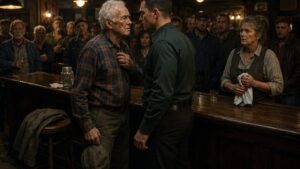
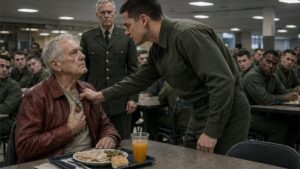
He smiled a little, not enough to make it a joke. His knees had stiffened during the drive, and getting out of the car had taken longer than he wanted her to notice. He wore khaki pants, boots polished more from habit than need, and a red field jacket faded at the elbows. On the left shoulder, an old patch had gone soft around the stitching. The jacket was too warm for the day, but he had worn it anyway.
Pamela glanced at the jacket, then at the gate. “You could have mailed it.”
Frank held up the folded rifle sling in his left hand. Brown leather, cracked near the buckle, wrapped in a plain cloth. “Wasn’t borrowed by mail.”
“That was forty years ago.”
“Thirty-eight.”
“That makes it much better.”
He heard the worry under her dry tone. She had inherited her mother’s way of using sarcasm to stand between herself and fear. Frank did not blame her. A daughter who had watched her father shrink two inches in four years had a right to count the curbs before he stepped over them.
A young gate guard came out of the booth, rifle slung, sunglasses hiding his eyes. He looked at Frank’s jacket first, then at the sling.
“Sir, this is a closed qualification range today.”
Frank took his old base visitor card from his shirt pocket. The laminate had yellowed at the corners. “I called last week. William Carter said I could stop by.”
The guard took the card delicately, the way someone handled an expired coupon he did not want to insult. “You retired, sir?”
“Long enough to know what closed means.”
The guard’s mouth twitched. He checked a clipboard, found the name, and his posture changed by one careful inch.
“Yes, sir. Frank Bennett?”
“That’s me.”
“Range Officer Carter said to escort you to the office.”
Pamela opened her door. “I can walk him.”
Frank looked at her over the roof. “I know the way.”
“You knew the way thirty-eight years ago.”
“I still know where the sun is.”
She wanted to argue. He could see it in the small tightening at the corner of her mouth. Instead, she came around the car and brushed dust off his shoulder as if he were still a man heading to church with a daughter too young to reach his collar.
“Call me when you’re ready,” she said.
“I will.”
“And don’t let anyone turn you into a mascot.”
That made him look at her.
Pamela’s voice lowered. “I mean it, Dad.”
The gate guard pretended not to hear. Frank folded the sling tighter under his arm and nodded once.
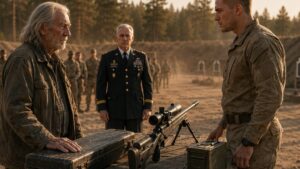
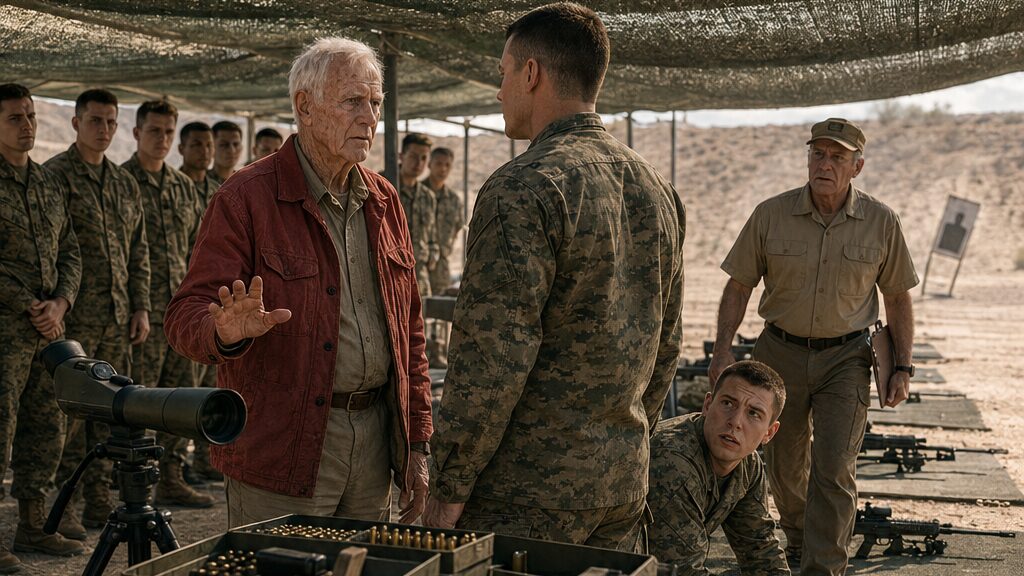
Inside the gate, the range opened wide around him. Rows of benches sat under green shade netting. A line of rifles lay on mats with muzzles pointed downrange. Orange flags snapped at the edges of the firing line. A spotting scope on a tripod aimed toward the far targets, its black barrel shining in the sun. Beside it, an ammunition box sat open, brass glinting inside like small, captured pieces of light.
A group of young soldiers stood near the benches, loose and loud between commands. Their sleeves were rolled. Their faces were all angles and sunburn. Frank felt their eyes move over him: white hair, red jacket, careful steps, old visitor card clipped to his pocket.
One soldier whispered something. Another grinned and looked away.
Frank kept walking.
The guard led him toward a range office made from two connected trailers. On the steps, a broad-shouldered older man in a tan cap turned at the sound of boots on gravel. William Carter had grown heavier since Frank had last seen him, but his face still held the same habit of command: eyes first, words later.
“Frank Bennett,” William said.
“Carter.”
William came down the steps and offered his hand. His grip was strong but measured, as if he had already adjusted for Frank’s age. Frank noticed and accepted it without comment.
“Been a long time.”
“Ranges keep count better than men do,” Frank said.
William glanced at the wrapped sling. “That what I think it is?”
“Lieutenant Coleman’s loaner. He told me to bring it back after the season ended.”
William let out a soft breath. “Coleman’s been gone twenty years.”
“I know.”
The space between them tightened. William looked at the sling again, then toward the firing line where a younger instructor was calling soldiers into position.
“You came on a busy day.”
“You told me Thursday.”
“I told you Thursday because I thought you’d look around, hand over the sling, drink bad coffee, and leave before the live strings got moving.”
Frank watched the instructor step behind a young soldier and adjust his elbow with two impatient taps.
“That your instructor?”
“Mark Harris,” William said. “Good shooter. Fast. Keeps them moving.”
“Fast can be good.”
“It can.”
The young instructor, Mark, saw William and began walking over. He was in his thirties, clean-shaven, with the clipped confidence of a man who had learned authority before patience. His eyes flicked over Frank’s visitor badge and red jacket.
“Sir,” Mark said to William, then gave Frank a polite nod. “Morning.”
“Mark Harris,” William said. “Frank Bennett. Retired Marine. Used to teach on this range.”
Mark’s smile sharpened into something practiced. “Then you’ve seen a lot of dust, sir.”
“Some.”
“We’re running qualification. I can clear a bench if he wants to sit in the shade.”
Frank looked past him to the firing line. A young soldier stood at lane six, rolling his shoulders as if he could shake tension out through his sleeves. His rifle was resting on the mat, magazine out, bolt open. He kept looking toward the far target with a fixed stare.
“What’s his name?” Frank asked.
Mark turned. “Miller. Ryan Miller. He’ll settle down.”
“Hasn’t yet?”
“First round jitters.”
Frank said nothing.
William cleared his throat. “Frank just came to return something.”
“I don’t want to interrupt,” Frank said.
Mark’s expression said he already had.
A command rang out. Soldiers moved to the line. Frank stepped beneath the shade net and stood near the spotting scope, close enough to see but not close enough to interfere. The smell of oil, dust, hot nylon, and brass rose around him. It entered him too quickly, too completely. For a moment he was not seventy-four. He was thirty-six, then twenty-two, then back again with a knee that ached and a hand that trembled if he forgot to curl it around something.
He placed the wrapped sling on a bench.
Ryan Miller took his position. He was young, maybe twenty-three, with a face trying hard not to show fear. Mark stood behind him.
“Breathe,” Mark said. “Don’t fight the rifle. You know the drill.”
Ryan nodded.
Frank watched the line, not the boy’s face. Wind from the left, mild. Heat shimmer low. Target carrier on lane six set a shade crooked, or maybe it only looked that way through the moving air. He leaned slightly toward the spotting scope but did not touch it.
“Ready on the right,” Mark called.
A soldier answered.
“Ready on the left.”
Another answer.
“Firing line is ready.”
The rifles came up.
Frank’s hand found the edge of the bench. His thumb rubbed a rough place in the wood where someone had dragged metal across it.
The first shots cracked across the range. Young shoulders tightened and released. Empty brass jumped and flashed. Dust lifted near the berm.
Ryan fired three times.
On the third shot, Frank heard it.
Not the rifle. Not the brass. Not the normal snap of target hardware shifting under impact.
A second sound, half a breath late.
A dry, sideways shudder.
Frank’s eyes moved to lane six.
The target carrier trembled and settled.
Nobody else reacted. Mark was already speaking to Ryan, tapping the air with two fingers. “You’re pulling. Again. Control it.”
Ryan swallowed. “Yes, Sergeant.”
Frank stared downrange.
Another soldier fired. Another target answered with a clean metallic tick. Lane six held still now, innocent in the heat.
William came to stand beside Frank. “You all right?”
Frank did not look at him.
“Lane six,” he said.
“What about it?”
Frank listened as the next string began. Heat pressed under the shade net. Young men fired, corrected, loaded, breathed. A radio crackled. The ammunition box sat open, brass and cartridges arranged in rows that were almost neat.
Ryan fired again.
The target shudder came late.
Frank’s fingers tightened on the bench.
William followed his gaze. “You see something?”
“Not yet,” Frank said. “But I heard it.”
Chapter 2: One Small Sound Nobody Wanted to Hear
Mark Harris liked a clean line.
Frank could see it in the way the younger man moved: quick corrections, short commands, no wasted steps. He valued rhythm. A range day, to Mark, was a machine that ran best when nobody questioned the gears.
Frank had known men like that. He had been one, once.
Ryan Miller sat back from lane six while another group rotated in. He removed his magazine, showed clear, and kept his face empty in the way young men did when they were trying not to look shaken. His first group on the target had been low and right. The second had spread wider. Mark had marked it as nerves.
Frank was less certain.
He stepped toward the spotting scope.
One of the soldiers near the bench shifted aside, not out of respect exactly, but out of discomfort. Frank placed one hand on the tripod and bent slowly. His back complained. His right knee sent a sharp warning up his leg. He ignored both and looked through the scope.
The target swam into focus.
Lane six. Paper torn in a pattern that could be bad trigger control. Or could be something else riding under it. The holes were not random. They had a repeated slant, a rhythm too regular to be pure panic.
Frank lifted his head.
Mark was watching him now.
“Need something, sir?” Mark asked.
Frank kept his voice even. “Who checked the carrier on six?”
Mark blinked once. “Target pit crew before the line opened.”
“Since then?”
“It’s paper, sir. Not a truck engine.”
A couple of soldiers smiled. Ryan did not.
Frank looked at the ammunition box beside the bench. The rows had been disturbed during the last reload. One cartridge sat turned opposite the others. Another had a faint discoloration near the neck. Not bad ammunition necessarily. Not enough to accuse. Enough to notice.
He reached down and picked up a spent casing from the mat near lane six. The brass was warm. He turned it between his fingers until the light caught the mark near the rim.
Mark stepped closer. “Sir, I need those left where they fall until we sweep.”
Frank set the casing on his palm. “This from Miller’s lane?”
“Probably.”
“Probably is a soft word on a live range.”
The smile left Mark’s face. “With respect, sir, we have a system.”
Frank nodded. “Systems work better when people listen to what falls outside them.”
The line had gone quieter. Soldiers pretended to check gear while their attention tilted toward the old man in the red jacket. Frank felt it: the weight of their judgment, the small curiosity, the impatience. He had no rank on this range now. No whistle. No roster. No authority except the kind no one could see until after they needed it.
William approached from the office steps. “Problem?”
“No problem,” Mark said quickly. “Mr. Bennett was looking at brass.”
“Frank,” William said, “what are you seeing?”
Frank looked at the target line, then at Ryan. The young soldier stood stiffly beside his bench, ashamed to be part of the discussion.
“I’m seeing enough to pause lane six and check the carrier,” Frank said.
Mark gave a short laugh. “Over three bad shots?”
“Over three shots with the same lie.”
“The same what?”
Frank held the casing lower, away from drama. “The rifle tells one story. The target tells another. The frame is adding a third.”
Mark looked at William as if asking whether this would be allowed to continue.
William’s jaw worked once. He did not like conflict in front of soldiers. Frank knew that. William had always been the kind of officer who preferred problems to become official before he treated them as real. Official problems had forms. Unofficial problems had faces.
“Lane six has been giving us grief all morning,” Mark said. “Because Miller is in his head.”
Ryan’s ears reddened.
Frank set the casing on the bench. “Maybe he is.”
Mark folded his arms. “Then we agree.”
“No,” Frank said. “We don’t.”
The words were quiet, but the silence after them widened.
Mark’s expression hardened. “Sir, I understand you used to teach out here. I respect that. But this isn’t the old range. Equipment’s different. Procedures are different. We don’t stop qualification every time something sounds funny.”
Frank looked down at the rifle resting on lane six’s mat. Muzzle downrange. Safety engaged. Bolt open. Everything visible. Everything correct enough to make a man stop looking.
“That’s exactly when you stop,” he said.
A soldier near lane four coughed into his fist. Another glanced at his friend.
Mark heard it and flushed. “Would you like to take a shot, sir?”
William’s head turned toward him.
Mark’s tone stayed polite, but the challenge under it was plain enough for every young man there. “We’ve got time before the next string. If you want to demonstrate what you mean, I’ll clear the lane. Maybe they’ll learn something.”
It was meant to corner him. If Frank refused, he was nervous. If he accepted and missed, he was finished. If he shot well, the issue would become his pride instead of the target carrier.
Frank had been handed traps before. Most came wrapped in courtesy.
Ryan looked at him then, really looked. Not with doubt alone. With a kind of plea he tried to hide.
Frank picked up the rifle from lane six. Slowly. Carefully. His joints made the movement less graceful than memory did. He checked the chamber, checked the safety, checked the line, then settled the stock against his shoulder without raising the muzzle toward anything it should not touch.
The soldiers watched.
Frank’s cheek touched the stock. For an instant the range narrowed. Front sight. Breath. Heat. Weight. The old map of muscle and discipline unfolded in him. He could fire. He knew that. Maybe not as well as before. Maybe not clean enough to satisfy the men waiting for either miracle or embarrassment. But well enough.
That was not the point.
He lowered the rifle.
Mark’s mouth tightened.
Frank set the rifle back on safe, muzzle downrange, and placed it on the mat.
“I’m not here to entertain your line,” he said.
The words did not rise. They did not need to.
Mark stared at him. “Then what are you here to do?”
Frank reached to the ammunition box and, with two fingers, turned the backward cartridge so it faced the same way as the others. Then he picked up the spent casing again and laid it beside the row.
“I’m here to ask why this casing is marked different from the last two I saw from this lane, why your target carrier answers late, and why Miller’s group moved in the same direction three strings in a row.”
No one spoke.
Frank looked at William. “Pause the lane. Send someone down to check the frame and tray sequence.”
Mark shook his head. “We cleared that frame.”
“Then clear it again.”
“With respect, sir,” Mark said, each word clipped now, “we don’t stop a line over a feeling.”
Frank looked at him for a long moment.
“It won’t be a feeling when it costs you,” he said.
The sentence landed harder than he intended. He saw it in Ryan’s face. He saw it in William’s eyes, a flicker of old knowledge.
Frank stepped back from the bench. His knee had begun to ache badly. His hand wanted to tremble, so he closed it around the brass casing until its rim pressed into his skin.
William did not order the pause.
Not then.
Instead he looked downrange, then at the schedule board, then at the line of young soldiers waiting under the sun.
“Run the next group,” he said. “We’ll inspect six during reset.”
Mark nodded too quickly. “Yes, sir.”
Frank’s face did not change.
Ryan returned to lane six with the expression of a man walking back into a room where everyone had already decided the story about him.
Frank stood in his red jacket beside the ammunition box while the line loaded again.
This time, when the target shuddered late, he was not the only one who heard it.
Chapter 3: The Young Soldier With Three Bad Shots
Ryan Miller did not miss loudly.
Some men cursed when a shot went wrong. Some shook their heads, slapped the mat, blamed wind, blamed sights, blamed a bad night’s sleep. Ryan only blinked, swallowed, and made himself smaller behind the rifle.
Frank watched him through the next string and saw the discipline under the nerves. The boy was not careless. He checked his chamber. He listened to commands. He kept his finger indexed until ready. His breathing sped up when Mark came near, but it slowed again when he looked through the sights.
Not hopeless, Frank thought. Just crowded.
“Low right again,” Mark called from behind the scope.
Ryan’s shoulders dipped.
“Run it back,” Mark said. “You’re anticipating recoil.”
“Yes, Sergeant.”
Frank leaned against the bench and looked toward the target pit access road. A white pickup moved behind the berm, then disappeared. During the reset, two members of the pit crew walked along the frames, stapling fresh paper, checking lines. At lane six, one of them paused, kicked at the base of the carrier, then bent for only a moment before moving on.
Frank saw Mark see it too.
The younger instructor looked away first.
Ryan came off the line after the next command and sat on an ammunition crate in the thin shade. He removed his helmet and rubbed both hands over his close-cropped hair. His rifle lay clear on the mat in front of him. The other soldiers gave him space, but not mercy. Space was often worse.
Frank walked over slowly.
Ryan stood at once. “Sir.”
“At ease,” Frank said.
Ryan almost smiled. “I don’t think I’m supposed to take that from you.”
“Probably not.”
Ryan looked toward Mark. “If this is about before, I’m sorry you got dragged into it.”
“I stepped there on my own.”
“Yes, sir.”
Frank lowered himself onto the bench beside the ammunition crate. He did it carefully, pretending the movement required thought instead of effort. Ryan noticed and had the decency to look away.
“You always shoot low right?” Frank asked.
Ryan’s jaw tightened. “No, sir.”
“Today you do.”
“Yes, sir.”
“Why?”
Ryan looked toward the target line. “Sergeant Harris says I’m anticipating recoil.”
“Are you?”
“I don’t know anymore.”
That answer interested Frank more than denial would have.
A hot gust moved under the canopy. The shade net snapped softly overhead. Down the line, Mark laughed at something one of the soldiers said, a short controlled laugh meant to show the day was still in his hands.
Frank opened his palm. The spent casing lay there, dull gold in the dust.
“You mind showing me your last three?”
Ryan hesitated. “We’re not supposed to collect brass until sweep.”
“Then don’t collect it. Point.”
Ryan studied him. Then he crouched by the mat and indicated three casings near the right edge. Frank leaned forward. The motion pulled at his back, and he had to brace one hand on his knee.
The primer marks were clean. Extraction looked normal enough. But one casing carried the same small scratch near the rim. Another showed a faint smear. Not proof. A whisper.
Frank picked up none of them. He only looked.
Ryan watched his face with growing uncertainty. “Sir?”
“You clean this rifle yourself?”
“Yes, sir.”
“When?”
“Last night.”
“Anyone else use it today?”
“No.”
“Magazine?”
“Two mags. Both mine.”
Frank nodded toward the ammunition box. “Who topped you off?”
Ryan looked embarrassed. “I did. Then the assistant instructor handed me another tray before the second string. We were moving fast.”
“Fast,” Frank repeated.
Ryan glanced at him. “You think it’s the ammo?”
“I think thinking is free.”
The boy let out a breath, almost a laugh, but it died quickly. “Sergeant Harris says I’m in my head.”
“Maybe you are.”
Ryan’s face closed.
Frank looked at him until the boy looked back. “Being in your head doesn’t mean the world outside it stopped existing.”
Ryan absorbed that slowly.
Frank pointed toward the spotting scope. “Look through there. Don’t look at the holes first. Look at the paper around them. Then look at the way the frame sits.”
Ryan obeyed. He bent to the scope, adjusted it clumsily, and stared downrange.
“What do you see?” Frank asked.
“My target.”
“That’s the answer men give when they want the question to end.”
Ryan stayed at the scope. His shoulders shifted. “Paper’s pulling on one side.”
“Which side?”
“Right.”
“After impact?”
“I don’t know.”
“Then watch after the next shooter on six.”
Ryan lifted his head. “They’re putting me back on six.”
“Then watch before you fire.”
Mark’s voice cut across the benches. “Miller. Hydrate, then stand by.”
Ryan straightened. “Yes, Sergeant.”
Mark’s eyes moved from Ryan to Frank. He approached with his hands on his belt.
“Everything all right?”
“Fine,” Ryan said.
Mark looked at Frank. “Sir, I need my soldier focused.”
“So do I,” Frank said.
“He needs fewer voices in his ear.”
“He needs the right one at the right time.”
Mark stepped closer, lowering his voice enough to pretend it was private. “I know what you’re doing. I know you mean well. But if he starts thinking the target is cheating him, he’ll never fix himself.”
Frank felt the old heat rise in him, the kind that had nothing to do with the desert. He let it pass before answering.
“A man can fix himself and still deserve good equipment.”
Mark’s expression changed, not much. “You think I’m giving him bad equipment?”
“I think you’re giving him a bad story.”
Mark’s eyes narrowed. “Careful.”
Frank stood. It took effort, and that irritated him more than Mark did. He held the casing between thumb and forefinger.
“Careful is what I’ve been asking for.”
For a moment, neither man moved. Around them, the range continued: rifles locking open, magazines clicking, boots grinding dust into gravel. A radio scratched from the office porch. William Carter stood there with a clipboard, watching but still not walking over.
Ryan stood between the two men with his helmet in one hand.
Mark turned to him. “You ready to qualify or not?”
Ryan’s throat moved. “Yes, Sergeant.”
“Then stop chasing ghosts.”
Ryan put his helmet on.
Frank said nothing more. He watched the young soldier return to lane six. This time, before lying down, Ryan looked at the target frame through the scope. Only a second. Barely enough for anyone else to notice.
But Frank noticed.
Mark noticed too.
“On the mat,” Mark said.
Ryan obeyed.
The line loaded. The command sequence began.
Frank stood behind the shade line, one hand tucked into the pocket of his red jacket. His fingers closed around the spent casing he had finally picked up when no one was looking. He knew he should have left it. He knew rules mattered. He also knew that sometimes a small piece of brass in the hand could keep a larger truth from being swept into a bucket.
Ryan fired once.
The shot cracked clean.
The target marked low right.
Ryan did not move.
He waited.
Half a breath later, the carrier gave its dry, sideways shudder.
Ryan turned his head slightly, not enough to break position, just enough for Frank to see that he had heard it.
Mark stepped forward. “Eyes downrange, Miller.”
Ryan faced front again. His jaw set.
He fired twice more.
The group was bad enough to fail him and regular enough to accuse the range.
When the cease-fire command came, Ryan stood slowly. He did not look at Mark first. He looked at Frank.
Frank gave him nothing public. No nod. No wink. No victory.
Only his hand in the red jacket pocket, closed around the casing, and his eyes turned downrange toward lane six as if the desert itself had finally started telling the truth.
Chapter 4: The Old Rule Frank Never Broke
Pamela was waiting in the driveway when Frank came home.
She had not meant to look like she was waiting. She had a paper grocery bag on one hip and the mail tucked under her arm, but the way she turned before his truck fully stopped told him enough. Frank parked slowly, set the brake, and sat for a moment with both hands resting on the wheel.
The red jacket felt heavier than it had that morning.
Pamela crossed to the driver’s side before he opened the door. “You didn’t call.”
“I’m home.”
“That is not the same thing.”
He reached for the old sling wrapped in cloth on the passenger seat, then remembered he no longer had it. William had taken it with both hands and placed it in the range office as if it belonged to a chapel. Frank had thought returning it would lighten something in him. Instead, he had come home carrying a brass casing in his jacket pocket and a sound in his head.
Pamela opened the door. “Dad.”
“I can get out of a truck.”
“I know.”
“No, you know I used to.”
The words came out sharper than he intended. Her face changed, but she did not step back. She only held the door and waited.
Frank regretted it before his boot touched the driveway.
His knee took his weight badly. He hid the flinch by reaching for the doorframe, but Pamela saw it. She always saw what he wished she would miss and missed what he most wanted her to understand.
Inside, the house was cool and dim. The late sun came through the blinds in narrow strips across the kitchen table. Pamela set the grocery bag down and began putting things away too quietly. Frank hung the red jacket over the back of a chair instead of on its hook. Dust clung to the sleeves. The old shoulder patch, faded almost smooth, faced the room.
Pamela noticed.
“Did they make fun of you?” she asked.
“No.”
“Did they treat you like a problem?”
Frank took off his cap and set it on the table. “They were running a range.”
“That isn’t an answer.”
He went to the sink and washed his hands. Brown water swirled away. Grit had settled into the creases around his knuckles, and the sight of it pulled him backward in time with such force that he stood there longer than he needed to.
Pamela shut the refrigerator. “I told you not to let them turn you into a mascot.”
“They didn’t.”
“Then why do you look like this?”
Frank dried his hands with a dish towel, folded it once, then again. “Like what?”
“Like you saw a fire and everybody else called it sunshine.”
He looked at her then.
The house held still around them. The clock above the stove ticked with a faint unevenness he had meant to fix for two months. Somewhere outside, a neighbor’s dog barked once and gave up.
Pamela’s anger softened into worry. “What happened?”
Frank sat at the table. The movement hurt enough that he stopped pretending halfway through and lowered himself carefully. He reached into the red jacket pocket and took out the spent casing.
Pamela stared at it.
“Please tell me you didn’t steal ammunition from a military range.”
“Spent brass.”
“That makes me feel so much better.”
He rolled it between his fingers. “It was going to be swept into a bucket.”
“Dad.”
Frank placed the casing upright on the table. It stood for half a second, then fell and rolled toward the salt shaker.
“A young soldier was missing,” he said. “They said it was nerves.”
“Was it?”
“Some.”
“And the rest?”
He did not answer right away. Through the blinds, evening light striped the red jacket, making the patch disappear and return as the chair shifted in the air-conditioning.
“The frame sounded wrong,” he said.
Pamela sat across from him. “A frame.”
“Target carrier. Lane six.”
“And you told them?”
“Yes.”
“They listened?”
Frank’s silence answered.
Pamela closed her eyes briefly. “So you went back to that place, tired yourself out, got ignored by men half your age, and brought home trash from the ground.”
He looked at the casing. “Not trash.”
“To me, it is if it hurts you.”
That sentence would have been easier if she had shouted it. Frank could stand against anger. Concern had more ways in.
He picked up the casing again and held it so the light caught the tiny scratch near the rim.
“There was a recruit once,” he said.
Pamela went still.
Frank had not planned to speak of it. Some memories stayed quieter if a man gave them no doorway. But the range had already opened the door that morning, and the late shudder from lane six had walked through it.
“It was before you were born,” he said. “Hot day. Not that different from today. We had a line full of boys who thought breathing was optional and speed was proof of courage.”
Pamela listened without interrupting.
“One rifle kept feeding rough. Not every round. Just enough. One target kept marking strange. Not every shot. Just enough. I heard something off in the carrier and thought, check it after the string.”
He turned the casing.
“After the string,” Pamela repeated softly.
Frank nodded. “A man tells himself that when he wants the day to keep moving.”
“What happened?”
“No one died,” he said, because that was always the first mercy and never the last word. “But a boy carried damage home. Hand. Eye. Pride. Future. All because several men, including me, decided a small wrong thing could wait.”
Pamela’s face tightened. “You never told me.”
“Your mother knew.”
“Mom knew everything you wouldn’t say.”
That almost made him smile. Almost.
Frank set the casing down. “After that, I made a rule. If a thing sounds wrong, you stop. If men laugh, they laugh stopped. If the schedule slips, it slips. No target, no score, no instructor’s pride is worth pretending you didn’t hear what you heard.”
Pamela looked toward the red jacket. “And today they laughed?”
“Not all of them.”
“But enough.”
“Enough is not the point.”
She leaned back, and the chair creaked. “What is the point?”
He wanted to say safety. He wanted to say discipline. He wanted to say young Ryan Miller’s face when he heard the shudder and knew he was not imagining it. But beneath all that was something smaller and harder to confess.
“The point,” Frank said, “is I almost stayed quiet.”
Pamela’s expression changed.
He rubbed his thumb over the brass. “Because I knew what they saw. Old man in a bright jacket, hanging around a range that belongs to younger backs. I knew if I spoke, they’d hear age before they heard words.”
“You’re allowed to be tired of proving yourself.”
“I wasn’t proving myself.”
“Weren’t you?”
He looked away.
The question sat between them, not cruel, not gentle, simply accurate enough to hurt.
Frank had gone to return the sling. That was true. He had gone to stand in a place where parts of him still answered to commands no one gave anymore. That was true too. He had told himself he did not care what the young men thought. Perhaps that was the only lie.
Pamela reached across the table and touched the casing with one finger. She did not pick it up.
“What happens now?”
“They’ll inspect during reset.”
“Will they really?”
Frank thought of William’s hesitation, Mark’s clipped respect, the schedule board, the line of soldiers waiting beneath the sun. “I don’t know.”
Pamela stood and crossed to the counter. For a while she opened and closed drawers without needing anything from them. Then she turned back.
“You wrote something down.”
Frank looked at her.
“I saw the notebook by your chair last week. You write when you’re trying not to worry me.”
He said nothing.
Pamela walked into the living room and returned with a small spiral notebook, the kind he used for grocery lists and measurements. She placed it on the table.
Frank did not open it at first.
Then he drew it toward him and flipped to a blank page. He took the pen from the coil, cleaned the tip with his thumb, and wrote:
Lane six.
Late carrier shudder.
Three-shot drift.
Mixed tray possible.
Check base pin.
Pamela watched him.
His hand was not as steady as it once had been. The letters leaned unevenly, but the words were plain.
“Dad,” she said, quieter now, “what if they still don’t listen?”
Frank closed the notebook.
In the fading light, the red jacket hung over the chair like a body that had stood too long and needed rest. Frank reached for it, not to put it away, but to smooth dust from the patch with the side of his hand.
“Then I go back tomorrow,” he said.
Chapter 5: When the Line Went Quiet
The range was already awake when Frank arrived the next morning.
Pamela drove slower this time, both hands on the wheel, saying little. She had argued once over coffee, not loudly, and stopped when she saw the red jacket waiting on the chair. Frank had put it on without ceremony. The brass casing was in his left pocket. The notebook was folded into the right.
At the gate, the guard recognized him and opened the barrier without inspecting the visitor card.
“Morning, Mr. Bennett.”
“Morning.”
Pamela leaned across before Frank shut the truck door. “Call me before you leave.”
“I will.”
She looked past him toward the range. “And if they ignore you again?”
Frank rested one hand on the door. “Then you’ll hear about it from them, not me.”
She did not like that answer. Neither did he, exactly. But it was the only one he had.
The air was cooler than the day before, though the sun promised to correct that soon. Soldiers moved with morning stiffness around the benches. A radio crackled from the range office. The target frames stood downrange in thin light, square and silent.
Frank found William Carter beside the schedule board.
William looked as if he had slept poorly. “You came back.”
“So did the line.”
William glanced toward lane six. “We had the pit crew look at it yesterday. They said it was fine.”
“Who checked the base pin?”
William’s eyes sharpened, and Frank knew the answer before he spoke.
“They checked the carrier face and cable.”
Frank nodded.
William exhaled through his nose. “Frank.”
“I’m not asking to run your range.”
“No, you’re asking me to stop it.”
“I’m asking you to look at the part that makes the sound.”
William lowered his clipboard. “You know how this looks.”
“Yes.”
“An old Marine comes in after years away, hears something nobody else hears, and tells my instructor his lane is bad.”
Frank looked at the firing line. Mark was already there, kneeling beside Ryan Miller’s mat, checking the rifle with efficient hands. Ryan stood nearby with his helmet tucked under his arm. He saw Frank and held his gaze for a second before looking away.
“Looks don’t change the sound,” Frank said.
William studied him. The old familiarity between them had grown strained, but not broken. It had weathered too many years and too many names on too many plaques for that.
“Mark thinks you’re undermining him,” William said.
“Mark is undermining himself by needing me to be wrong.”
William looked toward the young instructor. “He’s good.”
“I know.”
“Then why do you make him sound careless?”
Frank’s answer came slowly. “Because good men can be careless when they are afraid of looking uncertain.”
That one landed. William said nothing for a while.
Before he could answer, Mark called from the line. “Sir, we’re ready to begin.”
William looked from Mark to Frank, then back to the schedule board.
“Run the first string,” William called. “Lane six monitored.”
Frank closed his eyes for half a second.
Not stopped. Monitored.
The difference had hurt men before.
He moved beneath the shade net and stood behind the spotting scope. Mark did not greet him. Ryan did, with a small nod no one else acknowledged.
The soldiers took their positions. The morning settled into formal rhythm: commands, checks, responses. Rifles came up. Safety rules were spoken cleanly. Everything looked right.
Frank put his eye to the spotting scope. Lane six’s target sat fresh and white. In the magnified circle, he saw the lower edge of the carrier face tremble in the wind. Not much. Not enough to prove anything to a man who had already decided proof came later.
The first shots cracked.
Ryan fired once. Clean.
The target hole appeared low right.
The frame held.
Ryan breathed.
He fired again.
This time the paper jumped, and a faint tremor moved through the bottom edge.
Frank’s hand tightened on the scope.
“Watch it,” he said.
No one answered.
Ryan fired a third time.
The late shudder came harder.
The sound was not loud, but it traveled through Frank’s bones like a remembered order. Downrange, the carrier face shifted, caught, and settled crooked by a fraction.
Ryan lifted his cheek from the stock.
“Eyes on target,” Mark said.
“Sergeant—”
“Fire your string.”
Frank stepped forward. “Hold lane six.”
Mark turned. “Stand back.”
“Hold lane six.”
The command left Frank before he had permission to give it. Not shouted. Not panicked. Hard enough to cut through the line.
Several soldiers froze.
Mark’s face flushed. “You do not call my line.”
Frank pointed downrange. “That carrier just bound low on the right. If the pit crew is behind it, you need to check before another round goes through a frame that isn’t where he thinks it is.”
“There is no pit crew behind active targets,” Mark snapped.
“Then check why your frame answered like a man kicked it.”
William was already moving from the office. “What happened?”
Mark turned toward him. “Sir, he interrupted a live string.”
Frank did not look at Mark. His eyes stayed on lane six.
“Cease fire,” William called.
Mark hesitated.
William’s voice hardened. “Cease fire.”
The command ran down the line. Rifles lowered. Safeties engaged. Bolts locked open. The range went still with the tense silence of men realizing stillness was not the same as safety.
Ryan rolled away from the rifle and sat back on his heels. His face had gone pale under the dust.
William took the radio from his vest. “Target pit, range control. Check lane six carrier base and right-side pin. Confirm no personnel behind frame.”
Static answered.
Frank listened to the empty hiss.
Mark stood with both hands on his belt, jaw tight. “Sir, with respect, this is unnecessary.”
The radio cracked.
“Range control, pit. Stand by.”
A long pause followed. Frank watched a dust devil form beyond the berm and collapse.
Then the radio came again, thinner this time. “Range control, pit. Lane six right-side lower pin is half out. Carrier face is binding. We also have a fresh strike on the bracket.”
No one moved.
William closed his eyes.
The radio continued. “Recommend lane six closed until repair.”
Mark stared downrange as if the target had betrayed him personally.
Frank let his hand fall from the spotting scope. The relief that moved through him was not clean. It came mixed with anger, fatigue, and the old grief of being right too late in another lifetime.
Ryan looked from Mark to Frank. His mouth opened, but he said nothing.
William lifted the radio. “Copy. Lane six closed. Send the maintenance note to range office.”
He clipped the radio back and turned toward Mark. “Unload and clear the line. Ten-minute stand-down.”
Mark nodded once. “Yes, sir.”
His voice had changed.
The soldiers began clearing rifles. Their movements were careful now, stripped of the casual rhythm from before. Men glanced at Frank and looked away. Not smirking. Not yet respectful, exactly. Adjusting.
Frank stepped back under the canopy. His knee had begun to throb from the quick movement, and his breath came shorter than he wanted. He reached into his jacket pocket and felt the casing there, familiar and small.
Ryan approached him before Mark could stop him.
“Sir,” Ryan said quietly.
Frank looked at him.
“I heard it this time.”
“I know.”
“I should’ve said something louder.”
Frank shook his head. “You said enough.”
“No, I didn’t.”
That mattered. More than the range falling quiet. More than William’s order. More than Mark’s silence.
Frank looked toward lane six, now empty and harmless-looking in the distance. “Next time you hear a thing wrong, don’t ask whether your voice is welcome.”
Ryan swallowed. “Yes, sir.”
Mark came over then. His face had settled into a hard official calm. “Miller, rejoin your group.”
Ryan obeyed, but slowly.
Mark and Frank stood facing each other beneath the shade net. Around them, rifles clicked open. Brass glittered in the dust. The red jacket felt too bright, too visible.
Mark spoke low. “You could have told me without cutting the line.”
“I did tell you.”
“Yesterday.”
“And today.”
Mark’s jaw worked.
William joined them, clipboard in hand but forgotten. “Frank.”
The way he said the name carried apology, warning, and exhaustion all together.
Frank took the notebook from his pocket and opened to the page he had written the night before. He handed it to William.
Lane six.
Late carrier shudder.
Three-shot drift.
Mixed tray possible.
Check base pin.
William read it once. Then again.
Mark looked at the page and said nothing.
Frank took the notebook back. “You still need to check the ammunition trays.”
Mark’s head lifted. “The frame was the issue.”
“One issue.”
“We just shut down a lane because of your sound.”
“Not my sound,” Frank said. “The range’s.”
William looked toward the ammunition table. The assistant instructor was already stacking trays for the next string.
Frank watched the man move cartridges quickly from one row to another, filling gaps without checking lot markings. Fast hands. Efficient hands. Hands that trusted the box because the box was there.
“Stop him,” Frank said.
William followed his gaze.
The assistant instructor lifted a tray.
One cartridge sat turned opposite the others.
William’s face changed.
“Hold that tray,” he called.
The assistant froze.
This time, no one argued.
Chapter 6: The Lesson Was Never About the Shot
Ryan had expected yelling.
He had expected Sergeant Harris to tear into someone, maybe the assistant instructor, maybe him, maybe the whole line for standing around while the morning fell behind schedule. He had expected the kind of loud correction that gave embarrassment somewhere to go.
Instead, the range office filled with quiet men.
That was worse.
Ryan sat on a folding chair near the wall, helmet on his knees, trying not to stare at Frank Bennett’s hands. The old Marine had taken off the red jacket and folded it over the back of a chair with careful, almost formal movements. Without it, he looked smaller. His shoulders seemed narrower in his faded shirt, his wrists thin where the cuffs rode up. But the room still arranged itself around him in a way Ryan could not explain.
William Carter stood at the desk with the maintenance note. Mark Harris leaned against a file cabinet, arms crossed, eyes fixed on the floor. On the desk lay three items: Frank’s spent casing, the tray with the turned cartridge, and a printed target from lane six marked with Ryan’s low-right group.
No one had called it proof. Not yet.
The quartermaster clerk had confirmed the ammunition was safe but mixed from two lots after a rushed resupply. Not catastrophic. Not even automatically disqualifying. Just another small disorder layered over the bad carrier, over a nervous shooter, over an instructor pushing pace.
Ryan stared at the target and felt his shame changing shape.
It did not vanish. Some of those misses were still his. His breathing had gone shallow. His shoulder had tightened. He had wanted too badly not to fail. Frank had not given him innocence, and Ryan was grateful for that. Innocence would have felt like pity.
William tapped the target with one finger. “We revise procedure. Carrier check includes base pins. Ammunition trays stay lot-consistent during qualification. Any shooter or instructor can call a pause for equipment irregularity without penalty until cleared.”
Mark’s mouth tightened. “Yes, sir.”
“You have something to add?”
Mark looked up. His eyes moved to Frank, then to Ryan. “No, sir.”
Frank sat near the window, sunlight cutting across his boots. He looked tired. Not sleepy. Drained in some deeper place, as if the morning had taken payment for every step.
William turned to him. “Frank?”
Frank rubbed his thumb along the edge of the casing. “Don’t write a rule nobody can use.”
William frowned. “Meaning?”
“If a private calls a pause, and everyone treats him like he’s scared, he won’t call the next one.”
Ryan felt the words land against his chest.
Mark shifted by the cabinet. “Nobody told Miller he couldn’t speak.”
Frank looked at him, not unkindly. “You told him what story he was in.”
The room went still.
Mark’s face reddened. “I told him to focus.”
“You told him the only thing wrong was him.”
“I had reason.”
“Yes,” Frank said. “You did.”
That surprised Ryan. Mark too.
Frank leaned forward slightly, elbows on knees. “He was anticipating some of it. His breath was high. Shoulder tight on the third shot. He wanted the score too much. You saw that.”
Mark’s posture changed by a fraction, as if he had been braced for a blow and received a tool instead.
Frank nodded toward the target. “But you stopped there.”
No one spoke.
“The first thing you see isn’t always wrong,” Frank said. “It’s just rarely the whole thing.”
William lowered himself into the desk chair.
Mark stared at the target. For the first time since Ryan had known him, the sergeant looked younger than his rank.
“I should have checked the lane,” Mark said.
Frank did not answer immediately. Outside, the stand-down had loosened. Soldiers spoke in low voices near the benches. Somewhere, the medic laughed softly at something, and the sound passed through the office window like proof the world had not ended.
“Yes,” Frank said.
Mark nodded once, accepting the clean edge of it.
Ryan expected Frank to add more. To press. To take what he had earned and make Mark hold it. But the old Marine only picked up the casing and set it beside the target.
“So should I have,” Frank said.
William looked at him. “You did.”
“Today.”
The word carried a history Ryan did not know.
Mark heard it too. His expression shifted from defensiveness into something uncertain.
Frank stood then, slower than Ryan expected. Instinct pulled Ryan halfway out of his chair to help, but he stopped himself, unsure whether the offer would embarrass him.
Frank noticed anyway.
“You can stand,” he said.
Ryan rose.
“Doesn’t make me glass.”
“No, sir.”
Frank reached for the red jacket. His hand hovered for a second over the patch, then he folded the jacket more neatly over his arm instead of putting it on.
William cleared his throat. “You’re welcome to stay through the reset.”
“I will sit through the reset,” Frank said. “Standing is becoming expensive.”
A faint smile touched William’s face and disappeared.
Mark stepped away from the cabinet. “Mr. Bennett.”
Frank looked at him.
The title hung there awkwardly. Not wrong, but incomplete.
Mark tried again. “Frank.”
“Yes.”
“I was out of line.”
Frank studied him. “You were protecting your line.”
“I was protecting my pride.”
Ryan looked down at his helmet.
Frank gave Mark a small nod. “Those get confused.”
Mark exhaled, almost a laugh, but there was no humor in it. “I don’t like being corrected in front of my soldiers.”
“No one does.”
“You made it look easy.”
Frank’s eyes moved to the folded jacket. “It wasn’t.”
That ended something in the room. Not the conflict entirely, but the performance of it.
William gathered the papers. “Miller, you’ll re-qualify after lane six is closed and lane four is reset.”
Ryan straightened. “Yes, sir.”
Mark turned to him. “And before you fire, you’ll check your lane through the scope. Then you’ll breathe lower. You understand?”
Ryan looked from Mark to Frank.
“I understand,” he said.
The men began to move out. William left first to speak with the pit crew. Mark paused at the door, looked back once as if considering another apology, then decided procedure would have to carry what words could not.
Ryan remained.
Frank sat again with the red jacket across his knees. Up close, Ryan saw the fabric was more worn than it looked from a distance. The elbow seams had been repaired by hand. The patch was not decoration. It was survival.
“Sir,” Ryan said.
Frank looked up.
“Can I ask you something?”
“You can ask.”
“How did you know?”
Frank glanced toward the window, toward the bright rectangle of range beyond it. “I didn’t.”
Ryan frowned. “But you were right.”
“That’s not the same.”
Ryan sat carefully in the chair across from him.
Frank picked up the casing from the desk and rolled it once across his fingers. “Knowing is for after. Before that, you notice. Then you respect what you notice enough to check.”
Ryan repeated it silently, as if storing the words where the morning could not shake them loose.
“I thought if I admitted something felt off,” he said, “they’d think I was making excuses.”
“Some would.”
Ryan gave a short breath.
Frank’s gaze stayed steady. “So you learn the difference between an excuse and an observation.”
“How?”
“You don’t use an observation to escape responsibility. You use it to increase responsibility.”
Ryan looked toward the target on the desk. Low right. Low right. Low right.
Some his. Some not. All his to understand.
Outside, William’s voice carried across the line, issuing new instructions. The range was beginning again, but not in quite the same shape.
Ryan stood. “Can you show me what you saw before I shoot again?”
Frank’s hand tightened briefly on the red jacket.
For a moment, Ryan thought he had asked too much. The old man looked out the window, and the sunlight caught his face in a way that showed every year plainly. Not weak. Not untouched.
Then Frank pushed himself to his feet.
“Bring the scope down two inches,” he said. “And don’t look at the hole first.”
Chapter 7: Before the Trigger, Look Twice
The next morning, the desert was blue before it was gold.
Frank arrived before the line opened. Pamela drove him again, though this time she did not keep the engine running at the gate. She parked beside the fence and watched the empty benches through the windshield.
“You don’t have to stay long,” she said.
“I know.”
“You say that like knowing and doing are cousins.”
“They’ve met.”
She smiled despite herself. Then her eyes moved to the red jacket folded across his lap. “You wearing it?”
Frank looked down at the jacket. In the dim morning, the red had gone dark, almost brown. The old shoulder patch was barely visible, just a tired shape in worn thread.
“Not yet,” he said.
Pamela did not ask why. She had asked fewer questions since the night he told her about the recruit from long ago. Not because she cared less, but because she had started listening differently.
At the gate, the same guard waved them through.
William Carter stood near the range office with a mug of coffee in one hand and a clipboard in the other. Mark Harris was already at the firing line, checking lane four with the assistant instructor. The target carrier on lane six had been removed, its empty space leaving a gap in the line like a missing tooth.
Frank noticed the difference before anyone told him.
A checklist hung from a nail at the ammunition table. New paper. Large print. Carrier base pins. Cable tension. Target face lock. Ammunition lot check. Shooter may call pause.
Frank read it once and looked away.
William came over. “Morning.”
“Morning.”
“Procedure’s changed.”
“I saw.”
William took a sip of coffee. “Mark wrote most of it.”
Frank’s eyes moved to the firing line. Mark was crouched near lane four, running a hand along the frame hardware, not hurried. Ryan Miller stood beside him, watching.
“Good,” Frank said.
William waited, as if expecting more. When none came, he nodded toward the benches. “You feel up to sitting with Miller for the first string?”
“Sitting is in my range now.”
That earned a small sound from William, almost a laugh.
Pamela got out of the truck and came around to Frank’s side with the red jacket. She held it while he stepped down. He disliked needing the pause before his second foot found the ground. He disliked even more that Pamela saw him dislike it.
She held the jacket open anyway.
Frank looked at it. “I can—”
“I know,” she said.
The words were soft, but firm enough to stop him.
He let her help him into it.
The sleeves settled over his arms. The patch returned to his shoulder. For years, the jacket had been a thing he put on when he wanted memory to hold still. Yesterday it had felt like a sign hung around his neck: old man, past tense, handle gently. This morning, it was only cloth. Worn cloth. His cloth.
Pamela smoothed the collar. “There.”
Frank looked at her.
She shrugged. “Still too warm for the weather.”
“It always was.”
She stepped back. “I’ll be at the truck.”
“You don’t have to wait.”
“I know.”
He accepted that answer.
At the firing line, Ryan saw him coming and straightened. The young soldier looked different in small ways. Not older. Not suddenly transformed. Just less crowded inside his own skin.
“Morning, sir,” Ryan said.
“Morning.”
Mark stood from lane four. For a moment, the old stiffness entered his shoulders. Then he let it go.
“Frank,” he said.
“Sergeant.”
Mark nodded toward the scope. “We reset it lower like you said. Lane four’s checked. Ammunition lot matched and logged.”
Frank glanced at the tray. Rows aligned. Mark had placed the cartridges carefully, not prettily. Carefully mattered more.
“Good.”
Mark hesitated. “Miller asked if you’d watch his first run.”
Ryan looked down for half a second, then back up.
“I asked if you’d teach me what to watch before it,” he said.
Frank looked past him to the berm. The morning light had reached the targets. Paper faces waited, clean and blank, asking nothing yet.
“Bring the scope,” Frank said.
Ryan moved it to the left side of lane four. Frank lowered himself onto the bench, and this time Ryan did not pretend not to see the effort. He simply waited until Frank was settled, then adjusted the tripod.
“Too high,” Frank said.
Ryan lowered it.
“Now don’t chase the hole.”
Ryan bent to the eyepiece. “Look at the frame first.”
“And?”
“The edges. The way it sits. Anything loose. Anything that moves after it shouldn’t.”
“What else?”
Ryan looked at the ammunition table. “Tray. Lot. Anything turned wrong. Anything handled too fast.”
Mark heard that. His face remained still.
Frank nodded. “Then yourself.”
Ryan lifted his head.
“That comes last?” he asked.
“No. It comes honestly.”
Ryan absorbed that.
Frank pointed at the mat. “If your shoulder is tight, it’s tight. If your breath is high, it’s high. You don’t blame the frame for your body, and you don’t blame your body for the frame. You look at both.”
Ryan looked down at his rifle. “Yes, sir.”
Mark stepped closer, but did not interrupt. William stood near the office, arms folded, watching from a distance that gave the moment room.
The line prepared slowly. Not sluggishly. Deliberately. Soldiers checked chambers and magazines. The assistant instructor read from the new sheet without apology. A few men shifted under the unfamiliar patience of it, but no one laughed.
Ryan lay down behind his rifle.
Frank watched his shoulders first. High, then lower. He saw the boy take one breath too deep, hold it too long, then release it and begin again.
Good, Frank thought.
Mark gave the commands.
“Ready on the right.”
A soldier answered.
“Ready on the left.”
Another answer.
“Firing line is ready.”
Ryan did not fire immediately.
He looked once through the scope. Not long. Long enough.
Then he settled behind the rifle.
The first shot cracked.
The target answered clean.
Ryan breathed.
The second shot went.
Clean.
On the third, his shoulder tightened. Frank saw it. Mark saw it too.
The shot marked low right.
Ryan did not flinch away from the mistake. He stayed down, breathed once, and checked the target frame through the scope.
No late shudder.
“No equipment issue,” Ryan said.
Mark’s voice came from behind him. “Correct.”
Ryan nodded without turning. He adjusted his elbow, lowered his breath, and fired again.
The next shot held.
Frank felt something ease in his chest, not triumph, not even relief exactly. It was the feeling of a tool placed back in the right hand after lying unused too long.
When the string ended, Ryan cleared his rifle and sat back. Mark checked the target through the scope. A faint smile moved across his face before he controlled it.
“Qualified,” he said.
Ryan closed his eyes for one second.
The soldiers nearby gave a few quiet congratulations. Not cheers. Not a show. Just enough warmth to let the boy stand straighter.
Ryan came to Frank first.
“Thank you,” he said.
Frank looked at the rifle mat, the scope, the tray, the target line. “You did the work.”
“I would’ve missed what mattered.”
“You won’t next time.”
Ryan held out his hand.
Frank took it. The grip was careful at first, then firm when Ryan realized Frank would not break under it.
Mark approached after Ryan stepped away. For a few seconds he stood beside the bench, both of them looking downrange.
“I put the pause rule in writing,” Mark said.
“I saw.”
“Some of them won’t use it.”
“Some will.”
Mark nodded. “Miller will.”
Frank turned the brass casing in his pocket, feeling the scratch with his thumb. “Then it’s not wasted.”
Mark’s gaze moved to the red jacket. “Yesterday, when I asked you to shoot, I was trying to make you small.”
Frank said nothing.
“I thought if you missed, this would become simple.”
“Most things men want simple aren’t.”
Mark let out a quiet breath. “No.”
The sun had climbed now. Heat gathered over the hardpan. The empty gap where lane six had been removed seemed less like a failure and more like a warning finally given space.
William came down from the office with Frank’s old sling in his hand. The cloth wrapping had been removed. The leather looked darker in daylight, cracked but still whole.
“Found a place for it,” William said. “Not in storage. In the range office. Beside the old sign-in book.”
Frank looked at the sling. “It belongs to the range.”
“So do some men,” William said.
Frank glanced at him, but William’s eyes were downrange.
Pamela walked up from the truck then, keeping enough distance not to intrude. Her gaze moved from Ryan’s relieved face to Mark’s changed posture to the red jacket on Frank’s shoulders.
“You ready?” she asked.
Frank considered saying yes. His knee hurt. His back was stiff. The morning had taken enough.
Then Ryan called from lane four. “Sir?”
Frank turned.
Ryan stood behind the rifle, not touching it yet. “Before the next string. The wind shifted. Slight left?”
Frank looked toward the range flags. They lifted and dropped in uneven rhythm. The old habit rose in him, clean and quiet.
“Slight,” Frank said. “But watch the mirage low. It’s lying more than the flag.”
Ryan bent to the scope.
Mark bent beside him.
Neither man looked embarrassed to learn.
Pamela came to Frank’s side. “You can sit for one more,” she said.
It was not a question. It was not an order either.
Frank lowered himself onto the bench. This time, when she offered her hand, he took it without pretending he did not need the balance.
The red jacket creased at his elbows. Dust had settled again along the sleeves. The patch on his shoulder caught the sun, faded thread brightening for a moment before dulling back into cloth.
Downrange, paper waited.
Behind him, young soldiers moved more slowly now, not from fear, but from attention.
Ryan settled behind the rifle. He did not rush. He looked first at the frame, then at the tray, then at himself.
Frank allowed himself the smallest smile.
“Before the trigger,” he said.
Ryan did not turn, but his answer came clear.
“Look twice.”
The shot cracked across the desert.
The target answered clean.
The story has ended.