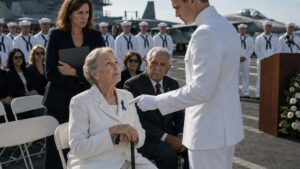
The Old Veteran Held a Folded Paper While a Young Officer Blocked the Memorial Gate
Chapter 1: The Folded Paper at the Memorial Gate
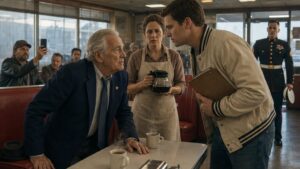
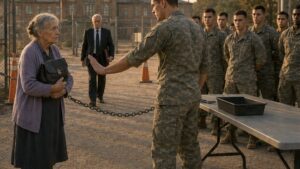
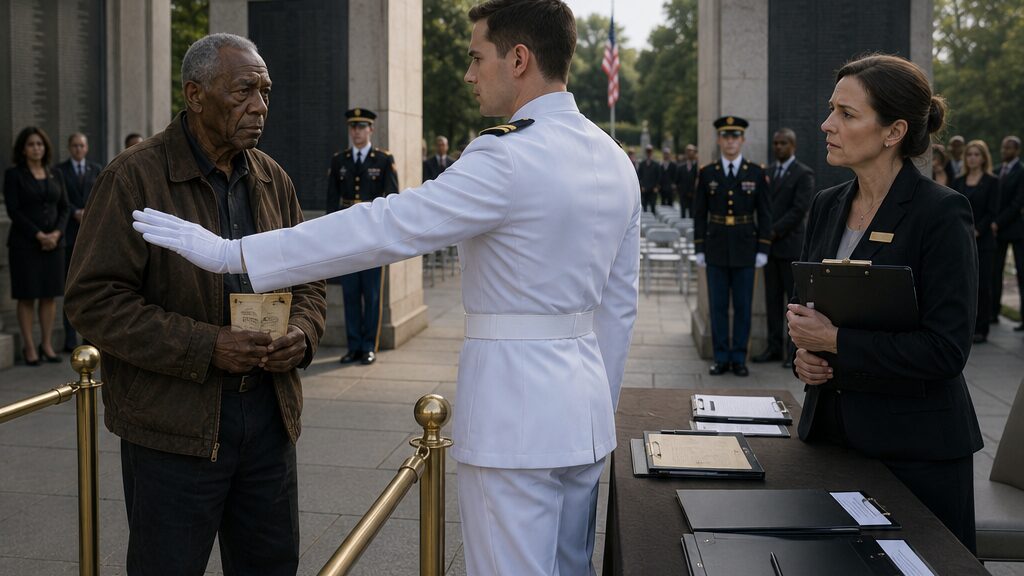
The white sleeve crossed Richard Walker’s chest before his boot touched the brass line set into the pavement.
It was not a shove. It was worse because it was careful. A young officer’s arm, straight and polished and certain, held him back as if Richard were a package delivered to the wrong address.
“Sir, this entrance is for registered attendees.”
Richard stopped. His right hand tightened around the folded paper until the old crease pressed into the pad of his thumb. The paper had been folded and unfolded so many times that the corners no longer met cleanly. One edge had softened like cloth. He held it near his jacket, not out like a demand, but close, the way a man carried something that had outlived the person it belonged to.
Behind the officer, the memorial gate stood open.
Two stone pillars rose on either side of it, newly cleaned, their engraved names covered for the ceremony by navy cloth. Beyond them, rows of chairs faced a small platform dressed with flowers and a microphone. Cadets in dress uniforms moved in straight lines across the lawn. Guests in dark suits and careful shoes walked past the registration table, received printed programs, and entered with small nods from volunteers.
Richard had seen enough military entrances in his life to know the difference between order and welcome.
This one had order.
“Name?” the officer asked.
“Richard Walker.”
The young man looked down at a tablet held in his left hand. His mouth barely moved as he searched. Richard noticed the thinness in his jaw, the pressure there, the kind men got when they were trying not to look unsure.
“Walker,” the officer repeated. “I don’t see you.”
Richard did not answer immediately. A woman in a dark suit stood behind the registration table, arranging folders with one hand and holding a clipboard with the other. She looked up when the line stopped. The guests behind Richard did not complain, but their silence turned around him, gathering weight.
“I was told to come to the gate,” Richard said.
“By whom?”
Richard looked past the officer’s shoulder toward the stone pillars. The cloth over the names moved slightly in the breeze. For a moment, he saw another gate, not stone, not polished, not dressed with flowers. A mud-choked road. A tailgate slick under his palm. A man laughing once before the engine turned over.
He blinked and came back.
“Long time ago,” he said.
The officer’s expression closed a little more. “Sir, I need a current invitation, access badge, or confirmation on the list.”
Richard lifted the folded paper.
The officer looked at it the way a clerk might look at a coupon from a store that no longer existed.
“That is not event identification.”
“I know.”
“Then I can’t let you through.”
A woman in pearl earrings, standing behind Richard with a program already in hand, leaned toward her companion and whispered. Richard did not turn. He had learned many years ago that turning toward every whisper only taught people their whispers mattered.
The young officer kept his arm out. His white glove was clean enough to show the faint line where the fabric stretched across his knuckles. Richard looked at that glove, then at his own hand. Brown skin, raised veins, a tremor he could stop if he pressed his thumb hard enough against the paper.
He pressed.
“Is there a problem?” the woman with the clipboard asked.
The officer did not lower his arm. “Unregistered attendee at the gate, ma’am.”
Richard let the word pass through him.
Unregistered.
Not unwelcome. Not yet. Only unregistered.
The woman stepped from behind the table. Her badge read Kathleen Mitchell. She held herself like someone who had already solved ten problems that morning and expected twenty more before noon.
“Sir,” she said to Richard, more gently than the officer had, “may I see what you’re holding?”
Richard looked at her hand. He looked at the paper. The old fold had split near the center, and he had repaired it years ago with a strip of yellowed tape. Elizabeth had seen him do it at the kitchen table and told him, quietly, that some things were not saved by tape.
He had folded it and put it away.
Now he held it out.
Kathleen took it with both hands, which Richard noticed. Not everyone did that with old paper. Some pinched it. Some flicked it open as if age were dirt. Kathleen set her clipboard against her hip and unfolded the top half only.
Jonathan watched her. The people behind Richard watched her. Even the cadets near the rope line slowed as if paperwork could become ceremony.
Kathleen’s eyes moved across the faded type. The first line was too pale from the years. The second held better. Her brow tightened.
“This is…” She stopped.
Jonathan glanced at her. “Ma’am?”
Kathleen angled the paper slightly away from the breeze. “Where did you get this?”
Richard did not like that question. It sounded as if the paper had belonged to somebody else.
“I kept it.”
“From service?”
“Yes.”
Jonathan’s face changed—not softened, not yet, but recalibrated. The arm across Richard’s path dipped an inch, then returned, as if the young officer had caught himself relaxing too soon.
Kathleen read another line. Richard knew where her eyes were before she said anything. Everyone’s eyes went there eventually, if they read long enough.
Temporary transport detachment.
Partial casualty transfer.
A unit code most people did not remember because it was never meant to last.
Kathleen turned toward the registration table. “Give me the printed memorial roster.”
A volunteer handed her a glossy program. She opened it with fast fingers, scanning the names under the covered engraving list. Richard watched her move through the alphabet.
Lewis.
He saw the place where her finger should have stopped.
It did not stop.
Kathleen glanced back at the old paper. Then back at the program. Then at Richard.
“Sir,” Jonathan said, voice quieter now but still official, “we have a schedule. If you’ll step to the side, Ms. Mitchell can review whatever this is.”
Richard looked at the path beyond the gate. Guests continued to pass through another lane. Their shoes tapped softly on the stone. One older man with a cane looked at Richard, then at the officer’s arm, then away.
Richard could step aside. He had stepped aside many times. For ambulances. For grieving mothers. For officers with maps who did not know the road. For young men who needed to feel brave before they became afraid.
He could step aside.
But the paper in Kathleen’s hand had already been stepped aside for forty-nine years.
“I’ll wait here,” Richard said.
Jonathan’s eyes sharpened. “Sir, you’re blocking the entrance.”
Richard looked down. His boots were not over the line. The officer’s arm was.
Kathleen must have seen it too, because for a brief second, her mouth tightened.
“Officer Davis,” she said, “hold the line for a moment.”
Jonathan did not like that. Richard could see it in the small movement of his shoulders. But he turned slightly, allowing the guests behind Richard to be redirected through the other side.
The public pressure shifted shape. Before, Richard had been one old man delaying a line. Now he was a problem being worked around. People looked at him with curiosity, irritation, pity. One cadet stared at the paper. Another stared at Richard’s jacket, worn brown at the elbows and shiny at the cuffs.
Richard kept his eyes on the gate.
Kathleen lowered her voice. “Mr. Walker, whose name were you expecting to see?”
Richard did not answer.
The name had lived in his mouth for decades without becoming sound. He had spoken it in dreams and in his truck and once in an empty hospital hallway after Elizabeth’s mother died. But never to a stranger with a clipboard. Never in front of a young officer whose arm still remembered how to block him.
Kathleen looked at the paper again. Her finger hovered near the faded line.
“I see your name,” she said. “I see the unit code. And I see another name referenced here.”
Richard’s thumb rubbed the seam of his glove, though he was not wearing gloves. Old habits did not always wait for the body.
Jonathan leaned closer. “If his name isn’t on the list, we need to clear him from the access point.”
Kathleen did not look away from the paper.
“This name,” she said quietly, “is not on today’s list.”
Chapter 2: The Officer Who Would Not Step Aside
Jonathan Davis felt the eyes before he heard the whispers.
They came from every angle: the donors waiting near the flower arrangements, the cadets holding their places by the rope line, the security volunteers pretending not to watch, the guests diverted around the delay. He had been told, three times that morning, that nothing could disrupt the rededication ceremony. The committee had spent months correcting the schedule, polishing the stone, confirming families, arranging photographs, and warning every person in uniform that this event carried attention beyond the campus.
And now an old man with a torn paper stood at the entrance, refusing to move.
Jonathan kept his right hand raised.
Not high. Not rude, he told himself. Professional. Clear. A visible boundary.
Still, he saw how it looked.
The old man stood so still that Jonathan felt foolish for holding him back so firmly. Richard Walker did not smell of alcohol. He was not shouting. He did not look lost in the way some older visitors did when ceremonies grew crowded and instructions came too fast. He looked tired, yes, and poor in that particular way that made people look past a man’s face and toward his cuffs, his shoes, his frayed collar.
But he was not confused.
That made the situation worse.
Kathleen Mitchell had the old paper spread halfway over her clipboard. She had turned her body to protect it from the wind, and Jonathan disliked the care in that gesture. It gave the paper importance before the paper had earned it.
“We can move this review inside,” Jonathan said.
Richard looked at him. The man’s eyes were steady, not challenging, not pleading. Jonathan had been trained to recognize aggression at entry points: tight jaw, forward lean, shifting feet, raised volume, hands disappearing into pockets. Richard showed none of it.
He showed something Jonathan did not have a category for.
“No,” Richard said.
One word. Quiet.
It landed harder than if he had cursed.
“Sir,” Jonathan said, keeping his voice low, “this is a secured ceremony. I understand you may believe you have a connection to the event, but I can’t allow unverified persons through the memorial gate.”
Kathleen glanced up sharply at “unverified.”
Jonathan knew he should have chosen another word.
Richard did not react. That bothered him too. If the man had argued, Jonathan could have managed that. If he had raised his voice, Jonathan could have taken control and felt justified doing it. But Richard only held his place while the gate stood open behind Jonathan like an accusation.
A committee member approached from the tent side, face tight. “Is this going to delay the program?”
“No,” Jonathan said immediately.
Kathleen spoke at the same time. “I need two minutes.”
The committee member looked from Kathleen to Richard’s jacket to the paper. “The family seating begins in twelve.”
Jonathan felt heat climb under his collar. The last ceremony he worked had gone wrong because a retired officer’s nephew slipped past the volunteer table and wandered into a restricted family area. No danger, only embarrassment. But embarrassment in uniform traveled upward fast. He had been told afterward that judgment mattered more than good intentions.
Judgment, he thought now, meant not letting a fragile-looking man with a damaged paper turn a public ceremony into a verification dispute.
“I can seat him outside the gate until this is resolved,” Jonathan said.
Kathleen’s eyes flicked toward him.
Richard’s did not.
“There’s a bench near the east path,” Jonathan continued. “Good view of the platform. We can bring a program.”
Something moved through the nearby crowd. Not a sound exactly, but a change in silence. Jonathan knew, before Richard answered, that he had made the offer badly.
Richard’s hand rose to his chest, not defensively, but toward the spot where the paper had been before Kathleen took it.
“I did not come for a chair,” he said.
Jonathan felt the words find every person within earshot.
The old man did not say them loudly. That was why they carried. No performance, no accusation. Just a correction.
Kathleen lowered the paper. “Officer Davis, I need access to the full memorial roster and the archival supplement.”
“The supplement is in the side office.”
“Then please have it brought.”
Jonathan should have sent a volunteer. Instead, he hesitated, because leaving the gate meant giving up control of the scene. Behind him, guests continued to filter through the secondary lane. In front of him, Richard stood at the blocked line with the patience of a man waiting not for permission, but for someone to stop being afraid of giving it.
A voice came from the crowd. “What unit was that?”
Jonathan turned.
An older veteran stood just beyond the rope, one hand resting on a cane, his program folded in half. He wore a dark suit with the careful stiffness of someone who did not often wear one anymore. His gaze was on the paper in Kathleen’s hand.
Kathleen lifted it slightly. “Temporary transport detachment. Code T-Seven.”
The older veteran’s face changed.
Jonathan noticed it before anyone else did. Recognition, brief and unwilling, like a hand touching a hot rail.
“You know it?” Kathleen asked.
The older veteran looked at Richard, then away. “Haven’t heard it said in a long time.”
“Were you attached to that unit?”
“No.” He swallowed. “But I knew men who were moved by them.”
Moved.
Jonathan heard the word and understood that it meant more than transportation. He glanced at Richard. Richard’s face had gone very still.
Kathleen stepped closer to the old veteran in the crowd, but he lifted his hand slightly, refusing the invitation to become the center.
“I’m not your record,” he said. “Just saying that code wasn’t made up.”
Jonathan felt something in the situation tilt. Not enough to let Richard through. Not enough to satisfy the rules. But enough to make his outstretched hand feel less like procedure and more like pride.
He lowered it halfway.
A local reporter standing near the registration table raised a phone, not quite filming, not quite hiding it. Jonathan saw the lens angle toward Richard’s worn jacket and his own white sleeve.
He lifted his hand again.
Kathleen saw.
Her expression hardened—not angry, exactly, but disappointed in a way that made Jonathan wish she had simply snapped at him.
“Officer Davis,” she said, “we are not turning this into a spectacle.”
“I’m preventing one.”
“Are you?”
That question hit harder than Richard’s refusal of the chair.
Jonathan looked at the crowd. He looked at the reporter’s phone. He looked at the gate and the rope and the program schedule. He thought of the reprimand in his file, the phrase “overconfidence at access point,” the officer who had said, You must learn to act early, not apologize late.
So he acted early.
“Mr. Walker,” he said, “until this is verified, you cannot pass through the memorial gate.”
The public finality of his own voice surprised him.
Kathleen inhaled. The older veteran in the crowd looked down at his cane. A cadet near the rope line stopped pretending not to listen.
Richard nodded once, as if Jonathan had confirmed something he had already known about the morning. He did not look defeated. That made Jonathan feel, briefly and sharply, like the smaller man.
Kathleen folded the paper only along its old crease and held it out.
Richard did not take it right away.
“What name?” she asked softly.
Jonathan almost told her not to continue in front of everyone. Almost. But the old man’s eyes had moved to the covered stones behind the gate, and for the first time Jonathan saw not stubbornness there, but something close to fear.
Richard took the paper. His fingers covered the faded line before Jonathan could read it.
Kathleen opened the glossy program in her other hand. “The memorial list includes all confirmed names from the corrected archive. If this paper refers to someone omitted, I need the name.”
Richard looked at the program. Then at the gate. Then at Jonathan’s white glove, still hovering where no arm needed to be anymore.
When he spoke, his voice was almost too low to hear.
“I did not come for a chair.”
The words were the same, but they were no longer an answer to Jonathan’s offer.
They were a door Jonathan had not opened.
Chapter 3: The Name That Was Not Printed
Kathleen Mitchell laid the old paper beside the glossy memorial program and saw, with a sinking clarity, that one of them had been made to be trusted and the other had been made to survive.
The program shone under the fluorescent light in the side office behind the ceremony tent. Heavy paper. Academy seal. Rededication schedule. Donor acknowledgment. A clean list of names arranged in two columns under the heading Honored in Stone, Remembered in Service.
The old transport document looked embarrassed beside it. Soft at the folds. Tape browned across a tear. Type faded unevenly, as if even the ink had become tired of holding on.
Kathleen flattened it with the side of her palm.
Richard Walker stood near the door, not quite inside, not quite outside. He had followed her from the gate only after she promised the review would take minutes, not the whole ceremony. Jonathan stayed at the office entrance with his hands behind his back now, as if removing the barrier from his arm had only moved it into his posture.
Kathleen ran her finger down the program.
Lewis did not appear.
She checked again, slower.
No Lewis.
“Do you have a first name?” she asked.
Richard’s gaze remained on the old paper.
Jonathan answered before Richard could. “The paper says Steven Lewis.”
Kathleen looked at him.
Jonathan’s mouth closed. He had read it after all, or enough of it to pretend he had not been curious.
Richard’s jaw shifted once. “Steven Lewis,” he said.
Kathleen wrote the name on a blank registration sheet. Her handwriting looked too modern beside the old type. “And your relationship to him?”
Richard took too long.
Jonathan’s face tightened, but he did not interrupt.
“We served,” Richard said.
Kathleen waited.
“That’s all?” Jonathan asked.
Richard turned his head a fraction. “That was not small.”
The office went quiet except for muffled voices from outside and the testing hum of a microphone from the platform. Kathleen felt the clock pressing against the back of her neck. Family seating in less than ten minutes. Opening remarks in twenty. Cloth removal at the gate after the honor guard took position.
She had solved problems all morning: missing floral ribbon, wrong reserved signs, a microphone battery, a donor upset about parking. Each problem had been a thing to move, print, replace, or smooth over.
Richard Walker was not a problem of that kind.
She opened the archival supplement binder, the one the committee chair had asked her not to carry around because it looked untidy next to the printed programs. Its pages were copies of copies, some sharp, some gray and blurred. The corrected memorial names had been pulled from this binder after months of crosschecking.
“What unit?” she asked.
Richard nodded toward the paper.
“T-Seven,” Jonathan said again, quieter.
Kathleen found the tab marked temporary detachments. Her finger moved down unit codes. T-One. T-Three. T-Five. The page skipped. A photocopy seam swallowed half a column.
T-Seven appeared in a footnote.
Not a formal standing unit. Temporary transport and casualty transfer assignment during evacuation period. Records later absorbed into parent commands.
“Absorbed,” she murmured.
Richard looked up. “That what they call it?”
Kathleen did not answer. She turned another page.
Outside, the ceremony announcer tested the speakers with one clipped phrase. “Please take your seats.” The words came through the canvas wall, too cheerful for the office.
The committee chair stepped in without knocking. “Kathleen, we need the family packets at the front table.”
“I need five more minutes.”
“You have two.”
Kathleen held up the old paper. “This may involve an omitted name.”
The committee chair looked at Richard, then at Jonathan, then at the paper. “From today’s list?”
“Possibly.”
“Possibly is not a basis for altering a rededication ceremony.”
Richard’s eyes lowered. Kathleen saw his thumb move over the crease again, though the paper was no longer in his hand.
“I’m not asking to alter it yet,” she said. “I’m asking to confirm.”
The committee chair stepped closer and glanced at the document with the impatience of someone seeing an inconvenience in the shape of a person. “That paper is decades old.”
“So is the memorial.”
Jonathan looked down.
Kathleen had not meant it to sound sharp. It had come out anyway.
The committee chair’s face cooled. “We spent months confirming the names. If every walk-up guest brings a family story at the gate, this ceremony collapses.”
Richard’s shoulders moved. Not much. Enough.
Kathleen looked at him then, really looked. His jacket had been brushed clean, though it was worn. His shoes were old but polished. He had shaved carefully; a faint line of gray stubble remained under his chin where the razor had missed. He had not come casually. He had come prepared in the only way he had.
“This is not a family story,” Richard said.
The committee chair turned to him. “Then what is it?”
Richard looked at the program lying beside the old paper.
Kathleen expected anger. She almost wanted it, because anger would have made the office feel normal again. Instead, he spoke as if the words had to pass through a narrow place.
“A man not printed.”
The committee chair glanced at Kathleen. “If the name isn’t confirmed, it cannot be read.”
“Can it be checked against the full archive?” Kathleen asked.
“After the ceremony.”
Richard closed his eyes for one breath.
Kathleen saw then what the gate scene had hidden. This was not about getting him a better seat. Not about whether a retired veteran felt insulted. The insult was real, but it was not the wound he had come carrying.
The wound was a blank space in a list.
She turned back to the binder. There—another reference. T-Seven attached to convoy transfer. Several names, some smudged. One looked like Lewis, but the first name was unclear. The typed letter after “Ste” vanished into a copy shadow. The last column showed reassignment, then a handwritten mark she could not decipher.
“This supports part of what you’re saying,” Kathleen said carefully.
Jonathan shifted. “Part?”
“The unit existed. A Lewis appears to be referenced. But the first name is damaged, and the final status line is unclear.”
Richard gave a small nod, as if he had expected the paper to fail him in exactly that way.
The committee chair seized on it. “Then we proceed as printed.”
“No,” Kathleen said before she had planned to.
Everyone looked at her.
She chose her next words with care. “We proceed on schedule. But I want Mr. Walker close enough to answer questions if the archive staff calls back.”
“The archive staff isn’t working the weekend,” the committee chair said.
“I have one emergency contact.”
The committee chair’s patience thinned to a thread. “Kathleen, do not delay the ceremony over one unclear record.”
Richard flinched at “one.”
Not visibly enough for the committee chair to notice. Enough for Kathleen.
Jonathan noticed too. She saw his eyes move toward Richard, then away.
The committee chair gathered the glossy programs from the desk. “Seat him where you can if you must. But the list remains as approved.”
After the committee chair left, the office seemed smaller.
Kathleen closed the binder halfway. “Mr. Walker, why today?”
Richard looked at the covered gate through the open office flap. “Because today they read the stone again.”
“And Steven Lewis should be on it?”
“He should have been on it before there was a stone.”
The answer settled over the desk.
Kathleen picked up the old paper and placed it beside her clipboard. For the first time that morning, the clipboard looked like the weaker document.
A voice outside called for final seating. Jonathan stepped back to clear the office entrance, and that was when a woman hurried past the tent opening, stopped, and turned as if the shape of Richard’s shoulders had pulled her out of motion.
“Dad?”
Richard’s face changed before he looked at her.
The woman stood in the doorway, breathing hard, eyes moving from him to Kathleen, from Jonathan’s white uniform to the old paper on the desk.
Then her voice dropped.
“Why did you bring that paper,” Elizabeth Walker asked, “after you promised me you would leave it alone?”
Chapter 4: What Elizabeth Thought Her Father Wanted
Elizabeth Walker stood in the office doorway with one hand braced against the canvas frame, as if the tent itself had shifted under her.
Richard did not answer her.
That was what frightened her most. Not the young officer in white. Not the woman with the clipboard. Not the old paper lying open on the desk like something dragged from a grave. Her father’s silence had always been his wall, but this morning it looked less like strength and more like a place he had locked himself inside.
“Dad,” she said again, lower now. “Why is that here?”
Kathleen looked from Elizabeth to Richard. “You know this document?”
Elizabeth gave a short, humorless breath. “I know what it does to him.”
Richard’s eyes moved toward the gate beyond the tent. The announcer’s voice rolled faintly over the lawn, asking guests to take their seats. The ceremony was swallowing time.
Jonathan stepped aside, but not far enough to seem absent. Elizabeth noticed the white uniform first, then the young man’s face, tight with the effort of appearing correct. She had seen men like that at hospitals, bank offices, government counters—men who mistook a rule for a conscience because rules did not shake in their hands.
“What happened?” she asked.
No one answered quickly.
That told her enough.
She looked at her father’s jacket, the brushed sleeves, the polished shoes he had not worn since her mother’s funeral, the careful part in his gray hair. He had come dressed for respect and received procedure.
Kathleen said, “There is a question about a name on the memorial list.”
Elizabeth’s face tightened. “Steven Lewis.”
Richard looked at her then.
It was the first time that morning he seemed surprised.
“You knew?” he asked.
“I knew enough.” Her voice wavered, and she hated that it did. “I knew every time you opened that drawer and thought I didn’t hear it. I knew every time the news mentioned this ceremony and you changed the channel. I knew when you ironed that shirt last night and told me you were going to the pharmacy.”
Jonathan’s eyes flicked toward Richard.
Richard lowered his gaze.
The lie had been small, but Elizabeth felt its bruise. He had let her believe he was only running errands. He had waited until she left for work, then called a cab, carrying that paper like contraband. At seventy-four, with a knee that caught on stairs and a cough he refused to discuss, he had crossed town alone to stand before a gate that had already humiliated him once in memory before it did it in public.
“You promised,” Elizabeth said.
Richard’s mouth moved. No sound came.
Kathleen’s clipboard slipped slightly in her hand. “Maybe we should give you both a minute.”
“There isn’t a minute,” Elizabeth said, looking toward the speaker towers outside. “That’s the problem, isn’t it? There’s never a minute until everything is already happening.”
Richard took a slow breath through his nose. “Elizabeth.”
“No.” She stepped fully into the office. “No, not like that. Not the voice you use when you want me to stop before I ask the question.”
Jonathan looked away. Kathleen closed the archival binder halfway, but the old paper remained visible.
Elizabeth saw it, and the sight pulled her backward years.
She had been twelve the first time she found it. Not in a frame, not in a box of honorable things, but folded into wax paper in the back of a kitchen drawer beneath spare screws, rubber bands, and an old bottle opener. She had opened it because children opened hidden things. Her father had taken it from her so quickly that she had thought she had done something terrible.
He had not shouted. That would have been easier.
He had only said, “Some papers don’t need reading.”
Later, after her mother died, Elizabeth found him at the kitchen table with the same paper spread beneath the yellow light. His hand had rested over one line. When he saw her, he folded it before she could read the name.
Now the name was in the open, and somehow that made everything worse.
“You said leaving it alone was how you kept peace,” she said.
Richard looked at the paper. “I said that?”
“You didn’t have to. You lived it.”
Jonathan shifted near the entrance. “Ma’am, the ceremony is about to begin.”
Elizabeth turned on him. “And you are?”
“Officer Davis.”
“The one who stopped him?”
Jonathan’s posture stiffened. “I followed access protocol.”
“Of course you did.”
Richard lifted one hand. “Elizabeth.”
She stopped, not because she was finished, but because his hand trembled before he lowered it. He saw her notice. She saw him regret being seen.
Kathleen spoke gently. “Mrs. Walker—”
“Ms. Walker.”
“Ms. Walker. Your father is not asking to be honored personally. From what I understand, he believes Steven Lewis was omitted from the memorial record.”
Elizabeth looked at Richard. “Is that true?”
Richard was quiet long enough for the ceremony music to begin outside, a low brass arrangement floating through canvas and open air.
“Yes,” he said.
“Then why didn’t you tell me?”
His answer came too softly. “Because you would ask why I waited.”
Elizabeth felt the anger inside her change shape.
She had thought he wanted recognition. She had imagined him sitting in the front row, waiting for someone to discover that the quiet old man was more important than he looked. She had resented the idea because it seemed like another way for the past to take him from the present. Another way Steven Lewis, a man she had never met, could sit at their table without a chair.
But her father’s face was not the face of a man seeking attention.
It was the face of a man afraid of being asked to survive the same day twice.
Outside, the announcer said, “Ladies and gentlemen, please rise for the presentation of colors.”
Every person in the office reacted except Richard. Kathleen straightened. Jonathan turned toward the sound by instinct. Elizabeth looked toward the tent opening.
Richard remained still, eyes on the paper.
“Come home,” Elizabeth said.
The words came out pleading, though she had meant them as an order.
Richard’s jaw tightened.
“Come home before they make you stand out there while they decide whether your grief is documented enough.”
Kathleen flinched.
Jonathan looked down.
Richard reached for the paper and folded it along the old crease. Once. Carefully. The motion was practiced, almost tender. Elizabeth watched his fingers and remembered all the years that same motion had ended every conversation.
“Dad,” she said.
He held the folded paper against his chest.
“I can still drive you,” she said. “We can leave now. You don’t have to let them do this to you.”
For a moment, she thought he would agree. His shoulders looked tired. His eyes moved toward the parking area beyond the tent, toward escape, toward the quiet life he knew how to manage.
Then the first memorial name came through the speakers.
A solemn voice, amplified and formal, read into the air beyond the gate.
Richard closed his eyes.
Another name followed.
Then another.
Elizabeth saw her father’s lips part without sound. Not to interrupt. Not yet. Only to make room for a name that had not come.
She took a step toward him. “Please.”
The announcer continued, each name clean and official.
Richard opened his eyes and looked past her toward the stone gate.
When the list moved on without Steven Lewis, he did not move at all.
That was when Elizabeth understood that if he left now, the paper would go back into the drawer, and this time it might never come out again.
Chapter 5: The Ceremony Continued Without Steven Lewis
The first name struck the air cleanly, and Richard Walker stood outside the memorial gate as if the sound itself had ordered him to halt.
The guests had risen inside the ropes. Uniforms faced the platform. Programs rested against chests. The honor guard held still near the covered stone while the announcer read names that had already been approved, printed, rehearsed, and placed beyond dispute.
Richard listened for Steven Lewis.
He had spent forty-nine years not listening for him in public.
The folded paper shook once in his hand. He pressed it flat against his jacket, but the tremor traveled through his fingers anyway. Age, anyone watching might think. Nerves. Embarrassment.
They would not see the road.
It rose inside him in pieces. Mud on tires. A cracked windshield. Diesel breath from a truck that should not have made another mile. Steven leaning against the side rail, helmet crooked, grinning because he always grinned when men were afraid and trying not to show it.
You take the next seat, Walker. Your leg’s dragging.
Richard had argued. Not loudly. Even then, he had saved loudness for engines and storms. Steven had shoved the transfer sheet against his chest and climbed where Richard should have sat.
Temporary transport. Casualty transfer. Names moved faster than records. Men moved faster than names.
Then smoke at the bend in the road.
Then a sound that ended one life and continued inside another.
“Dad.”
Elizabeth’s voice pulled him back. She stood beside him now, not in front of him. She had stopped asking him to leave. That small mercy made it harder to stand.
Kathleen had gone to the side of the platform with her phone pressed to one ear and the archival binder against her hip. Jonathan stood near the rope line, no longer blocking Richard, but not inviting him through either. His face had changed since the gate. Less polished. More uncertain. Uncertainty did not absolve him. Richard knew that. It only made him human enough to disappoint.
The announcer read another name.
Not Steven.
Richard looked down at the folded paper. The crease had darkened where his thumb rested. He had not meant to carry it so long. At first, after he came home, it had been proof that Steven had existed in the place where the official records blurred him. Then it became accusation. Then habit. Then something he hid so Elizabeth would not see how one sheet of paper could command her father more completely than any living voice.
A movement to his right caught his eye.
The older veteran from the crowd had stepped near the rope. He held his cane with both hands and looked not at Richard, but at the paper.
“T-Seven,” the older veteran said quietly.
Richard turned.
The man’s voice was low enough not to disturb the ceremony. “You drove for them?”
Richard nodded once.
“My brother was moved through a station they supplied.” The older veteran’s throat worked. “We never knew the drivers’ names.”
Richard did not know what to do with that.
The man looked toward the platform. “That code wasn’t much on paper. But men waited for those trucks like they were church bells.”
Richard’s grip loosened.
For a moment, the paper was not proof. It was not accusation. It was a road other people remembered from the far end.
Jonathan had heard. Richard could tell by the way the young officer’s shoulders shifted. Kathleen, still near the platform, turned back with her phone at her ear and caught Jonathan’s eye. She shook her head once—not no, exactly. Not yet.
The ceremony moved forward.
A speaker spoke about sacrifice in broad, polished sentences. Richard heard phrases he had heard many times: debt of gratitude, honored legacy, never forgotten. Each one landed beside the empty place where Steven’s name should have been.
Elizabeth leaned close. “Was he the one?”
Richard looked at her.
“The one you wouldn’t talk about,” she said. “Steven.”
The name, spoken by his daughter, nearly undid him.
He had imagined telling her one day. Not in an office, not outside a gate, not with a ceremony continuing without permission from his heart. He had imagined a kitchen table, two cups of coffee, perhaps rain against the window. He had imagined having the courage to begin.
Instead, he had given her silence so often she had mistaken it for refusal.
“He took my place,” Richard said.
Elizabeth went still.
The words were too small. They explained nothing and everything badly.
“In the truck?” she asked.
Richard nodded.
“Why?”
“My leg was hurt. I said I could ride. He said I was lying.”
A faint smile crossed Richard’s mouth and vanished before it became warmth. “He was right.”
Elizabeth looked toward the platform, then back at him. “And he died?”
Richard did not answer.
She closed her eyes briefly.
The speaker on the platform continued, unaware that the ceremony had split into two ceremonies: the one inside the gate, and the one outside it, where a daughter finally heard the shape of the silence she had grown up beside.
“I promised his mother,” Richard said.
Elizabeth opened her eyes.
“When I got back. I found her. I told her he wouldn’t be misplaced.” His thumb moved over the paper again. “That was the word she used. Misplaced. Like he was a box in the wrong room.”
“Did you try?”
The question was gentle. That made it worse.
Richard looked at the ground between his shoes. “Not enough.”
Elizabeth’s hand rose as if to touch his sleeve, then stopped. She had inherited that from him too—the hesitation before comfort.
At the platform, Kathleen lowered her phone. Her expression told him the answer before she approached.
“The emergency archive contact found a partial reference,” she said. “A Lewis attached to T-Seven during the evacuation period. But the first name is incomplete in the scanned copy. The final status was transferred to a parent command.”
Jonathan stepped closer. “What does that mean?”
“It means the record may have been absorbed under a different unit before the memorial review. It supports Mr. Walker’s claim, but it does not fully confirm it under today’s standard.”
Today’s standard.
Richard almost laughed. Not because it was funny. Because the dead had always been asked to meet standards set after they were gone.
Kathleen’s voice softened. “I’m sorry.”
The ceremony entered the formal reading of the engraved names. This was the part that mattered. The part that would become photographs, captions, memory.
Richard looked at the stone pillars.
If he stayed quiet, no one could accuse him of making a scene. Jonathan could finish his duty. Kathleen could complete her schedule. Elizabeth could drive him home and watch him put the paper back where pain belonged when families were tired of walking around it.
Steven Lewis would remain a shadow in a damaged line.
Richard unfolded the paper.
Not the top half this time. All of it.
The tape pulled slightly at the crease. The bottom corner fluttered. He held it with both hands and let the whole old record face the light.
Jonathan looked at it, then at him.
Kathleen whispered, “Mr. Walker?”
Richard did not look away from the paper. There, near the lower edge, beneath the smudged transfer mark, was the line he had avoided showing because it had never been official enough, never clean enough, never free of his own shame.
Substituted seat assignment: Lewis, Steven. Walker, Richard medically deferred to following transport.
Jonathan’s face lost its remaining certainty.
Richard held the paper out, fully open, for the first time since the morning Steven died.
Chapter 6: The Paper Proved Less Than Everyone Needed
Kathleen Mitchell read the line twice and knew, with a cold drop in her stomach, that the paper was real and still might not be enough.
Substituted seat assignment: Lewis, Steven. Walker, Richard medically deferred to following transport.
It was there. Faded, damaged, imperfect, but there. The kind of line that could carry a life if the right person chose to treat it as weight instead of inconvenience.
Behind her, the ceremony continued with merciless smoothness. A speaker thanked the families. Chairs creaked. Programs rustled. The names on the stone waited beneath the ceremonial cloth, already engraved, already absent of Steven Lewis.
Kathleen placed Richard’s paper on a portable table behind the announcer’s platform and flattened it beside the archival binder. The contrast bothered her more now. The official documents had clean margins, typed headings, signatures copied into neat boxes. Richard’s paper had traveled through hands, weather, drawers, and years of being opened only when grief overpowered discipline.
The committee chair approached, face controlled. “What have we got?”
“A supporting transport document naming Steven Lewis,” Kathleen said. “A partial archive match to the unit code. A plausible misfile under a parent command.”
“Plausible,” the committee chair repeated.
Jonathan stood near the platform steps, silent.
Richard stood a few feet away with Elizabeth beside him. He had given the paper to Kathleen without ceremony, but his hands had not known what to do afterward. They hung at his sides now, empty and slightly curled, as if still holding the shape of the fold.
The committee chair leaned over the document without touching it. “This does not authorize a live amendment.”
Kathleen felt heat climb her throat. “It authorizes caution.”
“It authorizes post-event review.”
Richard did not move.
Elizabeth did. “You’re going to read every name but his, knowing this?”
The committee chair’s eyes moved to her. “Ma’am, I understand this is emotional.”
Elizabeth laughed once, softly and without humor. “That’s what people say when they want pain to wait politely.”
Kathleen looked down before the committee chair could see her reaction.
Jonathan stepped forward. “Sir,” he said to the committee chair, “I should have brought this in sooner.”
Richard turned slightly toward him.
The admission was quiet. No performance. No public self-cleansing. It cost Jonathan something; Kathleen could see that in his face.
The committee chair frowned. “This is not about you, Officer Davis.”
“No, sir. It’s about the delay my decision caused.”
Kathleen saw Richard’s expression shift—not forgiveness, not yet, but attention.
The committee chair straightened. “The ceremony cannot become a records hearing.”
“No one is asking for that,” Kathleen said. “But we have a guest who may be the only living person here who can explain why a name was missed.”
“May be,” the committee chair said. “Again.”
The word hung there.
Richard looked at the old paper. “He was not maybe.”
No one answered.
The announcer’s voice rose from the stage, moving toward the unveiling portion. Kathleen checked the schedule clipped to her board. Four minutes, perhaps less.
She made a decision she knew would be punished later if it went badly.
“We can add a brief acknowledgment before the cloth is removed,” she said. “Not an official engraving amendment. A spoken note. ‘A record has been brought forward for review.’”
The committee chair shook his head. “That invites questions we cannot answer.”
“Questions are already here.”
He glanced toward the local reporter near the side aisle, whose phone was now lowered but still in hand. “Exactly why we don’t feed them.”
Jonathan looked at Richard. “What would you want said?”
The question was simple. It cut through the procedural fog.
Richard’s mouth tightened.
Kathleen expected him to say Steven’s name. Instead, he looked toward the chairs where families sat with programs in their laps. Toward the cadets lined straight-backed along the path. Toward the gate where he had been stopped in front of strangers.
“I don’t want him used to fix your morning,” Richard said.
Jonathan took that without defense.
The committee chair exhaled impatiently. “Mr. Walker, with respect, we are offering to review the matter properly after the event. If the record supports an amendment, the committee can issue a correction.”
“After the event,” Elizabeth said.
“Yes.”
“After the photographs.”
The committee chair did not answer.
“After the speeches.”
Silence.
“After everyone goes home thinking the list was complete.”
Kathleen looked at Richard. His face had gone still again, but not in the same way as at the gate. There, silence had protected him from humiliation. Here, silence was becoming a choice with another man’s name on the other side of it.
The announcer’s voice came through the speaker: “In a few moments, we will unveil the restored memorial gate…”
Four minutes had become two.
The committee chair lowered his voice. “I will not alter the formal program based on an unclear record. But Mr. Walker may be seated inside if he wishes. Front section, if necessary.”
Elizabeth turned to her father.
Kathleen saw the offer for what it was: a false ending wrapped as kindness. A chair inside the gate. A private promise to review. An old man made comfortable while the missing stayed missing.
Richard looked at the paper on the table. Then at the open gate.
For a moment, Kathleen thought he would accept. Not because he was weak, but because he was tired. Tired men sometimes chose the least painful wrong.
Jonathan stepped closer to Richard. His voice dropped so only those near the table could hear. “I should have stepped aside sooner.”
The words came rough, as if he had not practiced them.
Richard looked at him.
Jonathan swallowed. “I saw a problem at the gate. I didn’t see you.”
Kathleen held still. Elizabeth too.
Richard’s eyes moved over Jonathan’s white uniform, the polished buttons, the young face trying to carry responsibility without yet understanding its weight.
“Seeing me now won’t help him,” Richard said.
Jonathan looked toward the paper.
“No, sir,” he said. “But it might help me not stand in the wrong place again.”
That was the first thing Jonathan had said all morning that did not sound like a rule.
The announcer began thanking the memorial committee.
Kathleen picked up the paper, then stopped. “Mr. Walker, I can ask for a pause. They may say no. If they say yes, they may only give you a minute.”
The committee chair’s head snapped toward her. “Kathleen.”
She ignored him.
Richard’s hand went to the edge of the table. His fingers rested near the paper but did not touch it.
Elizabeth spoke softly. “Dad, you don’t have to protect everybody from feeling bad.”
His face tightened.
She stepped closer. “Not me. Not him.” She glanced at Jonathan. “Not them.”
Richard looked at his daughter, and Kathleen saw the private wound between them: years of Elizabeth asking and Richard folding the answer away; years of Richard mistaking silence for mercy; years of a dead man’s name living in a drawer because a living man could not bear to let it stand in daylight.
“I don’t know if I can say it right,” Richard said.
Elizabeth’s voice softened. “Then say it true.”
The platform microphone gave a brief squeal of feedback. Everyone turned.
The announcer smiled out at the crowd, unaware of the small argument behind him that had become larger than the schedule.
Kathleen looked at the committee chair. “One minute.”
“No formal amendment,” he said.
“One minute.”
His jaw worked. His eyes moved from the reporter to Jonathan to Richard. Calculation crossed his face, but so did something less easy to name. Not compassion, perhaps. Recognition that the ceremony would be false if it protected itself too perfectly.
“One minute,” he said. “Before the unveiling. No accusations. No change to the printed record today.”
Kathleen turned to Richard.
He did not reach for the paper.
Instead, he straightened his jacket with both hands, smoothing the worn brown fabric as if it were a uniform only he remembered how to wear.
Jonathan moved aside, clearing the path to the platform.
Richard looked once at the folded paper lying open on the table, then at the microphone waiting beyond it.
“I’ll need less than that,” he said.
Chapter 7: One Minute for the Missing Name
Jonathan Davis stepped toward the microphone first, then stopped as if the polished black stand had become a line he no longer had the right to cross.
The announcer had already turned aside, confused but obedient to the committee chair’s tight gesture. A soft murmur passed through the rows of chairs. Faces lifted. Programs lowered. The honor guard remained still beneath the covered stone, but even their stillness seemed to lean toward the interruption.
Richard Walker stood at the edge of the platform steps with his jacket smoothed flat and his hands empty.
For one second, Jonathan looked back at him.
Not to command. Not to block.
To ask.
Richard climbed the two steps slowly. His knee caught on the second one, and Jonathan moved half a pace as if to help, then stopped himself. Richard noticed. That restraint mattered more than the help would have.
Kathleen stood near the small table with the old paper open beneath her fingertips. Elizabeth waited just behind the platform rope, one hand pressed to her own wrist as if holding herself in place. The committee chair’s face had gone blank with public caution.
Richard reached the microphone.
The crowd quieted in stages. First the front rows. Then the cadets. Then the guests at the back who had not understood why an old man in a worn brown jacket was being permitted to interrupt a ceremony already in motion.
Richard looked at the memorial gate.
The cloth still covered the engraved names. The stone beneath it held its silence cleanly, as stone did. Men made lists. Stone received them. Sometimes stone was asked to carry what men had failed to carry properly.
He adjusted the microphone down. The small metal hinge clicked too loudly.
His mouth was dry.
For a moment, he almost reached back for the paper. He wanted the line under his hand. He wanted the faded type to speak first so he would not have to. But the paper had done what paper could do. It had survived. It had arrived. It had opened.
Now the name had to pass through a living throat.
Richard looked at the crowd and found, without meaning to, Jonathan’s white uniform near the platform steps. The young officer stood at attention, but his face was not ceremonial anymore. It was open in a way that made him look younger.
Richard began with the only words that mattered.
“Steven Lewis.”
A small shift moved through the chairs. People checked their programs, searching for the name that was not there.
Richard let them search.
“He is not printed in your program,” he said. “He is not under that cloth. That is why I came.”
The committee chair’s jaw tightened. Kathleen did not move.
Richard could hear his own breathing through the microphone. It sounded older than he felt inside. He placed both hands lightly on the edges of the stand to steady them.
“I was attached to a temporary transport detachment. T-Seven. We moved men when records were moving slower than bodies. Sometimes we carried wounded. Sometimes we carried the ones who had already given everything they had.”
The crowd did not stir now.
Richard saw a woman in the second row lower her hand from her mouth. He saw the older veteran with the cane standing just beyond the rope, eyes fixed on the platform. He saw Elizabeth looking at him as if she were hearing not only the story, but the years he had refused to give it.
“Steven Lewis served with me,” Richard said. “On one transport, I was supposed to take a seat. My leg was bad. I said I could go. He said I was lying.”
A faint breath moved through the crowd, not laughter, only recognition of the small human thing inside the large solemn one.
“He took my place.”
Richard stopped.
The silence after that sentence was different. It was no longer waiting for ceremony. It was waiting for him.
“That transport did not make it through.”
He lowered his eyes briefly. The platform beneath him blurred, then steadied.
“Afterward, records were changed, moved, absorbed into other units. That is the word I heard today. Absorbed.” He lifted his gaze. “But a man is not absorbed because a file moves him.”
Kathleen’s hand tightened on the table edge.
Richard looked toward the paper without touching it. “I kept a transport document. Not because it made me important. It does not. Not because it is perfect. It is not. I kept it because it had his name when other places did not.”
He felt the old reflex rise: stop there, fold the rest away, leave before anyone asked about guilt. The reflex had protected him for decades. It had also protected the mistake.
Elizabeth’s face held him in place.
“I promised his mother he would not be misplaced,” Richard said. “I did not keep that promise well enough.”
The words cost him more than he had expected. He had imagined shame would roar. Instead, it came quietly, like a door opening in a room he had stopped entering.
The committee chair looked down.
Jonathan stared at the ground.
Richard turned slightly, enough that the crowd could see Jonathan if they chose to, but he did not point, did not accuse, did not tell them about the arm at the gate. The memory of that white sleeve crossing his chest remained sharp, but another man’s public shame would not restore Steven.
“This morning,” Richard said, “there was confusion at the gate. Some of it came from paper. Some of it came from time. Some of it came from me not saying what should have been said sooner.”
Jonathan’s head lifted.
Richard held his gaze just long enough for the young officer to understand he was being spared, not erased.
“I am not asking you to change stone without doing the work,” Richard said. “I am asking that while you do that work, you hear his name in this place. Steven Lewis.”
The older veteran near the rope lowered his head.
Richard looked at the covered gate again.
“Steven Lewis,” he repeated, softer.
No one applauded. For that, Richard was grateful. Applause would have made the moment too easy to survive. Instead, the name remained in the air, where it had been placed carefully and could not be immediately taken back.
Kathleen stepped to the microphone only after Richard moved away from it. She did not touch his arm. She did not guide him. She waited until he had chosen his own step down.
Then she said, “The memorial committee will review the record brought forward today. Until that review is complete, we acknowledge that the name Steven Lewis has been presented here by a surviving member of his transport detachment.”
The committee chair did not stop her.
Richard descended the platform steps. His knee caught again, but this time Elizabeth was there, not to rescue him from being seen, only to stand beside him when he reached the ground.
Her hand found his sleeve. “You said it true,” she whispered.
Richard could not answer.
Jonathan moved toward him. The crowd had begun to shift, the ceremony trying to resume around what had changed. The announcer, subdued now, invited everyone to remain standing for the unveiling.
Jonathan did not speak at first. He went to the rope line by the gate—the same place where Richard had been held outside—and unhooked the brass clasp.
The rope fell softly against the post.
Jonathan turned toward Richard. His white glove was no longer raised as a barrier. It rested open at his side.
“Sir,” he said, voice low enough that it did not become performance, “would you walk in first?”
Chapter 8: The Gate Was Open When He Left
Jonathan Davis waited by the memorial gate after the chairs emptied, after the flowers had been photographed, after the cloth had been folded and carried away from the stone.
Richard saw him from the walkway and almost turned toward the parking lot instead.
The morning had taken more from him than he had expected. Speaking Steven’s name had not freed him all at once. It had loosened something, and loose things hurt when they moved after being fixed in place too long. Elizabeth walked beside him without filling the silence. Kathleen was at the registration table, placing the old paper into a clear archival sleeve with a care that made Richard look away twice before he could bear to watch.
The gate stood open now.
No rope across the entrance. No white arm across his chest. No guests waiting to see whether he belonged.
Only stone, sun, and names.
Not Steven’s name. Not yet.
But his name had been heard there.
Jonathan removed his cap when Richard approached. He held it against his side. Without the full shape of ceremony around him, he looked less like authority and more like a young man wearing the consequences of his own judgment.
“Mr. Walker,” he said.
Richard stopped.
Elizabeth stopped with him but did not step forward. Richard appreciated that more than he knew how to say.
Jonathan looked once toward the stone, then back at Richard. “I owe you an apology.”
Richard waited.
“I saw an old man with damaged paperwork,” Jonathan said. “I saw a delay. I saw risk. I did not see a veteran. I did not see a man carrying someone else’s name.”
The words were not polished. That made them easier to believe.
Richard’s hands rested at his sides. They felt strange without the paper folded into one of them.
“You had a duty,” Richard said.
“Yes, sir. I did.” Jonathan swallowed. “I used that duty to make a public mistake.”
Elizabeth’s fingers tightened around the strap of her purse.
Jonathan did not look at her for rescue or punishment. He kept his eyes on Richard. “When you did not blame me at the microphone, you did more for me than I deserved.”
Richard looked at the place where the rope had hung earlier. “I was not there to correct you.”
“No, sir.”
“That does not mean you were right.”
Jonathan nodded once. “No, sir.”
The simple agreement settled between them. Richard felt no triumph in it. He had not wanted to be the lesson a young officer learned in public. He had wanted to arrive, unfold a paper, and have somebody say, We should have fixed this long ago.
But life had never given him clean routes. Only roads with damage and men choosing, late or early, how to drive them.
Kathleen approached with the archival sleeve held flat between both hands. The old paper looked different inside the clear cover. Not new. Not official exactly. But protected from fingers, wind, and the old habit of being hidden too quickly.
“Mr. Walker,” she said, “I’ve made a temporary intake note. The committee chair agreed to open a formal review. I can’t promise the outcome today.”
“I know.”
“But the document won’t go back into a drawer unless you want it to.”
Richard looked at the paper.
For decades, he had thought keeping it close was the same as keeping faith. The drawer had been his bunker, the folded paper his rationed proof. Each time he opened it, he told himself Steven was remembered because Richard still hurt.
Now, under the plastic sleeve, the paper seemed smaller. Not less important. Less alone.
Elizabeth stepped closer. “Do you want to take it home?”
The question was gentle, but it reached the deepest place of the day.
Richard looked at his daughter. He saw the years she had spent outside doors he closed softly. He saw her twelve-year-old hands holding the paper before he snatched it away. He saw her last night, probably checking his medicine on the counter, believing he was going to the pharmacy because he had chosen a lie easier than a conversation.
“No,” he said.
Elizabeth blinked.
Richard touched the edge of the sleeve with one finger. “Not today.”
Kathleen nodded. “I’ll give you a receipt for it. You can request its return anytime.”
“Keep it where people have to read it,” Richard said.
Kathleen’s eyes softened. “I will.”
Jonathan looked toward the stone. “If the review confirms the correction, I’d like to be present when his name is added.”
Richard studied him.
The young man did not add anything. No promise to make it right by force of will. No dramatic vow. He had learned at least that much in one morning: not every wrong answered to urgency.
“We’ll see,” Richard said.
It was not forgiveness exactly. It was not refusal either.
Jonathan accepted it as more than he had earned.
The older veteran with the cane stood a few yards away near the uncovered memorial. He did not intrude. When Richard’s eyes met his, the man placed two fingers against the top of his cane and gave a small nod. Not a salute. Not a performance. Just one old witness acknowledging another.
Richard returned the nod.
Elizabeth slipped her hand through her father’s arm as they started toward the gate’s far side. He let her. Usually he carried his own balance with stubborn pride. Today, he allowed the warmth of her hand to share a little of his weight.
They passed between the stone pillars.
Richard looked at the engraved names. He did not search them for Steven now. He already knew the blank. Instead, he pictured the name where it might one day belong, carved not to make Richard innocent, not to make the past clean, but to keep one man from being misplaced.
At the far side of the gate, Elizabeth stopped.
“What was he like?” she asked.
Richard’s first instinct was to fold the answer away.
He felt it rise in him, old and practiced: Later. Not here. Not now.
But his hand was empty. The paper was behind him in Kathleen’s care. Steven’s name had already entered the air. Silence, for once, did not seem like the only dignified thing left.
Richard looked down the walkway.
“He laughed when engines failed,” he said.
Elizabeth gave a small, startled smile. “That sounds annoying.”
“It was,” Richard said.
Then, after a moment, he added, “It helped.”
They walked on slowly, father and daughter, away from the gate that had first refused him and then opened. Behind them, Jonathan remained by the entrance, not guarding it now, simply standing where he had once stood wrong and meaning, in whatever small way he could, to stand differently.
Richard did not look back until they reached the parking lot.
When he did, he saw Kathleen carrying the sleeved paper toward the office, held flat in both hands.
For the first time in forty-nine years, Richard Walker left the memorial without Steven Lewis folded in his fist.
The story has ended.