What He Carried Into the Room
Part I — The Cup Before the Truth
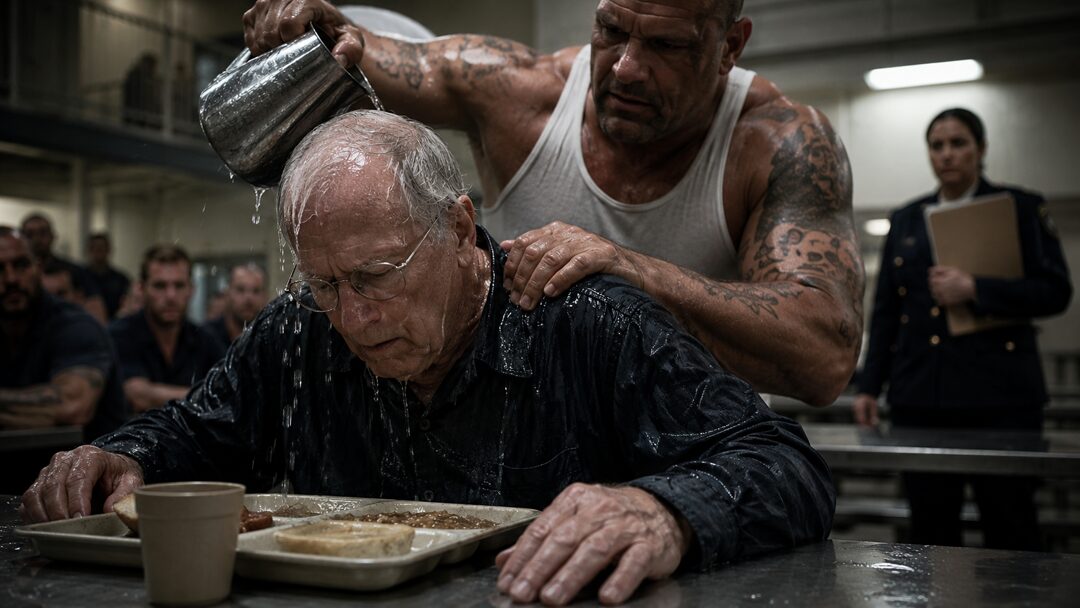
The water hit Robert before he ever saw the man holding the pitcher.
It came down cold over the back of his head, hard enough to knock his glasses crooked and thin enough to slide under his collar in a dozen freezing lines. His spoon clattered against the plastic tray. The soup in front of him trembled, pale and watery, as if even it had been startled.
For one full second, the mess hall went silent.
Then someone laughed.
Robert did not turn around.
He sat with his shoulders rounded, his hands open on either side of the tray. Water dripped from the edge of his nose onto the table. His white beard, trimmed short that morning by a clerk who had not looked him in the eye, darkened beneath his chin. His glasses fogged over, turning the room into a blur of light and gray.
Behind him, a voice said, “Heroes don’t eat alone unless they’re frauds.”
The man’s hand came down on Robert’s shoulder.
Heavy. Warm. Certain.
Robert closed his eyes.
He had been cold before. Colder than this. He had learned a long time ago that the body could survive the first shock if the mind did not run from it.
The mess hall belonged to the detention wing of Fort Calder, a low concrete building at the edge of the base where men waited for hearings, transfers, charges, and the kind of decisions that changed how their names would be spoken afterward. The room smelled of bleach, overcooked vegetables, wet boots, and old anger.
Robert had been there for less than an hour.
That had been enough.
The younger man behind him leaned close. Robert could smell coffee on his breath.
“Look at me,” the man said.
Robert removed his glasses carefully. His fingers shook more from age than fear, though no one in that room was likely to believe that. He wiped the lenses with a napkin. The paper dissolved in his wet hands.
The hand on his shoulder tightened.
“I said look at me.”
Robert lowered the ruined napkin.
“Please move your hand,” he said.
That got another laugh, louder this time. Not from everyone. A few men turned their faces away. But enough of them laughed for the sound to spread.
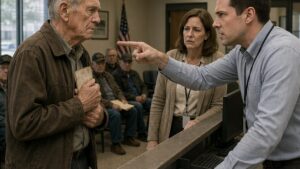
The younger man stepped around him, dragging the metal pitcher along the table with a scrape that made Robert’s teeth ache. He was tall and thick through the arms, with a shaved head, restless eyes, and faded tattoos disappearing under the straps of a white tank top. His knuckles were swollen purple. His jaw worked as if he had been chewing on his anger all morning and had finally found somewhere to spit it.
Robert knew men like him.
Not exactly him. Never exactly.
But he knew the posture. The way grief stood when it did not want to be recognized.
The man bent until his face was level with Robert’s.
“My name’s Mark Miller,” he said. “Maybe that means something to you.”
Robert’s wet fingers paused around his glasses.
It was small. A fraction of a movement.
Mark saw it.
His smile vanished.
“There it is,” Mark said. “You do know that name.”
Robert put his glasses back on. One lens was still streaked. Through it, Mark looked like two men trying to occupy the same face.
“I knew many men,” Robert said.
“Don’t do that.” Mark’s voice sharpened. “Don’t hide inside old-man words.”
A guard near the doors shifted his weight. “Miller.”
Mark did not look away from Robert.
“No,” he said. “Everybody here’s been whispering about him since he came through intake. Old medic. Big ceremony. Took a swing at an officer in front of half the base. Now he sits here like somebody’s confused grandpa.” He tapped the side of Robert’s tray with the pitcher. “I want to know what kind of man gets dragged out of a memorial and still lets people call him sir.”
Robert’s soup had begun to spill into the compartments of his tray. A piece of bread floated at the edge like something abandoned.
“I don’t ask people to call me anything,” Robert said.
“Good,” Mark said. “Then I won’t.”
He pressed down.
Pain flashed white through Robert’s shoulder.
Robert gripped the edge of the table, not to fight back, only to remain upright.
Across the room, chairs scraped. Men leaned forward. The silence changed shape. It was no longer surprise. It was expectation.
Someone whispered, “That’s Miller’s kid.”
Someone else muttered, “Shut up.”
Mark heard them anyway. His eyes never left Robert.
“My father was Sergeant Thomas Miller,” he said. “Decorated after Red Harbor. You remember Red Harbor, don’t you?”
Robert’s hand moved without permission.
Not far. Just toward the left side of his chest.
Toward the small coin sewn into the inner pocket of the detention shirt they had given him.
Mark’s gaze dropped.
Then he smiled again, and this time it was uglier.
“You do remember.”
Part II — Names Men Inherit
Robert had not gone to the ceremony to hurt anyone.
He had gone because the letter said the operation would be acknowledged at last, because names long locked away would finally be read beneath bright lights and polished flags, because men who had been reduced to sealed pages would receive two minutes of public dignity.
He had almost stayed home.
At seventy-four, almost was where much of his life had settled. Almost call. Almost explain. Almost sleep through the night. Almost forgive himself.
Then he had seen Thomas Miller’s name printed on the program.
Not as he remembered him.
Not as the young sergeant with dust in his hair and blood soaking one sleeve. Not as the man who had grabbed Robert’s wrist with the last of his strength and pressed a coin into his palm. Not as the man who had whispered about a son too young to know any version of him yet.
A cleaner version.
A smoother version.
A version with all the fear removed.
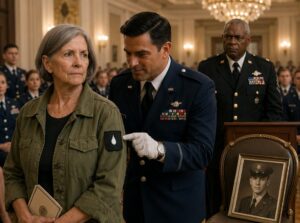
At the ceremony, an officer with bright ribbons and a practiced voice had spoken of sacrifice, successful extraction, disciplined withdrawal, and command integrity. Robert had sat in the third row, hands folded over the hidden coin, and felt the old lie rise in the room like steam.
When the officer said no one had been left behind by error, Robert stood.
He did not remember deciding to.
He remembered the faces turning.
He remembered saying, “That isn’t true.”
He remembered a younger captain taking his arm and telling him to sit down.
He remembered the hand on him feeling, for half a second, like another hand from twenty-eight years before. A hand pushing him back from a burning vehicle. A hand telling him not to go.
Robert had struck the man once.
Not hard enough to damage him. Hard enough to stop the lie.
That was how he had arrived here.
That was all anyone in the mess hall had been told.
Mark knew enough to hate him and not enough to understand why.
“Say it,” Mark demanded now.
Robert looked at him through streaked glass.
The room waited.
“Say what?”
“Say you were there.”
Robert swallowed. His throat felt dry despite the water running down his neck.
“I was there.”
The words moved through the mess hall faster than a thrown object.
Mark’s hand tightened again.
“And?”
Robert said nothing.
Mark laughed once, but there was no humor in it.
“You know what they said about men like you when I was growing up? They said classified meant important. They said silence meant honor.” He bent close enough that Robert could see the pale scar over his eyebrow. “Then I joined up. You know what I learned? Silence usually means somebody higher up wanted to keep their hands clean.”
One of the detainees near the far table murmured approval.
Mark lifted his chin, performing for the room now because the room gave him shape.
“My father came home different after Red Harbor,” he said. “He woke up swinging. He drank by the garage with the door half open like he was waiting for someone to call his name. My mother told me not to ask. Everybody told me not to ask. Then men like you show up at ceremonies looking sad and holy, like the rest of us should thank you for keeping your mouth shut.”
Robert stared at the table.
Mark struck the pitcher down beside the tray.
“Look at me.”
Robert did.
Mark’s eyes were red around the edges.
“My father spent the rest of his life carrying whatever happened out there,” Mark said. “And you people turned it into a medal and a paragraph.”
Robert’s mouth moved before he could stop it.
“Thomas hated paragraphs.”
The mess hall went still again.
Mark’s face changed.
Not softened. Not yet.
Changed like a door had opened behind his anger and shown him something he was not ready to see.
“You don’t get to call him Thomas.”
Robert accepted that as fair.
He had accepted worse.
The guard took another step forward. “Miller, back off.”
Mark threw one arm out without turning. “You want me to back off? Ask him why he hit an officer at my father’s memorial.”
Robert’s wet shirt clung to his ribs. His shoulder throbbed beneath Mark’s hand. The hidden coin pressed against his chest like a small, hard question.
He could have said it then.
He could have ended the shape of Mark’s rage with one sentence.
I carried your father out.
But words like that did not enter a room alone. They dragged the rest behind them. The burning road. The missing convoy. The bad order. Thomas begging. Thomas afraid. Thomas brave anyway.
And the boy who had grown up with a framed photograph instead of the truth.
Robert looked at Mark and saw, for a dangerous second, the child inside the man. Not innocent. Not harmless. But still standing in a doorway somewhere, listening to adults lower their voices.
“I’m sorry,” Robert said.
Mark recoiled as if Robert had spit at him.
“You’re sorry?”
Robert nodded once.
“That’s all?”
“It is what I can give you here.”
Mark’s face hardened.
“Then I’ll take the rest.”
He shoved Robert’s shoulder down until the old man’s breath caught.
A tray clattered behind them as someone stood.
Then the mess hall doors opened.
Part III — The Folder
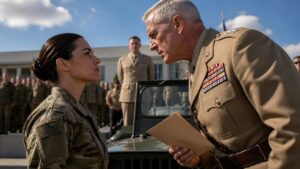
Captain Lisa Carter entered as if the room had been expecting her and had failed to behave properly before she arrived.
She wore her uniform with the kind of precision that made even tired men straighten by instinct. Her dark hair was pinned back. Her boots made no dramatic sound on the floor. The folder under her arm was sealed with a red band.
Robert saw the band and felt something inside him go quiet.
Not calm.
Quiet.
Captain Carter stopped three tables away.
“Sergeant Miller,” she said.
Mark did not move.
Carter’s eyes flicked from his hand on Robert’s shoulder to the pitcher, the wet shirt, the tray, the silent men.
“Step back.”
Mark let go, but slowly. He lifted his hand as if proving no one had forced him.
Robert’s shoulder rose an inch.
The pain stayed.
Carter approached the table. She did not ask Robert if he was all right. That was one of the first things Robert respected about her. There were rooms where that question only made the injury public twice.
“Mr. Robert Hayes,” she said, “your preliminary review has been moved up.”
Mark’s eyes narrowed. “Review for what?”
Carter did not look at him. “You are not part of this proceeding.”
“He was part of my father’s.”
That made her look.
For the first time since she entered, the controlled surface of her face shifted.
Not much.
Enough.
Mark saw it too. “You know who I am.”
“I read your intake file,” she said.
“You read his?” Mark pointed at Robert. “Or is that the problem?”
Carter’s hand tightened on the folder.
Robert noticed because he was looking for reasons to stop her.
“Captain,” he said softly.
She looked down at him.
Water dripped from his sleeve onto the floor. One drop at a time. Small. Regular. Like a clock.
“Not here,” he said.
Mark laughed under his breath. “Of course not.”
Carter’s eyes stayed on Robert. “New material has been declassified.”
The air changed before she finished the sentence.
Men who had been pretending not to listen stopped pretending. The guard near the door lowered his hand from his radio. Even Mark went still.
Carter said, “It concerns the Red Harbor survivor list.”
Mark’s mouth parted.
Robert closed his eyes.
For twenty-eight years, that list had existed only in fragments. Men alive. Men dead. Men returned under names that did not match what happened to them. Men omitted because the operation itself was easier to bury than explain.
Thomas Miller had been on the list twice.
Once as missing.
Once as recovered.
Neither line told the truth.
Mark reached toward the folder.
Carter pulled it back before his fingers touched it.
“Don’t,” she said.
“You say my father’s name in a room like this and tell me don’t?”
“I said the operation’s name.”
“My father was the operation.”
Robert looked at him then.
Mark felt it and turned.
For a moment, they faced each other without the room between them.
Robert saw the boy again.
But this time, he also saw the man that boy had become. A man who had broken another soldier’s jaw outside a bar because someone had called his father lucky. A man awaiting discipline because he could not tell the difference between insult and wound. A man who had poured water over an old man and called it justice.
Carter leaned close to Robert, lowering her voice.
“If this is read into the record here, it may clear the immediate allegation,” she said. “But it will expose details the families were never briefed on.”
Robert gave a small, tired smile.
“Families,” he said.
The word had carried so much weight for so long it no longer sounded plural.
Carter’s voice was quieter when she answered. “He has a right to know some of it.”
“Some?”
“Rights and mercy are not always the same thing.”
Mark slammed his palm on the table. “Don’t whisper over my father.”
The old Robert—the one who had survived by staying silent—almost won.
He almost folded his hands and let Carter take him away. Let Mark keep hating him. Let Thomas remain a clean picture on a wall. Let the lie continue its long work because at least the lie had kept a son standing.
But Mark was standing over him.
Thomas’s son.
Using grief like a boot.
Robert touched his chest again.
The coin was there.
It had always been there.
Carter saw the movement.
Her expression changed from procedural caution to something closer to recognition.
Mark saw it too.
This time, he was faster than either of them.
He snatched the folder off the table.
Part IV — The Name Beside His Father’s
“Sergeant Miller!”
Carter’s voice cut through the room, but Mark had already broken the seal.
The red band snapped and fell against Robert’s tray.
Mark opened the folder with hands that were too rough for paper. Pages slid loose. Some were blacked out in thick bars. Some carried stamps. Some carried names.
Robert did not try to stop him.
He watched Mark search the pages the way a starving man searches a bag for food.
Then Mark froze.
His eyes locked on a line near the bottom of a page.
Robert knew the line without seeing it.
Thomas Miller — recovered alive.
Beside it, in a column marked field medical extraction, was Robert’s name.
Mark looked up slowly.
For one dangerous breath, nobody spoke.
Then Mark’s face twisted.
“You forged this.”
Carter stepped closer. “Put the folder down.”
“You forged this,” Mark repeated, louder now, but the certainty was already cracking. “Or they did. Or somebody did.”
“No,” Carter said.
Mark pointed at Robert. “He was the one who abandoned them. That’s what people said. That’s why he disappeared after. That’s why nobody invited him to anything until they needed old faces for a ceremony.”
Robert flinched at the word abandoned.
Not because it was false.
Because part of him had believed it anyway.
Carter took the file from Mark’s hands. This time, he let her.
She looked at Robert.
He shook his head once.
Her face tightened.
Then she read only one line.
“Field medic Robert Hayes disobeyed withdrawal instruction, returned on foot to Grid Red Harbor Three, and extracted Sergeant Thomas Miller under hostile conditions.”
The mess hall did not react at first.
The words were too clean.
Too official.
Too small for what they contained.
Mark stared at Carter.
“No.”
Carter did not soften her voice. That would have been worse.
“The abandonment charge attached to Mr. Hayes was administrative, not factual. It was part of a sealed operational review.”
“What does that mean?” Mark demanded.
“It means,” Carter said, “the report protected the operation before it protected the men inside it.”
Someone at the back whispered, “Damn.”
Mark turned on him so fast the man sat back down.
Robert wished Carter had stopped there.
But truth, once touched, had its own weather.
Mark faced Robert. “You saved him?”
Robert’s hands lay flat on the table. Thin, pale, trembling.
“Yes.”
The word came out rough.
Mark shook his head, not in denial exactly, but as if trying to dislodge the sound.
“My father never said your name.”
“I asked him not to.”
Wrong answer.
Mark’s face went red.
“You asked him not to?”
Robert lifted his eyes.
“No. That’s not true.” He breathed in slowly. “I asked the record not to. Your father asked something harder.”
Mark stepped toward him.
Carter moved between them.
Robert said, “Let him.”
“Mr. Hayes—”
“Let him stand where he needs to stand.”
Carter did not move away entirely, but she shifted enough for the line between the two men to reopen.
Mark’s voice dropped.
“What did he ask?”
Robert looked past him for a moment.
The mess hall fell away. The tables. The trays. The wet shirt. The hard floor.
For half a breath, he saw a road washed in dust and orange light. He saw Thomas Miller half under him, half in his arms, laughing once through teeth red with blood because he had just remembered his son’s birthday was written on the inside of his helmet. He saw a vehicle burning without making the kind of noise fire made in movies. He saw his own hands pressing where blood kept coming through.
But memory was a country no one else should have to live in.
Robert came back.
“He asked me not to let you grow up with his worst minute,” he said.
Mark’s mouth tightened.
“What does that mean?”
Robert did not answer fast enough.
Mark struck the table with both palms. The tray jumped. Soup splashed across Robert’s sleeve.
“What does that mean?”
Robert looked at the spilled soup, then at the water still shining on the table.
“It means he was scared,” Robert said.
The words landed badly.
Mark’s right hand closed into a fist.
Carter said, “Miller.”
Robert kept his eyes on Mark.
“It means he was wounded and scared and begging to go home,” Robert said. “It means he thought fear would make him smaller in your eyes. It means he was wrong.”
Mark raised his fist.
Every chair in the room seemed to tighten.
Robert did not move.
Not because he was brave in the way men liked to say brave.
Because he was tired of letting Thomas’s son swing at ghosts.
Mark’s fist hovered inches from Robert’s face.
His knuckles shook.
“You don’t get to make him weak,” Mark said.
Robert’s voice was barely above a whisper.
“I’m not.”
Mark’s eyes shone now, though no tears fell.
Robert said, “I’m making him human.”
Part V — The Coin
For a moment, no one knew which way Mark would go.
Robert could see it happening inside him. The old reflex. The body choosing force before the heart had time to be ashamed. Mark had built himself into a weapon because weapons did not have to ask what grief wanted from them.
Robert slowly reached for the towel one of the guards had dropped near his chair.
Carter’s hand moved.
Robert shook his head.
He used the towel to wipe his face first. Then his glasses. Then, with a care that made the room watch harder, he laid the towel across his shoulders.
The motion took longer than it should have. Age made every small dignity a negotiation.
Then he stood.
The chair scraped behind him.
Mark stepped back without meaning to.
Robert was shorter than him by nearly a foot. So thin the wet detention shirt hung off him like it belonged to someone recovering from a long illness. His knees bent slightly under him.
Yet standing changed the room.
Not because he became imposing.
Because he stopped accepting the shape they had put him in.
He reached into the inner pocket of his shirt.
For one sharp second, Mark looked ready to lunge.
Robert brought out a coin.
Small. Darkened by years. Worn along the edge from being touched too often.
He placed it on the table between them.
The sound was soft.
It was enough.
Mark stared at it.
His face lost color.
“No,” he said, but this time the word was not aimed at Robert. It was aimed at time itself.
The coin bore the emblem of Thomas Miller’s unit. Mark had seen one like it only in photographs. His father’s had never been found, or that was what his mother had told him. There had been a folded flag. A framed citation. A ceremony with men who spoke in clean sentences.
But no coin.
Robert touched the edge with one finger, then withdrew his hand.
“He pressed it into my palm during the extraction,” Robert said.
No one breathed loudly now.
“He said, ‘Give it to my boy when he’s old enough.’”
Mark’s throat worked.
Robert did not look away.
“He said, ‘Tell him I was scared and went anyway.’”
The room held the sentence.
It was not heroic in the way men preferred.
That was why it hurt.
Mark stared at the coin as though it had accused him.
Robert continued, because stopping there would be another kind of cowardice.
“I kept it because when I came home, they had already told your family a different story. A cleaner one. Your mother was standing beside a man from command who said your father’s courage never wavered.” His mouth tightened. “I had his coin in my pocket. I had his blood under my nails. And I could not decide which truth would be kinder.”
Mark’s voice broke around the edges.
“So you decided for us.”
Robert nodded.
“Yes.”
That answer did more damage than any defense would have.
Mark looked up.
“You let me grow up worshiping a statue.”
Robert’s eyes lowered.
“Yes.”
“You let me think fear meant failure.”
Robert’s hand trembled once against the table.
“Yes.”
“You let me hate men who came home quiet.”
Robert did not answer right away.
When he did, it was barely a sound.
“Yes.”
Mark’s fist rose again, slower this time.
No one stopped him.
Not Carter. Not the guard. Not the room.
Robert stood still.
He had spent twenty-eight years imagining Thomas’s son. Sometimes he was five years old. Sometimes ten. Sometimes grown, with Thomas’s eyes and his mother’s mouth. Never like this, and exactly like this.
Mark could hit him.
Robert almost hoped he would.
Some debts asked for a shape.
But Mark looked at the coin, and his fist opened.
The hand fell to his side.
For a moment, he seemed to age in front of them. Not into weakness. Into knowledge.
He picked up the coin.
Not like proof.
Like something warm.
His thumb moved over the worn emblem.
“My mother waited for that,” he said.
Robert’s eyes closed.
“I know.”
“No, you don’t.”
Robert accepted that too.
Mark looked at him, and the anger was still there. It had not vanished. It had simply lost its target and had nowhere clean to stand.
“Was he crying?” Mark asked.
Carter looked away.
Robert did not.
“Yes.”
Mark’s jaw tightened.
Robert said, “So was I.”
That was the line that broke something.
Not loudly.
No dramatic collapse. No apology. No embrace. No sudden forgiveness for a room to admire.
Mark sat down.
Across from Robert.
Not behind him.
Not over him.
Across.
The mess hall watched as if something larger than an apology had happened and none of them knew what to call it.
Mark held the coin in his closed hand and stared at the table.
Robert remained standing for another moment, then his knees reminded him of the body he had.
Carter reached for his elbow.
This time, he let her help him sit.
The folder lay closed in her other hand.
There was more inside it. Names. Errors. Orders no one wanted spoken aloud. Men who had lived inside redacted lines. Men who had not lived at all.
Mark looked at the folder.
Carter saw him.
“Not here,” she said.
This time, Mark did not argue.
Part VI — A Different Kind of Silence
The review did not happen in the mess hall.
Captain Carter closed the folder, gathered the loose pages, and ordered everyone back to their seats with a voice that did not need volume. Men obeyed, though none of them returned fully to their food.
Robert’s tray was taken away. He noticed that before he noticed anything else. The spilled soup, the wet bread, the bent spoon—all of it removed by a young orderly whose hands moved too quickly.
Some part of him wanted the tray left there.
Evidence, maybe.
Or memory.
But life had always been efficient at clearing tables after the damage was done.
Mark stayed seated across from him, the coin hidden in his fist.
He did not look at Robert.
Robert did not ask him to.
Carter stood beside the table for another moment, watching both of them.
Then she said quietly, “Mr. Hayes, we still need your statement.”
Robert gave a tired nod.
“I know.”
“You understand that the declassified material changes the review.”
“Paper changes paper,” Robert said. “Not everything else.”
Carter’s face softened, but only slightly.
“No,” she said. “Not everything else.”
Two guards came to escort Robert back to the holding wing before the formal interview. One offered him another towel. Robert took it with both hands and said thank you, though his voice came out thin.
As he stood, Mark’s head lifted.
For a second, Robert thought he might speak.
He did not.
That was all right.
There were silences that hid cowardice, and silences that kept a person from breaking open in public. Robert knew the difference. He had learned it too late, but he knew it.
He walked slowly toward the doors.
His shoes left faint wet marks on the floor.
Behind him, chairs shifted. Conversations tried to restart and failed. The mess hall had lost its appetite.
At the doorway, Robert stopped.
He did not turn fully around. Only enough to look back over one shoulder.
Mark was still sitting at the table.
The big man who had poured water over him now sat with both elbows near his ribs, head bowed, one closed fist pressed to his mouth.
Robert saw Thomas in that posture.
Not in the anger.
In what came after.
He looked away before memory could take more than it was owed.
The holding corridor smelled colder than the mess hall. Carter walked beside him with the sealed folder against her chest.
After several steps, she said, “You could have told him sooner.”
Robert’s wet sleeve brushed the wall.
“Yes.”
“You could have told his family.”
“Yes.”
“Why didn’t you?”
Robert kept walking.
The easy answer was that the operation had been sealed, that men had signed papers, that orders had weight, that names were buried under authority. All of that was true.
None of it was the answer.
“Because his mother still smiled when they handed her the flag,” Robert said. “Because the boy was small. Because everyone in that room wanted the same lie, and I was tired enough to give it to them.”
Carter said nothing.
Robert added, “Mercy can look like pride when you carry it too long.”
They reached the holding door.
A guard opened it.
Before Robert stepped through, Carter said, “And now?”
Robert looked down at his empty hands.
Now the coin was gone.
For the first time in twenty-eight years, his chest felt lighter and more exposed.
“Now he has to decide what to do with what I should have given him,” Robert said.
The guard led him inside.
The interview took place an hour later in a narrow room with a table bolted to the floor. Carter asked questions. Robert answered the ones he could. She did not press him for every detail of Red Harbor. Perhaps because she knew the file. Perhaps because she had seen the mess hall.
Perhaps because some truths, once proven, did not need to be made naked for procedure.
When it was over, Robert was returned to the detention wing near evening.
Dinner had already begun.
He almost asked to skip it.
Then he remembered Thomas saying, with half a laugh and half a sob, Tell him I was scared and went anyway.
Robert went.
The mess hall was quieter when he entered. Men looked up, then down. No one laughed. No one saluted. No one tried to turn respect into theater.
That was a mercy.
Robert took a tray. Soup again. Bread again. The same pale meal served as if nothing in the world had shifted.
He carried it with both hands.
His fingers trembled halfway to the table, and some of the soup spilled over the edge.
A hand reached out.
Robert tensed before he could stop himself.
But the hand did not touch his shoulder.
It set a dry cup of water on his tray.
Clear. Steady. Full.
Robert looked up.
Mark stood beside the table, but not close enough to crowd him. He had changed out of the white tank top into a gray detention shirt. The coin was not visible, but Robert knew it was with him.
Mark’s eyes were swollen, though his face had hardened around that fact.
He did not say sorry.
Robert was grateful for that.
Some words were too small when spoken too soon.
Mark nodded toward the seat across from Robert.
“Taken?”
Robert looked at the chair.
Then at the cup.
The first water had made the whole room look.
This water asked nothing from anyone.
Robert sat.
Mark sat across from him.
For a while, neither man touched his food.
The room kept moving around them in small, careful sounds. Forks against trays. Boots under tables. A cough. A chair leg scraping.
Finally, Mark opened his hand under the table.
The coin rested in his palm.
“My mother used to say he never talked about being afraid,” Mark said.
Robert picked up his spoon. Held it. Put it down again.
“He probably didn’t want fear to follow him home.”
Mark’s fingers closed around the coin.
“It did anyway.”
“Yes,” Robert said.
Mark looked at the cup of water he had placed on Robert’s tray.
“I don’t know what I’m supposed to do with this.”
Robert knew he meant the coin. The truth. His father. Himself.
Maybe all of it.
“No one does at first,” Robert said.
Mark nodded once. It was not agreement. It was the smallest possible sign that he had heard.
Robert lifted the cup.
His hands shook, and for a moment the surface trembled.
Mark noticed.
He did not reach to steady it.
That mattered.
Robert drank.
The water was room temperature now. Plain. Tasteless. Nothing like forgiveness. Nothing like absolution.
But it went down clean.
When he lowered the cup, Mark was looking at the table.
Robert gave him one nod.
Not enough to erase anything.
Enough to begin somewhere neither of them had wanted to stand.
Outside the narrow windows, evening settled over Fort Calder. The lights came on one row at a time, turning the glass into dark mirrors. In one of them, Robert saw an old man with wet hair drying in uneven strands, and across from him, a younger man bent over something he had inherited too late.
Neither of them looked heroic.
For the first time all day, that felt almost honest.