The Room That Finally Looked
Part I — What Gary Saw
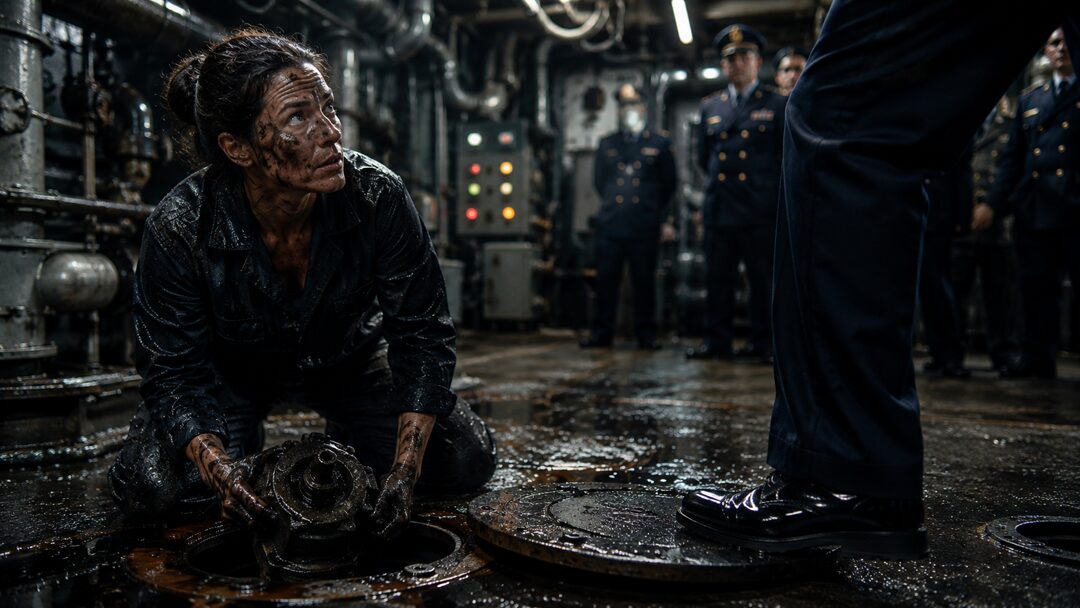
Rear Admiral Gary Whitaker saw the woman on her knees before he saw the ship around her.
That was his first mistake.
She was crouched in the middle of the engineering compartment, one hand braced on the wet deck, the other gripping a fouled metal component caked in black sludge. Her dark jumpsuit was so stained it looked almost painted onto her. Grease streaked her face. Her hair was pulled into a tight bun, but even that had not escaped the filth.
Behind Gary, three officers stepped into the cramped compartment and stopped short.
The floor glistened under harsh fluorescent lights. Puddles spread beneath pipes and conduit. Red and blue indicators blinked across control panels. Somewhere deep inside the vessel, machinery beat with an uneven rhythm.
Gary’s polished shoes touched the wet deck.
His face tightened.
“What the hell is going on down here?”
No one answered quickly enough.
The woman on the floor did not look up. She was still working the component in her hand, turning it, checking the seal by touch.
That offended him more than the mess.
Gary stormed forward and kicked a grimy cover plate aside. It skidded across the deck and rang against a pipe.
The woman’s hand paused.
Only then did she lift her head.
Her eyes were steady.
Exhausted, yes. Angry, maybe. But not afraid.
Gary bent toward her.
“Who is your commanding officer?”
The words cracked through the compartment.
A young lieutenant behind him shifted. The engineers along the wall froze. One of them, a lean man in stained coveralls, took half a step forward and stopped himself.
The woman looked at Gary for a full second.
Then she said, calm as a sealed hatch, “You’re looking at her, Gary.”
The compartment changed.
It did not get louder. It got quieter.
Gary’s mouth stayed open for half a beat longer than it should have.
He recognized the voice before he let himself recognize the face.
Commander Patricia Hale.
The woman he had been scheduled to review in forty minutes.
The woman whose readiness reports he had read from a clean folder in a clean wardroom. The commanding officer of the vessel he had just boarded.
The woman kneeling in sludge while his inspection party stood spotless behind him.
A flush climbed his neck.
“Commander Hale,” he said.
The title came out like an accusation.
Patricia did not move from the deck. She kept the fouled component pinned under one dirty hand, as if even now she trusted the machinery less than she trusted the men in the room.
Gary heard a quiet breath behind him. Someone had understood before he had.
That made it worse.
He straightened, needing height again.
“You’re out of uniform.”
Patricia looked down at herself.
A streak of black sludge slid from her sleeve onto the deck.
“No,” she said. “I’m in the one that fit through the crawlspace.”
The engineer who had stepped forward looked at her sharply, warning or admiration or both.
Gary turned on him.
“And you are?”
“Chief Engineer’s Mate Daniel Price, sir.”
“Then explain why your commanding officer is interfering with engineering systems instead of allowing trained personnel to do their jobs.”
Daniel’s jaw worked.
Patricia answered before he could.
“Because the trained personnel couldn’t reach the actuator.”
Gary looked back at her.
“Then you should have waited for proper equipment.”
A metal groan rolled through the compartment.
The overhead lights flickered.
Patricia’s hand closed tighter around the component.
“We were out of waiting.”
Part II — The Name in the Room
Gary heard the ship complain again.
He did not like the sound, but he liked less that Patricia did not seem surprised by it.
She turned her head toward Daniel.
“Secondary line?”
“Still climbing,” Daniel said. “Slow, but climbing.”
“Isolate starboard auxiliary.”
Daniel moved at once.
Gary snapped, “Hold.”
Daniel stopped.
Every engineer in the compartment seemed to stop with him.
Gary stepped between Patricia and Daniel. “No one touches another system until I understand the damage.”
Patricia finally rose.
Not all the way. Just enough to get one boot under her and push herself upright. The motion looked painful. Her jumpsuit clung heavy with water and oil. Beneath the grime, a patch of rank insignia showed near her collar, half-obscured but unmistakable.
Commander.
Gary saw his officers see it.
Patricia said, “Admiral, step clear.”
It was not loud.
That made it harder to fight.
Gary lowered his voice. “You do not give me orders in front of my staff.”
“I do when your staff is standing in the flood path.”
Daniel looked past Gary to the pressure gauge.
“Ma’am.”
One word. Tight. Urgent.
Patricia did not wait.
“Isolate starboard auxiliary.”
Daniel moved.
This time Gary did not stop him.
The compartment came alive in controlled bursts. Two sailors shifted around Gary, careful not to touch him, as if his uniform were something fragile and impractical. Daniel reached a valve station and turned a wheel. Another engineer pulled a lever. The alarm tone dipped, steadied, then dropped into intermittent pulses again.
Patricia exhaled.
Only then did Gary realize she had been holding her breath.
He hated that realization.
He hated that she had known exactly how close they were.
He hated that he had entered the compartment and seen only dirt.
“Commander Hale,” he said, sharper now, “you will explain why I found you crawling through an unsecured maintenance space during an active review.”
Patricia wiped one filthy hand against her thigh. It did nothing.
“I will,” she said.
Daniel turned. “Sir, she went in because the access hatch—”
Gary cut him off with a look.
Daniel stopped, but his anger did not.
Patricia noticed.
“Chief Price is telling you what happened.”
“I did not ask Chief Price.”
“No,” Patricia said. “That’s been the problem.”
The sentence landed clean.
Gary’s officers looked away.
One did not.
Lieutenant Sarah Coleman stood near the compartment door, clipboard held tight against her chest. Her brown hair was pinned perfectly under her cover. Her uniform looked untouched by the ship she had come to inspect. But her eyes kept moving from Patricia’s filthy sleeves to the water pooled around the deck plates.
She was young enough to still be disturbed by obvious things.
Gary pointed at Patricia.
“You may command this vessel, but you do not get to turn a readiness review into theater.”
Patricia’s expression barely changed.
“Theater happens above deck, Admiral. This is where the ship tells the truth.”
A few engineers lowered their eyes.
Not to hide amusement.
To hide the fact that the line had cut too close.
Gary leaned in. “Careful.”
Patricia held his stare.
She had not flinched when he kicked the cover plate. She had not flinched when he demanded her commander. She did not flinch now.
Gary felt the room slipping, and because he felt it, he reached for the oldest weapon rank gives a frightened man.
“I could have you thrown in the brig for unauthorized interference, reckless endangerment, and disorder during inspection.”
The words sounded excessive the second they left him.
But he could not take them back.
The compartment waited.
Patricia looked down at her hands.
Black sludge had settled into the creases of her knuckles. One fingernail was split. A thin line of dark water ran from her cuff and tapped the deck.
When she looked up again, her voice had not risen.
“You should have looked closer.”
Gary stared at her.
The phrase was quiet.
But it did not end there.
Patricia reached for the zipper at the front of her jumpsuit. It had worked loose during the crawlspace repair, exposing a ruined layer beneath. Slowly, deliberately, she pulled it up until the teeth sealed over the soaked fabric.
The gesture was small.
It felt final.
Not because the matter was over.
Because Patricia had decided who she was going to be in the room.
Gary looked away first.
Part III — The Clean Version
The immediate failure stabilized within twelve minutes.
Gary knew because Sarah Coleman marked the time.
He saw her do it.
That bothered him too.
The engineering crew did not celebrate. They moved with the weary precision of people who knew survival was not the same thing as repair. Water still gathered under the grates. The smell of oil clung to the air. The fouled component Patricia had removed sat on an overturned crate like evidence no one had yet admitted was evidence.
Gary wanted the room cleared.
Patricia refused.
“We’ll discuss it here,” she said.
“In this compartment?”
“Yes.”
“It is not suitable for review.”
“That’s exactly why.”
Daniel Price stood behind her, arms crossed, his coveralls stained dark to the elbows. He looked less relieved than angry.
Gary recognized that look from junior men who had forgotten the size of the machine above them.
Patricia saw him see it.
“Chief Price submitted three maintenance requests on the actuator assembly,” she said.
Gary’s eyes narrowed. “I am aware of maintenance traffic.”
“No,” Daniel said.
The word came out before discipline could catch it.
Gary turned.
Daniel’s face tightened, but he did not retreat.
“No, sir,” Daniel corrected. “You were aware of the downgraded summary.”
Sarah’s pen stopped.
Gary looked from Daniel to Patricia.
Patricia nodded once. Daniel reached for a sealed plastic sleeve from a toolbox and withdrew several damp copies. The edges were softened from the compartment humidity, but the pages were protected enough to read.
He placed them on the crate beside the fouled component.
Gary did not touch them.
Patricia did.
She spread them with two filthy fingers.
“Request one: actuator resistance beyond safe tolerance. Request two: intermittent seal failure after pressure cycling. Request three: immediate replacement recommended before readiness review.”
Gary’s jaw hardened.
“These requests would have been processed through maintenance command.”
“They were,” Patricia said.
“Then if they were downgraded, there was a reason.”
Daniel’s laugh was short and bitter.
Patricia did not look at him. She kept her eyes on Gary.
“The reason written was ‘noncritical impact on operational readiness.’”
Gary remembered the phrase.
Not the request.
The phrase.
It had appeared in a summary packet among dozens of other entries. Standard language. Clean language. Language that allowed a fleet to keep moving.
He had signed the packet.
Not because he wanted damage. Not because he wanted men in danger. Because readiness was a number everyone above him demanded, and numbers did not tolerate messy compartments.
Patricia read his face.
That annoyed him more than being wrong.
“You signed it,” she said.
“I signed an assessment based on staff recommendations.”
“My crew lived under your assessment.”
The compartment seemed to shrink.
Gary could feel Sarah’s eyes on him, and Daniel’s, and the engineers along the wall. None of them spoke. They did not need to.
Patricia picked up the fouled component.
“This jammed at 0410. By 0430, the pressure climbed enough to force standing water across the deck. By 0448, my smallest technician tried the crawlspace and got pinned halfway. By 0452, I went in.”
Gary looked at the narrow access hatch behind her. It was barely wide enough for shoulders.
Patricia’s shoulders.
Not Daniel’s. Not most of the crew’s.
“I was not performing theater,” she said. “I was correcting the distance between your paperwork and my ship.”
Gary’s face warmed.
“Commander, you will not imply negligence in front of—”
“Then don’t make me whisper it in private.”
Silence.
Sarah’s pen moved again.
Gary heard it.
Scratch. Scratch.
The sound was small, but it carried.
He looked at her.
She froze.
Patricia saw that too.
“Lieutenant Coleman,” Patricia said, still watching Gary. “Please record that Chief Price’s prior requests are now in review.”
Sarah looked at Gary first.
That was the old room.
Then she looked at Patricia.
That was the new one beginning.
“Yes, Commander,” Sarah said.
Gary’s control slipped another inch.
Part IV — Where the Ship Speaks
The formal review began two hours later in the same compartment.
Gary had objected.
Patricia had not argued. She simply said she would not discuss a flooded engineering fault in a room dry enough to make everyone comfortable.
So they came back down.
Gary arrived again in formal uniform. The same immaculate jacket. The same four gold stripes. The same polished shoes, now marked faintly at the soles from the earlier water.
Patricia arrived in the same jumpsuit.
Someone had wiped enough grime from her collar to reveal her rank. Someone had cleaned one side of her face, but black smudges still traced her cheek and temple. Her hands remained stained, even after scrubbing.
Gary noticed.
He hated that he noticed.
Sarah stood to one side with her clipboard. Daniel stood near the valve station. The engineers stayed back, silent but present.
The compartment no longer felt like a worksite.
It felt like a witness.
Gary began formally because formality still belonged to him.
“Commander Hale’s decision to personally enter an active maintenance crawlspace raises concerns about protocol, delegation, and risk management during inspection conditions.”
Patricia let him finish.
That was worse than interruption.
Gary continued, hearing the weakness in his own wording but trapped inside it.
“While the outcome appears to have temporarily stabilized the issue, command action should not depend on improvisation outside established procedure.”
Patricia looked at the component on the crate.
“Is that your finding?”
“That is my preliminary concern.”
“Good.”
She stepped forward.
The wet deck gave slightly beneath her boot.
“Then mine is that established procedure was used three times to ignore the people closest to the problem.”
Gary’s face tightened. “That is not established.”
Patricia nodded to Daniel.
Daniel placed the reports on the crate.
Not dramatically. Not triumphantly.
Just there.
Sarah moved closer, writing.
Patricia placed the fouled component beside them.
The blackened metal left a mark on the crate.
“Chief Price identified the fault,” Patricia said. “Submitted it. Resubmitted it. Elevated it. Your staff downgraded it. You signed the readiness packet.”
Gary looked at the component.
It looked ugly there.
Too physical. Too hard to explain away.
He had built a career around clean surfaces: clear decks, crisp language, controlled rooms. Problems were meant to arrive summarized, ranked by severity, placed into columns.
This thing had no column.
It had weight.
Patricia said, “You asked who commanded this compartment.”
No one moved.
“I did.”
She looked around the room once. At Daniel. At Sarah. At the engineers. Then back to Gary.
“You asked why I was on the floor.”
Her voice stayed even.
“Because your reports kept everyone else there.”
Gary felt the words strike the people behind him before they reached him.
That was how public failure worked. It moved outward first, then returned.
He straightened.
“You are dangerously close to accusing a flag officer of falsifying readiness conditions.”
Patricia looked tired then.
Not frightened.
Tired.
“I’m accusing the record of being cleaner than the ship.”
Gary said, “Commander, I can still recommend disciplinary action.”
The threat hung there.
It had weight, but less than before.
Patricia glanced down at her hands.
The black grime had sunk so deeply into her skin that it looked permanent.
When she spoke, it was nearly the same tone she had used the first time.
“You should have looked closer.”
Then she took the zipper of her jumpsuit between two stained fingers.
The compartment watched.
She pulled it up slowly, sealing the front all the way to her throat.
No speech followed.
No smile.
No victory pose.
Just the sound of metal teeth closing over the soiled fabric.
The same garment Gary had mistaken for proof that she was beneath him now sat like command attire on her shoulders.
Sarah lowered her clipboard.
Daniel’s jaw unclenched.
Gary looked at Patricia and finally saw what his rank had failed to show him.
She had not been diminished by the dirt.
She had been closest to the danger.
Part V — What Remained
Gary was removed from the immediate review before evening.
The phrase used was temporary reassignment of oversight.
Everyone understood what it meant.
No one celebrated.
That mattered to Patricia.
A cheering crew would have turned the moment into theater. Her crew did not cheer. They went back to work. They checked seals. Logged pressure. Replaced what should have been replaced weeks earlier. Scrubbed what could be scrubbed and marked what could not.
The compartment remained stained.
So did the record, now that someone had finally allowed the stain to show.
Sarah Coleman found Patricia near the access hatch just before the end of the watch. The lieutenant’s uniform was still crisp, but not untouched anymore. A dark smear marked her cuff where she had leaned against the crate while photographing the component.
She seemed embarrassed by it.
Patricia noticed and said nothing.
Sarah held the clipboard out.
“I entered Chief Price’s reports into the review log.”
Patricia took it.
The language was careful but clear. No dramatic accusations. No polished escape.
Daniel Price submitted repeated maintenance warnings prior to the pressure failure.
Warnings downgraded during readiness review.
Commander Hale entered restricted crawlspace after crew access failed.
Action prevented further system degradation.
Patricia looked up.
“Admiral Whitaker won’t like this.”
Sarah swallowed.
“No, ma’am.”
“And you wrote it anyway.”
Sarah’s grip tightened on the clipboard.
“I wrote what happened.”
Patricia handed it back.
“That’s where it starts.”
Sarah looked toward the stained deck, then the machinery, then Patricia’s jumpsuit.
For a moment she seemed very young.
“I thought the report was supposed to make things orderly,” she said.
Patricia’s eyes softened, just slightly.
“No. It’s supposed to make things true. Order comes after.”
Sarah nodded once and left.
Daniel approached next, carrying a replacement part in one hand and a mug of coffee in the other.
He offered the coffee.
Patricia looked at it.
“Is this yours?”
“Yes, ma’am.”
“Then no.”
For the first time all day, Daniel smiled.
It did not last long.
“You think they’ll bury it?”
Patricia took the replacement part instead.
“They’ll try to file it.”
“That’s not an answer.”
“It’s the honest one.”
Daniel leaned against the console, careful to avoid the live controls.
“You shouldn’t have had to crawl in there.”
Patricia looked at the hatch.
No, she thought.
But someone had.
And when command became the job of pointing from clean rooms, somebody else always ended up on their knees in the dark.
She did not say that.
Instead, she said, “Next time your report gets downgraded, you bring it to me before the compartment starts making its own argument.”
Daniel nodded.
“Yes, ma’am.”
He left her with the replacement part.
Patricia stood alone for a moment in the engineering hum.
The ship was steadier now. Not fixed. Steadier.
That was often the best command could give in a single day.
Later, before returning to the bridge, she stopped beside the crate where the fouled component had sat. Its black outline remained on the surface. The component itself was already locked away as evidence.
She looked down at her hands.
They were still dirty.
She could have gone to clean them. She could have changed. She could have presented herself above deck in a uniform that made the day easier for everyone else to digest.
Instead, she reached for the zipper at her throat.
It had slipped half an inch during the repair work.
Patricia pulled it closed again.
A small gesture.
A private one this time.
Then she stepped back into the compartment, past the stained deck and the blinking panels, toward the crew waiting for orders that had to be earned before they were obeyed.