What the Room Remembered
Part I — The Scratch Beneath the Light
Sergeant Emily Carter found the scratch because everyone else had already decided there was nothing left to find.
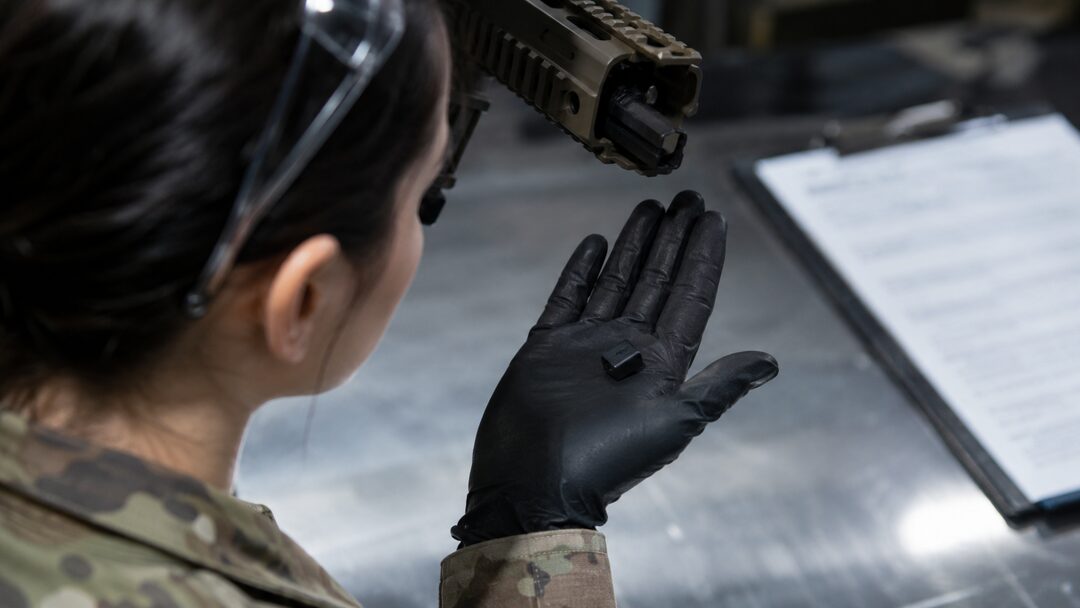
The rifle lay on the metal table beneath the armory lights, tan finish dulled by dust, optic still mounted, sling folded the way Staff Sergeant Daniel Brooks used to fold it himself. Major James Miller stood behind her in his dress uniform, arms crossed, waiting for her to sign the malfunction report.
The report was already clipped to the board beside her elbow.
All it needed was her name.
Emily did not touch the pen.
She leaned closer instead, safety glasses pushed up into her dark hair, and ran one gloved thumb along the seam beneath the optic mount. Her thumb caught on a line so thin it could have been nothing.
But nothing did not scrape against a tool mark.
Miller’s voice came from behind her. “Sergeant?”
Emily did not turn around. “One minute, sir.”
“You’ve had forty.”
She felt that in the back of her neck. Not anger. Not exactly. Pressure. The kind officers carried into a room without raising their voices.
The armory was too bright and too quiet. Racks along the wall held tagged weapons. A flag hung at the far end, motionless in the still air. Somewhere beyond the locked door, the rest of the building moved through the morning like this was just another file being closed.
But Daniel Brooks’s rifle did not feel closed.
It felt watched.
Emily adjusted the optic under the light. The scratch appeared, vanished, then appeared again. A crescent of exposed metal near a cover plate that had no reason to be disturbed.
Miller stepped closer. She could see his reflection in the black glass of the optic: tall, still, face controlled.
“The incident team already cleared the external inspection,” he said.
“Yes, sir.”
“And you were asked to verify malfunction, not rebuild the history of the weapon.”
Emily picked up the smallest driver from her tray.
Miller’s reflection sharpened. “Sergeant Carter.”
She paused with the tool in her hand.
The last time Daniel Brooks had stood at this table, he had made a joke about her labeling system. Said her tags were straighter than parade lines. She had told him if he stopped bringing sand into her armory, she would stop judging his storage habits.
That had been six days ago.
Now his name was on a casualty list, and his rifle had come back with a story already written for it.
Emily set the driver into the screw head.
“I just need to check the housing, sir.”
“You find something?”
“Not yet.”
That was true.
It was also the only answer she trusted.
The screw turned with less resistance than it should have. Too loose. Recently moved. She removed the first, then the second, placing both in a magnetic cup with soft clicks.
Miller said nothing.
His silence had weight.
Emily lifted the cover plate.
A small black wafer dropped into her palm.
For one second, neither of them moved.
The piece was no larger than her thumbnail, matte black, almost weightless. It sat against her glove like a burned flake of plastic. It was not a spacer. Not part of the optic. Not any issued component she had ever seen.
Emily stared at it.
Then she looked up.
Miller was already beside her.
His eyes fixed on the object before they reached her face. Something passed through him so quickly most people would have missed it.
Emily did not.
The major’s composure cracked at the edges.
He pointed at her palm.
“Put that down.”
The words were quiet.
That made them worse.
Emily closed her fingers halfway around the device, not hiding it, just refusing to let it fall back into the story everyone wanted.
“No, sir,” she said. “Not until I log it.”
Miller’s jaw tightened.
Outside the armory, a phone rang in some other office and stopped after one sharp burst.
Inside, the room seemed to hold its breath.
Part II — Not Issued
Miller locked the armory himself.
He moved past Emily, turned the deadbolt, then checked the small window in the door as if the hallway had grown ears. When he came back to the table, he was no longer standing behind her. He stood opposite her, with Daniel Brooks’s rifle between them.
Emily placed the black wafer on a clean cloth.
Then she opened a blank evidence entry in the log.
Miller’s hand came down on the binder before she could write.
“Not yet.”
Emily looked at his hand. Then at his face.
“With respect, sir, that was concealed inside the optic housing.”
“I saw where it was.”
“Then it has to be recorded.”
“It has to be understood before it is recorded.”
That was the first thing he said that sounded less like an order and more like fear.
Emily kept her pen still above the page. “That’s not how evidence works.”
Miller let out a slow breath through his nose. “You are not an investigator.”
“No, sir. I’m the armorer who found it.”
“And if you write the wrong thing in that book, you turn a controlled inspection into an uncontrolled accusation.”
“It’s already uncontrolled.”
His eyes lifted to hers.
Emily’s heart was moving too fast, but her hands stayed steady. That had always been her gift. She could be afraid everywhere except her fingers.
Miller removed his hand from the binder.
“Daniel Brooks’s family is waiting for a final account,” he said. “The unit is waiting. Two other families are waiting. The preliminary finding is a weapon malfunction during contact. This inspection confirms whether the file closes cleanly.”
Emily looked down at the report clipped beside her elbow.
Weapon malfunction.
The phrase sat there like a door someone had already shut.
She said, “And if that isn’t true?”
Miller’s face did not change. “Truth without structure becomes noise.”
“Sir, that is not issued.”
The sentence landed between them.
Miller looked at the black wafer again. His eyes closed once, briefly. When they opened, he was back inside himself.
“Do not speak of this outside this room,” he said.
Emily wrote the time in the log.
Miller’s voice hardened. “That was not a suggestion.”
She finished the entry line.
“Sergeant Carter.”
Emily set the pen down. “If you order me not to log evidence I found during an official inspection, I need that order in writing.”
For the first time, Miller looked at her as if she had become someone else.
Not a mechanic. Not a careful enlisted soldier with grease under one thumbnail. Not the quiet sergeant who kept the armory cleaner than the chapel.
Someone dangerous because she had noticed.
He stepped back from the table.
“You understand what you’re opening?”
Emily looked at Brooks’s rifle. At the taped mark on the stock where his thumb had rested so often the adhesive had worn smooth.
“I think he already opened it,” she said.
Miller’s phone buzzed.
He glanced at the screen and did not answer.
Emily saw only the name before he turned it facedown.
Colonel Harren.
Miller stared at the phone for three seconds. Then he looked at the armory door.
“Stay here.”
He did not unlock it.
He walked to the far corner and made a call in a voice too low for her to hear.
Emily used the silence.
She pulled Brooks’s rifle binder from the shelf and opened it to the checkout logs. His handwriting was there in block letters, neat and firm. BROOKS, DANIEL. Date. Time. Condition. Return.
The last official entry before the convoy was normal.
The one above it was not.
Same rifle. Same serial number. Checked out after midnight under officer override.
Authorized by: J. Miller.
Emily stared at the time stamp.
Behind her, Miller stopped speaking.
She did not turn the page fast enough.
When he returned to the table, his eyes went to the binder.
“You had no need to pull that.”
Emily pointed to the entry.
“You checked out his rifle after midnight?”
Miller’s gaze stayed on the page. “Calibration issue.”
“For an optic that came back with an unissued device hidden inside it?”
His mouth tightened.
Before he could answer, there was a knock at the door.
Not a casual knock.
Three controlled taps.
Miller locked the binder shut with one hand and went to the door. He opened it just wide enough for Lieutenant Sarah Hayes to slip inside.
Sarah looked tired before she looked worried. Her uniform was crisp, sleeves set perfectly, but the skin beneath her eyes told the truth first. She carried a small notebook and did not open it.
Miller shut the door behind her.
Sarah took in the table, the rifle, Emily, the cloth.
Then she saw the black wafer.
Her face went pale in a way Emily did not like.
Miller said, “Tell me that is not what I think it is.”
Sarah did not move closer.
“That depends what you think it is.”
Emily said, “Lieutenant?”
Sarah finally stepped to the table. She bent slightly, not touching the object.
Her voice dropped. “That’s a short-range recorder.”
Miller looked away.
Emily felt the room tilt.
Sarah added, “Or it was built to look like one.”
“For what?” Emily asked.
Sarah’s eyes stayed on the device. “Radio bursts. Nearby encrypted traffic. It would not transmit far. It would store.”
Emily looked at the rifle again.
The object seemed smaller now.
And worse.
“Who would hide that in Brooks’s optic?” she asked.
No one answered quickly enough.
Part III — The Note Behind the Page
Sarah asked for gloves.
Emily handed them over.
It was strange watching someone else move carefully in her room. Sarah’s fingers were narrow and precise, but she handled the black wafer like it might accuse her if she breathed too hard.
“No ports visible,” Sarah said. “No markings. Whoever used it did not want it identified in a routine check.”
Miller stood with his arms at his sides now. Not crossed. That small change made him look less like a commander and more like a man waiting for a sentence.
Emily opened the rifle binder again.
Miller saw her do it.
This time, he did not stop her.
Brooks’s pages carried the dull, ordinary life of equipment: cleaned, checked, zeroed, returned. But the final entries felt different now. Every blank space seemed deliberate. Every signature felt like a person choosing what could be remembered.
Emily ran her thumb along the inner pocket of the binder.
Paper shifted where no paper should be.
She pulled out a folded maintenance slip.
Not filed. Not stamped. Tucked behind the plastic sleeve like someone had hidden it in a hurry but wanted it found by the kind of person who checked corners.
She unfolded it.
Seven words, printed in Brooks’s block letters.
If the optic comes back clean, they buried it.
Emily read it twice.
Then she handed it to Miller.
His face did not change at first.
Then his eyes stopped moving.
Sarah whispered, “Major?”
Miller lowered the paper.
“He came to me,” he said.
Emily waited.
Miller’s voice was dry. “Two nights before the convoy. Brooks said there was a delay on route traffic. He said the schedule had been echoed on a channel that should have been silent.”
Sarah’s head turned sharply. “He told you that?”
“He was exhausted,” Miller said. “They all were.”
“That is not an answer,” Emily said.
Miller looked at her then, and for the first time there was pain in his face without anger to cover it.
“No,” he said. “It isn’t.”
The armory seemed smaller after that.
Emily could hear the hum in the overhead lights. The faint tick of cooling metal somewhere in the rack. Sarah’s breathing, measured but uneven.
Miller folded the note once along its existing crease.
“He had been pushing concerns for weeks,” he said. “Route adjustments. Delayed confirmations. Small things. Nothing that held together. Nothing I could take up without making him look unstable.”
Emily thought of Brooks standing at the counter six days ago, smiling like a man who had slept badly and learned how not to mention it.
She had asked him if his optic was holding zero.
He had said, “Depends who’s looking.”
She had thought it was another joke.
Now the memory hurt.
Sarah finally opened her notebook. “If this device recorded internal traffic before the convoy, it could show whether the route was compromised.”
“Could,” Miller said.
Emily looked at him. “You still want to close this?”
His eyes flashed. “You think I want this?”
“I think you wanted me to sign the report.”
“Yes,” he said. “I did.”
The admission was so blunt it stopped her.
Miller placed Brooks’s note on the table beside the black wafer.
“I wanted the file closed because three families are waiting for words that won’t break them twice,” he said. “I wanted it closed because a command inquiry will turn Brooks into a problem before it turns him into a witness. I wanted it closed because if we mishandle this, if we make one unsupported accusation, this device disappears into a drawer and his name becomes gossip.”
Emily’s anger did not vanish.
It sharpened.
“So we protect him by writing a lie?”
Miller looked at the malfunction report.
“No,” he said quietly. “We protect him by making the truth survive long enough to matter.”
Sarah did not look convinced.
Emily wasn’t either.
But something in the room had changed. Miller was no longer standing on the other side of the table as a wall.
He was standing there as someone trapped under the same ceiling.
His phone buzzed again.
This time he answered.
He listened without speaking. His face became formal, empty.
“Yes, sir,” he said.
A pause.
“No, sir. The inspection is not complete.”
Another pause.
His eyes moved to Emily’s hand resting near Brooks’s rifle.
Then to the note.
“Yes, sir,” he said again. “By morning.”
He ended the call.
No one asked.
They already knew enough.
Miller set the phone on the table.
“Colonel wants the rifle released for disposal with the completed file by 0800.”
Sarah closed her notebook.
Emily heard her own pulse.
“Disposal?” she said.
Miller nodded once.
The word did not sound administrative anymore.
It sounded like a mouth closing.
Part IV — The Names on the Page
Sarah wanted a clean chain.
Miller wanted time.
Emily wanted to put the device in a bag, put the bag in front of someone with authority, and make every silent person in the building answer for the space around it.
None of those wants fit together.
“That recorder may contain protected traffic,” Sarah said. “If we open it wrong, we contaminate it. If we route it through standard channels, we alert whoever pushed the disposal order. If we sit on it, we become the problem.”
Emily said, “We’re already sitting on it.”
Sarah’s mouth tightened. “I know.”
Miller was reading Brooks’s note again, though there were only seven words on it. Emily wondered if he was trying to find a different sentence there. One where Brooks had been less clear. One where Miller had been less late.
He looked up. “Who else knew Brooks raised concerns?”
Sarah hesitated.
That hesitation answered before she did.
Miller’s eyes narrowed. “Lieutenant.”
Sarah pressed the notebook flat against her thigh. “He asked me once if route confirmations ever repeated on a maintenance channel.”
“When?”
“A week before the convoy.”
“And you didn’t report it?”
“I told him to document a pattern.”
Emily stared at her.
Sarah’s voice stayed controlled, but color climbed her neck. “One odd repeat is nothing. Two is a coincidence. Three is a report. That’s how the system works.”
Emily said, “And if someone knows the system?”
Sarah looked at the black wafer.
“Then they stay under the number.”
The room went quiet again.
There it was. Not proof, not yet. Something worse in the beginning: a pattern shaped like intent.
Miller sat down slowly in the chair across from the rifle. It was the first time Emily had ever seen him sit in the armory.
He looked wrong there.
Too formal. Too human.
“Brooks tried to tell both of us,” he said.
Sarah did not answer.
Emily thought of the device hidden in the optic. Of Brooks checking out his own rifle. Of him knowing his weapon would be recovered, tagged, inspected, handled by someone like her.
Someone who looked at scratches.
“He didn’t hide it from us,” Emily said.
Miller looked up.
“He hid it for us.”
The words stayed in the air.
Sarah’s eyes closed briefly.
Emily picked up the black wafer with gloved fingers and placed it in her open palm, the way she had before. Only this time she held it lower, between all three of them.
“It isn’t asking us to guess,” she said. “It’s asking us to carry it.”
Miller looked at the device for a long time.
Then he looked at Emily.
“You think carrying it is simple because you found it.”
“No, sir.”
“You think if you are right, being right will protect you.”
Emily did not answer.
Because some part of her had thought that.
Miller’s voice softened. “It won’t.”
Emily swallowed.
Sarah said, “He’s right.”
The agreement stung more than the warning.
Emily looked from one officer to the other. “Then what are we supposed to do? Certify a malfunction and let his family thank us for a clean lie?”
Miller flinched.
Not much.
Enough.
Emily regretted the sentence the moment it left her, but she did not take it back.
Some truths were cruel only because people had made them wait too long.
Miller stood.
He picked up the malfunction report.
For a moment, Emily thought he was going to sign it.
Her stomach went cold.
He carried it to the shred bin, then stopped.
Not dramatic. Not heroic. Just stopped with the paper in his hand, as if the old habit of order was still stronger than the new shape of courage.
Then he folded the report once and placed it face down on the table.
“We do this formally,” he said.
Sarah looked at him. “Major.”
“We identify the rifle as material evidence in a suspected internal breach. We document the device without opening it. We transfer it under witness signature.”
Sarah’s face went still. “To whom?”
Miller picked up his phone.
“To the one person Colonel Harren cannot quietly overrule before morning.”
Emily did not ask who.
Miller dialed.
This time, when someone answered, his voice changed. It became official in a way that did not hide fear. It carried it.
“This is Major James Miller,” he said. “I need an evidence transfer witnessed now.”
He listened.
Then he said, “Yes. I understand what I’m alleging.”
His eyes moved to Brooks’s note.
“No,” he said. “Not alleging. Preserving.”
Part V — Observed Without Correction
The colonel’s aide arrived before the evidence officer did.
Captain Robert Vale entered with two folders under one arm and a face made for delivering messages he could later deny were threats. He glanced at Emily first, then Sarah, then Miller.
“Major,” he said, “Colonel Harren expected a completed certification.”
Miller stood behind the table. Brooks’s rifle lay in front of him. The black wafer rested on the cloth beside the note.
“The certification will not be completed,” Miller said.
Vale’s expression remained polite. “May I ask why?”
“Yes.”
Miller did not continue.
Emily almost looked away.
She did not.
Vale’s smile thinned. “Sir, the colonel’s instruction was clear.”
“So is the evidence.”
Vale’s gaze dropped to the table.
For a moment, the room became the opening scene again: the rifle, the hidden object, the officer staring at what should not have been there.
Only now Emily was not the only person holding the room still.
Vale said, “Has that item been identified?”
Sarah stepped forward. “Preliminarily, as a recording device.”
Vale looked at her. “Preliminarily?”
“Without extraction or analysis,” she said. “Which is why it needs to be preserved.”
“And you are attaching your name to that assessment?”
Sarah’s fingers tightened around her notebook.
Emily saw the old caution move through her face.
Then Sarah opened the notebook and clicked her pen.
“Yes,” she said.
One syllable.
A career could fit inside it.
Vale turned to Miller. “Major, I strongly recommend you wait for the colonel before initiating any transfer.”
Miller said, “Noted.”
The evidence officer arrived with two sealed bags and a digital log pad. He was young, confused, and smart enough not to ask unnecessary questions.
Miller gestured to the table.
“Rifle recovered from Staff Sergeant Daniel Brooks,” he said. “Previously pending malfunction certification. Inspection revealed concealed unissued device within optic housing. Related handwritten note recovered from rifle binder.”
The evidence officer looked at the note.
Then at Miller.
“Sir, classification of transfer?”
Miller’s pause was short, but Emily felt it.
This was the moment.
Before this, there had been suspicion. Fear. Argument. Possibility.
After this, there would be a record.
Miller said, “Material evidence in suspected internal breach.”
Vale inhaled sharply. “Major.”
Miller did not look at him.
The evidence officer tapped the log pad. “Basis?”
Miller picked up the black wafer with gloved hands and placed it into the clear bag. The plastic swallowed it, made it look even smaller.
Then he placed Brooks’s note in a separate sleeve.
“Basis includes physical discovery by Sergeant Emily Carter,” Miller said, “preliminary identification by Lieutenant Sarah Hayes, and prior verbal warning from Staff Sergeant Brooks to me regarding irregular route communications.”
Sarah went still.
Emily felt the sentence move through the room like a door opening into weather.
Vale said, “You are entering your own failure to escalate as part of the basis?”
Miller finally looked at him.
“Yes.”
No defense.
No decoration.
Just yes.
The evidence officer’s fingers slowed over the log pad.
Miller continued. “Brooks reported concern to me two nights before the convoy. I dismissed it as fatigue-related judgment. That dismissal is relevant to the preservation of this evidence.”
Vale’s face had lost its polite shape.
Emily looked at Miller and understood something she had not wanted to understand.
Telling the truth was not always standing above the lie.
Sometimes it was stepping into the part of it that had your name on it.
The log pad came to Emily first.
Her hand did not shake as she signed.
CARTER, EMILY.
Discovery witness.
Sarah signed next.
HAYES, SARAH.
Preliminary assessment witness.
Then Miller signed.
MILLER, JAMES.
Reporting officer.
He held the stylus one second longer than necessary.
Then, in the notes field, he added one more line.
Failed to escalate prior warning from SSG Brooks.
Vale said, “This will not remain contained.”
Miller handed the log pad back.
“It never was,” he said.
The evidence officer sealed the bags. Brooks’s rifle was tagged again, but no longer as equipment awaiting disposal. The tag was red now. Official. Heavy.
Emily stared at the rifle.
All morning, she had thought she was trying to keep it from disappearing.
Now she understood.
Brooks had made sure it could speak.
They had only decided whether to listen.
Part VI — What Stayed Behind
Three weeks later, the armory was bright again.
It always was. Fluorescent light did not care what people had carried underneath it.
Emily unlocked the door at 0630, signed the morning sheet, and paused before the empty slot on the evidence rack.
Brooks’s rifle was gone.
Not disposed of. Not cleaned, recertified, and returned to inventory. Gone into a process above her, behind doors she would never be invited through.
But the space where it had rested still pulled at her eyes.
A corrected account had gone to Brooks’s family. Not the whole truth. Not names and channels and every person who had looked away. But no malfunction certification. No clean lie folded into official sympathy.
Emily had heard that Brooks’s mother had asked for a copy of his last maintenance note.
She had not heard if anyone gave it to her.
Lieutenant Hayes still came by the armory sometimes, always for a stated reason. A serial number. A transfer question. A signature. She no longer kept the little notebook closed.
Major Miller had been reassigned pending inquiry.
No announcement. No ceremony. His office emptied over a weekend, nameplate removed by Monday morning.
Emily told herself she had expected that.
It still felt like the building had swallowed him quietly.
At 0705, an envelope slid under the armory door.
No knock.
Emily picked it up.
Inside was a copy of her original inspection sheet. The one she had started before everything changed. Her neat handwriting listed the time, the serial number, the scratch beneath the optic mount, the concealed device.
At the bottom, beneath her findings, someone had written in black ink:
Observed without correction.
No signature.
It did not need one.
Emily stood for a long time with the paper in her hand.
She had imagined, once, that courage would feel louder. That truth would arrive with witnesses, declarations, some clean line between before and after.
Instead, it felt like an empty rack space.
A copied form.
A sentence left behind by a man who had finally stopped correcting what he did not want to see.
The next rifle on her table belonged to a private who had returned from a field exercise with sand packed into every seam. It was ordinary, neglected, irritating work.
Emily set the inspection sheet aside and pulled her safety glasses down over her eyes.
She checked the chamber.
Checked the mount.
Checked the screws.
Then she slowed.
Her thumb moved along the edge beneath the optic, patient and exact.
The room hummed around her. The flag at the far wall hung still. Outside the locked door, footsteps passed and faded.
Emily worked carefully.
Not because she expected every weapon to carry a secret.
Because one had.
And because Daniel Brooks had trusted the small things to outlive the large ones.
She found no hidden device that morning. No note behind the page. No officer waiting for her to sign away what she had seen.
Only dust.
Loose grit.
A screw half a turn from where it should have been.
Emily tightened it, logged the correction, and moved to the next line.
The work did not feel smaller after Brooks.
It felt heavier.
It felt like listening.