What He Brought Home
Part I — The Doorway
Sarah opened the front door with one hand on her phone and the other already reaching for grocery bags.
Instead, her husband stood on the porch.
David was in uniform.
Not the clean version from the photos he used to send when he wanted Emily to feel proud. Not the smiling version on video calls, framed from the shoulders up, pretending the world behind him was quiet. This David stood with dusty boots on their welcome mat, a healing cut near one eyebrow, and a green duffel bag hanging from his right hand by a frayed strap.
For one full second, Sarah could not move.
The phone in her hand kept buzzing. Somewhere on the porch, an insect clicked against the porch light. Inside the house, the dryer hummed with the load she had forgotten to fold.
David smiled first.
It was a small smile. Careful. Almost asking permission.
“Hey,” he said.
Sarah gripped the edge of the door.
He looked thinner than he had three weeks ago. His face had lost that easy warmth he could turn on for Emily. His shoulders were still squared, but not in the way she remembered. They looked held together, as if relaxing would make something fall apart.
“You’re—” Sarah stopped.
Home.
Alive.
Early.
Wrong.
All the words jammed together in her throat.
David shifted the duffel bag lower in his hand. “I know.”
“You said next month.”
“I know.”
“You said the seventeenth.”
“I know.”
She should have run to him. That was what she had imagined for nine months. She had imagined the scream, the laugh, the way she would jump into his arms and make the neighbors look through their blinds. She had imagined herself crying beautifully, which was stupid, because real crying always made her nose red.
But standing there, looking at him, Sarah felt something colder move under the joy.
No one came home early without a reason.
David’s smile thinned. “Sarah.”
The sound of her name broke whatever had frozen her.
She stepped out barefoot onto the porch and collided with him so hard the duffel bag dropped beside his boot. David caught her immediately, one arm wrapping around her back, the other bracing her shoulders. The movement was automatic. Practiced. Strong.
Then his hand began to shake.
Sarah felt it between her shoulder blades.
She tightened her arms around his neck. He smelled like airport air, sun, stale fabric, and something metallic she could not name. His cheek pressed against her hair.
“I’m home,” he whispered.
It should have been enough.
For a moment, it almost was.
She buried her face against his collar and let the shock become relief. Her body remembered him faster than her mind did: the slope of his shoulder, the pressure of his hand, the way he breathed once, deeply, when he was trying not to break.
“You didn’t call,” she said into his uniform.
“I wanted to surprise you.”
Sarah pulled back just enough to look at him. “David.”
He looked past her, into the house.
The hallway behind her was warm and yellow. Emily’s rain boots sat by the stairs, one tipped over, one upright. A crayon drawing was taped crookedly to the wall. The living room lamp was on, and the whole house looked too normal for the man standing outside it.
“They moved the date,” David said.
It was too fast.
Too clean.
Sarah heard the sentence land between them and knew he had practiced it.
“They moved the date,” she repeated.
His eyes came back to hers. “Yeah.”
For a second neither of them spoke.
Then the phone in Sarah’s hand buzzed again. She looked down by instinct. The grocery app flashed: Your driver has arrived.
A car door shut at the curb behind David.
The delivery driver stopped at the bottom of the porch steps, holding two brown paper bags and looking between them.
“Uh,” the driver said, “Sarah?”
Sarah laughed once. It came out broken.
David stepped back as if embarrassed to be seen. Sarah caught his sleeve before he could move too far.
“Leave them there,” she called, without turning around.
The driver obeyed quickly. The grocery bags landed near the porch rail with soft paper thumps. A carton of strawberries tipped against a loaf of bread. The ordinary sound made Sarah’s throat close.
David was still watching the hallway.
Sarah followed his gaze.
“She’s upstairs,” she said.
His face changed, almost imperceptibly.
“Sleeping?”
“Supposed to be.”
He nodded, but his jaw flexed.
“She’s been asking every night,” Sarah said.
“For me?”
“For whether you remembered where her room was.”
The words were sharper than she meant them to be.
David looked at her then, really looked, and Sarah saw the hurt register. Not offense. Not anger. Something worse.
Agreement.
He bent to pick up the duffel bag.
Sarah reached for it at the same time.
David’s hand closed around the strap.
“Don’t,” he said.
The word cracked across the porch.
Sarah froze.
The delivery car pulled away from the curb. Its tires whispered down the street. Inside the house, the dryer stopped.
David’s face went pale under the porch light.
“I’m sorry,” he said immediately. “I didn’t mean—”
Sarah let go of the strap.
The bag sat between them, green, heavy, ordinary, suddenly not ordinary at all.
“What’s in it?” she asked.
“Nothing.”
“David.”
“Just my stuff.”
“Then let me carry it.”
He held the strap tighter.
Sarah looked at his hand, then at his face.
The reunion she had rehearsed for months had lasted less than three minutes before becoming something else.
Behind them, from the top of the stairs, a small voice called, “Mom?”
David stopped breathing.
Part II — The Girl on the Stairs
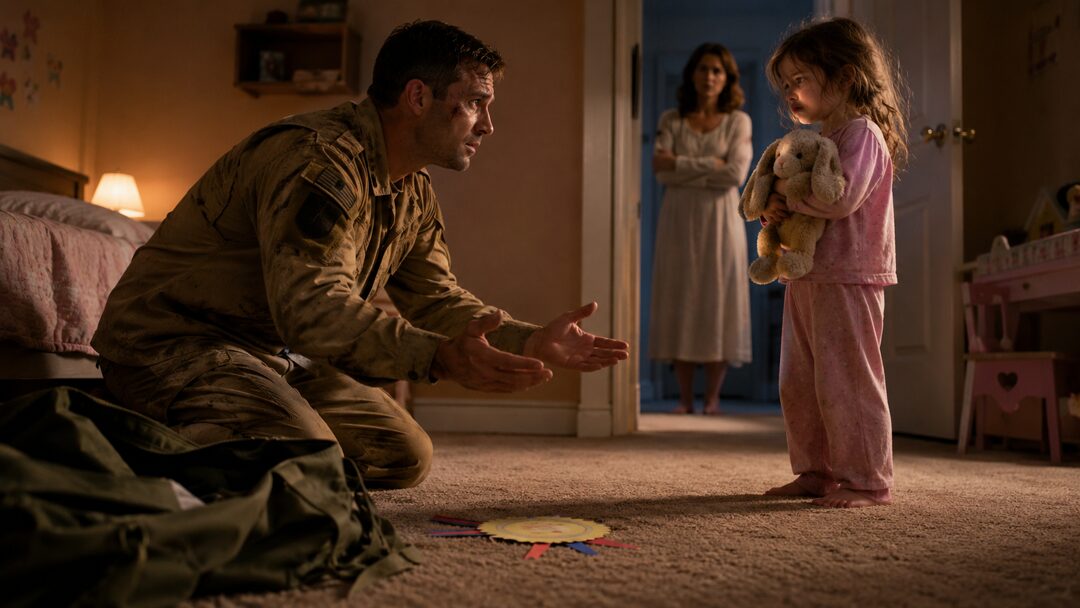
Emily stood at the top of the staircase in pink pajamas, her hair flattened on one side and wild on the other.
She held the stuffed rabbit David had mailed from overseas six months earlier. Its gray ears were nearly worn white at the tips. Sarah had washed it so many times the left eye had gone loose, but Emily refused to sleep without it.
She stared down at the man in the doorway.
David stepped inside without seeming to know he had done it.
The duffel bag remained on the porch.
Sarah watched that small fact happen. Watched her husband cross the threshold and leave the bag outside like it had not been invited.
Emily’s eyes moved from his boots to his uniform to his face.
“Daddy?” she said.
David’s mouth opened.
No sound came out.
Sarah put one hand against the doorframe. She wanted to run up the stairs, lift Emily, carry her down, place her in David’s arms, and force the moment into the shape it was supposed to have. She wanted one clean memory. One picture she could send his mother. One proof that waiting had been worth it.
But Emily did not run.
She stayed on the top stair with the rabbit pressed against her chest.
David took one step forward. “Hi, Em.”
Emily blinked.
Her lower lip did not tremble. She did not cry. That somehow made it worse.
“Are you staying this time?” she asked.
Sarah closed her eyes.
There it was.
The question Sarah had tried to tuck under bedtime stories, pancakes shaped like hearts, calendar stickers, and video calls that ended before Emily noticed David looking tired. The question that had lived in the house longer than David had been gone.
David looked up at his daughter like she had reached into him and touched the place he had taped shut.
“I’m home,” he said.
Emily hugged the rabbit harder. “That’s not what I asked.”
She was six. She still mispronounced spaghetti. She believed the moon followed their car. She asked if clouds were soft enough to sleep on.
But she knew the difference between an answer and a wish.
Sarah moved to the bottom of the stairs. “Honey, Daddy just got here.”
“I know.”
“He’s tired.”
“I know.”
David lowered himself slowly until one knee touched the floor at the foot of the stairs. The movement made his face tighten, but he hid it quickly.
Emily saw anyway.
“You got a cut,” she said.
“It’s small.”
“Did it hurt?”
“A little.”
“Did you cry?”
David gave a breath that was almost a laugh. “No.”
Emily looked disappointed by that.
Sarah felt a sharp, unexpected ache. Emily had cried plenty for both of them.
David opened his arms.
It was the gesture Emily had been waiting months to see. The gesture from old videos, from airport photos, from bedtime stories Sarah had told when the nights got too long.
Emily did not move.
David’s arms stayed open for one second.
Two.
Then he lowered them.
Sarah saw the effort it took him.
Emily’s gaze dropped to his chest, where the name tape read MILLER. She had once asked Sarah why Daddy had his last name on his shirt, as if he might forget who he was. Sarah had laughed then.
She was not laughing now.
“You didn’t call me,” Emily said.
David swallowed. “I know.”
“On my birthday.”
Sarah whispered, “Emily.”
But Emily’s eyes stayed on David.
“You promised,” she said.
David bowed his head.
Sarah saw his hand curl against his knee. Saw his thumb press into the seam of his pants like he was trying to keep himself anchored.
“I’m sorry,” he said.
“The phones were down,” Sarah said softly.
Emily glanced at her. “That’s what you said.”
“They were,” Sarah insisted, because it had been the only explanation she had been given, and she had clung to it like a rope.
David did not back her up.
Sarah looked at him.
He was staring at the floor.
“David,” she said quietly.
Emily noticed the silence. Children always noticed the silence adults hoped would pass over them.
“The phones weren’t down?” she asked.
David’s face changed.
Sarah had seen him scared twice before.
Once when Emily was three months old and had a fever that would not break. Once when an officer had come to their door to tell her David’s convoy had been delayed, and David had called six hours later pretending nothing had happened.
This was different.
This was fear with nowhere to go.
“I couldn’t call,” David said.
Emily hugged the rabbit under her chin. “Why?”
David looked at Sarah, not for permission, exactly. More like he was searching for the edge of a cliff in the dark.
Sarah shook her head once.
Not here.
Not like this.
David understood. Or maybe he was grateful not to answer.
Emily turned and walked back up the stairs.
“Em,” David said.
She did not stop.
Her bedroom door closed softly.
Not slammed.
That was worse too.
Sarah stood at the bottom of the staircase with her hand still on the rail.
David remained kneeling.
Outside, the porch light glowed over the groceries, the fallen duffel bag, and the empty space where the simple version of this homecoming had been.
Part III — The Bag Outside
Sarah waited until Emily’s door clicked shut before she spoke.
“What happened?”
David rose slowly. His knees seemed older than the rest of him.
“They moved the date,” he said again.
Sarah stared at him.
“Don’t do that.”
His eyes flicked to hers.
“Don’t stand in my house and give me the sentence they taught you to give strangers.”
The words surprised them both.
David looked toward the stairs. “Can we keep our voices down?”
“No,” Sarah said. Then softer, because Emily was upstairs: “Not if quiet is where you hide.”
He flinched.
Sarah hated herself for the pleasure she felt when the words landed. She hated him a little for making her say them.
He took off his cap and held it in both hands.
Without it, he looked less like a returning hero and more like a man who had spent too long awake.
“I wanted tonight to be easy,” he said.
“It stopped being easy when you left your bag outside like it was contagious.”
His eyes moved toward the open door.
The green duffel lay on the porch where he had dropped it. The strap was twisted. The grocery bags sagged beside it.
Sarah walked to the doorway.
David said, “Sarah.”
She stopped.
Not because he had ordered her. Because his voice had cracked.
“I can bring it in,” he said.
“Then do it.”
He stepped past her onto the porch, picked up the grocery bags first, and carried them inside.
Sarah watched him set them on the kitchen counter with absurd care. Bread. Strawberries. Milk. Eggs. The things she had ordered because she thought it was just another Tuesday.
Then he went back for the duffel.
He stood over it for a moment before lifting it.
Sarah saw the small tremor return in his hand.
He brought it inside and set it just across the threshold.
Not in the living room.
Not by the stairs.
Just inside.
As if the house had accepted it, but only barely.
Sarah closed the door.
The click of the latch sounded final.
David looked at it.
“You were supposed to call when you landed,” Sarah said.
“I know.”
“Your mother doesn’t know, does she?”
“No.”
“Your commander?”
“He knows I’m here.”
“That’s not what I asked.”
David rubbed his thumb along the cap in his hands. “I didn’t want people at the airport.”
“You didn’t want people looking at you?”
His silence answered.
Sarah leaned against the kitchen counter. The white dress she had put on because the house was too warm suddenly felt ridiculous. She had imagined wearing it to pick him up next month, imagined him seeing her first in it.
Now she was barefoot in a kitchen with thawing groceries and a husband who had come home like a secret.
“Were you hurt?” she asked.
“No.”
“David.”
“Not like that.”
“Then like what?”
He took a breath and did not finish it.
From upstairs came the faint creak of Emily’s bed.
David looked up.
Sarah knew that look. The part of him still counting exits, measuring rooms, listening for sounds that did not belong.
“She’s not a patrol,” Sarah said.
His eyes snapped back to her.
She regretted it immediately.
“I know that,” he said.
But his voice was thin.
“Do you?”
He set his cap on the counter. “I didn’t come home to scare either of you.”
“You scared me when you said ‘leave it’ like I was reaching for something that could hurt us.”
The kitchen went quiet.
David looked down at the duffel.
Sarah followed his gaze.
“What’s in the bag?”
He shook his head.
“Is it paperwork?”
“No.”
“Medicine?”
“No.”
“Something you’re not supposed to have?”
“No.”
“Then what?”
David’s mouth tightened. “Stuff I didn’t know what to do with.”
That was the first honest sentence he had said.
Sarah let it sit there.
His shoulders sank, barely, but enough.
She remembered the first month after he deployed, when Emily slept in David’s T-shirt and refused to let Sarah wash it. The third month, when Emily began drawing him into every picture, even pictures of the grocery store and the dentist. The sixth month, when the video calls grew shorter and David started saying, “Bad connection,” before the screen froze.
Then the birthday.
Emily in a paper crown. A cupcake with six candles. Sarah holding her phone in both hands, pretending it would ring any second.
It never did.
For three days after, Emily left one chair empty at the dinner table.
Sarah had not told David that.
She had planned to tell him when he came home and could fix it.
Now she understood he had arrived without the tools.
“Tell me one thing,” Sarah said.
David looked at her.
“One true thing.”
He closed his eyes.
When he opened them, they were wet but not spilling.
“Michael didn’t come back.”
Sarah’s hand went to the counter.
Michael Turner.
She had never met him in person, but she knew his face from grainy pictures: big grin, dusty sleeves, two fingers raised behind David’s head. He had sent Emily a ridiculous postcard once with a camel on it and written, Tell your dad I’m still better-looking.
Sarah looked toward the duffel bag.
“Was he with you?”
David nodded.
“On Emily’s birthday?”
He did not answer.
He did not need to.
Part IV — What the Silence Held
Sarah pulled out one of the kitchen chairs and sat down before her legs made the choice for her.
David stayed standing.
He had always done that when something hurt. Stayed on his feet like pain was a room he could refuse to enter.
“Sit down,” she said.
“I’m fine.”
“I didn’t ask if you were fine.”
For a second, he looked almost amused.
Then the expression vanished.
He sat.
The chair creaked under him. Sarah noticed that he kept his body angled toward the doorway, not the table. Half home, half ready to leave.
“Tell me what I need to know,” she said.
David looked at his hands.
“We were moving people out,” he said. “It was supposed to be routine.”
Sarah almost laughed. She had grown to hate that word. Routine meant someone was trying not to say afraid.
“I was with Michael,” David continued. “There were civilians near the road. More than expected. It got loud.”
He stopped.
Sarah waited.
She knew enough not to ask for every image. She did not want the shape of what haunted him. She wanted the part that had followed him into their kitchen.
“Michael was hit,” David said.
The word sat between them, flat and insufficient.
Sarah nodded once.
“I got to him. I did what I could.” His voice thinned. “He had a picture in his vest. His son. He kept trying to give it to me.”
David’s thumb moved against the table, back and forth, back and forth.
“I kept telling him to hold still.”
Sarah saw it then. Not the scene. David would never give her the scene. But she saw him inside it, doing what he knew how to do, using calm as a bandage.
“He knew,” David said.
Sarah did not ask what.
David swallowed. “After that, there was another extraction. A kid ran out near the convoy.”
Sarah’s fingers tightened around the edge of the table.
“I froze.”
The word was so quiet she almost missed it.
David looked at her then, and the shame in his face made her want to look away. She didn’t.
“I saw Emily,” he said. “I know it wasn’t her. I knew it wasn’t. But for a second—” He pressed his hand to his mouth, then dropped it. “Every child had her face.”
Sarah breathed in slowly.
“Did someone get hurt because of it?”
“No.” He answered fast. “No. They pulled back. They changed the route. No one—” He stopped, then corrected himself. “Not because of me.”
“Then why are you here?”
“Evaluation.” His mouth twisted. “That’s the word. Makes it sound clean.”
Sarah looked toward the stairs.
Emily’s door was still closed.
“And you didn’t tell me.”
“I didn’t know how.”
“You knew how to say the phones were down.”
“I never said that.”
“No,” Sarah said. “You let me.”
That landed harder than she expected.
David bowed his head.
There was a part of Sarah that wanted to stand up, walk to him, and hold his face in her hands. There was another part that wanted to throw every lonely night at him like plates.
Neither part won.
Instead she said, “She waited in her birthday crown for two hours.”
David shut his eyes.
“I told her maybe the time was different where you were,” Sarah continued, because now that she had started, she could not stop. “I told her maybe you had work. I told her maybe the call would come tomorrow. I told her everything except that her father might be somewhere choosing between somebody else’s life and her voice.”
David whispered, “I wasn’t choosing.”
“I know.”
The room tightened around them.
Sarah’s anger had nowhere simple to go. That was the cruelest thing. He had not missed the call because he did not care. He had missed it because the world he belonged to for those nine months had asked for everything at once.
But Emily was six.
Six-year-olds did not understand classified disasters, field medicine, survivor’s guilt, or the terrible arithmetic of duty.
They understood promises.
David pushed back from the table.
Sarah thought he might walk out.
Instead he went to the duffel bag.
He knelt beside it in the entryway and unzipped the top.
The sound was small and harsh.
Sarah stood but did not move closer.
David pulled out a rolled T-shirt, a shaving kit, two pairs of socks, a paperback with a cracked spine. Ordinary things. Human things.
Then he reached deeper.
His hand paused.
When it came out, he was holding a bundle of envelopes tied with a black cord.
Sarah recognized Emily’s handwriting immediately. Big uneven letters. Too many hearts over the i’s. Stickers peeling off the corners.
“You didn’t open them?” she asked.
David shook his head.
Sarah’s face changed before she could stop it.
“I opened the first ones,” he said quickly. “I did. I read them until…” His hand tightened around the envelopes. “After Michael, I couldn’t.”
“Because they were from Emily?”
“Because they were from home.”
Sarah’s eyes burned.
David reached into a side pocket and removed a small folded patch. He did not unfold it. He did not need to.
Michael.
The name entered the room without being spoken.
Then David pulled out a small piece of construction paper laminated badly with clear tape.
A medal.
Emily had made it the week before he left. Yellow circle. Red ribbon drawn in marker. Glitter glue along the edges. In the center, written in purple crayon: BEST DAD.
Sarah remembered laughing when Emily insisted he wear it to the airport.
David had pinned it to his chest for the whole drive.
Now it was bent at one corner, but carefully preserved.
Sarah covered her mouth.
David looked down at it like it was evidence.
“I kept it in the safest pocket,” he said.
Sarah walked to him then.
Slowly.
She knelt on the floor across from him, the duffel bag between them.
“You were afraid to bring this inside,” she said.
He nodded.
“Because of Michael?”
“Because of me.”
Sarah waited.
David’s voice dropped. “What if she runs to me and I can’t be who she thinks I’m running back as?”
Sarah looked at him for a long moment.
Then she reached across the duffel and touched his wrist.
“Emily doesn’t need the man in the airport picture,” she said. “She needs the father who came back to step inside.”
“I am inside.”
“No,” Sarah said. “Your boots are.”
His eyes met hers.
The house seemed to hold its breath.
Upstairs, Emily’s door opened.
Part V — The Safest Pocket
Emily stood in the hallway outside her bedroom, still holding the rabbit.
She looked smaller from below.
David quickly wiped his face with his sleeve, but not fast enough. Emily saw. Sarah saw her see.
“Are you crying?” Emily asked.
David looked down at the paper medal in his hand.
“Yes,” he said.
Emily’s brow furrowed.
Sarah stayed at the bottom of the stairs. This time she did not move to soften the moment.
David climbed the stairs slowly. He did not rush. He did not call her baby girl in the bright voice he used on video calls. He stopped outside her room with enough space between them that Emily could close the door if she wanted to.
“Can I come in?” he asked.
Emily looked at Sarah.
Sarah nodded once, but said nothing.
Emily stepped backward into her room.
David followed.
Sarah waited in the hallway for three seconds before she allowed herself to stand where she could see them.
Emily’s room had not changed much while David was gone. Same glow-in-the-dark stars on the ceiling. Same bookshelf crammed with picture books. Same drawing taped beside the bed: three stick figures holding hands under a giant yellow sun.
But the room had grown around his absence.
His old sweatshirt lay folded at the foot of Emily’s bed. A paper chain hung from the window curtain rod, each loop marked with a date. Sarah had stopped removing links when the return date moved twice. Emily had noticed.
David did not sit on the bed.
He sat on the floor.
That small choice changed the room.
He placed the paper medal on the carpet between them.
Emily looked at it.
“You kept it,” she said.
“In the safest pocket I had.”
“You didn’t wear it.”
“I wanted to keep it from getting ruined.”
“It’s bent.”
“A little.”
Emily crouched and touched the bent corner with one finger.
David’s hands stayed on his knees.
Sarah could see how badly he wanted to reach for her. His fingers flexed once, then went still.
Emily looked at him. “Why didn’t you call?”
David glanced toward Sarah.
Sarah’s heart tightened.
Here was the place where he could hide again. Where he could say the phones were down, or work got busy, or grown-ups had reasons children did not need to know.
Instead David said, “Something happened that day. Someone needed help very badly. I was scared, and after that, I didn’t know how to talk right.”
Emily listened with the solemn attention only children could give, as if every word was a physical object being placed in front of her.
“So you forgot me?” she asked.
David’s face broke.
“No.”
“You didn’t call.”
“I didn’t forget you.”
“But you didn’t call.”
“No,” he said. “I didn’t. And I’m sorry.”
Emily looked at the medal again.
Sarah leaned one shoulder against the doorframe. Her throat hurt from keeping quiet.
David said, “I thought if I couldn’t be good at coming home, maybe I should wait until I could.”
Emily frowned. “That doesn’t make sense.”
A sad laugh moved through him. “I know.”
“You were supposed to call even if you were bad at it.”
David nodded.
“That’s true.”
Emily picked up the medal and held it in both hands.
“Are you staying this time?” she asked again.
David did not answer right away.
Sarah felt the old instinct rise in her. Say yes. Say of course. Say forever. Give her the thing that lets her sleep.
But David looked at their daughter and did not reach for the easy lie.
“I’m here tonight,” he said. “I’m here tomorrow. And when I’m scared, I’m going to tell you instead of disappearing.”
Emily stared at him.
“That’s not forever.”
“No,” David said. “But it’s true.”
The room went quiet.
Sarah felt the line land in herself too.
It was not enough.
It was more than she had been given in months.
Emily stepped closer, still holding the medal. David opened his arms slightly, then stopped. He let them rest there, available but not demanding.
Emily took one more step.
Then another.
When she reached him, she did not leap.
She placed the paper medal against his chest, right over his name.
“It still says best dad,” she whispered.
David’s face folded.
Emily climbed into his lap, awkward and careful at first, rabbit pressed between them. Then her small arms went around his neck.
David held her like something inside him had finally been allowed to fall.
His shoulders shook once.
Then again.
He buried his face in her hair and cried silently, the way he had probably learned to cry where no one could afford sound.
Emily did not pull away.
She patted the back of his neck with one small hand.
“It’s okay,” she said, because she was six, and because children often tried to become the comfort they were owed.
David shook his head against her hair.
“No, Em,” he whispered. “You don’t have to make it okay.”
Sarah covered her mouth.
That was the moment she understood he had come home.
Not when he stood at the door.
Not when he crossed the threshold.
Now.
When he stopped asking his daughter to receive the version of him he wished he could be.
Part VI — Inside the House
Sarah found them on the floor exactly as she had imagined and not at all how she had imagined.
Emily was tucked against David’s chest, her pink pajama sleeve twisted under his arm. The paper medal was flattened between them. The stuffed rabbit lay on its side near David’s boot, temporarily forgotten.
David’s eyes were closed.
Tears moved quietly down his face and disappeared into Emily’s hair.
Sarah knelt behind him.
For a second, she did not touch them.
She let herself see the whole thing: the man who had left standing straight in the driveway months ago; the child who had waved until the car turned the corner; the mother who had gone back inside and found a pink sock on the kitchen floor and cried over it because there had been no one else to cry at.
Then Sarah wrapped her arms around both of them.
David turned his head slightly, as if the touch startled him.
“It’s me,” she whispered.
His hand came up and covered hers.
Not to hold it down.
To make sure it stayed.
Emily mumbled something into his uniform.
“What was that?” Sarah asked.
Emily lifted her head just enough to speak. “I said he smells weird.”
A sound escaped David.
Not quite laughter. Not quite sobbing. Something in between.
Sarah laughed too, and the laugh hurt on the way out.
“He does,” she said.
David wiped his face with the heel of his hand. “I can shower.”
Emily tightened her arms around him. “Not yet.”
So he stayed.
The house settled around them.
Downstairs, the groceries waited on the counter. The milk had probably warmed. The strawberries were bruising in their carton. The dryer held clothes that would wrinkle, and the porch light still glowed over an empty mat.
None of it moved.
None of it mattered yet.
After a while, Emily fell asleep against David, heavy and trusting in the sudden way children surrendered once their bodies decided the danger had passed. David looked terrified by the weight of her.
Sarah brushed Emily’s hair back from her cheek.
“You can breathe,” she said.
David took in a slow breath.
Then another.
Sarah helped him lift Emily onto the bed. He moved carefully, as if every small part of her had its own fragile weather. When the blanket was pulled up to her shoulder, Emily stirred and reached blindly.
David gave her the rabbit.
She caught his sleeve instead.
“Tomorrow,” she mumbled.
“I’ll be here,” he said.
Her fingers loosened.
Sarah turned off the bedside lamp, leaving only the glow of the plastic stars on the ceiling.
In the hallway, David stood still.
Sarah touched his arm. “Come on.”
They walked downstairs together.
The duffel bag sat by the front door, just inside the house.
David stopped when he saw it.
Sarah expected him to pick it up. Expected him to carry it to the laundry room, the bedroom, anywhere out of sight. Expected him to start sorting the ordinary from the impossible because that was what he did when feeling became too large.
He did not.
He looked at the bag for a long time.
Then he set Emily’s paper medal on the small entry table beside their keys.
Not in the bag.
Not hidden.
Inside the house.
Sarah stood beside him.
“We don’t have to unpack it tonight,” she said.
David nodded.
His face was tired beyond sleep.
“I don’t know how to be here yet,” he said.
Sarah slipped her hand into his.
“Then start by not leaving the room.”
He looked at her.
There was pain in his eyes. There was gratitude too. Neither erased the other.
Outside, a car passed slowly down the street. Somewhere nearby, a dog barked once and quieted. The house smelled like warm laundry, grocery bags, and the rain that had not yet fallen.
David squeezed her hand.
Not hard.
Enough.
Together they turned off the porch light.
The duffel bag remained by the door, still full, still heavy, no longer waiting outside.