What She Carried
Part I — The Woman With the Purple Suitcase
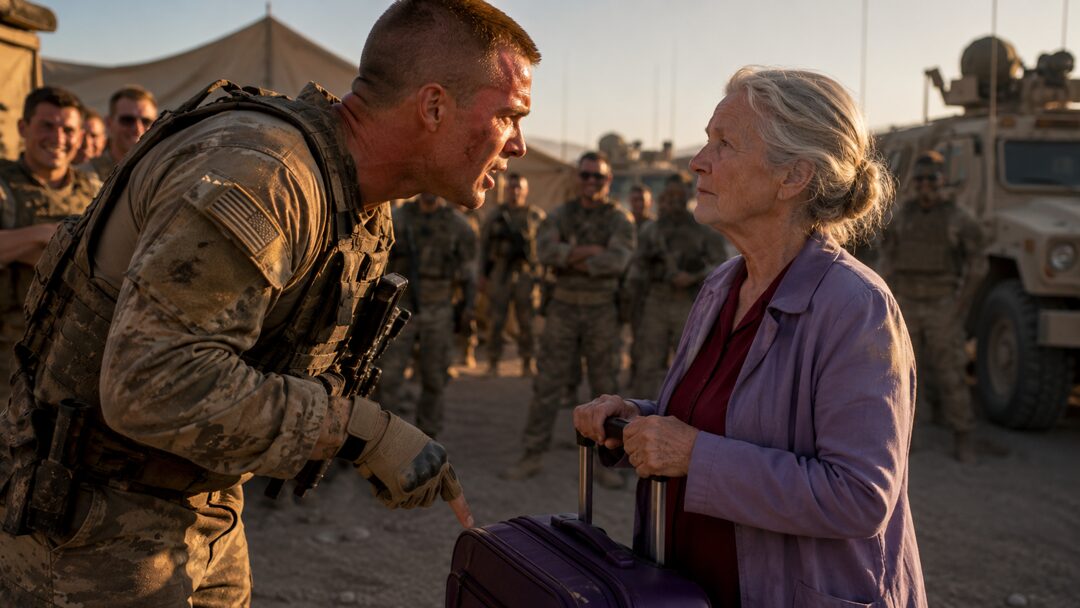
Sergeant Ryan Walker laughed before the old woman even finished stepping into the weapons issue area.
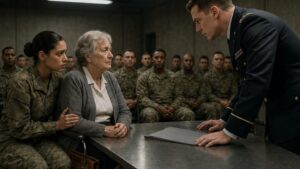
She stood between two stacks of sandbags with both hands resting on a dark purple rolling suitcase, wearing a lavender jacket over a red blouse as if she had taken a wrong turn on her way to a church luncheon. Around her, soldiers tightened straps, checked gear, loaded magazines, and pretended not to stare.
Ryan did not pretend.
He leaned close enough for the dust on his vest to almost brush her sleeve and pointed at the compact case beside her suitcase.
“Is that a toy,” he asked, “or are we actually shooting?”
His squad cracked up behind him.
The laugh came too fast and too loud. It was the kind of laugh men used when the afternoon was too hot, the mission too close, and nobody wanted to say they were scared.
Ryan fed it.
He tipped his head back, mouth wide, gloves half-fastened, the picture of a man with no room left in him for doubt.
“Maybe the enemy’ll die laughing.”
More laughter.
Private Joshua Miller laughed last. He was thin, pale beneath the grit, his helmet sitting a little too low over his brow. His laugh came out like something borrowed from the other men.
The old woman did not blink.
Her silver-gray hair was pulled back neatly. Her face was lined but not soft. She looked at Ryan the way people looked at weather they had survived before.
Not offended.
Not impressed.
Just waiting.
Ryan hated that more than anger.
Most civilians reacted to him. They flinched at his gear, softened their voices, thanked him too many times, or looked at the rifle across his chest like it might answer back. This woman looked past the camouflage, past the patches, past the dust, and landed somewhere under his ribs.
He straightened a little.
“Ma’am,” he said, dragging the word out just enough to make the squad smile again, “this is a restricted area.”
“I know.”
Her voice was low and even.
That killed half the laughter.
Ryan looked over her suitcase again. Purple. Polished. Ridiculous. There were scuffs along the bottom corners and a strip of gray tape wrapped around the handle. It looked well traveled, but not by anyone who belonged here.
“You lost?” he asked.
“No.”
“You visiting somebody?”
“No.”
“Then what exactly are you doing in my lane?”
She shifted one hand on the suitcase handle.
“I’m here to see your rifles before you leave.”
The squad went quiet in pieces.
A magazine clicked into place somewhere behind Ryan. A boot scraped the hard-packed dirt. Farther out near the vehicles, an engine idled with a rough, impatient growl.
Ryan stared at her.
Then he smiled again, but the smile had sharpened.
“My rifles?”
“Your squad’s rifles.”
“You inspect weapons now?”
“I have.”
That answer should have been nothing.
But she said it with the calm of someone who had not guessed, had not hoped, had not wandered in by mistake. She said it like a fact that did not need Ryan’s permission to exist.
The men behind him shifted.
Ryan could feel their attention turning. That was dangerous. Men could follow fear. They could also follow embarrassment. He had built the squad’s rhythm carefully: jokes before convoys, noise before silence, swagger before the gate. Nobody got to shake that right before a run.
Especially not an old woman with a purple suitcase.
He stepped closer.
“Do you even know how much a rifle weighs?”
The old woman finally looked directly at the weapon across his chest.
Then she looked at him.
“I know what it weighs,” she said, “and what your confidence costs.”
The words struck the circle clean.
No one laughed.
Ryan felt the heat come up his neck before he could stop it. He heard the engine. The wind. The small metal clink of someone’s sling buckle settling against a vest.
The old woman’s hands stayed on the suitcase.
Not one finger trembled.
Before Ryan could answer, a voice cut in from behind the line of vehicles.
“Sergeant Walker.”
Captain Lisa Grant walked toward them with her sleeves rolled tight, her expression already impatient. She was lean, sharp-eyed, and had the clipped voice of someone who had been asked five questions before breakfast and had answered all of them while reading three reports.
Ryan snapped upright.
“Yes, ma’am.”
Captain Grant looked once at the squad, once at Ryan, then at the woman.
“Mrs. Caldwell is cleared for this area,” she said. “You’ll cooperate with her inspection.”
Ryan blinked.
The old woman did not look at him.
“Inspection, ma’am?” Ryan asked.
“You heard me.”
“With respect, we roll in forty minutes.”
“Then don’t waste any more of them.”
The captain turned to Mary Caldwell.
“Mrs. Caldwell, let me know if anything needs command attention.”
“I will.”
Captain Grant left as quickly as she had arrived, already speaking into her radio.
Ryan stood there with his squad watching him.
The silence after laughter always felt worse than the laughter.
He looked at Mary Caldwell.
She looked back.
“Well?” she said.
Part II — The Inspection
Ryan handed over the first rifle like it had personally betrayed him.
Mary Caldwell took it without ceremony.
She did not admire it. She did not act impressed by its weight. She did not hold it awkwardly or ask where to put her hands. Her fingers went where they needed to go with the quick, economical certainty of someone who had done the same motion thousands of times and had forgotten more about weapons than Ryan wanted her to know.
That bothered him.
Her lavender sleeve brushed against black metal. Her red blouse flashed beneath the open jacket. The image looked wrong, but her hands made it right.
She checked the chamber. Looked along the worn edges. Ran a thumb near a seam where dust had settled into a thin pale line.
“Who cleaned this?”
One of the men shifted behind Ryan.
“Mine,” said Corporal Mark Stevens.
Mary looked at him. “You rushed the last pass.”
Mark’s grin faded. “No, ma’am.”
She turned the rifle slightly.
Ryan saw it then. Not much. A trace of grit where a careful man would have caught it.
Mary did not gloat. That made it worse.
“It may run,” she said. “May isn’t good enough when someone else is counting on you.”
Mark took it back, cheeks reddening.
Ryan forced a laugh through his nose.
“Good thing Mrs. Caldwell caught the apocalypse in a dust speck.”
Mary had already reached for the next rifle.
The squad did not laugh as hard this time.
That irritated Ryan more than open defiance would have. He could feel control slipping by degrees. A minute ago they had been watching him humble her. Now they were watching her correct them one by one.
She adjusted one sling.
“Too loose.”
The soldier frowned. “Feels fine.”
“Feels fast standing still. It won’t feel fast when you’re climbing out under pressure.”
She tapped a magazine.
“Marked but not tested?”
The soldier’s mouth opened.
Mary held up one finger, not unkindly. “Don’t tell me what the tape says. Tell me what you know.”
He said nothing.
Ryan crossed his arms.
The convoy had a departure window. The route brief had been short and ugly. Reports had been contradictory all morning. Two villages along the road had gone quiet, which never meant nothing. Captain Grant wanted them moving before dusk.
And here they were, being slowed by a seventy-two-year-old woman in a lavender jacket.
Ryan stepped beside her.
“Ma’am, we’ve run this road before.”
“I heard you the first time.”
“I didn’t say it the first time.”
“You’ve been saying it since I arrived.”
His jaw tightened.
Behind him, Miller lowered his eyes.
Mary reached for Miller’s rifle.
He handed it over too quickly, like he was relieved to be rid of it and ashamed of the relief.
Mary noticed.
Ryan noticed her noticing.
“What?” he asked.
She kept her eyes on Miller. “How has it been running?”
Miller swallowed.
“Fine, ma’am.”
The word came out too smooth.
Ryan glanced at him. “Miller.”
The private stiffened.
Mary set the rifle gently against the table but did not release it.
“Fine is what people say when they want the question to end.”
Miller’s ears went red.
Ryan felt anger rise, clean and useful. Not at Miller. Not exactly. At the delay. At the pressure. At being undermined. At the way Mary Caldwell seemed to find weak spots by standing still.
“Private Miller knows how to report an issue,” Ryan said.
Mary looked at him.
“Does he?”
The question landed too close to something Ryan did not want touched.
He turned toward Miller. “You got a problem with your weapon?”
Miller’s eyes flicked to the other men.
There it was.
A small glance.
Fast. Almost nothing.
But it went through Ryan like grit in a hinge.
The squad was quiet now. No jokes. No relief. They were waiting to see what kind of answer was safe.
Miller said, “No, Sergeant.”
Mary did not move.
Ryan should have let it go. He could have. The clean path was right there: take the word, load the convoy, roll on time. Every minute mattered. The men needed certainty.
Instead, because Mary Caldwell was watching him, because Miller had looked afraid, because the old woman’s sentence still sat in the dirt between them, Ryan heard himself say, “Then run the check again.”
Miller hesitated.
“Now,” Ryan said.
Miller moved.
His hands were careful. Too careful. Ryan saw the tremor in his fingers and hated that everyone else might see it too.
The rifle seemed fine at first. Nothing dramatic. Nothing obvious. The kind of nothing that let men say, See? and move on.
Then Miller repeated the motion under Mary’s instruction, with dust worked deliberately through the area she had flagged.
A catch.
Small.
Brief.
But real.
Miller froze.
Ryan’s stomach tightened.
Mary did not look triumphant.
That bothered him most of all.
She only said, “Again.”
Miller did it again.
The hesitation returned.
This time even Mark Stevens saw it.
“Damn,” Mark whispered.
Ryan turned on him. “Quiet.”
The word came out harder than he meant.
Mary placed the rifle down.
“How long?” she asked Miller.
Miller’s lips parted.
Ryan stared at him.
The private looked twenty years old for the first time that day. Not young in the usual way. Young in a way that made the gear look too heavy for his shoulders.
“Since yesterday,” Miller said.
Ryan felt the squad’s attention snap toward him.
His voice dropped. “Yesterday?”
“It only happened twice.”
“Twice?”
“I cleaned it again. I thought—”
“You thought what?”
Miller looked at the ground.
The answer was already there.
Ryan heard it before the private said it.
“I thought you’d say I was making excuses.”
No one moved.
Even the engine noise seemed farther away.
Ryan looked at Mary.
She was not looking at him with victory.
She was looking at him with recognition.
And somehow that was worse.
Part III — Inside the Suitcase
Captain Grant arrived again ten minutes later, and this time she did not look impatient.
She looked at Miller’s rifle on the table. Then at Mary. Then at Ryan.
“How bad?”
“Intermittent,” Mary said. “Enough to matter.”
Grant’s mouth tightened. “We can swap it.”
“We should inspect the rest again,” Mary said.
Ryan almost laughed, but there was no humor left to push it with.
Captain Grant checked her watch.
“Convoy moves in twenty-three minutes.”
“Then twenty-three minutes is what you have.”
Grant looked at Ryan.
He knew that look. It was command math. Risk against time. Delay against exposure. A flaw found against flaws still hidden. The road did not care about feelings. The clock did not slow because an old woman had made a point.
Ryan wanted Captain Grant to decide for him.
She did not.
“Sergeant,” she said, “your call on your squad’s readiness. But if you ask for a delay, make it clean.”
Then her radio crackled. She turned away to answer.
Ryan stood with dust in his mouth and a private’s shame in front of him.
Mary bent to the purple suitcase.
The wheels were scratched. The handle had been repaired more than once. Up close, Ryan saw faded tags tucked beneath the tape, old airline labels, base access stickers, inspection seals, places he recognized and places he didn’t want to.
She unzipped the suitcase.
Ryan expected tools.
There were some.
But there were also envelopes.
Photographs.
Small folded flags in protective sleeves.
Dog tags on neat loops of cord.
Plastic bags holding worn metal parts, each labeled in handwriting so careful it looked almost tender.
The squad stopped pretending not to look.
Mary removed a photograph and set it on the table, not facing Ryan at first.
A young man smiled from the image. Close-cropped hair. Sunburned face. Gear hanging off him like he had been born in it. He leaned against a vehicle with one boot up, grinning as if nothing in the world had ever been bigger than him.
Ryan knew that grin.
He had worn it ten minutes ago.
Mary turned the photo.
“My son,” she said. “Daniel.”
Ryan did not speak.
Miller looked away.
Mary’s finger rested near the edge of the photograph, not touching Daniel’s face.
“He was loud before missions,” she said. “He said quiet made men think too much.”
Ryan felt something in him try to reject the comparison before she made it.
Mary did not make it.
That was how she trapped him.
She lifted one of the labeled parts from the suitcase. A small worn component in a clear bag. Nothing dramatic. Nothing that looked like grief should fit inside it.
“His squad leader ignored a warning,” she said. “Small one. Inconvenient one. The kind men make jokes about.”
Ryan’s throat tightened.
Mary put the bag down.
“He was brave,” she said. “That wasn’t the problem.”
The sentence did more damage than accusation could have.
Ryan stared at the photo.
Daniel Caldwell’s grin had Ryan’s shape to it. The same raised chin. The same challenge to the world. The same lie young men told each other because saying they were afraid felt like giving the road permission.
Ryan looked away first.
“You don’t know my men,” he said.
Mary zipped one corner of the suitcase halfway closed, then stopped.
“No.”
“You don’t know this route.”
“No.”
“You don’t know what it’s like to have them watching you, waiting to see if you’re scared.”
Mary finally looked up.
For the first time, there was something tired in her face.
“No,” she said. “I only know what it looks like when no one is allowed to say they are.”
Ryan had no answer ready.
That angered him.
He needed motion. Orders. A problem he could solve with volume.
Instead, the problem stood in front of him wearing lavender and holding the past in plastic bags.
He turned toward Miller.
“Why didn’t you report it?”
Miller opened his mouth, but Ryan already knew.
The private looked toward Mark, then toward the other men, then back at Ryan.
“I didn’t want to be the guy who slowed everybody down.”
Ryan almost said the thing he would have said an hour ago.
Better slow than useless.
Better embarrassed than dead.
Get out of your head, Miller.
He heard all the lines waiting behind his teeth, old reliable tools, hard and familiar.
Mary’s voice cut through before he could use them.
“Pressure is exactly when confidence becomes expensive.”
Ryan looked at her.
The squad looked at him.
The convoy horn sounded once from the vehicle line.
A reminder.
A warning.
Captain Grant came back fast.
“Route window is tightening,” she said. “Walker, I need your answer.”
Every man in Ryan’s squad watched him.
He could preserve the shape of himself.
That was the easiest thing.
Swap Miller’s rifle. Tell him they’d talk later. Roll on time. Keep the men sharp, keep the captain satisfied, keep the embarrassment contained. Nobody would say he had been wrong. Not directly.
Not now.
Ryan looked at Miller’s hands.
They were still trembling.
Not because of the rifle.
Because of him.
Part IV — The Cost of Being Sure
Ryan had learned confidence from men who never called it that.
His first team leader used to say fear was contagious. He said it while taping a cracked boot, while swallowing pain, while writing letters he never mailed. Ryan had believed him because belief made things simpler.
So Ryan became simple.
Laugh first. Move fast. Keep the line tight. Never let silence gather long enough for doubt to stand up.
It had worked.
Mostly.
Men followed him. They liked him. They repeated his jokes. They trusted his nerve when roads narrowed and radios failed and everyone’s mouth went dry.
But now Ryan saw the other side of it.
A private had hidden a problem because Ryan had made uncertainty expensive.
Mary Caldwell had not done that to his squad.
He had.
Captain Grant checked her watch again.
“Sergeant.”
Ryan inhaled.
The whole yard waited.
“Hold the convoy,” he said.
Grant’s eyes narrowed.
Ryan’s squad went still.
“Say again,” Grant said.
Ryan felt the humiliation arrive before the words did. It settled on his shoulders, heavier than gear.
“Hold the convoy. Full recheck on my squad’s weapons and loadout. I missed Miller’s issue.”
Miller looked up sharply.
Ryan did not look away from Grant.
“I created the environment that made him hesitate to report it,” he said. Each word tasted like dirt. “That’s on me.”
No one spoke.
Then Mark Stevens shifted his weight, uncomfortable, maybe ashamed. Another soldier stared at the table. Miller’s face had gone blank with shock.
Captain Grant held Ryan’s gaze.
“How long?”
“Fifteen minutes.”
“You have ten.”
“Yes, ma’am.”
Grant turned to the vehicle line and raised her voice.
“Convoy hold. Ten-minute readiness recheck. Move.”
The yard snapped into motion.
Not clean motion. Not confident motion. Embarrassed motion. Irritated motion. Necessary motion.
Ryan faced his squad.
“All right,” he said. His voice was quieter now, and because it was quieter, they listened harder. “Nobody eats anybody for finding a problem. You find one, you call it. You’re not slowing us down. You’re keeping us alive.”
Miller flinched at the word alive, but he did not look away.
Ryan pointed at him.
“Miller was right to speak up.”
The private’s eyes widened.
Ryan made himself keep going.
“He should’ve done it yesterday. He didn’t because I made him think he’d pay for it. That ends now.”
The men stood silent.
Ryan looked at Mark. “Start over.”
Mark nodded once.
“Yeah,” he said. “Starting over.”
Mary watched from beside the table, one hand resting on the purple suitcase, the other near Daniel’s photograph.
She did not smile.
Ryan was grateful for that.
A smile would have made it too easy.
The next ten minutes moved with brutal speed.
Men checked what they thought they knew. One found a cracked strap. Another admitted a magazine had been marked after cleaning but not tested after dust exposure. A driver reported a radio mount that had been rattling loose since morning.
None of it looked dramatic alone.
Together, it looked like a story men would have told afterward with lowered eyes.
Ryan moved through the squad without jokes.
Once, he almost made one.
The words rose automatically when Mark fumbled a strap.
Ryan swallowed them.
Mark noticed.
So did Miller.
That small silence changed more than a speech could have.
Captain Grant returned at nine minutes with her radio pressed to one ear.
Her face had changed.
Not much.
Enough.
“Walker,” she said.
Ryan turned.
“Route update just came in. Patrol north of the irrigation road reported new obstruction. No confirmation yet, but enough that we’re rerouting.”
Ryan felt the yard tilt.
Grant looked at the men still checking gear.
“If we had rolled on the original time, we’d be committed before the update cleared.”
No one celebrated.
That was the strange thing.
Nobody cheered. Nobody clapped Ryan on the back. No one looked at Mary like she had saved them with magic.
The news did not feel like victory.
It felt like a hand passing over the place where a door had almost closed.
Ryan looked at Miller.
Miller’s face had gone pale again, but this time he stood straighter.
Mary closed the suitcase.
The zipper sounded small and final.
Grant looked at Ryan. “You made the right call.”
Ryan nodded once.
He wanted that to feel good.
It didn’t.
It felt like being spared from a lesson that would have cost too much.
Part V — Enough
The convoy left twenty-eight minutes later on a different route.
By then the light had shifted. The gold of late afternoon had cooled at the edges, and the shadows from the vehicles stretched long across the dust.
Ryan moved down the line, checking his men without touching what they had already checked. That was new for him. Trusting them after demanding honesty felt harder than giving orders.
When he reached Miller, the private stood beside the vehicle with his replacement rifle held close.
Ryan stopped.
“You ride near me.”
Miller looked startled. “Sergeant?”
“You heard me.”
“Yes, Sergeant.”
Ryan started to turn, then stopped again.
“And Miller.”
“Yes?”
Ryan looked at the young man’s careful hands.
“Next time something feels wrong, I hear it from you first.”
Miller swallowed.
“Yes, Sergeant.”
Not loud.
But steady.
Ryan nodded and walked back toward the weapons table.
Mary Caldwell was still there.
The table had been cleared. Daniel’s photograph was gone. The labeled parts were gone. The envelopes, flags, tags, records—whatever else the suitcase carried—had disappeared back into purple vinyl and repaired seams.
Only Mary remained, one hand on the handle.
For the first time that day, she looked her age.
Not weak.
Just tired.
Ryan stopped in front of her.
The apology pushed at his throat, too large and too late. He knew how to apologize to officers. He knew how to apologize when a report was wrong or a timeline slipped. Those apologies had structure. This one did not.
“I was out of line,” he said.
Mary looked at him for a moment.
“Yes.”
He almost smiled.
Almost.
She did not soften the word, and he respected her for it.
He looked toward the suitcase.
“Daniel,” he said. “Was he like me?”
Mary’s eyes moved to the line of vehicles.
For a moment, Ryan thought she would refuse him.
Then she said, “Enough.”
One word.
It did not forgive him.
It did not condemn him.
It gave him exactly what he had asked for and no more.
Ryan nodded.
The convoy commander called for final load.
Mary reached for the suitcase handle, but Ryan stepped forward.
“Let me.”
Her hand remained on the handle.
He waited.
That was another new thing.
After a moment, she released it.
Ryan lifted the suitcase.
He expected awkward weight.
He did not expect this.
The suitcase was heavy in a way that made no sense for its size. Dense. Uneven. It pulled at his arm and settled into his shoulder. Tools, paper, metal, memory. All of it packed carefully by hands that had refused to let loss become only silence.
He did not say anything about the weight.
Neither did she.
They walked together toward the transport that would take Mary back across the base.
The squad watched them pass.
No one laughed.
At the ramp, Ryan set the suitcase down gently. Not because it was fragile.
Because he understood, finally, that some things were carried long after they should have been allowed to rest.
Mary placed one hand on the handle.
“Sergeant Walker.”
He looked up.
Her face was unreadable in the cooling light.
“Don’t become careful because you were embarrassed today,” she said. “Embarrassment fades.”
Ryan held her gaze.
“Then why?”
“Because someone quiet may be trusting you with the truth.”
The line went deeper than the first one.
Maybe because no one else heard it.
Maybe because he did not have laughter to hide behind anymore.
“Yes, ma’am,” he said.
Mary nodded.
The ramp lifted partway, then stopped as a driver checked a latch. For a few seconds, she stood framed there with the purple suitcase beside her, lavender jacket moving slightly in the warm wind.
Ryan stepped back.
His rifle sling tugged across his chest.
He looked down.
Too loose.
He adjusted it the way she had shown Mark, tightening it until it sat close and practical, not impressive. The motion was small. No one would write it down. No one would know what it meant unless they had watched the whole day change around it.
Miller saw.
So did Mary.
The transport door closed.
Ryan returned to his vehicle and climbed in beside his men. He did not give a speech. He did not turn the lesson into a slogan. He checked the faces in front of him and saw, with a discomfort that felt almost like grace, that none of them needed him to be fearless.
They needed him to be honest enough to hear them.
The convoy began to move.
Dust rose behind the wheels, softening the base into shapes and light. Ryan looked once toward the place where Mary Caldwell had stood with her purple suitcase, ridiculous and steady, carrying more than anyone had guessed.
Then he looked at Miller.
“Eyes open,” Ryan said.
Miller nodded.
“Eyes open.”
The vehicles rolled out through the gate, slower than planned, quieter than before.
And for the first time all afternoon, Ryan did not fill the silence.