The Way Back Home
Part I — The Yard Went Quiet
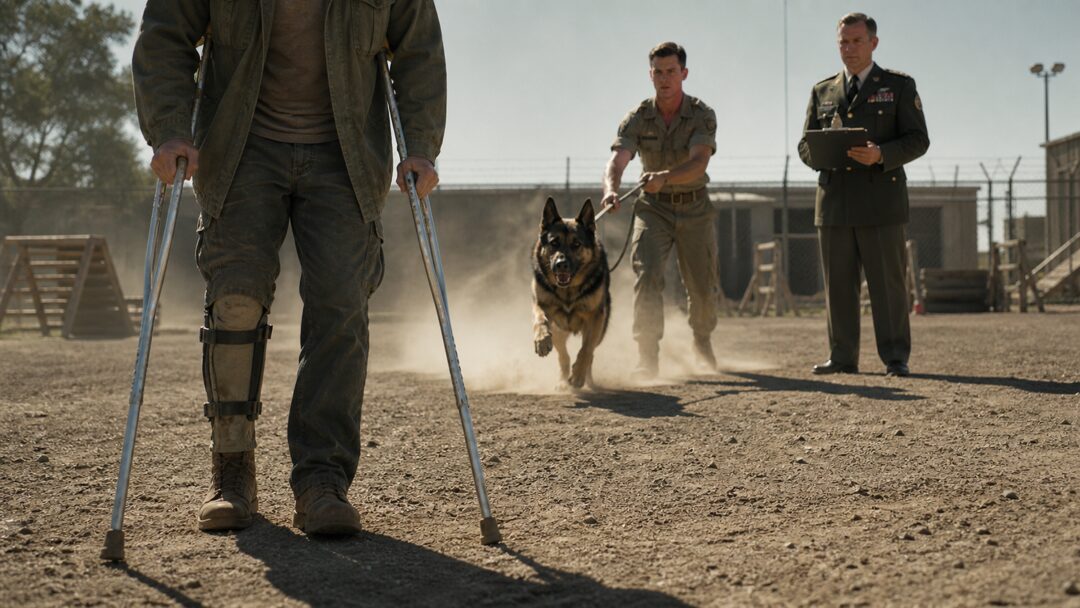
Daniel Harris had taken only six steps into the yard when the German Shepherd at the far fence went still.
That was the first warning.
Not the barking. Not the shouting. Not the way Sergeant Brian Collins snapped both hands around the leash a second too late.
The first warning was the silence before all of it, the moment Ranger saw him and forgot the rest of the world existed.
Daniel stopped with both crutches planted in the dust.
Across the training yard, Ranger lowered his head.
“Collins,” someone called from the shade of the kennel office. “Watch him.”
Collins already was.
The dog’s ears stood forward. His dark back tightened. His muzzle, graying at the edges now, pointed straight at Daniel as if no time had passed at all.
Daniel’s bad leg pulsed under the brace.
He had told himself he would not see the dog.
That had been the whole plan.
Sign the release form. Shake the major’s hand if he had to. Leave the facility before anyone thought to bring Ranger out.
He had made it almost ten minutes.
Then Ranger broke loose.
The leash burned through Collins’s grip, and the dog came across the yard like something released from a locked room. Dust shot up behind his paws. A young corporal cursed. Two handlers moved without knowing where to go.
“Ranger!” Collins shouted. “Hold!”
The word hit the air and died there.
Daniel could not step back fast enough. He could barely step back at all.
His hands tightened around the crutch grips. The aluminum dug into his palms. His eyes locked on the dog charging toward him, and for one terrible second the yard disappeared.
Rotor wash.
Smoke.
A gate rattling.
Ranger barking so hard his body slammed the chain link again and again.
Daniel on his back, blood on someone else’s glove, yelling, “Go back for him.”
A medic’s face above him. “We don’t have time.”
The helicopter lifting.
Ranger getting smaller behind dust.
Daniel came back to the present with the dog almost on him.
Collins was still yelling. Another handler moved in from the side. Someone said, “Brace him!”
Daniel did not brace.
He looked at the charging dog and heard himself say, barely loud enough to be real, “Ranger.”
The dog hit him hard enough to knock one crutch out from under his arm.
But Ranger did not bite.
He rose up against Daniel’s chest, front paws thudding into the faded field jacket, and made a sound Daniel had not heard in three years.
Not a growl.
Not a warning.
A broken, frantic whine.
Daniel’s other crutch fell. He stumbled, caught himself badly on his good leg, and one hand landed in Ranger’s thick fur.
Every soldier in the yard froze.
Ranger pressed his head under Daniel’s chin, shaking with the effort to get closer. His tail did not wag the easy way dogs wagged when they were happy. It moved in short, hard bursts, as if his whole body could not decide between relief and panic.
Collins reached them first.
“Sir, don’t move.”
Daniel lifted one hand, palm out, without looking at him.
“Don’t pull him off.”
Collins stopped so sharply his boots slid in the dust.
Ranger whined again and shoved harder into Daniel’s chest. The pressure hurt. Everything hurt. The brace bit into Daniel’s leg, and his ribs tightened around the old places that never seemed to forget weather.
Still, he kept his hand buried in the dog’s fur.
“You got old,” Daniel whispered.
Ranger’s ears flicked at his voice.
For one second, the years between them opened and closed.
Then Major Thomas Reed stepped out of the office.
The yard remembered itself.
Handlers straightened. Collins’s face flushed red up the neck. Someone picked up one of Daniel’s crutches and stood there holding it like an accusation.
Reed crossed the yard with a folder tucked under his arm and his expression under perfect control.
“Sergeant Collins,” he said.
Collins swallowed. “Sir.”
“Secure the dog.”
Ranger’s body tightened at the word.
Daniel felt it under his hand.
“He’s secure,” Daniel said.
Reed looked at him. Not cruelly. Not kindly either.
“Mr. Harris, with respect, you are standing on one leg with a dog under evaluation pressed against your chest. That is not secure.”
Daniel glanced down.
Ranger’s scarred ear brushed his jacket. His eyes were closed now, or nearly closed, but his breathing still came too fast.
“I know this dog,” Daniel said.
Reed’s eyes moved to the fallen crutches. “That is exactly what concerns me.”
The yard stayed quiet.
That was worse than the shouting.
Daniel knew what they had all seen.
A dog under evaluation had broken from his handler and charged a disabled veteran in front of command.
It did not matter what Ranger had meant.
Meaning had never looked good on paper.
Part II — The Form He Came to Sign
Inside the kennel office, the air smelled like coffee, dust, and disinfectant.
Daniel sat in a plastic chair that was too low, both crutches propped against the wall beside him. Ranger had been taken to a holding run outside the window. He stood there now, watching the office through the wire.
Not pacing.
Not barking.
Watching Daniel.
Collins stood near the door, jaw tight, his right palm raw where the leash had burned him.
Reed opened the folder on his desk.
“You understand why we asked you here.”
Daniel looked at the top page.
Former Handler Release and Placement Waiver.
His own name was already printed in three places.
“I was told it was routine,” Daniel said.
“It would have been,” Reed replied. “Before that display.”
Collins shifted. “Sir, he’s never gone through a leash like that.”
Reed did not look up. “He has refused two handlers, broken formation during transport drills, reacted during storm simulations, and nearly put Specialist Lane on the ground last month.”
“Lane crowded him.”
“Lane followed protocol.”
“Ranger hates gates,” Collins said before he could stop himself.
Reed’s pen paused.
Daniel heard the word gates and kept his face still.
Outside, Ranger’s ears twitched.
Reed turned a page. “The retirement board convenes at sixteen hundred. If we can place him safely, we will. If we cannot, he will be transferred for restricted evaluation.”
Daniel knew what that meant. Not officially. Officially, everything had clean language. Restricted. Unfit. Unmanageable. Liability.
Unofficially, some dogs did not come back from being too hard to trust.
Daniel leaned forward. “He’s not dangerous.”
Reed’s eyes lifted. “He knocked you off your support.”
“He came to me.”
“He ignored a direct command.”
“He remembered me.”
That landed harder than Daniel meant it to.
Collins looked away.
Reed closed the folder halfway, as if he wanted the paper between them but not too much of it.
“You came today to release any prior claim. Is that correct?”
Daniel’s mouth went dry.
“Yes.”
Outside the window, Ranger sat down without being told.
Reed noticed. So did Collins.
Daniel wished he had not.
“You didn’t ask to see him,” Reed said.
“No.”
“You didn’t respond to the first two placement inquiries either.”
Daniel looked at the desk. There was a mug with a chipped handle. A framed photo of Reed with three dogs Daniel did not recognize. A paperweight shaped like a small bronze paw.
“I wasn’t in a position to take a dog.”
“That is not the question I asked.”
Daniel’s hands went still on his knee.
Collins gave a small, sharp breath through his nose, like he had been waiting years to hear someone say that.
Daniel looked at him.
The sergeant was younger than Daniel had expected. Maybe twenty-eight. Clean uniform. Squared shoulders. Sunburned neck. The kind of handler who still believed discipline could hold back anything if you applied enough of it.
Ranger had probably made him feel helpless every day.
That was a private humiliation Daniel understood better than he wanted to.
Reed slid the release form toward him.
“You can still sign,” he said. “But after what happened outside, I need to know whether Ranger’s reaction to you is an isolated attachment response or a safety risk that has been misunderstood.”
Daniel almost laughed.
Not because it was funny.
Because the words were so careful they nearly broke him.
An isolated attachment response.
A safety risk.
Misunderstood.
Ranger had slept with his head on Daniel’s boots through three months of bad heat and worse roads. Ranger had found wires under trash, men behind doors, fear under silence. Ranger had once refused to enter a courtyard until Daniel trusted him, and that refusal had kept six people alive.
Now he was a line item in a folder.
Daniel reached for the pen.
Outside, Ranger stood.
The movement was small, but everyone saw it.
Daniel’s fingers closed around the pen anyway.
He had promised himself he would do this cleanly.
He had promised himself the dog deserved a handler who did not wake up fighting sheets, who did not measure staircases before entering buildings, who did not hear helicopters in ceiling fans.
He had promised himself leaving was kindness.
Ranger pressed his muzzle to the wire outside and gave one low whine.
The pen stopped above the paper.
Collins spoke first.
“He does that every time someone leaves.”
Daniel did not look up.
Collins’s voice was tight. “But not like that.”
Reed watched Daniel with a commander’s patience. The kind that could wait longer than shame.
Daniel set the pen down.
“I’ll do the observation,” he said.
Collins turned to him.
Reed’s expression did not change, but his hand moved the folder back by half an inch.
“One controlled observation,” Reed said. “Small yard. No contact unless authorized.”
Daniel looked through the window.
Ranger was still staring at him.
Daniel had spent three years trying not to be recognized.
Now the one creature he feared most had done it in front of everyone.
Part III — The Word That Still Worked
The smaller yard was fenced on all sides and washed in white afternoon light.
No shade. No hiding place.
Daniel stood near the center with one crutch under each arm, sweat gathering at the base of his neck. Collins brought Ranger through the gate on a shorter leash this time, both hands set, shoulders braced.
Ranger did not pull.
He entered with his eyes on Daniel.
“Keep him at ten feet,” Reed said from outside the fence.
Collins nodded.
Daniel hated the way the sergeant’s hands looked on the leash. Too tight. Not cruel. Just afraid of being embarrassed again.
Ranger felt it. Daniel could tell.
Dogs always knew who was holding on for control and who was holding on because they trusted the other end.
“Ranger,” Daniel said.
The dog’s ears lifted.
Collins flinched at how fast it happened.
Reed made a note on his clipboard.
“Basic commands only,” he said.
Daniel swallowed. His voice was still rough from disuse, or from memory. He had not used command tone in years.
“Sit.”
Ranger sat.
Not eventually. Not reluctantly.
Immediately.
Collins stared.
“Down.”
Ranger dropped to the dust, front paws straight, eyes still locked on Daniel.
“Heel.”
Collins loosened the leash without meaning to, and Ranger moved to Daniel’s left side, exactly where he had lived for two years.
Daniel felt the old shape of him there.
A body beside his leg. Heat at his knee. Silent readiness.
For one dangerous second, Daniel was not in a training yard stateside.
He was younger. Whole. Trusted.
Then his bad leg trembled.
Ranger looked up.
Daniel stiffened.
“Stay,” he said quickly.
Ranger stayed.
But his eyes changed.
Not disobedience. Concern.
That was what undid Daniel.
Not the charge. Not the whining. Not the way Ranger had slammed into him like grief given muscle.
It was that look.
The dog had seen the brace. The crutches. The uneven breath. And he had not looked confused.
He had simply adjusted his world around it.
Daniel turned his face away.
Collins saw.
He said nothing.
For the first time all afternoon, Daniel was grateful to him.
Then the helicopter passed overhead.
It was not low. It was not dramatic. Just a transport craft moving beyond the facility line, its sound rolling over the yard in a dull chop.
Ranger’s head snapped up.
Daniel felt the change before anyone else reacted.
The dog’s breathing stopped.
“Ranger,” Collins warned.
The helicopter thudded above them, closer now, shadow crossing the far fence.
Ranger spun toward Daniel.
“Hold him,” Reed called.
Collins did.
For half a second.
Then Ranger drove forward—not toward the fence, not toward Collins, not toward the sound.
Toward Daniel’s legs.
He hit low, shoulder into Daniel’s good knee, body twisting across his path as if blocking him from being dragged away.
Daniel lost balance.
The ground came up hard.
One crutch skidded. Pain flashed bright through his hip and brace. Collins cursed and dropped beside Ranger, trying to pull him back.
Ranger did not attack.
He pinned himself against Daniel’s legs, trembling, whining through closed teeth, eyes fixed upward at the passing aircraft.
“Get him off,” Reed ordered.
“No,” Daniel said.
His voice was flat enough that everyone stopped.
He lay in the dust, one hand pressed to the ground, breath coming hard.
Ranger’s body shook against him.
Daniel put his hand on the dog’s neck.
Not to command him.
To tell him he was still there.
The helicopter moved on.
The sound faded.
Ranger did not move until Daniel whispered, “Easy.”
The word came from somewhere before the blast, before the gate, before three years of unanswered calls.
Ranger lowered his head to Daniel’s thigh and went still.
Collins sat back on his heels.
His face had changed.
Not softened exactly.
Stripped.
Reed opened the gate himself.
“Observation terminated,” he said.
Collins helped Daniel sit up. Daniel hated needing the help, but his leg hated pride more.
When Ranger tried to rise with him, Collins reached for the leash and stopped.
He looked at Daniel instead.
“What was that?” Collins asked.
Daniel brushed dust from his palm. His hand would not stop shaking.
“That,” he said, “was the last thing he remembers.”
No one asked him to explain.
That made it worse.
Part IV — The Calls He Never Returned
Collins found Daniel behind the kennel office twenty minutes later, sitting on a concrete step with his crutches against the wall.
Ranger was back in the holding run, but this time he lay near the side closest to Daniel. His head rested on his paws. His eyes remained open.
Collins stood a few feet away.
“You should get checked out,” he said.
Daniel looked at the dust on his pants. “I’ve had worse.”
“I know.”
That made Daniel look up.
Collins’s face tightened. “I read the file.”
“Of course you did.”
“I had to.”
“No, you wanted to.”
The words came out too sharp. Daniel expected Collins to fire back.
Instead, the sergeant looked through the fence at Ranger.
“Yeah,” Collins said. “I wanted to.”
Daniel waited.
Collins rubbed his burned palm against his pant leg. “For a year, every time that dog failed something, your name came up without anybody saying it. He wouldn’t settle after transport drills. He wouldn’t sleep after thunder. He wouldn’t bond clean with a new handler. He’d work, then stop. Like he was listening for another voice.”
Daniel said nothing.
“I thought you were dead at first,” Collins said.
Daniel swallowed.
“Then I found out you weren’t.”
Ranger lifted his head at the shift in Daniel’s breathing.
Collins noticed that too.
“I resented you,” he said. “I know that’s ugly.”
“It’s honest.”
“It felt like trying to train a dog that was already married.”
Daniel almost smiled. It did not last.
Collins sat on the other end of the step without asking permission. For a while they listened to the kennel fans.
Then Collins said, “What happened over there?”
Daniel looked at Ranger.
He could have given the report version. It was clean, because reports always were. Convoy interdiction. Search team separated. Casualties evacuated under unstable conditions. Working dog recovered and reassigned.
Every sentence washed.
Every sentence missing the sound.
“He was behind a gate,” Daniel said.
Collins stayed still.
Daniel’s hand closed over the edge of the concrete step.
“We were clearing a supply lot. Bad information. Too many blind corners. Ranger alerted on the gate before I saw anything. Then everything went loud.”
He stopped.
The rest came in pieces because that was the only way it ever came.
Smoke.
Ranger’s leash tangled in wire.
Daniel’s leg not answering him.
Someone dragging him by the straps of his vest.
Ranger slamming the fence.
A medic yelling, “He’s crashing.”
Daniel trying to roll off the stretcher and failing.
“I begged them to go back,” Daniel said. “I did. I need you to know that.”
Collins did not answer too quickly.
That helped.
Daniel looked down at his hands. “They told me later he survived. They said another team recovered him. Then the calls started. Updates. Placement questions. Handler transition notes.”
“You didn’t answer.”
“No.”
“Why?”
Daniel laughed once, without humor.
Because the dog had seen him whole.
Because the dog had watched him leave.
Because Ranger would run to him and find a man who measured every curb.
Because Daniel did not know whether dogs could forgive, and the thought of finding out had been unbearable.
“I thought he’d be better off not seeing me like this,” Daniel said.
Collins’s eyes moved to the crutches.
Daniel hated that he looked.
He hated more that Collins looked away again.
From the holding run, Ranger gave a small breath through his nose, almost a sigh.
Collins stared at him.
“He never acted like he was waiting for somebody whole,” Collins said quietly. “He just acted like he was waiting.”
Daniel closed his eyes.
That sentence found the place he had been protecting and stepped straight into it.
The kennel office door opened.
Reed came out with the folder in his hand.
Both men stood, though Daniel took longer.
Reed looked from Daniel to Collins to the dog beyond the wire.
“The board reviewed the incident reports,” he said. “Given today’s response pattern, Ranger is not eligible for standard civilian placement.”
Collins’s jaw set. “Sir—”
Reed lifted one hand. “Let me finish.”
The yard seemed to draw in around them.
“There is one supervised veteran placement path available if the former handler accepts primary responsibility, completes transition requirements, and agrees to follow-up evaluations.”
Daniel felt the words before he understood them.
Collins turned toward him.
Daniel’s first instinct was no.
It rose fast. Practical. Convincing.
His apartment had stairs.
His nightmares had teeth.
His recovery was not over.
He could barely take care of himself on bad days. Some mornings he stood in the kitchen and forgot why he had opened the drawer. Some nights a truck backfired three streets away and he found himself sitting on the floor with his heart trying to break through his ribs.
Ranger deserved more than a damaged man with a second-floor lease and a drawer full of medications he kept forgetting to refill.
“No,” Daniel said.
Ranger stood in the run.
Collins looked at him as if Daniel had struck the dog.
Reed did not blink.
“If no qualified placement is accepted by close of day,” Reed said, “Ranger will be transferred.”
Daniel’s mouth went dry.
“You know what that means,” Reed added.
Daniel did.
Of course he did.
He had known before Reed said it. He had known since he walked in and saw the folder.
The first time Daniel left Ranger, he had been carried away.
The second time would be by signature.
That was the part he could not survive.
Not again.
Not cleanly.
Not with both eyes open.
Part V — The Last Test
The main yard looked larger the second time.
Maybe because everyone knew what was at stake now.
Maybe because Ranger knew too.
Collins held the leash near the far gate. His face had gone still in the way people go still when they are choosing something that will cost them.
Reed stood beside the fence with two evaluators and the folder tucked under his arm.
Daniel waited thirty feet away, crutches planted, dust clinging to one sleeve from the fall.
“You will not command unless instructed,” Reed said.
Daniel nodded.
Ranger stood at Collins’s left side.
Perfect posture.
Perfect stillness.
But his eyes were on Daniel.
The test began with simple movement. Forward. Halt. Turn. Sit. Stay.
Ranger obeyed Collins.
Not the way he had obeyed Daniel. Not with that old instant certainty. But he obeyed.
Collins’s shoulders loosened by one careful inch.
Reed made notes.
Daniel watched Ranger’s paws. That was easier than watching his face.
For three years Daniel had believed the worst thing would be Ranger not knowing him.
He had been wrong.
The worst thing was being known completely and still trying to leave.
“Approach pattern,” Reed called.
Collins led Ranger across the yard at a measured pace. Ten feet from Daniel, Ranger’s breathing changed. Not much. Enough.
Daniel kept his hands still.
Ranger passed him.
Once.
Twice.
On the third pass, a gate clanged behind Daniel.
It was only a handler bringing equipment through.
Metal on metal.
A small sound.
The wrong sound.
Ranger broke.
He spun out of formation, leash snapping tight, body driving toward Daniel.
Collins dug in.
“Ranger, heel!”
Ranger surged harder.
The evaluators stepped back. Reed’s hand went to the folder, already reaching for the decision that would end it.
Daniel saw all of it in a single bright line.
The charge.
The dust.
The way everyone’s bodies prepared for danger.
Ranger’s eyes were not wild.
They were terrified.
Not of Daniel.
For him.
Collins looked at Ranger, then at Daniel.
In that second, something passed out of the sergeant’s face. Pride. Possession. The need to prove the dog was his.
He let go of the leash.
Reed snapped, “Sergeant—”
Collins cut through him, voice raw. “Call him like you mean it.”
Ranger came hard, leash trailing behind him through the dust.
Daniel lowered one crutch.
The movement hurt. His bad leg trembled. His body warned him not to trust it.
For once, he ignored the warning.
He stood with one crutch and one bare hand open at his side.
He did not shout.
He did not use parade-ground command.
He used the voice from before everything went wrong.
“Ranger,” he said. “Home.”
The dog slowed.
Not all at once.
His paws dragged through dust. His body fought itself, panic against training, fear against recognition.
“Home,” Daniel said again.
Ranger stopped three feet away.
The yard held its breath.
Daniel could see the gray at his muzzle now. The scar near one ear. The eyes that had watched roads, doors, shadows, and finally a helicopter lifting away.
Daniel’s throat closed.
“I’m here,” he said.
Ranger took one step.
Then another.
Not charging now.
Coming in.
Daniel let the crutch fall.
Someone made a sound behind the fence, but nobody moved.
Ranger reached him and pressed his head into Daniel’s stomach with such careful force that it hurt more than the charge had.
Daniel put both hands in the dog’s fur.
He bent as far as the brace allowed and held on.
“I’m sorry,” he said.
The words were not loud.
They did not need to be.
“I’m sorry I left you.”
Ranger shuddered once, full-body, as if a long-held command had finally been released.
Then he sat.
Right against Daniel’s leg.
At heel.
Daniel laughed once, but it broke in the middle.
Collins looked down.
Reed said nothing for a long time.
The dust settled around them.
Daniel kept one hand on Ranger’s head. Ranger leaned into the touch, not frantic now, not desperate, just there.
The evaluators waited.
Reed closed the folder.
Not dramatically.
Just enough for the sound to carry.
“Document the response,” he said. “Placement under supervised veteran transition. Pending final signatures.”
Collins exhaled like he had been holding his breath for a year.
Daniel did not look away from Ranger.
He was afraid if he did, the moment would become paperwork again.
But Ranger stayed.
And for the first time since the helicopter lifted, Daniel believed staying might be something he could learn.
Part VI — What Walked Beside Him
The signatures took less time than the silence after them.
Reed explained the conditions in his clipped, careful voice. Supervised transition. Home inspection. Follow-up checks. Required support appointments. Emergency contacts. Handler adjustment period.
Daniel listened.
He signed where Reed pointed.
His hand only shook once.
Collins stood beside the desk with Ranger’s old lead looped in his hand. Not holding the dog anymore. Just holding the proof that he once had.
When the last page was done, Reed slid a copy toward Daniel.
“This is not a cure,” the major said.
Daniel looked up.
Reed’s face remained stern, but not closed.
“For either of you.”
Daniel folded the paper once. “I know.”
“I hope you do.”
There was no insult in it.
Only responsibility.
Daniel respected that.
Outside, Ranger waited near the door with Collins. Every few seconds his eyes flicked to Daniel, checking. Not panicked. Checking.
Collins crouched in front of him and adjusted the collar.
“You’re going to be a pain,” he told the dog.
Ranger blinked.
Collins swallowed, then rubbed the scarred ear once with his thumb.
“Yeah,” he said. “I know. You were never really mine.”
Daniel looked away, giving him that much privacy.
When Collins stood, he held the leash out.
Daniel did not take it right away.
“You did good by him,” Daniel said.
Collins’s jaw shifted.
“Not enough.”
“Enough to get him here.”
That stayed between them.
Collins gave a short nod and placed the leash in Daniel’s hand.
It was heavier than Daniel remembered.
Or maybe he had forgotten what responsibility weighed like when it was alive.
Ranger stepped close.
Daniel adjusted one crutch under his arm. The other he tucked awkwardly against his side for a moment while he got the leash settled. It should have looked clumsy.
Maybe it did.
Ranger did not care.
They crossed the yard slowly.
No one saluted. No one clapped. It would have ruined the truth of it.
The afternoon had softened. Heat still lifted from the ground, but the shadows were longer now. Dust moved around Daniel’s boots and Ranger’s paws in the same thin cloud.
Halfway to the gate, a transport helicopter sounded in the distance.
Ranger stopped.
Daniel stopped with him.
The leash tightened, then went slack.
Ranger looked up at Daniel.
Daniel’s chest tightened. His hand closed once around the crutch grip.
For a moment, both of them listened to the past coming from the sky.
Then Daniel lowered his hand to Ranger’s head.
“Easy,” he said.
Ranger leaned against his leg.
Not blocking him.
Not dragging him back.
Just touching him.
The helicopter moved on.
Daniel took one step.
Ranger matched it.
At the gate, Daniel paused and looked back.
Collins stood by the office, arms crossed, pretending not to watch too closely. Reed had already gone inside, but the blinds in his office were angled open.
Daniel almost raised a hand.
Instead, he turned forward.
Some things did not need a witness after all.
The parking lot waited beyond the fence. So did the second-floor apartment, the stairs, the bad nights, the forms, the follow-up calls, the work neither of them had agreed to because it was easy.
Ranger walked close enough that his shoulder brushed Daniel’s leg.
Daniel kept the leash loose.
At the curb, he stopped and breathed through the ache in his hip. Ranger stopped too, patient now in a way that hurt to see.
“You remember the old command?” Daniel asked softly.
Ranger looked up.
Daniel swallowed.
“Home.”
Ranger stepped forward with him.
Not ahead.
Not behind.
Beside him.