What the Range Remembered
Part I — The Old Guest
“Sir, step back before you hurt yourself.”
Sergeant Daniel Hayes said it loud enough for the whole line to hear.
Twenty recruits stood behind the yellow safety line, boots planted in damp gravel, hands folded behind their backs. None of them moved. None of them laughed. But the silence after Daniel’s words was worse than laughter.
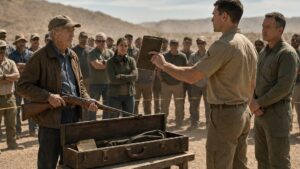
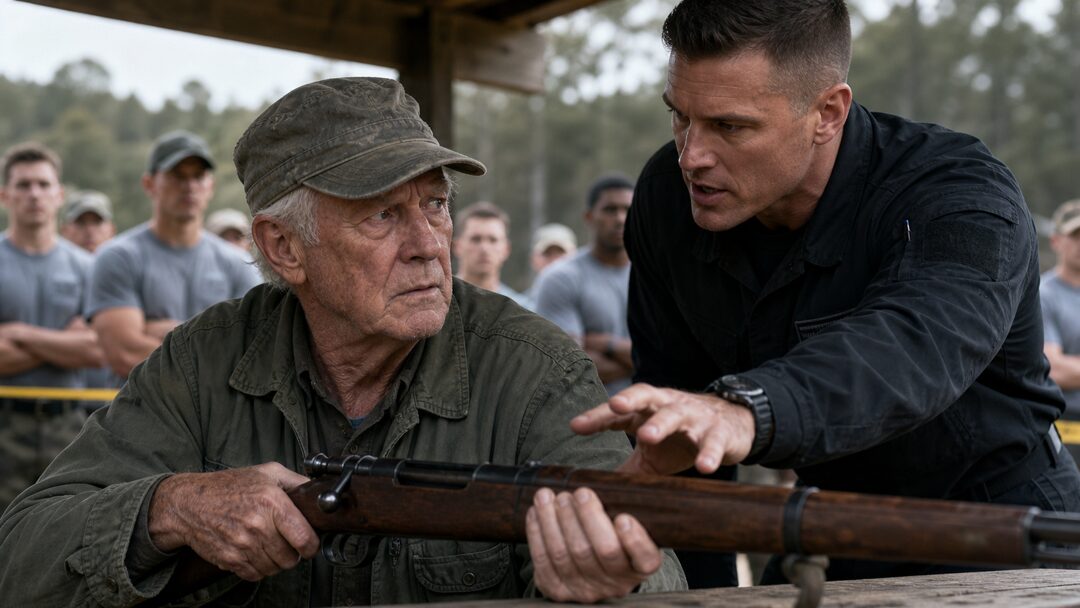
At the firing bench, Robert Walker kept his hand on the old wooden rifle.
His left hand trembled. Not much. Just enough for Daniel to notice. Just enough for the recruits to notice after Daniel did.
Robert was seventy-eight, maybe older in the cold. White hair showed beneath his faded cap. His green field jacket looked like it had been pulled from the back of a closet after sleeping there for years. He stood too carefully, as if each movement had to be negotiated with old bones before it could happen.
Daniel stepped closer.
“Sir,” he said again, sharper now, “I need you behind the line.”
Robert did not look at him.
He looked downrange.
The morning was gray and flat. The old qualification range sat in a shallow clearing bordered by pine trees and rusted posts. Fresh paper targets waited in their clean white squares, bright against the dark berm. Beyond them, weeds had swallowed the places where older markers used to stand.
Robert’s fingers tightened around the rifle stock.
Daniel saw the motion and felt irritation rise in his chest. It was not anger exactly. It was the feeling he got whenever a controlled space became uncertain.
This was a range. His range for the day. A place with rules, commands, and consequences.
And the old man had been standing at the bench when Daniel arrived, touching a rifle that looked more suited for a museum case than a live evaluation.
Daniel lowered his voice, but not enough.
“Sir, I understand Captain Miller invited you, but you can’t just handle equipment out here.”
Robert’s eyes stayed on the targets.
Daniel reached toward the rifle.
Robert spoke for the first time.
“Don’t touch that rifle.”
The words were quiet. Almost tired.
That made them worse.
Daniel stopped with his hand hovering a few inches above the stock. Behind him, the recruits held their breath in the way young people did when they knew an adult had been challenged but had not yet decided how to respond.
Daniel glanced back.
Private Emily Carter stood near the end of the line, smaller than most of the others, helmet sitting a little too low on her forehead. Her eyes were fixed on Robert’s hand. Not on Daniel. Not on the rifle. On the hand.
Daniel turned back.
“Range discipline applies to everyone,” he said. “Even guests.”
Robert finally looked at him.
His face was lined and severe, but not confused. Daniel had expected embarrassment. Maybe stubbornness. Maybe the soft fog of age.
What he saw instead was focus.
That should have slowed him down.
It didn’t.
Daniel moved beside him and placed one hand near Robert’s elbow, not grabbing, just guiding with the authority of someone used to being obeyed.
“You’re blading your stance wrong,” Daniel said. “If this were live fire, you’d be off balance.”
Robert’s jaw shifted.
The recruits watched.
Daniel knew Captain Sarah Miller was somewhere behind them near the command shed. He could feel her presence without turning around. She had told him that morning there would be a guest. An old marksman. A courtesy invitation. The range was being closed after decades of use, and command wanted a “respectful final day.”
Daniel had heard the phrase and understood the real meaning.
Do your job around the ceremony.
He hated ceremonies. They made people careless.
He moved his hand closer to the rifle’s stock. “Let me clear this.”
Robert’s right hand snapped sideways.
Not wild. Not desperate.
Fast.
Daniel felt the old man’s wrist strike his hand cleanly away from the rifle, hard enough to sting, precise enough to embarrass him.
The sound was small.
The silence after it was not.
Daniel stared at his hand.
Robert had not even turned his shoulders.
For one strange second, Daniel saw no trembling at all.
Then Robert lowered his hand back to the wooden stock as if nothing had happened.
Behind the line, one recruit swallowed audibly.
Daniel’s face heated.
“Sir,” he said, very carefully, “you need to step away from the bench.”
Robert looked downrange again.
“No.”
That was when Captain Sarah Miller walked over.
She did not hurry. Sarah never hurried unless someone was bleeding or lying. She crossed the gravel with her hands at her sides, uniform pressed, eyes tired in the permanent way of people who had learned to sleep lightly.
“Sergeant Hayes,” she said.
Daniel turned. “Ma’am, the guest is refusing range instruction.”
Sarah looked at Robert. Then at the rifle. Something moved across her face and disappeared before Daniel could name it.
“He was invited to stand at that bench,” she said.
“With respect, ma’am, he struck my hand.”
“With accuracy, from what I saw.”
A few recruits looked down fast.
Daniel’s mouth tightened.
Sarah stepped closer to Robert, but not too close.
“Mr. Walker,” she said. “You still want the five-round string?”
Robert’s shoulders shifted under the old jacket.
“Yes.”
Daniel looked between them. “Five-round string?”
Sarah kept her eyes on Robert. “The old line closes today. He asked for one last turn before they pull the benches out.”
Daniel nearly laughed, but the look on Sarah’s face killed it.
One last turn.
That was exactly the kind of phrase he distrusted. It dressed risk in nostalgia. It made people forget that rifles were not memories. They were objects that did what careless hands told them to do.
“Ma’am,” Daniel said, “he can barely hold steady.”
Robert’s hand trembled again on the stock.
This time everyone saw.
Sarah did not deny it.
“He fired on this range before most of us had parents old enough to drive,” she said.
“That doesn’t make today safe.”
“No,” Sarah said. “That’s your job.”
Daniel heard the trap in it.
If he refused, he looked like the sergeant who shoved an old veteran out of his farewell. If he allowed it, and Robert made one bad movement, the responsibility would sit on Daniel’s name.
Robert turned his head just enough to look at him.
“I’m not here for your record, Sergeant.”
Daniel hated how much that landed.
Because every man who said he did not care about pride usually cared about it most.
Part II — The Hand Near the Wood
The rifle looked wrong on the modern bench.
Everything else on the range was new enough to be replaceable. Polymer cases. Bright flags. Clean mats. Printed checklists in plastic sleeves. Radios clipped to vests. Range commands laminated and zip-tied where rain could not soften them.
The rifle was dark walnut and worn steel.
It carried dents that had not been sanded smooth. The old sling had cracks along the edges. On the underside of the stock, just ahead of the trigger guard, there was a small place where the finish had been rubbed almost pale by a thumb that had returned there again and again.
Daniel noticed that because noticing details was part of his job.
He did not ask whose thumb.
He told himself he did not care.
“Everyone remains behind the safety line,” Daniel called. His voice regained its force. “Eyes forward. No chatter.”
The recruits straightened. Emily Carter did it a half-second late.
Robert noticed.
So did Daniel.
“You,” Daniel said.
Emily’s chin jerked up. “Yes, Sergeant.”
“If watching makes you nervous, qualification will be worse.”
Her face tightened. “I’m not nervous.”
Daniel gave her a look that told her lying was another failure.
Robert’s hand rested on the rifle. He said nothing.
Daniel took his position at Robert’s right side. He would not let the old man run this moment. If Captain Miller wanted the courtesy, fine. He would make it controlled.
“Mr. Walker,” he said, “you’ll follow my commands exactly.”
Robert nodded once.
“Do not lift until instructed.”
Another nod.
“Do not place your finger near the trigger until instructed.”
Robert’s mouth moved, not quite a smile.
Daniel saw it and stiffened. “Something funny?”
“No.”
“Then follow the command.”
Robert looked down at the rifle. “I heard you.”
The recruits were too still. Daniel felt their attention pressing against his back.
He stepped closer again. Not touching this time. Close enough to correct. Close enough to remind everyone whose voice governed the line.
“Feet shoulder-width,” he said.
Robert adjusted.
“More.”
Robert shifted half an inch.
Daniel frowned. “You’re still favoring the left.”
“I know.”
“Then correct it.”
“I can’t.”
The admission was so plain that Daniel almost had no response.
Robert did not look ashamed. He just said it as fact.
Daniel’s irritation bent, for a moment, into something less clean. He had expected denial. He had expected old pride fighting reality.
He had not expected reality spoken without apology.
Then Robert reached for the rifle.
“Not yet,” Daniel said.
Robert’s hand paused.
Daniel inhaled through his nose. “On my command.”
Robert’s fingers hovered above the stock, close enough that the tremor showed again.
For the first time, Daniel saw the recruits not as a line but as witnesses. Their eyes moved between the old hand and his own. They were measuring something he had not meant to put on display.
He had spent years teaching them that hesitation could cost lives. That sloppy habits became grief. That fear had to be trained out before it trained you.
His father had taught him the same thing without saying it.
John Hayes had returned from service when Daniel was ten and spent twenty-two years turning silence into a household rule. No old stories. No photographs on the mantel. No tears at funerals. No patience for men who made a shrine out of their worst years.
Once, when Daniel was sixteen, he had asked his father what bravery felt like.
His father had looked at him for so long Daniel regretted the question.
Then he said, “Mostly like being too late.”
Daniel had joined anyway.
Maybe to understand him. Maybe to beat him at his own silence.
Now an old man stood at Daniel’s range refusing correction, and Daniel felt that same childhood resentment rise in him.
People treated age like proof. They treated sorrow like rank.
Daniel did not.
“On my command,” he repeated.
Robert turned his head toward the far end of the range.
His eyes narrowed.
Sarah noticed from behind the line.
Daniel saw her notice.
“What is it?” he asked.
Robert did not answer at first.
The wind moved through the pine trees. Paper targets snapped lightly in their frames.
Finally Robert lowered his hand away from the rifle.
“Where did they move the marker?”
Sarah’s face changed.
Not much. Just enough.
Daniel looked downrange. “What marker?”
Robert kept looking past the targets. “There used to be a painted square on the left frame. Blue. Then white after they repainted. Hanging crooked.”
Daniel let out a short breath. “These are standard qualification targets.”
“No,” Robert said. “Beyond them.”
Sarah stepped to Daniel’s side, eyes on the same distance Robert watched.
“They took it down three years ago,” she said quietly. “When they replaced the outer frames.”
Robert absorbed that like a physical blow.
He did not sway. But the stillness in him changed.
Daniel looked at Sarah. “You knew what he meant?”
Sarah did not answer him.
Robert touched the rifle again. Not gripping now. Resting his palm on it the way someone might rest a hand on a closed door.
“I thought they’d leave that,” he said.
Sarah’s voice softened. “I asked.”
Daniel hated that he was lost in his own range.
He knew the distances. He knew the benches. He knew wind behavior, drainage issues, target replacement schedules, radio dead spots, recruit error patterns.
But he did not know the missing blue square.
And Robert did.
Part III — What Sarah Didn’t Say
Daniel found Sarah behind the command shed while the recruits rotated through their first dry run.
Robert remained near the bench, seated now, the rifle laid in front of him. Emily Carter had been placed at the far end of the line, where Daniel could still see her shoulders rising too fast.
Daniel kept his voice low.
“Ma’am, I need to understand what we’re doing here.”
Sarah checked the clipboard in her hand, though Daniel knew she was not reading it.
“We’re closing a range,” she said.
“With a live demonstration by a seventy-eight-year-old man whose hands shake.”
“With your supervision.”
“That doesn’t answer the question.”
Sarah looked up.
Daniel had served under officers who confused calm with vagueness. Sarah Miller was not one of them. When she withheld something, it was on purpose.
“That rifle belonged to Michael Reeves,” she said.
The name meant nothing to Daniel.
Sarah watched his face and continued. “Reeves was in Robert Walker’s patrol. Their radio went dead during a mountain sweep. Weather turned. Map was wrong. Orders didn’t catch up with conditions.”
Daniel waited.
He had heard enough old stories to know when one was about to become polished. Men lost in bad weather. A heroic decision. A medal refused. A lesson wrapped in smoke.
Sarah did not polish it.
“Robert got most of them back,” she said. “Reeves didn’t make it.”
Daniel glanced toward the bench.
Robert sat with his head bowed, hands folded over the rifle. From this distance he looked less like a threat and more like something left behind after everyone else moved on.
“Why bring him here?” Daniel asked.
“Because he asked.”
“That’s it?”
“No,” Sarah said. “Because this range is where they trained before deployment. Because Reeves used to outshoot him on a crooked marker beyond the official line. Because Robert sends a letter here every year asking if the marker is still standing.”
Daniel looked at her.
Sarah slipped the clipboard under her arm.
“He never came back to see it. Until today.”
A command crackled over the radio from another section of the base. Sarah ignored it.
Daniel rubbed the back of the hand Robert had struck. The sting had faded, but memory kept replaying the motion.
Clean. Fast. Exact.
“If you knew all that,” Daniel said, “why didn’t you tell me before he touched the rifle?”
Sarah’s mouth tightened. “Because I didn’t invite him here to be explained to you.”
Daniel felt the words land harder than he wanted them to.
“He still has to follow range protocol.”
“Yes.”
“And I still have to make the call if he’s unsafe.”
“Yes.”
“So if I decide this stops—”
“Then it stops,” Sarah said.
That should have satisfied him.
It didn’t.
Because she had given him authority without taking away the weight.
Daniel looked toward his recruits. Emily stood in position now, jaw tight, trying so hard to look calm that every muscle betrayed her.
His father had looked like that at breakfast for years. Steady hands around a coffee mug. Eyes that never quite entered the room.
Daniel had once promised himself he would never become the kind of man who made silence feel like a locked door.
Then he joined the service and learned how useful locked doors could be.
“Old stories can make people careless,” he said.
Sarah followed his gaze to Robert.
“Sometimes,” she said. “Sometimes they make people careful in ways we forgot how to notice.”
Daniel almost answered.
A shout cut him off.
“Sergeant!”
Emily Carter stood frozen at the line, rifle shouldered, body rigid, breathing too fast.
Daniel moved before Sarah did.
Part IV — Let Her Breathe
Emily had not fired.
She had not broken any rule badly enough to be dangerous. That was the problem. Her failure was internal. Invisible to anyone who did not know what fear did to a body.
But Daniel knew.
He saw her locked elbow. Her shoulders climbing. Her cheek pressed too hard against the stock. Her eyes too wide, trying to force steadiness into existence.
“Carter,” Daniel said, approaching fast. “Lower and reset.”
She did not move.
“Carter.”
Her throat worked. “I’m trying, Sergeant.”
“Trying isn’t a command. Lower and reset.”
The recruits watched with the terrible attention of people grateful not to be the one exposed.
Daniel reached toward her elbow.
A voice came from behind him.
“Let her breathe.”
Daniel turned.
Robert stood a few feet away from the bench. He had moved quietly, one hand still resting against the edge of the table for balance. The old rifle remained where it was, watched by Sarah.
Daniel’s eyes hardened. “Mr. Walker, return to the bench.”
Robert ignored him and looked at Emily.
“Private,” he said. “Take your cheek off it.”
Emily did.
Daniel took one step toward Robert. “This is not your line.”
Robert’s gaze stayed on Emily. “No. It’s hers.”
Something passed through the recruits then. Not defiance. Not exactly. More like recognition that the old man had named something Daniel had not.
Emily kept her face turned away from Daniel.
Robert’s voice stayed low. “You’re fighting the thing like it insulted you.”
A nervous breath slipped from someone in the formation. Not laughter. Relief trying not to be heard.
Emily swallowed. “I don’t want to mess up.”
“You already did,” Robert said.
Daniel stiffened. That was not helping.
But Emily blinked at Robert, startled.
Robert continued. “Now you know it won’t kill you.”
Emily’s grip eased by the smallest amount.
Daniel watched her hands.
Robert nodded once. “Good. Listen to your pulse. Don’t argue with it. It’s telling you you’re alive.”
The range went very quiet.
Emily looked downrange again.
Daniel should have stopped it. He knew that. His authority had been interrupted in front of the line by a guest who had already struck his hand once.
But Emily’s breathing changed.
Not perfect. Not calm. Better.
Robert said, “When the world gets loud, don’t get louder with it.”
Emily lifted the rifle again.
Daniel moved close enough to intervene if he had to, but he did not touch her.
That was the first thing that changed.
Emily fired cleanly.
The shot cracked across the clearing. Paper jumped in the frame. Her shoulders flinched after, not before.
Daniel glanced through the spotting scope.
A clean hit. Not perfect. Good enough.
Emily lowered the rifle, face pale with relief.
The recruits did not cheer. Daniel would not have allowed it. But something in the line loosened.
Robert looked at Daniel then.
There was no victory in his expression. No challenge.
That made it harder to dislike him.
Daniel turned away first.
“Carter,” he said. “Reset and prepare for next command.”
“Yes, Sergeant.”
Her voice was still shaky.
But she smiled after she said it.
Daniel saw Robert notice that too.
The old man returned to the bench slowly. This time Daniel saw the effort. The stiffness in his left leg. The way pain crossed his face only when he thought no one was looking.
Robert was not pretending to be weak.
That was what unsettled Daniel most.
His hands really did shake.
His body really was old.
And somehow the part of him that mattered at the range had not loosened its grip.
A cold wind moved across the clearing. It came hard enough to slap the paper targets sideways and rattle the old metal frames beyond them.
Sarah checked the sky.
“We may need to suspend the closing string,” she said.
Daniel felt relief before he could stop it.
Then shame followed too closely behind.
Robert heard her. His hand closed over the rifle.
“How long?” he asked.
“Wind’s cutting across the far line,” Daniel said. “Visibility’s dropping.”
Robert looked at him.
Daniel heard himself add, “No one expects anything from you.”
He meant it as mercy.
Robert received it as something else.
“That’s been the trouble for years,” the old man said.
The sentence seemed to remove sound from the range.
Sarah took off her cap.
Daniel looked at her, then at the recruits, then at Robert.
The old man did not ask Sarah this time.
He looked only at Daniel.
“Load it for me.”
Daniel’s first instinct was refusal.
Not because it was unsafe. Because it asked for too much.
It asked him to take the hand he had used to correct and turn it into a hand that served.
Robert waited.
No one else moved.
Daniel stepped to the bench.
The wood of the rifle was colder than he expected. He handled it carefully, not because it was fragile, but because Robert was watching him touch a memory.
For the first time all morning, Daniel did not fill the silence with instruction.
He loaded the rifle.
Then he stepped back.
Part V — The Missing Marker
Robert did not lift the rifle immediately.
He stood with both palms flat on the bench, head bowed. His shoulders rose once, then settled.
Daniel watched from his right side.
Sarah stood behind them, cap in one hand.
The recruits lined the safety boundary without a sound. Emily Carter was near the end, her eyes fixed on Robert’s face.
The wind moved again. Paper snapped. Somewhere beyond the targets, old metal creaked against its bolts.
Robert reached for the rifle.
His hand trembled badly now.
Daniel felt his own body lean forward, ready to stop him.
Then Robert seated the rifle against his shoulder.
Everything changed.
Not his age. Not his pain. Those remained. Daniel could see the stiff angle of his neck, the way his knees worked harder than they should have, the way one breath caught and had to be forced free.
But the rifle met him like a remembered language.
The tremor narrowed.
His cheek touched the stock.
His right eye settled.
The old man who had stood at the bench a moment ago, fragile and publicly doubted, became still in a way Daniel had never taught anyone to be.
Not frozen.
Alive and still.
There was a difference.
Daniel saw it then. The thing he had missed all morning.
Robert’s body was not betraying a lack of discipline.
It was carrying too much of it.
Sarah’s voice was barely audible. “Range is yours, Mr. Walker.”
Robert did not answer.
He fired.
The first shot cracked through the cold air.
No flourish. No drama. Just sound, recoil, breath.
The paper target moved.
Daniel looked through the scope.
Clean hit.
Robert fired again.
Another hit.
The recruits remained silent, but the energy behind Daniel changed. He felt twenty young people reassessing everything they had thought they saw.
Third shot.
Not center, but controlled.
Robert lowered the rifle halfway.
Daniel thought he was done.
Instead Robert shifted the muzzle slightly left.
Not toward the paper.
Beyond it.
Daniel’s hand twitched.
Sarah saw and said quietly, “Wait.”
Robert’s breathing had changed. The old man was looking past the official target, past the clean white paper, toward the rusted outer frame where a small painted marker had once hung crooked in the weather.
There was nothing there now.
Only a gap.
Robert whispered something Daniel could not hear.
Then he fired the fourth shot.
Metal rang.
The sound went through the range like a bell.
The recruits flinched. Emily’s mouth parted. Sarah closed her eyes.
Daniel stared downrange.
Robert did not move.
The sound seemed to hang longer than it should have.
He lifted the rifle one last time.
For a moment, Daniel thought about stopping him. Four rounds were enough. The point had been made. The old man had proven what everyone needed to see.
But Robert had not come to prove anything to them.
Daniel understood that only then.
He did not raise his hand.
Robert fired the fifth shot.
Metal rang again, sharper this time.
Then Robert lowered the rifle and placed it gently on the bench.
His hand shook when he let go.
No one spoke.
Daniel had heard applause at ranges before. Cheers after competitions. Jokes after a hard qualification. Loud relief when pressure broke.
This silence was different.
It had weight.
Robert turned away from the bench and looked downrange.
Sarah put her cap back on but did not straighten it.
Daniel cleared his throat. “I’ll retrieve the frame.”
No one ordered him to.
He walked the length of the range alone.
Each step made the old line feel longer.
The paper target showed good hits. Not impossible. Not legend. A great shooter with an old body had done great work. That would have been enough for a simpler story.
But Robert’s final shots had not gone into the paper.
Daniel reached the rusted metal frame beyond it.
There, on the left support, he found the fresh bright mark where the round had struck.
Then he saw another mark beside it.
Older. Darkened. Almost swallowed by rust.
Not the same place.
Almost.
Daniel crouched.
Two marks, years apart, close enough to look like a conversation resumed after a long silence.
He touched neither.
When he returned, he carried no target. Just the knowledge of what he had seen.
Sarah met him halfway.
“That old mark,” Daniel said.
Sarah looked past him toward Robert.
“Michael Reeves made it,” she said.
Daniel waited.
Sarah’s voice stayed even, but something underneath it had worn thin.
“He and Robert used to bet coffee on that marker. Not regulation. Not smart. Young men do dumb things when they think they’ll always have more mornings.”
Daniel looked back at the bench.
Robert stood alone, palm resting on the rifle.
Sarah added, “Robert never told the story at ceremonies. Never wanted the medal. He said Reeves carried the rifle farther than he did.”
Daniel thought of his father then.
Not as a closed door.
As a man who might have been holding one shut from the other side.
The thought hurt more than resentment.
Part VI — What Remained
When Daniel reached the bench, Robert was waiting.
The old man did not ask what he had found.
He already knew.
Daniel stood beside him, no longer too close.
For a moment, all he could see was his own hand earlier that morning, reaching in as if every object belonged to his authority. He remembered the way Robert had knocked him away. The embarrassment had burned then.
Now it looked like mercy.
A harder man might have let Daniel touch the rifle and then told him what he had done.
Robert had stopped him before he could dishonor something he did not understand.
Daniel swallowed.
“Mr. Walker,” he said.
Robert looked at him.
There were many things Daniel could have said. He could have apologized. He could have explained that he was responsible for the line. He could have said he did not know. He could have said his father’s silence had taught him to hate every old pain that asked for room.
All of it felt too large and too late.
So he said the only thing that was useful.
“Would you like me to clear it?”
Robert studied him for a long second.
Then he nodded.
Daniel cleared the rifle with careful hands.
Not ceremonial. Not dramatic. Correct.
When he finished, he stepped back and waited.
Robert placed his palm flat on the old wooden stock. His fingers spread over the pale worn place where someone’s thumb had lived for years.
“Michael hated cold coffee,” Robert said.
Sarah looked down.
Daniel did not speak.
“He’d complain like it was a personal betrayal,” Robert continued. His voice remained dry, almost ordinary. “But he drank it anyway.”
A faint movement crossed his face. Not a smile. The memory of one.
Then it vanished.
Robert lifted his hand from the rifle.
For the first time all morning, he looked at the recruits.
They stood straighter than before, but not from fear. Even the restless ones were still now. Emily Carter held her helmet under one arm, jaw no longer locked so tightly.
Robert’s eyes moved across them and stopped on Daniel.
“Teach them to come home,” he said.
The line did not sound like advice.
It sounded like the only order he had left.
Daniel nodded once.
“Yes, sir.”
Robert did not correct the title.
He picked up the old rifle. Sarah moved as if to help him, then stopped herself.
Robert noticed, and something like gratitude passed between them because she had not touched him either.
He walked away from the bench slowly.
No music. No applause. No salute ordered from the line.
Just an old man crossing gravel with a rifle in his hands and a piece of the past finally answered behind him.
At the edge of the range, Robert paused.
He did not turn fully around.
He looked once toward the far frame where the missing marker used to hang.
Then he kept walking.
Daniel faced the recruits.
His voice, when it came, was quieter than they expected.
“Back on the line.”
They moved.
Emily Carter took her place with the others. Daniel walked down the row, checking spacing, posture, breathing. He stopped near Emily and saw the old fear flicker in her face, ready for correction.
His hand started to rise.
Then it stopped.
“Breathe first,” he said.
Emily looked at him.
The whole line seemed to hear the difference.
Daniel stepped back.
The range remained cold. The old frames still rusted at the far end. The missing marker did not return. Michael Reeves stayed absent. Robert Walker carried away no peace anyone could see.
But something had shifted.
Not enough to fix the past.
Enough to change the next command.
Daniel stood behind the line and let the silence settle before he spoke again.