The Space Between the Words
Part I — The File With No Picture
The first sound was a man breathing like he had been running from something that had already caught him.
Sarah Mitchell sat alone at her kitchen table, one hand on the laptop, the other wrapped around a mug of coffee gone cold. The file had arrived in a sealed gray packet with no return address on the outside, only a government courier sticker and her full name typed in block letters.
Inside was a flash drive.
On the flash drive was one file.
Its label was simple enough to make her stomach tighten.
AUDIO / 12.14 SEC / NO VIDEO STREAM
Sarah had spent twelve years learning what panic sounded like when people tried to hide it. A clipped breath under radio static. A command spoken too fast. A pause where an answer should have been.
She pressed play.
For six seconds, the apartment disappeared.
Static. A scraping noise. Boots or gear dragging across stone. Someone shouted through broken transmission, the words cracked at the edges. Behind it, another breath, closer to the microphone.
Then—
Nothing.
Not a soft fade. Not normal drop-out.
A clean absence.
Sarah stared at the waveform. The gap lasted less than a second, but it felt placed there by a hand.
The sound came back.
A younger voice, buried under distortion. Two words, maybe three. She couldn’t catch them before the file fell away again into a longer silence.
Her jaw locked.
That second silence was worse.
It was not empty. It waited.
At nine seconds, the final burst came through: a low voice, a scrape of static, something almost like a name.
Then the file ended.
Sarah did not move.
The apartment heater clicked on. A bus groaned past outside. Somewhere upstairs, a neighbor dropped something heavy and cursed.
Normal sounds. Civilian sounds.
Sarah closed the laptop.
Then she opened it again.
She played the file three more times, each time telling herself she was listening as a contractor, not as the woman who had once sat in a radio truck outside the border zone while Operation Lantern Ridge collapsed through her headset.
By the fourth playback, she knew two things.
The file was real.
And one of the voices belonged to James Walker.
Her phone rang before she could decide whether to throw the drive into a drawer or across the room.
The name on the screen was unfamiliar.
“Sarah Mitchell?” a man asked when she answered.
“Yes.”
“My name is Robert Hayes. I’m with the civilian review board assigned to the Lantern Ridge hearing.”
Sarah’s fingers tightened around the phone.
No one said Lantern Ridge to her without wanting something.
“I’m not active service,” she said.
“I know. That’s why we’re calling.”
Her eyes moved to the closed laptop.
Robert continued, crisp and careful. “You received a packet this morning.”
“I received a file.”
“We need you to authenticate it.”
“I don’t work old mission disputes.”
“This is not a dispute.”
Sarah almost laughed. Nothing about Lantern Ridge had ever been anything else.
On the official record, Commander James Walker had ordered a retreat that left two men behind beyond the extraction line. The report never used the word abandoned. Reports rarely used the words that mattered. They used “operational necessity,” “loss of contact,” “command discretion.”
But everyone knew what the report meant.
Sarah had testified that the only clear command she heard that night was withdrawal.
She had been twenty-nine then, still believing accuracy was the same as truth.
Robert’s voice lowered. “Ms. Mitchell, if the file is authentic, your prior testimony may be incomplete.”
There it was.
Not wrong.
Incomplete.
A cleaner word for the same blade.
Sarah looked at the flash drive lying beside her coffee mug. It was small, black, ordinary. A thing that could disappear between couch cushions. A thing that could reopen a life.
“When is the hearing?” she asked.
“Friday morning.”
It was Tuesday.
“You waited years,” she said, “and now you need me in three days?”
“We didn’t have the file years ago.”
Sarah shut her eyes.
In the dark behind them, she heard the first six seconds again. James Walker’s voice under static. That impossible silence where an order should have lived.
Robert said, “Can we count on you?”
Sarah looked toward the window. The city beyond it was pale with winter light, clean and indifferent.
“I’ll listen,” she said.
It was the safest answer she had left.
Part II — The Man Who Asked About the Ending
By noon, Sarah had turned her dining table into a listening station.
Laptop. External monitor. Headphones. Notebook. Three pens aligned beside the keyboard. She had always done that under pressure: put objects in order when the world refused to be.
She played the file again.
The first burst opened hard.
A scrape.
A clipped male voice: “—hold line—”
Static.
Another voice: “—can’t move him—”
Breathing. Close. Wet with effort, but not panic.
Then James Walker, unmistakable beneath the damage.
“Return to—”
The first silence cut him off.
Sarah sat back.
On the old transcript, the line had been logged as: Return to base.
That was the sentence that helped end him.
Return to base. Withdrawal order confirmed. Two unaccounted for. Command action reviewed and deemed within crisis discretion, then quietly condemned everywhere outside the document.
Sarah had heard it then.
Or thought she had.
She isolated the first six seconds, slowed them, cleaned the static just enough to see the waveform more clearly. Not enough to invent sound. She had built a career on never doing that.
Truth could be sharpened.
It could not be manufactured.
Again.
“Return to—”
Cut.
Not a radio break. Not atmospheric loss. Too clean. Too square.
Her pulse moved into her throat.
At two-thirty, Robert called again.
“Do you have a preliminary opinion?”
“I have a concern.”
“That it’s fake?”
“That it may be edited.”
Silence on his end.
Then, “Edited by whom?”
“I don’t know.”
“Can you prove it?”
“Not yet.”
“Friday is fixed, Ms. Mitchell.”
“Then Friday may be too soon.”
“The families have waited years.”
Sarah pulled off the headphones.
The families.
That was the word people used when they wanted grief to hurry up and become useful.
“I need to speak with Walker,” she said.
Robert hesitated. “James Walker has not been cooperative.”
“He doesn’t need to cooperate. He needs to listen.”
“He may refuse.”
“He won’t.”
“How do you know?”
Sarah looked down at the waveform, at the gap where his voice had been severed.
“Because he already knows what’s missing.”
James Walker worked nights at a veterans’ center on the south side, in a low brick building that looked more like a closed school than a place where people came to survive themselves.
Sarah found him in the storage room, stacking donated coats by size.
He was heavier than she remembered and smaller in a way that had nothing to do with his body. His hair had gone gray at the temples. His hands were still steady. That angered her for reasons she did not want to examine.
He looked up and did not seem surprised.
“Mitchell,” he said.
Not Sarah.
Not Ms. Mitchell.
The old name from the old order of things.
“Walker.”
The corner of his mouth moved, not quite a smile. “No rank?”
“You don’t use mine. I don’t use yours.”
“That fair?”
“No.”
He nodded once, accepting the hit.
She held up the flash drive. “You know about this?”
His eyes moved to it, and something in his face closed so quickly most people would have missed it.
Sarah was not most people.
“I know enough,” he said.
“Did you send it?”
“No.”
“Did you edit it?”
“No.”
“Did you know it existed?”
James looked past her to the shelves of folded coats. Small ones on the left, men’s large on the right. Everything arranged by someone who needed order but no longer trusted it to save him.
“Does it have the final three seconds?” he asked.
The question landed wrong.
Not “What does it prove?” Not “Will it clear me?” Not “Who has it?”
The final three seconds.
Sarah studied him.
“Why?”
His jaw tightened.
“Does it?”
“Yes.”
For the first time, his composure faltered. He looked down at his hands.
Sarah felt the room shift. Years ago, he had been the voice everyone obeyed. Now he was a man in a storage room asking a former subordinate whether an ending had survived.
“What’s in them?” she asked.
James picked up a coat, folded it badly, unfolded it, then folded it again.
“If you can’t hear it,” he said, “don’t make it say what you want.”
The words struck harder than they should have.
Sarah heard the accusation under them. Or maybe she brought it herself.
“I testified to what I heard.”
“I know.”
“You never corrected the record.”
“No.”
“Why?”
He looked at her then, and she saw exhaustion so old it had become part of his face.
“Because some records don’t want correction. They want a body to stand on.”
She hated him for saying it quietly.
She hated more that she understood.
“You let them make you that body.”
“I let them stop looking.”
“For what?”
His voice dropped.
“For someone to blame besides themselves.”
A door opened down the hall. Men laughed, then fell quiet. A television murmured in another room.
Sarah slid the flash drive back into her pocket.
“Friday hearing,” she said. “They want me to authenticate.”
“I figured.”
“You could come.”
“I was summoned.”
“And?”
“I’ll be there.”
“Will you tell them what happened?”
James reached for another coat.
“No,” he said.
Sarah stared at him. “You’d let it stand?”
He did not look at her.
“I’ve stood under worse.”
That was the first time she wanted to shake him.
Instead, she said, “The silence after your voice isn’t natural.”
His hands stopped.
“There are two silences,” she added. “The second one is longer.”
He closed his eyes.
For one second, the room held its breath with him.
Then he opened them and said, “That one belongs to someone else.”
Part III — The Voice in the Middle
Sarah did not sleep that night.
She went home and worked until the city outside her window turned black, then blue, then gray.
She drank coffee until her stomach burned. She marked each transient sound, each break in the waveform, each breath that rose above the static. She told herself fatigue could produce patterns that weren’t there. She forced herself to stop, walk to the sink, run cold water over her wrists, and return.
At 3:12 a.m., she found the voice in the second fragment.
Not clearly.
Not enough for a courtroom transcript.
But enough for memory.
“Don’t let her hear it.”
Or:
“Don’t let them hear it.”
The difference was a life.
Sarah replayed it until the words stopped sounding like words.
The voice was young. Tight with pain. Trying not to waste air.
Michael Torres.
The name came with the force of a door opening in a room she had boarded shut.
Michael had been twenty-three, maybe twenty-four. A medic with a crooked grin and a habit of talking to wounded men like they were late for dinner, not bleeding out on rock. In the radio truck, Sarah had never seen his face in person, only his file photo clipped to the roster. Dark eyes. Soft mouth. Too young to have learned that some people looked young forever because they never got older.
She had heard him that night too.
Or she thought she had.
“Don’t let her hear it,” Sarah whispered.
Her own voice sounded wrong in the apartment.
Who was her?
His mother?
Sarah?
Someone in command?
Or did he say them?
Robert called at eight.
“You sound awake,” he said.
“I found Michael Torres.”
A pause.
“In the file?”
“In the second fragment.”
“What does he say?”
“I’m not ready to certify.”
“That wasn’t my question.”
“No,” Sarah said. “It was your mistake.”
Robert exhaled sharply. “Ms. Mitchell, I understand this is personal.”
“You understand procedure. Don’t confuse them.”
“I have a room full of people coming Friday who have lived with an official account for years. If that account is false, delay helps the people who buried it.”
“And haste helps who?”
Robert said nothing.
Sarah softened, but only slightly. “There’s a line in the second fragment. It may change who this file belongs to.”
“The file belongs to the record.”
“No,” she said. “That’s what I used to think.”
After she hung up, she opened the old Lantern Ridge transcript.
Her testimony was still there in black text, stripped of heat, stripped of breath.
Analyst Mitchell confirmed audible command consistent with withdrawal.
Consistent with.
Not definitive. Not complete.
But enough.
Enough for James Walker to lose command.
Enough for the inquiry to close.
Enough for two families to receive polished language instead of the cracked truth.
Her phone buzzed with a message from Robert.
We need a preliminary certification by tomorrow evening.
A second message followed.
Walker will not give us anything. If you can, make him talk.
Sarah read that line twice.
Then she put on her coat.
The veterans’ center smelled like coffee, floor cleaner, and old wool. James was in the back courtyard this time, fixing a loose leg on a picnic table no one would use until spring.
Sarah walked straight to him.
“I heard Torres.”
The wrench slipped in his hand.
Only slightly.
“You sure?”
“No.”
“Then don’t say it like you are.”
“I heard enough.”
James leaned over the table again. “Enough has caused a lot of trouble.”
Sarah stepped closer.
“He says, ‘Don’t let her hear it.’ Or ‘Don’t let them hear it.’”
James stopped working.
A siren passed somewhere far away.
Sarah waited for him to ask how clear it was. To challenge her. To deny it.
He said, “He was always thinking about someone else.”
The sentence opened something and closed it at the same time.
“Who is her?” Sarah asked.
James tightened a bolt that no longer needed tightening.
“His mother.”
Sarah felt the answer before she accepted it.
“Linda Torres?”
He nodded.
“She was told he died instantly.”
James’s voice was flat.
Sarah’s mouth went dry.
“He didn’t?”
James said nothing.
That silence answered more cruelly than words.
Sarah took a step back.
“You knew.”
“Yes.”
“You let her believe that?”
He looked up then.
“I let her sleep.”
The line was so quiet it barely reached her.
Sarah wanted to tell him that wasn’t his right. She wanted to say truth did not belong to him. She wanted to say Linda should have been trusted with her own grief.
But there were nights after Lantern Ridge when Sarah had wished someone had lied to her too.
Not forever.
Just long enough to breathe.
“You let everyone believe you ordered retreat,” she said.
“I ordered withdrawal after return was denied.”
“Return was denied by whom?”
James looked at the center’s windows. A man inside lifted a paper cup in greeting. James lifted two fingers back.
“By people whose names stayed above the line,” he said.
Sarah felt anger, fresh and clean, cut through the old shame.
“The first silence,” she said. “It removes your order.”
He did not ask how she knew.
“What did you order?”
James placed the wrench on the table.
“I ordered my team back across the ridge.”
“To retrieve Torres?”
“To retrieve both of them.”
“But command—”
“Command had already decided the extraction was over.”
The air between them tightened.
Sarah heard the file again.
Return to—
Cut.
Return to what?
Not base.
Not safety.
Return to them.
Sarah turned away before James could see her face change.
For years she had believed the worst sound in the file was the command she thought she heard.
Now she understood.
The worst sound was the part someone had removed.
Part IV — What the Gaps Were Holding
By Thursday afternoon, Sarah had proof.
Not the kind that made truth painless. Just enough to make denial harder.
She found it in the edges of the silences.
A file cut always left a seam if the hand was rushed, if the export was old, if the person doing it trusted everyone else to hear only what they expected to hear. The first silence was not atmospheric. It had been inserted. The longer silence had been stretched over missing speech.
The audio had not failed.
It had been handled.
Sarah sat frozen in front of the waveform, her hands hovering above the keyboard.
She thought of her younger self in the radio truck, headset pressed hard against one ear, writing times with a shaking pen while officers behind her demanded clarity.
Say again.
Confirm.
Identify command.
Withdrawal?
She remembered wanting to be useful.
That was the shame of it. Not malice. Not cowardice.
Usefulness.
She had given the room a sentence it could use.
Her phone rang.
Robert.
“I have your certification slot at 9:40 tomorrow,” he said. “You’ll present authentication, chain of custody limitations, and relevant recoverable content.”
“No.”
“No?”
“I won’t summarize the file.”
“Ms. Mitchell—”
“I’ll authenticate it. Then I’ll play it.”
“That may not be appropriate for everyone present.”
Sarah looked at the screen, at the two gaps that had governed too many lives.
“You wanted public truth.”
“I want responsible truth.”
“So do I.”
“The families will be there.”
“I know.”
“Walker will be there.”
“I know.”
Robert lowered his voice. “If there is sensitive final content, we can enter it into sealed record.”
Sarah heard James: That one belongs to someone else.
She heard Michael: Don’t let her hear it.
Or them.
She did not know which.
That uncertainty was the hinge everything turned on.
“I need to speak with Walker before morning,” she said.
“What for?”
“To find out whether silence is still protecting anyone.”
Robert did not answer immediately.
Then he said, “Careful, Ms. Mitchell. Sometimes people call it protection when they mean control.”
Sarah closed her eyes.
He was not wrong.
That was the problem with this case. Everyone was partly right, and the dead were still dead.
James opened the door to his apartment before she knocked twice.
He lived above a closed hardware store in a narrow walk-up with bad lighting and careful quiet. No photographs in the front room. No decorations except a small wooden box on the bookshelf and a folded flag in a triangular case turned slightly away from the window.
Sarah placed her laptop on his table.
“I found the edits.”
James did not sit.
“How much?”
“Enough.”
She opened the reconstructed file, not fully clean, not perfect, but closer to what had been recorded before someone carved it down into usefulness.
“Before I play this tomorrow,” she said, “I need to know what I’m doing.”
James looked at the laptop as if it were alive.
“You’re correcting the record.”
“No,” Sarah said. “That’s Robert’s answer. I need yours.”
His face tightened.
“For years, you let me believe I heard you abandon them.”
“You heard what they left you.”
“You could have said something.”
“To whom?”
“To me.”
That moved him.
For the first time, James Walker looked less like a ruined commander and more like a tired man who had run out of places to put the truth.
“You were twenty-nine,” he said.
“I was an analyst.”
“You were a good analyst.”
“I was wrong.”
“You were given a broken thing and told to make it whole.”
Sarah’s throat burned.
“Don’t make me innocent,” she said.
James looked down.
Neither of them spoke for a long moment.
Then he sat.
“Michael was alive when I gave the order to return,” he said.
Sarah stood very still.
“He and David Price were pinned below the ridge. David was unconscious. Michael had him stabilized enough to move if we could reach them. I had four men still able to cross. I requested air cover. Denied. I requested smoke. Denied. I requested permission to break radio silence and coordinate local extraction.”
He looked at the laptop.
“Denied.”
Sarah did not interrupt.
“I ordered return anyway. That’s the part they cut. Command came over hard. Told us if we crossed again, we’d lose the whole team and compromise the corridor. They said the extraction was closed.”
His voice remained controlled, which made it worse.
“What did you do?” Sarah asked.
“I kept two wounded men alive.”
“By leaving two.”
James nodded once.
There was no defense in it.
Only fact.
“I withdrew who I could. I told myself I’d answer for the rest.”
“And did you?”
A faint, bitter softness crossed his face.
“They didn’t want an answer. They wanted a shape.”
“A shape?”
“A commander who made a bad call. One man’s failure is easier to archive than six people’s permission.”
Sarah looked toward the wooden box on the shelf.
“What’s in the final three seconds?”
James’s hands folded together.
“Michael asked me to tell his mother he wasn’t afraid.”
Sarah’s chest constricted.
“But he was,” James said.
There it was. The unbearable mercy.
“He was terrified. He was trying not to be, but he was. And before that, he said not to let her hear it. He didn’t want his last sound in the world to become the thing she carried.”
Sarah looked at the laptop.
“Then why keep it?”
“Because he deserved not to disappear into the report.”
“And Linda?”
James’s voice broke almost invisibly.
“She deserved a son who came home clean. I couldn’t give her that. So I gave her the cleanest lie I had.”
Sarah thought of Robert’s warning.
Protection. Control.
Sometimes the same hand.
“The final three seconds belong to her,” James said. “Not to the room. Not to the record. Not to me.”
“Then should I play them?”
James did not answer for so long she thought he would refuse.
At last, he said, “If you don’t, they’ll use the silence again.”
Part V — The Room That Listened
The hearing room was smaller than Sarah expected.
That made it worse.
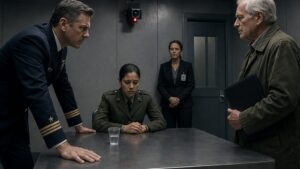
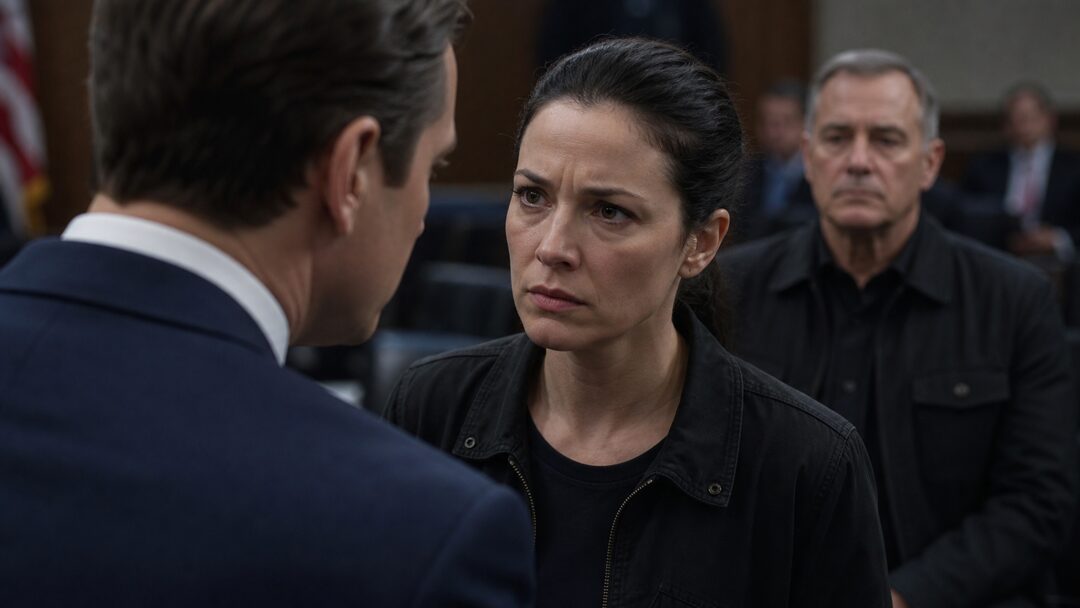
There were no grand flags, no cameras in her face, no row of dramatic lights. Just a government conference room with beige walls, microphones, water glasses, and people carrying years of grief in ordinary clothes.
Robert sat near the front, suit pressed, tablet ready.
James Walker sat two rows behind him.
He wore a dark jacket, no decorations, no visible claim to who he had been. His hands rested flat on his knees.
Sarah did not look for Linda Torres.
Not yet.
If she saw her too soon, she might lose the narrow bridge between duty and mercy.
Robert called her name at 9:43.
Sarah walked to the front with her laptop and the flash drive.
Her oath sounded strange in her own mouth.
Robert began carefully. “Ms. Mitchell, you previously served as a signals analyst assigned to Lantern Ridge communications review?”
“Yes.”
“And you have examined the recovered file submitted to this board?”
“Yes.”
“Can you state your findings?”
Sarah looked at him.
This was the moment he expected clean language.
Authentic recording. Evidence of post-event alteration. Relevant recovered command.
Words that would make the room believe it understood.
She glanced at James.
He gave no sign.
That was his last command to her, though he did not issue it.
Do not make it smaller.
Sarah turned back to the microphone.
“The file is authentic,” she said. “It was also edited.”
A murmur moved through the room.
Robert’s eyes sharpened, but he did not stop her.
“The original recording was cut in two places. The first cut removed part of Commander Walker’s order. The second obscured a final exchange involving Michael Torres.”
Someone behind her made a sound that was not quite a gasp.
Sarah kept her hands still.
“I can describe the recovered audio,” she said. “But I am not going to do that first.”
Robert leaned toward his microphone. “Ms. Mitchell—”
“The harm began when people described fragments as if they were whole.”
The room went very quiet.
Sarah inserted the drive.
For a moment, no one breathed loudly enough to hear.
Then she pressed play.
Static filled the room.
The first six seconds came harsh and immediate.
“—hold line—”
Scrape.
“—can’t move him—”
Breathing.
James’s voice, damaged but present:
“Return to—”
The restored section cracked open beneath it.
“—the ridge. Bring them back. Repeat, return to the ridge.”
A chair shifted.
Someone whispered, “God.”
Then command static, clipped and cold. Unclear words, but enough shape to understand refusal. Denial. Closure. Authority from a distance.
The room heard what had been missing.
Sarah did not look at James.
She let the audio continue.
The second fragment came.
Michael’s voice, young and strained beneath the static.
“Don’t let her hear it.”
This time, Sarah heard her.
No doubt.
The longer silence followed.
In that silence, the room changed.
No one coughed. No one moved paper. No one tried to own the moment.
It was less than a second in the file, stretched from damage and concealment. But in the hearing room it became a place everyone had to enter alone.
Then the final three seconds arrived.
Michael Torres’s voice was barely there.
“Tell my mom…”
Static swallowed part of him.
“…I wasn’t afraid.”
The file ended.
No one spoke.
Not Robert.
Not Sarah.
Not the officials with their pens and tablets.
In the second row, James Walker stood.
He did it slowly, as if his body had forgotten it was allowed to answer anything. He stood straight, shoulders squared, eyes forward.
At attention.
Not for the board.
Not for the record.
For the voice that had finally been allowed to finish.
Sarah felt something inside her give way. Not forgiveness. Not relief.
Something harder.
The end of pretending accuracy had no cost.
Robert looked down at his tablet, then closed it.
For once, he seemed to understand that the next useful sentence would be smaller than the silence.
Sarah stepped back from the microphone.
No one asked her to explain what the room had heard.
And because no one asked, she did not turn the dead into evidence again.
Part VI — What Remained
The report was amended three weeks later.
That was the word they used.
Amended.
Not healed. Not restored. Not returned.
James Walker’s command record was revised to reflect suppressed communication and improper alteration of evidence. The official language shifted around him like furniture moved in a house after someone is gone.
It gave him something.
It gave back nothing.
Robert called Sarah after the amendment posted.
“You did the right thing,” he said.
Sarah was standing outside Linda Torres’s building with the flash drive in her coat pocket.
“I don’t know what that means anymore,” she said.
After a pause, Robert answered, “Maybe that’s better than being too sure.”
She almost smiled.
Almost.
Linda Torres lived on the third floor of a clean brick apartment building with plants in the hallway windows and a blue mat outside her door. She opened it before Sarah could knock a second time.
She was smaller than Sarah expected. Not fragile. Just careful, as if she had learned to move around an absence without bumping it.
“You’re Sarah Mitchell,” Linda said.
“Yes.”
Linda looked at her coat pocket.
“You brought it.”
Sarah nodded.
“I don’t have to play it,” she said. “I can leave it with you. Or I can take it back. Or I can stay.”
Linda considered her for a long moment.
Then she opened the door wider.
Her apartment smelled like lemon cleaner and tea. On a side table near the window was a framed photograph of Michael in dress uniform, young face fixed in a smile that had not learned caution.
Sarah looked away first.
Linda noticed.
“He was handsome,” she said.
“Yes.”
“He hated that picture. Said he looked like he was pretending to be older.”
Sarah swallowed.
Linda sat on the couch. Sarah placed the laptop on the coffee table with the same care she might have used for a living thing.
Before she pressed play, Linda reached for the chain at her neck.
Michael’s service tag rested against her sweater.
“I was told he didn’t suffer,” Linda said.
Sarah’s hand froze over the trackpad.
“I know.”
“People think that sentence is kindness.”
Sarah looked at her.
Linda’s eyes were dry.
“I let them say it because they needed me to be grateful.”
There were no good words for that, so Sarah did not offer any.
“Will I hear him scared?” Linda asked.
The honest answer stood between them.
“Yes,” Sarah said softly. “Maybe.”
Linda closed her eyes.
Then opened them.
“A mother already knows that part.”
Sarah felt the line enter her and stay.
She pressed play.
The room filled with static, command, breath, the restored order, the refusal, Michael’s broken request.
Linda did not move when he said, “Don’t let her hear it.”
Her fingers tightened around the tag, but her face held.
Then came the longer silence.
Sarah watched her.
Linda closed her eyes.
In the hearing room, that silence had felt like judgment. Here, in this small apartment with tea cooling on the table, it felt different. Less like absence. More like someone gathering strength.
Then Michael’s final words came through.
“Tell my mom…”
Static.
“…I wasn’t afraid.”
The file ended.
Linda did not cry.
For a long time, she did not speak.
Sarah waited, because waiting was the only decent thing left to do.
At last, Linda opened her eyes.
“He was,” she said.
Sarah’s throat tightened.
Linda looked at Michael’s photograph.
“He was afraid. Of course he was.” Her thumb moved over the metal tag. “What I needed to know was that he wasn’t alone.”
Sarah looked down.
The sentence landed more gently than forgiveness and more painfully than blame.
Linda reached across the table and touched the flash drive.
“May I keep it?”
“Yes.”
“Did Commander Walker hear it played?”
“At the hearing.”
Linda nodded. “Good.”
Sarah was surprised by the word.
Linda saw it.
“He carried it too long,” she said. “That doesn’t mean he carried it well.”
“No,” Sarah said.
“But he carried my boy’s voice.”
Sarah had no answer.
Linda picked up the drive and held it in her palm, not tightly, not like a relic. Like something fragile that still had work to do.
When Sarah stood to leave, Linda walked her to the door.
In the hallway, Sarah paused.
“I’m sorry,” she said.
Linda studied her face.
“For what you did?” she asked. “Or for what you didn’t know?”
Sarah could not separate them.
Linda nodded as if that was answer enough.
“Then live differently with it,” she said.
Outside, the city was loud in its usual ways.
Car doors. A dog barking. Brakes sighing at the corner. A delivery truck beeping as it reversed. Ordinary noise folding itself around ordinary lives.
Sarah stood on the sidewalk and listened.
For years, silence had meant failure to her. Missing data. Broken transmission. The place where truth had been cut out.
Now she heard something else inside it.
A pause before someone chose what to carry.
A space where a voice could arrive late and still matter.
She walked home without putting in her earbuds.