What the Table Remembered
Part I — The Hand Above the Table
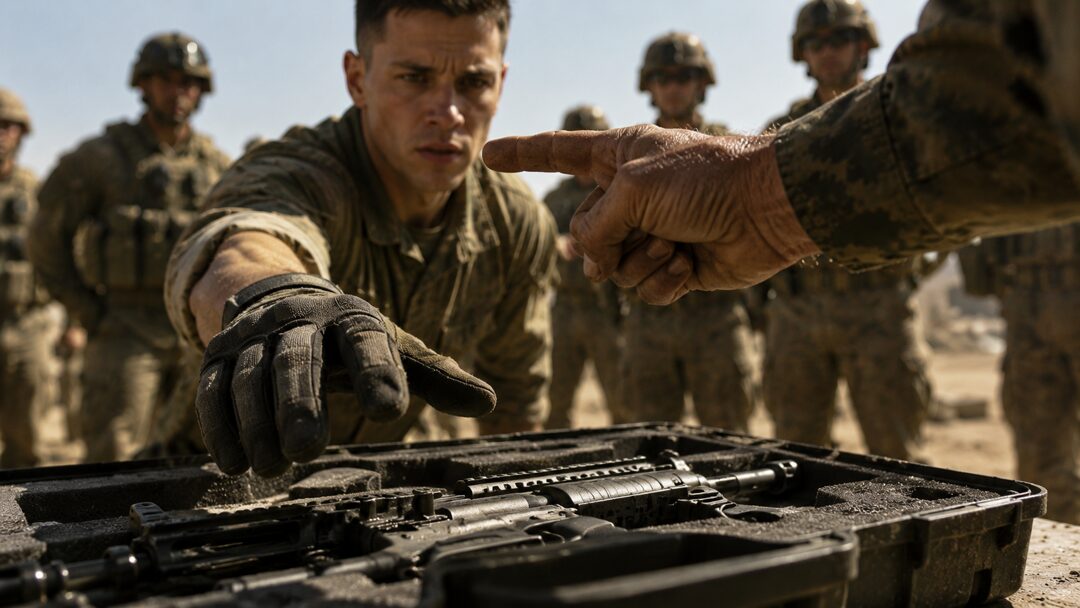
Mark Carter’s gloved hand was three inches from the rifle when Sergeant Robert Hayes shouted across the training ground, “Put that weapon down!”
Every soldier in the lane froze.
Even the helicopter seemed to hesitate above the distant ridge, its blades chopping hot air into dust. The desert morning had already turned bright and mean. Heat shimmered over the metal field tables, over the stacked crates, over the rows of soldiers pretending not to watch too hard.
Mark stopped with his hand still hovering.
He had not touched the rifle.
That detail mattered to him immediately.
It did not matter to Hayes.
The sergeant came at him from the left side of the lane, boots striking dirt, jaw locked, one finger already raised like the verdict had been reached before the trial began. Hayes was built lean and hard, with short dark hair, a battle-worn face, and a tactical vest loaded so heavily it looked like it had its own opinion.
“What part of wait for command did you not understand?” Hayes snapped.
Mark straightened.
“I was following the rotation card, Sergeant.”
Hayes reached the table and stopped inches away from him.
“The card?”
“Yes, Sergeant.”
Hayes looked down at the table.
There was the rifle, laid out clean on the black foam insert inside its open case. There were two empty magazines placed parallel. There was a plastic chamber flag. There was a clipboard.
There was no rotation card.
Mark’s stomach tightened.
It had been there.
He knew it had been there.
Ten seconds earlier, he had read his station number, his task, and the instruction to initiate inspection on command from the lane NCO. Ten seconds earlier, the world had made sense.
Now the card was gone.
Hayes turned back to him.
“You think you’re special?”
The line landed loudly enough for the back row to hear.
Someone behind Mark shifted their boots. Someone else stopped breathing in that obvious way people did when they wanted to disappear.
Mark kept his hands visible.
“No, Sergeant.”
Hayes stepped closer.
“You think because you can read a checklist, you can skip procedure?”
“No, Sergeant.”
“Then why was your hand moving toward my weapon?”
The phrase did what it was meant to do.
My weapon.
Not the training rifle. Not the assigned lane equipment. Hayes had taken ownership of the object and the mistake in the same breath, and Mark had become the careless man standing too close to both.
Mark looked at the table again.
The missing card bothered him more than Hayes’s volume.
“I saw an instruction card,” he said.
Hayes smiled without humor.
“You saw an instruction card.”
“Yes, Sergeant.”
“Did the card speak to you too?”
A few soldiers lowered their eyes.
Mark felt their almost-laughter, but no one dared let it breathe.
He kept his voice level.
“No, Sergeant.”
Hayes jabbed a finger toward Mark’s chest.
“Back away from the table.”
Mark stepped back.
The movement felt like guilt.
Hayes watched him retreat, then turned to the rifle case with the disgusted patience of a man about to demonstrate competence to a child.
“This,” Hayes said to the unit, “is why we do not let confidence outrun control.”
Mark stared straight ahead.
The heat pressed down on his helmet.
From the corner of his eye, he saw Emily Brooks near the supply canopy, holding a clipboard too tightly against her chest. Her sandy hair was tucked under her cap. Her sleeves were dust-smudged. Her face looked wrong.
Not surprised.
Afraid.
That was when Mark knew the missing card had not simply blown away.
Part II — The Thing Under the Foam
Hayes reached for the rifle case.
He moved with sharp confidence, every gesture clean enough to be used in a training video. The nearby soldiers watched him the way soldiers watched a superior doing anything with equipment: respectfully, silently, and with a private hope that nobody would ask them a question.
Mark stood one pace back.
His hands were down.
His mouth was shut.
That was the safest posture when authority wanted a mistake and had already chosen a body to attach it to.
Hayes lifted the rifle from the foam insert and set it across the table with controlled care. Then he pointed to the space beneath it.
“You inspect the table before touching anything,” he said. “You inspect the layout. You inspect the tags. You inspect the—”
He stopped.
The foam insert had lifted slightly with the rifle.
Something was tucked beneath it.
Something colorful.
Something that absolutely did not belong on a desert weapons lane.
Hayes saw it.
Mark saw it.
Emily Brooks closed her eyes.
Hayes pinched the edge of the foam and lifted it higher.
A flattened cereal box slid out and dropped onto the metal table.
It landed with a soft cardboard slap.
For one full second, nobody knew what kind of silence to use.
The box was crushed flat, sun-faded along one edge, with a bright cartoon grain bowl on the front. The lettering was partly torn, partly folded, and nobody could read the whole thing. It might have been funny anywhere else.
On that table, beside that rifle, under Hayes’s hand, it felt like a hole had opened in reality.
Hayes stared at it.
Mark stared at it.
The helicopter thumped in the distance.
A private in the second row made a sound that could have been a cough if anyone was feeling generous.
Hayes’s head snapped up.
The row went rigid.
“Not one word,” he said.
No one breathed.
Hayes looked back down at the cereal box as if it had personally betrayed him.
Then, with the same deadly authority he had used to stop Mark’s hand, he said, “Carter.”
“Yes, Sergeant.”
Hayes pointed at the box.
“Check the cereal.”
Mark blinked.
He was certain he had misheard.
“Sergeant?”
Hayes’s eyes lifted.
Mark immediately regretted having a voice.
Hayes spoke slower, which somehow made it worse.
“Check. The. Cereal.”
Somewhere in the formation, a soldier’s shoulders twitched.
Hayes didn’t even look.
“Anybody laughs, I will find you by sound.”
The shoulders stopped.
Mark stepped toward the table.
He had been yelled at before. He had been corrected, smoked, inspected, and professionally embarrassed by men who could weaponize disappointment.
But he had never been ordered to check breakfast packaging while standing beside a rifle under formal readiness conditions.
He picked up the cereal box.
It felt light.
Too light to matter.
Too weird not to.
Hayes watched him like a hawk.
“Open it.”
Mark slid one finger under a torn flap.
Inside, paper shifted.
Not crumbs.
Paper.
He looked up.
Hayes noticed.
“What?”
Mark pulled out a bundle of laminated tags held together by a rubber band.
The missing rotation card was on top.
No one moved.
Mark set it on the table.
Then he reached back into the cereal box and removed a folded serial checklist, a strip of inventory labels, and the torn corner of a requisition form.
Hayes’s face did not change at first.
That was his talent.
His jaw, however, tightened.
Mark placed the papers neatly beside the cereal box.
“The card was in here, Sergeant.”
Hayes looked at the card.
Then at Mark.
Then at Emily Brooks.
Emily had gone pale under the dust.
Hayes saw that too.
Of course he saw it.
“Brooks,” he said.
Emily straightened so fast her clipboard snapped against her chest.
“Yes, Sergeant.”
Hayes picked up the cereal box between two fingers.
“Why is readiness paperwork inside a cereal box?”
Emily’s mouth opened.
Nothing came out.
Hayes held the box higher.
“Do not make this a harder question than it is.”
Emily swallowed.
“I was told to patch the inserts, Sergeant.”
Mark looked at the foam.
Patch the inserts?
Hayes turned his head slowly.
“By whom?”
Emily’s eyes flicked past him toward the command tent.
It was small.
It was enough.
Hayes looked that way too.
So did everyone else who thought they could get away with it.
At the far side of the lane, Captain Linda Price had just stepped out of a vehicle.
Early.
Naturally.
Part III — The Box Became Evidence
Captain Price crossed the training ground with a notebook tucked under one arm and a calm expression that made people stand straighter without knowing why.
She had neat dark hair under her patrol cap, a crisp uniform, and the stillness of someone who did not need volume to make people nervous. Dust moved around her boots. She did not hurry.
That made it worse.
Hayes still held the cereal box.
The rifle lay on the table.
The tags lay beside it.
Mark stood one pace back, exactly where he had been ordered to stand.
Emily looked like she was trying to become part of the supply canopy.
Price stopped at the table.
She took in the rifle.
The open case.
The scattered tags.
The cereal box.
Her face did not change.
That made it much, much worse.
“Sergeant Hayes,” she said.
“Ma’am.”
Price looked at the cardboard in his hand.
“I assume there is context.”
There were several possible answers.
None of them were good.
Hayes chose the most dangerous one: formality.
“During lane inspection, an unauthorized packing substitute was found under the case insert, ma’am.”
Price’s eyes moved to the box.
“Is that what we are calling it?”
Mark stared straight ahead.
Hayes’s cheek muscle jumped once.
“Yes, ma’am.”
Price extended a hand.
Hayes gave her the cereal box.
She turned it over.
A faded cartoon grain bowl smiled up at her.
No one smiled back.
Price reached into the box and removed the requisition corner Mark had found. She looked at it, then at the tags, then at Emily.
“Specialist Brooks.”
Emily stepped forward.
“Yes, ma’am.”
“Did you stage this lane?”
Emily gripped the clipboard.
“I assisted, ma’am.”
“Did you place inspection documents inside this box?”
Emily looked at Hayes.
Hayes did not rescue her.
Mark understood that moment.
Not because Hayes was cruel. Because rescue would have been a lie, and everyone was already standing knee-deep in one.
Emily looked back at Price.
“Yes, ma’am.”
“Why?”
Emily’s mouth tightened.
“We were short two case inserts and one tag holder. I was told to keep the layout complete for evaluation.”
“By whom?”
Emily froze.
The command tent seemed suddenly very far away.
Hayes looked at the table.
Mark knew the calculation happening around him.
It was not written down, but every person in uniform learned the shape of it eventually. The system could survive a missing tag. It could survive a bad insert. It could survive a cereal box if everyone agreed it was funny and small.
What it could not survive gracefully was the sentence: We made it look complete because it was not complete.
Price waited.
Emily’s face had gone tight with fear.
Hayes took a breath.
Mark almost spoke.
He could have.
The opening was right there. He could explain he had followed the card, that the card was hidden, that he had been accused in front of the unit for a table someone else had staged wrong.
He could save himself cleanly.
But he looked at Emily’s hands around the clipboard and saw how hard she was trying not to shake.
She had hidden the problem.
She had not created it.
And Hayes—Hayes looked like a man being forced to stand next to a joke that had teeth.
Price turned to Mark.
“Specialist Carter.”
“Yes, ma’am.”
“What did you observe before Sergeant Hayes intervened?”
Hayes’s eyes moved to him.
Not warning.
Not begging.
Just watching.
Mark kept his voice even.
“There was a rotation card on the table when I approached, ma’am. It was missing when Sergeant Hayes challenged me.”
Price’s pen moved once in her notebook.
“Did you touch the weapon?”
“No, ma’am.”
“Did you touch the case?”
“No, ma’am.”
“Did you remove the documents from the box?”
“Yes, ma’am. Under Sergeant Hayes’s order.”
Price looked at Hayes.
“What was the order?”
Mark felt the entire formation lean inward without moving.
Hayes stared at the table.
A helicopter thumped above the ridge.
Dust curled around their boots.
Hayes said, in the driest voice Mark had ever heard, “I ordered him to check the cereal, ma’am.”
Someone in the back made a strangled noise.
Price looked up.
The formation became statues.
Price returned her attention to Hayes.
“I see.”
She did not smile.
That was almost worse than if she had.
Part IV — What Everyone Pretended Not to Know
Price set the cereal box down in the exact center of the table.
That placement changed the whole lane.
Before, the rifle had been the serious object and the box had been the embarrassment.
Now the box sat between all of them like evidence with better posture.
Price turned to Emily.
“Who told you to keep the layout complete?”
Emily’s fingers tightened on the clipboard.
“No one used those exact words, ma’am.”
Price waited.
Emily’s shoulders lowered half an inch.
“The message was that the lane needed to look ready.”
Hayes’s face changed.
Only for a second.
Mark caught it anyway.
Hayes hated the word look.
He hated it the way serious men hated fake polish, loose straps, late forms, and anyone saying “good enough” near something that could get someone hurt.
But the lane had looked ready.
The rifle had been clean. The magazines had been aligned. The foam had held its shape. The table had passed the first glance.
That was the problem.
Price turned to Hayes.
“Did you verify the table before the run?”
Hayes’s jaw locked.
“I verified the lane at zero six hundred, ma’am.”
“With this case?”
A pause.
“No, ma’am. The case was staged after.”
“By supply?”
Hayes glanced at Emily.
“By lane support.”
Emily flinched at the softer wording.
Price noticed.
So did Mark.
Hayes did too.
The sergeant’s face hardened, but not at Emily this time. It hardened inward.
Price picked up the folded requisition corner.
“This indicates a shortage.”
“Yes, ma’am,” Emily said quietly.
“When was the shortage reported?”
Emily looked at Hayes.
Hayes looked at the command tent.
Then he looked back at Price.
“It wasn’t, ma’am.”
Price held his gaze.
“Why?”
That was the question.
Not why was the cereal box there.
Not why had Mark reached toward the rifle.
Why had an entire lane been dressed up to hide what everyone needed to know?
Hayes did not answer fast.
For once, he could not command the shape of the silence.
Mark saw the soldiers watching. He saw the embarrassment moving through the formation, the restrained laughter drained now into discomfort. The cereal box was still ridiculous. It was still funny in a way that would survive the day and ruin someone’s composure at dinner.
But it was no longer harmless.
Price looked at Mark again.
“Specialist Carter, step back.”
Mark stepped back.
The order was not punishment this time.
It was protection.
Price turned to Emily.
“Specialist Brooks, did Specialist Carter cause this lane irregularity?”
“No, ma’am.”
“Did Sergeant Hayes instruct you to hide the shortage?”
Emily looked at Hayes.
Hayes spoke before she could.
“No, ma’am.”
Price turned to him.
Hayes’s voice stayed hard, but not defensive.
“I did not instruct Brooks to hide anything. I also did not catch what was hidden before this lane went active. That is my failure.”
The statement hit the ground heavier than yelling.
Emily stared at him.
Mark did too.
Hayes kept his eyes on Price.
“This lane is compromised.”
Price tapped the cereal box with one finger.
“I agree.”
A soft wind moved dust across the table.
Hayes looked down at the box.
Then at the rifle.
Then at Mark.
For a second, Mark expected one last correction. One last attempt to pull the whole mess back into the shape of a subordinate’s mistake.
Hayes did not do it.
He picked up the rifle, set it safely inside the case, and closed the lid with controlled precision.
Then he held up the cereal box.
His face had the expression of a man trying to maintain authority while holding the least authoritative object in the desert.
“This,” Hayes said, “is not a training aid.”
No one moved.
His eyes narrowed at the box.
Then, lower and utterly sincere, he said, “What the hell?”
The sound that went through the formation was not laughter exactly.
It was relief trying to behave.
Price turned her face away for one professional second.
Hayes heard the almost-laugh, but for once he let it live.
Only barely.
“Full lane reset,” he barked. “Everything off the table. Everything verified. If it has a tag, I see the tag. If it does not have a tag, it does not exist.”
He pointed toward the supply canopy.
“Brooks, document the shortage.”
Emily nodded fast.
“Yes, Sergeant.”
Hayes looked at Mark.
“Carter.”
Mark braced.
“Help her.”
Mark blinked.
“Yes, Sergeant.”
Hayes set the cereal box back on the table like it had earned a place in the chain of custody.
“Start with that.”
Part V — The After-Action Table
By noon, everyone knew.
Not officially.
Officially, the readiness lane had been paused for reset due to equipment-staging irregularities.
Unofficially, the cereal had entered history.
The phrase moved faster than dust.
Check the cereal.
Someone said it near the water buffalo and got elbowed so hard they spilled half a cup. Someone else whispered it while inventorying cases and had to turn away before Hayes saw their face. By lunch, even the soldiers who had not been near the lane had heard that Sergeant Hayes had discovered breakfast inside a weapons case and nearly declared war on it.
Hayes made no comment.
That was dangerous.
He moved through the reset with the calm fury of a man building a wall brick by brick because someone had embarrassed him with cardboard. Every case was opened. Every tag was checked. Every shortage was written down. Every “close enough” died on the table.
Mark worked beside Emily under the supply canopy.
For the first ten minutes, she said nothing.
Then she set down her clipboard.
“I didn’t think anybody would look under the insert.”
Mark checked a tag against the new list.
“That’s usually where problems live.”
She gave him a small, tired look.
“Under the insert?”
“Under whatever nobody wants lifted.”
Emily looked toward Hayes.
“He could have blamed me.”
Mark followed her gaze.
Hayes stood at the far table with Captain Price, holding a checklist. His posture was rigid, his expression carved from displeasure, but he was listening.
“He didn’t,” Mark said.
Emily looked back at him.
“He could have blamed you too.”
“I noticed.”
“You were calm.”
Mark huffed once.
“I was confused.”
“Same thing, from far away.”
That nearly made him smile.
Nearly.
They worked through another crate.
Emily’s handwriting was neat even when she was nervous. Every shortage got a line. Every substitute got a note. Nothing was described as “temporarily complete” or “pending visual correction,” phrases Mark had seen used to mean nobody wanted to say missing.
By the time Price returned, the lane looked worse.
That was how Mark knew it was more honest.
Open cases lay across the tables. Tags were stacked in ugly little piles. Missing items were marked with blank spaces instead of excuses. The polished drill lane had become a mess of visible facts.
Price looked it over.
“Better,” she said.
Hayes did not seem pleased.
“Ma’am, it is less ready than it appeared.”
Price closed her notebook.
“That is often the first step toward readiness.”
Hayes absorbed that like medicine he did not enjoy but intended to keep down.
Mark was carrying a case past them when Price turned.
“Specialist Carter.”
He stopped.
“Yes, ma’am.”
“You saw the card before it went missing?”
“Yes, ma’am.”
“And you held position when challenged?”
“Yes, ma’am.”
Hayes looked at him.
Price said, “Good.”
One word.
Clean.
No decoration.
Mark nodded.
“Thank you, ma’am.”
Hayes waited until Price walked away.
Then he stepped closer to Mark.
The old tension came back by instinct.
Hayes glanced toward the table where the flattened cereal box now sat beside a shortage report.
“You still reached before I cleared you.”
Mark kept his face neutral.
“Yes, Sergeant.”
“You will not do that again.”
“No, Sergeant.”
Hayes stared at him.
Then his gaze shifted to the box.
“And I will not assume a clean table means a clean lane.”
Mark said nothing.
That sounded close enough to an apology that touching it would ruin it.
Hayes pointed to the next case.
“Check everything.”
“Yes, Sergeant.”
Hayes began to turn away.
Mark should have let him.
He really should have.
But the day had been long, the heat was cruel, and the box was still sitting there with its cartoon bowl facing the sun.
“Even breakfast, Sergeant?”
Emily froze beside him.
Two soldiers behind the canopy stopped moving.
Hayes turned back slowly.
Mark immediately understood that confidence was a renewable mistake.
Hayes looked at him for a long second.
His face remained hard.
His eyes did not.
“Especially breakfast,” Hayes said.
Then he walked away.
The soldiers behind the canopy bent over their cases with sudden devotion.
Emily pressed her clipboard against her mouth.
Mark looked down at the cereal box.
It was bent, faded, ridiculous, and somehow more useful than half the morning’s paperwork had been.
Part VI — Appearance and Readiness
The after-action board went up at the end of the day.
It was a folding table under a shade canopy, not a board at all, but everyone called it that because the Army could turn any flat surface into a lesson if given tape and enough disappointment.
There were corrected forms.
There were shortage reports.
There were case tags.
And in the center, placed upright in a clear plastic sleeve, was the cereal box.
Someone had covered the cartoon bowl with a blank strip of tape so the front stayed unreadable. Above it, in Hayes’s blocky handwriting, was a label:
Do not confuse appearance with readiness.
Mark stopped when he saw it.
The words were exactly the kind of thing Hayes would say after yelling at someone for saying it first.
Emily stood beside him with her clipboard held lower now, loose at her side.
“He wrote that himself,” she said.
“I can tell.”
“How?”
“Looks angry.”
Emily laughed once before she could stop herself.
Across the lane, Hayes looked over.
Emily went silent.
Mark did too.
Hayes walked toward them.
The sun was lower now. The mountains had turned blue at the edges. The helicopter was gone. Without the blade noise, the training ground felt strangely exposed, as if the day had finally run out of excuses.
Hayes stopped in front of the table.
His eyes went to the cereal box.
Then to Mark.
“You reading or working, Carter?”
“Reading, Sergeant.”
“Dangerous habit.”
“Yes, Sergeant.”
Hayes looked at the label again.
For a moment, his face carried the same bewilderment from the morning. Not the comic part. The other part. The part that had understood a box had told the truth before any of them did.
Emily cleared her throat.
“I filed the shortage report, Sergeant.”
Hayes nodded.
“Good.”
“I included the substitute packing.”
“I saw.”
Emily waited for punishment in the silence after that.
Hayes did not give her any.
Instead, he said, “Next time someone tells you to make something look complete, you ask if they want it complete or pretty.”
Emily’s grip tightened once on the clipboard.
“Yes, Sergeant.”
Hayes turned to Mark.
“And you.”
Mark stood straighter.
“Yes, Sergeant.”
“You see something missing, you say missing before you move.”
“Yes, Sergeant.”
Hayes picked up the cereal box in its sleeve and studied it like an enemy he had decided to keep alive for instructional purposes.
“I do not ever want to hear this story exaggerated.”
Behind him, two soldiers suddenly found the dirt fascinating.
Hayes continued.
“I do not want to hear that I yelled at a box. I do not want to hear that the box outranked anybody. I do not want to hear that breakfast saved the lane.”
Mark kept his face still with real effort.
“Yes, Sergeant.”
Hayes’s eyes narrowed.
“But if anyone asks why the reset happened, you tell them the truth.”
Emily looked up.
Mark did too.
Hayes set the box back down.
“The table lied,” he said. “The box didn’t.”
No one had a joke ready for that.
It was still funny.
Somehow, it was also not.
Hayes stepped away from the after-action table.
The lane behind them was ugly now. Open, tagged, incomplete in places, corrected in others. It looked less impressive than it had that morning.
It also looked less fake.
Mark glanced at Emily.
She was staring at the box with an expression he recognized: embarrassment slowly becoming relief.
Price passed by the canopy, paused, and read Hayes’s label. Her mouth almost moved into a smile, then settled back into professional calm.
“Accurate,” she said, and kept walking.
Hayes watched her go.
Then he looked at Mark one last time.
“Tomorrow,” he said, “we run it clean.”
“Yes, Sergeant.”
Hayes started away.
Mark glanced at the cereal box again.
He knew better than to say it.
Emily knew better too.
That was why neither of them did.
But later, when the unit broke down the lane and the sun slid behind the ridge, someone carried the after-action materials past the table and tapped the plastic sleeve by accident. The cereal box wobbled, then settled upright again.
Mark watched it hold.
A ridiculous little thing, standing where the serious things had failed.
He picked up the last case tag, checked it twice, and clipped it where everyone could see.