The Day He Asked Them Not to Cover the Yellow Horse
Part I — The Space Beside the Patch
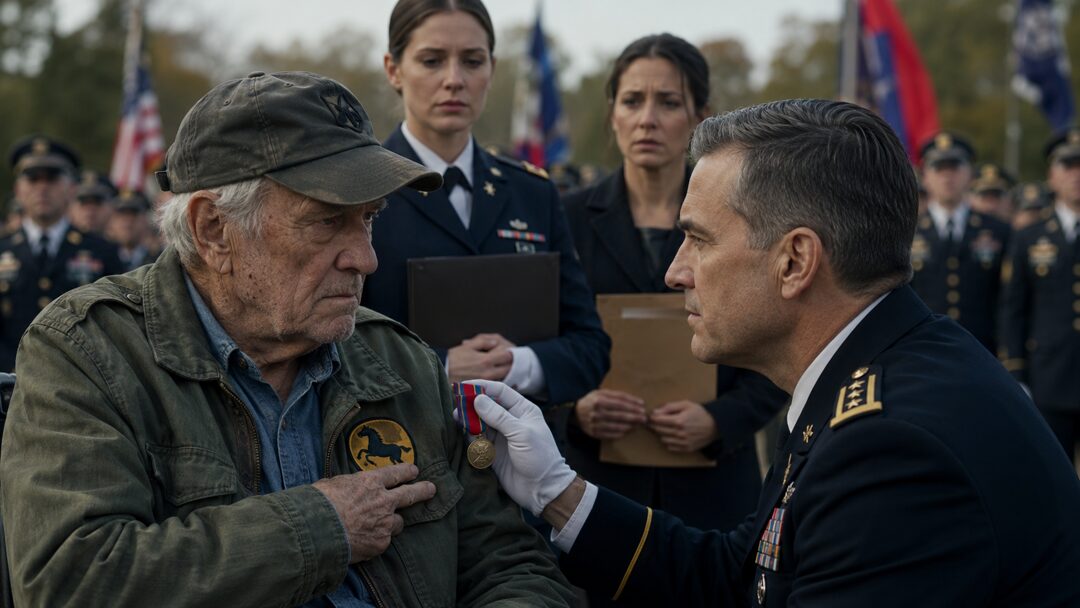
The general was already on one knee when Richard Hill put two fingers over the faded yellow horse on his jacket and said, almost too softly for the microphone to catch, “Don’t pin it over the horse.”
The band had stopped.
The flags kept moving.
Across the parade field, hundreds of pressed uniforms sat in rows so straight they looked measured with a ruler. White gloves rested on blue trouser legs. Shoes shone under the late morning sun. Cameras stood on tripods near the aisle, pointed at the old man in the front row who had arrived in a denim shirt, scuffed boots, and a green field jacket older than most of the people watching him.
General Edward Reeves paused with the medal in his gloved hand.
He did not smile for the cameras. He did not pretend not to hear.
He looked at the small yellow horse, sewn unevenly over Richard’s left breast, the thread puckered from age and washing and hands that had mended it more than once.
“I won’t,” Edward said.
Richard kept his fingers there anyway.
Behind him, Laura Hill sat rigid in the second row, one hand clamped around the old folder she had found in her grandfather’s kitchen. She had imagined many things when she mailed copies of those papers to the Army records office. A polite call. Maybe a letter. Maybe a small room with coffee, two officers, a handshake.
Not this.
Not a platform.
Not a band.
Not a general kneeling in front of her grandfather like the whole country owed him something.
Richard had agreed because she had said, “It’s just a small recognition, Grandpa. You don’t even have to say anything.”
He had looked at her then with those pale, tired eyes and asked, “Small to who?”
She had thought he was being difficult.
Now she understood he had been warning her.
General Reeves remained on one knee. He was tall even lowered, his dress uniform sharp enough to make the morning look informal. Rows of ribbons crossed his chest. His white gloves made the medal seem too clean for the old jacket.
Richard’s face did not change, but Laura saw his thumb move over the horse.
Back and forth.
Back and forth.
Like he was checking whether it was still there.
A young officer stood behind the general holding a folder against her chest. Lieutenant Jessica Carter. That was the name Laura had heard when they were introduced. Jessica looked composed in the way young officers tried to look composed, but her eyes kept dropping to the old man’s hand.
Richard had not stood when the band played.
He had tried. Laura saw his knees gather under him, saw the decision pass through his shoulders, then saw pain or memory stop him halfway. Edward had noticed too. He had stepped off the platform before anyone could offer a microphone or a ceremonial aide.
That was when the crowd leaned forward without moving.
A general crossing empty grass toward one old man made its own silence.
Edward looked at Richard’s jacket. “May I?”
Richard’s answer came late.
“Beside it,” he said.
The general nodded once.
But he still did not pin the medal.
Instead, he turned slightly toward Jessica.
“Lieutenant,” he said, “read the citation from the beginning.”
Jessica opened the folder.
The paper made a clean sound in the open air.
Laura felt her grandfather’s back stiffen before the first sentence was spoken.
“For conspicuous courage during the evacuation of Observation Post Mason,” Jessica read, “then-Specialist Richard Hill, assigned to the 7th Cavalry Reconnaissance Detachment, repeatedly entered hostile conditions to recover wounded personnel after his team was cut off near Red Draw—”
Richard’s hand closed over the yellow horse.
Not gently now.
Laura nearly stood.
She had read those lines a dozen times in the file. She had cried over them at her kitchen table. She had underlined the words recommended for award and never processed. She had been angry on his behalf. Angry at lost paperwork, old indifference, all the ways the world forgot quiet men.
But Richard did not look like a man finally being remembered.
He looked like someone being asked to return to a room he had locked from the inside.
Jessica continued.
“Despite direct orders to withdraw, Specialist Hill assisted in moving four wounded soldiers from the observation post to the extraction vehicle and operated the vehicle under extreme pressure—”
“No,” Richard said.
It was not loud.
It stopped everything anyway.
Jessica looked at the general.
The general did not look away from Richard.
“No?” Edward asked.
Richard’s fingers trembled over the horse.
“That’s the clean version,” he said.
Part II — The Names Not Spoken
Laura had never heard her grandfather speak that way in public.
At home, Richard was quiet but not fragile. He fixed things with half his strength and all his patience. He wrapped electrical tape around broom handles. He sharpened pencils with a pocketknife. He kept old coffee cans full of screws labeled in handwriting so small it looked like a code.
When Laura was little, she thought he had been born old.
Only after her grandmother died did the past start falling out of drawers.
A photograph behind a recipe box.
A folded map inside an oil-stained manual.
A green jacket in the hall closet, wrapped in a dry-cleaning bag even though it had never been dry-cleaned.
And the folder.
The folder changed everything for Laura.
It held a copy of an old recommendation, a typed summary, and a name she had never seen her grandfather write: Mark Miller.
When she asked Richard about it, he had taken the folder from her and set it on the table as if it were hot.
“Where did you get this?”
“In the pantry cabinet.”
“Put it back.”
“Grandpa, it says you were recommended for—”
“I know what it says.”
“You never told us.”
“I never told you plenty.”
She had been hurt then. She had thought silence meant distrust. She had thought if she pushed hard enough, she could give him back something stolen from him.
Now, under the flags, Laura understood that some stolen things were dangerous when returned.
General Reeves stayed kneeling.
Most men in his position would have stood by now. They would have protected the shape of the ceremony. They would have cleared their throat, thanked the veteran for his humility, moved the event forward.
Edward did not.
He lowered the medal to his knee and said, “Tell me which part.”
Richard looked past him.
The field blurred in the heat. Somewhere a flag rope tapped against a pole.
“The names,” Richard said.
Jessica still held the citation open.
Laura watched the young officer’s face change. Not dramatically. Just enough. Her lips pressed together. She had read the record. She knew the words on the page and suddenly understood there were people missing between them.
Edward asked, “Whose name?”
Richard gave a dry laugh with no humor in it.
“The one I hear.”
Laura’s throat tightened.
Richard had never said Mark Miller aloud to her. Not once. The name existed in paper, not in the house. It had lived in the folder like a pressed leaf from someone else’s life.
Now Richard said it.
“Mark Miller.”
The name reached the rows behind them and seemed to make the day colder.
Jessica looked down at the citation again, searching.
Edward did not need to search.
“I know,” he said.
Richard’s eyes snapped to him.
The general’s voice stayed low. “I know his name.”
For the first time since the ceremony began, Richard looked fully at the man kneeling in front of him.
There was suspicion in his face.
Worse, there was hope.
Edward turned slightly toward the microphone, but when he spoke, his words were for Richard.
“My father was at Red Draw.”
The crowd shifted.
Laura felt the folder bend under her grip.
Edward continued, “He came home because a cavalry scout dragged him under a transport and lied to the medics about who needed the last stretcher.”
Richard went still.
His hand fell from the patch.
The yellow horse looked suddenly small.
“No,” he said.
Edward’s expression tightened. “His name was Dennis Reeves.”
Richard blinked once.
The morning disappeared from his face.
Laura did not know the name, but Richard did. She saw it strike him before she understood.
“He was twenty-two,” Edward said. “He lived to be seventy-nine. Had three children. Six grandchildren. He never stood up from a chair without making a sound, and he never let anyone in my family complain about bad weather.”
A few people in the rows behind them gave a soft, broken laugh.
Richard did not.
Edward’s voice lowered. “He said a boy with a yellow horse on his sleeve pulled him out by his collar and called him sweetheart because he wouldn’t stop yelling.”
Something passed over Richard’s mouth.
Not a smile.
The memory of one.
Laura could almost see the young man hidden inside him for a second, ridiculous and terrified and alive.
Then it was gone.
Richard swallowed. “Dennis made it?”
“Yes.”
Richard stared at him, and for one sharp second Laura thought this might save him.
Then Richard shook his head.
“One made it,” he said. “That doesn’t settle the others.”
Part III — Red Draw
The official report said the scouts were sent to confirm movement along a dry ridge before a ceasefire line was finalized.
The official report did not mention the smell.
Richard remembered the smell first.
Dust baked into canvas. Hot metal. Diesel. The bitter sting of smoke blowing low enough to taste. Men shouted through it, but the radio snapped and broke their voices into pieces.
He had been nineteen and certain he looked younger.
The yellow horse had been fresh then, bright on his sleeve, painted in a rough stencil on the doors of their vehicles. Mark said it made them look like a traveling circus.
“Better than looking like a target,” Richard had said.
Mark had grinned. “Hill, everything out here is a target. We’re just the ones wearing livestock.”
Mark Miller laughed at the wrong time. That was what Richard remembered most clearly.
Not because Mark was careless. He wasn’t. He was a medic who could tape a bandage with one hand and insult a man’s haircut with the other. He laughed when fear made everyone else too quiet.
At Observation Post Mason, he had laughed once while pulling a wounded radio operator behind a stack of sandbags.
“You picked a fine morning to need attention,” Mark told the man.
The radio operator was crying.
Mark said, “Don’t worry. I’m charming under pressure.”
Then the ridge shook.
Richard remembered receiving the withdrawal order through static.
He remembered refusing it once.
He remembered the voice coming back harder.
Pull out before the ridge is cleared.
Cleared.
That was the word used by men far enough away to use words like that.
Richard had looked at Mark.
Mark had looked at the wounded.
There were too many of them.
There was never enough of anything when it mattered.
They loaded the first two into the vehicle. Then Dennis Reeves, bleeding and furious, because he kept trying to crawl back toward a man whose name Richard never learned. Richard dragged him by the collar and called him sweetheart because Dennis was cursing like a man twice his size.
Mark had laughed.
Then he pointed through the smoke.
“The radio operator,” he said.
“No,” Richard said. “We have to move.”
“He’s alive.”
“Mark.”
“He’s alive, Rich.”
No one had called him Rich after that day.
Not his wife. Not Laura. Not anyone.
The last clear thing Richard remembered was Mark turning away from him with the yellow horse on his sleeve flashing once through the smoke.
Then the order again.
Move now.
Richard waited.
He counted to three. Then five. Then ten.
Someone in the back screamed that they had to go.
Dennis Reeves was losing consciousness.
The ridge shook again.
Richard climbed into the driver’s seat.
He told himself Mark would appear.
He told himself men appeared from smoke all the time.
They did in movies. In stories. In lies told afterward so listeners could breathe.
Mark did not appear.
Richard drove.
For sixty years, that was the whole truth.
No medal changed it.
No typed citation changed it.
No general on one knee changed it.
Back on the parade field, Jessica had stopped reading. The page trembled slightly in her hands. Laura wondered whether anyone else noticed.
Richard’s voice was barely more than breath.
“He was alive when I left.”
Edward did not interrupt.
Richard looked at the medal in the general’s hand.
“That belongs to Mark.”
The rows behind them were so silent Laura could hear the click of a camera shutting off.
She wanted to reach for her grandfather’s shoulder. She wanted to say she was sorry. She wanted to take him home and undo every letter she had sent, every call she had made, every moment of proud urgency that had led him here.
But she did not move.
For the first time, she understood that touching him too quickly would be another way of taking control.
Richard was still speaking.
“Report said he was gone before we loaded the first man. That’s what they put down. That’s what made it easy.” His lips tightened. “He wasn’t gone.”
Edward looked at Jessica.
She closed the citation.
The sound was small, but everyone heard it.
Richard said, “I drove away from him.”
There were no tears in his voice.
That made it worse.
Edward looked down at the medal, then back at Richard.
“My father said you saved him.”
Richard’s eyes hardened. “Your father didn’t know who I left behind.”
“He knew more than you think.”
Richard shook his head. “Don’t do that.”
“Do what?”
“Dress it up.”
The words struck harder than a shout.
Edward accepted them without flinching.
Laura had never seen a powerful man look so careful.
Part IV — The Paper in the Folder
For a long moment, no one seemed to know whether the ceremony was still happening.
The band members held their instruments in their laps. The front row of officers watched the general kneel in the grass. A breeze moved through the flags, bright and indifferent.
Then Edward stood.
Not fully away from Richard. Just enough to turn to Jessica.
“Lieutenant,” he said, “the addendum.”
Jessica opened the folder again, but not to the citation.
There was another envelope inside. Cream-colored. Sealed with a clear archival sleeve. Laura had not seen it before.
Richard noticed it too.
“What’s that?” he asked.
Edward took the envelope carefully. This time his gloves looked wrong. Too clean. Too white.
“When the Red Draw records were digitized,” he said, “some items were re-cataloged. A damaged radio case from Observation Post Mason was opened for preservation. Inside it was a field note.”
Richard’s face changed before the words finished.
It was not fear exactly.
It was a man seeing a door open in a house he thought had burned down.
Edward looked at him. “It was signed by Mark Miller.”
Richard said nothing.
Laura pressed her hand over her mouth.
Jessica removed a copy from the folder and handed it to the general. Edward held it but did not read from the microphone. He crouched again, closer this time, so Richard would hear first.
“There are only a few lines,” Edward said.
Richard’s jaw worked.
“Read it,” he said.
Edward looked down.
His voice was controlled, but not untouched.
“Four out with Hill. Ridge almost gone. Don’t send him back. If anybody asks, tell Hill to drive.”
Richard closed his eyes.
The whole field seemed to lean toward him.
Edward continued, quieter. “The last line is harder to read. But the preservation team believes it says, ‘He already did enough.’”
Richard made a sound then.
Not a sob.
Not quite.
It was the sound of something held for so long that the body no longer knew how to release it.
Laura stood halfway before she stopped herself. Her knees trembled. She sat again, useless and awake.
Richard opened his eyes. They were wet but steady.
“No,” he said.
Edward waited.
“No, he wouldn’t have—”
“He did.”
“You don’t know his voice.”
“No,” Edward said. “But I know my father’s.”
Richard looked at him sharply.
Edward folded the copied note once along its crease, then unfolded it again, as if his hands needed something to do.
“My father gave a statement in 1987,” he said. “He said the medic went back because no one else could. He said the driver waited too long already. He said if that driver had waited another minute, everyone in the vehicle would have stayed there.”
Richard’s mouth moved, but no words came.
Edward said, “He also said the driver didn’t want to live with it.”
Richard’s shoulders sank.
For a second, he looked not eighty-two but nineteen and completely unprotected.
Laura thought of all the years he had fixed broken hinges and leaky faucets and lawnmowers that should have been thrown away. All the years he had held things together because something in him had not been allowed to mend.
She had wanted him honored.
She had not understood that honor could arrive like a hand on a bruise.
Richard stared at the note.
“Why didn’t they tell me?”
It was the first question that sounded like pain.
Edward’s face tightened. “The statement was attached to an inquiry that never reached the award file. The note was cataloged under recovered equipment, not personnel records. By the time the files were cross-referenced, decades had passed.”
Richard looked at the general with a tiredness beyond anger.
“Decades pass easy for paper.”
Edward lowered his eyes.
“Yes,” he said. “They do.”
That line moved through the crowd more heavily than any official apology could have.
Richard leaned back in the chair.
The medal still rested unpinned in Edward’s hand. The ceremony had circled back to it, but nothing about it was the same.
Laura saw that now.
The medal had arrived as a claim.
It had become a question.
Richard looked at the yellow horse on his jacket.
Then at the note.
Then at Edward.
“Is Mark’s name on that citation?”
Edward did not answer quickly enough.
Richard gave a small nod, as if he had expected it.
“No,” Edward said. “Not on the original citation.”
“Then it’s still wrong.”
“The addendum will enter the record.”
Richard’s voice sharpened. “That is not what I asked.”
A few officers shifted in their chairs.
Edward did not.
“No,” he said. “His name is not on the citation for your medal.”
Richard put both hands on the arms of his chair.
For a moment, Laura thought he was going to push himself up and walk away.
Maybe he wanted to.
Maybe he had wanted to from the first note of the band.
“The medal is yours,” Edward said.
Richard looked at him.
“The day wasn’t.”
Part V — Beside, Not Over
No one moved after Richard said it.
The words hung in the bright air.
The day wasn’t.
Laura knew then that her grandfather was not refusing because he thought he had done nothing.
He was refusing because he knew he had not done it alone.
Edward looked at the medal again. Then he did something that made Jessica’s eyes widen.
He removed one white glove.
Slowly.
Deliberately.
He handed it to her.
Without the glove, his hand looked older. Human. Less ceremonial. There was a pale ring line on one finger and a scar across one knuckle.
He reached into the folder and took out a small object wrapped in tissue.
Richard watched as if he could not breathe.
Edward unfolded the tissue.
Inside was a yellow horse pin, smaller than Richard’s patch, its enamel dulled at the edges, one leg scratched, the clasp replaced for preservation.
Richard did not ask what it was.
He knew.
Edward held it in his bare palm.
“It was recovered with the radio case,” he said. “The catalog listed it as unit insignia. My office requested release for today.”
Richard’s hand rose, then stopped before touching it.
“Mark’s?”
Edward nodded. “Mark’s.”
Jessica looked away for a moment.
Laura saw her blink hard and straighten again.
Edward shifted back onto one knee in front of Richard. The same position as before. The same old man. The same green jacket. The same uniforms watching.
But the meaning had changed.
The first time, the general had been there to give him a medal.
Now he was there to ask permission from the dead.
Edward lifted the medal.
“Regulations say this belongs on the left breast,” he said.
Richard’s mouth tightened.
Edward glanced at the old yellow patch. “But memory has its own chain of command.”
He placed the medal beside the horse.
Not over it.
The pin went through the worn fabric with a small resistance. Richard did not look away. His chin trembled once, then held.
Edward secured the clasp.
Then he lifted Mark’s yellow horse pin.
Richard whispered, “Careful.”
“I will be.”
Edward placed it above the old patch.
For several seconds, his bare fingers stayed against the jacket, steadying the small emblem as he fastened it.
The parade field held its breath.
The medal, the old patch, and the recovered horse formed a small, uneven triangle over Richard’s heart.
Nothing about it looked polished.
That was why it looked true.
Edward leaned closer.
His voice did not carry to the crowd, but Laura was close enough to hear it.
“Mark said to drive,” he told Richard. “You did.”
Richard’s face folded inward.
Not dramatically. Not for the cameras. His eyes closed, and the lines around them deepened, and his mouth opened as if he had been struck by air.
For sixty years, the sentence inside him had been: I drove away.
Now someone had changed only two words.
You did.
Not absolution.
Not praise.
An answer.
Richard lifted his hand. His fingers touched Mark’s pin first, barely grazing it. Then the medal. Then the old patch.
His hand stayed there.
Laura wanted to remember that exact order for the rest of her life.
Mark.
The day.
The unit.
Then Richard opened his eyes.
He looked at Edward, still kneeling.
“Help me up,” Richard said.
Edward stood at once, but he did not pull. He offered his arm.
Richard took it.
The movement was slow. Painful. His knees resisted. His boots shifted in the grass. For one frightening second, Laura thought he would fall.
Then Jessica stepped forward on his other side without being told.
Richard let her help.
That, more than anything, broke Laura.
Her grandfather, who had refused help carrying groceries even when his hands shook, allowed a young officer to steady him in front of everyone.
He rose.
At first, no one applauded.
That saved the moment.
Instead, the soldiers stood.
One row, then another, then another.
The sound was not clapping. It was fabric, chairs, breath, the soft movement of hundreds of people understanding that noise would be too small for what had just happened.
Richard stood between the general and the lieutenant, one old hand pressed over the yellow horse.
He looked past the reviewing stand.
Past the flags.
Past the cameras.
Toward the open field beyond the ceremony, where the grass bent under the wind and kept no record anyone could file.
Laura stood too.
She did not call his name. She did not rush to him. She simply stood where he could see her if he turned.
For once, she did not need to rescue him from silence.
Richard’s lips moved.
Edward leaned closer.
But Laura heard it.
“I drove,” Richard whispered.
No one answered.
No one needed to.
Part VI — What Remained Standing
Afterward, people approached carefully.
Not many. Edward made sure of that. With one glance, one lifted hand, he turned away the officials who wanted photographs, the aides who wanted signatures, the cameras waiting for the old man to become a story they could package.
Laura saw him do it and understood something about authority she had not understood before.
Sometimes power was not making a room listen.
Sometimes it was keeping a room from taking too much.
Richard sat again beneath the shade at the edge of the field. The medal rested beside the old horse. Mark’s pin sat above it, catching light only when Richard breathed.
Laura came to him slowly.
She still held the folder.
For the first time all morning, she hated it a little.
“I’m sorry,” she said.
Richard looked up.
“For what?”
“For making it bigger than I said.”
His eyes moved across her face. The anger she expected was not there. Neither was comfort.
Just tiredness. And something less closed than before.
“You didn’t know,” he said.
“I should have asked more.”
“I wouldn’t have told you.”
That almost made her laugh. Almost.
She sat beside him.
For a while, they watched Jessica return the papers to the folder. The young lieutenant handled each page differently now, as if the ink had weight.
Edward stood a few feet away speaking quietly with an aide. He did not look like a man pleased with a successful ceremony. He looked like a man who had completed something that should have been completed long before he was born.
Laura glanced at her grandfather’s chest.
“Can I see it?”
Richard looked down.
His fingers touched Mark’s pin.
“Not yet.”
She nodded.
That answer hurt, but it did not wound her. She understood the difference now.
A breeze moved through the flags again. Somewhere behind them, the band began packing away instruments. Chairs folded. Voices returned in low tones. The world, disrespectfully and mercifully, continued.
Edward came back alone.
He stopped in front of Richard, no longer kneeling, no longer performing anything.
“My office will send you the amended record,” he said.
Richard nodded.
“And the original note,” Edward added, “will remain preserved. But you’ll receive a copy.”
Richard looked at him. “Don’t lock it away where nobody can find it.”
Edward accepted that like an order.
“I won’t.”
For a moment they simply faced each other: the old scout in the faded jacket, the general in the immaculate uniform, both carrying men who were not there.
Then Edward extended his bare hand.
Richard looked at it.
Took it.
Their handshake was brief.
Laura noticed Edward did not thank him again.
That was right.
Gratitude had already done what it could.
As the general stepped away, Richard leaned back and closed his eyes. Laura thought he might sleep right there, with the medal newly pinned and the old patch uncovered.
But then he spoke.
“Your grandmother hated this jacket.”
Laura turned to him.
“She said it made me look like I was waiting for weather that already passed.” His fingers brushed the worn sleeve. “She sewed that horse back on twice.”
Laura swallowed. “She knew?”
“Some.”
“About Mark?”
Richard was quiet.
Then he said, “Enough to leave room.”
Laura looked at the space beside him on the bench.
At the space beside the patch.
At all the room love had made around things it could not fix.
Richard opened his eyes.
“Take me home,” he said.
Laura stood and offered her arm.
This time, he took it without pretending he did not need to.
They walked slowly across the edge of the parade field. No band played. No one announced them. Behind them, the chairs emptied and the flags kept lifting in the wind.
Before they reached the car, Richard stopped once.
Laura waited.
He looked back at the field, at the place where Edward had knelt, at the row where soldiers had stood without applause.
His hand rose to his chest.
First to the small yellow horse that had belonged to Mark.
Then to the medal.
Then to the old patch his wife had sewn back into place.
He did not smile.
He did not cry.
But his shoulders, which had carried one sentence for sixty years, lowered by the smallest measure.
Laura saw it.
That was enough.
Richard turned toward the car.
The past came with him.
But for the first time, it did not walk alone.