The Old Man In The Red Jacket Spilled Nothing But Their Shame
Chapter 1: The Hand On The Red Jacket
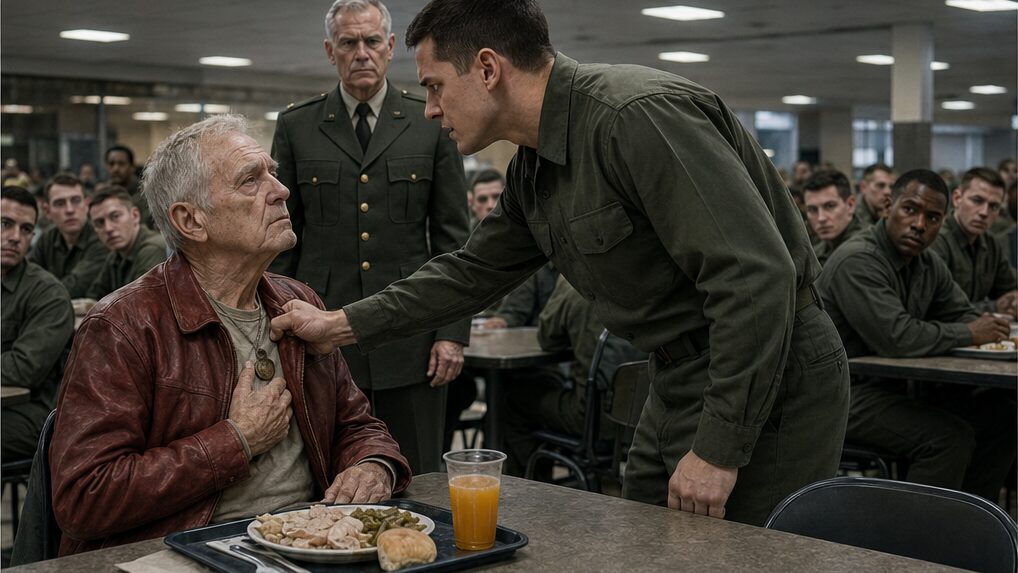
The young soldier’s hand closed on Donald Martin’s red jacket before Donald could set down his fork.
The grip came hard and high, just below the collarbone, folding the old leather into a fistful of red creases. Donald felt the pull through his shirt, through his thin chest, through the small chain that rested against his skin. The cafeteria tray bumped against his wrist. The orange drink shivered in its plastic cup.
“Sir, you need to stand up,” the soldier said.
Donald looked first at the hand.
It was a young hand, clean and strong, the knuckles pale from the force of the grip. There was a small nick near the thumb, maybe from a doorframe, maybe from a rifle rack, maybe from a careless morning. Donald noticed things like that before he noticed anger. He had learned, a long time ago, that anger was usually late to arrive. Hands arrived first.
“I’m eating,” Donald said.
His voice came out quieter than he intended. Around him, forks slowed. Trays stopped sliding. The long military cafeteria, loud a moment earlier with lunch noise and chair legs and young men laughing too hard at nothing, seemed to draw in around his table.
The soldier leaned closer. His name tape read WHITE.
“This section is restricted during training rotation,” he said. “Visitor seating is at the front.”
Donald’s left hand moved to his chest, not to pry the soldier loose, not to defend himself, but to cover the old service tag and the round cafeteria token that hung beside it. The token was small, darkened at the edges, stamped with a ship number nearly rubbed smooth by years of fingers. He pressed it flat under his palm.
“I know where I’m sitting.”
The words did not help. He knew they would not as soon as they left his mouth.
The soldier’s jaw tightened. He was young enough to still believe a rule spoken firmly became a truth. Behind him, two trainees had turned halfway around on their bench. One had a spoon lifted but forgotten in midair. Another stared openly at Donald’s red jacket, at his spotted hands, at the white hair above his ears.
Donald looked down at his tray.
Turkey, mashed potatoes, green beans soft from steam, a roll, and the orange drink. He had asked for the drink without ice. The young kitchen worker had not asked why. That had been a kindness.
“This isn’t a public dining hall,” White said. “You can’t just wander in here because you used to know somebody.”
Donald held the chain tighter.
“I didn’t wander.”
White’s face came closer. Donald could smell starch, coffee, and the faint metallic scent of a recently cleaned belt buckle.
“Then show your pass.”
Donald had already shown it at the gate. He had shown the printed email. He had shown the old laminated card. He had watched the security desk clerk frown at the memorial list and make a phone call that went nowhere. He had waited forty-three minutes on a bench under a framed photograph of young sailors who would never get old. He had been told, finally, that the cafeteria was “probably fine” if he stayed out of the training section.
But this was the table. Not a table. The table.
Donald looked to the far corner of the cafeteria, where sunlight from the high windows fell in a pale block across the polished floor. He had chosen the seat facing the door, as always. Across from him, he had left a space untouched. No napkin. No fork. Just the clean strip of table where a second tray could have gone.
White followed his eyes and misunderstood them.
“You looking for somebody to back you up?”
Donald did not answer.
A shadow shifted behind White. An older officer in dress uniform had stopped three tables away, his cap tucked under one arm, his silver hair cut short and severe. Donald had seen him earlier near the serving line. The officer had looked at him once, then looked away as if searching through a memory he could not place.
Now he watched without speaking.
White saw the glances around them and seemed to feel the room measuring him. His grip tightened, not much, but enough that Donald’s collar pulled against the chain.
“Stand up,” White said again.
Donald’s right hand moved, slow and careful, toward the orange drink. He did not want it knocked over. Not today. Not on this table. He had carried it from the line with both hands, embarrassed by how much care it took, embarrassed by the tremor in his thumb.
White mistook the movement for refusal.
He jerked the jacket once.
The cup tipped.
For one suspended second, Donald watched the orange surface lean inside the plastic rim. Then it went over. The drink struck the tray, splashed against the plate, ran under the roll, and spilled in a bright stream across the table. It reached the edge and poured into the cuff of Donald’s red jacket.
A few people gasped. Someone said, low, “Man.”
Donald’s hand froze over the fallen cup. His cuff darkened quickly, the orange soaking into the old leather seam, making it shine. The cold of it touched his wrist.
White let go.
The sudden absence of the hand felt almost worse.
Donald did not look at him. He picked up the cup before it could roll off the table. He set it upright. His fingers were wet. A drop slid from his knuckle onto the token under his palm.
The cafeteria had gone quiet enough for Donald to hear the refrigerator case humming near the wall.
White’s face had changed. Not softened, exactly. It had sharpened around uncertainty. He looked at the cup, at Donald’s cuff, then at the hand Donald still held against his chest.
“Sir,” White said, but the word came out different this time, less like a command and more like a mistake.
Donald took a napkin from the tray and laid it over the spill. The paper darkened at once. He pressed it down carefully. He could feel every eye in the room. He had stood in worse rooms, under worse watching, with smoke in his throat and men calling for names he could not answer. But shame was strange. It did not get lighter just because a man had carried heavier things.
The older officer stepped forward at last.
“Private White.”
The young soldier straightened so fast his boots scraped the floor.
“Sir.”
The officer’s gaze did not leave Donald. His nameplate read ROBERTS. His face was disciplined, but the skin at his temples had tightened. He looked at Donald’s red jacket, then at the hand over his chest.
“Take one step back,” Brian Roberts said.
White obeyed.
Donald did not move. The orange drink crawled slowly toward the table’s center seam. He placed another napkin in its path.
Brian Roberts came closer. Not too close. Close enough to see.
“Sir,” he said to Donald, “may I ask what you have there?”
Donald’s hand stayed where it was.
“No.”
The answer landed harder than a shout would have.
Brian’s eyes lowered. Through the gaps between Donald’s fingers, the edge of the old cafeteria token had turned outward. Its stamped number caught a thin piece of light.
Brian Roberts stopped breathing for half a second.
Donald saw recognition try and fail to become certainty.
The young trainees waited. Katherine Hall, the civilian cafeteria supervisor, had appeared near the beverage station with a towel in one hand and alarm in her face. White stood rigid, staring at a point above Donald’s shoulder.
Brian’s voice dropped so low that only the nearest tables could hear.
“Where did you get that?”
Donald lifted his eyes from the ruined tray.
For the first time since the hand had touched his jacket, he looked directly at the officer.
“I brought it back,” he said.
Chapter 2: The Table Nobody Wanted To Remember
Katherine Hall did not raise her voice. That made the hallway feel smaller.
“I need him moved out of the service area,” she said, folding the towel in her hands as if it were the only thing keeping her from pointing at Donald. “We have a training lunch in progress, an incident on the floor, and half the room pretending not to watch.”
Donald stood beside the supervisor station with his red jacket cuff hanging heavy and damp at his wrist. The orange stain had crept past the seam and darkened the leather in an uneven line. He could still smell the drink. Sweet. Artificial. Too bright for the gray hallway.
Brian Roberts stood between him and the cafeteria doors. Matthew White had been sent back inside to “assist with cleanup,” which seemed to mean standing near the spill with a towel and a face that could not decide whether to be ashamed or angry.
“Mrs. Hall,” Brian said, “give me a moment.”
“I gave the front desk a moment this morning,” Katherine replied. “I gave the visitor list a moment. I gave that old memorial email a moment. Nobody gave me authorization.”
Donald looked at the bulletin board beside her desk. Today’s menu was clipped beneath a plastic cover. Turkey plate. Green beans. Roll. Citrus beverage. Beneath that, a printed reminder asked personnel to clear tables quickly during rotation blocks.
Quickly.
That was the word that had chased him all morning. Move quickly. Sign quickly. Wait quickly. Explain quickly. Eat quickly.
He had not come for quick.
The security desk clerk appeared at the end of the hall, young enough to look uncomfortable in his own authority. He carried a folder and a tablet pressed against his chest.
“Ma’am,” the clerk said, “I checked again. His name isn’t on today’s approved outside visitor roster.”
Katherine looked at Brian as if that settled it.
Donald said nothing.
Brian turned to him. “Mr. Martin, did someone from the memorial office confirm your access?”
Donald kept his hand near the chain, though no one was reaching for it now.
“They sent the email.”
“Do you have it?”
Donald nodded toward his jacket pocket. Then he hesitated.
The pocket was damp.
He reached into it anyway and drew out a folded sheet of paper softened at the crease. The corner had taken some of the orange drink. The ink there had blurred, turning the signature line into a blue cloud.
Katherine took half a step forward. “May I?”
Donald did not hand it to her. He opened the page himself and held it where she could read without touching.
Annual Memorial Access Request. Former service personnel. Dining hall visit. Approved pending verification.
Pending.
Katherine saw the word. Her mouth tightened.
“This is not clearance,” she said.
“No,” Donald said.
“Then you understand the problem.”
“I understand the word.”
Brian glanced at him. There was something in the officer’s face Donald did not want to see. Sympathy was one thing. Recognition was another. Recognition asked questions.
The clerk shifted his weight. “The memorial list attached to the request was incomplete. It had a ship number but no active sponsor.”
Donald folded the paper along its old crease. He did it slowly because his fingers were stiff and because the damp corner wanted to tear.
“I called two weeks ago,” he said.
“Yes, sir,” the clerk said, too quickly. “But the office changed systems. Some of the older entries didn’t transfer.”
Katherine let out a breath. “This is exactly why we can’t let informal traditions override procedure.”
The word traditions hit Donald worse than the soldier’s hand had. It made the thing small. Optional. Decorative. A wreath someone forgot to dust.
Brian heard it too. “Mrs. Hall.”
“I’m not trying to be disrespectful,” Katherine said. “But I have two hundred active-duty personnel to feed in forty minutes, and a visitor with incomplete clearance was involved in a physical incident in my dining hall.”
Donald looked through the small wire-glass window in the door. Inside, trainees had returned to eating, but not fully. Heads tilted. White wiped the table where Donald had been sitting. The tray remained there, untouched except for the spreading stain. The roll had collapsed into the orange liquid.
Across from Donald’s place, the empty strip of table remained clean.
Brian followed his gaze.
“You chose that table for a reason,” he said.
Donald folded the paper once more and put it back in his pocket.
“Yes.”
“What reason?”
Donald’s hand closed over the chain.
Katherine’s tone softened by a fraction. “Mr. Martin, if this is about a memorial visit, we can arrange something properly. Not today, maybe, but through the correct office.”
Donald almost smiled. Not because it was funny. Because properly had never arrived on time for the people he remembered.
“I’m already here today.”
The clerk looked helplessly at Katherine. “I can call the memorial office again.”
“It’s lunch hour,” she said.
“They may still answer.”
“They may not.”
Brian looked toward the cafeteria doors, then back at Donald. “Mr. Martin, I need to understand what that token is.”
Donald’s fingers tightened. The chain pressed into the soft skin at the base of his throat.
“No, Colonel.”
Brian’s eyes flickered at the rank Donald had not been told.
Donald noticed. Brian noticed that he noticed.
For a moment the hallway held a different silence.
Katherine lowered the towel to her side. “Sir, with respect, refusing to explain makes this harder.”
Donald looked at the orange stain on his cuff. It had begun to dry at the edges, leaving a tacky shine. He rubbed his thumb against it once. The sweetness clung to his skin.
“I’ve explained it before,” he said.
“To whom?” Brian asked.
Donald looked past him, toward the cafeteria, toward the empty place across from his tray.
“To men who aren’t here.”
No one answered.
From inside the cafeteria came the scrape of a tray being lifted. Donald turned.
Matthew White stood at the table with Donald’s tray in both hands. He had cleaned the spill, or most of it. His sleeve bore a faint orange smear near the wrist. He paused before carrying the tray away.
His eyes moved over the plate, the ruined roll, the single cup.
Then he saw the empty space across the table.
Not an accident. Not a gap left by clutter. A place deliberately kept open.
White looked toward the hallway window. For an instant, he and Donald saw each other through the wire-crossed glass.
Donald did not look away.
Matthew’s face lost the last of its certainty.
Chapter 3: The Young Soldier Who Needed A Rule
Matthew White scrubbed the same clean patch of table until the towel squeaked.
The orange drink was gone. The tray was gone. The cup was in the trash. The floor had been mopped, and the trainees had returned to pretending lunch was lunch. But the table still looked wrong to him. Not dirty. Not damaged. Wrong.
A clean rectangle sat across from where the old man had been. Empty, untouched, as if someone invisible had been expected there and everyone but Matthew had known not to sit down.
“White.”
Matthew turned.
The training office door stood open behind the cafeteria entrance. Colonel Brian Roberts waited inside with his cap on the desk and his jacket still buttoned. That was worse than if he had taken it off. It meant this was official before it was personal.
Matthew dropped the towel in the bin and entered.
“Close it,” Roberts said.
Matthew closed the door.
The office smelled like printer heat and old coffee. A wall clock ticked above a framed code of conduct. Matthew stood at attention without being told.
Roberts let him stand that way.
“Explain what happened.”
“Sir, the visitor was seated in a restricted dining section during active training rotation. His authorization was incomplete. I instructed him to relocate. He refused.”
“And your hand on his jacket?”
Matthew swallowed. “I intended to assist him to his feet.”
Roberts said nothing.
The answer sounded thinner in the silence than it had in Matthew’s head.
“I misjudged the amount of contact, sir.”
“Misjudged.”
“Yes, sir.”
“You grabbed an elderly man by the chest in front of a room full of soldiers.”
Matthew felt heat rise behind his ears. “Yes, sir.”
“Did he threaten you?”
“No, sir.”
“Raise his voice?”
“No, sir.”
“Touch you?”
“No, sir.”
“Then what exactly were you assisting?”
Matthew stared at the wall behind the colonel. The code of conduct blurred into blocks of black text.
Three weeks ago, a civilian contractor had walked through the wrong entrance with an expired badge. Matthew had waved him past because the man looked confident and everyone else seemed busy. The contractor had been harmless, but the report had not been. Matthew’s sergeant had made the lesson plain enough for the whole squad to hear: Rules are only rules if someone has the spine to enforce them.
Matthew had heard the laughter after. Not loud. Just enough.
Since then, every badge looked like a test. Every hesitation felt like weakness wearing his name.
“Sir, I was previously counseled for failure to control access.”
Roberts leaned back slightly. “So today you controlled it.”
Matthew did not answer.
“Look at me.”
He did.
The colonel’s face was not furious. That made it harder. Fury gave a man something to brace against. Roberts looked disappointed in a way that seemed older than the incident.
“Private White, there is a difference between enforcing a rule and needing someone to see you enforce it.”
The words struck too close to the place Matthew had been avoiding.
“Yes, sir.”
“What did Mr. Martin say to you?”
Matthew tried to remember the old man’s exact words. I’m eating. I know where I’m sitting. I didn’t wander.
Not much else.
“He said he didn’t wander in.”
“And did you ask what he meant?”
“No, sir.”
“Why not?”
Because the room was watching. Because the old man’s calm had felt like defiance. Because Matthew had already chosen what the scene meant and needed the facts to line up behind him.
“No excuse, sir.”
Roberts studied him. “That is not the same as an answer.”
Matthew’s eyes dropped, despite himself, to his sleeve. There, near the cuff, the faint orange smear remained. He had not noticed it until now. The drink had touched him too.
“He had something on a chain,” Matthew said. “He kept covering it.”
“I saw.”
“I thought maybe he was trying to hide an expired pass or something taken from the display.”
“The display.”
“Yes, sir.”
Roberts was quiet long enough for the clock to fill the room.
“Do you know what a cafeteria token is?”
Matthew blinked. “No, sir.”
“Neither do most people anymore.”
The colonel opened a folder on his desk. Inside was a photocopy of Donald’s blurred access request and a handwritten note from the security desk. Matthew saw the name: Donald Martin.
The old man had a name. That should not have surprised him. It did.
Roberts tapped the paper once. “Mr. Martin’s visitor file is a mess. That is not his fault.”
“No, sir.”
“You will help correct it.”
“Yes, sir.”
Roberts stood and moved to a metal cabinet near the wall. He unlocked the top drawer and withdrew a thin binder with a cracked blue spine. Dust lifted from it when he set it on the desk.
“This base absorbed records from three closed facilities and two decommissioned commands,” Roberts said. “Some memorial access records were scanned. Some were boxed. Some were forgotten by people who thought old paper was not operational.”
Matthew looked at the binder.
“Sir?”
Roberts wrote a number on a yellow note and pushed it toward him. “This was stamped on Mr. Martin’s token. Pull the old visitor logs, memorial rosters, and dining hall exception files for that ship number.”
Matthew picked up the note. The number meant nothing to him.
Yet he saw again the old man’s hand covering the chain, not like a man hiding contraband. Like a man keeping something from being touched by strangers.
“Yes, sir.”
“And White.”
Matthew stopped at the door.
Roberts’s voice lowered. “You will not discuss this with the trainees. You will not make Mr. Martin the subject of cafeteria talk. If you need to feel embarrassed, do it quietly and usefully.”
Matthew looked down at the orange smear on his sleeve.
“Yes, sir.”
He stepped into the hallway and walked past the cafeteria doors. Inside, the table had been wiped clean. For the first time, clean did not look like fixed.
At the supervisor station, Katherine Hall handed him a ring of old keys and a box label written in marker.
“Records room is down the west hall,” she said. “If the lights flicker, don’t kick the cabinet. It sticks.”
Matthew took the keys.
“What am I looking for?”
Katherine glanced toward the cafeteria, then toward the hallway where Donald had gone.
“Apparently,” she said, “a reason that old man chose the only table nobody else noticed.”
Matthew looked again at the yellow note in his hand.
The ship number stared back at him, small and stubborn, waiting to be made into more than a rule.
Chapter 4: The Name Under The Cafeteria Token
The records room was colder than the rest of the building.
Brian Roberts had always suspected the base kept its past at the wrong temperature. Not preserved, not cared for, just chilled enough to slow the damage. Metal cabinets lined the narrow room from floor to ceiling. Cardboard boxes sat on gray shelving, their marker labels faded into soft blue shadows. A fluorescent light flickered overhead with the tired insistence of something nobody had budgeted to replace.
Matthew White stood beside the first cabinet with the ring of keys in his hand, trying the third key in the lock.
“That one sticks,” Brian said.
Matthew stopped forcing it. His face tightened, but he did not argue. He adjusted the key, lifted slightly, and the drawer gave way with a long metal complaint.
Inside were folders that smelled of dust, paper, and old glue.
Brian watched him begin too quickly, fingers moving with the nervous speed of a man trying to finish guilt like a task. The young soldier flipped past tabs, scanned dates, frowned, moved on.
“Slow down,” Brian said.
Matthew’s hand froze on a folder. “Yes, sir.”
“You are not looking for a parking citation.”
“No, sir.”
Brian turned to the box on the table. The ship number from Donald’s token was written on the yellow note between them. He had copied it twice already, once from memory and once from the security still image when Donald’s hand shifted in the corridor. The number had bothered him from the first glance. Not because he knew it fully. Because he knew its shape.
Some numbers lived under other numbers.
He opened the blue binder he had taken from his office. It was an old memorial index, assembled from commands that had been folded into other commands, then into this base, then into storage. There was no elegance to it. Photocopies, typed sheets, rosters, handwritten addendums. Names crossed out. Names added. Names misspelled and corrected by someone who had cared enough to use a ruler.
Brian had served long enough to know that institutions remembered best when remembering was easy.
He turned the pages carefully.
Matthew pulled a folder from the cabinet. “Dining hall exception files, sir. Years are mixed.”
“Bring them.”
Matthew set the folder down.
The door opened behind them, and Katherine Hall stepped in with a paper cup of coffee and a look that said she had not forgiven anyone for making her part of this.
“Kitchen staff found his tray ticket,” she said. “He paid cash. Exact amount.”
Brian looked up.
Katherine placed a small receipt on the table. “Turkey plate. Roll. Citrus beverage. No ice.”
Matthew stared at the receipt.
“No ice,” he repeated quietly.
Katherine heard him but did not ask.
Brian slid the receipt beside the yellow note. “Thank you.”
“I’m not here to make this sentimental,” Katherine said.
“No one asked you to.”
Her mouth tightened. Then her eyes moved to the open folders. “But if there’s a reason he was there, I’d like to know before someone turns this into a complaint I can’t answer.”
Brian nodded once. “Fair.”
Matthew opened the dining hall folder. “Here. Annual exceptions. Some memorial meals, some retiree events, some guest speakers.”
“Dates,” Brian said.
Matthew read through the tabs. “The current year isn’t here.”
“We’re looking backward.”
Matthew looked at him, then turned toward the older pages.
Brian returned to the binder. A casualty list appeared between two pages of mess inventory. It had been copied crookedly, the left edge almost cut off. The title was plain: EVACUATION SUPPORT PERSONNEL — AUXILIARY AND GALLEY ASSIGNMENTS.
Galley.
Brian’s hand stilled.
He ran a finger down the names.
Martin, Donald.
No rank beside it in the line. Just a rating abbreviation, half-faded, and a note in parentheses: reassigned to casualty movement during evacuation.
Katherine leaned closer despite herself. “That’s him?”
Brian did not answer immediately. He read the line again, as if a second pass might make it less frail.
“Could be.”
Matthew’s face had gone still. “Casualty movement?”
Brian turned the page.
A photograph had been paper-clipped to the next sheet, the image washed pale with age. It showed a shipboard dining area or something like it after damage: benches shoved aside, trays stacked against a wall, men in stained uniforms carrying stretchers through a narrow aisle. Near the back, half-turned away from the camera, was a young sailor with dark hair, sleeves rolled up, one hand gripping a metal beverage crate, the other holding a cloth against someone’s shoulder.
The face was blurred by motion. It could have been Donald. It could have been any young man before time found him.
Katherine’s coffee cup lowered.
Brian lifted the photo carefully. Behind it was an old meal card, yellowed at the corners. Printed boxes marked portions: sandwich, fruit, roll, citrus beverage. Someone had circled the beverage in pencil.
Matthew looked from the meal card to the receipt Katherine had brought in.
“No ice,” he said again, so softly this time that it was almost not a sound.
Brian turned another page.
The records did not give the whole story. They never did. They gave fragments and trusted the living to pretend fragments were enough.
Mess personnel reassigned after impact. Emergency feeding station converted to triage overflow. Evacuation route through dining compartment due to blocked passageway. Civilian casualties received. Personnel commended informally by command, formal citations deferred pending review.
Deferred. The graveyard word of paperwork.
Brian pressed his thumb against the page edge.
He had joined years after those events, but he had heard pieces as a young officer: a damaged vessel, an evacuation that should have failed, galley crew who kept moving men through smoke and steam because the main corridor was gone. The story had lived in wardrooms as something between history and warning. Then time had made it smaller. A framed paragraph. A display case. A line in a speech.
Matthew pulled a logbook from the bottom of the folder. Its cover was cracked black vinyl.
“Visitor meals,” he said.
Brian held out his hand.
Matthew gave it to him.
The early pages listed names in careful columns. Date. Visitor. Sponsor. Table assignment. Purpose. Most were retirement luncheons or family events. Then, several years back, the handwriting changed. Annual memorial visit. D. Martin. Dining table C-14. One meal. No ceremony.
Brian turned the pages faster.
The entry repeated year after year.
D. Martin. C-14. One meal. No ceremony.
Then, three years ago, the sponsor line changed from a name to “legacy approval.” Two years ago, someone had written “verify next cycle.” Last year, the line was stamped incomplete. This year, nothing.
Katherine’s face shifted in small degrees, procedure losing ground to recognition.
“He’s been coming all this time,” she said.
Brian looked at the table assignment.
C-14.
The corner table in the cafeteria. The one with the clean space across from his tray.
Matthew stepped back as if the floor had moved. “I grabbed him at his own table.”
Brian closed the logbook but kept his hand on it.
“You grabbed him at a table this institution let him believe it remembered.”
No one spoke.
The fluorescent light flickered twice.
Katherine set her coffee down untouched. “Why didn’t he just say that?”
Brian looked toward the door, toward the hall Donald had walked through with orange drink drying on his cuff.
“Maybe he should not have had to.”
Matthew swallowed. “Sir, what do we do?”
Brian did not answer until he had opened the last folder in the box. Inside were loose sheets, some watermarked from old damage, some curled at the corners. Near the back was a torn half-page, handwritten in a slant that looked rushed and young.
It was not an official form. It had no stamp. No signature block. Just three lines under a date older than Matthew’s life.
Brian read the first two lines silently. The third made the air leave his chest.
He turned the paper so Katherine and Matthew could see.
Save him a seat if Martin comes back.
Matthew’s lips parted, but no words came.
Brian looked at the small receipt with its citrus beverage, the old meal card with the circled drink, the visitor log repeating the same table year after year.
Then he understood that the empty space had not been empty.
Chapter 5: The Daughter Who Wanted Him To Stop Returning
Stephanie Allen found her father in the parking lot with his red jacket folded across his knees.
He was sitting in the driver’s seat of his old sedan with the door open, one foot on the pavement, the other still inside. He had not turned the engine on. The late afternoon sun rested on the windshield, catching every streak and dust line. Beyond the fence, the base buildings sat low and square against the sky, ordinary as a place that had never hurt anyone.
Stephanie stopped beside the car and gripped the roof with one hand.
“Dad.”
Donald looked up as if he had expected her, though he had not called.
“Stephanie.”
“Don’t say it like you’re surprised I came. The security desk called me because your emergency contact is still in their system.” Her eyes dropped to the jacket. “What happened?”
He looked down at the orange stain on the cuff. It had dried darker than the rest of the leather, stiff at the seam. He had tried once to rub it clean with water from the restroom sink. That had only spread the sweetness into a dull mark.
“Lunch got complicated,” he said.
Stephanie’s face tightened the way it had since she was a girl trying not to cry in public.
“Were you hurt?”
“No.”
“That isn’t what I asked.”
“Yes, it is.”
She stepped back and looked toward the cafeteria building. “They said there was an incident.”
Donald folded the jacket more carefully. “People use big words when small ones would do.”
“What’s the small word?”
He ran his thumb over the stained cuff.
“Spill.”
Stephanie closed her eyes for a moment. When she opened them, there was anger in them, but not all of it belonged to today.
“You promised me this year would be simple,” she said.
“I said I would handle it.”
“That is not the same thing.”
He gave a faint nod. “No.”
She leaned down, lowering her voice though no one was nearby. “Why do you keep doing this to yourself?”
The question sat between them with all the years attached to it.
Donald looked past her to the gate. A young guard waved through a delivery truck. The truck’s brakes hissed. Somewhere beyond the fence, a whistle blew on a training field.
“I come once a year.”
“You come once a year and disappear for the rest of the day. You don’t eat breakfast. You wear that jacket even when it’s too warm. You check that chain a dozen times before you leave the house. Then you come home exhausted and tell me nothing happened.”
He rubbed the heel of his hand over one knee. The joint had stiffened in the cafeteria hallway. It always stiffened when he stood too long under fluorescent lights.
“Nothing usually does.”
“But today it did.”
He said nothing.
Stephanie crouched beside the open door. She was no longer young, though he still sometimes saw her as the child who used to sit on the kitchen counter and steal orange slices from his plate. Her hair, pinned back for work, had loosened near her temple. She smelled faintly of hospital soap and car heat.
“Dad,” she said, softer now, “you don’t have to keep proving you remember.”
His hand stopped moving.
“That what you think this is?”
“I think it hurts you.”
“That isn’t what I asked.”
She looked away.
For a while they listened to the parking lot. A car door closed somewhere down the row. A group of trainees crossed near the far walkway, laughing until one of them noticed the old man and lowered his voice.
Stephanie saw it. Donald wished she had not.
“This is what I mean,” she said. “They see an old man sitting somewhere and they decide you’re in the way. They don’t know you. They don’t know what you did. And you let them.”
“I don’t let them.”
“You don’t stop them.”
Donald’s eyes moved to the red jacket.
There had been a time when stopping a thing meant putting his shoulder into a door that would not open, dragging a man by the belt because the floor was too slick to lift him, holding a pan of water to cracked lips, saying names into smoke so the living would keep answering.
Later, stopping a thing meant not telling Stephanie’s mother everything because she had already waited through too many nights. It meant coming home and learning how to sit at the dinner table without counting exits. It meant raising a daughter who did not flinch when a pan hit the floor.
Not all restraint looked like surrender. But he had never found a simple way to say that.
Stephanie touched the stained cuff. “Did someone do this?”
Donald looked at her hand on the jacket. Her fingers were gentle, but the sight made his throat tighten.
“A young soldier made a mistake.”
Her eyes flashed. “A mistake?”
“Yes.”
“Did he apologize?”
“Not yet.”
“Then let me go inside.”
“No.”
She stood. “No?”
“No, Stephanie.”
Her face hardened. “You will defend a stranger faster than you’ll defend yourself.”
Donald opened his hand. The chain lay against his palm. The service tag, the old token, the worn edges polished by decades. Stephanie had seen them all her life but never been allowed to hold them for long.
“I’m not defending what he did.”
“Then what are you doing?”
Donald looked toward the cafeteria building.
“Keeping him from making it worse.”
Stephanie’s anger faltered, confused by the answer.
He drew the token along the chain until it rested between his fingers. “There was a man who used to sit across from me. Not here. Before here. Before you.”
She had heard pieces. A ship. A fire. An evacuation. Men Donald had not named. Her mother once told her that some rooms in a person were not locked because they were empty, but because someone was still inside.
Donald turned the token over.
“He was younger than that soldier today. Always hungry. Always complaining the orange drink was too warm and still taking two cups when he could get away with it.”
Stephanie lowered herself slowly back beside the door.
Donald’s eyes stayed on the token. “The day everything went bad, the dining compartment turned into a passageway because the main route was blocked. We moved people through where we used to serve meals. Trays on the floor. Steam in the air. Too many voices.”
He stopped.
Stephanie did not push.
“He was hit before I got to him. Not at first. Later. Close to the end.” Donald closed his fingers around the token. “He knew I was trying to lift him. He knew I couldn’t do it alone. He kept saying foolish things so I wouldn’t hear how scared he was.”
The parking lot blurred at the edges.
Donald blinked once and continued.
“He said, ‘Save me a seat next time, Martin.’ Like we were late for chow. Like there would be a next time if he said it plain enough.”
Stephanie covered her mouth with her hand.
“I told him I would.”
The words were small, almost dry.
Donald looked at the cafeteria again. “So I come back. Same day. Same kind of meal when they’ll serve it. Same drink. One seat open. No ceremony.”
“Why didn’t you tell me?”
He gave a tired half-smile. “You would have wanted to come.”
“Yes.”
“It wasn’t yours to carry.”
Her face broke a little. “And it was yours?”
Donald did not answer. The question had no clean place to land.
A base vehicle rolled by slowly. The driver glanced over, then away.
Stephanie picked up the red jacket from his knees and held it as if it were heavier than leather.
“You should come home,” she said, but there was less force in it now.
Donald’s hand went to the steering wheel. He sat upright, the effort visible in his shoulders.
“I will.”
“When?”
He took the jacket gently from her and slid one arm into it. The stained cuff resisted where the leather had stiffened. He pulled it on anyway.
“After I finish lunch.”
Stephanie stared at him. “Dad.”
He placed one foot fully on the pavement, then the other. For a second he swayed, and she reached for him. He let her steady his elbow. That was new. That was something.
He looked toward the dining hall doors.
“The seat is still empty,” he said.
Chapter 6: The Meal That Was Never For One Man
By evening, the cafeteria sounded like a room remembering itself.
The lunch rush had drained away hours before, leaving behind the small noises that hid under crowds: the clatter of pans in the kitchen, the swish of a mop near the beverage station, the hum of the refrigerated case, the soft thud of stacked trays being squared by tired hands. The tables had been wiped. Chairs stood tucked in straight rows. Outside the high windows, the sky had gone blue-gray.
Donald stood just inside the doorway in his red jacket.
No one stopped him this time.
Katherine Hall saw him first from behind the serving counter. Her hand paused over a stack of plates. The apology that crossed her face did not become speech. She only nodded once and turned toward the kitchen.
Brian Roberts waited near the corner table. His cap was under his arm again. Beside him stood Matthew White, back straight, face pale with the kind of discipline that had finally run out of places to hide.
Donald walked toward them slowly. Stephanie had wanted to come in. He had asked her to wait in the car. She had not liked it, but she had understood enough to let him try.
At table C-14, the surface was clean.
Too clean.
Donald stopped beside it and looked at the place where the orange drink had spilled. Nothing remained but a faint dullness in the shine when the light hit it.
Brian cleared his throat. “Mr. Martin.”
Donald looked at him.
“The records were incomplete,” Brian said. “They should not have been.”
Donald did not respond.
Brian held a folder at his side but did not open it. Donald appreciated that. Paper could make a man feel cornered.
“I found the visitor logs,” Brian continued. “And the meal entries.”
Matthew’s eyes dropped.
Donald took the chair he had used before. The motion cost him more now than it had at noon. His knee gave a dull complaint. His damp cuff brushed the table edge, leaving no mark.
Across from him, the empty place waited.
Katherine arrived with a tray. Turkey plate. Green beans. Roll. Napkin. Plastic utensils. One orange drink with no ice.
She set it down gently in front of him.
“I had them make it fresh,” she said. “The roll too.”
Donald looked at the tray. “Thank you.”
Her mouth moved as if she wanted to say more. Instead, she stepped back.
Matthew remained standing.
Brian glanced at Donald, then at Matthew. “Private White has something to say.”
Donald looked at the young soldier.
Matthew swallowed. His eyes were red at the edges, though whether from shame, dust in the records room, or the effort not to show either, Donald could not tell.
“Mr. Martin,” Matthew said, “I was wrong. I put my hands on you. I embarrassed you in front of others. I damaged your meal. There’s no excuse.”
The words were neat. Prepared. True enough, but still standing at a distance from the thing itself.
Donald picked up the orange drink. The plastic was cool against his fingers. He set it down again without drinking.
“Did Colonel Roberts tell you to say that?”
Matthew’s jaw tightened. “No, sir.”
Donald waited.
Matthew glanced at Brian, then back. “He told me not to waste your time.”
That almost brought a smile to Donald’s face. Almost.
“And are you?”
Matthew’s hands opened at his sides. “I don’t know yet.”
The answer was better.
Donald gestured toward the chair across from him.
Matthew looked startled.
Brian shifted slightly, but said nothing.
Matthew sat. Not fully at ease. Not as if he belonged there. As if the chair might reject him if he moved too quickly.
Donald unwrapped the plastic fork and placed it beside the plate. He did not eat.
“You found the logs,” he said.
“Yes, sir.”
“What else did you find?”
Matthew looked at the empty space between them. “A meal card. A visitor list. A photo. A note.”
Donald’s hand closed over the chain beneath his jacket.
“What note?”
Matthew’s voice lowered. “Save him a seat if Martin comes back.”
The cafeteria seemed to pull farther away.
Donald looked down at the tray. Steam lifted faintly from the potatoes. The orange drink stood bright and untouched.
“For a long time,” he said, “I thought maybe nobody kept that.”
Brian said quietly, “Someone did.”
Donald nodded once. The movement was small, but it carried years.
Matthew leaned forward, then stopped himself. “Was it his note?”
Donald looked at him. The young man had asked carefully. Not greedy for the story. Not grabbing this time.
“No,” Donald said. “He couldn’t write it.”
Matthew absorbed that.
Donald turned the token under his fingers. “A cook wrote it. After. Maybe for me. Maybe because there were too many things that day nobody could fix, and he wanted one thing written down.”
The kitchen noises softened behind them. Katherine had stopped pretending not to listen. Brian stood still near the end of the table.
Donald looked at the empty chair, though Matthew was now sitting in it. For a moment he saw another young face there. A grin too quick. A spoon tapping a cup. A boy pretending not to be afraid because fear embarrassed him more than danger.
“He liked this drink,” Donald said.
Matthew looked at the cup.
“Said it tasted like melted candy and bad decisions. Drank it anyway. Always asked for no ice because he said ice was how they cheated you out of the good part.”
The corner of Matthew’s mouth trembled and vanished.
“When things went wrong, we used the dining space to move people through. There wasn’t time to make it something else. One minute you’re serving food. Next minute you’re holding a man’s head still so he can breathe.” Donald’s thumb rubbed the edge of the token. “I was good at feeding people. Not saving them.”
No one corrected him. Donald was grateful.
“He was younger than you,” Donald said to Matthew. “Loud. Always in the way. Always first when somebody needed lifting.”
Matthew’s gaze dropped to his own hands.
“I got him partway,” Donald said. “Not far enough. Before he stopped talking, he asked me to save him a seat next time. I said I would. Men say things at the end, and other men pretend the world is kind enough to let them keep their answers simple.”
His voice thinned. He took a breath through his nose.
“So I come here. I sit. I leave the place open. I drink what he would’ve complained about.” Donald touched the cup. “Most years nobody asks.”
Matthew’s face had changed entirely now. Shame remained, but something quieter had entered with it. Understanding, maybe. Or the beginning of it.
“I interrupted that,” Matthew said.
“Yes.”
“I thought you were trying to use being old as a reason not to follow rules.”
Donald looked at him for a long moment.
“I am old,” he said. “And I have followed enough rules to know which ones are alive and which ones are only paper.”
Matthew flinched, but Donald did not sharpen the words further.
Brian stepped forward. “Mr. Martin, I can ensure your access is corrected. Permanently.”
Donald glanced at him. “That helps.”
“I can also recommend appropriate disciplinary action.”
Matthew stared at the table.
Donald knew what the room expected then, though no one said it. The old man could nod, and the young soldier would be made an example. There were men who would call that justice. Maybe some part of it would be.
Donald looked at the orange stain on Matthew’s sleeve. Faint, stubborn, missed by the laundry of pride.
“Discipline him for grabbing me,” Donald said. “Not for being ashamed after.”
Brian’s expression shifted. “Understood.”
Matthew looked up, startled.
Donald slid the untouched orange drink across the table until it rested between them.
Matthew blinked. “Sir?”
Donald removed his hand from the cup.
“This one is mine,” he said.
Matthew stared at it, confused.
Donald nodded toward the serving counter, where the drink machine stood beneath its soft electric hum.
“The other one spilled.”
Matthew’s throat worked.
Donald reached across the table, took the empty plastic cup Katherine had set aside with the tray, and placed it in front of Matthew.
He did not smile. He did not forgive out loud. He did not make the young man smaller.
He only pushed the cup forward with two fingers.
“Bring it back,” Donald said, “without spilling it.”
Chapter 7: The Seat They Finally Stopped Taking
Matthew carried the empty cup as if it were glass.
It was only thin plastic, the same kind used by every trainee in the cafeteria, stacked by the hundreds beside the beverage station. Earlier that day he would have taken one without looking, filled it too fast, set it down too hard, and moved on to the next thing needing correction.
Now he held it with both hands.
The dining hall had nearly emptied. Kitchen workers moved behind the counter in low voices. Katherine Hall stood near the register, wiping a surface already clean. Colonel Brian Roberts remained at the end of table C-14, not seated, not intruding, but present enough that the room understood this was still under his eye.
Matthew crossed to the drink machine.
The orange beverage glowed behind its small plastic label, the color brighter than anything else in the room. He pressed the cup to the lever and watched the liquid gather. The machine hummed. The stream hit the bottom too loudly at first, and he eased the cup lower. Foam rose, settled, rose again.
No ice.
He remembered that without being told.
When the cup was full, he let the last drops fall before moving. A bead of orange clung to the rim. He took a napkin and wiped it away carefully. His own reflection bent faintly in the metal panel above the machine: young face, tight jaw, eyes that had looked at an old man and seen a problem to remove.
He turned back.
Donald Martin waited at the table with the first cup untouched beside his tray. The red jacket was still on his shoulders. The cuff had dried in a darker band, stiff where the drink had soaked in. The old man’s hand rested near his chain, but not over it now. The token was partly visible against his shirt.
Matthew walked slowly enough that no liquid touched the rim.
Each step felt longer than the distance allowed.
When he reached the table, he did not speak. He set the cup down across from Donald, in the place that had remained empty since noon.
The cup made a small sound against the tabletop.
Donald looked at it.
So did everyone else who had pretended not to.
There was no announcement. No call for attention. No apology performed for the room. Only a young soldier standing with his hands at his sides and an old man sitting before two orange drinks, one in front of him, one across from him.
Donald did not reach for either.
Matthew waited, unsure whether he was dismissed, forgiven, or still being measured.
Donald looked up. “Sit.”
Matthew sat again, slower than before.
For a while, nothing happened.
That was the hardest part.
Matthew had thought apology would require the right words. Then he had thought it would require the right action. But sitting there, under the quiet weight of the empty place he had been allowed to approach, he understood that some things required time after the words and after the action. They required a man to stay in the discomfort he had made.
Donald unfolded his napkin and placed it on his lap. He picked up his fork. His fingers trembled once before settling.
“Eat something,” he said.
Matthew looked at him. “Sir?”
“You missed lunch.”
“I’m all right.”
Donald glanced at the young man’s face. “That wasn’t what I asked.”
Matthew almost answered by habit. Yes, sir. No, sir. Understood, sir. Instead he looked toward the counter.
Katherine had already anticipated it. She came over with a small plate: a roll, a serving of green beans, and a folded napkin. She placed it in front of Matthew without ceremony.
“Kitchen was closing,” she said. “This was left.”
Matthew nodded. “Thank you, ma’am.”
Katherine looked at Donald. “Mr. Martin, I spoke with the memorial office.”
Donald’s fork paused.
“I told them the dining hall will keep table C-14 available on this date from now on,” she said. “No reservation sign. No display. Just available.”
Donald looked at the table surface.
Katherine added, quieter, “If that is acceptable.”
The old man’s throat moved once. “It is.”
She nodded and stepped back before gratitude could make the moment too large.
Brian Roberts took a folder from under his arm and laid it on the table near Donald, but not too close. “Your access record has been corrected,” he said. “I signed it myself. You will not need to explain the old approval again.”
Donald looked at the folder but did not open it.
“Thank you, Colonel.”
Brian’s face shifted at the formal address, as if it carried both respect and distance. “Mr. Martin, I also owe you an apology.”
Matthew looked up.
Donald waited.
“I saw enough to stop it sooner,” Brian said. “I let the room decide what it was before I did. That was my failure.”
Donald studied him. The officer did not look away.
“You recognized the token,” Donald said.
“Not soon enough.”
“No,” Donald said. “But you did.”
Brian accepted that because it was not forgiveness, and it was not refusal. It was the truth trimmed down to what could be carried.
Matthew stared at his plate. He had not touched the roll.
Donald cut a small piece of turkey and ate. The food had cooled, but not unpleasantly. It tasted like institutional gravy and steam and a day that had gone too long. He took another bite because his daughter would ask, and because the body deserved care even when memory made care feel disloyal.
Across from him, Matthew picked up his roll. He broke it in half but did not eat immediately.
“What was his name?” Matthew asked.
Brian’s eyes moved sharply to him, warning too late.
Donald’s fork stopped halfway to the plate.
Matthew set the roll down. “I’m sorry. I shouldn’t have—”
“No,” Donald said.
The old man’s gaze went to the second orange drink.
For years he had protected the name by not speaking it in rooms that could not hold it. He had kept the ritual narrow enough to survive: one meal, one seat, one drink, then home before the grief found too many doors open. There was safety in silence. There was also loneliness.
He touched the token.
“James,” he said.
The name entered the cafeteria softly, without rank, without date, without history attached to it. Just James.
Matthew lowered his eyes. “James.”
Donald watched him say it. Not loudly. Not for effect. Just enough to make the name belong to more than one memory.
“He would have liked you,” Donald said.
Matthew’s face tightened. “I don’t think so.”
“He liked loud fools who could learn.”
For the first time that day, a small sound escaped Katherine near the counter, not quite a laugh, not quite a breath. Brian looked down at his shoes.
Matthew’s mouth trembled. He looked at the orange drink across from Donald, then at the stain on the old man’s cuff.
“I’ll accept whatever discipline comes,” he said.
“You should,” Donald said.
“Yes, sir.”
“But don’t make discipline the end of it. That’s too easy.”
Matthew looked up.
Donald leaned back slightly, tired now in a way he could no longer hide. “You want to enforce rules, learn what they’re protecting. Not just what they’re blocking.”
Matthew nodded once. Then again, smaller.
Donald lifted his cup at last. He held it for a moment, looking across the table at the second cup. He did not tap them together. He did not make a toast. He simply took a drink.
It was too sweet, too warm, exactly wrong.
Exactly right.
Matthew did not touch the second cup. Somehow he knew not to.
Outside the windows, the last light had nearly left the glass. The cafeteria reflected itself now: tables, chairs, tired workers, a senior officer standing with a folder, an old man in a red jacket, and a young soldier seated where he had not earned the right to be comfortable.
Donald ate slowly. A few bites of turkey. Half the roll. Three green beans because Stephanie would ask if he ate vegetables, and he wanted, for once, to tell her yes without lying.
When he was finished, he placed the fork on the tray and folded the napkin.
Matthew stood, but Donald lifted one hand.
“Not yet.”
Matthew sat back down.
Donald reached beneath his collar and drew the chain into the open. The service tag and the cafeteria token lay against his palm. He did not remove them. He did not hand them over. He only let Matthew see them fully.
The token was worn thin at the edges. The stamped ship number was nearly gone, but not gone. A small groove cut across one side where something heavy had once bent it and been hammered flat again.
“This isn’t proof,” Donald said.
Matthew looked at the token, then at him.
“It’s a reminder,” Donald said. “Proof is for people who doubt. A reminder is for people who already know and are trying not to forget.”
He let the chain fall back against his shirt.
Brian picked up the folder again. “Mr. Martin, would you like someone to walk you out?”
Donald looked toward the cafeteria doors. Through the glass, he could see Stephanie’s car parked beneath a light pole. She was standing beside it now, arms folded against the evening air, watching the entrance.
“No,” Donald said. Then, after a breath, “But he can carry the tray.”
Matthew stood at once. Not too fast this time. He lifted Donald’s tray with both hands.
Donald took the second orange drink and placed it carefully in the center of the table across from his seat.
Matthew looked at it. “Should I—”
“Leave it.”
“Yes, sir.”
Donald pushed himself up from the chair. His knee gave, and for a fraction of a second Matthew shifted as if to help. Then he stopped, waiting. Donald noticed.
That mattered.
Brian offered his arm without stepping too close. Donald shook his head, then rested one hand lightly on the back of the chair until his balance steadied.
Katherine came forward with a small cloth. “For the cuff,” she said.
Donald accepted it. “Thank you.”
“I’ll make sure the table is left alone,” she said.
“Not alone,” Donald corrected gently.
Katherine looked at the cup across from the empty place.
“No,” she said. “Not alone.”
Donald walked toward the exit. Matthew followed a step behind with the tray. No one in the cafeteria stood. No one saluted. No one clapped. A kitchen worker looked up, then lowered his eyes with quiet respect. The base chaplain, passing through the far doorway, paused long enough to understand that something had happened and that interrupting it would make it smaller.
At the tray return, Matthew stopped.
Donald turned back.
The young soldier held the tray uncertainly. “Do I just put it here?”
Donald looked at the conveyor slot, then at the tray: plate, fork, folded napkin, one empty cup.
“Not just,” he said.
Matthew nodded as if receiving an order with weight. He set the tray down carefully and pushed it forward. The conveyor carried it through the opening with a soft mechanical hum.
Donald watched until it disappeared.
Outside, the evening air had cooled. Stephanie straightened when she saw him. Her eyes moved to Matthew, then to Brian, then back to her father. She did not ask questions yet. That was her gift to him.
Matthew stopped at the doorway.
Donald faced him beneath the exterior light.
“I’m sorry, Mr. Martin,” Matthew said.
This time there were no polished edges on the words.
Donald looked at the young man for a long moment. He saw the hand that had grabbed him. He saw the same hand carrying the tray. Both belonged to the same person. That was the hard truth and the hopeful one.
“Be better to the next old man who knows where he’s sitting,” Donald said.
Matthew’s eyes shone. “Yes, sir.”
Donald turned to Stephanie. She touched his elbow, and this time he let her keep her hand there as they crossed the lot.
At the car, she opened the passenger door for him. He lowered himself in slowly. The red jacket creaked at his shoulders. The stained cuff rested in his lap.
Stephanie stood beside the open door. “Did you finish lunch?”
He looked back through the windshield toward the cafeteria windows. Inside, beyond the reflection of the parking lot lights, the second orange drink remained on table C-14.
“Yes,” he said.
She followed his gaze and understood enough not to correct him.
Inside the dining hall, Brian Roberts watched from a distance as Katherine placed no sign, no ribbon, no folded flag on the table. She only moved two chairs back into place and left the cup where Donald had set it.
Matthew remained near the tray return until the kitchen worker told him the line was closed.
Then he returned to table C-14.
He did not sit. He stood beside it, hands folded behind his back, looking at the cup that had not been drunk from and the seat that had not been empty.
For the first time all day, he did not feel the need to enforce anything.
He only kept watch.
The story has ended.