The Old Sailor Unwrapped One Burned Fragment And Made The Navy Remember His Name
Chapter 1: The Old Man At The Polished Navy Table
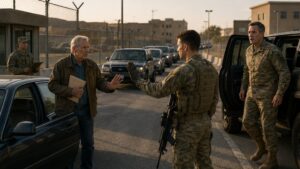
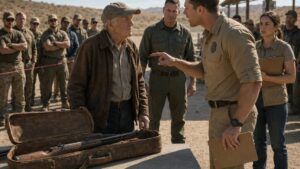
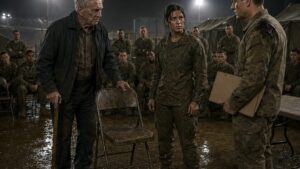
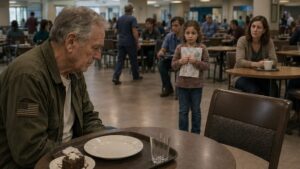
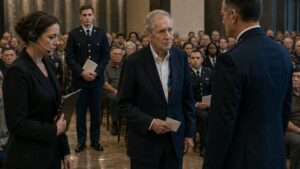
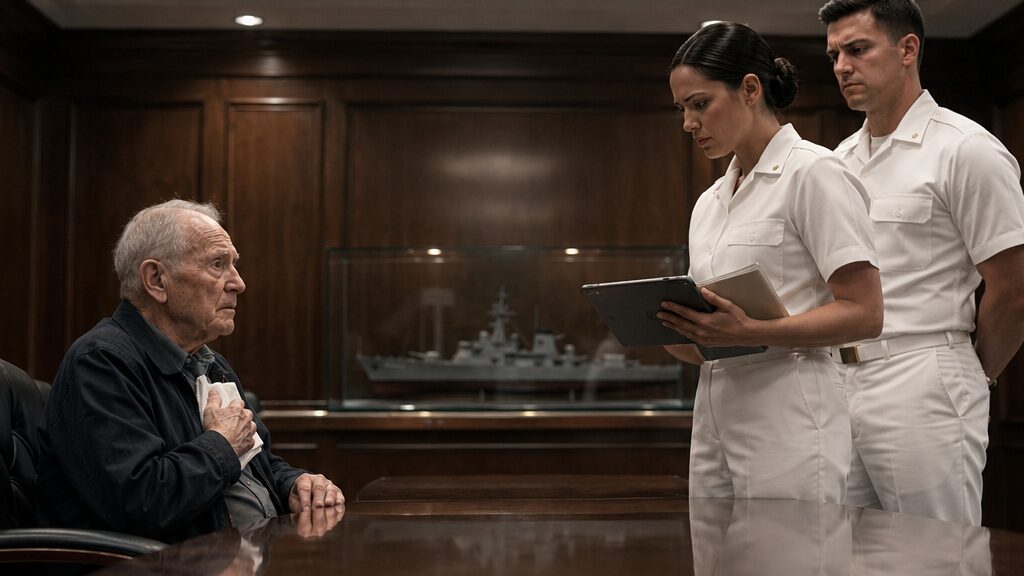
William Campbell kept his hand over the folded white cloth as if the room itself might reach across the table and take it from him.
The conference room smelled of polish, paper, and air too cold for an old man’s bones. Bright panels in the ceiling flattened every face beneath them. The walls were dark wood, the kind meant to make decisions feel older than the people making them. At the far end of the polished table, a small model of a destroyer sat behind glass, all clean lines and untouched paint.
William sat alone on one side.
Two uniformed officers stood on the other.
They had offered him a chair, but not time. They had offered him water, but not belief.
His knees ached from the walk in from the visitor lot. His left hand, the steadier one, rested on the cloth. His right hand curled under the edge of the table, two fingers finding the seam in the wood as if it were a rail on a rolling deck. He had worn his dark jacket because it was the plainest one he owned. It hung loose at the shoulders now. The clerk downstairs had looked at the frayed cuff before looking at his face.
The woman in white stood with a tablet held against her ribs. Her name tape read HILL. Lieutenant Laura Hill, according to the reception clerk, though she had introduced herself quickly enough that the name nearly passed him by. She had clear eyes, careful hair, and the posture of someone trained not to show irritation until the meeting was over.
Behind her, slightly to the left, stood Lieutenant Jack Rodriguez. He had not sat down. He watched William with the polite stillness of a man waiting for someone else to handle a delay.
“Mr. Campbell,” Laura said, “we’ve reviewed the request you submitted.”
William looked at the tablet, then at her face.
Mr. Campbell.
He had been called that for most of his life, and he had no quarrel with it. Still, in this room, with the ship model behind glass and the flags at the corner and the framed photographs of men who had once stood younger than him in the same kind of uniform, the name landed strangely. Lightly. As if there had been no years before it.
He nodded once.
Laura touched the screen. “You’re asking that the review board delay replacement of the memorial plaque for the crew of the Franklin May.”
At the ship’s name, William’s hand tightened over the cloth.
No one in the room seemed to notice.
“The plaque is scheduled for removal next week,” she continued. “The replacement has already been approved. The board is only taking final corrections to spelling, dates, and verified service information.”
William nodded again.
Jack shifted his weight. The sound of his shoe sole on the carpet was soft, but William heard it.
Laura glanced down. “Your written statement says the plaque credits the wrong sailor for an action during the engine-room fire.”
William kept his eyes on the table.
“Specifically,” she said, “you state that the emergency pressure release was held manually by Seaman George Lewis, not by Petty Officer—”
“You don’t have to say his name,” William said.
His voice came out rougher than he intended. Not loud. Not angry. Just unused.
Laura paused. Jack’s eyes sharpened.
William felt the pulse under the cloth. Not in the thing beneath it, of course. In his own hand. In the skin that had thinned over the bones. For a moment, he saw a different table. Not polished. Steel. Wet with heat and spray. A wrench sliding away. Someone shouting above the alarm.
He pressed the cloth once and let the room return.
Laura lowered the tablet slightly. “We do have to say names, sir. That’s what this review is for.”
Sir, then. It had come automatically, not as recognition. A courtesy offered to age, not to service.
William looked at her. She was young enough to have never heard the Franklin May mentioned except in a file. To her it was a damaged record, a closed incident, a memorial line. To him it still had heat.
“I know what the review is for,” he said.
Jack took half a step closer to the table. “Then you understand the board can’t delay a scheduled memorial correction based on a personal recollection alone.”
William did not answer him.
Laura shot Jack a brief glance, not exactly a rebuke, then returned to William. “Mr. Campbell, no one is dismissing what you remember. But the surviving report lists a different man at that valve station.”
“Reports list what someone wrote down.”
“And memory changes,” Jack said, not unkindly, but too quickly. “Especially after that many years.”
William turned his head slowly toward him.
Jack’s expression altered by a fraction, as if he had expected confusion and found something harder. But he did not step back.
William had met men like him in every decade: not cruel, not stupid, simply certain that the oldest person in the room must also be the least exact. They mistook slowness for absence. They heard silence and supplied their own explanation.
Laura set the tablet on the table but kept her hand near it. “Did you bring service records?”
“No.”
“Ship logs?”
“No.”
“Letters, photographs, anything with identifying marks?”
William’s thumb moved once over the folded cloth. The fabric had once been part of a plain handkerchief. White, before smoke and years softened it into the color of old bone. He had washed it only once, the night he took it from the locker, and never again.
“I brought what I have,” he said.
Laura looked at the cloth for the first time as more than something in his hand. Her eyes dipped, then lifted. “May I ask what it is?”
William did not move.
Jack looked toward the door, then back at him. “Mr. Campbell, the board chair has ten minutes between briefings. If there’s something material, now would be the time.”
There it was. Not open contempt. That would have been easier. This was worse: the soft pressure of schedules, the tidy impatience of people protecting a system from inconvenience.
William looked down at his fingers. The veins stood raised, blue and uneven. Once, those hands had known valves by feel in darkness. They had counted pipe turns, knots, pressure changes. They had held a young sailor’s sleeve while smoke rolled low over the deck. Now they looked like hands that had wandered into the wrong building.
The cloth stayed folded.
Laura drew in a quiet breath. “The memorial text has already gone through command review. I’m trying to understand whether your concern is with the wording or with the entire record.”
“With the name,” William said.
“George Lewis.”
William did not answer, but the name remained in the room after she said it. It did not fall flat. Not to him.
Laura scrolled again. “George Lewis is listed among the lost. The plaque includes his name.”
“Listed isn’t remembered.”
Jack’s mouth tightened. “That plaque honors everyone who died aboard.”
William looked at him again. “Does it?”
The room cooled further.
For the first time, Laura sat down. Not across from him exactly, but at the corner, still angled toward the door, still half in charge. She folded her hands around the tablet.
“Mr. Campbell,” she said, more carefully, “were you aboard the Franklin May?”
William had known the question would come. He had practiced answering it in his kitchen, with the old cloth on the table beside a chipped mug and the morning news speaking to no one. He had tried yes. He had tried I was. He had tried I served in damage control. Each version sounded too small or too large.
So he said nothing.
Laura waited.
Jack did not.
“Sir,” he said, “if you were aboard, that needs to be in the statement. If not, we need to know how you came into possession of whatever you brought.”
William’s eyes lowered to the cloth.
Possession.
As if it had ever belonged to him.
He could feel the shape through the folds: curved on one side, jagged on the other, one scorched ridge where metal had given up cleanness to heat. A piece of a valve wheel. A broken part of a broken night. He had carried it out without understanding why. Later, when men with clipboards wrote the story into lines, the fragment became the only thing in the world that refused the clean version.
Laura’s voice softened, but the words did not. “If you can’t provide proof today, I can note your objection. But I can’t recommend delaying the plaque on that basis.”
William looked past her to the model ship behind glass. Its tiny railings were perfect. Its hull had never blackened. No one had to crawl beneath smoke inside it. No one had to choose which voice to follow when two men shouted from opposite ends of a passageway.
The Franklin May had not looked like that at the end.
He removed his right hand from beneath the table and placed it beside the cloth.
Laura watched the movement.
Jack watched, too.
William did not unwrap it. Not yet.
He smoothed one corner with his thumb, then folded that thumb back into his palm. His hand trembled once before he made it stop.
Laura took the tremor for frailty. He saw it in the shift of her face.
That was when the hurt settled into something colder and steadier.
They thought he had come here to be indulged. They thought the cloth held a keepsake, some old man’s comfort, something they could photograph, label, and return. They thought proof belonged only to files kept in climate-controlled rooms.
William had spent fifty-nine years avoiding rooms like this one. He had not come because he wanted to remember.
He had come because they were about to carve the wrong memory deeper.
Laura pushed the tablet slightly toward him, screen glowing with a form he could barely read from where he sat. “Mr. Campbell, if you have proof, produce it. Otherwise, I’ll have to close this as an unverified objection and let the replacement proceed.”
William looked at the cloth under his hand.
Then he looked at Laura Hill.
For the first time since entering the room, he let his fingers move to the first fold.
Chapter 2: The Burned Piece They Called Debris
Laura Hill had seen many kinds of hesitation across government tables.
There was the hesitation of people hiding facts. The hesitation of people embarrassed by paperwork. The hesitation of older relatives trying to correct birth dates, discharge forms, grave markers, benefit records. There was the stubborn pause before anger, and the fragile pause before tears.
William Campbell’s pause was none of those.
His hand moved slowly, but not aimlessly. He unfolded the cloth as if there were a correct sequence and he had no intention of rushing it for anyone in uniform. First the top flap. Then the left. Then the corner nearest his chest, which stuck to itself for half a second before loosening.
Laura felt Jack grow still behind her.
A blackened object sat inside the cloth.
At first glance it looked like scrap from a fire pit. A curved piece of metal, no longer than Laura’s palm, with one edge broken into teeth. Its surface was charred dark, blistered in places, and worn smooth in others where fingers had touched it over time. Tiny stains marked the cloth beneath it.
Jack exhaled through his nose. Not quite a laugh, but near enough that Laura wished he had not done it.
William did not look at him. He used two fingers to turn the object slightly. The movement was careful, almost tender, but not sentimental. He set the piece in the center of the cloth and withdrew his hand.
“There,” he said.
Laura stared at it.
This was the moment she had expected to become easier. An object would either carry an identifying mark or it would not. It would either match something in the record or it would remain personal debris. She had used that phrase before in reviews: personal debris. Not to wound anyone. Just to separate memory from evidence.
The words now sat badly in her mouth.
She leaned forward. “May I?”
William’s eyes moved from her face to her hand.
“Don’t pick it up by the broken edge,” he said.
The correction was quiet, but it made her stop.
Jack shifted again. “Mr. Campbell, if that’s been in private possession for decades, chain of custody is going to be a problem.”
Laura did not answer him. She reached into the folder beside her tablet and removed a pair of thin cotton gloves used for handling old photographs and brittle paper. She had brought them out of habit, not expectation.
William saw the gloves. Something in his face changed, not gratitude exactly. A slight easing around the eyes, then gone.
Laura put them on.
The fragment was heavier than she expected when she lifted it. Its weight pulled at the fingertips. Not aluminum, then, or not mostly. She turned it toward the overhead light.
A scorched ridge ran across one side. Beneath the blackening, nearly lost in the roughness, were stamped characters.
She narrowed her eyes.
“Rodriguez,” she said.
Jack leaned over her shoulder.
The characters were incomplete. Heat had eaten the first part. But the last four were clear enough.
V-17C.
Laura looked at her tablet, then at the fragment again.
William sat motionless.
“Is that supposed to mean something?” Jack asked.
Laura did not answer at once. She pulled up the scanned equipment appendix from the Franklin May incident packet. She had skimmed it earlier without much interest. Most of it had been maintenance references, pressure systems, damage-control diagrams, replacement inventories. The sort of background material included because policy required it, not because anyone expected it to alter the memorial text.
Her finger moved down the list.
VALVE ASSEMBLY, AUXILIARY PRESSURE RELIEF.
V-17.
She stopped.
A small pressure moved behind her sternum.
There were subcategories. V-17A. V-17B. V-17C.
Emergency manual wheel assembly.
She looked back at the blackened piece. The curve was not random. It was part of a wheel. One small portion of what a sailor’s hand would have gripped when power failed.
Jack bent closer. “That could be from any system.”
William’s eyes lifted. “No.”
It was one word, not raised, but the room arranged itself around it.
Laura rotated the fragment a few degrees. A second mark appeared under the soot, not stamped as clearly as the first. More like a maintenance scratch, shallow and uneven.
F.M.
Franklin May.
Her throat tightened before she could stop it.
Jack saw it on her face. “Hill?”
She placed the fragment back on the cloth with more care than she had used to lift it.
“Where did you get this?” she asked William.
He looked at the fragment, not at her. “I told you where.”
“No,” Jack said. “You told us what you believe it is.”
William’s face did not change.
Laura removed one glove, tapped her screen, and searched the incident packet for V-17C. The first result was a maintenance note from three months before the fire. The second was an inspection failure marked corrected. The third was a damage diagram with a red circle around a section labeled auxiliary pressure passage.
The fourth result opened as a low-resolution scan of a casualty statement.
She enlarged it.
Smoke obstruction. Visibility near zero. Manual pressure release believed held by Petty Officer—
The credited name followed.
Not George Lewis.
Laura glanced at William. He had not moved since she returned the fragment to the cloth. His hand now rested flat on the table, inches away from it, but he did not touch it. The distance looked intentional.
“You were aboard,” she said.
William’s gaze stayed downward. “Yes.”
Jack stood straighter.
Laura felt heat rise in her neck, not from embarrassment alone. The file she had opened did list surviving crew. She had not checked his name carefully. He had arrived in worn civilian clothes, carrying no framed records, no veteran’s cap, no prepared binder. She had let the room define him before the file did.
She searched again.
CAMPBELL, WILLIAM. Damage Controlman Second Class.
Survived.
She had seen the name earlier among many others and passed over it.
“Damage control,” she said quietly.
William said nothing.
Jack looked from the tablet to the old man. His expression shifted, then guarded itself. “Mr. Campbell, why didn’t you say that when we started?”
William’s hand curled once, then opened.
Laura knew the answer before he gave it. Or part of it.
He should not have had to.
Still, William did not say that. He only looked at the fragment and spoke as though the words had been stored for years and had lost all ornament.
“Because I didn’t come to talk about me.”
No one moved.
Outside the conference room, a phone rang at a distant desk. Someone laughed once in the hallway, quickly cut off by the door. The ordinary sounds of a building doing ordinary work.
Laura looked at the old man’s jacket, the cloth, the broken metal, the tablet full of scanned certainty. Her earlier words returned with a force that made her want to take them back.
Unverified personal debris.
She picked up the fragment again, this time with both gloved hands. Not because she needed both. Because one felt wrong.
“Mr. Campbell,” she said, and stopped.
The title felt insufficient now, but she did not know what else he would accept.
He lifted his eyes.
“Would you permit us to photograph this for comparison against the equipment appendix?”
“Here,” he said.
“Here?”
“In this room.”
Jack frowned. “We have an evidence intake process.”
William looked at him. “It doesn’t leave the cloth.”
Jack’s first response rose visibly in his posture: procedure, custody, policy, the need to control the object now that it mattered. Laura saw it and spoke before he could.
“We can photograph it here.”
Jack turned toward her.
Laura held his look. “For preliminary comparison.”
He said nothing, but his jaw moved.
She opened the camera function on the tablet and placed a clean document pad beside the cloth. When she reached toward the fragment again, William’s hand moved.
Not to stop her. To point.
“There,” he said.
She followed his finger to the scorched side.
“Turn it so the light catches under the ridge.”
Laura did as he instructed.
The stamped number sharpened.
V-17C.
Jack leaned in despite himself.
William’s gaze fixed on the metal, and for a moment his face changed so completely that Laura no longer saw the old man who had sat under their questions. She saw a young sailor in his place, eyes burning from smoke, listening for a voice in a passageway where alarms screamed through steel.
Then it was gone.
Laura took the photograph.
“Who was George Lewis?” she asked.
William’s mouth tightened. He looked at the cloth as if it had asked him instead.
“A sailor who did what the record says another man did.”
Jack spoke more carefully this time. “Records from a casualty event can be incomplete.”
William’s eyes moved to him. “Incomplete is when you don’t know. Wrong is when you know and leave it.”
Laura felt the sentence land in the center of the table beside the fragment.
She searched George Lewis in the packet. His name appeared in the casualty list. Age twenty-three. Seaman. Lost in the fire. No attached commendation. No cited action. No note beyond location: engineering passage.
The credited sailor’s entry was longer.
Laura looked up. “The official record says Petty Officer—”
William cut her off with one small motion of his hand. Not sharp. Not rude. A hand raised only enough to stop a door from closing.
“You can read what it says,” he said. “I know what it says.”
“Then tell us what happened.”
William looked at the fragment for a long time.
When he spoke, his voice was almost flat.
“The Navy credited the wrong man.”
Chapter 3: The Name Missing From The Record
By noon, Laura Hill had three open files, two conflicting reports, one photographed fragment, and the uncomfortable knowledge that she had almost sent William Campbell away.
The archive office was two floors below the conference room, tucked behind a security door and a narrow corridor lined with metal shelving. It had no flags, no model ships, no polished table. The light was softer here, yellowed by old fixtures. Paper lived in the air. So did dust, toner, and the faint chemical scent of preservation sleeves.
Elizabeth Wright sat at the main workstation with her glasses low on her nose, moving between databases with the calm irritation of someone who had spent years rescuing truth from bad scans.
“This is why I tell them not everything old is digitized,” Elizabeth said. “They nod. Then they ask me to find something from sixty years ago in three minutes.”
Laura stood beside her, arms folded too tightly. “Can you find the equipment serials?”
“I can find what survived being boxed, moved, microfilmed, scanned, mislabeled, and migrated through four systems.” Elizabeth clicked open a maintenance index. “Whether that includes what you need is a different question.”
Jack Rodriguez stood near the doorway with the tablet in one hand. He had followed them down reluctantly, then stayed. He had not apologized to William. Neither had Laura. The opportunity had passed into awkwardness, and William seemed to prefer it that way. He sat outside in the narrow waiting area, the cloth and fragment on his lap again, refusing the offer to have them placed in a temporary evidence drawer.
Laura could see him through the interior window. He sat very still. A security officer had brought him water. William had thanked him but had not opened the bottle.
Elizabeth enlarged the photograph Laura had taken. The fragment filled the monitor: blackened, curved, ugly with heat.
“V-17C,” Elizabeth said. “Auxiliary pressure relief. Manual wheel assembly. Franklin May had three in that section. One primary. Two bypass.”
Laura set the incident packet beside the keyboard. “The casualty statement credits the manual release to Petty Officer—”
“Yes,” Elizabeth said. “I saw.”
“Could he have reached it?”
Elizabeth did not answer immediately. She opened the damage-control diagram and overlaid an evacuation path. Her cursor moved through narrow passages, watertight doors, ladder access, valve stations, and compartments marked damaged.
Jack stepped closer despite himself. “That diagram was made after the fire?”
“After, from surviving layout plans and testimony.” Elizabeth clicked another file. “Which means it is only as good as whoever was alive and willing to talk.”
Laura looked toward the window again.
William had his head lowered. One hand rested over the folded cloth.
“George Lewis,” Laura said. “What do we have on him?”
Elizabeth typed the name.
A short personnel record opened.
LEWIS, GEORGE. Seaman. Engineering division support. Deceased, Franklin May casualty.
“That’s it?” Jack asked.
“For the indexed file.” Elizabeth’s mouth tightened. “Which is not the same thing as all that exists.”
Laura leaned closer. “No commendation?”
“Not in this record.”
“No witness statement?”
“Not attached.”
Jack looked at the screen. “Then Campbell may be remembering the wrong man.”
Laura turned toward him.
He raised a hand, palm half-open. “I’m not saying he’s lying. But casualty memory is unreliable. Smoke, panic, time. We still need more than a fragment and his word.”
Laura hated that he was right. She also hated that the same sentence, spoken an hour earlier, had sounded like dismissal. Now it sounded like a barrier they had to cross carefully.
Elizabeth opened the credited sailor’s record. It was longer, cleaner, written with the polish of official gratitude. Manually engaged emergency pressure release under hazardous conditions. Prevented boiler rupture. Posthumous commendation. Name engraved with action note on the memorial plaque.
Laura read it twice.
“What if both were there?” she asked.
“Possible,” Elizabeth said.
Jack looked toward the waiting room. “Campbell said the wrong man was credited. That’s stronger than saying someone was left out.”
Laura opened her notes. She had written William’s statements as clean lines. Too clean, perhaps.
Listed isn’t remembered.
Incomplete is when you don’t know. Wrong is when you know and leave it.
The Navy credited the wrong man.
They looked less like complaints now and more like the edges of a map.
Elizabeth pulled up a box inventory. “There may be supplemental maintenance logs in storage. Not all were scanned because water damage made them unstable.”
“From the Franklin May?” Laura asked.
“From the post-incident engineering review.”
Jack checked the time. “The board chair will want a preliminary answer by fourteen hundred.”
Elizabeth gave him a look over her glasses. “Then the board chair should have begun caring about archival accuracy before lunch.”
Laura almost smiled. Jack did not.
The archive assistant brought in a gray document cart with two slim boxes and one long flat case. Elizabeth signed the intake slip and put on gloves. Laura did the same. Jack hesitated, then reached for a pair.
Elizabeth noticed. “Only touch what I hand you.”
“Yes, ma’am,” Jack said, and for the first time that day, he sounded younger than his rank.
They worked through brittle copies and curled log sheets. Many were useless. Some were duplicates. Some had handwriting faded into brown ghosts. The names repeated: officers, compartments, repair teams, times that could not all be true.
Laura felt the uneasy shape of institutional memory: not a lie exactly, but a thing assembled under pressure, sealed once it became useful, and then treated as sacred because it had survived.
At 12:46, Elizabeth found George Lewis in a handwritten watch list.
“Here,” she said.
Laura bent over the page.
LEWIS, G. assigned auxiliary passage support, engineering lower access.
It placed him near the valve station before the fire.
Jack read over her shoulder. “That doesn’t prove he held it.”
“No,” Laura said. “But it proves he was there.”
Elizabeth opened another folder. “And the credited petty officer?”
She traced the roster with one gloved finger, then stopped.
The petty officer had been assigned forward damage control at the same hour.
Jack frowned. “Assignments can change during casualty response.”
Elizabeth nodded. “Yes. But now we have a contradiction worth checking.”
Laura looked again through the window. William had not moved much, but she saw the tension in his shoulders. He was waiting without asking if they had found him believable yet. That patience made her feel worse than accusation would have.
She carried a copy of the watch list to the waiting area.
William looked up as she approached.
“We found George Lewis on an engineering lower access assignment,” she said.
His face did not brighten. If anything, it closed further.
“You didn’t need me for that,” he said.
“We needed a reason to look.”
He looked at the paper but did not reach for it.
Laura sat in the chair across from him. The hallway was narrow; her knees nearly touched his. She was conscious now of height, distance, posture. In the conference room, she had stood over him without thinking. Here, seated lower than before, she felt the correction in her own body.
“Mr. Campbell,” she said, “the official record still contradicts your claim. But the assignment list supports part of what you told us.”
He nodded once.
“May I ask why you didn’t include your own service record in the request?”
His mouth moved slightly, not quite a smile. “You found it.”
“We should have found it before the meeting.”
William looked at her then.
The statement hung between them. It was not an apology, but it was the first honest piece of one.
He looked away first. “I didn’t come for mine.”
“I understand that now.”
“No,” he said softly. “You understand there’s a file. That isn’t the same.”
Laura absorbed that without defending herself.
Behind her, the archive door opened. Elizabeth stepped into the hallway holding a clear sleeve between both hands. Her expression had changed. The dry impatience was gone.
“Lieutenant Hill,” she said.
Laura stood. “What is it?”
Elizabeth glanced at William, then back at Laura.
“I found a damaged maintenance reference from the emergency valve station.” She held up the sleeve. Inside lay a dark-edged paper strip with water stains cutting through the text. “Most of it is unreadable.”
Jack appeared behind her. “But?”
Elizabeth pointed to one surviving line.
Manual wheel assembly V-17C removed from lower engineering passage after casualty.
Laura felt every sound in the hallway recede.
Elizabeth’s finger moved to a second line, broken by a burn mark but still partly legible.
Recovered near Lewis position.
William closed his eyes.
Not long. Just once, as if something inside him had stepped backward into smoke.
Laura looked at the folded cloth on his lap.
For the first time, the thing inside it no longer felt like an object waiting to be verified.
It felt like someone had been holding out a hand for fifty-nine years.
Chapter 4: The Fire William Would Not Describe
William heard the word Lewis through the glass before he heard anything else.
Elizabeth had said it quietly, with the caution of someone handling more than paper, but the name slipped through the archive door and reached him anyway. It moved through the waiting area like heat under steel.
Recovered near Lewis position.
William kept his eyes closed a moment longer.
The bottle of water sat unopened beside his chair. The folded cloth lay across his knees, his hand resting over it, thumb pressed into the seam he had worn thin over the years. Inside the cloth, the fragment held its silence better than any man could. It did not explain. It did not defend itself. It stayed blackened and heavy and true.
When William opened his eyes, Laura Hill stood in front of him.
She had a paper sleeve in one gloved hand and a question in her face she had not yet learned how to ask gently.
“We found a maintenance reference,” she said.
“I heard.”
Her mouth closed.
That pleased him less than he expected.
Jack Rodriguez remained near the archive door, shoulders squared, face set in a way William recognized. Men did that when they were trying to rebuild themselves inside their uniforms. Elizabeth stood behind him, watching everyone with archive-room patience.
Laura lowered herself into the chair across from William again. This time she did not angle toward the door. She sat fully facing him.
“The reference says the V-17C wheel assembly was recovered near George Lewis’s position,” she said. “It supports part of what you told us.”
William nodded once.
“We still need a statement.”
The hallway seemed to narrow around the word.
Statement.
A statement meant sequence. Time. Location. Names. A clean path through smoke. It meant saying where he had been when George was still alive, and where he had not been when George needed one more pair of hands. It meant turning a night into sentences.
William looked down at his hand on the cloth.
“I already gave one.”
“Not enough for the board.”
“The board has enough to look.”
“To look, yes,” Laura said. “Not to correct.”
He lifted his eyes.
She did not flinch this time. That was something.
“We need to know what you saw,” she said.
William’s throat worked once. “You don’t.”
Jack spoke from the doorway, more quietly than before. “Sir, if the record is wrong, your testimony may be the only way to fix it.”
There was that word again, sir. It came differently now. He could hear the difference. That made it harder, not easier.
William rubbed the edge of the cloth between two fingers. He had learned long ago that memory was not a door. People spoke of opening it as if hinges obeyed. Memory was pressure behind a bulkhead. You did not open it. You loosened one wheel and hoped the force did not take your arm with it.
Laura’s voice lowered. “We can take it slowly.”
He almost laughed. Not because it was funny. Because slowly was how the worst things returned.
The alarm had not sounded like it did in movies. No noble bell. No clear warning. It had been a shriek swallowed by metal, broken by shouted orders and the hammering cough of smoke. William had been twenty-three with shoulders that fit through narrow spaces and hands quick enough to work by touch. The Franklin May had lurched under his boots. Someone yelled for auxiliary pressure release. Someone yelled aft. Someone yelled that the automatic system had failed.
And George Lewis, with one sleeve already burned through at the cuff, had looked at William and grinned like a fool.
Not a hero’s grin. A scared man’s grin.
Go, he had mouthed, because the passage was too loud for sound.
William pressed his thumb harder against the cloth until the present steadied.
“I didn’t see all of it,” he said.
Laura did not move to write. “Tell us what you can.”
That helped.
He breathed in through his nose. The archive hallway smelled like paper, dust, and cold coffee from somewhere unseen. Not smoke. He held to that.
“Valve station V-17C sat low in the auxiliary passage,” he said. “Manual wheel. If the automatic release failed, somebody had to hold it open until pressure dropped. It wasn’t built for comfort. You had to brace your shoulder and keep both hands on the wheel when the line kicked.”
Laura listened. Jack came closer but stayed standing farther back than before.
“George was assigned support,” William continued. “He wasn’t supposed to be the one on it. He was supposed to move messages and tools, help where ordered.”
“Was he trained for it?” Jack asked.
William looked at him. “Enough.”
Jack accepted that with a small nod.
“The fire cut the passage,” William said. “We had smoke down low and heat up high. Men got turned around. Some orders crossed. I was sent to check a pressure gauge near the lower access. George was already at the wheel when I got there.”
The hallway faded at the edges.
He saw George’s hands again, dark with grease, locked around the spokes. Saw the skin pulled tight over his knuckles. Saw the valve shudder when pressure hit. George had jammed one boot against a pipe bracket. His cap was gone. His hair was wet with sweat or spray. Smoke moved above him like a living ceiling.
“He shouldn’t have been able to hold it,” William said.
Laura’s eyes had lowered to his hand.
“He did?”
William nodded.
“For how long?”
“Long enough.”
No one asked him to measure it after that.
He was grateful.
Elizabeth stepped softly into the hall and placed a portable recorder on the chair beside Laura, not turning it on. “Only with permission,” she said.
William looked at the recorder. A small red button. A black grille. A machine waiting to keep what he had avoided giving.
He shook his head.
Laura did not argue. “Then I’ll take notes by hand.”
She reached for a notepad instead of the tablet.
For reasons William did not understand, that nearly undid him.
A tablet made people look away. A notepad kept them present. He watched her click the pen, then wait.
He spoke in pieces after that.
He told them there had been another man in the report, a petty officer whose name he still would not say. He told them that man had been forward when the release had to be held. He told them the confusion after the casualty had moved men into cleaner stories. A dead petty officer with rank fit the shape of a citation better than a support seaman nobody had tracked closely.
“Did you report this at the time?” Laura asked.
William looked at the floor.
There it was.
The question he had carried longer than the fragment.
“Yes.”
Laura’s pen stopped.
Jack’s head lifted.
“To whom?” Laura asked.
“To the man writing down survivors’ statements.”
“Was it included?”
William’s mouth tightened. “You read the file.”
The silence afterward did not accuse him. That was worse. It invited him to continue.
He drew one long breath, then another.
“They told me I was concussed. Smoke inhalation. Shock. They said I had George mixed with someone else. Then they told me the credited man’s family had already been notified of the commendation recommendation.” He looked at Laura. “I was twenty-three. I had no paper. No rank worth hearing. Just my word and this.”
His hand moved over the cloth.
“Why keep it?” Jack asked.
William’s eyes went to him.
Jack corrected himself. “Why did you keep it with you?”
William looked past him to the archive door. “Because George asked me to take it.”
Laura’s face changed. “He was alive when you left?”
William’s fingers curled.
For a moment the hallway vanished.
George’s face was streaked black except where sweat had cut pale tracks down his cheeks. He had one hand on the wheel and one hand gripping the broken piece after the wheel cracked under force. William had tried to pull him clear when the pressure dropped. The passage behind them had flashed orange. Somewhere a pipe screamed. George shoved the metal against William’s chest hard enough to bruise him.
If they forget, he had said.
Or perhaps he had only mouthed it. Perhaps William had built the sound around the shape of his lips. That uncertainty had tormented him more than a clean memory would have.
William swallowed.
“He gave it to me,” he said. “That’s enough.”
Laura did not press.
The quiet lasted until Elizabeth’s workstation chimed softly in the next room. The sound brought William back fully. His heart was beating too fast. He hated that they could see it in his breathing.
Laura closed the notepad halfway. “We can stop.”
“I didn’t finish.”
“You don’t have to finish all of it now.”
William looked at her, surprised by the mercy and suspicious of it.
Jack moved toward the door. “I’ll check the forward assignment records for the credited petty officer.”
Laura turned. “Jack—”
“No,” he said, not defensive now. “We need to know where he actually was.”
William watched him go into the archive office.
It was the first useful thing the man had done.
Laura remained seated. “Mr. Campbell.”
“William,” he said before he could stop himself.
Her expression softened, then steadied with care. “William. I’m sorry we did not check your service record before bringing you into that room.”
He looked at her.
Apologies had many shapes. Some were offered to close a door. This one did not feel like that. Still, he had no place ready to put it.
“You checked now,” he said.
She accepted the limit.
Elizabeth appeared at the doorway, holding another printed sheet. Her face had the tight focus of someone who had found the next nail in a sealed board.
“Lieutenant Hill,” she said. “Lieutenant Rodriguez found the forward damage-control roster.”
Laura stood.
William stayed seated, the cloth gathered under his hand.
Elizabeth looked from Laura to William, then spoke carefully.
“The credited petty officer was assigned forward when the valve was engaged. He was treated for injuries there before the lower passage was cleared.”
Laura’s eyes moved to Jack inside the archive office.
Jack stood over the workstation, one hand braced on the desk, reading the screen as if the words had changed something under his feet.
William closed his eyes once more.
For nearly sixty years, no one in uniform had looked at that part of the story long enough.
Now they had.
And it did not feel like victory.
Chapter 5: The Officer Who Finally Lowered His Voice
Jack Rodriguez had always trusted records because records did not tremble.
People did. People forgot. People softened their own failures and sharpened other men’s. People remembered light where there had been dark and made heroes out of whoever guilt allowed them to name. Records were imperfect, yes, but they had at least passed through hands trained to preserve order.
That morning, Jack had believed William Campbell was a problem of memory.
By the next morning, he understood he might be a problem of conscience.
The review board office was smaller than the conference room but colder in feeling. No polished ship model. No ceremonial flags. Just a long table crowded with folders, a wall clock, a screen showing the proposed memorial plaque text, and a strip of morning light falling across the carpet.
William sat at the same side of the table as before, though no one had assigned him there. The folded cloth lay before him, the fragment inside it. He had not opened it yet. Laura sat to his right with her notes, Elizabeth beside a box of copied documents, and Jack stood near the screen with a remote in hand.
The senior review board chair sat at the head of the table, reading the preliminary findings through half-lowered glasses.
“So,” the chair said, “we have an object matching an emergency valve component, a damaged maintenance reference suggesting recovery near Seaman Lewis’s position, and a contradictory assignment record regarding the originally credited petty officer.”
“Correct,” Laura said.
The chair looked at William. “And we have Mr. Campbell’s recollection.”
Jack felt the old impulse rise in him: to separate testimony from evidence, to keep the meeting clean. He nearly let it pass.
Then he saw William’s hand tighten over the cloth.
“His firsthand statement,” Jack said.
The chair looked up.
So did William.
Jack kept his eyes on the screen. “Damage Controlman Second Class Campbell was assigned in the affected area and survived the casualty. His account is firsthand.”
The title entered the room quietly, but it changed the air.
William did not thank him. Jack was glad. Gratitude would have made the correction too small.
The chair leaned back. “Noted.”
Laura’s pen moved once across her paper.
The chair continued. “The board can authorize a delay in plaque replacement pending additional review. We can also recommend adding a general line recognizing unresolved discrepancies in survivor accounts.”
William’s face did not move, but Jack saw the refusal before he spoke.
“No.”
The chair paused. “Mr. Campbell?”
William looked at the screen where the proposed plaque text glowed in clean black letters. Names in order. Dates aligned. A paragraph honoring sacrifice. The wrong action still attached to the wrong man.
“No general line,” William said.
Laura turned toward him slightly. “William, a delay would give us more time.”
“For what?”
“To build the case.”
“You have the case.”
Jack expected the chair to stiffen at that. Instead, the older officer removed his glasses and rubbed the bridge of his nose.
“What we have,” the chair said, “is enough to raise doubt. It may not yet be enough to rewrite a formal commendation line.”
William’s hand moved to the cloth. “Then don’t write around it.”
The room stilled.
Jack looked at the fragment beneath the fabric. Yesterday, he had almost called it scrap. He had almost let the word stay in the room. He had almost watched an old man walk out carrying it back into silence.
The chair spoke carefully. “We are not trying to erase Seaman Lewis.”
William looked at him. “You already did.”
No one answered.
The words did not come like accusation. They came like a weather report from a place everyone else had refused to visit.
Laura set her pen down. “The board’s proposed compromise accepts that the fragment matters but avoids naming George as the sailor who held the valve.”
William turned to her.
Jack watched her meet his eyes. She did not hide behind the file.
“That isn’t enough,” William said.
“I know,” Laura said.
The chair looked at her sharply.
Laura did not withdraw the words.
The review continued for another twenty minutes and moved nowhere. The chair wanted an evidentiary threshold. Laura wanted another archive search. Elizabeth insisted there were still unprocessed logs from the engineering review. Jack argued for delaying the plaque until the contradiction could be fully resolved. Every time someone said delay, William grew quieter.
At last, the chair slid a document across the table.
“This is a temporary statement,” he said. “It allows us to pause the replacement and classify the fragment for review. It does not require you to endorse final wording.”
Laura read it first. Her eyes moved line by line, then tightened.
Jack took it from her.
The language was polished enough to hide its purpose.
Submitted artifact believed by claimant to be associated with Franklin May casualty.
Claimant.
Artifact.
Believed.
Jack looked at William. The old man had not reached for the paper.
“It’s procedural,” the chair said. “Not final.”
William looked at the document. “No.”
“Mr. Campbell—”
“No.”
Jack heard irritation enter the chair’s breath. He understood it. Procedure existed so every grief did not become policy. But there was a difference between caution and cowardice, and the document on the table had found the seam between them.
Laura said, “We can revise the language.”
The chair’s voice cooled. “Lieutenant Hill, the purpose is simply intake.”
William reached for the cloth.
Everyone watched.
He unfolded it, not fully, only enough to expose the blackened curve. The fragment sat there like a coal that had refused to go cold. He did not push it forward.
“You can intake paper,” he said. “You can intake a photograph. You don’t intake him.”
The chair was silent.
Jack had thought he understood the source of William’s anger. Now he saw he had mistaken it. The old man was not protecting evidence from mishandling. He was protecting a person from being reduced to evidence.
The chair stood. “We’ll take a recess.”
The others rose automatically, except William.
A junior officer entered after being called and began gathering documents for copying. He reached for the cloth without looking, moving it aside as if clearing space.
William’s hand came down over it.
The young officer froze.
The chair turned. Laura’s mouth opened.
Jack spoke first.
“Don’t.”
The word came out sharper than intended.
The junior officer pulled back. “Sir?”
Jack crossed the room, slower now. He stood beside the table and lowered his voice.
“Handle it like it belonged to someone.”
The young officer’s face flushed. “Yes, sir.”
William looked up at Jack.
Jack met his eyes for only a second. It was enough to feel the weight of the morning before: his impatience, his almost-laugh, his clean assumptions. He could apologize. He should, perhaps. But William did not seem to need Jack’s guilt laid at his feet.
So Jack did the only useful thing available.
He picked up a fresh evidence tray and placed it beside the cloth, not touching either.
“May I?” he asked.
The question was directed to William.
The room noticed.
William studied him. Then he folded the cloth over the fragment again, slowly, deliberately, and slid it into the tray himself.
“Only for the photograph,” he said.
“Only for the photograph,” Jack repeated.
The recess became something else after that.
Elizabeth returned to the archive storage request. Laura revised the intake language by hand before anyone could stop her. The board chair read it, frowned, crossed out one word, then allowed it.
Submitted fragment identified by survivor William Campbell as recovered from Franklin May valve station V-17C near Seaman George Lewis’s casualty position.
It was not enough.
But it no longer lied.
William signed beneath it after a long time. His signature shook at the end, and Jack looked away before the old man could see him notice.
When the chair left for another briefing, Jack remained by the screen with Laura.
“You were right yesterday,” Laura said quietly.
Jack stared at the plaque text. “About what?”
“That memory can be unreliable.”
He swallowed. “That wasn’t why I said it.”
She did not answer.
On the screen, the credited name remained where it had always been. George Lewis’s name sat below with the rest of the lost, honored equally and remembered incorrectly.
William stood with care, one hand on the edge of the table until his knee steadied. Jack moved half a step before thinking, then stopped. The old man did not want to be caught like a falling file.
William gathered the folded cloth from the tray.
The chair had left the temporary statement on the table. Laura had a copy. Elizabeth had another. The system had begun to move, slow and reluctant, around something it could no longer dismiss.
As William passed Jack, he stopped.
Not fully. Just enough that Jack felt addressed.
“You’re still trying to save the record,” William said.
Jack had no defense ready. “I’m trying to fix it.”
William looked toward the screen.
“If you remember the object and forget the hands that held it,” he said, “you haven’t fixed anything.”
Then he walked out with the folded cloth held against his chest.
Jack remained beside the glowing plaque text long after the door closed.
For the first time since joining the review, he did not wonder how to protect the Navy from embarrassment.
He wondered how much embarrassment the Navy had mistaken for honor.
Chapter 6: The Log Page Under The Wrong Name
Elizabeth Wright found the missing page in a box that had been labeled too neatly.
That was the first sign.
Real archive boxes told the truth of their handling. Corners crushed. Tape layered over old tape. Pencil notes from people no longer employed. A water stain that did not care about filing systems. But this one sat at the back of the storage room with a clean white label printed in a modern font: FRANKLIN MAY ENGINEERING SUPPLEMENTAL, DUPLICATES.
Duplicates rarely deserved labels that clean.
Elizabeth stood on the rolling ladder with one hand on the shelf and stared at it for several seconds before calling down.
“Lieutenant Hill.”
Laura looked up from the table below. Jack stood beside her, sleeves rolled, sorting through copied rosters. William sat near the end of the room in a straight-backed chair, the folded cloth on the table before him. He had refused to wait outside this time.
Elizabeth lifted the box carefully. “I may have something.”
The storage room was narrow and high, with shelves rising nearly to the ceiling. The air held the dry chill of preservation. Fluorescent lights hummed overhead. Somewhere behind the wall, a vent clicked on and off with the tired rhythm of an old ship pump.
Laura cleared a space on the table.
Elizabeth brought the box down and set it in the center. “This was indexed as duplicates.”
Jack read the label. “And you don’t think it is?”
“I think someone wanted later staff to think it was.”
No one spoke for a moment.
William’s eyes remained on the box.
Elizabeth opened it with a small blade and removed the top folder. The first pages were duplicates: casualty summaries, equipment lists, copied diagrams. Then came a separator sheet with no label. Behind it, several thinner pages wrapped in preservation tissue.
Her pulse quickened.
“Gloves,” she said.
Everyone already had them on except William. He did not reach toward the papers.
Elizabeth unfolded the tissue.
The page inside was warped, brown at the edges, and scarred by a burn that had eaten through the lower left corner. But the upper half remained legible.
ENGINEERING CASUALTY SUPPLEMENTAL LOG.
Franklin May.
Laura stepped closer.
Jack stopped breathing audibly.
Elizabeth worked slowly, flattening the page under weighted strips. The handwriting was cramped, uneven, written by someone under strain or afterward from notes made under strain. Some entries were time-marked. Others were fragments.
Aux pressure automatic fail.
Manual V-17C engaged.
Smoke obstruction lower passage.
Lewis holding wheel.
Elizabeth felt the room tighten around the line.
Laura whispered, “There it is.”
William did not move.
Elizabeth looked at him, expecting something: relief, pain, anger. His face showed almost nothing. Only his hand had changed. It rested flat on the table now, fingers spread, as though steadying himself against a roll no one else could feel.
Jack leaned in. “Keep going.”
Elizabeth read the next lines silently first.
Campbell ordered aft gauge check. Returned with line pressure report. Lewis remained at wheel. Relief successful. Lower passage flashover.
The final words on the page were smeared, but visible enough.
Lewis presumed lost at station.
Not near. At.
Elizabeth looked at the folded cloth.
The fragment inside had come from that station.
For an archivist, proof usually arrived as satisfaction: a date matched, a name corrected, a missing piece placed where it belonged. But the page on the table did not satisfy anything. It made the air heavier. It clarified the shape of a loss that had already happened and then been mishandled for decades.
Laura turned to William. “You were ordered away.”
William’s jaw moved once.
Jack straightened. His face had gone pale beneath the steady posture.
“The statement in the official commendation,” he said, “says the credited petty officer manually held V-17C.”
Elizabeth slid another page from the tissue. “This may explain that.”
The second sheet was not a log page. It was a typed summary, marked DRAFT across the top. Several lines were corrected in pen. Elizabeth scanned it quickly.
“It references conflicting survivor accounts,” she said. “And recommends crediting the senior casualty in the section because of incomplete confirmation.”
Laura’s eyes hardened. “Senior casualty?”
“The petty officer.”
Jack took one step back. “So they knew George Lewis was a possibility.”
Elizabeth kept reading. “More than a possibility.”
She pointed to a handwritten note in the margin.
Lewis name not in initial action chain. Family notification already complete re: P.O. commendation. Avoid revision unless command directs.
Laura said nothing.
Jack’s face changed in a way Elizabeth could not immediately name. Shame, perhaps, but not personal. Something larger and colder.
William finally spoke.
“They knew enough.”
His voice was calm. Too calm.
Laura sat down slowly in the chair nearest him. “Why didn’t you come back sooner?”
Elizabeth looked at her sharply, but Laura’s face held no accusation. Only grief and confusion.
William looked at the page.
For a long moment, the only sound was the hum of the lights.
“When I got out of the hospital,” he said, “they had already held the service.”
No one moved.
“George’s people were poor. Didn’t travel easy. The petty officer’s family had officers at their door, letters, commendation language. I was told the official record would stand until a full review. Then the review closed.”
He folded his hands together. The gloves made everyone else’s hands look careful. His bare hands looked exposed.
“I wrote twice,” he said. “No answer the first time. The second said my statement had been considered.”
Laura’s voice was soft. “And after that?”
William looked at the folded cloth.
“After that, life got loud.”
No one asked what he meant. They did not need to. Hospitals closed. Men aged. Jobs ended. Names disappeared from mailboxes. A young sailor became a middle-aged man, then an old one, still carrying a burned piece of a night nobody wanted reopened.
Elizabeth had spent her career among records. She had seen what time did to paper. She had thought less often about what time did to people whose truth paper failed to hold.
Jack leaned over the typed draft again. “If this note is authentic, it shows the command chose not to revise.”
“It shows someone recommended avoiding revision,” Laura said.
Jack looked at her.
She did not soften it. “We need to be precise.”
William gave a small nod. “Precise matters.”
The words landed differently from him. Not as procedure. As mercy.
Elizabeth prepared a scanner cradle for the damaged page, but when she reached for it, William’s eyes followed her hand. She stopped.
“Mr. Campbell,” she said, then corrected herself. “William. I need to scan this. The page is fragile. I won’t remove it from the table until you can see where it goes.”
He looked at her for a long time. “It isn’t mine.”
“No,” she said. “But you brought us to it.”
He accepted that with silence.
Laura stood and walked to the far end of the storage room. She faced the shelves for a moment, one hand against the edge of a metal rack. Elizabeth pretended not to see. Jack watched the draft page as if it might accuse him next.
When Laura returned, her eyes were clear.
“The board will want to soften this,” she said.
Jack nodded slowly. “Yes.”
“They’ll say the old commendation was made under uncertainty.”
“It was.”
“They’ll say correcting George’s action may appear to dishonor another casualty.”
Jack looked at William. “It doesn’t have to.”
William’s mouth tightened. “Then don’t let it.”
The sentence was not a plea. It was a charge.
Laura looked at the log page, then at William. “If we bring this forward, it will reopen the memorial text. It may reopen the old commendation file. People may ask why the Navy waited this long.”
“They should,” William said.
“George’s surviving relative may be contacted.”
William closed his eyes briefly.
Elizabeth saw that this, more than the board, struck him.
Laura noticed too. “Did you know them?”
“His sister,” William said. “Years ago.”
“Does she know?”
“No.”
“Why?”
His hand moved to the folded cloth and rested there.
There were answers he could have given. Because he had been young. Because nobody had believed him. Because telling a grieving family that their son had done more than the Navy admitted felt like opening a grave with his hands. Because the longer he waited, the harder truth became to deliver without also delivering his own failure.
He gave the smallest true answer.
“I didn’t know how to say I left him.”
Laura looked down.
Jack’s voice came quietly. “You were ordered away.”
William turned to him. There was no anger in his face, only an old exhaustion.
“That’s what the page says.”
Jack had no reply.
Elizabeth finished positioning the log in the scanner cradle. The machine made a low sound as light moved beneath the glass. The damaged page appeared on the monitor line by line, enlarged beyond the table, beyond the room, beyond the long years in a mislabeled box.
Lewis holding wheel.
Campbell ordered aft gauge check.
Lewis presumed lost at station.
There it was, in light.
Proof.
And yet no one smiled.
Laura stood beside William. “Why now?”
He looked at the monitor. The letters reflected faintly in his eyes.
“They’re replacing the plaque,” he said. “Once they cut the new one, the mistake gets younger.”
The room absorbed that.
William lifted the folded cloth and placed it beside the scanned image on the table, close but not touching.
“I’m tired,” he said. “But I’m not that tired.”
Laura looked at him for a long moment.
Then she asked, “Will you tell the board that?”
William’s hand remained on the cloth.
He did not answer quickly. The storage room waited with him: shelves, boxes, rescued paper, three people in government service learning the difference between having a record and keeping faith.
At last, he nodded once.
But Laura was not finished.
“William,” she said, “why did you wait all these years to bring the fragment forward in person?”
He looked at the burned page on the screen, then at the folded cloth under his hand.
This time, the silence did not hide him.
It gathered him.
Chapter 7: The Name Spoken Correctly At Last
William Campbell stood in the small memorial room with the folded white cloth in his left hand and the truth waiting on a table in front of him.
The room was not made for ceremony. It had two glass cases, a wall of framed ship photographs, and a narrow brass plaque mounted beneath the old image of the Franklin May. The plaque had been polished so many times that the edges of the letters had softened. Men’s names sat in rows, equal in size, unequal in what the record had allowed them to carry.
George Lewis was there.
William had known that for decades.
But beneath another man’s name, the action line still claimed the hands that held V-17C until pressure dropped and the lower passage filled with fire.
Laura Hill stood beside the table with the corrected packet held flat in both hands. Jack Rodriguez stood near the door, not blocking it now, only keeping others from wandering in. Elizabeth Wright had placed the scanned log page, the damaged maintenance reference, and the revised statement in a careful row. No one had brought a camera. No one had invited a crowd.
The senior review board chair entered last, carrying the proposed correction in a blue folder.
William watched the folder more than the man.
The chair cleared his throat. “Mr. Campbell.”
William turned.
The chair’s eyes moved once toward Laura, then back. “Damage Controlman Campbell,” he corrected.
William did not answer. He did not need to reward a name being spoken properly.
The chair opened the folder. “The board has agreed to delay installation of the replacement plaque. We will recommend amending the memorial record to reflect newly reviewed evidence regarding Seaman George Lewis’s position and possible action at valve station V-17C.”
Possible.
The word stood out as cleanly as if someone had underlined it.
Laura’s head lowered a fraction.
Jack looked toward William.
William placed the folded cloth on the table. He did it slowly, with the palm of his hand resting over it for one breath before he let go.
“No,” he said.
The chair paused. “Mr. Campbell, this is a significant correction.”
“It is a soft one.”
“It reflects what the evidence can sustain.”
William looked at the row of documents. “Read the log.”
“We have.”
“Then read it out loud.”
The chair did not move.
Laura reached for the scanned page, but William raised his hand slightly. Not to stop her completely. To ask for the right person to do it.
The chair understood after a moment. He picked up the page.
The paper copy trembled only slightly in his hand.
“Manual V-17C engaged,” he read. “Smoke obstruction lower passage. Lewis holding wheel.” His voice lowered as he continued. “Campbell ordered aft gauge check. Returned with line pressure report. Lewis remained at wheel. Relief successful. Lower passage flashover. Lewis presumed lost at station.”
The room held still.
William looked at the old plaque.
The words had lived in him so long that hearing another man speak them did not free him. It made them heavier, because now they belonged to the room too.
The chair set the page down. “The board is concerned about implying fault in the original commendation.”
William turned back to him. “I didn’t come here to shame a dead sailor.”
“No one believes you did.”
“Then don’t protect him by taking from George.”
The chair’s face tightened, but not with anger. With the effort of letting a difficult truth stay difficult.
Laura stepped forward. “Sir, the proposed correction can honor the original casualty without repeating the error. We can revise the action line. We do not need to assign blame in order to name what George Lewis did.”
Jack spoke from near the door. “And if we avoid naming it after finding this, then the new plaque becomes part of the old mistake.”
The chair looked at him.
Jack did not look away.
William studied the young officer for a second. Yesterday, Jack had stood over him like a man waiting for an inconvenience to end. Now he stood aside so the truth could pass through the door first. That was not redemption. It was not enough to erase anything. But it was behavior, and behavior mattered.
The chair closed the blue folder.
“What wording do you want, Damage Controlman Campbell?”
William had prepared for many things. Refusal. Delay. Polite dismissal. A document written to bury its own correction.
He had not prepared to be asked.
The question reached him in a place no accusation had reached. His hand moved toward the cloth, then stopped before touching it.
“I don’t want wording,” he said.
Laura’s face changed.
William looked at the old plaque again. “I want his name beside what he did.”
The chair waited.
William’s voice was low, but it did not shake. “Seaman George Lewis manually held emergency valve V-17C during the Franklin May fire, allowing pressure release before the lower passage was lost.”
No one wrote for a moment.
Then Laura did.
Her pen moved across the page carefully, each word given its own space.
The chair listened until she finished. “That may require legal review.”
“Then review it.”
“It may take time.”
William nodded. “He’s waited.”
The sentence did not rise. It did not need to.
Elizabeth removed the fragment from the temporary tray only after looking to William for permission. He gave it with a small motion of his fingers.
She carried it in both gloved hands and set it on the white cloth beside the corrected draft. The blackened curve looked smaller in this room than it had in the conference room, but not less important. The polished plaque reflected a dim, broken shape of it.
Laura came around the table. She stopped before touching the cloth.
“William,” she said, “may I place it beside the record?”
He looked at her hands. They were gloved, steady, waiting.
“Yes.”
She lifted the cloth with the fragment resting inside it, not separating one from the other, and placed it beside the copied log page. Then she stepped back.
No salute came.
William was glad.
A salute might have made the room easier for everyone else. It might have given them a picture to remember instead of the work that had to follow. He did not need their arms raised. He needed George’s name placed where the fire had put it.
The chair signed the revised recommendation at the bottom of Laura’s handwritten wording. Jack signed as witness. Elizabeth signed the archival attachment sheet. Laura signed last, pressing hard enough that the pen left an impression on the page beneath.
Then she turned to William.
“How should George’s name be spoken when the correction is entered?” she asked.
William’s throat closed.
For a moment he was not in the memorial room. He was in a passage where smoke folded over itself, where George’s young face looked back through heat, where a broken piece of wheel struck William’s chest and a mouth formed words he had carried without trusting his own memory.
If they forget.
William looked at the plaque.
“Plain,” he said. “Don’t dress him up. Don’t make him taller than he was.”
Laura nodded.
“He was twenty-three,” William said. “He was scared. He did it scared.”
No one interrupted.
“That matters,” William added.
“It does,” Laura said.
The chair picked up the signed correction. “The old plaque will remain until the amended replacement is approved. The replacement will not be installed with the disputed wording.”
William breathed out slowly.
It was not the sound of a burden leaving. Burdens like that did not leave. But something shifted. For the first time in years, he felt that if his hand opened, George would not fall.
A junior officer entered carrying an archival case. He reached toward the table, then hesitated. His eyes moved to Jack.
Jack said quietly, “Ask first.”
The junior officer turned to William. “Permission to prepare the fragment for temporary preservation?”
William looked at him for a long moment. “Not the fragment.”
The young officer flushed. “Sir?”
William touched the edge of the white cloth. “Say what it is.”
The officer swallowed. His voice changed. “Permission to prepare the V-17C wheel fragment for temporary preservation?”
William nodded.
The officer moved with care after that.
When the fragment had been placed in the archival case, William picked up the empty cloth. It felt lighter than it should have. Stained, worn, soft from years of folding. For nearly sixty years, it had held the metal. Now it held only the shape where the metal had been.
Laura noticed. “Do you want the cloth preserved with it?”
William folded it once. Then again.
“No,” he said. “This part comes home.”
No one asked why.
He placed the cloth inside his jacket.
In the hallway outside the memorial room, the building sounded ordinary again. Phones rang. Shoes moved. A printer started somewhere. The Navy continued, as it always had, but one small part of it had been made to stop and look back.
At the exit, Jack opened the door for him and stood aside.
William paused.
Jack straightened, not sharply, not for show. His voice was low enough that only William could hear.
“Damage Controlman Campbell.”
William looked at him.
Jack did not salute. He simply held the door and waited until William was ready to pass.
That was enough.
Outside, the morning had softened into pale afternoon. William stepped into the light with the folded cloth against his chest. Behind him, in a quiet room, George Lewis’s name waited beside the truth at last.
William walked slowly toward the visitor lot.
His knees hurt. His hand trembled. The cloth was empty.
For the first time, that did not feel like loss.
The story has ended.