What the House Remembered
Part I — The Toast
Robert Hayes knew the evening was wrong before Daniel Reed put a hand on his shoulder.
He knew it from the way the tribute video kept looping silently behind the podium, showing younger versions of him shaking hands, saluting flags, standing beside men who had not lived long enough to become old. He knew it from the sealed brown envelope tucked inside Daniel’s jacket across the room. Mostly, he knew it because Daniel had not looked away from him once all night.
The Whitmore Foundation dining hall was too warm.
Chandeliers burned over crystal glasses. Donors leaned over white tablecloths. Retired officers laughed carefully, the way men laughed when rank had never fully left their bones.
Robert stood near the head table in a dark suit and open-collar shirt, silver hair combed back, smile fixed in the shape people expected from him.
His wife, Lisa, sat two chairs away in a gold dress, one hand around the stem of her untouched glass. She was smiling too, but not with her eyes. She had noticed his hand near his mouth. She had noticed the sweat at his temple.
The foundation chairman lifted his glass.
“To General Robert Hayes,” he said, “whose leadership during Operation Glass Harbor remains one of the great examples of courage under pressure.”
Applause rose.
Robert dipped his head.
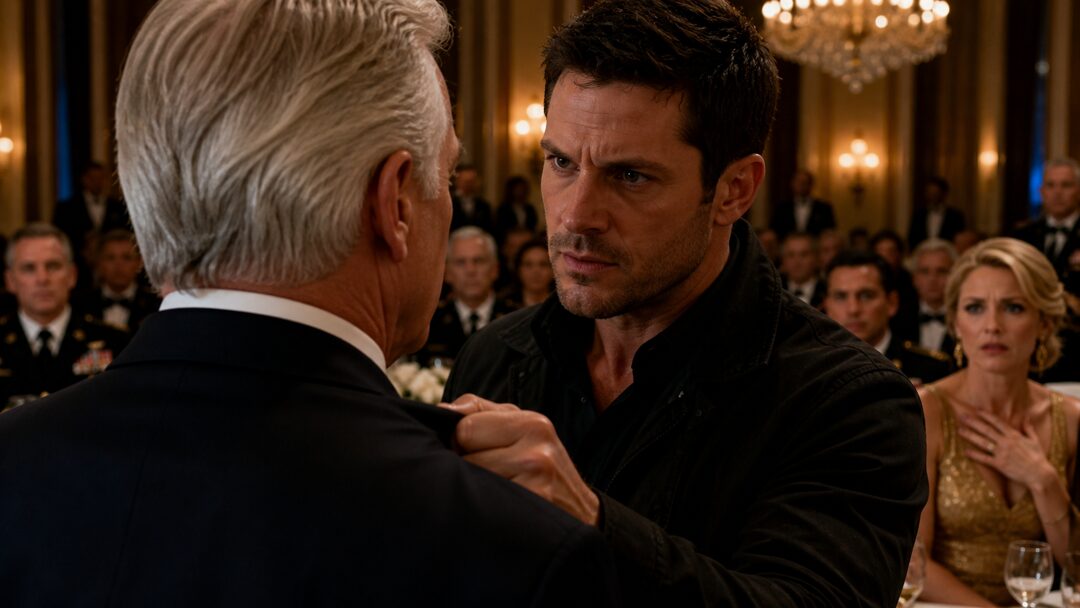
Then Daniel stepped behind him.
He wore black, not formal enough for the room, his dark hair damp from the rain outside. He smelled of wet wool and cold air. He leaned close enough that only Robert heard the first sentence.
“Tell them what was in the envelope.”
Robert did not turn.
The applause thinned.
Daniel’s hand landed on his shoulder.
Not hard at first. Just visible. Just wrong.
Robert felt the room catch it. A donor stopped mid-clap. A woman’s bracelet clicked against her glass. Someone at the back whispered Daniel’s name as if saying it softer might make him vanish.
Robert said quietly, “Take your hand off me.”
Daniel’s grip tightened.
He turned Robert toward the room.
It was not a shove. It was worse than that. It was intimate. Familiar. A subordinate correcting the posture of a commander in front of everyone who still believed commanders could not be touched.
Lisa stood.
“Daniel,” she said, uncertain.
Daniel did not look at her.
He looked at Robert.
“Ask him why the convoy never came.”
The silence fell all at once.
Robert felt it settle on his shoulders beside Daniel’s hand.
A foundation security aide started forward. Daniel reached into his jacket and pulled out a brown field envelope, creased, old, soft at the corners. Its faded markings were too worn to read from across the room.
Robert saw it anyway.
His pulse hit once, hard.
Daniel smiled without humor. “You remember it.”
“I don’t know what you think you have,” Robert said.
His voice was calm. That was old training. Calm could cover a lot if people wanted to believe it.
Daniel stepped closer.
“You signed for it the night twelve men were waiting at Relay Station Three.”
Robert’s fingers went cold.
Around them, the guests had become statues. The chandelier light made every face look polished and cruel, though most of them were only confused.
Robert leaned toward Daniel and spoke through his teeth. “You’re embarrassing men who died with honor.”
Daniel’s face changed.
Not anger first.
Pain.
“The dead weren’t honored,” he said. “They were used.”
The words reached the nearest tables.
Lisa’s face lost color.
“Robert?” she said.
Robert held out his hand. “Give me that.”
Daniel slapped the envelope into his palm.
The room watched Robert not open it.
That was when the evening turned.
Not when Daniel grabbed him. Not when the accusation landed. When Robert took the envelope and crushed it slightly in his fist, as if the paper itself could be made to obey.
A man near the podium said, “General, should we—”
“No,” Robert said. “No one move.”
Daniel leaned in once more.
This time he did not whisper.
“If it means nothing,” he said, “open it.”
Robert looked at the envelope.
Then at Daniel.
Then at the room that had stood for him less than a minute ago.
“I need air,” he said.
He walked out before anyone could decide whether to follow.
Part II — The Corridor
The hallway outside the dining room was lined with portraits of men in dress uniforms and oil-painted restraint.
Robert passed them without looking.
Behind him, the hall doors opened.
Lisa followed first. Her heels struck the marble fast, then stopped when she saw the envelope still in his hand.
“Robert.”
“Go back inside.”
“No.”
He kept walking.
She caught his arm near a side table arranged with flowers and folded programs. “What did Daniel mean?”
“Daniel has been unwell for years.”
“That isn’t an answer.”
“Grief makes people cruel.”
Lisa looked through the half-open dining room doors. Daniel stood inside now with two security aides near him, not touching him yet. He was not shouting anymore. Somehow that made him look more dangerous.
“Why did he have that?” Lisa asked.
Robert looked down.
The envelope sat in his fist like a small animal he had meant to kill but only injured.
“I don’t know.”
“You recognized it.”
“No.”
“Robert.”
He turned on her faster than he meant to. “You don’t know what men bring home from places like that.”
Her face hardened, but her voice stayed low. “Then tell me.”
He almost did.
That was the terrible thing.
For one second, standing beneath a portrait of a general dead for sixty years, Robert wanted to hand Lisa the whole weight of it. Relay Station Three. The call. The storm. The delegation trapped on the low road. Daniel’s brother, Brian Reed, barely twenty-three, laughing the day before because the station coffee tasted like melted tires.
Then the want passed.
He had buried the story too deeply to uncover it in a hallway beside flowers.
“Operation Glass Harbor was chaos,” he said. “Daniel wants someone to blame.”
Lisa’s eyes moved to the envelope.
“Then why are you still holding it?”
Robert had survived briefings, withdrawals, congressional hearings, and two decades of men trying to catch him in contradiction.
He had no answer for his wife.
The dining room doors opened wider.
Daniel stepped out between the aides, but he shook them off before they could guide him anywhere.
“Don’t make it neat,” Daniel said.
Robert turned.
Daniel looked younger in the hallway light. Not young, exactly. Just unfinished by grief.
“You always do that,” Daniel said. “You take ugly things and put a clean border around them.”
“Enough.”
“No. Not tonight.”
Lisa looked between them. “What happened?”
Daniel’s eyes flicked to her. For a moment, Robert saw regret there. Then it was gone.
“Your husband received an extraction request,” Daniel said. “My brother’s unit was pinned at the relay station. They were alive when command canceled the convoy.”
Lisa’s hand dropped from Robert’s sleeve.
Robert said, “That is not what happened.”
Daniel’s laugh was quiet and empty. “Then open the envelope.”
The security aides shifted.
Robert lifted one finger without looking at them. They stopped.
That small obedience disgusted him suddenly.
Daniel saw it too.
“All these people,” Daniel said. “Still waiting for your hand to tell them what truth is.”
Robert stepped close enough that Lisa drew in a breath.
“You don’t know what command costs.”
Daniel did not step back. “I know what your silence cost.”
The hall doors opened again. A donor peered out, then withdrew. The story was already moving through the dinner like smoke under a door.
Robert looked toward the side entrance that led to the terrace and the long driveway beyond.
He needed the cold.
He needed distance from Daniel’s eyes.
He needed one moment where no one watched his face.
He turned and pushed through the terrace door.
Rain had turned the stone steps slick. The night outside was blue-black and sharp, the mansion behind him glowing like a promise he no longer believed in.
Robert walked into it with the envelope in his hand.
Part III — The Envelope
The driveway lights reflected in the wet stone.
Beyond the gate, several cars idled in the dark, their shapes blurred by rain and distance. Robert noticed them, then looked away.
He stood under the portico and finally opened the envelope.
His hands were steady.
That frightened him more than shaking would have.
Inside were three things.
A folded extraction request.
A photograph.
A cracked memory card.
Robert did not touch the memory card first. He touched the request because he already knew what it would say. Some part of him had known from the moment Daniel walked in.
The paper had softened at the folds. The ink had faded, but the essentials remained.
Relay Station Three.
Twelve personnel.
Transmission active.
Extraction requested.
His initials sat at the bottom.
R.H.
Small. Efficient. Damning.
The rain clicked against the stone beyond the roofline.
Robert unfolded the photograph next.
A dozen men stood in desert light beside a low concrete wall. They were squinting, grinning, bored, alive. Daniel stood at one end, younger, hand raised to block the sun. Beside him was Brian Reed, one arm slung over another man’s shoulder, mouth open in mid-laugh.
There were names written on the back.
Not ranks.
Names.
Brian had written them, Robert knew somehow. The letters had that careless confidence of men who believed they would have time to write better later.
The mission returned in pieces.
A map covered in grease pencil.
A radio operator saying the weather was closing.
A civilian delegation trapped near the low road, their security detail already compromised.
A staff officer asking if Robert wanted to split the convoy.
Someone saying Relay Station Three was still transmitting.
Robert had stood over the table for fourteen seconds.
He remembered the number because afterward, when sleep would not come, his mind gave him that measurement as punishment.
Fourteen seconds to decide who moved and who waited.
Fourteen seconds to become the man everyone praised.
He sent the convoy to the low road.
The delegation lived.
The relay station went silent before dawn.
That was the official story.
Not the whole story.
The whole story was that the relay station had not been silent when he chose. The whole story was that he had known the request reached him. The whole story was that after the inquiry, when language like “uncertain conditions” and “communications failure” and “unrecoverable position” began to form around the dead, Robert had not corrected it.
At first, he told himself the lie protected morale.
Then families.
Then national confidence.
Then the memory of the men.
Eventually, it protected only him.
The terrace door opened.
Lisa stepped out, pulling a wrap around her shoulders. Her gold dress looked wrong in the rain-dark air.
She saw the photograph in his hand.
“What is that?”
Robert did not answer.
She came closer and looked.
Her eyes moved over the young men in the picture. Then to the names.
“Daniel’s brother?”
Robert touched one name with his thumb.
“Brian.”
Lisa looked at him. “Was Daniel telling the truth?”
Robert folded the extraction request once. Then again. Too neatly.
“I made the call.”
“That isn’t what I asked.”
He looked toward the gate.
The cars were still there.
“It was a collapsing field,” he said. “Routes were compromised. We had a civilian delegation trapped. If I split the convoy, we could have lost everyone.”
Lisa’s voice was soft. “But they were alive.”
Robert closed his eyes.
Behind his eyelids, he heard the radio again.
Relay Three still transmitting.
He opened his eyes.
“Yes.”
Lisa’s wrap slipped from one shoulder. She did not fix it.
“You told me they were gone before you knew.”
“I told everyone that.”
“Why?”
The answer was too large and too small at once.
Because the country needed a clean story.
Because men like him were rewarded for certainty.
Because twelve names could ruin a thousand speeches.
Because he had survived the decision and could not bear to survive the truth too.
Lisa looked at the mansion windows. Guests had gathered behind the glass, their silhouettes floating in warm light. Watching.
She turned back to Robert.
“Then why did you let them call you a hero for it?”
He had no defense against that.
Not from her.
Not from anyone.
His phone vibrated.
The screen showed an unknown number.
Robert stared at it until it almost stopped. Then he answered.
A woman’s voice came through, thin against the rain.
“General Hayes?”
He did not speak.
“This is Mary Keller.”
The name moved through him before the memory did.
Keller. Relay Station Three. Another name on the back of the photograph.
“We’re at the gate,” she said. “Captain Reed said you might finally be ready to answer us.”
Robert looked toward the headlights beyond the iron bars.
They were not waiting cars.
They were arrivals.
Part IV — The Gate
For a moment, Robert thought of running back inside.
It was not fear of the families that moved through him first. It was habit.
Inside, there were people trained in containment. Foundation aides. Retired officers. Men who understood how to take a raw thing and wrap it in procedure until it stopped bleeding in public.
One controlled statement, and Daniel would become unstable.
One careful reference to classified circumstances, and the envelope would become disputed.
One expression of sorrow, and Mary Keller might be turned into someone too emotional to be reliable.
Robert knew exactly how to save himself.
That knowledge was the ugliest thing in him.
The terrace door opened again.
This time Daniel stood there, rain already darkening the shoulders of his black shirt. The aides remained inside behind him, uncertain whether authority still belonged to Robert.
Daniel’s face no longer held the heat from the dining room.
He looked tired.
Older.
“I didn’t bring them here to watch you get dragged,” Daniel said.
Robert almost laughed. “You grabbed me in front of three hundred people.”
“I wanted the room to stop protecting you.”
Lisa stood between them, silent.
Daniel stepped into the rain. “I don’t want your dinner. I don’t want your foundation speech. I don’t even want your medals taken down.”
“What do you want?”
Daniel looked toward the gate.
“My brother’s name in your mouth,” he said. “In front of his mother. And the truth after it.”
Robert looked at the photograph.
Brian Reed. Keller. Markham. Ellis. Twelve names in faded ink.
“They’ll hate me,” Robert said.
Daniel’s expression did not change. “Some of them already do.”
A foundation chairman hurried onto the terrace, holding an umbrella no one had asked for.
“General,” he said carefully, “we can still manage this. Come inside. We’ll issue a statement about an unfortunate emotional disruption. Mr. Reed will be escorted out quietly. There is no need for this to unfold in front of—”
Robert looked at him.
The chairman stopped.
For years, Robert had heard men like that finish sentences for him. Helpful sentences. Useful sentences. Sentences that built walls.
No need for this to unfold in front of guests.
No need to reopen old wounds.
No need to damage public trust.
No need to put names where abstractions work better.
At the gate, one car began to move forward.
Then another.
Headlights swept over the wet drive.
Lisa took one step back from Robert.
Not away completely.
Just enough to leave him standing by himself.
He felt that inch of distance more sharply than Daniel’s hand on his jacket.
“You don’t have to forgive me,” Robert said to Daniel.
Daniel’s jaw tightened. “I wasn’t planning to.”
The first car stopped near the base of the steps.
The driver’s door opened. Then the passenger door.
Mary Keller stepped out in a plain dark coat, holding an old folded program against her chest. She did not look like a woman arriving to accuse a famous man. She looked like a woman who had already spent years asking questions into rooms designed not to hear her.
Behind her, others emerged from the cars.
A father with a cane.
A sister Robert recognized from a memorial photo.
A man in a work jacket, face set hard against whatever he had promised himself he would not feel.
The mansion doors opened behind Robert.
Guests drifted out into the covered entry. No one spoke loudly now. No one laughed.
The warmth of the dining hall stayed behind the glass.
The cold had everyone.
Mary Keller stopped a few steps away.
Her eyes went to the envelope.
Then to Robert’s face.
“You have my son’s answer in there?” she asked.
Robert held the envelope with both hands.
He had spoken before crowds larger than this. He had briefed presidents, senators, generals, reporters who wanted blood and mothers who wanted comfort.
He had never felt less able to begin.
Daniel came to stand beside Mary, not touching her. He looked at Robert once.
Not with rage now.
With a question.
“Was Brian alive,” Daniel asked, “when you canceled the convoy?”
The rain answered first.
Then the driveway.
Then the whole house seemed to lean toward Robert and wait.
Part V — The Names
Robert could have said conditions were unclear.
He could have said command acted on the best intelligence available.
He could have said sacrifice always looked different after the fact.
All of those sentences were true enough to hide inside.
He opened the envelope instead.
The paper stuck slightly when he unfolded it. Rain touched the edges. The ink blurred at one corner, but not where his initials were.
“Relay Station Three requested extraction at 0217,” he said.
His voice sounded strange outside. Smaller than it did in halls.
No one moved.
Robert read the coordinates, then stopped himself. Coordinates were not what they had come for.
He looked at Mary.
“Your son was alive when this reached my table.”
Mary’s face did not change.
That was worse than if she had cried.
Robert looked down at the photograph.
“Brian Reed,” he said.
Daniel’s eyes closed for half a second.
“Thomas Keller.”
Mary’s hand tightened around the folded program.
“Matthew Ellis. John Markham. David Price. Christopher Hale. Steven Walsh. Anthony Miller. Paul Grant. Joseph Turner. Andrew Cole. William Barrett.”
The names did not echo.
They simply entered the night and stayed there.
Robert lowered the photograph.
“I chose to send the convoy to the low road,” he said. “There was a civilian delegation trapped there. The route to the relay station was dangerous. I believed splitting resources could cost more lives.”
An older man with a cane said, “Did you know they were still transmitting?”
Robert swallowed.
“Yes.”
The word hit harder than all the names.
Someone behind him made a sound. A guest, maybe. Or Lisa.
Robert did not turn.
Mary Keller looked at him as if measuring the distance between the answer she had wanted and the answer that had arrived too late.
“Why did the report say communication failed before the decision?”
Robert held the empty envelope open. The memory card slid into his palm.
“Because I let it.”
Daniel stared at him.
Robert looked at the mansion windows. The donors stood behind glass, faces pale in chandelier light. Men who had applauded him minutes earlier now watched as if applause were something they had been tricked into giving.
Robert turned back to Mary.
“I did not kill your sons with a clean hand,” he said. “And I did not honor them with a clean story.”
The father with the cane looked away.
Lisa covered her mouth.
Daniel’s face tightened, but he did not speak.
Robert forced himself to finish.
“I chose who the country would see me save.”
There it was.
Not the whole truth. There was no whole truth large enough for twelve families. But it was the first honest sentence Robert had given them without rank standing between.
Mary Keller stepped closer.
For one terrible moment, Robert thought she might strike him.
Instead, she held out her hand.
“The photograph,” she said.
Robert looked down at it.
Brian Reed’s handwriting had survived what Robert’s speeches had not.
He gave the photo to Daniel first, because Daniel had carried the anger here.
Daniel looked at it, touched his brother’s name, then passed it to Mary.
She held it carefully, not like evidence.
Like something returned from a long distance.
“Thank you,” she said.
Robert flinched.
Mary saw.
Her voice hardened. “Not for you.”
The line settled over him with more force than accusation.
Behind him, the foundation chairman whispered to someone about privacy. Another guest began to cry quietly. A retired colonel walked back inside without looking at Robert.
Lisa stood near the terrace door.
She had not left.
She had not come closer.
Robert understood that both were choices.
Daniel looked at him one last time. The fury in him had not vanished, but it had changed shape. It no longer needed Robert’s collar.
“What now?” Robert asked, though he did not know whom he was asking.
Mary folded the photograph against her chest.
“Now,” she said, “you answer the rest.”
Part VI — The Empty Paper
The dinner ended without anyone announcing it.
Guests left through side doors. Cars rolled down the drive in embarrassed silence. The tribute video inside the hall kept playing for several minutes after the room had emptied, younger Robert lifting his hand in grainy footage to salute people who could no longer correct him.
No one remembered to turn it off.
Lisa stayed until the families moved inside to sit in a smaller room away from the rain. She touched Robert’s sleeve once, lightly, as if testing whether the man inside the suit was someone she knew how to reach.
“I can’t stand beside the version of you they toasted tonight,” she said.
Robert nodded.
She waited.
Maybe for him to defend himself.
Maybe for him to ask her not to go.
He did neither.
After a moment, she went inside.
Daniel remained on the terrace steps.
The rain had slowed to mist. Without anger moving him, he looked exhausted enough to fall.
“You got what you wanted,” Robert said.
Daniel turned his head. “No.”
Robert knew better than to ask.
Daniel answered anyway.
“I wanted him back when I was twenty-eight. I wanted my mother to stop waiting for reports written by people who never had to read them twice. I wanted to stop being the crazy one at every memorial dinner.”
He looked at the closed doors.
“Tonight was just what was left.”
Robert folded the empty envelope once.
It no longer felt dangerous.
That was almost worse.
“What happens to me?” he asked.
Daniel gave a tired laugh. “You still think that’s the center of it?”
Robert looked at him.
Then, for the first time that night, he understood the answer was no.
Inside, Mary Keller sat at a long table with the photograph in front of her. Other families gathered around it, touching names, asking questions, arguing over details, falling silent in turns. Robert could see them through the glass.
They were not healed.
They were not satisfied.
They were no longer waiting outside the story.
That had to be enough for one night.
Robert walked back toward the mansion doors.
At the threshold, he stopped beside Daniel.
“I should have said their names years ago.”
Daniel did not look at him. “Yes.”
No forgiveness.
No absolution.
Only accuracy.
Robert accepted it because it was more mercy than he deserved.
He entered the small room with the empty envelope in his hand.
The conversations stopped.
Mary Keller looked up.
Robert did not sit at the head of the table. He did not stand by the fireplace or beneath the foundation portrait. He took the plain chair nearest the door.
For years, rooms had arranged themselves around him.
This one did not.
Mary unfolded the extraction request and placed it on the table between them.
“Start at the beginning,” she said.
Robert looked at the names on the back of the photograph.
Then at the families.
Then at the empty envelope that had finally stopped protecting him.
He began again, not to be forgiven, not to be understood, but because the lie no longer belonged only to him.
Outside, the mansion lights shone across the wet driveway until morning, bright enough for everyone leaving to see the road.