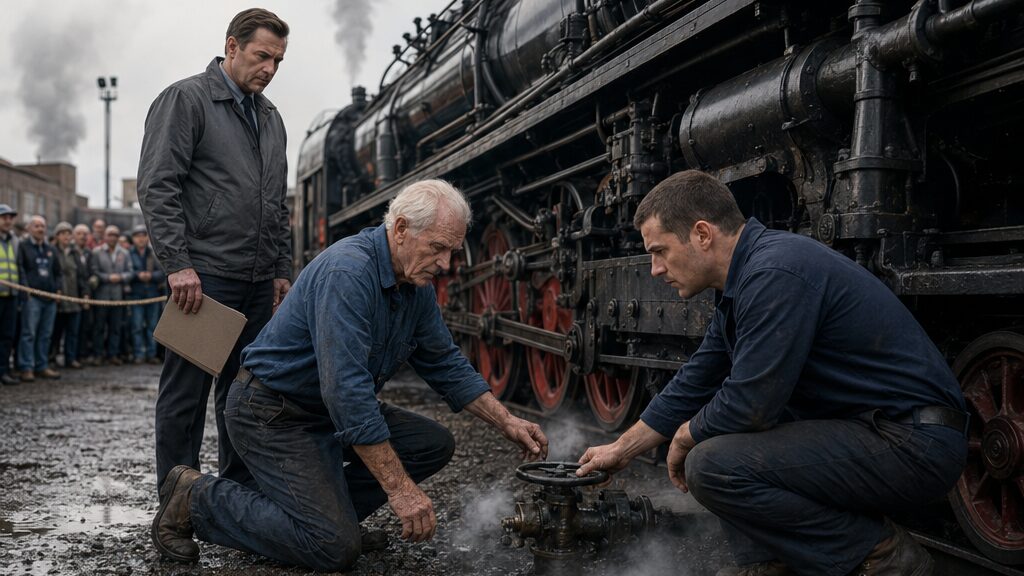
They Told the Old Veteran to Step Away Until the Steam Engine Answered Him
Chapter 1: The Old Man Who Heard the Engine First
Dennis Bennett heard the wrong sound before anyone else noticed the steam.
It came from the low side of the locomotive, not from the whistle, not from the stack, not from the polished brass gauge Jacob Carter had been tapping with one knuckle all morning. It was a soft, uneven breath near the left running board, almost hidden beneath the clang of tools and the chatter of volunteers setting up ropes along the gravel.
Hiss.
A pause.
Hiss-hiss.
Dennis stopped with one boot on the rail and one on the gravel. His right knee complained first, then his hip, then the old scar beneath his ribs that never liked damp mornings. He let the pains speak and then pass. Pain had never been useful as an order. It was only information.
The black locomotive sat in front of him like a sleeping animal pretending not to dream. Its boiler jacket had been buffed dark enough to reflect the pale morning sky in broken stripes. Red paint trimmed the wheels. Pipes ran along the side in careful iron lines. At the edge of the crowd area, a banner snapped in the spring wind: FIRST STEAM DAY—WELCOME BACK OLD 97.
Dennis did not care for the banner. Not because it was wrong, but because it made the engine sound like a memory instead of a machine.
A child beyond the rope pointed at the smoke rising from the stack. A volunteer in a museum vest told the family to come back at one o’clock for the first demonstration. Somewhere near the depot platform, Emma Miller was speaking to a donor with both hands folded tight around a paper cup of coffee.
Dennis looked past all of it.
Hiss.
A pause.
Hiss-hiss.
He moved toward the low side valve.
“Mr. Bennett?”
Jacob’s voice came from behind him, polite enough to be called polite and firm enough to mean stop.
Dennis rested his palm against the locomotive’s side ladder, feeling the tremor travel through old metal. “She’s talking wrong.”
Jacob came down from the inspection platform with his clipboard tucked under one arm. He was thirty-something, clean-shaven, strong in the shoulders, his navy work shirt still crisp though the rest of the crew already smelled of coal dust and oil. He had the look of a man who had stayed late the night before and arrived early enough to make sure everyone knew it.
“The pressure’s within range,” Jacob said. “We’re still warming through.”
Dennis did not answer immediately. He bent as far as his back allowed and watched a thin ribbon of vapor slide from beneath the valve housing. It did not come steadily. That was what bothered him. Steam told the truth if a man let it finish its sentence.
Hiss.
A pause.
Hiss-hiss.
Jacob glanced toward the visitors gathering near the viewing rope. “We’ve got families coming in already. Daniel Reed will be here any minute for the city walk-through. I need the area clean.”
Dennis straightened slowly. “How many turns did you give the drain cock?”
“According to procedure.”
“That’s not a number.”
Jacob’s jaw tightened, then relaxed into the kind of smile younger men used when they remembered they were speaking to an old volunteer. “Two and a quarter. Same as the restoration manual.”
Dennis nodded once. He knew the manual. He had helped argue over two of its pages fifteen years ago, though most of the current crew thought his main contribution to the museum was sweeping the shop and telling school groups not to climb the coupler.
“Manual was written for a dry morning,” Dennis said.
Jacob looked at the gravel under their feet. It had rained overnight. Water still darkened the ties beneath the locomotive.
“We accounted for condensation.”
“Not all of it.”
One of the volunteers called Jacob’s name from the far side. A compressor coughed. The locomotive gave a low metal tick as heat moved through it. Dennis waited for the next breath.
There.
Hiss.
Pause.
Hiss-hiss.
He felt it in his teeth.
Dennis had learned machines first in the Army, though he rarely said so unless someone asked him directly. Not tanks, not airplanes, nothing that looked impressive on a museum plaque. He had learned generators, field pumps, rail equipment that groaned through mud with bad seals and tired men depending on them. Later, after his discharge, he had learned steam on tourist lines and restoration crews, under old railroaders who cursed quietly and listened better than church deacons.
A machine under pressure did not care how many people were watching. It did not care who signed the checklist. It only cared whether the person touching it understood what had changed since the last time.
Jacob flipped a page on his clipboard. “Mr. Bennett, we’re not ignoring you.”
Dennis almost smiled at that. It was a sentence people used exactly when they were ignoring someone.
“I didn’t say you were.”
“You’re welcome to observe. You know that. But live steam work has to stay with the approved crew today. Insurance is watching us hard, and Emma’s got the board here.”
Dennis looked toward Emma. She stood near the depot steps in a blue blazer, her hair pinned back, nodding while a man in a tan jacket spoke with the lazy confidence of someone who gave money and expected gratitude for every dollar. Emma’s smile was steady, but her eyes kept finding the locomotive.
The museum needed this day. Everybody knew it and pretended they did not. The winter storm had torn half the roof from the storage shed. A grant had stalled. The county had hinted that the land might be more useful as parking if the museum could not prove it still brought people in. Old 97 was not just an engine today. It was a petition made of iron.
Dennis understood why Jacob was nervous.
That did not change the hiss.
He took one step closer to the valve.
Jacob moved with him. “Sir.”
The word landed softly and still managed to build a fence.
Dennis took his hand away from the side ladder. He looked at his fingers. Oil had found the cracks around his nails though he had not touched anything dirty yet. He rubbed his thumb over the black crescent and remembered another morning, another machine breathing wrong, another young man saying the numbers were fine.
He pushed that away.
“Tell me what you hear,” Dennis said.
Jacob blinked. “What?”
“The hiss. Tell me the count.”
Jacob’s eyes flicked toward the valve, then toward the platform where visitors were starting to gather in thicker clusters. He listened for half a second, maybe one whole second, but his attention was full of the morning. Full of lists. Full of people.
“It’s venting,” Jacob said. “That’s what old steam does.”
Dennis nodded again. That answer told him enough.
Behind them, a white city vehicle rolled through the open gate and crunched over the gravel. Daniel Reed stepped out in a gray jacket with a folder under his arm. Emma left the donor so quickly her coffee almost spilled.
Jacob’s posture changed. Shoulders back. Clipboard higher.
“Please stay clear of the running gear until we finish inspection,” he said.
Dennis looked once more at the low valve. The vapor had thinned. That was worse, not better.
Hiss.
Pause.
Hiss-hiss.
He stepped back.
Not because Jacob was right. Not because the machine had stopped speaking. Because a warning given too loudly became a performance, and Dennis had no use for performance. If he was going to be useful today, he needed to remain the kind of old man people forgot to watch.
Jacob softened his voice. “I appreciate you keeping an eye out.”
Dennis lifted his gaze to him. “Don’t appreciate it. Check it.”
For the first time that morning, irritation showed plain on Jacob’s face.
“Mr. Bennett, we’ve checked it.”
Dennis looked at the locomotive’s black side, the red wheel beneath it, the small valve sitting low enough that a man had to kneel in the gravel to reach it properly. Then he looked at the rope where children were leaning forward, their faces bright with the simple trust of people who believed adults knew what they were doing.
“All right,” Dennis said.
Jacob turned away, already answering Daniel Reed’s first question before the inspector had reached the platform.
Dennis remained where he was for another moment. The old locomotive breathed. The gravel shifted under his boots. Steam curled and vanished.
He counted under his breath.
“One.”
Hiss.
“Two.”
Pause.
“Three.”
Hiss-hiss.
His hand hovered at his side, fingers remembering the valve before touching it.
“That valve is talking wrong,” he said.
Jacob did not turn around. “Please don’t start.”
Chapter 2: A Checklist Can Miss a Whisper
Jacob Carter had built the morning around control.
Clipboards did not forget. Gauges did not get sentimental. Checklists did not wander into stories about how things used to be done before anybody had a liability form. That was why Jacob liked them. A line either had a check mark or it did not. A pressure reading either sat within tolerance or it did not. A volunteer either stayed behind the rope or became a problem.
By ten-thirty, the rail yard had become a hundred small problems pretending to be celebration.
A family tried to cross the rope for a photograph. The temporary speaker system cut in and out with a dry crackle. One of the volunteer crew misplaced the wrench used for the injector cover. A board member wanted to know whether the locomotive would move exactly at one or closer to one-fifteen, because the local reporter had another assignment.
Jacob answered each question with the same calm he had practiced in the mirror of the shop bathroom that morning.
“Yes, we have that handled.”
“No, visitors can’t stand past the rope.”
“Yes, the safety inspection is part of the schedule.”
“No, the steam release is normal.”
The last answer he gave twice, and both times he felt Dennis Bennett somewhere behind him like a draft under a door.
Daniel Reed walked slowly along the inspection platform, making notes in a folder that looked too clean for a rail yard. He was not unfriendly. That almost made him worse. A hostile inspector could be dismissed later in stories. A calm one had to be answered.
“Crew certification?” Daniel asked.
Jacob opened the folder clipped beneath his top page. “Here. Fireman, engineer, ground crew. All current for demonstration operation.”
“Volunteer boundaries?”
“Roped. Posted. Staffed at four points.”
“Emergency shutoff briefing?”
“Completed at eight-forty.”
Daniel glanced at Old 97. “And the gentleman in the blue shirt?”
Jacob did not need to ask which gentleman.
“Dennis Bennett. Longtime volunteer. Retired rail mechanic. He won’t be operating today.”
Daniel’s pen paused. “He was inside the marked service area when I drove in.”
“He was leaving it.”
“Didn’t look like leaving.”
Jacob felt heat rise under his collar, though the morning wind remained cool. He could see Emma at the edge of the depot steps, pretending not to listen while absolutely listening.
“I’ve spoken with him,” Jacob said. “It won’t be an issue.”
Daniel looked over the top of his folder. “Make sure it isn’t. I don’t like unauthorized hands near live steam, especially not when cameras are out.”
Cameras. That was the word Jacob hated most today.
The museum had begged for attention all winter. Now that attention was here, every wrong angle felt dangerous. A photograph of Old 97 rolling under steam could save them. A photograph of an elderly volunteer burned beside the engine could finish them by supper.
Jacob glanced toward Dennis.
The old man stood by the tool cart, not touching anything. His blue shirt was tucked into light work pants, and his white hair lifted slightly in the wind. He looked smaller away from the locomotive. Not weak exactly, but breakable in the way older men became when they stood still too long. One hand rested against his thigh as if steadying a knee.
Jacob remembered seeing Dennis in old museum photos, always near machinery, always with his sleeves rolled. In some pictures he was not old at all. In others he was becoming old but had not yet admitted it. There was one in the crew room where he stood beside the boiler after a repaint, face smudged black and grinning so hard Jacob had barely recognized him.
That was the trouble. Everyone at the museum loved Dennis as proof of continuity. They just did not want him under pressure anymore.
Jacob had arrived three years earlier with a diesel maintenance background and a certificate in heritage mechanical operations that cost him more than his first car. He had been hired after two longtime volunteers aged out at once and the museum realized affection could not schedule a safe crew. Jacob respected old knowledge. He did. But old knowledge came wrapped in old habits, and old habits did not always write things down.
He checked the main pressure gauge again.
Within range.
Water level proper.
Fire steady.
Cylinder cocks tested.
Drain sequence completed.
He had done the work.
From the side of the engine came a faint hiss.
Jacob heard it this time because he was trying not to.
He looked down at his clipboard, then up at the gauge. The numbers held.
Daniel noticed the glance. “Problem?”
“No. Normal venting while she warms through.”
“Old equipment?”
“Old design,” Jacob said, a little too quickly. “Maintained equipment.”
Daniel wrote something.
Emma crossed toward them with the careful walk she used when gravel threatened her shoes but donors were nearby. “How are we looking?”
“On schedule,” Jacob said.
Daniel said nothing.
Emma’s eyes moved between them. She was good at reading silence. Museum directors had to be. “Daniel?”
“So far, documentation is fine. I’ll need to observe the next steam release and crew response.”
“Of course.”
“And I’d prefer nonessential volunteers outside the service boundary.”
Emma followed his gaze to Dennis.
Her expression changed, just a little. Jacob saw affection first, then worry, then calculation. He did not envy her. Dennis had been here before Emma took the job, before Jacob knew the place existed. He had fixed windows, painted benches, donated old tools, led Veterans Day tours when his hip allowed, and once slept in the depot overnight during a freeze because a pipe had burst near the archive room.
But this was live steam, public attendance, city inspection, donor money, insurance riders, and one bad video away from closure.
Emma walked to Dennis. Jacob could not hear the first part, but he saw Dennis turn his head toward the locomotive instead of toward her. Emma touched his sleeve. He looked at her then.
Jacob wished Dennis would make it easier. Laugh. Wave a hand. Say he was only fussing. Instead, the old man listened past Emma while she spoke to him.
The hiss came again.
Hiss.
Pause.
Hiss-hiss.
Jacob’s pencil stopped above the checklist.
There was a rhythm to it. He heard that now. But machines made rhythms all the time. Water moving through cooling pipes. Metal expanding. A loose fitting singing under heat. If a man treated every sound as prophecy, nothing would ever run.
He marked the line: SIDE VENTING OBSERVED—NORMAL WARMING.
The pencil lead pressed hard enough to shine.
A volunteer approached with the missing injector wrench. “Found it behind the coal bin.”
“Good,” Jacob said. “Set it on the cart. Not on the running board.”
“Dennis says that side valve—”
Jacob looked up.
The volunteer stopped.
“What did Dennis say?”
“Nothing. Just that maybe we ought to—”
“We’ve got it.”
The volunteer nodded and retreated.
Jacob exhaled through his nose. He did not like snapping at people. He liked it even less when the person deserved a better answer. But every mention of Dennis’s warning made the morning feel less like an operation and more like a vote. On one side: the checklist, the inspection, the crew. On the other: an old man’s ear.
Daniel stepped closer to the low side, careful to remain outside the marked line. “You mind opening that panel after the next cycle?”
“We can,” Jacob said. “But the valve housing was checked yesterday.”
“Then checking again shouldn’t hurt.”
Before Jacob could answer, Emma returned.
“I asked Dennis to observe from the visitor side during the public cycle,” she said quietly.
Jacob should have felt relieved. Instead, he looked over and saw Dennis standing behind the rope now, among visitors and folding chairs, his hands clasped behind his back.
That was where the public belonged.
That was not where Dennis belonged.
The thought irritated Jacob because he had no clean place to put it.
A whistle of wind moved coal smoke across the platform. The locomotive ticked and breathed. On the pressure gauge, the needle held steady. On the checklist, every important line was marked.
From low on the engine came the whisper again.
Hiss.
Pause.
Hiss-hiss.
Daniel turned his head slightly.
Jacob spoke before the inspector could.
“It’s venting.”
Daniel looked at him. “I didn’t ask.”
Jacob kept his eyes on the gauge. The needle did not move.
At the rope, Dennis Bennett lowered his chin, as if counting something no one else had agreed existed.
Chapter 3: When the Steam Burst Around His Hands
Dennis waited until the machine asked a third time.
He had been good at waiting once. Waiting under canvas while rain drilled the dirt flat. Waiting beside stalled equipment with a wrench in his hand and a lieutenant demanding an answer no machine could give faster than it gave it. Waiting for men younger than him to stop speaking long enough to hear the thing that would save them work, time, or skin.
Age had made waiting harder in some ways. His body punished stillness. His left hand stiffened if he kept it closed too long. His back preferred motion until it suddenly preferred nothing at all. But the part of him trained by pressure and consequence remained patient.
Old 97 breathed again.
Hiss.
A pause.
Hiss-hiss.
Across the rope, Jacob and Daniel stood shoulder to shoulder near the inspection platform. Emma hovered a few steps behind them. The donor in the tan jacket had returned with two board members and a local reporter carrying a small camera. Visitors lined the rope, drawn by the smoke and the promise that something old would move.
Dennis watched the valve.
Not the polished handrail. Not the bright wheel rims. Not the gauge Jacob kept checking as though numbers were the only language worth believing.
The valve.
A little moisture had gathered beneath the housing, darkening the grime in a crescent shape. That had not been there ten minutes before. The crescent was small enough to be missed by anyone standing upright.
A child near Dennis tugged on a sleeve. “Is it going to blow the whistle?”
“Not yet,” Dennis said.
“Do you drive it?”
“No.”
“Did you used to?”
Dennis looked at the locomotive. “I used to listen to things that could hurt people.”
The child frowned, not sure whether that was an answer.
A sharper hiss cut from the low side of the engine. Several visitors turned their heads. Jacob did too, though he tried to make it look casual.
Dennis saw the moment arrive. Not the crisis. Not yet. The invitation.
He unclasped his hands from behind his back and stepped under the rope.
“Dennis,” Emma called softly, but her voice had a public edge in it.
He kept walking.
The gravel shifted treacherously under his boots. He took his time because hurrying would give them the wrong argument. A hurried old man was a danger. A deliberate one was harder to dismiss, though not impossible.
Jacob moved fast from the platform. “Mr. Bennett, stop right there.”
Dennis stopped three feet from the valve. Steam curled around the running board and vanished.
“Need to ease that housing,” Dennis said.
“No, you need to step back.”
“It’s holding wet.”
Jacob’s face flushed. “The pressure is stable.”
“The pressure up top is stable.”
Daniel Reed came closer, folder tucked under one arm now. “Sir, this is an active service area.”
Dennis looked at him once. “Yes.”
“You are not listed on the operating crew.”
“No.”
“Then you cannot be inside the boundary.”
Dennis nodded, accepting the facts as facts. “Then one of you do it.”
Jacob’s grip tightened around the clipboard. “Do what?”
Dennis pointed to the low valve. Not dramatically. Just enough. “Wait for the third breath. Crack it an eighth. No more. Let it spit, not sing.”
The phrase made Jacob’s mouth flatten. Dennis could see him hearing it as old-timer poetry instead of instruction.
Daniel said, “That is not in the procedure you submitted.”
“No,” Dennis said. “It’s in the engine.”
A few visitors murmured. The reporter lifted the camera slightly.
Emma stepped between the public and the men, not blocking the view, just softening it. “Dennis, please. We can talk about this inside.”
The old familiar tiredness moved through him then. Not physical tiredness. Something deeper. The weariness of making a true thing small enough for other people to accept. He had done it with officers. With doctors. With his own grown relatives after his wife died and they began speaking to him in gentle tones as if grief had made him simple.
He looked at Jacob.
The young man was not cruel. That mattered. Cruel men were easy to resist. Worried men with responsibility in their hands could do more damage because they believed they were preventing it.
“Jacob,” Dennis said, keeping his voice low, “you hear the double at the end?”
Jacob looked at the locomotive despite himself.
Hiss.
Pause.
Hiss-hiss.
For half a second, his eyes changed.
Then Daniel said, “Mr. Carter?”
The change vanished.
“Step back,” Jacob said.
Dennis could have obeyed. Part of him wanted to. Let the paper men own the paper consequences. Let the engine teach them in its own expensive language.
Then the child behind the rope said, “Mom, why is the old man in trouble?”
Dennis lowered himself to one knee.
A sound moved through the gathered people—not a gasp exactly, more like everyone inhaling at once. His knee found the gravel hard. Pain shot bright up his thigh. He let it pass. He placed his left hand on the edge of the running board and his right near the valve wheel, not touching yet.
Jacob took one step forward. “Dennis!”
“Don’t grab me,” Dennis said.
It was the first sharp thing he had said all morning.
Jacob stopped.
Dennis listened.
The locomotive’s heat pressed against his face. Coal smoke thickened the air. The side of the engine smelled of oil, wet iron, and old paint warming under stress. Beneath all of it, the valve whispered again.
One.
Hiss.
Two.
A pause.
Three.
Hiss-hiss.
Dennis turned the valve.
Not far. Not even as far as his hand wanted from muscle memory. Just a fraction, enough to break the wet hold inside the housing. For one suspended instant, nothing happened.
Then steam burst sideways in a white roar.
The crowd lurched back against the rope. Emma flinched. Daniel raised his folder like it could stop vapor. Jacob dropped his clipboard into the gravel.
Dennis did not move.
Steam wrapped around his forearms, hot but not biting, loud but clean. He felt the first spit of water hit the gravel near his boot. He watched for color, listened for pitch. The burst came heavy, then thinned. He held the valve steady, counting under the roar.
One.
Two.
Three.
The sound changed.
There.
He closed it.
The steam snapped down to a ghost. The sudden quiet after it made the rail yard seem larger. Somewhere behind him, a child whispered, “Whoa.”
Dennis kept his hand on the valve wheel a moment longer. Not for effect. To feel whether the tremor settled.
It did, but not completely.
He pushed himself up with the running board. His knee nearly failed halfway, and Jacob stepped forward instinctively. Dennis lifted one hand, not refusing help forever, only refusing it in that second. He stood on his own.
Jacob stared at the valve, then at the wet gravel, then at Dennis.
Daniel found his voice first. “Was that intentional?”
Dennis wiped his damp hand on his pants. “Better than accidental.”
A nervous laugh came from the visitors, then died when no one official joined it.
Emma came closer, her face pale under its practiced calm. “Dennis, are you burned?”
“No.”
Jacob bent to pick up his clipboard. The top page had landed face down in a smear of damp grit. He shook it once, uselessly.
“That release wasn’t scheduled,” he said.
“No.”
“You can’t just—”
“It was holding water against heat,” Dennis said. “Now it isn’t.”
Daniel crouched, careful not to touch anything, and looked at the crescent-shaped damp patch beneath the valve. His brows drew together.
Jacob saw it too.
For a moment, no one spoke.
The locomotive ticked. The wind dragged the last steam across the gravel and broke it apart around Dennis’s legs.
The reporter had the camera up now. Emma noticed and gave the smallest shake of her head. The camera lowered, reluctantly.
Jacob swallowed. “Why didn’t the gauge show it?”
Dennis looked at the gauge high above them, polished, approved, and blameless.
“Gauge told you what the boiler knew,” he said. “Not what that pocket was keeping.”
Daniel looked from Dennis to Jacob. “Is the engine safe to run?”
Jacob opened his mouth.
Dennis answered before him. “Not from that question.”
Everyone turned.
He regretted the bluntness as soon as he saw Emma’s face. Not because it was wrong. Because the museum had built a day around everyone wanting one simple word: yes.
Dennis looked back at the locomotive. The valve housing sat quiet now, almost innocent. That was how trouble behaved after being noticed. It cleaned its face.
Jacob’s voice came lower. “You said it was holding water. You released it.”
“I released what it was willing to give me.”
“That means it’s fixed.”
Dennis heard the hope under the statement. He heard the fear too. He understood both.
“No,” he said.
The crowd had gone quiet enough now that even those behind the rope could hear him.
Emma stepped closer. “Then what does it mean?”
Dennis turned toward the black locomotive, its stack breathing smoke into the brightening sky, its great wheels wai
Chapter 4: The Man They Wanted Behind the Rope
Emma Miller had learned to recognize the exact second when a public event became a private disaster.
It was not when something broke. Broken things could be repaired, postponed, explained with the right tone and a printed sign. It was not even when people became frightened. Fear moved through crowds all the time and passed if someone calm stood where they could see.
The dangerous second was when everyone looked for the person in charge.
After the steam burst, they looked at her.
Emma felt it from every direction: the donor in the tan jacket, the board members, the parents with their children pulled close, Daniel Reed with his folder pressed against his chest, Jacob holding a clipboard stained with wet grit, Dennis Bennett standing beside the locomotive as if the white cloud had only been weather.
She made herself walk, not hurry.
“Everyone, thank you for giving the crew space,” she called, keeping her voice warm enough to quiet the visitors and firm enough to move them back. “That was a controlled steam release during final testing. Please remain behind the rope while we complete inspection.”
Controlled. Final. Testing.
Three useful words, none fully false if she did not look at Dennis while saying them.
The crowd settled by inches. A few people laughed nervously. The child who had asked whether Dennis was in trouble stared at him with open admiration. The local reporter still had one hand on the camera, waiting to see whether this was a charming old-machine moment or something better.
Emma positioned herself between the reporter and the low side valve.
“Jacob,” she said quietly, “take Daniel through whatever he needs to see.”
Jacob’s eyes stayed on Dennis. “Emma—”
“Now.”
The authority in her own voice surprised her. Jacob swallowed whatever argument had been coming and turned to the inspector.
Daniel crouched again near the damp crescent under the valve housing. He did not touch it. “I need that panel opened and the release documented.”
“You’ll have it,” Jacob said.
Emma touched Dennis’s elbow. “Come with me.”
He looked down at her hand. Not offended. Just noticing.
“I’m not hurt,” he said.
“I know.”
“Then don’t walk me like I am.”
She removed her hand at once. “All right.”
His face softened a little, and that was almost worse. Dennis rarely asked for much. The museum had taught itself to mistake that for needing nothing.
They crossed the gravel toward the visitor side. Dennis walked slowly, not for effect; she could hear the small hitch in his breathing when his right foot slid on loose stone. Several visitors stepped aside. One man murmured, “Good work there.” Dennis nodded without looking at him.
At the rope, Dennis stopped.
Emma lifted it.
He did not duck under immediately. For a moment he stood on the service side with the locomotive behind him and the public in front of him, belonging fully to neither.
“I need you to stay out here for now,” Emma said.
“I know what you need.”
The words were not angry. That made them harder to answer.
A gust carried coal smoke between them. Beyond it, Jacob was kneeling where Dennis had knelt, Daniel watching over his shoulder. Jacob’s movements were careful, almost stiff. He removed the housing cover with the volunteer’s retrieved wrench and set it on a clean rag. Dennis watched every motion.
Emma lowered her voice. “Daniel can shut us down.”
“He should, if you run wrong.”
Her stomach tightened. “Are we running wrong?”
Dennis did not answer fast enough.
“Dennis.”
He looked at her then. His eyes were pale, tired, and steadier than anyone else’s in the yard. “I don’t know yet.”
“You said it would happen again when the crowd gets close.”
“Yes.”
“That sounds like knowing.”
“That sounds like not liking the shape of it.”
Emma pressed her lips together. She had grants to secure, board members to calm, donors to charm, insurance forms waiting in her office, and a century-old locomotive that had become the museum’s best and last argument for survival. She also had Dennis Bennett, who had given the museum more unpaid hours than most directors ever survived in paid ones.
“I am trying to protect you,” she said.
His gaze returned to the engine. “That’s what people call it.”
The sentence struck more sharply than if he had accused her outright.
Emma remembered him three winters ago on a ladder in the freight room, changing a bulb no one else could reach because the step ladder had gone missing and Dennis had simply climbed the built-in shelves like a man half his age. She had scolded him then. He had listened, nodded, and never done it again where she could see.
After that came smaller changes. No heavy lifting. No undercarriage work. No climbing into the cab unless someone was nearby. Each rule had been reasonable. Each had been kind. Somehow, together, they had moved him farther and farther from the places where his hands still knew what to do.
Behind them, a board member approached with a tight smile. “Emma, is everything all right?”
“Yes,” she said before the question landed. “Final safety check.”
The donor in the tan jacket joined him. “Looked a little dramatic.”
“Steam often does.”
His eyes flicked to Dennis. “Was he supposed to be doing that?”
Dennis looked at the man’s polished shoes sinking slightly in the gravel.
Emma answered, “Dennis has been part of this museum longer than any of us.”
The donor smiled thinly. “That’s nice. But from a liability standpoint—”
“From a liability standpoint,” Emma said, still smiling, “Daniel Reed is completing his review.”
The donor took the hint, but not happily. He drifted back toward the platform.
Dennis said, “You didn’t answer him.”
“I did.”
“No. You gave him a sentence to leave with.”
Despite herself, Emma almost laughed. “That is half my job.”
“And the other half?”
She watched Jacob lean close to the opened valve housing. He touched a rag to the damp area, then looked at the rag as if it might embarrass him.
“The other half,” Emma said, “is keeping this place alive.”
Dennis nodded. “Then keep the engine alive too.”
There it was again. Not accusation. Not drama. Just the plain weight of a man who had already sorted the important things.
Before Emma could respond, Katherine Cooper hurried from the depot door with a canvas archive bag tucked against her side. Her gray hair had slipped loose from its clip, and her glasses hung crooked on her nose.
“Emma,” she called, then stopped when she saw Dennis behind the rope. “Oh.”
Emma noticed Dennis’s expression change. Very little changed in his face, but something closed.
“Katherine?” Emma said.
“I was looking through the restoration files for the donor display. There’s a maintenance log from the early volunteer crew.” She held up the bag. “Dennis’s name is in it.”
Dennis looked back at the locomotive.
Emma frowned. “Of course his name is in it. He helped here.”
“No,” Katherine said, lowering her voice. “Not just helped. There’s a note about a valve correction on this class of engine. Same side. Same housing, I think. The handwriting is messy, but it mentions his field method.”
Jacob called from the service area. “Emma?”
His voice had changed. It was not panic, but it had lost its polish.
Emma turned.
Jacob stood with the cover off the valve housing. Daniel was beside him. The two men stared down at the open section, where another faint thread of vapor had begun to appear.
Dennis did not move toward them.
That was the first thing Emma noticed.
The second was that his hands were clasped behind his back so tightly the knuckles had gone white.
Chapter 5: The Old Logbook With Grease in the Margins
Katherine Cooper hated the archive room when she was in a hurry.
On quiet days, she loved it more than any other place in the museum. The narrow room behind the depot office smelled of paper, dust, metal shelving, and the faint sweetness of old wood. Cardboard boxes carried decades of handwriting: ticket stubs, crew lists, boiler certificates, photographs, receipts from hardware stores that no longer existed. There were coffee stains on half the important records and grease thumbprints on the other half. History, Katherine liked to say, did not arrive clean.
But urgency made the room hostile. The shelves were too tight. The labels too vague. The boxes too many.
Outside, Old 97 was supposed to become a miracle at one o’clock.
Inside, Katherine stood with a stack of restoration binders spread across the table and the uneasy certainty that she had once seen Dennis Bennett’s name beside a warning no one had thought important enough to type.
She had gone looking because of his face.
Not during the steam burst. Everyone had looked at the steam then. Katherine had looked at Dennis afterward, when Emma moved him behind the rope. He had not seemed embarrassed. He had seemed returned. Not to the present, but to some older place where the same mistake had already begun.
Katherine opened another binder.
Photographs slid loose. Men in stained coveralls stood beside Old 97’s boiler shell before repainting. Dennis was in one picture, younger by fifteen years, shoulders broader, hair more gray than white, one hand resting on the same side of the engine. Katherine touched the edge of the image, then moved it aside.
“Come on,” she whispered.
She found the logbook in a flat archival box labeled RESTORATION NOTES—UNSORTED. The cover was black imitation leather, warped from damp, with a corner chewed by time or mice. Inside, most entries were ordinary: dates, parts ordered, measurements, names of volunteers, arguments about paint codes disguised as technical notes.
Then she saw the grease in the margin.
It was not a stain so much as a fingerprint dragged downward beside a paragraph. The handwriting next to it was cramped and slanted, written by someone who had been standing, not sitting.
SIDE VALVE POCKET HOLDING WET UNDER CROWD LOAD SIM. D.B. SAYS LISTEN FOR THREE UNEVEN BREATHS BEFORE RELEASE. DO NOT RUN UNDER CROWD LOAD IF SIDE HISS RETURNS.
Katherine read it twice.
Then a third time.
D.B.
Dennis Bennett.
Her hands went cold.
She reached for the loose photograph again and turned it over. Someone had written on the back: Dennis B. showing side release method—Army rail unit habit, says not in manuals.
Not in manuals.
Outside the archive room, the depot loudspeaker crackled, then produced the bright voice of a volunteer telling visitors the demonstration would begin after final safety checks. Applause followed. Katherine looked toward the closed door as if the sound had entered the room and stolen time.
She gathered the logbook, the photograph, and two related pages. Paper clips would have been proper. Proper was too slow. She slid everything into the canvas archive bag and stepped into the office.
Emma was not there.
Through the front window, Katherine saw her near the rope with Dennis. Jacob and Daniel were crouched by the engine.
Katherine hurried out.
By the time she reached them, gravel had found its way into one shoe, her breath was short, and the wind kept trying to pull the top page from the bag. She called Emma’s name, then saw Dennis standing behind the rope like a man placed on display beside an exhibit about himself.
“Oh,” she said before she could stop herself.
Dennis saw the bag. Then he saw the photograph in her hand. His face closed the way a door closes when someone inside wants no visitors.
Katherine had known Dennis for years in the careful way museum people knew one another. She knew how he took coffee, which chair he preferred at board meetings he was not technically required to attend, how he fixed a loose hinge without telling anyone, how he left before cake was served at volunteer appreciation nights. She knew he had served in the Army, but only because another volunteer had once mentioned it and Dennis had changed the subject by asking where the trash bags were kept.
She had never asked why.
Now the question seemed too large for the yard.
Emma took the logbook from her. “Show me.”
Katherine opened it to the marked page. Emma read quickly, then slowed. Her thumb rested beside the grease mark.
“Crowd load,” Emma said.
Dennis looked away.
Jacob called then, and Emma turned toward him. Katherine followed her gaze. The side housing was open. Vapor slipped from it in a thin line. Not dramatic. Not yet. But now Katherine could see the rhythm even if she could not understand it.
Jacob had removed his work gloves. His fingers were blackened at the tips from touching around the housing. Daniel stood over him with a guarded expression.
“What did you find?” Emma called.
Jacob did not answer immediately. He looked toward Dennis instead.
Katherine stepped closer to the rope and lowered her voice. “Dennis, this note—”
“No need.”
“You wrote part of it?”
“Maybe.”
“It says not to run if the hiss returns.”
His eyes stayed on the engine. “Then you can read.”
She flinched, not because the words were cruel, but because they were tired.
Emma approached Jacob with the logbook. Daniel leaned in, and the three of them formed a small official knot around old paper. Katherine remained beside Dennis.
“I wasn’t trying to expose anything,” she said.
Dennis gave the faintest nod. “Records expose what people forget they wrote down.”
“Why didn’t you tell them about the note?”
“I told them about the valve.”
“That isn’t the same.”
“No,” he said. “It’s better.”
Katherine studied him. His hands were still behind his back. The right one trembled slightly against the left wrist. He was hiding it from the crowd, from Jacob, perhaps from himself.
The loudspeaker crackled again. “Thank you for your patience, folks. Old 97 will be ready shortly.”
A cheer went up from the platform. Children waved small paper flags printed with the museum logo. The donor in the tan jacket smiled for a photograph beside the banner.
Katherine felt the ugliness of the contrast: celebration on one side, warning on the other.
At the engine, Daniel flipped through the logbook pages. “This is handwritten. Undated on the warning line.”
Katherine stiffened. “It’s in the restoration sequence from 2009. The photograph is dated on the back.”
“I’m not dismissing it,” Daniel said, though his tone suggested he wanted it known he was not accepting it either.
Jacob was quieter. He looked at the phrase three uneven breaths as if it had followed him from the morning and become ink.
“Dennis,” he called.
Dennis did not step under the rope. “Yes.”
“Was this after the hydro test or before?”
“After.”
Jacob looked down at the housing. “Why would it show only under crowd load?”
Dennis hesitated.
Katherine saw Emma notice the hesitation too.
“It isn’t the crowd,” Dennis said at last. “It’s the run pattern. You idle her pretty for visitors, then ask her to pull smooth before she’s cleared her low wet. Heat shifts. Pocket traps. Pressure looks fine where you’re reading it.”
Jacob’s face tightened with concentration, not annoyance now. “And the double hiss?”
“Wet arguing with steam.”
Daniel frowned. “That is not a technical phrase.”
“No,” Dennis said. “It’s an accurate one.”
Katherine nearly smiled.
But the smile died when the side valve whispered again.
Hiss.
Pause.
Hiss-hiss.
This time Jacob heard it fully. Katherine saw the hearing enter his body. His shoulders, which had been squared all day, dropped half an inch.
Emma looked at the crowd. More people had arrived. The platform was filling. The board members were watching the officials now instead of the locomotive. Pressure had become visible.
Daniel closed the logbook. “I can delay approval pending further inspection.”
The sentence hung there, clean and terrible.
Emma’s face went still.
Jacob looked at her, then at Dennis, then at the engine. He was being asked to choose among several kinds of failure, each with an audience.
Dennis remained behind the rope.
Katherine wanted him to step forward. She wanted him to rescue them from the decision so no one else had to make it. Then she understood, with a small burn of shame, that this was what everyone had been doing to him in different ways: moving him away, then wanting his hands the moment fear arrived.
Dennis looked at Jacob.
“Your call,” he said.
Jacob’s mouth opened, then closed.
From the platform, the local reporter lifted the camera again. The locomotive breathed. The logbook rested against Daniel’s folder, grease mark exposed to the light.
Katherine looked down at the handwritten warning.
Do not run under crowd load if the side hiss returns.
Outside, the crowd began counting down for a demonstration no one had officially promised.
Chapter 6: The Crowd Arrived Before the Truth Did
Jacob Carter heard the hiss through applause.
That was what frightened him most. Not the steam, not the open valve housing, not Daniel Reed’s unreadable face, not Emma’s silence as she held the museum’s future behind her eyes. It was the fact that the sound cut through everything else once he knew how to hear it.
The platform was full now. Families stood shoulder to shoulder behind the rope. Children held paper flags. A local reporter had moved toward the best angle, careful not to look too eager. The donor in the tan jacket was talking to a board member and glancing at his watch. Above them all, Old 97 breathed smoke into the clear afternoon like it had no opinion about being loved.
Jacob stood beside the low valve with his clipboard in one hand and Dennis Bennett’s warning in the other, though the warning was not written on the clipboard. It was in his ear.
Hiss.
Pause.
Hiss-hiss.
He checked the gauge.
Stable.
He hated the gauge for that.
Daniel came up beside him. “Mr. Carter.”
“Yes.”
“I need your operational recommendation.”
Jacob looked at the open housing. The damp crescent had spread, then dried at the edge, leaving a faint mineral trace. The valve looked ordinary again. That was part of the trap. If it had cracked, screamed, leaked in a way cameras could see, the decision would be easy.
“Give me two minutes,” Jacob said.
“You may not have two.”
Emma approached from the rope line, keeping her voice low. “The crowd is getting restless. The board wants to know whether we’re delaying.”
The board. The crowd. The city. The donors. The reporter. The museum’s roof. His job.
Jacob wanted one clean fact to stand on.
He looked at the logbook in Emma’s hand. Old handwriting. Grease in the margin. D.B. says listen. It was evidence, but not the kind that protected a man after something went wrong. If he canceled, donors might walk. If he ran and the engine failed, the museum might close. If he brought Dennis into the service area again, Daniel might shut them down before the first wheel turned.
He looked toward Dennis.
The old man stood behind the rope, separated from the locomotive by a line meant for children and visitors. His hands were clasped behind his back. His eyes were not on Jacob. They were on the valve.
Jacob remembered the steam bursting around Dennis’s arms. He remembered the old man’s hand moving only a fraction, not grabbing, not forcing. He remembered the sound changing.
At the time, Jacob had felt embarrassed. Now he felt something worse: late.
The loudspeaker crackled. The volunteer at the microphone, unaware of the exact trouble, smiled toward the crowd. “Folks, we’re just about ready to see Old 97 breathe again.”
The crowd clapped.
Hiss.
Pause.
Hiss-hiss.
Jacob’s pencil snapped between his fingers.
Emma heard it and looked down.
“Jacob,” she said.
He realized he had been staring at the valve too long.
“I don’t think we should move her yet,” he said.
Emma closed her eyes for half a second. When she opened them, there was no anger. Only the cost.
Daniel nodded once, as if a box had been checked. “Then the demonstration is delayed pending—”
“Wait,” Jacob said.
Daniel’s expression sharpened. “Mr. Carter.”
“I said I don’t think we should move her yet. I didn’t say we know why.”
“Uncertainty is reason enough to delay.”
“For approval, maybe. Not for diagnosis.”
Daniel looked toward the crowd. “This is not the time for improvisation.”
Jacob almost laughed, not because it was funny but because twelve hours earlier he would have said the same thing. He had built his authority out of not improvising. Procedures had carried him into this job. They had given him a language older volunteers had to respect. But the procedure had not heard the hiss until Dennis taught the yard to hear it.
He turned to Emma. “If we announce a delay without understanding the issue, we’ll have panic and rumors. If we run, we may damage the engine. I need Dennis.”
Emma did not answer.
Daniel did. “He is not on the approved crew.”
“Then put him beside the approved crew.”
“That is not how approval works.”
Jacob felt something in him shift. All morning he had been trying to look ready. Now he was tired enough to tell the truth.
“I don’t know this engine the way he does.”
The words left him quietly, but they seemed to change the air. Emma looked at him as if he had handed her something fragile. Daniel’s face remained controlled, yet his pen stopped moving.
Jacob turned toward the rope.
“Dennis.”
The old man did not step forward. “Yes.”
“I hear it.”
Dennis’s chin lifted slightly.
“The double at the end,” Jacob said.
A murmur moved through the nearest visitors. Emma raised one hand to quiet them without taking her eyes off Dennis.
Jacob felt the clipboard trembling against his palm and lowered it before anyone else saw. Too late. Dennis saw. Of course he did.
“What do I do?” Jacob asked.
The question felt like gravel in his mouth. Not because he minded asking for help. Because he should have asked it before the crowd arrived.
Dennis looked at Daniel.
The inspector said, “Mr. Bennett, if you give instruction, you do so with the understanding that Mr. Carter remains the operating lead.”
Dennis nodded. “Good.”
Jacob expected him to come under the rope then.
He did not.
“First,” Dennis said, “tell the crowd nothing moves until the engine says it can.”
Emma’s mouth tightened at the blunt phrasing, but after a second she nodded to the volunteer at the microphone.
The speaker crackled. “Ladies and gentlemen, thank you for your patience. Our crew is taking an extra safety step before movement. Old 97 has waited a long time to return properly, and we’re going to give her the care she deserves.”
It was a good sentence. Emma must have shaped it with her eyes.
The crowd settled, not happy, but willing.
Dennis finally ducked under the rope.
He did it slowly, and this time no one rushed to stop him. That made the movement feel larger than the steam burst had. The old man crossed the gravel with a careful limp, passing between visitor space and service space as if the rope had never been the real boundary.
Jacob met him near the valve.
Up close, Dennis looked more tired than he had before. Sweat had gathered at his temple despite the cool wind. His right hand trembled once before he closed it. Jacob pretended not to see.
Dennis noticed the pretending.
“Don’t do that,” he said.
Jacob blinked. “Do what?”
“Look away from the parts that don’t work.”
The words landed harder than any rebuke.
Jacob nodded. “Yes, sir.”
Dennis’s eyes narrowed slightly, not at the respect but at the title. “Dennis is fine.”
Daniel stepped closer. “What exactly are you proposing?”
Dennis lowered himself carefully beside the housing but did not touch the valve. Jacob moved as if to help, then stopped. Dennis got one knee to the gravel, breathed once through the pain, and settled.
“We wait,” Dennis said.
“For what?” Daniel asked.
Dennis looked at Jacob. “Tell him.”
Jacob listened.
The crowd noise thinned in his attention. Coal smoke. Metal ticking. A child asking whether the train was broken. Wind against the banner. Then beneath it, near the side valve:
Hiss.
Jacob raised one finger.
Pause.
He raised a second.
Hiss-hiss.
He raised a third, too late and too fast, but Dennis nodded once.
“The third breath,” Jacob said.
Dennis looked back at the valve. “Good. Now we find out whether she’s warning or just complaining.”
Emma stood several steps away, logbook pressed to her chest. Katherine watched from behind her. Daniel’s pen hovered above his folder.
Jacob crouched beside Dennis. The gravel bit into his knee. He had knelt by engines before, but not like this. Not with the crowd waiting behind him and an old man’s method replacing the clean authority of paper.
Dennis did not touch the valve.
That unsettled Jacob more than if he had.
“Why aren’t we releasing it?” Jacob asked.
“Because you don’t answer every sound with your hand.”
The hiss came again.
Hiss.
Pause.
Hiss-hiss.
Dennis closed his eyes.
Jacob stared at him, then at the valve, then at the crowd. He wanted to ask what Dennis heard now, but the old man’s face stopped him. There was memory in it. Not confusion. Not drama. A memory held tight enough to keep working.
When Dennis opened his eyes, the calm was still there, but something under it had changed.
“Not yet,” he said.
Jacob’s throat went dry. “Why?”
Dennis looked at the locomotive’s dark side, at the faint wet mark, at the valve wheel waiting low in the heat.
“Because this time,” he said, “it’s not ready to forgive us.”
Chapter 7: He Waited for the Third Breath
Dennis had not meant to say forgive.
The word slipped out because the sound took him back before he could stop it. Not all the way. He was too old now to be dragged whole into memory without noticing. But enough that the gravel under his knee became packed dirt for a second, and the smell of coal smoke carried diesel, rain, and hot rubber from another place where a machine had warned them in a language men were too busy to hear.
He opened his eyes.
Jacob was watching him. Not the valve. Not the crowd. Him.
Dennis did not like that. He had spent a lifetime trying to keep people’s eyes on the work.
“Don’t look at me,” he said. “Look where the steam wants out.”
Jacob turned at once.
Good, Dennis thought.
The low valve gave another whisper.
Hiss.
Pause.
Hiss-hiss.
It was heavier now. Not louder. Heavier. The second breath carried water in its throat.
Daniel Reed stood close enough to hear but far enough to keep his polished shoes out of the damp grit. “I need a clear recommendation.”
Dennis almost smiled. Inspectors always wanted a sentence they could write down. Machines rarely gave one.
“Do not move her,” Dennis said. “Not yet.”
Emma closed her hand around the logbook. “Can we make her safe?”
Dennis looked at Jacob.
Jacob understood the question had been passed to him first, and for once he did not reach for the clipboard.
“We need to clear that pocket,” Jacob said slowly. “But not with the crowd tight to the rope.”
Dennis nodded.
Daniel said, “And how do you propose to do that without unauthorized operation?”
Jacob’s jaw worked. “I’m authorized.”
Dennis could hear the fear under the answer. Not cowardice. Fear of being wrong. It made Jacob more useful than he had been all morning.
“You are,” Dennis said. “So you’ll do it.”
Jacob looked down at him.
“I’ll do what you tell me.”
“No,” Dennis said. “You’ll do what the engine tells you. I’ll make sure you don’t miss the first part.”
The crowd behind them shifted as Emma moved away to speak to the volunteer at the microphone. Her voice came through the speaker a moment later, smooth and carrying.
“Ladies and gentlemen, thank you for your patience. We’re going to ask everyone to take three steps back from the rope while our crew completes one final steam-clearing procedure. Old machines deserve careful hands.”
The donor’s face tightened. A few people groaned softly. Most obeyed. Parents pulled children back. The reporter stayed close until Daniel looked at him; then he backed away too.
Dennis waited until the rope line had room to breathe.
“Katherine,” Emma said quietly, “keep that logbook with you.”
“I have it.”
Dennis heard paper rustle behind him. Grease in the margins. His own younger scrawl, probably. He could not remember writing it, but he remembered the day.
Not this engine. Not exactly. Same design family. Same miserable pocket. Same kind of morning when everyone wanted the thing to run because officers were watching and schedules had teeth.
He had been thirty-one then, an Army mechanic with a wedding ring still shiny and a temper he thought was discipline. A pump had chattered wrong. A private had said he heard a catch in the line. Dennis had been under another unit’s sergeant that day, and the sergeant had waved it off because the gauge held steady.
Dennis had heard it too.
He had not pushed hard enough.
No great explosion came. No movie fireball. Just a burst of pressure at the wrong place, a scream, and a young man’s hand ruined before lunch. That was how some guilt entered a life: not loudly enough for others to remember, but precisely enough that the body never forgot the count before it happened.
Hiss.
Pause.
Hiss-hiss.
Dennis came back to the yard with his right hand closed around nothing.
Jacob had moved closer to the valve. “Eighth turn?”
“Less.”
“How much less?”
Dennis reached out, then stopped. He looked at his own hand. It trembled. The tremor had been small in the morning, larger now from heat, pain, and the effort of kneeling twice in one day.
Jacob saw it.
This time he did not look away.
Dennis gave him that much credit.
“Put your hand on the wheel,” Dennis said.
Jacob did.
“Don’t grip like you’re winning a fight. It isn’t a fight.”
Jacob loosened his fingers.
“Good. Feel the play before the bite.”
Jacob moved the valve wheel barely at all. “There.”
“No. That’s rust memory. Keep going.”
Another fraction.
“There?”
Dennis listened to the metal through Jacob’s hand, through the valve, through the gravel, through every morning he had ever trusted a machine more than a man’s confidence.
“There.”
The hiss came again.
One.
Dennis raised a finger.
Hiss.
Jacob’s shoulders tightened.
“Breathe,” Dennis said.
Jacob breathed.
Two.
Silence.
The whole yard seemed to hold itself still with them. Somewhere behind the crowd, a child began to ask a question and was hushed.
Three.
Hiss-hiss.
“Now,” Dennis said.
Jacob cracked the valve.
Steam struck out with a hard white bark, stronger than before. Jacob flinched but did not let go. Dennis placed his left hand over Jacob’s wrist—not taking control, only weighting it.
“Hold.”
Water spat from the release and peppered the gravel. The sound sharpened, then thickened, then began to smooth. Steam rolled low along the locomotive’s side and curled around their knees. Dennis felt heat on his face, wet and familiar.
Jacob’s hand shook under his.
“Hold,” Dennis said again.
Daniel took a step back, but he did not interfere. Emma stood beside Katherine, one hand at her throat, the other clenched around nothing. The crowd had gone silent in the way crowds did when they understood something real was happening even if they did not understand what.
The pitch changed.
Not enough.
Dennis waited.
His knee screamed. His lower back seized. Sweat ran into his eye and stung. He blinked it away.
Jacob whispered, “Now?”
“No.”
The steam thinned, then pulsed. There was the hidden catch, the wetness refusing to leave.
Dennis’s mind flashed to the private’s face in the rain, not accusing him, which had always been worse. He felt again the uselessness of explaining afterward what he had almost said before.
He leaned closer to Jacob’s ear. “When you hear it go clean, you close. Not before. Not after. Clean.”
Jacob nodded once.
The valve roared.
Then, beneath the roar, something let go.
The steam’s voice changed from broken anger to a clear, narrow rush. The tremor under Dennis’s hand settled. Not vanished. Settled.
Jacob heard it.
Dennis knew because the young man closed the valve without being told.
The white cloud collapsed into ribbons. The locomotive ticked. Then it breathed once, long and even.
No double.
No wet argument.
Just one clean exhale.
For several seconds nobody moved.
Dennis removed his hand from Jacob’s wrist first. It mattered that he did it first. Jacob needed to know the work had passed, not been stolen.
Jacob kept his palm on the valve wheel. “That was it?”
“That was what she was willing to give us.”
“And the rest?”
Dennis shifted his weight and winced before he could hide it. “You inspect the pocket. You document the release. You warm her through again without showing off for the crowd. If she talks clean, she can move. If she lies, she stays.”
Daniel looked at Jacob. “Can you verify?”
Jacob did not look to Dennis before answering. “Yes. With time.”
Emma closed her eyes briefly, and this time the relief in her face was not public. It was human.
The crowd began to murmur, then clap in scattered bursts. Emma lifted a hand, not encouraging it, not stopping it. Dennis ignored the sound. Applause was only another kind of noise if it came before understanding.
Jacob turned to him. His face had changed. Not humbled in the cheap way stories liked. Focused. Stripped of something.
“I should have asked you sooner,” Jacob said.
Dennis used the running board to push himself upright. This time, when Jacob offered an arm, Dennis took it.
Only until he stood.
“Yes,” Dennis said.
Jacob absorbed the single word.
Dennis looked at the valve, then at the younger man’s hand still blackened from the wheel.
“But you asked before it moved,” he said. “That counts.”
Katherine approached with the logbook open. “Dennis, this note. It says you learned the method from an Army rail unit.”
Dennis looked at the grease-stained page. His younger handwriting seemed both familiar and rude, like a man speaking too loudly from another room.
“A boy heard it first,” he said.
Katherine waited.
Dennis did not give her the whole story. Not there. Not with the crowd leaning toward him, hungry for meaning. The boy had a name, but it belonged to his family and to God and to the corner of Dennis’s memory where he still stood at attention sometimes when sleep would not come.
“I listened too late,” Dennis said.
The words were quiet. Jacob heard them. Emma did too. Daniel lowered his eyes.
The locomotive breathed cleanly beside them.
Dennis looked at Jacob. “That’s why we listen before touching.”
Jacob nodded, and this time there was nothing polite about it. “Show me again.”
“Not in front of everybody.”
“After.”
Dennis studied him. The request was not for rescue now. It was for learning.
Behind them, the volunteer’s voice returned through the speaker, telling visitors the demonstration would be delayed but not canceled, and that the crew had completed an important safety procedure. The crowd accepted it with surprising grace. Perhaps people did not mind waiting when they believed care was being taken. Perhaps they had wanted to see the locomotive treated as more than an exhibit.
Daniel signed one page in his folder, then another. “No movement until reinspection after the next warm-through,” he said. “But I’m not shutting the event down.”
Emma exhaled so softly Dennis almost missed it.
Jacob bent and picked up the clipboard from the gravel. The top page was ruined. He looked at it for a moment, then turned it over and wrote on the back in block letters:
LISTEN FIRST.
Dennis saw it and said nothing.
The locomotive settled into a clean rhythm, iron and fire remembering itself under careful hands.
Dennis took one step back from the valve.
Then another.
This time, no one told him where to stand.
Chapter 8: The Lesson Was Not in the Applause
By evening, most of the visitors had gone home carrying photographs of smoke, wheels, and children waving paper flags.
Old 97 had moved that day, but not at one o’clock. Not with the easy triumph Emma had promised donors or the polished schedule Jacob had printed and taped to the depot door. The locomotive had moved at three-seventeen, after a second warm-through, a documented inspection, and forty patient minutes in which the crew listened more than they touched.
When it finally rolled forward, it did not lunge into glory. It eased.
The great red wheels turned slowly. The stack lifted a dark ribbon of smoke. A clean breath of steam moved from the side and disappeared without argument. The crowd cheered then, and Dennis stood near the edge of the platform with his hands folded on the top of the rope.
No one had asked him to stand behind it.
No one had asked him to stand inside it either.
That suited him.
Now the yard was quiet except for cooling metal and the scrape of volunteers stacking folding chairs. Sunset laid copper along the rails. The banner had come loose at one corner and tapped gently against its post. Somewhere inside the depot, Emma was giving the donor a version of the day that turned delay into responsibility and responsibility into confidence. She was good at that. Dennis hoped she would win whatever battle came next.
He sat on a bench near the tool cart with his right leg stretched out and his left hand wrapped around a paper cup of coffee gone lukewarm. He had refused a ride to the emergency clinic, refused ice twice, and accepted two aspirin from Katherine because she had handed them over without making a ceremony of it.
Jacob came across the gravel carrying the valve housing cover, cleaned now, and the ruined checklist folded under one arm.
“You should be sitting with your leg up,” he said.
“I am sitting.”
“With your leg up.”
Dennis looked at his extended boot. “That’s up enough.”
Jacob almost smiled. Almost. The day had taken some of the shine off him, but not in a bad way. More like a tool after its first honest use.
He set the housing cover on the bench between them. “Daniel signed off on the limited run. Full movement schedule has to wait for a written procedure.”
“Good.”
“Emma wants that procedure before next weekend.”
Dennis grunted.
“Katherine says she can type from notes.”
“Then she should type from yours.”
Jacob looked at him. “Mine?”
“You’re the operating lead.”
“I don’t know the method.”
“You know more than you did this morning.”
Jacob looked toward Old 97. The locomotive stood cooling in the last light, black paint dulled now by a skin of dust and steam residue. Without the crowd, it seemed less like a symbol and more like what it was: heavy, old, complicated, and still capable of work if treated honestly.
“I was wrong about you,” Jacob said.
Dennis took a slow drink of bad coffee. “People are wrong all day. Usually doesn’t kill anybody.”
“That supposed to make me feel better?”
“No.”
Jacob nodded, accepting it.
For a while they listened to the engine settle. The metal ticked in uneven little notes that meant cooling, not warning. Dennis let the sounds separate themselves. This one safe. That one ordinary. That one worth remembering for later.
Emma walked over with Katherine beside her. Both women looked tired, but Emma’s shoulders had dropped from their daylong height.
“The donor is staying on,” Emma said. “Cautiously.”
“Caution is underrated,” Dennis said.
Katherine held up the logbook. “I’m putting this in a proper sleeve tomorrow. And scanning it.”
Dennis gave her a look. “Don’t make a shrine out of grease.”
“It’s not a shrine. It’s a record.”
“Records get used or they turn into decorations.”
Emma sat on the edge of the bench across from him, careful of the housing cover. “That’s what I wanted to talk about.”
Dennis sighed. “Here it comes.”
She did not smile. “I owe you an apology.”
“No, you owe me better railings by the archive steps. I’ve been telling you since March.”
“Dennis.”
He looked at her then.
The apology sat between them, earnest and heavy. He had no wish to carry it for her. But he also knew refusing it entirely would be another kind of pride.
Emma folded her hands. “I thought I was protecting you. Some of that was real. Some of it was me being afraid in your direction.”
Dennis watched a volunteer coil an orange extension cord near the depot wall. “I know.”
“That doesn’t make it fair.”
“No.”
Her eyes shone, but she did not let tears fall. He respected her for that.
“I don’t want the museum using you as a mascot,” she said. “And I don’t want us pushing you under engines because it’s convenient when we need old knowledge.”
“Good.”
“So tell me how this should work.”
Dennis looked from Emma to Jacob to Katherine. Daniel had left an hour earlier, but his signed notes remained on Emma’s clipboard. The board members had gone. The reporter had taken photographs but, at Emma’s request, no video of Dennis kneeling had been posted yet. That surprised him more than anything. The world loved an old man in a dramatic cloud of steam. Emma had chosen not to feed it before asking him.
That counted too.
Dennis set his coffee down. “First, Jacob writes the procedure.”
Jacob opened his mouth, then closed it.
Dennis continued. “I’ll sit with him. Katherine can pull whatever records help. Not just my notes. Anybody who knew something and left it behind.”
Katherine nodded.
“Second,” Dennis said, “no rule that says old volunteers can’t touch anything because they’re old. Rules should say who is trained, who is current, who is physically able that day, and who has sense enough to step away when they’re not.”
Emma’s mouth tightened as if that one had found her directly. “Agreed.”
“Third, nobody runs this engine for donors.”
Emma looked toward the depot, then back. “We run it for the museum.”
“No,” Dennis said. “You run it right, or you don’t run it. The museum can survive disappointment better than it can survive pretending.”
The evening quiet held the words.
Jacob looked down at the folded checklist under his arm. “What about you?”
“What about me?”
“You said you can’t keep kneeling under engines forever.”
“I can’t.”
“So what do you want?”
It was a plain question. Nobody softened it. Nobody wrapped it in concern. Dennis found, unexpectedly, that he had to look away.
What did he want?
He wanted his knees back, if wishing counted. He wanted his wife alive to hear about the day and tell him he had been stubborn in exactly the wrong tone. He wanted the private from decades ago to have kept his hand. He wanted younger men to ask sooner and old men to answer without bitterness. He wanted a world where knowledge did not have to burst into steam before anyone respected it.
He picked up the paper cup, remembered it was bad coffee, and set it down again.
“I want,” he said, “to teach it once and have it stay taught.”
Jacob nodded slowly. “Then teach me.”
Dennis studied him. “Now?”
Jacob glanced at Old 97. “Before I forget how scared I was.”
That was a good answer.
Dennis pushed himself up from the bench. His leg objected. He let Jacob offer an arm and took it without making either of them pretend it was nothing. Together they crossed the gravel to the locomotive’s low side.
The yard was nearly empty now. Emma and Katherine followed but stayed back. The sunset had cooled into purple behind the depot roof. Old 97 ticked softly, heat leaving iron by degrees.
At the side valve, Jacob started to crouch.
Dennis stopped him with one hand.
“Not like you dropped something,” he said. “Like you came to listen.”
Jacob adjusted. Slower. One knee to the gravel. One hand on his thigh. Head turned slightly, not toward Dennis but toward the engine.
Dennis stood beside him, feeling the strange ache of seeing another man take the place where he had knelt that afternoon. Not replacement. Continuation. There was a difference, though it took age to feel it without resenting it.
“What do you hear?” Dennis asked.
Jacob listened.
“Cooling ticks.”
“Good.”
A pause.
“Soft draw from the stack.”
“Good.”
Another pause.
“No side hiss.”
Dennis nodded. “So what do you do?”
“Nothing.”
“Best tool you own, if you can stand using it.”
Jacob smiled then, small and tired.
Emma stood a few yards away with her arms folded, watching without managing. Katherine held the logbook against her chest, but she was not writing. Not yet. The moment did not need to be captured before it was lived.
Jacob reached toward the valve, then stopped himself.
Dennis saw it.
“Better,” he said.
The younger man lowered his hand.
For a few minutes, nobody spoke. The old locomotive cooled. The gravel held the day’s footprints. In the fading light, the rope line looked less like a boundary and more like a thing waiting to be taken down.
Jacob finally said, “What comes after listening?”
Dennis looked at the valve, the wheel, the faint mineral trace beneath the housing, the black side of the machine that had answered him because he had given it time.
“Then you learn what the sound meant yesterday,” Dennis said. “And what it means today. Never assume they’re the same.”
Jacob nodded.
Dennis turned to leave, then stopped. There was one more thing, and it mattered enough to spend breath on.
“Don’t listen for the loud part,” he said. “Listen for what comes before it.”
Jacob stayed kneeling beside the valve, head bowed slightly toward the old engine, not touching, not rushing, not performing.
Dennis walked back across the gravel with Emma and Katherine nearby but not holding him. Behind him, Old 97 gave one long, clean sigh into the evening.
This time, everyone heard it.
The story has ended.