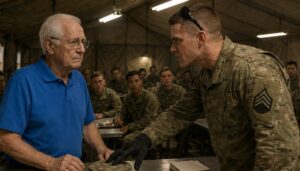
The Boy Left a Burger Beside the Old Veteran’s Coffee, Then Saluted Without Saying Why
Chapter 1: The Old Man at the Same Small Table
Jack Bennett arrived at the diner eleven minutes before noon, the same as he had every year for longer than Susan Miller liked to count.
He parked beneath the faded sign by the side door, not in the front lot where the lunch crowd might see him getting out slowly. His truck was old enough to complain when he turned the key, and he sat for a moment after the engine stopped, one hand still on the wheel, the other resting on a folded sheet of paper in the pocket of his field jacket.
The jacket did not fit him the way it used to. Nothing did. His shoulders had narrowed, his wrists looked too sharp when the cuffs shifted, and the left sleeve had a pale place where a patch had once been. He had taken the patch off years ago, though he could not remember whether he had done it because it hurt too much to look at or because strangers asked too many questions.
Inside the diner, the bell over the door gave its tired little ring.
Warm air met him first: coffee, onions on the grill, fryer oil, toast, the sweet chemical smell of table cleaner. Susan’s place had brick walls that had been real before brick walls became decoration, wide windows looking out over the street, and pendant lights that made every booth seem softer than it was. Someone at the counter laughed. A fork scraped a plate. A waitress called, “Two burgers walking,” through the kitchen window.
Jack kept his eyes down until he reached the small round table near the second window.
It was empty.
It was always empty on this date.
Susan had never said she held it for him. Jack had never asked. Some arrangements survived because nobody was foolish enough to name them.
She looked up from the register when he took off his cap.
“Morning, Jack.”
“Morning.”
“You want coffee?”
“Yes, ma’am.”
“The usual?”
He gave the smallest nod he could manage.
The usual meant coffee only. Black. White mug. No menu. No cream. No food until he had sat there long enough to prove to himself he could leave again.
He lowered himself into the chair with the care of a man who had learned which parts of his body would object if he moved too quickly. The table wobbled under his hand, a familiar unevenness in the front leg. Years ago, Susan had tried to fix it with a folded napkin. Later, someone had wedged a piece of cardboard beneath it. Now the wobble had become part of the place, like the cracked tile near the counter and the old clock above the pie case that ran five minutes slow.
Jack set his cap on the chair beside him.
Then he took the folded paper from his inside pocket and placed it beside the empty space where a plate would have gone.
He did not unfold it.
Susan brought the coffee herself. She set the mug down gently, handle angled toward his right hand.
“Bit of a crowd today,” she said.
Jack looked around because it was expected of him. Two men in work shirts sat near the counter. A mother and a boy occupied the booth by the brick wall. Three older women shared a plate of fries beneath the window. Michael Reed, who repaired nearly anything in town with a motor or hinge, was reading the sports page at the counter and pretending not to notice anyone.
“Good for business,” Jack said.
Susan studied him for one second too long. “You let me know if you need anything.”
“I will.”
They both knew he would not.
She left him with the coffee.
Jack wrapped his hands around the mug, letting the heat settle into the sore joints. The surface of the coffee trembled faintly. He told himself it was the table. He told himself many things on this date.
Across the room, the little boy in the teal hoodie was talking with his hands. His mother leaned over the menu, listening and correcting him with a touch to his sleeve whenever his voice rose too high. He could not have been more than nine. Maybe ten, if he was small for his age. He kept glancing around the diner with the alert seriousness of a child who believed every room contained a mission.
Jack looked away before the boy’s eyes reached him.
He had worn the field jacket only because the closet had seemed heavier with it left inside. At dawn he had stood in front of it, dressed in his plain shirt and dark trousers, one hand on the hanger. He had told himself he was too old for rituals. He had told himself fabric did not remember. Then he had put it on anyway.
Now the jacket had done what he feared it might. It made him visible.
The waitress passed with a tray balanced high, and the smell of fries followed her. Jack’s stomach tightened, not from hunger exactly, though he had not eaten breakfast. Hunger was honest. This was something else.
He looked at the folded paper.
One crease had begun to whiten from being opened and closed too many times. The paper was not official, not important to anyone who might find it. No seal. No signature. No clean typed message. Just Jack’s handwriting, smaller now than it used to be, written in stops and starts at his kitchen table.
He had rewritten the first line every year.
Dear Mrs. Walker,
No. Too formal.
Dear family,
No. Too cowardly.
Dear—
He touched the edge of the paper and stopped.
The bell over the door rang again. A couple came in arguing softly about whether they had time for lunch. Behind the counter, Susan poured coffee without looking at the pot. Outside, a delivery truck groaned past the window.
Jack lifted the mug and drank. It was too hot. He welcomed the burn.
“Mom,” the boy in the teal hoodie said from the booth, not quietly enough. “Why is he by himself?”
Jack kept the mug at his mouth a moment longer than necessary.
The mother murmured something he could not hear.
“But he’s wearing Army stuff.”
The room did not go silent. Rooms never did for small hurts. Forks kept moving. Coffee kept pouring. The grill hissed. But Jack heard the words land and remain there.
He lowered the mug carefully.
The mother whispered more sharply this time. The boy looked down at his plate, then back at Jack, then down again. His face did not hold mockery. That was worse somehow. It held concern, naked and untrained.
Jack turned the folded paper so its open edge faced away from the room.
Susan appeared at the edge of his table with the coffee pot though his mug was nearly full.
“Top you off?”
“No, thank you.”
“You sure you don’t want something from the kitchen today?”
Jack almost said no.
He always said no.
But the smell of the grill moved through the diner, onions and beef and buttered bread, and for one loose second he was not in Susan’s place at all. He was in another hot room with metal trays and bad coffee, listening to a young man with dust in his hair describe, in impossible detail, the first meal he would order when they got home.
Not steak. Not lobster. Nothing fancy.
A burger, Bennett. Real fries. A drink with ice. I’m telling you, that’s how you know you made it back.
Jack’s hand tightened around the mug.
“Jack?” Susan said.
He blinked. The diner returned in pieces.
“No,” he said. “Coffee’s fine.”
Susan did not push. She never had. She had inherited the diner from her father and with it the local wisdom that some men spoke best when not chased.
She went back to the counter.
Jack stared through the window at the street. A flag hung outside the hardware store, its edge flicking in the mild wind. He tried to count the passing cars. He made it to six before his gaze drifted back to the folded paper.
He had come to mail it today.
He had told himself that before leaving the house. He had even put a stamp in his wallet, tucked behind his driver’s license.
After coffee, he would walk two blocks to the post office. He would write the address cleanly. He would put the letter through the slot. Then the yearly bargain would be over. Maybe next year he would not come to the diner. Maybe next year he would not need the table, the mug, the empty space where the burger should have been.
The boy in the teal hoodie slipped out of the booth.
Jack noticed without turning his head. Soldiers learned the edges of rooms; old men kept the habit after the reason had passed.
The boy crossed to the counter, standing on his toes to speak to Susan. Susan leaned down. The boy pointed toward the menu board. His mother looked up, saw where he was, and started to rise.
Jack looked away again.
He did not know yet that the boy had been watching the empty place at his table.
He did not know that the boy had counted the coins and folded bills in his own pocket three times that morning.
He did not know that a child’s question, once planted, could grow faster than an old man’s defenses.
He only knew that the diner had become too bright, that the field jacket felt too heavy, and that the folded paper beside his coffee had begun to look less like a letter than an accusation.
Across the room, Justin Carter turned from the counter with both hands empty and a face full of decision.
“Mom,” he said, “I need to buy him lunch.”
Chapter 2: The Boy Who Carried the Tray
Jessica Carter caught her son by the sleeve before he could reach the register again.
“Justin,” she whispered, bending close enough that her hair brushed his cheek, “you can’t just buy food for strangers.”
“He’s not a stranger.”
“You don’t know him.”
“He’s a soldier.”
The word came out with the firm simplicity children used when adults were making something easy into something complicated. Jessica looked toward the small table by the window. The old man sat with his shoulders slightly rounded beneath a faded field jacket, both hands around his coffee mug. His cap rested on the chair beside him. A folded paper lay on the table as if it had been invited there.
“He may not want attention,” Jessica said.
Justin’s eyes stayed on Jack. “He doesn’t have food.”
“Maybe he isn’t hungry.”
“He looked at the burgers.”
Jessica exhaled slowly. She had learned, since Justin was old enough to talk, that his observations were often inconvenient because they were precise.
At the register, Susan Miller pretended to sort receipts.
Justin stepped closer to his mother. “Grandpa said when you see somebody who served, you say thank you.”
“I know what Grandpa said.”
“He said some people don’t hear it enough.”
Jessica’s face changed then, just a little. It was not softening exactly. It was the expression of a mother who felt an old lesson returning through a child’s mouth before she had decided whether the world deserved it.
“You have eight dollars,” she said.
“I have twelve. I saved.”
“That won’t cover—”
“I asked the lady. She said it was enough for the lunch special if I don’t get pie.”
Susan coughed into her hand and turned toward the coffee machine.
Jessica closed her eyes for half a second.
“Justin.”
“I won’t bother him. I’ll just give it to him.”
“You can’t make people accept things.”
“I know.”
“And if he says no?”
Justin looked worried for the first time, but the worry did not weaken him. “Then I’ll say sorry.”
Jessica glanced again at Jack. He had not looked toward them, but something in his stillness suggested he knew he was being discussed. That made her cheeks warm.
She wished her father were there to tell her what to do. He would have laughed first, not because it was funny, but because he believed children embarrassed adults mostly by remembering what adults had taught them.
“Please,” Justin said.
Jessica rubbed her thumb over the seam of his hoodie. “You are not making a scene.”
“I won’t.”
“You are not asking questions.”
“I won’t.”
“You are not telling him anything about heroes or battles or—”
“I’m just buying lunch.”
Susan finally turned, wiping her hands on a towel. “Burger, fries, and a drink,” she said quietly. “I can put it on a tray.”
Jessica looked at her.
Susan’s expression said she had already decided to help and was only waiting to be forgiven for it.
Justin emptied his pocket on the counter. Folded bills, quarters, two dimes, three pennies, and a nickel rolled toward the register. He tried to flatten the bills with his palm. One had been folded into a square so long it wanted to stay that way.
Susan counted slowly, then pushed back the pennies. “Keep those.”
“But tax—”
“Lunch special covers it today.”
Jessica started to object, but Susan shook her head once.
Justin took the pennies back as if they had been entrusted to him. While the kitchen worked, he stood at the counter with both hands gripping the edge. His feet shifted, then stilled. He looked smaller from behind, all hood and narrow shoulders, but his posture had the solemnity of a boy carrying out instructions from someone no longer in the room.
At the table by the window, Jack heard the plate set on the tray. He heard the scrape of the fry basket, the clink of ice in a paper cup. He told himself it had nothing to do with him.
Then Susan came around the counter carrying the tray, and the boy followed her.
Jack sat straighter.
Susan stopped halfway, looked down at Justin, and lowered the tray into his hands. “Both hands,” she murmured.
“I know.”
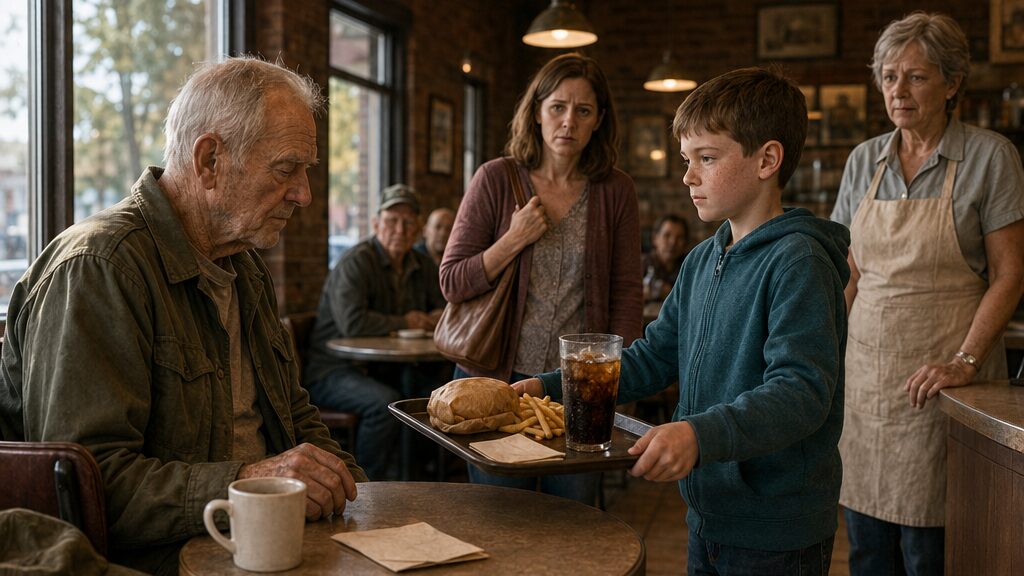
The tray was almost too wide for him. The burger sat wrapped in paper inside a red plastic basket, fries spilling against the edge, a drink sweating beside it. A folded napkin had been tucked under the fork though there was no reason for a fork. On top of the napkin lay a small note written in block letters.
Justin walked carefully, eyes fixed on the tray. The whole diner seemed to rearrange around his progress. The waitress paused with a pot of coffee. Michael Reed lowered his newspaper. The three women near the window went quiet one by one.
Jack wanted to stop him before he arrived.
He wanted to say, No, son. Wrong table.
He wanted to say, Find someone who earned it better.
But the boy had already reached him.
Justin set the tray down in the empty space beside the coffee mug. The table wobbled. The drink shivered. Justin grabbed the edge just in time, steadying everything with both hands.
Jack looked at the meal.
Burger. Real fries. A drink with ice.
For a moment, the diner’s warm light thinned around the edges.
“You don’t have to do that,” Jack said.
His voice sounded rougher than he intended.
Justin swallowed. Up close, his freckles stood out across his nose. “I already did, sir.”
Jack’s eyes moved from the tray to the boy’s face. “Why?”
Jessica had left the booth but stopped several feet away, one hand pressed against her own wrist. Susan stood near the counter, still as a witness in church.
Justin looked back at his mother. Jessica gave the smallest nod, though she looked as if she might cry from fear of what her son had started.
The boy turned to Jack again.
“My grandpa said to thank soldiers,” Justin said. “But you looked like maybe people keep not doing it.”
The words had no polish. No ceremony. That was why they found their way through.
Jack looked down.
On the folded napkin, the note read:
Thank you. You should not eat alone.
The letters leaned unevenly, some too large, some crowded at the edge where the boy had run out of room.
Jack felt something move in his chest, an old door swollen shut by weather.
“I’m not active anymore,” he said, because a correction was easier than gratitude.
Justin nodded seriously. “My mom said once a soldier, kind of always.”
A faint sound passed through the diner. Not laughter. Breath, maybe.
Jack reached toward the tray, then stopped. His fingers hovered over the paper around the burger. His hand trembled once, sharply enough that he pulled it back and curled it into a fist on his knee.
Justin saw. Children saw everything before adults taught them mercy.
The boy stepped back from the table.
For half a second Jack thought he was leaving.
Instead, Justin straightened. His heels came together awkwardly. His right hand rose to his forehead in a salute that was not quite correct and more powerful because of it.
Jack stared at him.
The last person who had saluted Jack with that much seriousness had been nineteen years old and trying to make a joke of fear.
Don’t leave me hanging, Bennett.
Jack’s throat closed.
He should have stood. His knees would not have liked it, but he should have. He should have said something fit for the gift. He should have thanked the boy’s mother, Susan, the whole room, anyone who would let the moment pass without asking for more of him than he had.
Instead, he lifted his right hand.
Slowly.
Carefully.
Not like a man performing for a room. Like a man returning something borrowed long ago.
The salute held between them.
Jessica covered her mouth. Susan looked down at the counter. Michael Reed rose halfway from his stool without knowing he had done it. One of the older women by the window pressed a hand to her chest.
Then, because silence sometimes asks others to become worthy of it, Michael stood fully. He did not salute. He placed his cap against his chest. The waitress did the same with the coffee pot held low in her other hand. Around the diner, conversation fell away, but no one clapped.
For that, Jack was grateful.
Justin lowered his hand first.
Jack lowered his a second later.
The boy looked at the tray. “It might get cold.”
That almost broke him.
Jack took the note from the napkin and folded it once, then again. He slipped it beneath the older folded paper beside his coffee.
“Thank you,” he said.
Justin waited as if there should be more.
There was more. There was too much.
Jack picked up one fry because it was the smallest thing on the tray and the only thing he could manage. He held it a moment before eating it.
Justin’s face lit, but he did not smile too widely. He seemed to understand that victory in this matter required gentleness.
Jessica stepped forward. “Sir, I’m sorry if he disturbed you.”
Jack looked at her. Her apology was ready to rescue everyone from feeling too much.
“He didn’t,” Jack said.
Jessica nodded, but her eyes moved to the folded papers. “All right.”
Justin leaned closer, lowering his voice. “Was the salute okay?”
Jack looked at him then, fully.
“It was just fine.”
The boy’s shoulders dropped in relief.
His mother guided him back toward their booth. Justin twisted once to look over his shoulder. Jack made himself lift the burger. It was heavier than he expected. He unwrapped one side of it and the smell rose, salt and meat and warm bread.
He took a bite.
He had not meant to. Not really.
The first chew was almost impossible.
The second brought him back to the diner.
The third took him somewhere else entirely.
When he set the burger down, he reached for Justin’s note again. He unfolded it beneath the edge of the table, shielding it from the room with his hand.
Thank you. You should not eat alone.
Jack read it twice.
Then he opened his own folded paper just enough to tuck the boy’s note inside it.
The first line of his letter stared up at him.
Dear Mrs. Walker,
He closed it quickly.
Across the room, Justin was whispering something to Jessica, his face hopeful and anxious. Jessica listened, but her eyes kept returning to Jack.
Jack took another fry. Then another. The food did not taste like forgiveness. He had never trusted easy things.
But for the first time in years, the empty place at the table was not empty because he had refused to fill it.
It had been filled by a child who did not know what he had touched.
And that, somehow, was harder to bear.
Chapter 3: The Note He Would Not Let Go
Jack brought the meal home in a white paper box Susan had handed him without a word.
He had eaten half the burger and more fries than he intended, but the rest sat on the passenger seat of his truck all the way back to his house. The paper box gave off the fading smell of salt and grease. Beside it lay his cap. In his jacket pocket, two folded papers pressed against his ribs.
He drove past the post office without slowing.
He noticed that he had done it only after the blue mailbox disappeared in the rearview mirror.
At home, he parked in the narrow driveway and sat until the truck’s ticking engine quieted. His house was small, white once, though the paint had surrendered to weather around the porch rail. A flag bracket near the door stood empty. He had removed the flag two winters ago when the cloth tore at the edge. He had meant to replace it. Meaning to do things had become one of the ways he measured time.
Inside, the house held its usual silence.
No television left on in another room. No kettle starting. No one calling that he had forgotten to take off his shoes.
Jack set the food box on the kitchen table. The room was clean in the spare way of a man who did not make enough mess to prove he lived there. One plate in the drying rack. One glass. A pill organizer near the sink. A calendar on the wall with no appointments written down, only the date circled in pencil.
He removed the field jacket and hung it over the back of a chair.
Then he took the folded papers from the inside pocket.
Justin’s note had made a new shape inside the old letter, a smaller thickness interrupting the familiar creases. Jack placed both on the table and stood looking at them.
The refrigerator hummed.
Outside, a dog barked twice and gave up.
Jack opened the letter.
The handwriting embarrassed him. Not because it was shaky, though it was. Because it looked like a man trying to sound honest while still hiding.
Dear Mrs. Walker,
I have written this letter before and failed to send it. That failure is mine. Your son—
Jack stopped there, as he always did.
Your son.
As if those two words were a bridge he had to cross each year and never could.
He slipped Justin’s note out from between the folds. The paper was torn from a small notebook, blue lines faint beneath the block letters. Thank you. You should not eat alone.
Jack laid it beside the letter.
“Well,” he said to the empty kitchen, “that’s easy for you to say.”
His own voice startled him.
He put the leftover food in the refrigerator though he knew it would not taste right later. Then he washed his hands. Then he dried them. Then he washed the mug he had used that morning before leaving the house, though it was already clean.
Only when there was nothing left to tidy did he return to the table.
He sat.
The chair across from him remained pushed in.
He had not always lived alone. For thirty-nine years, there had been another voice in the house, another coat by the door, another hand moving the salt because he had put it in the wrong place again. After his wife died, people had brought casseroles, cards, flowers, pie. They had said call if you need anything, which was a kind thing to say and a hard thing to answer.
Jack had needed plenty.
He had called no one.
In the drawer beneath the phone book he no longer used, he kept the letters.
Not many. A handful, wrapped in a rubber band that had dried and cracked with age. Two from men he had served with. One from a chaplain. One official notice that had arrived long after everyone already knew. And beneath them all, the old address written in his own hand.
Mrs. Walker. A town two states away. A street name he had memorized against his will.
He pulled the drawer open.
The rubber band broke when he touched it.
Jack stared at the pieces lying on the wood among batteries, matchbooks, and a screwdriver too small for anything useful.
“About right,” he muttered.
He lifted the letters carefully. The paper had softened over the years, corners furred from handling. He did not read them. He did not need to. Memory had done that work too often.
Instead he found the small card with the address.
The ink had faded, but not enough.
Years ago, he had told himself there was nothing he could write that would help. Then he told himself it was too soon. Then too late. Then selfish. Then cruel. Then pointless. The reasons changed their coats, but they all carried the same cowardice underneath.
He placed the address card beside Justin’s note.
Thank you. You should not eat alone.
He imagined the boy writing it, tongue caught at the corner of his mouth, pressing too hard with the pencil. He imagined Jessica telling him not to bother people. He imagined the boy deciding, in the clear private court of childhood, that a man alone in a service jacket needed lunch more than he needed permission.
Jack rubbed both hands over his face.
The meal had not been pity. He knew that now. Pity made a person smaller. The boy’s gesture had made the room larger, and that was why Jack had wanted to escape it.
He rose, went to the refrigerator, opened it, and looked at the white box.
After a moment, he took it out.
The fries had gone limp. The burger had cooled into itself. He stood at the counter and ate one bite anyway. It tasted like salt, paper, and memory.
He remembered the young man’s grin. Not his last face. Jack refused that one whenever he could. He remembered the grin from before, when they were all heat and nerves and bad jokes.
Real fries, Bennett. None of that powdered potato nonsense. And ice. I want so much ice the cup sweats.
Jack set the burger down.
His hand moved to his chest before he could stop it. Not dramatic. Just the body reaching for a place where pain had learned to live.
He returned to the table and pulled a blank sheet from the drawer. For several minutes he did not write.
Then, slowly, he copied the date at the top.
Not the year from back then. Today’s.
He wrote Dear Mrs. Walker again.
The words sat there.
This time, he did not cross them out.
He added one sentence.
A boy bought me the meal today that I once promised your son.
Jack leaned back so sharply the chair creaked.
The sentence looked impossible. Too plain. Too much. Not enough.
He folded the paper before he could tear it up and put it with the others. Justin’s note remained on the table.
Evening light moved across the kitchen, touching the empty chair, the broken rubber band, the old address card. The house did not feel less silent. But the silence had changed shape. It had a question inside it now.
Jack picked up the address card.
He carried it to the hallway, took his wallet from the small bowl by the door, and found the stamp tucked behind his license.
For a full minute, he held both.
Then he put the stamp and the address card back in the drawer.
Not today.
The words came quickly, almost with relief.
But the relief did not last.
Before turning off the kitchen light, Jack took Justin’s note and slipped it into his shirt pocket instead of the drawer.
He did not know why.
Or he did and was not ready to say it.
Outside, the street settled into dusk. Somewhere down the block, a child laughed. Jack stood in his quiet kitchen with a cold burger on the counter and a boy’s crooked handwriting against his heart, and understood with a kind of dread that the day he had planned to survive was not finished with him yet.
Chapter 4: The Mother Who Tried to Apologize
Jessica Carter waited until the next afternoon because waiting until the next afternoon seemed more polite than walking back into the diner ten minutes after she had left it.
She had spent most of the evening asking herself whether politeness was the right word for what she owed the old man.
Justin had talked about him all the way home. He had wanted to know whether the man liked the burger, whether his salute had been too crooked, whether soldiers got lonely even when they were old, whether he should have said more, whether maybe saying more would have made it worse. Jessica had answered what she could and deflected what she couldn’t.
At bedtime, Justin had asked, “Do you think Grandpa saw?”
Jessica had tucked the blanket around his shoulder and smoothed his hair, pretending the question had not gone straight through her.
“I think Grandpa would have been proud you used your own money.”
Justin had nodded, satisfied enough to sleep.
Jessica had not slept well.
By two the next afternoon, she stood outside Susan Miller’s diner with her hand on the door and her apology already arranged in her mouth. The lunch crowd had thinned. Through the window, she could see two women at a booth, Michael Reed at the counter with a cup of coffee, and Susan wiping down the register area with the same steady movements she had used the day before.
Justin was at school. Jessica was grateful for that. He would have wanted to come, and she did not trust herself to manage both his hope and her own embarrassment.
The bell rang when she entered.
Susan looked up. Recognition came quickly, followed by something gentler.
“Afternoon,” Susan said.
“Hi.” Jessica stepped aside for a waitress carrying a tub of dishes. “I was wondering if I could talk to you.”
Susan set the towel down. “Sure.”
Jessica glanced toward the small round table by the second window. It was empty. Clean. Waiting in the way empty tables waited, though this one seemed to hold more than the others.
“He isn’t here,” Susan said.
Jessica’s face warmed. “I wasn’t sure.”
“He doesn’t usually come two days in a row.”
“Right.” Jessica clasped her purse strap with both hands. “I just wanted to make sure we didn’t upset him yesterday.”
Susan leaned one hip against the counter. “Your boy?”
“Justin. Yes. He means well, but sometimes he decides what kindness should look like before he asks anyone else.”
“That’s not the worst flaw a child can have.”
“No.” Jessica smiled because it was easier than letting her mouth tremble. “But it can still hurt people if he aims it wrong.”
Michael Reed lowered his newspaper at the counter. Jessica noticed and he immediately raised it again, though not convincingly.
Susan followed Jessica’s eyes and gave him a look. The newspaper lifted higher.
“I don’t think he aimed wrong,” Susan said.
Jessica looked back at her. “You don’t?”
Susan took a moment before answering. “I’ve known Jack Bennett for fifteen years. Known of him longer. He comes in, drinks his coffee, pays cash, tips too much, never asks for anything that takes trouble. I know his truck. I know how he likes his mug turned. I know he fixes the wobble under that table with his boot instead of complaining.” She glanced toward the window table. “I did not know why yesterday mattered.”
Jessica’s fingers tightened on her purse strap. “Yesterday mattered?”
Susan gave a small nod. “To him, yes.”
The apology in Jessica’s mouth began to lose its shape.
“I thought maybe Justin embarrassed him,” she said.
“He was embarrassed,” Susan said. “But not the way you mean.”
Jessica looked toward the table again. She could picture Justin standing there with both feet planted, his hand at his forehead, too small for the solemn thing he was trying to do. She had wanted to stop him. Then she had wanted to disappear. Then she had watched Jack Bennett raise his hand and felt something in the diner change.
“My father served,” Jessica said quietly. “Not Jack’s generation. Later. He didn’t talk much about it. But he taught Justin to say thank you. He used to make him practice shaking hands without squeezing too hard.” She looked down. “After Dad died, Justin kept the salute. I think he thought it was their thing.”
Susan’s expression softened but did not collapse into pity. Jessica appreciated that.
“How long ago?” Susan asked.
“Three years.” Jessica gave a small laugh with no humor in it. “Long enough that people think you don’t still measure things by before and after.”
Susan nodded as if she understood more than she would say.
“Justin saw Mr. Bennett sitting alone,” Jessica continued, “and I think he put too many things together. My father. The jacket. The empty table. Maybe he just saw a chance to do what he wished somebody could still do for Grandpa.”
From behind the newspaper, Michael made a sound like a throat being cleared.
Susan looked toward him. “You need more coffee, Michael, or are you planning to listen dry?”
The newspaper lowered slowly. Michael Reed was a broad-shouldered man with a gray beard trimmed close and hands that looked permanently marked by machine oil no matter how often he washed them. He gave Jessica an apologetic look.
“Sorry,” he said. “Didn’t mean to pry.”
“Yes, you did,” Susan said.
“Well,” Michael said, “not rudely.”
Jessica almost smiled.
Michael folded the newspaper. “For what it’s worth, ma’am, I don’t think your boy did harm. I saw Mr. Bennett’s face. That wasn’t offense.”
“What was it?” Jessica asked before she could stop herself.
Michael rubbed his thumb along the edge of his mug. “Looked like somebody opened a door he’d been holding shut.”
The words settled among them.
Susan reached under the register and pulled out a small paper slip. “He left this.”
Jessica took it.
It was the receipt from Justin’s meal. Burger special, fries, drink. Paid. Beneath the printed total, in careful block letters, Susan had written: Covered by customer. Jack had left cash over the amount, enough to pay for the meal twice.
Jessica stared at it. “He paid for it?”
“After your boy already did. I tried to tell him.” Susan’s mouth shifted. “He said the boy’s money had already done what it came to do.”
Jessica read the line again though there was nothing else to learn from it.
“Did he keep the note?” she asked.
Susan’s gaze moved to the small table. “Yes.”
Jessica pressed the receipt flat between her fingers. The paper was thin, already curling at the edges from register heat.
Justin would want to know that. He would want to know the old man had kept his note. But Jessica was not sure whether telling him would make the thing larger than Jack wanted it to be.
“I came to apologize,” she said.
Susan picked up the towel again but did not wipe anything. “Maybe what you need is to come back for lunch sometime.”
Jessica looked up.
“No plan,” Susan said. “No big gesture. Just lunch.”
Jessica understood the warning inside the kindness. Do not chase him. Do not turn him into a project. Do not make a child’s gift into an adult’s performance.
“Saturday,” Jessica said. “We usually come after Justin’s library hour.”
Susan nodded. “Saturday’s good.”
At the counter, Michael looked toward the window table. “He always sit there?”
“When it’s open,” Susan said.
Jessica folded the receipt and put it into her purse. She imagined Justin’s face when she told him only the part he needed: Mr. Bennett wasn’t upset. He kept your note.
Outside, the afternoon sun had brightened the street. Jessica stood on the sidewalk a moment before going to her car. In the window reflection, she could see the small round table behind her, clean and empty, with the chairs pushed in.
She wondered how many times a person could sit alone before loneliness looked like preference.
Inside, Susan picked up Jack’s coffee mug from the shelf where it waited with the others. She turned it handle-right, though no one was there to use it.
Michael watched her do it.
“You know,” he said, “that old lunch pail he brings sometimes? Brown one with the metal latch?”
Susan looked at him.
“Saw the handle cracked last month,” he said. “Could fix it easy.”
Susan’s expression sharpened, not in warning exactly, but in care. “You ask first.”
Michael lifted both hands. “I know.”
But he was still looking at the empty table when he said it.
Chapter 5: The Letter Under the Coffee Cup
Jack stayed away from the diner for four days and pretended it was ordinary.
He made oatmeal. He threw half of it away. He took his pills. He checked the mailbox even when he knew the delivery had not come. He swept the porch, then stopped halfway because he could not remember why he had started. Every morning, he moved Justin’s note from his shirt pocket to the kitchen table, then from the kitchen table back to his pocket before leaving the room.
On the fifth day, he drove to Susan’s place just after the breakfast crowd and before lunch could make excuses for him.
The lot was mostly empty. A delivery truck sat near the side door, its back open. A young driver was stacking boxes by the kitchen entrance. Jack parked in front this time because he was too tired to plan his invisibility.
The bell rang.
Susan looked up from filling sugar dispensers. Her eyes went first to his face, then to the folded paper in his hand, then back to his face.
“Morning, Jack.”
“Morning.”
“The same?”
He nodded.
She reached for the white mug without turning around.
Jack sat at the small table by the second window. It was open. Of course it was. He wondered, not for the first time, what kindness cost Susan when she pretended it had not cost anything.
Today, he had brought the old lunch pail.
It sat on the chair beside him, dull brown, square-edged, with a metal latch that clicked too loudly if he was careless. The handle was cracked near one bracket and wrapped with black tape he had put on months ago. He had not planned to bring it. He had been standing in the hallway with his keys when he turned back and took it from the closet shelf.
Inside was nothing but the folded letter, Justin’s note, the address card, and the stamp.
Susan brought the coffee.
She did not ask about the pail.
He appreciated that so much it irritated him.
“Quiet morning,” she said.
“Looks like.”
“Michael’s around somewhere. He’s been pretending he doesn’t want pie.”
Jack glanced toward the counter. Michael Reed sat at the far end, coffee in front of him, one elbow on a folded newspaper. He gave Jack a nod, friendly but not eager.
Jack nodded back.
Susan set the mug down, handle to his right. “You want a menu?”
The question hung there, familiar and new.
Jack looked through the kitchen window. A cook moved behind the steam, turning something on the grill. The smell came out warm and immediate.
“No,” Jack said.
Susan’s face gave nothing away.
Then he added, “Not yet.”
Her hand paused on the coffee pot.
“All right,” she said.
He opened the lunch pail after she left. The latch snapped softly. He took out the folded paper and placed it under the edge of the coffee cup so it would not fold back in on itself. Justin’s note remained tucked inside.
The first line had changed. He had written it the night before after crossing out three attempts.
Dear Mrs. Walker,
Yesterday a boy bought me the meal your son and I used to talk about when the days were hard. I am writing because I realized I have let my silence pretend to be respect.
Jack read the sentences once and felt his stomach tighten.
Too much.
Not enough.
He reached for the paper as if to fold it again.
“Leave it,” Susan said from beside him.
He looked up.
She had returned with the coffee pot though his mug was full. Her eyes were not on the letter. They were on his hand.
Jack let go of the paper.
Susan sat in the chair across from him without asking, which was bold enough that he almost smiled. She did not settle in. She perched, ready to rise if he made the smallest sign.
“You don’t have to tell me,” she said.
“I know.”
“But you look like you might need to tell somebody.”
Jack looked toward the window. A woman crossed the street carrying flowers wrapped in paper. A truck rolled by. Life, careless and continuing.
“He was nineteen,” Jack said.
Susan did not move.
Jack kept his eyes outside. “Younger than he thought. Older than he looked. Always hungry. Some men get scared and go quiet. He got scared and described food.”
Susan’s hands folded around the coffee pot handle.
“Burger,” Jack said. “Fries. A drink with ice. He had the whole thing planned. Which side of the bun he’d bite first. How he’d ask for extra pickles. How the fries had to come in a basket, not a paper sleeve, because baskets meant you were sitting down somewhere safe.”
His mouth had gone dry. He picked up the mug but did not drink.
“Your boy yesterday,” he said, and stopped. “Not your boy. The Carter boy.”
“Justin,” Susan said gently.
Jack nodded once. “Justin put that tray down, and for a second I thought—”
The sentence failed.
Susan waited.
Jack set the mug down. “I thought I had stolen the meal from the wrong person.”
At the counter, Michael had gone very still over his newspaper.
Jack noticed but lacked the strength to resent it.
Susan’s voice was low. “What was his name?”
Jack’s hand closed around the mug. He could see the name. Hear it. Feel the shape of it from years of not saying it.
“Walker,” he said at last. “That’s all I can manage today.”
“That’s enough.”
“No,” Jack said, sharper than intended. “It isn’t.”
The table seemed smaller with the letter open on it. He had spent years making sure the past had no place to sit. Now it was crowded in among coffee, paper, sunlight, and the smell of toast.
Susan did not flinch.
“You come here every year for him?” she asked.
Jack looked at the empty space on the table. “For the meal we were supposed to have.”
“But you don’t order it.”
“I didn’t come back hungry enough,” Jack said.
Susan’s eyes shone, but she did not let tears fall. He respected her for that too.
He reached into the lunch pail and pulled out Justin’s note. The blue-lined paper looked even smaller in his hand.
“This is foolish,” he said.
“What is?”
He held up the note. “Letting a child’s handwriting push an old man around.”
Susan leaned forward enough to read it. Thank you. You should not eat alone.
She sat back.
“Maybe it isn’t pushing,” she said. “Maybe it’s asking.”
Jack folded the note carefully along its existing crease.
Michael cleared his throat from the counter.
Susan turned her head. “Michael.”
“I didn’t hear anything,” Michael said.
“You heard plenty.”
He looked embarrassed, then gave up pretending. “Only enough to know I should keep my mouth shut.”
Jack surprised himself by saying, “That’d be a first.”
Michael blinked. Susan’s mouth twitched.
The small break in tension did not undo anything, but it allowed Jack to breathe.
Michael slid off the stool, took his mug, and approached no farther than the neighboring table. “Mr. Bennett, I noticed that old pail handle. I fix things for a living. If it ever gets to bothering you, I could put a proper brace on it. No charge. No fuss.”
Jack’s first instinct was refusal. It rose clean and automatic.
Then his eyes moved to the pail. The tape had loosened at one edge. Beneath it, the cracked handle showed pale and brittle.
“He carried it?” Susan asked quietly.
Jack looked at her, then at the pail.
“Sometimes,” he said. “When we could get one. He said eating out of something with a handle made him feel civilized.”
Michael’s expression shifted. Whatever practical offer he had been making became something heavier.
“I’d handle it careful,” he said.
Jack hated the pun and the sincerity both.
He put Justin’s note back inside the letter and folded it. Then he placed the folded paper under the coffee cup again, not hiding it this time, only keeping it from sliding away.
“Not today,” he said.
Michael nodded. “Whenever.”
Susan rose and touched the back of the empty chair across from Jack. “You want me to bring a menu now?”
Jack looked toward the kitchen window. He thought of a red basket. Real fries. A drink with ice. He thought of a nineteen-year-old voice describing safety as if it could be ordered.
“Coffee’s enough today,” he said.
Susan nodded.
But before she turned away, Jack added, “Saturday. Maybe.”
She looked back.
“Maybe,” he repeated.
The word did not promise anything. It did not mail the letter, order the meal, fix the pail, or forgive the old silence. But it stayed on the table after Susan walked away.
At the counter, Michael went back to his newspaper without turning a page.
Jack sat with his coffee cooling and the folded letter under the cup, aware that for the first time in years he had told the story badly, incompletely, and out loud.
It should have felt like failure.
Instead, it felt like a door left unlatched.
Chapter 6: The Small Repair Nobody Announced
Michael Reed waited until Thursday to ask again, and even then he did it badly.
Jack had come into the hardware store for batteries he did not need and a small packet of screws he already had at home. The store smelled of dust, cut wood, and fertilizer from the garden aisle. A radio near the register played old country low enough that every song sounded like it was coming from another room.
Michael was in the back by the key machine, arguing with a drawer that would not close. He looked up when the clerk said, “Mr. Bennett,” and for a moment his face showed too much recognition.
Jack nearly turned around.
Instead, he walked to the battery display and took a pack of double-A’s. He did not own anything that needed them anymore except a flashlight already full of working ones.
Michael came down the aisle wiping his hands on a rag.
“Morning,” he said.
“Morning.”
“That pail holding up?”
Jack looked at the screws. “It’s holding.”
“That’s different from holding up.”
Jack gave him a sideways glance. “You always sell repairs this hard?”
“Only when I’m trying not to sound like I care.”
That was too honest to argue with.
Jack put the screws in his basket. “It isn’t mine.”
Michael understood enough not to ask whose it was. “All the more reason to keep it from coming apart.”
A woman pushed a cart past the aisle, nodding to both men. Jack waited until she moved away.
“You don’t know what it is,” he said.
“No,” Michael said. “I know it’s old, cracked, and you carry it like it bites.”
Jack huffed once. It was not quite a laugh, but it was near enough to surprise them both.
Michael lowered his voice. “Bring it by the shop. I’ll look. If you don’t like what I say, you walk out.”
“No charge,” Jack said flatly.
“No charge.”
“I don’t take charity.”
“I’m not offering charity. I’m offering to fix a handle because busted handles annoy me.”
Jack stared at him.
Michael stared back with the patient stubbornness of a man who had once spent three days coaxing a tractor engine awake because someone told him it was impossible.
Finally Jack said, “Tomorrow.”
Michael nodded as if they had made an agreement about weather.
The next morning, Jack almost did not go.
He put the lunch pail on the kitchen table before breakfast. He walked past it seven times. He told himself the tape was enough. He told himself metal fatigued, leather cracked, objects ended, men ended, promises ended. Then the handle shifted when he lifted it, and something inside him recoiled at the thought of it breaking in his hand.
Michael’s repair shop sat behind the hardware store in a low cinder-block building with two garage doors and a hand-painted sign. The open bay held a lawn mower, a bicycle with no front tire, and a fan pushing warm air in circles. Tools hung on pegboard in outlines darker than the wall around them. A bench beneath the window was covered in parts, screws, clamps, and a chipped mug full of pencils.
Michael cleared a space as soon as Jack entered.
“Set it there.”
Jack did, but kept one hand on the pail until the last second.
Michael noticed. He did not comment.
He turned the pail gently, examining the handle where it met the metal bracket. “Old crack. Tape kept it from spreading some.”
Jack stood stiffly beside the bench.
“Can brace it from underneath,” Michael said. “Small metal support. Won’t show much unless you look for it. I won’t replace the handle unless I have to.”
“No replacing.”
“I heard you.”
Jack’s jaw worked once.
Michael opened a drawer and took out a narrow strip of metal. “This’ll do. Need to drill two small holes.”
Jack’s hand moved toward the pail.
Michael paused. “Too much?”
The question was plain. No pity. No pressure.
Jack looked at the pail, at the brittle handle, at the latch that had once clicked open in places where a man might pretend to be civilized if only for ten minutes.
“He said it made bad food taste less bad,” Jack said.
Michael set the metal strip down.
Jack did not look at him. “The kid. Walker. He’d trade for crackers or peanut butter or whatever nonsense he could get and put it in that thing. Said presentation mattered.”
Michael’s mouth moved as if he might smile, but he kept it contained.
“He sounds like a character,” he said.
“He was a pain.”
This time, Jack almost smiled on purpose.
Michael picked up the pail again. “I’ll make the holes clean.”
The drill sound filled the shop, brief and sharp. Jack felt it in his teeth. He turned toward the open bay and watched a car pass on the street. He did not want to see the pail altered, but he did not leave.
Michael worked carefully. No chatter. No questions. The little metal brace went beneath the cracked section, fitted so neatly it looked less like repair than reinforcement. He tightened the screws by hand at the end, slow quarter-turns, testing the pressure.
When he finished, he lifted the pail by the handle and let it hang.
“Try it,” he said.
Jack took it.
The handle held.
A foolish amount of relief moved through him. He had to look down to hide it. The brace was visible only if he turned the pail and searched for it. The crack remained. The tape was gone. Nothing had been erased. Something had been held together.
“What do I owe?” Jack asked.
Michael wiped the bench. “Nothing.”
Jack’s face closed.
Michael saw it and sighed. “Fine. You owe me a cup of coffee sometime when you’re already getting one. That way neither of us has to call it something noble.”
Jack considered this.
“One cup,” he said.
“Black.”
“You don’t know how I take my coffee.”
“You look like you’d distrust cream.”
Jack gave him a look, and Michael grinned.
The pail felt different in Jack’s hand on the way home, not lighter, not newer. Safer, maybe. That was a dangerous word. Safe things could be lost too.
At his kitchen table, Jack opened the pail and placed the folded letter inside. Justin’s note was still tucked in it, along with the address card and stamp. He ran his thumb over the repaired handle, then set the pail near the door instead of returning it to the closet.
Saturday.
The word had followed him since he had said it at the diner.
He did not know whether Justin and Jessica would come. He did not know what he would say if they did. He did not know whether a child should be invited any deeper into an old man’s grief than he already had wandered.
But late that afternoon, Jack picked up the phone.
Susan answered on the fourth ring, breathless, with kitchen noise behind her. “Miller’s Diner.”
“It’s Jack.”
The noise seemed to lower around her. “Everything all right?”
“Yes.” He looked at the pail by the door. “Do the Carters still come Saturdays?”
A small pause.
“Most Saturdays,” Susan said.
“After the library?”
“Usually.”
Jack closed his eyes briefly. Of course Susan had remembered that.
“I need a favor,” he said.
“All right.”
“Not a fuss.”
“I know.”
“And not free.”
“That depends what it is.”
Jack looked at the folded letter visible through the pail’s open lid. “Saturday, if they come in, I’d like the small table. And I’d like to order two lunches before I lose my nerve.”
Susan did not answer right away.
Jack almost withdrew the request.
Then she said, very softly, “Burger special?”
“Yes.”
“Fries?”
“Yes.”
“Drinks with ice?”
Jack opened his eyes.
The kitchen wall blurred for one quick second and cleared again.
“Yes,” he said. “With ice.”
After he hung up, Jack stood beside the phone until the dial tone turned into a warning. He placed the receiver back in its cradle.
The house was quiet.
But near the door, the repaired lunch pail waited where he could see it, its old handle holding.
Chapter 7: The Table Set for More Than One
Saturday morning arrived with rain threatening but never falling.
Jack woke before the alarm he had set and lay still, listening to the house. The old pipes ticked once behind the bathroom wall. A car passed outside, tires whispering over dry pavement. Somewhere in the kitchen, the refrigerator started its small, loyal hum.
He had not slept well, but he had not expected to.
The field jacket hung on the closet door where he had left it the night before. He had brushed it, though brushing had done little for the faded cloth or the pale mark where the patch had been. He had considered wearing something else, then changed his mind. Justin had not thanked a hidden man. The boy had seen him as he was, or as close as Jack had allowed himself to be seen.
On the kitchen table sat the repaired lunch pail.
Jack opened it after breakfast and checked the contents for the fourth time. Folded letter. Justin’s note. Address card. Stamp. A clean envelope he had found in the desk drawer beneath a stack of old utility bills. He had written the address on it the night before, slowly, stopping twice because his hand did not want to shape the name.
Mrs. Walker.
No first name. He had known it once. He probably still knew it somewhere. But the letter had always belonged to a distance he could not cross, and the formal address seemed like the last fence standing.
He closed the pail.
At eleven-thirty, he was dressed and ready with nowhere to go for twenty minutes.
He filled the time by wiping the counter, then by opening the refrigerator and shutting it, then by standing in the doorway of the spare room he never used. His wife had once stored Christmas paper there, rolls of it leaning in the closet like bright walking sticks. Now the room held boxes, a card table, and things he had not needed badly enough to find.
On the wall above the card table was a photograph in a plain frame. Jack had meant to move it many times. He never had.
It showed six men younger than he now believed men should be allowed to be. Dusty, sunburned, grinning at something beyond the camera. Jack stood at one end, lean and narrow-faced, eyes half closed against the sun. Beside him, a young man held a dented lunch pail by its handle, lifting it slightly as if presenting proof of civilization.
Walker.
Jack touched the frame, not the face.
“I’m trying,” he said.
The house did not answer. It did not need to.
At the diner, Susan had already placed a small reserved sign on the round table by the window, though she had turned it facedown so only the blank side showed. Jack saw it when he walked in and nearly turned around.
Susan met him near the register before he could reconsider.
“Morning,” she said, as if there were nothing unusual about a man arriving with a lunch pail in one hand and dread in the other.
“Morning.”
“Coffee first?”
“Yes.”
“The food waits until you say?”
He nodded.
She leaned closer, lowering her voice. “They usually get here about noon fifteen.”
“I know.”
“You can still change your mind.”
Jack looked at the small table. The chairs were pushed in. The white mug was already waiting on the counter behind Susan.
“I’ve done that enough,” he said.
Susan did not answer. She picked up the mug and led the way.
Jack sat with his back half to the wall, facing the door without meaning to. Old habits did not care whether they were useful. He placed the lunch pail on the chair beside him and the folded letter under his coffee cup, just as before. Justin’s note remained inside the fold, a smaller secret within the larger one.
The diner filled in its ordinary Saturday way. Families after errands. A man in a baseball cap eating alone at the counter. The three older women near the window, dividing fries with fierce equality. Michael Reed came in at five minutes to noon and paused when he saw Jack.
Jack raised two fingers from the table.
Michael gave one nod and sat at the counter, far enough away to be respectful, close enough to be available.
At noon ten, Jack told Susan, “All right.”
She did not ask him to repeat it. She passed the order through the kitchen window.
“Two burger specials. Fries. Drinks with ice.”
The cook called back, “Two walking.”
Jack stared at his coffee.
The words had weight. Two. Not one avoided. Not one imagined. Two ordered into the world where anyone might see.
He opened the lunch pail and took out the envelope. It was unsealed. The letter inside had grown to three pages, though he had tried to keep it short. He had not written every detail. Some things belonged to men who were gone and should not be turned into explanation. But he had written the meal. The promise. The years of silence. The boy at the diner.
He had written: I do not ask you to forgive me for not knowing what to do with coming home. I only wanted you to know your son was remembered in small places too.
The line still frightened him.
The bell over the door rang.
Jack looked up too quickly.
It was not them. A delivery driver came in carrying a clipboard. Jack looked back down and felt foolish.
Susan set the two paper cups on the table first. Ice cracked softly inside them. She had not filled them all the way to the top, so the lids would not spill. Then came the tray.
No red plastic basket this time. A real tray. Two burgers wrapped in paper, two portions of fries, two napkins, two straws still in their wrappers. She set it between the empty chair and Jack, not directly in front of him.
“Whenever,” she said.
His throat tightened. “Thank you.”
She touched the back of the chair across from him. “I’ll be nearby.”
Jack looked at the tray and wondered whether Walker would laugh at him for being afraid of lunch.
The bell rang again.
Justin entered first, pushing the door with his shoulder because he was carrying two library books against his chest. Jessica followed with her purse over one arm and a folded umbrella in the other, though the rain had not come. Justin was talking as he walked, then saw Jack and stopped so suddenly Jessica nearly bumped into him.
For one long second, no one moved.
Justin’s eyes went to the tray.
Then to the old field jacket.
Then to Jack’s face.
Jessica’s hand settled on her son’s shoulder. She looked at Jack, cautious and kind and ready to leave if he gave the smallest sign.
Jack stood.
His knees objected. He ignored them.
“Mrs. Carter,” he said.
“Mr. Bennett.”
“Jack is fine.”
Jessica nodded once. “Jessica, then.”
Justin hugged the books to his chest. He looked as if he wanted to speak and was afraid of choosing the wrong words.
Jack looked down at him. “Hello, Justin.”
“Hello, sir.”
The boy’s right hand twitched at his side.
Jack saw the salute forming before Justin raised it. The same awkward care. The same seriousness.
Justin brought his hand up.
Jack felt the room narrow around them. He could have returned it. Part of him wanted to, because it would have been easier than what came next. The salute had rules. The table did not.
He lifted his own hand halfway, then stopped.
Gently, he reached out and lowered Justin’s wrist.
The boy’s face changed, uncertainty flashing bright.
“You did that right the first time,” Jack said.
Justin stared up at him.
Jack nodded toward the chair across from his. “Today I wondered if you’d sit instead.”
Jessica drew in a breath.
Justin looked at his mother. Jessica’s eyes moved over the tray, the two drinks, the open chair, the folded letter under Jack’s coffee cup. She understood enough to be afraid of intruding and enough not to rescue her son from the invitation.
“If Mr. Bennett is sure,” she said.
“I’m sure,” Jack said, though he was not.
Justin placed his library books on a nearby chair as carefully as if they were breakable. Then he climbed into the seat across from Jack.
His feet did not quite reach the floor.
Jack sat too.
For a moment they only looked at the tray between them.
“I didn’t bring money today,” Justin said, worried.
Jack almost laughed, but the sound caught into something gentler. “Good. That would ruin my plan.”
“You had a plan?”
“Not a very strong one.”
Justin considered this. “Those are the hardest kind.”
Jessica turned away quickly, pretending to look for Susan.
Jack slid one wrapped burger toward Justin. “The other day, you bought me lunch.”
Justin nodded.
“I didn’t know what to do with that.”
“You ate some.”
“I did.”
“The fries get bad if you wait.”
“I learned that too.”
Justin smiled, small and relieved.
Jack rested one hand on the folded letter. “There was someone I knew a long time ago. He wanted this meal. Burger, fries, drink with ice. Talked about it more than any sensible person should.”
Justin’s smile faded into attention.
“He didn’t get to have it,” Jack said.
The diner sounds continued around them, but farther away now. Coffee pouring. Plates setting down. A child at another booth asking for ketchup.
Justin looked at the second burger. “Is this for him?”
Jack felt the question enter quietly.
“In a way,” he said. “And in a way, it’s for me to stop pretending nobody should sit here.”
Justin did not answer. He pulled his burger closer but did not unwrap it yet.
Jack took Justin’s note from inside the folded letter and placed it on the table. The blue-lined paper had softened from being carried.
Justin recognized it immediately. His cheeks colored.
“You kept it?”
“Yes.”
“Why?”
Jack looked at the crooked letters.
“Because it told the truth in a way I couldn’t dodge.”
Jessica sat in the booth beside them, not at the table but near enough. Susan brought her coffee without asking. Michael at the counter turned his mug slowly in both hands and looked firmly at the pie case.
Jack slid a straw toward Justin.
The boy unwrapped it, poked it through the lid, and waited.
Jack understood then that Justin would not start until he did.
So he picked up his burger.
The paper crackled in his hands.
Across from him, Justin picked up his own.
The first bite did not heal anything.
It did something better.
It began.
Chapter 8: The Meal He Finally Shared
Justin ate with the concentration of a boy trying to be polite and hungry at the same time.
He took careful bites, wiped his mouth after each one, and glanced at Jack between fries as if checking whether he was doing the meal correctly. Jack pretended not to notice until the pretense became kindness of its own.
“You can eat normal,” Jack said.
Justin froze with a fry halfway to his mouth. “I am.”
“No, you’re eating like your mother is watching.”
From the booth nearby, Jessica made a sound that was almost a laugh and almost a warning.
Justin grinned then, quick and boyish, and ate the fry.
Jack let himself take another bite of the burger. Warm bread, salt, onions, the sharpness of pickle. It was not the best burger he had ever had. It was not the worst. It was ordinary in the blessed way Walker had imagined ordinary things would be once they were far from danger.
That hurt.
But hurt did not always mean stop.
Jack set the burger down and reached for his drink. Ice shifted under the plastic lid. The cup sweated against his fingers.
Justin watched him. “Did he like ice?”
Jack looked at the cup. “He talked about it like it was treasure.”
“Why?”
“Because where we were, cold things didn’t stay cold long.”
Justin nodded as if storing this properly. “What was his first name?”
The question was simple.
Jack’s hand tightened around the cup.
Jessica leaned forward. “Justin.”
“It’s all right,” Jack said, though his voice had thinned.
But it was not all right. Not immediately. The name had lived behind his teeth for years, spoken only in dreams and once at a graveside where wind took it before anyone else could.
He looked at the folded letter. Then at Justin’s note beside it.
“Scott,” he said.
The diner did not change. No glass broke. No door opened. No one gasped at the name restored to air.
Scott.
A young man’s name, ordinary and whole.
Justin lowered his fry. “Scott Walker?”
Jack nodded.
“Was he your friend?”
Jack considered all the small words that failed under weight. Friend. Soldier. Kid. Responsibility. Memory.
“Yes,” he said. “He was my friend.”
Justin accepted this without requiring more.
Jack looked toward Jessica. “I don’t want to put more on him than a boy should carry.”
Jessica’s expression softened. “He can carry a little truth if it’s handed to him carefully.”
Jack looked back at Justin. The boy sat straighter, as if careful truth required good posture.
“There was a meal we talked about,” Jack said. “This meal. He made it sound like getting home would be proved by it. Not medals. Not speeches. A burger in a basket. Fries. A drink so cold the cup sweated.” He touched the side of his own cup. “I came home. He didn’t.”
Justin’s face changed slowly, as a child’s face does when the world grows larger than the answer he expected.
“I’m sorry,” he said.
“So am I.”
“Is that why you were alone?”
Jack looked at the empty spaces around the table. Susan had kept people back without making it obvious. The diner was full enough for warmth, quiet enough for mercy.
“I thought being alone was how I remembered him properly,” Jack said. “For a long time.”
Justin looked at the tray. “But then nobody ate with him.”
The words landed softly, without accusation.
Jack closed his eyes for one moment.
“No,” he said. “Nobody did.”
He opened the folded letter.
Jessica shifted, not away, but ready to stop him if he seemed to be hurting himself for their benefit. Susan stood near the counter with the coffee pot held low. Michael had stopped pretending to choose pie.
Jack did not read from the beginning. He could not. Instead he found the line he had marked with a faint pencil dot.
His voice, when it came, was rough but steady.
“Yesterday a boy bought me the meal your son and I used to talk about when the days were hard. He did not know your son’s name. He did not know mine. He only saw an old man sitting alone and decided gratitude should have somewhere to go.”
Justin looked down at his hands.
Jack continued.
“I have let silence pretend to be respect. It was also fear. I was afraid that writing to you would open pain you had already learned to live beside. I was afraid it would sound like asking for forgiveness. Maybe I was afraid you would give it, and I would not know what to do then.”
He stopped there.
The rest could stay on the page for Mrs. Walker.
Jack folded the letter again, slowly.
Justin did not speak right away. Then he said, “Are you going to mail it?”
Jack looked at the envelope beside the lunch pail.
“That was the plan.”
“Today?”
“Yes.”
Justin nodded solemnly. “Good.”
Jessica let out a breath that might have been held for several minutes.
Jack took Justin’s note and placed it beside the envelope. The blue-lined page and the clean white envelope looked like they belonged to different worlds. Maybe they did. Maybe that was why both were needed.
“You gave me this,” Jack said.
Justin glanced at the note and blushed again. “It wasn’t very much.”
“It was a meal.”
“It was just lunch.”
Jack looked at him. “Sometimes just lunch is the thing a man can’t get past.”
Justin’s eyes grew damp, but he fought it with the stern dignity of a child who did not want to be treated as little.
Jack reached into the lunch pail and removed something wrapped in a paper napkin. He had almost left it at home. Twice.
He unfolded it on the table.
It was the old, empty brass nameplate from the inside of the lunch pail lid. Not a military tag. Not a medal. Just a small, worn rectangle Scott had scratched his initials into with a pocketknife long ago. S.W. The letters were uneven and nearly childish.
Jack had removed it the night before and cleaned it with a soft cloth.
Jessica’s eyes widened slightly, but she said nothing.
“I’m not giving this away,” Jack told Justin.
Justin nodded quickly. “Okay.”
“I’m showing it to you because you asked who sat here before you.”
The boy leaned closer, careful not to touch.
“S.W.,” Justin said.
“Scott Walker.”
Jack wrapped the nameplate again and put it back inside the pail.
Then he did something he had not planned. He turned the pail toward Justin and opened the lid all the way.
Inside, the repaired handle brackets showed where Michael had worked. The envelope lay flat at the bottom, stamped but unsealed.
“This belonged to him,” Jack said. “I kept it in a closet for a long time. Michael fixed the handle this week.”
At the counter, Michael looked down into his coffee as if it had become very interesting.
Justin twisted to look at him. “You fixed it?”
Michael cleared his throat. “Just a handle.”
Justin considered this, then said, “That matters.”
Michael did not answer. He rubbed one hand over his beard.
Jack looked at Susan. She was watching the table with the expression of someone trying very hard not to interfere with grace while it was happening.
“Could I borrow your pen?” Jack asked.
Susan brought one from the register.
Jack took the envelope out. His hand shook as he opened the flap. He slid the letter inside, then paused.
Justin’s note remained on the table.
Jack picked it up.
“Would you mind,” he asked, “if this traveled with it?”
Justin stared. “My note?”
“Yes.”
“To Scott’s mom?”
“To his family,” Jack said. “If they’re still there. If it reaches them.” He looked at the crooked writing. “I think they should know somebody else remembered him too, even without knowing his name.”
Justin’s mouth opened slightly. He looked to Jessica.
Jessica’s eyes shone, but her voice was steady. “That’s your choice.”
Justin thought hard. Then he pushed the note toward Jack.
“She can keep it,” he said. “If she wants.”
Jack slid the boy’s note behind his letter and sealed the envelope before he could lose his nerve.
The glue tasted bitter and dusty.
He wrote his return address in the corner. His hand shook, but the letters were readable.
For a while, they finished eating.
It was not solemn the whole time. Justin asked whether Jack had ever eaten powdered potatoes. Jack said yes and advised him to avoid the experience if America gave him any choice. Jessica apologized twice for Justin’s questions and then stopped when Jack answered them. Susan refilled coffee. Michael eventually ordered pie and sent a slice to the table with three forks, claiming he had misunderstood the number of people who wanted it.
Justin ate most of the whipped cream.
When the meal was done, Jack paid Susan despite her attempt to wave him off. He put cash on the counter and held his hand over it until she stopped arguing.
“Not free,” he said.
“I know,” she said.
Outside, the rain had finally decided against falling. The sky hung low and pale over the street. The post office was two blocks away.
Jack stood on the sidewalk with the lunch pail in one hand and the sealed letter in the other.
Justin came out beside him, Jessica a few steps behind. “Can we walk with you?”
Jack looked down the street.
For years, he had imagined this walk alone. He had pictured the slot in the post office wall, the envelope leaving his hand, the terrible lightness after. He had also imagined turning back. Many times, turning back had been the clearer picture.
He looked at Justin.
“You can walk,” Jack said. “But I put it in.”
Justin nodded. “Because it’s yours.”
“Yes.”
They walked slowly. Jack’s pace set the rhythm. Justin shortened his steps to match without making a show of it. Jessica walked on the other side, close enough to be there, far enough to let silence have room.
At the post office, the lobby smelled of paper, dust, and floor polish. A clerk behind the counter sorted packages. No one paid them much attention.
Jack stood before the blue mail slot.
The envelope felt heavier than three pages and a child’s note should have been.
He thought of Scott with dust in his hair, lifting the lunch pail. He thought of Susan turning the mug handle toward him. Michael fitting a brace beneath a broken handle. Jessica allowing her son to offer kindness without owning the result. Justin standing beside the diner table with his crooked salute.
He did not feel forgiven.
That was not what this was.
He felt accompanied.
Jack slid the envelope into the slot.
It dropped out of sight with a soft paper sound.
Justin did not cheer. Jessica did not touch Jack’s arm. No one applauded in the post office lobby.
After a moment, Justin asked, “Do we still eat there next year?”
Jack looked at the empty slot.
Then down at the boy.
“If your mother says yes,” he said.
Justin turned hopefully.
Jessica wiped beneath one eye with her thumb and pretended it was nothing. “We’ll see.”
That meant yes in mother language. Justin knew it. So did Jack.
Back at the diner, Susan had already cleared the small round table. But she had left the white mug there, clean and turned handle-right, beside the repaired lunch pail Jack had forgotten in the booth and Michael had placed carefully on the chair.
Jack picked it up.
For the first time, the table did not look empty when he stepped away from it.
The next year would come with its own weight. Memory would not become simple. The letter might be returned. Mrs. Walker might have moved. Grief might still be waiting at dawn with the field jacket.
But there would be a table.
There would be coffee.
There would be a meal with fries