They Laughed At The Old Veteran’s 188 MPH Tractor Ticket Until He Pointed At The Motorcycle Shadow
Chapter 1: The Tractor That Could Not Go 188
James Bennett found the envelope wedged crookedly between the mailbox flag and the faded tin wall, its white corner flapping in the late-afternoon wind like it was trying to warn him.
He had been coming back from the lower pasture on the red tractor, the same tractor his neighbors still called old even though James had rebuilt half of it twice. Its paint was dulled by sun and dust, its left fender carried a crease from a gatepost he had misjudged nine winters ago, and the gearshift trembled at idle like a nervous hand. It did not hurry. Nothing about it hurried. Even the crows seemed to know they could cross the road in front of it and have time to reconsider.
James cut the engine beside the mailbox. The sudden quiet settled over the farm road. Across the field, the red barn and the silo stood under a soft gold light, their shadows stretching long toward the ditch. Farther down the road, the new speed camera sat on its pole, square-faced and smug, aimed at the straightaway where local boys had always liked to open their engines before the curve.
James looked at it, then at the envelope.
The return address belonged to the municipal office.
He climbed down slowly, one boot at a time, because his right knee had been stiff since before most of the office clerks were born. He carried the envelope inside, set his cap on the kitchen table, and slit the paper with the pocketknife he kept beside the salt shaker.
At first, he thought the town had misprinted a tax notice.
Then he saw the number.
188 MPH.
James lowered himself into the chair.
The kitchen was quiet except for the refrigerator ticking and the faint click of the wall clock above the sink. He held the paper farther from his face, then closer, as if distance might make the number ashamed of itself.
The citation stated that on County Road 6, at 4:42 p.m. the previous Thursday, a vehicle registered to James Bennett had been recorded exceeding the posted speed limit by one hundred and thirty-three miles per hour. The listed vehicle was his tractor. The photograph below the notice was grainy but clear enough: his red tractor, his cap, his shoulders hunched slightly forward, the barn behind him, the silo to the left, the roadside camera catching him from an angle just past the shoulder.
Above the image, stamped in red digital characters, was the same impossible number.
188 MPH.
James stared at the tractor in the photo, then out the kitchen window at the real one cooling beside the drive.
“You and me been holding back,” he said softly.
The joke lasted only as long as it took him to read the rest.
Failure to respond could lead to increased penalties. A mandatory hearing would be scheduled if he contested the citation. Insurance notification might follow. License review could be required due to excessive speed.
James rubbed his thumb along the edge of the paper.
He did not care much what people laughed about. A man who had spent two years keeping supply trucks moving through desert heat and mountain mud learned not to take laughter personally. Machines made fools of proud men often enough. People did too.
But a license review was not a joke. His farm was small, but it was still work. Feed, parts, seed, church on Sundays when his knee permitted it, the clinic forty minutes away when it did not. He had no wife to drive him now. No son waiting in the next room. No one to say, Let me handle that.
He turned the paper over, then back again.
In the lower right corner of the photo, behind the tractor, there was a smear of red at the road’s edge. Not part of the tractor. Not the barn. Something lower, thinner, moving nearer the centerline than the tractor had been. He remembered the sound now, faint beneath his own engine: a motorcycle winding up behind him, passing the lower field, then easing off when it saw the camera.
Or maybe not easing off soon enough.
James stood and took the paper to the window. The sun had dropped behind the silo, darkening the kitchen glass until his own reflection floated over the citation. His face looked thinner in the reflection than he felt inside. White hair under the kitchen light. Lines around his mouth. A small nick on his chin from shaving too quickly. An old man holding a picture of an older tractor accused of flying.
He went to the drawer beneath the phone and found his reading glasses. Then he took out a pencil, the stub worn flat on one side. He laid the citation on the table and studied it the way he used to study cracked housings, broken brackets, tire tracks in dust, oil sprayed where oil had no business being.
The tractor had not been centered in the lane. He remembered keeping right because of the motorcycle behind him. The roadside camera stood just past the ditch. The photo angle clipped the edge of a fencepost, a vertical line so thin most people would ignore it. Across the road, in the picture, there was a narrow shadow crossing the pavement at a slant.
James tapped the pencil point on that shadow.
The clock clicked again.
He did not yet know what the shadow meant. Not fully. But it bothered him. He had lived long enough to trust the small things that bothered him.
In the Army, a clean gauge could still lie if the line feeding it was kinked. A driver could swear the road was empty and still miss the shape under a tarp. A convoy could be safe for twenty miles, then one odd glint in the wrong place could change everything.
His late wife used to tease him for noticing what nobody asked him to notice. “James,” she would say, “some days a fencepost is just a fencepost.”
Maybe.
But not always.
He folded the citation carefully and slipped it into the breast pocket of his work shirt. Then he stepped outside again.
The evening air smelled of cut hay and cooling metal. His tractor ticked as the engine settled. Down the road, the speed camera stared without blinking. James looked past it to the place where the motorcycle had been, trying to replay the moment in his mind: the flash, the sound, the road, the barn, the angle, the shadow.
A truck passed slowly, the driver lifting two fingers from the wheel. James returned the gesture.
By morning, half the county would probably know. A tractor ticket like that would travel faster than the tractor ever had.
He walked to the machine shed and found a flat wooden clipboard hanging on a nail. He clipped the citation to it so the paper would not curl. Then he took the pencil and drew the road from memory: barn, silo, ditch, camera, fencepost, tractor path, motorcycle path.
His lines were plain and a little crooked, but they were enough.
When the phone rang in the kitchen, he let it ring three times before going inside. The caller ID showed the municipal office.
James picked up.
A woman’s voice, polite and practiced, said, “Mr. Bennett, this is Virginia Harris from the clerk’s office. I’m calling regarding a traffic citation.”
“I saw it.”
There was a pause. “Then you understand the severity.”
James looked through the window at the tractor. “Ma’am, that tractor shakes if it sees thirty.”
“Yes, sir. That is why this matter has been flagged for review. The office would like you to come in tomorrow morning.”
“Bring the tractor?”
Another pause. “No, sir. Just yourself.”
He almost smiled, but her voice had no room for humor.
“I’ll be there,” James said.
After he hung up, he went back to the table. The kitchen had grown darker. He switched on the lamp, and the citation glowed under the yellow shade.
His eyes returned to the red blur near the corner. Then to the thin fencepost shadow.
He folded the paper once, not randomly, but along that slanted line.
The tractor disappeared behind the crease. The red blur sat almost exactly where the number said the speed had been taken.
James stood very still.
Outside, the speed camera flashed once as a pickup rolled by, though the pickup was barely moving.
James watched the pale burst fade from the window.
Then he put the folded printout in his pocket and reached for his cap.
Chapter 2: The Office Laughed Before He Spoke
The municipal office smelled like copier toner, burnt coffee, and raincoats that had dried badly after last week’s storm.
James arrived ten minutes early. He always arrived early to places where other people had the power to waste his time. He wore his cleanest work shirt, a brown jacket with a repaired cuff, and the same cap from the photograph. He had shaved, though he had missed one small patch beside his jaw. The folded citation rested in his breast pocket, its crease sharp from being pressed under a dictionary overnight.
Behind the front counter, Virginia Harris looked up from a stack of forms. She had silver-rimmed glasses on a chain and the careful face of someone who had spent years saying no in a pleasant tone.
“Mr. Bennett?”
“Yes, ma’am.”
She glanced at his cap, perhaps recognizing it from the photo. Her eyes moved quickly away.
“They’re expecting you in the review room.”
James followed her down a short hallway past bulletin boards crowded with notices: burn permits, road closures, a missing dog, a flyer about senior fraud prevention. He almost stopped at that last one, but Virginia kept moving.
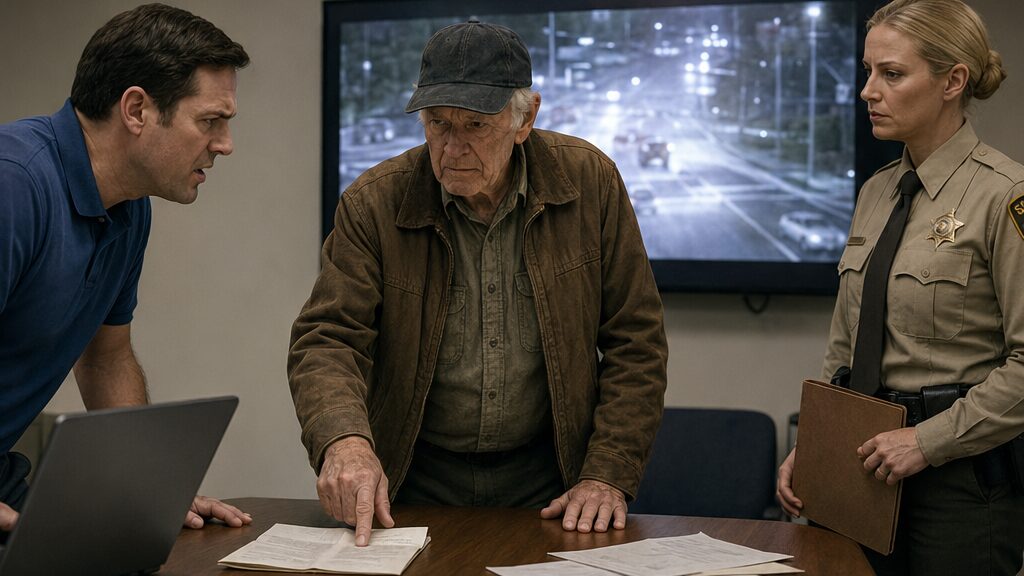
The review room was small, with a long table, a wall-mounted monitor, and three rolling chairs that squeaked when anyone shifted. Deputy Amy Carter stood beside the table, one hand resting on a folder. She was younger than James had expected, maybe late thirties, with blonde hair pulled back tight and a uniform that looked too crisp for the tired room. Her expression was not unkind, but it had the guarded neutrality of someone trained not to give away the verdict.
A man in a blue polo shirt leaned over a laptop connected to the monitor. Eric Miller, James guessed, from the embroidered patch on his sleeve: Miller Traffic Systems.
Eric did not look up right away. “Mr. Bennett,” he said, clicking a key, “you’re the tractor.”
James took off his cap. “I’m the man on it.”
Amy’s eyes flicked toward him, then back to the folder.
The monitor lit up.
There it was again, larger than life: the rural road, the barn, the silo, the red tractor, and above it the number that made the whole room feel foolish.
188 MPH.
Eric leaned back and gave a short laugh through his nose. “I’ll say this. I’ve seen people blame their brother, their cousin, their dog. First time I’ve seen a farm tractor try to break a land speed record.”
Virginia, standing near the door with a clipboard, lowered her eyes. Amy did not laugh, but one corner of her mouth tightened as if she was holding back either amusement or discomfort.
James set his cap on the table.
“That tractor won’t do twenty-five unless it’s downhill and scared,” he said.
“That’s what makes this interesting.” Eric enlarged the image until the tractor filled most of the screen. “Camera captures plate zone, vehicle body, location, timestamp. Radar unit records speed. System pairs the two. It’s automated.”
“Machines pair wrong things sometimes.”
Eric turned then, smiling in the way men smiled when they had already decided the other person did not understand the topic. “With respect, sir, this isn’t a hand-cranked stopwatch.”
James heard the word sir and not the respect.
Amy opened the folder. “Mr. Bennett, we’re not saying you drove a tractor one hundred eighty-eight miles an hour.”
“That’s kind.”
“But the registered vehicle in the image is yours. We need to establish whether the equipment malfunctioned, whether another vehicle was involved, or whether the image was misread. Until then, the citation remains active.”
James nodded. “Then I’d like the raw timestamp file.”
Eric’s smile thinned. “The processed image includes timestamp data.”
“I’d like the raw file.”
“That’s proprietary.”
James looked at Amy. “Then I’d like to know where the speed was taken from.”
Eric clicked another key. A thin box appeared around the tractor. “The vehicle is detected here.”
James took the folded citation from his pocket and laid it on the table. “That’s where the camera saw.”
“That’s the same thing.”
“No,” James said. “It isn’t.”
The room went quiet in the particular way a room goes quiet when people decide whether an old man is being stubborn or useful.
James unfolded the paper and smoothed it with his palm. Then he folded it again, slowly, along the faint slanted shadow crossing the road. He lined the crease with the fencepost at the edge of the image and pressed it flat.
Eric gave a small chuckle. “Are we doing origami evidence now?”
James did not look at him. He turned the folded paper toward Amy.
“This shadow was not on my tractor,” he said. “It’s crossing the lane behind me. The motorcycle was there.”
Amy leaned a little closer.
Eric reached over and tapped the monitor. “The motorcycle is not the target vehicle.”
“You cropped it out of your mind,” James said.
That made Eric’s face change.
Amy lifted a hand slightly. “Let him finish.”
James pointed to the red smear in the lower corner. “That bike came up behind me before the camera. Red fairing. High engine. I heard him roll off, but not before the flash. Your picture caught my tractor because I was big, slow, and in front. But the number belongs to what crossed your beam.”
Eric folded his arms. “The system compensates for multiple vehicles.”
“Does it compensate for a pole shadow?”
“It doesn’t use shadows.”
“I do.”
Virginia shifted by the door. The sound of her clipboard against her belt seemed loud.
Eric exhaled. “Mr. Bennett, I understand you may have worked on engines in your day—”
“In my day?” James asked quietly.
Eric paused, then continued. “But this equipment is calibrated. Certified. It doesn’t guess based on shadows and feelings.”
James placed one finger on the fold. The nail was clean but ridged, the skin around it scarred from old work. “Neither do I.”
Amy’s eyes dropped to his hand. It was not shaking. Not even a little.
For the first time since he came in, her face changed in a way that seemed private. Not belief yet. Something closer to attention.
“What exactly are you saying happened?” she asked.
James looked at the monitor. The red number burned above the tractor like a joke told too loudly.
“I’m saying the camera took my picture and measured that motorcycle,” he said. “Or it measured something along that line and assigned it to the biggest thing in the frame. If you give me the raw timestamp and the sensor angle, I can show you.”
Eric laughed again, but this time only once. “You can show us.”
“Yes.”
“With what, a ruler?”
James picked up his cap. “If that’s what it takes.”
Virginia’s mouth pressed into a line. Amy closed the folder without looking away from the screen.
Eric clicked the laptop and returned the monitor to the citation view. “The hearing date stands. You can make your argument there. The town is not releasing proprietary files because a farmer folded a printout.”
James slipped the citation back into his pocket.
“I was a mechanic before I was a farmer,” he said.
Eric looked bored. “A lot of people were a lot of things.”
James put on his cap. For half a second, he wanted to tell him about heat rising off convoy hoods, about sand in filters, about men who lived because somebody noticed a gauge twitch the wrong way. He wanted to say that old methods were only old because they had kept working long enough to survive.
Instead, he nodded once.
Amy followed him into the hallway.
“Mr. Bennett,” she said.
He stopped.
She held the folder against her side. “Did you say red fairing?”
“Yes.”
“The motorcycle?”
“Yes.”
“How sure are you?”
James looked toward the bulletin board with the senior fraud flyer. “Sure enough to ask for the file before somebody decides the paper is cleaner than the truth.”
Amy absorbed that. “The hearing is next Tuesday.”
“I heard.”
“If you have anything else, bring it.”
“I intend to.”
He walked out through the front office. Virginia watched him pass with an expression that was not quite pity and not quite doubt. Outside, the morning sun flashed off the windshields parked along the curb. For a moment, the glare looked like the camera flash on the farm road.
James paused at his truck and took the citation out again.
The crease had softened in his pocket, but the line remained.
He looked at the fold, the fencepost shadow, the red corner.
Then he looked back at the municipal building.
Behind one of the windows, Amy Carter stood watching him.
James did not wave. He only folded the paper again, sharper this time, and drove home.
Chapter 3: The Motorcycle In The Cropped Corner
James pinned the citation to the barn wall with two roofing nails and stood back until the whole thing blurred.
The barn was dimmer than the kitchen, better for thinking. Light came through gaps in the boards, laying narrow stripes across the dirt floor and the side of the red tractor. Dust moved in those stripes whenever the wind pressed against the walls. The air smelled of hay, diesel, old rope, and the metal filings that seemed to live forever beneath his workbench no matter how often he swept.
On the wall beside the citation, he had tacked a feed sack turned inside out. On it he had drawn County Road 6 with a carpenter’s pencil: the barn, the silo, the fence line, the ditch, the camera pole, the curve, the place where he remembered hearing the motorcycle.
He did not hurry.
Hurry had broken more machines than age ever had.
He walked from the wall to the tractor and back again, measuring with steps. Not exact steps. Familiar ones. His knee complained after the fifth pass, and he rested his hand on the tractor’s fender until the complaint settled into a dull heat.
“You’re not helping,” he told the knee.
The tractor gave no reply.
He had spent the morning at the roadside, standing in the ditch where the grass grew ragged around the camera pole. A maintenance sticker on the back of the unit showed last month’s date and Miller Traffic Systems in blue letters. The bolts at the base were new. The pole itself leaned a little toward the road, not enough to catch a driver’s eye, but enough for James to crouch, squint, and frown.
A younger man might have taken pictures with a phone, but James’s phone was mostly for calls and weather. He had used what he trusted: pencil marks, boot lengths, fencepost alignment, and memory.
Now, in the barn, he held a piece of twine between the sketched camera and the sketched road. One end pinned at the pole. The other crossing the lane where the tractor had been.
No.
He moved the twine back.
There.
The line grazed the tractor’s rear but crossed the path where a motorcycle could have been if it were behind him and closer to the centerline.
James turned to the citation. The red smear in the corner seemed less like a blur now and more like a witness trying not to be seen.
He remembered the sound more clearly with each hour. A high whine behind him, climbing, then dropping. He remembered adjusting his right hand on the steering wheel and easing the tractor toward the shoulder. He remembered the camera flash bright in the edge of his vision. He remembered thinking the motorcycle had been foolish but lucky.
Maybe luck had simply picked the wrong man to blame.
He took down an old clipboard from a nail and wrote the time at the top: 4:42 p.m. The citation time. Under it he wrote: sun angle, shadow line, second flash?
The last two words came from nowhere at first. Then, as soon as he wrote them, he stopped.
Had there been a second flash?
He shut his eyes.
Engine knocking under him. Tractor vibration through the seat. Warm light. Motorcycle whine. Flash. A beat. Then, behind him, maybe another pale flicker in the mirror.
Maybe.
Memory was not a film. It was a workbench after a long repair: useful pieces mixed with scraps. He knew better than to trust it without checking.
He went back to the road in the afternoon, carrying a tape measure, a small notebook, and a jar of iced tea wrapped in a towel. Traffic was light. A hay truck passed. Two pickups. A delivery van with a driver who slowed to stare at him near the camera pole.
James ignored the stares.
At the edge of the shoulder, near the camera’s base, he found what he had missed that morning: a small streak of red paint on the metal guard strip around the post. Not much. A scrape, no longer than his thumb, bright beneath the dust where something had kissed it hard enough to leave color.
He crouched slowly, one hand on his thigh.
The red was too bright for his tractor. His tractor’s paint was sun-faded, closer to brick and rust. This was glossy. Motorcycle red.
He touched it with the tip of his pencil, not his finger. The mark flaked slightly.
A motorcycle could have drifted close after the flash. Or before. A rider surprised by the camera might have twitched toward the shoulder, brushed the guard, corrected, and kept going.
James looked down the road toward town.
He did not want to ruin a young man’s life over panic and speed. He had seen young men do worse than go too fast and still become decent when someone held them accountable without crushing them. But if the town wanted clean evidence, then the evidence had to name the right machine.
A car slowed behind him.
Deputy Amy Carter’s cruiser rolled onto the shoulder, gravel popping beneath the tires. She stepped out, hatless, one hand resting near her belt but not on it.
“Mr. Bennett,” she said, “the office got a call that you were tampering with the speed camera.”
James remained crouched. “I’m looking at paint.”
Amy came closer, careful of the ditch. “Paint?”
He pointed with the pencil.
She bent, not as far as he had, and looked. For a moment, her face was only official. Then her eyes narrowed.
“That from your tractor?”
“No. Mine’s duller. Older.”
“Could be from anything.”
“Yes.”
She glanced at him. “That your answer?”
“It’s the honest one.”
The faintest expression crossed her face. Frustration, perhaps, because he refused to make her work easy in either direction.
James stood, slower than he wished. His knee caught halfway, and he had to grip the post guard. Amy noticed but did not offer help. He appreciated that more than she knew.
“You really think the motorcycle did it,” she said.
“I think the camera saw one thing and measured another. The motorcycle is part of how.”
“That doesn’t prove the citation is wrong.”
“No,” James said. “It proves there’s something worth proving.”
Amy looked up at the camera housing. The late sun reflected off its dark face. In that reflection, James saw the road, the field, himself, and the deputy all bent small and distorted.
“You asked for the raw file,” she said.
“Yes.”
“Eric says there’s no reason to release it.”
“Eric sells reasons not to.”
That almost made her smile. Almost.
She looked back at the red scrape. “You were military?”
James nodded once.
“Mechanic?”
“Motor transport. Long time ago.”
“Is that where you learned this?”
He followed her gaze to the pencil, the notebook, the road lines. “Some of it. Mostly I learned that when a machine gives you an answer that makes no sense, you don’t start by worshiping the answer.”
Amy looked at him then, not at the scrape.
A pickup came over the rise, slowing as it passed. The driver leaned to see them, then continued toward town.
“People are talking,” Amy said.
“I assumed.”
“They think it’s funny.”
“It is funny,” James said. “Until it isn’t.”
The words settled between them.
Amy straightened. “Bring what you have to the hearing.”
“I will.”
“And Mr. Bennett?”
He turned.
“Don’t touch the camera.”
“I don’t need to.”
She went back to her cruiser. James watched her pull onto the road and drive away, not toward town at first, but slowly past the camera, past the barn, past the stretch where the motorcycle had been.
He stayed until the sun lowered enough for the fencepost shadow to cross the pavement again.
At 4:42, he stood in the ditch with the folded citation in his hand.
The shadow on the paper and the shadow on the road nearly matched.
James felt no triumph. Only the old, familiar tightening that came when a bad reading began to reveal the shape of the real problem.
He turned the paper slightly, aligning the crease with the fencepost and the road beyond it.
The red smear in the cropped corner sat exactly where a fast motorcycle would have crossed the beam.
Then, from somewhere toward town, a high engine note rose and vanished before he could see its source.
James folded the printout, placed it back in his pocket, and looked at the scrape of red paint on the post.
He had found the corner of the truth.
Now he needed the rest of it.
Chapter 4: A Hearing For A Foolish Old Man
By Tuesday evening, the town had already turned James Bennett into a joke.
Not a cruel joke in every mouth. Some people meant no harm. They smiled at him outside the hardware store and said they wished their pickup could do what his tractor did. A man at the feed counter asked if James had installed wings. One neighbor left a hand-drawn rocket taped to his mailbox, the kind of joke that expected him to laugh along to prove he was not offended.
James did laugh once or twice. It cost less than correcting people.
But by the time he walked into the town meeting room with the folded citation in his jacket pocket and his road sketch tucked under one arm, the laughter had hardened into something else. The room was too bright. Folding chairs faced a long table where the police chief sat with two council members, Virginia Harris, and Eric Miller. A projector hummed on a cart. On the wall behind them, enlarged until the red numbers looked nearly as tall as a man’s hand, was the photograph.
188 MPH.
The red tractor sat beneath the number like a farm animal accused of flying.
A few people in the room chuckled when James entered. He kept his cap in his hand and moved down the center aisle without looking left or right. His knee had been bad since morning, and the walk felt longer because of every eye following him. He took the empty chair at the front.
Amy Carter stood near the side wall with a notepad. She was in uniform, her face arranged into official stillness. When James glanced her way, she gave him a small nod. It was not belief, but it was not laughter either.
Virginia adjusted her glasses and read the citation into the record. Her voice was even, but her cheeks colored faintly when she reached the speed.
“One hundred eighty-eight miles per hour.”
Someone near the back whispered, “World record.”
The police chief looked up. “Let’s keep this orderly.”
Eric stood with a remote in his hand. He wore a pressed shirt and the smooth confidence of a man explaining a machine to people who had already decided machines were cleaner than memory.
“The unit on County Road 6 is certified,” he said. “It passed calibration last month. The image capture system and speed detection system are designed to pair a vehicle image with a recorded speed. In rare cases, review may be required. That is why we are here.”
He clicked the remote. The image zoomed closer to James’s tractor.
“The registered vehicle in the capture area belongs to Mr. Bennett. The system tagged that vehicle. Obviously, no one is claiming a standard farm tractor can travel at this speed. We are dealing with either data corruption, misregistration, or outside interference.”
James noticed the word outside. It made the error sound like a thing that had attacked the machine, not a thing the machine had done.
A council member leaned into the microphone. “Mr. Bennett, did you alter your tractor in any way?”
“No.”
“Was anyone else operating it?”
“No.”
“Were you aware of another vehicle near you?”
“Yes.”
Eric clicked again, and the picture returned to its full frame.
James leaned forward. “There was a red motorcycle behind me.”
A murmur moved through the room.
Eric said, “A partial object appears at the edge of the image. It is not the tagged vehicle.”
“It is the measured vehicle,” James said.
The room quieted just enough for the projector hum to become sharp.
The police chief clasped his hands. “Mr. Bennett, you’ll have a chance to present evidence.”
James looked at the wall. “That is the evidence.”
Another chuckle, softer this time.
Amy’s pen stopped moving.
Virginia called James forward. He rose carefully and brought his folded paper and sketch to the table. The projector image glared over his shoulder. He spread the sketch beside the citation.
“I drove here,” he said, pointing to the tractor path. “Slow. Right side of the lane. The motorcycle came up here, closer to center. Your camera saw me clear because I was large and near the front of the frame. But the measuring line—”
Eric interrupted. “Mr. Bennett, with respect, you don’t have access to the measuring line.”
James looked at him. “That’s why I asked for the raw file.”
“The raw file is not necessary for a citizen hearing.”
“It is if the citizen is right.”
The words came out flatter than he intended. He heard the weight of them after the room did.
The police chief frowned. “Let’s stay civil.”
James took a breath. Pride was a bad mechanic. It tightened bolts past reason and stripped threads. He lowered his eyes to the paper and folded it along the fencepost shadow, the way he had in the office.
“This line here,” he said. “The shadow crosses the road at the same angle as the camera’s detection face. At 4:42, the sun puts that shadow across the lane. The motorcycle passes behind my tractor right along it. If your system matched the biggest visible object to the fastest return, it would make exactly this mistake.”
Eric’s smile returned, smaller and sharper. “That is a theory based on a shadow.”
“It is based on position.”
“It is based on looking at a photograph and guessing.”
James did not answer quickly. He let the room sit with the folded paper in his hand.
A farmer in the back raised his voice. “I paid one of those tickets last month.”
The police chief looked toward him. “This hearing is not about—”
“Clocked my hay truck at ninety-two,” the farmer said. “That truck gets nervous at fifty.”
Another person muttered agreement. Virginia looked down at her stack of papers.
Eric lifted both hands slightly. “Anecdotes are not diagnostics.”
James looked toward the back, then back at the table. He had not known about the other tickets. The thought settled heavily. It was one thing to be laughed at alone. It was another to see the shape of a wrong thing widening.
Amy stepped away from the wall. “Mr. Miller,” she said, “could the system assign a speed return to the wrong visual target if two vehicles enter the detection zone close together?”
Eric’s jaw tightened. “Theoretically, any system can produce an exception. That does not mean this system did.”
“Has it been tested at that location with farm equipment and motorcycles in the same frame?”
“The unit was calibrated according to standard procedure.”
“That wasn’t my question.”
The room shifted. James saw it: not belief, not yet, but a crack in the smooth face of certainty.
Eric clicked off the projector. The wall went blank, leaving a pale rectangle where the image had been.
The police chief cleared his throat. “The citation will remain pending while we request additional review from the vendor.”
James turned his head toward Eric.
Eric said, “We can review processed records.”
“Raw file,” James said.
The chief ignored that. “This hearing is continued for one week.”
Chairs scraped. People rose. The mood in the room was restless now, less amused. The farmer who had mentioned the hay truck caught James’s eye and gave a grim nod.
James gathered his papers. His hands felt tired, not shaky. The folded citation had softened at the crease from use.
As he stepped into the aisle, a chair near the back bumped hard against the wall. A young man in a dark jacket moved quickly toward the exit, head down. James caught only a profile and a flash of red on a helmet tucked under one arm.
Amy saw him too.
“Christopher,” she called.
The young man did not stop.
James watched him push through the side door into the evening.
No one else seemed to notice the way Amy’s face changed when the door swung shut. No one else seemed to notice the red helmet.
James put the folded citation into his pocket.
The room behind him buzzed with questions, but the road outside had just become more important than the hearing.
Chapter 5: The Boy Who Was Not The Villain
The gas station at the edge of town had two pumps, a soda machine that rattled before giving change, and a fluorescent light over the door that made everyone standing beneath it look either tired or guilty.
James found the red motorcycle beside the air hose.
It leaned on its kickstand with the careless beauty of a young man’s machine: bright fairing, black seat, polished exhaust, tires too clean for a farm road except at the edges. A red helmet hung from one handlebar. Near the right side, low on the fairing, a thin scrape cut through the shine.
James parked his truck beside the gravel strip and sat for a moment with both hands on the wheel.
He had not followed the boy straight from the hearing. That would have felt too much like hunting. He had driven home, fed the barn cats, made himself a sandwich he barely tasted, and then remembered that young riders with nervous minds often went where there was light, fuel, and room to pretend they were only passing through.
Christopher Reed stood near the soda machine, a bottle in one hand, phone in the other. He was younger than James had first thought. Early twenties, maybe. Tall but not filled out yet, with dark hair smashed flat from the helmet and a face caught between defiance and worry.
When he saw James, his shoulders tightened.
James got out slowly. “Evening.”
Christopher looked toward the road. “You following me?”
“No.”
“That’s funny, because here you are.”
“I came to look at your motorcycle.”
Christopher’s mouth hardened. “You a cop now?”
“No.”
“Then don’t touch it.”
James stopped several feet from the bike. “Wasn’t planning to.”
The station door opened. The clerk looked out, saw no immediate trouble, and disappeared inside again. Crickets sang in the weeds beyond the pavement. A truck hissed by on the highway, headlights sliding across the motorcycle’s red paint.
Christopher shoved his phone into his pocket. “I don’t know anything about your tractor ticket.”
“I didn’t say you did.”
“Everybody’s talking about it.”
“They do that.”
“Look, if that camera messed up, that’s not my problem.”
James rested one hand against the side of his truck, more for his knee than for effect. “Maybe not.”
Christopher studied him, suspicious of the answer. “Then what do you want?”
James looked at the scrape on the motorcycle. “You were on County Road 6 last Thursday at 4:42.”
Christopher’s eyes flicked toward the bike.
“Lots of people ride County Road 6.”
“Not lots of red bikes passed my tractor when that camera flashed.”
The young man swallowed. For a second, the defiance faltered and something younger showed underneath.
“I wasn’t going one eighty-eight.”
James said nothing.
“I mean, that number’s crazy.”
“Yes.”
Christopher looked down. “Maybe I was going fast. Not that fast.”
“Fast enough to be scared when the camera flashed?”
Christopher kicked a pebble with the toe of his shoe. It skittered under the air hose.
James waited.
The waiting was what people hated most when they had filled themselves with excuses. In the Army, young drivers had confessed more to silence than to shouting. Silence gave a man room to hear himself.
Christopher finally said, “I saw you.”
“Behind me?”
“Yeah.”
“How close?”
“Not close like I was gonna hit you.”
“That wasn’t the question.”
Christopher’s jaw worked. “I came up behind you after the straightaway. You moved right. I thought I could ease past before the camera zone. Then I saw the flash.”
“One flash?”
The boy looked away.
James felt the old tightening again. “Christopher.”
“There was another one,” he said. “Maybe. I don’t know. It happened fast.”
“After I passed the camera?”
“Maybe.”
“After you passed it?”
Christopher ran a hand through his hair. “I braked. The back end jumped a little. I drifted right. I clipped that metal guard thing under the camera. Just barely.”
James pictured the red paint on the post.
“Why didn’t you come forward?”
Christopher laughed once, bitterly. “And say what? Hey, maybe I was speeding bad enough to make the camera accuse an old man’s tractor? My insurance is already a mess. My mom would lose it. I need my license for work.”
James looked at the motorcycle. The scrape was small. A mistake made visible.
“You let them laugh at me instead.”
The words were not loud. That made them worse.
Christopher flinched. “I didn’t make them laugh.”
“No.”
“But you don’t get it. If I say I was there, they’ll pin the whole thing on me.”
“They might.”
“That’s not fair either.”
“No,” James said. “It isn’t.”
Christopher stared at him. The station light buzzed overhead.
James had come angry, though he had not admitted it to himself. Not hot anger. The colder kind that settled into the bones when people decided age made a man easy to dismiss. He had imagined the rider careless, smug, laughing somewhere about the old farmer taking the blame.
But the boy in front of him was not laughing.
He was scared.
James knew scared young men. He had seen them behind steering wheels too large for them, under helmets, under orders, under the weight of mistakes that could grow teeth if no one stopped them. Fear did not excuse harm. But it explained the shape of it.
“You need to tell Deputy Carter what you told me,” James said.
Christopher shook his head. “No.”
“Yes.”
“They’ll hammer me.”
“Maybe not if you come before they drag it out of you.”
“You don’t know that.”
“I know hiding makes small wrongs bigger.”
Christopher looked at the ground.
James took the folded citation from his pocket. The paper was worn now, its edges soft. He opened it and held it toward the boy, not close enough to force him to take it.
“That’s my tractor,” James said. “That’s your bike in the corner. That number up there doesn’t belong to me, and it may not belong cleanly to you either. The issue is the system put it on the wrong vehicle. But if you stay quiet, they’ll either keep blaming me or use you to avoid admitting the machine failed.”
Christopher’s eyes moved over the photo. He did not touch it.
“I didn’t know it showed me,” he said.
“Most people didn’t look.”
The boy’s voice dropped. “You did.”
James folded the paper again. “I had reason.”
For a while, neither of them spoke.
Inside the station, the clerk laughed at something on a small television. The sound was thin through the glass.
Christopher zipped his jacket halfway, then stopped. “If I talk to Deputy Carter, will you tell them I came clean?”
“I’ll tell the truth.”
“That’s not the same.”
“No.”
Christopher gave him a look that was almost resentful, almost respectful. “You always like this?”
“When tired, mostly.”
That surprised a short laugh out of the boy. It vanished quickly.
James stepped back from the motorcycle. His knee ached enough that he wanted to sit, but he stayed standing. Some conversations needed both men upright.
“Tomorrow,” James said. “Call her. Or I will.”
Christopher looked at him sharply.
“I’m not threatening you,” James said. “I’m telling you the clock is running.”
The boy looked toward the highway. A pair of headlights crested the rise and disappeared.
“I was doing maybe ninety,” he said. “Maybe more. Not one eighty-eight.”
“Then say that.”
“They’ll ask why I ran.”
“Yes.”
“What do I say?”
James opened his truck door. “Start there.”
He climbed in carefully, closed the door, and started the engine. In the mirror, Christopher stood beside the red motorcycle, head bowed, one hand on the scraped fairing.
James drove home under a sky scattered with late stars. The road unwound pale in his headlights. Past the last houses, he slowed near the speed camera and looked at the metal guard around the pole.
The scrape was invisible in the dark, but he knew where it was.
For the first time since the citation arrived, the truth felt less like a puzzle and more like a responsibility.
At home, he placed the folded printout on the kitchen table and set his cap beside it. He did not feel victorious. He felt older than he had that morning.
Before turning off the lamp, he wrote one line in his notebook:
The number may be right. The name is wrong.
Then he underlined name once and sat listening to the quiet house.
Chapter 6: The Same Road At The Same Hour
Amy Carter arrived at County Road 6 at 4:18 p.m. with a dashboard camera running, a department tablet on the passenger seat, and a feeling she did not like.
It was not doubt exactly. Doubt was clean. This was messier, an irritation under the skin, the sense that she had been standing in the correct room, using the correct forms, saying the correct words, and still missing the thing in plain sight.
James Bennett was already there.
His red tractor waited near the entrance to the lower pasture, its engine off, its faded paint catching the late sun. James stood beside it with a clipboard under one arm and the folded citation in his shirt pocket. He wore the same cap. From a distance, he looked like part of the road itself, weathered into the field, patient as fence wire.
Christopher Reed sat on his motorcycle near the barn drive, helmet on his knee, face pale. He had called Amy that morning. He had not confessed so much as unburdened himself in fragments: the speed, the flash, the panic, the scrape. His words had been defensive, then ashamed, then quiet.
Amy had written it all down.
Eric Miller had not been invited by Amy, but word had traveled. His company truck came over the rise at 4:24 and pulled sharply onto the shoulder. He got out with a tablet in hand and anger already in his walk.
“What is this?” he called.
Amy met him halfway. “A field check.”
“You don’t conduct a field check on a certified traffic unit without authorization from the vendor.”
“I’m not touching your unit.”
“You’re staging a reenactment.”
“I’m observing a road condition.”
Eric looked past her to James. “Of course.”
James did not answer. He was kneeling beside the road, though it cost him effort. He placed the folded citation flat against a fencepost, then turned his head toward the camera housing.
Amy watched him. The motion was careful, not theatrical. He was not performing certainty. He was checking it.
The sun lowered behind the silo. A long shadow reached across the pavement.
James lifted one hand. “Deputy.”
Amy walked over.
He held up the citation. The crease in the paper aligned with the shadow on the road so closely that Amy felt a small coldness at the back of her neck.
“That time on the ticket,” James said. “It wasn’t just a time. It was a position.”
Amy looked from the paper to the road. The real fencepost shadow cut across the lane at the same angle as the faint line in the photograph. In the enlarged office image, it had seemed like background noise. Here, standing in the heat and dust, it looked like a ruler laid by the sun.
Eric came close enough to see and scoffed. “Shadows do not trigger radar.”
“No,” James said. “They show where things were when radar did.”
Amy looked toward Christopher. “You understand what we’re doing?”
Christopher nodded, swallowing. “I ride the same line I rode then. But slower.”
“Much slower,” Amy said.
“Yes, ma’am.”
James stood with a hand on the tractor fender. He glanced at Christopher, and Amy caught something in the look: warning, but not hatred.
The police chief’s cruiser arrived at 4:31. He stepped out looking displeased and wary. Virginia Harris was in the passenger seat, clutching a folder. She had come, she said, because if there was going to be a record problem, the clerk’s office needed to know exactly what kind.
No one laughed.
That alone changed the road.
Amy set her dashboard camera to face the speed unit, then placed the department tablet on the hood of her cruiser where it could record a wider view. Eric protested twice, both times using words like procedure and liability. The chief told him to let the observation finish.
James climbed onto the tractor. The movement was slow enough that Amy almost looked away to spare him the effort, but he did not seem embarrassed. He settled into the seat, adjusted the throttle, and rested both hands on the wheel.
The tractor coughed, caught, and began its uneven idle.
At 4:40, James drove to the start point.
At 4:41, Christopher put on his helmet.
Amy stood beside the cruiser, one hand shading her eyes. The road was washed in gold. Dust lifted from the shoulder. The camera stared from its pole. The barn and silo held their places in the frame as if the whole scene had been waiting a week to repeat itself.
James rolled forward first, slow and steady, keeping to the right side of the lane.
Christopher waited, then followed at the agreed distance.
“Too slow,” James called over the tractor engine without turning around.
Christopher hesitated.
Amy stiffened. “Mr. Bennett—”
“He has to cross where he crossed,” James said. “Not fast. Just there.”
Christopher eased left, closer to centerline, the motorcycle engine rising only modestly. He was nowhere near reckless speed now, but the geometry changed at once. From Amy’s angle, the tractor dominated the view, large and red and easy to tag. The motorcycle slipped into the lower corner, small and sharp, passing through the line James had marked with the sun shadow.
The speed camera flashed.
Then, a fraction later, it flashed again.
Amy’s breath caught.
The tractor had already moved beyond the camera’s main field. Christopher had crossed the shadow line. The second flash lit the post, the road, the red fairing, and James’s rear tire.
Eric looked down at his tablet, then froze.
“What does it show?” the chief asked.
Eric did not answer.
Amy walked to him. “What does it show?”
He angled the tablet away. She stepped closer, not touching him, but close enough that refusal became visible.
On the screen was a fresh capture from the camera system. The speed reading was not outrageous this time because Christopher had been riding slowly. But the tagged vehicle box sat on the tractor.
The speed return belonged to the moving motorcycle.
The name would have gone to James.
Virginia covered her mouth with one hand.
The chief stared at the screen. “Run it again.”
Eric’s face flushed. “This is not a controlled test.”
James had circled the tractor back and cut the engine. He climbed down, took the folded citation from his pocket, and walked over. His expression held no triumph.
“It was controlled enough to repeat the mistake,” he said.
Eric snapped, “You manipulated the scenario.”
James looked at him. “I recreated the road.”
Amy picked up her tablet from the cruiser hood and replayed the video. There it was: tractor filling the frame, motorcycle cutting through the detection zone, flash, second flash, wrong tag. Not proof of every detail, perhaps. Not the raw file Eric had refused. But enough to make denial look smaller than the truth.
Christopher removed his helmet. His face had gone gray. “So it would’ve done it again.”
Amy nodded slowly. “Yes.”
The chief turned to Eric. “I want the raw data from the original citation.”
Eric shook his head. “That request has to go through—”
“No,” the chief said. “It goes through me now.”
James watched the exchange, then looked down the road toward the barn. The field was quiet except for the ticking tractor engine and the faint settling sound of gravel under cooling tires.
Amy came to stand beside him.
“You knew,” she said.
“I suspected.”
“That’s not the same.”
“No.”
She looked at the folded citation in his hand. “You could have pushed harder at the hearing.”
“Would it have helped?”
Amy did not answer.
Eric was on his phone now, speaking low and fast beside his truck. Virginia was writing notes with a hand that did not look steady. The chief stood facing the camera pole as if it had personally disappointed him.
Amy said, “I should have listened sooner.”
James watched the long fencepost shadow reach across the road. “You listened before most.”
The words struck her more than if he had accused her.
A gust moved through the ditch grass. The sun had almost cleared the silo. In a few minutes, the shadow would shift and the road would become ordinary again.
Eric ended his call and strode toward them. “No one saves or distributes any of this until my company reviews it.”
Amy turned. “The department footage is already saved.”
His eyes sharpened. “Deputy, you may not understand the contractual—”
“I understand evidence,” she said.
James saw Eric’s face close.
The police chief heard it too. “Mr. Miller.”
But Eric had already stepped toward Amy’s cruiser, toward the tablet on the hood.
James moved before anyone expected him to. Not fast, not young, but precisely. He placed himself between Eric and the cruiser, one hand resting lightly on the hood beside the tablet.
Eric stopped short. “Move.”
James looked at him, calm and tired. “No.”
The single word carried farther down the road than a shout.
For a moment, the whole scene held still: the deputy, the chief, the clerk, the frightened rider, the contractor, the old veteran with his hand beside the saved recording, and the speed camera that had finally been made to show its mistake.
Then the chief said, “Eric, step back.”
Eric did, but his eyes stayed on James.
James folded the old citation along its worn crease one more time.
This time, everyone watched where the shadow fell.
Chapter 7: The Number Was Right, The Name Was Wrong
The next morning, the municipal office did not smell like burnt coffee anymore. It smelled like wet paper.
A storm had come through before dawn, hard and brief, driving rain under the back door and leaving a gray dampness in the hallway. Virginia Harris had spread old towels along the threshold. The copier hummed anyway, warming itself as if nothing had happened.
James sat in the same review room where they had laughed at him.
This time, no one had put the 188 MPH photograph on the wall. The monitor showed a spreadsheet instead, rows of citation numbers and timestamps, small black text on a white background. It looked harmless that way. Clean. Organized. Almost honest.
Amy stood near the end of the table with a folder under her arm. The police chief sat heavily across from James, reading through printed pages without turning them. Virginia had three stacks of papers in front of her, each marked with a sticky note. Eric Miller stood by the monitor, arms folded, his company tablet tucked close against his ribs like something that might be taken from him.
James kept his cap on the table. The folded citation lay beside it, the crease worn pale.
The chief looked up. “Mr. Miller has provided processed records from the County Road 6 unit.”
James watched Eric.
“Processed records,” James said.
Eric’s mouth tightened. “The raw diagnostic file has been requested through company channels.”
“Was it requested before or after you tried to keep Deputy Carter from saving yesterday’s video?”
Amy’s eyes moved to James. The chief’s face hardened.
Eric set his tablet down. “I was protecting chain of custody.”
“You were protecting custody,” James said. “Not the chain.”
No one laughed. That made the words land heavier.
The chief cleared his throat. “We’re not here to argue over phrasing. We have enough from yesterday’s observation to suspend citations from that camera pending review.”
“Suspending them isn’t the same as correcting them,” James said.
Virginia touched the top stack of papers. “That’s what we’re trying to determine.”
Her voice had changed since the hearing. It was still careful, but the carefulness no longer pointed only toward procedure. It pointed toward damage.
Amy opened her folder and slid a printed image across the table. “Yesterday’s field recording shows a visual tag assigned to your tractor while the movement generating the speed return came from Christopher Reed’s motorcycle.”
James looked at the image. His tractor was there again, slow and large, with the motorcycle small in the lower corner. The number above this new image was modest, not absurd, because Christopher had ridden slowly. But the tag box sat on the tractor anyway.
The mistake looked less funny when it repeated quietly.
Eric leaned forward. “That is an interpretation of the recording.”
Amy said, “It is what the recording shows.”
“It shows a staged scenario.”
James picked up his folded citation and placed it beside the new printout. The same road. The same angle. The same shadow. The same wrong box.
“Then your system can be staged by a road,” he said.
Eric looked away.
Virginia pushed the second stack of papers toward the chief. “We found nine citations from the same camera in the last six weeks where a slow or large vehicle is prominent in the image and another smaller vehicle appears partially in frame or near frame edge. Not all are necessarily wrong, but they fit the same pattern.”
The chief took off his glasses and rubbed the bridge of his nose.
“How many paid?” Amy asked.
Virginia’s fingers rested on the stack. “Seven.”
The room seemed to grow smaller.
James thought of the farmer at the hearing. Hay truck at ninety-two. Probably paid because fighting would cost more than surrender. Pride had a price. So did embarrassment. Small towns knew how to collect both without sending an invoice.
The chief turned to Eric. “Why wasn’t this flagged?”
Eric spread his hands. “Because the speed returns were valid. The system did not fail to measure speed.”
James looked at him then.
“That’s what I wrote down last night,” he said.
Eric frowned.
James opened his notebook and turned it around. The line sat alone near the bottom of the page.
The number may be right. The name is wrong.
Virginia read it silently. Amy did too.
James tapped the page once. “That’s worse than a bad number. A bad number looks foolish. A wrong name looks official.”
Eric’s face flushed again, but there was less heat in it now. “The system identifies likely targets based on visual prominence and detection timing. In unusual mixed-traffic environments—”
“Farm roads,” James said.
Eric stopped.
“You mean farm roads,” James said. “Slow tractors. Fast bikes. Hay trucks. Sun low across a ditch. Poles that lean a little because frost worked the ground. Things your standard procedure didn’t bother to understand.”
The chief looked toward the window, where rain streaked the glass. He had the expression of a man hearing his own office described too accurately.
Eric’s voice dropped. “Mr. Bennett, I’m not saying the system is perfect.”
“You were yesterday.”
Amy closed her folder. “Christopher Reed has provided a statement. He admits he was speeding the day of Mr. Bennett’s citation. He also confirms a second flash and contact with the camera guard.”
Virginia added a page to the first stack. “The scrape matches the location.”
The chief sighed. “Then we can dismiss Mr. Bennett’s citation and issue a corrected notice to Reed.”
“No.”
Everyone looked at James.
The chief leaned back. “No?”
James’s hands rested flat on the table. He looked at his own knuckles, the old scars, the veins raised under thin skin. He had wanted the ticket gone. He had wanted the room to stop smiling at him as though age were a diagnosis. He had wanted, more than he cared to admit, to hear someone say he had been right.
But he had not spent a week on the truth so it could be moved like a sack of feed from one shoulder to another.
“Christopher was speeding,” James said. “He should answer for that. But not for one hundred eighty-eight unless you can prove that number belongs to his bike and not to the same bad pairing that put it on me.”
Eric stared at him.
The chief said, “He admitted he was traveling at a high rate of speed.”
“He said maybe ninety. Maybe more. Fear guesses high and low depending on what it wants. Your machine said one eighty-eight and assigned it to a tractor. I wouldn’t hang that whole number on the boy just because it gets you out of admitting the machine made a mess.”
Amy’s face softened in a way she quickly tried to hide.
Virginia looked down at the paid citations. “Then what are you asking for?”
“Review them all,” James said. “Refund the ones you can’t stand behind. Recalibrate the camera at the road it actually watches, not the road in the manual. Give Christopher a fair ticket for what can be supported. And stop treating a machine’s mistake like it’s cleaner than a person’s question.”
The chief sat still.
Rain ticked against the window. Somewhere in the office, the copier jammed and beeped for attention.
Eric said, “You understand this could affect the town’s enforcement agreement.”
James put the notebook back in his pocket. “I expect unfair things usually do affect agreements.”
Virginia’s mouth twitched, almost a smile, but not quite.
The chief stood. “Deputy Carter, preserve all field recordings. Virginia, identify every citation from that unit since installation where multiple vehicles appear in or near the frame. Mr. Miller, I want the raw diagnostic file by close of business tomorrow or I will suspend the contract pending council review.”
Eric’s jaw worked, but he said, “Understood.”
The chief looked at James. “Your citation is dismissed pending formal paperwork.”
James nodded once.
“There will be no license review.”
Another nod.
The chief hesitated. “I regret the way this was handled.”
James picked up his cap. “Handle the rest better.”
It was not forgiveness. It was not refusal either. It was simply the next correct thing.
In the hallway, Amy caught up with him.
“Mr. Bennett.”
He turned.
She held out a copy of yesterday’s recording still, the one with the wrong tag box. “I thought you might want this.”
He looked at it but did not take it right away. “Why?”
“So you have proof.”
James’s gaze rested on the image. “Proof of what?”
“That you were right.”
He slid the paper back toward her. “Keep it where it helps somebody.”
Amy lowered her hand slowly.
Virginia came out of the room with one of the citation stacks held against her chest. “Mr. Bennett?”
“Yes, ma’am.”
“I’m sorry for the notice language. The license warning. The way it was written.”
James thought of the envelope in his mailbox, the number on the page, the way the kitchen had gone quiet around him.
“It was written to make people afraid,” he said.
Virginia’s cheeks colored. “Yes.”
He did not add anything. She had heard him.
When he stepped outside, the storm had passed. Water ran along the curb in thin brown streams. Across the street, two men stood under the awning of the hardware store, watching him. One lifted a hand, not joking this time.
James put on his cap and walked to his truck.
Behind him, inside the municipal office, the copier beeped again and again until someone finally opened it and pulled out the jammed page.
Chapter 8: The Old Method That Saved The Town
A week later, the town meeting room filled again.
This time, the 188 MPH photograph was not projected to make people laugh. It sat printed in a row of documents on the table beside the newer field images, the camera maintenance report, the citation list, and a short statement from Miller Traffic Systems that used the phrase environmental misassignment three times and apology not once.
James sat in the second row instead of the front.
He had not wanted to come. Amy had asked only once, standing beside his farm gate with her cruiser idling behind her. The council would be reviewing the County Road 6 citations, she said. The chief would be making the dismissal official. Christopher would be there with his mother. Some of the farmers would be there too.
“You don’t have to speak,” Amy had added.
That was why he came.
Now he sat with his cap in his lap and the folded original citation in his jacket pocket. The room was still too bright. The chairs still scraped. The projector still hummed. But the laughter was gone, and its absence felt like a field after a hard rain.
Virginia stood at the table, reading from a prepared page. Nine citations were under formal review. Seven paid fines would be held pending refund decisions. The County Road 6 camera would remain offline until a location-specific calibration and angle assessment were completed. Future citations involving multiple vehicles would require manual review before notice.
The farmer with the hay truck sat two rows ahead of James, arms folded, listening with the intense stillness of a man trying not to show relief too early.
Eric Miller was there too, but not at the table. He sat along the side wall with a company representative whose polished shoes had never seen a ditch. Eric looked tired. Not broken, not humbled into a new man, but tired in the useful way people became when certainty had cost them something.
Christopher Reed stood when the chief called his name.
His mother sat behind him, one hand pressed against her purse. Christopher’s face was pale again, but he did not look around for an exit this time.
The chief explained that Christopher had admitted to unsafe speed and failure to maintain control near the camera post. The evidence did not support the 188 MPH reading as a charge against him. He would receive a lesser citation, a safety course requirement, and a warning that the next one would not be treated as a lesson.
Christopher nodded through it all.
When asked if he had anything to say, he gripped the back of the chair in front of him.
“I should have stopped when it happened,” he said. “I didn’t because I was scared. Mr. Bennett came to me before anybody else did, and he didn’t try to bury me with it. I appreciate that.”
He sat down quickly, ears red.
James looked at the floor.
The chief cleared his throat. “Mr. Bennett, your citation has been formally dismissed. There will be no fine, no license review, and no insurance notice.”
Virginia walked over with a paper and handed it to him. Across the top, stamped in blue, was DISMISSED.
The word was plain. Smaller than the red number had been. But it weighed more.
James folded it once and placed it with the original citation in his pocket.
The chief continued. “The department also acknowledges that Mr. Bennett identified a roadway condition and vehicle assignment issue that our process failed to catch.”
Every head turned toward James.
He disliked it immediately.
Not because he was ashamed. Because attention could become another kind of mistake. People liked to turn men into symbols so they did not have to change ordinary behavior.
The chief paused. “Would you like to say anything?”
James could have said no. He almost did.
Then he saw Amy standing by the wall, hands folded in front of her, watching him without pushing. Virginia stood near the table with the citation stack. Christopher stared at his shoes. The farmer with the hay truck looked back once, waiting.
James stood.
His knee caught. He let it. He did not rush to hide it. For once, the room waited without making that waiting feel like pity.
“I don’t have much,” he said.
His voice sounded rough in the bright room.
“That camera didn’t make a mistake because it’s new. And I didn’t see the mistake because I’m old.”
People were very still.
“It made a mistake because the road is the road, and nobody checked the road closely enough. I saw it because I live with that road. Because I was there. Because I’ve spent a long time learning that when a reading looks impossible, you don’t call the first person foolish and go home.”
His hand went to the folded papers in his pocket.
“I don’t want anybody punished just to make the story neat. Not Mr. Miller. Not Christopher. Not the clerk’s office. But if a notice can scare a person, and a hearing can shame a person, then the people sending those notices ought to be just as careful as the people receiving them.”
He stopped there. It was enough.
No one clapped at first, and James was grateful. Then the farmer with the hay truck gave one firm nod and said, “That’s right.”
A few murmurs followed. Not applause exactly. Agreement. Better.
James sat.
The meeting moved on to procedures, refund timelines, contract language. James listened for a while, then let the words fade into the hum of lights and rainwater dripping from the eaves outside. The important part had already happened. Not the dismissal. Not even the admission.
The important part was that the next person might not have to fold a piece of paper ten different ways just to be believed.
Afterward, people came up in small numbers. The hay truck farmer shook his hand and said he should have fought his ticket sooner. Virginia apologized again, quieter this time, without making James carry the apology for her. Christopher’s mother thanked him with wet eyes, and James told her only, “He stopped hiding. That matters.”
Eric approached last.
For a moment, neither of them spoke.
“I should have looked at the road,” Eric said.
James studied him. The words were not polished. That helped.
“Yes,” James said.
Eric nodded once, as if accepting the size of that small answer. “We’re changing the review protocol.”
“Good.”
“I still don’t think shadows diagnose radar.”
James almost smiled. “They diagnose people who forgot to look up.”
Eric looked at him, then gave a short breath that might someday become a laugh at himself. “Fair enough.”
Outside, the sky had cleared into a pale evening. Amy walked with James to his truck. The air smelled of wet asphalt and cut grass.
“I owe you an apology too,” she said.
“You already gave one.”
“Not properly.”
James opened the truck door but did not climb in.
Amy looked toward the west, where the sun had begun to drop. “When you folded that paper in the office, I thought you were just trying to make the picture fit what you wanted.”
“You weren’t alone.”
“I should have asked why you folded it before I decided what it meant.”
James rested one arm on the door. “Next time, ask.”
She nodded. “I will.”
The words were simple. They did not fix everything. That was why he trusted them.
“Can I ask you something?” she said.
“You just did.”
This time she did smile. “Why didn’t you tell Eric about your service sooner? Motor transport, convoys, all of that. It might have made him listen.”
James looked across the street at the flag outside the municipal building. It moved lightly in the damp breeze.
“Maybe,” he said. “But a man shouldn’t need a résumé to be heard when he points at something true.”
Amy took that in quietly.
The next afternoon, James drove the tractor down County Road 6.
He had no reason to except that feed needed moving to the lower pasture, and he refused to let the road become a place he avoided. The red tractor rattled in second gear. The repaired fender shook. His cap brim shaded his eyes. In his shirt pocket were the original citation and the dismissal, folded together along the old crease.
The speed camera stood dark on its pole, covered now with a yellow service sleeve.
As James approached, he glanced toward the barn, the silo, the fencepost, the ditch. The shadow had not yet reached across the lane. It would, later. The road kept its habits whether people noticed or not.
Near the camera, Amy’s cruiser sat on the shoulder.
She was outside, looking not at the tractor but at the road itself. At the angle. At the post. At the places where one thing could be mistaken for another.
James eased the tractor past her.
She lifted two fingers in a small wave.
He returned it without stopping.
The tractor moved on at a steady, ordinary pace, slow enough for dust to follow lazily behind the tires. Behind him, the silent camera watched nothing. Ahead, the road bent toward the lower field, the evening light spreading over it like something patient.
James touched the folded papers in his pocket once, then let his hand return to the wheel.
The story had not made him younger. It had not made his knee hurt less. It had not brought his wife back into the quiet kitchen or changed the fact that some mornings required more effort than he cared to admit.
But the next time he saw a wrong thing, he would still point.
And maybe, somewhere in town, someone would look before laughing.
The story has ended.