The Officer Checked His Old Flight Jacket, Then Realized Why He Came Back To The Carrier
Chapter 1: The Old Man At The Carrier Gate
Rain had turned the access lane into a gray ribbon of reflected lights.
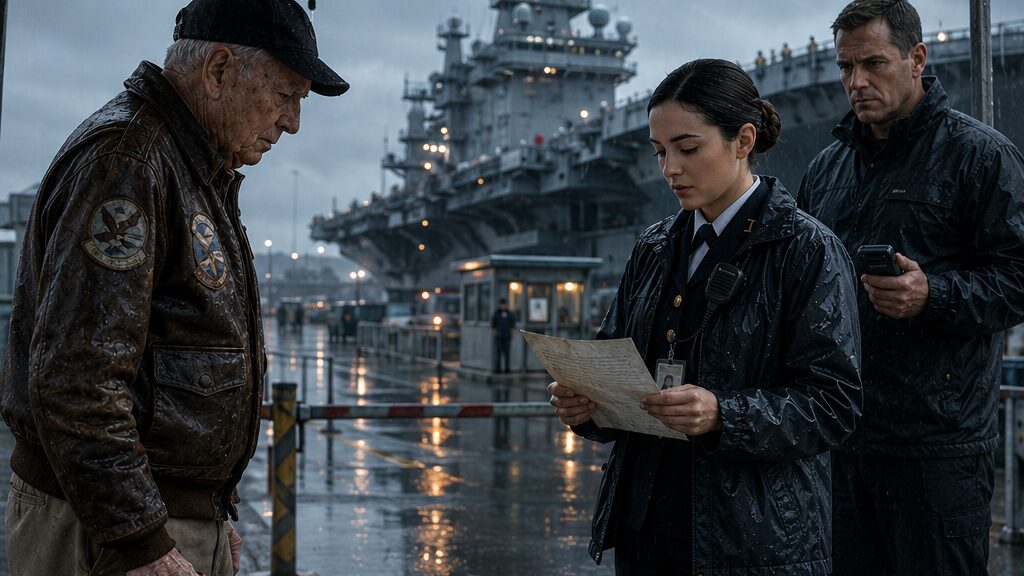
Edward Bennett stood at the edge of it with one hand wrapped around the curved handle of his cane and the other holding a folded paper beneath the flap of his jacket. The leather was old enough to have lost its shine in places. Brown at a distance, almost black where the rain had soaked into the seams, it hung heavy from his narrow shoulders. A faded aviation patch clung to the left side, its thread worn down until the old squadron code could only be read when the light caught it just right.
Beyond the checkpoint, the aircraft carrier rose out of the harbor like a city wall.
Edward had known ships that looked smaller from the pier and larger once you were aboard. This one did the opposite. From where he stood, with the rain misting across his glasses and the cold working into the knuckles around his cane, the carrier looked impossibly large, as if time had built another country on top of steel he used to understand.
A young sailor at the first barricade glanced at him, then at the paper.
“Sir, visitor processing is under the awning.”
Edward nodded once and moved where the sailor pointed. His knee did not like the wet pavement. His right hip had begun complaining back at the parking lot, but he had chosen the far spaces on purpose. If he came limping right up in a shuttle cart, someone would help too fast, ask too many questions, make him smaller than he already looked.
He had not come to be helped.
He had come to finish.
Under the awning, a line of visitors waited with plastic badges, tour wristbands, folded umbrellas, and phones protected in clear sleeves. A family ahead of him whispered over the weather. A man behind him sighed each time the line stopped. Edward kept his eyes on the carrier. Rain ran from the brim of his plain cap and struck the front of his jacket in small dark points.
He reached the table after almost twenty minutes.
The officer there was young enough to be his granddaughter, though Edward no longer measured people that way if he could help it. She wore a dark formal uniform under a rain shell, her hair tucked tightly back, her ID badge clipped straight, radio at her shoulder. Her nameplate read CARTER.
“Good morning, sir,” she said, already reaching for the paper. “I’ll need your government ID and your clearance confirmation.”
Edward removed his wallet slowly. His fingers were stiff, and the little plastic window caught at the corner of his driver’s license. He placed it on the table rather than make her watch him fight with it.
The officer took it without impatience. “Thank you, Mr. Bennett.”
“Edward,” he said.
Her eyes flicked up. “Mr. Edward Bennett?”
“Edward Bennett is fine.”
She gave a polite nod and unfolded his paper.
The rain had touched one corner, softening the ink, but the appointment line remained clear enough: ARCHIVE REVIEW / CARRIER HERITAGE ACCESS / DECK LOG SUPPLEMENTAL FILE. Beneath that, a time. Beneath the time, a reference number Edward had copied three times at home before trusting the printer.
Officer Carter frowned gently, the way people did when a machine had failed them and a human being stood nearby to absorb the delay.
“I’m not seeing you on today’s active visitor manifest.”
Edward said nothing.
She checked the tablet beside her, entered his name again, then his date of birth. The man behind Edward shifted with another audible breath. A child farther down the line asked if they were still going to see the planes. Rain popped softly against the awning.
“You have an archive appointment,” Officer Carter said, more to the screen than to him, “but not a ship access authorization.”
“That paper came from the archive office.”
“Yes, sir. I see that. But carrier access has to be confirmed separately.”
Edward had known there would be trouble. Not this exact trouble, but some kind. Nothing involving the Navy and paper had ever been simple when he was young; age had not improved either institution.
He pressed his thumb against the fold in the paper. “They told me to bring this.”
“I understand.” She kept her voice professional. “The issue is that this form alone doesn’t clear you past the checkpoint.”
A civilian security supervisor stepped under the awning from the side gate. He was broad in the chest and dry under a black jacket, carrying a handheld scanner and the expression of a man counting delays. His badge said SULLIVAN.
“What do we have?” he asked.
Officer Carter turned the tablet slightly. “Archive appointment. No access authorization attached.”
The supervisor glanced at Edward, then at the line behind him. His gaze landed on the cane, the wet hem of Edward’s khakis, the old jacket. It did not stay long enough to read anything.
“Then he needs to reschedule through the visitor center,” he said.
Edward kept his eyes on the carrier.
“Sir,” Officer Carter said, softer now, “did someone from the archive call you this morning?”
“No.”
“Email?”
“I don’t use it much.”
The supervisor’s mouth tightened. “There you go.”
Edward looked at him then. Not sharply. Just enough.
The supervisor softened his tone by a fraction, which somehow made it worse. “Mr. Bennett, this happens. The online systems don’t always talk to each other. We can’t send someone through on a partial printout.”
“I came from two counties over,” Edward said.
“I’m sorry, sir, but that doesn’t change access protocol.”
Behind him, someone muttered, “Come on.”
Officer Carter heard it. Edward saw that she did by the small change in her jaw. She was not cruel. That mattered, and it made no difference.
The old paper trembled once in the wind. Edward tightened his grip.
“Is there someone in the archive office I may speak to?” he asked.
“The archive staff are aboard today,” Officer Carter said. “That’s the problem. Without access—”
“I know where they are.”
The words came out before he meant to give them away.
Officer Carter paused. “Sir?”
Edward breathed in through his nose. The air smelled of rain, diesel, wet rope, and the faint metallic odor that came off ships even after all these years. He had not expected that smell to remain intact. So much else had been painted over.
“I know the archive office used to be forward of the hangar bay,” he said. “That doesn’t mean it still is.”
The supervisor gave a short, practiced laugh. “A lot of people toured carriers years ago.”
Edward folded the paper once along its old crease. “I didn’t tour.”
Officer Carter looked from him to the jacket. Her eyes paused on the left patch. Rain had darkened the leather around it, making the faded letters stand out more than they had in the house mirror that morning.
The supervisor checked his watch. “Carter, we need to keep this moving.”
“Yes, Mr. Sullivan.”
She did not move him aside yet.
Edward wished she would. It would be easier to leave if someone simply ordered him away. Then he could tell Donna he tried. He could tell himself the same thing. He could put the paper back in the envelope, hang the jacket behind the bedroom door, and let the old promise keep its teeth.
But the carrier waited beyond the checkpoint, gray and patient, with rain threading down its hull.
Officer Carter entered something else into the tablet. “Your appointment reference begins with H-BAY-72.”
Edward heard the number before she finished it, and his hand tightened around the cane.
“Seventy-three,” he said.
She looked up. “Excuse me?”
“That sequence wasn’t used until seventy-three. If the form says seventy-two, someone copied from the index page.”
The supervisor went still, but only because the correction had been too specific to dismiss as ordinary confusion.
Officer Carter lowered the paper slightly.
Edward looked at the carrier again. He should have kept quiet. Men who came back after too many years owed silence to the ones who could not.
“Sir,” she said, “how do you know that?”
Edward swallowed. The rain had worked its way under his collar. The jacket felt heavier by the minute.
“I was there when they changed it.”
The line behind him quieted in that way people quieted when they sensed they had walked into the edge of a private room.
Officer Carter looked down at the paper again. Then at the patch.
“Mr. Bennett,” she said, and the name no longer sounded like a line on a form. “Would you mind stepping just inside the awning for a moment while I verify one more thing?”
The supervisor frowned. “Carter—”
“One more thing,” she repeated, not loudly.
Edward did not thank her. He only nodded.
She gestured him toward the side of the table, out of the line but not away from the gate. As he moved, the cane tip slipped lightly on the wet pavement. He caught himself before anyone could take his arm.
Officer Carter noticed and did not reach.
For that alone, he was grateful.
She smoothed the rain-softened paper on the table with more care than before. Her finger stopped beneath the reference line. Then she looked at the old aviation patch again, and this time she tried to read it.
Edward turned his shoulder slightly, not hiding it, not offering it.
Beyond the barricade, the carrier’s loudspeaker crackled and faded. Somewhere aboard, metal struck metal in a rhythm so familiar that his chest hurt.
Officer Carter read the name on the paper a second time.
“Edward Bennett,” she said quietly.
He waited.
Her eyes moved to the patch, then back to the document.
And for the first time that morning, she looked less like someone trying to decide whether he belonged there and more like someone afraid she had already answered wrong.
Chapter 2: Rachel Reads The Name Beneath The Rain
Rachel Carter had been trained not to let uncertainty show at a checkpoint.
A hesitation could slow a line. A softened tone could invite argument. A guessed exception could become a report by noon and a security review by evening. The gate required even hands, clear language, and the ability to say no without making it personal.
But there was nothing impersonal about the old man’s correction.
H-BAY-72 should have meant nothing to him. It barely meant anything to her. It was a reference string, one of many that appeared when the archive office requested limited escorted access for veterans, families, researchers, or donors. Most visitors brought folders. Some brought photographs. Some brought stories they tried to tell before their paperwork was even checked.
Edward Bennett had brought silence.
Rachel kept the paper flat beneath her fingers. The ink at the top had bled at the corner. His name remained clear. His hand, when he had passed the document over, had been unsteady, but the correction had not been. He had said seventy-three the way a machinist might correct the size of a bolt, without pride or doubt.
Mark Sullivan stepped closer. “We can’t hold the line for an archive mistake.”
“I’m not holding the line,” Rachel said.
“You’re holding him.”
She glanced at Edward. He stood just inside the awning, shoulders rounded, one hand on the cane, the other resting near the seam of his jacket. He was looking past both of them toward the ship, as if the conversation had become weather.
Rachel lowered her voice. “Sir, may I look at the patch on your jacket?”
Edward turned his head back slowly.
The question seemed to reach him from far away. For a moment, Rachel thought he had not heard. Then he shifted his left shoulder toward her by an inch.
Not permission exactly. Not refusal.
Enough.
She leaned slightly, keeping her hands to herself. The patch was older than any uniform item she owned. Its edges had curled where the stitching had loosened. The image had once been a winged shape crossing an anchor, maybe, or a bolt of lightning over a deck line. The letters were faded into the brown of the leather, but under the rain-darkened thread she could make out three characters.
V-A-7.
Below that, almost gone, were two smaller numbers.
Her radio popped at her shoulder. She ignored it.
Mark saw where she was looking. “Old jackets are all over surplus stores.”
Edward did not react.
Rachel did. She looked up at Mark, and something in her face made him stop.
“Mr. Bennett,” she said, “were you assigned to an aviation unit aboard this carrier?”
“No.”
Mark gave a short breath, almost a laugh.
Rachel kept her eyes on Edward.
Edward looked at the ship. “Not this carrier. Same name before her. Same line. Different steel.”
Rachel felt the hairs rise along her arms beneath her rain shell.
Ships inherited names. Crews inherited stories. Sometimes the public confused one for the other, but the old man had not. Same name before her. Same line. Different steel. That was not tourist language.
She turned back to the tablet and searched his name against the archive appointment database instead of the visitor manifest. The connection lagged. Rain beat harder against the awning, and the visitors behind them began to bunch around the table.
“Carter,” Mark said, warning now.
Rachel lifted one hand without looking at him.
The search results loaded in fragments.
BENNETT, EDWARD
REQUEST TYPE: DECK LOG SUPPLEMENTAL REVIEW
ASSOCIATED NAME: MILLER, FRANK
REFERENCE: H-BAY-73-14C
STATUS: PENDING MANUAL VERIFICATION
The line beneath it was partly hidden until she expanded the window.
FORMER SERVICE CLAIM: UNVERIFIED
Rachel hated that phrase the moment she saw it.
Former service claim. As if service were a coupon to be validated, as if time itself had not already taken enough.
She looked at Edward’s hands. The knuckles were large, the skin thin and spotted. On the right wrist, just below the jacket cuff, an old pale scar ran toward the thumb. His cane was plain, black, rubber-tipped. The jacket cuff on the left side bore a dark, irregular mark that rain had made visible: not a stain, exactly, but an old scorch shadow.
“What is this really about?” Mark asked, no longer speaking only to Rachel. “Sir, if you’re here for a veterans’ tour, we can get you the right office number.”
Edward’s eyes moved to him.
“I’m not here for a tour.”
“Then what are you here for?”
The line was too sharp. Rachel heard it land. The old man did not flinch, which made her feel worse.
Edward folded the paper once, carefully aligning damp edge to damp edge.
“I was told,” he said, “that a supplemental file was available for review.”
“By who?” Mark asked.
“The archive office.”
“And you came alone?”
Edward’s thumb stilled on the fold.
Rachel saw, too late, that the question had not been about access. It had been about age. About competence. About whether he should be trusted to know where he was going, what he wanted, what morning it was.
She turned slightly between them. “Mr. Sullivan, I can handle the verification.”
Mark’s face hardened. He was not a bad man. Rachel knew that. He had a job that rewarded suspicion and punished embarrassment. But in that moment, with rain blowing in sideways and Edward standing under the awning as if his body were the least important thing he had brought, Mark looked like every closed door Rachel had ever watched someone old try to open.
Edward reached inside his jacket.
Mark’s hand moved toward his scanner. Rachel’s did not.
Edward withdrew a small clear sleeve, cracked at one corner. Inside it was a second paper, older than the first, folded around a photograph so worn it had become more silver than black. He did not hand it over at first. He held it between two fingers and looked at it as if confirming that it had survived the weather.
Then he placed it on the table.
Rachel bent over it.
The photograph showed a younger man in deck gear, his face half turned from the camera, one hand raised against sun glare. Beside him stood another man in a flight suit, grinning with the careless confidence of someone who had not yet learned the cost of being remembered. Behind them, a section of carrier deck stretched into white sky.
On the back, in block letters faded to blue-gray, someone had written:
FRANK SAID THE OLD BIRD WOULD WAIT FOR US.
Beneath that were initials.
E.B.
Rachel’s throat tightened before she understood why.
Mark leaned in, less impatient now but still guarded. “That doesn’t clear him.”
“No,” Rachel said. “It doesn’t.”
Edward’s face changed at that. Not much. A faint settling around the mouth. A man prepared, again, for denial.
Rachel picked up the rain-softened access paper. This time she held it by the edges. She read the reference again, then the associated name.
“Frank Miller,” she said.
Edward looked at the photograph.
“Lieutenant Miller,” he said quietly.
“You served with him?”
Edward took a slow breath. “I worked where his aircraft slept.”
Rachel waited.
He did not explain further.
She looked at the tablet again and opened the service verification field. A note appeared from the archive clerk: POSSIBLE MATCH TO LEGACY CREW ROSTER. MANUAL FILE REQUIRED. DO NOT DISCARD REQUEST.
Do not discard request.
Rachel felt heat rise in her face, partly anger, partly shame. The system had already warned them to be careful. They had nearly sent him away under the awning like a paperwork nuisance.
“Mr. Bennett,” she said.
“Edward.”
This time she nodded. “Edward. I need to ask your permission to check one more thing.”
He looked at her then, fully. His eyes were pale, tired, and very clear.
“What thing?”
“The patch,” she said. “And the cuff.”
His hand went to the scorched edge before he could stop it.
Rachel saw the reflex. She saw memory move faster than intention.
Mark saw it too. His expression shifted, but not enough.
Edward lowered his hand. “It won’t tell you what happened.”
“No,” Rachel said. “But it may tell me where to look.”
For the first time, his restraint cracked into something like pain.
The rain hammered the awning.
A tour coordinator called for the next group. The family ahead had moved on. The line behind them had been redirected to another table by a sailor with a clipboard. Around Edward, the morning had rearranged itself without asking him to move.
Rachel straightened.
“Mr. Sullivan,” she said, “I’m taking this to manual verification.”
Mark’s eyes narrowed. “On what basis?”
“Possible legacy crew match. Archive instruction says not to discard the request.”
“That’s not access clearance.”
“No,” Rachel said. “It’s enough not to send him away in the rain.”
The words surprised her. They were not regulation language.
Edward looked down.
Mark glanced toward the carrier, then back at the old man. His jaw worked once. “Fine. Ten minutes. Keep him here.”
Rachel turned to Edward. “Would you like to sit inside the visitor shelter while I make the call?”
“No.”
The answer was immediate.
Rachel understood she had offered kindness shaped like removal.
“All right,” she said. “Then I’ll stand here.”
He gave her the smallest glance.
She did not know whether he was grateful or only tired.
She keyed the archive extension into her radio phone, then stopped with her thumb over the call button. One question pressed against her professional caution.
“Edward,” she said, “why is Frank Miller’s name on your request instead of yours?”
His eyes remained on the ship.
A gust of wind pushed rain beneath the awning and lifted the corner of the old photograph. Edward placed two fingers on it with a tenderness so brief that anyone not watching closely would have missed it.
“It was never my name I came to fix,” he said.
Rachel forgot the cold for one clean second.
The carrier loomed behind him, gray and silent, while the old jacket darkened in the rain. On the left cuff, the scorch mark looked almost fresh.
Chapter 3: The Missing Page In The Deck Log
The archive office had moved since Edward’s day.
Rachel told him that as they crossed the quarterdeck under escort, perhaps to fill the silence, perhaps because she still felt the need to account for every change the ship had made without him. Edward nodded as if he had expected nothing else. Ships changed. Men changed. The sea only pretended not to.
The passageways were narrower than his memory and brighter than he liked. Too many signs, too many safety stickers, too many clean edges. But beneath the paint and electronics, he felt the old structure in his feet. The deck carried sound the same way. A dropped tool somewhere above them rang down through steel with a familiar thinness. Ventilation moved air with that same restless breath ships had at sea and in port alike.
Rachel walked beside him, not ahead. That was the first thing he noticed.
She had offered a wheelchair at the quarterdeck. He had refused with one shake of the head, and she had not offered again. Instead she adjusted her pace so subtly that only a man accustomed to watching deck crews move around danger would have caught it. She left space on his cane side. She warned him before a raised threshold but did not touch his elbow.
That was the second thing he noticed.
The archive clerk met them outside a small office tucked behind a heritage display and a locked storage room. The clerk wore white gloves tucked in one hand and an expression that had already prepared an apology.
“I’m sorry about the confusion,” the clerk said. “The request should have been routed more cleanly.”
Edward looked past the clerk into the office. Metal cabinets lined one wall. A long table stood beneath a lamp. On the far side, a framed photograph of the older carrier hung above a shelf of binders. The sight of the ship as she had been pulled something tight inside him.
“Is the file here?” he asked.
The clerk hesitated. “A portion of it.”
Rachel heard the hesitation too. “A portion?”
“The digitized index references a supplemental deck log, but the physical file is incomplete.”
Edward’s hand settled on the head of his cane.
The clerk continued, cautious now. “We have the incident summary, the aircraft maintenance extracts, and two witness statement abstracts. But the full supplemental page listed under H-BAY-73-14C is missing from the folder.”
Edward closed his eyes for half a second.
Of course it was.
Rachel stepped closer to the table. “Was it removed?”
“I can’t say that. Older records were handled differently. Pages were copied, refiled, sometimes misnumbered.” The clerk looked at Edward. “That’s partly why your request was flagged. Your letter mentioned details that don’t appear in the surviving summary.”
“I didn’t write a letter,” Edward said.
The clerk blinked. “The request came with a statement.”
Edward reached inside his jacket and touched the photograph sleeve, but did not remove it. “I answered questions on the phone. Someone wrote them down.”
Rachel watched him carefully. “Which details?”
The clerk opened a folder and withdrew a photocopied page. “Reference to a damaged power lead in Hangar Bay Three. A fuel vapor warning. A delay in the launch cycle. And Lieutenant Frank Miller remaining in his aircraft after the deck alarm.”
Edward stared at the page as if it might move.
The room grew smaller.
He had spent years teaching himself not to remember in sequence. A smell might come; he let it pass. A sound might strike wrong; he waited it out. But words on paper had always been more dangerous. They arranged the past into lines, and lines pretended events happened cleanly.
Rachel lowered her voice. “Edward?”
“I’m listening.”
The clerk placed another page beside the first. “The official incident summary says Lieutenant Miller’s aircraft suffered an electrical fault during deck handling. It notes smoke in the cockpit, emergency response, and loss of life after complications during evacuation.”
“Complications,” Edward said.
The word left him flat.
Rachel heard the change. “That isn’t accurate?”
Edward’s eyes went to the old photograph on the shelf, the carrier from before, the one with sharper angles and fewer comforts. “It isn’t enough.”
The clerk shifted. “Mr. Bennett, before we review anything further, I need to verify your standing. The file involves personnel history and operational records. Without proof that you were assigned to the relevant department—”
Edward gave a tired nod. “You have the roster?”
“Not the full one. That is part of the problem.”
He let out a small breath that might have been a laugh if it had carried any amusement. “Always was.”
Rachel looked at him.
Edward removed his cap. His hair, thin and white, had been flattened by damp wool. Without the cap, he looked older, but not weaker. More exposed, perhaps. He set the cap on the table beside the cane and unzipped his jacket halfway.
Rachel glanced down, then away, giving him privacy he had not asked for.
From an inner pocket, Edward took out a folded sheet sealed in a clear plastic sleeve. The plastic had yellowed. Along one edge was a strip of old tape, brittle and clouded. He handled it with less tenderness than the photograph, but more caution.
“My discharge papers won’t tell you the bay,” he said. “This might.”
The clerk accepted it with gloved hands. Rachel watched the gloved fingers pause over a stamped line, then move to a handwritten note in the margin.
The clerk’s expression changed.
“What is it?” Rachel asked.
The clerk read softly. “Temporary reassignment, aviation electrical support, hangar bay emergency repair crew. Signed by a division officer.” The clerk looked up. “This places you there.”
Edward did not seem relieved.
“Can we proceed?” Rachel asked.
The clerk nodded and moved the folder under the lamp.
Edward remained standing until Rachel pulled out a chair and set it near the table without a word. She did not gesture to it. She did not tell him he should sit. She simply left it there.
After a moment, he sat.
His knee thanked him with a sharp pulse of pain. He kept his face still and folded his hands on the cane.
The pages came out slowly. Copies, extracts, index sheets. A maintenance note blurred from old carbon. A response timeline with several entries blacked out by age rather than secrecy. Frank Miller’s name appeared three times. Edward’s did not appear at all until the final abstract, where someone had typed E. BENNETT, A/E SUPPORT, STATEMENT TAKEN.
The statement itself was missing.
Rachel saw it before he said anything. “There should be another page.”
“Yes,” the clerk said. “The abstract refers to attached statement fourteen-C. It isn’t in this folder.”
Edward looked at the number. Fourteen-C. A small, harmless code for the part of his life that never stopped burning.
The clerk turned to a cabinet and began searching a drawer of oversized folders. “Sometimes supplemental statements were copied into incident binders by department instead of by event.”
Rachel remained beside the table. Mark Sullivan had not come with them, but Edward could feel the pressure of him anyway, the clock ticking somewhere outside the room. Ten minutes had become more than ten. Favors did not stretch forever.
Rachel touched the edge of the old access paper, now laid flat to dry. “You said it was not your name you came to fix.”
Edward kept his eyes on the folder. “That’s right.”
“But your statement is the missing one.”
He said nothing.
“And Lieutenant Miller’s family never received it?”
His hand tightened around the cane. “Families receive what the Navy sends.”
It came out harder than he intended.
Rachel accepted the rebuke. “And what did the Navy send?”
Edward looked at the photograph on the table. Frank’s grin had faded until it seemed made of weather.
“A folded flag,” he said. “A clean sentence. A mistake dressed nicely.”
The clerk stopped moving at the cabinet.
Rachel did not speak for a while.
Edward wished she would go back to being procedural. Procedure had walls. Sympathy wandered into rooms where it had not been invited.
Finally, she said, “Were they blaming him?”
“Not in the words.”
“In the spaces?”
Edward looked at her then. She was younger than the sailors he remembered, and older than she had looked at the gate. The difference was not time. It was attention.
“In the spaces,” he said.
The clerk returned with a wide folder tied by cotton tape. “I found a department copy index. No guarantee the page is there.”
The tape came undone with a whisper. Inside were thin sheets, some typed, some copied crookedly. The clerk moved through them with professional delicacy. Rachel stood still. Edward heard rain ticking somewhere beyond the wall, or imagined it.
Then the clerk stopped.
“This is odd.”
Rachel leaned in. “What?”
“There’s a carbon sheet attached to a routing memo.” The clerk lifted it carefully. “It has the same reference. H-BAY-73-14C.”
Edward felt his pulse in his throat.
The page was faint, purple-gray in places, the lower corner torn. But at the bottom, beneath a paragraph too light to read from where he sat, were initials written in a hand he had not seen in decades and had seen every day since.
E.B.
The room held its breath.
Rachel looked from the initials to Edward.
He reached toward the page, then stopped before touching it.
The clerk waited.
Edward withdrew his hand and rested it again on the cane. The old jacket creaked softly at his shoulders. The scorched cuff lay against his wrist, dark against pale skin.
“What does it say?” Rachel asked.
The clerk adjusted the lamp.
Edward closed his eyes, but the words found him before anyone read them aloud. The alarm. The vapor warning. Frank in the cockpit. The cable in Edward’s hands. The heat. The order no one heard the first time. The choice that had never fit cleanly into any official sentence.
The clerk bent closer.
Rachel’s voice came low beside him. “Edward, do you want to continue?”
There it was again. Not Can you. Not Are you sure you understand. Not Sir, we need to move this along.
Do you want to continue?
Edward opened his eyes.
He had come for the page. He had not expected the page to ask for him back.
“Yes,” he said.
The clerk lifted the carbon copy into the light, and the first readable line appeared beneath the old blur:
Statement taken from Edward Bennett, aviation electrical support, regarding Lieutenant Frank Miller’s decision to remain aboard aircraft during hangar bay emergency.
Rachel’s hand moved to the edge of the table, not touching the page, not touching him.
Edward stared at the initials.
For the first time since he had stepped beneath the awning, he looked afraid.
Chapter 4: Donna Thought It Was Only Memory
Edward did not answer his phone the first time it rang.
It buzzed against the table beside the old photograph, bright and out of place among the paper sleeves, cotton ties, and photocopied fragments of men long dead. Rachel saw the name on the screen before he turned it facedown with two careful fingers.
Donna.
The archive clerk pretended not to notice. Rachel tried to do the same, but the sound had already changed the room. Until then, everything had belonged to the ship: the metal cabinets, the old logs, the air that tasted faintly of dust and paint, the muffled thump of work somewhere beyond the bulkhead. The phone brought in the world outside the gate. A daughter. A kitchen clock. Someone waiting with worry she had perhaps learned to disguise as irritation.
Edward kept his eyes on the carbon copy.
The clerk had read only part of it aloud. The page was too faint for quick work, and every sentence required the lamp to be moved, the paper angled, the old impression caught in light. What had emerged so far was not the clean line of an official report. It was broken and practical. Damaged wiring near the port side service panel. Fuel odor detected. Lieutenant Miller ordered to hold position. Electrical support attempting isolation of power lead.
Then the phone rang again.
This time Edward closed his eyes.
Rachel said, “We can pause.”
“No.”
The answer came too fast, too sharp. He heard it himself. His jaw shifted.
The phone stopped, then began again almost immediately.
The clerk looked at Rachel. Rachel looked at Edward.
He picked it up on the fourth ring.
“Yes.”
Rachel turned toward the cabinet, giving him what privacy the small room allowed. She could still hear the voice on the other end, thin and anxious, though not the words.
Edward listened without moving.
“I’m inside,” he said.
A pause.
“No.”
Another pause, longer.
“I said no.”
Rachel kept her eyes on the old carrier photograph above the shelf. In it, the flight deck was full of sunlight. Men stood in groups, all of them young enough to believe their bodies would continue obeying them.
Edward’s voice lowered. “Donna, I can hear you. I’m not confused.”
The archive clerk stopped arranging pages.
Rachel felt the words like a bruise.
Edward took off his glasses and rubbed the bridge of his nose. “I know what the doctor said. I also know what I said. Those are both true.”
The voice on the phone softened. Whatever Donna said next made the old man look down at his jacket, at the rain-dark leather now beginning to dry in stiff patches. His thumb moved over the scorched cuff.
“No,” he said, but the word had lost its edge. “It isn’t about seeing the ship.”
Rachel turned back slightly.
Edward looked smaller with the phone pressed to his ear. Not weaker. Just divided. The man at the gate had been all purpose. The man speaking to his daughter had a body, a home, someone who noticed when he did not come back on time.
“I should have told you before,” he said.
The old photograph lay between his elbow and the carbon copy. Frank Miller grinned up from under the plastic, forever young, forever waiting beside a man whose face had been turned away from the camera.
Donna’s voice rose just enough for Rachel to catch a few words.
You promised me.
Edward’s eyes closed again.
“I promised you I’d be careful.”
A pause.
“I didn’t promise I’d leave it alone.”
The room held still. Even the ship seemed to quiet around him.
Edward listened, his mouth drawn into a line. Then he said, “There was a man named Frank Miller. I told you his name once.”
Another pause. Longer this time.
“You were twelve,” Edward said. “You asked about the jacket.”
His hand closed over the cuff, hiding the scorch mark.
“No, honey. Not a pilot friend. Not exactly.”
Rachel heard the honey and looked away again. It was the first soft word she had heard from him.
Edward sat back, but the chair did not seem to help him. The weight he carried was not in his knee or hip now. It was in the silence between what his daughter had believed and what he had withheld.
“I can’t do this on the phone,” he said. “I can’t make it small enough.”
Donna said something that made his face flicker. Fear, perhaps. Or guilt sharpened by love.
“I know,” he said. “I know you’ve been the one keeping track.”
The archive clerk, still holding a page, lowered it carefully to the table.
Edward swallowed. “I’m not asking you not to worry. I’m asking you not to turn me around before I know whether the page is real.”
Rachel looked at the carbon copy. The initials at the bottom waited under the lamp.
Donna’s voice quieted.
Edward listened for almost a full minute. The only sound in the archive office was the faint electric hum overhead.
At last he said, “If I need you, I’ll call. If I’m done, I’ll call. Those are the choices I can promise.”
He ended the call before his daughter could make him add a third.
For a moment he held the phone in his palm and did not set it down. His hand shook now, not badly, but enough that Rachel saw it. He noticed her seeing it and put the phone away.
“She thinks this is memory,” he said, without looking at either of them.
Rachel did not answer.
“She thinks I woke up old and decided I needed to stand near a ship before I die.” His mouth tightened, not in anger at Donna but at the cruelty of how plausible that sounded. “Maybe that’s what it looks like.”
“What is it?” Rachel asked.
Edward looked at the old photograph.
“A bill coming due.”
The clerk slid the carbon copy a little closer to him. “Mr. Bennett, there’s more on the lower half. It’s faint, but I can make out references to a memorial statement.”
Edward’s head lifted.
“What memorial statement?”
The clerk checked the index. “There appears to have been a later addition to the carrier heritage record. Not the incident record itself. Something for the hangar bay memorial wall.”
Rachel glanced at Edward. “There’s a memorial aboard?”
The clerk nodded. “A corridor display. Names connected to the ship’s earlier service history. Not all casualties, not all the same conflict. It’s been expanded over the years.”
Edward stared at the clerk. “Frank’s name is there?”
“I believe so.”
He looked toward the closed office door.
Rachel saw the change in him before he moved. Fatigue remained. Pain remained. But something had been added, or uncovered. A line pulled tight.
“I need to see it,” he said.
The clerk hesitated. “That area requires escort and command approval if the visitor authorization is still pending.”
Rachel picked up the access paper, now mostly dry but wrinkled from the rain. She had slipped it into a temporary protective sleeve without asking him. He had noticed and said nothing.
“I can request it,” she said.
Edward looked at her. “You’ve already done more than you had to.”
“No,” Rachel said. “I did less than I should have at the gate.”
He did not let her turn that into confession. “You read the paper.”
“Not soon enough.”
“You read it.”
That was all he gave her. It landed more heavily than comfort.
The clerk gathered the carbon copy and supporting pages. “If we go to the memorial corridor, the original documents should stay here. I can make a supervised scan.”
“No scan yet,” Edward said.
The clerk paused.
Edward’s fingers tightened on the cane. “Not until I know what they wrote on that wall.”
Rachel understood then. He was not afraid the truth had vanished. He was afraid a partial truth had survived.
She radioed for permission while the clerk secured the pages. Mark Sullivan’s voice came back in her earpiece before command did.
“You still with the archive visitor?”
“Yes.”
“We’re past ten minutes.”
“I’m aware.”
“Carter, this needs to resolve.”
Rachel watched Edward put his cap back on, slower than before. He pressed it down over his white hair and stood carefully, refusing to use the table for balance until the last second betrayed him. His hand touched the edge once, light as a secret.
“It is resolving,” Rachel said into the radio.
Mark exhaled audibly. “That’s not an answer.”
“No,” she said, looking at Edward’s jacket, at the old patch drying into visibility. “It isn’t.”
She ended the transmission before he could reply.
Edward raised an eyebrow.
“Was that wise?” he asked.
“Probably not.”
The corner of his mouth moved, almost but not quite a smile.
They left the archive office with the clerk leading and Rachel walking beside Edward again. The passageway outside was busy now. Sailors moved past with clipped purpose. A cart rattled over a seam in the deck. Somewhere ahead, a tour group laughed too loudly, then quieted when their guide spoke.
Edward’s cane tapped once with every other step.
Rachel listened to that rhythm until it changed from an old man’s slowness into something else. A count. A measured advance. A man choosing each foot of distance because turning back would cost more than continuing.
At the next corner, a sign pointed toward the hangar bay heritage corridor.
Edward stopped beneath it.
For a second, Rachel thought he needed rest. Then she saw his eyes.
“Are you all right?” she asked.
He looked down the passage.
“No,” he said. “But I’m here.”
Chapter 5: The Wall That Remembered Everyone Except Him
The memorial corridor was quieter than Rachel expected.
It ran along one side of the hangar bay, set back from the working spaces behind a low rail and polished panels of photographs, plaques, ship histories, and engraved names. The lighting was warmer there, museum-soft, meant to make steel feel like memory. Beyond it, through an open section, the hangar bay stretched wide and busy, filled with equipment, painted lines, voices, and the echo of work.
Edward stopped just before the first panel.
Rachel did not hurry him.
The archive clerk stood several steps behind with a folder held against their chest. A sailor from the command duty office had joined them as an escort but remained near the rail, uncertain whether this was an administrative task or something closer to a private service.
Edward looked at the photographs first, not the names.
Rachel watched his face move through decades in fragments. A deck crew lined up beside an aircraft. A launch officer leaning into wind. A grainy shot of the older carrier underway, bow cutting through dark water. He did not touch the display. His hand hovered once near the glass, then fell back to the cane.
“There,” the clerk said softly.
Edward followed the direction.
The plaque was not large. It held a short description of a hangar bay emergency from 1973, written in the clean, compressed language of public history. Electrical fault. Smoke event. Flight-deck response. Loss of Lieutenant Frank Miller, remembered for courage and devotion to duty.
Below the paragraph was Frank’s name.
Lieutenant Frank Miller.
Edward read it once. Then again.
Rachel waited for the relief that did not come.
The plaque honored Frank. Anyone passing through would think so. It used the right words, the polished words. Courage. Devotion. Duty. It gave him dignity, at least from a distance.
Edward’s face said distance was the problem.
“What’s wrong?” Rachel asked.
He did not answer immediately. His gaze remained on the paragraph.
The archive clerk stepped closer, reading it too. “It doesn’t mention the fuel vapor warning.”
“No.”
“Or the damaged power lead.”
“No.”
Rachel looked from the plaque to him. “It says he remained at his station.”
Edward nodded.
“That part is true?”
“Yes.”
“But not all of it.”
His thumb moved over the cane handle. “Truth can be true and still leave a man alone in the wrong room.”
Rachel let that settle.
A tour group entered the far end of the corridor, guided by a sailor with a bright voice and a rehearsed rhythm. Families drifted toward the first display. A boy pointed at a model aircraft. A woman lifted her phone to take a picture. The guide began explaining the carrier’s history in broad, proud strokes.
Edward shifted slightly away from the approaching group.
Rachel noticed and stepped between him and the flow of visitors without making a wall of herself.
The guide’s voice carried. “This section honors sailors and aviators whose service shaped the legacy carried forward by today’s crew.”
Edward’s jaw tightened.
Frank’s photograph was not on the plaque. Only his name. Rachel wondered whether that was mercy or another kind of disappearance.
“What should it say?” she asked.
Edward looked at her then. “That’s not my decision.”
“You came because it was wrong.”
“I came because it was unfinished.”
The distinction mattered to him. Rachel could hear it.
The archive clerk opened the folder and withdrew a copy of the carbon statement protected between two clear sheets. “The lower section may help. I was able to read more while you were on the call.”
Edward did not take it.
The clerk looked to Rachel, then back to him. “May I?”
Edward’s nod was small.
The clerk read carefully, not projecting toward the tour group, not turning the corridor into a stage.
“Statement indicates Lieutenant Miller was ordered to remain in cockpit after smoke was observed because movement of aircraft risked ignition near vapor concentration. Bennett and repair crew attempted to isolate damaged lead manually. Miller acknowledged delay and remained calm while bay personnel cleared adjacent area.”
The tour guide’s voice faded into the background.
Rachel looked at Edward’s left cuff.
The scorch mark was not from the cockpit. It was from the cable.
She saw it now with terrible clarity: not the full scene, not the things he had chosen not to say, but the shape of it. A younger Edward with both hands where no hands should have been. Heat. Smoke. A pilot staying still because panic would kill more men than fire. A report later trimmed until bravery became neat and responsibility blurred.
The clerk continued, slower.
“Bennett states Lieutenant Miller remained aboard not from failure to evacuate but to prevent premature movement during electrical isolation. Miller requested crew complete evacuation before attempts to extract him continued.”
Edward turned away.
Rachel followed his gaze into the working hangar bay. The present crew moved under bright lights, safe in the ordinary confidence of routine. A mechanic laughed at something another sailor said. A cart beeped in reverse. A chain rattled.
Life aboard a ship insisted on continuing.
“Why wasn’t that on the plaque?” Rachel asked.
The clerk lowered the page. “Public memorial language often came from the original summary.”
“And the original summary left out the part that explained why he stayed.”
Edward spoke without turning back. “It left out enough to make people wonder whether he froze.”
Rachel felt the words strike the corridor.
The guide at the far end was still talking. Visitors looked at photographs, unaware that the old man in the worn jacket standing near the rail was part of the history they were passing.
Edward’s voice remained low. “His mother asked me once. At the service. She didn’t ask the officers. She asked me because I had soot on my sleeves and couldn’t look at her.”
Rachel did not move.
“She said, ‘Was he scared?’” Edward’s throat worked. “I told her yes. Because he was. We all were. Then I told her he stayed anyway.”
The old man’s hand closed around the cane until his knuckles paled.
“That should have been enough. I thought, if she knew, that was enough.”
The clerk held the page against the folder. The command escort looked down at his boots.
Rachel said, “But it wasn’t written.”
“No.”
“And people kept reading the clean sentence.”
“Yes.”
Edward turned back to the plaque. “Years go by, and clean sentences become what happened.”
The tour group was closer now. The guide reached the panel before Frank’s and began describing the earlier carrier’s deployments. A few visitors glanced toward Edward’s jacket. One older man seemed to notice the patch, but his wife pulled him toward the model display.
Edward stepped back to let them pass.
Rachel did not.
“Give him a moment, please,” she said to the guide.
The guide blinked. “Ma’am?”
Rachel kept her voice calm. “Please move the group to the aircraft display first.”
The guide looked at her uniform, then at Edward, then nodded. “Of course.”
The visitors shifted around them, curious but quiet. No one complained.
Edward looked at Rachel. There was no gratitude in his face yet. Gratitude would have been too easy. But there was recognition of another kind: she had not saluted him, had not praised him, had not made him visible in a way he had not chosen. She had simply given him room.
The archive clerk said, “Mr. Bennett, there is another issue.”
Edward’s eyes returned to the folder.
“The carbon copy includes your initials, but the final page—the full signed statement—is still absent. Without it, command may not authorize a formal correction. They may allow an interpretive note, but not an amendment.”
Rachel’s stomach sank. “An interpretive note?”
“A small addition saying later accounts suggest further context.”
Edward gave a tired laugh under his breath.
Rachel understood why. Later accounts suggest. Further context. More clean words. More distance.
Before she could speak, Mark Sullivan entered the corridor from the far side, rain still beaded on his jacket. He had the look of a man who had followed a problem and found it larger than expected.
“There you are,” he said.
Rachel turned. “Mr. Sullivan.”
“We have an access issue turning into an unscheduled heritage review with a visitor who has not been fully cleared.”
The command escort straightened. The archive clerk closed the folder halfway.
Edward did not turn from the plaque.
Mark lowered his voice, but not enough. “Carter, the duty office wants this wrapped up. If the archive needs to follow up, they can do it by mail.”
Rachel saw Edward’s shoulders move once, a small inward settling.
By mail. After two counties, rain, a cane across wet pavement, and a promise old enough to have outlived almost everyone who had heard it.
“This isn’t finished,” Rachel said.
Mark looked past her at Edward. “Sir, no disrespect intended, but this isn’t how records get changed.”
Edward finally turned.
“No,” he said. “It’s how they don’t.”
The corridor went still.
Mark’s face flushed. Not with cruelty. With embarrassment sharpened into authority. “I understand this may be personal—”
“You don’t,” Edward said.
The words were quiet. They stopped Mark more effectively than a shout would have.
Edward seemed surprised by himself. He looked down at his cane, then at the plaque. When he spoke again, his voice had returned to its earlier restraint.
“You don’t have to. That’s not your job.”
Mark had no answer ready for that.
Rachel stepped in before he found the wrong one. “Mr. Sullivan, the archive has located a department copy tied to Mr. Bennett’s request. We need command review before he leaves.”
“Need?”
“Yes.”
Mark looked at the clerk. “Is that accurate?”
The clerk hesitated, then straightened. “The file is incomplete, and the visitor has provided material relevant to the missing statement.”
Mark rubbed a hand across his mouth. He was trying to decide whether the safest path was denial or delay.
Edward looked at Frank’s name again.
“I didn’t come for a ceremony,” he said.
No one spoke.
“I don’t want a group. I don’t want photographs. I don’t want someone saying thank you loud enough to make themselves feel better.” His hand moved to the scorched cuff. “I want that sentence to stop leaving him alone.”
Rachel felt the corridor narrow to that one request.
Mark looked away first.
His radio crackled. He answered, listened, then sighed. “Duty office wants everyone there. Now.”
Rachel looked at Edward.
He had gone pale around the mouth. The walk, the standing, the old page under the lamp, the call from Donna, the plaque: all of it had taken more from him than he would admit.
“You can sit before we go,” she said.
He shook his head.
“Edward.”
The use of his first name made him look at her.
She did not soften it with pity. “You can sit before we go.”
The old resistance rose in his face, met something in hers, and faded.
Rachel pulled a bench away from the wall. He sat slowly beneath Frank Miller’s name. The cane rested between his knees. The brown jacket creaked as he leaned forward, one hand over the scorched cuff.
Visitors moved at the far end of the corridor, voices hushed now because the guide had told them this was a place of remembrance.
Edward looked up at the plaque.
Rachel stood beside him, holding the protected document.
For the first time, she understood that recognition was not discovering a hero in disguise. It was discovering what someone had been carrying and deciding not to make him carry it alone.
Chapter 6: Edward Would Not Trade Truth For A Salute
The command duty office was too clean for what Edward had brought into it.
The desk surfaces were clear, the chairs lined up, the ship’s crest mounted square on the wall. A coffee mug sat beside a phone. A printer hummed in the corner, producing pages that came out warm, flat, and easy to read. Edward looked at it and disliked it immediately.
Nothing important should look that neat.
He sat in the chair Rachel had placed for him, the cane upright between his knees. His jacket had dried in patches, leaving the leather stiff at the shoulders. The scorched cuff looked dull now, almost ordinary unless one knew where to look.
Rachel knew. She had not stopped knowing since the memorial corridor.
Mark stood near the door with his arms folded. The archive clerk had spread copies across the desk. A command duty officer reviewed them with a careful expression that revealed very little. The ship moved around them in muffled layers: announcements, footsteps, a distant mechanical whine.
Edward could feel time pressing against the room.
Donna would be checking the clock. The rain would be slowing traffic on the bridge. His pills were in the glove compartment because he had not wanted them rattling in his pocket like a warning. His hip had gone from ache to fire and then to something colder, which was worse. He kept his left hand over the cane and his right near the folded photograph inside his jacket.
The command duty officer set down the carbon copy. “Mr. Bennett, first, thank you for bringing this to our attention.”
Edward said nothing.
The officer continued, “The archive does appear to have an incomplete file. Your materials and the department copy are relevant, but formal amendment of historical records requires a review beyond this office.”
Mark looked relieved at the word beyond.
Rachel did not.
“What can be done today?” she asked.
The officer glanced at her. “We can attach a visitor-submitted note to the digital index pending review.”
Edward’s fingers tightened.
Rachel heard the leather creak. “A note written by whom?”
“Mr. Bennett, if he chooses. Or archive staff can summarize his concern.”
“My concern,” Edward said.
The words were quiet enough that the duty officer had to look at him closely.
Edward lifted his eyes. “Is that what it is?”
The officer drew a breath. “I don’t mean to minimize it.”
“No. You mean to make it fit.”
Rachel looked down at the papers on the desk.
The duty officer did not take offense. That helped Edward respect him, if only a little.
“We have to be careful with official language,” the officer said.
“So did they.”
No one answered.
The printer clicked and fell silent.
The archive clerk slid the carbon copy forward. “The department copy supports that Lieutenant Miller remained in the aircraft to allow evacuation and electrical isolation. It also supports that Mr. Bennett’s statement was taken and later abstracted.”
“But the signed statement is missing,” the duty officer said.
“Yes.”
“Then we cannot present the carbon copy as the complete final record.”
Rachel leaned forward. “But we can stop presenting the memorial language as complete.”
The duty officer studied her. “Lieutenant Carter—”
“Sir, visitors are reading a clean sentence that implies an incomplete truth. Mr. Bennett isn’t asking us to invent anything.”
Mark shifted near the door. “He is asking for a record change based on a faint carbon and a memory from fifty years ago.”
Edward looked at him.
Mark’s face tightened. This time, he did not look away.
“That’s not disrespect,” Mark said. “That’s procedure.”
Edward nodded once. “Procedure matters.”
The admission seemed to disarm the room.
Edward leaned back with effort. “If it didn’t, I wouldn’t have come.”
Rachel saw the duty officer’s expression change by a degree.
Edward removed the photograph from his jacket. He placed it on the desk, not near the duty officer, not near Rachel, but in the center where everyone had to see it as a thing separate from argument.
Frank’s grin faced the ceiling.
“I had fifty years to make up a better story,” Edward said. “If I wanted one, I’d have brought it.”
The archive clerk lowered their eyes.
Edward’s voice remained steady, but the words came with cost. “Frank was scared. That matters. Men get made into statues when people leave that out. He was scared, and he stayed because moving too soon would have killed men who didn’t even know his name.”
The duty officer rested both hands on the desk.
“I was twenty-six,” Edward said. “I thought if I told his mother, then I had done my part. I thought paper was for officers and families were for truth.” His mouth tightened. “I was wrong.”
Rachel felt the room holding itself carefully around him.
“The statement they took from me had more in it than the summary. It said he was ordered to hold. It said he acknowledged. It said he waited until we got the adjacent crew clear. It said the power lead was still live when I pulled it.”
He looked down at his cuff.
“The report made it sound like equipment failed and then a pilot died. Equipment did fail. A pilot did die. But between those two facts, men made choices.”
The duty officer did not speak.
Edward took a slow breath. “I don’t need my name on your wall.”
Rachel understood then what he feared. Not being forgotten. Being inserted too late, too brightly, into a place where Frank’s name had been standing alone for decades.
“I don’t want anyone saying I saved anybody,” he continued. “That’s not clean either. But Frank’s family should not have to read a sentence that makes him look trapped by accident when he was holding still on purpose.”
The archive clerk gently rotated the carbon copy so the duty officer could see the lower section again. “There is a line here. It’s faint, but the wording appears to be: ‘Miller remained by order and by consent until adjacent personnel were clear.’”
The duty officer bent over the page.
Rachel stopped breathing for a moment.
Mark stepped closer despite himself.
The officer read silently. Then again.
“This cannot be formally authenticated today,” he said.
Edward closed his eyes.
“But,” the officer continued, “we can create a preservation note attached to the memorial record stating that a department carbon copy has been located and is under review. We can include the exact language visible on the copy, marked as pending verification. We can also suspend use of the current summary in guided remarks until the heritage office completes review.”
Rachel looked at Edward.
It was not everything. It was not the clean correction the world in stories would have handed him. It was a first line placed carefully where silence had been.
Edward opened his eyes. “Would Frank’s family see it?”
The duty officer looked to the archive clerk.
“If we have contact information through the heritage office,” the clerk said, “yes. Or if Mr. Bennett has a family contact, we can send notice once the review is opened.”
Edward’s hand moved to his inner pocket and stopped. “I have a name. Not an address.”
“Then we start with the name,” Rachel said.
Mark rubbed the back of his neck. “This will still take time.”
Edward looked at him. “Most things that matter do.”
It was not forgiveness, and it was not accusation. Mark accepted it like a man handed something heavier than expected.
The duty officer pulled a blank form from a drawer and placed it before Edward. “You may write a statement for the preservation note. It does not have to be long.”
Edward looked at the blank lines.
For the first time all day, he seemed truly uncertain.
Rachel picked up his rain-softened access document from the desk. She had placed it in a protective sleeve earlier, flattening it gently between two clean sheets. Now she set it beside the blank form.
He looked at it, then at her.
“You saved that?”
“It belongs with the request.”
“It was wet.”
“It was still the document you brought.”
His eyes stayed on her face.
She did not salute. She did not thank him. She did not ask him to become a lesson.
She took a pen from the desk and placed it near his right hand.
“Edward,” she said, “what should be written?”
The question moved through the room more quietly than any order.
Edward stared at the pen.
His hand did not reach for it.
“I can’t write the whole thing,” he said.
“Then don’t.”
The duty officer said, “One sentence can open the review.”
Edward gave a small, humorless breath. “One sentence closed it.”
Rachel felt that land.
“Then choose a better one,” she said.
Edward looked at the photograph of Frank. He saw the grin. The turned collar. The sunlight. He saw the young man who had said the old bird would wait for them, as if ships and men made appointments with the future and kept them.
He picked up the pen.
His fingers shook badly enough that Mark noticed. The supervisor stepped toward the desk, then stopped when Rachel gave him the slightest shake of her head. Help had to be invited. That, too, was respect.
Edward wrote slowly.
The first attempt at the E caught on the paper. He paused, breathed through the pain in his hand, and continued. The room remained silent. No one filled it for him.
When he finished, he set the pen down and turned the page toward Rachel, not the duty officer.
She read it.
Lieutenant Frank Miller stayed because others needed time.
Her throat tightened.
The sentence did not mention fear. It did not mention Edward. It did not mention heat or smoke or the power lead. It held all of that beneath its surface, the way the scorched cuff held fire without flame.
Rachel looked at the duty officer. “This should be entered exactly.”
The duty officer nodded. “Pending review, attached to the preservation note.”
“Exactly,” Rachel repeated.
He met her eyes, then looked at Edward. “Exactly.”
Mark exhaled, long and quiet. “I’ll notify the gate that Mr. Bennett’s escort remains active until he departs.”
It was the closest thing to an apology he offered. Edward did not require more from him.
The archive clerk made a clean copy of the handwritten sentence, then slid the original into a protective sleeve with the access paper. Rachel signed as witness where the duty officer indicated. The clerk signed beneath her. Then the duty officer turned the page toward Edward.
“There is a line for you if you wish to sign.”
Edward looked at the blank space.
For fifty years, his name had been either absent or abstracted. E. Bennett. A/E Support. Statement taken. A line in a file no one read.
Now the full name waited.
He could leave it blank. He had come for Frank, not himself.
Rachel seemed to know exactly where his mind had gone.
“This line doesn’t take anything from him,” she said.
Edward looked at her.
“It says who carried the sentence here.”
The room blurred slightly. He blamed the lamp.
He signed Edward Bennett in a careful, uneven hand.
No one clapped. No one spoke for several seconds. The printer began again, producing the preservation note that would not fix everything and would not vanish into nothing.
The duty officer gathered the pages. “Mr. Bennett, when the heritage review opens, you may be contacted for a fuller statement.”
Edward put the photograph back in its sleeve. “I’m not hard to find.”
Rachel thought of Donna’s calls. “Someone will make sure of that.”
He glanced at her, tired enough now not to hide all of what the day had cost.
Mark opened the door.
The passageway beyond seemed brighter than before, or maybe the office had grown too close. Edward stood with care. His right leg nearly failed him on the first try. Rachel moved only after his eyes flicked toward the chair beside him.
“May I?” she asked.
He hesitated, then nodded.
She offered her forearm. He used it for balance, not surrender.
When he was steady, she released him.
The duty officer stood straighter. Not theatrically. Not for anyone else. Just enough to mark the moment.
“Mr. Bennett,” he said, “we’ll handle the documents carefully.”
Edward looked at the protected sleeve under the clerk’s hands.
“Handle Frank carefully,” he said.
The duty officer nodded once.
Rachel picked up Edward’s cane and passed it to him grip-first, as if returning something issued and trusted.
He accepted it. His thumb brushed the handle, then the scorched cuff.
“Is there a way out that passes the memorial corridor?” he asked.
Rachel opened the door wider.
“Yes,” she said. “There is.”
Chapter 7: The Carrier Let Him Leave As Himself
They returned to the memorial corridor by the longer route.
Rachel did not explain why she chose it. Edward did not ask. The shorter passage would have cut straight toward the quarterdeck and out into the wet evening, but this one moved along the hangar bay, past the places where the ship still worked and breathed. Edward walked slowly, cane tapping against the deck with a sound that no longer seemed out of place.
The day had changed color while they had been inside. The rain had thinned to a mist, leaving the ship’s lights bright against the gray. Through an opening along the bay, Edward could see a slice of harbor and the dark water shifting beneath it. Somewhere outside, gulls cried over the pier. Somewhere inside, a young sailor laughed and then lowered his voice when he saw Rachel escorting the old man in the worn flight jacket.
Edward noticed the lowering of voices now.
He wished he did not.
Recognition had weight. People imagined it lifted something, but mostly it added shape to what had always been there. His jacket had not grown lighter because Rachel understood the patch. His cane had not become less necessary because the command duty officer had stood straighter. Frank was still dead. The official review would still take time. The sentence they had entered was only a first thread pulled through old cloth.
But it was there.
Lieutenant Frank Miller stayed because others needed time.
Edward had written it in a hand he barely recognized as his own. The clerk had taken the original with the care of someone handling more than paper. Rachel had watched until the sleeve was sealed. Mark Sullivan had held the door and said nothing as Edward passed, which was perhaps the first useful thing the man had done all day.
At the memorial corridor, the tour group was gone.
The display lights glowed softly over the polished plaques. Frank’s name waited where it had waited before, unchanged for the moment. Edward stopped in front of it, and Rachel stopped with him. She held his rain-softened access document in its protective sleeve, along with a copy of the preservation note. She had offered to put them in a folder. Edward had said the sleeve was enough.
He looked at the plaque for a long while.
The words were still too clean.
Electrical fault. Smoke event. Loss of Lieutenant Frank Miller.
Edward read them without the old anger rising quite the same way. The words had not changed, but they had been caught. That mattered more than he had expected. A wrong sentence left alone became a wall. A wrong sentence questioned became a door.
Rachel stood a few feet back. Close enough if he needed her, far enough that he did not feel watched.
Edward reached inside his jacket and took out the photograph.
The plastic sleeve had warmed against him. He held it at chest height, angling it so the corridor light fell across Frank’s face. The young pilot grinned up at the plaque bearing his name, and Edward, after fifty years, felt foolish for bringing a photograph to a photographless wall.
Then he did not.
“You waited,” Edward said.
The words were barely audible.
Rachel looked down, giving him the privacy of pretending not to hear.
Edward’s thumb brushed the edge of the photograph. “Took me long enough.”
No answer came, of course. No forgiveness rose out of the steel. No voice from the past told him he had done well. The dead did not become generous just because the living were tired.
Still, something inside him eased one notch. Not release. Nothing so grand. More like setting down a tool after holding it too long and discovering the shape of it remained in the hand.
He slid the photograph back into his jacket.
When he turned, Rachel was holding the protected document with both hands. Not pinched carelessly at the corner. Not folded against a clipboard. Both hands, level, as if returning something issued under trust.
“Edward,” she said, “the archive clerk will keep the original preservation note with the carbon copy. This is your copy of the entry and the access request.”
He accepted it.
For a moment, neither of them moved.
Then Rachel straightened. It was subtle, the kind of military bearing that came from inside rather than command. Her voice stayed low.
“Mr. Bennett, permission to escort you to the gate?”
He looked at her nameplate. CARTER. He thought of the awning, the first time she had said Mr. Bennett as a line from a form. He thought of how she had asked whether he wanted to continue. He thought of the pen placed near his hand, not in it.
“Yes,” he said. “Permission granted.”
A small breath moved through her, almost a smile, gone before it fully arrived.
They walked back toward the quarterdeck.
At the final turn, Mark Sullivan was waiting near the bulkhead. He had taken off the black rain jacket and held it over one arm. Without it, he looked less like a barrier and more like a man who had spent the day discovering the limits of being correct.
“Mr. Bennett,” he said.
Edward stopped.
Mark looked at the cane, then at Edward’s face, then at the old flight jacket. This time his eyes did not skip over the patch.
“I notified the visitor shelter that your daughter was called when she arrived at the outer lot,” he said. “She’s waiting near the gate. We kept her out of the rain.”
Edward absorbed that. “Thank you.”
Mark nodded. A flush touched his neck.
“I should have asked more before I moved to deny the request.”
Edward looked at him for a moment. Mark had not asked for forgiveness. That helped.
“You had a line to run,” Edward said.
“That isn’t all I had.”
No one corrected him. No one rescued him from the sentence.
Edward shifted his cane slightly. “Next time, read the paper before you read the man.”
Mark’s eyes lowered, then returned. “Yes, sir.”
The sir sat awkwardly between them, but it was not false.
Edward gave one nod and continued.
Outside, evening had settled over the pier. The rain was nearly gone, leaving the pavement shining beneath the floodlights. The aircraft carrier rose behind them, not waiting exactly, but present, immense and indifferent and full of human history no plaque could hold completely.
Donna stood just beyond the sheltered area near the gate.
Edward recognized the shape of her before her face: arms folded tightly, shoulders high against the damp, hair pulled back in the rushed way she wore it when worry had gotten ahead of her. When she saw him, she moved forward, then stopped herself from hurrying the last few steps.
Rachel noticed. Edward did too.
Donna looked first at his face, then his cane, then the jacket. Her eyes were red, but she had not been crying recently. She had probably done that in the car.
“Dad,” she said.
“I said I’d call.”
“You said if you were done.”
“I’m done.”
The words caught him unexpectedly.
Donna heard it. Her face changed.
Rachel remained a respectful distance away, holding nothing now. The document was in Edward’s inside pocket, over the photograph, near the place where the jacket still held its old scorch.
Donna looked at Rachel. “Are you Officer Carter?”
“Yes, ma’am.”
“Thank you for staying with him.”
Rachel shook her head slightly. “He stayed with what he came to do.”
Donna did not understand at first. Then her eyes moved to Edward’s jacket again, to the patch, to the cuff his hand had been covering for years without her knowing why.
“What happened?” she asked.
Edward looked toward the carrier. Its lights shimmered in the wet pavement. Men and women moved along the gangway, beginning and ending their own smaller duties.
“I wrote one sentence,” he said.
Donna waited.
He reached into his jacket and withdrew the protected copy. His fingers hesitated before he handed it to her. Not because he did not want her to see. Because once seen, it would become part of her life too.
Donna took it carefully.
Rachel watched her read.
The change was not dramatic. Donna did not gasp or cover her mouth. She read the sentence once, then again. Her lips pressed together the way Edward’s did when something hurt too much to name. When she lifted her eyes, she looked not at the ship, not at Rachel, but at her father’s left cuff.
“The mark on your jacket,” she said.
Edward glanced down. “Yes.”
“You told me it was from a shop fire.”
“It was easier.”
Donna folded her hand around the protected paper. “For who?”
He had no answer good enough.
The silence between them was old in a different way from the silence between him and Frank. This one had lived in kitchens, doctor visits, missed questions, changed subjects, jackets taken from closets and hung back without explanation.
Edward looked at his daughter. “I didn’t want you growing up inside it.”
“I grew up outside it,” she said. “That wasn’t the same as being safe from it.”
The words struck cleanly because they were true.
Rachel looked away toward the gate.
Edward swallowed. “No. It wasn’t.”
Donna’s expression softened, not into forgiveness exactly, but into recognition. That seemed to be the day’s work, everywhere he turned. People looking again. People seeing what had been there and what had been withheld.
She held out the paper.
Edward shook his head. “Keep it for a minute.”
Donna looked down at it.
“He was your friend?”
“Yes.”
“And you came here for him.”
“Yes.”
She touched the edge of the sleeve. “And for you?”
Edward almost said no.
The old answer rose automatically, polished by decades. Not for me. Never for me. Men like him hid inside those words because they sounded noble and required nothing further.
Rachel stood at the edge of his vision, quiet. Mark remained under the awning, speaking softly to a sailor. The carrier lights shone behind them. Frank Miller’s name was still on the wall, and beneath it now, somewhere in the ship’s records, was a sentence Edward had carried out of himself at last.
“For both of us,” he said.
Donna’s face broke slightly then, not into tears but into relief she did not know how to hold.
She stepped closer. “Can I take you home?”
Edward looked at the long wet path to the parking lot. Earlier that morning, he would have insisted on walking it alone. Pride had its uses. It could carry a man through a gate. It could also turn a parking lot into a battlefield no one had asked for.
“Yes,” he said.
Donna blinked, surprised by the simplicity of it.
Rachel reached for nothing, offered nothing, and somehow made the space feel steadier.
Edward adjusted the jacket on his shoulders. It was dry now at the top, damp still at the hem. The patch showed more clearly under the gate lights. VA-7. 73. A remnant. A clue. A piece of cloth that had been mistaken for old decoration until someone read closely enough.
Before he left, Edward turned to Rachel.
“Lieutenant Carter.”
She straightened at once.
“Thank you for reading the paper.”
Her eyes held his. “Thank you for bringing it.”
He considered that. Then nodded.
Rachel raised her hand, not sharply, not for display. A restrained salute, held low enough to belong to the two of them and no one else.
Edward did not return it.
For a moment, Donna seemed uncertain whether he would. Rachel did not seem to expect it.
Edward instead placed his right hand over the scorched cuff on his left sleeve, the old gesture he had made all day without knowing how often. This time he did not hide it. He simply rested his hand there, over the mark, over the history, over the place where heat had entered leather and never fully left.
Rachel lowered her salute.
The exchange passed quietly. No one nearby clapped. No one filmed. The gate kept operating. Visitors moved. Sailors checked badges. The ship continued being a ship.
That made it better.
Donna walked on his cane side, but not too close. Edward noticed and knew Rachel had taught her nothing; his daughter had simply learned him in the space of a sentence.
At the edge of the awning, he paused and looked back once.
The carrier stood in the mist, lights blurred, hull dark against the harbor. For most of his life, he had thought returning would mean being swallowed by what he had failed to finish. Instead, the ship had let him leave with the work begun and his own name written where it needed to be.
Donna opened the passenger door.
Edward lowered himself into the seat slowly. His hip protested. His knee burned. His hands shook when he placed the cane beside him. Ordinary pain returned, almost welcome.
Donna closed the door gently, then came around to the driver’s side.
Before she got in, she looked back toward Rachel. The young officer still stood under the gate light, hands behind her back, watching not like a guard now but like a witness.
Donna lifted the protected paper once in thanks.
Rachel nodded.
Inside the car, Edward leaned his head against the seat and closed his eyes. The jacket creaked around him. The photograph rested against the preservation note. Frank’s grin, the new sentence, the old access request, all held together in the same inside pocket.
Donna started the engine but did not drive yet.
“Dad,” she said.
He opened his eyes.
“When you’re ready,” she said, “I want to know about him.”
Edward looked through the windshield at the wet gate, the officer, the ship beyond.
For once, the answer did not feel like betrayal.
“All right,” he said. “But not all at once.”
Donna nodded. “Not all at once.”
The car pulled away from the carrier slowly, tires whispering over wet pavement.
Edward kept his hand on the jacket cuff until the ship disappeared behind the rain-dark buildings. Then he let it rest in his lap, open and still, as if it had finally been allowed to stop guarding the past alone.
The story has ended.