The Old Veteran Raised His Phone After They Told Him That Seat Wasn’t His
Chapter 1: The Phone On The Cafeteria Table
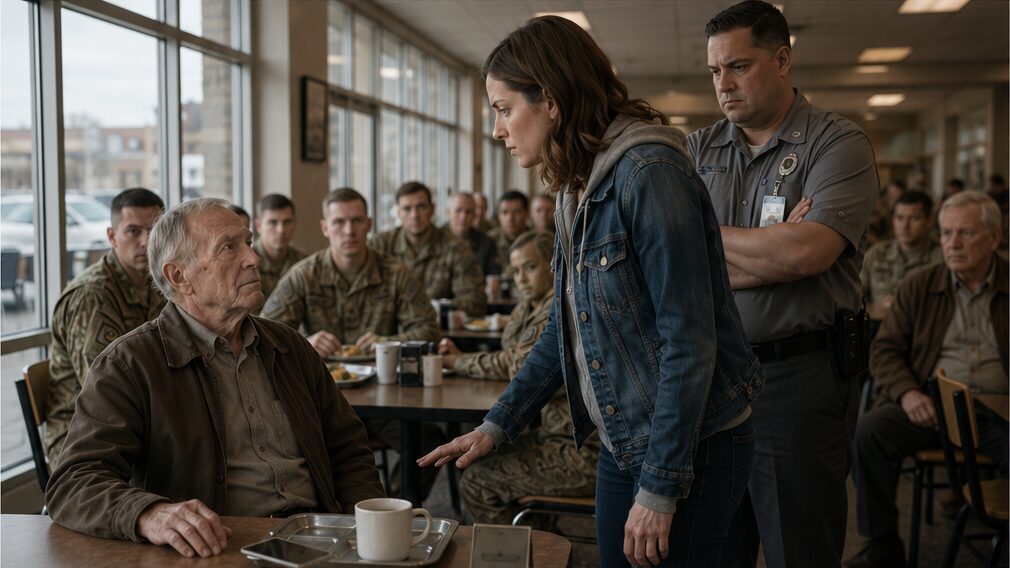
The woman’s hand stopped two inches from Richard Carter’s tray.
It hung there above his coffee, palm down, as if she could quiet him by pressing the whole table flat.
“Sir,” she said, not loudly, but clearly enough for the soldiers at the next table to turn their heads, “you can’t sit here.”
Richard looked at her hand first. It was easier than looking at her face. Her nails were trimmed short. A plastic badge swung from the pocket of her denim jacket. Amanda Wilson, Cafeteria Coordinator. Behind her stood a uniformed security officer with his arms folded across his chest, the kind of folded arms that made a small matter look decided before anyone had spoken.
Richard’s phone lay beside his tray, face-up, black screen reflecting the long cafeteria windows.
Outside those windows, the winter light was thin and white. Inside, the veterans facility cafeteria was all motion: trays sliding along metal rails, chairs scraping, coffee machines hissing, young soldiers laughing too hard at one table and older men eating in practiced silence at another. The lunch crowd filled nearly every seat except the chair across from Richard, the one he had not touched.
The table where he sat was near the windows, four seats from the corner, close enough to feel the cold through the glass. A small laminated sign stood in the center.
RESERVED.
Richard had moved it gently to the side, as he always did.
Amanda glanced at the sign, then at the phone. “This table is for the recognition lunch. Registered guests only.”
Richard kept one hand around the paper cup. The coffee had gone lukewarm. He had not yet taken a sip.
“I know what the table is,” he said.
Amanda’s expression tightened, not with anger exactly, but with the strain of someone who had already been asked too many questions that morning. “Then you understand why I need you to move.”
The security officer shifted his weight.
Richard heard the shift more than saw it. Leather. Floor polish. The dull clink of something on the officer’s belt.
Across the aisle, a young soldier lowered his fork. Another pretended not to watch and watched anyway. A kitchen worker paused behind the serving line with a pan of rolls in both hands.
Richard put his thumb on the rim of his cup and turned it once.
“I’m waiting,” he said.
“For who?” Amanda asked.
The chair across from him stayed empty.
Richard looked at it briefly. “No one who’s coming through that door.”
That made Amanda soften for half a second. Then she looked again at the sign, the phone, the old brown jacket hanging loose on Richard’s shoulders. The jacket had a worn cuff where his wrist bone pressed against the fabric. His shoes had been polished, but polish could not hide age in leather any more than dignity could hide age in hands.
“Sir, I’m sorry,” she said. “But people are asking why this table is occupied. If you’re here for lunch, we have open seating by the wall.”
There was no open seating by the wall. There was one chair squeezed beside a trash station and another at a table where someone had stacked coats. Richard did not correct her.
Timothy Scott, the officer, stepped forward. “Do you have a visitor badge?”
Richard looked up at him then. Timothy was not unkind-looking. That made it worse. He looked like a man doing what he thought was reasonable.
“No,” Richard said.
“Facility card?”
Richard touched the breast pocket of his jacket but did not reach inside. His card was there, folded behind an old receipt. It would have been simple. One square of plastic, one swipe, one apology that would not be an apology.
But Amanda was no longer asking whether he belonged in the building. She was asking whether he belonged at that table.
“No,” he said again.
Amanda drew a slow breath. “Were you recording people?”
The cafeteria seemed to change shape around the question.
Richard’s thumb stilled on the coffee cup.
The phone on the table had gone dark again, but Amanda’s eyes remained fixed on it. In the black glass, the overhead lights appeared as pale bars.
“No,” Richard said.
“Several people saw you holding it up earlier.”
“I looked at a picture.”
“Of the cafeteria?”
He did not answer.
Timothy’s voice stayed even. “Sir, if you’ve been filming service members without permission, that’s a concern.”
Richard heard the sentence land around him. Not loud. Not cruel. But public.
A concern.
At the next table, the young soldier put down his fork entirely. Someone in the serving line whispered. One of the older veterans looked at Richard, then looked away with the reflex of a man who understood humiliation well enough not to stare at it directly.
Richard’s hand moved from the coffee cup to the phone.
Amanda leaned forward. “Sir, please don’t—”
He did not rush. He never rushed when his hands were shaking. He pressed the side button, waited for the screen to wake, then unlocked it with a thumb that did not work the first time. The phone rejected him. He tried again. The small delay put heat in his face.
Timothy said, “Sir.”
Richard opened the photo.
For a moment he did not raise it. He looked at it himself.
A younger Sharon Carter smiled from the screen, standing beside this same window table. Her hair was tucked behind one ear. She wore a volunteer apron over a blue sweater, and in one hand she held a tray with two coffee cups. Richard stood beside her in the photo, not young, but younger than now, shoulders straighter, mouth resisting a smile and failing.
Behind them, half out of frame, was the same window. The same corner. The same table.
Richard lifted the phone.
Amanda’s expression changed before she meant it to. The official line of her mouth loosened. She leaned in, close enough now to see the photo and the name below it in the audio file still paused beneath the image.
Sharon Carter.
Timothy unfolded his arms.
Richard did not play the message. His thumb rested near the triangle on the screen, close enough that the phone seemed to hold its breath.
“That her?” Amanda asked, and her voice no longer carried to the next table.
Richard lowered the phone slightly, but not enough to hide it.
“My wife,” he said.
The cafeteria sounds came back slowly, as if the room had remembered it was still a room. A tray clattered near the dish return. Someone coughed. The coffee machine hissed again.
Amanda looked from Sharon’s face on the screen to Richard’s face above it. “Was she staff here?”
“Volunteer,” Richard said. “Tuesdays. Some Thursdays. More often if someone called in sick.”
Timothy glanced at the reserved sign. “Sir, that still doesn’t explain—”
Richard stood.
The chair legs scraped against the floor, a short harsh sound that made several people turn. He rose carefully, not because he wanted drama, but because the angle of the room had become unbearable. He had been sitting while they stood over him. He had let them do it because he was tired and because there were kinds of tiredness no sleep touched.
Now he stood with the phone in one hand and the paper cup in the other.
He was not taller than Timothy. He was not stronger than Amanda. His back had a small bend in it that deepened when the weather changed. But standing made his voice come from his chest instead of from the table.
“I came for this seat,” he said. “Not for a free meal.”
Amanda’s cheeks colored. “I didn’t say—”
“No,” Richard said. “You didn’t.”
That was all. He did not rescue her from the silence after it.
Timothy’s eyes dropped to Richard’s jacket pocket, then to the phone. “Mr. Carter, maybe we can step into the lobby and sort this out.”
Richard looked at the empty chair across from him. Sharon’s chair. Not officially. Not in any file. Not on any facility map. Just the chair she used to leave open when she saw a man hovering with a tray and nowhere he felt welcome enough to sit.
The old habit rose in him like a pain behind the ribs.
He touched the volume button on the side of the phone and turned it down until the bars disappeared.
Amanda saw the motion. “There’s a message?”
Richard’s thumb covered part of Sharon’s name.
“There is.”
“From her?”
He slid the phone into his jacket pocket before the screen could go dark.
“Yes.”
No one asked him to play it. Maybe they did not dare. Maybe they thought the photograph was enough. Maybe Amanda already regretted letting the room hear the beginning and not the end.
Richard picked up his tray with both hands. The coffee trembled in its cup.
Amanda stepped back quickly. “Sir, you don’t have to—”
Richard paused.
For the first time since she had come to the table, he looked straight at her, not past her badge, not past her young worried face, but at her.
“I know,” he said.
Then he carried the tray toward the lobby, leaving the reserved sign in the center of the table and the chair across from him empty.
Chapter 2: The Rule That Did Not See Him
The lobby smelled of floor wax and rainwater.
Richard sat on a bench beneath a framed poster about community support programs and held his phone inside his jacket pocket. He did not need to look at it to know where the screen had gone cold. His palm remembered the shape of it. His thumb remembered the place where Sharon’s message waited.
Amanda stood near the reception desk, speaking quietly with Timothy. She had taken off her cafeteria badge and held it in one hand, rubbing the plastic edge as if smoothing it could smooth the last fifteen minutes.
Richard watched the automatic doors open and close. People came in carrying folders, umbrellas, paper cups, small expectations. A man in a wheelchair rolled past him toward the elevators. A young soldier walked beside an older woman, guiding her with one hand near her elbow but not touching unless needed.
Every few seconds, Amanda looked toward Richard and then away.
He had finished half his coffee before they moved him from the cafeteria. Finished it because Sharon would have told him not to waste good coffee just because people had lost their manners. Then he had left the sandwich untouched. It sat wrapped on the tray somewhere behind the reception desk, probably already thrown out.
Timothy approached first.
“Mr. Carter,” he said, “Administrator Johnson can see you now.”
Richard stood.
Amanda stepped forward. “I’ll come too.”
Timothy looked as if he wanted to say that was not necessary. Amanda’s face said she already knew that and was coming anyway.
The office was small, with a window that faced the parking lot instead of the cafeteria. Rebecca Johnson sat behind a desk arranged too neatly to be comfortable. File folders squared with the desk edge. Pens in a cup. A framed certificate on the wall. A small dish of mints beside the computer.
She rose when Richard entered.
“Mr. Carter,” she said. “I’m Rebecca Johnson.”
He shook her hand because she offered it. Her grip was careful, as if she knew old hands might break. Richard disliked that almost as much as roughness.
“Ma’am.”
“Please sit.”
He sat in the chair nearest the door. Amanda and Timothy remained standing until Rebecca gestured toward the other seats. Amanda took one. Timothy stayed by the wall.
Rebecca folded her hands on the desk. “I want to begin by saying I understand there was a misunderstanding in the cafeteria.”
Richard said nothing.
Amanda’s eyes moved toward him.
Rebecca continued. “We’ve had new access procedures during scheduled events. The recognition lunch today included invited guests, visiting families, and registered service members. Certain tables were reserved.”
Richard nodded once.
“You were asked for identification.”
“Yes.”
“And you declined to provide it.”
“I declined to reach for it while a room watched me be measured.”
The words came out quieter than he expected. They did not strike the desk. They simply landed there.
Amanda lowered her eyes.
Rebecca held still for a moment. “I see.”
Richard knew she did not, not fully. But she was trying to leave space in the room, and he respected the effort.
“I do have a facility card,” he said. “It’s in my pocket.”
“May I see it?”
Richard reached inside his jacket and took out the card. It had been bent at one corner. He placed it on the desk, face-up.
Rebecca picked it up, typed his name into the computer, and waited. The printer near the wall clicked once, then settled.
“You’re in our system,” she said. “Active visitor. Veteran designation confirmed.”
Timothy shifted against the wall.
Amanda closed her fingers around her badge.
Rebecca looked at the screen. “It says you attend the cafeteria annually?”
“Once a year for that table,” Richard said. “Other times for coffee, if the rain is bad.”
“Once a year on today’s date?”
“Yes.”
“Is there a reason?”
Richard looked at the dish of mints. Green and white wrappers twisted tight at both ends.
“Yes.”
Rebecca waited.
He did not continue.
Amanda spoke, softly. “Was it because of your wife?”
Richard’s hand closed around the edge of his chair.
Rebecca looked toward Amanda.
Amanda swallowed. “There was a photo on his phone. Same table.”
Richard did not correct her. He had shown them that much. He could not pretend he had not.
Rebecca turned back to him. “Mr. Carter, if this is connected to a memorial visit, we could have handled it differently.”
Richard almost smiled. Not because anything was funny.
“A thing has to be known before it can be handled,” he said.
Rebecca’s face changed a little. She was not offended. She looked, for the first time, tired.
“You’re right.”
Timothy cleared his throat. “Sir, I asked about the phone because we had concerns about recording. We’ve had families complain before.”
“I wasn’t recording.”
“I understand that now.”
Richard looked at him. “No. You know it now. Understanding takes longer.”
Timothy absorbed that without answering.
Amanda looked as if she wanted to say something. Her mouth opened once and closed.
Rebecca set Richard’s card back on the desk, facing him. “I’m sorry the situation became public.”
Richard took the card and slid it into his pocket.
That apology was shaped carefully. Sorry for the situation. Sorry it became public. Not sorry for the first assumption. Not sorry for the hand above his tray, or the voice that made soldiers turn, or the sign placed between him and a memory.
Still, he nodded.
Rebecca clicked through something on her computer. “For future visits, we can note your file. If you plan to come on this date each year, we can make arrangements.”
Richard looked up.
“Arrangements?”
“To avoid confusion.”
He heard Sharon’s voice in his head then, not the recording, but the living voice that used to come from across the table.
Richard, don’t let them make kindness sound like storage.
He rubbed his thumb slowly along the seam of his pocket, over the hidden edge of the phone.
“I don’t need arrangements.”
Rebecca’s professional expression returned, softer than before but still built from rules. “The difficulty is that today’s table had been reserved.”
“That table was reserved before your sign was printed.”
Amanda looked at him.
Rebecca’s fingers stilled on the keyboard. “By whom?”
Richard’s throat tightened. He had not meant to say that much.
He saw the table as it had been years ago, before Sharon’s knees got bad, before she started keeping cough drops in every coat pocket, before the phone became a thing that held her voice better than he did. She would put napkins down first. Then coffee. Then she would leave one chair empty, always the one facing the room.
“Sharon,” he said.
Amanda leaned forward slightly.
Rebecca’s voice was careful. “Your wife reserved cafeteria tables?”
“She saved one seat,” Richard said. “There’s a difference.”
No one spoke.
Outside the office window, a car pulled into a space near the entrance. Its headlights swept across the wall and disappeared.
Rebecca folded her hands again. “Mr. Carter, the recognition lunch today was planned through our office. I can’t undo what happened, but I can make sure there’s no further issue. If you want to attend future events, you can register in advance.”
Richard looked at her then, and something in him went very still.
Register in advance.
For grief. For habit. For keeping a promise to a woman whose name now lived under his thumb on a phone screen. For a seat that had never belonged to him alone.
“No, ma’am,” he said. “I don’t want to attend events.”
Amanda’s eyes lifted.
Richard stood, slower than before. “I wanted lunch.”
Rebecca rose too. “Mr. Carter—”
“And the chair by the window.”
Amanda whispered, “I’m sorry.”
It was so quiet Richard almost pretended not to hear it. It would have been easier for both of them.
But he had spent too many years hearing things men tried not to say.
He looked at her. Her face was pale now, not from fear, but from the first clean edge of shame.
He nodded once, not forgiving, not refusing. Only acknowledging that the words had crossed the room.
Rebecca came around the desk. “May I ask one more question?”
Richard waited.
“Why today? Specifically?”
He could have said it was the date Sharon died. He could have said it was the date of her last volunteer shift. He could have said it was the day he missed the call because he had been in a pharmacy line arguing over a prescription he could not afford. All of those were true. None of them were the whole truth.
Instead, he said, “She asked me not to stop coming.”
Rebecca looked down.
Amanda’s badge creaked in her grip.
Rebecca nodded slowly. “The seat today was reserved for a recognition lunch.”
Richard reached for the door.
Behind him, Rebecca added, “For volunteers.”
His hand stopped on the knob.
Amanda turned toward Rebecca, startled.
Richard looked back.
Rebecca’s face held the cautious look of someone realizing too late that a file had a shadow.
“We were honoring current and former volunteers,” she said. “Families too. I didn’t know your wife was one of them.”
Richard opened the door halfway.
“She didn’t do it to be recognized,” he said.
“No,” Rebecca said. “I imagine not.”
Richard stepped into the hall. Amanda followed him out as far as the reception desk, then stopped.
He walked past the poster, past the automatic doors, past the bench where he had sat with his phone in his pocket like a second heart.
At the exit, the cold air met him.
His phone buzzed once.
He did not take it out until he reached the curb. The screen showed a voicemail notification from the facility’s main number, left minutes ago while he had been inside Rebecca’s office.
Richard stared at it.
Then another call came through.
He answered.
Rebecca’s voice was quieter now. “Mr. Carter, I’m sorry to bother you. Until we clarify what happened today, I need to ask that you not return to the cafeteria.”
Richard looked through the glass doors toward the bright room beyond the lobby.
“Clarify,” he said.
“Yes.”
The word settled between them like a locked door.
Rebecca added, “Just temporarily.”
Richard ended the call without saying goodbye.
Chapter 3: The Woman In The Old Cafeteria Photo
Two days before Amanda Wilson put her hand over Richard’s tray, his phone had tried to die in the middle of Sharon’s voice.
He had been sitting at his kitchen table at 6:10 in the morning, the apartment still dark except for the blue light from the phone screen and the yellow bulb above the stove. The old charger had a split near the end of the cord. If it bent wrong, the phone stopped charging. If it bent right, it worked as if nothing had ever been broken.
Richard understood that kind of thing.
He adjusted the cord with two fingers and watched the battery symbol flicker from red to green.
Sharon’s message waited on the screen.
Not playing. Waiting.
Her name appeared above the file because he had never changed it, never shortened it, never moved it into a folder where grief could be organized. Sharon Carter. One minute and twelve seconds. Saved.
There were mornings when he listened to the whole thing. There were mornings when he only looked at her name and let that be enough. There were mornings when he hated the phone for keeping what he had failed to answer.
That morning, he touched the screen.
A small hiss came first, the old kind that lived in recorded silence. Then Sharon’s breath.
“Richard, if you’re still at that pharmacy, don’t fuss at the clerk.”
He closed his eyes.
Her voice was weak in the recording but still hers. Dry humor at the edge. A little breathless. Trying to sound ordinary for his sake.
“I know you. You’ll stand there like a courthouse statue and make everybody nervous.”
He opened his eyes before the next part came.
The kitchen table had only one placemat now. He had not removed the second chair, but he had pushed it closer to the wall, where it held folded mail, a scarf, and a grocery bag he kept meaning to reuse. On the table beside the phone lay the old cafeteria photo in a cheap frame.
In the photo, Sharon stood at the window table smiling as if she had just caught Richard pretending not to be happy. Her volunteer apron had a coffee stain near the pocket. She had refused to let him crop it out.
“That stain,” she had said, “is proof I was useful.”
The phone continued.
“When you get back, remind me to call the cafeteria about Tuesday. There’s a man who’s been coming in with that blue cap. He sits too close to the door. Nobody should sit alone by the door unless they choose it.”
Richard pressed pause.
The silence afterward was too complete.
He looked at Sharon in the frame. “I remember.”
The apartment gave no answer.
It was a small place, made smaller by what he had kept. Her mug, though the handle had cracked. Her grocery list pad with three blank pages left. Her sweater folded in the drawer he opened less and less because the smell of her had almost gone and he could not bear to confirm it.
The cafeteria had been hers before it was his.
She started volunteering after his knees began to trouble him and after she grew tired of hearing him say he did not need company. She had a way of finding men who said the same thing and putting coffee in front of them before they could defend themselves.
“They don’t come for food,” she told him once. “They come because the room is warm and nobody at home is waiting to ask how the potatoes are.”
He had told her she was making poetry out of lunch.
She had said lunch needed all the help it could get.
The window table became her post. She liked that it let her see the entrance, the serving line, and the far corner where the quiet ones drifted. She never called it charity. She called it noticing.
When her breathing got bad, she still went on Tuesdays. When she started forgetting where she put her keys, she still remembered who took sugar and who pretended not to. When she could no longer carry trays safely, she sat at the window table and waved people over.
Richard went because she asked him to drive.
Then because she asked him to sit.
Then because she was gone.
He picked up the phone again. The message waited at the paused line.
His thumb hovered over Delete.
The word had lived in his mind for months. Delete, and he would stop punishing himself. Delete, and he would not wake before dawn to hear the call he missed. Delete, and Sharon could become memory instead of evidence.
He had been at the pharmacy when she called that day. The prescription had been wrong. The clerk had said he needed to come back after lunch. Richard had stood there, stiff with irritation, making everyone nervous exactly as Sharon later accused him of doing. His phone had buzzed in his pocket.
He had seen her name.
He had thought, Two minutes.
By the time he listened, she was asleep in the hospital bed, and the nurse told him not to wake her.
She never fully woke again.
His thumb trembled over Delete.
Then he moved it away.
“No,” he said to the empty kitchen.
The phone dimmed.
He tapped the screen before it went black and opened the cafeteria photo instead. Sharon’s smile filled the small rectangle. Behind her, the window caught a bright wash of afternoon light. On the table sat two coffee cups and a third chair pulled out for someone not yet there.
That was what people missed when they looked too quickly.
The empty chair had never been empty to Sharon. It was an invitation held open.
Richard set the phone against the frame and stood. His knees complained. He ignored them. He made oatmeal he did not want, rinsed the bowl before it dried, and took his brown jacket from the hook by the door.
In the pocket was his facility card, a folded receipt, and the small paper list he kept from last year: three names without first names because he had not asked for them, only remembered where they sat. Blue cap. Walker. Man with daughter’s photo.
He had not seen two of them in months. The third had died in spring, according to a volunteer who said it gently near the coffee urn.
Richard had kept going anyway.
Not every week. Not like Sharon would have. Some mornings he reached the bus stop and turned back. Some afternoons he stood outside the facility and watched people through the glass without entering. Grief made a coward of him in small, practical ways.
But once a year, on the day Sharon left the message, he sat at the window table.
He did not play the whole message there. Not usually. He looked at her photo. He drank coffee. He left the chair across from him open until someone needed it, or until no one came and he had to sit with that too.
On the present evening, after Rebecca Johnson’s call, Richard sat again at the same kitchen table, his jacket still on though the apartment was warm.
The facility’s words remained in the room.
Do not return until the matter is clarified.
The phone lay plugged into the charger, green battery symbol steady now. Sharon’s message was open. Her name glowed above the line he had not let anyone hear.
Richard pressed play.
Sharon breathed. Teased him about the pharmacy. Mentioned the man with the blue cap.
Then came the part he rarely let finish.
“If I can’t get back there for a while, you go for me. Don’t make that face. I know you’re making it. Just sit by the window. Leave one chair open. Somebody always needs to know there’s room.”
Richard’s eyes closed.
On the recording, Sharon inhaled carefully.
“And Richard? Don’t wait for them to ask if you belong. Some people are too tired to ask. You sit down first.”
The message ended with a rustle, a distant nurse’s voice, and Sharon saying his name once more, softer than the rest.
Richard sat very still.
For the first time, the phone did not feel like proof.
It felt like a weight he had agreed to carry without understanding how far the road would be.
The landline rang.
He let it ring twice before answering.
“Mr. Carter?” said a receptionist’s voice. “This is the veterans facility calling on behalf of Administrator Johnson. She wanted to confirm you received the instruction not to return to the cafeteria until the matter is clarified.”
Richard looked at Sharon’s picture.
“Yes,” he said.
“Thank you for understanding.”
He almost corrected her.
Instead, he said, “Good night,” and set the receiver down.
The apartment returned to silence. The phone screen faded slowly beside the old photo, Sharon’s name still visible until the light went out.
Chapter 4: The Seat Nobody Wanted To Explain
Amanda found the receipt list because someone had folded it into the wrong folder.
It was not even a list at first glance. Just a thin strip of register paper with dates written beside small amounts: $4.10, $6.85, $3.25, $8.00. No names. No explanation. Only one repeated note in careful block letters.
Window table.
She stood in the staff area behind the cafeteria, one hand still on the open file drawer, while the lunch rush moved beyond the swinging door. Trays slid. Voices rose. Someone laughed near the soda machine. The room sounded normal again, which made the memory of Richard Carter standing with his phone feel sharper.
“What are you looking for?” a kitchen worker asked.
Amanda folded the receipt without meaning to hide it. “Nothing.”
The worker gave her a tired look and went back to stacking cups.
It had been three days since Rebecca Johnson asked Richard not to return until the matter was clarified. Three days of Amanda correcting schedules, answering family questions, and walking past the window table without looking at it directly.
The reserved sign was gone now. Not because anyone had made a decision, but because the recognition lunch had ended and the next event had not begun. Without the sign, the table looked ordinary. Four chairs. A napkin holder. Salt and pepper. Afternoon light.
Amanda kept seeing Richard there anyway.
His cup trembling in his hand. His phone lifted. Sharon Carter’s name below the paused message. The way he had turned the volume down before anyone could hear her voice, as if protecting the room from something it had not earned.
She carried the receipt strip to Rebecca’s office after the lunch rush slowed.
Rebecca was on the phone, saying, “Yes, I understand your concern,” in a tone that meant she had heard the same concern before. Amanda waited by the door until Rebecca ended the call and rubbed the bridge of her nose.
“If this is about the volunteer lunch photos,” Rebecca said, “I haven’t had time.”
“It’s about Richard Carter.”
Rebecca’s hand paused. “What now?”
Amanda placed the receipt strip on the desk. “This was in the cafeteria drawer. Kitchen staff said he leaves cash sometimes. For meals.”
Rebecca looked down but did not touch it. “His meals?”
“No. Other people’s.”
Rebecca leaned back.
Amanda stayed standing. She did not feel right sitting. “There’s no formal account. No name. The cashier said he’ll notice someone stuck at the register, someone whose card isn’t working, someone embarrassed. He pays and tells staff not to say anything.”
“Did you ask why this wasn’t recorded properly?”
“That’s what you heard first?”
Rebecca looked up.
Amanda regretted the sentence as soon as it left her mouth, but she did not take it back.
Rebecca picked up the receipt. “No. It isn’t.”
Amanda looked toward the window. From Rebecca’s office, she could see only a slice of the parking lot and the edge of the cafeteria entrance. “We told him not to come back.”
“We asked him temporarily.”
“He’s seventy-eight.”
“That doesn’t exempt him from policy.”
“I know.” Amanda pressed her fingers into her palm. “That’s the problem. I know the policy better than I knew him.”
Rebecca put the receipt down again. “Amanda.”
“I thought he was filming people. I thought he was refusing to move because he didn’t understand the event. I thought if I kept my voice calm, I was being respectful.”
Rebecca did not answer.
Amanda remembered the young soldiers watching. The older veterans looking away. Timothy standing with folded arms, making her feel backed by authority. She had wanted the situation contained. She had wanted the table cleared before visiting families noticed confusion near the recognition lunch. She had wanted no one to accuse her of being careless.
She had not thought about how it would feel to be the person everyone watched.
Rebecca opened Richard’s file on her computer. “He has veteran status confirmed, but there are no service details listed beyond eligibility. No emergency contact. No volunteer association under his name.”
“Sharon’s?”
Rebecca typed. The office filled with the soft clatter of keys.
Amanda waited.
Rebecca’s face changed by almost nothing, but Amanda saw it.
“What?” Amanda asked.
“Sharon Carter volunteered here for eleven years,” Rebecca said. “Cafeteria support. Meal assistance. Informal visitor welcome.” She scrolled. “Notes from prior staff. ‘Window table.’ ‘Helps isolated guests.’ ‘Spouse often present.’”
Amanda sat down without being asked.
Rebecca continued reading silently. Her mouth tightened.
“What happened to the notes?” Amanda asked.
“Archived when the volunteer database was updated.”
“Archived meaning forgotten.”
“Archived meaning not visible on the current screen.”
Amanda looked at the receipt strip. “That sounds cleaner.”
Rebecca closed the file but kept her hand on the mouse. “We still have to be careful. If we create personal exceptions, other guests will ask why. If a table is reserved for an event, staff need clarity. If someone is using a phone near service members, security has to respond.”
“Richard wasn’t using the phone near them.”
“He held it up.”
“Because I asked him what he was doing like he was a problem.”
Rebecca’s eyes lifted. “You made a mistake. That does not mean every rule is wrong.”
“No.” Amanda’s voice dropped. “But it means the rule did not see him.”
Rebecca looked away first.
That afternoon, Amanda went to the cafeteria entrance and stood just outside the line where the tile changed color. Through the glass, she could see the window table. A young soldier had left his jacket on one chair while he got coffee. Two older veterans sat at the far end of the room, one eating soup, the other turning a paper napkin into smaller and smaller squares.
Amanda watched the door longer than she needed to.
Richard did not come.
The next day, he did not come either.
By Friday, the absence had become part of the room.
Amanda found herself noticing men and women she had not noticed before. The veteran who carried his tray with both hands and paused too long before choosing a seat. The older woman who sat with her back to the wall and kept one gloved hand on her purse. The man in a blue cap who entered, scanned the room, and left without eating.
She followed him as far as the lobby.
“Sir?” she called.
He turned, wary.
“The cafeteria is still serving.”
He looked past her, toward the bright noise. “Too crowded.”
“We have quieter seating near the windows.”
His eyes sharpened slightly, as if the offer had struck an old bruise.
“No, thank you,” he said, and left.
Amanda stood there after the doors closed.
Later, Timothy found her near the staff board, where she was reading the updated event schedule without taking in a word.
“You all right?” he asked.
“I don’t know.”
He stood beside her, hands clasped in front this time instead of folded. “Johnson asked me to review the incident report.”
Amanda let out a small breath. “And?”
“I wrote what happened.”
“That I mishandled it?”
“That we both did.”
She looked at him.
Timothy’s jaw moved once. “I asked him for ID in front of the room. Should’ve asked him aside first.”
Amanda looked down the hallway. “He had it.”
“Yeah.”
“He had the card in his pocket the whole time.”
Timothy nodded. “I know.”
“Why didn’t he show us?”
Timothy did not answer quickly. Through the cafeteria doors, someone called for more coffee. A chair scraped along tile.
“He was a soldier,” Timothy said finally.
Amanda turned.
Timothy looked uncomfortable with the certainty of it. “Not because of the file. Because he didn’t reach for proof when we pushed. I’ve seen that before. Some of the old ones, they won’t defend themselves if they think the question is insulting. They’ll take the hit before they beg to be recognized.”
Amanda thought of Richard’s voice.
You know it now. Understanding takes longer.
“He never mentioned being a veteran,” she said.
Timothy looked toward the cafeteria, where the window table sat in full light, empty for the moment.
“No,” he said. “He didn’t.”
Chapter 5: The Message He Would Not Play
Richard laid three things on the kitchen table: his facility card, his phone, and the brown jacket.
The card lay face-up, small and official, with his name printed cleanly beneath a photograph that looked like a tired stranger. The phone lay beside it, charging cord bent into the one angle that still worked. The jacket hung over the back of Sharon’s chair because he had not yet decided whether to wear it.
He had told himself he was not going back.
The facility had asked him not to return until the matter was clarified, and Richard had spent most of his life following orders he disliked. It was easier, in some ways, to obey. Stay home. Make soup. Let the cafeteria become one more place that belonged to before.
But on Friday afternoon, the rain started.
A cold, slanted rain that blurred the apartment window and made the streetlights glow early. Rain like the day Sharon first made him come inside the cafeteria instead of waiting in the car.
“You look like a wet newspaper,” she had said, opening the passenger door with an umbrella tilted badly over both of them.
“I’m fine.”
“You are not a weatherproof man, Richard Carter.”
“I was in the Army.”
“You are still not a weatherproof man.”
He had gone in because arguing with Sharon in the rain was harder than sitting among strangers. She put him at the window table with coffee and told him not to scowl at anyone unless they deserved it.
That was how it began.
Now the rain tapped the apartment glass, and the phone screen glowed with Sharon’s name.
Richard picked up the facility card.
It would be the simplest answer. He could walk in, show it before anyone spoke, let the card pass from hand to hand like permission. He could bring the printed volunteer record Amanda must have found by now, if she had looked. He could bring photographs, receipts, anything that made him less easy to dismiss.
He set the card down.
“Proof,” he said aloud, and disliked the sound of it.
His life had too much proof in it and not enough presence. Forms proving he had served. Forms proving Sharon had died. Forms proving income, address, eligibility, need. Proof was what people asked for when they did not want to slow down long enough to see.
He reached for the phone instead.
The message opened where he had left it. One minute and twelve seconds. Sharon’s name above the line. The play triangle waited.
His thumb hovered over it.
He did not press it yet.
There were parts of Sharon’s message he had worn smooth from listening. Her joke about the pharmacy. Her reminder about the man in the blue cap. Her instruction to sit by the window. Then the part that came after a breath, the part he had never played in the cafeteria because it belonged to him and to the room at the same time.
He pressed play.
Sharon’s voice filled the kitchen softly.
“Richard, if you’re still at that pharmacy, don’t fuss at the clerk.”
He almost smiled.
The message moved through familiar lines. Her breath. The faint hospital sound behind her. The rustle of sheets. Then:
“If I can’t get back there for a while, you go for me. Don’t make that face. I know you’re making it. Just sit by the window. Leave one chair open. Somebody always needs to know there’s room.”
Richard stared at the brown jacket.
“And Richard? Don’t wait for them to ask if you belong. Some people are too tired to ask. You sit down first.”
The message went on, into the part he usually stopped before the end.
“If a person comes in looking like they might turn around and leave, you make room before they have to explain why. Promise me that. Not because you owe me. Because you know what it is to stand in a doorway and wonder if the room has already decided against you.”
Richard closed his eyes.
There it was.
Not a request to be honored. Not a shrine to her. Not a chair saved for grief alone.
A promise.
The guilt had hidden that from him for a long time. He had wrapped the message around the missed call and made it punishment, because punishment was simpler than carrying on. If he kept hurting, maybe that meant he had loved her correctly. If he kept replaying the message alone, maybe he could undo not answering.
But Sharon had not spent her last strength asking him to suffer.
She had asked him to notice.
The phone clicked at the end of the recording. Silence returned.
Richard sat for a while, listening to the rain.
Then he stood and put on the brown jacket.
He left the facility card on the table.
At the bus stop, rain misted under the shelter and gathered on the toes of his polished old shoes. He held the phone in his pocket, one hand curled around it, not for warmth, but to feel the weight. The bus was late. The driver lowered the ramp for another passenger and nodded at Richard when he climbed aboard.
Richard took a seat near the front and watched the city slide by in gray streaks.
The closer he got to the facility, the more his body argued. His knees stiffened. His hand tightened. A small, stubborn part of him said he was walking back into embarrassment. Another part, older and quieter, said he had been embarrassed before and survived.
When the bus stopped outside the veterans facility, Richard did not get off immediately.
The driver looked in the mirror. “This you?”
Richard looked through the rain-streaked window.
The cafeteria glowed beyond the lobby glass. People moved inside with trays and cups. At the far end, near the windows, he could see the table. There was no reserved sign, but no one sat there.
Not yet.
“This is me,” he said.
He stepped down onto the curb.
Inside the lobby, the reception clerk looked up. Recognition flashed across the clerk’s face, followed by uncertainty.
“Mr. Carter?”
Richard nodded.
“I think Administrator Johnson said—”
“I know what she said.”
The clerk’s hand moved toward the phone on the desk.
Richard did not raise his voice. “I’m going to the cafeteria.”
“I should call—”
“You can call.”
He kept walking.
Every step through the hallway took him closer to the noise: utensils, voices, the soft roar of a public room pretending no one inside was lonely. He paused outside the cafeteria doors.
Through the window, Amanda Wilson stood near the serving line with a clipboard. She was speaking to a kitchen worker, but her eyes lifted as if she had felt the change before she saw him.
She saw the brown jacket first.
Then his face.
The clipboard lowered.
Richard pushed open the cafeteria door and stepped inside.
Chapter 6: The Lunch Where Everyone Looked Away
The room noticed Richard Carter in pieces.
First the receptionist at the cafeteria entrance, who glanced behind him as if expecting someone from administration to follow. Then the kitchen worker at the coffee urn, who went still with a stack of cups in both hands. Then the young soldiers near the center tables, their conversation lowering without stopping all at once.
Amanda noticed him completely.
She stood near the serving line with the clipboard held against her chest. For a moment, she did not move. Her first expression was not relief or fear, but recognition sharpened by consequence. She knew he had been told not to return. She knew he had come anyway.
Richard walked past the entrance without looking for permission.
He did not go to the register. He did not pick up a tray. He went first to the window table.
The chair across from it was tucked in. The napkin holder had been refilled. A faint ring from someone else’s cup marked the surface near the edge. No reserved sign stood there now.
Richard pulled out the chair facing the room and sat.
The room did not fall silent. Rooms rarely did in real life. They thinned. Voices shortened. Laughter stopped finding its second breath. People kept eating with the small caution of witnesses who did not yet know what kind of scene they had entered.
Amanda came toward him.
Timothy Scott appeared from the lobby side a few seconds later, walking fast but not running. Rebecca Johnson followed behind him, her face controlled in the way of someone trying not to make a public mistake larger by hurrying.
Amanda reached the table first.
“Mr. Carter,” she said.
Richard looked up.
She stopped on the other side of the table, near Sharon’s chair, but did not put her hand on it. That mattered. Richard noticed.
“You came back,” she said.
“Yes.”
Rebecca arrived with Timothy at her side. “Mr. Carter, I asked that you wait until we clarified the matter.”
Richard looked at the window. Rain moved down the glass in crooked lines.
“I waited,” he said.
Rebecca lowered her voice. “Sir, I don’t want to address this in the middle of the cafeteria.”
“Neither did I.”
Amanda flinched.
Timothy looked down.
Richard removed the phone from his jacket pocket and placed it face-up on the table.
No one spoke.
The phone was not raised this time. It lay between them like something fragile enough to break if handled too quickly.
Rebecca looked at it, then at Richard. “Is there something you want us to see?”
“No,” Richard said.
Amanda’s brow tightened, confused.
Richard touched the screen. Sharon’s name appeared. The photo opened first, the old cafeteria picture, Sharon smiling in her apron beside the window table. He set the phone down so all three could see it, then turned it slightly toward Amanda.
“She liked this table,” he said.
Amanda’s voice came out small. “I know.”
“No,” Richard said. “You know she stood here.”
Amanda took that without defending herself.
Richard tapped the audio file below the photo, then paused before pressing play. His thumb rested over the triangle.
A part of him still wanted to put the phone away. The message had survived because he had guarded it. Playing it here felt like opening a door in a house where strangers had not wiped their feet.
He looked at the room.
At the young soldiers trying not to stare. At the older veterans who understood too much and therefore looked at their trays. At the empty chair across from him, Sharon’s chair only because she had made it belong to anyone who needed it.
Then he pressed play.
The volume was low. Only the people at the table could hear clearly. The room could see, but not own it.
Sharon’s faint recorded breath came first.
“Richard, if you’re still at that pharmacy, don’t fuss at the clerk.”
Amanda’s eyes lowered to the phone.
Richard did not watch the screen. He watched Amanda’s hand, open at her side, fingers curling once and relaxing.
The message moved gently through the lines. The pharmacy. The man with the blue cap. The window. The chair.
“Somebody always needs to know there’s room.”
Rebecca’s face changed.
Timothy looked toward the empty chair.
The message continued.
“Don’t wait for them to ask if you belong. Some people are too tired to ask. You sit down first.”
Richard’s throat tightened, but his hand stayed still on the table.
Then came the part Amanda had not heard, the part that belonged to why he had come back.
“If a person comes in looking like they might turn around and leave, you make room before they have to explain why. Promise me that. Not because you owe me. Because you know what it is to stand in a doorway and wonder if the room has already decided against you.”
The recording rustled. Sharon said his name once, soft and tired.
Then it ended.
No one clapped. No one saluted. No one said the words people reached for when silence made them uncomfortable.
Richard pressed the side button and darkened the screen.
Amanda’s eyes were wet, but she did not wipe them. “Mr. Carter,” she said, “I’m sorry.”
He nodded once.
She looked toward the room, then back to him. “I should have asked you aside. I should have listened before I decided what I was seeing.”
“Yes,” Richard said.
Rebecca took a breath. “Mr. Carter, we can document Mrs. Carter’s volunteer history properly. We can also add a note to your file, so when you come—”
“No.”
Rebecca stopped.
Richard put his phone in his pocket. “I didn’t come back for a note in my file.”
Rebecca’s face softened with embarrassment. “Then what can we do?”
He looked at the empty chair.
A man near the far wall sat alone with a tray he had barely touched. Richard had seen him before, though not often. Gray coat. Hands folded before every meal as if prayer and hesitation had become the same gesture.
Richard looked back at Rebecca.
“Stop making people prove they deserve a place to sit.”
Rebecca did not answer.
Amanda looked toward the far wall too.
Richard continued, still quietly. “Not every old man with a phone is recording trouble. Not every person who sits alone wants to explain why. If a table is reserved, say for who. If a seat is open, let it be open. And if somebody looks like they might leave because they don’t know where they belong, send someone before the door closes.”
The words cost him more than anger would have. Anger gave heat. This gave only exposure.
Rebecca folded her hands in front of her, not on a desk now, not protected by procedure. “You’re right.”
Richard looked at her long enough to make sure she meant the sentence as more than a way to end the scene.
Amanda pulled out the chair across from him slightly, then stopped. “May I?”
Richard looked at Sharon’s chair.
For a moment, his first instinct was refusal. The chair had carried too much. But Sharon’s voice had just filled the space between them, asking him to make room before people explained why.
He nodded.
Amanda sat, but only on the edge, as if ready to leave if he changed his mind.
Timothy remained standing. Rebecca remained standing too. That made the table feel less surrounded than before, because no one leaned over him now.
Amanda said, “I found some receipts.”
Richard looked at her.
“For meals,” she added. “The ones you paid for.”
He sighed. “They weren’t meant to be found.”
“I know.”
“Then forget them.”
“I can’t exactly forget them.”
“You can stop making them useful against me.”
Amanda absorbed that.
Rebecca said, “No one will use them that way.”
Richard glanced at her. “People use good things wrong when they’re embarrassed.”
Rebecca’s mouth tightened, and he knew the sentence had reached her.
A kitchen worker approached carefully with a tray. “Mr. Carter?”
On it sat coffee, a bowl of soup, and a wrapped sandwich.
Richard looked at Amanda.
She said, “I thought you might not have eaten.”
“I didn’t ask.”
“No.”
The kitchen worker set the tray down and left without waiting for thanks. That kindness, because it did not demand performance, nearly undid him.
Richard wrapped both hands around the coffee cup.
Across the room, the man in the gray coat at the far wall looked toward the window table, then away. Amanda noticed. Richard saw her notice.
That was enough for now.
Rebecca turned toward the center of the table, where a small plastic holder displayed a printed card for upcoming events. Behind it, a leftover reserved sign lay flat, forgotten after the recognition lunch.
She picked it up.
For a second Richard thought she meant to place it back.
Instead, Rebecca slid the card from its holder, folded the reserved sign once, and carried it toward the staff counter. She did not make an announcement. She did not look around to see who approved. She simply removed it from the table.
When she returned, the space between the napkin holder and the salt shaker was empty.
Richard looked at it, then at the chair across from him.
Amanda sat very still.
Timothy stepped back toward the wall, giving the table room.
Richard lifted his coffee and took the first sip while rain threaded down the window beside him.
Chapter 7: The Seat Left Open By The Window
Several weeks later, the cafeteria had learned to leave one table unfinished.
Not empty. Not reserved. Unfinished.
That was how Richard thought of it when he stepped through the entrance on a clear Tuesday morning and saw the place near the windows without a sign in its holder. The napkins were filled. The salt and pepper stood together. The chairs were pushed in except for one, angled slightly toward the room as if someone had just risen and meant to return.
No laminated card. No printed explanation. No special ribbon. Nothing that turned kindness into an announcement.
Amanda Wilson stood near the register with a stack of trays in her arms. She saw him and did not wave him over. She did not call his name across the room. She only gave him a small nod and looked toward the window table, the way a person might point without pointing.
Richard nodded back.
That was enough.
He moved slowly through the line. Coffee first. Then soup. Then a sandwich wrapped in paper, though he knew he would take half of it home. The kitchen worker put an extra packet of crackers on his tray without meeting his eyes, an old favor disguised as routine.
At the register, the clerk glanced at Richard’s tray.
“Good morning,” the clerk said.
“Morning.”
No one asked for his facility card.
That, too, was enough.
Richard carried the tray with both hands. His phone was in his jacket pocket, but he had not opened Sharon’s message that morning. He had charged it overnight, unplugged it carefully, and placed it in his pocket with the screen facing inward. At the bus stop, his thumb had found the side button twice. Twice he had let it go.
The window table was not empty.
An older veteran sat in the chair Richard usually took, facing the room. The man wore a gray coat buttoned all the way to the throat, though the cafeteria was warm. His tray held coffee, toast, and a small bowl of fruit he had not touched. One hand rested flat beside the tray. The other stayed in his lap.
Richard stopped three steps away.
For a moment, the old reflex rose in him. That was the chair. That was the angle of the room. That was where Sharon’s photograph lined up with the window and the entrance and all the lonely places between.
Then he heard her voice, not from the phone this time.
Leave one chair open.
Richard looked at the chair across from the man. It was open.
He walked to it.
“Mind if I sit?” Richard asked.
The man looked up with the guarded expression of someone who had expected to be moved before being greeted. His eyes flicked to Richard’s tray, his jacket, his face.
“Plenty of tables,” the man said.
“There are,” Richard said.
He waited.
The man looked toward the rest of the cafeteria. The room was not crowded yet, but it was filling. Two younger soldiers sat near the center with plates of eggs. A visiting family settled near the far wall. A staff member adjusted chairs to make space for a wheelchair. Morning light lay across the tile in pale rectangles.
The man finally shrugged.
Richard sat.
He set his tray down, then took the phone from his jacket pocket and placed it screen-down beside his coffee. The gesture surprised him. For months, the phone had lain face-up like a small door he might need to open at any moment. Now its dark glass faced the table.
The man in the gray coat noticed but said nothing.
Amanda crossed the cafeteria carrying a coffee pot. She stopped at two tables before reaching theirs. At each one, she asked quietly if anyone needed a refill. When she came to Richard’s table, she did not hover.
“Coffee?” she asked.
Richard looked at his cup. It was full.
“For him,” he said, nodding toward the man across from him.
Amanda turned gently. “Would you like a little more?”
The man hesitated, then pushed his cup forward.
“Half,” he said.
Amanda poured half.
No one called it a program. No one explained that Rebecca Johnson had changed the cafeteria guide so one accessible table near the windows stayed open during ordinary lunch hours. No one mentioned that Amanda had trained staff to ask before assuming, to offer before directing, to step beside someone instead of standing over them. No one said Richard Carter’s name in connection with it.
That was the way he had asked for it.
Rebecca had wanted a plaque at first.
Not a large one, she had said in her office two weeks earlier. Just a small acknowledgment of Sharon’s years of service. Something tasteful.
Richard had looked at the sample she printed and slid it back across the desk.
“If you put her name on the table,” he said, “people will think they need permission to sit there.”
Rebecca had lowered her eyes, then folded the paper in half.
“You’re right,” she said.
She said that more carefully now, as if the words were not a surrender but a tool she had learned to use.
Timothy Scott had changed too, though in smaller ways. Richard saw him near the cafeteria entrance that morning, speaking with a young soldier whose visitor badge had twisted backward on its lanyard. Timothy did not fold his arms. He stood beside the soldier, not in front of him, and pointed him toward the reception desk with two fingers instead of a command.
When Timothy caught Richard’s eye, he gave one brief nod.
Richard returned it.
Across the table, the man in the gray coat stirred his coffee though he had added nothing to it.
“You come here often?” Richard asked.
The man’s mouth tightened. “Sometimes.”
Richard unwrapped half his sandwich.
“Good soup on Tuesdays,” he said.
The man looked at his own bowl as if he had forgotten it was there. “That right?”
“Not great. Good.”
A small breath moved through the man’s nose. Almost a laugh, but not offered for inspection.
They ate for a while in quiet.
Richard did not mind quiet. He trusted it more than most speech. But there were different kinds. The silence at the table weeks ago had been the kind that pressed a man smaller. This one gave room.
The man finally said, “I almost left.”
Richard looked up.
The man kept his eyes on the fruit bowl. “Too many people.”
Richard nodded.
“Then that woman by the door said there was a seat near the window if I wanted it. Didn’t make a big thing of it.” He rubbed his thumb along the handle of his spoon. “I figured I’d try.”
Richard looked toward Amanda. She was at the register now, helping a visitor sort through meal tickets. Her face was focused, but not rushed. When the visitor fumbled and apologized, Amanda waited.
“She’s learning,” Richard said.
The man glanced at him. “From who?”
Richard picked up his coffee. “The hard way.”
The man accepted that.
After a while, the cafeteria grew louder. Chairs filled. Trays passed. Someone near the center laughed, then lowered his voice without being told. A kitchen worker carried fresh rolls to the serving line. Rainless light touched the window, and Richard could see his own reflection faintly beside the man across from him.
He did not look as old in the glass as he felt. Or maybe he looked exactly that old and no longer cared to argue with it.
His phone stayed screen-down.
Once, it buzzed with some harmless notification. His hand moved toward it from habit, then stopped. He let it be.
Sharon’s voice was still there. He knew that. Her name remained in the device, saved beneath glass and code and all the fragile machinery of memory. But for the first time in a long while, he did not need to press play to obey her.
The man across from him finished his toast and pushed the fruit bowl toward the center of the table.
“You want that?” he asked.
“No,” Richard said.
“Me neither.”
They sat with the unwanted fruit between them like a small, harmless truth.
Amanda came by once more, this time without the coffee pot.
“Everything all right here?” she asked.
The man in the gray coat looked ready to say yes just to make her leave, but Richard answered first.
“We’re fine.”
Amanda nodded. Her eyes touched the phone lying screen-down beside Richard’s cup, then moved away without asking. Before she left, she adjusted the empty chair at the side of the table, turning it slightly outward.
An invitation, not a display.
Richard watched her go.
The man across from him followed his gaze. “You know everybody here?”
“No.”
“Looks like they know you.”
Richard thought of the day the room watched him stand with the phone in his hand. He thought of Rebecca folding the reserved sign. Timothy stepping back. Amanda sitting in Sharon’s chair like someone asking permission from more than one person.
Then he thought of all the mornings Sharon had sat here without anyone writing down what she did.
“No,” Richard said. “They’re starting to notice, that’s all.”
The man considered this.
Outside, a bus pulled away from the curb. Inside, the cafeteria doors opened and another older veteran stepped in, paused, and scanned the room with a tray already trembling in one hand.
Richard saw the pause.
Amanda saw it too, but she did not rush over. She looked toward Richard’s table, then toward the open chair at the side.
Richard picked up his phone and slid it into his jacket pocket without waking the screen.
He turned to the man across from him.
“You eating alone today?” Richard asked.
The story has ended.