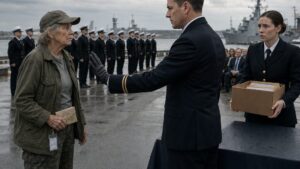
They Stopped the Old Man at the Gate Before Learning Whose Names He Had Come to Carry Home
Chapter 1: The Old Sedan Blocking the Memorial Gate
“Keep both hands where I can see them.”
The order came before Donald King had fully straightened beside the open door of his sedan.
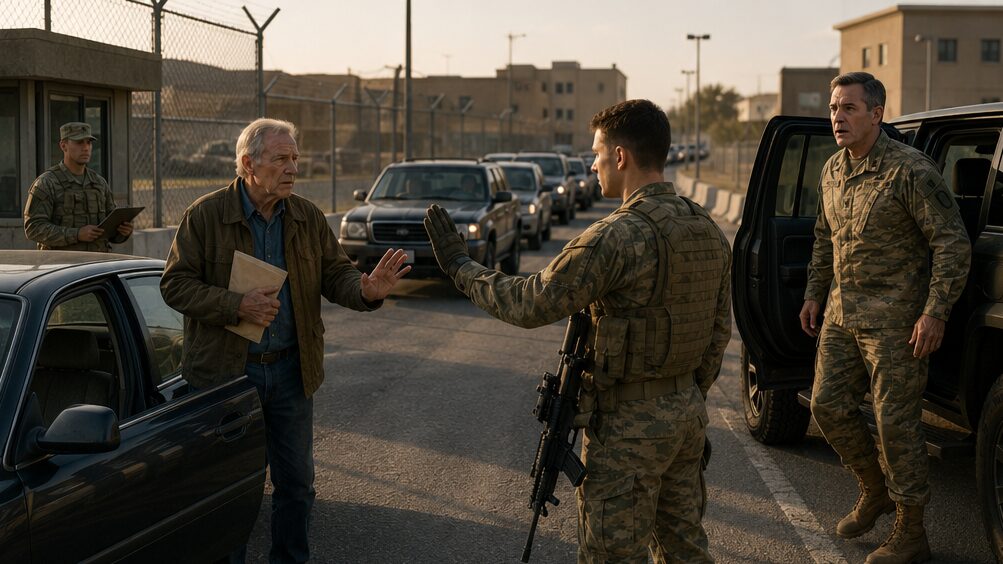
He stopped with one foot on the pavement and one hand still resting on the roof. Then, slowly, he brought both hands up to chest height. His palms faced the young soldier standing three yards away.
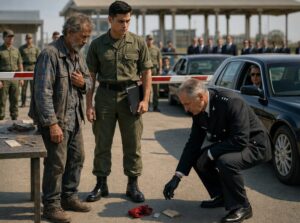
The gesture pulled the front of his olive-brown field jacket tight across his shoulders. The jacket was faded at the seams and repaired along the left sleeve with thread that did not quite match. Beneath it, Donald wore a plain blue shirt. His jeans were worn pale at the knees. Dust from the highway marked the toes of his work boots.
Behind him, the sedan idled roughly in the late-afternoon heat.
The soldier’s gloved hand remained raised in a hard stop signal. A rifle hung across his chest. His name tape read MILLER.
“Sir, step away from the vehicle.”
Donald moved one careful pace forward.
“Far enough?”
“Another step.”
Donald took it.
Traffic had begun to collect behind the sedan. Through the windshield of the nearest black government vehicle, a driver glanced toward the gate clock. Farther back, a small bus carried families to the memorial dedication. Several faces had turned toward the old man holding his hands in the air.
Donald looked past the soldier at the chain-link fence and the low buildings beyond it. Fort Calder had changed its entrance twice since he had last driven through. The guardhouse was new. The concrete barriers were not. They were simply placed where he would not have put them.
“Identification,” the soldier said.
“It is on the dashboard.”
“I told you to keep your hands visible.”
“That is why it remains on the dashboard.”
The soldier’s mouth tightened. He was young enough that the attempt to appear older only made his tension more obvious.
A second guard stood near the booth with a clipboard. He watched but did not approach.
“What is the purpose of your visit?”
Donald’s gaze shifted briefly to the base buildings. Somewhere inside the memorial gallery, an archive director named Michelle Lewis would be checking display lights and seating cards. In the inner pocket of his jacket, a thick cream envelope pressed against his ribs.
“The archive dedication.”
“Invitation?”
“On the seat.”
“Digital pass?”
“No.”
“Registration code?”
“I was not sent one.”
The soldier looked at the old sedan as though the missing code had been hidden somewhere in its cracked paint.
“Name?”
“Donald King.”
The second guard turned pages on the clipboard.
Miller waited.
The second guard shook his head.
Donald said, “There is a replacement roster.”
Miller looked toward the booth. “Which roster?”
“Handwritten. It should have arrived from the archive office after three.”
A pause followed.
Donald saw the doubt deepen rather than soften.
Miller stepped sideways to improve his angle on Donald’s hands. “How would you know that?”
“Because I was told.”
“By who?”
“Michelle Lewis.”
“Do you have her number?”
“I have it written inside the invitation.”
“Which is inside the vehicle.”
“Yes.”
The line behind them lengthened. A horn gave one short impatient sound and stopped.
Miller keyed his radio. “Hold inbound traffic, lane one.”
Donald watched the barrier arm drop behind his sedan.
The young soldier approached the open driver’s door without taking his attention off Donald. He leaned enough to see the invitation lying on the passenger seat.
It had once been white. Repeated folding had softened it to gray along the creases. A rain stain spread across one corner. Donald had kept it in the map pocket during the drive from Virginia, then taken it out at a rest stop and read the single handwritten line again.
Please bring what you promised.
Miller reached inside and lifted the invitation between two fingers.
“There’s no scannable code.”
“I know.”
“The event logo is blurred.”
“It got wet.”
“And your name is handwritten.”
“The printed copy was changed.”
“By you?”
Donald did not answer at once.
The correct answer was yes, though not in the way Miller meant. Donald had asked for the title removed, then the photograph, then the formal introduction. When the coordinator resisted, he had asked for the entire place setting to be changed to his plain name. He had thought that would be enough.
Silence had once been one of his most useful tools. In a crowded briefing room, silence made other people reveal what they had failed to consider. At the gate, it had a different effect.
Miller folded the invitation along its old crease.
“Sir, did you alter this document?”
“No.”
“Did you ask someone else to alter it?”
“I asked for a correction.”
“What correction?”
Donald lowered his hands an inch.
Miller’s rifle shifted against his vest. “Keep them up.”
Donald raised them again.
The movement sent a bright line of pain through his right shoulder. He let it pass without changing his face.
Miller examined the invitation. “There’s no rank, no organization, no sponsor, and no pass number. This looks like an incomplete draft.”
“The name can be checked.”
“It has been checked.”
“You checked one sheet.”
The second guard glanced at Miller.
Donald continued, “Secondary verification was moved to the east booth after the power failure. The archive office should have sent an addendum there.”
Miller’s eyes narrowed. “The east booth has been out of regular use for three weeks.”
“Not regular use. Secondary event verification.”
The second guard said quietly, “He’s right about that.”
Miller turned his head. “What?”
“The event memo. Overflow verification at east.”
Miller faced Donald again. “How do you know a restricted processing change?”
“It was included in the instructions.”
“There are no instructions attached to this.”
“They were given by telephone.”
Miller’s jaw flexed. The line of arriving vehicles had become an audience. The bus doors remained shut, but Donald could see the pale oval of a child’s face against the glass. A woman in the first government car had lowered her window.
Donald had spent years teaching officers that pressure did not excuse carelessness. He recognized carelessness now—not in Miller’s decision to stop him, but in the soldier’s growing need to prove that the stop had been justified.
“Move to the inspection area,” Miller said.
Donald looked toward the painted pull-off beside the fence. “My vehicle?”
“Leave it until we clear you.”
“It is blocking the lane.”
“We’ll move it.”
“Who will?”
“Someone authorized.”
Donald studied him. “Specialist Miller, I would prefer no one drive that car.”
Miller’s expression changed at the use of his rank.
“Did you read that from my sleeve?”
“No.”
“My sleeve doesn’t show rank.”
“I know.”
The second guard looked down, concealing something that might have been surprise.
Miller held up the invitation. “You seem to know a lot about this installation for someone who cannot provide valid access credentials.”
Donald felt the envelope against his chest.
Thirty-four years earlier, he had stood under fluorescent lights in an operations room while names disappeared from radio traffic one by one. Since then, people had called him decisive, disciplined, and brave. No one had called him fast enough.
“I came because I was invited,” he said.
Miller raised the radio. “Main control, lane one. Elderly civilian presenting altered credentials for the archive dedication. Possible unauthorized access attempt.”
The words carried farther than necessary.
Donald heard a murmur from the bus.
Miller listened to the radio response, then said, “Military police are coming.”
“You could call the archive.”
“We have a process.”
“The archive is part of the process.”
“Sir, I need you to stop directing this checkpoint.”
Donald’s hands remained open.
For a moment Miller saw only an old man in a worn coat standing before an armed soldier. Donald could tell by the way the younger man’s shoulders settled. Temporary power had found a shape it understood.
“You need to move away from the incoming VIP lane,” Miller said. “You’re delaying invited guests.”
Donald looked at the invitation in Miller’s hand.
“Am I not an invited guest?”
“At this point, you are an unverified civilian.”
The phrase landed without force and still managed to wound.
Donald’s eyes moved to the gate beyond Miller. Through it he could see the old headquarters roof, the flagpole, and the corner of a building that had once housed the command archive. He had signed casualty notifications there until his hand cramped. He had walked those halls in polished boots while people rose when he entered.
None of that was a reason Miller owed him courtesy.
That was precisely the point.
A military police vehicle turned toward the lane. Its lights were not flashing, but everyone saw it arrive.
Miller handed the invitation to the second guard and pointed toward Donald’s jacket. “Do you have anything else related to the event?”
Donald did not answer.
Miller stepped closer. “Sir, I asked whether you are carrying any other documents.”
Donald’s right hand moved—not toward his pocket, but across the front of his jacket, covering the envelope beneath the cloth.
Miller saw it.
“What is inside your coat?”
“An archive delivery.”
“Remove it slowly.”
“It is sealed.”
“Remove it.”
Donald drew the cream envelope from his inner pocket. It was thick enough to hold more than a letter. A red line crossed the flap, and Michelle Lewis’s name had been written in Cynthia Brown’s narrow hand.
Miller reached for it.
Donald closed his fingers over the envelope and lowered his hands for the first time.
The military police vehicle stopped behind the guard booth.
Miller’s voice sharpened. “Give me the document.”
Donald’s face changed—not into anger, but into the expression of a man who had finally reached the edge of what he would surrender.
“That does not leave my hand at a gate.”
Chapter 2: The Commander Who Recognized His Silence
The military utility vehicle had nearly cleared the outer barrier when Brigadier General Christopher Wright saw the old man beside the inspection lane.
He stopped speaking in the middle of an order.
Brandon noticed because the general’s driver noticed. The vehicle slowed, then braked at an angle that blocked half the lane. The rear door opened before the driver could circle around.
General Wright stepped onto the pavement.
His eyes went first to the cream envelope clenched in the civilian’s hand, then to the faded field jacket, then to the old man’s face.
The change in him was immediate.
“General King?”
Brandon felt the blood leave his cheeks.
The old man looked toward Wright but did not smile.
“Christopher.”
The general crossed the distance quickly. He had been expected at the dedication entrance, where staff waited to receive him. Instead he stopped several feet from the man Brandon had just described over an open radio channel as a possible unauthorized visitor.
Wright came to attention.
His salute was precise and unhurried.
For one suspended second, no one moved.
The second guard straightened. The military police sergeant halted beside his vehicle. Through the window of the waiting bus, heads shifted toward the glass.
Donald King transferred the envelope to his left hand and returned the salute with his right.
The movement was smaller than Wright’s. Age and pain narrowed it, but nothing about it was uncertain.
Wright lowered his hand.
Brandon realized his own was still raised in a stop gesture.
The general reached over and pushed it gently down.
“Specialist,” Wright said, “lower your hand.”
Brandon obeyed.
Wright turned back to Donald. “Sir, we expected you at the command entrance.”
“I did not.”
“Your driver called ahead?”
“I drove myself.”
Wright glanced at the dark sedan, its exhaust trembling beneath the rear bumper. “From Virginia?”
“Yes.”
“In that?”
“It still runs.”
A few people behind them laughed nervously, then stopped when Donald looked toward the waiting vehicles.
Wright’s attention dropped to the invitation held by the second guard. “What happened?”
Brandon tried to speak, but his throat had tightened.
Donald answered first. “There was an irregular credential.”
Wright looked at him. “Your credential?”
“Yes.”
“And the lane was stopped because—”
“Because Specialist Miller stopped an irregular credential.”
The general’s face gave away nothing, but Brandon heard the protection in the wording. It did not relieve him. It made his error harder to hide inside procedure.
Wright extended a hand toward the invitation. The second guard passed it over.
He read the name.
“Donald King,” he said. “Nothing else.”
“That is what I requested.”
Wright’s eyes lifted. “You requested this?”
“I requested several things.”
“You also requested no escort.”
“Yes.”
“No command vehicle.”
“Yes.”
“No formal reception.”
“Yes.”
“And apparently no usable pass.”
“That was not among the requests.”
The military police sergeant approached, stopping just outside the conversation. Brandon knew him from training. He also knew every radio transmission from the lane had been recorded.
Wright looked toward the cream envelope. “Is that for Michelle?”
Donald placed his hand flat over it. “It is.”
“I’ll take you to the archive.”
“No.”
The answer surprised everyone except Donald.
Wright lowered his voice. “Sir, you’ve been standing in the access lane with your hands raised.”
“I am aware.”
“My vehicle is here.”
“That does not resolve the entry record.”
“It resolves it for me.”
Donald looked at Brandon.
The young specialist wished he would look anywhere else.
“For you,” Donald said. “Would it resolve it for an unknown old man?”
Wright’s mouth tightened.
Donald continued, “The credential was irregular. The stop was lawful. The verification was not completed.”
Brandon managed to speak. “Sir, I checked the roster.”
“You checked the printed roster,” Donald said. “You were told there was an addendum.”
“I had no confirmation that the addendum existed.”
“You had a booth assigned to confirm it.”
Brandon heard his own earlier words returning to him, stripped of the confidence with which he had spoken them.
Wright looked toward the east side of the checkpoint. “Is the secondary station staffed?”
The second guard answered. “Yes, sir.”
“Then why wasn’t the name checked there?”
Brandon’s hesitation gave the answer before he did.
“The document appeared altered, sir.”
“That is a reason to verify it,” Wright said. “Not a reason to stop verifying.”
Brandon swallowed. “Yes, sir.”
He could feel the military police sergeant watching him. Six weeks earlier Brandon had allowed a contractor through after glancing at a valid-looking vehicle placard. The contractor had turned into the wrong maintenance zone and triggered a review. No harm had been done, but the written warning remained in Brandon’s file.
His father’s response had been simple.
One more mistake and you will be back unloading trucks with me.
Brandon had promised himself he would never again be the soldier who trusted appearances.
Now he had failed in the opposite direction.
Donald held out one open hand, not demanding, merely waiting. “My invitation.”
Wright returned it to him.
Donald folded it once and slipped it into the envelope’s outer cord.
Wright said, “You should not have been spoken to as though you were confused.”
Donald glanced at Brandon. “No.”
Brandon braced for what came next.
Donald said, “But not because I was a general.”
The sentence left no safe place for Brandon’s relief.
Wright looked toward the waiting traffic. “Clear the lane. We’ll finish this in the inspection pull-off.”
The sedan was moved under Donald’s supervision, though he refused to let anyone drive it. He eased it forward himself while the military police vehicle blocked traffic. The engine coughed once, then steadied.
At the pull-off, Brandon carried the handwritten addendum from the east booth.
The page had been faxed, copied, and annotated twice. Several names had smeared where the paper had caught moisture. At the bottom, beneath a list of family representatives and archive guests, someone had added:
Donald King — civilian visitor — archive delivery.
No title. No sponsor code. No vehicle designation.
Brandon checked the authorization line. It bore Michelle Lewis’s initials.
He keyed the entry manually.
“Identity confirmed,” he said.
Donald stood beside him, watching the screen.
“Not by General Wright?”
“No, sir. By the archive authorization.”
“Good.”
The word should have felt like approval. It felt instead like an examination Brandon had barely passed.
Wright opened the rear door of his vehicle. “Come with me. We’re already behind.”
Donald looked at the sedan.
“We’ll have someone secure it,” Wright said.
“I would prefer to drive.”
“You’ve driven six hours.”
“Seven.”
“Then let me take you the final half mile.”
Donald’s eyes moved toward the base interior. The strength seemed to leave his face for only a moment, exposing something older than fatigue.
“I did not come to be delivered,” he said.
Wright studied him, then closed the vehicle door.
“Fine. I’ll ride with you.”
The idea of the installation commander climbing into the cracked passenger seat of Donald’s sedan sent the public-affairs officer hurrying from the command vehicle. Wright silenced the objection with one glance.
Before they could leave, the ceremony coordinator arrived at a run, carrying a stack of printed programs against her chest.
“General Wright, we need you inside. Families are already being seated.”
Then she saw Donald.
Her pace slowed.
“General King?”
Donald’s expression gave nothing away.
The coordinator looked down at the program in her hands, flipping rapidly through the pages. “There must be an error.”
Wright held out his hand.
She passed him the top copy.
The cover showed Fort Calder’s old command building under the title A LEGACY OF DECISION: THE CALDER EVACUATION ARCHIVE.
Inside, Wright found the evening order. His own welcome appeared first. Michelle Lewis followed. Then a historical film, a formal dedication, and the presentation of an empty chair beneath a projected photograph of Donald in uniform.
But Donald’s name did not appear.
Not as speaker.
Not as guest of honor.
Not as general.
The coordinator pulled the handwritten addendum from Brandon’s desk and compared it to the program.
Her face changed.
“He’s only here as a civilian archive delivery,” she said.
Wright looked at Donald.
Donald placed the sealed envelope against his chest.
“That,” he said quietly, “was the intention.”
Chapter 3: The Name He Asked Them to Remove
The first person to meet Donald inside the memorial corridor tried to direct him back toward visitor services.
“Sir, the public entrance is on the other side of the gallery.”
Michelle Lewis heard the words from her office and stepped into the hall before Donald answered.
He stood beneath a floor-to-ceiling photograph of himself at twenty-eight.
The younger Donald King wore a field uniform and held a radio handset against one ear. Dust covered his face. Behind him, soldiers moved toward transport aircraft beneath a darkening sky. The exhibit lighting had been adjusted to make the image seem almost sculpted—jaw firm, eyes clear, command embodied in a single frozen instant.
The old Donald’s reflection hovered over the glass.
His field jacket looked brown beside the younger man’s uniform. His shoulders had narrowed. Silver hair lay flat from the drive. One hand rested over the sealed envelope.
Michelle stopped several paces away.
She had spent four years assembling the Calder archive. She knew every approved photograph of Donald King, every public quotation, every recorded briefing in which his voice had remained steady while other people’s broke.
None of it had prepared her for the man who had apparently been detained at her gate.
“General King,” she said.
Donald’s eyes shifted to her. “Ms. Lewis.”
The staff member who had redirected him stepped backward.
Michelle did not salute. She was a civilian, and Donald had specifically asked that people stop turning his presence into a ceremony.
She glanced at Christopher Wright, who stood a few feet behind him.
“What happened?”
Christopher said, “His entry record was incomplete.”
Donald said, “My entry record was exactly as requested.”
Michelle stared at him. “You asked me to remove your title from the program. You did not ask me to make you unverifiable.”
“I asked to arrive as Donald King.”
“At an active military installation during a restricted memorial event.”
“Yes.”
“That is not the same as arriving at a grocery store.”
“No.”
She looked at the envelope. “You brought it.”
“I said I would.”
“You also said you would be here before four.”
“The gate required attention.”
Christopher drew a breath. “Michelle.”
“No, sir. We have forty-six minutes before the dedication. The gallery film is loaded, the families are seated, and the central guest has removed himself from the program so completely that security considered him a fraudulent visitor.”
Donald’s face remained calm, which made her angrier.
She had received his requests one at a time over six weeks.
Remove the formal rank from the invitation.
Remove the command biography.
Remove the photograph from the guest materials.
Do not announce him at the entrance.
Do not reserve front-row seating under his title.
Each request had sounded modest on its own. Together they had created a hole in the event large enough for everyone else to fall into.
“Come inside,” she said.
Donald did not move.
“Is the envelope going into the archive?” he asked.
“That depends on what is in it.”
“It is sealed for you.”
“And you waited until tonight to bring it.”
“It was not mine to mail.”
Michelle looked at the handwriting across the flap.
Cynthia Brown.
Her irritation cooled by one degree.
She knew the name. Every serious researcher of the Calder evacuation did.
Lieutenant Brown had commanded the rear security team. Eleven soldiers from that team never boarded the final transports. The official report described them as lost during perimeter collapse after the evacuation had been completed.
Cynthia Brown had challenged that phrasing for three decades.
“Office,” Michelle said.
Donald followed her past the exhibit wall. As he walked, his reflection moved across photograph after photograph: the operations tent, the runway, the returning aircraft, the day Fort Calder’s colors were raised again.
Near the end of the corridor, a display case held a reproduction of the command map.
Michelle noticed Donald glance toward one torn corner.
His left hand touched the repaired sleeve of his jacket.
Only then did she see what the mismatched stitching held beneath the cuff: a faded strip of laminated map fabric, narrow as a ribbon.
She said nothing.
Inside the archive office, Christopher closed the door.
Donald remained standing.
Michelle cleared a section of her desk and held out her hands for the envelope.
Donald did not give it to her.
“You drove seven hours to deliver it,” she said. “Now you will not let go.”
“I need to know how it will be handled.”
“Catalogued, scanned, preserved, and reviewed.”
“Before the dedication?”
“That depends on what it contains.”
“It contains a corrected roster.”
Michelle’s eyes went to Christopher.
He looked as surprised as she felt, though his surprise had a guarded edge.
“Corrected by whom?” she asked.
“By the people who were there and the families who received the first notifications.”
“The official roster has been reviewed repeatedly.”
“The official roster has been repeated repeatedly.”
Michelle held his gaze. “Those are not the same accusation.”
“No.”
“Are you accusing the archive of falsifying names?”
“I am saying the archive inherited a record shaped for a purpose.”
“What purpose?”
Donald looked through the office window toward his younger face on the gallery wall.
“To give people one story they could stand to live with.”
Michelle turned to her computer.
She opened the evacuation database and entered the operation date. The master roster appeared, divided into extracted personnel, wounded, missing, and confirmed dead.
“Three hundred eighty-two evacuated,” she said. “Seventeen wounded. Eleven missing, later declared dead.”
Donald said nothing.
She opened the digitized casualty appendix.
The same total appeared.
Then she searched the family submissions directory and found a scanned document sent by Cynthia Brown two years earlier. It had been marked pending corroboration.
Michelle opened it beside the official roster.
The names did not align.
Not completely.
The official record listed the eleven rear-team soldiers under a supplemental casualty section dated six hours after the final transport departed.
Cynthia’s copy placed them inside the active evacuation perimeter before departure.
Michelle leaned closer.
Christopher moved beside her.
“What does that change?” he asked.
“The operation timeline,” she said. “Possibly the definition of when the evacuation ended.”
Donald’s hand tightened over the envelope.
Michelle scrolled lower.
Cynthia’s copy included a handwritten notation beside Lieutenant Brown’s name:
Objected to final departure sequence at 1842. Requested seven-minute delay for rear-team movement. Denied.
Michelle turned from the screen.
“Was this notation in the original command log?”
Donald’s expression did not move.
“General?”
He looked at her then.
“You asked me not to use the title,” Michelle said. “But titles matter when they explain who had authority.”
“I know.”
“Did Lieutenant Brown request a delay?”
“Yes.”
“Was it denied?”
Donald’s eyes returned to the two rosters.
“Yes.”
“By you?”
He did not answer.
Christopher stepped between the desk and Donald, not blocking either of them but narrowing the room.
“Michelle, the archive cannot accept an amended operational record forty-six minutes before public dedication without authentication.”
“I know the standard.”
“Then follow it.”
She faced Donald. “I will secure the envelope. I will not place its contents into tonight’s exhibit unless we establish provenance.”
“It has provenance.”
“It has handwriting.”
“It has names.”
“And if I publish an unverified correction, those names become part of another contested story.”
Donald’s mouth pressed into a thin line.
Michelle understood then that his restraint was not endless patience. It was control. He had walked into her office expecting the moral weight of the envelope to determine the procedure, even while refusing to use his rank.
He had removed the symbols of authority and kept the habit of being obeyed.
“You do not get to arrive at the last possible moment,” she said, “hand me a sealed packet, and call my caution another form of erasure.”
Christopher looked at her sharply.
Donald did not.
The old man’s gaze dropped to his hands.
For several seconds he seemed unable to open them.
Then he placed the envelope on the desk but kept two fingers over the flap.
“I was asked to deliver it unopened.”
“By Cynthia?”
“Yes.”
“And she expects it used tonight?”
“She expects the names not to disappear again.”
Michelle sat down.
She compared the rosters line by line.
The first three matched. The fourth appeared in both records with different unit notation. The fifth had been moved from rear security to perimeter support. The sixth through eleventh were grouped beneath a later timestamp in the official appendix.
She read the first omitted operational name aloud.
“Sergeant Jeffrey Martin.”
Donald’s fingers stopped moving.
Michelle looked up.
The gallery film started automatically beyond the office wall. Music rose, followed by a narrator’s measured voice describing the evacuation.
Donald spoke over it.
“His position stopped answering at eighteen fifty-seven.”
Michelle stared at him.
No hesitation. No search of memory. Exact minute.
She read the next name silently.
Donald said, “Eighteen fifty-nine.”
The third.
“Nineteen hundred.”
Christopher turned toward him. “Sir.”
Donald’s face had gone pale beneath the warm office light.
Michelle closed the roster.
Outside, the narrator praised the command team’s discipline under impossible conditions. On the monitor behind her, Donald’s younger face remained frozen over a map.
She rested one hand on Cynthia’s version.
“You have carried those minutes for thirty-four years,” she said.
Donald looked at the sealed envelope beneath his hand.
“Yes.”
“Then tell me what happened in the final one.”
Chapter 4: Eleven Names Beneath One Heroic Photograph
The narrator’s voice filled the closed gallery.
“Through decisive command and disciplined execution, the evacuation was completed without loss inside the perimeter.”
Donald stood beneath the projected image of his younger face while eleven absent names waited on Michelle’s screen.
The film moved on to transport aircraft lifting through smoke. Music rose beneath the footage, solemn but victorious. Onscreen, soldiers ran beneath spinning rotors. The official timeline marked the final departure at eighteen fifty-two.
Donald looked at the time and felt his right hand begin to close.
Michelle paused the film.
The gallery fell silent except for the cooling fans inside the projector.
“Your copy says the rear team was still inside the perimeter after that aircraft left,” she said.
“They were.”
“Then the narration is false.”
“It is incomplete.”
Michelle turned from the control panel. “That distinction has protected this exhibit for years.”
Christopher remained near the doors with the ceremony program folded under one arm. Families waited on the other side of the building. Staff had been told that a technical delay would postpone seating.
He checked his watch. “We need authentication before we call anything false.”
Donald placed the cream envelope on the long worktable beneath the heroic photograph. His hands hovered over it.
Cynthia had sealed the flap herself. She had made him promise it would be opened in the archive, not in his kitchen, not in a hotel room, and not in the private office of someone who could quietly make the problem disappear.
He slipped one finger beneath the red line, then stopped.
Michelle noticed. “You carried it across three states.”
“Yes.”
“And now you cannot open it?”
“It was not sealed for me.”
“It has my name on it.”
Donald withdrew his hand. “Then you open it.”
Michelle broke the seal.
Inside were three folders. The first held photocopies of operational notes, some typed, some handwritten. The second contained eleven family-submitted service records. The third was thinner and marked in Cynthia’s hand:
For the permanent record, if anyone is finally willing to keep it permanent.
Michelle removed a statement from the third folder.
Christopher came closer.
Donald remained where he was.
Michelle read silently at first. Her expression changed at the second page.
“What?” Christopher asked.
She looked at Donald. “Mrs. Brown says you visited her six days after the notification.”
Donald nodded.
“You arrived without staff.”
“Yes.”
“You brought her husband’s field notebook.”
“Yes.”
Christopher looked surprised. “I never heard about that.”
“There was no reason for you to.”
Michelle continued reading. “She says you told her Lieutenant Brown objected to the final departure sequence and asked for seven more minutes.”
The number seemed to alter the room.
Seven minutes was small enough to sound harmless. It was long enough to close an air corridor.
Christopher said, “The weather cell reached the southern approach at nineteen hundred.”
“At nineteen oh-one,” Donald said.
“You remember the meteorological record too?”
“I remember all of it.”
Michelle set Cynthia’s statement down. “Mrs. Brown says you promised that her husband’s objection would be entered into the permanent operational history.”
Donald looked toward the darkened screen.
“I did.”
“But it was not.”
“No.”
“Why?”
Christopher answered before Donald could. “Because the formal investigation concluded that the objection did not alter the lawful necessity of the command decision.”
Michelle faced him. “That does not explain why it vanished.”
“It did not vanish. It remained in supporting material.”
“Supporting material unavailable in the public archive.”
“The archive did not exist then.”
“The record did.”
Donald’s fingers touched the envelope again. The repaired cuff of his jacket pulled back, exposing the faded map strip stitched beneath it.
Michelle had seen the same contour line in the display case outside.
She pointed to his sleeve. “Is that from the operations map?”
Donald covered it instinctively.
Christopher stared. “Sir?”
“The northeast corridor,” Donald said.
The fragment was no wider than two fingers. A red grease-pencil mark crossed it at an angle.
“Brown’s position?” Michelle asked.
Donald nodded.
He had cut the strip from a damaged field copy after the inquiry closed. At the time, he had told himself he kept it so the location would not become an abstraction.
Over the years, it had become something else: a private proof no one could challenge because no one was permitted to see it.
Michelle spread the family records across the table.
“Sergeant Jeffrey Martin,” she said. “Communications.”
Donald answered, “He stayed with the relay set after the vehicle lost power.”
“Staff Sergeant George Campbell.”
“Medic. He moved two wounded soldiers to the maintenance trench.”
“Specialist Linda Flores.”
“Vehicle mechanic. Twenty-two years old.”
The names continued.
Donald supplied each duty without hesitation. He knew which soldier had a child born after deployment. He knew which one had transferred into the team two months before the operation. He knew who had volunteered and who had been ordered.
Christopher watched him with growing unease.
“You memorized all eleven files.”
“No,” Donald said. “I remembered eleven people.”
Michelle stopped at Lieutenant Brown’s record.
“He requested the delay at eighteen forty-two.”
“Yes.”
“What did you tell him?”
“That the final transport would hold until eighteen forty-nine.”
“And did it?”
Donald’s gaze moved to the paused image of the aircraft.
“No.”
Christopher unfolded his arms. “The western fuel point was hit at eighteen forty-six. That changed the departure window.”
“It did.”
“You had hundreds waiting on the apron.”
“Yes.”
“The weather was closing.”
“Yes.”
“Then why are we talking as though you casually broke a promise?”
Donald looked at him. “Because a necessary explanation is not the same as an honest record.”
Michelle found a typed communication summary in the first folder. A paragraph had been crossed out in pencil. Beneath the strike-through, Lieutenant Brown’s objection remained faintly visible.
“Who removed this from the public summary?”
Christopher stepped closer to inspect it. “That is not the final version.”
“I can see that.”
“The inquiry office produced several drafts.”
“Who approved the final version?”
Christopher did not answer.
Donald said, “I did.”
Michelle looked up.
“The formal summary described the rear team as unable to reach extraction after the perimeter collapse,” Donald continued. “That was true by the time the aircraft departed.”
“But not before,” she said.
“No.”
“They were holding the corridor so everyone else could board.”
“Yes.”
“And Brown warned you the published sequence left too little time for them to withdraw.”
“Yes.”
The gallery doors opened a few inches. The ceremony coordinator appeared.
“General Wright, families are asking why the program has stopped. Public affairs needs a decision.”
Christopher turned. “Ten more minutes.”
“We already gave them fifteen.”
“Then give them ten.”
She closed the door.
Christopher faced Donald. “If we alter the exhibit tonight, the dedication stops. The archive becomes evidence. Every public statement gets reviewed. There may be a command investigation into record handling.”
“There should be.”
“This is not only your legacy.”
“I know.”
“It is the base’s history. The families’ history. The soldiers who survived have built their lives around the fact that the evacuation worked.”
Donald’s voice stayed level. “It did work.”
“You are standing beneath a photograph of three hundred eighty-two people who came home because you released those aircraft.”
“And eleven who did not.”
“Both can be true.”
“That is what the wall fails to say.”
Christopher lowered his voice. “And what do you think happens if we put your private guilt into an official record? People will reduce the entire operation to one order. They will call you either hero or butcher because those are the only words the public knows.”
Donald’s jaw tightened.
Michelle saw then why he had waited. It was not merely fear of blame. He had wanted to control the shape of the correction so completely that no one could misuse it. The same instinct that had governed an evacuation now governed memory.
She placed Cynthia’s statement beside the official roster.
“You cannot protect the truth from being misunderstood by keeping it hidden,” she said.
Donald looked at the eleven names.
The projector restarted automatically. His younger image vanished, replaced by footage of the last aircraft turning toward the runway.
Christopher watched the timestamp advance.
“At eighteen fifty-one,” he said, “the pilot reported crosswinds beyond limit. At eighteen fifty-two, the field commander had to release him.”
Michelle turned to Donald.
“Was that your order?”
Donald’s hands rested on either side of the open envelope.
“The departure order was mine.”
Christopher stepped nearer. “I am asking about the delay. Brown requested seven minutes. The aircraft left before the time you promised him. Was the final minute taken from his team by your order?”
Donald watched the transport lift onscreen.
The sound of its engines filled the gallery.
“The final minute,” he said, “was mine.”
Chapter 5: The Order That Saved Hundreds and Abandoned Eleven
Donald’s younger voice emerged from the briefing-room speakers with none of the hesitation Christopher had just seen in the gallery.
“Calder Actual to Lift Six. Depart now. Repeat, depart now.”
The recording carried a wash of static, rotor noise, and distant alarms.
Christopher stood beside the console overlooking the dark flight line. Beyond the glass, runway lights stretched into the night. Donald sat at the far end of the empty briefing table, his field jacket still buttoned, his hands open on the polished wood.
Michelle had found the audio file in a restricted annex to the archive. The ceremony remained delayed. Staff had begun serving coffee to families without telling them why.
Christopher replayed the transmission.
“Depart now.”
He stopped it before the pilot’s acknowledgment.
“You were told the crosswind would exceed limits in sixty seconds,” Christopher said.
Donald did not answer.
“You had three hundred eighty-two people on the aircraft and apron. Some were wounded. Fuel storage was burning. The southern approach was closing.”
“I was there.”
“Then stop describing it as though you chose between patience and cruelty.”
Donald’s right hand closed, then opened.
Christopher had seen that hand command rooms, aircraft, and battalions. As a young captain, he had watched Donald raise two fingers during briefings and bring twenty arguing officers to silence.
Now the same hand looked uncertain on the table.
“I told Brown eighteen forty-nine,” Donald said.
“The conditions changed.”
“The promise did not change with them.”
“A commander’s promise cannot overrule physics.”
“No. But the record should show who paid when physics won.”
Christopher turned back to the console. “There is more.”
He advanced the recording fourteen seconds.
Static cracked. Then another voice came through, rough and breathless.
“Calder Actual, Brown.”
Donald’s shoulders stiffened.
The younger Donald answered, “Go.”
“We see Lift Six moving.”
“Affirmative.”
A pause, filled by noise.
Brown’s voice returned. “Send them. We will hold.”
Christopher stopped the audio.
The room seemed to contract around the final words.
Donald looked toward the speaker.
“He gave consent,” Christopher said.
“He acknowledged reality.”
“He told you to send the aircraft.”
“After he saw it moving.”
“You had already made the decision.”
“Yes.”
“And he understood why.”
“He understood there was no longer time to argue.”
Christopher leaned against the console. He had spent years defending Donald’s decision in classrooms, command reviews, and memorial planning meetings. The evacuation had become a lesson in action under impossible pressure. Young officers studied its timing. Senior leaders quoted Donald’s calm transmissions.
But they rarely listened to Brown.
Christopher played the next section.
“Rear team, fall back by maintenance trench,” the younger Donald ordered.
Brown replied, “Trench is blocked. Two wounded. We’ll hold east corridor.”
“Alternate route?”
“Negative.”
“Can you reach the service wall?”
“No time.”
Then, quieter: “Get them home, sir.”
The recording ended in static.
Donald’s eyes remained fixed on the speaker.
Christopher said, “That is not a man accusing you of abandoning him.”
“No.”
“It is a soldier completing his duty.”
“Yes.”
“And you completed yours.”
Donald stood.
The chair legs scraped sharply against the floor.
“My duty did not end when the aircraft left.”
“No one says it did.”
“The public record says it did. It ends with departure. The film ends with aircraft in the air. The plaque ends with my name.”
Christopher felt anger rise—not because Donald was wrong, but because he was making himself the only person permitted to carry the wrong.
“You visited every family,” Christopher said. “You fought for survivor benefits when the casualty classifications stalled. You kept Brown’s team attached to the operation instead of letting headquarters call them a separate perimeter loss.”
“And then I approved a summary that removed his objection.”
“You approved a summary that prevented the entire evacuation from being dismissed as command failure.”
Donald looked at him. “That sounds rehearsed.”
“It is. I have had to defend the decision for twenty years.”
“Why?”
“Because it was defensible.”
“That is not what I asked.”
Christopher walked to the window.
Below, a transport aircraft taxied across the runway, its lights moving slowly through darkness.
He had been a lieutenant during the review period, too junior to shape the first report. Years later, when a new official history was commissioned, he had served on the approval board.
The draft had included Brown’s requested delay.
Christopher had argued to move it into an appendix.
He had told himself the detail would confuse the central lesson. He had said the base needed a coherent account after years of criticism and budget threats. He had said families should not be forced through another public dispute.
Donald’s silence had made the decision easy.
Christopher faced him.
“I approved the public version used in the exhibit.”
Donald did not move.
Michelle, standing near the door with the folders, looked at Christopher. “You knew the objection was missing.”
“I knew it was in the underlying records.”
“You knew visitors would never see those records.”
“I believed the summary was accurate.”
“Was it?”
Christopher looked toward the dark runway.
“It was useful.”
Donald’s expression hardened.
Christopher continued before he could respond. “The base was fighting closure. Units that survived the evacuation were being described as broken. Families were exhausted by investigations. We needed an account people could understand.”
“You needed a hero.”
“We had one.”
Donald struck the table once with the flat of his hand.
The sound was not loud. It stopped everyone.
“You had an operation,” he said. “You had hundreds who boarded under fire. You had pilots who took off into weather they had been ordered to avoid. You had eleven people who held a corridor after their exit disappeared. You turned all of that into one man because one man fits on a wall.”
Christopher’s face warmed.
“And you let us,” he said.
The words landed between them.
Donald lowered his hand.
Christopher stepped closer. “You reviewed the text. You approved the photograph. You attended the first anniversary ceremony. Do not stand here now and pretend the institution stole a truth you refused to speak.”
Michelle remained still by the door.
Donald looked down at his palms.
For years Christopher had thought Donald’s silence came from discipline. Now he saw the other side of it: silence forced everyone around him to decide what he meant, what he wanted, and what history was allowed to keep.
Donald said, “I believed correcting the record publicly would make their deaths serve my confession.”
“And part of you?”
The question held.
Donald’s fingers curled against the table edge.
“Part of me,” he said, “did not want to become the commander who lost them.”
The admission was barely louder than the ventilation system.
Christopher felt his anger loosen.
Not disappear. Change.
Donald continued, “I could visit their homes. I could carry their files. I could remember every minute. None of that required me to surrender the story people told about me.”
Michelle set Cynthia’s statement beside the audio console.
“So the silence protected you,” she said.
“Yes.”
The word left Donald diminished and, for the first time that evening, honest.
Christopher looked again at the photograph on the folder: Donald at twenty-eight, face turned toward an aircraft no one else could see.
“The decision still saved hundreds,” he said.
Donald nodded.
“Brown still chose to hold.”
“Yes.”
“And the order still left his team without the time you promised.”
“Yes.”
Three truths. None canceled the others.
The briefing-room phone rang.
Michelle answered.
She listened, then looked at Donald.
“It is the gate.”
Donald’s eyes narrowed.
Michelle covered the receiver. “Cynthia Brown has arrived. Her name is confirmed, but she will not enter.”
“Why?”
“She says she spent thirty-four years coming through doors after other people decided which part of her husband’s story was allowed inside.”
Donald reached for the envelope.
Michelle shook her head. “She does not want the packet. She wants you.”
Christopher glanced toward the clock. The dedication had already been delayed nearly an hour.
“What did she say exactly?” Donald asked.
Michelle listened again, then lowered the phone.
“She said she will cross the gate only if the man in the old field jacket meets her there himself.”
Chapter 6: The Widow Who Refused a Perfect Apology
Cynthia recognized the jacket before she recognized Donald.
He came toward the visitor shelter beneath the gate lights, walking more slowly than he had thirty-four years earlier, but wearing the same olive-brown coat. The left sleeve had been repaired. The collar had faded almost gray.
The first time he had appeared at her door in it, he had carried her husband’s notebook and stood on the porch for eleven minutes before finding the courage to knock.
Tonight, he stopped outside the shelter and waited for her to speak.
Christopher and Michelle remained several paces behind him. The young gate specialist stood near the booth, stripped of his earlier certainty. Cynthia had been told enough about the delay to understand that another old person had become a security problem before becoming a person.
She looked at Donald’s empty hands.
“You opened it?”
“Michelle did.”
“And?”
“The rosters do not match.”
“I knew that before I sealed them.”
Donald nodded.
Cynthia sat on the metal bench without inviting him to join her. A paper copy of the roster lay across her lap. Its edges had softened from years of handling.
“You came to tell me you are responsible,” she said.
“I am.”
“That is not an apology.”
“No.”
“It is also not the whole truth.”
Donald remained standing.
Cynthia studied him. Age had thinned his face, but his stillness was unchanged. He had always known how to make silence feel respectful. For years she had mistaken that skill for honesty.
“Sit down,” she said. “You are making everyone else stand at attention.”
Donald lowered himself onto the far end of the bench.
Christopher and Michelle stayed where they were.
Cynthia held up the roster. “What do you want me to say after you confess? That I forgive you?”
“No.”
“That my husband would have understood?”
“He did understand.”
Her eyes sharpened. “Do not use his last transmission to answer for him.”
Donald accepted the rebuke without lowering his gaze.
“He said, ‘Send them. We will hold,’” Cynthia continued. “Everyone quotes that part because it is useful. It turns him into a man who agreed with whatever happened next.”
“He did not agree with the sequence.”
“No. He argued with you.”
“Yes.”
“He told you the rear team needed seven minutes.”
“Yes.”
“And you gave him less.”
“Yes.”
The clean answers angered her more than excuses would have.
Cynthia unfolded another page from beneath the roster.
“This was his last letter. It never reached me through the field post. One of his soldiers had kept a copy in a waterproof pouch. The Army sent it nine months later.”
Donald looked at the paper but did not reach for it.
She read from the final paragraph.
“General King is right that the whole force cannot wait on us if the weather closes. He is wrong if he thinks rear security can be treated like a door that disappears once everyone else walks through it.”
The gate lights hummed overhead.
Cynthia lowered the page.
“He defended the evacuation decision,” she said. “He criticized the way command thought about the people holding the exit. Both things were in the same letter.”
Donald’s voice was rough. “I never saw that.”
“You saw enough.”
“Yes.”
“You saw his objection in the log.”
“Yes.”
“You promised me it would be in the permanent history.”
“Yes.”
“And when I wrote asking why it was missing, you stopped answering.”
Donald’s hands lay open between his knees.
Christopher shifted behind them.
Cynthia did not look away from Donald. “Why?”
He took time before speaking. Once, she would have called that thoughtfulness. Now she recognized control being loosened one finger at a time.
“I told myself the review was still active,” he said. “Then I told myself a public dispute would hurt the families. Later I told myself I no longer had authority over the record.”
“You had a telephone.”
“Yes.”
“You had my address.”
“Yes.”
“You had enough authority that people built an exhibit around your face.”
Donald looked toward the base beyond the fence.
“Yes.”
Cynthia placed the letter beside the roster.
“The order is not the only thing I have been waiting for you to admit.”
“I know.”
“No. You know now because I said it plainly. For years you made grief come to you in the language you could bear. Duty. Necessity. Command responsibility. You never answered when I asked whether you were afraid.”
Donald’s jaw moved.
“Were you?”
“Yes.”
“Of me?”
“Of losing the version of the operation that allowed me to keep functioning.”
Cynthia sat back.
There it was. Smaller than the grand apology she had imagined, and more useful.
Donald said, “I was afraid that if the record included Brown’s objection, every life saved would be used to excuse the eleven, or the eleven would be used to erase every life saved. I believed I could carry the contradiction privately.”
“You could not.”
“No.”
“And neither could we.”
“No.”
The young specialist near the booth looked down.
Cynthia gathered the two rosters. The official version was clean, typeset, and stamped. Her copy contained pencil marks, uneven dates, and notes from families who had spent decades correcting spellings and assignments.
She placed both across Donald’s open hands.
He received them carefully.
For a moment his hands trembled beneath their weight.
“My husband was not always right,” she said. “He was stubborn. He challenged orders after decisions had been made. He thought every plan needed one more argument.”
Donald’s mouth shifted slightly. “That sounds accurate.”
“He was also not a sacrificial saint waiting to make your decision noble. He wanted to come home.”
“I know.”
“Say that tonight.”
Donald looked at her.
“Do not make him a symbol,” Cynthia said. “Do not make yourself a villain so people can forgive you and go home feeling clean. Tell them the operation saved hundreds. Tell them he told you to send the aircraft. Tell them he warned you first. Tell them you promised him time and took the final minute back.”
Christopher stepped forward. “Mrs. Brown, the dedication program can be postponed. We can convene a review and—”
“No.”
He stopped.
Cynthia turned to him. “Reviews are where institutions put truths they are not ready to say aloud.”
Michelle’s expression tightened, though she did not disagree.
Cynthia looked again at Donald. “Is tonight still a tribute to you?”
“It was intended to be.”
“Then I will not attend.”
“The program can change.”
“Can it?”
Donald looked down at the rosters.
Inside the base, families were waiting beneath his photograph. Staff were protecting schedules. Officers were protecting the institution. For thirty-four years, Donald had protected the dead with memory and protected himself with silence.
Cynthia watched the realization settle into him without drama.
He rose from the bench.
The rosters remained open in his hands.
“I cannot promise what the room will do with the truth,” he said.
“No.”
“I cannot promise it will repair what was omitted.”
“No.”
“I can stop deciding that those are reasons not to speak.”
Cynthia folded her husband’s letter and placed it on top of the names.
“That will be a beginning.”
Donald turned toward the gate.
Brandon stepped away from the booth, uncertain whether to open the pedestrian barrier or wait for instruction.
Donald stopped before him.
“Mrs. Brown’s entry has been verified?”
“Yes, sir.”
“Then complete it.”
Brandon looked at Cynthia. This time he did not raise his hand. He opened the barrier and stood aside.
Cynthia remained seated.
Donald understood. She would not enter on the strength of his intention.
He walked back toward Christopher, the two rosters resting in his open hands.
“The prepared introduction is already loaded,” Christopher said. “Public affairs will object to an unscripted correction.”
“Then they may object.”
“The archive film names you as the command figure.”
“It can be stopped.”
“The families have waited more than an hour.”
“They have waited longer than that.”
Christopher looked at the papers, then at Donald’s face.
“What exactly are you asking me to change?”
Donald glanced back at Cynthia beneath the gate light.
Then he faced the base where his younger image waited on the wall.
“Remove the speech,” he said, “or remove my chair.”
Chapter 7: The General Who Corrected His Own Memorial
The master of ceremonies had reached the words “the commander whose courage saved Fort Calder” when Donald stepped to the lectern and closed the prepared folder.
The soft clap of cardboard against wood carried through the gallery.
Behind him, his younger face filled the projection wall: uniform crisp despite the dust, one hand lifted over a field map, eyes turned toward an unseen runway. Before him sat surviving soldiers, widows, adult children, current officers, archive staff, and families who had waited more than an hour beneath photographs that told them the past had already been settled.
Christopher stood beside the front row.
The public-affairs officer leaned toward him, whispering urgently.
Christopher did not move.
Donald looked toward the last row. Cynthia sat near the aisle with her husband’s letter folded in her lap. She had entered only after the prepared speech was removed from the lectern. Michelle stood beside the projection controls, one hand near the switch that could stop the exhibit film.
Donald placed both rosters on the lectern.
His open hands rested on either side of them.
“I was asked to speak tonight about a successful evacuation,” he said.
The room waited for the familiar story.
“It was successful.”
A few shoulders eased.
“Three hundred eighty-two people left Fort Calder before the air corridor closed. Seventeen wounded soldiers received treatment because pilots accepted conditions that should have grounded them. Mechanics kept damaged aircraft moving. Medics loaded litters while fuel burned less than two hundred yards away.”
He looked at the projected photograph.
“The decision to release the final transport was necessary.”
Cynthia’s expression did not change.
Donald continued, “That sentence has appeared in every official account. It is true. It is also where the official account has been allowed to stop.”
The public-affairs officer whispered again. Christopher raised one hand without looking at him. The whispering ended.
Donald opened the clean roster.
“This document lists eleven members of the rear security team as losses occurring after the evacuation was completed.”
He placed Cynthia’s marked copy beside it.
“This document shows that they were still holding the eastern corridor when the final aircraft began to move.”
A quiet unease spread through the room. Several surviving soldiers looked toward one another.
Donald read the first name.
“Sergeant Jeffrey Martin.”
He did not add rank flourishes or heroic descriptions. He stated the assignment.
“Communications relay.”
Then the next.
“Staff Sergeant George Campbell. Medic.”
He continued through all eleven.
Each name changed the silence. It became less like ceremony and more like attendance.
When Donald reached Lieutenant Brown, he paused.
“Lieutenant Brown commanded the rear team. At eighteen forty-two, he advised me that the extraction sequence left insufficient time for his people to withdraw. He requested seven additional minutes.”
Cynthia lowered her eyes to the letter in her lap.
“I denied the request as submitted. I told him the final transport would hold until eighteen forty-nine.”
Donald’s right hand tightened against the wood. He opened it again.
“At eighteen forty-six, the western fuel point was struck. At eighteen fifty-one, the transport pilot reported that the crosswind was approaching his operational limit. I ordered the aircraft to depart at eighteen fifty-two.”
No one shifted now.
“Lieutenant Brown saw it moving. His final recorded instruction to me was, ‘Send them. We will hold.’”
The projection behind Donald changed to a photograph of the departing transport. Michelle had removed the triumphant music. The image stood without narration.
“Those words have often been used as proof that he agreed with every decision that preceded them,” Donald said. “He did not. He challenged the sequence. He warned that his team could be left without an exit. He performed his duty after his warning proved correct.”
Cynthia looked up.
Donald met her gaze.
“Lieutenant Brown was not disloyal when he challenged me. He was not weak because he wanted his soldiers to come home. He did not become brave only when he accepted that they might not.”
A woman in the second row covered her mouth.
Donald looked down at the two rosters.
“The evacuation saved hundreds of lives. The rear team helped save them. Both truths belong in the same record.”
He lifted his head.
“The order to release the aircraft was mine. The changing conditions were real. Lieutenant Brown’s decision to hold was his. The deaths that followed cannot honestly be reduced to one person’s guilt or one person’s heroism.”
Christopher’s posture shifted almost imperceptibly.
Donald saw it and continued.
“What can be assigned is responsibility for the record.”
The room seemed to turn toward him.
“I approved the first public summary. It omitted Lieutenant Brown’s objection from the central account. Years later, when the base prepared the version used in this gallery, officers responsible for review chose clarity over completeness.”
Christopher stepped from beside the front row.
“I was one of them,” he said.
The admission moved through the audience in a low breath.
Christopher faced the room. “I approved placing the objection in supporting material rather than the public narrative. I believed the base needed a history that would hold the units together.”
Donald watched him.
Christopher added, “I was wrong to believe unity required silence.”
Michelle switched off the projected photograph of Donald. In its place appeared a plain white field containing the eleven names.
No portrait.
No aircraft.
Only names.
Donald’s voice lowered.
“I knew the account was incomplete. I told myself that reopening it would injure families, confuse a necessary decision, and make the lost soldiers serve my need for confession.”
He looked toward Cynthia.
“Those reasons were not entirely false.”
She held his gaze.
“They were also not the whole truth. Part of me did not want to lose the story in which I was the commander who saved Fort Calder.”
The confession produced no dramatic reaction. It did something harder. It made the audience look again at the heroic photograph that was no longer there.
Donald touched the repaired cuff of his jacket.
“I carried a strip of the operations map for thirty-four years. I remembered every time a position stopped answering. I visited families. I preserved files. I believed private memory was a form of accountability.”
His fingers rested over the faded map fabric.
“It was not enough. Memory kept private can become another way of controlling what others are permitted to know.”
Cynthia unfolded her husband’s letter.
Donald said, “The permanent archive will include Lieutenant Brown’s objection, the full operational timeline, both rosters, the command audio, the family submissions, General Wright’s later review decision, and my delay in correcting the public record.”
Michelle nodded once from the control station.
No one applauded.
Donald had not asked them to.
The ceremony coordinator moved toward Christopher and spoke under her breath. Behind her, the military police sergeant entered through a side door. Brandon followed without his rifle, his face tight.
Christopher turned.
The sergeant said quietly, “Sir, access control has completed its preliminary incident report. Specialist Miller has been relieved pending review.”
Brandon stared at the floor.
The timing was too neat. Donald recognized the instinct immediately. The institution had found the smallest visible failure and prepared to contain the damage inside it.
Christopher said, “We will address that after—”
“No,” Donald said.
Every face turned toward him again.
Brandon looked up.
Donald stepped away from the lectern. The difference between them was plain now. The old man in the worn coat had been revealed as the former four-star commander whose photograph had dominated the room. The young specialist who had controlled the gate stood without visible authority.
Donald did not enjoy the reversal.
“Specialist Miller,” he said, “were my credentials irregular?”
“Yes, sir.”
“Was stopping my vehicle appropriate?”
“Yes, sir.”
“Was requesting identification appropriate?”
“Yes, sir.”
Donald looked at the military police sergeant. “Then those actions are not the offense.”
The sergeant remained silent.
Donald turned back to Brandon. “Why did you refuse secondary verification?”
Brandon swallowed. “I believed the document was fraudulent.”
“That explains suspicion. It does not explain why you stopped checking.”
Brandon’s eyes moved toward the families.
“I wanted the lane cleared.”
“For whom?”
“The official guests.”
Donald waited.
Brandon’s voice dropped. “I had already decided he was not one of them.”
Not he.
You.
Donald heard the correction fail inside the younger man.
“Did you believe an unimportant civilian could be spoken to differently from a general?”
Brandon’s face reddened. “I did not think of it that way.”
“That is often how contempt works.”
The military police sergeant shifted. “General King, this will be handled through command channels.”
“It should be.”
Donald returned to the lectern and placed one hand over the corrected roster.
“But do not mistake a convenient punishment for a correction.”
Christopher watched him carefully.
Donald said, “He was right to stop an uncertain visitor. He was wrong in what he believed uncertainty allowed him to do—and so was I.”
Chapter 8: The Same Coat Leaving Through a Different Gate
Brandon reported to the command office the next morning expecting to be discharged from access control.
Donald was already seated inside.
He wore the same olive-brown field jacket. The corrected roster lay on the conference table beside Michelle’s archive release form. Christopher stood near the window, and the military police sergeant waited with Brandon’s preliminary report in hand.
No one invited Brandon to sit.
He came to attention.
Christopher said, “At ease.”
Brandon lowered his hands but kept his shoulders rigid.
Donald studied him without the pressure of an audience. In daylight, Brandon looked younger than he had at the gate.
Christopher opened the report. “You departed verification procedure, used an unauthorized characterization over the radio, and failed to move the visitor to secondary processing after being advised that an addendum existed.”
“Yes, sir.”
“You also attempted to seize a sealed archival delivery outside the established chain.”
“Yes, sir.”
The sergeant said, “Specialist Miller has acknowledged all findings.”
Donald looked at Brandon. “Have you?”
Brandon’s eyes shifted toward him. “Yes, sir.”
“That sounded like agreement with a report.”
Brandon hesitated.
Donald waited.
The old silence returned, but it no longer felt like a weapon being used to force an answer. It left Brandon room to decide whether he would hide.
“I was afraid of making another mistake,” Brandon said.
Christopher looked toward the sergeant, who gave a slight nod.
Brandon continued. “Six weeks ago, I cleared a contractor because his vehicle pass looked right. He turned into a restricted maintenance area. No damage was done, but I received a final warning.”
“Not a final warning,” the sergeant said. “A formal warning.”
“My father called it final.”
Donald said, “Your father is not your chain of command.”
“No, sir.”
“But you brought his fear to the gate.”
Brandon looked down. “Yes, sir.”
“Where did procedure end?”
The question seemed to trouble him more than any accusation.
“When I decided the invitation was fake.”
“That was still a judgment related to procedure.”
Brandon thought again.
“When the second guard told me about the east booth.”
Donald said nothing.
“I should have verified the addendum then.”
“And contempt?”
Brandon’s jaw tightened.
“When I called you an elderly civilian over the radio.”
“Age and civilian status were accurate.”
“It was how I meant it.”
Donald’s hands remained open on the table.
Brandon forced himself to continue. “I meant you were nobody who mattered. Once I decided that, I stopped seeing a visitor and started seeing a problem I needed moved before important people arrived.”
The room stayed quiet.
Donald nodded once. “That is the part no checklist can correct by itself.”
Christopher closed the report.
Brandon looked at him. “Am I being discharged, sir?”
“No decision has been made.”
Donald said, “And I will not recommend one.”
Brandon’s surprise showed.
“I will also not recommend absolution,” Donald continued. “You followed part of your duty and abandoned another part. Command will determine the consequence.”
The sergeant placed a second document on the table. “Pending review, he will be reassigned from armed entry control and complete remedial verification and visitor-treatment instruction.”
Brandon accepted the decision with a quiet, “Yes, Sergeant.”
Christopher turned to Donald. “You could request a harsher action.”
“I could request many things.”
“And?”
Donald looked toward the roster.
“I have caused enough trouble by assuming my private judgment should settle public questions.”
Michelle entered carrying a storage case. She placed it beside the documents and opened the lid. Inside were archival sleeves prepared for Brown’s letter, both rosters, the copied operational notes, and the strip of map fabric from Donald’s cuff.
Donald touched the repaired sleeve.
“You want the original?”
“I want whatever the permanent record requires,” Michelle said. “That includes the map strip if you authenticate it.”
He looked at the faded stitching.
For decades, the fragment had rested against his wrist where no one else could interpret it. Giving it to the archive felt less like surrendering an object than permitting other hands to decide what it meant.
Michelle placed the release form before him.
“The exhibit correction will state that you preserved family records and sought benefits for the rear team,” she said. “It will also state that you approved an incomplete public summary and did not correct it for thirty-four years.”
Christopher glanced at Donald.
Michelle continued, “Your statement last night will not replace the record. It will become part of it.”
Donald read the paragraph.
“You are warning me that the archive will criticize me.”
“I am confirming that you no longer control the conclusion.”
He signed.
Then he removed a small folding knife from his pocket and carefully cut the mismatched stitches along his sleeve. The map strip came free with a faint tearing sound.
Donald laid it in Michelle’s open palm.
“The red mark is Brown’s corridor,” he said.
She placed it inside a clear sleeve without answering.
Later that morning, Brandon returned to the gate without a rifle. He carried a training clipboard and stood beside the second guard while an elderly woman approached the pedestrian entrance carrying a paper invitation.
Her hand shook as she searched her bag for identification.
The second guard looked toward the growing line.
Brandon felt the old urge to make the uncertainty disappear quickly.
He stepped forward.
The woman saw his uniform and stopped searching. Anxiety tightened her face.
Brandon raised one hand.
For an instant, the gesture resembled the one he had used against Donald.
Then he turned his palm upward and extended it toward the secondary booth.
“Take your time, ma’am. We can verify the invitation over here without holding you in the lane.”
Her shoulders lowered.
He walked beside her instead of ahead.
Across the road, Donald stood near his sedan with Christopher. The old car had needed two attempts to start. Its engine now rattled steadily beneath the morning traffic.
Christopher held the rear door of an official vehicle open.
“At least let the driver take you home.”
Donald looked at the polished vehicle, then at his sedan.
“No.”
“You drove seven hours yesterday.”
“I am aware.”
“The command vehicle has working air-conditioning.”
“That is a persuasive military capability.”
Christopher almost smiled.
Then his expression grew serious. “The corrected gallery will reopen next month. The families want you invited.”
“Invite Donald King.”
“With or without the title?”
Donald looked toward the gate.
Brandon had finished the woman’s verification. Instead of dismissing her toward the sidewalk, he held the barrier and indicated the correct building with an open hand.
“With the full record,” Donald said.
Christopher offered his hand.
Donald took it.
There was no salute this time.
He climbed into the sedan, placed both hands on the steering wheel, and waited for a transport vehicle to pass. Through the windshield he could see the memorial building beyond the fence. Inside it, his photograph no longer stood alone. Eleven names occupied the wall beside it, along with Brown’s objection, the command timeline, and the final order.
The archive would not call him only a hero.
It would not call him only a failure.
It would say what he had done, what others had warned, what the operation had saved, what it had cost, and how long the truth had been made to wait.
Donald shifted into drive.
The same field jacket creased at his shoulders. The same dark sedan rolled toward the gate where he had raised his hands the day before.
This time, the barrier lifted before he reached it.
Brandon stood to one side.
He did not salute.
He met Donald’s eyes and opened his hand toward the road home.
Donald drove through.
The story has ended.